Email Security Buyer’s Guide:
Software, Appliance, Managed Service?
A MessageLabs Whitepaper; October 08
Table of Contents
Executive Summary
3
The Rising Tide of Email Threats
3
Email Security Options: In Brief
3
Software-based Solutions
4
Appliance-based Solutions
5
Managed Services
6
The MessageLabs Approach
6
The Right Choice for Business
7
Executive Summary
Email security solutions fall into three basic categories: software-based, appliance-based and managed services (also known as SaaS – Software-as-a-Service). Key weaknesses of software-based and appliance-based solutions
include: difficulties in ensuring the solution stays
up-to-date; major commitment of in-house IT resources; and ongoing investment in additional software/hardware etc, substantially increasing total cost of ownership. By comparison, managed services offer many clear advantages: a clean email “pipe”; round-the-clock, constantly updated real-time protection; freeing up of in-house IT resources; and lower costs. MessageLabs is the leading vendor of SaaS worldwide. Its unique proprietary technology, Skeptic™, and world-leading global infrastructure enable MessageLabs to deliver benchmark levels of accurate threat protection at extremely competitive cost; its services also offer unrivalled Service Level Agreements (SLAs) and ease of use. From
protection of business continuity, confidential data
and brand image, to effective implementation of company email policies and regulatory compliance at national and international level – MessageLabs managed services represent the best email security solution for business.
The Rising Tide of Email Threats
Email has become a key business communication tool. For a growing number of organizations, it provides a quick, effective medium that links management, employees, existing/potential customers, vendors, partners, investors etc. But just as reliance on email has increased, so too have email-based threats that can severely disrupt electronic communications and business operations. Spam, viruses, trojans, spyware,
phishing – all pose real and significant dangers
to companies failing to take effective steps to protect themselves. For instance, spam alone currently accounts for around three-quarters of all emails processed through MessageLabs global messaging security network, with overall spam volumes continuing to show an upward trend. Moreover, malicious attacks in general are becoming more sophisticated (“Worldwide Messaging Security 2007-2011 Forecast and 2006 Vendor Shares”, IDC 2007). As they increasingly merge and converge, email-based threats may not simply result in clogged bandwidth, network crashes and reduced employee productivity. Failure to put effective messaging security
measures in place may also lead to loss of
intellectual property and other confidential data.
This, in turn, can seriously damage a company’s reputation, brand value and business relationships. Furthermore, businesses across the world are faced with the need to comply with regulatory regimes that increasingly require them to secure
inbound and outbound email traffic. The aims of
these regulations vary from employee protection
to ensuring that client confidentiality, personal data
etc are not compromised. But the net result is the same – regulatory compliance is now a key driver
influencing companies’ messaging/web security
purchasing decisions.
Naturally, the proliferation and diversification of
email-related dangers is fuelling rapid growth in demand for messaging security solutions. In this context, a recent analyst report estimated that the worldwide messaging security market will more than double from $2 billion to $4.8 billion by 2011, compared with 2006 (IDC 2007).
What email security solutions are available for businesses today? Which solutions provide the best protection, affordability and ease of use? Which of the many vendors active in this market can deliver the optimum functionality and service levels that businesses require? This MessageLabs whitepaper provides the answers – and aims to help companies make the most cost-effective purchasing decisions that fully meet their messaging security needs.
Email Security Options: In Brief
Email security solutions fall into three basic categories: software-based solutions, appliance-based solutions and managed services
(sometimes also known as hosted services or SaaS – “software as a service”):
• Software-based solutions involve installation of licensed email security software on an organization’s premises, between its network boundary and its email server.
• Appliance-based solutions involve the physical installation of a hardened server on an organization’s premises, between its network boundary and its email server.
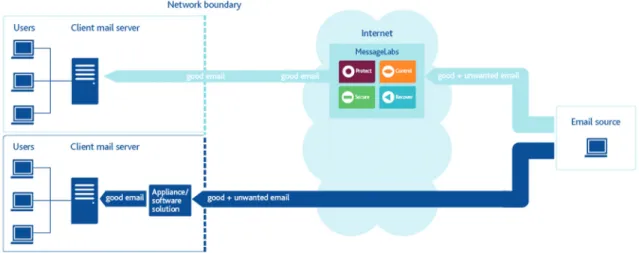
• Managed services are provided by vendors who use a network of data centers located at major internet hubs to process email on their clients’ behalf. These services, which do not generally require installation of hardware or software on a client’s premises, operate “in the cloud”. In other
WHITEPAPER: Email Security Buyer’s Guide: Software, Appliance, Managed Service?
Proliferation of
email dangers
is fuelling a
rapid growth
in demand for
messaging
security
solutions.
3
Managed
services prevent
“bad” traffic
from reaching
the client’s
network.
Software-based Solutions
To date, software-based solutions have accounted for a majority of the worldwide messaging security market. In 2007, the total revenue they generated ($1348 million) was estimated to exceed the combined revenue generated by appliance-based solutions ($722 million) and managed services ($454 million) (IDC 2007).
words, email traffic is redirected through the vendor’s infrastructure, with “bad” traffic prevented
from reaching the client’s network. Such services are customarily provided in exchange for a subscription fee.
The following sections summarize the key issues associated with these three broad options. For rapid reference, the following table also provides a quick comparison of the different solutions and their respective merits.
However, the compound annual growth rate of software-based solutions (7.7%) is predicted to be far outstripped by that of appliance-based solutions (27.9%) and managed services (36.3%)
in the next few years (IDC 2007 – figures for the
period 2006-2011). In MessageLabs view, this is primarily because software-based solutions
have significant limitations, impacting not only
on their effectiveness as a security safeguard but also on their suitability for deployment by companies of all types and sizes:
• Any company using a software-based solution must ensure signature updates are regularly completed in order to respond promptly and effectively to evolving email threats. With threats emerging and mutating on a daily or even hourly basis, this can represent a major challenge. • Networks relying on software-based solutions can quickly become clogged and jammed by spikes of “bad” emails, e.g. the tens of thousands of emails that may be sent to a company when a spammer fraudulently hijacks its domain name as part of a spam run.
• There will be considerable onus on in-house IT
staff to ensure the software operates efficiently and remains fit-for-purpose, as well as to provide
support for end-users. This can be particularly problematic for companies where in-house IT expertise is limited.
• Even where a business has significant in-house
IT skills at its disposal, state-of-the-art spam and virus expertise is not easy to acquire or keep up-to-date. As malware threats become more ingenious, there is a corresponding need for
significant specialist knowledge that can devote itself full-time to this specific – but business-critical – field of IT activity.
• Software solutions include a number of
different costs, which are not always immediately apparent. Such things as hosting, monitoring, daily administration, redundancy, scalability, support costs etc all add up to a need to be taken into account if the total cost of ownership is to be fully understood.
• Technology refresh cycles mean that any software solution the customer chooses will need to be replaced every 3-5 years with the associated costs of renewing the hardware and software. • Software-based solutions often require additional
investment in specific server hardware and
software.
WHITEPAPER: Email Security Buyer’s Guide: Software, Appliance, Managed Service?
The trend
towards
managed
services is set
to continue.
5
The net result is generally a time/resource-hungry security option of potentially limited effectiveness, with a high total cost of ownership.
Appliance-based Solutions
Although increasingly popular, appliances generally also have a range of limitations with unwelcome implications:
• It can take several days to install, deploy and
test an appliance and refine its settings to match a specific email environment. This can result
in major disruption to internal and external email communications.
• As well as the ongoing challenge of ensuring appliances are regularly upgraded/updated to keep pace with emerging threats, they can easily be swamped by “bad” emails (e.g. resulting from a spam spike, during which email volumes received by an organization under attack may peak at up to 25 times normal levels).
• Each appliance can only process a finite amount
of email. So, as email volumes grow, more appliances (and associated software) must be purchased, installed, tested and maintained. This means more disruption, increased demands on network storage and bandwidth, and more expense whose precise level may be hard to predict with accuracy.
• Major commitment of in-house IT staff time will be needed to administer the system, e.g. to adjust appliance settings, install security patches provided by the vendor, monitor malware threats/ trends, review and plan for changing capacity needs, and provide technical support to internal end-users.
• In-house administrators also need a comprehensive understanding of their organization’s human resource policies and of relevant developments in the regulatory/legal sphere. Otherwise their companies may be open to policy breaches – or to the charge that they have not taken measures necessary to ensure
confidentiality of client data, protect their
employees etc. (This also applies to software- based solutions.)
• Faced with the fact that their own IT resources
are finding it hard to cope with the complexities
of the changing email threat landscape, companies often incur more expense by engaging external expertise to supplement
With appliances,
total cost of
ownership often
extends well
beyond the initial
purchase price.
malware propagators. This also means expert trouble-shooting and problem-solving capabilities
are always available, to the immediate benefit of
service subscribers.
• Freeing up of companies’ (often hard-pressed) in-house IT staff/resources, liberating them from the need to deliver the kind of specialist expertise necessary to cope with today’s array of
sophisticated email threats.
• Cost savings, compared to software-based and appliance-based solutions, because of the reconomies of scale that managed service providers can achieve. Moreover, since there is generally no software or hardware to install on the customer’s premises, expensive set-up/
maintenance costs are avoided, while future subscription costs are transparent and predictable.
The MessageLabs Approach
A managed service may potentially offer the best prospect of effective, affordable email security. But which of the many vendors now offering such a solution can provide companies with a subscription service that best meets their needs? Which SaaS vendor is best-placed to deliver all the necessary components of a comprehensively effective managed service?
MessageLabs has established itself as “the worldwide leader for hosted messaging security services” (IDC 2007). Moreover, it is recognized as a “clear innovator…of managed e-mail security services” (“The European in the Cloud Managed Security Services Market”, Frost & Sullivan 2006).
Specifically, there are three key areas where
MessageLabs outperforms its competitors:
1. Accurate protection:
MessageLabs email services (Anti-Spam, Anti-Virus, Content Control and Image Control, complemented by Boundary Encryption, Policy Based Encryption, Email Continuity and Archiving) deliver a higher level of accurate threat protection than is available from other vendors. This is because MessageLabs combines multiple commercial scanners with its own unique, industry-leading proprietary technology, Skeptic.
Skeptic has pioneered predictive threat detection since 1999. It learns from every message it scans, evolving with every new threat, constantly building on its vast knowledge base and automatically updating signatures in real-time. Located at internet level, it scans millions of emails every day and is ideally equipped to stop new and unknown threats. in-house appliance management capabilities.
(This pattern is also characteristic of companies relying on software-based solutions.)
Taking all of these factors into account, it is not surprising that the total cost of ownership of an appliance-based solution often extends well
beyond the initial purchase price. Further difficulties
will result in the event of a power failure or the
appliance going offline. Undelivered email
“bounce-backs” are more than just a nuisance. They can erode client goodwill and may even lead to a failure to meet communication/response deadlines, resulting in lost contracts, missed opportunities etc. To protect against system failures, companies opting for appliance-based solutions sometimes deploy additional “redundant” appliance hardware. Requiring more bandwidth, more storage capacity and more administrator input, this can drain budgets and in-house IT resources.
Managed Services-SaaS
To date, managed services have secured a limited but growing share of the worldwide messaging security market. Indeed, there is no doubt that this delivery model is gaining ground rapidly.
Significantly, vendors are offering enhanced
functionality, plus greater ease of customization
and configuration to meet the specific needs of
individual companies (“Predicts 2007: Software as a Service Provides a Viable Delivery Model”, Gartner, Inc. 2006). The trend towards greater take-up of managed services is therefore set to continue, not least because managed service providers (i) can get their capabilities to market quicker than their competitors and (ii) are a primary source of innovation (Gartner 2006).
Software-as-a-Service solutions are fundamentally different from software-based or appliance-based
solutions because all scanning/filtering/blocking
operations take place upstream from subscribers’ networks. The key advantages that managed services generally aim to offer are as follows: • A clean email “pipe” into and out of the subscriber’s network, keeping malware and
spam at bay and also speeding up email traffic
by preventing “bad” emails from entering the pipe and using up bandwidth. Malware attacks and spam spikes are absorbed by the vendor’s infrastructure, before unwanted emails even reach the client’s network boundary.
• Round-the-clock, constantly updated, scalable real-time protection monitored and continuously improved by messaging security specialists whose sole focus is to stay a step ahead of
Complementing Skeptic, the best-of-breed
commercial scanners used by MessageLabs detect and stop all known threats.
This benchmark level of protection is particularly important in the context of the increasing volume and sophistication of malicious email-born attacks.
By comparison, first- and second-generation
software-based and appliance-based anti-spam technologies, for instance, have become less effective in dealing with threats (IDC 2007). The bottom line is that MessageLabs is able to deliver 99%-plus spam capture and zero
false-positives (with a five-star rating from VeriTest
independent anti-spam benchmarking) as well as 100% protection against known and unknown viruses. All of this is backed up by the most comprehensive range of SLAs in the sector, which also cover service availability, email delivery and latency.
Underpinning these capabilities is MessageLabs
secure global infrastructure – the most advanced and stable network in the world today. Comprising 14 data centers on four continents and capable of processing over 2.5 billion attempted mail connections each day, this load-balanced infrastructure is entirely scalable and can process email with no discernable delay, even during major peak periods.
2. Ease of installation and use:
MessageLabs services offer unrivalled simplicity in terms of set-up, use and administration. They
work with any mail client or server configuration, anywhere in the world. Once a company’s specific
requirements have been determined, MessageLabs
enables a service through a simple modification of
the Domain Name Server (DNS) and mail server settings. This only takes a matter of minutes, regardless of the client’s location. No additional hardware or software is needed. 24/7 client support is included in the subscription fee.
Administration is handled via an easy-to-use web-based portal. This provides a wealth of
management information, configuration tools,
service statistics and reports in real-time, allowing the client to monitor how the service is performing and to stay in control. As well as providing real-time, zero-hour threat protection, MessageLabs takes care of all service updates and upgrades – no client involvement or client resources are involved. Moreover, as the market leader, MessageLabs has an enormous, 19,000-plus customer base worldwide. This is a key advantage because client feedback plays an important role in helping any
WHITEPAPER: Email Security Buyer’s Guide: Software, Appliance, Managed Service?
The cost of
MessageLabs
services
is stable,
predictable
and extremely
competitive.
7
managed service vendor optimize the service it provides. More customers mean more feedback – which means a better, easier-to-use service. And an enhancement made in response to one
client’s requirements automatically benefits all
MessageLabs thousands of other clients as well.
3. Total cost of ownership:
As a managed service provider, MessageLabs helps its clients avoid the add-on costs associated with appliance-based or software-based solutions (e.g. additional hardware or software, increased storage and bandwidth, dedicated technical staff to manage and monitor the solution, support contracts, regular software updates, routine updates
to spam and virus definitions). Crucially, whereas
the total cost of ownership for an appliance-based or software-based solution will increase over time (driven primarily by growth in email volumes and threat levels), the cost of a managed service remains stable and predictable.
Furthermore, the cost of MessageLabs services – typically calculated on a per user, per month basis – is guaranteed to be extremely competitive with the less accurate, less comprehensive and less user-friendly managed service solutions provided by other vendors. And there are no hidden extras.
The Right Choice for Business
As this whitepaper explains, MessageLabs services are explicitly designed to equip businesses
worldwide with unrivalled protection against email threats – not just in comparison with software-based and appliance-based solutions but also compared with other managed service vendors.
From protection of business continuity, confidential
data and brand image, to effective implementation of company email policies and regulatory
compliance at national, international and global level – MessageLabs sets the standard for email security services. With its unique combination of world-class, patented technology, leading-edge infrastructure, ease of use, round-the-clock customer support and low total cost of ownership, MessageLabs really does offer the best possible email threat protection solution.
“[MessageLabs] provides a convenient and cost-effective solution for managing and reducing risk and providing certainty in the exchange of business information” (IDC 2007).
For more information or for a free trial of
MessageLabs Email Security Services please visit www.messagelabs.com/trials/free.
MessageLabs delivers a higher level of accurate
threat protection than other vendors.
©2008 MessageLabs Inc. All Rights Reserved. MessageLabs and the MessageLabs logo are registered trademarks and Be certain is a trademark of MessageLabs Ltd. and its affi liates in the United States and/or other countries. Other products, brands, registered trademarks and trademarks are property of their respective owners/companies. WP_EMAILSECURITY_1108
WHITEPAPER: Email Security Buyer’s Guide: Software, Appliance, Managed Service?
Americas AMERICAS HEADQUARTERS 512 Seventh Avenue 6th Floor New York, NY 10018 USA T +1 646 519 8100 F +1 646 452 6570 CENTRAL REGION 7760 France Avenue South Suite 1100 Bloomington, MN 55435 USA T +1 952 830 1000 F +1 952 831 8118 Asia Pacific HONG KONG 1601 Tower II 89 Queensway Admiralty Hong Kong T +852 2111 3650 F +852 2111 9061 AUSTRALIA Level 14 90 Arthur Street North Sydney NSW 2060 Australia T +61 2 9409 4360 F +61 2 9955 5458 SINGAPORE Level 14 Prudential Tower 30 Cecil Street Singapore 049712 T +65 6232 2855 F +65 6232 2300 Europe HEADQUARTERS 1270 Lansdowne Court Gloucester Business Park Gloucester, GL3 4AB United Kingdom T +44 (0) 1452 627 627 F +44 (0) 1452 627 628 LONDON 40 Whitfield St London WIT 2RH United Kingdom T +44 (0) 207 291 1960 F +44 (0) 207 291 1937 NETHERLANDS Teleport Towers Kingsfordweg 151 1043 GR Amsterdam Netherlands T +31 (0) 20 491 9600 F +31 (0) 20 491 7354 BELGIUM / LUXEMBOURG Culliganlaan 1B B-1831 Diegem Belgium T +32 (0) 2 403 12 61 F +32 (0) 2 403 12 12 DACH Feringastraße 9 85774 Unterföhring Munich Germany T +49 (0) 89 189 43 990 F +49 (0) 89 189 43 999 www.messagelabs.com [email protected] © MessageLabs 2008 www.messagelabs.com [email protected] TOLL FREE 866-460-0000