
COMBINATION REVERSE ANNUITY CONTRACT
AND CRITICAL ILLNESS INSURANCE
JOANNA DĘBICKA, AGNIESZKA MARCINIUK, BEATA ZMYŚLONA Wroclaw University of Economics, Faculty of Management, Information Systems and Finance,
Department of Statistics, ul. Komandorska 118/120, 53-345 Wrocław, Poland
email: [email protected], [email protected], [email protected]
Abstract
The purpose of the article is to combine two different products: critical illness insurance and reverse annuity contract. Such a combination of different categories of payments arising from the security agreements against the effects of longevity and the incidence of terminal illness leads to complex protecting packages. In particular, we focus on cancer insurance policies, which can be shaped in several different ways mainly connected with type of benefits. Then we construct an appropriate multiple state model and calculate the actuarial values of benefits. Probabilistic structure is based on the actual data for the Lower Silesia Voivodship in Poland and the Lower Silesia Life Tables.
Key words: reverse annuity contract, critical illness insurance, multiple state model. 1. Introduction
Low pensions, high bills for utilities and rent make it difficult to maintain a large property, especially in big cities or in a situation when one of the spouses died. One of the possibilities to obtain additional financial resources might be to conclude a reverse annuity contract. According to the agreement, an owner may receive monthly benefits in return for the transfer of the ownership onto the company, which ensures the right to live in property until his death by a notarial act (Shan, 2011).
Another problem may be connected with high expenditures on medicine and treatment. In such a situation health insurances are useful. Critical illness (dread disease) insurances are typical examples of limited-coverage health insurance products, as only diseases belonging to a precisely defined set are covered.
The most traditional way to combine different benefits, in framework of the insurances of a person, is to define a health-related benefit as a rider to a life insurance policy. Moreover, lifetime-related benefits can be linked to lifelong sickness insurance or income protection.
The purpose of the article is to create a new product that is a combination of two different products: critical illness insurance and reverse annuity contract. This new product allows a policy holder to protect him against the effects of longevity and the incidence of terminal or chronic diseases. A holder of such a product, without involving additional premiums, receives a little bit lower benefit in a situation when he/she is healthy, and when he/she gets sick, receives an additional illness benefit. This second benefit allows an insured person to obtain additional resources for a retrieval of health. Our considerations focus on cancer as an example of a critical illness. A sick person, who has metastases, will surely die. In such a situation, an insured person has a possibility to receive an additional benefit for the palliative care. Moreover, this agreement may be concluded in one company, reducing costs associated with operating two separate products.
We consider the discrete appropriate multiple state model for term individual policy. The calculation of actuarial values is based on the actual fixed interest rate. The probabilistic structure is based on the actual data for the Lower Silesia Voivodship in Poland and the Lower Silesia Life Tables.
2. Model
The reverse annuity contract is a well-known financial product. In Poland, this contract has been offered since 2005 by a few companies, i.e. mortgage funds, created especially for this purpose. Benefits arising from the reverse annuity contract are received by an owner in exchange for surrender-ring his real estate to a company. The owner is guaranteed the right to live in the property until his death by a notarial act (Dębicka and Marciniuk, 2014). The transfer of the ownership onto the company takes place after signing of a notarial act. The payment of the pension is secured in section IV of the mortgage register.
The reverse annuity contract is offered to elderly people. We assume that annuity benefits are paid for n years, but this contract might be paid also throughout the whole life. The value of benefits is determined on the basis of the pensioner’s age x(called age at entry), the value of real estate W and the further life expectancy. In fact, benefits are calculated for a percentage of the value of real estate W, where
0,0.5
(Dębicka and Marciniuk, 2014). The value of benefits can be valorized.The mortgage funds cover a rent as well as any potential rises in this cost. Firms compete in offering various additions to the basic reverse annuity contracts. They take over payment of maintenance fees, pay the real estate tax and perpetual usufruct tax, as well as add free health insurance, property insurance, free legal advice, trainings and trips, etc. The funds also bear all costs related to the valuation of real estate and reverse annuity starts. In theory, the agreement is irreversible and the heirs do not have the ability to recover the surrendered property. However, sometimes the possibility of breach of contract existsafter paying off the received benefits with the interests and any other incurred costs (it is unregulated by the law, but only a goodwill of the fund) (Marciniuk, 2014), (Davidoff, 2009).
Increase in the average lifetime causes aging of population and a number of phenomena unfavorable from the point of view of economics. Older people succumb often to chronic diseases, which require costly and time-consuming treatment. The funds from the state budget for health care are insufficient to cover the increasing costs associated with the treatment of the aging population. One of sources of additional funds may be payments from private health insurance. A critical illness policy provides the policyholder with the benefit in case of illness such as heart attack, cancer or stroke, which are included in a set of diseases specified by the policy conditions. Note that the benefit is paid on diagnosis of a specified condition, rather than on disablement. On the one hand, it means that critical illness policy does not meet any specific need or protects the policyholder against any particular financial loss such as the loss of earnings, reimbursement of medical or other expenses incurred. On the other hand, in practice insurers make the payment of benefits not only on the diagnosis but also on the expected future lifetime of a sick person. Depending on the policy, the benefit may be paid to a sick person whose expected future lifetime will be between two and four years (the differences come from medical circumstances).
In this paper, we focus on cancer, because cancerous diseases belong to one of the most common illnesses in the older age. In case of early detection of cancer, complete recovery is very likely, but it involves the usage of expensive treatment. If metastases are diagnosed, the
chance of cure is minuscule, a future life time is usually not longer than four years. In this case, palliative care is needed, which also absorbs significant financial resources. Thus, regardless of the stage of the tumour, financial resources are necessary.
Construction of the new financial product, taking into account a reverse annuity contract and critical illness insurance requires an introduction of multiple state model
S,T
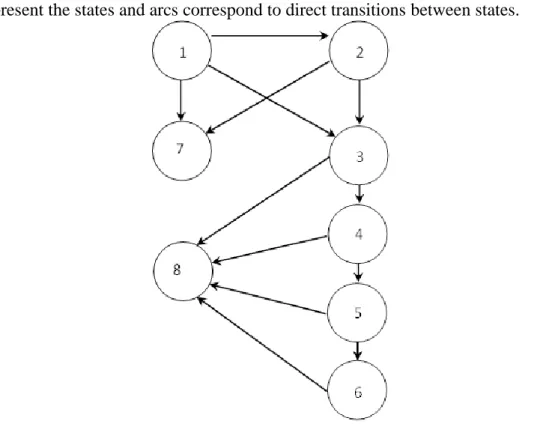
, where S is a state space and T denotes a set of direct transitions between states of the state space (Dębicka, 2013). Death, incidence of malignant cancer and diagnosed metastasis are three random events, which will be included in the multiple state model. Thus, the state space
1,2,...,8
S , where the meaning of the states is as follows (Dębicka and Zmyślona, (b)): 1 - is alive and are healthy (without cancer)
2 - is ill with cancer without metastases
3 - is suffering from cancer for a year after diagnosis of metastases
4 - is suffering from cancer for the second year after diagnosis of metastases 5 - is suffering from cancer for a third year after diagnosis of metastases 6 - is suffering from cancer for a fourth year after diagnosis of metastases
7 - died for reasons other than cancer or being sick with cancer without diagnosed metastases
8 - died being sick with cancer with diagnosed metastases.
The graphic representation of the multiple state model
S,T
is shown in Figure 1, where circles represent the states and arcs correspond to direct transitions between states.Figure 1. A multiple state model for combining reverse annuity contract with critical illness insurances.
Let be so-called a reverse annuity parameter
0,1
. The customer receives a capital W, which is divided into two parts: Wis a capital for the reverse annuity contract and 1 (1)Wis treated as a net single premium for critical illness insurance. Note that a variety of financial product has to be considered depending on the value of parameter :1
- a reverse annuity contract,
0,1 - a combination of reverse annuity contract and critical illness insurance, 0
- a critical illness insurance.
In particular (border) cases, a detailed analysis of the contracts are presented in (Dębicka and Marciniuk, 2014) for 1 and in (Dębicka and Zmyślona (a)) for 0.
The description of the stream of cash flows determines the type of contract. We focus on discrete-time model, where X(k)denote the state of an individual (the contract) at time k (
} ,..., 2 , 1 , 0 { T n
k ). Hence the evolution of the insured risk is described by a discrete-time stochastic process {X(t);tT}, modelled by a Markov chain (Christiansen, 2012), (Djehjche, 2011).
Let cfj(k) be the future cash flow payable at time k if X(k) j ( jS). The critical illness contract provides one of two types of benefits: an annuity benefit b1 payable after the diagnosis of metastases or lump sum benefit c1 payable at time k1, if the insured diagnosis of metastases occurred in time interval [k,k 1) before the end of the contract. Both types of illness benefits are paid from below. Namely, the reverse annuity contract provides only one type of the benefit b , which is paid at the beginning of the year, if a customer is alive (regardless of a customer’s state of health) and it is paid in advance. Thus, the constructed financial product might be proposed in one of the following options:
Option 1. (reverse annuity with annuity critical illness benefits)
beside 0 and 6 , 5 , 4 , 3 1 ,..., 5 , 4 and 6 1 ,..., 4 , 3 and 5 1 ,..., 3 , 2 and 4 1 2 1 and 3 for 1 ,..., 2 , 1 and 2 , 1 for 0 and 1 for ) ( 1 1 n k j b n k j n k j n k j ,...,n-, k j b b n k j b k j b αW k cfj
Option 2. (reverse annuity with a lump sum critical illness benefit) beside 0 and 3 for 1 ,..., 2 , 1 and 3 for 1 ,..., 5 , 4 and 6 1 ,..., 4 , 3 and 5 1 ,..., 3 , 2 and 4 1 ,..., 2 , 1 and 2 , 1 for 0 and 1 for ) ( 1 1 n k j c n k j c b n k j n k j n k j n k j b k j b αW k cfj
Let us note that from the financial point of view, the cash flow cfj(k)
is a sum of inflows representing an income to a particular fund and outflows representing an outgo from a particular fund, then the capital W and benefits take the opposite signs.
Since the multiple state model shown in Figure 1 is extensive, it is worth using matrix notation to determine benefits. Then we use matrix formulas presented in (Dębicka and Marciniuk, 2014) and (Dębicka and Zmyślona, (a)) to calculate b , b1 and c1.
3. Numerical Examples
In the paper, we focus on lung cancer, because it belongs to the most common tumours in the developed countries. High mortality is largely related to the late detection of this type of cancer, where metastases are diagnosed. Epidemiological data indicate unequivocal age of a patient as one of the major risk factors. Peak incidence occurs in the sixth and seventh decade of life. In addition, sex and place of residence have a significant impact on the risk of morbidity. Lung cancer is several times more frequent in male population. The stage of advancement of tumour has a very significant impact on the time of a patient’s survival. Statistics concerning histories of patient treatment indicate that in case of detection of metastases the time of surviving is up to four years. Undoubtedly, the occurrence of lung cancer affects the mortality, significantly.
An important element of modelling financial products is probabilistic structure of the multiple state model. The probability of death of a real estate’s owner, who is not sick with lung cancer, is estimated based on life tables for the population of men and women inhabiting the region of Lower Silesia from 2008 from the Central Statistical Office. The incidence of morbidity of lung cancer is estimated on the basis of (Wojciechowska and Didkowska, 2014), separately for the male and female populations. The probability of diagnosing metastases within one year after detection of lung cancer is modelled using the logit model with age as explanatory variable. Increased risk of death for people with detected lung malignancy was estimated based on data concerning histories of hospitalization from the National Health Fund (Data base …, 2012). In the analyzed model, we assume that the increased probability of death of a patient with lung cancer at age x is calculated as conditional probability on the basis of survival time distribution. Survival time is measured to an accuracy of a year. We used logit model for ordered categorical variable in case of population of men and Poisson
regression with identity link function in case of population of women. The details are described in (Dębicka and Zmyślona, (b)).
It is determined that the fixed yearly interest rate i equals 5.817%. The fixed interest rate i
was chosen at 5.817%, because the long-term rate in Nelson-Siegel model of yield curve was equal to 5.187%. This parameter was estimated by using the least-squares method on the basis of actual Polish market data, related to the yield to maturity on fixed interest bonds and Treasury bills from 20081. The estimation was made by the use of the Solver in Microsoft Excel (Marciniuk, 2009), (De Rezende and Ferreira, 2013).
In the examples we assume that the value of property W 100000, 0.5, 0.99 then 49500 and 1500.
Under the assumption that an investment period equals 15 years, the benefits for both parts of the combining product (Option 1 and Option 2), depending on sex of the insured person and age at entry, are presented in Table 1.
Table 1. The amount of benefits depending on the age at entry for a 15-year investment period (for W 100000,0.5, 0.99).
Sex Women Men
x b 1 b c1 b b1 c1 65 3828.32 68541.03 77724.31 4251.19 16464.78 19432.03 70 4265.60 80587.14 89591.05 4719.71 18393.88 21498.57 75 5110.32 101071.00 110334.71 5521.48 25661.84 29704.06 80 6564.89 141135.86 150981.16 6826.83 41897.17 48074.58 85 8853.91 189156.48 199858.15 8748.99 66340.77 75560.34 Source: own elaboration.
The yearly value of the benefit in case of the reverse annuity contract is lower for women. The differences between the value of b for man and for woman are increasing with the rise of age at entry. We observe an opposite situation in case of the yearly value of critical illness annuities b1, lower for men which directly reflects the fact that lung cancer is much more frequent in men population. Moreover, note that the differences in the amount of illness annuity b1 and lump sum c1 are not too large, because the probability of death in the first year after metastases diagnosis is very high.
Let us observe that the benefits for women and men differ significantly for the insurance part of the product and relatively smaller differences are observed in reverse annuity-related part, which is presented in Figure 2. The percentage share of the difference between the benefits for women and male counted in relation to the benefit of men diminishes with age (for people over seventy) for all kind of benefits.
Figure 2. The percentage share of the difference between the benefits for female and male counted in relation to the benefit of man depending on the age at entry (for n15, W 100000,0.5, 0.99).
Source: own elaboration.
Under the assumption that age at entry is equal to 65 years, the benefits for both parts of the combined product, depending on the sex of the insured person and the period of investment, are presented in Table 2
Table 2. The value of benefits depending on the investment period (for x65, W 100000, 5
. 0
, 0.99).
Sex Women Men
n b b1 c1 b b1 c1 5 10185.85 190702.80 215361.01 10473.40 40466.62 46595.57 10 5345.64 94053.91 106721.71 5720.54 20879.17 24513.76 15 3828.32 68541.03 77724.31 4251.19 16464.78 19432.03 20 3182.07 60180.21 68018.37 3634.82 15072.40 17816.01 25 2908.85 57135.87 64431.94 3375.62 14661.84 17337.70 Source: own elaboration.
We can observe, analogously like in Table 1, that the yearly value of the benefit in case of the reverse annuity contract is lower for women, but in case of illness benefits the situation is opposite. Moreover, the value of all benefits for men and women are decreasing with the rise of the investment period.
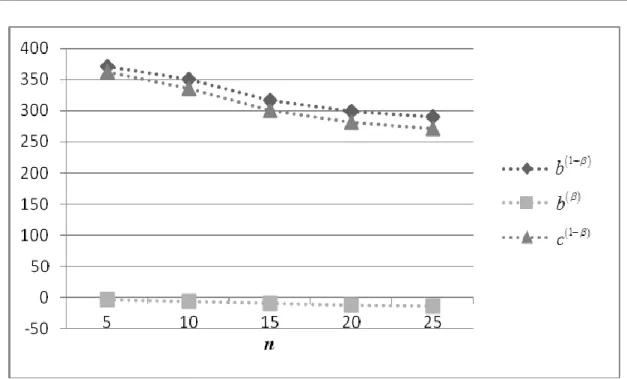
Figure 3. The percentage share of the difference between the benefits for female and male counted in relation to the benefit of man depending on the investment period (for x65, W 100000,0.5, 0.99).
Source: own elaboration.
Correspondingly to Figure 2, the benefits for women and men differ significantly for the insurance part of the product and relatively smaller differences are observed in the reverse annuity-related part, which is presented in Figure 3. The percentage share of the difference between the benefits for females and males counted in relation to the benefit of man diminishes for both kinds of illness benefits and grows slightly for the reverse annuity benefits with increasing investment period.
If the value of a real estate is equal to W1, the percentage is lower than 50% and it equals 1, then the following results must be augmented by the factor W11 W.
All calculations are made by the use of the authors’ own programs written in C++. 4. Conclusion
The paper presents a combination of two products i.e. the reverse annuity contract and the critical illness insurance. On the market, such a combination of contracts is not offered. Therefore, the consideration of this product poses a new proposition of protecting against the effects of longevity. It is worth noting that, from the real estate owner’s perspective, buying a combined product can be less expensive than purchasing each single components, in particular thanks to a reduction of the acquisition and maintenance costs charged to the customer.
The analysis of numerical examples based on actual Polish data leads to the basic conclusion that, although the benefits obtained from the reverse annuity contract are a little bit lower than in the situation when the whole capital W is used to calculation of the reverse annuity benefit, annual illness benefits are considerably high. This gives the owner of a real estate an additional financial protection in difficult times associated with a dread disease. The
benefit is lower for women not only in case of the individual reverse annuity contract, but also for the lung cancer illness benefit.
It is not surprising that the value of the benefits depends on the age of the owner and the length of the contract, but the calculations show a strong influence of sex on the amount of illness benefits. The difference is between 150% and 300%. Therefore, the application of The European Union Directive, which does not distinguish gender in actuarial calculating, does not seem appropriate in case of critical illness insurance.
Acknowledgements
The support of the grant scheme NON-STANDARD MULTILIFE INSURANCE PRODUCTS WITH DEPENDENCE BETWEEN INSURED 2013/09/B/HS4/00490 is gladly acknowledged.
References
1. CHRISTIANSEN M.C. 2012. Multistate models in health insurance. In Asta-Advances in Statistical Analysis, 2012, vol. 96, iss. 2, pp. 155-186.
2. DAVIDOFF T. 2009. Housing, Health, and Annuities. In Journal of Risk and Insurance, 2009, vol. 76, iss. 1, pp. 31-52.
3. DE REZENDE R. B., FERREIRA M.S. 2013. Modelling and Forecasting the Yield Curve by an Extended Nelson-Siegel Class of Models: a quantile autorgression approach. In Journal of Forecasting, 2013, vol. 32, iss. 2, pp. 111-123.
4. DĘBICKA J. 2013. An approach to the study of multistate insurance contracts. In Appl. Stochastic Models Bus. Ind., 2013, vol. 29, iss. 3, pp. 224–240.
5. DĘBICKA J., MARCINIUK A. 2014. Comparision of reverse annuity contract and reverse mortgage on the Polish market. In 17-th AMSE. Applications of Mathematics in Economics. International Scientific Conference: Poland, 27-31 Agust, 2014. Conference Proceedings. Wrocław: Wroclaw University Press, 2014, pp. 55-64. ISBN 978-83-7695-421-9.
6. DĘBICKA J., ZMYŚLONA B. (a), Modelling of dread disease insurances – manuscript. 7. DĘBICKA J., ZMYŚLONA B. (b), Modelling of lung cancer survival data for critical
illness insurances - manuscript.
8. DJEHJCHE B. 2011. Actuarial mathematics for life contingent risks. In Scandinavian Actuarialn Journal, 2011, iss. 4, pp. 318-328.
9. MARCINIUK A. 2009. Nielosowe modele natychmiastowej stopy procentowej i ich zastosowanie w klasycznych ubezpieczeniach życiowych, Ekonometria 27, PN Wroclaw University 84, Wrocław: Wroclaw University Press, 2009, pp. 112-127.
10. MARCINIUK A. 2014. Renta hipoteczna a odwrócony kredyt hipoteczny na rynku polskim. Śląski Przegląd Statystyczny, vol 12, iss 18, Wrocław: Wroclaw University Press, 2014, pp. 253-272.
11. SHAN H. 2011. Reversing the Trend: The Recent Expantion of the Reverse Mortgage Market. In Real Estate Economic, 2011, vol. 39, iss. 4, pp. 743-768.
12. WOJCIECHOWSKA U., DIDKOWSKA J. 2014. Zachorowania i zgony na nowotwory złośliwe w Polsce. Krajowy Rejestr Nowotworów. Centrum Onkologii - Instytut im. Marii Skłodowskiej - Curie. Available at: 33 (date10.04.2014).
13. Data Base of Lower Silesia Department of National Health Fund 2012 - unpublished due to confidentiality.


![[B768.Ebook] Free PDF Big Data Governance An Emerging Imperative By Sunil Soares.pdf](data:image/gif;base64,R0lGODlhAQABAIAAAP///wAAACH5BAEAAAAALAAAAAABAAEAAAICRAEAOw==)