Distribution & Wholesale
THE SALES FORCE
EFFECTIVENESS PARADOX
WHY SALES FORCES STILL PRODUCE 80 PERCENT OF THEIR VALUE
FROM 20 PERCENT OF THEIR ACTIVITIES
“We have put a huge amount of
investment into technology and
enablers for the sales force, yet the
sales productivity number is the
same now as it was ten years ago.”
- CEO $BN DISTRIBUTOR
I
n our recent interviews with 25 CEOs of billion dollar distributors, we’ve heard a consistent theme: that sales force effectiveness is one of their highest priority issues, and that they are frustrated. Many have made substantial investments in a broad range of sales enablers such as sales force automation platforms, solution selling, challenger training or in some cases large scale ERP replatforming programs.Yet an inconvenient truth remains … few companies have managed to ignite a profitable sales growth engine. Indeed many CEOs tell us that their sales productivity metrics have remained largely unchanged for years. Further, now more than ever, they see the need for real improvement to offset slow market growth and to out-sell their competitors, including new on-line players.
In this paper, we talk about what’s behind this frustration and what to do about it. We’ll focus in our examples on the mass of mid-size customers that can make up 50%-80%+ of a distributor’s revenue since it is in that part of the business that this challenge is most acute. However, many of the same principles also apply to larger “national accounts” or “strategic partnerships.”
SO WHAT’S GOING ON?
For the most part, our experience suggests that many companies have been trying to solve the wrong problem. Or, more fairly put, they’ve been solving useful problems but missing three core underlying issues.
First, individual field sales professionals are still
largely in control of where they spend their time. Despite all manner of attention on detailed tracking of pipeline opportunities, customer rostering, territory assignments, selling process review, etc., the day-to-day reality is that it is still often largely up to the individual rep to decide how much time he or she should spend selling and servicing each customer and which opportunities to pursue.
Of course it often may not feel like such an active choice. In any week, sales professionals are often “on the run” between a few demanding customers, a set of opportunities that need urgent attention and the need to navigate a maze of internal admin as they try to get their customers the quote, the service or the product that they need. On a good day they’ll call on one or two prospective customers but typically with insufficient preparation or insight because of everything else they are trying to manage. The result is a picture like Exhibit 1.
The second issue is that sales professionals often may not know where the greatest opportunities lie. While
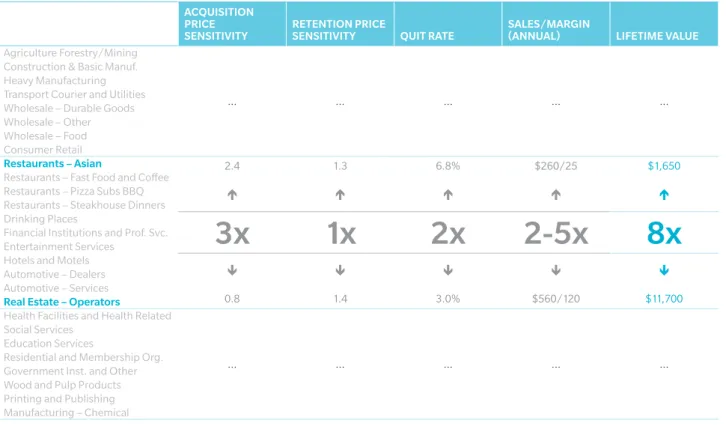
some may have good intuition, this can often be overshadowed by “easy sale” behavior. Consider a waste industry example. Most sales professionals understand that restaurants serving Asian food are low profit customers for waste companies. Costs are heavily driven by disposal weight, and so customers like Asian restaurants that regularly fill the container with large quantities of heavy wet waste are structurally low margin. Yet despite such sales force intuition, a huge amount of sales force time is nonetheless spent on these restaurants. Why? Because restaurants are easy to find, their owners are easy to access, and restaurants are almost always ready to sign up to a new deal as long as it saves them money.
When you do the math to understand the true lifetime value of acquiring an average Asian restaurant vs. another group like real estate operators, you see a huge difference: close to 8x in lifetime value per sale. (See Exhibit 2.) Some 2-3 percentage points of operating margin improvement are often available from “out-mixing” competitors – focusing the sales force on the best highest lifetime value customers – if you are one of the first to act on such insight. This approach is commonplace in many financial services sectors, for instance, yet we find
ExHIBIT 1: SALES FORCE TIME ALLOCATION ExAMPLE
50% 75% 25% Total time Tr avel Other Administr ation Customer Pricing Planning Face-to-face time
Selling time face-to-face
Pr
ospecting
Tr
aining customers
Relationship building
In this distributor, less than 13% of total time was spent in face-to-face selling
NON-SELLING SELLING 100%
few distribution companies have yet done the work to understand what makes one customer type more valuable than another over a multi-year period.
Compounding this is an issue that many sales leaders come across: what’s in the sales automation system is rarely a good reflection of all the opportunities out there. At best such systems tend to capture only ~80% of the opportunities, often several weeks out of date, with opportunities themselves mostly self-reported by the sales team with only partial data. This makes it even harder to optimize a sales force system inadvertently focused on selling average to low value business.
The third issue is that the nature of sales is changing, fast.
Already nearly 60% of new B2B purchases are first researched by customers online before they make contact with a company, and 90% of younger (under the age of 35) procurement buyers now
make B2B purchases online. [See our previous paper “Amazon &
Google in Wholesale Distribution.”]
Customers want fewer visits than ever before – and very often fewer visits than the sales force thinks they need. Rather many customers increasingly want to interact with distributors in an “omni-channel” way: selecting the phone, website, tablet app, web chat or in person interaction that best suits who they are, where they are, and what they are trying to get done.
When they do show up, sales professionals are expected to
understand the customer’s business, to bring real incremental value and expertise, and to be armed with data and insight on all of that customer’s interactions with their business.
TIME FOR A CHANGE
So what’s required to break through this paradox? We’ve seen a small number of companies unlock sales productivity improvements equivalent to ten points of market share and three points of margin improvement by taking a more disciplined, six-step approach: using powerful analytical insights to reshape day-to-day activities as well as long-term capabilities.
We’ve seen a small number of
companies unlock sales productivity
improvements equivalent to ten
points of market share and three
points of margin improvement by
taking a more disciplined approach:
using powerful analytical insights to
reshape day-to-day activities as well
as long-term capabilities.
FIGURE OUT WHAT YOUR
SALES FORCE
ACTUALLY
DOES AND FREE UP
SELLING TIME.
Build the picture of how your sales force spends its time in an average week or month. While the most accurate answers will come from asking sales professionals to keep diaries, downloading Outlook calendars and the like, you can get to a first high level answer in a week or so through a simple survey of a sample of the sales force or managers.
The chances are that you’ll find a large amount of time dedicated to “admin” and non-sales activities (Exhibit 1). Be ready for this and ask your sales force in advance to categorize the most common causes (e.g. pricing process, chasing approvals, research for customer, etc.). This will give you a better sense of what you need to do to drive up effective selling time. In one example, we saw a huge amount of sales force time consumed by customer service. In another example, we found that some sales reps spent close to a third of their time travelling to and from customers, because accounts had been allocated without full consideration to travel time.
If you have already invested in a sales force automation system like salesforce.com or CRM Dynamics then this type of analysis should be easy in theory. However, you may find low or at best patchy adoption of the tools across sales professionals (40 percent or less in many cases). See step 4.
ExHIBIT 2: ExAMPLE DRIVERS OF CUSTOMER LIFETIME VALUE IN COMMERCIAL WASTE HAULING
ACQUISITION PRICE
SENSITIVITY RETENTION PRICE SENSITIVITY QUIT RATE SALES/MARGIN (ANNUAL) LIFETIME VALUE
Agriculture Forestry/Mining
... ... ... ... ...
Construction & Basic Manuf. Heavy Manufacturing Transport Courier and Utilities Wholesale – Durable Goods Wholesale – Other Wholesale – Food Consumer Retail
Restaurants – Asian 2.4 1.3 6.8% $260/25 $1,650
Restaurants – Fast Food and Coffee
Restaurants – Pizza Subs BBQ Restaurants – Steakhouse Dinners Drinking Places
3x
1x
2x
2-5x
8x
Financial Institutions and Prof. Svc. Entertainment Services
Hotels and Motels
Automotive – Dealers Automotive – Services
0.8 1.4 3.0% $560/120 $11,700
Real Estate – Operators
Health Facilities and Health Related
... ... ... ... ...
Social Services Education Services
Residential and Membership Org. Government Inst. and Other Wood and Pulp Products Printing and Publishing Manufacturing – Chemical
This is in some ways the most important diagnostic step and one that you will want to repeat on a regular basis. The first analyses you will want to see are those highlighted in Exhibits 1 & 2. Figuring out lifetime value with properly allocated route and handling costs, churn and acquisition, etc. is of course not simple. Indeed, we’ve heard some CIOs argue that such analysis will take three years and a new ERP system to deliver(!) Our experience is that most of the data you will need will exist in your business somewhere, and that if you task the right highly capable individuals with the challenge, a good first cut is possible in as little as 2-4 weeks.
If you then bring the picture of customer potential together with the view of how the sales force is deployed, you can create a picture like that in Exhibit 3, which immediately highlights first order opportunities to better match sales capacity against customer value and potential.
When you’re ready to go further, it’s time to take a long hard look at your productivity gradients through two lenses: customer and sales person.
A helpful way to think about the customer angle is to separate out the three core drivers: customer acquisition rate, customer sales and margin growth, and customer retention/churn. You will find huge variation in each, particularly if you then slice by market. Together these graphs will reveal the structural potency of your proposition to each customer segment and market. In places where you have a strong proposition and sales pitch you will be winning customers, growing share and seeing low churn. In other places you will see unexpectedly high churn and low acquisition – reflecting stronger competition and perhaps that what you are selling is over-priced. A whole host of to do’s will flow from this analysis. However, from a selling perspective, the immediate imperative will be to focus more sales time on those customers and markets with highest lifetime value, where you have proven you can win and retain business, and where there is still significant share left to take. Then taking a hard look at individual sales person productivity – now with the ability to control for customer mix – will tell you who is most capable of driving sales harder, and who needs help or attention.
DO THE MATH AND ALIGN
SALES FOCUS AGAINST
CUSTOMER POTENTIAL.
DO THE HOMEWORK ON
HOW CUSTOMERS WANT
TO BUY AND BE SERVED.
Understanding how your customers want to be served is an important piece of information that is often overlooked. Getting it right can help increase sales by making your customers happier and at the same time reduce costs by focusing your resources more effectively.
In the short-term there’s a key piece of understanding you will want around how often your customers want to see a sales person, and how much they would prefer to do by phone, or with your existing online offer. It’s not unusual to discover that your field sales force is spending double the time physically calling on customers vs. what customers want. If so, that’s not a bad thing. In theory your sales productivity just doubled! Of course in practice, such responses may reflect the limited value your sales force is seen as bringing. In the medium-term the chances are that a fundamental re-imagining and re-engineering of your whole customer engagement model – including the role of the sales force – will be required. We’ll address this topic more fully in a forthcoming paper. Start to build the knowledge you need for that exercise now: At the same time as you ask customers how they would like to be served (as they think about your business), ask them what their ideal future vendor partner would do, and test out a few of your leading hypotheses. ExHIBIT 3: ALLOCATION OF SALES CAPACITY
AGAINST OPPORTUNITY 0.3 0.2 0.1 0.4 0.5 0.6 0.0 0.7 CUMULATIVE OPPORTUNITY ($MM) 0 10 20 30 40 50 60 70 80
REPS FOR EVERY $MM
Overcovered: Reduce resources
Undercovered: Increase resources
SOME TERRITORIES ARE OVERCOVERED, SOME UNDERCOVERED
GIVE SALES
PROFESSIONALS
TOOLS AND
PROCESSES THEY LOVE.
All too often with sales tools and processes, we see frustration. In the center, sales leaders get frustrated because they put huge effort into new systems, processes and reporting, only to see rejection and low adoption from the field. “It’s all there, if only they would actually use it,” is a common refrain. Meanwhile in the field one hears a different story: one of complexity, of the sales force not being able to find what they need fast, of new tools and processes taking so long that they are not worth using, and of low confidence in the validity of any new sets of numbers and reports.
Why does this happen so often? A lot traces back to two causes. First is a lack of meaningful engagement of the field when new approaches are developed: “It often feels like another report or process got thrown over the wall at us.” Second is broad adoption of off-the-shelf software tools with “vanilla” capabilities that are not built around what the sales force wants and needs. Thus sales professionals default to doing what they know and personally find most productive, resulting in as many different ways of working as there are sales professionals.
There is a better way. It is rooted in a “by the field, for the field” methodology and an agile approach to tool development. This mind-set can deliver powerful bespoke tools and processes in a matter of weeks. On the tool side, it focuses on providing just the right insights and information to the sales person, and no more, tailored to how the field wants and needs to work. Like Apple products, the aim is for the tools to be so simple that there is no need for a manual. Importantly the approach is focused on decision support: empowering the sales professional with real insight, but recognizing that only he or she knows the customer and can make the final judgment call.
See Exhibit 4 for an example of a tool developed in this way to provide the highest priority sales leads and issues each week for a sales professional to review.
When you get this right, the “pitch” to the field is thus both simple and powerful: “Here’s a new way of working, designed by experienced fellow sales professionals, that will save you time and make you more successful.” That’s pretty hard to argue with.
ExHIBIT 4: ExAMPLE SALES OPPORTUNITY PRIORITIZATION TOOL
Monday morning dashboard provides simple, intuitive and actionable insight on
the most valuable opportunities. The tool uses sophisticated algorithms to
supple-ment sales reps judgsupple-ment and helps them determine which customers to call and
visit that week.
ATTACK ONLY THE
MOST IMPACTFUL
CAPABILITY CHALLENGES.
We often encounter one of two legacy situations. In the first distributors have signed up to one or more “cookie cutter” or “fashionable” sales approaches over several years leading to a disjointed overall sales process, out of step with what really matters and will drive value. In the second, distributors have conducted some form of sales diagnostic and then come away with a long “laundry list” of areas to address – effectively taking an “everything is broken and everything needs to be fixed” approach.
The most successful players, we have found, take a hard look at the data on what is actually going on in their business (steps 1-3) and then go after the highest priority areas.
For instance, if you have not previously understood “true” customer lifetime value potential and sales productivity, you will probably want to act on sales resource allocation and reshape your field execution model. If you have properly understood market deal flow and concluded you are not winning your fair share of contracts despite a competitive offer, you may want to act on demand generation and drive upstream lead incubation.
Similarly, if you find huge gradients of sales professional productivity focused on the same types of customer and product that aren’t obviously related to experience, it’s probably time to look to sales force recruitment and incentives to revitalize your selling capability. The most important point is to pick the few areas that will have the biggest impact for your organization and get started in a focused way.
THINK BOLD,
BE DIFFERENT,
AND PROTECT IT.
Those companies that truly break away don’t do it by putting the sales force through the same training programs as everyone else or installing the same generic software platforms. They break through by building a sustained advantage in typically two or more of four areas: unique data, better insights, better ways of working, and stronger sales professionals. (And often it is investment in the first three areas that attracts stronger sales professionals who see tangible evidence of a company that is on a transformational journey and backing the sales force.)
Better insights are always possible – and don’t require a big new technology investment or platform. We have for instance never yet seen a distributor that is fully leveraging the power of even its own internal data – whether order history, customer data, cost to serve data, web event logs, etc. There are also increasingly powerful external data sources that can drive valuable insights on markets and potential customers. The trick is to hone the insights that you need and to bring them to bear at just the right moment to inform each key commercial decision.
Similarly, develop your own ways of working “by the field, for the field.” If you don’t have a center of excellence to support the field with insight and advice, build one. Encourage experimentation and pilots. Expect a few (controlled and fast) failures on the way to even greater successes. Above all, set high standards, clear targets and a high “clock speed” for execution and innovation.
SUMMARY
Many distributors have put significant efforts into driving sales productivity with, at best, limited returns. Our experience suggests this is often because individual field sales professionals are still largely in control of where they spend their time, and lack immediately actionable insights to enable them to be more productive. Moreover the nature of sales and customer expectations are changing fast.
Profitably re-igniting the sales engine doesn’t need a large up-front cash investment. Nor does it require addressing huge data or system complexity to get substantial benefits out in the first phase. We have seen distributors drive dramatic top and bottom line improvements by taking a disciplined approach to understanding the core productivity drivers: where the sales force spends its time, where customer lifetime values are greatest and least, and how customers want to be engaged. They then build processes and tools that the sales force loves, attack only the most important organizational capability gaps, and act boldly in building a unique capability that is not readily copied.
It’s real work for sure. But for a two billion dollar business such approaches can drive $400 MM+ in incremental high value sales over three years. That prize is worth attention.
Oliver Wyman is a global leader in management consulting that combines deep industry knowledge with specialized expertise in strategy, operations, risk management, and organization transformation.
In the Distribution and Wholesale practice, we draw on unrivalled customer and strategic insight and state-of-the-art analytical techniques to deliver better results for our clients. We understand what it takes to win in distribution and wholesale: an obsession with attracting, serving and growing customers, constant dedication to operational excellence, and a relentless drive to improve capabilities. We have a track record of helping clients win in this environment, creating real competitive advantage and driving significant growth. We believe our hands-on approach to making change happen is truly unique – and over the last 25 years, we’ve built our business by helping distributors and wholesalers build theirs.
Copyright © 2014 Oliver Wyman
All rights reserved. This report may not be reproduced or redistributed, in whole or in part, without the written permission of Oliver Wyman and Oliver Wyman accepts no liability whatsoever for the actions of third parties in this respect.
www.oliverwyman.com
FOR MORE INFORMATION PLEASE CONTACT: RICHARD BALABAN Partner [email protected] +1 212 345 9389 KEITH CREEHAN Partner [email protected] +1 412 355 8844 SHRI SANTHANAM Partner [email protected] +1 650 575 6469