TWIA & TFPA Property Damage Evaluation Guidelines
2014
1
TWIA & TFPA
Property
Damage
Evaluation
Guidelines
V. 10-7-2014TWIA & TFPA Property Damage Evaluation Guidelines
2014
2
Contents Table of Revisions ... 7 Purpose of Document ... 9 Introduction ... 9 Disclaimer... 9Definitions & Acronyms ... 10
General Field Claims Adjuster Guidelines: ... 11
Initial Contact ... 11
Temporary or Emergency Repairs... 11
Tree Removal: ... 11
Inspection ... 11
Reserve Recommendations ... 11
Status, Initial, and Final Reports ... 12
Status Reports ... 12
Initial / Final Reports ... 12
Photos ... 12
Estimating ... 13
Diagramming and Measurements ... 14
Debris Removal: ... 14
Like Kind and Quality ... 14
Matching ... 15
Natural Breaks ... 15
Insured Completed Labor Hours/Repairs ... 15
Permits ... 15
Overhead and Profit ... 15
Sales Tax ... 16
Determination of Cause of Loss: ... 16
Roof Inspector Safety: ... 17
General Roof Loss Guidelines: ... 17
Hail Damaged Roofs ... 17
Evaluation of hail damaged roofs: ... 18
Wind Damaged Roofs ... 18
Roof Loss Cost - Estimating Guidelines: ... 18
Roof Waste Factors: ... 20
TWIA & TFPA Property Damage Evaluation Guidelines
2014
3
Evaluation of Losses by Roof Type: ... 21
Flat Roofs ... 21
Tile / Slate Roofs ... 21
Metal Roofs ... 21
Wood Roofs ... 21
Additional Roof Loss Evaluation Considerations: ... 21
Nailable Surface ... 21
Multiple Overlay of Roofing Materials ... 22
Footfall ... 23 Siding/Paint/Stucco ... 23 Pools ... 23 Filling ... 23 Pool Decking ... 23 Fences ... 24
Sheds, Outbuildings, and Other Structures ... 24
Pricing for sheds, other outbuildings, and other structures: ... 24
Retaining Walls ... 25 Interior Damages ... 25 Interior Diagrams ... 25 Drywall ... 25 Plaster ... 26 Wall Coverings ... 26 Paint ... 26
Wall and Ceiling Texture ... 27
Wallpaper ... 27 Flooring ... 27 Carpet ... 27 Wood Floors ... 27 Tile Floors ... 28 Vinyl Floors ... 29
Multiple Layers of Floor Coverings ... 29
Electrical ... 29
Testing ... 29
Water Damage to Electrical Fixtures ... 29
TWIA & TFPA Property Damage Evaluation Guidelines
2014
4
HVAC ... 29 Reparability Reports ... 29 Reparability ... 30 Ductwork ... 30 Remediation ... 30 Water ... 30 Mold ... 30 Asbestos ... 30 Contractors ... 31 Contractor Estimates ... 31 Hiring a Contractor ... 31 Mobile/Manufactured Homes ... 31Mobile Home Coverage ... 31
Interior ... 31
Re-leveling ... 31
Xactimate Grades for Mobile Homes ... 32
Personal Property... 32
Special Handling Instructions ... 33
Identification of Building versus Personal Property ... 34
Supplements ... 35
Salvage ... 35
Subrogation ... 35
Replacement Cost & Actual Cash Value Losses ... 36
Replacement Cost Coverage (RCC) ... 36
Actual Cash Value Losses ... 36
Recoverable and Non-Recoverable Depreciation ... 36
Items Subject to Depreciation ... 36
Guidelines on Withholding of Recoverable Depreciation ... 37
Guidelines for use of Non-Recoverable Depreciation ... 37
XactAnalysis How-to ... 37
Add a document ... 37
Request EagleView Roofing Measurement ... 38
QA Approve ... 38
External Data ... 39
TWIA & TFPA Property Damage Evaluation Guidelines
2014
5
Order Hail History Reports ... 40
Order Lightning Strike Reports... 40
XactAnalysis Assignment Workflow ... 40
QA Approval: ... 41
Commercial Property Damage Evaluation Guidelines ... 42
Introduction ... 42
Roles and Responsibilities ... 42
Claims Manager ... 42
Claims Examiner ... 42
Independent Field Adjusters ... 43
Executive General Adjuster (EGA) ... 43
General Adjuster (GA) ... 44
Commercial Adjuster (CA) ... 44
Engineers ... 44
Building Consultants ... 44
Independent Contractors ... 44
Authority of the Policyholder’s Representative ... 44
Commercial Policies Insured by TWIA ... 45
Governmental Entities ... 45
Essential Services ... 46
Condominiums, Townhouses, and Apartment Buildings ... 46
Churches and Historical Buildings ... 47
Large Commercial ... 47
Small Commercial ... 47
Investigation and Reporting ... 47
Reserve Recommendations ... 48
Coinsurance ... 48
Core Samples... 49
Roof-Top Mounted Equipment ... 50
Aerial Images ... 50
Claims with a Large Number of Insured Items ... 50
Uploading Large Reports ... 51
Emergency Services ... 51
Evaluating the Loss... 52
TWIA & TFPA Property Damage Evaluation Guidelines
2014
6
Material and Labor Sales Tax on Repair Estimates ... 53
Commercial HB-3 Policy ... 54
Coverage A ... 55
Coverage B ... 56
Common Endorsements ... 57
Endorsement 164 – Replacement Cost Endorsement ... 57
Endorsement 282 (1) or (2) – Condominium Property Form... 58
Endorsement 17 – Business Income Form ... 58
Endorsement 432 – Increased Cost of Construction ... 59
Endorsement 26 – Church Form ... 60
Endorsement 176 – School Form ... 60
Endorsement 18 -- Builder’s Risk Stated Value Form ... 60
TWIA & TFPA Property Damage Evaluation Guidelines
2014
7
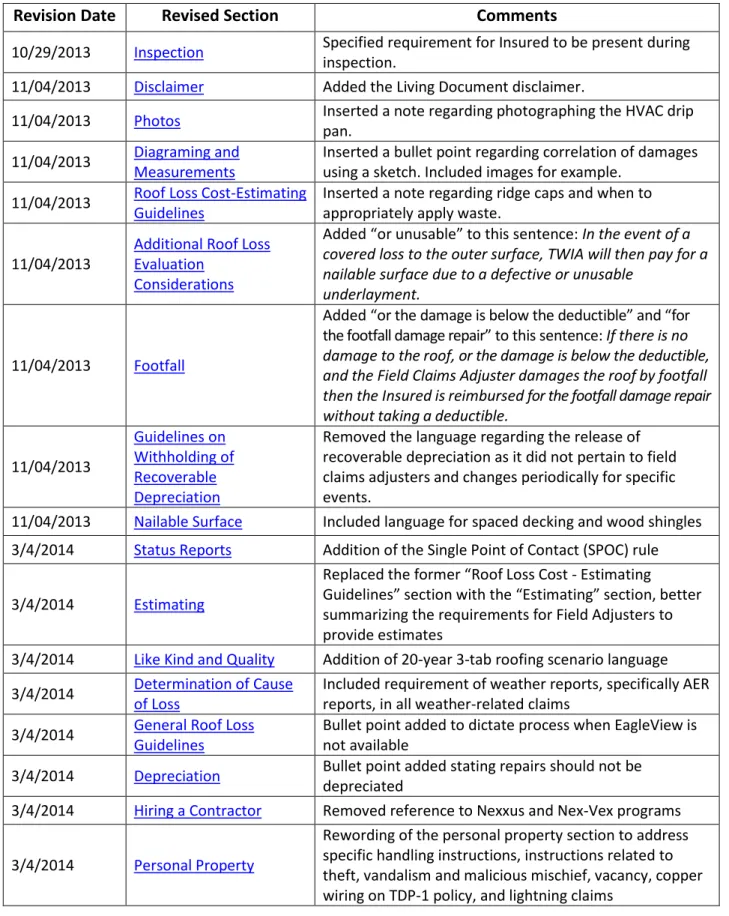
Table of Revisions
Revision Date
Revised Section
Comments
10/29/2013 Inspection Specified requirement for Insured to be present during inspection.
11/04/2013 Disclaimer Added the Living Document disclaimer.
11/04/2013 Photos Inserted a note regarding photographing the HVAC drip pan.
11/04/2013 Diagraming and Measurements
Inserted a bullet point regarding correlation of damages using a sketch. Included images for example.
11/04/2013 Roof Loss Cost-Estimating Guidelines
Inserted a note regarding ridge caps and when to appropriately apply waste.
11/04/2013
Additional Roof Loss Evaluation
Considerations
Added “or unusable” to this sentence: In the event of a covered loss to the outer surface, TWIA will then pay for a nailable surface due to a defective or unusable
underlayment.
11/04/2013 Footfall
Added “or the damage is below the deductible” and “for the footfall damage repair” to this sentence: If there is no damage to the roof, or the damage is below the deductible, and the Field Claims Adjuster damages the roof by footfall then the Insured is reimbursed for the footfall damage repair without taking a deductible.
11/04/2013
Guidelines on Withholding of Recoverable Depreciation
Removed the language regarding the release of recoverable depreciation as it did not pertain to field claims adjusters and changes periodically for specific events.
11/04/2013 Nailable Surface Included language for spaced decking and wood shingles 3/4/2014 Status Reports Addition of the Single Point of Contact (SPOC) rule 3/4/2014 Estimating
Replaced the former “Roof Loss Cost - Estimating
Guidelines” section with the “Estimating” section, better summarizing the requirements for Field Adjusters to provide estimates
3/4/2014 Like Kind and Quality Addition of 20-year 3-tab roofing scenario language 3/4/2014 Determination of Cause
of Loss
Included requirement of weather reports, specifically AER reports, in all weather-related claims
3/4/2014 General Roof Loss Guidelines
Bullet point added to dictate process when EagleView is not available
3/4/2014 Depreciation Bullet point added stating repairs should not be depreciated
3/4/2014 Hiring a Contractor Removed reference to Nexxus and Nex-Vex programs 3/4/2014 Personal Property
Rewording of the personal property section to address specific handling instructions, instructions related to theft, vandalism and malicious mischief, vacancy, copper wiring on TDP-1 policy, and lightning claims
TWIA & TFPA Property Damage Evaluation Guidelines
2014
8
3/4/2014 Identification of Building vs. Personal Property
Updated instructions on how Field Adjusters should address personal property and inventory
3/4/2014 Supplements Added section on how to address claim supplements 3/4/2014 Actual Cash Value Losses Rewording of the Actual Cash Value section to better
reflect all TWIA and TFPA policies
3/4/2014 XactAnalysis Assignment Addition of XactAnalysis assignment workflow section 3/4/2014 ALL Updated the justification and formatting of the entire
document for uniformity 10/7/2014
Commercial Property Damage Evaluation Guidelines
TWIA & TFPA Property Damage Evaluation Guidelines
2014
9
TWIA & TFPA Damage Evaluation Guidelines
Purpose of Document
The guidelines contained in this document were prepared by the Texas Windstorm Insurance Association (TWIA) and the Texas FAIR Plan Association (TFPA) for use by its staff, its contracted independent field adjusting firms and their adjusters, as well as other business partners involved in the evaluation, handling, and servicing of TWIA’s & TFPA’s claims.
Guidelines described in this document may differ for individual claims depending upon the unique facts and circumstances of each individual claim. This document is intended to serve as a guideline only - the adjuster should apply professional discretion as each claim is unique.
These guidelines were composed to comply with applicable insurance policies, contracts, and the laws, rules and regulations of the State of Texas. In the event of any conflict, applicable laws and regulations will prevail.
Introduction
TWIA & TFPA expects high levels of customer service, communication, professionalism, and expertise at all times. In addition, a strong sense of urgency and an appreciation of the importance of uniform compliance with policies, laws and regulations from all our employees and business partners are expected during the claim process as we assign, dispatch, investigate, evaluate, and pay claims.
Disclaimer
This is a living document and thus, it is subject to revision. It is prepared as an aid to staff, contractors and associated firms and cannot be relied upon by the regulated community as representation of the law. Any policy and/or endorsement excerpts, examples, or selections represented in this document may not reflect the official version. In the event of inconsistency or discrepancy, the controlling policy, regulation or law prevails. This document will be revised, as necessary, to reflect any relevant future amendments. Printed or distributed copies cannot be controlled. Announcements contained in such printed or electronic material are subject to change without notice, and may not be regarded in the nature of binding obligations on the Associations and/or the State.
TWIA & TFPA Property Damage Evaluation Guidelines
2014
10
Definitions & Acronyms
ACV Actual Cash Value, a value figured by subtracting depreciation from the full replacement or repair cost
ALE Additional Living Expenses, a calculation of expenses in addition to the typical or normal daily living expenses
C&O Cause & Origin (more recently referred to as O&C, or Origin & Cause) CE Claims Examiner
CGI The internal claims management system used by Texas FAIR Plan Association DOL Date of Loss
FNOL First Notice of Loss, the notification sent in from the insured (or the insured's representative) informing a carrier of a new loss/claim
GC General Contractor
IA Independent Adjuster or Field Claims Adjuster
ISO Insurance Services Office, an online database of claims used to search for prior losses ITV
Insurance to Value, a percentage of the amount of insurance carried (limit of liability) over the actual replacement cost value of the property
MSB Marshall & Swift/Boeckh, reconstruction cost estimator used to determine ITV NI Named Insured, the person(s) who has financial interest in the covered property
NOTUS The internal claims management system used by Texas Windstorm Insurance Association O&P Overhead & Profit, a percentage added to a repair estimate to account for a General
Contractor's expense for overhead and profit POL Proof of Loss
PPIF
Personal Property Inventory Form, a detailed list of claimed personal property details including description, serial/model information, date and location purchased, replacement cost and actual cash value
RCC Replacement Cost Coverage, refers to a policy that provides full replacement cost benefits RCV Replacement Cost Value
ROR Reservation of Rights
SIU Special Investigations Unit, investigates suspected insurance fraud TFPA Texas FAIR Plan Association
TWIA Texas Windstorm Insurance Association
Xactimate Estimating software that can calculate the repair cost of reconstruction as well as the replacement cost of personal property items
TWIA & TFPA Property Damage Evaluation Guidelines
2014
11
General Field Claims Adjuster Guidelines:
Initial Contact
:Initial Contact is expected same day or less than 24 hours from assignment.
Temporary or Emergency Repairs
The need for emergency services, tree removal, and temporary repairs to protect the property from further loss should be addressed at the time of initial contact.
Explain that permanent repairs should not be made before the property is inspected so the Field Claims Adjuster can see the damage and determine if it was caused by a covered peril. Ask the insured to provide accurate records and receipts or other documentation for any temporary repairs.
Tree Removal:
Tree Removal is covered under Extensions of Coverage under TWIA/TFPA policies. Extensions of coverage are not additional insurance and do not increase the limit of liability. If a covered peril has caused a tree to fall and damage covered property, we will pay for the expense for the removal from the described location. If the tree needs to be removed before the Field Claims Adjuster is able to perform the inspection, to mitigate any further damages, ask the Customer to take pictures and keep receipts.
If additional questions or concerns arise, please consult the TWIA/TFPA Claims Examiner assigned to the loss.
Inspection
Inspection is expected to take place within 48 hours of Initial Contact. In order to ensure all damages are addressed during the initial inspection the property must be inspected with the Insured present. If the Insured is unable to be present within that time frame, put a comment in your file notes explaining the reasons why you were unable to inspect within the desired time frame
Properly greet and introduce yourself to a customer. Include an explanation of why you are there and what the customer can expect from your visit and inspection.
Be sure to walk entire property with customer. Allow the customer to point out any and all claimed damages.
Close your inspection by sharing the next steps of the claims-handling process. End the inspection by asking the customer “Have I missed anything and have I lived up to your expectations today?”
Dress code should meet business casual standards, and be professional and practical. Denim pants are not permitted. You should wear shoes that provide adequate traction for traversing a multi-pitched roof. Have proper identification available should the customer request confirmation of your identity.
Reserve Recommendations
In cases where the loss is expected to exceed $10,000 for Residential losses and $25,000 for Commercial losses, you must call the TWIA/TFPA Claims Examiner within 24 hours of the Inspection to
TWIA & TFPA Property Damage Evaluation Guidelines
2014
12
inform them CE of the need for reserves to be properly set and to receive any additional handling instructions.
Status, Initial, and Final Reports
Status Reports
Status reports are expected to be provided to the TWIA/TFPA Claims Examiner every 7 days from the claim assignment until loss is resolved. A phone call will suffice, but be sure to notate the file with items discussed with the Claims Examiner. Inside Desk Claims Examiners are expected to return all contacts within 24 hours. If the Field Claims Adjuster is not contacted within the expected timeframe, their respective team lead/manager should forward communications to that firm’s single point of contact at TWIA/TFPA.
Initial / Final Reports
Initial or Final Reports are expected to be provided within 72 hours of the inspection.
File Documentation
Written file activity notes should be maintained on all TWIA/TFPA claim files. Activities should be documented in the Field Claims Adjuster’s file or log from first receipt of the assignment to final report submission. Any documentation or evidence the Field Claims Adjuster obtains related to the claim should be evaluated, responded to, included in their file, and provided to TWIA/TFPA.
To Be
Included in the Field Claims Adjuster Report (PDFs):
One copy of your invoice.
Copy of TWIA/TFPA Fee Schedule Breakdown (if charges not broken down on invoice) Activity Log (including T&E log)
Field Claims Adjuster’s General Loss Assessment MSB Valuation (RCV & ACV amounts)
Statement of Loss
Building/Personal Property Worksheet (estimate/inventory) Field Claims Adjuster’s Photo Sheets (labeled)
Documents received from insured, including e-mails, estimates, invoices, receipts, photos, proof of loss(541/542 claims only), Advance Pay Requests.
Copies of letters/e-mails sent to insured.
Photos
Clear digital photos are required. Photos should be numbered, identified by the building or item number and room/area, and include a description. Enough photographs should be taken to adequately document the damaged as well as the undamaged portions of the item.
Overview as well as close up photographs should be taken, whether they are determined to be covered or not.
Do not comment on whether or not something is covered by the policy in the photo captions.
TWIA & TFPA Property Damage Evaluation Guidelines
2014
13
Elevation photos - north, south, east, west elevations of the risk Overview of all slopes and test squares
Close-up photos of most severely damaged shingle(s)
Damage or lack of damage to soft metals, screens, gutters, etc. Shingle and pitch gauge on roof
Showing evidence of single or multiple layers of roofing Interior attic showing type of roof decking
Interior attic showing any evidence of interior damage or ongoing leaks
o NOTE: a photo of the HVAC system condensation pan (drip pan) is needed when interior water damage is reported/claimed near the condensation pan.
Overview of all interior rooms damaged or not, and a close up photo of damaged areas Personal Property when applicable
Roofs of other nearby structures to document damage or no damage
The Estimate should be written in the same order that the photos are taken above.
Estimating
Adjusters are expected to create their own estimates based on damages observed during the inspection. If you need to consult with a contractor, jointly inspect the loss with an independent contractor assigned by the Inside Desk Claims Examiner. You should never recommend contractors to the insured. If asked, inform the insured that you are not recommending or hiring a contractor—it is the insured’s choice and obligation.
There should be a separate estimate per item of insurance involved. Estimates should be clearly marked as to which item they represent (i.e. Item 1 - dwelling, Item 2 – detached garage etc.). Split your items within the Xactimate Claim tree applying proper coverage limits and deductibles to the applicable item number. Estimates should begin with the exterior damages, followed by the interior. The photos should be in the same order as the estimate is written and should be labeled to match the corresponding areas in the estimate. A properly labeled overview photo is required for all rooms, including the attic.
Estimates should reflect the reasonable cost to repair covered damage with materials of like kind and quality at the time and location of the loss and any applicable depreciation. Apply the proper price guide for the area using the date of loss to price point the estimate. Apply the proper tax rate for residential or commercial construction. Consider loss history when you are writing your estimate, making certain you do not allow for damage that has been paid for in prior claims. The Inside Desk Claims Examiner will provide prior claim reports for comparison.
The Field Adjuster should include in their estimate any damage identified during the inspection that is consistent with a named peril. The Field Adjuster should include in their General Loss Report any damage identified during the inspection that is not consistent with a named peril.
Adjusters in the field do not have the authority to discuss what damages are covered or not covered with the Insured; this is the responsibility of the Inside Desk Claims Examiner. The Field Adjuster’s responsibility is to make a thorough property damage evaluation and submit their recommendations to the Inside Desk Claims Examiner, who will review applicable policy provisions to determine the disposition of the claim.
TWIA & TFPA Property Damage Evaluation Guidelines
2014
14
Diagramming and Measurements
Diagrams with measurements are required on all field adjusted losses.
The computer generated diagram and measurements for any damaged room or area must be uploaded with the Xactimate estimate.
Measurements should be rounded up to the nearest inch.
Note the correlation of any interior damage on the diagram or sketch to the exterior damage. o Example:
Debris Removal:
Disposal should be included in the estimate when appropriate if the local waste collector will not remove the debris from the Insured’s curbside. Before allowing for disposal, the Field Claims Adjuster should review which line items already include it.
The "Remove" operation includes putting the materials in a job site receptacle, so using "Remove" would not be a sufficient allowance for debris removal if the local waste company would not take it. If estimating for general demolition using labor hours, it is inappropriate to use the "Remove" operation in Xactimate.
Like Kind and Quality
All estimates should reflect replacement of damaged materials with the same materials and level of quality. If the damaged material is no longer manufactured, use the closest available materials and quality but in no case use materials of lesser quality.
TWIA & TFPA Property Damage Evaluation Guidelines
2014
15
There is one scenario that TWIA and TFPA allows for an “upgrade” of materials. Due to the limited availability of 20-year 3-tab shingles, TWIA and TFPA allows for their replacement with 25-year 3-tab shingles when a covered loss exists.
Matching
TWIA & TFPA policies do not provide coverage for perfect matching of shingles, siding and other items unless there is a reasonable basis to conclude mismatching will appreciably diminish market value after repairs are completed.
A Field Claims Adjuster should consider whether or not any significant diminution in market value can be avoided by providing for matched shingles, siding, or components for single or multiple slopes, sides, or areas within a line of sight.
Natural Breaks
The Field Claims Adjuster should allow for repairs to adjoining areas if there is no natural break between the damaged and undamaged areas. Adjoining areas are connected rooms or elevations with no natural break to separate the rooms or elevations.
A natural break separating interior rooms could be a wall separating multiple rooms, a soffit wall/ceiling, a doorway, a transition strip, differences in surface material (floor, wall, ceiling), or floor levels (1st story vs. 2nd story). A natural break on the exterior of the home could be a different directional roof slope or elevation.
Insured Completed Labor Hours/Repairs
For the customer’s labor to perform general clean up or temporary repairs, use the LAB LBR selector code in Xactimate. If the scope of a repair job cannot be accurately estimated in Xactimate, use skilled labor hours and add an estimate line item note (F9 note) in Xactimate.
If the customer repairs a damaged item and it is a quality, permanent repair (not a temporary repair,) an estimate should be written in Xactimate for what it would cost to hire a professional contractor to perform the work. In no case would TWIA or TFPA pay a customer more than what it would cost for a contractor to do the same work.
Permits
Permits should be estimated and included in the estimate. Because permit fees vary greatly, any actual permit fees in excess of the estimated fees should be submitted for supplemental and timely payment.
Overhead and Profit
Overhead and profit should be included in an estimate where the customer is likely to require the services of a general contractor to repair the damage. The Field Claims Adjuster must document the reasons for their belief a general contractor will be used. Job Personnel Overhead (or Sub-Contractor O&P) expenses are included in the Labor Overhead portion of each unit price in the Xactware price list. Factors to consider in making this determination include the nature and extent of the damage, the number of trades needed to make repairs, the degree of coordination or supervision of trades required to make repairs, the opinions of subcontractors, general contractors and other experts about industry standards, and whether a repair estimate lists overhead and profit.
TWIA & TFPA Property Damage Evaluation Guidelines
2014
16
On claims that warrant general overhead and profit, Field Claims Adjusters should include O&P as a separate Xactimate line item at the end of the estimate (10% overhead and 10% profit = cumulative 21%) and apply to all building items and trades, including roofing and fencing, when supervision or coordination of the item or trade is reasonably required by a general contractor. If it is necessary for a general contractor to supervise or coordinate all trades, including roofing and fencing, explain why in your report to TWIA or TFPA. When applicable, general overhead and profit is considered part of the repair/replacement cost and is NOT depreciable.
Sales Tax
Sales tax should be added and separately identified on all estimates, as appropriate. Please consult the Texas Comptroller’s website for taxable services and materials:
http://www.window.state.tx.us/taxinfo/sales/faq_collect.html
Examples of taxable items include: materials on repairs; labor on non-residential repairs (excluding property used as a family dwelling such as apartment complexes, nursing homes and retirement homes); personal property repairs; waste removal from real property. Tax should not be added to estimates for tax-exempt entities, such as schools, government or non-profit organizations that have a tax exempt certificate. The Field Claims Adjuster must verify this. Sales tax is not depreciable.
External Damages
Determination of Cause of Loss:
Weather reports
o TWIA only provides coverage for losses caused by the perils of wind and/or hail. Weather reports can help determine if high winds or hail has affected a particular area or property. o If available, use location-specific weather reports to confirm the date of loss and peril(s)
involved for all TWIA and TFPA losses where weather is suspected as a cause or contributing factor in the loss.
o Atmospheric and Environmental Research, Inc. (AER) is the preferred weather history report for both TWIA and TFPA. TWIA and TFPA agreements with AER stipulate that there should be an AER report in every wind and hail claim automatically, typically within 1-2 days of the assignment being generated.
o If an AER report is unavailable, notify the Inside Desk Claims Examiner immediately.
o Copies of applicable weather reports must be included with the Field Claims Adjuster’s report.
TWIA & TFPA Property Damage Evaluation Guidelines
2014
17
o An expert(s) may be needed for claims where the cause of loss or damage may be difficult or inappropriate for the Field Claims Adjuster to evaluate. As soon as the need for an expert is identified, immediately contact the TWIA/TFPA Claims Examiner assigned to the file to discuss the hiring and use of all experts.
o Where a decision is made to utilize experts, you must discuss with the customer the reasons behind the need for an engineer or other expert(s) to assist in the evaluation of their claim.
Roof Inspector Safety:
Safety comes first and you should never attempt to access any roof when, in your professional judgment, it would not be safe to do so.
Ground level visual inspections are not accepted. You should notify the Claims Examiner if you cannot safely access the roof. Appropriate assistance from a roofing or other paid professional may be used to access the roof, but only with prior approval from the Claims Examiner. In all other situations, you are expected to personally complete the roof inspection.
If the roof is too steep or high for you to perform an on-roof inspection, authorization must be approved from the Claims Examiner and documented in the claim file prior to having a paid professional complete the roof measurement and inspection. You are still expected to complete the roof estimate and all other aspects of the claim.
General Roof Loss Guidelines:
Roof inspections are required on all field-adjusted roof claims.
TWIA & TFPA use EagleView as their aerial imagery/CAD measurements provider. Use roof “CAD” diagrams and measurements to establish roof measurements and as needed for diagrams. You are not required to physically measure the roof when the EagleView report has provided this information.
When Eagleview is not available, measurements must be taken or verified manually and sketched in Xactimate.
The Field Claims Adjuster report must include the type(s) of roofing, age of roof, slope pitch, and the number of layers of roofing.
Replacement materials must be of like kind and quality. Identify and document the type, weight, and style of the roofing material being replaced. Do not rely on the use of a roof gauge to identify shingle type; hail-impact resistant shingles and other more recent types of shingles may not be properly measured by the roof gauge.
Hail Damaged Roofs
When adjusting claims for hail damage to roofs, evaluate and document evidence of damage or “hail hits”:
A “hail hit” is defined as functional damage to the roofing material. Specifically, functional damage of roofing material is a reduction in water-shedding capability or expected long-term service life. Composition shingles are functionally damaged when they are fractured by hailstones. The damage is typically immediate and visually noticeable. The fracture may also be noticeable by feeling the top
TWIA & TFPA Property Damage Evaluation Guidelines
2014
18
and bottom surface of a shingle. A fracture from hail is not always apparent in the bottom surface of a shingle.
10’x10’ test squares for each elevation (North/South/East/West), should be measured, if applicable. If it is not feasible to mark off a 10'x10' area due to the size/shape of the slope, mark out a 100 SF
area of a different shape that fits in the surface area.
Since hail damage on a roof can vary from slope to slope depending on the pitch, condition of the roof, protection offered by trees and buildings and the direction of the hail, you should complete test squares on the appropriate number of slopes to evaluate the damage to the entire roof.
Count and document the number of damaged shingles within the test square.
Document all test squares with annotated photos and upload with the Xactimate estimate. Damage is determined by the number of damaged shingles, not individual tabs on 3-tab shingles. Once the amount of hail hits are noted, then consider the age, condition and reparability of the roof
or slope.
Evaluation of hail damaged roofs:
Granular loss alone generally does not constitute damage by hail to composition or flat roofs. Composite shingles damaged by hail typically show “bruising”.
Metal roofing damaged by hail typically shows dents.
Tile roofing damaged by hail typically shows cracks in the damaged area.
Wood shake roofing typically show splits, splinters, or dents, with appropriate aging for the time of loss.
Wind Damaged Roofs
Wind damage is evaluated differently than hail damage. Wind damage typically includes tearing, bending, and bruising to shingles. Wind damage to tile roofs can consist of tiles being blown loose from the mortar patty or nails or tiles damaged by flying debris.
In the absence of other covered damage, lifted/non-sealed tabs alone are not necessarily indications of wind or other damage.
Tile roofs are generally designed and installed to allow some movement without damage.
Without visible damage, a report of vibration or chattering will generally not qualify as actual physical damage.
For claims involving Unsealed Shingles, please note that TWIA Policies cover only damage caused by windstorm or hail. A composition shingle that was properly sealed prior to the storm and then is unsealed by windstorm is covered damage. Properly sealed composition shingles are intended to resist significant wind events. However, some composition shingles may not seal at the time of installation for reasons such as seal strip contamination, installation errors, manufacturing defects and cold weather installation.
Roof Loss Cost - Estimating Guidelines:
Field Claims Adjusters are expected to prepare computer-generated estimates on all losses, as appropriate. Xactimate has been selected as the current property estimating platform for TWIA & TFPA claims.
TWIA & TFPA Property Damage Evaluation Guidelines
2014
19
In certain cases, the individual facts of the loss and damages present may require an estimate to be written differently than these guidelines suggest. Throughout this guide, for any exception or deviation, the Field Claims Adjuster is expected to justify such deviations and document them with a line item note (F9) in the Xactimate estimate and to notify the Claims Examiner as appropriate. The building estimate should reflect the type of building involved, type of construction, dimensions
of the damaged areas, total square footage, replacement cost of the damaged items, and actual cash value of the items when applicable. On all dwelling estimates written on a replacement cost basis, actual cash value should be calculated. The estimate format must display in a room-by- room, line-by-line basis and utilize unit-cost pricing with line-item depreciation, when applicable.
If an item is not found in the Xactimate price guide, a local price may be used if documented and reasonable. For items that appear to be priced incorrectly based on the quality allowances in Xactimate, have localized price anomalies, or have grade differences, you are encouraged to use time and material estimating for the item and document how the price was created. Such methods may be necessary for unusual or commercial items or while working in areas with access issues. You should add the new line item under the appropriate trade for the item. Include a line item note (F9) in the Xactimate estimate to explain the reason for the deviation. Base service charges are included in the unit pricing.
Xactimate will attach a local pricelist and you should verify that the correct pricelist is attached based upon the location of the property being estimated.
The most current price database should be used for the estimate. Be sure to use the price data base for the loss location closest to the loss location from within the loss state.
It is not TWIA’s or TFPA’s general practice to accept contactor or public adjuster estimates as the means to determine property damage values as the Field Claims Adjuster has a responsibility to determine the cost of repairs. However, if the Field Claims Adjuster writes an estimate and finds an estimate submitted by a contractor or public adjuster is in line for the same scope of repairs, with prior approval from TWIA, settlement may be made based upon the submitted estimate. The comparison estimate must be clearly labeled and uploaded into the file to document the basis for the settlement.
Repair vs. Replacement – Always consider roof material “brittleness test.” If a roof was not repairable at the time of loss, it should likely be replaced. If shingles crack or tear, the roof cannot likely be repaired.
On a repair to a wood, tile or composite shingle roof with damage scattered across the roof the Field Claims Adjuster should use a “per shingle/tile/shake price”, depending on the condition of the roof. “Per square” price should be used if the damage is in concentrated areas.
When most or all of an entire slope of roofing material is blown off, the tear-off allowance should be reduced or eliminated depending on the circumstances.
Steep charges should be used on roofs with a slope of 7/12 pitch or greater.
Multiple story charges should only be used on roofs that are greater than two stories high. Steep and/or multiple story charges are calculated on the square footage of the slope(s) involved. Actual measurements on roofs are to be used for tear-off.
TWIA & TFPA Property Damage Evaluation Guidelines
2014
20
For multiple layers, add first layer as roof tear-off allowance and the second layer tear-off on a separate line of the estimate as removal of an additional layer.
Except for metal roofs, Xactimate line item pricing includes haul off, so no separate allowance for dumpsters should be allotted unless there are unusual circumstances. However, if multiple trades are in the estimate, a dumpster charge may be needed to accommodate repairs.
When paying to replace roofing use separate line items for the “Remove” and “Replace” operations. The “Remove” line item should allow for the actual square footage with no waste and no rounding to the nearest bundle.
Additional items to consider are: ridge cap, metal valley, plumbing sleeves, chimney step flashing, skylights, vents, felt, drip edge, pipe jacks, cap sheet (tile), removal and reset of A/C unit, cooler, or antenna attached to the roof, access charge, and debris removal, as appropriate.
o NOTE: the ridge cap is included in the waste factor for 3-tab shingles on full slope replacements as they are cut from the field shingles used by the installers. When replacing one or more slopes with 3-tab shingles, there should be no separate charge for ridge cap. High profile, wood, tile and metal roofs may have additional charges for ridge cap, when necessary. Any deviation must be approved by TWIA/TFPA.
Roof Waste Factors:
10% waste factor on gable roof replacements.
15% waste factor on hip roof replacements and may be appropriate on more intricately designed roofs with multiple roof lines, valley, or dormers.
10% waste factor when replacing one slope. Add linear feet when replacing the ridge cap.
5% waste factor should be used for a flat roof and rounded up to the next square.
20% waste factor for tile repairs on an individual basis to allow for tile breakage during installation.
Depreciation:
Good judgment should be used when determining the appropriate depreciation to apply. Consider all factors, including the quality of the roofing material, its life expectancy, age and overall condition. Do not apply depreciation to labor, roof tear-off, or overhead and profit.
Depreciation should be calculated and applied on an item-by-item basis using appropriate guidelines and methods, which may include depreciation tables, reasonable life expectancy, overall condition of the roof at time of loss, market value, and other reasonable methods under a broad evidence rule.
TWIA & TFPA Property Damage Evaluation Guidelines
2014
21
Repairs of covered damage should never be depreciated.
Evaluation of Losses by Roof Type:
Flat Roofs
On built up roofs, unless evidence is presented to the contrary, 3-ply roofing should be used (plus any applicable ballast).
TWIA & TFPA do not recognize the Vacuum Uplift Test as a valid way to determine if an existing flat roof is damaged by wind since this test is not an industry standard for identifying hail or wind related damage. If asked to consider such test results, TWIA may consider utilizing an expert or engineer to interpret the test and to assist in the property damage determination or review.
Tile / Slate Roofs
Tile (including but not limited to concrete or clay) roof losses require detailed inspections by the Field Claims Adjuster.
Tile roofs can be repaired in many situations when the Field Claims Adjuster can determine the manufacturer, profile, and design of tile roofing. The Field Claims Adjuster should independently verify that a tile is no longer available and document the efforts to identify the tile in the claim log. The “per tile” price in Xactimate includes labor to remove and reset tiles around the one that is
being replaced.
When inspecting a tile roof for damage, the Field Claims Adjuster should inspect for missing, cracked, or displaced tiles. There must be a covered cause of loss to pay for the repair.
Loose tile that has become un-bonded from the mortar patty but has remained in the same place is generally not storm damage.
Metal Roofs
Some metal roofing requires detaching and resetting to the nearest edge due to the style and installation method of the roof.
Wood Roofs
Where the customer indicates a desire to replace the wood roof with available alternative roofing materials the Field Claims Adjuster must seek direction from the TWIA/TFPA Claims Examiner and their manager before offering any alternative solutions.
Additional Roof Loss Evaluation Considerations:
Nailable Surface
On some occasions, a claim is presented by a customer to remove and replace an underlying surface material that is not damaged by a covered cause of loss. TWIA & TFPA do not cover an underlying surface if it is aged or has a defect not attributed to a covered cause of loss unless the outer layer of the roof was damaged by a covered peril. In the event of a covered loss to the outer surface, TWIA will then pay for a nailable surface due to a defective or unusable underlayment.
TWIA & TFPA Property Damage Evaluation Guidelines
2014
22
An example of this would be if there is covered damage to the roof covering (shingles, tile, wood shakes, metal, etc.) and we determine that the roof decking or spaced decking is rotted. In this example, the policy generally would owe to replace the rotten roof decking, or spaced decking (and thus provide a nailable surface to expedite the repair or replacement of the roof).
Wood Roof as a Decking Material
In an effort to improve the consistency of our estimates and payments to our customers, TWIA & TFPA are clarifying the way its estimates are written with respect to wood shake/shingle as an underlying layer. As of 11/7/2011 all roofs that are damaged as a direct result of windstorm or hail with wood shake/shingle as an underlayment are to be written as follows:
1. Removal of the damaged composition shingles due to direct loss from windstorm or hail.
2. Removal of all additional layers of composition shingles, as specified in the code requirement to remove all layers if two or more layers are present.
3. Removal of the wood roof shingles serving as a decking material for the composition shingles, as specified in the code requirement to remove all layers if two or more layers are present.
4. Replacement of the wood roof decking with code compliant ⅝ sheathing as specified in the code.
o Depreciation is based on the age, use, quality and condition of the top layer of composition shingles.
5. Replacement of the composition shingle roof including a 15lb felt underlayment, 2 layers of 15lb felt underlayment if pitch is 4/12 or below.
o Depreciation based on the age, use, quality and condition of the top layer of composition shingles.
Based on the above scenario, the estimate should resemble something similar to the example below. Please keep in mind that this is an example only and does not contain all materials that are normally found in a roofing estimate.
Multiple Overlay of Roofing Materials
TWIA/TFPA allow for the cost to tear off multiple layers of roofing materials and to re-deck the roof if necessary.
TWIA & TFPA Property Damage Evaluation Guidelines
2014
23
Footfall
If the Field Claims Adjuster causes footfall damage to a roof during an inspection:
Add the number of shingles, shakes, or tiles damaged by footfall plus the number of shingles, shakes, or tiles damaged by a covered peril to the estimate. The total damage is subject to the deductible.
If there is no damage to the roof or the damage is below the deductible and the Field Claims Adjuster damages the roof by footfall, then the Insured is reimbursed for the footfall damage repair without taking a deductible.
Siding/Paint/Stucco
These claims should be evaluated on the basis of each individual elevation: Only the damaged elevations should be repaired or replaced.
When one elevation of siding is replaced, TWIA does not automatically owe to replace any other elevations in order to match the new siding (see "Matching" topic).
When there is an insulation board or house wrap behind the siding, the insulation may be damaged in the process of repairing the siding. In these cases; the insulation board or house wrap should be included in the estimate.
When diagramming exterior wall damage, the Field Claims Adjuster should include both damaged and undamaged elevations.
Pools
Filling
If an insured’s pool is leaking as the result of a covered loss, coverage for the pool and water within may be dependent upon the policy and cause of loss involved. While many pools are covered under the Other Structures section of the policy, the water contained within pools is considered Personal Property (Coverage B).
When estimating to drain a pool to perform covered repairs, the Field Claims Adjuster should separately estimate the cost to re-fill the pool with water and the appropriate chemicals. The cost of the water can be obtained in various ways; from the local water authority, from a pool company or from the Insured’s water bill.
The cost of the water and appropriate chemicals should be listed separately as it will be considered for payment under any available Personal Property Coverage.
Pool Decking
The policy must be reviewed to determine if there is coverage for pool decking.
If concrete pool decking is damaged by a covered cause of loss, the repairs should be estimated similarly to sidewalk/driveway repairs. However, the extent of repair to any deck surface material (Cool deck, etc.) must also be evaluated to provide for a uniform appearance.
TWIA & TFPA Property Damage Evaluation Guidelines
2014
24
Fences
Fences should be measured to the nearest linear foot. Chain link fences can be replaced on a per linear foot basis.
Wood, aluminum, and vinyl fences can generally be replaced in 8 foot sections (Or the actual length between posts for the fence section).
Blown down wood, aluminum, or vinyl fencing can often be reset depending on the severity of damage to the panel.
Fence posts should only be replaced if there is covered damage to the post.
TWIA only owes for the Insured’s interest of a common fence. (i.e. ½ of a “good neighbor” or other shared fence)
Since the Xactimate price for fence removal includes the cost to place the damaged fence in a job site waste receptacle, a dumpster or pickup truck line item should be added only when the city will not remove fence debris placed for garbage pickup. Typically, one pickup truck load will be sufficient for the removal of 4-5 sections of fence.
If depreciation applies to the damaged fence, the Field Claims Adjuster should determine if the repair or replacement of the damaged portion of the fence will place the Insured in a better position than before their loss. If betterment is involved, then the fence repair/replacement will need to be depreciated.
Sheds, Outbuildings, and Other Structures
Determine if the structure qualifies as an Other Structure (Coverage A) or Personal Property (Coverage B):
The Structure qualifies as an Other Structure (Coverage A) when:
o It is a permanent part of the realty, has a foundation, or has tie downs or is in some other way affixed to the realty.
o If it was removed it would deface the property, such as when it has been landscaped around making it impossible to be easily removed.
The structure qualifies as Personal Property (Coverage B) when:
o It is manufactured to be easily moved such as pre-fabricated plastic storage units or the shed is placed on skids for easy transport
Pricing for sheds, other outbuildings, and other structures:
When the price for a prefabricated structure is available in Xactimate, the Field Claims Adjuster should match the features in the Xactimate Selector Code with the features of the damaged shed. If the Insured's structure has more features than the Xactimate structure a “stick built” estimate
should be written to reconstruct the structure.
When appropriate, the Field Claims Adjuster should consider using general demolition rather than using the "remove" operation in Xactimate.
TWIA & TFPA Property Damage Evaluation Guidelines
2014
25
Retaining Walls
Claims for damaged retaining walls should be thoroughly investigated as they are typically damaged by perils such as earth movement, wave action or surface water which are not covered by a TWIA/TFPA policy.
Generally, it is appropriate to hire an expert to perform a professional evaluation of the cause of the damage especially where suspected non-covered causes of loss contributed to or caused the damage in any way.
Interior Damages
Interior Diagrams
The diagrams should include the room measurements, ceiling heights, any relevant offsets, and any cabinets or built-ins.
Kitchen and bathrooms require detailed diagrams of appliance, fixtures, and cabinets.
Wall openings larger than 50% of the area should be deducted when estimating the replacement of wall finishes or surfaces.
The diagram with measurements should be completed for the damaged area(s) and any area where the same damaged product was installed to continuous surfaces such as floors, carpeting, wallpaper or siding.
If the building or dwelling has multiple stories and a thorough inspection reveals the damage is confined to one story (or level); then only the story damaged would require full measurements and a diagram.
Drywall
There are many types of drywall, so the Field Claims Adjuster should determine the correct grade and/or makeup of the wall or ceiling surface.
Generally, drywall installed on ceilings is 5/8” thick, wall surfaces is 1/2” thick.
Types of drywall include: fire rated drywall, Type-X, and drywall located in moisture prone areas. In moisture prone areas, such as a bathroom, the Field Claims Adjuster would use green- board
unless the investigation shows it was not present prior to the loss.
The Field Claims Adjuster should estimate the actual drywall material damaged and not round up to the nearest whole sheet of drywall. It may be necessary to allow for some additional repair area as a perfectly square repair without waste is generally unlikely.
It is TWIA/TFPA’s general policy to cut out and remove the ceiling/wall surface exposed to water damage rather than sealing and painting. For minor water stains that has already dried, sealing and painting may be appropriate.
TWIA & TFPA Property Damage Evaluation Guidelines
2014
26
Plaster
Since there are many types of plaster/backer material/lath combinations, the Field Claims Adjuster needs to determine the correct grade and/or makeup of the wall or ceiling surface.
The most appropriate way to determine which Xactimate selector code to use is to examine the backer material or lath behind the plaster.
Wood lath is common in homes built before the 1940s. Metal lath is common in homes built after the 1940s. The most common backer material used today is 1/2" gypsum board.
The Field Claims Adjuster would estimate replacement of like kind and quality. If the Field Claims Adjuster is unable to determine the type of material, 1/2" gypsum board should be used.
When estimating to repair an isolated area of plaster on a wall or ceiling surface, estimate for the actual square footage of repair and include for a thin coat of plaster over the entire surface of the wall or ceiling that is being repaired.
Wall Coverings
Paint
On damaged walls that require repainting, it is usually necessary to repaint adjacent walls for a uniform finish including any of the adjacent walls that continue without a natural break.
When drywall is replaced, the newly installed drywall should be painted with a sealer and all walls painted with one coat of paint.
Rooms with large or long walls and those with large amounts of natural light such as a great room that may require more than one coat of paint.
All openings over 50% of area being repaired or areas not requiring painting (such as behind cabinets) should be deducted when estimating for painting.
When plaster is replaced, all repaired walls or ceilings would also require two coats of paint due to the differing absorption rates of plaster and drywall.
Extra coats should be allowed when walls are custom painted, have an unusual finish, or when there is an appropriate reason.
Content Manipulation may be used when:
It would be unacceptable to move the contents to the middle of the room and cover with a drop cloth. Rooms with large numbers of items (small figurines) on the walls or with very large items (piano) may require additional content manipulation.
An allowance for extra masking may be appropriate in rooms with chair rails, picture rails, or base and crown molding. Switch/outlet covers and dropping of standard light fixtures are included in the paint price in Xactimate.
TWIA & TFPA Property Damage Evaluation Guidelines
2014
27
Wall and Ceiling Texture
The accepted repair technique for popcorn ceiling texture is to scrape and re-texture the entire ceiling. When applying popcorn texture to new drywall, the drywall should first be sealed as a separate operation to allow the popcorn texture to adhere to the new drywall.
Many of the hand textures used on ceiling surfaces and walls can be spot replaced and the texture blended into the existing texture. It may require repainting of the entire surface area for a uniform finish. The Field Claims Adjuster needs to evaluate each claim for possible repair techniques.
Wallpaper
If any portion of wallpaper is damaged, the wallpaper to all adjacent walls must be removed and replaced. Should any of the adjacent walls continue without a natural break into any adjoining room(s), the adjoining room(s)' walls should also have the wallpaper removed and replaced.
Since waste is included in the wallpaper price in Xactimate; no additional waste should be calculated except in unusual circumstances
The Wallpaper price in Xactimate does not include prep work to install the new wallpaper when it is installed over surfaces where the old wallpaper was located.
Flooring
Carpet
Carpet replacement should be estimated using the drop and fill method as this allows for the most efficient use of a roll of carpet by calculating how much square footage would be needed based on the seams and direction the carpet fills the room.
Field Claims Adjusters must identify the quality of material, the appropriate width for the replacement, and number of seams in a room. The Field Claims Adjuster should not estimate for more seams than are currently used. It is acceptable to allow for content manipulation in order to replace carpeting. Carpet should be replaced to a natural break such as a doorway, flooring material transition, etc.
The grade of the damaged carpet is an important factor in estimating the replacement cost. The different grades/styles of carpet can be found in Xactimate along with images that show specific examples.
When carpet has been exposed to water, the Field Claims Adjuster should assess if the carpet can be salvaged since a wet carpet does not always require replacement. It is acceptable to have carpet cleaned and deodorized if the carpet has not been permanently stained or delaminated.
The Field Claims Adjuster should determine the potential of having the carpet cleaned by a professional carpet cleaning service prior to allowing replacement of the carpet. When the carpet can be saved, an estimate to detach and reset the carpet, to replace the carpet pad as well as an allowance for germicide may be required.
Wood Floors
Field Claims Adjusters must distinguish hardwood floors from laminate floors due to high variances in price, quality, and repair options depending on type and quality of the flooring. Generally, repairs to damaged hardwood floors can be isolated to the damaged planks. These planks can be removed and replaced and the floor sanded, stained, and refinished to match. It is important to identify the cause of
TWIA & TFPA Property Damage Evaluation Guidelines
2014
28
loss to wood floors since wood flooring can be damaged by non-covered causes such as warping from humidity, surface water, improper installation, etc.
The Field Claims Adjuster should evaluate the level of damage to the hard wood floors as hardwood floors can be sanded and refinished without replacing the actual wood. This is dependent on the extent of damage and the number of time(s) the wood floor has previously been sanded and refinished.
When estimating to sand, stain, and finish hard wood flooring some items that need to be taken into consideration are:
Refinishing the floor up to a natural break Content manipulation as appropriate
The machinery used to sand, stain, and refinish wood floors may mar baseboards causing them to be damaged, appropriate repairs or replacement should be allowed
A light post repair cleaning may be necessary
Laminate flooring is more difficult to repair as it cannot be sanded. It may be difficult to match laminate flooring, even if the same brand/type of floor can be obtained, since the new floor will be from a different dye lot resulting in a product color that may not match. If the Insured has any extra materials left over from the original installation it is appropriate to estimate for a repair.
For engineered hardwood flooring, the type and manufacturer of engineered flooring often determines the reparability. Some manufacturers give a warranty of 1 to 3 sandings for the lifetime of the engineered wood. The Field Claims Adjuster may need to research to determine if the engineered flooring can be refinished.
When replacing wood floors, it should be replaced to a natural break (doorway, flooring material transition, etc.). It is generally difficult to stop at doorways unless there is a clear transition. If strip flooring runs under a door, proper estimating may require an estimate to extend into another room.
Tile Floors
Tile floors are resistant to water; therefore, replacement should not be necessary unless the mortar bed is compromised or it is cracked from a covered peril.
If tile must be replaced, the Field Claims Adjuster should research to determine if replacement tiles can be located or manufactured. In addition, the Field Claims Adjuster should ask the Insured:
If they have any extra materials left over from the original installation. The store where the tile was purchased.
The name and contact information of the company that installed the tile.
If it is possible to repair with matching tiles, it is appropriate to estimate for only the square footage of damaged tile. If repairs are not an option, then replacement should be made to a natural break.
Sometimes claims are made for discolored tile. Tile by its very nature does not stain. If staining due to a covered cause of loss is noted, it may be necessary to have the tile professionally cleaned to determine if truly stained. Discoloration of grout can be cleaned very easily. If the discoloration is a result of a covered loss, tile can be re-grouted without having to replace the tiles.
TWIA & TFPA Property Damage Evaluation Guidelines
2014
29
Hollow sounds under tile are not necessarily an indication of damage.
Vinyl Floors
The drop and fill method should be used for computing the replacement of vinyl flooring sheet goods. These sheet goods come in 6’ and 12’ wide rolls. Damage due to tears, burns, and stains caused by a covered loss generally requires replacement of the vinyl floors. Vinyl tile can sometimes be repaired if the materials are still available.
Multiple Layers of Floor Coverings
If there are multiple layers of flooring, only the top layer should be considered for like, kind and quality replacement.
If an Insured has laid carpet over wood plank flooring, the wood floor may be considered abandoned and we would only owe to replace the carpet. If there is material under the carpet that was also damaged it should be considered on a functional basis.
If the wood plank floor was damaged and required replacement it may be replaced to provide a solid sub-floor and restore the Insured to pre-loss condition, but the abandoned wood floor should not be refinished.
If an Insured chose to leave an old glue-down carpet in place and laid new carpet over the top of the old carpet, this Insured has abandoned the glue-down carpet as a functional carpet, but has retained this carpet as a functional pad for the new carpet. If there is covered water loss that damages both carpets, TWIA/TFPA may consider the new carpet for replacement and the abandoned carpet that was also water damaged may be considered for removal and replacement with a carpet pad.
Electrical
Testing
There must be some evidence of electrical damage before paying for exploratory testing. If the damage is evident but not physically visible, have the Insured get an electrician to give them an estimate along with the cause of loss.
Water Damage to Electrical Fixtures
If there is evidence that water has passed through an electrical fixture, such as a light or ceiling fan, it is generally most cost effective to remove and replace the light fixture. For high value fixtures, consideration may be given to hiring an electrician to determine if the fixture(s) require replacement.
Insurable Interest
The insurable interest of certain electrical items must be verified with local municipalities/utility companies prior to including them on estimates. The Field Claims Adjuster should verify that the Insured is responsible for that particular electrical item before we pay to repair or replace it.
HVAC
Reparability Reports
For a loss to an A/C unit, the Field Claims Adjuster may consider getting a cause of loss and reparability report. In all cases, the Field Claims Adjuster will need basic information on the HVAC unit such as make, model, age, and SEER rating.
TWIA & TFPA Property Damage Evaluation Guidelines
2014
30
Reparability
Replacement of an air handler when a compressor is damaged is not always required. Unless there is a justifiable reason covered under the applicable policy to replace the air handler and the compressor; the policy will only pay for like, kind and quality replacement of one component.
If a contractor states they must replace multiple components in order to guarantee the work, TWIA/TFPA’s policy covers only the damaged item, not the added component needed to satisfy a warranty requirement. If the claim is for replacement of an air handler, due to direct damage of a compressor, the Field Claims Adjuster must verify and document the reason(s) for including both components in their estimate.
If repairs require multiple components due to an ordinance or law the Field Claims Adjuster must determine if the policy contains provisions or endorsements which provide coverage for any repair or replacement requirements mandated by any ordinance or law.
If the replacement unit is an upgrade, then the added costs to upgrade must be documented and deducted from the estimate of damages.
Ductwork
Prior to replacing ducts on a covered loss, the Field Claims Adjuster should explore all remediation and cleaning options available.
Remediation
Water
On claims that have extensive interior water damage, it is recommended that the Field Field Claims Adjuster include water remediation in the estimate if the Insured has not already contacted a water remediation company.
If the Insured has called out a remediation company before the Field Claims Adjuster has had the opportunity to inspect, then the Field Claims Adjuster should write a comparative estimate once the remediation bill is received in order to determine whether the invoice is reasonable. This comparison estimate should be clearly labeled and uploaded with the Xactimate estimate.
It is extremely important for the Field Claims Adjuster to monitor remediation efforts so that fans, dehumidifiers, negative air machines, etc. are used appropriately.
Mold
If the property has both covered water damage and non-covered mold growth, the adjuster’s estimate should include the cost of ordinary water damage repairs, not the increased cost associated with mold remediation or testing. On a covered loss where mold is present, the Field Claims Adjuster should immediately notify the Insured of the mold and their responsibility to mitigate any further damage.
Asbestos
TWIA/TFPA’s policies do not cover any loss or damage caused by or resulting from asbestos. We do cover direct physical loss caused by windstorm or hail to covered property containing asbestos materials; however, we do not cover the additional cost or expense to test for, monitor, clean up, remove, contain, treat, abate or assess the effects of asbestos or asbestos-containing materials.