1
PRAGMATICS AT WORK: LOOKING THROUGH THE LENS OF
SHARED INTENTIONALITY
A thesis submitted by
Anh Doi
Master of Arts – Linguistics Language and Communication
LEIDEN UNIVERSITY
May, 2017
2 Abstract
3 Table of contents
List of figures ... 4
I. Introduction ... 5
II. Pragmatics and its role in communication ... 10
1. Pragmatics – the new emerging field ... 10
2. Main theories in pragmatics ... 21
i. Speech act theory ... 21
ii. Implicature ... 29
III. Shared intentionality... 38
IV. Pragmatics viewed through the lens of shared intentionality ... 49
1. Shared intentionality in communicative acts ... 50
2. Shared intentionality within Austin and Searle’s Speech act theory ... 61
3. Shared intentionality within Grice’s Cooperative principle ... 67
4. Shared intentionality within Clark’s communicative joint act ... 70
V. Conclusion ... 75
4 List of Figures
Figure 1 A visualization of how shared intentionality explains the pragmatic processing.. 8 Figure 2 Individualistic view of we-intentions ………..………. 47 Figure 3 Searle’s holistic view of we-intentions………. 47 Figure 4 Shared intentionality framework in pragmatic processing (within a
5
I. Introduction
Within the field of linguistics, pragmatics is considered a relative newcomer, yet its growth in a short span of time (compared to the development of other linguistics fields such as phonology or syntax etc.) is undeniably exponential. A clear-cut definition of this emerging field is still of a debatable matter, even among pragmaticists. In Mey’s words:
Pragmatics is the study of the conditions of human language uses as these are determined by the context of society.
(Mey, 1993: 42)
6 Make your conversational contribution such as is required, at the stage at which it occurs, by the accepted purpose or direction of the talk exchange in which you are engaged.
(Grice, 1975: 26)
Grice’s Cooperative Principle (which was then further divided into four Categories with more specific maxims) comes under the form of an imperative, but by no means did Grice mean it as a ‘rule of etiquette’ or ‘a guide to good social behavior’ (Chapman, 2011: 74); rather, his Principle is best taken from an observation’s point of view, that of describing the ways according to which “human language uses” operate. Interestingly, the Cooperative Principle lies under an overarching account of human interaction which stipulates human beings’ “impulse towards cooperative behavior” (Chapman, 2011: 74). This behavioral account is perhaps most apparently demonstrated in human communication. The Cooperative Principle does not only offer a view on how communication works, but can also serve as a sounding board, based on which we could interpret what our interlocutor means or tries to convey as opposed to what is said, or in Grice’s terminology, how we could derive ‘implicature’ (what is implicated) from what is said.
7 Gilbert (Chant et. al, 2014: 2); their influential theories contributed to shape this theory of action, in reply to the basic question of how a joint action differs from an individual one. If we were to take communication, or language use, as a social, cooperative joint action (another proposal which has been deeply discussed in Herbert Clark’s book Using language), then we would come to my thesis’s central point of interest:
How does the theory of ‘shared intentionality’ account for how people communicate using everyday language; more specifically, can the notion of ‘shared intentionality’, subserve as the psychological infrastructure and explain the pragmatic processing in everyday communication?
8 Figure 1: A visualization of how shared intentionality explain the pragmatic processing
The structure of my thesis will be divided into three parts (indicated by the encircled numbers). The first two parts are introductory and preparatory, in the sense that the two foundations will be discussed in preparation for the argument.
- The first part will focus on communication/language use and its intrinsic component, i.e., pragmatics; within this section the main pragmatic theories will be presented. The pragmatic theories will illustrate how people communicate using everyday language, and how meaning is explicated.
- The second part will focus on the notion of ‘shared intentionality’ as explored under the philosophical inquiry on joint action. This is illustrated as the dotted-line rectangular figure in the diagram. Shared intentionality, in general, “is [what]
JOINT ACTION
SHARED INTENTIONALITY
COMMUNICATION – PRAGMATICS
Psychological infrastructure?
1 2
9 necessary for engaging in uniquely human forms of collaborative [joint] activity in which a plural subject ‘we’ is involved: joint goals, joint intentions, mutual knowledge, shared beliefs” (Tomasello, 2008: 6-7).
- The third part will focus on the central argument of my thesis: should human communication be considered a joint action, then ‘shared intentionality’ would provide the psychological infrastructure for the pragmatic process (since pragmatics plays an inherent part in everyday communication and language use). In other words, could this “we” intentionality account for the specific ways on which human communication operates?
10
II. Pragmatics and its role in communication
In this first part an overview of pragmatics, its intrinsic role in communication and its main theories will be presented. The reason for this focus on the field of pragmatics is due to the fact that it occupies a central role in communication, and that communication and communicative acts lay the foundation for the thesis’s central idea (which will be discussed in the third part). This part will be further divided into two sub parts: the first will cover a general overview of the field, and in the second part an account of pragmatics’ main theories will be presented.
1. Pragmatics – the new emerging field
In this first sub part an overview of pragmatics will be presented; such overview will certainly not attempt to cover every aspect of the field, but will rather serve as an introduction to this new emerging field of linguistics in order to provide the background for the second sub part (where the main theories of pragmatics are introduced). Different notions revolving around the field such as meaning, (communicative) functions and context will be touched upon since they are intrinsically interwoven in pragmatics’ main theories.
11 since the very beginning of human history, our ancestors have benefited from cooperation in the primitive environment. Human beings (including pre-hominids and early hominids) are social animals. Precisely for this reason, we could survive only by cooperation (Coelho & McClure, 2016: 69). This is why one of the most powerful ways to sustain our own survival, and that of a society, is cooperation, of which one of the most powerful tools is communication. As pointed out by Harder (2009: 65), the evolution of communication occurred among “social groups” due to the enhancement of the collective survival and existence by caching on “naturally available information” created by communication. Such behavior has been observed in animal social groups like the ‘alarm calls’, from which the safety of all members of the group benefits, thus securing collective group survival.
12 sufficient. Within the field of linguistics in general, pragmatics is a study precisely about how people communicate using the so-called ‘natural’ language.
Pragmatics – the study of the relationship and interplay between language use and contexts in which it is used (Birner, 2013: 2) – on the other hand, is a relative ‘newcomer’ field compared to the other core components of linguistics. Within the field of pragmatics itself, there doesn’t seem to exist a clear-cut definition, or perhaps more importantly, one that is agreed upon or mutually shared by pragmaticists and linguists. In layman terms, pragmatics could generally be understood as the study concerned with ‘meaning in context’ (Chapman, 2011: 1). More specifically, such statement could be understood as ‘what people mean rather than what they say’, or ‘meaning in use rather than literal meaning’, among many other definitions (Chapman, 2011: 1). What ‘meaning’ and ‘context’ denote is in itself a debatable issue. Such issue will be further explored later on.
13 taken into consideration (Archer et al., 2012: 4). The two meanings are distinguished between semantic meaning of sentences, and the pragmatic meaning of utterances. There are then a number of topics that provide the data for the examination of the semantics/pragmatics borderline, such as logic and natural language; mood; presupposition and deixis (Chapman, 2011: 19). Let’s take a look at the following example which illustrates how logic works in determining meanings. Logic is seen under the perspective of philosophy of language as the source to explain how meaning works in language (under semantic aspect). Pragmatics, on the other hand, is interested in many other ways with which meanings are drawn from natural language; ways that logic-like rules cannot account for (Mey, 1993: 25).
When two propositions (called p and q) are conjoined, according to logical rule, we have a logical conjunction, symbolized by the form p & q; the order of the two constituents does not matter: p & q is logically equivalent to q & p. Let’s consider the following example:
(1) Marta got drunk and went home.
Logical conjunction determines the truth condition of a complex proposition from the truth conditions of the propositions joined together, no matter the order of the constituent parts. Thus, according to this logical rule, (1) would be equivalent to (2):
(2) Marta went home and got drunk.
14 everyday-language and seems to denote chronological order; in this case, it could be understood as “and then”.
15 as pragmatic rules and principles that we follow in order to produce and interpret language in everyday communication.
Another approach to the use of language could be the focus on different functions that utterances carry. This notion plays an essential part in ‘speech act theory’, which was proposed by Austin in his book How to do things with words. As suggested by the title of his book, Austin was interested in different things that we do using language, not just in language in its descriptive form (Chapman, 2011: 57). He opposed to the ‘descriptive fallacy’ in philosophy (Austin, 1975: 2-3), which stipulates that the only meaningful function of language is to make statements of fact. Specifically, this philosophical idea was closely linked to logical positivism, an approach to philosophy associated with the Vienna Circle group (whose philosophers came from scientific background). According to this school of thought, only a language that could be scientifically determined as ‘true’ or ‘false’ is regarded as noteworthy of discussion (Chapman, 2011: 48). On the other hand, ‘natural language’ posed illogical and imprecise nature, and thus only sentences that could be verified as ‘true’ or ‘false’ are considered ‘meaningful’. Logical positivism distinguished sentences as ‘analytic’ and ‘synthetic’: the first category are sentences where the true/false verification lies inherently in the properties of the language in which it is expressed, without having to take into consideration the world or people involved in the statement/communication process. The second, ‘synthetic’ category includes sentences in which it is possible to determine if they are true or false through empirical observation.
Let’s take a look at the following examples:
(3) Triangles are three-sided.
16 (3) is an example of an analytic sentence, whereas (4) is that of a synthetic one. (3) is meaningful simply by the words they contain. (4) could be determined as ‘true’ or ‘false’ by scientific observations. Synthetic sentences are thus called because there are different elements brought together to make them. This type of sentences is considered ‘meaningful’ only if they are verifiable through identifiable evidence or empirical researches. This rule leaves out many expressions in natural language, which according to logical positivism, are considered ‘meaningless’, or ‘pseudo-statements (Austin, 1975: 2), that is, when there is no identifiable process of verification. Most controversially, these ‘outcast’ sentences include also all “religious, metaphysical or ethical statements” (Chapman, 2011: 49), such as:
(5) Lying is morally wrong. (6) God is always with us.
According to logical positivists, statements such as these are not false, since they cannot be tested empirically, and thus are simply considered meaningless, and not worthy of serious discussion.
17 language's function to make statements of fact, and such focus was too narrow to describe all the various functions that ordinary language assumes, i.e., all sorts of other things that language could do such as to request, order, promise etc. among others. Meaningful sentences deemed by the logical positivists are mostly declarative statements, and must be understood literally. Austin called this the ‘descriptive fallacy’ (Austin, 1975: 3): a mistaken notion that only the descriptive function of language (to make statements of fact) was to be considered interesting or noteworthy of consideration to philosophy. Thirdly, Austin was against the category of ‘analytic’ sentences, which were considered true simply due to the words they contained. Such notion of fixed, unquestionable meaning of words troubled Austin, since he considered that the meanings of words could change depending on the context in which they occurred. In his own words, “there is not simple and handy appendage of a word called ‘the meaning of (the word) x” (Austin, 1940: 30). In fact, the ‘descriptive’ function of language is one of the many functions that one could do using language. In his book, Austin proposed the ‘speech act theory’, which attempted to elaborate on these functions of language use. Speech act theory has been the very ‘founding assumptions of pragmatics’ (Chapman, 2011).
18 in constructing a text” (Archer et al., 2012: 7). Halliday’s functions are termed metafunction, precisely because they are concerned with the functions of language, as opposed to the functions of language use.
Austin’s speech act theory was based on the grounds that the literal meaning of a sentence might be well distinct from what the speaker meant in a particular context. From here we have come to another concept within the field of pragmatics that is immensely vast in definition, regarding what it might denote and comprise of: that is, the concept of ‘context’. An utterance could assume different meanings depending on the context where it is used, or rather, in order to determine the meaning of an utterance, one has to take into consideration the various factors involved in the communicative act: the speaker and hearer, the relationship between the interlocutors, as well as other situational variables, to name a few. For example:
(7) It was a great performance!
In one context, (7) could be interpreted as a compliment that the speaker expresses towards a certain event, given that she truly appreciates it. In another context, however, (7) could well be interpreted as ‘sarcastic’, with which the speaker expresses the exact opposite opinion of the event compared to the previous interpretation. The second interpretation might also depend of the way which (7) was delivered (speaker’s tone), that is, the prosodic element of communication. Now if we look at the following utterance:
(8) Such a performance!
19 in (8) no such attitude was expressed. In order to correctly interpret (8), not only does the hearer have to take into account the speaker’s attitude and tone, but also the quality of the performance (situational variables). The notion of ‘context’ has been studied in various disciplines, but there’s hardly a unanimous agreement regarding the features that help to shed light on utterances’ meaning (Archer et al., 2012: 7). The role of context (not only limited to conversational context, but extends also to the socio-cultural aspects pertaining to context surrounding a communicative act) in interpreting ‘what is meant’ also delineates a borderline between theoretical pragmatics and social (or socio-cultural) pragmatics. This borderline lies in the type of data used by the two branches of pragmatics, which reflect also their different aims (Chapman, 2011: 6). Most often, theoretical pragmatic choose examples that might not have been uttered by an actual speaker, but those that help to reveal certain features of language use in order to arrive at a set of systematic explanation about language use (Chapman, 2011: 6). Theoretical pragmatics is concerned more with the way meaning can be conveyed with finite resources of a language and within different context, thus attempts to establish the general rules or principles which govern language use (Chapman, 2011). Social pragmatics, on the other hand, employs utterances from real life conversation for analysis. It then takes into account various elements that are relevant to the conversation, especially the socio-cultural aspect of language use. In different cultural settings and different backgrounds of interlocutors, utterances might assume different meanings. According to Ochs:
20 locus of the communicative situation, the social identities of participants, the social acts and activities taking place, and participants’ affective and epistemic stance.
(Ochs, 1996: 410; emphasis in original)
The above-quoted definition is a much broader definition of context, going beyond the linguistic context, which is limited to the grammatical boundary of utterances.
The role of context can be illustrated in an even more extreme light when we examine the case of polysemy of the use of single words (not utterances), and its context-dependency aspect. The following quote from Moravcsik offered an excellent illustration of this point:
The verb ‘walk’ admits of polysemy. On the one hand, there is a common meaning core, locomotion with legs in appropriate position. But one has to add: ‘appropriate distance, covered in an appropriate time.’ For what counts as a walk for a toddler’s first attempts does not count as a walk for a normal, healthy adult, and the walk of a recovering patient in a hospital is still a different matter. What counts as a walk depends on different senses of the word.
Moravcsik (1998: 35-36)
How we understand the verb ‘walk’ depends on the context, more specifically, on speaker’s intention, the purpose of the conversation etc.
21 2. Main theories within the field of pragmatics – classical pragmatics
In modern day pragmatics, one could say that the ideas of how language works coming from the Ordinary language philosophers have laid the foundational stones for the development of pragmatics (Chapman, 2011: 56). Their shift of focus to the use of everyday language, especially as a reaction against the logical positivism’s dismissive view towards daily language that we examined above, is of immense importance for the field of pragmatics. Specifically, these philosophers’ concern shifted “from reduction, reformulation, and translation to description and elucidation” (Sbisà, 2011: 15). Thus, the object of focus shifted from scientific language to ordinary language. We will examine hereby two ‘related but separate’ theories, which could be considered the ‘classical’ theories of pragmatics (Chapman, 2011: 56). One theory is called ‘Speech act theory’, developed by Austin (and further elaborated by his pupil Searle), the other is the work of Austin’s Oxford colleague Grice, within which the central idea revolved around ‘implicature’.
i. Speech act theory
When Austin proposed his famous ‘Speech act theory’ and his study of meaning in natural language, his aim of doing so was not particularly concerned with pragmatics (Chapman, 2011: 52). Instead, Austin’s view of his work was a contribution to the field of philosophy, not linguistics. Austin’s speech act theory drew attention to the use of language that pertains to the performance of action (Sbisà, 2011: 4). Austin believed that besides the use of language as to make statement of facts, or purely to describe or report some aspect of the world, we use language to ‘perform’ a wide range of actions. Initially in his book How to do
22 labelled ‘constatives’, and the latter type of sentences for which he introduced the new term ‘performative’ (Austin, 1975: 6). The importance of such distinction lies in the definition of performative, which, according to Austin, is used to perform some sort of action. Performative sentences may in fact take various forms as in the examples below:
(9) I will finish all my meal.
(10) I promise I will finish all my meal.
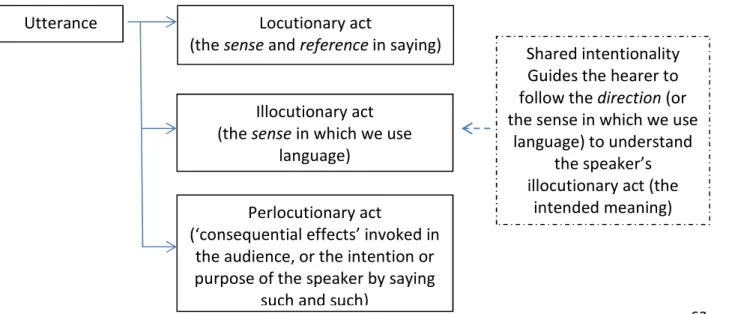
Austin called (9) a primary performative, and (10) an explicit performative. The latter indicates clearly what act had been performed (a promise), while the former left room for uncertainty as to what act it performed, whether it was a promise, or a thought, or a prediction. In the case where (9) was indeed a promise, it essentially carried the same ‘function’ or goal as (10), that is, the performance of a promise. The ‘forms’ of the two sentences, which correspond to its lexical and grammatical features, might differ, while their ‘functions’ could be the same. It is therefore crucial to draw a distinction between the ‘form’ of a sentence and the ‘function’ it performs (Austin, 1975: 99). Austin later on took a different turn with the distinction between constative and performative. Speech acts, whereas previously divided into different types, now shared common properties. He proposed that each utterance carried three different acts, which he himself coined ‘locutionary act’, ‘illocutionary act’, and ‘perlocutionary act’ (Austin, 1975: 103-109). Let’s examine the following example: let’s say it’s an utterance from a speaker called Marta, to a hearer called Ana.
23 ‘Locutionary act’ is basically describing what has been said, with clarification of any disambiguation and reference assignment. So in (11), ‘you’ refers to Ana, the hearer, and ‘now’ denotes the moment Marta uttered the question. In other words, ‘locutionary act’ is the act of saying something (Austin, 1975: 94). The ‘locutionary act’ of (11) is a question from Marta to Ana inquiring about the fact whether Ana has to go home at that time or not. ‘Illocutionary act’ is an act that the speaker wishes to perform in saying something (in 11 the illocutionary act is a request) (Austin, 1975: 99-100). In general, we tend to be ‘indirect’ when we want to order someone else to do something. In (11), by referring to the fact that Ana might have to go home, Marta actually might want to ask Ana to leave. The third act identified by Austin is called the ‘perlocutionary act’, that is, the “‘consequential effects’ invoked in the audience, or the intention or purpose of the speaker by saying such and such” (Austin, 1975: 101). In (11), whether Ana leaves or not (effect on audience), and Marta’s intention in persuading Ana to leave (speaker’s intention/purpose) make up the perlocutionary act.
The locutionary act describes an act of saying something, while the illocutionary act describes that in saying something. One may wonder why such distinction possesses an immense importance to the study of language. The reason lies in the fact that, by distinguishing the ‘form’ and ‘function’ of language use, Austin drew a significant attention to the nature of natural human language (Chapman, 2011: 63).
24 that mean ‘give a finding as to something’ like ‘convict’, ‘rule’; exercitives are concerned with ’excercising of powers, righs, or influence’ by making a decision and include verbs such as ‘appoint’, ‘order’; commissives commit the speaker to a certain action, like ‘promise’, ‘guarantee’; behabitives are speech acts with which the speaker expresses her own attitudes and reactions towards others’ behavior, for example ‘thank’, ‘apologize’; and lastly, expositives are to do with ‘making clear how what is being said fits into its context’, and examples include ‘deny’, ‘testify’ and ‘concede’ (Austin, 1975: 151-152, 160; Chapman, 2011: 64).
Within the framework of ‘speech act theory’, Austin identified the set of conditions, or circumstances, which provide the ground for a performative to count as successful, which he termed ‘the doctrine of the Infelicities’, or also known as ‘felicity conditions’ (Austin, 1975: 14-15). The set of felicity conditions comprised of three types. The first required ‘certain conventional procedures and forms of words’, together with the presence of people involved to make such act successful. The second condition called for the correct and complete execution of the procedure. The third required the existence of certain thoughts, feelings or intentions on the part of the performer, and that they genuinely have these. As we could see, the first two rules apply to formal procedures, such as a wedding ceremony in a church (conventional procedures, certain forms of words uttered by the participants, mainly the priest, the bride and groom, the complete execution of the ceremony etc.).
25 classification of kinds of illocutionary acts”, and that “there is no clear or consistent principle or set of principles on the basis of which [Austin’s] taxonomy is constructed” (Searle, 1979: 9-10, emphasis in original). Searle classified speech acts into five categories; unlike Austin, whose categories were divided in terms of verbs, Searle’s types were distinguished based on the nature of the speech acts themselves, that is, the nature of the acts committed by the speaker by an utterance. Searle’s categories are: ‘assertives’, ‘directives’, ‘commissives’, ‘expressives’, and ‘declarations’ (Searle, 1979: 12-16). The notion of ‘illocutionary force’ – the act performed by an utterance – was of central importance to Searle, since the illocutionary force indicator reveals “what illocutionary force the utterance is to have; that is, what illocutionary act the speaker is performing in the utterance of the sentence” (Searle, 1969: 30). The ‘illocutionary force’ under Searle’s perspectives is seen at ‘macro’ level, identified as “the types of things that speakers typically do”, rather than an identification of individual acts (Chapman, 2011: 66). For example, individual acts such as asking, requesting, advising fall under the category of ‘directives’. Specifically (adapted from Searle, 1979):
Assertives commit the speaker to something’s being the case, to the truth of the expressed proposition.
Directives are attempts by the speaker to get the hearer to do something.
Commissives commit the speaker to some future course of action.
Expressives express a psychological state of the speaker towards some state of affairs.
Declarations bring about some change in the world.
26 The following examples illustrate the above-mentioned definitions, respectively:
(12) The Sun is a star.
(13) Please go visit your Grandmother this week. (14) I will help you with moving.
(15) I am proud that you have finished the race. (16) You are now married.
According to Searle, the types of speech acts do not correspond with specific performative verbs, and vice versa, individual verbs don’t always denote a particular illocutionary force. Searle’s most important contribution to speech act theory is his notion of ‘indirect speech acts’, i.e., “cases in which one illocutionary act is performed indirectly by way of performing another” (Searle, 1979: 31). This notion is perhaps illustrated most clearly in the category of ‘directives’. It doesn’t come as a surprise that people use different forms to solicit action from someone else; after all, it is not common to ask someone to do something by means of a direct request, or order. For examples:
(17) Close the windows!
(18) Could you please close the windows?
(19) It would be great if you could close the windows. (20) It’s a bit cold in here…
27 Searle distinguished between the ‘primary illocutionary act’, and a secondary, ‘literal’ act (Searle, 1979: 33). These forms of expression could be interpreted as ‘directives’ since they are highly conventionalized in daily communication. It is considered customary to ask a question in order to request someone to do something. The literal meaning of (18) is a question about the (physical) capability of the hearer to close the windows; regarding (19) the requested is issued by expressing the speaker’s attitude towards the (requested) action from the hearer. In the case of (20), things get even stranger, since all that the speaker expressed was merely a statement about how she was feeling. The distinction between illocutionary force and the literal meaning of an utterance could be demonstrated even more clearly with the following examples. Imagine your friend comes over for a visit, and you both are sitting at the table, and you ask her:
(21) Could you reach the water jug?
28 Searle also retained the concept of Austin’s ‘felicity conditions’, but revised them as: 1) preparatory conditions (necessary facts for the successful performance of the speech act); 2) sincerity conditions (belief/attitudes from the part of the speaker – similar to Austin’s third type of felicity condition) and 3) essential conditions (the intended purpose of the speech act from the speaker’s point of view) (Searle, 1969: 65). For example, for a ‘directive’ to be successfully carried out, the following conditions must be in place (‘H’ for hearer, ‘S’ for speaker, ‘A’ for a future act by H):
Preparatory conditions: H is able to do A. S believes H is able to do A. it is not obvious to both S and H that H will do A in the normal course of events of his own accord.
Sincerity condition: S wants H to do A.
Essential condition: counts as an attempt to get H to do A.
(Searle, 1969: 66)
29 or the hearer) remain implicit. The implicit request has to be worked out entirely by taking into consideration the context and common ground between the two interlocutors.
ii. Implicature
As we have seen so far, in everyday communication, in order to understand what the other is saying, one cannot only rely on the semantic, literal meaning of the words that constitute the sentence. In fact, one must ‘interpret’ what the other is trying to convey. “Interpretation is a tricky affair” (Mey, 1993: 100), and it’s common for misunderstanding to occur. According to Leech (1983: 30), “Interpreting an utterance is ultimately a matter of guesswork, or (to use a more dignified term), hypothesis formation”. Imagine the following situation: I am about to move house, and a friend of mine enquires about the new place location, to which I reply:
(22) Somewhere in Amsterdam.
31 with occasional occurrence of misunderstanding). Furthermore, what qualifies people as competent ‘guessers’ depends not only on the incorporation of context, but also, and more importantly, relies on the intuitive understanding of how language use works. The latter denotes precisely what Grice observed in everyday communication: people somehow do follow the ‘general principles of language use’ when they want to convey what they mean. Vice versa, to interpret what is conveyed by someone, one also relies on the assumption that the speaker adheres to such principles (Grice, 1989: 86).
The two levels of meaning of utterances in natural language were termed ‘what is said’ and ‘what is implicated’ (Chapman, 2011: 74). To a certain extent, ‘what is said’ corresponds roughly to the literal meaning, or, the truth-conditional meaning, together with elucidation on any ambiguous elements (reference assignment etc.). Any speaker that possesses linguistic knowledge of a language would be able to understand this type of meaning. ‘What is said’ might provide a necessary starting point in order for a hearer to interpret ‘what is implicated’, even in cases where ‘what is implicated’ diverges significantly from ‘what is said’. Anyhow, to understand ‘what is implicated’, or, to grasp an implicature (Grice, 1975: 24), one would have to add more information and also understand the ‘general principles’ of language use.
32 ‘to fold’) (Mey, 1993: 99). What is ‘implied’ then must have been ‘folded in’, and in order to be understood, it has to be ‘unfolded’. It could intuitively be perceived from the etymological root the ‘implicit’ nature of implicature, or in other words, “things that left unsaid but conveyed” (or intended to be conveyed from the speaker’s point of view) (Mey, 1993: 99). Let’s take a look at Grice’s description and classification of ‘implicature’.
From example (22), we could see that there’s an additional layer of information on top of the semantic meaning; this additional meaning, derived via pragmatic principles, is labelled ‘conversational implicature’ by Grice (Grice, 1975: 26). In sum, conversational implicatures are implicatures extracted from the combination of context and adherence to the general principles of language use. Such adherence is part of Grice’s central claim in his theory. Grice proposed that human beings are inherently propelled towards cooperative behavior, which is perhaps most apparent in communication. Grice labelled this set of principles ‘Cooperative Principles’:
Make your conversational contribution such as is required, at the stage at which it occurs, by the accepted purpose or direction of the talk exchange in which you are engaged.
(Grice, 1975: 26)
The superordinate Cooperative Principle mentioned above was then divided into four categories, or ‘maxims’.
33 1) Make your contribution as informative as is required (for the current purposes of the
exchange).
2) Do not make your contribution more informative than is required.
Category of Quality
1) Do not say what you believe to be false.
2) Do not say that for which you lack adequate evidence.
Category of Relation
1) Be relevant.
Category of Manner
1) Avoid obscurity of expression. 2) Avoid ambiguity.
3) Be brief. 4) Be orderly.
(Grice, 1975: 26-27)
34 allow for the fact that subjects of conversation are legitimately changed etc.” (Grice, 1975: 27). The fourth Category, that of Manner, is not concerned with the information itself, but more with how the information is conveyed.
As mentioned, a hearer will arrive at an implicature on the assumption that the speaker adheres to these cooperative principles. Grice (1975: 31-32-33) gave three ‘groups’ of examples to illustrate his theory. Group A involves examples where the observation of the cooperative principles is straightforward such as the following:
(23) Visitor: I’d like to see a movie.
(24) Local: There’s a theater around the corner.
In replying to the visitor’s remark, the local’s answer in (24) led the visitor to believe that there’s a theater nearby, which is open, and also has movies in showing (instead of theatrical plays or other types of performances) etc. This additional layer of information derived from (24) does not lie in its literal meaning, or ‘what is said’. The proposition that the nearby theater is the one where the visitor might want to visit (where she could see movies and not other types of entertainment) is a conversational implicature, given that the local is being cooperative and following the maxim of Relation.
35 living (only that it’ll be in Amsterdam), I am not in a position to be more specific because otherwise I would have to disregard the second Maxim of Quality (which requires me to not say anything for which I do not have adequate evidence). In this case, I, the speaker, was faced with a clash between two maxims, and conversationally implicated that I do not know exactly where I would be moving to.
Group C examines examples where ‘what is said’ seems to go blatantly against what is expected, so that a new interpretation is required if the principles are assumed to be maintained. These situations occur when a speaker, under Grice’s word, ‘flouts’ a maxim for communicative effect (Grice, 1975: 33). This perhaps offers the most interesting cases, where it’s most obvious to see the cooperative principles ‘at work’. These are utterances that, at the level of ‘what is said’, are significantly uncooperative, but turn out to be extremely cooperative.
According to Grice, cases of ‘flouting’ could help reveal how ‘figure of speech’ is at work, such as metaphor or irony. If somebody were to say:
(25) You are the rain to my soul!
36 accustomed to reach the additional layer of meaning (the implicature) without being baffled by the seemingly absurdity of such statements, is the very proof of the existence of the Cooperative Principles, and our (automatic) adherence to them. This also shed light on the nature of Grice’s theory. By no means were the Cooperative Principle proposed as ‘guidelines’ or ‘rule of etiquette’ (Chapman, 2011: 74), even though the Maxims were expressed as imperatives. By proposing this theory of cooperative principle, Grice was in fact trying to summarize and describe, in a systematic way, the ‘general norms by which people actually operate’ (Chapman, 2011: 74).
In order to recognize a conversational implicature, according to Grice, one could refer to the five properties he identified: cancellable, reinforceable, non-detachable, calculable and non-conventional.
37 meaning of “and”, that is, the logical conjunction, “and” from (1) and (2) seems to carry an additional meaning of ‘and then’. Such additional meaning, according to Grice, is not only a conversational implicature, but more specifically, an example of a GCI, due to the fact that, when “and” is used to described two events, people tend to assume that they occur in the order in which they have been stated. Such assumption could be cancelled due to some particular aspect of context as in (27):
(26) Marta did manage to get home, and she got completely drunk last night!
In (26), “and” didn’t carry the ‘and then’ implicature, but the opposite: the two events narrated seem to occur in the reverse order. There seems to be also a register of ‘surprise’ on the part of the speaker, that the first event described could happen after the second event. (1), (2) and (26) show that GCIs are ‘default’ implicature, which will generally occur “in the absence of any particular indications to the contrary”, and will be cancelled otherwise (Grice, 1975: 37).
As opposed to ‘conversational implicatures’, Grice identified another category of implicature, which he coined ‘conventional implicature’. Conventional implicatures are the additional meaning that certain words carry; they are implicatures because these additional meanings are not part of the ‘truth-conditional’ meaning. However, contrary to ‘conversational implicatures’, the meaning that conventional implicatures contribute to ‘what is said’ is a property of these words, instead of being dependent on the context. Examples for conventional implicatures are meanings derived from words like ‘therefore, but, even’ etc. For example:
(27) He is a guy; he is strong.
38 In terms of truth-conditional meaning, the two parts of (27) and (28) are the same. However, in (28), ‘therefore’ indicates a sense of ‘consequence’, and this sense is a conventional implicature, since it doesn’t belong to ‘what is said’. If one were opposed to either part of (27), then one could say that the (27) is false. But if one were to agree with both elements, but opposed to the idea that there’s a causal relationship between them, he/she wouldn’t say that (28) was strictly false, but was opposed to the ‘conventional implicature’ of (28) and not to either element (especially if one were a feminist advocate…)
The above-presented general overview of pragmatics and its main theories discussed the potential difference between ‘what is said’ and ‘what is meant’, the various layers of meaning, and a variety of functions that language use can perform. According to the Ordinary Language Philosophers, people use daily language not only to make statement of facts, but (most of the time) to ‘do things with words’. On the other hand, on top of ‘what is said’, ‘what is meant’ plays a critical part of human communication. Grice’s Cooperative principle provides an invaluable insight into the general ways with which people communicate. This section therefore provides one of the two foundations for my thesis’s main idea: the interaction between shared intentionality and pragmatic processing. In the next section, the second foundation will be presented, which is that of ‘shared intentionality’.
III. Shared intentionality
39 The idea of ‘shared intentionality’ (which comes under various terms, such as ‘we intentionality’, collective intentionality, we-mode etc.; from now on the two terms ‘shared intentionality’ and ‘collective intentionality’ will be used interchangeably) has been the focus of philosophers of action in the last 30 odd years (Chant et. al, 2014: 1). The theory was hypothesized and developed as an answer to the question of how a joint action differs from an individual one. Take the famous example from Margaret Gilbert, that of an extremely simple activity of two people walking together, as opposed to coincidentally walking side by side: in walking together, you and I agree and understand that we do something together, that is, a
40 The theory of ‘shared intentionality’ was developed from the four most influential theories of Michael Bratman, Raimo Tuomela, John Searle, and Margaret Gilbert, to whom Chant et. al (2014: 2) referred to as “the Big Four of collective intentionality”. Each of these four philosophers has offered significant contributions under different perspectives, which shine a light on the constitution of collective or shared intentionality. Intuitively, the term ‘shared intentionality’ presupposes ‘intention that is shared among agents who participate in a joint action’. Such ‘joint intention’ is not merely a collective of individual intentions that happen to match. Human beings are, inherently, intentional agent, but when we place ourselves in a joint act, our intention is shared in pursuit of a common goal. The following part will present and discuss the theories proposed by the Big Four.
41 that we would be committed to mutually supporting each other. In the event that, during our walk, you start getting tired and slow down, I would likewise slow down so that you could get some breath, or maybe offer you some water. I do this with the intention to help you also to fulfil your part and your role in the joint act.
Furthermore, Bratman stipulates the following attitudes necessary to SCA, which runs as follows (with J being the joint act):
(1)(a)(i) I intend that we J.
(1)(a)(ii) I intend that we J in accordance with and because of meshing subplans of (1)(a)(i) and (1)(b)(i).
(1)(b)(i) You intend that we J.
(1)(b)(ii) You intend that we J in accordance with and because of meshing subplans of (1)(a)(i) and (1)(b)(i).
(Bratman, 1992: 333-334)
42 only when they are jointly committed to intend as a body to do such-and-such in the future’ (Gilbert, 2009: 167, emphasis in original), and that agents are “jointly committed with one another in some way a ‘plural subject’” (Gilbert, 2009: 182). According to her, “a joint commitment is not a concatenation of personal commitments” (Gilbert, 2009: 180), hence, the shared intention in this sense is top-down, a priori to any personal intentions and subplans. Viewed under this light, the derived commitments possess a more solid and a greater stability, since neither agent can revise nor change the derived individual commitment at their own will (Gilbert, 2009: 184), or that neither can decide a shared intention for both (Gilbert, 2009: 170). This doesn’t mean that personal intentions do not exist, but rather they are derivable from and guided by the joint commitment (Gilbert, 2009: 184). For example, if you and I were to take a walk together on a day when there will be a woman’s march in the city, and thus several streets would be closed down, and the sub-plan we shared involves me checking which closed streets would there be, I may devise my personal intention to open my laptop and look up this information on Google, as a way of accomplishing my individual commitment to check the information. The fact that each person is bounded to the shared intention imposes a sense of obligation to each party. And precisely for this sense of obligation that Gilbert proposes two criteria for an account of shared intention: the ‘obligation criterion’ and the ‘concurrence criterion’ (Gilbert, 2009: 173). The obligation criterion is stipulated as follows:
an adequate account of shared intention will entail that each party to a shared intention is obligated to each to act as appropriate to the shared intention in conjunction with the rest.
43 The stipulated obligation imposed on each party denotes the consequent sense of ‘rights’, ‘owing’ and ‘owning’: binding ourselves to our shared intention, we owe each other action appropriate to the shared intention, and I have a right against you to such action and vice versa, and precisely due to this right to your action, in some sense, I could claim ownership to that action, and vice versa (Gilbert, 2009: 175-176). For this right, in the case of me veering off during our walk together (an inappropriate action to our shared intention, or a ‘breach’ to such intention), you can both rebuke me for this inappropriate action, and at the same time can also demand that I return should our joint action be fulfilled.
As shown from the example discussed above, the obligation criterion is most apparent in case of a breach of joint action, or a non-conformity to the agreed shared intention (by performing an action inappropriate to the shared intention). The second criterion, also derives from the obligation sense, occurs in the event of a ‘breach of contract’. The concurrence criterion runs as follows:
an adequate account of shared intention will entail that, absent special background understandings, the concurrence of all parties is required in order that a given shared intention be changed or rescinded, or that a given party be released from participating in it.
(Gilbert, 2009: 173)
44 Gilbert, 2009: 173). What you mean is that I am not in a position to unilaterally to decide to stop doing what we have been doing together. This indicates the need for concurrence (from your side) to my changing our joint act: that is, in order for me to act not in accordance with (or against) our shared intention, I would have to come up first with at least some explanation, and more importantly, to ask for your concurrence for me to change or rescind the joint act. The reason is because I have an obligation towards our joint intention, and I owe you the appropriate behavior (on my side) in the pursuit of our joint goal. Note that, by inserting ‘absent special background understandings’, Gilbert meant ‘prior agreements’ regarding the event when either one of us wants to be ‘released’ from the joint act (Gilbert, 2009: 174). If, prior to our joint walk, I told you that I felt quite tired that day, so at any given time I might not be able to continue walking together, your reaction would be quite different from the original example.
Tuomela, in his study of ‘intentional social action’, proposed several concepts. Proper social actions are those that are “performed jointly by several agents we shall call multi-agent actions” (Tuomela & Miller, 1985: 27). The central claim which introduced concepts related to collective intentionality ran as follows:
…all intentional joint many-agent actions will involve some relevant we-attitudes, viz. we-intentions and mutual beliefs plus the we-proattitudes underlying them.
(Tuomela & Miller, 1985: 27)
45 (which they share), at the same time they are aware of others’ intentions, and believe that the others are aware of their own (Tuomela & Miller, 1985: 28-30). We-intentions and the presupposed beliefs guarantee ‘group cohesion’, at the same time make up ‘group pressure’ which inhibits deviation in each member’s expected action (Tuomela & Miller, 1985: 40). Such notion seems to be reminiscent of the sense of obligation and duty proposed by Gilbert, as discussed earlier.
In his book The philosophy of sociality: The shared point of view (2007), Tuomela discussed collective intentionality under the group’s point of view, which he termed
46 Gilbert’s idea of an irreducible we-intention. Going back to the example of taking a walk (together or not): if you and I just happen to have the idea, or an intention of taking a walk (probably also on the same route and at the same time), and I know that you have this idea, and you, vice versa, know that I do too, and if all of these premises occur without us intending to take the walk together (and thus without consequent agreement or planning to meet up at a certain spot at a given time etc.), then our intentions are at the I-mode. Under the I-mode, since each of us function as a private person, I can absolutely change my idea (maybe to take another route, or to start the walk at a different time than yours, or to abandon the whole idea of taking a walk altogether), it wouldn’t affect you in any way whatsoever, or more importantly, to us doing it together. But if we both intend to take the walk as a group (in this case composed of two people), and it is considered under the full-blown view of joint intention, then collective commitment and collectivity condition apply. It’d involve us making some kind of agreement, such as where and when to meet up, perhaps also which route to take. And obviously neither I nor you would even dream of changing our idea on a whim (at least not without some justification). As Tomasello humorously (but also correctly so) put it, acting occasionally this way (breaking up joint intention, acting uncooperatively etc.), one could be thought of as purely eccentric, and acting consistently this way ‘will lead to some kind of psychiatric diagnosis and possible removal from mainstream society’ (adapted from Tomasello, 2008: 92).
47 like only to emphasize that the example and the consequent details entailed only serve to illustrate the points so far discussed.
In his book The construction of social reality (1995), Searle argued that collective intentionality is absolutely irreducible to individual intentionality (Searle, 1995: 24). The ‘sense of doing something together’ is crucial to collective intentionality (as opposed to two actions which happen to synchronize, such as two people happen to walk side by side, without the shared intention to do it together), and individual intentionality is derivable from (and not constitutive of) collective intentionality (again, these points are parallel to those of Gilbert’s) (Searle, 1995: 24-25). Searle illustrated the individualistic view of we-intentions (Figure 2) and the alternative view, which is his holistic view (Figure 3).
Figure 2. Individualistic view of we-intentions
(Searle, 1995: 26)
48 (Searle, 1995: 26)
Up until now, the notion of collective intentionality has been discussed and illustrated mostly as constitutive of social joint act between two agents. Social acts, according to Searle, are thus considered if they involve collective intentionality (Searle, 1995: 26). Social acts can manifest itself in the act of two people taking a walk together (an example which we are by now extremely familiar with), or they can scale up to the constitutional level, involving institutionally constructed notions such as money, marriage, and government. Notions such as the building blocks of social reality, brute and institutional facts, social facts, are not of central focus in my thesis. Nor is the argument on the (ir)reducibility of collective intentionality. Having said that, my stance on this point slants towards the side of irreducibility of shared intentionality, where the sense of ‘we are in this together’ transcends each other’s individual intention, commitment or effort. All in all, the take home message in this part is the essence of shared intentionality: in a joint act together, you and I share ‘our’ intention in pursuit of a
common goal; each of us will do everything not only to guarantee that we each do our part but also to stay alert of the other’s attention and action (viz. mutual responsiveness, in order to coordinate our own action to ensure the successful outcome of the other’s execution of their own part, and in case that the other is in difficulty, then also to extend support from our side); shared intentionality also encompasses mutual commitment, up to the point of mutual
49 ‘we-intend’ in our own head, I would venture that what matters most is the sense of ‘we-ness’ that makes up the DNA of our joint intention and action.
The first and second segments (II and III) have put forth the basic notions that make up my thesis’s main point of interest: the interaction between ‘shared intentionality’ and pragmatic processing. The next part, which is also the central point of my thesis, will examine how ‘shared intentionality’ accounts for pragmatic processing (such process is stipulated by the general rules observed and presented by the main pragmatics’ theories previously discussed).
IV. Pragmatics viewed through the lens of shared intentionality
50 1. Shared intentionality in communicative acts
First of all I’d like to go through briefly the idea proposed by Clark (1996), which views communication as a joint act. In his book Using language, based on Grice’s notion of meaning (especially that of non-natural meaning), Clark interpreted two types of meanings: speaker’s meaning and signal meaning (Clark, 1996: 126). The two meanings are different but connected: “speakers mean something only by using signals, and signals mean something only because they are used by speakers to mean something” (Clark, 1996: 128). Clark used the following gestural communication as an example: a man and his wife were having lunch; the man then looked at his watch in order to remind his wife of an impending dentist appointment (Clark, 1996: 128). The gesture of ‘looking at the watch’ is the signal to convey speaker’s meaning, which in this case is the reminder of the dentist appointment. Based upon this distinction, Clark then came to the definition of a communicative act (which is, by itself, a joint act):
The joint act of one person signaling another and the second recognizing what the first meant.
(Clark, 1996: 130)
To use yet another example from Clark (1996: 131), this time using linguistic as means of communication: in a frame of a joint (communicative) act called r, A presents signal s to B (e.g., by uttering “Please sit down”), meaning that p (e.g., that he is to sit down). A expects B to do his part, that is to recognize what she means (p) by seeing that she is uttering “Please sit down”.
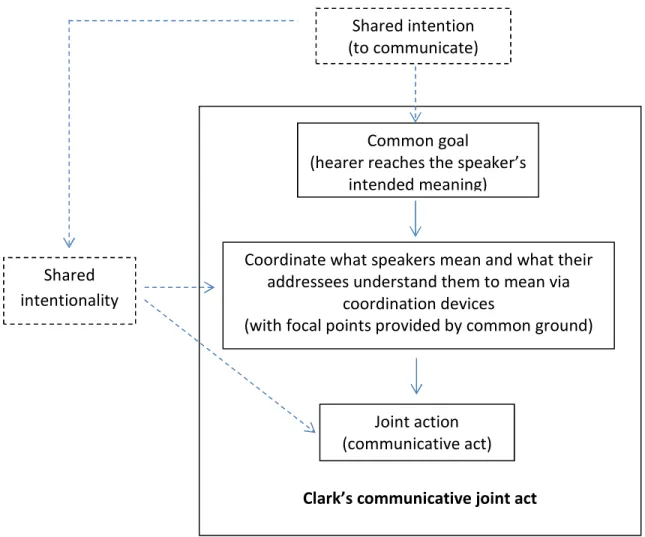
52 Figure 4: Shared intentionality framework in pragmatic processing (within a communicative joint act)
Communicative act (joint act)
Shared intention: speaker signaling so that hearer recognizes speaker’s meaning
Speaker A Hearer B
Signal Meaning
A’s intention regarding the ‘direction’ that B is to take to arrive at meaning (or to interpret A’s utterance)
B recognizes A’s intention and takes such direction to arrive at A’s meaning
CONTEXT &
COMMON GROUND
‘Shared intentionality’ features Mutual commitment Mutual responsiveness
53 Under the proposed framework (visualized as in the diagram above), communication is a joint act, and the shared intention involves two components: the discharge of signaling from the speaker and the recognition of speaker’s meaning on the hearer’s side. By no means does this mean that the shared intention is made up of two separate, personal acts or ‘intentions’ of the speaker and hearer, respectively. Rather, it is a unified flow of communication: the two afore-mentioned components (speaker’s signaling and hearer’s recognition of meaning) are derivable from the shared intention. The ultimate joint goal is the hearer’s understanding of the speaker’s conveyed meaning. In the final frame containing the specific role of the agents (speaker and hearer) lies my proposed interpretation of Clark’s definition of joint communicative acts: there’s a certain direction in which the speaker’s meaning is to be taken, in order for it to be understood; the speaker, taking in the context and common ground, attempts to convey what he/she means by issuing a signal. In my view, such signal is used as a way to get the hearer recognize the direction in which the utterance is to be taken and interpreted.
The following example will serve to illustrate what I mean by ‘direction’:
54 to arrive at my intended meaning. The speaker’s intention regarding the direction which the hearer is to take is not to be confused with the ‘shared intention’ of the communicative act as a whole. The boxes underneath the speaker and the hearer in the diagram (A’s intention regarding the direction, B recognizes etc.) are the means subserving the overarching shared intention of the communicative act.
55 sequence for the said enunciation. At a psychological level, shared intentionality comes in as a framework on which communicative act (a joint act) leans on, and as a ratchet that propels the flow of the communicative act. It is indeed a psychological drive that pushes participants towards the characteristics and features that make up shared intentionality, in order to reach the ultimate goal of the joint communicative act.
Under the framework of ‘shared intentionality’, in the flow of a communicative joint act, A and B will do everything they can to guarantee that they each do their part to make sure that A’s signal (taking into account the context and mutual common ground) marks the ‘direction’ on how A’s meaning is to be taken, and that B (in her turn, also takes into account the context and mutual common ground) takes on the right ‘direction’ to arrive at A’s meaning. ‘Shared intentionality’ also imposes both agents’ awareness of their common ground, and ensure that their exchanges should remain well in the joint attentional frame. Interlocutors must also commit themselves to the communicative act. (Please note that the whole process is A and B’s shared intention, but the fact that B arrives at the correct intended meaning of A is their common goal. Whether or not the common goal is achieved (or at least not immediately at the first round of exchanging), the communicative act is still a joint act, as long as the agents have shared intention and all the other above-mentioned qualities.) I would also like to emphasize the crucial role that context and common ground play within the course of a conversation. Without them, people would be at a loss when they attempt to establish the ‘direction’ with which their utterance is to be taken.
56 happen to say something that resembles a conversation without jointly communicating. For example, two women happen to be in two adjacent cubicles in a restroom, both talking on the phone. Imagine that what they say appears to sync (at least for a while), like one says “Hey, how are you?”, and the other says “I’m good, how are you?” The two utterances, on the surface, could be seen as a pair in a conversation, but this is utterly not a joint act, because before long what they say (on their phone, respectively), will veer off into different directions, without offending the other in any way whatsoever. The first utterance was not meant as the question for the other person in the other cubicle, nor was the answer vice versa. When you and I are to jointly have an exchange, then all the features of ‘shared intentionality’ apply. If I were to ask you “Hey, how are you?”, then you in return, being responsive to my part in the joint act, will reply accordingly by telling me how you are. The joint commitment would also mean that you could not just ignore my ‘signaling’ (in this case a question to request to know how you are) and offer a completely unrelated information such as “The watermelon is in season now.”, without a good a valid reason for doing so (e.g., by saying so, you mean you do not want to talk about how you are). Joint commitment also presupposes (mutual) intention and belief, that when I initiate the conversation with you, I do have the intention to do so, and believe that you would have the same intention to partake in the communicative act between us.
57 express myself will make the direction I want you to understand what I mean more clear, and thus you can recognize the direction and ultimately the meaning of my utterance. During the conversation, the obligation and concurrence criterion also apply: if at some point you do not (or cannot) continue talking, you will seek my ‘approval’ for your opting out of our joint act, by offering some excuse such as “I’m sorry I can’t talk anymore because I have to go now”.
58 Even though the characteristics of shared intentionality (mutual responsiveness, mutual support, joint commitment and obligation) are expressed seemingly as a conscious process, I would argue that this psychological frame operates at the subconscious level. Since the cooperative nature of human being is inherent and innate (Tomasello, 2009: XIII), thus shared intentionality, which has evolved to subserve human cooperative activity, must also be innately built in. This built-in mechanism is the scheme that drives us towards all the characteristic behaviors listed above. Because of this, in a joint act, we are responsive to each other not because that prior to executing the act, we explicitly agree to be responsive, or that we tell ourselves “We have to be responsive to the other, remember that!”. We don’t have to remind ourselves of that simply because it’s an inherent drive already built in, and such mutual responsiveness is implicitly understood and shared between us. The same goes for the other characteristics. This innate quality could be illustrated in the simplest example of communication: a complete stranger in the street turns to you and asks you for the time; you would naturally tell him/her the time if you could, which is due to natural, innate helpful and cooperative tendency. But on a communicative level, the fact that you reply at all to someone you don’t know, that you in turn are committed to the conversation and act your part, is all due to shared intentionality that comes built-in inside you.
59 the “dynamic development” (and not just the context) of the conversation that guides our understanding (Mey, 1993: 9). In the cases of unachieved goal of a correct understanding on the hearer’s side, I would venture that the reason for it to occur is the mismatch of direction from both sides. The mismatch of direction may be caused indirectly by a mismatch in
(assumption of) mutual common ground. Let’s take a look at the following example (adapted from Mey, 1993: 8-9):
You and I are in a part of town which is in neither’s own neighborhood, but I have been before, so I think I know the way.
(29) Me: Do you know the way back to the city center? We can go in my car. (30) You: Ok!
While driving back, you however keep giving me directions, which irritates me since I initially thought that I needed to guide you, not the other way around. I therefore speed up so that you don’t get a chance to interfere, after which you say:
(31) You: Oh, I thought you didn’t know the way back. (32) Me: I thought you didn’t know!
(whereupon we both start laughing).
60 confusion was cleared up in (31) and (32). I would interpret the misunderstanding and whole situation as following: there was a mismatch in the assumption of mutual common ground, which led to a mismatch in direction of how the meaning of (29) is to be taken. I knew the way and at the same time assumed that you might not, and thus meant (29) to be taken as a real question. Vice versa, you knew the way and perhaps assumed that I didn’t, took (29) as an indirect request. Your reply in (30) didn’t really help either, since it’s only a partial reply (to the second half of (29) but not to my question in the first half). This mismatch in (assumption of) common ground (which is manifested in (31) and (32)) led to the mismatch in direction of the interpretation of (29). You and I however are still committed to our joint act, and thus, after seeing that, after the first round of exchange, you didn’t arrive at my intended meaning (which has never been ambiguous in the first place), we both made effort to clear up the confusion (by making reference to our own assumption in (31) and (32)).
There’s another interesting example from Clark (1996: 131), which ran as follows: