M.S. in I.S.degree. May, 2020. 37 pages. Advisor: Ryan Shaw.
This paper design and develops a interactive Publication Management System for Renaissance Computing Institute at the University of North Carolina at Chapel Hill. This system supports allows users to insert publication by only providing the DOI information, search publication stored in the database with up to 5 metrics.
Renaissance Computing Institute develops and deploys advanced technologies to enable research discoveries and practical innovations. Publication Management System would play an important role in making full use of the existing publications, as well as keeping and managing publications.
Headings:
PROJECT REPORT
by Bo Zhou
A Master’s paper submitted to the faculty of the School of Information and Library Science of the University of North Carolina at Chapel Hill
in partial fulfillment of the requirements for the degree of Master of Science in
Information Science.
Chapel Hill, North Carolina
May 2020
Approved by
Table of Contents
SECTION 1. INTRODUCTION ... 2
1.1 BACKGROUND ... 2
1.2 OBJECTIVES ... 4
1.3 RESEARCH QUESTIONS ... 4
1.4 DEFINITION OF TERMS ... 6
SECTION 2. LITERATURE REVIEW... 7
2.1 THE PRACTICES OF PUBLICATION MANAGEMENT SYSTEM ... 7
2.1.1 Bibliography Management Systems ... 7
2.1.2 Online resources for locating Scientific Literature ... 8
2.1.3 Enterprise Content Management Systems... 9
2.2 SYSTEM DESIGN ... 9
2.3 EVALUATIONS... 11
SECTION 3. SYSTEM DESIGN AND METHODS ... 13
3.1 USER REQUIREMENTS COLLECTION ... 13
3.2 USER REQUIREMENTS ANALYSIS ... 13
3.3ARCHITECTURE DESIGN ... 15
3.3.1 Database Design ... 15
3.3.2 Backend Design ... 17
3.3.3 Database Insertion & RESTful API Design ... 18
3.3.3 Frontend Design ... 22
3.4ANTICIPATED IMPACT ... 27
SECTION 4. CONCLUSION AND USER FEEDBACK ... 31
4.1USER FEEDBACK ... 31
4.2LIMITATIONS ... 32
Section 1. Introduction
1.1 Background
Publication management is a relatively time-consuming and sophisticated
procedure. Even though we can make it easier by implementing software
or applications, potential risks exist when unexpected publication breaks
the system, leading the server down and the entire system encounter
privacy issues. Interactive web design is a good way to reduce potential
risks and improve usability. Changes in the database or server should be
shown at user’s interface interactively, instead of reloading the entire web
page. On the other hand, any updates from the client side should be
processed by backend server as well.
Renaissance Computing Institute (RENCI) is an institute of the University
of North Carolina at Chapel Hill, aiming to develop and deploy advanced
technologies to enable research discoveries and practical innovations1.
Researchers at RENCI publish numerous publications every year and are
involved in different research team. How to collect various types of paper
and make full use of these data as research goes on is a big concern to
which can be inserted through a form, allowing users to fill in different
attributes, such as title, author, category, published date, DOI, etc… These
operations seem easy to use and are user-friendly, however, when the
scale becomes larger and larger, these steps would be extremely
time-consuming and even impossible to complete. Therefore, an interactive
automation process should be in place to manage publications more
efficiently and further enable advanced function to make full use of these
publications.
As a web developer intern at RENCI, I mainly responsible for the design
and development of RENCI Publication Management System to help them
improve efficiency and make full use of existing publications. At higher
level, the RENCI Publication Management System is built using the MERN
(MongoDB, Express, React, Node.js) stack. The user interface is created
using React JavaScript Framework, which is responsive thus users can
have more interactions without even refreshing the page. MongoDB is
chosen as a database system since the publication is more
1.2 Objectives
The main goal of this paper is to provide an overview of the entire process
of RENCI Publication Management System design and development in a
real-world environment, including gathering requirements, system design
and analysis, implementation, deployment and evaluation. As for
requirement gathering, I will meet with both project managers and
researchers at RENCI, understanding their demands and concerns. Since
the Publication Management System would be integrated into RENCI’s
current website in the future, it is important for me to generate a design
plan that would fit into RENCI’s overall design. Moreover, the development
of Publication Management System should not only realize required CRUD
(create, read, update, delete) functions, but also be able to handle large
data sets interactively and prevent unexpected error. Usability testing
would be collected in the final stage and an analysis will be generated to
reflect overall result. Therefore, this paper can provide suggestions of
Publication Management System development and design for future
project managers and web browser developers.
1.3 Research Questions
This research is conducted based on the following research questions:
RQ1: What are the advantages and disadvantages of NoSQL database,
Relational and NoSQL database are often compared with each other in
different development settings. Therefore, the research will dig into current
area of interest, publication management system, and compare both
strengths and weaknesses of each other.
RQ2: How are users interacting with the system, what information do users
need?
Potential users at RENCI have various roles, from researchers to project
managers. To understand how well our system is being used by users and
make sure users get the information they want, the research will collect
user’s feedback individually and generate an analysis report to answer this
research question.
RQ3: Does the usability testing results meet the user’s needs?
A proposed plan for usability testing of the RENCI Publication
Management System, including goals and tasks, will be beneficial for this
research to understand the overall user’s experience when using this tool
1.4 Definition of Terms
Relational Database (RDBMS) refers to a database that stores data in a
structured format, using rows and columns. The relational structure makes
it possible to run queries across multiple tables at once.
NoSQL Database includes simplicity of design, simpler horizontal scaling
to clusters of machines and finer control over availability. The data
structures used by NoSQL databases are different from those used by
default in relational databases which makes some operations faster in
Section 2. Literature Review
Introduction
In this section, literature that is related to Publication Management System
and web development process is reviewed. Much emphasis has been
focused on system design and evaluation, which are the backbones and
guidelines for this project.
2.1 The Practices of Publication Management System
Publication Management System is not the only term that is used to
describe the software that manages research paper. If we separate them
into different purposes, there are mainly three types: Bibliography
Management Systems for recording and utilizing bibliography citations,
various online platforms for researchers to locate scientific literature and
enterprise content management systems created to manage critical
information for organizations (Naak, 2008).
2.1.1 Bibliography Management Systems
Bibliography management systems are often referred as citation
platforms such as BibTeX and EndNote, allowing users to store citations
which later could generate bibliographies, like a list of citation references.
The flow of completing an article generation with XBMS can be separated
into 4 phases, which are editing phase, validating phase, associating
phase and transformation phase.
However, the increase in the size of collections has made bibliography
management one of the most frustrating tasks that researchers have
encountered (Naak, 2008, p2). Therefore, automation processes are
essential if we are going to build modern comprehensive Publication
Management System.
2.1.2 Online resources for locating Scientific Literature
Among various online resources, TechLens combines Collaborative and
Content-Based recommendation functions to help user better locate
scientific literature. In addition, Nishikant has made a way to improve the
TechLens workflow by using user’s personal citation libraries to enhance
his profile and better provide recommendations (Nishikant, 2007). Tang
also propose a recommender system which takes pedagogical aspects
into consideration (Tang, 2009).
Therefore, personal profile seems like a good way for online publication
management system to either provide accurate results or make the
2.1.3 Enterprise Content Management Systems
One of the deficiencies in business software system development is that
developed system can’t change adaptively when the business upper
management pattern change (Yu & Li, 2006). Enterprise Content
Management (ECM) systems are designed to facilitate the storage,
sharing, management and retrieval of critical information and processes for
organizations, teams and individuals. It is necessary to have always
available information on who did what, how and in cooperation with whom,
when processing a task (Simonova & Hudec, 2015). Systems like LiveLink
is designed to manage context and relative knowledge in an institutional
context, as well as some other advanced functions like archiving,
collaboration and digital asset management. These supportive functions
are very helpful to big organizations where different people have different
goals to achieve. Morever, when it comes to enterprise content
management systems, we should focus more on stability and consistency.
2.2 System Design
Web application is an interactive system which allows user to have various
of interaction with the system. Yan and Guo summarized that in
information architecture, the focus is on the organization, navigation,
labeling and search systems that offer accessibility to the end user (Yan &
design management framework leveraging design thinking and system
thinking that take human-centeredness, understanding and acting of
various stakeholders systemically into consideration (Vinnakota, 2016).
Therefore, we would rather identify the aesthetics of a user interface as a
separate metric apart from its functionality. We should focus more on the
satisfactory of a human user rather than the completion of required and
other supportive functions. It is essential for us to separate the entire
design into functional design and UI design.
The ever-growing complexity and operational scale of such systems
means that the software must be validated at a level of scrutiny far greater
than what manual quality assurance can accomplish (Hamill et. al., 2009).
The Validation and verification techniques for effective privacy controls for
secure data transmission. As for publications within an organization, which
are properties of an organization, we need to validate each publication that
is indeed accurate and has no missing values. Therefore, users should be
able to interact with the system in a secure condition, and both frontend
and backend server need to have validation function in place before any
A “user” in an UCD approach is considered to be knowledgeable and
motivated about their work tasks and as such the goal for a designer is to
design a tool to help users complete their work tasks easily and efficiently
(Quintana et. al., 2000). Along with the idea of user-centered design, UI
design will emphasize more on interaction and responsiveness of the
application. This project aims to apply the latest web technology and
framework to Publication Management area, in order to make it more
interactive and responsive.
2.3 Evaluations
Since our web applications are versatile and diverse, the importance of
evaluation and usability testing are not a child’s play. Jacob Nielsen, a
Usability guru defines the usability according to the five components:
Learnability, Efficiency, Memerobility, Few Errors, and Users' Satisfaction
(Nielson, 1994). Another approach taken by H. Shahizan and Li Feng for
the evaluation of the web usability is benchmarking (Shahizan & Li, 2005).
They include seven comprehensive phases, which are screen appearance,
consistency, accessibility, and navigation, media use, interactivity and
According to Wang and Yan, linking the analysis results of usability testing
data and product design patterns would find out the source of usability
problems and give practical guide (Wang & Yan, 2011). In addition,
Voigt-Antons found that their results reveal that participants seem to be unable
to rate the usability and Quality of Experience independently from each
other (Voigt-Antons et. al., 2018).
Therefore, when conducting evaluation and usability testing, it is always
important to link to the actual situation and also take user’s quality of
experience into consideration. This provides a guideline for how to gather
user’s feedback for evaluating the entire RENCI Publication Management
Section 3. System Design and Methods
3.1 User Requirements Collection
In this paper, requirements collection would be done individually through
interviews within Renaissance Computing Institute about the needs for the
Publication Management System from different user groups. I will set up
appointments with various user groups, including but not limited to project
managers, researchers, research developers, digital content specialist,
administration people. Thoughts and relevant information will be collected,
and the final requirement analysis should point out the main functionalities
for Publication Management System which satisfies various user needs.
3.2 User Requirements Analysis
“Requirement analysis is the process of analyzing a new or modified
product and determining the user expectations for the product” (Rouse,
2007, paragraph 1).
Specifically, the requirements analysis includes gathering user’s feedback,
analyze the data, and make a guideline for further development and
Here are some required functionalities:
● The system should be able to create, read, update and delete
publications from the backend database. As the core function of
Publication Management, it should categorize different RENCI
publications, store and update them responsively.
● It should support basic and advanced search function, where users
can choose multiple filters to get the search results they want. This
would require the system assuring not only the database is ready to
process any search but also the frontend is reflecting any new
updates such as new categories or time period.
● The system would support data visualization function, showing the
category patterns in a pie chart.
● The system is capable of inserting multiple publications at the same
time, or have some automation process that allows bulk ingest
function. Due to the large amount of RENCI publication, it is not a
wise decision if the system only allows user to insert one publication
at one time.
● The system should validate and verify publication before any
operation can be done. Due to the large amount of publications,
there are chances that users mistype the DOI of a publication,
into database. What’s even worse is that the system stores the
wrong publication into the database and user does not have a
chance to figure that out.
Some other requirements might exist along with these required functions.
For example, Nishikant et al.’s approach to develop a personal profile
page, store search history or customized homepage as user’s demand.
However, due to the limited time period, these advanced functionalities
might only be considered as future improvement of the proposed system.
3.3 Architecture Design
Data in this project is mainly about publications at RENCI. This section
discusses two main part where data transfer happens, one is at the
database server, and the other is consume RESTful API to retrieve data
from external servers. How are these data stored and fetched are
concerned and proposed.
3.3.1 Database Design
The database used to store publication for the entire project has two
models required in the project.
1. User Model:
This user model is used to store user’s account information and
Publication Management System. Basic user schema would include
id, email, first name, last name and password.
2. Publication Model:
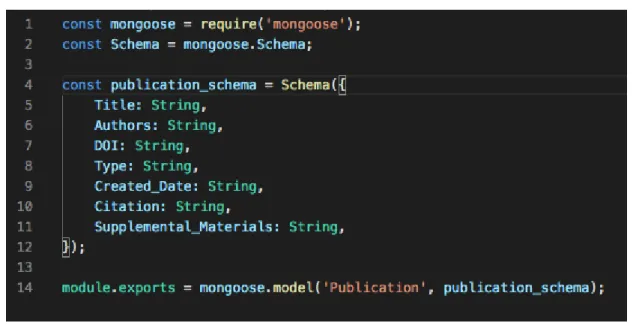
Publication model is relatively more sophisticated compared to user
model, containing DOI information, title, author, category, citation,
created date information and supplemental materials fields, which
users can use to store information rather than the previous fields
provided (Figure 1).
Figure 1. Publication Data Model
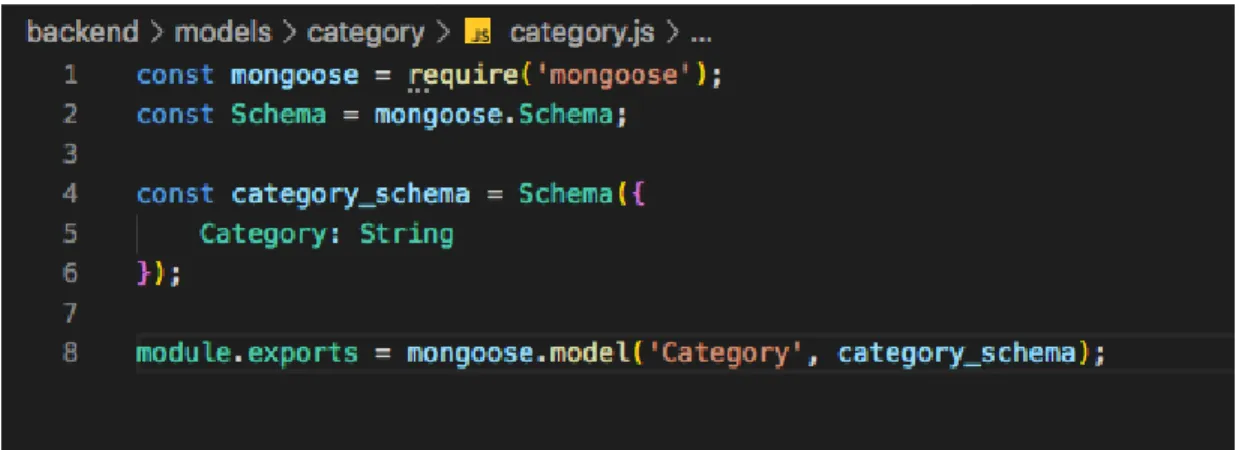
3. Category Model:
When linking database to our system, it should be vital that any new
categories added to the database should be reflected to the frontend
Figure 2. Category Data Model
3.3.2 Backend Design
The entire backend system is built on top of Express.js framework. To
improve code readability and architecture, it will be made up of controllers,
data models, database configuration and router components. In this way,
developers can have a better understanding of how the backend system
works and it is easier to modify or add new features in the future. A tree
Figure 3
3.3.3 Database Insertion & RESTful API Design
This section mainly describes how to use external API to improve overall
efficiency when inserting a large amount of publications into the database.
Rather than typing in each field manually, setting up RESTful API would
save both user and systems’ processing time and improve the workflow at
Citation.js API provides RESTful API where our system can retrieve
publication information by sending requests, including title, author, doi,
creation date. This would be implemented in the express backend server.
a) Setup
First of all, we need to load Citation.js into our controller (Figure 4).
Figure 4
Once we have a publication’s DOI, we can fetch every piece of
metadata it includes, by calling ‘Cite’ method (Figure 5). By
specifying bibliography, we are able to generate an APA style
citation. Along with citation, it also includes publication title, authors,
created date, category and other details which can be further used in
our publication management system.
Once we fetch all the data using Citation.js, it is essential to make
sure that the data retrieved is valid. There would be times that the
DOI is invalid, or the Citation.js itself does not include this publication
information. A ‘Try-Catch’ logic is implemented (Figure 6) to detect
potential errors and prevent this application from breaking down.
Figure 6 c) Frontend Validation
If we use backend validation to filter those invalid results, this
frontend validation is to provide a way for users to decide whether
the information is the one that they want to add. If data retrieved
from the backend system is irrelevant or incorrect. They can choose
not to insert them at this process. By checking boxes on the left side
of each publication, the frontend React application would send the
filtered requests to the backend system, where it would be insert into
the database.
d) Database Insertion
Like we discussed in the previous section, our MongoDB consists of
user information. We keep it in this way because publication
categories would play an important role in our ‘Search Function’.
Keeping it in a separate, relatively light-weight database allows us to
update the React frontend application very quickly.
As the importance of publication categories being discussed, it is
necessary for us to make sure that each publication will have its
category inserted into the category collection. MongoDB will not
detect duplicates when doing insertion operations. Therefore, find
method is used to check whether the publication has its category in
place, and if not, we will add these categories accordingly (Figure 7).
Figure 7
Once we make sure that the publication category is in place, we can
Figure 8
3.3.3 Frontend Design
Interactive JavaScript Framework has played a vital role when designing
and developing modern responsive websites. React is used in this
application as we can take advantage of its high responsiveness, updating
web contents without refreshing the entire website, which would take more
time and might further decrease user experience.
Material UI is implemented throughout entire application, which makes web
development faster and easier.
a) Homepage Design
The main function of homepage is the search function, where user can
search for publication stored in the database using up to 5 metrics,
The category filter fields will load before any search operation, which would
require very quick database response. Again, keeping publication category
in a separate collection would greatly improve loading performance.
Along with search function, this application also provides a data
visualization board for users to better understanding the category patterns
of results. Pie chart is used to show the percentage of each category in
resulting publications (Figure 10).
As we discussed in the previous section, each publication would come
along with a citation. For users who want to search for some publications
and then cite them accordingly. Our application also provides a download
citation tab, where users can download a list of citations, which will be
Figure 9
Figure 11
b) Add Page Design
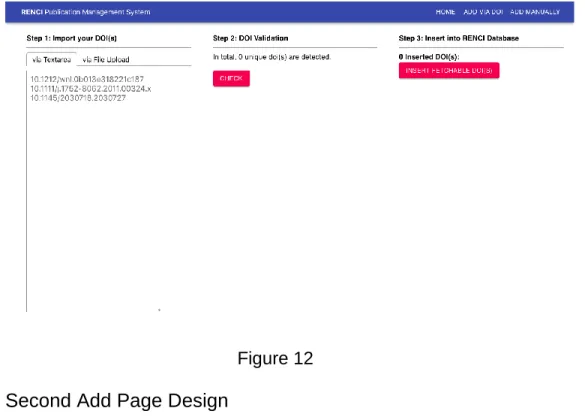
As being discussed, this ‘Add’ page would support publication
insertion. Built on top of RESTful API, which means users only need
to provide DOI information of a publication and the system would do
the rest of work. Considering that there might be a huge amount of
user input request, we provide two different methods for users to
dump in their DOIs. One solution is that user can copy a list of DOI
into the textarea provided and the other is through file upload (Figure
12).
To complete publication insertion, a user needs to go through three
steps as listed on the page. After loading all the DOI information, the
information is valid and the metadata shown is exactly the same as
user’s intention. If there is any DOI that has already added to the
database, it would be detected at this step and notify user that it is
stored in the database. If every piece of information is correct and
users are ready to insert them into the database, they can click the
‘INSERT’ button at the right. All the confirmed metadata would be
added to MongoDB database at this step.
Figure 12
c) Second Add Page Design
There might be circumstances that the main ‘Add’ function does not
provide correct publication metadata, or a user does not have its DOI
information. This second Add page would serve as an alternative solution.
Five fields are provided, and users can choose one category field out of
Once the user clicks ‘INSERT’ button, all metadata would be added to the
database, including the specific category collection. Supporting this
function would allow us to expand the user target group.
Figure 13
3.4 Anticipated Impact
If the system is developed successfully and meet all required functions, it
should be able to have a homepage (Figure 14), which would allow users
to browse all publications stored in RENCI’s database, along with ‘search’
function, where users are able to make query to get results they want, an
‘add’ page, where users can paste a list of publication’s dois (Figure 15a)
(Figure 15b), along with user authentication and verification. The
development is still in progress, so the figure shown here is of full
functionalities.
Figure 14. Homepage of RENCI Publication Management System
As for UI design, the primary goal to implement user-centered design,
where most of the goals in the user’s requirements are met. The second
overall design ideas and style, because in the future it might be integrated
into the RENCI website.
Section 4. Conclusion and User Feedback
This paper gives an overview of the design and development of a
Publication Management System in a real-world environment. Single Page
Application has become a hot topic in the recent year, its high
responsiveness enables user to have a better user experience when
comparing with traditional website, especially when it comes to dashboard
and interactive system design and development. From the usage of
NoSQL in this application, it greatly improves the overall backend
performance as it is relatively a lightweight database choice. Express.js is
always a hot pick in the node.js backend development.
4.1 User Feedback
Throughout the entire development process, several talks and meetings
have been scheduled to listen to user’ feedback and make the application
better meet user’s demand. It is very essential that we should keep user’s
words in mind while developing, rather than just implementing what we
have in our mind.
Brittany Todd, one of the Project Manager Team at Renaissance
within the big RENCI homepage, which is very inspiring. Developing a
project probably would take a period of time, which means there might be
changes in the outside world and we need to make sure our application
can fit into the bigger picture very well.
4.2 Limitations
There are certain limitations existing in this paper. Automatic publication
insertion is really useful when users have their DOI in place. However,
when it comes to those publications that does not have a DOI, it might take
extra time and effort to insert a certain amount of publications using
‘Add-Manually’ function.
There could also be chances that some users might not be in flavor in of
auto-insert function when compared with traditional input-insert function.
References
A. Naak, H. Hage and E. Aïmeur, "Papyres: A Research Paper Management System," 2008 10th IEEE Conference on E-Commerce Technology and the Fifth IEEE Conference on Enterprise Computing,
E-Commerce and E-Services, Washington, DC, 2008, pp. 201-208. doi:
10.1109/CECandEEE.2008.132
E. Folmer and J. Bosch. "Architecting for Usability: A Survey," Journal of
Systems and Software, Issue 70-1, January 2004, pp. 61-78.
Emmanuel Hooper, 2009: E. Hooper, "Intelligent strategies for secure complex systems integration and design, effective risk management and privacy,"
2009 3rd Annual IEEE Systems Conference, Vancouver, BC, 2009, pp.
257- 261. doi: 10.1109/SYSTEMS.2009.4815808
Guan et al. S. Guan, W. Hu and H. Zhou, "Front-end and Back-end Separation - React Based Framework for Networked Remote Control Laboratory,"
2018 37th Chinese Control Conference (CCC), Wuhan, 2018, pp.
6314-6319.doi: 10.23919/ChiCC.2018.8483988
P. Hamill, D. Alexander and S. Shasharina, "Web Service Validation Enabling Test-Driven Development of Service-Oriented Applications," 2009 Congress on
Services - I, Los Angeles, CA, 2009, pp. 467-470.
doi: 10.1109/SERVICES-I.2009.113
H. Shahizan, L. Feng, "Evaluating the Usability and Content Usefulness of Web Sites: A Benchmarking approach," Journal of Electronic Commerce in
Organizations, ABI/INFORM Global, Apr-Jun 2005, pp. 46
Introduction to NoSQL. (n.d.) Retrieved from
https://www.geeksforgeeks.org/introduction-to-nosql/.
ACM conference on Recommender systems Minneapolis, MN, USA: ACM, 2007, pp. 183-184.
Quintana, C., Krajcik, J., & Soloway, E., Exploring a Structured Definition for Learner-Centered Design. In B. Fishman & S. O'Connor-Divelbiss (Eds.),
Fourth International Conference of the Learning Sciences, pp.
256-263, 2000.
RDBMS. (n.d.). Retrieved from https://techterms.com/definition/rdbms/.
Rouse, M. (2007). requirements analysis (requirements engineering). Retrieved from
http://searchsoftwarequality.techtarget.com/definition/requirements-analysis
S. Simonova and A. Hudec, "Enterprise content management based on identified requirements," 2015 International Conference on Information and Digital Technologies, Zilina, 2015, pp. 324-329. doi: 10.1109/DT.2015.7222991 Tang, T. Y., & Mccalla, G. (2009). A Multidimensional Paper Recommender:
Experiments and Evaluations. IEEE Internet Computing, 13(4), 34–41. doi:
10.1109/mic.2009.73
Tseng-Chang Yen and Shang-Juh Kao, "XBMS - an open XML bibliography management system," Third International Conference on Information Technology and Applications (ICITA'05), Sydney, NSW, 2005, pp. 88-94 vol.1. doi: 10.1109/ICITA.2005.314
T. Vinnakota, "A conceptual framework for complex system design and design management," 2016 Annual IEEE Systems Conference (SysCon), Orlando, FL, 2016, pp. 1-6. doi: 10.1109/SYSCON.2016.7490575 J. Voigt-Antons, T. Hoβfeld, S. Egger-Lampl, R. Schatz and S. Möller, "User
Experience of Web Browsing - The Relationship of Usability and Quality of Experience," 2018 Tenth International Conference on Quality of
Multimedia Experience (QoMEX), Cagliari, 2018, pp.
13.doi:10.1109/QoMEX.2018.8463383
Control and Industrial Engineering, Wuhan, 2011, pp. 395-398. doi: 10.1109/CCIENG.2011.6008042
X. Huang, A. An, N. Cercone, and G. Promhouse, "Discovery of interesting association rules from Liv elink web log data," in IEEE International Conference on Data Mining (ICDM 2002), Maebashi, Japan, 2002, pp. 763- 766.
Pei Yan and Jiao Guo, "The research of Web usability design," 2010 The 2nd International Conference on Computer and Automation Engineering (ICCAE), Singapore, 2010, pp. 480-483. doi:
10.1109/ICCAE.2010.5451619
Y. Hai-jie and L. Xiang-yang, "Enterprise Software System Development Based o n Management Pattern Components," 2006 International Conference on Management Science and Engineering, Lille, 2006, pp. 213-217. doi: