PUT YOUR HEART INTO IT: DOES PHYSIOLOGY FACILITATE COPING WITH RACIAL DISCRIMINATION AND CAN THIS PROCESS REDUCE MENTAL HEALTH
SYMPTOMS?
Vanessa V. Volpe
A dissertation presented to the faculty of the University of North Carolina at Chapel Hill in partial fulfillment of the requirements for the degree of Doctor of Philosophy in the Department
of Psychology and Neuroscience (Developmental Psychology).
Chapel Hill 2016
! """! ABSTRACT
Vanessa V. Volpe: Put Your Heart into it: Does Physiology Facilitate Coping with Racial Discrimination and Can this Process Reduce Mental Health Symptoms?
(Under the direction of Jean-Louis Gariépy and Patrick Curran)
Racial discrimination is a central contributor to racial disparities in mental health, even after controlling for socioeconomic status (Williams & Mohammed, 2009). Furthermore, both self-reports of racial discrimination and mental health symptoms increase during the transition from adolescence to young adulthood for Black college students attending a predominantly White institution. While many Black students draw upon coping strategies to combat the risk that racial discrimination poses to their mental health, the extant literature is unclear regarding which strategies are most optimal. The present study aimed to clarify the coping literature by examining intraindividual estimates of respiratory sinus arrhythmia (RSA) as partial mediators in the
relation between coping strategies and mental health symptoms. Black college students completed an online questionnaire (N=205) and a laboratory visit that recorded heart rate in response to an in vivo challenge via electrocardiogram (N=115). Using structural equation modeling and time series analysis, results indicated that: 1) more frequent use of John Henryism to cope with racial discrimination was uniquely associated with fewer self-reported symptoms of depression and anxiety in the short-term, above and beyond other coping strategies, and 2) elements of RSA during recovery from the challenge were directly associated with coping strategies and mental health symptoms. Frequency of use of John Henryism may merit further examination as an index of health risk during the transition from adolescence to young
! "#!
! #!
! #"!
ACKNOWLEDGEMENTS
I would like to thank those at UNC – Chapel Hill who have shaped my research throughout the years, including Dr. Jean-Louis Gariépy, Dr. Lilly Shanahan, Dr. Beth-Kurtz-Costes, Dr. Patrick Curran, Dr. J. Steven Reznick, Dr. Peter Ornstein, and Dr. Kathleen Gates. Dr. Jean-Louis Gariépy is owed tremendous thanks for his support of my work and intellectual potential, without which I would not have completed this project. I am so grateful for his belief in my research interests, even when these diverged from his own. Acknowledgement is also due to Dr. Carol Cheatham for her instrumental role in making my dissertation work possible.
Beyond UNC, I must also acknowledge the support and mentorship I received from Dr. Annelle Primm and Dr. Alfiee Breland-Noble, without whom I would not have had the strength and wisdom to continue. Thanks are also due to the American Psychological Association, Active Minds’ Emerging Scholars Fellowship, and The Steve Fund for supporting this work. The Steve Fund, a non-profit organization dedicated to the mental health and emotional well-being of students of color, has been instrumental in facilitating my professional development. Both the fund at large and the Rose family specifically have provided me with countless encouragement and the tools necessary to make a difference.
! #""!
! #"""!
TABLE OF CONTENTS
LIST OF TABLES... x
LIST OF FIGURES ... xi
CHAPTER 1: INTRODUCTION... 1
Racial Discrimination And Mental Health... 3
Coping and Mental Health ... 6
The Mediating Role of Physiology ... 14
Overview of the Current Study ... 21
CHAPTER 2: METHOD ... 26
Participants ... 26
Measures... 27
Procedure... 31
CHAPTER 3: DATA ANALYSIS OVERVIEW... 33
Initial Data Preparation and Inspection... 33
Specific Aim 1 – Unique Associations between Coping Strategies and Mental Health Symptoms... 34
Specific Aim 2 – Intraindividual Estimates of RSA during Recovery ... 34
Specific Aim 3 – Mediation of the Relation between Coping and Mental Health Symptoms by Estimates of RSA during Recovery ... 42
CHAPTER 4: RESULTS... 43
! "$!
Intercorrelations between Study Variables ... 45
Missingness ... 46
Specific Aim 1 – Unique Associations between Coping Strategies and Mental Health Symptoms... 47
Specific Aim 2 – Intraindividual Estimates of RSA during Recovery ... 50
Specific Aim 3 – Mediation of the Relation between Coping and Mental Health Symptoms by Estimates of RSA during Recovery ... 56
CHAPTER 5: DISCUSSION... 61
Specific Aim 1 – Unique Associations between Coping Strategies and Mental Health Symptoms... 61
Specific Aim 2 – Intraindividual Estimates of RSA during Recovery ... 63
Specific Aim 3 – Mediation of the Relation between Coping and Mental Health Symptoms by Estimates of RSA during Recovery ... 64
Contributions... 68
Limitations ... 72
General Conclusion and Future Directions ... 74
! $!
LIST OF TABLES
Table 1. Descriptive Statistics (N=116)... 77
Table 2. Intercorrelations amongst Study Measures (N=116)... 78
Table 3. Descriptive Statistics (N=205)... 79
Table 4. Intercorrelations amongst Study Measures (N=205)... 80
Table 5. Results of Model Addressing Specific Aim 1: Full Sample (N=205)... 81
Table 6. Results of Model Addressing Specific Aim 1: Sub-Sample (N=115)... 82
Table 7. Model Comparison – Fit Criteria... 83
Table 8. Model Information (N=115)... 84
Table 9. Results of Model Addressing Specific Aim 3: All Coping Strategies... 92
Table 10. Results of Model Addressing Specific Aim 3: All Coping Strategies with Robust Standard Errors... 95
Table 11. Results of Model Addressing Specific Aim 3: Just John Henryism... 98
Table 12. Results of Model Addressing Specific Aim 3: Just John Henryism with Robust Standard Errors... 99
Table 13. Model Comparison – Fit Criteria... 100 !
! $"!
LIST OF FIGURES
Figure 1. Initial empirical model... 101
Figure 2. Specific Aim 1... 102
Figure 3. Specific Aim 1 – Significant Paths (N=205)... 103
Figure 4. Specific Aim 1 – Significant Paths (N=115)... 104
Figure 5. Spaghetti Plots of RSA across Laboratory Paradigm... 105
Figure 6. Time Series Decomposition for Participant 506... 108
Figure 7. Partial Autocorrelation Function Plot of Residuals of Cubic Regression Model for Participant 506.... 109
Figure 8. Partial Autocorrelation Function and Autocorrelation Function Plots of Residuals of Baseline ARIMA model for Participant 506.... 110
Figure 9. Specific Aim 3 Model Including All Coping Strategies... 111
Figure 10. Specific Aim 3 Model Including All Coping Strategies Including Estimates... 112
Figure 11. Specific Aim 3 Model Including Only John Henryism... 115
! %!
CHAPTER 1: INTRODUCTION
Please note: This dissertation uses the term “Black” to refer to individuals who self-identify as such, including African American, Caribbean, African, and Bi-/Multi-racial individuals.
! &!
While the experience of racial discrimination may compromise healthy development at any age, the transition from adolescence to young adulthood heightens stress susceptibility for Black individuals as they forge identities and undergo physical, cognitive, and social transitions (e.g. Fisher, Wallace, & Fenton, 2000; Neblett et al., 2008; Seaton, Neblett, Upton, Powell Hammond, & Sellers, 2011; Sellers, Linder, Martin, & Lewis, 2006). During this developmental period, experiences of racial discrimination may exert their pernicious influence by threatening one component of an individual’s identity – racial group membership (Arnett, 2000; Shanahan, 2000; Thoits, 1991). Indeed, one of the central tasks of adolescence and young adulthood,
scaffolded by increases in abstract reasoning, is identity development (Erikson, 1968) and during this time Black youth are actively exploring their racial identity (Spencer, 2006). This identity development is shaped by interpersonal interactions and social comparison processes (Settersten, 1999; 2010) as young adults compare themselves to others to generate meaning about who they are and their significance in larger society. However, experiences of racial discrimination communicate negative messages about an individual as a member of a certain racial group, a membership that is assigned by phenotypic characteristics and not of the individual’s own volition. Because a central developmental task of young adulthood is the acquisition of autonomy and agency (Benson & Elder, 2011; Schawartz, Cote, & Arnett, 2005), facing
experiences of racial discrimination may threaten psychological well-being. Indeed, distress due to experiencing racial discrimination during this time has been associated with poorer mental health outcomes, including depression, anxiety, and substance abuse (Williams & Mohammed, 2009, for a review).
! '!
responses to racial discrimination is needed. Furthermore, from a clinical perspective, differences in the impact of racial discrimination are likely to be tied to the coping strategies individuals draw upon to recover from these experiences. However, the coping literature remains
inconclusive about the benefits of coping strategies for Black young adults in the face of racial discrimination. Therefore, the current study seeks to resolve inconsistencies in the coping literature by examining autonomic regulation following an in vivo situation of racial
discrimination as a central process through which coping strategies are impactful for mental health. Prior studies have demonstrated that physiological responses to laboratory scenarios evoking racial discrimination are related to reports of psychological distress and health outcomes (e.g. Brody et al., 2014; Neblett & Roberts, 2013), however these studies have either focused on a challenge period rather than a recovery period, focused on older adult populations, and/or have not examined parasympathetic activity. While racial discrimination is not a variable under statistical consideration in my analyses, the current study focuses on individuals’ response to one laboratory task that mirrors elements of a racial discrimination experience. The literature on racial discrimination and mental health will be reviewed below to demonstrate the need for further work on the mechanisms by which racial discrimination confers mental health risk. This section is presented to stress the importance of the current study as a first step towards
understanding the psychophysiological underpinnings of individuals’ complex responses to racial discrimination.
Racial Discrimination and Mental Health
! (!
2004; last year, Guthrie, Young, Williams, Boyd, & Kintner, 2002) or during their lifetime (Gibbons, Gerrard, Cleveland, Wills, & Brody, 2004). Experiences with racial discrimination have been consistently linked with a host of negative psychosocial outcomes for Black youth over time, including increased internalizing (Seaton, Caldwell, Sellers, & Jackson, 2008) and externalizing (Brody et al., 2006) symptoms, and lower self-esteem (Greene, Pahl, & Way, 2006). Specific to mental health, more frequent experiences of racial discrimination have been associated with increased depression and anxiety symptoms in Black adolescents and young adults (Gaylord-Harden & Cunningham, 2009; Neblett et al., 2008; Prelow, Danoff-Burg, Swenson, & Pulgiano, 2004). Several prominent reviews in both health and psychology fields have systematically documented the negative impact of experiences of racial discrimination on the mental health of Black individuals, taking the position that experiences of racial
discrimination are akin to pervasive interpersonal stressors which disrupt cognitive, emotional, and biological systems (Williams & Mohammed, 2009; Williams, Neighbors, & Jackson, 2003; Pascoe & Smart Richman, 2009; Mays, Cochran, & Barnes, 2007; Paradies, 2006). To
compound the long-term impact of experiences of racial discrimination on mental health, Black young adults with higher levels of education have been found to be least likely to seek help for mental health challenges (Broman, 2012). Experiencing racial discrimination, combined with limited help seeking behaviors, may confer potent developmental risk for Black young adults (e.g. Neblett & Roberts, 2013), as evidence suggests that the transition from adolescence to young adulthood poses greater threat of facing mental health challenges.
! )!
group from both students and faculty, contributing to perceptions of the campus as unfriendly to students of color (Ancis, Sedlacek, & Mohr, 2000). Indeed, research has found that Black
students at PWIs self-report a lack of support and frequent experiences of racism, discrimination, and alienation (Fisher & Hartmann, 1995; Suarez-Balcazar, Orellana-Damacela, Portillo, Rowan, & Andrews-Guillen, 2003). The experience of stereotype threat and prejudice has also been associated with increased anxiety symptoms in college students of color (Aronson, Fried, & Good, 2002).
! *!
and feelings of isolation, thus ultimately impacting mental health. Taken together, this work suggests that the transition to a PWI seems to confer specific mental health risk for Black young adults due to the increased risk of racial discrimination.
While such findings acknowledge the role of racial discrimination on the mental health of Black individuals and suggest that the college years may be an especially important period of risk, most studies examine self-reported experiences of racial discrimination across the lifetime and/or the past year (e.g. Boynton, O’Hara, Covault, Scott, & Tennen, 2014). In recent years the rise of ambulatory technologies and daily diary studies has called for increased attention to the acute impacts of such experiences and their temporal sequelae. While self-reported measures provide insights into chronic stress due to racial discrimination, they may be hampered by threats to validity such as social desirability, memory and latency effects, and/or variability in the
experiences they capture. Indeed, many studies that employ self-reported measures of racial discrimination suggest that participants report relatively low levels of racial discrimination, even when qualitative and audit studies suggest the experience of racial discrimination is much more prevalent (Williams & Mohammed, 2009, for a review). Therefore, in order to more precisely measure the processes by which racial discrimination confers mental health risk, the current study utilizes a laboratory paradigm that captures in vivo responses to a task that mimics elements of the experience of racial discrimination.
Coping and Mental Health
Individual differences in the impact of racial discrimination on the mental health of Black young adults may be tied to the coping strategies they employ. According to the hallmark
! +!
individual within a given context. In this framework coping processes are initiated jointly by the cognitive, emotional, and stress systems, with implications for long-term mental health. More specifically, in the transactional theory, coping is posited as critical mediator in the relation between stress and mental health outcomes. While Lazarus and Folkman (1984) provided
important groundwork for conceptualizing and measuring coping, recent research has focused on the efficacy of specific coping strategies for mental health.
One important distinction in the present coping literature is between “culturally-relevant” coping strategies and “mainstream” coping strategies, though there is much less literature on the former. Coping strategies that are based on an Afrocentric worldview and grounded in the historical, cultural, and philosophical tradition of people of African descent in the United States (e.g. Chambers et al., 1998) are referred to as “culturally-relevant” coping strategies. In contrast, “mainstream” coping strategies are based on a conceptual framework believed to be applicable to all individuals regardless of their racial/ethnic background (e.g. Utsey, Ponterotto, Reynolds, & Cancelli, 2000). For example, communalistic approaches such as collective action or sacrifice may govern culturally-relevant coping efforts, while mainstream coping may instead emphasize individual effort. Both types of strategies have been examined in the literature. After controlling for the use of mainstream coping strategies, distress due to experiences of racial discrimination independently predicts the use of communalistic, spiritual, and emotional debriefing coping strategies (Gaylord-Harden & Cunningham, 2009; Lewis-Coles & Constantine, 2006).
! ,!
culturally-relevant and mainstream coping strategies may confer unique mental health benefits. Thus the current proposal examines two mainstream and two culturally-relevant coping
strategies.
Active Coping. The first mainstream coping strategy that may impact mental health is active coping. Active coping encompasses a set of strategies (sometimes referred to as
“approach-oriented” or “approach” coping strategies) that include active behaviors meant to address the situation at hand. This often includes strategies such as positive cognitive
restructuring and problem focused behaviors such as reporting or confronting the source of a perceived injustice. Active coping strategies may be contrasted with avoidant coping strategies, which require fewer cognitive resources and often serve to minimize acute threat to the
mistreated individual (Feagin, 1991). Avoidant strategies include behaviors such as self-distraction, denial, and behavioral disengagement.
! -!
escalate psychological distress and hostile interactions (Noh, Beiser, Kaspar, Hou, & Reumans, 1999).
Research on the health benefits of active coping for Black adults is less clear. For
example, studies show that Black adults report significantly more avoidant coping strategies than problem-solving or support-seeking strategies (Plummer & Slane, 1996; Utsey, Ponterotto, Reynolds, & Cancelli, 2000) and this avoidance is related to reductions in self-esteem and life satisfaction (Utsey, Ponterotto, Reynolds, & Cancelli, 2000), and increases in negative emotions (Hyers, 2007) and distress (Smith, Stewart, Myers, & Latu, 2008). However, such results came from cross-sectional studies and therefore causal links between avoidant coping and these psychosocial outcomes could not be evaluated. Other studies report associations in the opposite direction or lack of associations between the use of avoidant coping and mental health. For example, Sanders Thompson (2006) found that greater use of avoidant coping strategies was associated with reductions in mental health symptoms and that the reverse was true for use of approach-oriented coping strategies. One study examined coping strategies in conjunction with racial identity using cluster analysis and found no difference in well-being as a result of different combinations of identity and coping strategies (Forsyth & Carter, 2012). Significant differences in mental health symptoms as a function of cluster were observed, such that the use of bargaining and cultural hypervigilance was associated with increased mental health symptoms compared to the use of empowered resistance. Empowered resistance, “the channeling of community and/or legal resources to make those involved accountable for their actions,” (p. 130) is easily
! %.!
result therefore may not be solely replicated with active coping. Taken together, the conclusion that avoidant coping preserves cognitive resources and is less dangerous in the short-term for many Black individuals awaits longitudinal analysis.
Social Support. The second mainstream coping strategy with implications for mental health is social support, defined as “a social network’s provision of psychological and material resources intended to benefit an individual’s ability to cope with stress” (Cohen, 2004, p. 676). Brief interventions focused on social belonging, which seek to induce a sense of security and provide encouragement for incoming college students of color, have provided compelling evidence that social support may function as a protective factor in this population. For example, in a randomized control trial conducted with Black undergraduates, a one-time intervention designed to generate feelings of social belonging upon entering college significantly improved GPA, self-reported health, and psychological well-being, and decreased the number of visits to the doctor 3 years following the intervention (Walton & Cohen, 2011).
! %%!
uncomfortable seeking social support following an instance of racial discrimination and perceive the responses they receive as inadequate, devaluing, or reprimanding, isolation may be their ultimate strategy and the social support may thus be ineffective (Prelow, Mosher, & Bowman, 2006). Alternatively, as experiences of racial discrimination often are a function of larger societal and systemic injustice, a lack of agency may make it difficult for some individuals to recruit or benefit from social support when facing discrimination. Yet other research suggests that the beneficial effects of social support may only be enhanced for individuals who are members of more concealable socially stigmatized groups (Frable, Platt, & Hoey, 1998). Thus, cultural factors such as the social visibility of one’s group may also explain conflicting findings regarding the value of social support as a buffer against negative health outcomes.
! %&!
associated with experiences of racial discrimination (Bierman, 2006) and reduces depressive symptoms for Black youth (Van Dyk & Elias, 2007). Conversely, Black adults with low levels of religiosity are more likely to experience suicidal ideation following depressive symptoms
associated with an instance of racial discrimination (Walker, Salami, Carter, & Flowers, 2014). Such evidence suggests that feeling a connection with a higher being through spirituality, akin to social support, is associated with better mental health (Houltberg, Henry, Merten, & Robinson, 2011). However, in one meta-analysis, some aspects of religious involvement (such as service attendance) appeared to be related with personal growth following a stressful event while other aspects of spiritual coping (such as pleading for direct intercession) were linked to increased mental health symptoms (Ano & Vasconcellas, 2005).
! %'!
175). This style is evidenced by a high personal sense of control, determination to succeed, and a preference not to seek help. Individuals who use this strategy tend to actively approach and solve problems through high levels of perceived control and determination. While such culturally-specific active coping may confer more mental health benefits than more passive forms, research indicates that the prolonged high effort response involved in John Henryism is often detrimental for Black adults. Indeed, in the urban legend John Henry was able to win the race but died of overexertion shortly thereafter. In line with allostatic load theories, research on physical health has found that individuals who score high on the John Henryism scale have higher heart rates, are prone to hypertension (Bennett et al., 2004), and are at increased risk of cardiovascular disease (Merritt, Bennett, Williams, Sollers, & Thayer, 2004). However, other research has found no associations or opposite associations between John Henyrism and mental health. For example, John Henryism has been associated with lower levels of depression both in a
population of individuals with sickle cell disease (McDougald et al., 2009) as well as in a
normative health population (Bronder, Speight, Witherspoon, & Thomas, 2014). It has also been associated with lower psychological distress and substance use (Kiecolt, Hughes, & Keith, 2009). However, the potential benefits of John Henryism as a coping strategy for mental health have not been examined in the context of Black young adults attending a PWI.
In sum, extant literature is unclear regarding the most successful coping strategies for offsetting the impact of experiences of racial discrimination on mental health (Brondolo, Brady Ver Halen, Pencille, Beatty, & Contrada, 2009), and this study aims to fill this gap with specific attention to Black college students. As a starting point for further research, the current study will be guided by the following assumptions that are drawn from the literature. Research has
! %(!
strategies across multiple contexts, and that this repertoire is often developed by adolescence (e.g. Frydenberg, 2008; Frydenberg & Lewis, 1994; Lewis & Frydenberg, 2004). Therefore, the current study examines coping strategies as relatively stable individual tendencies towards a particular cognitive/emotional style of managing experiences of racial discrimination. Furthermore, Cairns and Green (1979) argued that the questionnaire method is well suited to measure personal tendencies and dispositions, as it requires subjects to appraise them over time and contexts. Therefore, the current study uses questionnaires rather than observational
techniques to measure the strategies individuals use to cope with an experience of racial discrimination. Finally, because coping processes involve cognitive, emotional, and biological systems, (see Lazarus & Folkman, 1984), the current proposal will contribute to the literature by using in vivo measures of physiological responses to an instance of racial discrimination. More specifically, I posit that autonomic responses, measured as changes in parasympathetic input to the heart, will mediate the relation between coping strategies and mental health in a sample of Black young adults enrolled in a PWI.
The Mediating Role of Physiology!
Theoretically, either mediating or moderating pathways for physiology could be proposed in the relation between coping strategies and mental health. However, the following section presents initial evidence from the literature which has informed the decision to explore a mediating pathway in the current study.
Physiological Responses to Racial Discrimination. The Biopsychosocial Model (Clark, Anderson, Clark, & Williams, 1999) posits that, in the face of racial discrimination, both
! %)!
necessitating both a cognitive/emotional response and a physiological response. Indeed, Clark and colleagues (1999) use evidence from early stress research (Burchfield, 1979; Cohen & Lazarus, 1979; Light & Obrist, 1980; Ursin, Baade, & Levine, 1978) to theorize that the magnitude and duration of cardiovascular responses to experiences of racial discrimination are intimately associated with the individual’s ability to cope with such experience (p. 812). This model suggests that physiological responses mediate the relation between coping processes and health outcomes such that a cardiovascular response of a large magnitude that persists beyond the stressful experience will pose health risk. A physiological response can be mounted from multiple biological systems, with one of the most rapid and flexible of such systems being the autonomic nervous system. As an arm of the peripheral nervous system, the autonomic nervous system manages the body’s responses to internal and external environments. There are two branches of the autonomic nervous system– the sympathetic nervous system (SNS) and the parasympathetic nervous system (PNS) – which both maintain an active discourse with cognitive and emotional processes via their origins in the brain stem.
! %*!
throughout the body, however the function of the PNS is in the service of anabolism.
Innervations by the PNS limit oxygen intake, decrease heart rate and blood flow, increase energy storage (as glycogen) in the liver, and promote engagement in digestion processes in the stomach and intestines. In the absence of challenge, such processes allow the body to engage in activities of maintenance and repair. The ability to recruit PNS activity has been postulated as an
especially important indicator of stress vulnerability with consequences for long-term health.
PNS activity is commonly measured via the magnitude of heart rate variability as induced by the vagus nerve (Porges, 1992, 1995; Porges & Byrne, 1992). The vagus nerve is the tenth cranial nerve, beginning in the brainstem and connecting with multiple organs. The vagus nerve is bilaterally organized, with one branch originating in the dorsal motor nucleus and the other originating in the nucleus ambiguus. Myelinated vagal pathways from the nucleus ambiguus feed into the sino-atrial node and are thus especially important to consider as they regulate heart rate. This input from the nucleus ambiguus may be quantified by deriving a measurement of
respiratory sinus arrhythmia (RSA)- the rhythmic increase and decrease in heart rate associated with respiration. Heart rate increases during respiratory inspiration due to decreased outflow from vagal efferents and decreases during respiratory expiration due to increased outflow from vagal efferents. Due to the vagal impact on heart rate, the amplitude of RSA functions as an index of PNS activity.
! %+!
suggests that rumination following an experience of racial discrimination is associated with lower levels of PNS activity for Black individuals. This decreased PNS activity is thereby associated with greater psychological distress. A rapid reinstatement of PNS activity following an experience of racial discrimination allows for a faster recovery of homeostasis, as it lowers SNS input to the viscera whose chronic innervation would otherwise increase risk of poor health in the long-term. As RSA functions as a measure of PNS activity, the current study measures RSA during recovery from an in vivo laboratory task that mimics elements of an experience of racial discrimination.
Harrell and colleagues (2003) stressed the need to conduct additional studies utilizing a “moderated psychophysiology” methodological approach. In this approach, intensive
physiological measurements are recorded in response to laboratory analogs of racial
discrimination, allowing researchers to better understand individual differences in the process by which racial discrimination is linked to mental health outcomes. This approach does not
necessitate conducting moderation analyses in statistical terms. The past decade has seen a large increase in the number of studies of racial discrimination that quantify PNS and SNS activity during a challenging laboratory situation. However, the majority of these studies have examined acute reactions to the stressor itself, rather than examining PNS activity during a period of
recovery when the individual is allowed to recuperate from the acute stressor. Furthermore, it has been common practice in these studies to capture patterns of RSA change across a laboratory task through averages computed across specified time intervals to estimate change scores.
! %,!
critical to the quantification of health risks. Therefore, the current study uses a continuous measure of individual change in RSA variability during the recovery period of a laboratory visit.
RSA is most often measured using change scores, subtracting an aggregate estimate of RSA during basal resting periods from an aggregate of RSA during periods of challenge in laboratory tasks. However, the current study examines patterns of RSA during the recovery period, when the challenge has been removed. As the literature suggests, the primary function of coping strategies is restorative, as they are aimed at reinitiating a calm state through appropriate control of stressful situations. Because this restorative activity has both cognitive/emotional and physiological components, I aim to quantify patterns of RSA during a period that, for different individuals, may or may not signal a capability to reinstate PNS control. Some studies of RSA have also examined interaction terms in order to capture the joint contribution of an aggregate of RSA during a stress task and an aggregate of RSA following a stress task. While this approach affords the researcher additional information about the joint contribution of both response to and recovery from stressor, in studies with smaller samples it may not always be feasible to estimate such interactions. Therefore, given the utility of the current study as a foundation for further examination, I will partial out the magnitude of PNS activity at stressor, thereby accounting for the acute response to challenge while estimating PNS reinstatement during recovery rather than examining interactions.
Coping Strategies and Respiratory Sinus Arrhythmia. According to the allostatic load model (McEwen & Stellar, 1993), pervasive experiences of chronic stressors may “get under the skin,” causing a “wear and tear” on bodily systems responsible for the initiation and regulation of responses. Such strenuous use of these systems results in an increased susceptibility to the
! %-!
chronically activated and PNS activity is dampened such that reinstatement of restorative processes is compromised. In the past ten years, over 58 longitudinal and cross-sectional studies have specifically examined the negative impact of allostatic load on the development of health symptoms (Juster, McEwen, & Lupien, 2009, for a review). Most notably, greater allostatic load has been associated with increased depressive symptoms (e.g. Maloney, Boneva, Nater, & Reeves, 2009), PTSD (e.g. Glover, 2006), and personality types associated with higher levels of anxiety (e.g. Sun, Wang, Zhang, & Li, 2007). Black college students who experience racial discrimination as a chronic and stressful experience may be at heightened risk for developing these symptoms. However, whether racial discrimination is experienced by some individuals as chronic and stressful could depend on the relative efficacy of the coping strategies they employ over time.
! &.!
Despite limited research, it may be postulated that the coping strategies Black college students employ in the face of racial discrimination should play a critical role in their RSA patterns during recovery from those experiences. Because coping strategies are initiated following an experience of stress, the ability of the PNS to restore homeostatic equilibrium during recovery from an experience of racial discrimination may be the process by which coping strategies exert an influence on mental health. More specifically, if coping strategies that involve an active mobilization of cognitive and emotional resources in response to a stressor, such as active coping and John Henryism, are indeed effective in reducing the risk for mental health symptoms, they should do so by permitting patterns of RSA augmentation post-stressor. Similarly, if social support and spiritual coping strategies do not encourage rumination or promote unhealthy relationships, they should also permit patterns of PNS activity post-stressor because they provide individuals with emotional assurance of the benefits of communing with others. Just as the function of the cognitive/emotional system of coping is to re-establish
cognitive equilibrium between self and environment following challenge, so too is the goal of the PNS activity during that same period of time. In sum, while the current coping literature makes it difficult to draw concrete predictions about the exact relations between coping strategies and RSA, strategies should be associated with PNS activity during recovery. Polyvagal Theory (Porges, 1995) asserts that it is specifically in the absence of threat that the PNS is enlisted in the service of social engagement and restorative processes. In this way, examining PNS activity during recovery from a racial discrimination experience will illuminate the role of different coping strategies as promoters or inhibitors of restorative processes.
! &%!
anxiety. High levels of RSA are often found to be associated with decreased symptoms of depression (De Jonge et al., 2007; Glassman, Bigger, Gaffney, & Van Zyl, 2007; Rottenberg, Wilhelm, Gross, & Gotlib, 2002; Vaccarino et al., 2008) and anxiety (Friedman & Thayer, 1998). Often, such studies are conducted by comparing clinically depressed individuals to controls (Van der Kooy et al., 2006; Licht et al., 2008). However, other studies of non-clinical samples have reported a positive association between RSA and depression (Bosch et al., 2009; Thayer, Smith, Rossy, Sollers, & Friedman, 1998), including a recent study that utilized a sample of middle aged Black adults (Keen, Turner, Mwendwa, Callender, & Campbell, 2015). Yet another study found that higher levels of RSA are associated with increased symptoms of anxiety in a non-clinical sample (Jonsson, 2007). The authors suggested that prior studies were largely conducted on panic disorder, which may be characterized by somatic symptoms related to decreased heart functioning, and therefore the relation between RSA and anxiety may be more convoluted in non-clinical samples. However, all of these studies have examined basal RSA rather than recovery following an instance of racial discrimination, and basal RSA may be indicative of larger individual differences in physiological functioning.
Overview of the Current Study
The current study seeks to examine the impact of Black college students’ use of four different coping strategies on their mental health symptoms as mediated by patterns of RSA during recovery from an in vivo experience of racial discrimination. Black undergraduate college students aged 18 –32 were recruited on campus to participate in a two-part study. In the first part of this study subjects completed an online survey in which they reported demographic
! &&!
laboratory, designed to activate cognitive/emotional systems. Subjects’ heart rate was monitored throughout the laboratory visit, including a baseline period, a stress period, and a recovery period. The first set of analyses will examine the relation between coping strategies and mental health symptoms. The second set of analyses seeks to model patterns of change in RSA across the recovery period. The third set of analyses examines the role of patterns of RSA as a mediator in the relation between coping strategies and mental health symptoms.
The current study offers several unique contributions to the literature. First, I propose to draw upon methodological and statistical approaches specifically designed to capture dynamic physiological processes. As emphasized by Porges (1976), instead of relying on population differences between subjects the current study will directly capture intraindividual variability by employing time series analysis. Second, my literature review suggests that the notion that coping with an experience of racial discrimination involves the recruitment of both cognitive and
physiological resources, although a sound proposition based on the work of Lazarus and Folkman (1984) and Clark et al. (1999), has never been put to empirical testing. Thus a unique contribution of my dissertation will be to test the empirical validity of this proposition. Given that the focus of the current study is to examine the mediating role of PNS activity in the relation between coping strategies and mental health, the use of an in vivo task that measures elements of racial discrimination will better capture these relations than survey methods of racial
! &'!
culturally-relevant. Through the following aims, the overall goal of this investigation is to clarify the present inconsistencies in the literature on the utility of specific coping strategies via a
systematic investigation of the processes through which different coping strategies may or may not confer mental health risk.
Specific Aim 1: Examine the association between coping strategies (active coping, social
support, spiritual coping, John Henryism) and mental health symptoms (depression, anxiety) in
the current sample. Given the literature reviewed above, there is sufficient evidence to
hypothesize that there will be a relation between coping strategies and mental health symptoms. However, there remains insufficient evidence to conclude that any one coping strategy would be more protective against mental health symptoms than others. Furthermore, as prior research has found both positive and negative relations between the coping strategies and mental health outcomes under examination, specific hypotheses regarding the directionality of these
relationships cannot be formulated at this time. A unique contribution of the current study, as specified in Aim 3, is to examine the role of physiological activity in these relations.
Specific Aim 2: Describe patterns of intra-individual variability in RSA during recovery
from a racial discrimination laboratory task in order to generate the estimates needed to test
Specific Aim 3. Based on the literature, three overall patterns of intra-individual variability in
! &(!
the amplitude of RSA during recovery could be indicative of an absence of stress response from which to recover or a constitutional difficulty to reinstate PNS activity following the removal of a stressor. However, partialing out PNS activity at stress (in Aim 3 below) will allow me to determine whether an absence of change in RSA during recovery reflects a lack of response to the stressor or a constitutional difficulty to reengage this system. These three overall patterns will be appropriately parameterized for each individual participant via time series analysis.
Specific Aim 3: Examine the role of patterns of RSA change during recovery as
mediators in the relation between coping strategies (active coping, social support, spiritual
coping, and John Henryism) and mental health symptoms (depression and anxiety). I examine
the hypothesis that benefits to mental health accrued through the instantiation of coping strategies may be obtained through physiological support in the form of PNS reengagement during recovery from an experience of racial discrimination. After completing the time series process for each participant’s second-by-second RSA data across the recovery period in Specific Aim 2, I will extract estimates that quantify the patterns described above. More specifically, patterns of RSA change will be quantified by parameters that describe: a) initial level of RSA at the beginning of removal of challenge (i.e. recovery) via an intercept estimate from each
! &)!
mobilization of PNS activity during the recovery period. Furthermore, I hypothesize that each of the four coping strategies will predict fewer symptoms of depression and anxiety through the magnitude of change in RSA across recovery through a greater and more positive linear
magnitude of change in RSA (i.e. augmentation of the amplitude of RSA). A similar mediation effect is expected for those participants who also evidence a more positive quadratic term (i.e. augmentation of the amplitude of RSA). I do not predict that greater “inertia” in RSA scores during recovery will mediate the relation between coping strategies and symptoms of depression and anxiety, because inertia may be associated with either augmentation of or reduction in the amplitude of RSA. It should be noted that, given the inconsistencies in the present coping
! &*!
CHAPTER 2: METHOD
Participants
The sample is comprised of Black undergraduate students recruited from a large public, historically White university in the southeastern United States. Criteria for participation
included: undergraduate student status at the university, 18 years or older, fluency in written and spoken English, and self-identification as Black (including African American, Caribbean,
African, and/or Bi-/Multi-racial). Research does suggest that these groups have different cultural considerations pertaining to their experiences of racial discrimination (e.g. Seaton, Caldwell, Sellers, & Jackson, 2008). However, members of these groups were included in order to recruit an adequate number of participants and to develop a sample that is representative of the Black college population from which it is drawn.
Students participated in this study from March 2014 – December 2016. The study consisted of two parts and 205 students completed part 1 while a subset of participants (n=116) completed both parts. The discrepancy between the numbers of participants who completed both parts compared to only the first part is due to study design, as there was no option to complete part 2 during 2014. The following descriptive information pertains to the sub-sample of participants (who completed both parts) which was used for analyses (n=116). Students were recruited via flyers (47.1%), campus organization or class announcements 5.8%), and the
! &+!
pool credits for participating in both parts of the two-part study ($10 or 1 participant pool credit if they only elected to complete the first part of the study).
About 73 percent of the sample was female, a percentage which was slightly higher than the proportion of Black female students enrolled at the university during the fall of 2015 (about 65%). The majority of participants were in-state students (78%), were not transfer students (85%), and had no known cardiovascular health concerns (95%). The age of participants in the sample ranged from 18 to 32 years, with 94% of participants being 22 years old or younger. Participants were well distributed with respect to year in college, with approximately 34% of students in their first year of college, 27% of students in their second year, 14% of students in their third year, and 25% of students in their fourth year or beyond. In terms of ethnicity, the majority of the sample identified as African American (83%). Thirteen percent of the sample identified as bi-/multi-racial, four percent of the sample identified as Afro-Central
American/Caribbean, and less than one percent of the sample identified as Native African/ African immigrant. In terms of highest level of parental education, 32.5% of participants reported that at least one of their parents earned a Masters degree of higher, 32.5% reported a Bachelors degree, 17.5% reported an Associates degree or vocational training, 12.5% reported a GED, and 5% reported that their most educated parent did not complete high school.
Measures
Demographic Measures. For the purposes of the current study, demographic measures of interest as covariates include self-reported age, sex, and highest level of parental education.
Physiological Measures. Trained research assistants gathered psychophysiology
! &,!
(ECG). Biopac’s MP100 data acquisition system was used to transmit and record ECG signal onto a laboratory computer via the AcqKnowledge program. These methods have been used extensively in psychophysiological research, including research with college students and Black populations (e.g. Neblett & Roberts, 2013).
Coping Strategies. Coping strategies were measured with two scales in order to capture mainstream coping strategies (i.e. those not related to any specific culture or racial/ethnic group) and culturally-relevant coping strategies (i.e. those developed with the unique considerations of a specific racial/ethnic group in mind). The Brief COPE (Carver, 1997) scale was adapted for the purposes of this study by presenting participants with 28 items corresponding to “things you may or may not be doing to deal with racial discrimination” on a scale from 0 (I haven’t been doing this at all) to 4 (I’ve been doing this a lot). For the purposes of this proposal, three coping strategies were measured using the Brief COPE. Following the Brief COPE scale specifications, two questions comprised the active coping subscale (sample Cronbach’s !=.76) and two
questions comprised the spiritual coping subscale (sample Cronbach’s !=.93). Example items include: “I've been concentrating my efforts on doing something about the situation I'm in” (active coping) and “I’ve been trying to find comfort in my religion or spiritual beliefs” (spiritual coping). Each subscale was calculated by summing two items. The social support subscale was created by using four items – two from the instrumental social support sub-scale (e.g. “I’ve been getting help and advice from other people”) and two from the emotional social support sub-scale (e.g. “I've been getting comfort and understanding from someone”), with a sample Cronbach’s !=.92. While the Brief COPE was not originally used with Black samples and has not received
! &-!
racial discrimination in investigations that examine the activity of the autonomic nervous system (e.g. Clark, 2003).
The John Henryism Active Coping Scale (JHAC12; James, Strogatz, Wing, & Ramsey, 1987) was used to measure one culturally-relevant coping strategy. John Henryism captures a strong personality predisposition to engage in effortful, active coping with stressors in the
environment. The JHAC12 provides participants with 12 items about how they “see themselves”, asking them to indicate how true or false each statement is “for them personally” on a scale from 1 (completely false) to 5 (completely true). Example items include “It’s not always easy, but I manage to find a way to do the things I really need to get done,” “I feel that I am the kind of individual who stands up for what he/she believes in, regardless of the consequences,” and “Hard work has really helped me get ahead in life.” In the current sample the internal reliability of the scale was good, with Cronbach’s !=.81.
! '.!
(e.g. Seaton, Upton, Gilbert, & Volpe, 2014). This scale was selected because its scores on this measure have been demonstrated to inform researchers about the risk of clinical depression and the psychometric investigations of the scale properties confirm cutoffs that are clinically useful. A score of 0-11 suggests minimal depressive symptoms, 12-20 suggests depressive symptoms in the clinical range, and 21-36 suggests very clinically elevated depressive symptoms.
Furthermore, the original CES-D measure has been widely used in large-scale national studies of mental health in the United States and does appear to be sensitive to the considerations of several racial/ethnic groups. In the current sample the internal reliability of the scale was good, with Cronbach’s !=.82.
Mental health symptoms of anxiety were measured using the Beck Anxiety Inventory (BAI; Beck, Epstein, Brown, & Steer, 1988). The BAI presents participants with 21 symptoms and asks to what degree they have been bothered by each of the symptoms during the past month on a scale from 0 (not at all) to 3 (severely – it bothered me a lot). Examples of symptoms
include “fear of worst happening,” “heart pounding/racing,” and “fear of losing control.” An overall score on anxiety symptoms was computed by summing the scores on each item. The BAI has been found to be a good measure of anxiety with non-clinical college populations (Creamer, Foran, & Bell, 1995) and also provides clinically relevant cutoffs. A score of 0-21 suggest low anxiety, 22-35 moderate anxiety, and a score of 36 or more may be a potential cause for clinical concern. In the current sample the internal reliability of the scale was good, with Cronbach’s !=.85. These measures of depression and anxiety are appropriate for Black young adults, with
! '%! Procedure
The study consisted of two sessions – an online session (Session 1) and a laboratory visit (Session 2). In Session 1 students complete an online Qualtrics questionnaire including consent, eligibility, and measures listed above. Session 2 was held a minimum of 72 hours following completion of the questionnaire in order to dampen any stress from Session 1. Upon arrival in the laboratory, participants were greeted by a Black research assistant (BRA) and a White research assistant (WRA). Throughout the laboratory task the participant was audiorecorded, unless they declined. The BRA conducted the session with the exception of the stress task, which was conducted by the WRA. After obtaining consent, the BRA secured ECG leads to the
participant, instructed the participant to relax for 5 minutes, and exited the room. The BRA’s exit began a 5-minute period in which the participant was alone in the room and a record of heart rate for the resting baseline period was obtained. For the purpose of the current study baseline
measures are not examined. Next, the WRA entered the room and presented the participant with the stress task, which combined elements of two paradigms well-established in the literature: the Trier Social Stress test (Kirschbaum, Pirke, & Hellhammer, 1993) and vignettes of racial
discrimination (Neblett & Roberts, 2013). In this task the WRA told the participant that the task required him/her to imagine himself/herself in a scenario. The WRA told the participant that the WRA would select a random scenario from a box of everyday scenarios students at UNC may experience and read the scenario aloud, after which the participant would be required to respond verbally to the scenario. While the WRA ostensibly draws a scenario from the box at random, all the scenarios are identical. The scenario that the WRA reads is as follows:
! '&!
you says, “Oh wow, you got into (college name)! So are you actually really smart or did they just have to let a certain number of Black people in?”
! ''!
CHAPTER 3: DATA ANALYSIS OVERVIEW
Initial Data Preparation and Inspection
! '(!
Specific Aim 1 – Unique Associations between Coping Strategies and Mental Health Symptoms
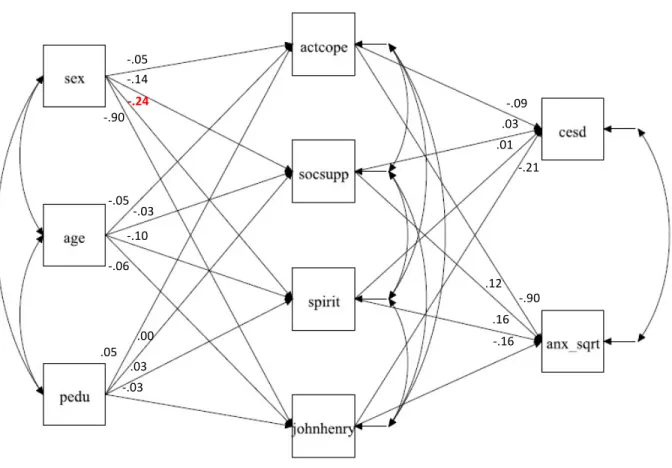
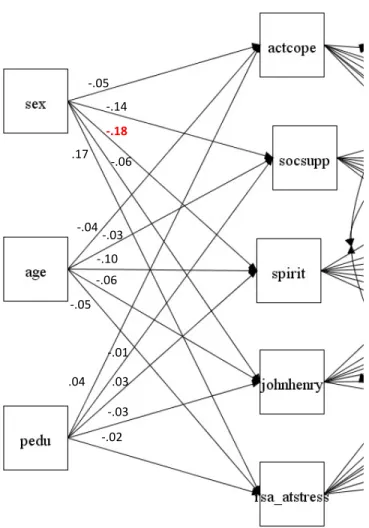
A regression analysis within a structural equation framework examines Specific Aim 1 – testing the relation between coping strategies and mental health. In this framework, symptoms of depression and anxiety are concurrently regressed on four coping strategies – active coping, social support, spiritual coping, and John Henryism. Covariates include participant sex, age, and parental education. A covariance is modeled between depression and anxiety symptoms as they have often demonstrated comorbidity in research with college populations (Eisenberg, Gollust, Golberstein, & Hefner, 2007). In addition covariances are modeled between each coping strategy as they share the same general construct. Model fit was first assessed. If model fit was adequate regression, parameters were examined to determine if each coping strategy was independently associated with symptoms of depression and/or anxiety.
Specific Aim 2 – Intraindividual Estimates of RSA during Recovery
Time Series Analysis as a Tool for Modeling Intra-individual Variability
! ')!
modeling approaches), I expect that patterns of RSA change during recovery will be best
understood by estimating individual parameters rather than group or sample-level means. Indeed, Porges (1976) called specifically for the use of time series in examining intraindividual variation in physiological processes. While psychologists often examine interindividual (between-person) variation with the assumption that interindividual variation is indicative of phenomena at the intraindividual level, research suggests that this assumption remains largely unsupported (e.g. Molenaar, 2004). Instead, “time-dependent variation within a single individual” is a more appropriate focus for examining questions about the parameters of intraindividual patterns (Molenaar, 2004, p.202). Furthermore, time series analysis is especially appropriate for continuous data numbering in the hundreds where points in time are equally spaced (Glass, Wilson, & Gottman, 1972). This statistical approach is optimal because my second specific aim consists of modeling patterns of intraindividual variation in RSA during recovery.
Introduction to Time Series Analysis
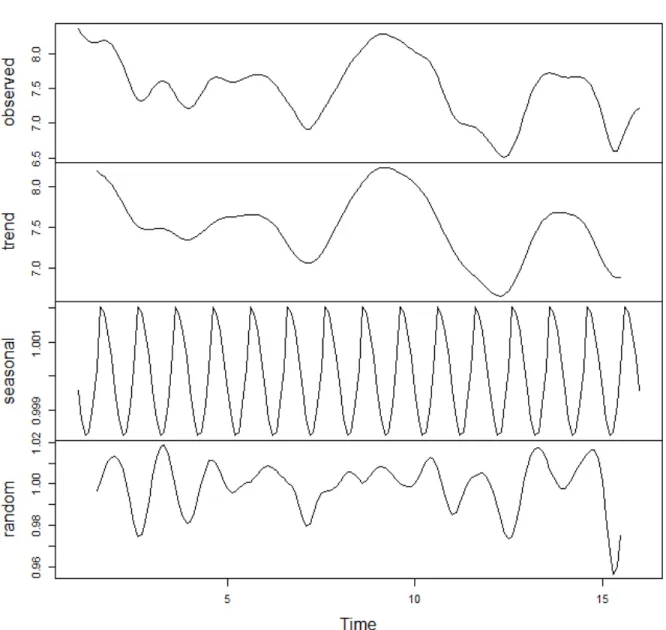
There are multiple components of a time series. Variation within a time series may be divided into four parts – trend, seasonal, cyclical, and irregular components (Persons, 1919). Trend is any systematic change in the level of a series. For example, a long-term increase or decrease in the pattern of data would indicate a trend. Both the direction and slope of a trend may remain constant or change throughout the course of the series and the trend need not be linear. Next, a seasonal component is a repeating pattern of increase and decrease that occurs
! '*!
repeating component are not intuitively identifiable if they are present at all (i.e. number of seconds that could quantify substantively different “segments” of time during recovery). A cyclical component, similar to a seasonal component, entails a pattern of fluctuation that reoccurs across periods of time. In contrast, the duration of a cyclical component is not fixed, meaning its magnitude can vary over time and may not be attributable to any specific time periods. Therefore, cyclical components may indeed be present in the current time series analysis as one’s RSA values may fluctuate across time during recovery but the consistency of this
fluctuation may vary across time intervals. Often cyclical components may be visually
represented as together with their trend components because they may be embedded in a larger cyclical pattern over a period of time. Finally, irregular components quantify any remaining unsystematic variability in the time series after accounting for the systematic trend, seasonal, and cyclical components. Another important component of a time series is its autocorrelation. The autocorrelation in a time series is the correlation between each observation in the series across time, i.e. the degree to which points in a series are impacted by prior points in that series.
Autocorrelations may be of any length, referred to as the lag of the autocorrelation. For example, a lag-1 autocorrelation indicates the correlation between the data point under examination and the point immediately preceding it. Another element of a time series is stationarity, typified by a mean, variance, and covariance that remain constant throughout the series. Stationarity is an important assumption as the values of the time series are only considered accurate estimates of population values when the mean, variance, and covariance remain constant.
Specific Application of Time Series Analysis to Research Aim 2
! '+!
individual’s time series. Time series analyses (n=116) was conducted in several steps. This process has two goals: 1) to describe dynamic patterns of RSA during recovery for each
individual; and 2) to extract model estimates that define these patterns for each participant so that they may be used in further analyses.
Step 1: Fit a separate regression model to each time series that quantifies each participant’s RSA pattern during recovery (n=116).
First, each time series was modeled using a regression framework according to the following model: yt=b0+b1t+"t, where t is the time variable, b0 is the level of the series when t=0, b1 is the amount of change in the series associated with a one-unit increase in time, and "t is the random error. If this linear regression model fully accounts for the trend, the residual error series will not contain any remaining trend component. Therefore, the residual error series was
examined to determine if a higher-order polynomial term must be included in order to construct a better-fitting model, especially if a quadratic is theoretically anticipated for some participants. If a linear model is found to be insufficient, a quadratic parameter was added to the regression, b2t2. After the addition of the quadratic parameter, the residual error series was re-examined to
determine if any trend component remained. An examination of R2 change following each progressive model specification guided the construction of a most optimally fitting model for each time series.
Step 2: It was likely that an autocorrelation will remain despite fitting a quadratic
! ',!
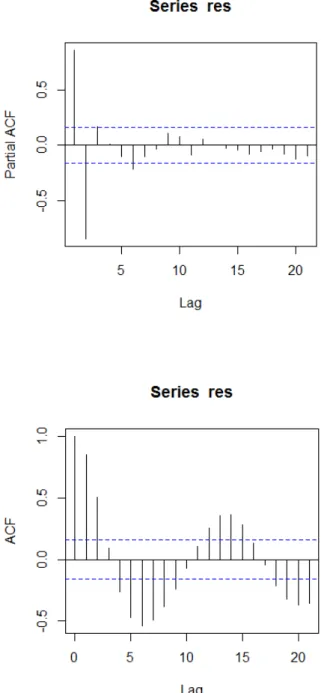
the residuals are appropriately unsystematic (i.e. irregular, a “white noise series”). The ACF plot charts the p< .05 criterion for statistical significance, allowing us to understand the degree to which autocorrelation is present in the series. If the residuals were found to be autocorrelated, analysis proceeded to the next step. If residuals were not autocorrelated, analysis proceeded to Step 4.
Step 3: If the residuals were autocorrelated, ARIMA terms were included. This specific approach was taken because a degree of non-stationarity in each time series was anticipated, due to potential quadratic and other time-varying trends evidenced in prior literature which examines RSA.
Overview of ARIMA models. Components of ARIMA models may be included within an existing regression model to improve its accuracy. The name ARIMA refers to three distinct elements of a class of models whose goal is to explain the autocorrelation in a given time series. The AR(p) component models the autoregressive component of the time series with p terms, where p is the number of preceding observations that exhibit significant autocorrelation. For example, an ARIMA model of type (1, d, q) includes one predictor, the observation immediately preceding the current value, and an ARIMA (2, d, q) model includes two predictors, the first and the second preceding observations (Jebb, Tay, Wang, & Huang, 2015, p. 16). An order 1
autoregressive component can be expressed mathematically as: yt= #1 (yt-1) + "t, where #1 is the autoregressive coefficient and yt-1 is the immediately preceding observation. This model can be expanded for quadratic patterns by the inclusion of an additional parameter: #2 (yt-2).
! '-!
ostensibly random (McCleary, Hay, Meidinger, & McDowell, 1980, p.40). This component accounts for the notion that random shocks result in autocorrelation because each data point may contain a trace of the lingering effects of prior unobserved shocks. An order-1 moving average component can be expressed mathematically as: yt= $1 ("t-1) + "t, where "t is the value of the random shock at t, "t-1 is the value of the previous random shock, and $ is the coefficient of the shock. This model can be expanded for quadratic patterns by the inclusion of an additional $2 ("t-2). Model building strategies (discussed below) were employed to determine if AR terms, MA
terms, or both AR and MA terms were needed for model specification. Often, autocorrelation may be explained by either AR or MA terms and such models are often more easily interpretable and parsimonious (Jebb et al., 2015).
Finally, the I(d) component does not add predictors to the modeling equation, but rather indicates what operation has been performed on the series in order to render it stationary. While the exact process of differencing for each time series will be discussed more specifically below, in general terms, making the series stationary is often accomplished by taking either the first differences or second differences (i.e. the first differences of the first differences) of the original series. The series must be stationary before any AR or MA terms can be included (Cowpertwait & Metcalfe, 2009).
Step 3a: Determine if the series is stationary. First, a plot of the series was examined for systematic changes in mean level and variance. More formally, an augmented Dickey-Fuller (ADF) test was also conducted to test for stationarity.
Step 3b: Transform the series to stationarity. If the mean, variance, and/or
! (.!
stationarity. Differencing transforms the values of a series into a series of the differences between observations adjacent in time. Each successive order of differencing should further remove trend and reduce the overall series variance. In practice the order of differencing rarely needs to be greater than two in order to stationarize the series (Jebb et al., 2015, p. 21). As a starting point, first differencing was conducted for each time series with a non-significant ADF test. If the series was still not stationary, second differencing was then conducted and a new ADF test was examined.
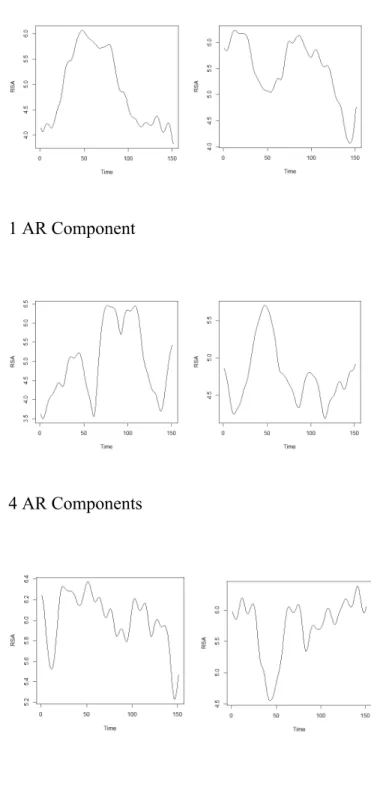
Step 3c: Determine how many AR and MA terms will be required to explain the series autocorrelation by inspecting ACF and PACF (partial autocorrelation function) plots of the residual error series. Similar to autocorrelation function plots, PACF plots chart the strength of the partial autocorrelation function (the autocorrelation of each lag after controlling for the autocorrelation due to all preceding lags, McCleary et al., 1980) across different lags in the series and include the p< .05 criterion for statistical significance. Patterns in these plots guide the inclusion of AR and MA terms. For example, an autocorrelation that is best explained by AR terms has a steadily decaying ACF and a PACF that drops after p lags, signaling that the series would require p AR terms. An autocorrelation that evidences a drop-off in the ACF after q lags and a gradually decaying PACF is best explained by MA terms, signaling that the series would require q MA terms. Often only one or two AR or MA terms are required per time series (Jebb et al., 2015).
Step 3d: Fit a parsimonious model via the inclusion of ARIMA components as
determined above. Times series can be modeled with AR terms, MA terms, or a mixture of AR and MA terms. However, the inclusion of AR terms is often preferred because their
! (%!
After fitting the model, if the inclusion of ARIMA terms has been successful in explaining the autocorrelation of a stationary series, the residual error should appear as unsystematic error variance, the series should have a mean of zero, and the series should have some constant variance. Therefore, visual inspection of the ACF and PACF plots helped assess model adequacy. In these plots, all autocorrelations are expected to be zero with 5% expected to be statistically significant due to sampling error (Jebb et al., 2015, p. 18). Furthermore, a Ljung-Box test (Ljung & Box, 1978) was conducted to determine if the model residuals were
indistinguishable from a random white noise series. If there was a fair magnitude of remaining autocorrelation, the model was re-specified accordingly.
Step 3e: If autocorrelation remained, multiple models were specified and then compared. The process of fitting ARIMA models is iterative and exploratory, essentially data driven (Jebb et al., 2015). However, following modeling conventions, non-mixed models were ruled out prior to fitting more complex mixed models. Re-specification of the model proceeded from the
continued examination of the pattern of residuals in ACF and PACF plots. The search for the best-fitting model was facilitated by model comparison utilizing the AIC, a model fit criterion that incorporates penalties for model complexity. Smaller AIC values indicate a better relative fit of the model to the time series. Models within two AIC points are comparable, a difference of 4-7 points indicates considerable support for the model with the smaller AIC, and a difference of 10 points or more indicates full strong support for the model with a smaller AIC (Jebb et al., 2015, p. 20). Models were appropriately re-specified using this framework until strong support for model fit was established.
! (&!
Specific Aim 3 – Mediation of the Relation between Coping and Mental Health Symptoms by Estimates of RSA during Recovery
Regression analysis within a structural equation framework examined Specific Aim 3 – examining RSA estimates as mediators in the relation between coping strategies and mental health (see Figure 1 for full model). In this model, symptoms of depression and anxiety were regressed on the estimates of the time series. While these estimates originally included the intercept, slopes, and autoregressive term of the series, the “Results” section below describes how the time series mean, variance, and number of autoregressive and moving average terms were included instead. These estimates were regressed on four coping strategies – active coping, social support, spiritual coping, and John Henryism. Covariates included participant sex, age, and parental education. An additional covariate in this model was RSA value at the stress period, in order to adequately control for the magnitude of PNS activity in the face of the racial
discrimination challenge. A covariance was maintained between depression and anxiety
! ('!
CHAPTER 4: RESULTS
Descriptive Statistics
Descriptive statistics for study variables are presented in Table 1 (n=116) and Table 2 (n=205). Descriptive statistics and distributions of variables remained consistent across these two samples and therefore the smaller sample (n=116) will be discussed below in order to present a more conservative description of sample characteristics. According to the clinical cutoffs suggested by the depression and anxiety scales, a majority of participants self-reported minimal depressive symptoms (67.2%) and low levels of anxiety (94.8%), as would be expected in a non-clinical sample. However, non-clinically significant symptoms of depression were reported by approximately one-third of participants, with 27.6% of participants reporting symptoms within the clinical range and 5.2% of participants reporting very clinically elevated symptoms. In contrast, only 4.4% of participants reported symptoms indicative of a moderate level of anxiety, and only .9% of participants reported anxiety symptoms indicative of a potential cause for clinical concern.
Symptoms of depression and anxiety were positively skewed, with more individuals indicating fewer symptoms of depression and anxiety. The distribution of depressive symptoms sufficiently approximated a normal distribution (skewness value of .72) such that a