SYNTHESIS OF POLYMERIC MATERIALS FOR DRUG DELIVERY AND INDUSTRIAL APPLICATIONS
Stephanie A. Kramer
A dissertation submitted to the faculty of The University of North Carolina at Chapel Hill in partial fulfillment of the requirements for the degree of Doctor of Philosophy in the
Department of Chemistry.
Chapel Hill 2015
ABSTRACT
Stephanie Ann Kramer: Synthesis of Polymeric Materials for Drug Delivery and Industrial Applications
(Under the direction of Wenbin Lin and Michel R. Gagne)
This dissertation reports the synthesis of polymeric materials for industrial and medicinal applications. Depending on their chemical structure, polymers have different properties and applications. Polyolefins, used in packaging and films, are one of the most highly produced polymeric materials in industry, whereas only a handful of polymeric materials are in the market for drug delivery.
The first part of this thesis presents a method to deoxygenate linear polyols producing branched polyolefins. In Chapter 2, linear polyols, such as poly(vinyl alcohol) (PVA), are hydrosilylatively deoxygenated using catalytic amounts of B(C6F5)3 and a reducing hydrosilane. Following reduction, a highly branched, predominantly saturated structure is obtained. Depending on the alcohol-protecting group and the hydrosilane used, the branch numbers can exceed 200 branches per 1000 carbons. The branching microstructure is also dependent on the protecting group and silane. For instance, the deoxygenation of TMS-protected PVA with diethylsilane produced a polymer with different branch types when compared to the polymer that results from the deoxygenation of TES-protected PVA.
ACKNOWLEDGEMENTS
I would like to thank many people for their guidance and support during my scientific career.
To my undergraduate advisor, Dr. Keith Walters, for showing me what a good teacher looks like. And to my unofficial advisors at NKU, Dr. Heather Bullen, Dr. Isabelle Lagadic, and Dr. Diane McGill for having faith in me and showing me the fun side of science. My professors at NKU have provided a lifetime of encouragement and direction. Because of their dedication to science education, I will always have a passion for science outreach and
teaching.
To my graduate advisor, Dr. Michel Gagne, thank you for being patient and understanding. You encouraged my scientific development and taught me how to
independently solve problems. To my previous graduate advisor, Wenbin Lin, thank you for supporting my research and providing scientific insight on my projects.
I would also like to thank all of the Lin and Gagne lab members, past and present. To Rachel Huxford and Demin Liu, thanks for showing me the ropes. To Trandon Bender and Laura Adduci, I appreciate your scientific discussions and suggestions. To Pippa, Chrissy, and Peruzzi, thanks for making our lab room such an enjoyable environment.
TABLE OF CONTENTS
LIST OF FIGURES………...ix
LIST OF TABLES………...xii
LIST OF SCHEMES………..xiii
LIST OF EQUATIONS………...xv
LIST OF ABBREVIATIONS AND SYMBOLS………...xvi
SYNTHESISOFPOLYMERICMATERIALSFORDRUGDELIVERY CHAPTER 1. ANDINDUSTRIALAPPLICATIONS ... 1
1.1 Introduction ... 1
1.2 Polymer Defunctionalization ... 1
1.3 Nanoscale Coordination Polymers for Anticancer Drug Delivery ... 13
B(C6F5)3-CATALYZEDHYDROSILYLATIVEDEOXYGENATIONOF CHAPTER 2. POLYOLSTOFORMHIGHLYBRANCHEDSTRUCTURES ... 21
2.1 Introduction ... 21
2.2 Experimental ... 22
2.3 Results and Discussion ... 26
2.4 Conclusions ... 51
2.5 Acknowledgements ... 51
SYNTHESISOFALINEAR-BRANCHED-LINEARTRIBLOCK CHAPTER 3. POLYMERTHROUGHHYDROSILYLATIVEDEOXYGENATION ... 52
3.1 Introduction ... 52
3.4 Conclusions ... 63
3.5 Acknowledgements ... 64
PLATINUMBISPHOSPHONATECOMPLEXESASTHERANOSTIC CHAPTER 4. AGENTS ... 65
4.1 Introduction ... 65
4.2 Materials and Methods ... 68
4.3 Results and Discussion ... 75
4.4 Conclusions ... 89
4.5 Acknowledgements ... 89
LIST OF FIGURES
Figure 1.1. Proposed mechanism of Ziegler-Natta polymerization of ethylene ... 4 Figure 1.2. Mechanism of α-diimine Ni/Pd-catalyzed olefin polymerizations ... 5 Figure 1.3. Lewis acid/base adduct formed between
1,2,3-tris(pentafluorophenyl)-4,5,6,7-tetrafluoro-1-boraindene and triethylsilane ... 11 Figure 1.4. Self-assembly of metal ion and bridging ligand to form a metal-ligand
network, known as a coordination polymer. ... 13 Figure 1.5. The enhanced permeability and retention (EPR) effect which leads to passive
tumor targeting by nanoparticles. Illustration provided by Demin Liu ... 16 Figure 1.6. Structure of two nitrogen-containing bisphosphonates, zoledronic acid and
pamidronic acid ... 19 Figure 2.1. GPC chromatogram of the starting material (TMS-PVA, black) compared to
the deoxygenated product (blue) confirming loss of mass following
deoxygenation. ... 28 Figure 2.2. 13C-NMR spectra (in CD2Cl2) of PVA-TMS (top) and in situ deoxygenation
of PVA-TMS (bottom). ... 29 Figure 2.3. 13C-NMR spectrum of deoxygenated TMS-PVA (in CD2Cl2) after treatment
with pyridine-HF. ... 31 Figure 2.4. 1H-NMR spectrum of deoxygenated TMS-PVA (in CD2Cl2) after treatment
with pyridine-HF. Analysis of the proton integrations using Equation 2.1 and Equation 2.2 determined a branch number of 210 and an alkene number of 30 (per 1000 C). ... 32 Figure 2.5. 13C-NMR spectrum of deoxygenated TMS-PVA following hydrogenation.
Labels are marked as Cx, where x is the chain length. EOC is end of chain; 2EOC is the second carbon from the end of the chain. The Greek letters indicate how far from a branch point each methylene is. ... 35 Figure 2.6. Reduction of Me2EtSi-protected glucitol with different hydrosilanes,
demonstrating that the selectivity and reactivity can be altered through changing the deoxygenation conditions. ... 36 Figure 2.7. 1H-NMR spectra of deoxygenated, non-hydrogenated TMS-PVA (top, in
CDCl3), SiMe2Et-PVA (middle, in CDCl3), and TES-PVA (bottom, in CD2Cl2)
Figure 2.8. 13C-NMR spectra of deoxygenated, non-hydrogenated TMS-PVA (top, in CDCl3), SiMe2Et-PVA (middle, CDCl3), and TES-PVA (bottom, in CD2Cl2). Deoxygenation of TMS-PVA results in a structure containing a high degree of methyl branches, whereas deoxygenation of TES-PVA results in a structure with ethyl yet no methyl branches. ... 40 Figure 2.9. Schematic representation of polymers obtained by deoxygenation of TMS-
and TES-PVA as assessed by 13C-NMR analysis and comparing to the database of assignments compiled by Brookhart and McLain ... 41 Figure 2.10. Proposed exchange of silane protecting group that can occur during the
B(C6F5)3 reduction. ... 41 Figure 2.11. 13C-NMR spectrum of hydroxylated polybutadiene (in CDCl
3), indicating a predominantly 1,5-polyol. If a 1,4- or 1,6- polyol formed, the spectrum would be more complex with 3 different peaks in the alkane region. ... 43 Figure 2.12.Comparison of 13C-NMR spectra of OH (top) and deoxygenated
PBD-OTMS (with SiEt2H2). Following complete deoxygenation, a branched
hydrocarbon structure is observed ... 45 Figure 2.13. Possible deoxygenation mechanism in which the deoxygenation proceeds
through a random process. In this case, one would expect the sample to go from a simple to highly complex to lower complexity structure, as observed in the 13
C-NMR spectrum. P indicates silyl protecting group. ... 48 Figure 2.14. Possible deoxygenation mechanism in which the deoxygenation proceeds
through a controlled, zippered process where deoxygenation starts at the least sterically hindered end and walks down the chain. P indicates the silyl protecting group ... 49 Figure 2.15. Time course 13C-NMR analysis of the deoxygenation of TMS-PVA
monitoring disappearance of starting material and appearance of branched product. Peak at 47 ppm, indicative of methylenes in starting polymer, initially broadens and then disappears at later times. Multiple peaks increase in intensity in alkane region (15-45 ppm), showing an increase in the number and types of
branches as the reaction proceeds ... 50 Figure 3.1. 1H-NMR analysis of (left) highly branched polyolefin synthesized through
B(C6F5)3/diethylsilane deoxygenation of PVA-TMS and of branched triblock polymer (right). The degree of branching cannot be determine through integration due to overlap of the PS protons ... 58 Figure 3.2. 1H-NMR spectrum of hydrogenated SBS (SEBS) in CDCl3. Only 85%
hydrogenation of the sample was achieved, as indicated by the residual alkene
Figure 3.3. 13C-NMR spectrum (CDCl
3, 0.5 M Cr(acac)3) of SBS that is ~85% hydrogenated as calculated from 1H-NMR spectroscopy (Figure 3.2). The PS aromatic peaks are found at 145, 130, 128, and 125 ppm, while the PS backbone makeup the broad peak at 40 ppm. The peak at 29 ppm is characteristic of the methylene backbone of the hydrogenated interior block. The remaining peaks are
indicative of defects from the polymerization ... 61
Figure 3.4. 13C-NMR spectrum (CDCl3, 0.5 M Cr(acac)3) of alkane region of hydrogenated SBS (SEBS) with assigned chemical shifts to highlight the defects in the butadiene block ... 62
Figure 3.5. 13C-NMR analysis of SEBS (top) and deoxygenated SBS-OH (bottom). Following B(C6F5)3-catalyzed deoxygenation, a linear-branched-linear structure is formed ... 63
Figure 4.1. TEM images of Ca-PtBP (a) and Mn-PtBP (b). Scale bars equal 200 nm ... 79
Figure 4.2. Number weighted DLS spectrum of Ca-PtBP (black) and Mn-PtBP (red) ... 79
Figure 4.3. TEM images of (a) Ca-PtBP@Lipid and (b) Mn-PtBP@Lipid ... 82
Figure 4.4. Z Average (nm) of Mn-PtBP@Lipid as a function of BSA exposure time ... 83
Figure 4.5. Platinum release from Ca-PtBP and Ca-PtBP@Lipid ... 84
Figure 4.6. Platinum release from Mn-PtBP and Mn-PtBP@Lipid ... 85
Figure 4.7. TEM images of (a) Ca-PtBP@LipidAA and (b) Mn-PtBP@LipidAA. ... 86
Figure 4.8. Cell viability assays of cisplatin (black), PtBP (red), MnPtBP@Lipid (green), and CaPtBP@Lipid (blue) evaluated against A549 human non-small cell lung cancer line ... 87
Figure 4.9. Cell viability assays of cisplatin (black), PtBP (red), MnPtBP@Lipid (green), and CaPtBP@Lipid (blue) evaluated against H460 human non-small cell lung cancer line ... 88
LIST OF TABLES
Table 2.1. 1H-NMR relative integration values for each unique proton resonance in the deoxygenated polymer produced from the reduction of TMS-PVA with borane
and diethylsilane. ... 32 Table 2.2. 1H-NMR analysis of branching and elimination present in deoxygenated PVA
polymer samples. ... 37 Table 2.3. 1H-NMR analysis of branching and elimination present in deoxygenated
PBD-OH polymer samples. ... 44 Table 4.1. DLS measurements for Ca-PtBP and Mn-PtBP obtained in THF. ... 79 Table 4.2. DLS measurements for Ca-PtBP@Lipid and Mn-PtBP@Lipid obtained in 5
mM PBS. ... 82 Table 4.3. DLS measurements for Ca-PtBP@Lipid and Mn-PtBP@Lipid obtained in 5
LIST OF SCHEMES
Scheme 1.1. Treatment of a primary alcohol with HSiEt3 and catalytic amounts of
B(C6F5)3. ... 8
Scheme 1.2. Catalytic reduction of a sterically hindered 2-heptyl-2,5-dihydrofuran C-O bond. ... 9
Scheme 1.3. Catalytic reduction of a 2-phenyl-2,5-dihydrofuran C-O bond. ... 9
Scheme 1.4. Catalytic reduction of a 3,6-2H-dihydropyran C-O bond, demonstrating the electronic control on the reaction ... 9
Scheme 1.5. Proposed B(C6F5)3-catalytic cycle for the reduction of alcohols. ... 10
Scheme 1.6. B(C6F5)3-catalyzed hydrosilylative deoxygenation of glucose into hexane and hexene isomers. ... 12
Scheme 2.1. TMS-Protection of Poly(vinyl Alcohol). ... 27
Scheme 2.2. Deoxygenation of TMS-PVA with B(C6F5)3 and diethylsilane. ... 27
Scheme 2.3. Hydroboration-oxidation of polybutadiene to form a 1,5-polyol. ... 43
Scheme 2.4. General scheme for the deoxygenation of hydroxylated-polybutadiene. ... 44
Scheme 2.5. Deoxygenation of 2-methyl-3-hexanol with B(C6F5)3 and diethylsilane. ... 46
Scheme 2.6. Deoxygenation of 2,5-hexanediol with B(C6F5)3 and diethylsilane. ... 46
Scheme 2.7. Deoxygenation of 2,4-pentanediol with B(C6F5)3 and diethylsilane. ... 47
Scheme 3.1. Hydroboration-Oxidation of SBS. ... 56
Scheme 3.2. B(C6F5)3-catalyzed deoxygenation of SBS-OH. ... 57
Scheme 3.3. Hydrogenation of SBS with tosylhydrazide in xylene to form SEBS. ... 59
Scheme 4.1. Synthesis and lipid coating of PtBP nanoparticles containing either Ca2+ or Mn2+. ... 68
Scheme 4.2. Synthesis of c,c,t,-Pt(NH3)2(phosphonocarbamate)2 (PtBP): a) oxidation of cisplatin with hydrogen peroxide, b) formation of platinum-carbamate species through nucleophilic substitution, and c) hydrolysis of platinum-ester to form PtBP. ... 76
Scheme 4.4. Synthesis of Ca-control and Mn-control nanoparticles ... 80 Scheme 4.5. Lipid coating of PtBP nanoparticles with 1:1:0.5 (by mol)
LIST OF EQUATIONS
LIST OF ABBREVIATIONS AND SYMBOLS
Å Angstrom
AA Anisamide
aq. Aqueous
9-BBN 9-Borabicyclo(3.3.1)nonane
Bodipy Boron dipyrromethane
BSA Bovine Serum Albumin
Ca-PtBP Calcium-based platinum bisphosphonate particle
C Celsius
c(RGDfk) Cyclic peptide known to target the αvβ3 integrin
° Degree
d1 Delay time
@ Denotes one component inside another
SiEt2H2 Diethylsilane
SiMe2EtH Dimethylethylsilane
DMF N,N-dimethylformamide
DSPE-PEG2K 1,2-distearoyl-sn-glycero-3-phosphoethanolamine-N-[methoxy(polyethylene glycol)-2000]
DOPA 1,2-dioleyl-sn-glycero-3-phosphate
DOPC 1,2-dioleoyl-sn-glycero-3-phosphocholine
DOPE 1,2-dioleoyl-sn-glycero-3-phosphoethanolamine
DOTAP 1,2-dioleoyl-3-trimethylammonium-propane
DLS Dynamic light scattering
EPR Enhanced permeability and retention
FDA Food and Drug Administration
GPC Gel Permeation Chromatography
g Gram
t1/2 Half-life
Hz Hertz
HDPE High density polyethylene
HPLC High pressure liquid chromatography
h Hour
HT-29 Human colorectal adenocarcinoma cell line
A549 Human non-small cell lung carcinoma cell line
H460 Human non-small cell lung carcinoma cell line
PBD-OH Hydroxylated polybutadiene
SBS-OH Hydroxylated styrene-b-butadiene-b-styrene
ICP-MS Inductively-coupled plasma mass spectrometry
IC50 Inhibitory concentration 50%
L Liter
LDPE Low density polyethylene
Mn-PtBP Manganese-based platinum bisphosphonate particle
MIL Materials of Institut Lavoisier
min Minutes
M Mega-
MOF Metal organic framework
MeOH Methanol
!! Micro-
M Molar
mol Mole
MW Molecular weight
MPS Mononuclear phagocyte system
n Nano
NCP Nanoscale coordination polymer
N-BP Nitrogen-containing bisphosphonates
NMR Nuclear magnetic resonance
ppm Parts per million
PBS Phosphate buffer saline
PtBP c,c,t,-Pt(NH3)2(phosphonocarbamate)2
PDI Polydispersity index
PEG Poly(ethylene glycol)
PS Poly(styrene)
PVA Poly(vinyl alcohol)
psi Pounds per square inch
SEM Scanning electron microscopy
s Second
SLB Single lipid bilayer
SBS Styrene-b-butadiene-b-styrene
SEBS Styrene-b-ethylene/butadiene-b-styrene
TEOS Tetraethyl orthosilicate
THF Tetrahydrofuran
TGA Thermogravimetric analysis
SiEt3H Triethylsilane
TES Triethylsilyl-
SiEt3D Triethylsilane-d
TMS Trimethylsilyl-
B(C6F5)3 Trispentafluorophenylborane
UV Ultraviolet
Vis Visible
W Water to surfactant ratio
wt Weight
SYNTHESISOFPOLYMERICMATERIALSFORDRUGDELIVERYAND Chapter 1.
INDUSTRIALAPPLICATIONS
1.1 Introduction
The properties of polymers are highly varied, as are their applications, which range from synthetic plastics to rubbers to natural biopolymers (e.g. DNA) to lubricants. The properties and hence the application of polymers depends exquisitely on the polymer
composition and microstructure. With few exceptions, one normally associates the monomer units with the composition of a polymer, though as described herein, this is not always the case. The microstructure on the other hand typically reflects how the monomers are arranged within the chain (e.g. tacticity), but this can also be ambiguous. This dissertation will discuss two different applications of polymeric materials (industrial polyolefins and drug delivery nanoscale coordination polymers), and in particular, the former materials in this chapter will be shown to significantly digress from their nominal “repeat unit” formulations.
1.2 Polymer Defunctionalization 1.2.1 Polyolefins
Polyolefins are used in a variety of applications, including industrial lubricants, grocery bags, engineering plastics, and adhesives. Despite their wide range of uses,
wildly varying properties. For instance, low-density polyethylene (LDPE) contains short chain branches, giving it properties that make it useful in plastic wraps. On the other hand, the minimal short chain branches in high-density polyethylene (HDPE) produces a more dense material that finds use in plastic storage containers (e.g. milk jugs).
The synthesis of branched polyolefins typically involves polymerization of olefinic monomers using metal catalysts.1 Coordination catalysts, which enchain alkene monomers via coordination-insertion mechanisms allow for greater control over the polymer structure when compared to free radical initiators. Depending on the catalyst selected, control over the connectivity of the monomers, and therefore the polymer properties, can be achieved. Initial olefin polymerization catalysts were discovered in the 1950s by Ziegler2 and Natta3,4
(Ziegler-Natta catalysts) and by Hogan and Banks (Phillips catalysts)5. The extensive development and optimization of these and many other families of polymerization catalysts have fed the enormously important polyolefin business that exists today. Polymerization with coordination catalysts involves coordination of the monomer to the active metal site,
followed by insertion into the metal-carbon bond at the active end of the polymer chain. The stereo- and regiochemistry of monomer coordination is what controls the propagation and structure of the resulting polymer chain.
1 Vasile, C., Ed. Handbook of Polyolefins; Marcel Dekker, Inc: New York, 2000. 2 Ziegler, K.; Holzkamp, E.; Breil, H.; Martin, H. Angew. Chem. 1955, 67, 541-547. 3 Natta, G. J. Polym. Sci. 1955, 16, 143.
4 Natta, G.; Pino, P.; Corradini, P.; Danusso, F.; Mantica, E.; Moraglio, G. J. Am. Chem. Soc. 1955, 77, 1708.
Polymerization of ethylene, using different coordination catalysts, provides a
synthetic route to produce polymers with unique microstructures and compatibility with polar solvents depending on the catalyst selected. Traditional approaches, such as Ziegler-Natta catalysis, of olefin polymerization allow for production of linear unbranched polymers at atmospheric pressures. In 1953, Ziegler discovered that a titanium catalyst together with an aluminum alkyl co-catalyst result in the polymerization of high molecular weight HDPE.2 Later, Natta extended that this catalytic system to other olefins, such as polypropylene.3,4,6 Second-generation catalysts were developed to increase the catalyst activity to efficiencies to 100-1000 kg polymer per gram of titanium, eliminating the need to remove residual catalysts from the final polymer.7 Figure 1.1 presents a proposed general mechanism for the Ziegler-Natta catalysis of polyethylene.8 The first step of the polymerization reaction is catalyst initiation, in which the alkyl aluminum co-catalyst serves to activate the titanium catalyst by acting as a Lewis acid to abstract a chloride, producing a vacant site for ethylene
coordination. Although the exact mechanism is unknown, polymer chain growth is believed to occur at vacant Cl sites at the titanium surface through migratory insertion reactions. For migratory insertion reactions to occur, the polymerization catalyst must have an extra empty orbital after coordination of ethylene. The alkyl group forms an agostic C-H bond interaction with the empty orbital on the titanium metal tilting the sp3 orbital away from the metal to promote migratory insertion. The polymer chain is terminated through either β-hydrogen
6 Natta, G. J. Polym. Sci. 1959, 34, 21-48.
7 Albizzati, E.; Galimberti, M. Catal. Today 1998, 41, 415-421.
elimination to produce polyethylene with a terminal C=C bond or, more commonly, through the use of hydrogen as a chain transfer reagent.9
Figure 1.1. Proposed mechanism of Ziegler-Natta polymerization of ethylene.
The controlled synthesis of branched polyethylene was first reported by Brookhart. Ni and Pd α-diimine catalysts were developed to polymerize olefins in a living fashion to yield high molecular polymers with a narrow weight distribution.10 Incorporation of the bulky diimine ligands into the catalyst allowed for synthesis of highly branched polymers through a chain walking mechanism (Figure 1.2).10,11,12,13 It is well established that the metal is able to
9 Santos, L. J. Braz. Chem. Soc. 2011, 22, 1827-1840.
10 Johnson, L.; Killian, C.; Brookhart, M. J. Am. Chem. Soc. 1995, 117, 6414. 11 Guan, Z.; Cotts, P.; McCord, E.; McLain, S. Science 1999, 283, 2059. 12 Ittel, S.; Johnson, L.; Brookhart, M. Chem. Rev. 2000, 100, 1169-1203.
AlR3
-AlR2Cl
LnTi Cl LnTi R
Initiation:
Propagation:
Ti CH3 Ti CH3
insertion Ti
Ti insertion Ti
2
chain growth
Termination:
n
Ti H + n
H2
Ti H + n
migrate or “walk” along the polymer chain through insertion and β-hydride elimination reactions. The two late transition metal catalysts demonstrate different polymerization behaviors. In the case of the Ni(II) system, the degree of branching and branching
microstructure was manipulated by controlling the ethylene pressure and temperature during the polymerization reaction. Increasing the ethylene pressure during the reaction lead to a polymer with a decrease in branch number and a linear topology with mostly short branches. At reduced ethylene pressures, dense, hyperbranched polymers were produced. Depending on the reaction conditions selected, the synthesized polyethylene ranged from linear to a highly branched (>120 branches/1000 C) structure. When the Pd(II)-catalyst was used in ethylene polymerization, the degree of branching (100 branches/1000 C) was essentially the same for all reaction conditions.
Figure 1.2. Mechanism of α-diimine Ni/Pd-catalyzed olefin polymerizations.
Due to their importance in defining properties, methods for characterizing the defects or branches in a polyolefin, such as polyethylene, have been developed with 1H- and 13 C-NMR spectroscopy being particularly useful. A branch is defined as the number of carbons from a methyl to a methine off of the backbone, and the number of these per 1000 C is a
13 Gates, D.; Svejda, S.; Onate, E.; Killian, C.; Johnson, L.; White, P.; Brookhart, M. Macromolecues 2000, 33, 2320.
M N
benchmark measure. This is typically quantitated in the 1H-NMR spectrum by integration of each proton type.14 For example, the degree of branching can be estimated from the ratio of methyl hydrogens (~0.85 ppm) to the total aliphatic hydrogens in the polymer by a specific formula. The equation used to calculate the degree of branching in this work is shown in Equation 1.1. A higher ratio of methyl to total hydrogens indicates a greater degree of branching.
Equation 1.1.
Adding chromium(III) acetylacetonate to an NMR sample containing a polyethylene sample prior to obtaining the 13C-NMR spectrum aids in shortening relaxation times which consequently allows for quantitative NMR spectroscopy. Unique carbon resonances can be distinguished, and have been assigned by others, for short chain branches of polyethylene,15 with the key methyl resonances from methyl, ethyl, propyl, and butyl or longer branches being particularly valuable. The signal at ~30 ppm in the 13C-NMR spectrum of branched polyethylene is due to the main CH2 groups in the polymer backbone.
1.2.2 Metal-Free Defunctionalization
Defunctionalization of organic functional groups is an important process in synthetic chemistry, particularly in the reduction of the C-O functional group to a methyl group. The carbonyl functionality can be reduced through a Clemmensen16 reduction, which makes use
14 Daugulis, O.; Brookhart, M.; White, P. S. Organometallics 2002, 21, 5935.
15 Cotts, P.; Guan, Z.; McCord, E.; McLain, S. Macromolecules 2000, 33, 6945-6952.
#
Branches
1000
C
=
CH
33
(
CH
+
CH
2+
CH
3)
2
of a strong acid and amalgamated zinc, or through the complementary Wolff-Kirschner17,18 reduction, which employs hydrazine and a strong base. These defunctionalization procedures require harsh conditions: high temperatures, high pressures, and strong acids or bases. The combination of a Lewis acid and a hydrosilane provides a milder approach for the reduction of carbonyl-containing compounds.
One defunctionalization reaction that has not received significant attention is the conversion of C-O bonds at the alcohol oxidation state to C-H bonds, i.e. alcohols to alkanes. The Lewis acid trispentafluorophenylborane (B(C6F5)3) has been investigated as a catalyst in the mild hydrosilylative reduction of C-O bonds because of its commercial availability, convenient handling, and comparable Lewis acidity to BF3.19 B(C6F5)3 is advantageous over BF3 because it avoids problems associated with reactive B-F bonds. Yamamoto first reduced primary alcohols using triethylsilane in the presence of catalytic amounts of B(C6F5)3.20This was the first example of catalytic use of a Lewis acid in the reduction of alcohols. Addition of an equimolar amount of silane resulted in silyl-protection to quantitatively produce the alkyl silyl ether (with concomitant H2 evolution), while adding excess silane (3 equivalents) fully reduced a primary alcohol to the alkane (Scheme 1.1). Using triethylsilane, more bulky secondary and tertiary alcohols were not reduced and only the corresponding silyl ethers
16 Clemmensen, E. Ber. 1914, 47, 681-687.
17 Kishner, J. J. Russ. Phys. Chem. Soc. 1911, 43, 582. 18 Wolff, C . Justus Liebigs Ann. Chem. 1912, 394. 86.
19 Ishihara, K.; Yamamoto, H. Eur. J. Org. Chem. 1999, 3, 527.
were obtained. Cleavage of linear and cyclic primary alkyl ethers was achieved in the presence of a stoichiometric amount triethylsilane and catalytic amounts of B(C6F5)3 to give the corresponding alkane and silyl ether. Nimmagadda and McRae further expanded the reduction of alcohols to secondary and tertiary alcohols, though this required the use of more reactive hydrosilanes, such as diethylsilane or n-butylsilane.21 Further investigations by Yamamoto indicated that the relative reactivity of alcohols towards reduction was: primary >> secondary > tertiary.22
Scheme 1.1. Treatment of a primary alcohol with HSiEt3 and catalytic amounts of B(C6F5)3.
Inspired by the mild B(C6F5)3-reduction approach, Njardarson investigated the reduction of the C-O bonds in unsaturated cyclic ethers.23 First, the reduction of 2,5-dihydrofurans, which contain two allylic ethereal C-O bonds, was studied to compare the impact of sterics and electronics in the reaction mechanism. Following the reduction of 2-heptyl-2,5-dihydrofuran (Scheme 1.2), the less sterically hindered C-O bond was cleaved, suggesting that steric congestion does impact the selectivity of reduction. However,
B(C6F5)3-reduction of 2-phenyl-2,5-dihydrofuran, shown in Scheme 1.3, indicates that other factors can influence the selectivity, for example when a cation-stabilizing group is present.
21 Nimmagadda, R.; McRae, C. Tetrahedron Lett. 2006, 47, 5755-5758.
22 Gevorgyan, V.; Rubin, M.; Benson, S.; Liu, J.; Yamamoto, Y. J. Org. Chem. 2000, 65, 6179-6186.
23 Mack, D.; Guo, B.; Njardarson, J. Chem. Commun. 2012, 48, 7844-7846. OH
10 mol% B(C6F5)3 1.1 eq HSiEt3
OSiEt3
OH
10 mol% B(C6F5)3
The results suggest that both sterics and electronics play a role in the cleavage of the C-O bonds. Secondly, the B(C6F5)3-reduction of 3,6-2H-dihydropyrans was studied to compare the reduction of allylic vs. non-allylic C-O bonds. A range of substrates was reduced, and the allylic C-O bond was found to be more easily reduced over the non-allylic position in all cases. In the case of this class of substrates, this provides a controlled route to substituted homoallylic alcohols. The magnitude of this preference was demonstrated on a quaternary substituted allylic ether in Scheme 1.4. In this case, the more stabilized allylic position was preferentially reduced even though it is sterically congested. The work by Njardarson has shown that B(C6F5)3 with a hydrosilane can selectively reduce the C-O bond of cyclic
Scheme 1.2. Catalytic reduction of a sterically hindered 2-heptyl-2,5-dihydrofuran C-O bond.
Scheme 1.3. Catalytic reduction of a 2-phenyl-2,5-dihydrofuran C-O bond.
Scheme 1.4. Catalytic reduction of a 3,6-2H-dihydropyran C-O bond, demonstrating the electronic control on the reaction.
Based on the work from Yamamoto20,22, McRae21, Piers24, a catalytic cycle for the reduction of alcohols with B(C6F5)3 is proposed in Scheme 1.5. The first step in this reaction is borane activation of the Si-H bond, which is believed to commence through coordination of the Si-H bond of the hydrosilane to the Lewis acidic boron. Nucleophilic attack of a silyl ether can then occur at the silicon atom by a process that has been shown to be invertive at Si.25 In this case, the oxygen atom of the silyl ether acts as the nucleophile. This results in the generation of a disilyl oxonium ion and a borohydride species. Lastly, hydride addition occurs to form the reduced species. In cases where alkoxide abstraction leads to stabilized carbocations (e.g. oxocarbenium ions), SN1-type processes may occur.22
24 Parks, D.; Blackwell, J.; Piers, W. J. Org. Chem. 2000, 65, 3090-3098. 25 Rendler, S.; Oestreich, M. Angew. Chem. Int. Ed. 2008, 47, 5997.
O
C7H15 C7H15 OH
1.1 eq SiEt3H
5 mol% B(C6F5)3
CH2Cl2, RT
TBAF
O Ph
1.1 eq SiEt3H 5 mol% B(C6F5)3
CH2Cl2, RT
TBAF
OH Ph
1.1 eq SiEt3H 5 mol% B(C6F5)3
CH2Cl2, RT
TBAF
O Ph
Scheme 1.5. Proposed B(C6F5)3-catalytic cycle for the reduction of alcohols.
The proposed borane-silane adduct was recently studied and observed by Piers and Tuononen.26 Up until this work, attempts to spectroscopically observe the Lewis acid/base adduct in solution using low temperature NMR spectroscopy failed.27 These observations lead to the conclusion that the equilibrium lies away from formation of the B(C6F5)3-silane adduct. To shift the equilibrium towards the adduct, a more Lewis acidic borane species was utilized. The anti-aromatic 1,2,3-tris(pentafluorophenyl)-4,5,6,7-tetrafluoro-1-boraindene is a stronger Lewis acid than B(C6F5)3,28 and its behavior in the presence of triethylsilane (Figure 1.3) was investigated by UV-Vis and NMR spectroscopy. The free boraindene is
characterized by a weak absorption at 465 nm, which is disrupted upon complexation with Lewis bases, as observed by a color change from red to yellow that occurs on formation of
26 Houghton, A.; Hurmalainen, J.; Mansikkamaki, A.; Piers, W.; Tuononen, H. Nat. Chem. 2014, 6, 983-988.
27 Parks, D.; Blackwell, J.; Piers, W. J. Org. Chem. 2000, 65, 3090-3098.
28 Houghton, A.; Karttunen, V.; Piers, W.; Tuononen, H. Chem. Commun. 2014, 50, 1295-1298.
B(C6F5)3
R3Si-H
B(C6F5)3
O SiR3
O SiR3 R3Si
H
+ (C6F5)3 B H SiR3
R' H +
O SiR3 R3Si
the borane-silane adduct. Variable temperature NMR spectroscopy experiments revealed the formation of the Lewis acid/base adduct. 19F-NMR analysis revealed a significant
perturbation in the chemical shift of the fluorine atom that is ortho to the boraindene boron atom. Cooling the sample also revealed an upfield shift for the Si-H resonance in the 1 H-NMR spectrum, as expected for a Si-H…B bridge. A crystal structure of the boraindene-silane adduct was obtained providing further evidence for the proposed Si-H…B bridge.
Figure 1.3. Lewis acid/base adduct formed between 1,2,3-tris(pentafluorophenyl)-4,5,6,7-tetrafluoro-1-boraindene and triethylsilane.
Gagné and coworkers demonstrated the use of B(C6F5)3 to catalyze the hydrosilylative reduction of monosaccharides and polysaccharides into hydrocarbons.29 Moreover, the
reaction conditions were tuned to selectively deoxygenate glucose (Scheme 1.6). These reactions were monitored using 13C NMR spectroscopy, as it allowed the disappearance of C-O bonds to be easily detected. For all substrates tested, complete deoxygenation was
achieved when diethylsilane was selected as the hydride source. It was also noted that depending on the identity of the sugar substrate, the relative yields of alkane and alkene products was variable. For instance, the deoxygenation of 1-deoxyglucose led to >60% of the alkyl-shifted products, 2-methyl and 3-methylpentane. By contrast, the ring-opened sugar glucitol only provides <15% of the production distribution in the branched form. The
29 Adduci, L.; McLaughlin, M.; Bender, T.; Becker, J.; Gagné, M. Angew. Chem. Int. Ed. 2014, 53, 1646-1649.
B F
C6F5 C6F5
C6F5 F
F F
generation of branched products was interpreted as likely reflecting the formation of cationic-intermediates in the deoxygenation sequence.
Scheme 1.6. B(C6F5)3-catalyzed hydrosilylative deoxygenation of glucose into hexane and hexene isomers.
When a tertiary silane (dimethylethylsilane) was selected as the reducing agent, the reaction rate and yield were significantly reduced, which is likely a reflection of the larger steric congestion of the bulkier silane. For example, the reduction of Me2EtSi-protected glucitol with dimethylethylsilane yields only partial deoxygenation even after a reaction time of 1 week.
1.2.3 Research Objectives
While inexpensive methods to synthesize branched polyolefins exist, the purpose of this research was to apply the B(C6F5)3-catalyzed hydrosilylative deoxygenation methods to commercially available linear polyols determine if, and to what extent, branched polymer structures would ensue, in analogy to the formation of branched hexane. Initial work focused on deoxygenating commercially available linear polyols (of high MW), which were
demonstrated to deoxygenate in a process that produces highly branched polyolefins with unique microstructures (Chapter 2). The chemistry was then applied to an industrially
relevant triblock polymer as a means to synthesize a material containing blocks arranged in a linear-branched-linear architecture. Such materials display interesting phase separation properties (Chapter 3).
O
OH OH
HO HO HO
24 eq SiEt2H2 5 mol% B(C6F5)3
1.3 Nanoscale Coordination Polymers for Anticancer Drug Delivery 1.3.1 Nanoscale Coordination Polymers
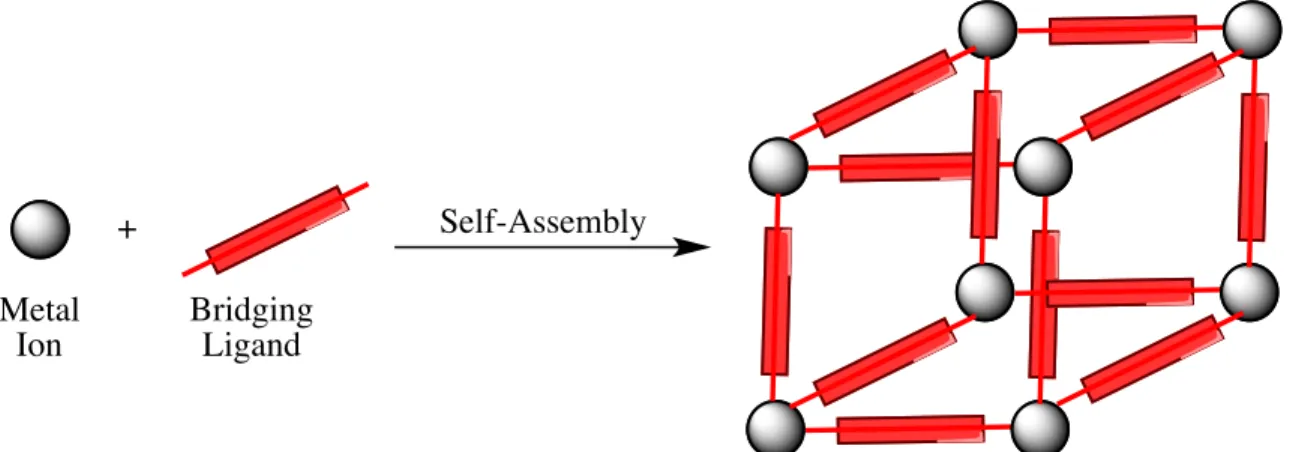
Coordination polymers, also known as metal organic frameworks (MOFs), are inorganic compounds containing polymerized metal-ligand networks. The structure of coordination polymers is composed of metal ions connected to polydentate bridging ligands (Figure 1.4). The composition of the coordination can be easily tuned by simply changing the metal ion or the bridging ligand. The highly tunable nature of the material allows for
different structures to be synthesized.
Figure 1.4. Self-assembly of metal ion and bridging ligand to form a metal-ligand network, known as a coordination polymer.
Published in 1960 by John Bailar, the first coordination polymer contained polymeric Schiff bases coordinated to various metal ions.30 Extensive research has since been
conducted on the crystalline network form of various coordination polymers, yet the first nanoscale coordination polymer (NCP) was not demonstrated until 2005.31 The Mirkin group demonstrated that addition of an initiation solvent to an aqueous solution of metal ions and metalloligands resulted in spontaneous precipitation of spherical NCPs. The NCPs consisted
30 Goodwin, H.; Bailar, J. J. Am. Chem. Soc. 1961, 83, 2467-2471. 31 Oh, M.; Mirkin, C. Nature 2005, 438, 651-654.
+
Metal
Ion BridgingLigand
of a carboxylate-functionalized binapthyl bis-metallo-tridentate Schiff base units coordinated to a metal ion (either Zn2+, Cu2+, or Ni2+) through the carboxylate functionalities. By adding a nonpolar solvent to the polar precursor solution, precipitation occurred due to the poor
solubility of the NCPs.
1.3.2 Nanoscale Coordination Polymers in Drug Delivery
Since the initial discovery of NCPs, these materials have been investigated for use in drug delivery. Conventional small molecule therapeutics are limited by their rapid clearance and nonspecific distribution in the body, which leads to high doses and adverse side effects.32 Incorporation of the small molecule drug into a nanomaterial provides a route to overcome the side effects and to increase the circulation time. Considerable research is being conducted in designing nanoparticles that are capable of controllable release of an active drug at a targeted area of interest and selective delivery of the drug to the target tumor sites.33 Many nanoscale systems have been shown to load and release drugs; these systems include: liposomes34,35, polymer micelles36, dendrimers37, inorganic particles38,39, and mesoporous
32 Davis, M.; Chen, Z.; Shin, D. Nat. Rev. Drug Discov. 2008, 7, 771.
33 Peer, D.; Karp, J.; Hong, S.; Farokhzad, O.; Margalit, R.; Langer, R. Nat. Nanotech. 2007, 2, 751-760.
34 Allen, T.; Cullis, P. Adv. Drug Del. Rev. 2013, 65, 36-48. 35 Torchilin, V. Nat. Rev. Drug Discov. 2005, 4, 145-160.
36 Siddik, Z.; Jones, M.; Boxall, F.; Harrap, K. Cancer Chemother. Pharmacol. 1988, 21, 19-24.
37 Bosman, A.; Janssen, H.; Meijer, E. Chem. Rev. 1999, 99, 1665-1688.
silica.40 Through extensive research in this area, successful translation into clinical studies has been achieved for few nanocarrier systems, such as doxorubicin (Doxil) and
daunorubicin (Daunoxome).
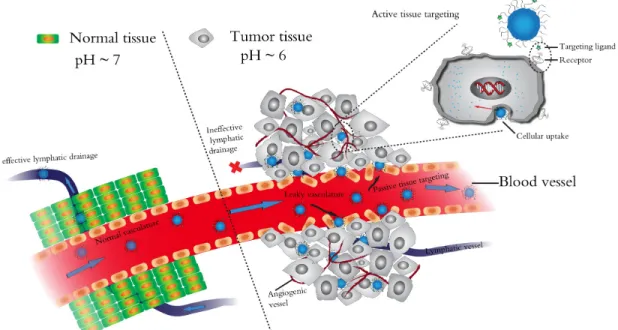
Passive targeting of nanoparticles to the tumor region occurs due to the enhanced permeability and retention (EPR) effect (Figure 1.5).41 Newly formed tumor vessels are abnormal in form and architecture, leading to large fenestrations in which macromolecules can escape through. The EPR effect is known as passive targeting because nanoparticles are unable to penetrate through the tight junctions of normal blood vessels. Furthermore, the nanoparticles are retained in the tumor region due to poor lymphatic drainage. Over time, the concentration of nanoparticles in the tumor site can build up due to the lack of effective drainage.
Figure 1.5. The enhanced permeability and retention (EPR) effect which leads to passive tumor targeting by nanoparticles. Illustration provided by Demin Liu.
Additionally, the surface of nanoparticles can be coated or functionalized with many different types of molecules for therapeutic applications. For instance, by incorporating poly(ethylene glycol) (PEG) onto the surface, nonspecific adsorption of proteins onto the nanoparticles can be minimized, increasing the blood circulation time.42 The hydrophilic nature of PEG attracts water molecules that shield the particle from protein adsorption. In other cases, coating nanocarriers with a lipid bilayer coating aids in creating a neutral surface charge to minimize nonspecific protein interactions. PEGylated liposomes can be utilized to coat the nanoparticles in a neutral bilayer and to increase the blood circulation time by preventing protein interaction with the nanoparticle surface. Also, pegylated liposomes are slow to degrade, resulting in a slow, sustained release of drug from the interior. Up until release, the drug is inert due to its entrapment. Alternatively, molecules can be directly attached to the particle surface to serve as targeting functionalities. Incorporation of a targeting molecule can play a role in cell uptake by specific cell types. Various molecules, including nucleic acid aptamers, antibodies, and small organic compounds, have been used to achieve active targeting of cancer cells. Introduction of functional groups (such as
carboxylates) onto these targeting molecules allow for conjugation onto the nanoparticle. The Lin group has set precedence in the development of NCPs for effective anticancer therapy. Using NCPs as an alternative approach to other nanocarriers provides many advantages due to the properties and characteristics of coordination polymers. NCPs can combine the advantages of both inorganic and organic nanoparticles to exhibit
compositional tunability, biodegradability, high drug loadings,43 surface functionalization, and well-defined morphologies.44,45 Incorporation of an anticancer therapeutic into the framework of the NCP allows for exceptionally high drug loadings. Secondly, adjusting the synthetic conditions can modify the composition, shape, and size of the NCPs. Additionally, the relatively labile metal-ligand bond makes NCPs biodegradable.
1.3.3 Initial Drug Delivery NCPs
Direct incorporation of a drug into a NCP framework can be achieved through use of the active agent as the bridging ligand. A cisplatin prodrug. disuccinatocisplatin
(c,c,t-[PtCl2(NH3)2(O2CCH2CH2CO2H)2]), was designed for use in a Tb(III) NCP.46 Dynamic light scattering (DLS) measured the hydrodynamic diameter of the NCPs to be ~58.3 nm in size. To increase the stability of the coordination polymer, the NCPs were encapsulated in silica. The resulting drug release exhibited a t1/2 of 9 hours after silica coating, whereas the bare NCPs had a t1/2 equal to 1 hour. Active targeting was achieved by functionalizing the Tb-based NCP surface with c(RGDfk), a peptide that targets the αvβ3 integrin overexpressed on certain cancer cell lines. The targeted NCPs displayed a higher cytotoxicity than cisplatin (IC50= 9.7 µM and 13.0 µM, respectively) when tested against HT-29 human colorectal adenocarcinoma cells. The nontargeted version did not display any cytotoxic effects against
43 Kim, J.; Piao, Y.; Hyeon, T. Chem. Soc. Rev. 2009, 38, 372.
44 Champion, J.; Mitragotri, S. Proc. Natl. Acad. Sci. U. S. A., 2006, 103, 4930.
45 Yavuz, M.; Cheng, Y.; Chen, J.; Cobley, C.; Zhang, Q.; Rycenga, M.; Xie, J.; Kim, C.; Song, K.; Schwartz, A.; Wang, L.; Xia, Y. Nat. Mater. 2009, 8, 935.
this cell line. The improved cytotoxity of the c(RGDfk)-targeted NCPs suggest that active targeting can be achieved.
Another method to incorporate small molecules drugs into NCPs is through post-functionalization of the bridging ligands. Lin and coworkers synthesized Fe(III)-carboxylate NCPs with a MIL-101 structure by solvothermal methods (~200 nm in diameter by DLS).47 Covalent attachment of biologically relevant cargoes was achieved without altering the NCP structure. The NCP was successfully post-synthetically modified with an optical imaging dye (BODIPY) and a cisplatin prodrug. UV-Vis spectroscopy confirmed a BODIPY loading of up to 12 wt%, and ICP-MS confirmed a cisplatin loading of 13 wt%. Confocal microscopy revealed that HT-29 cells internalized the BODIPY-loaded NCPs. Silica coating was again used to increase the stability of the NCP system, which increased the t1/2 from 1 hour to 14 hours. Post-functionalization with both an imaging agent and a therapeutic agent suggest that NCPs can be developed for theranostic applications.
1.3.4 Stabilization of NCPs
Although silica coating of NCPs aids in controlled release of the drug, the previously reported NCPs were not stable under physiological conditions. Therefore, alternative NCP systems encapsulated in a lipid bilayer were synthesized. First, NCPs were used to deliver nitrogen-containing bisphosphonates (N-BPs) to cancer cells.48 The structure of two different N-BPs, zoledronic acid and pamidronic acid, are shown in Figure 1.6. Currently used to treat osteoporosis, N-BPs are not effective anticancer drugs due to their high affinity towards bone
47
Taylor-Pashow, T.; Della Rocca, J.; Xie, Z.; Tran, S.; Lin, W. J. Am. Chem. Soc. 2009, 131, 14261-14263.
48
Liu, D.; Kramer, S.; Huxford-Phillips, R.; Wang, S.; Della Rocca, J.; Lin, W. Chem.
absorption. By incorporating N-BPs into NCPs, targeted delivery of the drugs to cancer cells can be achieved. Both zoledronate and pamidronate were incorporated into the framework of NCPs through coordination to Ca2+ ions. The as-synthesized NCPs rapidly decomposed in solution (t1/2 = 6.3 h for pamidronate NCP). To control the release of the N-BPs, the surface of the NCPs was coated with single lipid bilayers. Following lipid coating, the drug release kinetics demonstrated a significant increase in the in vitro circulation half-life (t1/2 = 20.1 h for pamidronate NCP). Therefore, it was concluded that the presence of the single lipid bilayer significantly stabilized the NCP systems.
Figure 1.6. Structure of two nitrogen-containing bisphosphonates, zoledronic acid and pamidronic acid.
More recently, the self-assembly of two zinc bisphosphonate NCPs containing
approximately 48 wt% cisplatin prodrug or 45 wt% oxaliplatin prodrug was reported.49 These NCPs possess hydrodynamic volumes in the range of 20-30 nm as determined by DLS. The NCPs were surrounded by a lipid bilayer and further PEGylated to increase the circulation times. Following PEGylation, the hydrodynamic diameters of the NCPs increased to 40-45 nm, indicating the presence of the lipid bilayer on the particle surface. In vitro stability studies revealed that the near-neutral surface charge of these systems minimized nonspecific protein interactions suggesting that uptake by the MPS can effectively be avoided.
Additionally, no premature drug release was observed from these NCPs prior to being placed into a reducing environment similar to that of the tumor site. This suggests that the NCPs can
circulate the body with minimal drug release, but upon arrival at the tumor site, the active agent can be released. Further, the selective delivery of the zinc-based NCPs to solid tumors was achieved in several different mouse models.
1.3.5 Research Objectives
B(C6F5)3-CATALYZEDHYDROSILYLATIVEDEOXYGENATIONOF Chapter 2.
POLYOLSTOFORMHIGHLYBRANCHEDSTRUCTURES
2.1 Introduction
The synthesis of branched polyolefins for industrial applications involves
polymerization of olefin monomers using either free radical initiators or metal catalysts.1 In contrast to free radical methods, coordination catalysts have demonstrated the ability to exercise significantly greater control of the polymer microstructure.50 Depending on the catalyst selected, control over the both the regiochemistry and stereochemistry of monomer enchainment can be achieved, which provides for polymers with variable properties. The microstructure and molecular weight of a polymer controls the properties of the bulk material, which consequently influences the applications for which it may be used.
We are interested in developing alternative methods to synthesize branched polyolefins through defunctionalization of linear, high MW polyols. The Lewis acid trispentafluorophenylborane (B(C6F5)3) has previously been used as a catalyst in the mild hydrosilylative reduction of C-O bonds.20,22, 21,24 Typically, a hydrosilane, such as
diethylsilane, is used as the hydride source in the reduction. Our group has utilized this chemistry to affect the deoxygenation of carbohydrates as a possible approach to biomass conversion to fuels.29 When diethylsilane was combined with the B(C6F5)3 catalyst, an aggressive reduction of glucose ensues to generate a mixture of products wherein hexane and
hexene isomers were observed, the former being dominant. The formation of branched products (predominantly 2-methylpentane and 3-methylpentane) indicates that elimination and alkyl shifting occurs during the deoxygenation process. Interestingly, the product distribution was dependent on the silane and protecting group used for the glucose OH groups.
In this study, we applied the B(C6F5)3-catalyzed hydrosilylative deoxygenation to linear polyols to explore how reduction would affect the structure of the reduced
hydrocarbon polymer. The reduction protocol leads to completely deoxygenated, highly branched polyolefins. We investigated the effect of the silane and protecting group on the branching and amount of elimination that occurs during the deoxygenation. Both 1H and 13C NMR spectroscopy were used as the primary methods to study the polymer structures post-deoxygenation.
2.2 Experimental 2.2.1 Materials
The deoxygenation reactions were performed inside a Vacuum Atmospheres
2.2.2 Instrumentation and Analysis
NMR spectra were recorded using a Bruker Avance III spectrometer equipped with a cryoprobe operating at 600 MHz (1H) or 150 MHz (13C). NMR chemical shifts are reported in ppm and internally referenced to residual proton peaks (1H) or the 13C resonances of the deuterated solvent (13C). All NMR spectra were recorded in CDCl3 or CD2Cl2. For 13C-NMR spectroscopy, chromium(III) acetate (Cr(acac)3) was added as a relaxation agent to all
polymer samples prior to collecting spectra (d1 = 1 s).
Gel permeation chromatography (GPC) was performed using an Agilent Tchnologies 1260 Infinity separation module equipped with two Agilent 3 µm MIXED-E 30x7.5mm column and a Wyatt Optilab T-Rex refractive index detector. Polymer samples were prepared in HPLC grade tetrahydrofuran and filtered before injection. Tetrahydrofuran was used as the eluent with a flow rate of 1.0 mL/min at 25 °C. Retention times were calibrated against narrow molecular weight polystyrene standards.
2.2.3 Hydroboration-Oxidation of Polybutadiene
Polybutadiene was hydroborated with borane reagents followed by oxidation using a procedure similar to that previously reported.51 A typical hydroboration-oxidation sequence was done as following: 0.5 g of polymer was combined with 50 mL of 0.5 M
9-9-borabicyclo[3.3.1]nonane (9-BBN) in THF under an N2 atmosphere. The reaction was stirred for 3 days at room temperature. To the resulting solution, a mixture of NaOH (3.0 M, 2.0 mL) and aqueous H2O2 (30%, 2.0 mL) was added at 0 °C. The reaction mixture was
allowed to stir at room temperature overnight. The mixture was dialyzed against 1:1 MeOH: water for 5 hours, or until pH was neutral. The MeOH: water was changed hourly. The reaction mixture was then removed from the dialysis tubing, the insoluble fraction was removed by filtration, and the soluble fraction was rotovapped to isolate the polyol (PBD-OH, 52% yield). 1H NMR (600 MHz, Chloroform-d) δ 3.81 – 3.78 (broad, m, 1H), 1.90 – 1.21 (broad, m, 6H). 13C-NMR (600 MHz, Chloroform-d) δ 71.90, 36.43, 31.53, 20.17. 2.2.4 Protection of Polyols
PVA and hydroxylated-polybutadiene were protected with different silanes using the following procedure: unprotected polymer (0.5 g) was dissolved in 20 mL pyridine and 0.05 moles of chlorosilane were added. The reaction was stirred for 3-4 days before workup. To quench the silane, 50 mL of water was added. The protected polymer was extracted into diethyl ether (3 x 50 mL). The ether layers were combined and washed with water (3 x 50 mL), brine (3 x 50 mL), and then dried over MgSO4. The solvent was removed by rotary evaporation. The product was triturated with toluene to remove any remaining pyridine and was dried on the vacuum line overnight. The materials were isolated as viscous oils.
PVA-TMS: 90% yield; 1H NMR (600 MHz, Methylene chloride-d2)δ 3.87 (broad,
1H), 1.99*, 1.59 (broad, 2H), 0.12 (broad, 9H). 13C-NMR (600 MHz, Methylene chloride-d2) δ 170.99*, 67.74, 47.50, 21.63*, 1.63. *Indicates minor peaks in spectrum due to
unhydrolyzed poly(vinyl acetate) in starting material.
PVA-SiMe2Et: 1H NMR (600 MHz, Chloroform-d) δ 3.85 (broad, 1H), 1.99*, 1.56 (broad, 2H), 0.92 (3H), 0.57 (2H), 0.09 (6H). 13C-NMR (600 MHz, Chloroform-d)δ 170.49*, 67.03, 46.90, 21.16*, 9.45, 7.15, 1.19. *Indicates minor peaks in spectrum due to
unhydrolyzed poly(vinyl acetate) in starting material.
PVA-TES: 1H NMR (600 MHz, Chloroform-d) δ 3.86 (broad, 1H), 1.98*, 1.55 (broad, 2H), 0.93 (9H), 0.54 (6H). 13C-NMR (600 MHz, Chloroform-d)δ 170.57*, 67.07, 46.94, 21.03*, 9.45, 6.64, 5.88. *Indicates minor peaks in spectrum due to unhydrolyzed poly(vinyl acetate) in starting material.
PBD-OTMS: 1H NMR (600 MHz, Chloroform-d) δ 3.78 – 3.66 (m, 1H), 1.83 – 1.50 (m, 4H), 1.49 – 1.28 (m, 2H), 0.17 – 0.05 (s, 9H). 13C-NMR (600 MHz, Chloroform-d)δ
72.07, 36.47, 20.07, 0.04.
PBD-OSiMe2Et: 1H NMR (600 MHz, Chloroform-d) δ 3.71 (m, 1H), 1.83 – 1.57 (m, 4H), 1.38 – 1.32 (m, 2H), 0.91 (t, 3H), 0.54 (q, 2H), 0.04 (s, 6H). 13C-NMR (600 MHz, Chloroform-d)δ 72.08, 36.56, 20.16, 8.38, 6.72, 2.24.
OSiMe2Et
OTES
OTMS
2.2.5 General Deoxygenation Procedure
In a nitrogen-filled glovebox, silyl-protected polymer (50 mg) and B(C6F5)3 (5 mol% relative to monomer) was dissolved in 0.25 mL CD2Cl2 or CH2Cl2. Then, 0.25 mL of silane (diethylsilane, dimethylethlsilane, or triethylsilane) was added. The solution was immediately capped with a vented cap and swirled. After gas evolution subsided, the reaction mixture was transferred to a septum-capped NMR tube and removed from the glovebox to continue reacting for 48 h at 35 °C. At this point, in situ NMR spectra were obtained if desired. 2.2.6 General Silane Removal Procedure
To remove excess silane and silyl ether from the deoxygenation reaction, the reaction mixture was added to a 15-mL plastic centrifuge tube. To the centrifuge tube, 0.80 mL of pyridine-HF was added. The reaction mixture was treated with pyridine-HF for 24 h. Silica was then added to remove any excess HF present. The silica was isolated by vacuum filtration, and the filtrate was rotovapped to yield the branched polyolefin.
2.2.7 General Hydrogenation Procedure
The branched polyolefin was dissolved in 2.0 mL of CH2Cl2 and transferred to a Fisher porter vessel. Wilkinson’s catalyst (1 mol%) was added, and the vessel was put under 40 psi of H2. The reaction was allowed to stir at 40 °C for two days. The catalyst was
2.3 Results and Discussion
2.3.1 Synthesis and Deoxygenation of TMS-PVA
During the deoxygenation process, the reaction conditions cause any of the free alcohols to become silylated, though the relative rates of OH silylation versus -OSiR3 deoxygenation are difficult to assess. To aid in studying the deoxygenation and to increase the solubility of the polymer, poly(vinyl alcohol) (PVA, MW=9-10,000) was preprotected as a silyl ether. As shown in Scheme 2.1, this was accomplished with TMS-Cl in pyridine; 48 h reaction times ensured complete formation of silyl ethers, and the desired product was isolated in 90% yield.
Scheme 2.1. TMS-Protection of Poly(vinyl Alcohol).
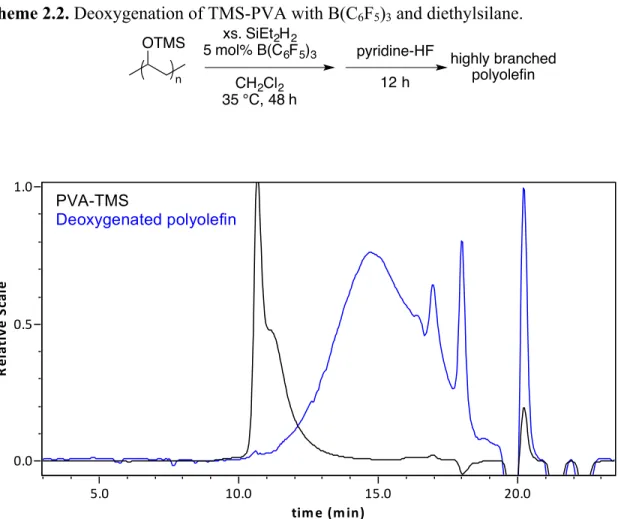
Use of a catalytic amount of commercially available B(C6F5)3 with diethylsilane as the reducing agent caused complete deoxygenation of PVA-TMS to occur (35 °C, 48 h, Scheme 2.2) as ascertained by NMR spectroscopy and gel permeation chromatography (GPC). Since the theoretical mass loss for the conversion of PVA-TMS to PE is 76%, GPC was used to check this loss of mass. This technique separates polymers based on size with high molecular weight polymers eluting first. Figure 2.1 shows the GPC chromatogram of TMS-protected PVA and the corresponding deoxygenated product. Qualitatively, the starting material elutes at a shorter retention time indicating that the product is indeed of lower molecular weight. The broad MW distribution additionally suggests that the deoxygenated polyolefin may have suffered chain scission during deoxygenation, may have become more heterogenous, and/or may have become branched.
OH TMS-Cl OTMS
Pyridine 35 °C, 48 h
Scheme 2.2. Deoxygenation of TMS-PVA with B(C6F5)3 and diethylsilane.
Figure 2.1. GPC chromatogram of the starting material (TMS-PVA, black) compared to the deoxygenated product (blue) confirming loss of mass following deoxygenation.
Particularly helpful was 13C-NMR analysis as this enabled the disappearance of the C-O bond to be followed. To perform quantitative 13C-NMR analysis, spectra were obtained by dissolving the polymer sample in a 0.05M solution of Cr(acac)3 (relaxation agent) in CDCl3 or CD2Cl2, and a 1 s relaxation delay between scans was used. 1H gated decoupling was performed to reduce NOE enhancement.The two characteristic peaks of the starting material at 67 (carbinol CHOSiR3) and 47 ppm (CH2) shift to an envelope of peaks upfield of 45 ppm. Figure 2.2 compares the 13C-NMR spectrum of the starting material (TMS-PVA) to the in situ derived deoxygenation reaction. Based on the in situ NMR spectrum, complete deoxygenation was achieved during this period of time, at least to the detection limit of the
OTMS
n
xs. SiEt2H2 5 mol% B(C6F5)3
CH2Cl2 35 °C, 48 h
highly branched polyolefin pyridine-HF 12 h chromatog rams 2sak12-B[SEC1310] 2sak1-B[SEC1310] time%(min)
5.0 10.0 15.0 20.0
spectra. The presence of excess silane used for the reduction and the R3Si-O-SiR3
complicates 13C-NMR analysis of the deoxygenated polymer structure. These interferents were removed from the deoxygenated polymer by treating with pyridine-HF, which breaks the Si-O bonds through formation of the stronger Si-F bond.52 Excess silica gel was added to quench any remaining HF. The deoxygenated polymer was isolated by filtration, and the solvent was removed.
Figure 2.2. 13C-NMR spectra (in CD
2Cl2) of PVA-TMS (top) and in situ deoxygenation of PVA-TMS (bottom).
NMR analysis (Figure 2.3) was used to study the purified deoxygenated polymer structure. The 13C-NMR spectrum shows a complex, highly branched polyolefin. The peak at 68 ppm indicates that this sample remained partially oxygenated. Several peaks were
observed in the 120-150 ppm region, indicative of alkene groups and the likelihood of
elimination occurring during the deoxygenation process.53 Most characteristic were the many peaks observed in the 10-50 ppm region of the spectrum, consistent with a highly branched
53 Eğe, S. Elimination Reactions. In Organic Chemistry: Structure and Reactivity, 5th ed.; Houghton Mifflin: Boston, 2004; 264-271.
B OSiMe3 A
B A
C
* *
* = unhydrolyzed poly(vinyl acetate) in the PVA C
Silanes Alkanes
microstructure post-deoxygenation. Since the starting polyol is a linear structure, it appears that the deoxygenation is accompanied by significant alkyl shifting, perhaps reasonably suggesting the intermediacy of carbocations.54 For the reduction of TMS-PVA, 1H-NMR spectroscopy was used to quantify the degree of branching and elimination in the resulting product. Modifications of the previously reported formula for calculating the number of branches in a polyethylene sample14, Equation 2.1 and Equation 2.2 were used to estimate both the branch and elimination number. It is important to note that Equation 2.2 does not account for the presence of tri- and tetra- substituted alkenes in the elimination calculation, which consequently underestimates the number of alkenes per 1000 C in the product polymer. The expectation is that these would represent low probability events given the linear nature of the starting polymer, but it does represent an uncertainty. The branch numbers for the polyolefin were determined from the ratio of the integration of methyl groups to the integration of total carbons (methyl + methylene + methine + allyl + alkene) in the 1H-NMR spectrum. Integration of the methyl 1H resonances with respect to the total resonances and applying the formula in Equation 2.2 gave the notably high average degree of branching of 210 + 35 per 1000 C (Table 2.2, Entry 1), which suggests that nearly one out of every two C2 “ethylene” units contains a branch. Similarly, the number of alkenes per 1000 C can be determined by taking a ratio of the alkenes to the total carbon integration. This
analysis suggested that the deoxygenated polyolefin possessed an average of around 17 alkenes per 1000 C (1 alkene = 2 alkene carbons).
Figure 2.3. 13C-NMR spectrum of partially deoxygenated TMS-PVA (in CD
2Cl2) after treatment with pyridine-HF. The presence of peaks between 120-140 ppm indicates the likelihood of elimination occurring, whereas peaks between 15-50 ppm indicates the likelihood of rearrangement occurring during the deoxygenation reaction.
Equation 2.1.
Equation 2.2.
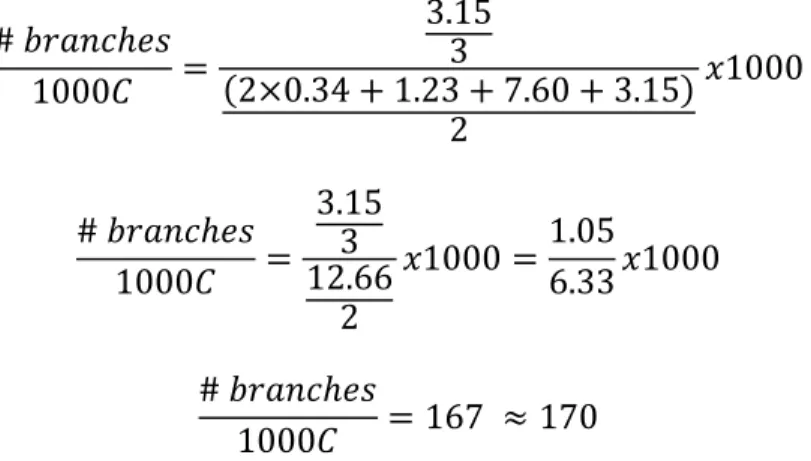
An example NMR analysis to determine the number of branches and alkenes present is shown below. The 1H-NMR spectrum shown below (Figure 2.4) is following
deoxygenation (with borane and SiEt2H2) and pyridine-HF treatment of TMS-PVA. The integration values for each unique proton resonance are presented in Table 2.1.
Silanes Alkanes
CO Bonds Alkenes
*CH
2
Backbone
#
Branches
1000C
=
CH
33
(2
×
CH
alkene+
CH
+
CH
2+
CH
3)
2
×
1000
#
Alkenes
1000
C
=
CH
alkene2
(2
×
CH
alkene+
CH
+
CH
2+
CH
3)
2
Figure 2.4. 1H-NMR spectrum of deoxygenated, non-hydrogenated TMS-PVA (in CD2Cl2) after treatment with pyridine-HF. Analysis of the proton integrations using Equation 2.1 and Equation 2.2 determined a branch number of 210 and an alkene number of 30 (per 1000 C). Table 2.1. 1H-NMR relative integration values for each unique proton resonance in the deoxygenated polymer produced from the reduction of TMS-PVA with borane and diethylsilane.
Proton Type Methyl Methylene Methine Allyl Alkene
Relative Integration 3.15 7.60 1.23 1.00 0.34
Calculation 1. Determination of branch number for the polymer produced from deoxygenation of PVA-TMS.
0 1 2 3 4 5 6 7 8 9 10 f1 (ppm) 3 .1 5 7 .6 0 1 .2 3 1 .0 0 0 .3 4
#
Branches
1000C
=
CH
33
(2
×
CH
alkene+
CH
+
CH
2+
CH
3)
2
#!!"#$%ℎ!"
1000! =
3.15 3
2×0.34+1.23+7.60+3.15
2
!1000
#!!"#$%ℎ!"
1000! =
3.15 3 12.66
2
!1000=1.05
6.33!1000
#!!"#$%ℎ!"
1000! =167!≈170
Calculation 2. Determination of alkene number for the polymer produced from deoxygenation of PVA-TMS.
#!!"#$%$&
1000! =
0.34
2
2×0.34+1.23+7.60+3.15
2
!1000
#!!"#$%$& 1000! =
0.34
2
12.66 2
!1000=0.17
6.33
#!!"#$%$&
1000! = 27
Even at this stage, the polyolefin structure was too complex to analyze the branching structure present by 13C NMR spectroscopy. The sample was further simplified by exhaustive hydrogenation of all alkenes using 1 mol% of freshly prepared Wilkinson’s catalyst at 40 psi hydrogen and 40 °C (2 days). A fresh preparation of Wilkinson’s catalyst was key to
achieving complete reduction. To remove the catalyst, the mixture was passed through a silica plug eluting with hexanes, and the polymer was isolated by evaporation of the solvent. Figure 2.5 displays the 13C-NMR spectra of deoxygenated TMS-PVA before and after
#
Alkenes
1000
C
=
CH
alkene2
(2
×
CH
alkene+
CH
+
CH
2+
CH
3)
2
achieved as evidenced by the disappearance of alkene peaks at 120-140 ppm. The branch number on the hydrogenated polymer was again calculated using Equation 2.2 following hydrogenation, and no change in branch number was observed, confirming that the modified equation provides a reasonable branch number estimation. For convenience, all branch numbers in this chapter were thus calculated prior to hydrogenation of the polymer.
Figure 2.5. 13C-NMR spectrum of deoxygenated TMS-PVA after pyridine-HF treatment: before (top) and after (bottom) hydrogenation with Wilkinson’s catalyst. Following
hydrogenation, the sample no longer appears to contain alkenes, which are characterized by peaks at 120-140 ppm.
Figure 2.6 shows the 13C-NMR spectrum obtained following exhaustive
hydrogenation with Wilkinson’s catalyst. Based on previous literature, the carbon resonances can be assigned to unique types of branches.55,56,57 The peak at 30 ppm represents the
methylenes in the middle of a long, straight chain (at least 4 methylene groups on each side). The other carbon resonances, such as methines at a branch point, have been assigned by Brookhart and the DuPont group.57 Comparison of the hydrogenated polyalkane to
previously reported branched polyethylene samples shows a number of structural similarities, and some differences. The deoxygenated material contains methyl, propyl, butyl and longer branches, but does not apparently contain ethyl branches, which are characterized by a resonance at ~11 ppm. In contrast to the branched polymers reported by Brookhart for Ni-catalyzed ethylene polymerization, the methyl peaks (20 ppm) in the present case appear to be more complex. Notably, the peak(s) at 46 ppm, which is characteristic of a methylene between two branch points, is significant in the present samples, but completely absent in the Ni-derived branched polyethylene.57,58
56 Prasad, J.; Rao, P.; Garg, V. Eur. Polym J. 1991, 27, 251-254.
57 McCord, E.; McLain, S.; Nelson, L.; Ittel, S.; Tempel, D.; Chris, K.; Johnson, L.; Brookhart, M. Macromolecules 2007, 40, 410-420.
Figure 2.6. 13C-NMR spectrum of deoxygenated TMS-PVA following hydrogenation. Labels are marked as Cx, where x is the chain length. EOC is end of chain; 2EOC is the second carbon from the end of the chain. The Greek letters indicate how far from a branch point each methylene is.
The deoxygenation of poly(vinyl alcohol) samples by a combination of borane and diethylsilane leads to complete deoxygenation and the introduction of significant branching in the resulting polymer. Although this reactivity parallels observations on the conversion of glucose to hexanes, the amount of branching was surprisingly high.
2.3.2 Effect of Silane and Protecting Group
Previously, the Gagné lab demonstrated that both the protecting group and the silane affect the selectivity and reactivity in glucose deoxygenation chemistry.29 For instance, the rate and selectivity of the reduction of Me2EtSi-protected glucitol were affected when the