LOWERING THE REFUGEE DEATH TOLL: AN EXTENT TO WHICH THE EU FAILED IN THE EU TURKEY JOINT ACTION PLAN
Lauren Gaillard
A thesis submitted to the faculty of the University of North Carolina at Chapel Hill in partial fulfillment of the requirements for the degree of Master of Arts in the Department
of Political Science, Concentration TransAtlantic Studies.
Chapel Hill 2017
Approved by:
Holger Moroff
ii
iii
ABSTRACT
Lauren Gaillard: Lowering the refugee death toll: An extent to which the EU has failed in the EU Turkey Joint Action Plan
(Under the direction of Holger Moroff)
In this research I aim to unravel to what extent the EU has failed under the EU
Turkey Agreement (JAP) to rightly lower the refugee death toll. I examine how the EU
acts in its own self-interest, noting that saving the lives of refugees legally and illegally
crossing its borders from the Eastern Mediterranean route is a contested moral, individual
and institutional issue. There is an abstract and normative political responsibility the EU
must uphold as an institution. Under Neo-institutionalism and the normative aims of R2P
and the 1951 Geneva Convention I conclude that the EU in the EU Turkey deal
superficially upholds its responsibility to lower the refugee death toll by fulfilling its
duties under this policy for its political advantage. The failure is that the EU circumvents
fixing the root causes of the issue by rerouting and increasing the death toll of refugees to
the Central Mediterranean route.
iv
ACKNOWLEDGEMENTS
After several months of deliberation, I was able to complete this research with the
help of UNC Professor Dr. Holger Moroff. Thank you for all of your guidance and
advice. This research would not have been possible without you. I would also like to
kindly thank Dr. Wolfgang Mackiewicz from Freie Universität for offering advice, as
well as Dr. Marcus Engler from Humboldt Universität for presenting materials and
inspiring me to pursue this topic. If it were not for our seminar and the exposure I had to
learn about refugee politics alongside my refugee and asylum seeking colleagues and
friends, I would not have been able to gain such a deep understanding of the personal and
international affects the Migrant Crisis has had, and continues to have, on the livelihood
and political relationships among international populations and institutions. My
experiences throughout this project have been invaluable, so thank you to everyone who
v
TABLE OF CONTENTS
LIST OF ABBREVIATIONS ... vii
CHAPTER 1: INTRODUCTION ...1
Introduction ...1
1.1 EU Turkey Agreement (JAP) ...5
CHAPTER 2: THEORETICAL FRAMEWORK ...9
2.1 Neo-Institutionalism ...9
2.2 Challenges ...12
CHAPTER 3: METHODOLOGY ...14
3.1 Data Collection ...14
3.2 Data Analysis ...17
CHAPTER 4: NORMATIVE AIMS ...24
Introduction ...24
4.1 Responsibility to Protect (R2P) ...28
4.2 1951 Geneva Convention ...32
4.3 Psychophysical & Psychological Explanation ...35
CONCLUSION ...38
APPENDIX 1: FIGURES ...42
APPENDIX 2: TABLE ...46
vi
vii
LIST OF ABBREVIATIONS
EEAS European External Action Service
EUBAM European Union Border Assistance Mission
EUNAVFOR European Union Naval Force
ISSG International Syria Support Group
JAP Joint Action Plan
1
CHAPTER 1: INTRODUCTION
Introduction
In this paper, I aim to address the pressing issue surrounding unsafe refugee
travel, specifically regarding the large number of deaths occurring on their journey to
Europe as they migrate through different Mediterranean routes: Central and Eastern. By
using the EU-Turkey JAP as a reference point, I will conclude that this particular deal has
set a certain precedent, an extent to which has now currently called for a similar deal to
be struck between North African countries and Europe. Several points of success outlined
in the EU-Turkey agreement between Europe and Turkey, and three hypotheses centering
around the failure on part of the EU in the EU-Turkey deal will be evaluated. The
successes and failures depicted here thematically stem from a normative perspective,
which revolve around the connection between morality and self-interest. I ask if it is
possible for rational actors to act upon a policy out of self-interest and not address the
‘root cause’ of the issue for which the policy is made. As such, the rational actor might be
identified as ‘less’ moral, but here this is seen as not the case. I must first establish that
this research firmly aims to suggest that the EU is a rational actor, which acts out of
self-interest under the EU Turkey deal and does in fact accomplish most of the issues that are
laid out in the JAP.
This insinuates that the JAP itself is not ‘amoral’; rather, it is the motive behind
2
death toll of refugees. Therefore, I determine the following as given: the EU is a moral,
rational actor, as there is no reason to believe otherwise; the EU Turkey deal is a valid
policy and the EU carries out the majority of the goals outlined in the policy. The policy
itself is neither ‘moral’ nor ‘amoral’, as it is a set of standards detailed for the EU and
Turkey by which to abide. I argue that the motives and actions of the EU as a moral and
rational actor, under the policy of the EU Turkey JAP, are somewhat ‘amoral’, as is
defined here as the EU’s lack of addressing the root causes behind saving lives of
refugees—supported statistically in the number of deaths that have continued to occur
even after the implementation of the JAP.
More explicitly, the main questions I address are: when evaluating the EU’s part
in the EU Turkey deal, to what extent has the EU upheld its end of the deal, and in doing
so, how has it succeeded or failed morally and statistically to save the lives of refugees?
Furthermore, from the aid of other EU policies and mandates that deal with the migrant
crisis and refugees, in what ways have they revealed the normative aims and political
justifications of the EU when focusing on the individual and international institutional
interests of lowering the death toll of refugees over time? The three hypotheses that may
answer these questions include: 1) The EU as a moral, rational actor acts in its own
self-interest; 2) EU policy makers are less at fault than the EU as a greater institution for
making a strategic deal with Turkey—one that makes lowering the death toll of refugees
less of a priority 3) The EU upholds the main points of the EU Turkey JAP superficially,
not fully solving the issue by neglecting the root causes of mass refugee deaths in the
3
I will conclude from this that the EU acting out of self-interest only delegitimizes
its morale when acting under the JAP in this humanitarian crisis; it is not delegitimized
completely as an institution. When a rational institution outlines a policy that does not
explicitly address the root cause of a moral issue it aims to achieve overall, but rather
uses strategic self-interest and coercive means to just make improvements of the situation
on the surface, then it might succeed at upholding the points of the deal and yet still fail
at properly addressing the issue directly. This suggests that in this research the EU
conducted ‘amoral’ actions as a moral and rational institution. An actor only uses the
construction and implementation of a policy as a vessel to prove whether its motives and
actions are thus out of self-interest and moral or not.
Quantitative data from EU Fact Sheets, FRONTEX Reports, IOM statistics, etc.
shows factual evidence as to how a deal like the EU-Turkey agreement is not adequately
combating the core issue of stopping refugees from dying on their journey to Europe—
that in this aspect, it is failing as a deal because it is simply rerouting the occurrences of
refugee deaths. I point out qualitatively that the EU-Turkey deal has not been explicitly
successful in taking measures to save refugees’ lives by using EU legislative documents,
fact sheets and press releases from 2015 to 2017, an article from BBC, as well as
secondary sources of literature for reference. Through these methods of research, I find
that there is a difference between actively saving refugees’ lives as they continue to cross
the borders of the EU and rather simply stopping the passage of refugees across the
Mediterranean by striking a deal to limit the number of travelers and strengthen
restrictions for travel—claiming that this is successful in ‘lowering the death toll’—
4
As I examine the EU and migrant crisis in more detail through the lens of a
neo-institutional framework and a 3-part normative angle, it is clear that though there is a
responsibility to protect by many nations other than the EU, it is due to the international,
neo-institutional and political nature of the EU in relation to the routes refugees are
taking that it makes most sense to analyze, for the purposes of this research, only the
EU’s responsibility to protect. The analysis will consist of deciphering the conundrum of
who’s ‘higher standards’ the EU on the macro and micro level uses when responding to
the crisis, and the moral and rational normative aims that may have guided the EU to act.
To first point out, the position the EU is in is very unique with respect to its role
as a supranational entity because alongside of its responsibility to protect under the
political commitment RtoP (or R2P), EU member states also have a commitment to abide
by the Geneva Convention, specifically the 1951 Refugee Convention. The ideological
issue is based on the overall purpose of the EU Turkey JAP, which is its commitment to
first saving the lives of refugees. The EU rather aims to achieve other goals that instead
benefit the EU (and Turkey) paving the way for further, similar deals to be made (several
of which will be mentioned later as supporting or resulting from the EU Turkey
agreement). In part, I research certain points highlighted in the EU Turkey deal and
expose how the EU is benefiting and what this may mean for current and future
agreements and partnerships.
1.1 The EU Turkey Agreement (Joint Action Plan)
Due to the massive developments of the Syrian war, the migrant crisis escalated to
5
refugee deaths. In recent years there has been one of the largest number of refugees to
cross over the borders into the EU. Legal and illegal, refugees continue to flee from the
Middle East and Africa using several possible routes and means of travel; however, the
most popular pathways have shifted from the Eastern Mediterranean route to the Central
Mediterranean route since the implementation of the JAP. The biggest issue for the EU is
its incapability to stop the large amount of deaths from occurring, specifically in the
Mediterranean ocean. As is hypothesized, the EU has failed to make lowering the death
toll a first priority. Initially it was in 2013 that the EU said it would actually make it a
priority to spearhead "increase [d] engagement with third countries in order to avoid that
migrants embark on hazardous journeys towards the European Union…”1. The EU
further tried to exemplify morale by concluding in 2015 after the extraordinarily large
loss of lives in the shipwreck near Lampedusa, that they would "mobilise all efforts at its
disposal to prevent further loss of life at sea and to tackle the root causes of the human
emergency" and then “strengthen their presence at sea.”2 There is a point of contention
resting upon the question as to how we should interpret the last aim written in this line:
‘to tackle the root causes of the human emergency’.
Ultimately, the root causes revolve around the concept of war. It is due to war that
there has been an escalation in refugee flight from cultural and political persecution. An
aim of the EU is to establish partnerships, deals and political relationships with its
1 See Appendix 3, 2b. Legislative Document, p.2;
Source from reference 2; primary source from COM (2015) final of 13.5.2015
2 See Appendix 3, 2b. Legislative Document, p.2;
6
neighboring countries to maintain cooperative and peaceful environments. If there is war
amongst its neighboring countries, causing refugee flight into Europe then that root cause
to be addressed is war. The EU is currently exploring different options to aid the crisis
such as focusing on the containment of traffickers and stopping the smuggling business.
This does not stop the root cause of the issue, and therefore does not prevent refugees
from coming into the EU (Kempin and Sheler, 2015).
Former military operations led by the US and NATO in several countries across
North Africa and the Middle East resulted in their regime changes, civil wars and
economic disparity. These in fact are several root causes that initiated the migrant crisis.
As Chossudovsky states, “The refugee crisis is triggered by the despair of millions of
people fleeing their homeland, whose lives have been destroyed as a result of [US led]
wars and civil wars coupled with devastating macro-economic reforms imposed by ‘The
Washington Consensus’ (Chossudovsky, 2016).” Outlined clearly by EU legislation is
that their “first priority remains saving the lives of those attempting to cross the
Mediterranean in their path towards Europe.” They also believe that “the root causes, in
particular conflict, political violence, abuse of human rights and poverty, is essential.3’
These objectives are prioritized like so, are however, not upheld by the EU under the EU
Turkey agreement the way in which it is phrased here.
It was on 29 November 2015 that the EU activated the Joint Action Plan, which
came from the European Agenda on Migration on 15 October 2015.4 The JAP notes
several key ways in which both Turkey and the EU will join together in partnership and
3 See Appendix 3, 2a. Legislative Document. In the document this quote comes from section II under “The European Union’s policy framework and response.”
7
try, “…to step up their cooperation on support of Syrians under temporary protection and
migration management in a coordinated effort to address the crisis created by the
situation in Syria5.” This shows that the EU has good moral and humanistic intensions to
make it a priority to save refugee lives but in planning and implementation there was a
failure. For example, the fault was not on the EU for the shipwreck but for the EU to
make a statement in 2013 to put in a collaborative effort to detour refugees from taking
hazardous journeys and then two years later there be a mass death occurrence of refugees
who took an unsafe method of travel, sheds light on the lack of attention the EU put on
tackling the root causes of the crisis.
Over time there have been overall successes, several of which do point to the
implementation of the EU Turkey JAP in this ‘step up’ in coordination; however, some
success also occurred in the interest of the EU. 1) The EU has less migrants crossing their
borders while Turkey has kept the majority, increasing the number of refugees Turkey
must politically support; 2) Turkey benefited from monetary aid the EU has given but
they are still left with more of a burden to take care of the refugees; 3) The EU convened
with Turkey to make this joint deal but under the EU’s provision. It is written in the JAP
Press Release as such: “The implementation of the Action Plan will be jointly steered and
overseen by the European Commission and the High Representative / Vice President and
the Turkish government through the establishment of the EU-Turkey high-level working
group on migration.6” This automatically gives more leeway to the EU, leaving Turkey at
a bit of a disadvantage even before negotiating. With this, the EU Turkey JAP initially
5 See Appendix 3, 4. EU Turkey Fact Sheet
8
exposes many underlying issues and yet successful measures as well, both for the EU and
Turkey; however, what can be concluded and further examined is the extent to which the
EU has failed to uphold its responsibilities in the EU Turkey agreement and how the
agreement has somewhat failed itself on a deeper level through the theoretical lens of
9
CHAPTER 2: THEORETICAL FRAMEWORK
2.1 Neo-Institutionalism
Institutionalism is a part of organization theory in which many scholars depict
institutional conception and reasoning as institutions having cultural, normative and
regulative elements (Scott, 2001). There is a spectrum within this new-institutionalist
way of thinking where the most constructivist part of the continuum, from scholars like
John Meyer, emphasize social creation of actors where it is believed that the environment
is what shapes institutions and organizations. At the other end of this continuum, there are
sets of ‘institutional constraints and supports’ of those pursuing self-determined interests
in the process co-creating institutions. The first would be more along the lines of a kind
of neo-institutionalism that the EU follows in its actions within the international
community. It was in the 1970s and 1980s that new institutionalism came to the forefront
of the theoretical scene, shifting attention from ‘old’ institutionalism in order to highlight
that there may in fact be outside environmental factors that affect the constructs of
organizations and give them ideas for their structure, increasing their legitimacy globally.
“As put byDiMaggio and Powell (1991:8): ‘The new institutionalism in organization
theory and sociology comprises a rejection of rational-actor models, an interest in
institutions as independent variables, a turn toward cognitive and cultural explanations,
10
aggregations or direct consequences of individuals’ attributes or motives’ (Bromley and
Powell, 2013).”
There is, however, an issue within neo-institutionalism, the rejection of self-interest
and the global legitimization of institutions. It is problematic in a way to say that the EU
has delegitimized itself under this theory if one abstractly blames them as an actor with
selfish motives to respond to the migrant crisis of course. There is an issue of morality—
detecting where these ‘higher standards’ and ‘higher forms of legitimization’ come from
and who creates them. It is difficult to pin down from whom and where these higher
‘moral’ and political standard originate. The issue of ‘higher standards’ and the actions of
individuals in connection to the institutional processes are more in line with Zucker’s
social psychological outlook (Zucker, 1997). This conceptualization of
neo-institutionalism constitutes that there is an emphasis on more of the micro-foundational
side where the individual is greatly connected, either by influencing or being influenced,
by institutions.
Regarding individual influence by institutions, it is also vital to recognize that at
such an individual political level, there is almost no choice but for politicians to adhere to
a rejection of their own political motives. For example, if a large number of the electorate
from EU member states perceive that helping refugees is not in their own self-interest, or
in the interest of the EU, then would it not be true that politicians who ignore them will
not be (re-) elected? However, this is not the case for highly politicized humanitarian
issues like the migrant crisis. From an abstract institutional level, the motives of the
politicians at a supraindividual level do become more of a focus than at an individual
11
supraindividual and thus can end up institutionalized. In the co-creation of greater
institutions or in the creation and implementation of policies and deals like the EU
Turkey deal, under neo-institutionalism when an institution does not reject their own self
-determined interests, one can in fact ‘appropriate aggregations and consequences’ to the
greater institution’s actions. This leads us to question the motives of the EU as an
institution. The EU has pursued its own interests and is consequentially failing to perform
the duty of saving refugee’s lives through a deal that in theory it was supposed to
accomplish; yet, instead the deal became a bargaining tool for EU border security and
thus reduced entry of illegal migrants into the EU.
On the contrary, the EU does uphold certain concepts of neo-institutionalism. Due
to the need for international responses of refugees in Europe, this humanitarian issue can
be seen as an outside, environmental influence in the global polity, requiring a collective
international response to initiate an expansion of empowering individuals and national
institutions to come together. On the surface, the EU has indeed continued to respond
from outside environmental factors, i.e. the Migrant Crisis, thus following the nature of
neo-institutionalism. They have and are diffusing the practice of nationalized
organization to international organization where rational-actors and their interests are
governed by a ‘wider institutional environment’. The EU Turkey deal can therefore be
categorized as a modernized form of rationalized administration from both the EU and
Turkey’s side in a linkage to world society. This emphasizes that there exists a world
polity which acts out of world societal influences, allowing international bodies to work
together under a new kind of institutionalization, one that is cohesively pursues collective
12
2.2 Challenges
Two concerns that Powell and Bromley mention are also two concerns within
researching normative and political motivations for the EU to form a deal with Turkey.
The first challenge under the neo-institutional framework is that some attest to the fact
that formal structures are superficial and that relative to actual practices, are tackling a
peripheral issue. In this instance, this would allude to the EU tackling the peripheral issue
of ‘lowering refugee deaths’ but actually not getting to the root causes of the issues. Neo
-institutionalism overlooks addressing the overspecialization of actors —the EU (and
Turkey as well)—and a lack of attention to coercive power (the EU coercing Turkey to
abide by their end of the deal in order to receive benefits specified in this deal, such as
reevaluation of Turkey’s accession into the EU and providing them monetary support in
order for the EU to retain ‘border security’ and less refugee entries). It cannot be ignored
that Turkey also uses refugees as a bargaining chip with the EU to make them acquiesce
to the authoritarian regime they are trying to establish. The second challenge is that some
interpret the emphasis on diffusion and homogeneity of organizational structures as
having an influence from modernity and rationalization, thus appearing to become
increasingly ‘superficially similar’ (Bromley and Powell, 2013).
Conclusively, how can high normative aims such as R2P still be pursued, even
under a mandate—the 1951 Geneva Refugee Convention—in a co-created policy like the
EU Turkey deal (when it is apparent that institutions on a macro-scale) have underlying
self-interests? This conundrum leads to the question, how high can normative aims like
13
possibly, and as is seen today, give rise to radical parties? Politicians have to walk a fine
line when voicing their own opinions and motives in public, or at the electorate
supraindividual and institutional levels. Looking further into the normative aims of R2P
and with respect to the Geneva Convention and a more psychological thought-provoking
section, this conundrum may connect the individual actor, the international and
institutional organizations and moral ‘high standards’ seen in the affects of the EU Turkey
14
CHAPTER 3: METHODOLOGY
3.1 Data Collection
As a means for collecting data, I used mixed methods in this research. The
quantitative data is used to provide mathematical models that are able to the issues in
number of refugee deaths, arrivals and routes taken over the time that occurred before
and during the EU Turkey deal was conceived and implemented. In order to put the
mathematical data to use, qualitative data was collected, some from the same sources. I
introduced the qualitative data involuntarily, as the premise of this research incorporated
the necessity of finding primary documents, first by searching for documented evidence
on the EU Turkey deal but then also the theoretical support and legislative writings to
factually explain and support the argument at hand. Due to this research’s case-based
nature, it was necessary to provide legislative grounding for a comparison over time on
how legislative implementation and the EU Turkey deal, along with supplementary
mandates and deals, affected or related to the increase or decrease in the death toll of
refugees.
The quantitative data I collected comes from various Internet based sources. Some
data comes from secondary sources such as articles or brief reports from institutes such as
the Migration Policy Institute. Other quantitative data was retrieved from Frontex Report
Analyses or data collection and analysis organizations such as IOM and GMDAC, along
15
There are limitations and biases, however. An issue with these documents is the
recognition that the sources are all from a one-sided (EU) perspective. Neither Turkish
nor African sources were used within the confines of this research. Even still, using such
international documents were arguably not necessary to support the research presented
here, which centered around faulting the EU for not upholding its morale in the EU
Turkey deal. Such conclusions can still be made by using EU documents, reports and
websites.
Also, having various kinds of data sources has advantages and disadvantages.
Advantages include that there area variety of primary and secondary sources pointing to
the same conclusion, adding more legitimacy to my argument. This quantitative variety
however still brings about disadvantages, including that some data aimed at measuring
the same topics were collected over sets of different years of comparison. For example,
data collected in 2015 and 2016 might only have figures and tables that compare data of
those years (or from several years before, like 2012), while updated data of 2016 or 2017
show comparisons between only those two years. This is an issue with researching a
contemporary and current topic—the data available is somewhat limited and covers
smaller ranges and sets of time, as well as smaller aspects of comparison.
Primary sources such as EU published documents add the advantage of reliability
and regular updates; however, this also has its limitations. As is true when researching
such a current policy issue, new proposals and deals are consistently being formed and
reformed, making it difficult to focus on specific ways in which, in this case, the EU
decides to combat a core issue within one policy. For example, when the EU held the
16
Turkey JAP and the safety of refugees. However, the combatant methods to tackle this
issue were shifted from focusing on the terms of the EU Turkey deal to smugglers and the
prevention of unsafe methods of illegal migrant crossings, specifically along the coast of
Libya and other North African countries. Ways of tackling the refugee death toll are
changing; there are two upsides to this.
One is that this helps verify the issue that the EU Turkey deal does not necessarily
do a just job at putting the lives of refugees first and actually reducing refugee deaths. It
just pushes the refugees to go to other locations through dangerous land routes or to the
coast of Libya where they take on the deadly waters of the Mediterranean and end up
dying in even larger numbers. This supports the argument that refugees overall are still
dying under the EU Turkey deal even though theymay have reduced the number of
deaths along the Eastern Mediterranean route. Therefore, this identifies that the EU
Turkey deal is a legislative and political means for the EU to say it has done its
humanitarian job while ultimately acting in its own interests by securing its borders and
subsiding continued refugee migration into the EU.
Secondly, this research comes from various updated documents that are consistently
changing. What once was a priority topic to be addressed in the EU Turkey deal, has now
turned into a deal on its own. Arguably, lowering of the refugee death toll is no longer at
the top of the agenda for the EU Turkey deal; it has become the primary agenda between
the EU and North African countries. This in a way delegitimizes the argument presented
in this paper considering that now there are more measures being taken and deals being
made in order to address the root causes and humanitarian issues of the migrant crisis.
17
the core of their proposal, perhaps even revealing that the psychological and theoretical
groundings used in this research may be discussed from a skewed angle—now revealing
an alternative, that EU policy makers may psychologically understand the gravity of the
large death toll and that the EU as a supranational entity may not be as worried about
border security as it is about saving the lives of refugees. But of course, these
counterarguments are hypothetical.
One brief additional limitation is that in some quantitative and actually qualitative
data, it is difficult to decipher if the number of deaths include other methods of travel.
The primary focus of this research is to detect the number of deaths by sea but also to
allude to the fact that more should be done overall to ensure the total amount of deaths
even on land and air, now within these African countries too, are reduced or fully
subsided.
3.2 Data Analysis
The aforementioned overlapping of qualitative and quantitative data is increasingly
evident as the research proceeds. Intertwined are the qualitative documents and primary
sources, alongside the quantitative mathematical figures and tables. The figures, table and
primary documents are all inserted in the appendices of this research paper in order to
allow for contextual flow and a clearer understanding of how legislative documents and
fact sheets naturally draw upon quantitative data. This better allows the EU perspective to
be the focus and shows in which ways these documents may support or negate what the
quantitative data reveals. The concluding argument of this research will be exposed once
18
I first and primarily evaluate in this research the qualitative data of the EU
legislative document on the Joint Communication to the European Parliament, the
European Council and the Council: Migration on the Central Mediterranean Route
Managing flows, saving lives from 25 January 2017. Additionally using further primary
and some secondary qualitative data sources, truths and falsehoods are recognized in a
correlated manner between the ways in which the EU qualitatively adheres to its
agreements and deals in the JAP, and also how it quantitatively reduces the death toll of
refugees. I remark from the data that there is a rising focus on the implementation of a
similar deal between the EU and North African countries.
It was after December 2013 that the plan to build a stronger policy and response to
help migrants avoid hazardous journeys to Europe was initiated. According to the
European Council, it became a priority. This ‘priority’ gained recognition and kept this
status as the EU took on an unprecedented role being a supranational body to develop
such response mechanisms to the tragedies that were occurring and would soon become a
pinnacle number of refugee deaths in history. In 2015 one of the most devastating
accidents, the shipwreck near Lampedusa, caused thousands of refugee deaths. The EU
made a call to respond, which solidified the notion that they would “tackle the root causes
of the human emergency by strengthening [their] presence at sea (2).7” This recently
published legislative document further states that since this tragedy, the EU has kept a
strong presence indeed in the Mediterranean, rescuing tens of thousands of lives through
today.
19
Even still, there have been negotiations and new deals thrown on the table for the
EU to work with the Libyan Coast Guard and instill a Partnership Framework with
several countries along the African transit route. It is therefore noticeable how the EU has
now recognized that the efforts to simply create a ‘stronger presence at sea’ has not
stopped the issue of refugees still crossing the Mediterranean, allowing for deaths to
continue to occur. Sure, we see that the European Council has increased efforts to save
the lives of refugees, but made known publicly at the 2017 Malta Summit by President
Junker, migrant deaths have increased along the Central Mediterranean route since 2015.
Put in other terms, this hints at a problem of this deal: migrants, mainly Syrian refugees,
are still trying to escape and are dying, doing so by using other routes and illegal
measures like smuggling to cross the Mediterranean into Europe because of the
circumvention of the EU to address the root causes of refugee deaths.
Taking a deeper look into the data, I find further limitations with two outcomes, one
with a negative affect and one with a positive affect. Firstly, certain data only depictsthe
sea crossings and the number of deaths occurring over the Mediterranean in relation to
the number of refugees (mostly illegal) who continue to leave the Turkish and North
African coastlines to cross. This is limiting, so in order to get a more accurate number of
refugee deaths over time, it would be most beneficial to look at data that shows the ratio
between the number of all refugees, legal and illegal, who have left to cross into the EU
before and after the agreement’s implementation and then look at the number of deaths
that occurred both before and after said agreement was put in place. It is then that one
would have a most accurate number and correlation to see if this agreement affected the
20
route separately and combined to better find if the deal was ‘a success’ in saving lives. In
addition to this, it would be necessary to take into account the means of transportation
and then look at the rates of death within the countries refugees travel through in order to
get to their destination country, regardless if it’s to the EU, Africa or the Middle East.
Numbers of this caliber are almost impossible to 100% account for. Because of this, and
because of the data limitations of this research, there may in fact be bias and skewed data.
It would be necessary to look at numbers of refugees specifically who legally and
illegally crossed the Eastern Mediterranean route from the coast (or by land or air) of
Turkey into the EU and compare that with the number of legal and illegal refugees who
travelled the Central Mediterranean route from the coastline (or by land or air) into the
EU. This would need to be done perhaps from 2014 until the implementation of the EU
Turkey JAP and then again from the implementation date up through today. This would
ultimately provide a more accurate, less biased and overall explanation as to if this deal
effectively, all around reduced the death toll of refugees. The morale of this deal of
course cannot mathematically be accounted for. This will have to fall under the category
of qualitative normative perceptions of determining this aspect of efficacy or by figuring
out if the EU dutifully upheld its responsibility to protect, doing so under good, selfless
intentions.
Quantitative data from the EEAS fact sheet further suggests that the EU decided to
establish relations and make proposals for agreements and deals with their African
neighbors, e.g. the EUNAVFOR Med Operation Sofia, EUBAM and the new approach of
the Migration Partnership Framework, which rethinks how all concerned actors – the
21
together to better manage migration flows and strive for well-managed migration.8 The
EU wants to solidify its African relations to continue its endeavor in responding to the
‘human emergency’ as a priority. So, for the different EU institutions and leaders
there-within, it is necessary to extend humanitarian responses of the migrant crisis toward
further assisting other countries along the central route that are a part of this international
challenge. Further expressed by two main leaders in the EU are statements that push for a
stronger European international presence in order to create win-win partnerships,
ultimately instilling the belief that this will help address the root causes of the refugee
crisis9.
“A lasting solution will only come if we address the root causes, the reasons why we are currently facing this important refugee crisis. Our European foreign policy must be more assertive.”
-Jean Claude Juncker, President of the European Commission
“Migration is a positive thing for the world, but we need to do it in a regulated way. It is a global, complex phenomenon, it concerns the EU as much as countries of transit or origin ...Our approach is a new one, based on a win-win partnership.”
-Federica Mogherini, High Representative/Vice-President of the European Commission, Strasbourg – 7 June 2016
In light of examining more data limitations and analyses, one must not be fooled.
These views come out of privilege and from a feeling or manner of ‘success’ they believe
they have achieved with Turkey in reducing the number of refugee deaths since the deal
was implemented10. This, however, only accounts for one mode of transit—sea—from the
Central African route. As such, it is difficult to project and make solid statements on the
efficacy of the EU’s policies to lower the death toll. However, this limitation allows us to
8 See Appendix 3, 3. EEAS Fact Sheet
9 See Appendix 3, 3. EEAS Fact Sheet, p.1
22
continue to examine the research in another way. I now must ask why the EU has been
refraining so far to stop the death toll on land too. Is it because of sovereignty? Is it out of
respect for these Middle Eastern and African countries in their partnership framework to
authoritatively take care of its people? Or is this fully or partly out of EU self-interest? If
the EU can only legally—without permission—save the lives of refugees at sea due to its
right by international law, then this is understandable. But it is due to this establishment
of new frameworks and partnerships between the EU and Turkey or North African
countries that shows how the EU can and will circumvent its involuntary duty to abide by
international regulations in order to continue to establish plans that harness its presence
and personal interests to extend its borders internationally and avoid addressing the crisis
head-on.
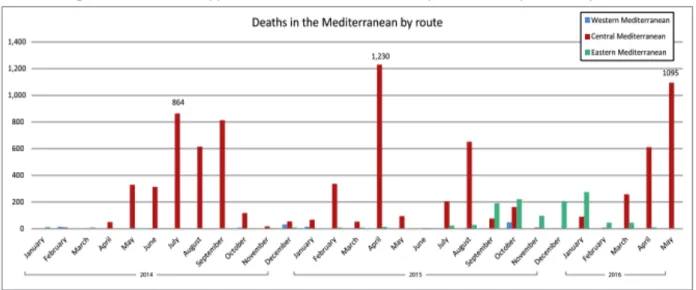
Secondly, the data for the number of refugee deaths across the Mediterranean ocean
along the Central route is not misleading and stands for itself, revealing that there has
undoubtedly been an increase in the death toll and in illegal migration since the
implementation of the EU Turkey deal. The numbers of migratory travelers, legal or
illegal, from North Africa to Italy along the Central Mediterranean route may have risen
in comparison to that of the Eastern route due to the containment of refugees in Turkey—
as was proposed in the EU-Turkey deal in exchange for financial support from the EU.11
The number of migrants crossing EU borders in general has decreased, especially along
the Eastern route, which was the predominate route of irregular migration since 201212
(Katsiaficas, 2016). It is because of this reduced border crossing that the EU sees the
11 See Table 1 –Appendix 2
23
need for a similar deal with North Africa. Just because one deal may have subsided the
number of migrants crossing EU borders, does not mean that the EU is saving the lives of
refugees because of this. Factually, the implementation of the EU Turkey deal has caused
a spike in refugee deaths due to its deterring nature. If they make another deal with North
African countries to combat such reduced EU border crossings, then track record shows
that refugees will just move and use another route, no matter the dangerous conditions.
The data provided also either only examines the Eastern route from Turkey to
Greece only or the Central route from North Africa (Libya mostly) to Italy. In the specific
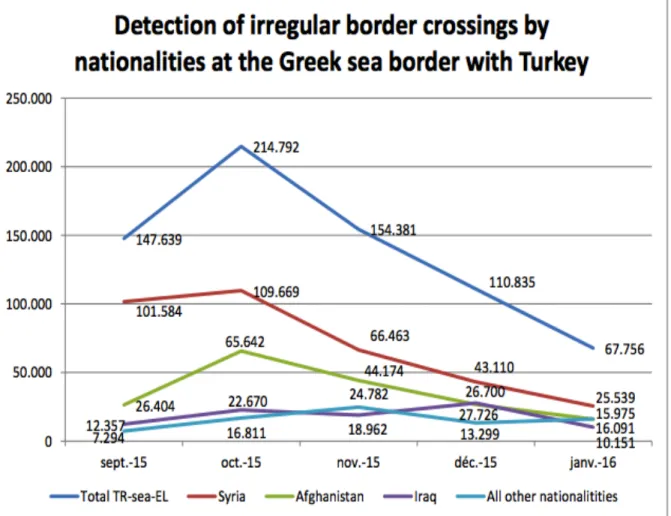
Grecian EU point of entry, it may be due to causal factors including, time of migration—
noting that the decrease occurred recently after the EU Turkey deal was established and
also that the months examined were over the Winter season, thus making refugees less
likely to travel in such cold waters and weather conditions13. Ironically, this season is the
time when most refugees decided to leave North Africa to travel to the EU. “In 2016,
migrants embarked on trips from North Africa across the Mediterranean more frequently
in winter months, as indicated by the 49,393 arrivals to Italy in October–December 2016,
compared to only 21,772 in the same period in 2015, and 31,304 in 2014 (GMDAC,
2016).”
24
CHAPTER 4: NORMATIVE AIMS
Introduction
In general, points of failure are viewed differently when approaching an
evaluation from a normative perspective. As such, there are several ways in which one
could normatively assess the failure of the EU to rightly lower the refugee death toll
under the EU Turkey JAP. However, considering it is evident that this deal has been
conceived under the management of the EU, I normatively assess motives and reasoning
of the EU from an institutional level by looking at their actions under R2P and the
Geneva Convention. I will also examine the actions and motivations of individuals, such
as policy makers and politicians further on from a psychoanalytical perspective to better
interpret how one can or cannot comprehend mass deaths. This would hint at a more
concrete idea of perhaps why getting to the root cause of the issue and of coming up with
an effective plan to combat the death toll might be difficult.
In 2016 the Migrant Crisis State of Play Agenda given by the European
Commission, listed twelve priority actions as ‘matters of urgency’. Several actions listed
here and carried out by the EU included distributing aid to Turkey and Syrian Refugees in
order to tend to their needs within Turkey. The Implementation Report states, “The aim of
the measure is to make Turkey a more attractive asylum country for Syrians addressing
thus one of the main factors pushing Syrians to cross irregularly to the EU in search of
better perspectives14.” This opens the door for asking about motives and the ideology
25
behind the EU extending help across its borders to admittedly keep refugees in Turkey. It
calls out refugees leaving Turkey for the EU, saying that they envision the EU as a better
place, in search of that ‘better perspective’.
Such a statement by the EU uncovers a slightly self-centered sense of political
and economic awareness in comparison to where refugees are coming from, and lacks the
selfless acknowledgement of the cultural and security challenges refugees face when
crossing over the Mediterranean into the EU. From a documented standpoint the EU even
first thinks of itself before and during its philanthropic actions to save lives. However,
here they are admitting that there are pull factors, which is not a bad or amoral thing to
do; the pull factors consist of: a better livelihood, safety, adequate means of food, shelter
and basic needs, as well as the potential to stay in countries that are not ridden with war.
In one respect it is necessary for the EU to mention the pull factors, but what might be
depreciating the value of this statement in the report is the lack of addressing the root
causes, the push factors, such as the initial cause of the migrant crisis—war.
The EU Turkey agreement also seems to flash this inward approach by
decentralizing the focus of humanitarian response from the greater international complex
of intervention based on adherence to the Geneva Convention and R2P regarding saving
the lives of refugees, to a more nationalized complex of advocating for national elections
and gaining right- or left-wing political support—mainly within EU member states. It is
necessary to first look at how there is more of a responsive action instead of a
preventative action being taken by the EU, which is indeed seen detailed in the JAP as
well as in other reports and mandates mentioned here for supplemented reasoning. Such
26
Report on managing the migrant crisis. This leads us to take a closer look at the
ideological reasoning for intervention in order to then analyze the facts on illegal
migration, the death toll and the number of arrivals into the EU pre and post the
implementation of the EU Turkey JAP.
Almost arbitrary yet documented information that sets up another normative
approach reveals how the EU acts more out of personal interest as a rational-actor,
skirting around addressing the root issue of migrant deaths. For example, in 2016 the EU
partly blamed weather conditions for the overall increase in the death toll. “It has also to
be noted that, due to deteriorating weather conditions, the number of people who perished
while irregularly crossing to Greece is on the rise.15” While this may be in fact true, what
is missing here is the reasoning as to why in the first place refugee migrants felt the need
to escape in such dangerous conditions knowing that they may possibly die. Perhaps it is
due to their need to desperately escape whatever situation they are in, the Syrian Civil
War for instance, knowing that if they stay they may die anyway. So, maybe they think,
why not just die trying to at least make it to safety in Europe? If the EU understood and
responded to the root causes of this humanitarian crisis, perhaps this legislative document
would not need to blame weather for refugee deaths. Instead maybe the EU could have, at
that time, called for safer measures for refugees to enter Europe.
It is true however that the EU is responding to the crisis in Syria by inducing
political solutions and not military ones. This comes after the reoccurrence of violent acts
after the deemed cessation of fighting and US-Russian hostilities in Syria. The EU is
giving neighboring Syrian countries financial and humanitarian assistance and is
27
suspending its cooperation with the Syrian government under the ENP. Does this now
suggest that they are acting out of morale as a legitimate institutional organization? They
are helping by actively participating in the ISSG, fully supporting the UN’s efforts of the
UN Special Envoy for Syria, and most importantly, pushing the notion that “stability in
Syria will only be restored through a Syrian-led political process leading to a peaceful
and inclusive transition, based on the principles of the Geneva communiqué of 30 June
2012...ready to provide support once political transition has started (The EU and the
Crisis in Syria, 2016).” The EU now addresses the root causes of war but only sticks to
providing humanitarian aid, waiting for Syria to properly politically transition. The EU
expresses concerns about foreign non-state actors and military involvement but ultimately
does not spearhead the solutions of war. Anxiously, everyone waits for the war to be over
while the EU continues humanitarian assistance. Of course aiding in such crises is moral
and important, which is what the EU is doing, but is this actually saving lives and solving
the issue?
Concluded in this report as well as in the aforementioned Malta Summit is that the
EU is sending in military-type support like the Frontex coast guard to cooperate with the
Libyan coast guard along the African coasts and they are also trying to assist in the
efforts with Turkey to prevent illegal migration. However, the EU is addressing the
affects of the root causes and hoping that the root issue will die down with the response
and peace tactics they have implemented. What is the right answer? What is the moral
thing to do—intervene directly, using hard power to stop the war, addressing the root
28
migrants from traveling across EU borders, strategically bargaining under their
self-interests?
We should understand that refugees come no matter the conditions; therefore,
should the EU not address the root cause of unpreventable migration by enacting safe
-travel as a prevention method to stop refugee deaths? Bridging the gap between the
normative perspective and policy making, how should the EU then make a deal with
Turkey, upholding their duty to respond out of adherence to the UN’s mandate, doing so
without making their personal political agenda a priority? Morally, should they help
Turkey and continue to do whatever is necessary to save the lives of refugees even if that
includes helping them safely cross dangerous waters—doing so instead of blaming their
actions and number of refugee deaths on the weather and methods of travel? Of course,
if the EU does open their borders and reach out to take on the responsibility to bring
migrants over, this could introduce many issues culturally, socially, politically and
geographically. Security issues would be of priority and existing citizens’ livelihoods
could feel threatened, politically this might be even more time-consuming for asylum
applications, relocation, Schengen countries and EU mandates versus national member
states’ law. So, how far the EU’s responsibility go to protect?
4.1 Responsibility to Protect (R2P or RtoP)
The first political responsibility through which I assess the EU under the JAP is
the Responsibility to Protect. Certain questions based on the foundation that members of
the UN agreed to the R2P political commitment therefore come into play. Which
29
efficient and open-minded in doing so? Keeping these questions in mind, it is very
important to point out that I unfortunately will not compare other countries’ mobility in
stepping up and extending aid as the EU has in this research. It is quite noticeable that the
EU has taken the brunt of the refugee migration crisis since the civil war in Syria broke
out, so they still deserve to be commended for the rapid work and policy implementations
they have achieved thus far.
After accounting for the timely response of the EU, under Pillar two,
International Assistance and capacity-building in the Responsibility to Protect mandate,
it is clear that the UN has promoted the means of coercion and suasion, as is so elegantly
put in the report of the Secretary General.16 This promotion of suasion generates the
notion that R2P is based more on deals and personal connections that two or more
national or international communities make with one another, so long as they appropriate
and encourage states to exercise their responsibility to protect.17 Where is the lawful and
legal legitimacy here? The Summit Outcome, which is what outlined this mandate R2P,
states in paragraphs 138 and 139 four forms of provision. This report highlights that the
first form of assistance implies “persuading States to do what they ought to do”while the
others actually, “suggest mutual commitment and an active partnership between the
international community and the State”18.
16 See Appendix 3, 6. Implementing the Responsibility to Protect (R2P): Report of the Secretary General p.15
17 See Appendix 3, 6. p.15
30
The kind of assistance asked of States in the international community is exactly
what the EU is doing, as well as Turkey and potentially the North African countries—
adhering to a somewhat mutual commitment and partnership to respond to this crisis. So,
they are indeed abiding by their responsibility to protect and work together, and the
formulation of the EU Turkey deal proves the EU stepped in to help. However, in the
same fashion it seems that by the standards of the R2P mandate, States are encouraged ‘to
meet their obligations relating to the responsibility to protect [which] could entail
confidential or public suasion, education, training and/or assistance19.’ This suggests that
it is ok for the EU to determine how and in what ways they might want to strike a deal
with another country based on its own motives and agenda. This is a dangerous privilege,
because this opens the door for States to lie or cheat one another out of a deal by only
upholding part or none of it at all. The legitimacy of state power and state credibility is
lost under R2P. It gives the EU permission to therefore strategically act as a rational-actor
for the purposes of its own interest in a coercive way, which allows for it to be the
subliminal meaning of the EU’s pronounced goal to save the lives of refugees.
As the Secretary General report states, “…when messages are reinforced by
parallel and consistent Member State diplomacy, they will be more persuasive. Dialogue
often achieves more than grandstanding, in part because it can provide parties with
greater insight into each other’s motivations and intentions (para. 30).” What this means
for the EU and its deal with Turkey is that the five main stipulations in this deal better be
upheld, because otherwise one or both parties will lose its credibility and jeopardize its
capability of keeping positive relations open between one another. The EU-Turkey
agreement signed on 18 March, 2016 manifested five main points, which state that
31
Turkey would agree to taking in the returned asylum seekers who illegally traveled
through Turkey to the EU in exchange for around €6 billion in aid, there would be visa
liberalization of Turkish citizens, negotiations revisited for Turkish accession into the EU,
about €2-3 billion toward funding projects to improve lives of refugees in host
communities in Turkey, and also the deal that the EU would provide resettlement of one
Syrian refugee from Turkey for each Syrian that is returned to Turkey of up to 72,000
legal entries of such EU accepted Syrians (Human Rights Watch, 2017). Just recently,
Turkish Prime Minister Tayyip Erdogan threatened to end the EU Turkey deal: “Now
they say readmission. What readmission? Forget about it," he said. "You don't let my
minister into the Netherlands. You revoke the landing rights of my foreign minister. You
prevent [us] holding meetings at the General Consulate building, which is my land. But
after that you'd expect us to do this [re-admit migrants]. That's not going to happen (BBC
News, 2017).” BBC stressed the concerns of Erdogan by mentioning that there was a
’Broken Promise’ and they continued by restating three of the five main points of the EU
Turkey deal, one of which Erdogan believed was not being upheld:
‘The migrant deal, signed in March 2016, saw Turkey promised aid, visa-free travel for its nationals and accelerated EU membership talks in return for its help in reducing the flow of migrants crossing to Europe.’
‘The number of migrants reaching Greece by sea dropped sharply after the deal was reached, and Turkey's continued co-operation with the EU is regarded as crucial in managing the mass arrival of migrants fleeing war and poverty in Africa and the Middle East.’
‘President Erdogan said the EU had broken its promise of granting visa-free travel to Turks.’
(BBC News, 2017)
What I conclude from this and from the Responsibility to Protect framework is
32
interpretation, so much so that States have leeway to make deals, change them or not
uphold them at all. Deals made under this framework are dowsed in power games and
self-interest, which is exactly what has been happening between the EU and Turkey. The
EU set up the game in their own interest and used forms of veiled bribery in the deal to
make sure Turkey kept the majority of refugees on their side of the Mediterranean. There
are many other reasons and arguments that could be made by this example, but the key
here is that the EU, under R2P, clearly made the EU Turkey deal with its own interest in
mind.
The EU, however, still upheld its responsibility to protect because quite frankly it
had to; the refugee crisis was and still is directly affecting them. The EU also upheld its
responsibility to help Turkey because it is very much encouraged under the R2P mandate
to help other States that feel they have less of a capacity to protect20. Yet most assuredly,
the EU responded because it is mandatory to do so when it regards refugees and their
livelihood, specifically dealing with countries that signed the 1951 Geneva Convention.
This gives reason to believe that the EU under the EU Turkey deal using the framework
of R2P acted out of necessity for the protection of refugees but also out of a mandated
response to protect by being in the UN and yet for its own interest to secure its borders
and hold off refugees from crossing into the EU who cross the Mediterranean from
Turkey.
4.2 1951 Geneva Convention
This convention was the first to consolidate all other forms of aid and responses to
refugees, providing the rights of refugees and determining who exactly a refugee is by
20
33
law. From Article I in this Convention, the term refugee ‘is someone who is unable or
unwilling to return to their country of origin owing to a well-founded fear of being
persecuted for reasons of race, religion, nationality, membership of a particular social
group, or political opinion21.’ The laws within the 1951 Refugee [Geneva] Convention
are very straightforward. Each article dictates the procedures that the ‘Contracting State’,
in this case the supranational body of the EU along side national state of The Republic of
Turkey, should follow when responding to a refugee crisis. The issue of contempt here is
that when looking at this mandate, both the EU and Turkey are following the guidelines
of most, if not all of the articles. The EU and Turkey also upheld the fundamental
principles that are underpinning this protocol, i.e. non-discrimination, non-penalization
and non-refoulement.22 So, then what is the problem here? How is it possible that aside
from seemingly not taking into account refugees’ personal situations that these countries,
specifically the EU, are not necessarily following the Geneva Convention’s protocol?
Two things stand out to be problematic in the EU’s response to the refugee death
toll that might be explained under the Geneva Convention: 1) the rights of illegal
refugees are being partly neglected, and 2) there is an issue with non-refoulement.
Following the EU Turkey JAP implemented on 29 November 2015, it was stated on 18
March 2016 that the foundational aim of this agreement was (and arguably still is) ‘to end
the irregular migration from Turkey to the EU in full compliance with EU and
international standards’ not to explicitly lower the death toll of migrants.23 Furthermore,
21 See Appendix3, 5. p.3
34
as was mentioned recently in February 2017 at the Malta Summit that a current aim is to
stop smuggling—one of the most if not the biggest methods of illegal travel into the EU.
Clearly it is obvious that even after several years of tackling this issue of irregular
migration, migrants and refugees still come. So, in terms of the EU Turkey agreement,
the two aforementioned issues come out of this aim, which shows that this aim is
misguided because of the fact that refugees are still crossing illegally. Later the data will
show that in certain routes this has increased over time.
The EU did indeed respond in the beginning very openly to accepting refugees. In
time more concerns and disdain were brought about, perhaps from a point of
misunderstanding or due to a lack of patience or time to accept refugees, including those
who crossed illegally. It is true that the numbers of refugees, entering mostly in only
several countries of the EU put a strain on resources and actions to respond. However,
could it be that the thought of limited resources to respond and massive waves of illegal
refugees caused an underlying distaste and lack of personalized evaluations for refugees,
thus neglecting their rights to fair treatment under the Geneva Convention? Basic rights
include: ‘rights to the courts, to primary education, to work and the provision for
documentation including a refugee travel document in passport form. …The Convention
[further] stipulates that, subject to specific exceptions, refugees should not be penalized
for their illegal entry or stay. This recognizes that the seeking of asylum can require
refugees to breach immigration rules.24’
23 See Appendix 3, 7. Commission Staff Working Document: 2016 Communication on EU Enlargement Policy p.4
35
So, why is it that refugees are told under the EU Turkey deal to stay in Turkey
other than for the benefit firstly of the EU and then for Turkey in regards to receiving
money and bribery partly for renegotiation of their entrance into the EU? And why is it
ok for the EU Turkey deal to somewhat circumvent the law of non-refoulement by stating
in the agreement that for up to 72,000 refugees the EU will send back one illegal refugee
in trade for a legal one from Turkey? In addition to this, why is it that burden sharing is
so much of an issue that even illegal refugees cannot be provided the basic rights to live a
decent life once they reach the EU if they survive their journey across the sea? Whether
there are in fact enough resources, land and space for all refugees to be dispersed and
properly treated, it is understandable that a solution to fair treatment takes time. But, the
issue of importance stems from the question of why refugees have to take illegal
measures to cross into the EU in the first place.
If refugees are still afforded basic rights (as they should be) and if it is mandatory
for countries under the Geneva Convention to accept all refugees, then hypothetically
speaking, why is there even a law in the first place? Also, why is there a more ‘goods and
services’ depiction of refugees? Where is the morale that recognizes that all humans are
humans? Every human facing persecution in their home country should be openly
provided entry to another country for safety. Perhaps if there was no status of legality,
less deaths would occur; but admittedly, this is too much of a utopian perspective, one
that requires the expectation that all humans act and even make policies in response to
crises with the intentions of having good will and decent morale. To shed light on how
36
it is worthwhile to explore the psychological perception of policymaking and reasoning
based in the thought processes of lowering the death toll of the mass groups of refugees.
4.3 Psychophysical & Psychological Explanation
Once more, the major profits of this EU-Turkey deal are threefold: 1) EU-Eastern
Mediterranean border control has increased and led to lower migration across its
borders—legal and illegal; 2) The death toll of migrants has decreased in this specific
region as a result; 3) Turkey now benefits monetarily from financial support by the EU.
Therefore, all outcomes make the EU on an institutional level look helpful and secure to
its citizens and make it seem like this deal is working. Subsequently, the EU is comprised
of individual MEPs and lawmakers who do in fact have moral compasses; so if assuming
correctly, these policy-makers most likely out of the goodness of their hearts would
probably not want any refugees to die. This calls for a brief but necessary explanation of
how psychological understanding or lack thereof of mass death affects policy-makers’
thought processes regarding in this specific case, how they may have developed the
purpose, plan of action and benefit scheme of the EU-Turkey deal. Stalin once said, “a
single death is a tragedy; a million deaths is a statistic,” and in light of this statement, a
psychological and legal study on the value of human lives, conducted by Goodman,
Jinks, Slovic, et.al from NYU School of Law, reveal a similar view:
37
“The […] importance of saving one life is great when it is the first, or only, life saved but diminishes marginally as the total number of lives saved increases. Thus, psychologically, the importance of saving one life is diminished against the background of a larger
threat— we will likely not “feel” much difference, nor value the difference, between saving 87 lives and saving 88.” (129).
Naturally no one wants anyone else to suffer, let alone die, but based on this study
people lose the ability to cognitively quantify and still feel connected to a mass amount of
deaths. This being said, we can assume that it becomes a bit easier for policy makers who
have not felt a personal connection to the mass amounts of refugee deaths to morally
justify the implementation of policies that covertly have more of the EU’s interest in
mind, selfishly justifying that this EU Turkey deal is then also providing its citizens
[border] security and safety—theoretically giving them, EU citizens, a greater value than
the loss of refugee lives. Policies like the EU-Turkey deal continue to be conceived based
on premises where the EU can reap benefits such as the three aforementioned profits
from the deal.
What should be recognized is simply the fact that the EU used its supranational
power and influence to extend its borders across the Mediterranean in order to retain its
power and border security, instilling this individualized and also institutionalized
perception of safety to its citizens and member states. Factors such as resource
availability and economic feasibility among member states is of course of concern when
thinking about border security and refugee acceptance, so it in one way makes sense for
the EU to reach out to the countries from where the refugees are departing in order to
create stability and security there first. However, policies and deals like these from the
EU are not rightly benefitting the refugees and saving lives, particularly the lives of those
38
CONCLUSION
I have addressed several points outlined and explained regarding the EU’s role in
the EU Turkey deal on the truth about lowering the refugee death toll. It is with this data
and the limitations provided within that one can ultimately conclude that there was
sidestepping of the EU within this deal. From blaming bad weather conditions for the
deaths of refugees to the increase in deaths since the deal’s implementation, it is evident
that the EU has failed in preventing and lowering the death toll overall, pointing blame
rather than solving the issue.
It cannot be missed however that on the contrary, the EU has in fact lowered the
death toll in the specific area of the Eastern Mediterranean route since the deal took
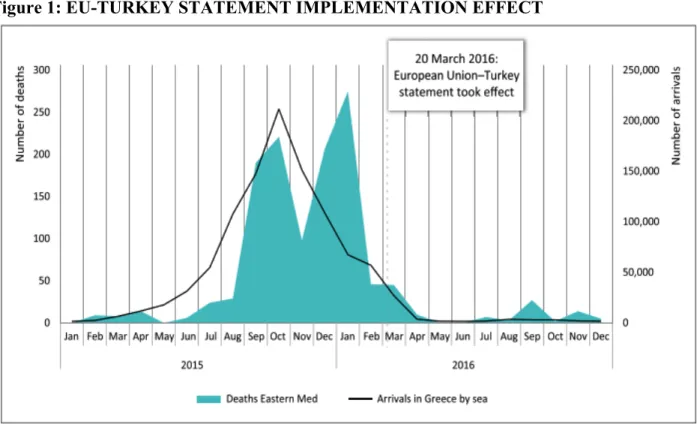
affect. The data from the transit of refugees across the Eastern Mediterranean Route from
Turkey shows the positive correlation between the decrease in illegal migration and the
decrease in the refugee death toll from January in 2016 and 201725. They also have
succeeded in upholding their end of the deal such as supplying Turkey with monetary
support and the like. In figure 1, one can see that the ratio of refugee crossings in May
and June of 2016 on the Eastern route has decreased as did the number of deaths, but the
ratio of this is much closer to even. With low number of crossings comes low number of
deaths; that is obvious.