Submitted in part fulfillment of the requirements for the degree of Master of Science in Political Science
Party System Fragmentation and Democratic
Representation in Peru, 1980-2011
Faculty of Social and Behavioral Sciences, Institute of Political Science
Leiden University
Word Count: 20038
Trilce Oblitas Bejar S1466224
2
Table of Contents
CHAPTER 1. Introduction p.3
CHAPTER 2. Literature Review and Theoretical Framework p.7
Political Parties and Democracy p.7
The Party System p.8
Democratic Representation p.11
Society-Elite Linkages p.13
Conceptualization p.14
CHAPTER 3. Research Design p.18
Method of Analysis p.18
Case Selection and Period of Study p.21
CHAPTER 4: Latin America and the Puzzling Peruvian Case p.22
CHAPTER 5: Party System Fragmentation p.29
Party Competition p.30
Party Roots in Society p.37
Number of Parties p.45
CHAPTER 6: Democratic Representation p.50
Political Outsiders p.51
Trust in Political Parties p.56
Clientelist linkages p.58
CHAPTER 7: Implications p.61
CHAPTER 8. Conclusion p.64
Appendix p.65
3
Chapter 1. Introduction
The political transformations that took place in Latin America from the mid-1970s onwards, were described by Samuel P. Huntington as the ‘third wave of democratization’. The global shift towards democracy, specifically a “group of transitions from nondemocratic to democratic regimes that occur[ed] within a specific period of time” became known as the waves of democratization (Huntington, 1991, p.15). As a result of this democratization trend and process, scholars and observers became increasingly optimistic about the consolidation of institutions and democracy in Latin America.
The party system, characterized by a minimum of two political parties interacting in structured forms (Melendez, 2012, p.5), is considered to be one of the most important institutions of democracy, followed by strong and representative political parties. According to Alexis de Tocqueville (1962) this is because political associations and parties are the key institutions of civil society. Thus, party system consolidation came to represent a significant indicator of a democratic form of governance. The political party however, regarded as one of the central pillars of democracy, has been met with increasing public dissatisfaction in Latin America (Levitsky and Cameron, 2003, p.1).
During the 1970s, when global attention focused on the consolidation of democracy in the southern region of the American continent, Latin American politics experienced the unprecedented. On the one hand, countries such as Colombia and Venezuela, that possessed a long tradition of strong and institutionalized party systems, aspired to further consolidate democracy. On the other hand, the Peruvian, Ecuadorian and Bolivian party systems regarded as inchoate and possessing extreme low levels of institutionalization, aspired to institutionalize the party system as a result of the democratization trend. Overall however, these five countries countries experienced a trend of severe party system decay during the late 1980s and 1990s that gave rise to the collapse of the party systems across the region.
4 factor that shapes the political system in the region today (Mainwaring et al, 2006, p.13). Party system fragmentation, concerned with the breakdown of one of the central political institutions or democratic representation, embodying the political relationship between the citizen and the representative, are not new phenomena in the discipline of political science. Despite this, analyzing these phenomena within, as well as across the diverse, complex and unique political environments in Latin America is particularly important. Firstly, however, these phenomena need to be more specifically defined.
Party system fragmentation occurs when the party system decomposes and the levels of competition and rootedness are weak. The concept of party system institutionalization that measures different dimensions of the party system, are useful to determine fragmentation. Low levels of institutionalization reveal high electoral volatility, low political party legitimacy, lack of political identification and political party organizational deficit. Fragmentation thus, considering the indicators mentioned, represents the decomposition of the party system.
In turn, as examined by Scott Mainwaring (2006), the patterns that presuppose changes in representation are foremost affected by instability. The quality of democratic representation is troubled when the electorate, the citizens, feel omitted from the political process, a lack of popular democracy is present, and the formal mechanisms of representation are no longer adequate (2006, p.19). Particularly in Peru, both phenomena are salient and a crisis of democratic representation that challenges the country’s political system has been prominent (Mainwaring, 2006 and Tanaka, 1998, 2003). A crisis of democratic representation reveals that the “… traditionally strong political parties have eroded or disappeared throughout Latin America allowing for the rise of political outsiders and a surge of political mobilization against the political establishment” (Mainwaring, 2006, p.13). Considering the variety of elements and interconnected indicators that both phenomena involve, it is rather evident they are not unrelated since party system fragmentation can influence on the quality of democratic representation greatly.
5 framed as follows: how does party system fragmentation influence the quality of democratic representation? Furthermore, this study aims to examine if party system fragmentation contributes to a crisis of democratic representation.
An ongoing party system fragmentation, the rise of political outsiders and anti-establishment figures together with the increasing dissatisfaction and rejection towards institutions, have shaped different forms of citizen-representative linkages in the Andean Region. Trust in institutions, an important factor that has an effect on democratic stability and that further reflects the electorate’s behavior (Tanaka and Vera, 2010, p.104), has been remarkably low in the last decades. In Peru, all these conditions are salient and shape a complex political reality. In fact, according to the Latinobarometro1 figures of 2008, a public opinion poll in Latin America, which measures different conditions and elements that shape democratic stability, Peru ranks lowest in the levels of trust towards two core institutions, the congress and the political parties.
The prevailing argument shaping this research thus, maintains that party system fragmentation and the quality of democratic representation are interconnected phenomena influencing each other. Moreover, due to the fact that the so-called programmatic linkages between voters and agents are weakened, these allow for the rise of other forms of citizen-representative linkages, for example those characterized by personalist and clientelist traits. As it will be shown, both phenomena are characteristic elements of an unstable political system, which challenges and hinders democratic consolidation.
It is ultimately maintained that if not assessed together, the understanding of the weakened institutional landscape that occurs in Latin America and in Peru in particular, would be remarkably limited. These two phenomena have to be considered jointly to allow for a comprehensive understanding of the political scenario and the key aspects of the puzzling political system prevailing in Peru and the region. Peru is the focus of this study due to the fact that the Peruvian party system decomposed abruptly in the late 1980s onwards and all conditions regarding the quality of democratic representation mentioned previously have been particularly salient in the country. The relationship between these phenomena thus, seems to be present in Peru, making the country a valuable case to examine.
1Latinobarómetro is “an annual public opinion survey that involves some 20,000 interviews in 18
Latin American countries, representing more than 600 million inhabitants”. See:
6 This study firstly delivers a literature review on the most relevant academic work concerning the party system fragmentation and democratic representation. This allows for the formulation of a framework that establishes the theoretical and conceptual direction taken. In order to empirically study these subjects, key indicators and conditions are established. Concerning party system fragmentation, the indicators of the levels of institutionalization are inter-party competition, party rootedness in society and party organization. In turn, regarding democratic representation, the conditions selected to best establish its quality, are the levels of trust towards the party system, clientelist linkages and the emergence of outsiders. These indicators and conditions will be examined from 1980 up to 2011 in the Peruvian context hoping to deliver results that are in line with the arguments previously mentioned.
This study aims to contribute to the academic discussion on the relationship between the party system and democratic representation. It will be determined if in the Peruvian case, whether the study of party system change, expressed specifically in fragmentation, greatly influences the quality of democratic representation. If party system stability is crucial for the quality of democratic representation and by extension, for democratic stability, the role of the party system and the political parties that comprise it needs to be emphasized. Due to the fact that weak political parties “… shape the political system in a variety of ways” (Mainwaring, 1995, p. 3), this research aims to establish that one way is directly affecting the quality of democratic representation.
7
Chapter 2. Literature Review and Theoretical Framework
The interest of the current study is firmly rooted in the relationship between party system fragmentation and democratic representation, and specifically, how the former may influence the latter’s quality. It is thus important to review the literature concerned with the fundamental concepts that frame this study in its wider context as well as set the premise for subsequent analysis. Accordingly, this chapter will look firstly at the relevant studies concerning party systems in wide-ranging terms and their functionality in a democracy.
Moreover, party system fragmentation and the consequences thereof within the Latin American context will be assessed. Subsequently, democratic representation literature will be explored and evaluated focusing specifically on political representation and the mechanisms that presuppose it. This will be followed by the theory that frames party system fragmentation and the quality of democratic representation, which will allow the establishment of the conceptual ground of the so-called crisis of representation as it transpires in the Andean Region of Latin America.
Political Parties and Democracy
Political parties are widely perceived to be a fundamental element of modern democracy. In his now famous paper on Party Government (1942), E.E. Schattschneider claims that “political parties created democracy”, a fundamental belief which for many would still hold true today. Schattschneider further claims that the very thought of democracy without political parties was inconceivable (1942, p.1). Far from being alone in his view, Schattschneider’s emphasis on the role of political parties within democracy has been echoed numerously in the academic work in the field.
8 contenders for political office, that, through political parties” (Ibid). Lipset’s definition of democracy serves to further establish the important role and functions of political parties. Conceiving political parties as a significant mechanism employed to represent the interests of the population, through elections, further makes the role of political parties important for a representative democracy.
Political parties are essential for democratic governance because of the functions they carry out. Political parties provide power to their leaders (Weber, 1922) and, they allow for electoral competition (Weber, 1922; Downs, 1957; Sartori, 1976,1992 in Alcantara and Freidenberg, 2001, p.18). They also allow for the recruitment of political elites to operationalize the political system (Sartori, 1976,199; Von Beyme, 1982,1986 in Alcantara and Freidenberg, 2001, p.18) and they make political socialization possible by providing basic information and explanations to the population about how to understand reality (Alcantara, 1997). Finally political parties represent and articulate the interests of social groups (Lipset and Rokkan, 1967; Cotarelo, 1985 in Alcantara and Freidenberg, 2001, p.18). Contemplating such characteristics makes the options to refute the significance of political parties minimal.
However, the developments that political parties and the party system have undergone since the 70s, particularly in Latin America, have made scholars question the indispensability of parties for democracy and point out a paradoxical relationship between them (Levitsky and Cameron, 2003, p.27). Levitsky and Cameron (2003) explain that this paradox lies in the fact that, “although parties are considered essential to the effective functioning of modern democracies, they are not [necessarily] created for that purpose” (2003, p.27). In fact, parties might as well be “created by politicians in order to resolve coordination problems and further their own careers” (Aldrich, 1995 in Levitsky and Cameron, 2003, p. 27). Despite the fact that parties may in fact be created for politicians to advance their political interests, this does not necessarily imply that their role and functions are less significant for a stable democracy. Indeed, as mentioned previously, political parties allow for the mechanisms of representation to be present, and only this consideration, makes them indispensable for democratic regimes.
Party System: Change, Institutionalization and Fragmentation
9 link together the political parties in a political system (1995, p.213). Secondly, a party system is composed of “at least two political parties that interact in structured forms” (Melendez, 2012, p.5). A political system consequently, is the set of rules, actors and interactions -formal and informal, shaping the political dynamics in a regime (Ibid). In the literature, party systems can be classified based not only on the number of relevant political parties or the ideological polarization (Sartori, 1969, p.134), but also, according to its degrees of institutionalization (Mainwaring and Scully, 1995).
Particularly in young democracies, institutionalization is a political dimension that requires prime attention (Melendez 2012, p.5). Understanding what this process entails is thus relevant. In Political Order in Changing Societies (1968), Huntington refers to this concept as a process by which “formal institutions and democratic procedures acquire value and stability” (1968, p.12). When associating thus, the party system and institutionalization, Peter Mair (2006) explains that party system change is an area of study that needs to be explored in detail. Moreover, Mair further determines that “… systemness implies institutionalization” (2006, p.66), which suggests that institutionalization is key for a system to ‘be’ a system. Based on this premise, it appears that the lack of institutionalization of the party system does not only affect, evidently, the systemness of the party system, but also already de-categorize it as a system.
Scholars interested in party system change and institutionalization, identify characteristics that are part of a continuum in which the party system can be found. On one extreme, institutionalized systems possess low levels of volatility, deep partisan loyalties, high political legitimacy and well-developed partisan organizations (Melendez, 2012, p.6). On the other extreme of the continuum, the characteristics are the opposite. There are different conditions identified for the party system and the change it may undertake in order to reach institutionalization, fragmentation or even, collapse. Importantly, Huntington accentuates that adaptability of an institution is a requirement for institutionalization. Nonetheless, he recognizes that an institution, which is too adaptable, is unfavorable (Huntington, 1965, p.369).
10 Considering that extreme circumstances may in fact hamper the process of value and stability acquisition an institution requires, it is necessary to first determine how to measure change to achieve institutionalization. Mainwaring (1998) differentiated key dimensions that indicate the levels of party system institutionalization. In fact, it seems that the key to a stable institution is when there is an existent balance between the following four dimensions: competition, rootedness, legitimacy and organization (Mainwaring, 1998, p.70).
Firstly, the patterns in intern-party competition need to be stable; this is to say that electoral volatility should remain low, election after election. Jones (2005) explains that in institutionalized party systems, the relevant political parties tend to remain the same and also tend to “gather relatively similar shares of the vote” over time (2005, p.5). Secondly, when the party system is strong, political parties have solid roots in society (Mainwaring 1998, 1999). The electorate tends to support the same political party election after election, therefore, creating strong loyalties (Jones, 2005, p.7). In decomposing party systems, election results are based on personal characteristics of the political candidates (Ibid). Thus, showing that existent lack of the electorate’s political identification. Thirdly, the legitimacy of parties and elections is considered to be an important aspect of a strong party system. Scott Mainwaring (1998, 1999) established that a basic prerequisite for party system institutionalization is that both political parties and elections are to be considered legitimate by the population (Mainwaring, 1998, Jones, 2005, p.9). As Jones (2005) further states, for parties to be legitimate, it is imperative that they are viewed as institutions that are vital for the functioning of the democratic system (2005, p.9). Lastly, the organization of the political party remains significant due to the fact that the structure of the party itself shows its capabilities in the political system. In poorly institutionalized party systems, political parties have limited resources, the internal processes are unpredictable, and individual party leaders dominate the parties (Jones, 2005, p.12).
11
Democratic Representation
On a joint work, Mark E. Warren and Dario Castiglione (2006) reconsider democratic representation by conceptualizing what representation, political representation and democratic representation establish. Their work is useful for this research as it establishes the theoretical ground for determining democratic representation what conditions presupposes its quality.
In her work The Concept of Representation (1967), Hanna Piktin established what is now considered as the formal view of ‘representation’. Pitkin identified that political representation involves; inter alia, authorization, accountability, and the looking out for another’s interests (Rehfeld, 2006, p.3). Moreover, it became noticeable that the practice of political representation emerged through two different processes: firstly through the establishment of the representative nature of the state and of its institutions, concerned with the act of authorization, and secondly through the emergence of a ‘representative government’, concerned with the extent to which representatives can be made accountable to the represented (Warren and Castiglione, 2006, p.3).
The understanding of political representation was the baseline that allowed for the conception of democratic representation since it was “…built on an early modern, state-centric conception of representative government” (Ibid, p.3). Though there is a wealth of studies that analyze the concept of political representation, either addressing the importance of accountability, or explaining how representation can be legitimate, it is essential to determine that representation needs to be considered as crucial in creating democratic practices (Plotke, 1997, p.19).
12 such characteristics entails a somewhat ideal relationship between quality of representation between the principals and agents. Nowadays, the relationship between these actors can be seen as mediated and enabled by many kinds of groups, organizations and institutions (Ibid), which makes the relationship between principals and agents more complex and distorted when analyzing contemporary socio-political relations.
Ongoing contemporary developments keep on challenging the notions of the quality of democratic representation and can be best illustrated by explaining that the various forms of representation are shaped by the specific “ways people relate to their political communities” (Warren and Castiglione, 2006, p.2). Moreover, a predominant trend of the diffusion of informal structures and opportunities for democratic representation is occurring. The development of informal structures does not only reveal a “diminished role of formal political structures in social decision-making, but also the increasing diversification of the forms of association in modern societies” (Beck, 1997; Warren, 2001 in Warren and Castiglione, 2006, p.2). To a large extent, such changes are valuable in showing that there have been significant shifts on how democratic representation has to be understood and what it entails nowadays. Additionally and most importantly, these variations make possible to conceive a weak formal democratic representation since other forms and structures become more prominent.
As seen previously, and according to Scott Mainwaring (2006), the relationship between the principal, the voters, and the agent, the politician and the political parties (2006, p.15) requires examination. Considering that political parties are the agents, whose role is to represent the voter’s interest, it is important to reassess this consideration because “the core of democratic representation lies in the relationship between citizens, on the one hand, and elected politicians, parties, and assemblies on the other” (Mainwaring et al, 2006, p.14). Realizing that there exists an institutional linkage between voters and their chosen representatives, traditionally established by the political parties, which continuously changes over time, serves to emphasize the role of these linkages in the literature.
13 varying linkages, are manifested. Moreover, the emergence of personalities that shape the political system is regarded as a clear indication of a crisis of democratic representation.
In The Rise of Outsiders in Latin America, 1980-2010: An Institutionalist Perspective (2012), Miguel Carreras points out that studying the rise of outsiders in political systems is important due to the fact that it is connected to ongoing debates in the Political Science field (2012, p.1453). In fact, the rise of political outsiders signifies a liability of a presidentialist system since it makes possible for individuals without previous experience to create new parties and participate in elections (Linz, 1994, Mainwaring, 1993 in Carreras 2012, p. 1453).
Suarez (1982) outlines two “pernicious consequences” of the election of political outsiders in presidential regimes (Suarez, 1982, p.109). Firstly, this phenomenon reduces the efficiency of the executive power and secondly, the rise of political outsiders allows for a personalist style of politics and governing (Suarez, 1982 in Carreras, 2012, p. 1453). Furthermore, electing outsiders will seek to develop personal bonds with the electorate, which according to Guillermo O’Donell (1994) involves “… bypassing intermediary institutions and engaging in delegative forms of democracy” (1994, p.55-59). Contemplating the significant effects of outsiders on governability and representative-electorate linkage, this phenomenon of anti-establishment or anti-political personalities, can be considered as an important dimension that can illustrate the quality of democratic representation.
Society-Elite Linkages
14 Clientelist linkages can be best illustrated by those dynamics of accountability and responsiveness that presuppose “delivering specific material advantages to a politician’s electoral supporters” (Ibid). This rather material exchange has demanded a re-consideration of the competing studies that have mainly focused on the prominent programmatic linkages. Programmatic linkages have been characterized by a somewhat ideal perception of politician’s responsiveness, and are those concerned with politicians pursuing policy programs that distribute benefits and costs to all citizens, irrespective of their vote intention and preference (Kitschelt, 2000, p. 845).
On a similar line of thought, Kenneth M. Roberts (2002) argues that nowadays the main party-society linkages have been degenerating, and linkages described as marketing and personalist, become more prominent in shaping the political system at the time of electoral campaigns and elections (2002, p.22). As expected, these linkages trends have several important implications for democratic representation in Latin America, since they establish a scenario in which the quality of democratic representation and its structure is challenged. Based on marketing and personalist considerations to exercise the right to choose representatives, the ties between society and those who represent them, may be weak or unstable, resulting in hindering the quality of representation.
Conceptualization
Party system fragmentation implies instability, decay and weakness of the party system. Two dimensions employed to examine party system fragmentation are derived from the party institutionalization literature, competition and rootedness. It should be clear that institutionalization and fragmentation are not regarded as concepts signifying the same phenomenon, but mainly that the former and the indicators that determine it, are employed as a reference to determine how fragmentation is determined.
Democratic representation in this study follows the definition by Mainwaring, it is the relationship between voters and their elected representatives in a democratic regime (2006, p.12). Whilst there exists a wealth of considerations that can influence democratic representation, three specific indicators are selected from the literature to determine the quality of democratic representation: Political outsiders, trust in institutions and clientelist linkages.
15 presidential elections, an outsider is (1) a candidate who does not have any previous political experience at the time of the electoral campaign and (2) someone who gains political support not in association with a competitive or traditional political party. Trust in institutions is a rather straightforward concept as it refers to the electorate’s trust towards de core institutions and relevant to this research, to political parties. Clientelist linkages are defined in this study as having a nature of direct exchange of goods and “material advantages” (Kitschelt, 2000, p. 853) between the representatives and the electorate.
Central to this study is to examine the relationship between party system fragmentation and democratic representation. Departing from the observations made by Kitschelt and Roberts, this study argues that party system fragmentation further affects the quality of democratic representation by weakening the party-society linkages that shape the relationship between society and the political elites. Moreover, this relationship can be identified examining the dimensions of party system fragmentation and of the quality of democratic representation.
It is expected that high electoral volatility and low, or non-existent, party competition, contribute into making more feasible for a political outsider to gain support and be elected. Moreover, if parties are not rooted in society, there is unstable competition, parties emerge and disappear, the capacity of political parties as vehicles for representation will be questioned and distrusted by the electorate. Therefore, this study argues that when political parties do not act as mechanisms of representation, the electorate and the elites may engage in developing other forms of linkages that shape the relationship with their representatives.
16 political outsiders and the rejection of the political establishment (2006, p.13). Addressing the interaction between these phenomena, the following hypotheses are thus formulated. Null Hypothesis (H0): There is no identifiable influence between party system fragmentation and the quality of democratic representation in Peru.
Alternative Hypothesis (Ha): There is an identifiable influence between party system fragmentation and the quality of democratic representation in Peru.
In order to address the relationship between party system fragmentation and democratic representation theoretically, and establish how a crisis of democratic representation occurs, the Neo-Institutional theoretical approach serves as a starting point. The significance of this approach lies in the fact that it stresses that the actual “organization of political life makes a difference” (March and Olsen, 2006, p.1). Neo-Institutionalism is best defined as the “set of theoretical ideas and hypotheses concerning the relations between institutional characteristics and political agency, performance and change” (Ibid). This approach is therefore relevant to the analysis intended to be employed in this research. Neo-Institutionalists not only emphasize that institutions have an impact upon individuals, but also acknowledge that there is an interaction between institutions and individuals (Marsh and Stoker, 2010, p.61). This interaction is that which is of most interest for subsequent analysis in this study.
Though particularly useful in framing the vital role of institutions and their interactions with the individual, Neo-Institutionalism is limited when addressing the linkages that presuppose accountability and responsiveness. As Kitschelt (2000) suggests, “parties in the institutional sense are not always parties in the functional sense”, this is to say, “they are not necessarily the collective vehicles that solve problems of collective action and of collective choice” (2000, p.848). For this reason, it is pertinent to examine the theoretical debate accounting for the linkage mechanisms between society and politicians.
17 democracy (Ibid). Furthermore, the accountability and responsiveness performed by political parties and characteristic of democratic representation, is the focus of this study. Kitschelt’s contribution therefore, is applicable to this research because it challenges the assumption that “above all, programmatic linkages matter for democratic accountability and responsiveness” (Ibid, p.847), since this study argues that these linkages are no longer prominent in Latin America.
18
Chapter 3. Research Design
Defining the research question driving social science research is the logical starting point for subsequent analysis, wherein the current study is no exception. As introduced initially, the focus of this study lies in describing how party system fragmentation influences the quality of democratic representation in Peru, in order to explain the crisis of democratic representation argues to be taking place in this country. In this chapter, the research design developed in order to answer this question is established. The method of analysis that is employed together with the case selection and temporality considerations, are subsequently explained.
Method of Analysis
Due to the fact that is it hardly possible to “… construct meaningful causal explanations without good description, and in turn, description loses most of its interest unless linked to some causal relationships” (King, Keohane and Verba, 1994, p.34), exercising both remains essential when carrying out social science research. In the current research, the causality observed is the influence of party system fragmentation on the quality of democratic representation. It must be noted however, that this causality is not one-sided and, as it will be shown, these phenomena, due to their temporal development, hold a mutual inter-relation. This is because, despite the implied causal relationship being the main focus of this study, it will also be argued that a crisis of democratic representation inhibits party system reconstruction. Acknowledging this interdependence between the issues of interest, allows political science research to have a holistic perspective and avoid reducing the analysis to a few separated variables (Pierce, 2008, p.43).
19 premised on discovering categories and being exploratory with open questions” (Vromen in Marsh and Stoker 2010, p. 257). Moreover, employing a qualitative method serves to demonstrate “sensitivity to context” (Pierce, 2008, p. 43) since the analysis will consider social, historical and temporal context from which the data has been gathered (Marsh and Stoker, 2010, p. 257). Schmitter (2008) emphasizes that “carefully constructed narratives remain key in understanding processes”, in this case these are party system fragmentation and a crisis of democratic representation, “that have a strong temporal dimension” (Hancké in Marsh and Stoker, 2010, p. 242). This study therefore, primarily addresses the observed causality considering the following temporal dimensions: sequence, context and change.
Accordingly, addressing sequence, the fragmentation of the party system in Peru has been concurred to take place in the beginning of the late 1980s (Tanaka, 2002, p.6; Levistky and Cameron, p.6; Cotler, 1994; Lynch, 1999; Planas, 2000), and, the qualityof democratic representation became evidently in peril from the early 1990s onwards. Throughout the 1990s and continuing during the 2000s, the mutual inter-relation between these phenomena has been evident.
Regarding the context, the qualitative method involves taking into account other factors that may have affected the quality of democratic representation and contributed to a crisis of democratic representation. On of these factors can be the structural changes in Peru, e.g., growth of the informal sector and development and spread of mass media technologies (Levistky and Cameron, 2003, p.1). Moreover, the profound effect of the armed conflict between the SenderoLuminoso (Shining Path) and the Peruvian state (late 70s-early 90s) on the political system, must not be overlooked.
Lastly, significant changes can have important effects on the outcome observed. It is not an easy task to determine which changes are significant and which are not. However, in the Peruvian case and taken into account in this analysis, the economic crisis that hit the Latin American region in the 1970s, is arguably a factor to consider since it demanded urgent responses from the political actors in these countries (Tanaka, 2002, p.1), shaping thus the forms of governability employed these years.
20 phenomena of interest therefore, employing this approach within the current qualitative analysis is applicable. It allows establishment of the paths that lead to a crisis of democratic representation by determining party system fragmentation and examining the quality of democratic representation.
The process-tracing approach is a subunit analysis that is useful in elaborating causal mechanisms that increase the number of theoretical relevant observations (King, Keohane and Verba, 1995, p. 227), and this is a significant goal this research aims to achieve. It is again worth mentioning, that the focus of this study is theory-confirming, since it is expected to conclude that the quality of democratic representation has been influenced by party system fragmentation thus contributing to a crisis of democratic representation.
As introduced in the first chapter, dimensions and conditions have been observed to indicate party system fragmentation and the quality of democratic representation respectively. Regarding the party system, the indicators of fragmentation will be analyzed and are listed as follows; inter-party competition, rootedness in society and the number of parties. The quality of democratic representation in turn, is approached by analyzing the following indicators; emergence of outsiders, clientelist linkages and trust in institutions.
Process-tracing involves looking closely at “the decision processes by which various initial conditions are translated into outcomes” (George and McKeown, 1985: 35), and this feature is highly relevant for analysis in this study. Due to the fact that decision-making actions and intentions are observable conditions that reconstruct the expected outcome (King, Keohane and Verba, 1995, p. 227), in this case a crisis of democratic representation, process-tracing highlights the importance of reaching the level of the individual actor. Considering that this study argues that the citizen-representative linkages, constituting the quality of democratic representation have been affected by party system fragmentation and have resulted in giving rise to different relationships, analysis reaching the individual actor level is necessary to explain how a crisis of democratic representation exists.
21 process-tracing approach, the number of observations has been expanded and this allows for greater, yet relevant, information delivery. In order to measure the indicators of the phenomena central to this study, secondary data and quantitative data from academic journals, electoral results, public opinion polls and surveys, is used for analysis in this study.
Case Selection and Time Frame
The literature suggests that the levels of dissatisfaction with the political system have been most severe in the Andean Region (Mainwaring et al, 2006 and Tanaka, 2003), which is comprised by Venezuela, Colombia, Ecuador, Bolivia and Peru. Accordingly, a divergence between the state and the citizens in terms of the linkages that presuppose their socio-political relationship has been more acute in these countries (Burt and Mauceri, 2004; Drake and Hershber, 2006).
In the Andean Region, only Colombia and Venezuela were regarded as holding a stable, firm and valued party system. In Peru, Ecuador and Bolivia, the party systems were described as inchoate. Overall however, in all five Andean countries, during the 70s and 80s, the party systems became fragmented and collapsed. Particularly interesting is the Peruvian case, which illustrates how party system fragmentation from the late 80s onwards, represented an opening for political instability and democratic uncertainty (Tanaka and Vera, 2010, p.35).
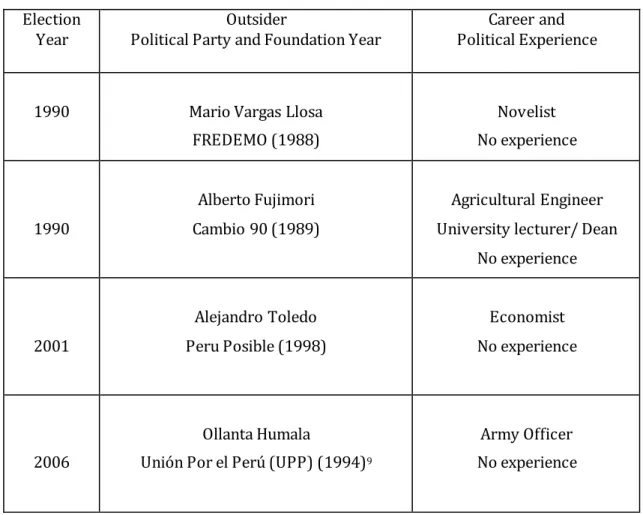
Peruvian politics contain contradictory and complex trends that characterize the political system (Aldrich, 1995, Levitsky and Cameron, 2003, Tanaka 1998, Tanaka 2002) and these are considered to have challenged, and even endangered, the democratization process (Woy-Hazleton and Hazleton, 1990, p.21). Electoral volatility has been the highest in Peru since the restoration of democracy in 1980. Moreover, the frequent shift in party support and loyalties has characterized Peruvian politics since the 1990s onwards. Political outsiders such as Alberto Fujimori, Alejandro Toledo and Ollanta Humala, and their rather new political parties at the time (1990, 1999, 2003 respectively), have all won presidential elections in Peru in 1990, 2001 and 2011 respectively. High volatility in Peru does not only reflect a shift in electoral preferences but also how quickly new parties emerge and old ones collapse.
22 employed and identified their electoral campaigns as highly clientelist. These conditions come to represent a rather puzzling political system and indicate the urgency to examine the indicators shaping this reality. In line with the focus of this study, determining what presupposes a crisis in democratic representation in Peru holds several implications.
The implications of studying the Peruvian case hold both academic and social value. By gaining in-depth understanding of a crisis of democratic representation, a multi-dimensional observation can help explain what mechanisms interact in shaping it and which are in particular more salient and need to be re-examined. The Peruvian case can contribute to the academic literature by offering insights of the democratization process in Latin America. Furthermore, examining Peruvian politics help distinguishing the actual limitations and weaknesses of the democratization process. Considering these implications, it seems rather fitting to have selected a case study that can contribute to our understanding of the underlying mechanisms shaping the political system academically and socially.
Having discussed and established the value of the temporal dimension that involves studying party system fragmentation and democratic representation in Peru, the time frame selected for analysis ranges from 1980-2011. This period of thirty-one years is useful in illustrating a temporal development of all the indicators of party system fragmentation and the mechanisms of democratic representation that determine its quality. As it has been explained previously, party system fragmentation occurred in the late 1980s and variations of the quality of democratic representation followed this phenomenon from 1990 onwards.
23
Chapter 4. Latin American and Peruvian Politics
In Latin America, and specifically concerning Peruvian politics, understanding the context in which the party system fragmented and how the quality of democratic representation has been affected, is highly necessary. According to Julio Cotler, a prominent Peruvian scholar who’s famous work Clases, Estado y Nación (1978) examines and describes the development of the Peruvian state and the political system in this country, a reading of Peruvian history is indispensable to an understanding of the present (Crabtree, 2011, p.1). Before fully diving into the contextual development of Peruvian politics, it is relevant to describe and examine Omar Sanchez’ grouping of ‘underlying causes’ of party system fragmentation and democratic representation in Latin America. By acknowledging the existence of environmental conditions in Latin America, the first part of this section stresses the important influence these have had on the political institutions’ organization and stability throughout the southern region of the continent.
Firstly, once characterized by a strong ideological fervor, ideology in Latin America is no longer conceived as the main factor for voters to elect their representatives and for parties to win electoral campaigns. Therefore, the region seems to have entered and to be experiencing a post-ideological era (Castaneda, 1994; Colburn, 2002). One could argue however, that the left-turn, asseen in different levels in the cases of Venezuela, Brazil, Ecuador, Bolivia and Argentina in the last 10 years, challenge this idea. The previous and current political leaders in these countries however, i.e., Chavez, Correa and Morales, did not rely on political ideology as the heart of their electoral campaign and governance, but they focused rather on anti-system rhetoric. These leftists leaders have arisen from a mixed past that includes populism, nationalism and as a consequence, with few ideological underpinnings (Castaneda, 2006).
24 political parties thus, was further weakened by instituting economic reforms resulting in restricting political agency.
Thirdly, as a result of continuous socio-economic reforms taking place in the region, the growth of the informal labor sector is a relevant factor to consider. According to Sabatini and Farnsworth (2006), an expanding informal labor sector results in composing an electoral group that is not attached to organized channels of political participation any longer (2006, p.55-62) Moreover, as claimed by Sanchez, the growing informal labor sector surely demands capabilities that traditional political parties are not able to exercise (Sanchez, 2008, p.317). These conditions result in disenchantment and distrust, with and towards the political system. Nonetheless, Levitsky and Cameron (2003) argue that different forms of informal party organization2 have eroded in the region and adaptability to external circumstances has taken place (2003, p.2).
Finally, the access to, and development of mass media technologies has further hampered the main role of political parties in structuring their party-organization building (Skidmore, 1993 in Sanchez, 2008, p.317). Television has specially weakened the incentives of politicians to engage in the organization of the political parties. Sanchez argues that in a mass media era, “telegenic political outsiders can potentially challenge well established, well organized party machines” (Ibid, p.317). Moreover, the increasing popularity of social networks and the access to a wealth of available information on the internet, clearly posits challenges to the conventional electoral campaign strategies held by political parties. Political presence is not judged only on television and radio slogans and appearances, but also on the extent to which political leaders are involved and represented in social media networks.
The factors outlined here are considered to be underlying multifaceted causes that have the power to shape the nature of the political sphere in a manner that is out of the control of the political parties themselves (Sanchez, 2008, p.317). According to Steven Levistky and Maxwell Cameron however, some of these indicators do not directly cause party systems to collapse, but rather, they may in fact “inhibit its reconstruction” (Levitsky and Cameron, 2003, p.25). Whether these conditions cause party system fragmentation or impede its reconstruction is not a task this research is directly concerned in debating. What is more relevant to argue is that these factors clearly influence political parties by limiting their agency and also, result in affecting the electorate’s behavior. Thus, these factors shape an even more complex political scenario, in which ‘the rules of the game’ are
25 in constantly changing and the quality of democratic representation is thus affected. The Peruvian case is particularly appealing in this regard, as Julio Cotler (1995) claims politics in Peru have consistently been unpredictable (Cotler, 1995 in Mainwaring and Scully, 1995, p.323). The following section thus, focuses in detail on the puzzling Peruvian considering the economic, political and social context between 1960 and 1990.
The deepening of democracy, claims John Crabtree (2011), has been absent in Peru despite the fact that constitutional governments have been upheld (2011, p.xviii). From the 1960s onwards, attempts to get rid of the old Peruvian regime aiming to modernize the country, were made (Crabtree, 2011, p.56). In fact, “social change and the emergence of both new political actors and political parties, brought attempts to outdated social structures” (Ibid). The creation of Acción Popular (AP) in 1956, founded by Fernando Belaunde, and the Partido Demócrata Cristiano founded in 1966 by Luis Bedoya are examples of the previously mentioned new political parties and actors. However, due to a successful and strong old regime, political movements and parties were forced to plea support from the mobilized sectors of the population by employing “… assistentialist policies that reaffirmed old populist ties” (Ibid). Such policies and resistance to reform, exacerbated institutional weakness and contributed to a political breakdown whereby “no political regime endured for a long as two decades” (Kenney, 2004, p. 6).
While Peru has experienced semi-democratic and democratic governance from the 1900s until the 1960s, when democracy was interrupted by military and authoritarian regimes. Most notably, the military intervention of 1968 led by General Velasco Alvarado, lasted no less than 12 years. Velasco, though a representative of the military forces, employed reforms that had popular support, remarkably the so-called “agrarian revolution”, which concentrated on agrarian reforms that re-distributed rural land ownership (Cotler, 1994). Crabtree emphasizes that despite Velasco’s reforms on land-ownership and popular economic policies, patterns of political patrimonialism, heritage of the post-colonial era, persisted in Peru (Kenney, 2004, p.6). Velasco’s military rule and reforms led the country to a deep economic crisis, which had to be faced when the country transitioned back to democracy in 1980 and Fernando Belaunde was reelected as president, since his electoral win in 1963, ended abruptly with Velasco’s military coup in October of 1968.
26 Report, 1980). The most important reformations were: Firstly, the general elections would elect collectively the president, the congress members, and the vice-president for a period of 5 years. Secondly, it established a two run-off system, in which a president would be elected if obtaining a minimum of 50 percent of total vote support. If less than 50 percent, the two parties with the highest vote share, would compete in a second round. Thirdly, it provided the president as entitled to have more power capacity to employ social reforms (Peruvian Congress Report, 1980).
Belaunde returned to power in 1980 when the AP won the presidential elections, marking thus an end to the military rule (Kenney, 2004, p. 18). The economic crisis was the main challenge Belaunde’s administration faced. In fact, by 1982, the GDP fell by 2.2 percent and by an unforeseen 14.6 percent a year later (Kenney, 2004, p.11-21). In addition, inflation figures were unprecedented as they went from 75 to 125 percent during these years (Ibid). The deepening of the ongoing economic crisis in the country has been correlated with Belaunde’s “IMF-style austerity program” (Burgees and Levitsky, 2003, p.898). Belaunde’s term ended in 1985, when Alan Garcia, leader of the Alianza Popular Revolucionaria Americana (APRA), was elected as president.
Originally a labor-based party, The Alianza Popular Revolucionaria Americana (APRA), founded in 1930, is considered the oldest political party in Peru. Founded by Víctor Raúl Haya de la Torre, APRA is commonly regarded as the only party that has maintained, though at times remarkably low, electoral support since the 1980s. During the 1960s, APRA was often involved in corruption and though formed in 1930, only gained formal recognition in 1962 (Kenney, 2004, p.6). Because APRA’s involvement in frustrating Belaunde’s “legislative program” in the 1960s, which lead to the military coup of 1968, the political party was still seen as a threat and was somewhat excluded from the political scene until 1985 (Ibid), when it won the presidential elections.
27 was formed. MRTA was another radical revolutionary movement that increased the social turmoil that shaped the state of emergency in the country (Ibid, p.254). States of emergency were established in ten of the twenty-four departments, restricting the civil and political liberties of one half of the Peruvian population in 1990 (Woy-Hazleton and Hazleton, 1990, p. 21). The political and armed violence between the state and the radical movements betwen 1980 and 1992, is reponsible for over 70 thousand lives, according to the Comision de la Verdad y la Reconciliación3 (CVR, 2003, p.115).
By 1985, the Peruvian political system was challenged by an incontrollable economic crisis characterized by hyperinflation and the armed conflict that paralyzed the country for longer than a decade. So when Alan Garcia (APRA) was elected in 1985, his term was associated with widespread corruption, which Crabtree (2011) claims, resulted from “rampant patrimonalism and contributed all in all to a failed government of heterodox policies” (2011, p.57).
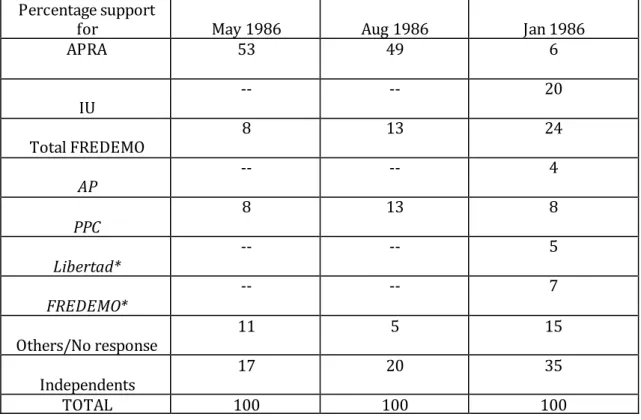
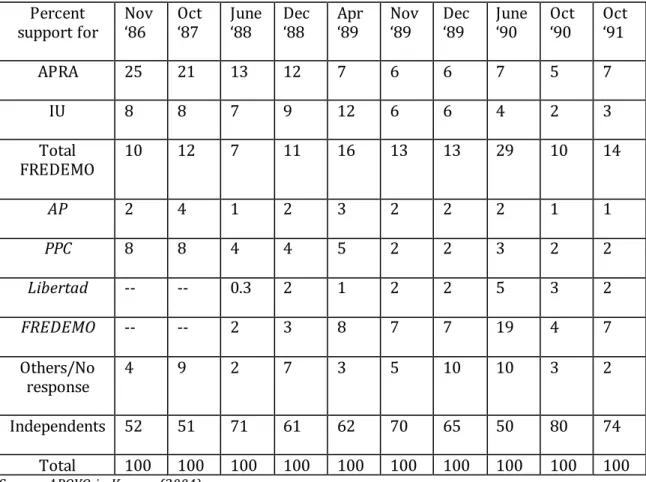
Despite the fact that the political forces in Peru resembled more social movements than parties (Cotler, 1995 in Cabtree, 2011, p.10), between 1980-1990, the APRA, AP, PPC and Izquierda Unida (IU), were considered the four-sustaining parties of the party system (Tanaka, 2002, p.2). IU was founded in 1980 and it was the only political force that represented a leftist vote. By 1990, “none of the four system-sustaining parties could demonstrate that it had the capacity to confront a multifaceted crisis: economic collapse, organizational weakness, and Sendero Luminoso” (Dietz and Myers, 2007, p.75). These conditions can help explaining why in 1990, an anti-establishment candidate such as Alberto Fujimori was elected.
In 1992, Fujimori “made every effort to ensure that no opposition parties received any help from the state” (Tuesta, 1996; Conagham, 2001 in Dietz and Myers, 2007, p.77). Furthermore, Fujimori “seized power in an autogolpe” or ‘self-coup’, when he dissolved the congress in 1992 and claimed to start the “national reconstruction” of the Peruvian political system (Tanaka, 1998, p.220-221). His move, though criticized internationally, was accepted and supported by the population as he “jumped from a 53 percent of support in March of 1992, to a 81 percent after the autogolpe” (Tanaka, 1998, in Levitsky and Cameron, 2003, p.8). In 1993, a New Constitution was approved via a national referendum and it established the consecutive presidential re-election (Tanaka, 1998, p.221). In 1995 thus, with an imposing 62,4 percent Fujimori is re-elected. Fujimori’s
3
Truth and Reconciliation Commission installed during the interim term of Valentín Paniagua,
29
Chapter 5. Party System Fragmentation in Peru
As introduced in the previous chapters, the literature has been concerned with identifying several dimensions that comprise the party system and that are useful in understanding party system change, and relevant to this study, fragmentation. Accordingly, these dimensions can be measured separately by focusing on specific indicators.
In this study, Party System Fragmentation is operationalized by examining three dimensions selected from the literature: Inter-Party Competition, Party Roots in Society and the Number of Parties.
30
Inter-Party Competition
Stability in the tendencies of Inter-Party Competition is determined by electoral volatility. Electoral volatility refers to the “net change within the electoral party system resulting from individual vote transfers” (W. Ascher and S. Tarrow, 1976, p.48). Thus, measuring volatility allows determining the percentage of the electorate that modifies their political preferences from one election to another. Volatility in this study is examined by relying on the measure developed by Pedersen in 1979, with high levels indicating higher volatility (Jhones, 2005, p.5), implying instability and weak inter-party competition.
In Party Systems in the Third Wave, Mainwaring (1998) provides the scores for electoral volatility post-1980 for the established advanced industrial democracies, the old European and the new Latin American democracies. When comparing the mean results of electoral volatility between Europe and Latin America, the differences are remarkable. In the former, the mean volatility reaches a 9.7 percent, whereas if focusing ten Latin American democracies, the mean is approximately 30 percent. In the Andean Region, the mean volatility is even higher, at 37 percent between 1970-1990.
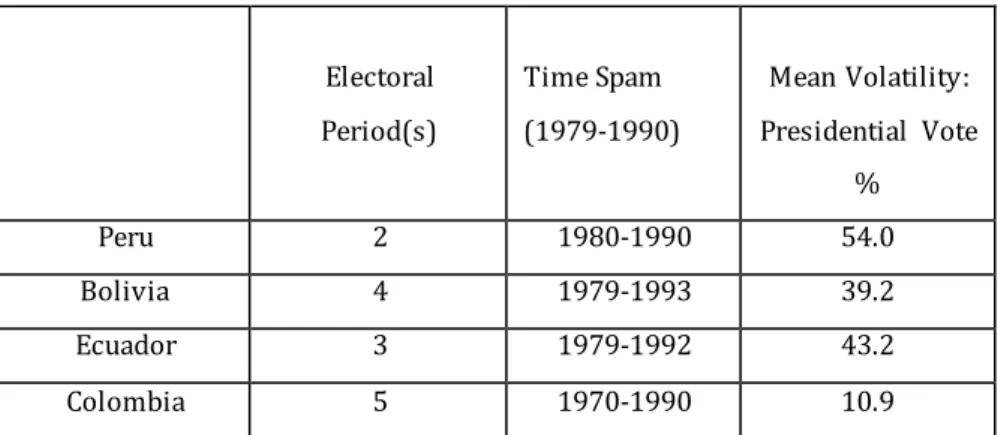
In Peru, the electoral volatility score had a mean of 54 percent between 1980 and 1990, the highest in the Andean Region during these years. As Table 1 shows, electoral volatility was prominently high in Peru during the 1980s. In order to assess how significant the high volatility figures are, the following table compares Peru’s volatility results to the rest of the Andean Countries. Moreover, it shows an overview of the electoral volatility in the region.
Table 1. Electoral Volatility in the Andean Region between 1979-1990
Source: Mainwaring and Scully (1995, p. 8).
Electoral Period(s)
Time Spam (1979-1990)
Mean Volatility: Presidential Vote
%
Peru 2 1980-1990 54.0
Bolivia 4 1979-1993 39.2
Ecuador 3 1979-1992 43.2
31 As seen in Table 1, Peru scores 54 percent, the highest electoral volatility in the Andean Region. This value is higher than Bolivia and Ecuador by almost 17 percent and more than 40 percent higher than Colombia’s mean volatility. As such, party competition during the 1980s in Peru is reflected by high volatility figures that not only illustrate constant vote variation but also, as the following observations will show, party system fragmentation since the patterns of competition are unstable in Peru.
Electoral volatility serves not only to examine party competition, it also makes it possible to observe varying patterns in the party system, e.g., in the distribution of electoral support among the relevant political forces. Thus, looking at the voting percentage shared by the competing Peruvian parties during the 1980s, allows assessing the shifts in vote preference. In fact, the 1980 and 1985 Peruvian general election results, show how four political parties, PPC, AP, APRA and IU together gathered an average of almost 85 percent of the electoral support. Such high figures expressed in vote percentages, allow the establishment of these parties as the principal, relevant political forces of the 1980s in Peru.
By 1990 however, there was a considerable decline in electoral support for these four principal parties. Actually, it is possible to observe a clear tendency of declining support towards the relevant parties of the 1980s up to the 2000s. In order to visually observe such tendencies, Graph 1 shows this declining trend in Peru from 1980 to the year 2000.
Graph 1. Vote Percentage to Principal Parties in General Elections between 1980-2000
Sources: Personal elaboration based on data from ONPE4.
4 ONPE is the National Office of Electoral Processes. 84,6 96,9 63,3 9,7 1,8 0 20 40 60 80 100 120
1980 1985 1990 1995 2000
V ot e Pe rc en tag e General Elections
32 Graph 1 provides significant evidence of the strong decline trend of the total vote percentage gathered by the four main political parties between 1980 and 2000. Between 1980 and 1985, electoral support rose from 84 percent to a grand 96.9 percent. From 1990 onwards however, an imposing and continuous decline occurred with the percentages shared by these four political parties. Accordingly, in 1990, the vote percentage shared between the four parties declined to a 63.3 and strikingly, to a 9.7 and 1.8 in the 1995 and 2000 general elections respectively.
The 1990 results, Tanaka explains, illustrate how the principal political parties of the 1980s, followed a path to their “political extinction” (Tanaka, 2002, p.2). The following four graphs show the decline of support to the principal parties of the 1980s during the general elections between 1980-2000 based on the vote percentage they obtained individually.
Graph 1a. Electoral Support for Alianza Popular Revolucionaria Americana (APRA)
Source: Personal elaboration based on data from ONPE.
Graph 1b. Electoral Support for Partido Popular Cristiano (PPC)
Source: Personal elaboration based on data from ONPE.
27,2
53,1
22,5
4,1
1,4 0
10 20 30 40 50 60
1980 1985 1990 1995 2000
General Elections
Vote Percentage
9,6
11,9
0
3,3 0 0
5 10 15
1980 1985 1990 1995 2000
General Elections
33 Graph 1c. Electoral Support for Acción Popular (AP)
Source: Personal elaboration based on data from ONPE.
Graph 1d. Electoral Support for Izquierda Unida (IU)
Source: Personal elaboration based on data from ONPE.
Collectively, Graph 1a to 1d provide a detailed account of how each relevant political party of the 1980s lost the popular support in the presidential elections in two decades. A couple of considerations can be made regarding what support decline meant for each political party. APRA, considered the oldest political party in Peru, experienced remarkable vote shift during the 1980s. Such variations in electoral support, allowed the party to win elections in 1985, though the party quickly lost support in the following three general elections. Only APRA can be regarded as the party system that barely survived party extinction, as Alan Garcia is reelected in 2001.
Regarding PPC and AP, both experienced a strong drop in electoral support over twenty years. Though the former experienced more variation in electoral support, it only managed to obtain a maximum of 12 percent during twenty years. AP in turn, was considered to have a strong party tradition as it was elected in the 60s and in 1980, but was also affected by decaying electoral support. Remarkably, AP obtained only almost 8 percent in vote support during the 1985 elections and less than 2 percent in the following
44,9
7,2
0 1,7 0,4 0
10 20 30 40 50
1980 1985 1990 1995 2000
General Elections
Vote Percentage
2,9
24,7
8,2
0,6 0 0
5 10 15 20 25 30
1980 1985 1990 1995 2000
General Elections
34 general elections. Such adverse results experienced by AP and PPC, forced both parties to make major decisions in order to survive extinction. This was manifested in the coalition AP and PPC formed in 1988, FREDEMO, that included a political movement called Movimiento Libertad, lead by novelist Mario Vargas Llosa. Thus, in the elections of 1990, FREDEMO was able to obtain 32,6 percent. AP and PPC are shown to have 0 support in the general elections of 1990 since neither party gathered votes independently.
Lastly, Graph 1c shows how IU managed to obtain almost 25 percent of electoral support in the 1985 elections, a striking figure when compared to that of almost 3 percent in 1980. From 1990 onwards however, IU’s electoral support was subjected to the predominant declining trend taking place in Peru. By the 2000 general elections, the political party did not even appeared in the voting ballot.
The observed variability in voting preference during the mid 1980s onwards and the high electoral volatility in the country during this decade, offers a clear image of the party competition in the country. The information provided illustrates that a volatile party competition began in Peru in 1985 and became prominent in the 1990 general elections. In fact, in 1990, the political scene witnessed a new political party, Cambio 90, winning the general elections by gathering 29,2 percent in the first election and 62,4 percent in the runoff.
Considering that the time frame of this study aims to examine inter-party competition up to the year 2011, it is necessary to provide the scores of electoral volatility in Peru from 1990 onwards. As shown initially in this chapter, between 1980-1990, the electoral volatility mean scored 54 percent in Peru. In the general elections that followed in 1990 and up to 2011, the scores vary considerably. Graph 2 provides the trend and fluctuations of aggregated electoral volatility scores in Peru up to 2011.
Graph 2. Aggregated Electoral Volatility in Peru, 1990-2011
Source: Margarita Batlle (2012) based on data from ONPE.
69,3 65,4
97,1 62,1 51,8 100 0 20 40 60 80 100 120
1990 1995 2000 2001 2006 2011
35 Overall, this section shows that electoral volatility scores and voting preference in Peru are high, but not continuously so throughout during the 2000s. During the 1980s, though volatility was high in Peru, the four main political parties obtained no less than 85 percent of electoral support. Such figures represented a positive trait regarding party competition in the country, especially because Peru was returning to democracy after a military rule that lasted 12 years. From 1990 onwards however, as Graph 2 shows, electoral volatility rises from 63 to 97 percent in only 10 years. Between 2001 and 2006, a significant decline can be observed since electoral volatility decreases from 62 to 51 percent. Several factors can be considered to affect the increase of electoral volatility between 1995 and 2000 and the decrease between 2001 and 2006. The electoral scene of during the 1990s and 2000s allows a general image to be formed that can help understand the unstable party competition in Peru.
The 1990s have been regarded as the ‘Fujimori regime’ years, since he was elected in 1990, reelected in 1995 and, though accused of corruption and human rights violations, (Levitsky and Cameron, 2003, p.21), also in 2000. As a result, Fujimori resigned the same year and general elections were held a year after. In the 2001 general elections, another new political party formed only in 1998, Peru Posible, obtained the majority of votes in a contented second run-off with the APRA leader Alan Garcia. In 2006, Alan Garcia was re-elected after having been president of Peru from 1985 to 1990, running against Ollanta Humala. In 2011, a new coalition of new parties, Gana Peru, obtained the majority of the votes in the first and second run-off that took place in that year. Remarkable is the fact that 11 parties participated in the 2011 elections, out of which, only two, had participated independently in the previous elections. The phenomenon of number of parties is explored in detail when addressing the remaining indicators of party system fragmentation.
36 dramatically from one election to the next. Inter-party competition does not really explain why this occurs, but it is an indicator which helps illustrate how electoral volatility and vote preference variability are high in Peru.
37
Party Roots in Society
The second dimension employed to examine party system fragmentation in this study is party rootedness in society. The literature identifies that a high degree of party rootedness is beneficial for party system stability (Mainwaring 1998, 1999). When the extent of party rootedness is high, voters tend to vote for the same party, election after election, demonstrating their political identification with the chosen party. Moreover, as expected, high party rootedness shows that political parties possess a high level of linkage with society (Johnes, 2005, p.7). In fact, the electorate has more possibilities of feeling connected to the party based on ideological or programmatic considerations (Melendez, 2011, p.11), where parties have strong roots.
Prior to an explanation of how rootedness is measured in this section, some considerations are needed. Since this study focuses on democratic representation and how the party system influences its quality, examining different linkages between the electorate and the agents is important. In this section therefore, when addressing party rootedness, the first evidence of how linkages vary, is expected to be present. This is because perhaps the most important aspect of party rootedness is that it indicates how parties fulfill their role as representative mechanisms.
The electorate, observes Kitschelt (2000), chooses to vote for political parties that represent their programmatic preferences, those based on an ideal perception of the politician’s responsiveness (2000, p.845). Moreover, regarding ideological considerations, programmatic linkages are significant because they help stabilize the electoral competition (Mainwaring and Torcal, 2006, p.204). Electoral volatility and party rootedness are therefore, closely interacting dimensions that moderate competition stability and by extension, stability of the party system as a whole. The opposite occurs however, when the degrees of party rootedness are low or inexistent. Accordingly, elections reflect voters casting their ballots “more based on the traits and characteristics” of the party leaders or their electoral campaign message (Johnes, 2005, p.7).