ONE SIZE DOES NOT FIT ALL: PREDICTING SUBGROUPS OF BREAST CANCER SURVIVORS WHO REPORT DIFFERENT PHYSICAL ACTIVITY AND SEDENTARY
BEHAVIOR FROM PRE-DIAGNOSIS TO TEN YEARS POST-DIAGNOSIS
Angela M. Stover
A dissertation submitted to the faculty at the University of North Carolina at Chapel Hill in partial fulfillment of the requirements for the degree of Doctor of Philosophy in the
Department of Health Behavior.
Chapel Hill 2015
ABSTRACT
Angela M. Stover: One size does not fit all: Predicting subgroups of breast cancer survivors who report different physical activity and sedentary behavior from pre-diagnosis to 10 years
post-diagnosis
(Under the direction of Christine Rini and Bryce B. Reeve)
Purpose: Despite increasing evidence that Physical Activity (PA) and Sedentary Behavior (SB) contribute to breast cancer prognosis, little is known about changes during survivorship and whether psychosocial variables predict change. In Study 1, I determined subgroups reporting different PA and SB trajectories from pre-diagnosis through ten years post-diagnosis. In Study 2, I predicted subgroup membership based on stress and coping theory constructs.
Sample: The NCI-funded Health, Eating, Activity, and Lifestyle (HEAL) study is a cohort of breast cancer survivors (stages 0-IIIA) diagnosed during 1995-1999. A subset of 938 survivors was analyzed who were ages 35-64 years at diagnosis. They were recruited from cancer registries in New Mexico, California, and Washington (36% African American, 12% Hispanic).
Methods: At six months post-diagnosis, breast cancer survivors reported their pre-diagnosis PA (hours/week of moderate-vigorous PA) and SB (hours/week sitting watching TV) and current PA and SB. Follow-up interviews occurred at two, five, and ten years post-diagnosis. Subgroup membership was determined with growth mixture modeling. Mediation was examined with structural equation modeling, where demographic and clinical characteristics were
Results: In Study 1, two subgroups were identified: 1) 91% reported low PA that increased from six months through five years post-diagnosis and TV watching consistent with the U.S. average of 18-19 hours/week across all time points (“Low but Increasing PA and Average TV Subgroup”); and 2) 9% reported high PA declining over time and TV watching consistent with the U.S. average but increasing over time (“High but Declining PA and Average but Increasing TV Subgroup”). In Study 2, African American breast cancer survivors with higher fatigue, greater comorbid conditions, and lower education were more likely to report poor
perceived health, and in turn were more likely to be in the “Low but Increasing PA and Average TV Subgroup.”
I dedicate this dissertation to my family in Pennsylvania who have always supported me and been a source of strength. I also dedicate my dissertation to Michael O’ Malley, PhD, who was taken from us too soon. I wouldn’t be where I am today without Michael’s mentorship. I hope I
ACKNOWLEDGEMENTS
TABLE OF CONTENTS
LIST OF TABLES ... xii
LIST OF FIGURES ... xiv
LIST OF EQUATIONS ... xvi
LIST OF ABBREVIATIONS ... xvii
CHAPTER 1. INTRODUCTION ... 1
1.1. Overview ... 1
1.1.1 Differentiating Physical Activity, Exercise, and Sedentary Behavior ... 1
1.1.2 Physical Activity, Sedentary Behavior, and Risk for Recurrence and Early Mortality ... 3
1.1.3 Biological Mechanisms Linking Physical Activity and Reduced Risk for Recurrence and Early Mortality ... 7
1.1.4 Longitudinal Physical Activity and Sedentary Behavior during Survivorship ... 9
1.2. Transactional Model of Stress and Coping ... 14
1.2.1 Transactional Model Constructs ... 14
1.2.2 Strengths and Weaknesses of the Transactional Model ... 18
1.2.3 Applying Appraisals and Coping to Breast Cancer ... 20
1.2.4 Physical Activity and Sedentary Behavior as Coping Strategies ... 22
1.3 Conceptual Models ... 25
1.3.1 Conceptual Model for Physical Activity... 26
CHAPTER 2. LITERATURE REVIEW ... 34
2.1 Physical Activity and Sedentary Behavior Levels at Different Time Points during Survivorship ... 34
2.1.1 Physical Activity Levels ... 34
2.1.2 Studies Examining Both Physical Activity and Sedentary Behavior Levels at Different Points during Survivorship ... 38
2.2 Empirical Research Informing My Conceptual Model for Physical Activity ... 42
2.3 Empirical Research Informing My Conceptual Model for Sedentary Behavior ... 48
2.4 Operationalizing Transactional Model Constructs ... 51
2.4.1 Operationalizing Primary Appraisal ... 51
2.4.2 Operationalizing Secondary Appraisal ... 55
2.4.3 Operationalizing Coping Processes ... 61
2.5 Significance of Dissertation Aims ... 64
CHAPTER 3. STUDY DESIGN AND METHODS ... 65
3.1 Missing Data Procedures ... 65
3.2 Latent Curve Modeling ... 66
3.3 Growth Mixture Modeling ... 72
3.4 Structural Equation Modeling ... 74
3.5 Factor Analysis of Mediators (Primary and Secondary Appraisals) ... 78
3.6 Power Calculations ... 80
3.6 Chapter Summary ... 83
4.2 Hypotheses ... 88
4.2.1 Aim 1a ... 88
4.2.2 Aim 1b ... 91
4.2.3 Aim 1c ... 92
4.3 Methods... 95
4.3.1 Participants ... 95
4.3.2 Measures ... 97
4.3.3 Missing Data Patterns and Multiple Imputation ... 100
4.3.4 Statistical Models ... 101
4.4 Results ... 104
4.4.1 Participant Characteristics ... 104
4.4.2 Mean Physical Activity and Sedentary Behavior Trajectories ... 106
4.4.3 Individual Variability in Trajectories... 111
4.4.4 Subgroups of Women Following Different Trajectories (Latent Groups) ... 113
4.5 Discussion ... 123
4.5.1 Physical Activity ... 124
4.5.2 Sedentary Behavior ... 126
4.5.3 Subgroups Reporting Different Physical Activity and Sedentary Behavior Trajectories ... 128
4.5.4 Limitations ... 132
4.5.5 Conclusion and Implications... 133
CHAPTER 5. STRESS AND COPING APPRAISALS DIFFERENTIALLY PREDICT LONG-TERM PHYSICAL ACTIVITY AND SEDENTARY BEHAVIOR PATTERNS IN BREAST CANCER SURVIVORS ... 134
5.1.2 Using the Transactional Model to Explain Subgroup
Findings from Study 1 (Chapter 4) ... 138
5.1.3 Hypothesized Mediation Model ... 141
5.2 Hypotheses ... 143
5.2.1 Aim 2a ... 143
5.2.2 Aim 2b ... 148
5.2.3 Aim 2c ... 151
5.3 Methods... 153
5.3.1 Participants ... 153
5.3.2 Measures ... 153
5.3.3 Structural Equation Modeling ... 163
5.4 Results ... 165
5.4.1 Participant Characteristics ... 165
5.4.2 Physical Activity Structural Equation Model Results ... 165
5.4.3 Sedentary Behavior Structural Equation Model Results ... 172
5.4.4 Structural Equation Results when Physical Activity and Sedentary Behavior Were Estimated in Same Model ... 177
5.5 Discussion ... 181
5.5.1 Physical Activity and Sedentary Behavior Identical Pathway: Perceived Health ... 183
5.5.2 Physical Activity Unique Pathway 1: Anxiety about Recurrence ... 185
5.5.3 Physical Activity Unique Pathway 2: Perceived Social Support ... 187
5.5.4 Physical Activity Unique Pathway 3:Religiosity ... 187
5.5.7 Limitations ... 190
5.5.8 Conclusion ... 195
CHAPTER 6. SUMMARY, CONCLUSIONS, AND IMPLICATIONS ... 196
6.1 Mean Trajectories of Physical Activity and Sedentary Behavior and Clinical Implications ... 196
6.2 Subgroups Reporting Different Physical Activity and Sedentary Behavior Patterns over Time ... 199
6.3 Identifying Breast Cancer Survivors in Different Physical Activity and Sedentary Behavior Subgroups ... 201
6.4 What Worked and Did Not Work with Transactional Model Constructs ... 202
6.5 Intervention Components for Increasing Physical Activity and Decreasing Sedentary Behavior ... 207
6.5.1 Cognitive-Behavioral Stress Management Intervention ... 208
6.5.2 Combining CBSM with Social Cognitive Theory or the Transtheoretical Model ... 210
6.5.3 Tailoring Intervention to Breast Cancer Survivors’ Needs ... 212
6.6 Strengths of My Studies ... 213
6.7 Limitations ... 214
6.7.1 Dataset Limitations ... 214
6.7.2 Statistical Limitations ... 219
6.7.3 Limitations Related to Changing Treatment Patterns Over 20 Years ... 220
6.8 Preventing Breast Cancer Incidence with Increased Physical Activity and Decreased Sedentary Behavior ... 221
6.9 Conclusion ... 223
LIST OF TABLES
Table 1.1. Expected Patterns of Physical Activity in Response to
Appraisals ... 22 Table 2.1. Longitudinal Physical Acitivty Levels during
Survivorship ... 36 Table 2.2. Cross-Sectional Physical Activity and Sedentary
Behavior Levels during Breast Cancer Survivorship... 40 Table 2.3. Summary of Correlates of Physical Activity in Breast
Cancer Survivors ... 44 Table 2.4. Summary of Correlates of Primary and Secondary
Appraisals ... 47 Table 2.5. Summary of Correlates of Sedentary Behavior ... 50 Table 4.1. Demographic, Clinical, and Treatment-Related
Characteristics ... 105 Table 4.2. Parameter Estimates and Fit Criteria for Physical Activity
and Sedentary Behavior Trajectories (Estimated Singly) ... 107 Table 4.3. Physical Activity and Sedentary Behavior Modeled
Simultaneously ... 110 Table 4.4. Physical Activity Subgroup Estimates and Model Fit Indices ... 114 Table 4.5. Sedentary Behavior Subgroup Estimates and Model Fit Indices ... 117 Table 4.6. Subgroup Estimates for Physical Activity and Sedentary
Behavior Modeled Simultaneously ... 120 Table 5.1. Summary of HEAL Data Collection Timing ... 154 Table 5.2. Exploratory Factor Analysis Results for the Brief Cancer
Impact Assessment... 157 Table 5.3. Summary of Primary and Secondary Appraisal Measures ... 160 Table 5.4. Summary of Demographic, Clinical, and Treatment-Related
Table 5.6. Summary of Model Building Results for Sedentary Behavior
Subgroups ... 173 Table 5.7. Summary of Model Building Results when Physical Activity
LIST OF FIGURES
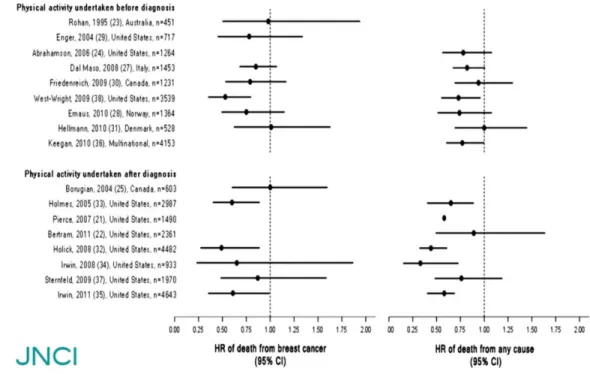
Figure 1.1. Owen’s (2000) diagram. ... 3 Figure 1.2. Observational studies of physical activity and mortality outcomes
in breast cancer survivors... 4 Figure 1.3. McTiernan’s (2008) diagram showing hypothesized mechanisms
linking physical activity to cancer risk and prognosis. ... 8 Figure 1.4. Lynch’s (2010) diagram showing hypothesized mechanisms
linking sedentary behavior to cancer prognosis. ... 9 Figure 1.5. Emery (2009) Trajectories from post-surgery to 5 years
post-surgery... 11 Figure 1.6. Emery (2009) trajectories stratified by perceived social
support level. ... 11 Figure 1.7. Brunet (2014) physical activity trajectories in 199 Canadian
breast cancer survivors. ... 12 Figure 1.8. Transactional model of stress and coping. ... 16 Figure 1.9. Park et al. (2008) structural equation model of cross-sectional
health behavior change after diagnosis. ... 25 Figure 1.10. Conceptual model: Physical activity. ... 26 Figure 1.11. Conceptual model: Sedentary behavior. ... 30 Figure 1.12. Conceptual model: Physical activity and sedentary behavior
modeled simultaneously... 30 Figure 2.1. Shaw’s (1999) framework of coping, illness representations,
health behaviors, and outcomes. ... 63 Figure 3.1. Mean linear trajectory structural equation model for
physical activity (PA). ... 69 Figure 3.2. Mean quadratic trajectory model for physical activity (PA). ... 70 Figure 3.3. Parallel process model diagram for physical activity (PA)
Figure 4.2. Best-fitting growth models for physical activity and sedentary
behavior estimated singly. ... 109 Figure 4.3. Physical activity and sedentary behavior estimated
simultaneously. ... 111 Figure 4.4. Individual variability in physical activity and sedentary
behavior trajectories. ... 112 Figure 4.5. Physical activity subgroups (quadratic model). ... 116 Figure 4.6. Sedentary behavior subgroups (quadratic models). ... 119 Figure 4.7. Subgroups when physical activity and sedentary
behavior were estimated simultaneously. ... 123 Figure 5.1. Hypothesized physical activity model. ... 142 Figure 5.2. Hypothesized structural equation model for physical activity. ... 148 Figure 5.3. Hypothesized structural equation model for sedentary
behavior subgroups. ... 151 Figure 5.4. Hypothesized structural equation model when physical
activity (PA) and sedentary behavior (SB) were estimated together. ... 152 Figure 5.5. Predictors of the low but increasing physical activity subgroup. ... 171 Figure 5.6. Predictors of the high but declining sedentary behavior subgroup. ... 177 Figure 5.7. Predictors when physical activity and sedentary behavior
LIST OF EQUATIONS
Equation 3.1: Individual survivor’s linear model with five time points ...68
Equation 3.2: Individual survivor’s quadratic model with five time points ...68
Equation 3.3: Measurement equation for a mean linear trajectory with covariate ...68
Equation 3.4: Structural equation for a mean linear trajectory with covariate ...69
Equation 3.5: Combined mean linear trajectory with covariate ...69
Equation 3.6: Combined mean quadratic trajectory with covariate ...70
Equation 3.7: Parallel process mean linear trajectory with covariate ...71
Equation 3.8: Parallel process mean quadratic trajectory with covariate ...71
Equation 3.9: Measurement equation for growth mixture model ...73
Equation 3.10: Structural equation for growth mixture model ...73
Equation 3.11: Combined growth mixture equation ...73
Equation 3.12: Structural equation model for categorical outcome ...74
LIST OF ABBREVIATIONS
GMM Growth mixture modeling
HEAL Health, Eating, Activity, and Lifestyle study HRQOL Health-related quality of life
LCM Latent curve modeling NCI National Cancer Institute PA Physical activity
SB Sedentary behavior SCT Social Cognitive Theory
SEER Surveillance, Epidemiology, and End Results cancer registries SEM Structural equation modeling
CHAPTER 1. INTRODUCTION
My dissertation is composed of six chapters. In Chapter 1, I review: 1) background information on my outcome variables of physical activity and sedentary behavior during breast cancer survivorship and the ways in which these constructs are differentiated; 2) two studies examining PA trajectories in breast cancer survivors; 3) constructs in Lazarus and Folkman’s (1987) Transactional Model of Stress and Coping and strengths and weaknesses of the model for examining physical activity and sedentary behavior as coping strategies; 4) my conceptual models for physical activity and sedentary behavior; and 5) the longitudinal dataset that I used to test my aims. I conclude the chapter with my Specific Aims. In Chapter 2, I review the empirical literature on PA and SB levels at different points during survivorship, describe empirical studies informing my conceptual models, and describe how I operationalized Transactional Model constructs. I conclude the chapter by describing the significance of my proposed work. In Chapter Three, I review my methodology, equations, and power calculations. Chapters Four and Five are my papers stemming from my dissertation research and Chapter Six is my concluding chapter discussing implications for cancer care and future interventions with breast cancer survivors.
1.1. Overview
1.1.1 Differentiating Physical Activity, Exercise, and Sedentary Behavior
metabolic rate (2013). In contrast, exercise is defined as, “systematic, planned, or structured PA involving a specific frequency, intensity, duration, or mode performed regularly for the purpose of enhancing physical fitness” (American College of Sports Medicine, 2013, pg. 4). Thus, PA is broader in scope in that it captures unstructured and structured lifestyle activities. Moderate-vigorous PA is the dominant aspect of human movement studied in PA research and its significance to health outcomes is well supported by over 60 years of scientific inquiry (Katzmarzyk, 2010). Examples of moderate-vigorous PA include brisk walking, running,
aerobics, and other activities that raise heart- and breathing-rates above a resting level and cause sweating to occur.
Sedentary Behavior (SB) is prolonged periods of sitting or reclining during waking hours with no skeletal muscle movement, such as sitting watching television or working at a desk for several hours in a row (Lynch, 2010). SB has a weak correlation with PA, which means that SB is not simply the opposite of PA (George et al., 2013a; Tremblay, Colley, Saunders, Healy, & Owen, 2010; Santos et al., 2012). PA and SB can vary independently and likely have different predictors and differential effects on health (Katzmarzyk, 2010).
Owen and colleagues (Owen, Leslie, Salmon, & Fotheringham, 2000) published a diagram differentiating PA and SB in different contexts (e.g., home, occupation), behavioral settings (e.g., indoor and outdoor activities), functions (e.g., home maintenance, commuting), and behavioral choices (e.g., watching television, cleaning) (see Figure 1.1). In this model, multilevel
work longer hours at one or more jobs, and may have sole childcare responsibilities, which all limit leisure time for engaging in PA.
Figure 1.1. Owen’s (2000) diagram.
1.1.2 Physical Activity, Sedentary Behavior, and Risk for Recurrence and Early Mortality
There is a growing body of evidence for the beneficial effects of PA for breast cancer survivors including better quality of life and reduced risk for recurrence and early mortality. Several systematic reviews have shown that PA improves physical function, mental health, fatigue, and quality of life in breast cancer patients (see Schmitz, 2011; Fong et al., 2012; McNeely et al., 2006).
beneficial than pre-diagnosis PA (Ballard-Barbash et al., 2012; Fontein et al., 2013; Ibrahim & Al-Homaidh, 2011). Ibrahim and Al-Homaidh (2011) conducted a meta-analysis of six studies with over 12,000 breast cancer survivors to determine the relationship between PA and mortality. Pre-diagnosis PA reduced risk of breast cancer-specific mortality by 18% and post-diagnosis PA reduced risk by 34%. Early mortality from other causes was reduced by 41%.
Ballard-Barbash and colleagues (2012) systematically reviewed studies that examined the relationship between PA and mortality (cancer-specific and all-cause) across several cancer types. Figure 1.2 shows the risk estimates for mortality based on 17 observational studies of PA in breast cancer survivors. The confidence intervals showed consistent evidence that PA was associated with reduced all-cause and breast cancer-specific mortality.
Additionally, two cohort studies of initially healthy women examined PA and breast cancer recurrence and survival (Nurses’ Health Study and the Women’s Healthy Eating and Living trial). In both studies, women diagnosed with breast cancer who engaged in recreational PA for approximately two to three hours per week (i.e., meeting the national PA guideline) had a 30-34% lower risk of breast cancer recurrence and all-cause mortality than breast cancer
survivors who did not meet the PA guideline (Holmes et al., 2005; Pierce et al., 2007). This decreased risk of recurrence and early mortality associated with PA was observed in both pre-menopausal and post-pre-menopausal women and was independent of body mass index (i.e., the measure of relative weight based on an individual's mass and height).
Finally, one study (Sternfeld et al., 2009) found a negative association between PA and recurrence over a seven-year period when models were adjusted for age but the association was not significant when adjusted for other covariates such as race and education. Age-adjusted results from 1,970 women in the Life after Cancer Epidemiology study showed that higher PA was associated with reduced risk of recurrence and breast cancer-specific mortality. However, results were attenuated when adjusted for other demographic and clinical characteristics.
SB, such as hours spent sitting per day, is deleterious in its own right and uniquely contributes to negative health outcomes, above and beyond PA. Three systematic reviews (in general population samples) have shown that SB was correlated with all-cause mortality,
sedentary time, compared with the lowest, was associated with a 112% increase in relative risk for diabetes incidence, a 147% increase in risk for cardiovascular events, a 90% increase in risk for cardiovascular mortality, and a 49% increase in risk for all-cause mortality.
In addition to all-cause mortality, cardiovascular mortality, and type II diabetes incidence, Biswas et al. (2015) also found significant correlations with cardiovascular disease incidence and cancer incidence and mortality. They reviewed 41 prospective articles and performed meta-analyses on outcomes for cardiovascular disease and diabetes (14 studies), cancer (14 studies), and all-cause mortality (13 studies). Significant hazard ratio (HR) associations were found with all-cause mortality (HR: 1.240 [95% CI, 1.090 to 1.410]), cardiovascular disease mortality (HR: 1.179 [CI, 1.106 to 1.257]), cardiovascular disease incidence (HR: 1.143 [CI, 1.002 to 1.729]), cancer mortality (HR: 1.173 [CI, 1.108 to 1.242]), cancer incidence (HR: 1.130 [CI, 1.053 to 1.213]), and type II diabetes incidence (HR: 1.910 [CI, 1.642 to 2.222]). Hazard ratios associated with SB and outcomes were generally more pronounced at lower levels of PA than at higher levels.
correlation between SB and early mortality was no longer significant. To date, no studies have examined SB and risk for recurrence.
The George et al. (2013a) HEAL study suggests that examining patterns of both PA and SB is important. A combination of long-term SB and low PA may be particularly detrimental to health. For instance, evidence from a meta-analysis in the general population suggests that a pattern of long-term SB paired with low levels of PA is associated with doubling the risk for diabetes and cardiac conditions (Edwardson et al., 2012). The health effects of a pattern of long-term SB paired with low levels of PA are unknown for breast cancer survivors but likely are harmful to health. Because evidence suggests that patterns of high SB paired with low PA are likely to place breast cancer survivors at risk for poor outcomes, as they do in other populations, my studies will determine if there is a subgroup of breast cancer survivors following a pattern of low PA and high SB, the percentage in this subgroup, and whether this subgroup is predicted by variables from Lazarus and Folkman’s (1987) Transactional Model of Stress and Coping.
1.1.3 Biological Mechanisms Linking Physical Activity and Reduced Risk for Recurrence and Early Mortality
Although I will not be examining biological mechanisms linking PA and SB to cancer prognosis, it is useful to review biological pathways published in the literature to establish that increasing PA and decreasing SB in breast cancer survivors will likely reduce recurrence and early mortality.
need to be impacted before effects of PA on cancer prognosis can be observed. The pathways may also vary by demographic, clinical, and treatment-related characteristics.
Figure 1.3. McTiernan’s (2008) diagram showing hypothesized mechanisms linking physical activity to cancer risk and prognosis.
One systematic review also published a diagram showing hypothesized pathways in which SB may be influencing cancer progression and prognosis (Lynch, 2010). The
Figure 1.4. Lynch’s (2010) diagram showing hypothesized mechanisms linking sedentary behavior to cancer prognosis.
1.1.4 Longitudinal Physical Activity and Sedentary Behavior during Survivorship
Despite PA and SB being likely determinants of outcomes after treatment for breast cancer, little is known about changes in PA and SB that may occur from pre-diagnosis through
Rutten, Arora, Bakos, Aziz, & Rowland, 2005), indicating a critical need for research on health behaviors during long-term survivorship.
To my knowledge, no study has modeled longitudinal patterns (trajectories) of SB in breast cancer survivors and only two studies have modeled trajectories of PA. In the first of these two PA studies, Emery and colleagues (Emery, Yang, Frierson, Peterson, & Suh, 2009) modeled the mean PA trajectory over five years for 277 women treated for breast cancer. They found a curvilinear pattern from the time period between post-surgery and five years post-surgery: PA initially increased after surgery through 18 months, reaching recommended levels, and then gradually declined. At the 5-year post-surgery assessment, mean PA was lower than it was at baseline (Figure 1.5). However, this average trajectory may be masking individual variation and subgroups following different patterns. To date, no studies have modeled trajectories of
longitudinal PA from the time of diagnosis to ten years post-diagnosis and no studies have modeled longitudinal SB trajectories.
Figure 1.5. Emery (2009) Trajectories from
post-surgery to 5 years post-surgery. Figure 1.6. Emery (2009) trajectories stratified by perceived social support level.
The second study examined PA trajectories in 199 Canadian breast cancer survivors over a 15-month period (Brunet, Amireault, Chaiton, & Sabiston, 2014). Women were assessed at three, six, nine, twelve, and fifteen months post-treatment. The investigators identified five subgroups. The largest subgroup (49.2%) consistently met PA guidelines over the 15 months after treatment. The next largest subgroup (25.1%) was consistently active at levels that did not meet guidelines. The third subgroup (10.6%) reported being inactive at 3-9 months
Figure 1.7. Brunet (2014) physical activity trajectories in 199 Canadian breast cancer survivors.
Three methodological concerns arise for the Brunet et al. (2014) study. First, the small sample size limits confidence in determining a reliable number of subgroups. Second, the authors did not adjust for sample size with the Bayesian Information Criterion (BIC) when enumerating the number of PA classes, which is biased toward too many classes (Enders, 2010b). Thus, five classes may be overstating the number of PA subgroups. Third, the sample was largely
Caucasian (85%) and highly educated (50% with a college degree). These demographics may explain the surprising finding that the largest subgroup met PA guidelines at all time points. A more diverse sample of breast cancer survivors in the U.S. is unlikely to show the majority of the sample consistently meeting guidelines because lower PA levels are associated with minority heritage and less education, even after controlling for clinical and treatment characteristics (e.g., Hair et al., 2014; Hawkins et al., 2010; Patterson et al., 2003; Irwin et al., 2003; Pinto, Trunzo, Reiss, & Shiu, 2002).
treatment, number of treatment types received, and physical symptoms did not predict PA trajectory group membership. Breast cancer survivors who reported higher depression and fatigue were less likely to be consistently sufficiently active compared to other groups. However, survivors who reported higher levels of cancer worry were more likely to be consistently
sufficiently active. Brunet’s small sample size limits confidence in determining reliable correlates of trajectories. However, this study suggests that there may be considerable value in examining whether subgroups of breast cancer survivors are following different trajectories and whether psychosocial variables are better predictors of subgroups than demographic and clinical characteristics. It may be the case that psychosocial variables are acting as mediators between demographic and clinical characteristics and subgroups of breast cancer survivors following different PA trajectories.
Neither the Brunet et al. (2014) nor the Emery et al., (2009) studies attempted to capture PA levels prior to cancer diagnosis; thus limiting our understanding of how trajectories of PA after treatment are associated with pre-diagnosed PA levels. Also, neither study examined SB trajectories, which ignores how the majority of leisure time is spent. No studies to date have estimated PA and SB in the same model for breast cancer survivors. Modeling PA and SB together would yield a fuller picture of how breast cancer survivors are spending their leisure time and which PA-SB trajectories may jeopardize long-term health.
survivors’ PA and SB changes, from pre-diagnosis to 10 years post-diagnosis, and examining potential cognitive and emotional predictors informed by Lazarus & Folkman’s (1987) Transactional Model of Stress and Coping.
1.2. Transactional Model of Stress and Coping
In addition to the fact that PA and SB have never been studied together from pre-diagnosis through ten years post-diagnosis in cancer survivors, using a research design that enables
examination and comparison of their trajectories simultaneously, research on PA and SB has rarely used a theoretical approach. Of the limited studies, the most commonly applied theories with cancer survivors (and in the general population) are Social Cognitive Theory (SCT), the Theory of Planned Behavior (TPB), and the Transtheoretical Model (TTM) (Pinto & Floyd, 2008). I will describe these theoretical approaches in Section 1.2.2 and compare their strengths and weaknesses to the Transactional Model of Stress and Coping, described in the next section.
1.2.1 Transactional Model Constructs
After understanding how PA and SB patterns change over the course of survivorship, the next logical step is to determine important demographic, clinical, and treatment-related
characteristics, as well as psychosocial variables, that may be associated with them. Demographic, clinical, and treatment-related characteristics are important for identifying subgroups of women in need of intervention. Psychosocial variables from the Transactional Model of Stress and Coping that prove to be mediators may be mutable intervention targets in the future.
Theories, such as the Transactional Model of Stress and Coping, are useful in several ways for identifying intervention targets for future research. Theory is helpful for selecting
light of the functions that psychosocial constructs may be playing in important health-related processes. Psychosocial variables are an important component of the Transactional Model of Stress and Coping, in that they describe how cognitive and affective perceptions predict the coping process.
The central tenets of the Transactional Model are four-fold: 1) Perception of a stressor is considered to be “transactional" because it is formed by an individual’s cognitive and emotional appraisal of the stressor and the environmental context in which it occurs; 2) Individuals vary in their perception of stressors and availability of coping resources; 3) Coping strategies are a process determined by how threatening the situation is perceived to be and what coping options are perceived to be available; and 4) Coping is conceptualized as dynamic in that it varies by situational context, even within individuals (Lazarus & Folkman, 1987; Lazarus, 1999; Hill Rice, 2000). The Transactional Model makes no a priori assumptions about what constitutes “good” or “bad” coping strategies (e.g., Folkman & Lazarus, 1985). Coping is simply an individual’s efforts to manage a stressor when demands exceed coping resources.
Figure 1.8. Transactional model of stress and coping.
Lazarus and Folkman describe two types of cognitive and emotional appraisals that impact coping behavior: primary and secondary appraisal. They argue that, before emotion occurs, individuals make a primary appraisal, which is an automatic, often unconscious, assessment of what is happening and what it may mean for them personally or for loved ones. In primary appraisal, a situation or stressor is judged on whether it is germane to well-being, i.e., whether the stressor is irrelevant, stressful, or benign-positive (lower left corner of Figure 1.8). If the situation is judged to be benign or positive, it has the potential for a positive outcome (labeled “benefit” in the Transactional Model literature but not shown in Figure 1.8). A situation perceived to be stressful is broken down further into three parts: harm/loss, future threat, and challenge (Lazarus & Folkman, 1987). “Harm or loss” is conceptualized as negative
A secondary appraisal also occurs. This appraisal relates to the perception of whether any action(s) can be taken to reduce or eliminate the stressor, and if so, which coping strategies might be effective (Lazarus & Folkman, 1987; Lazarus, 1999). Coping strategies are the cognitive, affective, and behavioral efforts to manage a situation perceived to be a stressor (Lazarus & Folkman, 1987).
Primary and secondary appraisals are explicitly described as influencing each other but not having a temporal dimension. In other words, the appraisal that something (or nothing) can be done about a stressor may be made before the individual has determined what is personally at stake. The Transactional Model predicts that when stakes are perceived to be high, mobilization of coping resources will occur. When the stake is substantial and coping resources are judged to be inadequate, a negative emotional response is predicted to occur. The greater the imbalance between stakes and coping resources, the greater the negative emotional response is predicted to be.
The Transactional Model of Stress and Coping suggests that breast cancer survivors who perceive recurrence to be an important future threat, and who appraise their coping resources as adequate to manage future recurrence risk, will change their behavior as a coping strategy. For instance, breast cancer survivors may increase their PA or change their diet to increase overall health and reduce future health threats. Breast cancer survivors may choose to change PA (instead of, or in conjunction with, other health behaviors) because of media reports on PA and cancer, a clinician’s recommendation to increase PA, or other sources of information.
as proxies for coping strategies after a breast cancer diagnosis. These ideas will be covered more fully in Section 1.2.4. In the next section, I discuss the strengths and weaknesses of the
Transactional Model in relation to my dissertation.
1.2.2 Strengths and Weaknesses of the Transactional Model
A review conducted in 2007 found only 30 published articles using a theoretical framework to understand a range of health behavior changes among cancer survivors (Park & Gaffey, 2007). The most commonly applied theories were Social Cognitive Theory (SCT), the Theory of Planned Behavior (TPB), and the Transtheoretical Model (TTM) (Pinto & Floyd, 2008). SCT postulates that a health behavior is performed if an individual perceives control over the outcome, few external barriers, and confidence in ability (i.e., self-efficacy) (Bandura, 1986). TPB theorizes that an individual’s intention to perform a behavior is a function of attitudes held toward the behavior, subjective norm (perception of how others want the person to act), and perceived behavioral control (Ajzen, 1991). TTM describes five temporal stages of readiness to change a behavior (Prochaska & DiClemente, 1983).
perceived social support and religious coping resources (secondary appraisal), which may impact health behavior. These features of the Transactional Model allow for a richer examination of the functions that health behaviors, such as PA and SB, may serve in the context of women’s responses to stressors associated with having been treated for breast cancer.
Despite its advantages, the Transactional Model also has several weaknesses. For instance, the Transactional Model fails to include potential effects of age, race, and gender differences on key model variables including perceptions of a stressor, perceived coping resources, and coping strategies. In Figure 1.8, the personal determinants of appraisals are focused on more intrapersonal cognitive constructs (e.g., commitments and beliefs) than on demographic characteristics. I included demographic, clinical, and treatment-related
characteristics in my conceptual models in order to take a public health approach to understanding women’s longitudinal PA and SB patterns after breast cancer.
The Transactional Model also lacks a variable such as self-efficacy for performing specific coping strategies. Self-efficacy has proven to be an important predictor of health behavior change in the general population (Armitage & Conner, 2000). However, it is arguable whether self-efficacy is implicitly included in the Transactional model. For instance, individuals are not likely to perceive something to be a coping resource unless they are able to access and use it.
(see Figure 1.8) where individuals make re-assessments of primary and secondary appraisals based on changes to the stressor or in the environment, which implies a long-term time element.
I used the Transactional Model of Stress and Coping to investigate predictors of PA and SB trajectories after breast cancer because it includes constructs for emotional reactions and social and cultural coping resources, which typically are excluded from classic health behavior theories. I also included demographic, clinical, and treatment-related characteristics in my conceptual models to take a public health approach to better understanding the determinants of breast cancer survivors’ PA and SB patterns. In the next section, I describe a study that applied primary and secondary appraisals to better understand the coping strategies used by breast cancer survivors. This study by Hilton (1989) illustrates that primary and secondary appraisal constructs are
relevant to my target population (breast cancer survivors) and the ways in which they cope with a cancer diagnosis.
1.2.3 Applying Appraisals and Coping to Breast Cancer
Hilton (1989) used the Transactional Model to examine the relationships between anxiety about recurrence, perceived control, and coping strategies in a sample of 277 women recently diagnosed with breast cancer. Two patterns emerged that reflect Transactional Model
predictions: 1) breast cancer survivors who had high anxiety about recurrence (proxy for primary appraisal) and low perceived control over the situation (proxy for secondary appraisal); and 2) breast cancer survivors who reported high anxiety about recurrence and high perceived control over the situation.
reported high anxiety and high perceived control were more likely to use coping strategies such as planful problem solving, seeking social support, positive reappraisal, and self-control
techniques than survivors who reported high anxiety and low control (Hilton, 1989). These two patterns of primary and secondary appraisals explained about a third of the variance in coping strategies used by survivors (1989).
Hilton (1989) did not report on whether women with low primary appraisal changed their coping strategies. However, the Transactional Model processes suggest that breast cancer survivors with low primary appraisal would not change their coping strategies because the situation is not seen as a stressor requiring action.
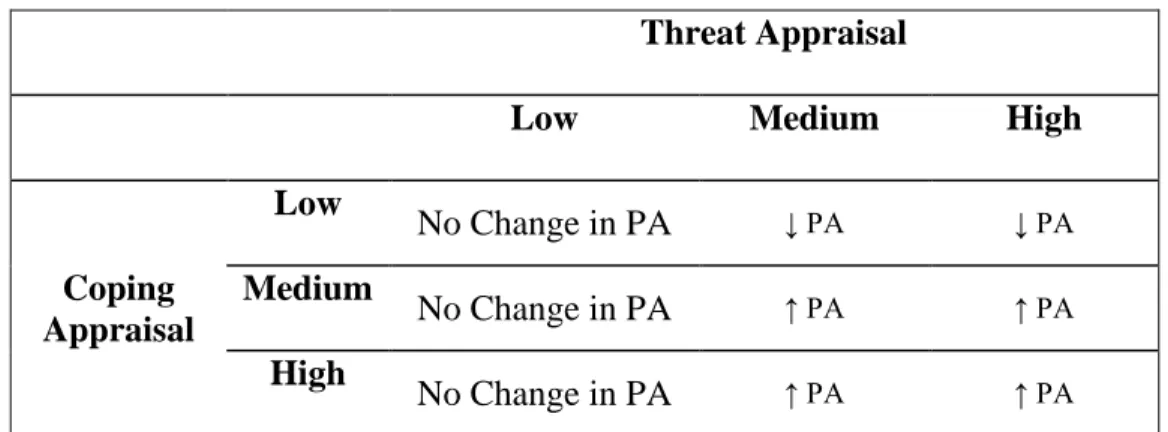
I hypothesized that similar patterns would emerge in my sample for primary and secondary appraisal clusters, which in turn would affect women’s levels of PA as a coping response. Table 1.1 presents a simplified way of thinking about the patterns of PA predicted as a coping strategy in response to primary and secondary appraisals. (Note that this table does not take into account demographic, clinical, and treatment-related characteristics.)
If threat/primary appraisal is perceived to be high and coping resources/secondary appraisal are low, a pattern lower in PA over time is predicted (top row, right cell) because the woman would be expected to perceive breast cancer to be a high threat for future health but that she is unable to change the stressor with cognitive, behavioral, or affective efforts. In contrast, if threat and coping appraisal are both high, a pattern higher in PA over time is expected (bottom row, left cell) because the woman perceives a high future health threat and that she has the coping
Table 1.1. Expected Patterns of Physical Activity in Response to Appraisals
Threat Appraisal
Low Medium High
Coping Appraisal
Low
No Change in PA ↓ PA ↓ PA
Medium
No Change in PA ↑ PA ↑ PA
High
No Change in PA ↑ PA ↑ PA
1.2.4 Physical Activity and Sedentary Behavior as Coping Strategies
A breast cancer diagnosis represents a “teachable moment” where women may be more receptive to hearing information about making lifestyle changes to become healthier. It also represents a time where women may begin using coping strategies in response to the stressor of cancer and feelings of vulnerability about their current and future health. One type of coping strategy after diagnosis is to change health behavior, which may be health-promoting (e.g., increasing PA) or health-inhibiting (e.g., decreasing PA). In a population-based sample of
survivors of different cancer types, almost 30% reported increasing their PA following diagnosis, about half remained the same, and 15% decreased PA following diagnosis (Hawkins et al., 2010). Thus, almost half of cancer survivors may be changing health behaviors in response to their cancer diagnosis.
emotional reactions stemming from the stressor. A more emotion-focused aspect of PA may be managing feelings of anxiety and depression stemming from a cancer diagnosis.
However, this dichotomy of problem- vs. emotion-focused coping is potentially misleading. It is more likely that coping strategies serve both problem- and emotion-focused functions (Park & Iacocca, 2014) because they serve several purposes. For example, PA as a coping strategy may have both problem- and emotion-focused aspects by helping a woman to feel better physically and emotionally and increasing her feelings of control. SB may have problem- and emotion-focused aspects by directly impacting the stressor (e.g., helping a woman to feel better by resting during active treatment) and managing the emotional reactions to cancer (e.g., increasing time spent sitting watching TV to avoid thinking about cancer). The
Transactional Model avoids labeling coping strategies in this way and assumes that coping strategies can be both problem- and emotion-focused.
In the context of the Transactional Model, I examined PA and SB as coping strategies in response to breast cancer. Conceptualizing PA and SB as long-term coping strategies is an innovative application of the Transactional Model. However, evidence from fields such as exercise science and health psychology support the notion that some individuals use PA explicitly for the purpose of coping with a stressor (e.g., Ingledew, Hardy, Cooper, & Jemal, 1996; Park & Iacocca, 2014). Research with breast cancer survivors is consistent with this function for PA. For instance, in a small qualitative study, breast cancer survivors spontaneously mentioned PA as an active coping strategy they employ to enhance feelings of personal control and to increase their physical and mental strength (Drageset, Lindstrom, & Underlid, 2009).
coping responses in general or medical populations (Park & Gaffey, 2007; Park & Iacocca, 2014). Because few researchers have explicitly framed health behaviors as coping strategies, little research exists about when health behaviors are used to manage a stressor. Park and Iacocca (2014) recommend using a Transactional Model approach to advance the understanding of health behaviors and to inform future intervention development.
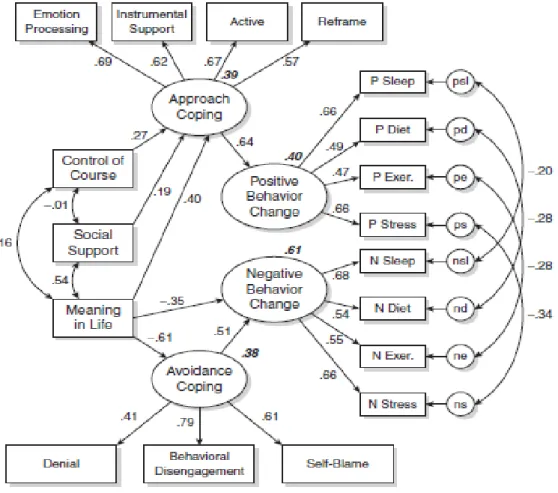
Park and colleagues (Park, Edmonson, Fenster, & Blank, 2008) successfully applied the Transactional Model to examine health behavior changes as coping strategies in response to cancer (see Figure 1.9). They examined cross-sectional positive and negative health behavior changes following diagnosis in 250 cancer survivors (almost 50% breast cancer, mean age: 45, 89% Caucasian). Health behaviors included PA, diet, sleep, and stress management.
Figure 1.9 is Park et al.’s (2008) structural equation model results showing that positive health behavior changes following diagnosis were related to social support, sense of control over disease course, meaning in life, and approach coping (composite index of emotion processing, instrumental support, active coping, and reframing the situation). Negative health behavior changes after a cancer diagnosis were related to a lack of meaning in life and avoidance coping (composite index of denial, behavioral disengagement, and self-blame) (Park et al., 2008). Positive and negative health behavior changes were predicted by different types of coping strategies, and thus appear to be distinct (but correlated) phenomena.
In sum, I examined PA and SB as coping strategies in response to cancer in the context of the Transactional Model. Very little research has explicitly examined health behaviors as coping responses. Park and colleagues (2008) applied the Transactional Model to examine
PA change can be predicted from appraisals. In the next section, I describe my conceptual models for PA and SB that incorporate Transactional Model constructs as mediators.
Figure 1.9. Park et al. (2008) structural equation model of cross-sectional health behavior change after diagnosis.
1.3 Conceptual Models
1.3.1 Conceptual Model for Physical Activity
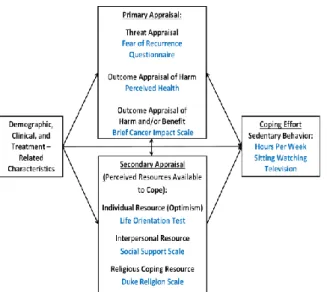
My PA conceptual model was informed by Lazarus and Folkman’s (1987) Transactional Model of Stress and Coping and a literature review of empirical research. The model represents the research question of whether primary and secondary appraisals (Transactional Model of Stress and Coping) mediate the relationships between demographic, clinical, and treatment-related characteristics and PA trajectories from pre-diagnosis through ten years post-diagnosis (see Figure 1.10).
Figure 1.10. Conceptual model: Physical activity.
Specific demographic, clinical and treatment-related variables were selected for my
conceptual model because they are important for breast cancer prognosis and are correlated with PA (see Chapter 2). Figure 1.10 shows that demographic, clinical, and treatment-related
characteristics were expected to have both direct and indirect effects on PA.
as disease stage, comorbid conditions, fatigue, and BMI. Treatment-related characteristics were operationalized as four variables: surgery (breast-conserving surgery or mastectomy);
chemotherapy; radiation therapy; and taking tamoxifen. Tamoxifen is an oral medication that prevents estrogen from binding with breast cancer cells (Devita, Lawrence, & Rosenberg, 2010; Rubin, 2001). During the years of this cohort study (1995-2009), tamoxifen was typically prescribed for five years following diagnosis to prevent recurrence for women with hormone-receptor-positive tumors (Rubin, 2001). Tamoxifen can cause menopausal-like symptoms such as hot flashes, mood swings, or nausea.
Mediators (primary and secondary appraisals) were selected from an existing dataset (see Section 1.4) with the goal of identifying variables from that dataset that best represent
Transactional Model constructs. I operationalized primary appraisal with three constructs: anxiety about recurrence (a proxy for anticipatory appraisal of threat); perceived health (a proxy for harm appraisal); and perceived impact of breast cancer (direct assessment of harm and benefit appraisals).
Anxiety about recurrence was chosen based on Folkman and Lazarus’ (1985) idea that emotions reflect an individual’s appraisal of the encounter. Anxiety about recurrence implies anticipatory concern or worry about a future health threat, and therefore is a good proxy for appraisal of threat.
Perceived impact of breast cancer was chosen based on Lazarus and Folkman’s
constructs of outcome appraisals of harm and benefit because breast cancer survivors report both negative and positive impacts of cancer on their lives (Alfano et al., 2006; Ganz et al., 2002). In other words, a negative perception of cancer impact represents harm appraisal and a positive perception represents potential benefit (e.g., post-traumatic growth such as re-evaluating what is important in life).
Secondary appraisal has been operationalized as perceived coping resources by several researchers, which I also did. Secondary appraisal was operationalized with three constructs: personal coping resources (generalized positive expectations for the future, or optimism); interpersonal resources (the presence of people to confide in, or perceived social support); and religious coping resources (measured by the proxy of religiosity/spirituality).
Optimism was selected as a personal coping resource based on work by Carver, Scheier, and Segerstrom (2010) showing that individuals with higher optimism (i.e., positive expectancies regarding future outcomes) use more problem-focused (engagement coping), which predicts better resilience against a health stressor. Perceived social support was chosen as an interpersonal coping resource based on Lazarus and Folkman’s work on coping resources (1997).
Religiosity/spirituality was chosen as a proxy for religious coping resources because it provides a schema for making sense of adversity, increases feelings of control over a stressor (e.g., a belief that “God has a plan”), and may provide emotional, tangible, and informational support resources for individuals who are part of faith communities.
perceived health, perceived impact of breast cancer, optimism, religiosity/spirituality, and social support are correlated among breast cancer survivors (Alfano et al., 2006; Waters, Liu,
Schootman, & Jeffe, 2013; Stolley, Sharp, Wells, Simon, & Schiffer, 2006). Finally, I operationalized longitudinal PA (as a coping strategy) as the number of hours of moderate-vigorous PA per week measured as trajectories from pre-diagnosis through ten years post-diagnosis.
1.3.2 Conceptual Model for Sedentary Behavior
My conceptual model for SB includes the same pathways as PA because they were correlated with SB in prior research or are predicted based on Transactional Model processes (see Chapter 2). SB was first included in a conceptual modeled by itself (see Figure 1.11) and then PA was added to the model as a separate outcome variable (see Figure 1.12).
Conceptualizing SB individually and then simultaneously with PA was important because they are separate (but correlated) constructs that may have different predictors. Including PA and SB in the same conceptual model reflects the idea that different combinations of trajectory patterns are possible (e.g., low PA and high SB, or high PA and high SB).
Figure 1.11. Conceptual model: Sedentary behavior.
Figure 1.12. Conceptual model: Physical activity and sedentary behavior modeled simultaneously.
1.4 Study Aims
The objectives of my dissertation were to determine the longitudinal trajectories of PA and SB and whether theoretically-based psychosocial constructs were important predictors. The
rationale for these objectives was that the results would provide a better understanding of the mechanisms underlying PA and SB patterns during survivorship and inform the type of interventions women with breast cancer need to increase their PA to recommended levels and decrease time spent in SB.
My dissertation was informed by previously published empirical research and a
theoretical framework, Lazarus and Folkman’s (1987) Transactional Model of Stress and
Coping. The Transactional Model predicts that two types of cognitive and affective appraisals will influence how an individual behaves in response to a stressor, primary and secondary
appraisal), perceived health (proxy for harm appraisal), and perceived impact of breast cancer (direct assessment of harm and benefit appraisal). Secondary appraisal is an assessment of available coping resources. It was also operationalized with three constructs: optimism (personal coping resource), social support (interpersonal resource), and religiosity/spirituality (proxy for religious coping resources).
My central hypotheses were that 1) Groups of breast cancer survivors would follow different PA and SB patterns over time based on demographic, clinical, and treatment characteristics (“predictors”); and 2) Primary and secondary appraisals would be important mediators of associations between predictors and women’s longitudinal PA and SB patterns during survivorship.
I examined these specific aims in a prospective cohort study called the “Health, Eating, Activity, and Lifestyle” (HEAL) study. HEAL is a cohort of 938 women diagnosed with breast cancer between 1995 and 1999. Women were recruited from cancer registries in New Mexico, California, and Washington. The sample is diverse with 61% Hispanic Caucasian, 36% non-Hispanic African American, and 12% non-Hispanic American. Their ages ranged from 35-64 years at the time of diagnosis. More detail is given about the HEAL study in Chapter 4.
Specific Aim 1: Estimate temporal patterns (trajectories) of PA and SB from 1 year prior
to breast cancer diagnosis through 10 years post-diagnosis
Aim 1b: Determine whether there is significant individual variability in the intercept and slope parameters for PA and SB trajectories from pre-diagnosis through ten years following breast cancer diagnosis (estimated in separate models first and then in the same model)
Aim 1c: Determine whether there are subgroups of breast cancer survivors who follow different PA or SB trajectories from pre-diagnosis through ten years post-diagnosis (estimated separately and then in the same model)
Specific Aim 2: Determine whether primary and secondary appraisal constructs from
Lazarus and Folkman’s (1987) Transactional Model of Stress and Coping predict PA and
SB patterns for breast cancer survivors
Aim 2a: Determine which psychosocial constructs from the Transactional Model of Stress and Coping mediate relationships between demographic, clinical, and treatment-related
characteristics and subgroup membership for breast cancer survivors following different PA trajectories from pre-diagnosis through ten years post-diagnosis
Aim 2b: Determine which psychosocial constructs from the Transactional Model of Stress and Coping mediate relationships between demographic, clinical, and treatment-related
characteristics and subgroup membership for breast cancer survivors following different SB trajectories from pre-diagnosis through ten years post-diagnosis
Aim 2c: Determine whether different Transactional Model constructs mediate the relationships between demographic, clinical, and treatment-related characteristics and subgroups when PA and SB are estimated in the same model (rather than modeled separately)
CHAPTER 2. LITERATURE REVIEW
In this chapter, I summarize the empirical and theoretical literature informing my hypotheses. I review: 1) PA and SB levels of breast cancer survivors at different time points during survivorship, 2) empirical studies and theoretical constructs informing the pathways in my conceptual models, and 3) an overview of how primary and secondary appraisal from the Transactional Model of Stress and Coping were operationalized. I conclude the chapter by describing the significance of my dissertation work.
2.1 Physical Activity and Sedentary Behavior Levels at Different Time Points during Survivorship
2.1.1 Physical Activity Levels
National guidelines for the recommended minimum amount of time per week to spend engaging in PA are identical for adults with and without cancer: 150 minutes per week of moderate PA or 75 minutes per week of vigorous PA (Rock et al., 2012; Haskell et al., 2007). Breast cancer survivors may be vulnerable to decreasing PA after diagnosis and throughout survivorship, and thus are at risk for not meeting recommended levels.
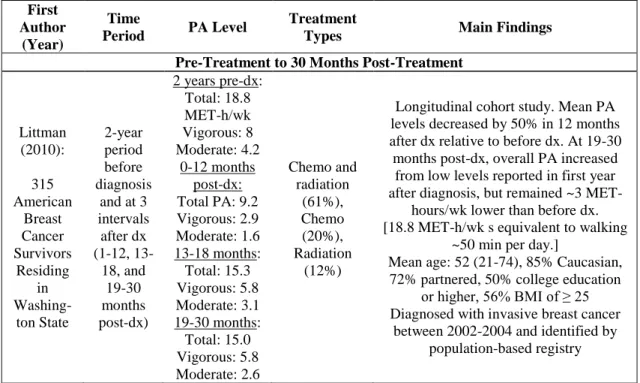
Littman et al. (2010) observed a decrease in PA during the first 12 months post-diagnosis and an increase at 19-30 months post-diagnosis for women diagnosed with invasive breast cancer.
Inconsistencies in PA levels across these studies may be explained by differences in demographic, clinical, and treatment-related characteristics, or even inconsistent use of PA measures, but evidence to date is inadequate. Samples across these prior studies were
homogenous for race (mostly Caucasian for the four studies conducted in the U.S.), age (around 50-55), education (high education level), and being partnered, and thus demographic differences cannot be compared. However, one study specifically examined PA levels by race (Hair et al., 2014). After adjustment for potential confounders, African American women were less likely to meet PA guidelines after diagnosis than Caucasian women (odds ratio, 1.38; 95% CI, 1.01-1.88) and reported less weekly post-diagnosis PA (12- vs. 14-MET hours) than Caucasian women.
Clinical and treatment-related characteristics may also account for a portion of the variance in PA across studies. The four cohort studies with a higher proportion of women with stage II and III disease reported decreases in PA after diagnosis (Littman et al., 2010; DeVoogdt et al., 2010; Andrykowski et al., 2007; Hair et al., 2014). In contrast, the two studies with larger proportions of women with early stage disease showed increases in PA after diagnosis (Harrison et al., 2009; Emery et al., 2009). The inconsistencies in the timing and direction of PA patterns underscore the importance of my dissertation research to model PA trajectories from
Table 2.1. Longitudinal Physical Acitivty Levels during Survivorship First
Author (Year)
Time
Period PA Level
Treatment
Types Main Findings
Women Followed Up To 12 Months Post-Diagnosis
Devoogdt (2010): 267 Flemish Breast Cancer Survivors Before surgery and 1, 3, 6, and 12 months post-operative Pre-Surgery: 269 MET-hours/week of TOTAL PA* 1 Month Post-Tx: 241 MET-hours/week
3 Months: 244 MET-hours/week
6 Months: 248 MET-hours/week 12 Months: 256 MET-hours/wek Mastectomy: 45%, Lumpectomy: 55%, Chemo: 51%, Radiation: 87%, Hormonal: 80%
PA significantly decreased between week prior to surgery to first month after
surgery and did not recover during first year. At each follow-up, total PA lower
than before surgery.
Mean age: 55 (21-90), Mean BMI: 25, race not reported (Flemish), education not reported. Greater age and smoking predicted decrease in moderate PA, not
having a spouse predicted decrease in household activities.
*TOTAL PA = light+moderate+vigorous Andry-kowski (2007): 257 American Breast Cancer Survivors from 2 Treatment Centers Between time of surgery and start of adjuvant therapy and 2 and 6 months post-tx After Surgery: Radiation: 150 min/week Chemo: 150 After Adjuvant Therapy: Rad: 100 Chemo: 100 2 Months Post-Tx: Rad: 150 Chemo: 150 6 Months Post- Tx: Rad: 125 Chemo: 175 Radiation: 143 (56%) Chemo+ Radiation: 114 (44%)
Significant decreases, relative post-surgery baseline, in total weekly MET-minutes of leisure-time exercise during adjuvant
therapy for both radiotherapy and chemotherapy + radiation groups. Levels did not differ from post-surgery by 2 and 6 months after adjuvant therapy. Groups
not significantly different for demographics or PA.
First Author
(Year)
Time
Period PA Level
Treatment
Types Main Findings
Hair (2014): 1,735 U.S. women with invasive breast cancer from Phase 3 Carolina
Breast Cancer Study Pre- (recalled) and post-dx
3 Months Prior to Diagnosis (Recalled): Sample: 473.9 minutes/week White: 491.0 Black: 420.1 6 Months
Post-Diagnosis: Sample: 245 minutes/week White: 263.8 Black: 144.7 Chemo: 51%, chemo+ radiation: 14%, no chemo or radiation: 23%, radiation: 12%
35% met PA guidelines after diagnosis. 59% reported decrease in PA after diagnosis, with average reducing PA by
15 MET-hours (95% CI: 12 -19). After adjustment, black women less likely to meet PA post-dx (OR = 1.38; 95% CI, 1.01-1.88) and reported less weekly postdx PA (12 MET hours vs 14 MET
hour). In adjusted stratified analyses, receipt of chemo or radiation significantly associated with postdx PA
in black women. In fully adjusted models, racial differences in postdx PA
and changes not significant. Erroneously classified low PA as SB.
Ages 20-74.
Women Followed Through 13 or More Months Post-Diagnosis
Harrison (2009): 287 Australian Breast Cancer Survivors
6, 12, 18 months post-dx
6 months post-dx: 283 minutes of TOTAL PA/ week 12 months post-dx: 307 min/week 18 months post-dx: 227 min/week 73% local exision, 27% mastectomy, 28% radiation
Harrison (2009): 80% reported engaging in some PA between 6 and 18
months following diagnosis, mostly moderate-intensity activities, with only
20–30% reporting either vigorous intensity or strength-based exercise.
45% met national guidelines for sufficient PA. Treatment-related complications related to lower PA. Mean age: 55, no other demographics
reported (Australia) *TOTAL PA = light+moderate+vigorous PA Emery (2009): 277 U.S. women (1/2
random-ized to PA inter-vention trial but inter-vention not success-ful) Post-surgery to 5 years post-tx Baseline: 16.6 METs/week* 4 months: 24.5 8 months: 26.6 1 year: 31.3
18 months: 25.4 2 years: 22.3
30 months: 23.2 3 years: 19.6
42 months: 21.0 4 years: 16.8
54 months: 13.8 5 years: 14.3
Surgery (57%), RT (54%), Chemo (84%), Tamoxifen (75%)
Curvilinear trajectory where PA initially increased from surgery through
18 months to recommended levels and then gradually decreased until 5-year
assessment. Higher social support associated with slower decline from
18-42 months.
Mean age: 51 (20-84), 90% Caucasian, 67% married, average of 14 years of
education.
*MET = ratio of energy consumption during specific activity to reference
metabolic rate, e.g., 18 MET-hours/week equivalent to
First Author
(Year)
Time
Period PA Level
Treatment
Types Main Findings
Pre-Treatment to 30 Months Post-Treatment
Littman (2010): 315 American Breast Cancer Survivors Residing in Washing-ton State 2-year period before diagnosis
and at 3 intervals after dx (1-12, 13-18, and 19-30 months post-dx)
2 years pre-dx: Total: 18.8 MET-h/wk Vigorous: 8 Moderate: 4.2 0-12 months post-dx: Total PA: 9.2 Vigorous: 2.9 Moderate: 1.6 13-18 months: Total: 15.3 Vigorous: 5.8 Moderate: 3.1 19-30 months: Total: 15.0 Vigorous: 5.8 Moderate: 2.6 Chemo and radiation (61%), Chemo (20%), Radiation (12%)
Longitudinal cohort study. Mean PA levels decreased by 50% in 12 months after dx relative to before dx. At 19-30 months post-dx, overall PA increased
from low levels reported in first year after diagnosis, but remained ~3
MET-hours/wk lower than before dx. [18.8 MET-h/wk s equivalent to walking
~50 min per day.]
Mean age: 52 (21-74), 85% Caucasian, 72% partnered, 50% college education
or higher, 56% BMI of ≥ 25 Diagnosed with invasive breast cancer
between 2002-2004 and identified by population-based registry
2.1.2 Studies Examining Both Physical Activity and Sedentary Behavior Levels at Different Points during Survivorship
SB, such as sitting watching television for several hours in a row, has only recently been examined in the context of breast cancer. No studies to date have examined SB changes after diagnosis without also examining PA. As such, three studies are reported that examined both PA and SB (Kim et al., 2013; Lynch et al., 2010; Rogers, Markwell, Courneya, & McAuley, 2011). It is important to note that these studies reported both PA and SB, but they did not model them together to determine if they were inter-related.
breast cancer survivors were more likely than women without cancer to report spending more than eight hours per day in SB (OR = 1.99, 95% CI: 1.25 to 3.19), suggesting that breast cancer survivors are inactive for longer periods of time than women without cancer (Kim et al., 2013). Interestingly, breast cancer survivors were also more likely than women without breast cancer to report spending up to 60 minutes per day engaged in moderate or vigorous PA (OR = 1.74, 95% CI: 1.07 to 2.83) (Kim et al., 2013). This result highlights the importance of examining
Table 2.2. Cross-Sectional Physical Activity and Sedentary Behavior Levels during Breast Cancer Survivorship First Author (Year) Time
Period Sedentary Time
Treatment
Types Main Findings
Kim (2013): NHANES 2007-2010 women with (132) and without breast cancer Cross-sectional: average of 4 years post-diagnosis (<3 years post-dx excluded)
>8 hours/day Unknown in NHANES
After adjusting for demographics, BMI, smoking, breast cancer survivors
more likely than women without cancer to report spending >8 hours/day in SB (OR = 1.99, 95% CI:
1.25 to 3.19) and to spend up to 60 minutes/day engaged in moderate or
vigorous PA (OR = 1.74, 95% CI: 1.07 to 2.83). Mean age: 62, 86% Caucasian, mean BMI of 29, 58% >high school, partnered not reported
Rogers (2011): 483 breast cancer survivors living in the most rural counties of a Midwest, U.S. state Cross-sectional: 39 months post-dx
Daily SB: 4.2 hours Walking,
MET-mins/week: 968.5±2064 (= 44 min/day)
Moderate-Vigorous
MET-mins/week 2969±3048 (= 139 min.day)
Not reported
Rogers (2011):
SB: no difference in age, race, or months since dx. Greater minutes sitting associated with less education. Women reporting ≥ 360 daily minutes
of sitting also reported less education when compared with
those reporting > 120 to < 360 min. Higher SB associated with higher #
comorbidities.
First Author
(Year)
Time
Period Sedentary Time
Treatment
Types Main Findings
Irwin (2003): 812 from HEAL (New Mexico and W. Washing -ton sites) *Exclude d Californi a site where all African America n women were recruited Longi-tudinal: Pre-dx to 6 months post-dx SB: Surgery Pre-dx: 41.3 hrs/wk Post-dx: 44.1 Surgery+RT pre-dx: 39.7 post-dx: 41.0 Surgery+Chemo pre-dx: 43.4 post-dx: 49.4 Surgery, RT, Chemo pre-dx: 37.8 post-dx: 45.9 PA: Surgery pre-dx: 18.9 hrs/wk post-dx: 17.3 Surgery+RT pre-dx: 18.7 post-dx: 17.4 Surgery+Chemo pre-dx: 19.7 post-dx: 16.1 Surgery, RT, Chemo pre-dx: 18.9 post-dx: 15.3 No differences in
PA or SB by stage. Surgery (n=266), Surgery and radiation (n=329), Surgery and chemotherapy (n=52) Surgery, radiation, and chemo (n=165)
HEAL patients decreased total PA by 2 hours per week from pre-dx to post-dx (11% decrease). Greater decreases in moderate-vigorous PA
observed for radiation and chemotherapy (50% decrease)
compared with women who underwent surgery only (24% decrease) or who were treated
with radiation only (23%). Greater decreases in PA among obese patients (41% decrease) compared with normal weight (24% decrease),
implying a potential for greater weight gain among women who
already are overweight. Mean age: 55, mean BMI: 27, 90%
Caucasian, 98% high school graduates (breakdown not reported),
partnered not reported
One additional study examined PA and SB longitudinally (Irwin et al., 2003). This prior HEAL study used data from two out of three sites (Washington state and New Mexico) and excluded the California site where all African American women in the HEAL study were
hour decrease in PA per week from pre- to post-diagnosis. Across treatment types, the level of increase in SB was not equivalent to the decrease in moderate-vigorous PA, reflecting the differences in the constructs.
In sum, three studies have examined both PA and SB for breast cancer survivors (two cross-sectional and one longitudinal). Inconsistencies in PA levels across studies may be
explained by differences in demographic, clinical, and treatment-related characteristics. Samples across prior studies were homogenous for race, age, education, and being partnered/married, and thus demographic differences cannot be determined from prior studies. Therefore, I included race/ethnicity, education, age at diagnosis, and marital/partnered status in my conceptual models. A longitudinal study indicated that PA and SB levels vary by treatment type, and thus I included surgery, radiation, chemotherapy, and tamoxifen in my conceptual models. In the next section, I review the literature supporting the proposed pathways in my conceptual model for PA.
2.2 Empirical Research Informing My Conceptual Model for Physical Activity
For Aim 2a, I examined whether primary and secondary appraisals mediated the relationships between demographic, clinical, and treatment-related characteristics and PA patterns from pre-diagnosis to ten years post-diagnosis. Demographic, clinical, and treatment-related characteristics are important variables to include because perceptions of harm, threat, and coping resources may vary by them.