1
Place Attachment &
Stewardship in Urban Parks
Clara Sofie Hemshorn de Sanchez
Master thesis proposal Psychology, specialization Soc. & Org. Psychology Institute of Psychology
Faculty of Social and Behavioral Sciences – Leiden University Date: 02 February 2017
Student number: s1812580
2
Table of Contents
Abstract………..4
Introduction………...4
1. Literature Review……….5
1.1 The role of urban green spaces………..5
1.2 Place Attachment and its predictors……….7
1.3 Place Attachment and Stewardship………..8
1.4 The Theory of Planned Behaviour and the Norm Activation Model……...…11
2. Method.………14
2.1 Data Collection and Participants……….14
2.2 Study Context………...….14
2.3 Measures………14
2.3.1 Demographic Information……….14
2.3.2 Park user information………...………...15
2.3.3 Place Attachment………..…………15
2.3.4 Stewardship………...……….15
2.3.4.1 Stewardship behavior……….………..……..16
2.3.4.2 Planned Behaviour variables……….………....17
2.3.4.3 Personal Norms………..………18
3. Results……….………..…….………..18
3.1 Demographic Information………18
3.2 Place Attachment and its predictors (H1 & Q1)………20
3.3 Place Attachment & Stewardship (H2 & Q2) ………..…24
3.4 Place Attachment & the Theory of Planned Behaviour (H3 & H4)………….27
3.5 Controls and exploratory analysis………...32
3
5. Limitations………..38
6. Future Research……….39
7. Conclusion………40
Acknowledgements………..41
References………41
Appendix………..47
Appendix A………..………47
Appendix B………..49
Appendix C………..71
Appendix D………..72
Appendix E………..73
Appendix F………..73
Appendix G………..74
Appendix H………..75
4 Abstract
Urban parks are vital for urban life quality providing spaces for recreation, exercise, restoration, as well as providing ecosystem services. Simultaneously, they shape citizens attitude towards nature by enabling contact with nature. Thus, voluntary park maintenance allows such contact with the benefit that the park's quality improves at low costs. Therefore, it is worth exploring what motivates people to get involved in such activities. Place attachment (PA) to the park, the positive, psychological bond to that park, is a potential candidate with such a motivating power. Yet, the literature does not offer a clear answer how exactly PA is related to such pro-environmental behaviour. Similarly, the underlying mechanisms of this relationship seem to be unexplored yet. Applying the extended planned behaviour model this study offers an approach to explain the relationship between the attachment to a place and a intentions to perform behaviour linked to that place. Results provide support for the
hypothesis that PA predicts intentions to help maintaining this park. This relationship is fully mediated by the attitude towards maintaining the park whereas personal norms play a less relevant role in this context. This study also investigated predictors for PA and their potential to predict stewardship behaviour for that park. Recommendations for managers of volunteer schemes for park maintenance and future research are included.
Urban green areas are vital for urban life. They provide spaces for human recreation and exercise (Cranz & Boland, 2004), restoration of attentional fatigue (Hartig & Kahn, 2016), social interaction and contact with nature (Ryan, 2006) and even ecosystem services (Dennis & James, 2016a). The maintenance of an urban park determines its attractiveness and therefore its use (Cranz & Boland, 2004; Ryan, 2005). Often city councils do not have
available the resources required for appropriate maintenance (Cranz & Boland, 2004). Involvement of the community around the park, people who use the park and those who live in the neighbourhood, can help to fill the resource gap (Cranz & Boland, 2004). Community involvement can even go beyond since it plays an important role in enhancing the
5 be encouraged it can be useful to look at person-place interactions (Devine-Wright, 2012; Uzzell, Pol, & Badenas, 2002). Emotional bonds with places for example have been
conceptualized as place attachment (PA) (Anton & Lawrence, 2016; Lewicka, 2013; Lee & Shen, 2012; Hallpenny, 2010; Ryan, 2006). There is evidence that place attachment is related to pro-environmental attitudes in general (e.g. Halpenny, 2010; Budruk, 2009) and also to place-specific stewardship (e.g. Hallpenny, 2010; Ryan, 2005). Within the context of park maintenance, a focus on place specific stewardship is more relevant. Stewardship has been defined as "work to conserve, manage, monitor, restore, advocate for, and educate the public about a wide range of issues related to sustaining the local environment" (p.76, Connolly, Svendsen, Fisher, & Campbell, 2013).
Although there are numerous studies that investigate the relationship between place attachment and some form of stewardship, there is no explanation yet for the underlying processes of this relationship. Furthermore, research on urban parks in particular is limited in this context.
Therefore, the following four questions are central to this study. First, is place
attachment to an urban park related to its stewardship? Second, do PA predictors also predict stewardship? If there is a relationship between PA and stewardship we may also expect a link between PA predictors and stewardship. Third, how do PA predictors differ in strength relative to each other? If PA encourages stewardship and PA predictors do so too, then knowing the relative strengths of predictors can help to direct efforts to increase attachment and thereby increase motivations for stewardship in an effective way. Finally, what are the underlying processes of the relationship between PA and stewardship behaviour?
1. Literature Review
1.1 The role of urban green spaces
There are two important reasons why the role of green spaces and in particular parks in urban areas becomes increasingly important. First, 53.9% of the world population currently lives in urban areas (The World Bank, 2016). In the Netherlands this number is as high as 90.0% and numbers are increasing all around the world (The World Bank, 2016). As a
consequence there is a pronounced need for optimizing urban spaces to meet the requirements of human well-being. In his classic paper on urban psychology, Milgram (1970) describes the benefits that cities offer their citizens including job opportunities, cultural attractions,
6 caused by crowding and large amounts of stimuli that have to be dealt with potentially
increasing stress levels and negatively affecting mental health. Although there is empirical evidence for the rural-urban dichotomy and its impacts on mental health (e.g. Lederbogen et al., 2011), Hartig and Kahn (2016) recommend to take these findings as a warning while at the same time considering the various factors and circumstances that lead to a more complex picture. For instance, urban green spaces such as parks, cemeteries, trees along streets, green patches, and private gardens have the potential to provide restoration from stressing factors caused by city life to some extent (Hartig & Kahn, 2016). Attention Restoration Theory specifically deals with the effects of nature to aid in recovery of mental fatigue (Kaplan & Kaplan, 1989; Kaplan, 1995). While the restorative potential of (urban) green spaces is a large field in itself, deserving more attention than given here, green spaces also have other benefits, which brings us the second important reason.
Green spaces have direct ecological benefits such as providing space for biodiversity (Rozenzweig, 2003). Further, since urban areas are largely sealed with concrete, green areas can retain rain water temporarily which is an important element in the management and control of water in cities (Fryd et al., 2012). Similarly, concrete surfaces absorb high amounts of sunlight which confronts cities that receive large amounts of sunlight with dramatically increasing temperatures. This effect can be mitigated via green urban areas, especially when they have a high tree-density (Gunawardena, Wells, & Kershaw, 2017). Green spaces also have indirect benefits through shaping citizen attitudes (Hartig & Kahn, 2016). This two-folded effect of bringing nature back to the city has been embraced by the reconciliation ecology approach (Rosenzweig, 2003). This approach is based on the observation that biodiversity is proportionally related to the land available for biodiversity. Therefore, it calls for an optimization of human-used land “establishing and maintaining new habitats to conserve species diversity in places where people live, work, and play” (p. 7, Rosenzweig, 2003). Simultaneously, urban green spaces provide opportunities to counterbalance the growing disconnect from nature and what Hartig and Kahn (2016) term environmental generational amnesia. The result of these phenomena is that people identify less with natural environments, become more indifferent towards it and are not able to see the dramatic changes we are experiencing now (Hartig & Kahn, 2016; Rosenzweig, 2003). Based on their data, several researchers conclude that in part, this explains the lack of action with regard to behaviour change in climate change mitigation (Hartig & Kahn, 2016; Rosenzweig, 2003; Scannell & Gifford, 2010a).
7 together to garden and especially to grow edible plants such as herbs, vegetables and fruits (McMillan, 2016; Schlosberg, 2011) reflects a growing desire to gain back some control over how food is produced and get back in touch with nature to some extent. Such community gardens have a real potential for providing biodiversity (Cabral et al., 2017) and reducing carbon emissions with regard to food production (Cleveland et al., 2017) while also having a positive impact on physiological and psychological health as well as improving quality of life and sense of community (Soga, Gatson, & Yamaura, 2017; Francis et al., 2012).
1.2. Place Attachment and its predictors
Place attachment is a psychological outcome of person-place interactions. In the current literature, PA is most often referred to as a positive affective bond of a person to a place (e.g. Anton & Lawrence, 2016; Lewicka, 2013; Lee & Shen, 2012; Ryan, 2006).
Already 26 years ago, Freitelson (1991, in Devine-Wright, 2012) proposed that PA is key for understanding human behaviour with regard to climate change. Indeed, PA has been
empirically related with predicting pro-environmental attitudes (e.g. Ryan, 2006; Budruk et al., 2009; Hallpenny, 2010; Enqvist, Tegö, & Bodin, 2014) as well as place specific
stewardship (Hallpeny, 2010; Ryan, 2005; Krasny, Crestol, Tidball, & Stedman, 2014). In general, the literature in this field has to be read with caution because concepts such as place identity, place dependence, place satisfaction, sense of place and place attachment are used across various disciplines involved in place studies, are sometimes used as interchangeable ideas and other times as discrete constructs (Lewicka, 2011a). Stedman (2002), for example uses place attachment and place identity as synonymous concepts, while Hallpenny (2010) summarizes research that distinguishes between a cognitive (identity), a functional
(dependence), and an affective (emotional) component. Williams and Vaske (2003) only differentiate between place identity and place dependence as two dimensions of place attachment. Place identity involves an emotional attachment that gives rise to a symbolic importance that provides meaning and purpose to life and is a component of the self-identity. Place dependence refers to the functional attachment to a place and the role this place has to enable particular objectives or activities. It is centered on the physical characteristics of a place that may or may not meet the individual’s needs and goals. There scale is widely used (Lewicka, 2011) and easily adaptable to the current context. Thus, following this
8 Place attachment can be measured at various levels including the home, holiday
homes, the neighbourhood, the city, the country or even the continent but also recreational places such as urban or national parks (Lewicka, 2011a). Similarly, people develop different levels of place attachment to different places (Williams & Vaske, 2003). Here, the focus will be on place attachment to an individual’s most frequently visited (urban) park.
In the literature we find several factors that predict PA. The first two predictors that have crystallised as reliable predictors for PA in general are the time someone has lived at a particular place and owning his*her home (Lewicka, 2011a). Two further factors, have been identified parks specifically, namely proximity to the park and visiting frequency (urban parks: Ryan, 2006; national parks: Moore & Graefe, 1994; William & Vaske; 2003). Finally, Ryan (2005) identified qualitatively different types of park users (e.g. active visitors, by-passers, volunteers and park-management staff) and measured how intensively they rated their use of the park. He found significant differences between different intensity levels of park involvement (e.g. gardeners working in the park, volunteers working in the park, neighbours walking their dog) with regard to their attachment measures. Therefore, we will include user-intensity as a fifth predictor for place attachment to parks.
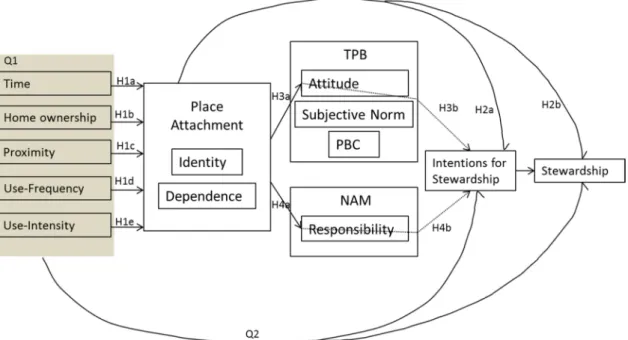
Hypothesis 1: Length of time at current residence (a), home ownership (b), proximity to the park (c), frequency of use (d), and use-intensity (e) predict place
attachment to the most-often used park.
If PA is linked to stewardship, it would be useful to know how we can encourage PA. The predictors investigated in this study are a starting point. To be able to direct such efforts efficiently it is useful to know which predictors are stronger and which are weaker.
Question 1: How do predictors of place attachment differ in strength relative to each other?
1.3 Place attachment and Stewardship
9 Therefore, ambiguities in this field may not only be attributed to diverse measurement
methods for place attachment and places for which attachment is measured, but also to the complexity of study-contexts that may involve pro- and anti-environmental aspects at different levels of analysis.
There is limited research on the relationship of PA to urban green areas and stewardship of these places. Ryan (2005) conducted a study on urban green areas in
Michigan. Based on the idea that negative changes sensitize PA, he used exploratory factor analysis on items describing possible actions in response to a negative change to participants' nearby parks. Three factors emerged: personal loss, environmental activism and seeking another park. Environmental activism comprised involvement with a local environmental group, visiting public meetings to express opposition, and engaging with preserving the rest of the park. These results are an indication that attachment to a nearby urban park is related to increased dispositions for stewardship in that park but they are not strong evidence. Hunter (2011) investigated stewardship behaviour for the maintenance of local street trees. She found that an increased level of emotional sensitivity towards local places was related to higher stewardship dispositions. Krasny, Crestol, Tidball, and Stedman (2014) studied the
motivations, memories and sense of place of volunteer oyster gardeners in New York City. They found that specific social-ecological experiences with the estuary were deeply connected with their attachment to the place and their motivations to volunteer there. Finally, Budruk, Thomas, & Tyrell (2009) investigated place attachment to recreational green areas in the city of Pune, India. Using the New Environmental Paradigm, the authors extracted three factors (Balance of Nature, Anthropocentrism, and Ecological Limits). Although these factors do not include stewardship in particular, high attachment was strongly related to an increased
sensitivity for the fine balance of nature and decreased anthropocentrism.
Some more evidence exists in the context of natural areas in general and national parks (also see Table 1). Lokocz, Ryan, and Sadler (2011) for instance investigated place
attachment to a specific rural landscape in Massachusetts and support for conservation of the area. Mean conservation scores (attitudes towards land protection of that area, level of support of landscape planning and conservation strategies, financial support for conservation
10 negative change to the lake. Place identity had an independent, positive effect on taking action. An often cited study, to illustrate the ambiguous effect of place attachment was
conducted by Uzzell, Pol, and Badenas (2002). They looked at social identification with place and attitudes and behaviours with respect to (local) environmental sustainability in two neighbourhoods in the UK. Social identity with place was a combined measure taken from data on place identification, place satisfaction, and social cohesion. The two neighbourhoods differed significantly in their place identity and place satisfaction but not in their social cohesion and sustainability. The authors could show that in the neighbourhood with low place identification and satisfaction, the relationship between place-related social identity and environmental sustainability was strong, while in the neighbourhood with high place identification and satisfaction this relationship was weak and in a negative direction. In this context it is interesting to have a look at Stedman's (2002) findings again. He investigated place identity and satisfaction separately and found that both exert independent and, importantly, opposing effects on place-protective action. In Uzzell et al.'s study these concepts were merged together so that their effects on interest in sustainability cannot be distinguished. Halpenny (2010) surveyed visitors to a Point Pelee National Park, Canada. She measured their attachment to the park and their intentions for pro-environmental behaviour for that specific site. Place-specific environmental behaviour included items describing a variety of behaviours (e.g. picking up litter, signing protective petitions, volunteer to stay away from favourite spots to allow recovery from damage, attending public meetings about park management, or joining a project to protect the park). Halpenny could demonstrate that place attachment predicted intentions for place-specific behaviour and that the effects of place dependence were mediated via place identity. The author explains this effect by drawing on the theory of reasoned action (Fishbein & Ajzen, 1975). In short, this theory proposes that attitudes about a particular behaviour predict intentions for that behaviour. These intentions are important predictors for the performance of that behaviour. Halpenny argues that a pro-environmental behaviour directed towards a place will be influenced by the experience with that place and the resulting attachment to it. Unfortunately, her findings are not a direct evidence for the effect of place attachment on attitudes but on intentions. Since intentions can be influenced by several factors (Staats, 2003), her findings are not useful for a better
understanding of the underlying processes of the relationship between attachment and
11 Hypothesis 2: Place attachment to a specific park positively predicts with a) intentions
for stewardship and b) actual stewardship activity in that park.
Question 2: Do the predictors of place attachment to the park also predict stewardship intentions and stewardship behaviour?
1.4 The Theory of Planned Behaviour and the Norm Activation Model
To understand the underlying processes of the relationship between place attachment and stewardship, it is helpful to consult theories that explain what factors influence behaviour. The theory of reasoned action and the theory of planned behaviour (TPB) (Fishbein & Ajzen, 1975; Ajzen & Fishbein, 1980) offer an approach. The three central premises of these theories are that behaviour is reasoned, that it is volitional and that the theory is sufficient to explain the behaviour. The theories are based on four key concepts. First, an attitude towards a particular behaviour. Second, a subjective norm that involves the perception that others want the individual to perform this behaviour. Third, a behavioural intention that consists of a purposeful plan to carry out this behaviour, and fourth, the performance of the behaviour itself. Finally, the TPB contains an additional concept, perceived behavioural control. The three predictors for behavioural intention, attitudes, subjective norm and perceived control are each influenced by a set of beliefs. For example, beliefs about the target behaviour will
influence the attitude towards it. According to Staats (2003), TPB is relatively successful in predicting a specific behaviour as long as the premises are met and we find correspondence in target, context, and time across the individual elements of the model. Nevertheless, he
recommends including personal norms as additional element to predict pro-environmental behaviour. Personal norms are self-expectations rooted in internalized values (Schwartz, 1977) and may give rise to moral and fairness concerns that are important additional predictors for behaviour (Staats, 2003). Personal norms are at the center of the Norm
12 pro-environmental behavior including all four factors or activators yielded the highest
explanatory power and that personal norms mediate their effect on pro-environmental behaviour. TPB and NAM have been integrated in models to explain behavioural intentions with regard to pro-environmental consumer and transport behaviour (Onwezen, Antonides, and Bartel, 2013) and with regard to public transport use (Bamberg, Hunecke, & Blöbaum, 2007). This research shows that combining the two models increases the explanatory power of the model.
In the next step of the analysis, we will add place attachment to these concepts. Here we have to take great caution. Next to TPB and personal norms, identity has also been brought forward as a factor that influences behaviour (Staats, 2003; Stedman, 2002).
Identification with performing a particular behaviour may not be confused with other identity concepts, such as place identity. Moreover, PA is a bond to a place but is not directly related to a behaviour even if it is performed within that place. So when predicting a particular behaviour such as stewardship place attachment would have little chance when competing with the TPB and NAM variables that are specific for the behaviour in question. Anton and Lawrence (2016) for example used TPB and place attachment to investigate disposition to protest against local governmental changes. For TPB, they used three variables (attitude, subjective norms and perceived behavioural control towards "protesting") and for attachment with the local city they used two variables (identity and dependence) to measure effects on protesting. The authors could show that all five variables had a significant, positive
correlation with protesting. In a regression model, however, the PA variables became non-significant. A reason could have been that the TPB variables were intimately related to a specific behaviour, protesting, which also was the outcome variable, while the attachment variables were only related to the city where the protesting would happen. So these five variables were not competing on the same level of specificity. Thus, PA should not be added directly in the regression model. Alternatively, we can treat PA as a background variable. Fishbein and Ajzen (1977;1980) emphasise the importance of such background variables and their role in influencing beliefs. According to TPB, attitudes towards a particular behaviour are caused by beliefs about the result of that behaviour and weighted by an evaluation of this result (Staats, 2003). So an attitude towards a behaviour that will affect a park in this case, is likely to be affected by the emotional bond one has with that park.
13 mediates the effect of place attachment on the intention for stewardship (b).
In a similar fashion, place attachment to a particular place may influence feelings of
responsibility toward performing a behaviour directed to that place. Place attachment involves an emotional bond but also identification with a particular place and it can be a source of self-esteem and well-being (Lewicka, 2011a). Behaviours that are related to protecting that place may be positively influenced. Lewicka (2011b) showed that attached people versus non-attached people scored higher on concepts such as life satisfaction, sense of coherence, interest in their families, trust in others, less egocentrism. Although she did not test for responsibility, it fits in as a similar concept. Awareness of the problem may be also affected. Research has shown that place attachment to urban parks increases monitoring of the park (Enqvist et al., 2014). In sum, we can expect that personal norms are influenced by PA.
Hypothesis 4: Place attachment to the park has a positive effect on personal norms to stewardship the park (a). Personal norms with regard to taking care of that park mediate the effect of place attachment on the intention for stewardship (b).
Figure 1 shows a schematic of the concepts used and hypotheses developed for this study. Note that the diagram evokes the idea of causal relationships. Although research
reviewed here gives reason to assume causality, the methodology of the current study does not allow testing for it.
14 2. Method:
2.1 Data Collection & Participants
The sample population for this study where residents of the city of Leiden. An online survey with 82 items was created with the Qualtrics Survey Software of Leiden University (Qualtrics, 2015). The link to this survey with a short description of the study was distributed via social media, private contacts and networks of local, “green” organizations. The survey was online for nine weeks form the beginning of April until mid-June. At the beginning of the questionnaire participants were briefly informed about the purpose of the study, the voluntary, anonymous, and confidential nature of the survey. Participants had the chance to win one of 10 boat tours for two persons around the canals of Leiden. Subjects gave their consent by checking the respective consent-box. At the end of the questionnaire participants were thanked and shortly debriefed. By emailing the experimenter they could subscribe to the lottery. 10 participants were randomly selected and received two tickets for a boat tour.
2.2 Study Context
In the city of Leiden, in the Netherlands, a large-scale urban park project has been launched (Vrienden van het Singelpark, 2017). Around the city center runs a quadrangular canal, the Singel, which once was surrounded by green areas. Currently, we only find a few individual parks along the canal. The project consists of “greening” the inner canal bank, building a linear park that encircles the city center. The project aims at improving the quality of the city in terms of sustainability and attraction, providing breathing space for its citizens and allowing the citizens to be part of the planning phase as well as encouraging them to take responsibility in the care of the park. (Veneestra et al., 2012) There is already a number of citizens actively involved in gardening projects around Leiden (e.g. Het Zoete Land, Stichting Leiden Oogst, 2016) and specifically the Singel (Vrienden van het Singelpark, 2017). A citizen initiative, "Friends of the Singelpark" is largely involved in bringing the project ahead and activating and organizing citizens here (Vrienden van het Singelpark, 2017).
2.3. Measures
2.3.1 Demographic Information
15 of education, employment, whether their household included children under the age of 15, whether they owned a dog, and whether they lived in Leiden.
2.3.2. Park user information
Participants were asked what their most frequently-visited park in Leiden is. They chose from a list of 22 parks in Leiden plus the option of “the park is not on the list” where they could then add their park. Frequency was measured with the question how often they visit the park (daily; weekly; fortnightly; monthly, or less). Proximity was measured with the question how long they take to get to the park on average (0-5 min; 5-10; 10-15 min; 15-20 min; 20 min or more). Use-intensity was measured with the item how much time per visit they spend in the park on average (15 min; 30 min; 45 min; 60 min; more than 60 min).
2.3.3. Place Attachment
Place attachment was measured with a modified scale developed by Williams and Vaske (2003). Originally, this scale was developed in the context of attachment to national parks and it has been used by various authors for similar purposes. It is a popular and often used tool (Lewicka, 2011). It consists of two dimensions, place identity and place
dependence. Both dimensions are measured with six items each. For identity examples include "I feel this park is a part of me" and "This park is very special to me". For
dependence examples include "This park is the best park for what I like to do" and "I get more satisfaction out of visiting this park than any other park". "This park" refers to the participant's most frequently visited park. The scale is originally in English and was carefully translated into Dutch. In a pilot study these twelve items were given to six native speakers who should indicate whether the items were clear and made sense and whether they sounded “serious”. On the basis of these answers the original scales were shortened to nine items and some items were slightly rephrased to suit the Dutch context (see section 3. Results).
2.3.4 Stewardship
16 flowerbeds, and taking care of herbal gardens. Picking up litter is important to maintain parks clean and nice and therefore more attractive to use. Clean environments are less inviting of breaking the norm “not to litter” (Keizer, Lindenberg, & Steg, 2008). Flowers add aesthetic value to the park and make it appear well-maintained and cared for. Herbal gardens are opportunities to learn about practical uses of plants (medical and culinary uses for example). Therefore, they add practical value to the plants of the park. All three activities have to be performed during the entire year. These three activities were condensed into two broader classes of behaviour to keep the length of the survey reasonable. “Maintaining the park” included picking up litter and maintaining flower beds. “Maintaining a herbal or vegetable garden” included behaviours that are similar to maintaining flowerbeds (e.g. planting new plants, watering, weeding, removing dead plant matter). However, the reasons why someone may do one or the other thing may have different motivations (aesthetic vs. practical use). Especially with regard to a growing interest in urban farming (McMillan, 2016; Schlosberg, 2011) it was considered useful to clearly distinguish between these activities. Each activity was briefly described in terms of its role for maintaining the park, the specific behaviours it involves, and the frequency and intensity of the volunteering effort required. For keeping the park nice the description was as follows:
Nice and well-maintained parks are environments where people feel
comfortable. The city council of Leiden does not always have the resources for
intensive maintenance in all parks. In some parks there are volunteer groups
that meet weekly for some 2.5 hours to help maintaining the park. For
example, the maintenance of flowerbeds involves planting bulbs, water
flowerbeds, and remove weeds and dead plants. Picking up litter is also an
important activity that such volunteer groups perform regularly. Volunteers
decided for themselves at which activities they want to participate and how
often they want to do this. Please answer the following questions with regard
to the park you have just described, not another place (even if you are
involved in a similar activity in a different park or place!).
2.3.4.1. Stewardship behaviour.
17 would join such a group if there was one (1=strongly disagree; 5= strongly agree) and how often they would then help out (never, less than once a month, once a month, once every two weeks, or once per week) to measure their intentions. As a control they were also asked whether they thought it was likely that such a group was organized in their park (1=strongly disagree; 5= strongly agree).
2.3.4.2 Planned Behaviour variables.
For each of the two behaviours a set of items were selected and adapted from Staats (2003), Onwezen et al., (2013), and Bamberg et al. (2009). For behavioural beliefs in
particular, items were selected and adapted from a list of 16 items identified and validated as key motivations for environmental stewardship covering the concepts social belonging, environmental care, and learning (Bramston, Pretty, & Zummit, 2011). Some additional items were included on the basis of interviews with people involved in stewardship activities within the Singelpark project.
Attitude was measured with two items for each behaviour: “Participating at these
18 2.3.4.3 Personal Norms
Personal norms for each of the two behaviours were measured with three items on a 5-point Likert scale with 1= strongly disagree and 5= strongly agree. Examples include “I feel a moral obligation to help taking care of a herb- or vegetable garden in the park.”; “I feel that I should help to protect the herb- or vegetable garden in the park.”; or “I feel it is important that people in general should help to maintain a herb- or vegetable garden in a park”.
For a complete list of all questions see Appendix B.
3. Results
3.1. Demographic Information
When not specified differently, data was analyzed with the statistical software package IBM SPSS statistics 23 (IBM Corporation, 2015).104 participants completed at least the first section of the questionnaire (14 items). 74 participants finalized the survey. The average age of these 74 participants was 44.89 years (SD= 13.55) (the average age of the Leiden
population is 38.3 year; UrbiStaat, 2015). 64.9% were female, 33.8% were male and 1.4% identified as “other” (the average Leiden population has 51.4% females; UrbiStaat, 2015). On average participants have been living in the same home for the last 10.8 years (SD= 10.13). 69.3% were homeowners (46% of the Leiden population own their home; Gemeente Leiden, 2017 ). 29.7% had children younger than 15 years of age and 11.0% had a dog. In terms of education, 54.1% of participants indicated that WO was their highest diploma in education. For 16.2% it was HB. VWO, MBO and other (Master, education abroad, MAVO, Leao, and ULO) each covered 8.1% of the participants. VMBO and HAVO each covered 2.7% (in 2015 23% of the Leiden population had a low education level, 33% had a medium education level and 44% had a high education level; Gemeente Leiden, 2017). With regard to employment, 33.3% had a full-time job, 37.3% had a part-time job, 4.0% were looking for a job, 4.0% were retired, 6.7% were students, 6.7% were a housewife/-man and 8.0% had no job but worked as volunteers (M=26.67 h; SD= 13.29) (in 2015 6.8% of the Leiden population were registered as unemployed, 34.8% were students; Gemeente Leiden, 2017).
19 Figure 2. Distribution in % of participants’ “most frequently visited park” in Leiden. N= 104.
Most people either get to their park by walking (53.8%) or cycling (40.4). Only 4.8% takes the car and 1% takes the bus. Participants’ responses with respect to the proximity to this park, the frequency of use and the intensity of use are shown in Figure 3.
Figure 3. Frequencies for the levels of three park-specific place attachment predictors. N= 104
0,0 5,0 10,0 15,0 20,0 25,0 P ar ti ci p an ts vi si ti n g th is p ar k m os t of te n ( % ) Leiden Parks 0 5 10 15 20 25 30 35 40 45
F
re
q
u
en
cy
Proximity Use- Use-Intensity
20 91.9% of participants lived in Leiden. Six people did not but an examination of these cases uncovered that four of them lived 15 minutes or less walking/cycling distance from their park in Leiden. Four of six used the park quite intensively (45 minutes or more per visit). The use-frequency was low with four people using their park once per month or less. The six cases were retained in the sample because the N was rather small already and the relevant variables that could have been affected by not living in Leiden (proximity, frequency, and use-intensity) seemed largely unaffected.
3. 2 Place Attachment and its predictors (H1 & Q1)
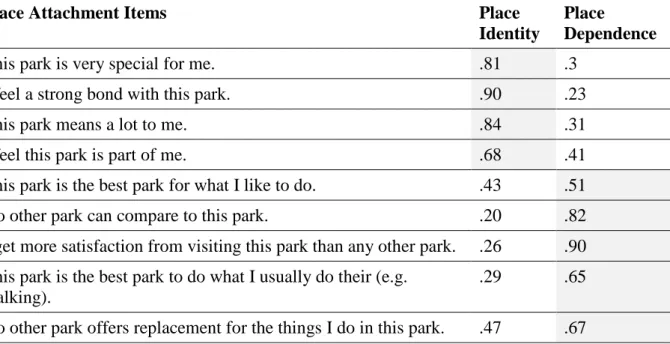
21 Table 1. Factor loadings with orthogonal varimax rotation on the two dimensions of place attachment, identity and dependence. “This park” refers to the park participants indicated as their most frequently used park.
Place Attachment Items Place
Identity
Place
Dependence
This park is very special for me. .81 .3
I feel a strong bond with this park. .90 .23
This park means a lot to me. .84 .31
I feel this park is part of me. .68 .41
This park is the best park for what I like to do. .43 .51
No other park can compare to this park. .20 .82
I get more satisfaction from visiting this park than any other park. .26 .90 This park is the best park to do what I usually do their (e.g.
walking).
.29 .65
No other park offers replacement for the things I do in this park. .47 .67
Note. The determinant of this analysis was .001 > .00001 (Field, 2013). Communalities
were .48 or higher which is acceptable for two factors and N= 104. Bartlett’s test of sphericity was significant (approximate χ2(36)= 696.75, p< .001) confirming an adequate sampling size. All inter-item correlations were between .3 and .9. indicating a good factor structure.
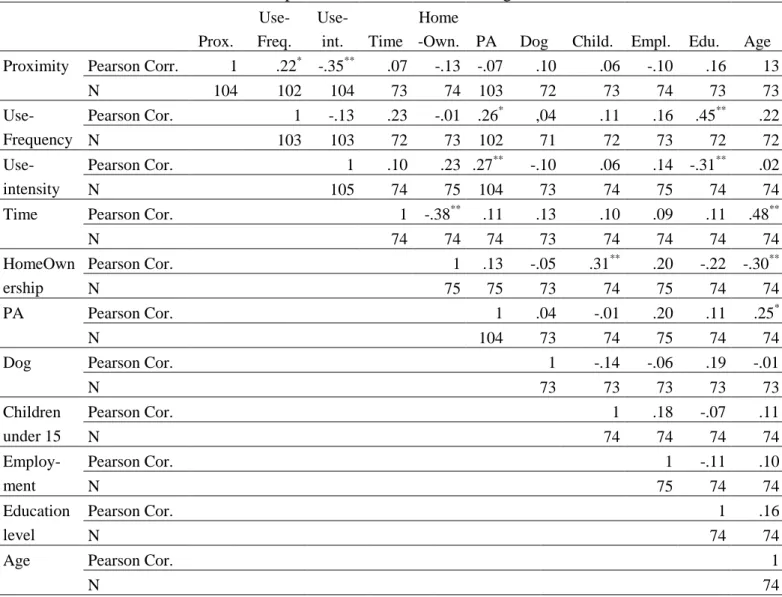
Tabel 2 presents the intercorrelations between place attachment and the five predictors for PA. In Appendix C you find an extended table of intercorrelations that includes
22 Table 2. Intercorrelations of place attachment predictors, PA, stewardship intentions and stewardship behaviour.
Prox.
Use-Frq
Use-Intens. Time
Home-Own.
PA St.
Intent.
St. Behav. Proximity Pearson Cor. 1 .22*
-.35** .07 -.13 -.07 -.04 .04
N 104 102 104 73 74 103 65 36
Use-Frequency
Pearson Cor. 1 -.13 .23 -.01 .26** .34** .58**
N 103 103 72 73 102 64 36
Use-intensity
Pearson Cor. 1 .10 .23 .27** -.05 .67**
N 105 74 75 104 66 36
Time Pearson Cor. 1 -.38** .11 -.19 .30
N 74 74 74 53 34
HomeOwn ership
Pearson Cor. 1 .13 .23 .20
N 75 75 54 34
Place Attachment
Pearson Cor. .19 1 .19 .31
N 104 66 36
Stewardship Intentions
Pearson Cor. .19 1 -.26
N 66 66 15
Stewardship Behaviour
Pearson Cor. 1
N 36
Note. *. Correlation is significant at the 0.05 level. **. Correlation is significant at the 0.01 level. Stewardship intentions and behaviour are correlated here but data stems from different
participants. The Ns for stewardship intention and behaviour differ because they represent two different groups of participants.
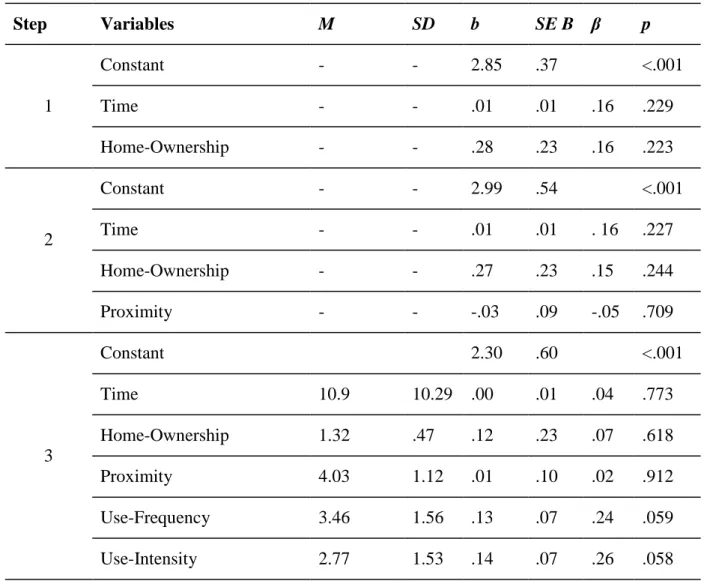
23 significant change to the data so it was retained in the data set. The first two steps resulted in models that were not statistically significant (Tabel 3). It worth noting that proximity has a negative regression weight but adding this predictor hardly changes the βs of the first two predictors. Introducing use-frequency and use-intensity in the final step resulted in a model that caused a significant change relative to the previous step (∆F(2,65)= 3.32, p= .042).
Although still not reaching significance the p-value became fairly low (Table 3). Use-frequency and use-intensity resulted as marginally significant predictors for PA.
Table 3. Means and standard deviation and linear model of predictors for place attachment to urban parks.
Step Variables M SD b SE B β p
1
Constant - - 2.85 .37 <.001
Time - - .01 .01 .16 .229
Home-Ownership - - .28 .23 .16 .223
2
Constant - - 2.99 .54 <.001
Time - - .01 .01 . 16 .227
Home-Ownership - - .27 .23 .15 .244
Proximity - - -.03 .09 -.05 .709
3
Constant 2.30 .60 <.001
Time 10.9 10.29 .00 .01 .04 .773
Home-Ownership 1.32 .47 .12 .23 .07 .618
Proximity 4.03 1.12 .01 .10 .02 .912
Use-Frequency 3.46 1.56 .13 .07 .24 .059
Use-Intensity 2.77 1.53 .14 .07 .26 .058
Note. N=71. Model 1: F(2,68)= 1.08, p= .345, R2= .03, Model 2: F(3,67)= .76, p= .522,
R2= .03, ∆F(1,67)= .14, p= .709, Model 3: F(5,65)= 1.81, p= .123, R2= .12, ∆F(2,65)= 3.32,
24 With regard to the first set of hypotheses (H1a-H1e), strictly all five hypotheses have to be rejected. Still the results provide good support for H1d and H1e (frequency and
use-intensity predict PA). To answer Question 1 (How do the predictors differ in strength relative
to each other?) we can inspect the standardized regression weights for these predictors (Table
2). We can observe that home ownership, time and proximity have relatively small weights (≤ .07). Use-frequency and use-intensity on the other hand, have larger and similar
standardized regression weights (around .25). Looking at the intercorrelations between predictors demonstrates that proximity significantly correlates with use-frequency in a positive direction and with use-intensity in a negative direction (Table 2). This may be a reason why proximity fails to predict PA, it has to compete with two other predictors in opposing ways.
3.3 Place Attachment & Stewardship (H2 & Q2 )
To test hypothesis 2a&b, a single intention measure was calculated first. Intention was measured with two items for each of the two behaviours. For each behaviour, these items were added and divided by two providing a single score for intention for each behaviour. These two new variables correlated highly (r=.52, p= .001, N= 38) and were thus combined to a single measure by adding up scores and dividing the sum by two resulting in a 4-item scale for intention that was reliable (Cronbach’s α= .78). For some of the data only one value was available (instead of two). To avoid data loss due to missing cases in the process of combining these two variables, in those cases the available value was taken as the score for intention for that participant. The data for this variable was not normally distributed, bias accelerated bootstrapping was performed to control for this. The median for Intention was 2.37 (IQR= 1.56) on a scale from 1 (=low) to 5 (5= high) (M= 2.40, SD= 1.08). Therefore, we can conclude that participants’ intentions to stewardship their park were rather moderate.
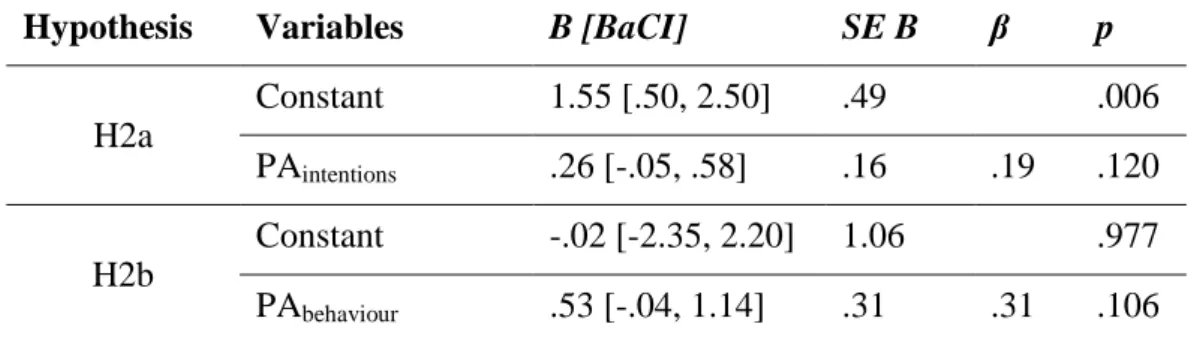
25 (Table 4)
Stewardship behaviour itself was only measured with one item per behaviour-type these two variables were correlated directly resulting in a high correlation (r= .79, p< .001,
N= 19) which justified combining the two scores to a single behavioural measure which was
highly reliable (Cronbach’s α= .88). Again, missing cases were treated as zeros. The data for stewardship behaviour was not normally distributed either. Case 58 was an outlier on leverage and Mahalanobis distance, but exclusion did not change results so the case was retained. The median for actual stewardship behaviour was 1 (IQR= 1) on a scale from 1 (=never) to 5 (5= very regularly) (M= 1.92, SD= 1.4). This indicates that on average participants join voluntary maintenance sessions in their park very seldom only. To test whether place attachment to the park predicted actual efforts to steward this park (H2b) a linear regression analysis with PA as predictor and actual stewardship as outcome resulted in a marginally significant model
(F(1,34)= 3.61, p= .066, adjusted R2= .07) explaining a variance of 9.6%. Again, strictly speaking we have to reject H2b, especially because the bootstrapped confidence intervals include zero. Nonetheless, considering the p-value and an N of 36 is rather small to detect this kind of effect we find support for the hypothesis that higher levels of PA predict stewardship behaviour on more regular basis (Table 4).
Table 4. Linear model for PA predicting stewardship intentions (H2a) and stewardship behaviour (H2b), with 95% bias corrected and accelerated confidence intervals. P-values, confidence intervals and standard errors are based on 1000 bootstrapped samples.
Hypothesis Variables B [BaCI] SE B β p
H2a
Constant 1.55 [.50, 2.50] .49 .006
PAintentions .26 [-.05, .58] .16 .19 .120
H2b
Constant -.02 [-2.35, 2.20] 1.06 .977
PAbehaviour .53 [-.04, 1.14] .31 .31 .106
Note. NH2a= 66, NH2b= 36. MPA= 3.30, SDPA= .83. MIntentions= 2.40, SDIntentions= 1.08. MBehaviour= 1.92, SDBehaviour= 1.4. Variables were measured on a Likert-scale from 1(=low) to 5(= high).
Home-26 ownership and time do not appear to have a special predictive power for place attachment. The intercorrelations for these variables are presented in Table 2.
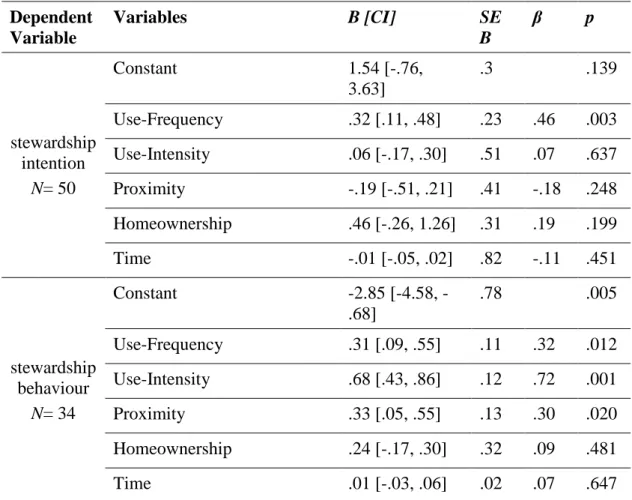
For intention all assumptions were met apart from normality. Therefore, bias corrected bootstrapping was performed on confidence intervals, standard errors and significance tests. Case 34 was identified as outlier on leverage and on Mahalanobis distance but excluding it from the analysis did not result in significantly different results so it was retained in the analysis. The overall prediction of the model was good (F(5, 44)= 2.79, p= .028) explaining 24.1% of the variance (adjusted R2= .15). Only use-frequency emerged as a significant positive predictor for stewardship intentions (Table 5).
Table 5. Linear model for PA predictors and intention (DV1) and real behaviour (DV2), with 95% bias corrected and accelerated confidence intervals. Confidence intervals and standard errors are based on 1000 bootstrapped samples.
Dependent Variable
Variables B [CI] SE
B
β p
stewardship intention
N= 50
Constant 1.54 [-.76,
3.63]
.3 .139
Use-Frequency .32 [.11, .48] .23 .46 .003
Use-Intensity .06 [-.17, .30] .51 .07 .637
Proximity -.19 [-.51, .21] .41 -.18 .248
Homeownership .46 [-.26, 1.26] .31 .19 .199
Time -.01 [-.05, .02] .82 -.11 .451
stewardship behaviour
N= 34
Constant 2.85 [4.58,
-.68]
.78 .005
Use-Frequency .31 [.09, .55] .11 .32 .012
Use-Intensity .68 [.43, .86] .12 .72 .001
Proximity .33 [.05, .55] .13 .30 .020
Homeownership .24 [-.17, .30] .32 .09 .481
Time .01 [-.03, .06] .02 .07 .647
27 For actual stewardship behaviour the same analysis was performed except for the outcome which was of course real behaviour in this case. All assumptions were met apart from normality. Furthermore, over 50% of the cases had leverage values above the acceptable criterion (Hoaglin & Welsh’s criterion, 1978: > 2(k + 1)/n)). Hence the analysis was
bootstrapped with an accelerated bias correction to control for this suboptimal condition. The overall prediction of the model was very good (F(5,28)= 15.69, p< .001 ) explaining a
variance of 73.7% (adjusted R2= .69). All three park-specific predictors made significant contributions to the model (Table 5). Interestingly, the intercorrelations (Table 2) show that behaviour does not correlate with proximity, still this predictor emerged as significant. To answer Q2 we can summarize that someone’s intentions to take care of a park can be
predicted by how frequently an individual visits the park: the more frequent the visits are, the stronger his*her intentions become. Real stewardship behaviour can be predicted by how often an individual visits the park, how much time he*she usually spends in the park per visit and how long it takes that individual to get to the park. The larger the scores on these
predictors the higher the probability that someone will actually be involved in a stewardship activity as described above.
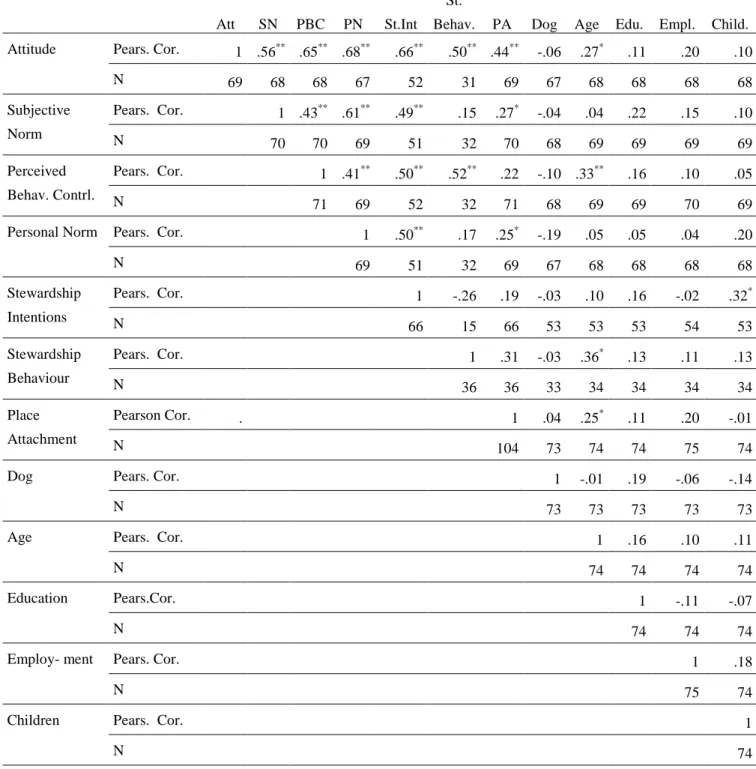
3.4 Place Attachment & the Theory of Planned Behaviour (H3 & H4 )
28 Table 6. Intercorrelations of TPB & NAM variables, stewardship intentions, and stewardship behaviour.
Atti. SN PBC PN PA St.Int. St.Beh.
Attitude Pearson Cor. 1 .56** .65** .68** .44** .68** .50**
N 69 68 68 67 69 52 31
Subjective Norm
Pearson Cor. 1 .43** .61** .28* .53** .15
N 70 70 69 70 51 32
Perceived Behavioural Control
Pearson Cor. 1 .41** .22 .47** .52**
N 71 69 71 52 32
Personal Norm
Pearson Cor. 1 .25* .45** .17
N 69 69 51 32
PA Pearson Cor. 1 .19 .31
N 104 66 36
Stewardship Intentions
Pearson Cor. 1 -.26
N 66 15
Stewardship Behaviour
Pearson Cor. 1
N 36
Note. **. Correlation is significant at the 0.01 level.
To test whether “Attitude” and “Personal Norm” are the elements within the extended planned behaviour model that are affected by place attachment (H3a and H4a), two linear regression analyses were conducted. One with PA as predictor and “Attitude” as outcome and a second one with PA as predictor and “Personal Norm” as outcome. For Attitude as outcome the model was highly significant (F(1,67)= 16.23, p<.001, R2= .20, adjusted R2= .18). For Personal Norm the model was significant as well (F(1,67)= 4.47, p=.038, R2= .06, adjusted
R2= .05). The details of both models are displayed in table 7. Higher levels of PA predict both, a stronger Attitude and Personal Norm with regard to taking care of one’s park. Therefore we can accept H3a. Although the significance level of PA predicting personal norms are only marginal, we still find support for H4a. Both hypotheses can be accepted.
29 Table 7. Linear models of PA predicting Attitude and Personal Norm, with a 95%
bias corrected and accelerated confidence interval reported in brackets. Confidence intervals, SEs and p-values are based on 1000 bootstrapped samples.
Hypothesis Variable B SE B β p
H3a
Constant 1.91 [1.18; 2.55] .38 .001
PAAttitude .44 [.19; .70] .12 .44 .002
H4a
Constant 2.23 [.79; 3.15] .37 <.001
PAPersonalNorm .20 [-.02; .44] .12 .25 .075
Note. NAttitude= 69; NPerNorm= 69. MPA= , SDPA= , MAtti= 3.15, SDAtti= .75, MPN= 2.78,
SDPN= .66. Variables were measured on a Likert-scale from 1(=low) to 5(= high).
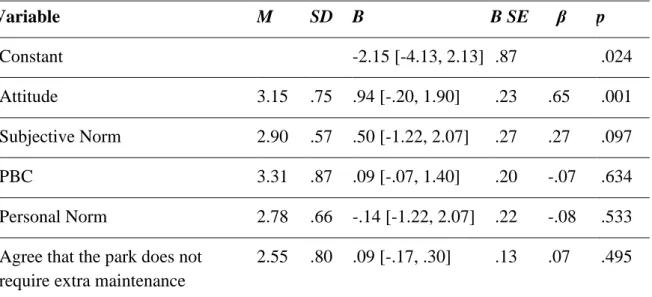
Furthermore, it was tested whether Attitude and Personal Norm predict stewardship intentions (H3b and H4b). Thus, a hierarchical MLR analysis was conducted with TPB variables as predictors introduced first to the model and the NAM variable (Personal Norm) introduced in a second step and stewardship intention as dependent variable. All assumptions apart from normality were met. Therefore, bootstrapping was performed to control for non-normality. The results are presented in table 8. Only attitude significantly predicts intentions. Introducing Personal Norm to the model did not change the model nor the standardized regression weights of the TPB predictors. Moreover, it has a very high p-value and a low and even negative β. Examining the correlation matrix shows that attitude and personal norm are highly correlated with stewardship intentions as well as with each other (Table 6). Thus, they may be competing for an impact on the outcome. Attitude has a stronger correlation with intentions, thereby possibly “winning” the competition which may also explain the negative regression weights of personal norm (Table 8). We should also consider that PA predicted attitude more strongly and more reliably than it predicted personal norms (Table 7). This justifies to further focus on attitude only and investigate whether it is a potential mediator in the relationship between PA and stewardship intentions. Also, we should reject H4b (personal
30 Table 8. Means and standard deviation and linear model of TPB & NAM variables as predictors and stewardship intentions as outcome variable, with 95% BCa confidence intervals, standard errors and significance values (based on 1000 bootstrapped samples).
Step Variable M SD B B SE β p
1 Constant -- -- -1.83 [.79, 3.15] .76 .015
Attitude -- -- -1.87 [.47; 1.26] .70 .60 .002 Subjective Norm -- -- .44 [-.00, .99] .24 .24 .070
PBC -- -- .08 [-.32, .40] .17 .06 .655
2 Constant -1.83 [-3.29, -.78] .76 .022
Attitude 3.15 .75 .94 [.49, 1.52] .22 .65 .004 Subjective Norm 2.90 .57 .51 [0.7, 1.17] .28 .27 .071
PBC 3.31 .87 .07 [-.38, .43] .18 .06 .716
Personal Norm 2.78 .66 -.15 [-.49, .10] .21 -.10 .473 Note. N= 51. Step 1: F(3, 47)= 22.38, p <.001), R2
= .59 (adjusted R2= .56). Step 2: F(4, 46)= 16.72, p <.001), R2= .59 (adjusted R2= .56), ∆F(1, 46)= .49, p= .493. MIntentions= 2.40, SDIntentions= 1.08. Variables were measured on a Likert-scale from 1(=low) to 5(= high).
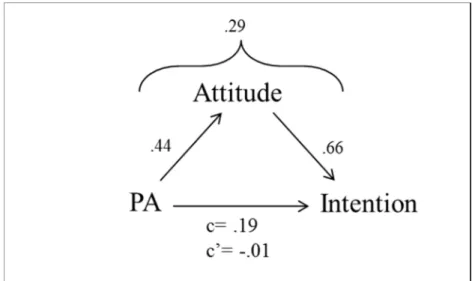
31 stewardship intentions disappears completely indicating full mediation.
Figure 4. Basic mediation model.
32 3.5 Controls and exploratory analysis
19.3% of participant indicated that they do other stewardship activities in the park such as education, organizing park- and nature-related events, biodiversity research and taking care of bee hives. 12.8% indicated that they did similar stewardship activities but in a different park.
To control whether people’s stewardship intentions were affected by the feeling that their park did not require extra maintenance a MLR analysis was conducted with the four TPB & NAM variables and an item targeting this aspect (Appendix F).
The idea of the TPB and NAM models is to explain behaviour focusing on one of the most important predictors for behaviour which is intention. Ideally, we would also analyze the effect of stewardship intentions on stewardship behaviour. This was not possible for
methodological reasons. Either people were already engaged in stewardship (asking for their intentions would have been redundant) or people were currently not engaged in stewardship but we had no opportunity to measure their behaviour after this survey. Instead a multiple regression analysis with the TPB and NAM variables as predictors and stewardship behaviour as outcome to see whether the variables are related to real behaviour in a similar way as they are with intention. None of the predictors were significant. Attitude and subjective norm had the lowest p-values, producing a similar pattern as with stewardship intention (Appendix G).
To control whether any of the demographic variables had an effect a MLR analysis was run with a hierarchical procedure (Step 1: TPB and NAM variables; Step 2: age, gender, current employment situation, education and having children younger than 15 years). Only having children reached a marginal significance (Appendix H).
33 4. Discussion
The aim of this study was fourfold. First, investigate whether place attachment to an urban park is related to voluntary stewardship of this park. Second, test what factors predict place attachment to urban parks and investigate whether they also predict stewardship. Third, compare the strength of PA predictors with each other. Finally, examine the underlying processes of the relationship between PA and stewardship.
First of all, the average place attachment score was moderate and comparable to previous research on PA to national parks (Hallpenny, 2010; Williams & Vaske, 2003; Stedman, 2002). Given that national parks often involve beautiful scenery, special flora and fauna and other distinctive characteristics their potential for symbolic value and thus place attachment is larger than a small park in the neighbourhood. Hence it is remarkable that we found comparable PA levels. It suggests that people connect psychologically to relatively simple green areas and may even identify with these places to a certain extent. This finding is especially surprising because in the process of developing this study doubts were raised whether place attachment to a park in the neighbourhood would be an effect that could be captured at all. For instance one participant in the pilot said “people have a favourite park because it’s close by, or has lots of flat spaces, or space for kids to play […]. I don’t think people from Leiden feel that strongly connected to a park.” Essentially, this participant said that place dependence is more relevant than place identity. According to Stedman (2002) being dependent on something is an important factor to cause a pscyhological attachment. Even more interesting in this regard is the finding that here on average participants had a higher place identity with their park than a place dependence (t(103)= 8.12, p< .001).
With regard to the predictors for place attachment it was predicted that the time participants had been living at their current home, home ownership, the proximity to the park, the frequency with which they visited this park, and the intensity of use would all be
34 user’s needs well, the user will have more reasons to visit the park on a regular basis than when the parks does not really meet the user’s goals. Ramkissoon, Smith & Weiler (2013) summarise that a high satisfaction of users’ goals and needs leads to an increased place dependence – a component of PA. At the same time, frequent visits to the park provide more opportunities to form cognitive and affective bonds to that place, forming the basis of place identity (Ramkissoon et al., 2013). Similarly, frequent visits help maintain a certain level of salience of that place which makes it more likely to be incorporated into self-identity aspects.
Proximity failed to predict place attachment. There are three possible explanations to this. First, proximity correlated positively with frequency and negatively with use-intensity. Therefore its predictive influence on PA may have been neutralized. Second, proximity was measured by participants’ estimate of the time it usually takes them to get to the park. Since most participants either walked or cycled to the park this should be a good estimate. However, it would have been more objective and accurate to measure spatial
distance from the home for example to the park as others have done (Moore & Graefe, 1994). Third, as mentioned, park density in Leiden is high. Thus, close proximity to a certain park does not distinguish it from other, alternative parks.
Time living at the current home and owning this home did not prove as useful predictors for place attachment. Looking at significance levels (Appendix B) does also not encourage thinking that with a larger sample size these results may have looked differently. This is surprising considering that in the field of place studies these predictors have proven to be quite reliable (Lewicka, 2011). Maybe the way how time was measured was not
appropriate. Living in a city with a large offer of parks it may not be so relevant how long a participant had been living at the same place but rather for how long he*she had been using the same park. Moore and Graefe (1994) for example measure for how long visitors have been associated with a particular recreational trail and show that this best predicts place identity with this trail. Here it is worth mentioning that age was positively correlated with levels of PA. The reason why homeownership is thought to be strongly related to place attachment is that homeowners made an investment to make it their own home. Owning a home increases feelings of being settled and belonging to place. An explanation for a lacking relationship with place attachment to a park in the neighbourhood could be that the park is seen as a self-contained space. Place attachment to the neighbourhood or to the city for example would refer to a space that comprises the home as well. In these cases
35 park, may be cognitively isolated from the concept of “my home” and would thus not be sensitive to homeownership.1
Investigating how these predictors related to stewardship – both intentions and real behaviour uncovered a slightly different pattern. For intentions to volunteer for park maintenance were only predicted by the frequency of visits to the park. Real volunteering behaviour was predicted by a use-frequency, the usual duration of visits (use-intensity) and time it usually takes a visitor to get to the park (proximity). That real stewardship behaviour is related to all three park-specific predictors is not surprising because it follows the rational of the hypotheses formulated in this study (PA predictors predict PA, PA predicts stewardship behaviour, so PA predictors may also predict stewardship). However, that stewardship
intentions are clearly only predicted by use-frequency is somewhat unexpected. To start with, proximity may not be enough to affect someone’s plans to volunteer (especially not when park density is high) but putting these plans into practice and really sticking with the group may be critically affected by proximity. Reaching the park adds extra time that will have to be devoted to the stewardship activity and people may only find out whether that is feasible when really engaging with the behaviour. We have to remind ourselves that the relationships investigated here are not causal. Actually, they may affect each other the other way around as well: once someone decides to participate in a volunteer group, it is more likely that that individual will visit the park for longer durations (user-intensity) because the volunteering activity takes so long. Scannell and Gifford (2010b) suggest that place attachment involves a psychological process which besides of an emotional and a cognitive element also features a behavioural component through which place attachment is expressed. Examples include maintaining proximity to the place or reconstructing it after damage has occurred to the place. Thus, it is very likely that there are feedback mechanisms playing a role in the here
investigated relationships. This could explain why only for real behaviour we can identify significant relationships with these predictors.
In the second set of hypotheses, it was predicted that place attachment to participants’ most frequented park is positively related to both their intentions for stewardship and actual
1
To explore potential differences between the two dimensions of place attachment, two separate MLR analyses were conducted, each with PA predictors as predictors and place identity and place dependence as
the respective dependent variables. The model to predict place identity (F(65,5)= 2.07, p= .080, R2= .14) was
better than the model for predicting place dependence (F(65,5)= 1.71, p= .144, R2= .12). The standardized
36 stewardship behaviour in the park. Strictly, both hypotheses would have to be rejected.
However, the effect that we tried to detect would have required a much larger N (min. 150). Considering our small sample size the marginally significant results give a good reason to assume that there is a positive relationship between PA and stewardship intentions as well as actual stewardship. These conclusions would be in line with research that shows that place attachment or an emotional bond with a green space is related to an increased care for this space (e.g. Krasny et al., 2014; Budruk, Thomas, & Tyrell, 2009; Hunter, 2011; Lokocz, Ryan, & Sadler, 2011; Stedman, 2002). More specifically, Hallpenny (2010) could show that place attachment to a national park predicted intentions for place-specific behaviour that amongst others includes behaviours such as picking up litter and joining a project to protect the park – behaviours that are similar to the ones investigated in the current study. Ryan (2005) looked at urban green areas and he could show that place attachment is linked to increased environmental activism in hypothetical scenarios. In this context, the current study makes a useful contribution by looking at a direct relationship between PA and stewardship intentions as well as actual stewardship behaviour in urban green areas. Within the wider context of urban green spaces and their role for urban life quality as well as for mitigating climate change, this finding is especially relevant. In a study covering 10 years, Locke et al. (2013) showed that while vegetation cover in New York City was generally decreasing, the opposite was the case for neighbourhoods with a higher number of stewardship groups taking care of vegetation cover. So even if research cannot yet provide clear results that place
attachment as a general concept is positively related to pro-environmental behaviour, in this very specific but not unimportant case of urban parks we can conclude that attachment to the park encourages maintenance of this park which in turn has positive, pro-environmental effects. So indirectly, place attachment to a park brings pro-environmental benefits. Even more so, if we consider that the behaviour we were looking at here was quite intense, spending an hour or two on a regular basis to work in a park demands effort. If place
attachment to a particular green area has the power to motivate real behaviour to develop this space, there is a promising potential in this concept. The only controlling variable that was negatively associated with intentions was having children. This may suggest that stewardship activities are perceived as time consuming and not suitable for taking children under 15 along to join.2
2 To investigate whether the two stewardship behaviours, maintaining the park and maintaining a herb or
37 Especially because the relationship between place attachment and pro-environmental behaviour is ambiguous it is key to understand the underlying process of this relationship. This is what the final set of hypotheses was concerned with. Here, the potential of behavioural models (Theory of Planned Behaviour and the Norm Activation Model) to explain this
relationship was explored. It was hypothesised that both attitude (as a hedonistic component) and personal norms (as a moral component) towards stewardship would be predicted by PA and that both would mediate the relationship between PA stewardship intentions. The results support attitude as the dominant mediating element in this relationship. Attitude fully
mediated the effect of PA on stewardship intention. Put simply it is a hedonistic element that links PA and stewardship intentions and not so much a moral concern. That attitude towards a specific behaviour is an important component to predict intentions to perform that behaviour is in line with a bulk of behavioural research (e.g. Onwezen et al., 2013; Hallpenny, 2010; Bamberg et al, 2007; Staats, 2003; Harland, Staats, & Wilke, 1999; Fishbein & Ajzen, 1975). That place attachment predicts an attitude towards a specific behaviour performed with in that place is a new finding. It does confirm however, the relevance of so-called background
variables that influence the beliefs on which an attitude is based on (Fishbein & Ajzen, 1977;1980). Hence, this study shows that attachment to a place that is intimately linked with the target behaviour may be such a background variable. At this point it is worth considering the exploratory analyses. The beliefs that resulted relevant in predicting attitude to some extent included “to have fun”, “to feel a peace of mind”, “ to contribute to the quality of the park”, “to meet new people” and “to see familiar faces”. Whether PA also affected these beliefs was not tested here. Still looking at these beliefs, it seems plausible that at least some may be affected by place attachment. Attitude itself embraced how important and enjoyable participants rated taking care of their park. Also here it seems very plausible that being dependent on a park to some extent will be related to evaluating maintenance activities in that park as important. Similarly, feeling identified with that park will likely be related to enjoying these activities. Interestingly, age was positively correlated with Attitude, Perceived
Behavioural Control and stewardship behaviour. It would be interesting to see whether this is due to generational differences or due to specific phases in life where certain activities such as being outside are more attractive. It does not seem to be related to having more time since