REVIEW
Coordinating cell cycle-regulated histone gene expression through assembly
and function of the Histone Locus Body
Robert J. Duronioa,b,c,dand William F. Marzluffa,c,d,e
aDepartment of Biology, University of North Carolina, Chapel Hill, NC, USA;bDepartment of Genetics, University of North Carolina, Chapel Hill, NC, USA; cIntegrative Program for Biological and Genome Sciences, University of North Carolina, Chapel Hill, NC, USA;dLineberger Comprehensive Cancer
Center, University of North Carolina, Chapel Hill, NC, USA;eDepartment of Biochemistry and Biophysics, University of North Carolina, Chapel Hill,
NC, USA
ARTICLE HISTORY
Received 5 August 2016 Revised 10 November 2016 Accepted 19 November 2016
ABSTRACT
Metazoan replication-dependent (RD) histone genes encode the only known cellular mRNAs that are not polyadenylated. These mRNAs end instead in a conserved stem-loop, which is formed by an endonucleolytic cleavage of the pre-mRNA. The genes for all 5 histone proteins are clustered in all metazoans and coordinately regulated with high levels of expression during S phase. Production of histone mRNAs occurs in a nuclear body called the Histone Locus Body (HLB), a subdomain of the nucleus defined by a concentration of factors necessary for histone gene transcription and pre-mRNA processing. These factors include the scaffolding protein NPAT, essential for histone gene transcription, and FLASH and U7 snRNP, both essential for histone pre-mRNA processing. Histone gene expression is activated by Cyclin E/Cdk2-mediated phosphorylation of NPAT at the G1-S transition. The concentration of factors within the HLB couples transcription with pre-mRNA processing, enhancing the efficiency of histone mRNA biosynthesis.
KEYWORDS
Cell cycle; Drosophila; histone genes; mRNA processing; nuclear body
Proper utilization of genetic information in eukaryotes requires extensive three-dimensional organization of the genome and its associated proteins within the nucleus. The basic unit of genome organization is the nucleosome, an octamer of two molecules of each of the four core his-tone proteins (H2A, H2B, H3 and H4) that packages
»147 base pairs of DNA. In mammalian cells,
approxi-mately 4£108 molcules of each core histone must be
syn-thesized during S phase of the cell cycle to package the newly replicated DNA. Defects in this process result in genome instability that can contribute to human patholo-gies like cancer. Histone protein synthesis results from a large increase in production at the beginning of S phase of equal amounts of mRNAs encoding the four core nucleosomal histones, as well as histone H1. This highly coordinated gene expression event is performed by a set of transcription and pre-mRNA processing factors unique to replication dependent (RD) histone mRNA biosynthesis that assemble into a nuclear body tightly associated with RD histone genes called the histone locus body (HLB). HLB formation involves a combination of ordered and stochastic assembly steps, and cell cycle regulated changes in the HLB occur to activate histone gene expression dur-ing S phase. Here we describe the history of how the HLB was discovered followed by a discussion of HLB assembly mechanism and how the HLB functions in RD histone mRNA biosynthesis.
Discovery of the Histone Locus Body: a nuclear body dedicated to replication dependent histone mRNA biosynthesis
Metazoan histone genes have unique properties
RD histone genes differ from all other genes in animal cells in several important ways. First, animal genomes contain multiple copies of each of the 5 different RD histone genes. There are
over 100 gene copies in Drosophila melanogaster,1,2400 in sea
urchins,3,4 and 10–20 in mice and humans.5Second, RD
his-tone genes have remained tightly physically clustered through-out evolution, unlike other genes (e.g. E2F targets) that are coordinately regulated during the cell cycle. The tight clustering of genes encoding different proteins suggests that there has been selective pressure during evolution to maintain a local environment in the nucleus (i.e. the HLB) that is optimal for histone mRNA biosynthesis. Third, RD histone genes encode the only eukaryotic cellular mRNAs that are not
polyadeny-lated, ending instead in a conserved stem-loop sequence.6,7
Hence they require a set of factors dedicated to histone mRNA biosynthesis. Because RD histone genes do not contain introns, only a single pre-mRNA processing step, an endonucleolytic
cleavage that produces the 30end, is needed to form mature
his-tone mRNA (Fig. 1A). This processing reaction requires two cis
elements, a stem-loop that binds stem-loop binding protein (SLBP) and a purine-rich sequence just downstream of the
cleavage site termed the Histone Downstream Element (HDE)8
CONTACT Robert J. Duronio [email protected]; William F. Marzluff [email protected] Integrative Program for Biological and Genome Sciences, CB #7100, University of North Carolina, Chapel Hill, NC 27599, USA.
© 2017 Taylor & Francis Group, LLC
that binds the 50 end of U7 snRNA via base pairing.9,10 U7 snRNA is part of the U7 snRNP, which assembles the process-ing machinery within the HLB. The only known functions of SLBP and U7 snRNP are in histone mRNA metabolism.
Histone mRNA biosynthetic factors are concentrated in a unique nuclear body
Following the identification of U7 snRNA by the Birnstiel,
Schumperli, and Steitz laboratories as a processing factor for
sea urchin and mouse histone mRNA,9-12Joe Gall’s laboratory
found that U7 snRNA is concentrated near the histone genes in
amphibian oocytes.13,14These bodies were termed “C
snurpo-somes”and are distinct from particles containing the snRNPs
required for mRNA splicing. In Xenopus oocytes C snurpo-somes contain over 95% of the U7 snRNA in the oocyte and
lack spliceosomal snRNAs.15 The role of C snurposomes in
oocytes is not clear. They might participate in the synthesis of the large store of histone mRNA produced earlier in oogenesis and/or serve as a stockpile of factors to allow histone mRNA synthesis in embryos at the mid-blastula transition.
Subse-quently, the Matera laboratory identified U7
snRNA-contain-ing nuclear bodies in mammalian cells that were only found at
the RD histone gene loci.16Many of these bodies also contained
Coilin, which had been defined as a marker of the Cajal body.17
Thus, the interpretation of these initial data was that there is a special Cajal body associated with RD histone genes.
The explicit recognition that the nuclear body associated with RD histone genes was distinct from the Cajal body and other nuclear bodies came from a 2006 study by the Gall laboratory
showing that U7 snRNP localized to a specific nuclear body at the
Drosophila RD histone genes.18 The core of snRNP particles is
composed of an snRNA bound to a ring of seven highly conserved
Sm proteins.19 The core U7 snRNP particle differs from other
snRNPs in the composition of the Sm ring. The U7 snRNP consists
of the small (55–70 nt) U7 snRNA bound by a ring of 7 Sm
pro-teins,five of which are also found in the Sm ring that binds to the spliceosomal snRNAs. The other two, Lsm10 and Lsm11, replace
SmD1 and SmD2 and are found only in U7 snRNP.20,21Liu et al.
expressed transgenic YFP-Lsm11 and found that it concentrated in a histone gene-associated nuclear body that also contained U7
snRNA and Lsm1018. They named this structure the“histone locus
body”and showed it was distinct from the Drosophila Cajal body,
which they detected by co-localized U85 scaRNA, U2 snRNA, or YFP-tagged SMN protein, and subsequently with Coilin anti-bodies after they identified Drosophila Coilin.22Shortly thereafter, Cajal bodies and HLBs were shown to be distinct structures also in
mammalian cells.23,24Although Coilin is sometimes observed at
HLBs in both Drosophila and mammalian cells,16,25-27HLBs that
do not contain Coilin are frequently observed. Moreover, genetic experiments show that HLB assembly occurs normally in the absence of Coilin.22,28Conversely, disruption of the HLB does not
eliminate formation of Coilin-marked Cajal bodies, although it can alter their appearance, perhaps because of effects on cell cycle pro-gression.28-30Thus, the cytological and genetic evidence indicates that HLBs and Cajal bodies are distinct nuclear structures (Fig. 2A,
B), with Cajal bodies involved in snRNP metabolism and HLBs in
histone mRNA metabolism.
Another seminal observation that ultimately helped define the
HLB was the discovery by the Harlow laboratory of NPAT as a
Cyclin E/Cdk2 substrate that promoted S-phase entry.31 Work
from the Harlow and Harper laboratories showed that NPAT concentrated in foci that localized to histone genes and was
neces-sary for histone gene expression.26,27These and subsequent
stud-ies demonstrated that NPAT is phosphorylated by Cyclin E/Cdk2 as cells approach entry into S-phase, resulting in activation of his-tone gene expression. The foci observed in this early work were clearly what we now know as HLBs, and NPAT together with U7
snRNP have become definitive markers for the HLB.
Our laboratories identified the product of the multi-sex
combs gene (mxc) as the Drosophila ortholog of NPAT.32
NPAT/Mxc is a scaffolding protein for the HLB, and may also directly participate in histone gene expression. The N-terminus
of NPAT activates histone gene promoters 3–4-fold in reporter
assays,33but mutations in NPAT that interfere with this activity
do not affect the ability of full length NPAT to support histone gene expression, suggesting that the role of NPAT is more
com-plex than simply participating in activation of transcription.34
Consistent with its critical role in histone gene expression, NPAT is essential for cell viability and for both mouse and
Drosophila development.32,34-37In pursuing the serendipitous
observation of Brian Calvi and Allan Spradling that a monoclo-nal antibody raised against mitotic phosphoproteins from HeLa cells (MPM-2) detected nuclear foci in Drosophila
Figure 1.Processing of histone pre-mRNA. (A) The histone pre-mRNA processing
ovarian follicle cells only when Cyclin E/Cdk2 was active,38we found that the MPM-2 foci contained Lsm11 and localized to the histone genes, indicating that the MPM-2 antibody
recog-nized a component of the Drosophila HLB.39We subsequently
determined that MPM-2 recognizes a Cyclin E-Cdk2 depen-dent phosphoepitope on Mxc (multi sex combs), idepen-dentifying the product of the mxc locus as the Drosophila ortholog of
human NPAT.32As both NPAT and Mxc are targets of Cyclin
E/Cdk2, activation of Cyclin E is thus essential for initiation of
both DNA replication and histone mRNA expression,40
effec-tively coordinating these two events.
An expanding list of HLB components
Additional HLB components have been identified in a number
of ways, including immunofluorescence with antibodies raised
against newly identified proteins, genome-wide RNAi screens
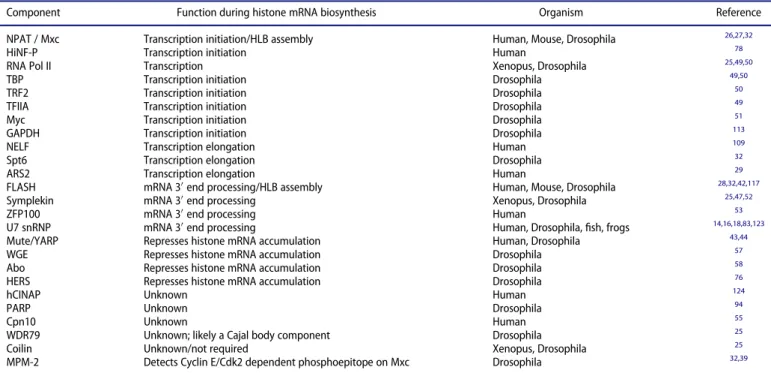
for factors required for histone pre-mRNA processing or HLB formation, and biochemical characterization of factors involved in histone gene transcription and pre-mRNA processing (Table 1). An example is FLASH, a large protein with low
complexity regions that was identified by De Laurenzi and
co-workers as concentrating in nuclear bodies containing NPAT
and shown to be essential for cells to enter S-phase.28,41 The
Marzluff laboratory subsequently identified FLASH in a
two-hybrid screen for proteins that interact with the N-terminus of Lsm11 and showed that it was essential for histone pre-mRNA
processing.42 A second example is muscle wasted (Mute),
dis-covered by the Chia lab in a screen for factors required for
mus-cle development and shown to concentrate in the HLB,43as does
its mammalian ortholog YARP.44Mute may function as a
nega-tive regulator of histone gene expression.43Dominski and
col-leagues also showed that cleavage of histone pre-mRNA is catalyzed by CPSF-73, the same protein that catalyzes cleavage of pre-mRNAs encoding poly(A) mRNAs, demonstrating a role
for polyadenylation factors in histone pre-mRNA processing,45
including Symplekin46 and CPSF100.47,48 These discoveries
opened up new avenues for understanding histone pre-mRNA processing and HLB composition and assembly.
As determined by immunofluorescence studies, HLB
pro-teins can be grouped into at least two general categories: those that are present in the HLB throughout the cell cycle and that are not detected at other sites in the nucleus, and those that are recruited to the HLB during S phase when the RD histone genes are expressed. NPAT/Mxc, FLASH and U7 snRNP are factors
in thefirst category that best define the HLB. The S phase
cate-gory has been largely studied in Drosophila, where HLBs can be visualized in a developing organism and there is much tighter transcriptional regulation of histone genes than in
mammals.49 This category includes proteins required for
gen-eral RNA synthesis such as TBP and RNA pol II,25,49,50 the
elongation factor Spt6,32 transcription factors like Myc,51 and
factors required for histone pre-mRNA processing like Symple-kin.25,52 These proteins are also present in the nucleoplasm throughout the cell cycle because they also function in general mRNA biosynthesis (e.g., Symplekin) or in the expression of other genes (e.g., Myc). The recruitment of these factors to the
HLB may be triggered or influenced by cell cycle regulated
sig-nals, including phosphorylation of NPAT/Mxc by Cyclin E/ Cdk2. HLB components likely exchange continuously between the HLB and the nucleoplasm, as do components of the Cajal body, but the rates of exchange can vary for different
compo-nents.49,53,54Finally, some HLB components are not detected in
all HLBs (e.g., Coilin and the chaperone protein Cpn10) or are also recruited to other nuclear bodies (e.g., the Cajal Body in the case of Coilin).18,55
Interestingly, several genes encoding Drosophila HLB com-ponents were originally discovered in genetic screens as muta-tions that affect organ development. The best examples are
mute and mxc. The mxc locus was identified by hypomorphic
mutations that cause homeotic transformation of adult male
legs, and consequently mxc was originally classified as a
poly-comb group gene.36 Only more than a decade later did we
show it encodes the Drosophila ortholog of NPAT.32Mute was
identified as a gene required for muscle development during
Figure 2.Visualization of the HLB by immunofluorescence. (A) HeLa cell stained
embryogenesis,43 and encodes a large protein with predicted
intrinsically disordered (IDR) regions that localizes to the HLB.
Winged eye (wge) was identified in a gain-of-function screen as
a gene that causes eye to wing transformations when
overex-pressed.56 wge encodes a bromo-adjacent homology (BAH)
domain protein conserved in mammals that was recently
shown to localize to the HLB in Drosophila.57 Wge binds to
Mute and the two appear to act together as negative regulators of histone gene expression. They can recruit co-repressors, but
their specific mechanism of action is not known. Finally,
abnor-mal oocyte (abo) was identified as a maternal effect mutation
that reduces the viability of offspring. abo encodes an HLB pro-tein that has no obvious functional domains, but is conserved in mammals. Abo appears to negatively regulate histone gene
expression in the Drosophila female germ line.58
An emerging theme from these observations is that altera-tions to histone gene expression via mutation of HLB com-ponents often result in widespread gene expression changes that affect the development of particular tissues or cell line-ages. In the case of hypomorphic mutations in mxc, a reduc-tion in replicareduc-tion dependent histone gene expression may result in a reduction of histone protein abundance, or an alteration of the proportion of canonical and variant histo-nes, that attenuates the establishment of polycomb-mediated repressive chromatin environments controlling cell identity. Likewise, some transposons are de-repressed in wge mutants, perhaps because repressive heterochromatin is not properly
established.57 Another possibility is that some HLB
compo-nents act directly to regulate gene expression at loci other than the RD-histone genes, consistent with the observation that Wge binds to multiple sites on salivary gland polytene
chromosomes,56 although Mute and Mxc are only found at
the histone locus. It is important to also keep in mind that mutation of any factor that affects entry into or progression through S phase may result in alteration of histone mRNA
levels, even though the factor may have no direct role in histone gene expression or histone mRNA metabolism.
HLB assembly
Work in a variety of experimental systems over the last 15 y has coalesced into three major concepts for how nuclear bodies
may assemble, each of which likely applies to the HLB.59
Importantly, the molecular mechanisms underlying these three
concepts are not mutually exclusive. The first is that nuclear
body components have an intrinsic ability for self-organization, resulting in complex macromolecular structures that can be
visualized by light microscopy.60 An important aspect of
nuclear body assembly remains unclear: whether self-organiza-tion occurs stochastically or through an ordered, hierarchical process.61The second concept is that a specific“seeding”event
initiates the self-organization process.62,63 In several instances,
most notably the nucleolus, the seeding event is transcription
of a specific RNA (e.g., rRNA), although other types of seeding
events are possible.62,64-67Identifying seeding events is key to
understanding assembly of particular nuclear bodies during
development and in specific cell types. The third concept
postu-lates that nuclear body assembly results in a phase transition characterized by liquid-liquid demixing. This process results in a distinct liquid-like compartment within the nucleus with dif-ferent physical properties than the surrounding nucleoplasm, and subsequent nuclear body function is mediated by this
phase transition.68In this section we consider evidence
suggest-ing that all three may contribute to the properties and assembly of the HLB.
Self-organization of the HLB
Self-organization refers to the ability of many molecules of one or more proteins to spontaneously assemble into large
Table 1.Proteins that can concentrate in the HLB and their role in histone gene expression.
Component Function during histone mRNA biosynthesis Organism Reference
NPAT / Mxc Transcription initiation/HLB assembly Human, Mouse, Drosophila 26,27,32
HiNF-P Transcription initiation Human 78
RNA Pol II Transcription Xenopus, Drosophila 25,49,50
TBP Transcription initiation Drosophila 49,50
TRF2 Transcription initiation Drosophila 50
TFIIA Transcription initiation Drosophila 49
Myc Transcription initiation Drosophila 51
GAPDH Transcription initiation Drosophila 113
NELF Transcription elongation Human 109
Spt6 Transcription elongation Drosophila 32
ARS2 Transcription elongation Human 29
FLASH mRNA 30end processing/HLB assembly Human, Mouse, Drosophila 28,32,42,117
Symplekin mRNA 30end processing Xenopus, Drosophila 25,47,52
ZFP100 mRNA 30end processing Human 53
U7 snRNP mRNA 30end processing Human, Drosophila,fish, frogs 14,16,18,83,123
Mute/YARP Represses histone mRNA accumulation Human, Drosophila 43,44
WGE Represses histone mRNA accumulation Drosophila 57
Abo Represses histone mRNA accumulation Drosophila 58
HERS Represses histone mRNA accumulation Drosophila 76
hCINAP Unknown Human 124
PARP Unknown Drosophila 94
Cpn10 Unknown Human 55
WDR79 Unknown; likely a Cajal body component Drosophila 25
Coilin Unknown/not required Xenopus, Drosophila 25
networks or polymers. In the case of nuclear bodies like the HLB that are composed of several different types of factors, there is likely a dense network of weak interactions among indi-vidual components that are necessary for assembling and main-taining the body. Scaffold protein oligomerization is well established in the nuclear body literature, and the N-terminal self-interaction domain of Coilin provides a good example of a
scaffold for Cajal Bodies.69 Drosophila Mxc and mammalian
NPAT contain a conserved N-terminal LisH domain and an adjacent SIF (self-interaction facilitator) domain that in
Dro-sophila mediate self-interaction among Mxc molecules.70 The
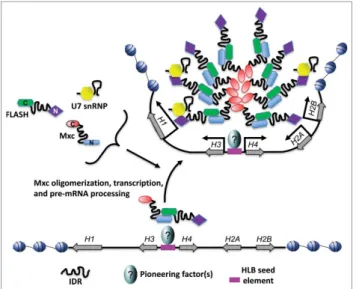
LisH and SIF domains of Mxc do not mediate simple dimeriza-tion, but instead provide multivalent binding capability that could help oligomerize Mxc into a large molecular network that provides a scaffold for the recruitment of other HLB
com-ponents (Fig. 3). Importantly, the oligomerization mediated by
the LisH and SIF domains is required for Mxc function in vivo, as substitution mutations of 3 amino acids in either domain render Mxc completely unable to support HLB assembly and
are lethal.70The LisH of NPAT domain is necessary for NPAT
to stimulate histone gene expression.33However, an ectopically
expressed NPAT lacking the LisH domain can localize to the HLB, perhaps because other domains can interact with
endoge-nous, wild type NPAT at the HLB.33
Multiple components can potentially self-organize to form
nuclear bodies via two different mechanisms. Thefirst is a
sto-chastic recruitment mechanism in which factors are not required to assemble in any particular order, resulting in many different potential pathways to nuclear body assembly. This process contrasts with a hierarchical or ordered mechanism in which nuclear body assembly follows an invariant order of events (i.e., A recruits B, followed by recruitment of C, etc.). Interestingly, the HLB exhibits properties of both mechanisms. For instance, the Dundr laboratory has demonstrated that
tethering a single HLB component or histone pre-mRNA to a
specific locus in mammalian cells can trigger recruitment of
other HLB components.64,71 Moreover, several different HLB
components are capable of nucleating HLB-like structures when tethered, supporting a model for stochastic assembly. In contrast, we have shown using genetic manipulation in Dro-sophila that some HLB factors (e.g., Mxc) are necessary for the recruitment of others (e.g., Mute, U7 snRNP), but not vice
versa, consistent with an ordered assembly process.32 In
addi-tion, we have microscopically observed the ordered appearance of components upon initial HLB assembly in the syncytial
cycles of early Drosophila embryogenesis.32,39 However, these
two ideas need not be mutually exclusive, and the HLB could form by initial recruitment of certain scaffolding factors such as Mxc and FLASH followed by stochastic recruitment of
addi-tional factors like U7 snRNP and Mute (Fig. 3).
A feature of some HLB proteins is that the domains required for recruitment are separable from the domains required for biochemical function in histone mRNA biosynthesis. For instance, an N-terminal fragment of Mxc containing the LisH and SIF domains that is unable to support HLB formation or transcription on its own is nonetheless able to concentrate in the HLB in the presence of wild type Mxc, likely both by self-associating and interacting with endogenous full length Mxc
within the HLB.70 Similarly, a direct interaction between the
NH2terminus of Lsm11 (in the U7 snRNP) and the NH2
termi-nus of FLASH is necessary for pre-mRNA processing, but not
for either U7 snRNP or FLASH to concentrate in the HLB.72,73
In addition, the sequence in histone pre-mRNA that binds U7 snRNP is not required for U7 snRNP recruitment to the
Dro-sophila HLB.74 Instead, we found that the C terminus of
FLASH, likely together with Mxc, is necessary for recruitment
of U7 snRNP to the HLB.72Thus, there are interactions among
HLB components involved in assembling the HLB that are dis-tinct from the interactions required for histone mRNA biosyn-thesis. Such modularity could explain how a protein like FLASH participates directly and separately in HLB formation and pre-mRNA processing.
A specific DNA sequence is required for seeding Drosophila HLB assembly
What triggers self-organization of the HLB? In the context of
combining ordered and stochastic models of assembly, a“seed
and grow”mechanism best describes HLB assembly.62 In this
model a specific nucleation event results in an increase in local
concentration of a specific factor(s) (“seed”) that provides a platform for recruitment of more factors via the properties of
oligomerization and self-organization (“and grow”). But what
provides the seed? Since HLBs are tightly associated with his-tone gene clusters, an obvious answer could be hishis-tone
encod-ing DNA or RNA. Indeed, we discovered a specific sequence in
the Drosophila RD histone gene array that is necessary and
suf-ficient to nucleate HLB assembly.74The Drosophila RD histone
locus is composed of»100 copies of a tandemly arrayed 5kb
sequence containing one copy of H1 and one copy of
diver-gently transcribed H3/H4 and H2A/H2B gene pairs1(Fig. 3). A
»300 bp sequence between the H3/H4 coding sequences and
containing the H3/H4 promoter(s) nucleates HLB assembly,
Figure 3.Schematic of Drosophila HLB assembly. The Drosophila replication
but the corresponding sequence containing the H2A/H2B
pro-moter(s) does not.74 In addition to driving HLB assembly, the
H3/H4 promoter sequence is required for efficient
transcrip-tion from the H2A/H2B gene pair, even though the H2A/H2B
pair contains intact promoters.74Together these results suggest
that the H3/H4 promoter is required for HLB assembly, which in turn is critical for histone gene expression.
Blocking transcription of the Drosophila H3/H4 genes by mutating their TATA boxes results in the recruitment of Mxc and FLASH but not Mute and U7 snRNP, suggesting that
tran-scription is essential for assembly of the complete HLB.74 At
first glance, this result appears consistent with the observation
that histone RNA can recruit HLB components in a tethering
assay.64 In addition, mature HLBs appear for thefirst time in
early Drosophila development near the time of activation of
zygotic histone gene expression.32,39However, a transgene
con-taining a 300 nt fragment with the H3/H4 promoter is capable of ectopically recruiting the core HLB components, including Mxc, FLASH, Mute and U7 snRNP in the absence of any
his-tone coding or 30end processing sequences.74Furthermore, in
Drosophila tissues HLBs are present in G1 and G2 phase cells that do not express histone mRNA, as well as in cells that have
exited the cell cycle.18,32,39 Similarly, NPAT, FLASH and U7
snRNP continue to be present in mammalian tissues that do
not express histone mRNA.75Thus, we favor a model in which
transcription from the H3/H4 promoter facilitates HLB assem-bly rather than the actual histone mRNA sequence. In addition, the pre-mRNA processing signals are not required to recruit FLASH or U7 snRNP to the HLB. The initial recruitment of Mxc and FLASH followed by transcription dependent recruit-ment of Mute and U7 snRNP in Drosophila is also consistent with an ordered assembly model. As noted above, however, ordered HLB assembly steps are not mutually exclusive with stochastic self-organization. A dramatic example of this point is that FLASH and Mxc can temporarily organize into foci that resemble HLBs in embryos where the RD histone genes have been deleted, demonstrating the self-organizational properties of these molecules.39,74
How do HLB components initially find the histone locus?
Since NPAT/Mxc does not bind DNA specifically, a likely
pos-sibility is recruitment to histone genes by interaction with a
DNA binding protein. Another possibility is that a specific
chromatin structure could be established on histone genes in
both humans andflies that promotes recruitment of HLB
com-ponents, including NPAT/Mxc76,77. Conserved sequences in
the Drosophila H3/H4 promoter that are not present in the
H2A/H2B promoter might serve to bind a specific factor or
establish a specific chromatin structure.74The assembly of the
HLB has only been studied in detail in Drosophila, and
mam-malian histone genes are organized very differently than inflies.
Humans contain a major histone gene cluster on chromosome 6 with 55 genes spread over several megabases as well as an unlinked, smaller, and more compact histone gene cluster on
chromosome 1 with 10 genes in about 100 kB.5 This general
organization is conserved in all mammals and contrasts with the 500 Drosophila genes in 500 kB of DNA. The much greater distance between histone genes in mammals and different orga-nization (e.g., there are no H3/H4 pairs) makes it less likely that there is a single DNA sequence that seeds the mammalian HLB.
Thus, the mechanism for recruiting NPAT to the histone locus
is likely to be different in mammals than inflies. However, the
histone genes on each chromosome organize into a single HLB, as human cells in S phase have two large and two small HLBs that assemble at the large and small histone gene clusters,
respectively.26,27Human NPAT can bind directly to HiNF-P, a
sequence specific DNA binding protein that is required for
his-tone H4 transcription.78,79 Deletion of HinfP from mouse
embryos abolishes histone H4 mRNA expression but does not abolish formation of the HLB as detected by staining for NPAT
and FLASH.80 Similarly, depletion of HiNF-P from cultured
cells results in a dispersion of HLBs into smaller bodies,
although they still form.81,82These data indicate that HiNF-P is
not required for mammalian HLB formation but may promote complete HLB assembly via its role in H4 transcription.
During mitosis the HLB is disassembled, but a small amount of Mxc as well as FLASH can be detected on condensed
chromo-somes throughout mitosis in Drosophila.32 By contrast, NPAT
has not been observed associated with mitotic chromosomes in
mammalian cells.26,27,83 The mechanism of HLB disassembly
during mitosis is not known, but perhaps involves changes in
phosphorylation of HLB components by mitotic CDKs. Inflies,
a small pool of NPAT/Mxc may remain associated with mitotic
chromosomes in order to “bookmark” the histone genes and
rapidly nucleate full HLB reassembly at the beginning of inter-phase. This argument has also been made for TBP, which in S2 cells is tightly associated with the Drosophila core histone genes
even after RNAi depletion of Mxc.49 Note that a novel form of
TFIID with a limited number of additional components beside
TBP localizes to the H2a/H2b and H3/H4 genes,49 and a TBP
paralog, TRF2, is present in the HLB at the histone H1 genes.50
The concept of bookmarking specific loci also holds true for
nucleoli, where UBF“bookmarks”rDNA after mitosis and
tran-scription of rDNA is necessary for full nucleolar formation.66,84
Thus the HLB and the nucleolus and potentially other nuclear
bodies that associate with specific loci may have a component
that serves a bookmarking role during mitosis.
Does phase separation help drive HLB assembly?
Phase separation has recently emerged as a possible common principle in the assembly of both nuclear and cytoplasmic bod-ies.68,85-87 In this process the physical chemical properties of body components promote a phase transition when the con-centration of the component(s) exceeds their solubility limit, such as when molecules precipitate out of solution and form a crystal. The phase transition need not result in a solid structure: Many bodies display liquid like properties, similar to a lipid droplet within an aqueous environment. A spherical shape and
fusing of body“droplets”are evidence for liquid like behavior
in the context of phase separation. This model is consistent with the rapid exchange of nuclear body components with the nucleoplasm.
of homolog pairing (Fig. 2C).39 Thus, two HLBs, one on each homolog, might fuse into one HLB when the histone gene arrays on homologous chromosomes pair with each other, con-sistent with the HLB having liquid like properties. Human cells have four spherical HLBs because there are two histone gene
clusters and the homologous chromosomes do not pair.26,27
Intrinsically disordered regions (IDRs) are a common feature
of proteins that undergo phase transition and form bodies.85
IDRs do not fold into well-defined protein domains and are
often composed of regions of low sequence complexity.88,89
Both Mxc and NPAT as well as FLASH and Mute are large proteins with regions of low complexity, such as the large polyserine tract in the middle of the Mxc protein. Multivalent interactions driven by IDRs can reduce solubility and facilitate body formation, with the strong interactions governing
poly-merization and the weak interactions governing solubility.86
Interestingly, conversion over time of phase separated droplets
composed of IDRs and RNAs from a liquid like to a morefiber
like state has been demonstrated in vitro suggesting that IDRs
may contribute to the “maturing” of the HLB in response to
transcriptional activation as described above.90,91
Post-transla-tional modifications may also modulate phase separation
asso-ciated with gene expression.92Poly ADP ribose promotes phase
separation,93 and poly (ADP-ribose) polymerase has been
detected in Drosophila HLBs.94Finally, given that IDRs might
be promiscuous, some proteins might concentrate in the HLB but not have an essential biological or biochemical function in histone mRNA biosynthesis. Such promiscuity may explain the observation that Coilin, which contains regions of low sequence
complexity that are likely IDRs,95 sometimes appears within
HLBs but is not required for HLB assembly or for histone
mRNA biosynthesis.22,25Although these ideas are rather
specu-lative, we suggest that phase separation may act together with self-organization and molecular seeding to promote HLB for-mation (Fig. 3).
HLB function
A prevailing model for nuclear body function postulates that nuclear bodies promote reactions by increasing the local con-centration of necessary factors and/or promoting
macromolec-ular assembly to allow efficient coupling of multiple
reactions.96 Indeed, recent data demonstrate that Cajal bodies
enhance the assembly of mature snRNPs both in mammalian
cells and early zebrafish embryos.97,98 In this section we will
summarize recent experiments that address how the HLB con-tributes to histone mRNA biosynthesis, with an emphasis on the role of FLASH and U7 snRNP in the pre-mRNA processing reaction.
Concentrating factors in the HLB promotes histone pre-mRNA processing
Since HLBs are tightly associated with RD histone genes, an important question is whether HLBs are actually sites of histone mRNA biosynthesis, or whether they might simply provide a stockpile of factors close to the histone genes. In large amphibian oocytes some C snurposomes (HLBs) are not associated with
his-tone genes.25 By contrast, in cultured mammalian cells and in
Drosophila tissues the HLB is invariably found at the histone
locus throughout the cell cycle.18,41 More importantly, in
Dro-sophila cells HLB components co-localize with nascent RD
his-tone transcripts, as detected by in situ hybridization,49and RNA
polymerase II becomes highly enriched in HLBs during S phase
when histone mRNA production is high.25,49These data suggest
that HLBs are the sites of histone mRNA biosynthesis inflies and
mammals, although direct evidence for this situation requires co-localizing the HLB and the histone DNA by high resolution microscopy.
An ideal way to address whether concentrating factors
within the HLB promotes reaction efficiency is to prevent a
wild type, fully active protein involved in some aspect of his-tone mRNA biosynthesis from concentrating in the HLB with-out disrupting the integrity of the HLB. Taking advantage of our knowledge of the molecular interactions of HLB compo-nents,44,70,72,73,99-101we have performed genetic studies in Dro-sophila using mutant proteins that are either processing defective or unable to localize to the HLB. Unlike other
meta-zoan genes, where transcription can continue well 30of the
pol-yadenylation site, transcription termination is tightly coupled to histone mRNA processing in both Drosophila and
mam-mals.72,102,103Drosophila RD histone pre-mRNA processing is
normally very efficient, meaning that in wild type cells and
ani-mals only stem-loop RD histone mRNAs can be detected. RNA
pol II pauses just 30of the HDE,104and likely terminates
imme-diately after processing since there are no detectable transcripts
downstream of the HDE.72Failure to process histone mRNA in
Drosophila results in continued transcription past the HDE
and polyadenylation at cryptic polyadenylation sites 30 of the
HDE in each histone gene.105Sufficient polyadenylated histone
mRNA is produced in the absence of processing factors (e.g., U7 snRNP) to allow much of development to occur in
Dro-sophila.106,107We can detect both poly AChistone RNA and
nascent read-through unprocessed RNAs by nuclease protec-tion and in situ hybridizaprotec-tion assays, allowing us to
quantita-tively determine the efficiency of histone pre-mRNA
processing in various tissues.72,108
Concentration of U7 snRNP and FLASH in the HLB appears to be particularly important for histone mRNA biosyn-thesis. There is a very small amount of U7 snRNA in the cell
(about 500 copies cf. with»500,000 for U1 snRNA in
mam-mals) and very small amounts of FLASH in Drosophila
embryos and larvae.72 FLASH is recruited to the HLB by an
interaction between the C-terminus of FLASH and the
C-ter-minus of NPAT/Mxc29,44,72,73. A hypomorphic allele of mxc
(mxcG46) that encodes a truncated form of Mxc lacking the last
195 amino acids results in failure of full length, wild type FLASH protein and U7 snRNP to concentrate in the HLB, although an HLB containing the truncated Mxc protein
forms.72 Interestingly, in this genotype histone gene
transcrip-tion is unaffected but histone pre-mRNA processing is ineffi
-cient, resulting in small amounts of both nascent, read-through
and polyadenylated histone transcripts.72 This result
demon-strates that concentrating FLASH and/or U7 snRNP in the
HLB is necessary for efficient coupling of histone mRNA
proc-essing and transcription termination.
occur in mammalian cells. Based on Pol II Chip assays, mam-malian histone genes differ from other genes in that pol II
ter-minates shortly after the 30 end of histone mRNA.72,102,103
Knockdown of a number of factors involved in either the early
steps of elongation of RNA (e.g., NELF,109 Cdk9110), factors
that interact with FLASH (e.g., Ars2,29,111), factors that catalyze
histone H2b ubiquitination110 and Y3 RNA112 all result in
expression of a small amount of polyadenylated histone
mRNA, about 2–4% of the total histone mRNA, without
affect-ing cell growth. This phenotype is similar to the molecular phe-notype observed in Drosophila when FLASH or U7 snRNP is
mislocalized,72and could arise from uncoupling processing and
transcription termination. Disrupting the interaction between Ars2 and FLASH interferes with cell cycle progression, and
depletion of Ars2 reduces the number of HLBs.29Knockdown
of Y3 RNA results in perturbation of the size of the HLBs
suggesting that it interacts directly with HLB components. We
find that there is no Ars2 or Y3RNA in our purified in vitro
processing complexes (Dominski and Marzluff, unpublished observations), consistent with these factors affecting HLB
func-tion, and Y3RNA has been suggested to play a role in
recruit-ing CPSF to the HLB.112
Functional changes in the HLB during S phase
As cells enter S-phase, there are at least two major events that together result in a massive increase in histone mRNA levels: initiation of histone gene transcription in response to activation of Cyclin E/Cdk2 in late G1 and activation of histone pre-mRNA processing. Phosphorylation of NPAT by Cyclin E/
Cdk2 is essential for histone gene transcription,26,27,34and may
also result in the recruitment of pre-mRNA processing factors
to the HLB like Symplekin,52 thereby activating histone
pre-mRNA processing. Changes to the HLB during S phase can be visualized cytologically. For instance, HLBs in both Drosophila
and human cells can be specifically detected during S phase
with antibodies that recognize phosphorylated NPAT/
Mxc26,27,32,39. In human cells the HLBs at the major cluster on chromosome 6 are readily visualized throughout the cell cycle, but clearly increase in size as cells enter S phase. RNA pol II,25,49,50and other factors (e.g., Spt632and Myc51) required for
transcription of the histone genes appear in the HLB during S phase, although TATA binding protein (TBP) is present
consti-tutively in the HLB.49 There is also recruitment of sequence
specific DNA binding proteins: e.g., OCA-S/Pdm-1 for core
histone expression,113114and HiNF-P for human His4
expres-sion,78although it is not known if they are only in the HLB in S
phase.
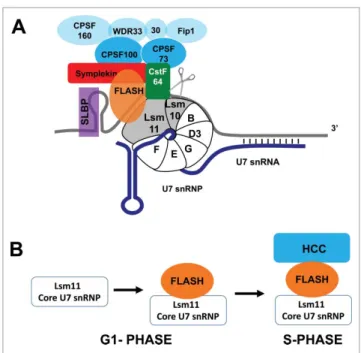
As cells enter S phase, a major change likely occurs in the U7 snRNP within the HLB, activating it for histone pre-mRNA processing. FLASH and Lsm11 interact to form a protein sur-face that recruits a set of proteins termed the histone cleavage
complex (HCC).100,101 The HCC includes the endonuclease
core of the CPSF polyadenylation complex (CPSF73 and CPSF100) plus the protein Symplekin, which binds CstF64.
The Symplekin/CstF64 interaction is likely specific for histone
pre-mRNA processing, since CstF64 forms a complex with CstF77 and CstF50 that functions in polyadenylation using the
same region it uses to interact with Symplekin.115,116U7 snRNP
isolated from nuclear extracts contains not only the core Sm proteins, and FLASH, but also the HCC components, suggest-ing that the U7 snRNP is already associated with the HCC when it binds to the histone pre-RNA. Since U7 snRNP is pres-ent in very small amounts in mammalian or Drosophila cells,
only a small fraction (<1%) of the total CPSF73, CPSF100,
Symplekin and CstF64 are present in the HLB even in S
phase.100,101We have found that Symplekin is concentrated in
the HLB primarily in S phase,52while U7 snRNP is there
con-stitutively. This result suggests that the active form of U7 snRNP, containing the HCC, may be assembled in the HLB during S phase as part of the mechanism of activating histone
pre-mRNA processing (Fig. 1B).
The recruitment of the HCC to the HLB suggests a regula-tory step may drive the assembly of the active U7 snRNP and/ or cause other important molecular changes within the HLB. Mammalian YARP, the Drosophila homolog of Mute, and FLASH each interact with the C-terminus of NPAT using a Myb-like domain, and this domain from either protein can
localize a heterologous protein to the HLB.44 The C-terminus
of NPAT can bind either YARP or FLASH but not both at once. Detailed in vitro binding studies demonstrated that the C-terminal Myb-like domain of FLASH also binds to Lsm11 adjacent to the binding site on Lsm11 for the N-terminus of FLASH, and that this interaction prevents FLASH binding to
NPAT.99 Thus, it is tempting to speculate that reorganization
of the Lsm11-FLASH-NPAT interactions in the HLB may be part of U7 snRNP activation and the onset of RD histone pre-mRNA processing during S phase. This idea also suggests that different pools of molecules may exist within the HLB. For example, some molecules of FLASH may interact with Mxc, and may be involved in scaffolding the HLB, while others could interact directly with U7 snRNP and not Mxc and participate in processing. The size of these pools could be dynamically reg-ulated by Cyclin E/Cdk2 activity during S phase. The applica-tion of super high resoluapplica-tion microscopy might provide an avenue to begin exploring these issues.
Concluding remarks
Does HLB function matter for organism development or home-ostasis? Null mutations of core HLB components (e.g., FLASH
and NPAT/Mxc) in mammals andflies are lethal early in
devel-opment,35,36,117likely in large part because little to no histone gene expression occurs. Because proteins like NPAT/Mxc and FLASH are necessary to scaffold HLB assembly and to stimu-late histone mRNA biosynthesis, both of these functions will be lost in the absence of these proteins making it difficult to assign functional roles to HLB assembly per se. An important point to emphasize is that HLB assembly need not be absolutely
essen-tial, or may only be essential in specific cells when there is a
particularly high demand for histone mRNA synthesis. For
example, Coilin depletion is lethal in zebrafish due to the need
for rapid assembly of snRNPs in embryogenesis,97whereas
Coi-lin mutation and the loss of Cajal Bodies inflies is not lethal
and doesn’t impact scaRNA modification, which is thought to
occur within Cajal bodies.118 In Drosophila the maximal
protein are deposited into the egg. Several mutations that affect the HLB and histone pre-mRNA processing result in female sterility,32,72,105,107suggesting that the HLB may be particularly important during oogenesis, either in proper development of
the egg107 or in production of sufficient maternal histone
mRNA for the embryo.105,108
Interestingly, one well-studied organism, C. elegans, appar-ently lacks an HLB, although their histone mRNAs end in a
stem loop and associate with SLBP.119In C. elegans the histone
mRNA 30end is formed by cleavage of a longer polyadenylated
precursor using small RNAs (analogous to RNAi).120
Further-more, the C. elegans histone genes are not tandemly arrayed,121
but the 13–14 copies of each core histone gene are found in
many small clusters spread over different chromosomes.122
Moreover, homologs of U7 snRNP and FLASH are not identifi
-able in the C. elegans genome (Z. Dominski, personal commu-nication). Perhaps these worms have lost the HLB because there is not a need to concentrate low abundance factors like U7 snRNP and FLASH for RD histone pre-mRNA processing due to the alternate cleavage mechanism.
Thus HLB assembly may provide a boost to efficiency of
histone mRNA biosynthesis, rather than being absolutely
essential. Such a boost in efficiency could provide an
advan-tage that is selected during the evolution of particular ani-mal lineages. This interesting question may be applicable to other nuclear bodies, and addressing it will require the fur-ther application of genetics, cell biology, and biochemistry that has been so important to our current understanding of HLB assembly and function.
Disclosure of potential conflicts of interest
The authors have no potential conflicts of interest.
Acknowledgments
We thank Dan McKay, Deirdre Tatomer, Leila Rieder, and Erica Larschan for critical reading of the manuscript, and Katy Curry for critical com-ments and assemblingFig. 2. HLB studies in the Duronio and Marzluff labs are funded by the NIH (GM058921).
References
1. McKay DJ, Klusza S, Penke TJ, Meers MP, Curry KP, McDaniel SL, Malek PY, Cooper SW, Tatomer DC, Lieb JD, et al. Interrogating the function of metazoan histones using engineered gene clusters. Dev Cell 2015; 32:373-86; PMID:25669886; https://doi.org/10.1016/j. devcel.2014.12.025
2. Lifton RP, Goldberg ML, Karp RW, Hogness DS. The organization of the histone genes in Drosophila melanogaster: functional and evolutionary implications. Cold Spring Harb Symp Quant Biol 1978; 42:1047-51; PMID:98262; https://doi.org/10.1101/SQB.1978.042.01.105
3. Schaffner W, Gross K, Telford J, Birnstiel M. Molecular analysis of the histone gene cluster of psammechinus miliaris: II. The arrange-ment of thefive histone-coding and spacer sequences. Cell 1976; 8:471-8; PMID:954100; https://doi.org/10.1016/0092-8674(76) 90214-2
4. Cohn RH, Lowry JC, Kedes LH. Histone genes of the sea urchin (S. purpuratus) cloned in E coli: order, polarity, and strandedness of the
five histone-coding and spacer regions. Cell 1976; 9:147-61; PMID:788917; https://doi.org/10.1016/0092-8674(76)90060-X
5. Marzluff WF, Gongidi P, Woods KR, Jin J, Maltais LJ. The human and mouse replication-dependent histone genes. Genomics 2002; 80:487-98; PMID:12408966; https://doi.org/10.1006/geno.2002.6850
6. Marzluff WF, Wagner EJ, Duronio RJ. Metabolism and regulation of canonical histone mRNAs: life without a poly(A) tail. Nat Rev Genet 2008; 9:843-54; PMID:18927579; https://doi.org/10.1038/nrg2438 7. Romeo V, Schumperli D. Cycling in the nucleus: regulation of RNA
30processing and nuclear organization of replication-dependent his-tone genes. Curr Opin Cell Biol 2016; 40:23-31; PMID:26895140; https://doi.org/10.1016/j.ceb.2016.01.015
8. Dominski Z, Marzluff WF. Formation of the 30 end of histone mRNA: getting closer to the end. Gene 2007; 396:373-90; PMID:17531405; https://doi.org/10.1016/j.gene.2007.04.021 9. Cotten M, Gick O, Vasserot A, Schaffner G, Birnstiel ML. Specific
contacts between mammalian U7 snRNA and histone precursor RNA are indispensable for the in vitro 30 RNA processing reaction. Embo J 1988; 7:801-8; PMID:3396543
10. Soldati D, Schumperli D. Structural and functional characterization of mouse U7 small nuclear RNA active in 30 processing of histone pre-mRNA. Mol Cell Biol 1988; 8:1518-24; PMID:3380087; https:// doi.org/10.1128/MCB.8.4.1518
11. Schaufele F, Gilmartin GM, Bannwarth W, Birnstiel ML. Compensa-tory mutations suggest that base-pairing with a small nuclear RNA is required to form the 30 end of H3 messenger RNA. Nature 1986; 323:777-81; PMID:3022153; https://doi.org/10.1038/323777a0 12. Mowry KL, Steitz JA. Identification of the human U7 snRNP as one
of several factors involved in the 30end maturation of histone pre-messenger RNA’s. Science 1987; 238:1682-7; PMID:2825355; https:// doi.org/10.1126/science.2825355
13. Wu CH, Murphy C, Gall JG. The Sm binding site targets U7 snRNA to coiled bodies (spheres) of amphibian oocytes. Rna 1996; 2:811-23; PMID:8752090
14. Wu CH, Gall JG. U7 small nuclear RNA in C snurposomes of the Xenopus germinal vesicle. Proc Natl Acad Sci U S A 1993; 90:6257-9; PMID:8327506; https://doi.org/10.1073/pnas.90.13.6257
15. Abbott J, Marzluff WF, Gall JG. The stem-loop binding protein (SLBP1) is present in coiled bodies of the Xenopus germinal vesicle. Mol Biol Cell 1999; 10:487-99; PMID:9950690; https://doi.org/ 10.1091/mbc.10.2.487
16. Frey MR, Matera AG. Coiled bodies contain U7 small nuclear RNA and associate with specific DNA sequences in interphase human cells. Proc Natl Acad Sci U S A 1995; 92:5915-9; PMID:7597053; https://doi.org/10.1073/pnas.92.13.5915
17. Gall JG. Cajal bodies: thefirst 100 years. Annu Rev Cell Dev Biol 2000; 16:273-300; PMID:11031238; https://doi.org/10.1146/annurev. cellbio.16.1.273
18. Liu JL, Murphy C, Buszczak M, Clatterbuck S, Goodman R, Gall JG. The Drosophila melanogaster Cajal body. J Cell Biol 2006; 172:875-84; PMID:16533947; https://doi.org/10.1083/jcb.200511038 19. Weichenrieder O. RNA binding by Hfq and ring-forming (L)Sm
proteins: a trade-off between optimal sequence readout and RNA backbone conformation. RNA Biol 2014; 11:537-49; PMID: 24828406; https://doi.org/10.4161/rna.29144
20. Pillai RS, Grimmler M, Meister G, Will CL, Luhrmann R, Fischer U, Sch€umperli D. Unique Sm core structure of U7 snRNPs: assembly by a specialized SMN complex and the role of a new component, Lsm11, in histone RNA processing. Genes Dev 2003; 17:2321-33; PMID:12975319; https://doi.org/10.1101/gad.274403
21. Pillai RS, Will CL, Luhrmann R, Schumperli D, Muller B. Purified U7 snRNPs lack the Sm proteins D1 and D2 but contain Lsm10, a new 14 kDa Sm D1-like protein. Embo J 2001; 20:5470-9; PMID:11574479; https://doi.org/10.1093/emboj/20.19.5470 22. Liu JL, Wu Z, Nizami Z, Deryusheva S, Rajendra TK, Beumer KJ, Gao H,
Matera AG, Carroll D, Gall JG. Coilin is essential for Cajal body organiza-tion in Drosophila melanogaster. Mol Biol Cell 2009; 20:1661-70; PMID:19158395; https://doi.org/10.1091/mbc.E08-05-0525
24. Alm-Kristiansen AH, Saether T, Matre V, Gilfillan S, Dahle O, Gabri-elsen OS. FLASH acts as a co-activator of the transcription factor c-Myb and localizes to active RNA polymerase II foci. Oncogene 2008; 27:4644-56; PMID:18408764; https://doi.org/10.1038/onc.2008.105 25. Nizami ZF, Deryusheva S, Gall JG. Cajal bodies and histone locus
bodies in Drosophila and Xenopus. Cold Spring Harb Symp Quant Biol 2010; 75:313-20; PMID:21047905; https://doi.org/10.1101/ sqb.2010.75.005
26. Ma T, Van Tine BA, Wei Y, Garrett MD, Nelson D, Adams PD, Wang J, Qin J, Chow LT, Harper JW. Cell cycle-regulated phosphor-ylation of p220(NPAT) by cyclin E/Cdk2 in cajal bodies promotes histone gene transcription. Genes Dev 2000; 14:2298-313; PMID:10995387; https://doi.org/10.1101/gad.829500
27. Zhao J, Kennedy BK, Lawrence BD, Barbie DA, Matera AG, Fletcher JA, Harlow E. NPAT links cyclin E-Cdk2 to the regulation of replica-tion-dependent histone gene transcription. Genes Dev 2000; 14:2283-97; PMID:10995386; https://doi.org/10.1101/gad.827700 28. Barcaroli D, Dinsdale D, Neale MH, Bongiorno-Borbone L, Ranalli
M, Munarriz E, Sayan AE, McWilliam JM, Smith TM, Fava E, et al. FLASH is an essential component of Cajal bodies. Proc Natl Acad Sci U S A 2006; 103:14802-7; PMID:17003126; https://doi.org/ 10.1073/pnas.0604225103
29. Kiriyama M, Kobayashi Y, Saito M, Ishikawa F, Yonehara S. Interac-tion of FLASH with arsenite resistance protein 2 is involved in cell cycle progression at S phase. Mol Cell Biol 2009; 29:4729-41; PMID:19546234; https://doi.org/10.1128/MCB.00289-09
30. Bongiorno-Borbone L, De Cola A, Barcaroli D, Knight RA, Di Ilio C, Melino G, De Laurenzi V. FLASH degradation in response to UV-C results in histone locus bodies disruption and cell-cycle arrest. Onco-gene 2010; 29:802-10; PMID:19915611; https://doi.org/10.1038/ onc.2009.388
31. Zhao J, Dynlacht B, Imai T, Hori T, Harlow E. Expression of NPAT, a novel substrate of cyclin E-CDK2, promotes S- phase entry. Genes Dev 1998; 12:456-61; PMID:9472014; https://doi.org/10.1101/ gad.12.4.456
32. White AE, Burch BD, Yang XC, Gasdaska PY, Dominski Z, Marzluff WF, Duronio RJ. Drosophila histone locus bodies form by hierarchi-cal recruitment of components. J Cell Biol 2011; 193:677-94; PMID:21576393; https://doi.org/10.1083/jcb.201012077
33. Wei Y, Jin J, Harper JW. The Cyclin E/Cdk2 Substrate and Cajal Body Component p220(NPAT) Activates Histone Transcription through a Novel LisH-Like Domain. Mol Cell Biol 2003; 23:3669-80; PMID:12724424; https://doi.org/10.1128/MCB.23. 10.3669-3680.2003
34. Ye X, Wei Y, Nalepa G, Harper JW. The cyclin E/Cdk2 substrate p220 (NPAT) is required for S-phase entry, histone gene expression, and Cajal body maintenance in human somatic cells. Mol Cell Biol 2003; 23:8586-600; PMID:14612403; https://doi.org/10.1128/MCB.23.23.8586-8600.2003
35. Di Fruscio M, Weiher H, Vanderhyden BC, Imai T, Shiomi T, Hori TA, Jaenisch R, Gray DA. Proviral inactivation of the Npat gene of Mpv 20 mice results in early embryonic arrest. Mol Cell Biol 1997; 17:4080-6; PMID:9199343; https://doi.org/10.1128/MCB.17.7.4080 36. Santamaria P, Randsholt NB. Characterization of a region of the X
chromosome of Drosophila including multi sex combs (mxc), a Poly-comb group gene which also functions as a tumour suppressor. Mol Gen Genet 1995; 246:282-90; PMID:7854313; https://doi.org/ 10.1007/BF00288600
37. Saget O, Forquignon F, Santamaria P, Randsholt NB. Needs and tar-gets for the multi sex combs gene product in Drosophila mela-nogaster. Genetics 1998; 149:1823-38; PMID:9691040
38. Calvi BR, Lilly MA, Spradling AC. Cell cycle control of chorion gene amplification. Genes Dev 1998; 12:734-44; PMID:9499407; https:// doi.org/10.1101/gad.12.5.734
39. White AE, Leslie ME, Calvi BR, Marzluff WF, Duronio RJ. Develop-mental and cell cycle regulation of the Drosophila histone locus body. Mol Biol Cell 2007; 18:2491-502; PMID:17442888; https://doi. org/10.1091/mbc.E06-11-1033
40. Lanzotti DJ, Kupsco JM, Marzluff WF, Duronio RJ. string(cdc25) and cyclin E are required for patterned histone expression at different
stages of Drosophila embryonic development. Dev Biol 2004; 274:82-93; PMID:15355790; https://doi.org/10.1016/j.ydbio.2004.06.019 41. Barcaroli D, Bongiorno-Borbone L, Terrinoni A, Hofmann TG, Rossi
M, Knight RA, Matera AG, Melino G, De Laurenzi V. FLASH is required for histone transcription and S-phase progression. Proc Natl Acad Sci U S A 2006; 103:14808-12; PMID:17003125; https:// doi.org/10.1073/pnas.0604227103
42. Yang XC, Burch BD, Yan Y, Marzluff WF, Dominski Z. FLASH, a proapoptotic protein involved in activation of caspase-8, is essential for 30 end processing of histone pre-mRNAs. Mol Cell 2009; 36:267-78; PMID:19854135; https://doi.org/10.1016/j. molcel.2009.08.016
43. Bulchand S, Menon SD, George SE, Chia W. Muscle wasted: a novel component of the Drosophila histone locus body required for muscle integrity. J Cell Sci 2010; 123:2697-707; PMID:20647374; https://doi. org/10.1242/jcs.063172
44. Yang XC, Sabath I, Kunduru L, van Wijnen AJ, Marzluff WF, Domi-nski Z. A conserved interaction that is essential for the biogenesis of histone locus bodies. J Biol Chem 2014; 289:33767-82; PMID:25339177; https://doi.org/10.1074/jbc.M114.616466
45. Dominski Z, Yang XC, Marzluff WF. The Polyadenylation Factor CPSF-73 Is Involved in Histone-Pre-mRNA Processing. Cell 2005; 123:37-48; PMID:16213211; https://doi.org/10.1016/j.cell.2005.08.002
46. Kolev NG, Steitz JA. Symplekin and multiple other polyadenylation factors participate in 30-end maturation of histone mRNAs. Genes Dev 2005; 19:2583-92; PMID:16230528; https://doi.org/10.1101/ gad.1371105
47. Wagner EJ, Burch BD, Godfrey AC, Salzler HR, Duronio RJ, Mar-zluff WF. A genome-wide RNA interference screen reveals that vari-ant histones are necessary for replication-dependent histone pre-mRNA processing. Mol Cell 2007; 28:692-9; PMID:18042462; https://doi.org/10.1016/j.molcel.2007.10.009
48. Kolev NG, Yario TA, Benson E, Steitz JA. Conserved motifs in both CPSF73 and CPSF100 are required to assemble the active endonucle-ase for histone mRNA 30-end maturation. EMBO Rep 2008; 9:1013-8; PMID:18688255; https://doi.org/10.1038/embor.2008.146 49. Guglielmi B, La Rochelle N, Tjian R. Gene-specific transcriptional
mechanisms at the histone gene cluster revealed by single-cell imag-ing. Mol Cell 2013; 51:480-92; PMID:23973376; https://doi.org/ 10.1016/j.molcel.2013.08.009
50. Isogai Y, Keles S, Prestel M, Hochheimer A, Tjian R. Transcrip-tion of histone gene cluster by differential core-promoter factors. Genes Dev 2007; 21:2936-49; PMID:17978101; https://doi.org/ 10.1101/gad.1608807
51. Daneshvar K, Khan A, Goodliffe JM. Myc localizes to histone locus bodies during replication in Drosophila. PLoS One 2011; 6:e23928; PMID:21886841; https://doi.org/10.1371/journal.pone.0023928 52. Tatomer DC, Rizzardi LF, Curry KP, Witkowski AM, Marzluff WF,
Duronio RJ. Drosophila Symplekin localizes dynamically to the his-tone locus body and tricellular junctions. Nucleus 2014; 5:613-25; PMID:25493544; https://doi.org/10.4161/19491034.2014.990860 53. Wagner EJ, Ospina JK, Hu Y, Dundr M, Matera AG, Marzluff
WF. Conserved zinc fingers mediate multiple functions of ZFP100, a U7snRNP associated protein. RNA 2006; 12:1206-18; PMID:16714279; https://doi.org/10.1261/rna.2606
54. Dundr M, Hebert MD, Karpova TS, Stanek D, Xu H, Shpargel KB, Meier UT, Neugebauer KM, Matera AG, Misteli T. In vivo kinetics of Cajal body components. J Cell Biol 2004; 164:831-42; PMID:15024031; https://doi.org/10.1083/jcb.200311121
55. Ling Zheng L, Wang FY, Cong XX, Shen Y, Rao XS, Huang DS, Fan W, Yi P, Wang XB, Zheng L, et al. Interaction of heat shock protein Cpn10 with the Cyclin E/Cdk2 substrate Nuclear Protein Ataxia-Tel-angiectasia (NPAT) is involved in regulating histone transcription. J Biol Chem 2015; 290:29290-300; PMID:26429916; https://doi.org/ 10.1074/jbc.M115.659201
57. Ozawa N, Furuhashi H, Masuko K, Numao E, Makino T, Yano T, Kurata S. Organ identity specification factor WGE localizes to the histone locus body and regulates histone expression to ensure geno-mic stability in Drosophila. Genes Cells 2016; 21:442-56; PMID:27145109; https://doi.org/10.1111/gtc.12354
58. Berloco M, Fanti L, Breiling A, Orlando V, Pimpinelli S. The mater-nal effect gene, abnormal oocyte (abo), of Drosophila melanogaster encodes a specific negative regulator of histones. Proc Natl Acad Sci U S A 2001; 98:12126-31; PMID:11593026; https://doi.org/10.1073/ pnas.211428798
59. Machyna M, Heyn P, Neugebauer KM. Cajal bodies: where form meets function. Wiley Interdiscip Rev RNA 2013; 4:17-34; PMID:23042601; https://doi.org/10.1002/wrna.1139
60. Misteli T. The concept of self-organization in cellular architecture. J Cell Biol 2001; 155:181-5; PMID:11604416; https://doi.org/10.1083/ jcb.200108110
61. Matera AG, Izaguire-Sierra M, Praveen K, Rajendra TK. Nuclear bodies: random aggregates of sticky proteins or crucibles of macro-molecular assembly? Dev Cell 2009; 17:639-47; PMID:19922869; https://doi.org/10.1016/j.devcel.2009.10.017
62. Dundr M. Seed and grow: a two-step model for nuclear body biogen-esis. J Cell Biol 2011; 193:605-6; PMID:21576389; https://doi.org/ 10.1083/jcb.201104087
63. Dundr M, Misteli T. Biogenesis of nuclear bodies. Cold Spring Harb Perspect Biol 2010; 2:a000711; PMID:21068152; https://doi.org/ 10.1101/cshperspect.a000711
64. Shevtsov SP, Dundr M. Nucleation of nuclear bodies by RNA. Nat Cell Biol 2011; 13:167-73; PMID:21240286; https://doi.org/10.1038/ ncb2157
65. Mao YS, Sunwoo H, Zhang B, Spector DL. Direct visualization of the co-transcriptional assembly of a nuclear body by noncoding RNAs. Nat Cell Biol 2011; 13:95-101; PMID:21170033; https://doi.org/ 10.1038/ncb2140
66. Grob A, Colleran C, McStay B. Construction of synthetic nucleoli in human cells reveals how a major functional nuclear domain is formed and propagated through cell division. Genes Dev 2014; 28:220-30; PMID:24449107; https://doi.org/10.1101/gad.234591. 113
67. Falahati H, Pelham-Webb B, Blythe S, Wieschaus E. Nucleation by rRNA Dictates the Precision of Nucleolus Assembly. Curr Biol 2016; 26:277-85; PMID:26776729; https://doi.org/10.1016/j.cub.2015.11.065
68. Zhu L, Brangwynne CP. Nuclear bodies: the emerging biophysics of nucleoplasmic phases. Curr Opin Cell Biol 2015; 34:23-30; PMID:25942753; https://doi.org/10.1016/j.ceb.2015.04.003
69. Hebert MD, Matera AG. Self-association of coilin reveals a common theme in nuclear body localization. Mol Biol Cell 2000; 11:4159-71; PMID:11102515; https://doi.org/10.1091/mbc.11.12.4159
70. Terzo EA, Lyons SM, Poulton JS, Temple BR, Marzluff WF, Duronio RJ. Distinct self-interaction domains promote Multi Sex Combs accumulation in and formation of the Drosophila histone locus body. Mol Biol Cell 2015; 26:1559-74; PMID:25694448; https://doi. org/10.1091/mbc.E14-10-1445
71. Kaiser TE, Intine RV, Dundr M. De novo formation of a subnuclear body. Science 2008; 322:1713-7; PMID:18948503; https://doi.org/ 10.1126/science.1165216
72. Tatomer DC, Terzo E, Curry KP, Salzler H, Sabath I, Zapotoczny G, McKay DJ, Dominski Z, Marzluff WF, Duronio RJ. Concentrating pre-mRNA processing factors in the histone locus body facilitates efficient histone mRNA biogenesis. J Cell Biol 2016; 213:557-70; PMID:27241916; https://doi.org/10.1083/jcb.201504043
73. Burch BD, Godfrey AC, Gasdaska PY, Salzler HR, Duronio RJ, Mar-zluff WF, Dominski Z. Interaction between FLASH and Lsm11 is essential for histone pre-mRNA processing in vivo in Drosophila. RNA 2011; 17:1132-47; PMID:21525146; https://doi.org/10.1261/ rna.2566811
74. Salzler HR, Tatomer DC, Malek PY, McDaniel SL, Orlando AN, Marzluff WF, Duronio RJ. A sequence in the Drosophila H3-H4 Pro-moter triggers histone locus body assembly and biosynthesis of repli-cation-coupled histone mRNAs. Dev Cell 2013; 24:623-34; PMID:23537633; https://doi.org/10.1016/j.devcel.2013.02.014
75. Lyons SM, Cunningham CH, Welch JD, Groh B, Guo AY, Wei B, Whitfield ML, Xiong Y, Marzluff WF. A subset of replication-depen-dent histone mRNAs are expressed as polyadenylated RNAs in ter-minally differentiated tissues. Nucleic Acids Res 2016; 44:9190-9205; PMID:27402160; https://doi.org/10.1093/nar/gkw620
76. Ito S, Fujiyama-Nakamura S, Kimura S, Lim J, Kamoshida Y, Shio-zaki-Sato Y, Sawatsubashi S, Suzuki E, Tanabe M, Ueda T, et al. Epi-genetic silencing of core histone genes by HERS in Drosophila. Mol Cell 2012; 45:494-504; PMID:22365829; https://doi.org/10.1016/j. molcel.2011.12.029
77. Mahajan K, Fang B, Koomen JM, Mahajan NP. H2B Tyr37 phos-phorylation suppresses expression of replication-dependent core his-tone genes. Nat Struct Mol Biol 2012; 19:930-7; PMID:22885324; https://doi.org/10.1038/nsmb.2356
78. Miele A, Braastad CD, Holmes WF, Mitra P, Medina R, Xie R, Zaidi SK, Ye X, Wei Y, Harper JW, et al. HiNF-P directly links the cyclin E/CDK2/p220NPAT pathway to histone H4 gene regulation at the G1/S phase cell cycle transition. Mol Cell Biol 2005; 25:6140-53; PMID:15988025; https://doi.org/10.1128/MCB.25.14.6140-6153.2005
79. Mitra P, Xie RL, Medina R, Hovhannisyan H, Zaidi SK, Wei Y, Harper JW, Stein JL, van Wijnen AJ, Stein GS. Identification of HiNF-P, a key activator of cell cycle-controlled histone H4 genes at the onset of S phase. Mol Cell Biol 2003; 23:8110-23; PMID:14585971; https://doi. org/10.1128/MCB.23.22.8110-8123.2003
80. Ghule PN, Xie RL, Colby JL, Rivera-Perez JA, Jones SN, Lian JB, Stein JL, van Wijnen AJ, Stein GS. Maternal expression and early induction of histone gene transcription factor Hinfp sustains devel-opment in pre-implantation embryos. Dev Biol 2016; 419:311-320; PMID:27609454; https://doi.org/10.1016/j.ydbio.2016.09.003 81. Ghule PN, Xie RL, Colby JL, Jones SN, Lian JB, Wijnen AJ, Stein JL,
Stein GS. p53 checkpoint ablation exacerbates the phenotype of Hinfp dependent histone H4 deficiency. Cell Cycle 2015; 14:2501-8; PMID:26030398; https://doi.org/10.1080/15384101.2015.1049783 82. Ghule PN, Xie RL, Medina R, Colby JL, Jones SN, Lian JB, Stein
JL, van Wijnen AJ, Stein GS. Fidelity of histone gene regulation is obligatory for genome replication and stability. Mol Cell Biol 2014; 34:2650-9; PMID:24797072; https://doi.org/10.1128/ MCB.01567-13
83. Ghule PN, Dominski Z, Yang XC, Marzluff WF, Becker KA, Harper JW, Lian JB, Stein JL, van Wijnen AJ, Stein GS. Staged assembly of histone gene expression machinery at subnuclear foci in the abbrevi-ated cell cycle of human embryonic stem cells. Proc Natl Acad Sci U S A 2008; 105:16964-9; PMID:18957539; https://doi.org/10.1073/ pnas.0809273105
84. Grob A, McStay B. Construction of synthetic nucleoli and what it tells us about propagation of sub-nuclear domains through cell divi-sion. Cell Cycle 2014; 13:2501-8; PMID:25486191; https://doi.org/ 10.4161/15384101.2014.949124
85. Bergeron-Sandoval LP, Safaee N, Michnick SW. Mechanisms and Conse-quences of Macromolecular Phase Separation. Cell 2016; 165:1067-79; PMID:27203111; https://doi.org/10.1016/j.cell.2016.05.026
86. Banani SF, Rice AM, Peeples WB, Lin Y, Jain S, Parker R, Rosen MK. Compositional control of phase-separated cellular bodies. Cell 2016, 166:651-63; PMID:27374333; https://doi.org/10.1016/j.cell.2016. 06.010
87. Courchaine EM, Lu A, Neugebauer KM. Droplet organelles? EMBO J 2016; 35:1603-12; PMID:27357569; https://doi.org/10.15252/ embj.201593517
88. Toretsky JA, Wright PE. Assemblages: functional units formed by cellular phase separation. J Cell Biol 2014; 206:579-88; PMID: 25179628; https://doi.org/10.1083/jcb.201404124
89. Malinovska L, Kroschwald S, Alberti S. Protein disorder, prion pro-pensities, and self-organizing macromolecular collectives. Biochim Biophys Acta 2013; 1834:918-31; PMID:23328411; https://doi.org/ 10.1016/j.bbapap.2013.01.003