DOI: 10.1002/ppul.23778
REVIEW
Overcoming barriers to a successful transition from pediatric
to adult care
Jennifer L. Goralski MD
1,2|
Samya Z. Nasr MD
3|
Ahmet Uluer DO
4,51Department of Medicine, The University of
North Carolina at Chapel Hill, Chapel Hill, North Carolina
2Department of Pediatrics, The University of
North Carolina at Chapel Hill, Chapel Hill, North Carolina
3Department of Pediatrics, University of
Michigan Health System, Ann Arbor, Michigan
4Department of Pediatrics, Boston Children’s
Hospital, Harvard Medical School, Boston, Massachusetts
5Department of Medicine, Brigham and
Women’s Hospital, Harvard Medical School, Boston, Massachusetts
Correspondence
Ahmet Uluer, DO, Department of Pediatrics, Boston Children’s Hospital, Harvard Medical School, 333 Longwood Avenue, Boston, MA 02132.
Email: [email protected]
Funding information
CFF PACE award, Grant number: GORALS16AC0; Gilead, Inc
Abstract
As life expectancy for people with cystic fibrosis (CF) has increased dramatically, so has
the need for a guided, structured transition from pediatric to adult-focused care. A
formalized transition program allows for seamless transfer of patients between
providers, helping to ensure continuity of care, and avoid potential declines associated
with inconsistent medical care. New CF Center guidelines issued by the CFF strongly
recommend that each center establish a transition program for age-appropriate
transition to an adult CF clinic. In this article, we explore the remaining barriers to
establishing a transition program in a CF Center and offer examples of several
successful models. We describe CFF-sponsored and other initiatives that exist to
support centers in establishing a transition program and discuss the need for ongoing
research in this area.
K E Y W O R D S
CF R.I.S.E, cystic fibrosis, transition
1
|I N T R O D U C T I O N
For individuals and families facing childhood onset chronic illness,
there are at least three critical points in their illness—time of diagnosis,
adolescence, and transition to adult care—each of which must be
handled with great care.1 One population that has been at the forefront of the discussion regarding the need for structured transition
has been cystic fibrosis (CF). Decades ago, medical care for those with
CF was focused on the goal of ensuring survival to adulthood.
However, given significant advancements in CF medical therapy,
survival in the CF population has steadily increased with the current
median survival age of 41.6 years,2and many patients will now spend more years under the care of providers trained in adult subspecialties
rather than pediatric subspecialties. The health of people with CF has
improved markedly over the last decade. In 2015, adults 18 years of
age or older comprised 51.6% of the United States CF population,
compared to 29.2% in 1986.2These statistics magnify the importance
of having good, collaborative transition procedures to avoid gaps in
care, and to prepare people with CF and their families for Adult CF
programs.
The importance of a planned transition from pediatric to adult care
has long been a topic of major concern to many health care providers.
The desirable time for transition (generally between ages 18 and 21)
coincides with many other significant life events, including graduating
high school, beginning college, launching a career, and becoming
legally responsible for personal decisions. This stressful period in a
young adult’s life can lead to poor health outcomes, as patients
struggle to cope with many simultaneous changes compounded by
difficulties with access to care.3,4It has been shown that compared to
age-matched peers, young adults who grow up with a chronic health
condition achieve milestones later in life or not at all, including
attaining a job or having a serious relationship.5–7
Studies have demonstrated that if systematic approaches are not
utilized, individuals with chronic illnesses face almost insurmountable
barriers to a successful transfer—from hospital logistics, such as
location of clinics, to poor communication between pediatric and adult
providers, to parents who refuse to relinquish primary responsibility
for disease management.1,8–12Further burdening transition is patients
’ perception that they are receiving poor quality of care from internists
who are unfamiliar with“pediatric”diseases.1,8–10These barriers may
lead to problems with fragmented care by three distinct but
interrelated processes; patients not seeking care until a serious
problem arises, not managing chronic symptoms to slow rate of
decline, and avoiding engaging in preventative care.3,13This may be an
unintended consequence of the family-focused care provided in
pediatrics that can limit education, independence, and attainment of
self-management skills for the adolescent with a chronic disease.12
Consequently, there is a clear need for guided transition of patients
from pediatric to adult care.
The goal of a planned transition is to improve quality of life,
maximize independence, and minimize interruption in care as a patient
moves from a pediatric to an adult subspecialist.14It is crucial to note
that this process occurs over a number of years, not as a single event in
a patient’s life. In the absence of dedicated efforts for transition,
patients are simply transferred to an adult provider when they age out
of being cared for by a pediatric provider. Often such a transfer may
occur at a time of rapid clinical deterioration or even sometimes in the
absence of a patient’s agreement if the transfer is delayed. Timing of
transfer needs to be defined a priori but also remain somewhat flexible
and correspond to the adolescent’s maturity level and current health
status.15 A planned, structured transition is most appropriate for
providing uninterrupted care and support for the young adult with CF.
The CF Foundation has strongly advocated for this approach since
2000, requiring all CF centers with more than 40 adult patients to
establish an adult program. In 2008, recognizing the unique problems
facing adults with CF, the CFF Center Committee recommended that
all CF Centers transfer at least 90% of their patients to adult providers
by age 21. This approach has stood strong, and now nearly all
accredited US Pediatric CF centers have an affiliate adult program16or are partners with an Adult CF Center. Despite this, however,
considerable variation continues to exist in the structure of transition
(or lack thereof) from center to center.3,4,17
1.1
|Overcoming barriers to transition
Living with a chronic disease diagnosed in childhood necessitates trust
in the medical team. Leaving the familiarity of the pediatric CF team
that has provided care for many years can be a anxiety-provoking
concept for patients and families. Introducing the idea of transition as a
normal, healthy part of becoming an adult is paramount and best
discussed longitudinally beginning prior to adolescence, preferably
right after diagnosis.10 By discussing the concept of a planned
transition early in the life of a CF patient, the expectation is set that the
patient will achieve adulthood, will become independent from his
parents, and will become a functioning member of society. In fact,
patients who are involved in a structured transition program indicate a
stronger degree of satisfaction with their pediatric center as well as a
higher perception of their health status.8Transferring to an adult care
program has been shown to give patients a sense of optimism about
the future and self-worth as an adult participating in society.18
Despite the known benefits of transition, barriers still exist on the
patient, family, and provider levels. Education of the patient with CF
about disease-specific manifestations, complications, and treatment is
necessary to ensure self-management skills. In one study, while
knowledge of nutrition and lung health was relatively high among
selected adults with CF, less certainty was documented for
reproduc-tive and genetic issues,19irrespective of patient age, socioeconomic
status, or disease severity. Clearly, insufficient knowledge about
fertility and reproductive health may lead to poor decision making
regarding family planning and vulnerability to sexually transmitted
infections.20 A survey of CF adults indicated unmet needs for
education, particularly on the topics of new CF therapies, ways to
cope with symptoms, and the uncertainty of the future.21 On the
caregiver level, parents, accustomed to providing all aspects of care to
their child with CF, may be reluctant to give up control and watch their
child struggle to find independence, especially if poor adherence has
the potential to lead to negative health outcomes. The pediatric
providers may also contribute to a delayed transition, fearing a decline
in the level of care provided after transfer to an adult team.11A close
partnership with adult providers is also critical to ensure confidence in
continuity of care and prevent delayed access to a new provider from
being a reason for patient’s health decline. While in the past, adult
pulmonary fellows often had limited exposure to CF patients, the aging
of the patient population has resulted in exposure of many more of
these patients to adult pulmonary trainees. Finally, an absence of
post-transfer outcome measures reported by the adult CF programs
accepting these patients also hinders the improvement process
surrounding development of a transition program.
1.2
|Approaches to transition
Ultimately, no single process for transition will work in all healthcare
systems, and it is the responsibility of each CF Care Center to
determine the approach that will best meet the needs of their patient
population and fit within the constraints of their healthcare system.
Some tools to facilitate transition include joint newsletters,8transition
appointments involving both adult and pediatric providers,8,15,22tours
of adult facilities,8,10and medical heath summaries,23among others.
Importantly, education about CF must start early and focus on the
patient as well as the family, and education must be ongoing and
repeated periodically to ensure that the adult with CF is well-informed
and capable of self-management.12,23–25
Several tools, both general and CF-specific, exist to guide
providers and centers in developing a transition program. Got
Transition (http://www.gottransition.org/) and the Center for Health
Care Improvement is a cooperative relationship between the Maternal
and Child Health Bureau and The National Alliance to Advance
health condition.14Got transition provides six core elements of health care transition to serve as a guide for patients and providers. The
STARx program (http://www.med.unc.edu/transition) supplies
readi-ness assessments and self-management tools to identify areas of
knowledge and skill deficits among patients ages 12 and older and
provide age-appropriate education.26,27 The Transition Readiness
Assessment Questionnaire (TRAQ) was validated as a tool to facilitate
the measurement of skills deemed necessary for a successful transition
of youth with special health care needs, including domains on
self-advocacy and self-management.28,29 Beginning in 2010, Gilead
Science and CFF collaboratively worked on a CF-specific transition
tool known as CF R.I.S.E. Led by a panel of experts in CF and transition,
this working group created a program that combined knowledge
assessments, goal setting, and responsibility checklists for use by the
CF team in guiding transition. Further details about CF R.I.S.E. are
discussed below.30
1.3
|Building a strong relationship
Ultimately, a successful transition program depends not only on the
efforts of the pediatric providers educating patients and families and
advocating for transitioning to the adult care, but also on adult care
teams ready with knowledge about the disease, appropriate personnel,
and bandwidth to welcome these patients into adult clinics. This is
certainly facilitated when a single pediatric center transfers most of its
patients to a single adult center on the same campus. In this case,
providers share the same medical records and frequent
communica-tion is feasible. This model allows for bidireccommunica-tional flow of informacommunica-tion,
including feedback to the pediatric provider about the preparedness of
an individual patient.31 Often, a joint
“transition clinic”is available, where a patient and family can witness direct turnover of the care from
one specialty team to another. In reality, though, many patients do not
continue to be followed at the same center for both pediatric and adult
care, whether this is because of facilities on different campuses,
relocation of the patient, or the decision to pursue treatment
elsewhere. In these cases, additional options include a “health
passport”32maintained by the patient, or a“warm handoff”33where the sending physician communicates directly with the receiving
physician, typically over the phone, beyond simply sending records.
It is important to note that the transition process does not end with the
transfer of the patient from pediatric to adult care; rather the adult
team assumes responsibility for continuing to prepare the young adult
for independence. Successful cross-talk between the pediatric and the
adult teams will give the new providers detailed information about
where educational deficiencies or limitations in responsibilities lay for
continued attention after the transfer.
1.4
|Outpatient versus inpatient
Transitional care-related work predominantly, and appropriately,
takes place in the ambulatory setting. The majority of pediatric and
young adult CF patients are admitted infrequently to the hospital; in
addition, it is also best to have such discussions when a patient is
feeling at his or her baseline so additional anxieties are not added to
a patient during a time of acute illness. However, an inpatient stay,
particularly beyond the initial acute phase of an admission, can
provide an opportunity to spend an extended and more focused time
working on skills necessary for the transitioning patient. The
ambulatory visit can be very busy with the multi-disciplinary team
addressing all the clinical and mental health needs of the patient,
making it challenging to add yet another assessment with
educational support. The inpatient setting can provide time for a
patient to work on assessments like CF R.I.S.E and benefit from
real-time remediation by qualified individuals. This can also be an
opportunity for the patient to work on identifying a primary care
provider, organizing appointments, and strengthening skills of
self-management and self-advocacy. Particularly for those CF patients
who are admitted frequently to the hospital and for those staying in
the hospital for the duration of the IV antibiotics, this is an
opportunity for the multidisciplinary care team to make inroads in
transition related matters for patients in need of additional support.
1.5
|Transitioning the parents
As noted above, excessive parental involvement or“overparenting”
may be a barrier to a successful transition.30,34In a Danish study of
58 patients and their parents, 40% of patients aged 18-25 still lived
with their parents and their parents played a daily role in the CF
management.35It is therefore important to include parents in the
transition process. After the patient has reached age 18, they may
opt against including their parent in further discussions of their
health care, but in our experience, patients tend to encourage the
ongoing involvement of their parents. Parents can be involved by
encouraging adolescents to take responsibility for cleaning and
managing equipment, calling for refills, writing down questions for
the clinic appointment, or notifying team members when an issue
arises. The Responsibility Checklists included as part of CF R.I.S.E.
(as described in section 2) are designed to help identify the person
responsible for various aspects of CF care within each
caregiver-patient dyad. These can serve as a tool to facilitate a conversation
about transitioning responsibilities.
2
|C F R . I . S . E .
Many individual CF centers have transition programs, yet no one
specific program is widely adopted.36In addition, most CF transition programs are missing an objective way to determine patients’
knowledge about the disease, their independence in managing their
disease and their readiness to move to an adult care provider. CF
R.I.S.E. (Responsibility. Independence. Self-Care. Education) was
created to address these issues.17
The CF R.I.S.E. program objectives are to provide people with CF
and the care team with tools that can be flexibly implemented to help
manage transition and transfer. It introduces the need for a gradual,
over time, and helps facilitate communication among pediatric and adult
care teams, patients and caregivers. It complements existing transition
efforts with tools that could be considered as a quality improvement (QI)
initiative. CF R.I.S.E. was developed in collaboration with a
multidisci-plinary team of CF experts and is sponsored by Gilead Sciences. The
modules are written at a 5th grade reading level, with program material
and tools having been approved by the CFF Education Committee. In
early 2015, after conducting a pilot study, the toolset and material were
launched nationally for patients 16-25 years.36The implementation of
CF R.I.S.E. at 10 centers has shown that the program has the potential to
address the deficits in transition.36A process evaluation of CF RISE implementation based on the Consolidated Framework of
Implementa-tion Research (CFIR) was done. A total of 95% of the CF healthcare
providers from the 10 sites that participated in the pilot project
completed an online survey about their experiences 6 months after
initiating the program. Providers reported that CF RISE facilitated
communication with patients and family. All providers rated the program
as valuable with 60% finding the program very or extremely valuable.
Ninety-five percent felt the program could become a sustainable part of
the clinic, and 91% felt that it was somewhat or completely likely that
they would be using the program 1 year from now. Providers also
appreciated the flexibility of the program. CF healthcare providers
positively evaluated CF RISE during its initial implementation period.17
CF R.I.S.E. comprises a series of CF education and skills assessments on
various topics designed to identify areas that need more focus and
support and allowing the patient and care team to work together to
develop a personalized and focused plan. Knowledge assessments
ensure that conversations are occurring about all areas of CF care. In this
way, education deficits are identified and addressed.17In 2016, a toolset
was developed for 10-15-year-old patients and their families. The
modules were written at a 3rd grade reading level and were approved in
September 2016 by the CFF Education Committee for dissemination to
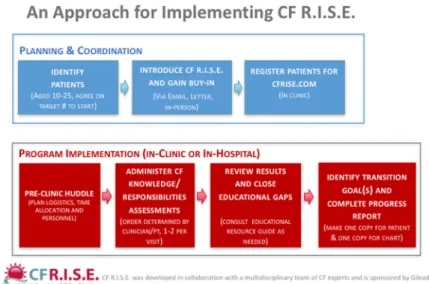
CF Centers. Figure 1 shows a suggested implementation approach to
incorporating CF R.I.S.E. into the clinic.
2.1
|Other CFF initiatives
In 2008, a study of US CF centers demonstrated that less than 25% of
centers typically provided educational material about transition to
patients and families, and only 18% had designed specific programs to
foster education and readiness skills.23The CFF has put into place multiple tools to rectify this situation, including CF R.I.S.E (as described in
section 2), PACE (Program for Adult Care Excellence) awards and
equivalents for pulmonary and non-pulmonary adult providers, and the
Learning and Leadership Collaboratives (LCC) The PACE award provides
up to three years of mentorship and academic salary support for
individuals interested in advancing the care of adult patients with CF,
which has been used by some trainees to design and institute a transition
program. Through initiatives like the DIGEST (Developing Innovative
Gastroenterology Specialty Training) Program, the CFF is doing its part to
attract academicians trained in gastroenterology. Similarly, CF Related
Diabetes demands the expertise of an endocrinologist who understands
this complication, as well as bone disease and other adult specific
complications. Mentorship programs funded by CFF in Physical Therapy,
Nutrition, Social Work, nursing and others, are helpful in attracting and
training adult CF team members essential to a program caring for adults.
LLC programs sponsored by the CFF utilize the Dartmouth Institutes
Clinical Microsystems Academy curriculum, focusing on quality
improve-ment, meeting skills, leadership, and management skills. For these
collaboratives, QI teams from 6 to 12 different institutions are assigned QI
coaches and conduct weekly phone meetings, periodic conference calls,
and quarterly face-to-face collaborative meetings to learn QI strategies,
tools and methods, and to report on progress. This tools could be crucial
for a center seeking to develop a transition program.
2.2
|Experiences from 3 centers
As noted previously, each CF Center needs to work within the
contraints of their healthcare system to formulate a transition process.
To illustrate how tools can be adapted within an institution, we offer
the examples of how our own centers formulated transition programs.
2.2.1
|University of North Carolina at Chapel Hill
(UNC)
Through the ONECF LLC2, the UNC CF Center created a
multidisci-plinary team involving members of the Pediatric and Adult CF
Programs, patients and parents, to address the transition process.
The focus is on optimizing communication among members of the
pediatric and adult CF teams, engaging patients and their caregivers to
better understand the patient perspective regarding transition, and
adoption of the CF R.I.S.E. program. This particular approach was
selected in order to have a definable measure of success in increasing
health literacy among our patients.
At UNC, transition is discussed at the time of diagnosis. As a
child grows older, increasing attention is paid to the education of
the patient and family in terms of independence and
self-management skills with children encouraged to have at least part
of their clinic visit without the parent in the room beginning in early
adolescence. Adolescents are also asked to identify a goal that they
would like to work on before the next meeting. Beginning at age
16, adolescents are registered for CF R.I.S.E. by a dedicated
transition coordinator, who also troubleshoots the program and
serves as a point of contact between clinic visits. The transition
coordinator role is a position unique to this program and one
critical to its success. Feedback is provided to the pediatric
providers about educational successes and deficiencies identified
by the CF R.I.S.E. modules. Members of the multidisciplinary team
facilitate education by answering questions that are raised by
completion of the knowledge assessments and responsibility
checklists. Patients in the transition pipeline are discussed during
a monthly transition meeting that involves multidisciplinary team
members from both the pediatric and adult care teams; at this time,
incorporating patient and family wishes, an optimal time for
transfer is recommended, typically at least 1 year after high school
graduation. The team also discusses the preferred adult provider,
based on personality, gender preference, and clinic day, among
others.
As the transfer time approaches, patients are met in the pediatric
clinic by the multidisciplinary adult care team and are offered a
handbook that includes contact information and clinic-specific
information about the Adult Care Clinic. Patients and families may
choose to tour the adult clinic, the inpatient adult facilities, or both.
Typically, a patient and their family will meet with adult care team
members 1-2 times prior to the formal transfer. At the designated last
pediatric visit, the pediatric CF nurse and/or transition coordinator
facilitates an appointment in the adult clinic, with the goal being <8
weeks between the two visits to minimize the chance of a significant
health issue interrupting the planned transition. After the patient is
seen in the adult clinic for their first visit, feedback is provided to the
pediatric CF care team. As a QI measure, health related outcomes will
be tracked for a year following the transfer to the adult center.
2.2.2
|Boston Children
’
s Hospital (BCH) and Brigham
& Women
’
s Hospital (BWH) CF center
A multidisciplinary QI initiative led to the implementation of a new
transition program at the combined BCH and BWH CF Center in
collaboration with ONECF LLC2. This program offers a unique and
effective transitional care model.
Part of a hospital-wide transitional care initiative, a cohort of
our Adult CF Program operates within a young adult program
offering ambulatory and inpatient care from adult providers to
those up to 30 years of age, while care to those older than age 30 is
provided at BWH. The program is part of a multi-disciplinary
inter-hospital, inter-health care collaboration, established to support the
age appropriate medical, surgical, and transitional care needs of all
young adult survivors of congenital or acquired pediatric diseases.
It is a model that demonstrates an emphasis on ambulatory and
inpatient transitional care preparation along with age appropriate
care. Within this framework, introduction and discussion of the
transition process at our CF Center begins at time of diagnosis,
whether through newborn screening, diagnosis later in childhood
or adolescence, or upon transfer to our CF center. A transition
policy was developed for the CF center making the program and its
transition processes transparent.
2.2.3
|Phase I
Pediatric caregivers introduce the adult CF program at the earliest
encounter (as noted in section 2.2.2) and at other opportunities (eg,
Family Education Night) to alert patients and families of the existence
of the transition process. By age 14, or sooner for some patients, the
parents will be asked to leave the room for a portion of the visit with
the full transition process starting at age 16.
2.2.4
|Phase II
The transition process starts with identification of patients turning age
16. A member of the CF multidisciplinary transition team (clinic RN’s,
CF center NP’s, or pediatric social workers) is assigned as“transition
coordinator”for each patient. A letter and/or email is sent out to the
family and patient to alert them of the upcoming process. The
transition coordinator is responsible for guiding the patient through
the transition process and documentation of an up-to-date checklist
which also allows any member of the team to step in and work with the
adolescent before the multidisciplinary team presentation to the adult
CF team. The transition coordinator works with providers, patient, and
family during clinic visits, and hospitalizations when appropriate and
provides feedback. The tasks on the checklist include completion of a
minimum number of CF R.I.S.E. modules while the multidisciplinary
team works together with each patient to perform a comprehensive
review of all aspects of their care. As the patient approaches the end of
this second phase, an adult pulmonologist is identified when
appropriate, Health Care Proxy and HIPPA forms are signed and
2.2.5
|Phase III
A patient’s transfer to adult care is brought up for discussion at
quarterly meetings held jointly with members of the pediatric and adult
multi-disciplinary teams in attendance. Individual patients are
gener-ally discussed around 18-21 years of age, but in some exceptional
cases up to age 26. A timeline toward eventual transfer is determined
and an adult provider is chosen to meet with the patient prior to
transfer to the adult CF program. The transition process continues as
the adult team resumes work where the pediatric team left off and
toward mastery of the skills necessary for an adult with CF.
2.2.6
|University of Michigan, Ann Arbor, MI (U of M
CFC)
The U of M CFC transition program was developed in 1980. Its goal
was to assure patient follow- through and to reduce the incidence of
patients dropping out of the health-care system.9 The U of M Transition Program consists of two phases.8
2.2.7
|Phase 1. preparing for transition
The transition process is introduced to patients and families at time of
diagnosis or at their first visit to the center. As patients get older, a shift
from interacting with parents to interacting with patients is done with a
focus on reeducation about the disease process. Independent visits are
offered and encouraged. Intervention with the adolescents and families to
help improve adherence to treatment and resolve any conflicts is done.
There is a focus on anxiety and depression screening and intervention for
all adolescents and parents. One of the center priorities is having the adult
CF team as an integral part of the annual newsletter and family education
function to demonstrate collaboration between the two programs.The
pediatric team evaluates patients for transfer readiness through mid to
late teenage years and re-introduces the transfer process to patients. In
addition, patients who are turning 18 years of age are periodically
discussed in the joint Pediatric and Adult CF Programs monthly meeting
which is attended by the two CF Center Directors, CF Center coordinators
and the transition coordinator (the pediatric center social worker).
2.2.8
|Phase II. active transition process
At 16 years of age, the pediatric pulmonary team discuss the process with
the patient and family. The adult pulmonologists are reviewed and a choice
of one is made. A patient ready for transfer is reviewed in the monthly
pediatric-adult CF meeting. Medical records are reviewed by the adult
pulmonologist, followed by an appointment in the pediatric clinic attended
by the pediatric and adult teams to provide opportunities for interaction
between the medical teams and patients and families. A tour of the adult
inpatient and outpatient facilities is offered prior to the transition to adult
care. If the patient and family are not ready after this joint clinic session, the
session is repeated up to three times.
Even though the transition program was established in 1980 and
went through assessment and revision twice,9,8the program lacked an
objective way to evaluate patients knowledge about CF and readiness for
transfer to the adult program. To address these deficiencies, CF R.I.S.E.
was adopted to provide patients, families, and the care team with tools
that can be flexibly implemented to help manage transition and transfer. It
complements the existing transition program with the most needed
tools.30CF R.I.S.E. has been used since 2012 with more patient/families
satisfaction with the transition process.
At U of M, there is a transition program for all patients with genetic or
chronic childhood diseases. This program is in the early phase of
development compared to the CF transition program. It covers technology
dependent patients, sickle cell disease, muscular dystrophy, and others.
This transition program studied the CF transition process and CF R.I.S.E. at
the U of M and used some of the knowledge assessments and
responsibility checklists after modifications.
2.2.9
|Transitioning across the healthcare spectrum
Beyond CF, between 500 000 to 750 000 adolescents with special health
care needs will transfer annually to adult care teams.37Medical advances
have led to an increase in adult survivors of chronic illness, much like CF.
Each survivor of a congenital or pediatric acquired chronic disease brings
its own set of challenges to the transition process and while there is
increasing attention to the development of appropriate transition
programs, there is still much work to be done.14The knowledge attained
from the literature on this subject is heavily populated by our experiences
from CF. The early push and financial support from the CFF toward
development of adult CF care centers decades ago highlights the role CF
has played in this field.
However, the field of transitional care medicine and research is
also moving forward nationally. Given the lack of consensus and the
limited agreement on successful outcome measures, leaders in the
field and those taking part in the Interdisciplinary Health Care
Transition Research Consortium (HCTRTC) have identified a list of
outcomes for researchers in the field to validate with quality of life as a
target outcome measure.38 The need for alternative outcome
measures for those with cognitive disabilities underscores the
challenges facing transitional care efforts across the chronic disease
landscape. Models of inclusive, hospital-wide initiatives are beginning
to take shape to address the challenges faced by free-standing
children’s hospitals across the country. The Center for Youth and
Adults with Conditions of Childhood (CYACC) at Indiana University has
an outpatient consultative model while the Transition Medicine Clinic
has a Primary Care Model focus. Children’s Mercy in Kansas City has
challenged primary or specialty care programs to join a hospital-wide
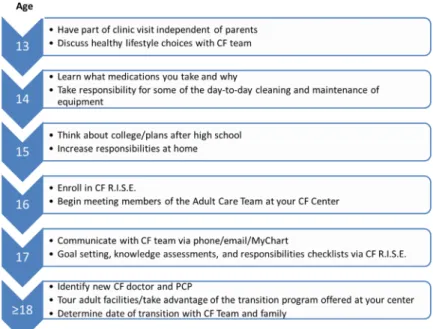
transition plan. Figure 2 suggests an age-based model for guiding CF
patients on expectations for transition during adolescence; this
guideline can be modified for individual patients.
2.3
|Outcomes
Limited data currently exists regarding health outcomes following
transition, including mortality, acquisition of new bacterial species, and
patients followed for 1 year before and after transition to an adult
center showed a non-significant decrease in lung function and no
changes in sputum microbiology or requirement for antibiotics.15
Another study used propens-matched scoring in a cohort of patients
from the CF Foundation Patient Registry and showed a less rapid
decline in lung function 2 years after a cohort of age-appropriate
patients who transitioned to an adult clinic versus those who did not.
There were no significant differences in BMI, hospitalization, and use
of home IV antibiotics.39A more recent study performed structured
interviews with 45 recently transitioned patients, and noted that
although there was significant individual variability, the mean FEV1
and BMI did not change 1 year after transfer. Importantly, there was a
sense of optimistic acceptance about the future.40As more centers are
becoming engaged in the creation of a formalized transition program, it
would behoove the community to study post-transition outcomes
further, including BMI, FEV1, pulmonary exacerbations, and patients
lost to follow-up after transfer.
2.4
|Special considerations
Certain circumstances deserve special consideration to determine
when, and if, transfer to an adult care team is appropriate. One
such case is that of the adolescent CF patient who is actively dying.
Most caregivers would agree that it would be in the best interest of
the patient and family to remain with the pediatric care team
throughout this difficult process, with reassessment occurring if
the patient’s health changes. Patients who are under consideration
for lung transplant should also be considered separately. In many
centers, multidisciplinary care for a transplanted patient is
provided by a team of professionals that is distinct from the CF
FIGURE 2 Suggested transition guideline for patients based on age
TABLE 1 Suggestions for best practices for transition Patient level Begin discussions of transition early in life
Develop a road map in preparation for transition readiness, disease knowledge, and skills assessment to share with patients and families
Create a personalized medical summary to ensure seamless continuity of care, especially where an electronic medical record is not shared by pediatric and adult programs
CF team level Create an open and transparent dialogue between the pediatric and adult CF programs
Develop a working transitional care policy at all levels of the multidisciplinary team (include input from patients and parents)
Create a registry of eligible patients and a plan to discuss them periodically
Identify outcome measures to monitor progress and success, including establishment of best practices and communication among pediatric and adult care teams
Institutional level
Seek institutional leadership buy-in
Collaborate with other hospital programs focused on transition
Care team. In these circumstances, one must weigh risks and
benefits to the patient unnecessarily enduring two transfers, the
first from pediatrics to adult care team and the second from the
adult care team to the transplant team. Children with special health
care needs outside of CF, including mental health, are another
distinct population that may not fall clearly into a single transition
model. Depending on local resources and specialty providers, it
may best benefit the child and the family to have a mix of adult and
pediatric care providers. Communication is key to facilitate these
transitions. In any scenario, the authors advocate for ongoing
education and preparation of the patient with CF to ultimately
assume responsibility for their health care.
3
|S U M M A R Y
The ongoing successes of personalized medicine, acute and chronic
medical therapies, quality improvement initiatives, initiatives
targeting adherence, multidisciplinary care models, patient and
family involvement, and more, have led to significant increase in
median life expectancy of CF patients and an increasing number of
adult CF patients.2 This change in the landscape of the disease underscores the importance of coordinated transitions of care.
Caregivers of those with CF continue to be at the forefront for
developing models of transitional care support for individuals living
with complex, multi-system, chronic illnesses. Pediatric CF
programs need to strengthen their focus on preparing adolescents
and young adults in order to facilitate continued success and stable
health outcomes in adult CF programs. Our combined experiences
have made it clear that a comprehensive transitional care
framework is essential to successfully transition a patient from a
pediatric to an adult CF program. They also illustrate the flexibility
of creating a transition program that adapts to the larger healthcare
environment within individual institutions. Table 1 provides a set of
guidelines that were crucial in the development of a transition
program at the three sites represented in this article; other centers
seeking to develop a transition process may use them to initate
discussions.
ORCID
Jennifer L. Goralski http://orcid.org/0000-0002-6785-5076
R E F E R E N C E S
1. Blum RW. Transition to adult health care: setting the stage.J Adolesc
Health. 1995;17:3–5.
2. Foundation CF. Annual data report.Patient Registry. 2015.
3. Okumura MJ, Hersh AO, Hilton JF, Lotstein DS. Change in health status and access to care in young adults with special health care needs: results from the2007 national survey of adult transition and health.J Adolesc Health. 2013;52:413–418.
4. Tuchman LK, Schwartz LA, Sawicki GS, Britto MT. Cystic fibrosis and transition to adult medical care.Pediatrics. 2010;125:566–573.
5. Stam H, Hartman EE, Deurloo JA, Groothoff J, Grootenhuis MA. Young adult patients with a history of pediatric disease: impact on course of life and transition into adulthood. J Adolesc Health. 2006;39:4–13.
6. Congleton J, Hodson ME, Duncan-Skingle F. Quality of life in adults with cystic fibrosis.Thorax. 1996;51:936–940.
7. Pfeffer PE, Pfeffer JM, Hodson ME. The psychosocial and psychiatric side of cystic fibrosis in adolescents and adults. J Cyst Fibros. 2003;2:61–68.
8. Chaudhry SR, Keaton M, Nasr SZ. Evaluation of a cystic fibrosis transition program from pediatric to adult care. Pediatr Pulmonol. 2013;48:658–665.
9. Nasr SZ, Campbell C, Howatt W. Transition program from pediatric to adult care for cystic fibrosis patients. J Adolesc Health. 1992;13: 682–685.
10. Flume PA. Smoothing the transition from pediatric to adult care: lessons learned.Curr Opin Pulm Med. 2009;15:611–614.
11. Flume PA, Anderson DL, Hardy KK, Gray S. Transition programs in cystic fibrosis centers: perceptions of pediatric and adult program directors.Pediatr Pulmonol. 2001;31:443–450.
12. Rosen D. Between two worlds: bridging the cultures of child health and adult medicine.J Adolesc Health. 1995;17:10–16.
13. Nakhla M, Daneman D, To T, Paradis G, Guttmann A. Transition to adult care for youths with diabetes mellitus: findings from a Universal Health Care System.Pediatrics. 2009;124:e1134–e1141.
14. Cooley WC, Sagerman PJ, American Academy of Pediatrics, American Academy of Family Physicians, American College of Physicians, Transitions Clinical Report Authoring Group. Supporting the health care transition from adolescence to adulthood in the medical home.
Pediatrics. 2011;128:182–200.
15. Dugueperoux I, Tamalet A, Sermet-Gaudelus I, et al. Clinical changes of patients with cystic fibrosis during transition from pediatric to adult care.J Adolesc Health. 2008;43:459–465.
16. Okumura MJ, Kleinhenz ME. Cystic fibrosis transitions of care: lessons learned and future directions for cystic fibrosis. Clin Chest Med. 2016;37:119–126.
17. West NE, Mogayzel PJ, Jr. Transitions in health care: what can we learn from our experience with cystic fibrosis. Pediatr Clin North Am. 2016;63:887–897.
18. Rosen DS. Transition to adult health care for adolescents and young adults with cancer.Cancer. 1993;71:3411–3414.
19. Siklosi KR, Gallagher CG, McKone EF. Development, validation, and implementation of a questionnaire assessing disease knowledge and understanding in adult cystic fibrosis patients.J Cyst Fibros. 2010;9: 400–405.
20. Kazmerski TM, Gmelin T, Slocum B, Borrero S, Miller E. Attitudes and decision making related to pregnancy among young women with cystic fibrosis.Matern Child Health J. 2017;21:818–824.
21. Sawicki GS, Sellers DE, McGuffie K, Robinson W. Adults with cystic fibrosis report important and unmet needs for disease information.
J Cyst Fibros. 2007;6:411–416.
22. Malbrunot-Wagner AC, Bonnemains C, Troussier F, et al. [Transition from pediatric to adult care: experience of a cystic fibrosis care center].
Arch Pediatr. 2009;16:235–242.
23. McLaughlin SE, Diener-West M, Indurkhya A, Rubin H, Heckmann R, Boyle MP. Improving transition from pediatric to adult cystic fibrosis care: lessons from a national survey of current practices.Pediatrics. 2008;121:e1160–e1166.
24. Boyle MP, Farukhi Z, Nosky ML. Strategies for improving transition to adult cystic fibrosis care, based on patient and parent views.Pediatr
Pulmonol. 2001;32:428–436.
26. Cohen SE, Hooper SR, Javalkar K, et al. Self-Management and transition readiness assessment: concurrent, predictive and discrimi-nant validation of the STARx questionnaire.J Pediatr Nurs. 2015;30: 668–676.
27. Ferris M, Cohen S, Haberman C, et al. Self-management and transition readiness assessment: development, reliability, and factor structure of the STARx questionnaire.J Pediatr Nurs. 2015;30:691–699. 28. Sawicki GS, Lukens-Bull K, Yin X, et al. Measuring the transition
readiness of youth with special healthcare ne eds validation of the TRAQ-transition readiness assessment questionnaire.J Pediatr Psy-chol. 2011;36:160–171.
29. Wood DL, Sawicki GS, Miller MD, et al. The transition readiness assessment questionnaire (TRAQ): its factor structure, reliability, and validity.Acad Pediatr. 2014;14:415–422.
30. Iles N, Lowton K. What is the perceived nature of parental care and support for young people with cystic fibrosis as they enter adult health services?Health Soc Care Community. 2010;18:21–29.
31. Crosnier H, Tubiana-Rufi N. [Modalities of transition of diabetic adolescents from pediatrics to the adult care in the Paris-Ile-de-France region: an appeal to cooperative work for improving quality of care. Paris-Ile-de-France Section of DESG (Diabetes Education Study Group) in French language]. Arch Pediatr. 1998;5: 1327–1333.
32. Campbell F, Biggs K, Aldiss SK, et al. Transition of care for adolescents from paediatric services to adult health services.Cochrane Database
Syst Rev. 2016;4:CD009794.
33. Richter KP, Faseru B, Mussulman LM, et al. Using“warm handoffs” to link hospitalized smokers with tobacco treatment after discharge: study protocol of a randomized controlled trial.Trials. 2012;13:127.
34. Huang JS, Gottschalk M, Pian M, Dillon L, Barajas D, Bartholomew LK. Transition to adult care: systematic assessment of adolescents with chronic illnesses and their medical teams. J Pediatr. 2011;159: 994–998. e2.
35. Bregnballe V, Boisen KA, Schiotz PO, Pressler T, Lomborg K. Flying the nest: a challenge for young adults with cystic fibrosis and their parents.
Patient Prefer Adherence. 2017;11:229–236.
36. Baker AMR KA, Sawicki GS, Eakin MN. CF RISE: implementing a clinic-based transition program.Pediat Aller Imm Pul. 2015;28:250–254. 37. Scal P, Ireland M. Addressing transition to adult health care for
adolescents with special health care needs. Pediatrics. 2005;115: 1607–1612.
38. Fair C, Cuttance J, Sharma N, et al. International and interdisciplinary identification of health care transition outcomes. JAMA Pediatr. 2016;170:205–211.
39. Tuchman L, Schwartz M. Health outcomes associated with transition from pediatric to adult cystic fibrosis care. Pediatrics. 2013;132: 847–853.
40. Askew K, Bamford J, Hudson N, et al. Current characteristics, challenges and coping strategies of young people with cystic fibrosis as they transition to adulthood.Clin Med (Lond). 2017;17:121–125.
How to cite this article:Goralski JL, Nasr SZ, Uluer A.
Overcoming barriers to a successful transition from pediatric
to adult care.Pediatric Pulmonology. 2017;52:S52–S60.