STATISTICAL LEARNING OF INTEGRATIVE ANALYSIS
Meilei Jiang
A dissertation submitted to the faculty of the University of North Carolina at Chapel Hill
in partial fulfillment of the requirements for the degree of Doctor of Philosophy in the
Department of Statistics and Operations Research.
Chapel Hill
2018
©
2018
Meilei Jiang
ABSTRACT
MEILEI JIANG: Statistical Learning Of Integrative Analysis
(Under the direction of J. S. Marron and Jan Hannig)
Integrative analysis is of great interest in modern scientific research. This dissertation mainly
focuses on developing new statistical methods for integrative analysis.
We first discuss a clustering analysis of a microbiome dataset in combination with phylogenetic
information. Discovering disease related pneumotypes of the infected lower lung is difficult because
the lower lung typically has few species of microbes and there is a low level of overlap from
patient-to-patient, which makes it hard to calculate reliable distances between patients. We address this
challenge by incorporating information from phylogenetic relationships, which results in improved
clustering. When applied to an existing dataset, the method produces statistically distinct, easily
described pneumotypes, which are better than those from standard approaches.
In the second part, we discuss an integrative analysis of disparate data blocks measured on a
common set of experimental subjects. We introduce Angle-Based Joint and Individual Variation
Explained (AJIVE) capturing both joint and individual variation within each data block. This
is a major improvement over earlier approaches to this challenge in terms of a new conceptual
understanding, much better adaption to data heterogeneity and a fast linear algebra computation.
Detailed comparison between AJIVE and competitors is discussed using a particular optimization
view point.
ACKNOWLEDGEMENTS
This dissertation would have not been completed without the help, inspiration, and
encourage-ment from many individuals during the last five years of my PhD study.
Foremost, I would like to express my sincere gratitude to my advisors, Professor J. S. Marron
and Professor Jan Hannig, for their guidance and support. Their patience, inclusive mindset,
immense knowledge and academic enthusiasm make me have a great experience of PhD life. Not
only I gain many knowledge, but also I learn the way to be a great scholar as well as a good person
from them. It is a great pleasure and luck for me to have them as my advisors.
Besides my advisors, I am grateful to Doctor Perry Haaland, my boss at Becton Dickinson
Technologies. Part of my dissertation is accomplished when I was an intern at there. I greatly
appreciate the support and guidance from him. My sincere thanks also go to Professor Yufeng Liu,
Professor Shankar Bhamidi, Professor Kai Zhang and Professor Yin Xia for their encouragement
and great help during my PhD study. In addition, I also want to express my thanks to the committee
member Professor Nicolas Frainman for reading my dissertation and providing useful comments.
TABLE OF CONTENTS
LIST OF TABLES . . . ix
LIST OF FIGURES . . . .
x
1
Introduction . . . .
1
2
Finding Community Subtypes On Microbiome Dataset . . . .
3
2.1
Introduction . . . .
3
2.2
Methods . . . .
6
2.2.1
Standard clustering algorithms for microbiome analysis . . . .
6
2.2.2
Object Oriented Data Analysis viewpoint . . . .
7
2.3
Analysis of the real microbiome data . . . .
8
2.3.1
Data description and processing . . . .
8
2.3.2
Computing the phylogenetic tree . . . .
9
2.3.3
k
-means clustering on TWA . . . 10
2.3.4
Description of TWA subgroups based on diagnosis . . . 11
2.3.5
Principal components visualization . . . 12
2.3.6
Comparison of results from other approaches . . . 15
2.4
Simulation study . . . 18
2.4.1
Simulation settings . . . 18
2.4.2
Data generating model . . . 19
2.4.3
Results of the simulation study . . . 21
2.5
Discussion . . . 23
2.5.1
Comparison between the LRI microbiome data and the simulation study . . . 23
2.5.2
Calculation of ratio . . . 23
3
Angle-Based Joint And Individual Variation Explained . . . 26
3.1
Introduction . . . 26
3.1.1
Toy Example . . . 30
3.2
JIVE . . . 34
3.2.1
Model . . . 34
3.2.2
Estimation . . . 35
3.3
AJIVE . . . 38
3.3.1
Population model . . . 38
3.3.2
Step 1: Signal Space Initial Extraction . . . 40
3.3.2.1
Initial Low Rank Approximation . . . 41
3.3.2.2
Approximation Accuracy Estimation . . . 42
3.3.3
Step 2: Score Space Segmentation . . . 48
3.3.3.1
Two Block Case . . . 48
3.3.3.2
Multi-block Case . . . 51
3.3.4
Step 3: Final Decomposition And Outputs . . . 56
3.4
Data Analysis . . . 58
3.4.1
TCGA Data . . . 58
3.4.2
Spanish Mortality Data . . . 62
4
Relationship Between AJIVE And Existing Integrative Methods . . . 67
4.1
SVD of the concatenated data blocks . . . 67
4.2
Partial least squares (PLS) . . . 69
4.3
Principal angle analysis (PAA) . . . 72
4.4
Canonical correlation analysis (CCA) . . . 75
4.5
Flag mean . . . 78
4.6
Common Orthogonal Basis Extraction (COBE) . . . 79
5
Perturbation Analysis For A Given Direction . . . 81
5.2
Perturbation analysis framework for a given direction . . . 82
5.2.1
Population model . . . 82
5.2.2
Signal space extraction . . . 85
5.2.3
Review of useful asymptotic results . . . 89
5.2.4
Direction specific perturbation angle estimation . . . 92
5.3
Algorithm . . . 96
5.4
Simulation study . . . 97
5.4.1
Direction specific perturbation angle estimation . . . 98
5.4.2
Gaussian vs non-Gaussian . . . 103
5.4.3
AJIVE directions perturbation analysis . . . 111
5.5
AJIVE directions perturbation analysis on TCGA dataset . . . 113
LIST OF TABLES
2.1
Calinski-Harabasz index values and SWISS scores from
k
-means clustering
on different data objects. This shows much better clustering performance
for TWA.. . . 16
2.2
Four methods of microbiome clustering analysis. . . 18
3.1
Coverages of the prediction intervals of the true angle between the signal
row(
A
k,1) and its estimator row( ˜
A
k) for the matrix
X
in the toy example.
Rows are nominal levels. Columns are ranks of approximation (where 2 is
the correct rank). The simulation based on 10000 realizations of
X
shows
good performance for this square matrix. . . 48
5.1
Perturbation analysis for AJIVE directions on the toy dataset. . . 111
5.2
Perturbation analysis for the adjusted AJIVE directions of the toy dataset. . . 112
5.3
Perturbation analysis for the middle point of
L
1. . . 113
LIST OF FIGURES
2.1
Operational taxonomic unit (OTU) relative abundances for the LRI
micro-biome. Rows represent subjects and columns represent OTUs. Each entry
is the proportion of the observed read counts over the total observed read
counts for a subject. Columns are ordered by the positions of OTUs in
the phylogenetic tree. It shows many zero values, and great diversity of
non-zero values, which motivates our approach. . . .
4
2.2
Heat map mutual information comparison of TWA and PCoA. Shades of
blue show superior performance of TWA, with white used for essentially
similar cases, and red when PCoA is better. The vertical axis represents
the strength of alignment between the phylogenetic tree and clustering in
the data. The horizontal axis represents how strongly relative abundances
are concentrated in the parts of the phylogenetic tree related to the clusters.
This shows a large range of biological settings where TWA is better. . . .
5
2.3
The unrooted phylogenetic tree computed by PhyloPhlAn. Tips are labeled
with the OTU names. Tips are colored based on the phylum identification
from NCBI. In general, this tree is consistent with the NCBI taxonomy. . . 10
2.4
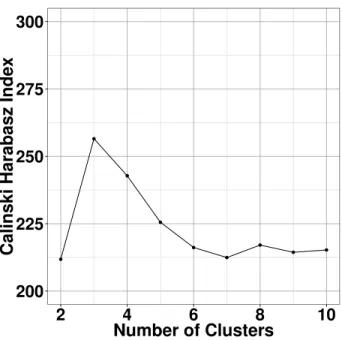
Calinski Harabasz index values for different numbers of clusters for
k-means
on TWA. Larger value of Calinski Harabasz index indicates a better
sepa-rated clustering results.The optimal clustering should be given by the first
local maximum of the values. For this microbiome data, 3-means clustering
gives the optimal result while 4-means clustering is reasonably good as well. . . 11
2.5
Phylum level relative abundances by subtype from TWA and PCoA. The
left panel shows the barplot of the subject subtype identified by TWA,
and the right panel shows the corresponding barplot for PCoA. For each
subject, relative abundances are aggregated at the phylum level. For each
subtype, the phylum percentages are the means of RA for all OTUs in that
phylum across the subjects in that subtype. Bar heights show number of
subjects in that subtype. The TWA clustering appears to do a better job
of separating subjects with dominant
Proteobacteria
infections from those
with dominant
Firmicutes
infections. . . 12
2.6
Distribution of diagnosis groups in each subtype. The diagnosis groups are
not of equal sizes so in order to compare the distributions of the diagnoses
across subtypes, we calculated the percent of each diagnosis that is
asso-ciated with each subtype. Bars of the same color add up to 100%. All
diagnoses except for Aspiration Pneumonia are equally represented in
Sub-type 1. Aspiration Pneumonia is over represented in SubSub-type 2 where as the
Control group is under represented. The Control group is over represented
2.7
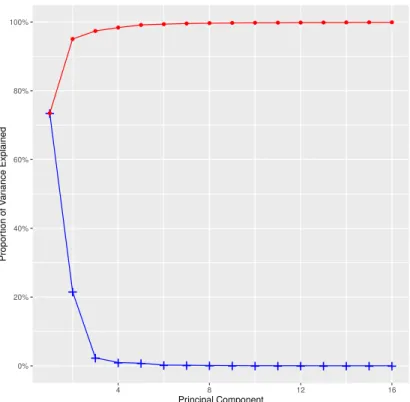
The PCA scree plot of TWA matrix. The scree plot of first sixteen PCs
shows the proportion of total variance attributed to each principal
compo-nent (blue line) and the cumulative variance explained (red line). The first
three principal components explain about 96% percent of the variance in
the data. The first seven PCs explain 99.3% of the total variation. The
first sixteen PCs explain 99.9% of the total variation. . . 14
2.8
The PCA scatter plot matrix for TWA. Visualization of the first three
principal components. The points are colored based on their subtype
mem-bership from the 3-means clustering on TWA shown in Figure 2.5. The
plots on the diagonal show the univariate distribution for each of the three
PCs. Off diagonal plots are the pairwise scatter plots. The three clusters
are clearly differentiated in the plot of PC1 versus PC2. . . 14
2.9
Subject cluster labels generated through different approaches and the
cor-responding relative abundance matrix. The left side of the figure shows
three columns. Each column corresponds to an approach; RA, PCoA and
TWA. The rows (subjects) are ordered by cluster labels of TWA results.
The entries are color coded by cluster membership. The plot on the right
shows the RA matrix, where the rows correspond to the colored bar. The
column order is based on the phylogenetic tree. This shows TWA gives the
most useful clustering. . . 15
2.10 The PCA scatter plots based on the RA matrix. Visualization of the first
three principal components of RA. The plots on the diagonal show the
univariate distribution for each of the three PCs. Off diagonal plots are the
pairwise scatter plots. The points in Figure 2.10(a) and Figure 2.10(b) are
colored based on RA clustering and TWA clustering subtypes respectively.
The TWA subtypes are not very related to this view. . . 17
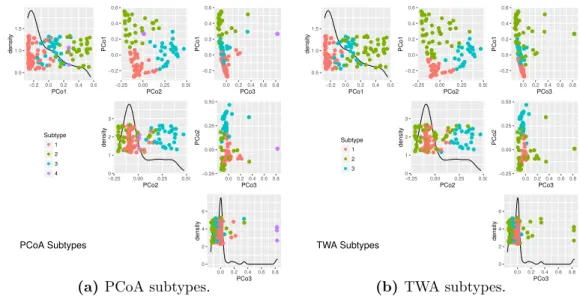
2.11 The scatter plots based on the PCoA scores matrix. Visualization of the
first three principal coordinates of PCoA scores matrix. Format is similar
to Figure 2.10. The points in Figure 2.11(a) and Figure 2.11(b) are colored
based on PCoA clustering and TWA clustering subtypes respectively. PCo1
and PCo2 separates three PCoA subtypes and TWA subtypes. PCoA
Sub-type 4 can be seen as the small set of purple points in the PCo3 dimension
in Figure 2.11(a). . . 17
2.12 Comparison between TWA and other methods by home set abundance odds
ratio (r) and tree distance ratio (d). The left subfigure shows mean NMI
values for representative
d
values and for all values of
r
. The right subfigure
shows mean NMI values for representative
r
values and for all values of
d
.
Error bars represent two times the standard error. From the left subfigure,
TWA is superior to RA except the case
d
= 1 where their performance
are almost the same; TWA dominates PCoA in most cases. PCoA has the
best performance when both
d
and
r
are small. In the right subfigure, for
each value of
r
, NMI of TWA and PCoA converges to the same limit as
d
increases. But TWA converges faster than PCoA. The blue dashed lines
3.1
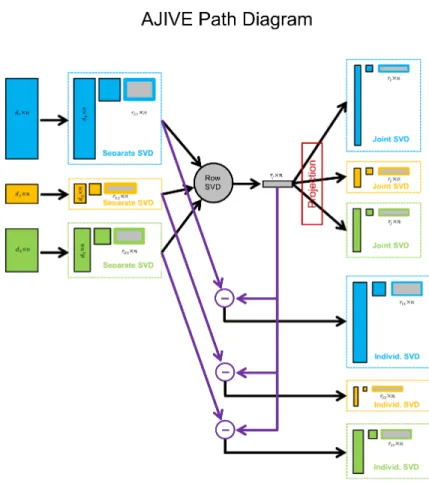
Flow chart demonstrating the main steps of AJIVE. First low rank
approxi-mation of each data block is obtained on the right. Then in the middle joint
structure between the low rank approximations is extracted using SVD of
the stacked row basis matrices. Finally, on the right, the joint components
(upper) are obtained by projection of each data block onto the joint basis
(middle) and the individual components (lower) come from orthonormal
basis subtraction. . . 28
3.2
Data blocks
X
and
Y
in the toy example . . . 32
3.3
AJIVE approximation of the toy data . . . 33
3.4
The old JIVE approximation of the toy data . . . 37
3.5
Scree plots for the toy data . . . 42
3.6
Principal angle plots between each singular subspace of the signal matrix
A
k,1and its estimator ˜
A
kfor the toy dataset. Graphics for
X
are on the
upper row, with
Y
on the lower row. The left, middle and right columns
are the under-specified, correctly specified and over-specified signal matrix
rank cases respectively. Each x-axis represents the angle. The y-axis shows
the values of the survival function of the resampled distribution, which are
shown as blue plus signs in the figure. The vertical blue solid line is the
theoretical Wedin bound, showing this bound is well estimated. The
verti-cal black solid line segments represent the principal angles
θ
k,1, . . . , θ
k,rk∧˜rkbetween row(
A
k,1) and row( ˜
A
k). The distance between the black and blue
lines reveals when the Wedin bound is tight. . . 46
3.8
Squared singular values in (3.8) and bounds for Step 2 of AJIVE for various
rank choices. The black vertical line segments shows the first ˜
r
1∧
r
˜
2squared
singular values of
M
in equation (3.8). The values of the survival function
of the random direction bounds are shown as the red circles and the red
dot-dashed line is the 95th percentile of this distribution, which is the random
direction bound. The values of the c.d.f of the Wedin bound are shown as
the blue plus signs and the 5th percentile (blue dashed line) is used for a
prediction interval for the Wedin bound. In the two-block case presented
here this contains the essentially same information as in Figure 3.7. For
the multi-block case it is the major diagnostic graphic. . . 55
3.9
Squared singular value diagnostic graphics for TCGA dataset over various
rank choices. Indicates that there are one joint component among four data
blocks and one joint component among three data blocks. . . 60
3.10 Left: Kernel density estimates of the CNS among GE, CN, RPPA and
mutation. The clear separation among Luminal A versus Her2 and Basal
indicates that these four data blocks share a very strong Luminal A
prop-erty captured in this joint variation component; Right: The CNS from
applying AJIVE to the individual matrices of GE, CN, and RPPA. The
clear separation indicates that these contain a joint variation component
that is consistent with the subtype difference between Basal versus the others. . . 61
3.11 Principal angle diagnostic graphics for Spanish mortality data set over
var-ious rank choices. Provides the rationale of the rank choice, ˜
r
1= 3
,
r
˜
2= 2. . . 63
3.12 The first block specific joint components of male (left panel) and female
(right panel) contain the common modes of variation caused by the overall
improvement across different age groups, as can be seen from the scores
plots in the right bottom of each panel. The dramatic decrease happened
around the 1950s shown in the columns plots. The degree of decrease varies
over age groups. . . 65
3.13 The second joint components of male (left) and female (right) contain the
common modes of variation driven by the increase in fatalities caused by
automobile penetration and later improvement due to safety improvements.
This can be seen from the scores plots in the right bottom. The loadings
plots show that this automobile event exerted a significantly stronger
im-pact on the 20-45 males. . . 65
3.14 The individual component of male contains the variation driven by the
Spanish civil war which can be seen from the blue circles on the right end
of the right bottom plot. The Spanish civil war mainly affected the young
to middle age males. . . 66
5.1
The graphs of different shrinkage functions under the standard model (5.5).
The horizontal axis represents empirical singular value. The vertical axis
shows shrunken singular values. The blue solid lines show the graphs of the
optimal shrinkage function
η
sn. The black dashed lines and the purple
dot-dashed lines show the graphs of the optimally tuned soft and hard threshold
functions. The left and right panel shows the case of square and non-square
matrices respectively. This figure is produced by modifying code from the
supplement of Gavish and Donoho (2017). . . 88
5.2
Singular value thresholds for the toy data . . . 89
5.3
Shows the direction specific perturbation angles for different vectors in the
estimated signal row space of
X
, a square matrix introduced in Section 3.1.1
of Chapter 3. The
x
-axis represents angles and the
y
-axis represents the
values of empirical distribution of resampled direction specific perturbation
angles. The vertical blue lines segment on the upper side of each panel show
the value of true direction specific perturbation angle. The blue plus signs
show the empirical distribution of the bootstrap samples of perturbation
angles. The black vertical lines on the lower part of each panel show the
principal angles between the signal space and the estimated signal space.
The vertical cyan dot-dashed lines show the values of the Wedin bound
of the perturbation angle between the signal space and the estimated
sig-nal space. The purple dashed line and solid line show the perturbation
bounds from Theorem 1 and Proposition 1 in Cai et al. (2018) respectively.
Panel 5.3(d) shows the case of rank underestimation, ˆ
r
x= 1. In all other
panelsthe signal rank of
X
is correctly specified, i.e. ˆ
r
x= 2. The half value
of random angle bound is not shown on this figure since it is larger than
all of these angles. . . 99
5.4
Shows the direction specific perturbation angles for different vectors in the
estimated signal row space of
Y
, a non-square matrix introduced in
Sec-tion 3.1.1 of Chapter 3.In Panel 5.4(a), 5.4(b), 5.4(c) and 5.4(d), the signal
rank of
Y
is correctly specified, i.e., ˆ
r
y= 3. In Panel 5.4(e) and 5.4(f), the
signal rank is underestimated, ˆ
r
y= 2. . . 101
5.5
Shows the direction specific perturbation angles for different vectors in the
estimated signal row space of
X
when the signal rank, ˆ
r
x= 3, is over
estimated. The vertical red dashed lines show the half of the values of
random angle bound. The perturbation bounds from Cai et al. (2018) are
90
°
, which are not useful in this case. . . 102
5.6
Shows the direction specific perturbation angles for different vectors in the
estimated signal row space of
Y
when the signal rank, ˆ
r
y= 4, is over
5.7
Scree plots of singular values for data matrices with Gaussian noise. The
x
-axis represents the principal component index, and the
y
-axis shows the
singular values. The black stars show the values of the true signal singular
values. The blue circles and red pluses show the values of the empirical and
shrunken singular values respectively. The horizontal red dashed lines show
the empirical singular value thresholds. The horizontal green dashed lines
show the value
β
1/4in each matrix, which is the cutoff for distinguishable
signal singular values. This shows the singular value shrinkage function
in (5.7) works well in the Gaussian noise case. . . 105
5.8
Scree plot of singular values for data matrices with Student
t
noise. This
shows the singular value shrinkage function in (5.7) works well in the
non-Gaussian noise case. . . 106
5.9
Histogram of empirical singular values. The
x
-axis shows the empirical
singular value and the
y
-axis shows the count of each bin. The vertical
red dashed lines show the empirical singular value thresholds. The vertical
green dashed lines show the theoretical bulk edge, 1 +
√
β
, in each matrix.
This figure shows that the distributions of the empirical singular values
from both Gaussian and non-Gaussian noise matrices follow the generalized
quarter circle law. . . 108
5.10 Direction specific perturbation angles for empirical principal components
for data matrices with Gaussian noise. The black dots show the values
of true perturbation angle. The blue and green dots show the values of
the 95th and 5th percentiles of the resampled perturbation angles. The
horizontal dashed cyan lines show the values of the Wedin bound. The
horizontal red dashed lines show the half values of the random direction
bound. This figure indicates the direction specific estimation algorithm in
Section 5.3 works well for the Gaussian noise case. . . 109
5.11 Direction specific perturbation angles for empirical principal components
CHAPTER 1
Introduction
In the past decade, we are experiencing the era of “big data” and “information explosion”.
Recently many datasets are large-scale not only in the sense of large-sample size and high dimension,
but also in the sense of being multi-source. It is a ubiquitous challenge as well as opportunity for
modern scientific research to integrate the information from disparate data blocks measured on a
common set of experimental subjects. This thesis aims at addressing this challenge by developing
new statistical learning methods for integrative analysis.
Chapter 2 discusses a clustering analysis of a microbiome dataset which incorporates
phyloge-netic information. Modern genomic methods have led to a dramatic increase in the ability to study
a wide variety of microbiomes. In particular, this has enabled precise quantification of various
bacterial species present in a range of different sample types, resulting in many statistical
chal-lenges. For example, discovering disease related pneumotypes of the infected lower lung is difficult
because the lower lung typically has few species of microbes and there is a low level of overlap from
patient-to-patient. This type of sparsity presents a special challenge to standard analysis methods
because it is hard to calculate reliable distances between patients. We address this challenge by
using information from phylogenetic relationships, which results in improved clustering. In our
application to a pneumonia dataset, the method produces statistically distinct, easily described
pneumotypes. It is seen that our pneumotypes are better than those from standard approaches,
using a SWISS score analysis. A simulation study explores the ways in which this new approach
generally performs better than standard methods.
now a fast linear algebra computation. Important mathematical contributions are the use of score
subspaces as the principal descriptors of variation structure and the use of perturbation theory as
the guide for variation segmentation. This leads to an exploratory data analysis method which is
insensitive to the heterogeneity among data blocks and does not require separate normalization.
An application to cancer data reveals different behaviors of each type of signal in characterizing
tumor subtypes. An application to a mortality data set reveals interesting historical lessons.
CHAPTER 2
Finding Community Subtypes On Microbiome Dataset
2.1
Introduction
Modern genomic methods have led to a dramatic increase in the ability to study a wide variety
of microbiomes. An important question is whether or not knowledge of the lower lung microbiome
in patients may aid in the diagnosis, treatment, or prevention of pneumonia (Koenig and Truwit,
2006; Beck et al., 2012; Yamasaki et al., 2013; Dickson et al., 2014; Segal et al., 2014). This
question is approached through determining whether or not there are community subtypes or
pneumotypes. We address the problem of finding pneumotypes by analyzing data from a previously
published study of intensive care unit patients (Bousbia et al., 2012). Most of the subjects in this
dataset were diagnosed with one of several types of pneumonia. For this microbiome dataset, we
focus on
Operational Taxonomic Units
(OTUs), a general biological term including species and
genera. The matrix of the proportions of bacterial OTUs found in each subject’s lung is called the
Relative Abundance
(RA) matrix. Li (2014) gave an overview of high-dimensional data analysis for
microbiome data. As shown in Figure 2.1, in each row of this microbiome data only a few entries
are non-zero, and the distributions of RA over OTUs among different subjects are very diverse.
These features of this microbiome data make it challenging to apply standard analytic methods
because of the difficulty of computing meaningful distances between subjects.
Taxa (OTU)
P
atient
0.00 0.25 0.50 0.75 1.00 proportion
Figure 2.1: Operational taxonomic unit (OTU) relative abundances for the LRI microbiome. Rows
that our approach is better than standard approaches that don’t incorporate information from
the phylogenetic tree. Related microbiome analyses which incorporate relative abundance with
phylogenetic information include Matsen and Evans (2013); Zhao et al. (2015); Chen et al. (2016);
Wu et al. (2016). A standard method that combines phylogenetic distances with RA is Principal
Coordinate Analysis (PCoA) (Gower, 1966), which uses the abundance weighted Unifrac distance
matrix (Lozupone and Knight, 2005).
We carefully study important drivers in a simulation study summarized in Figure 2.2 with the
goal of understanding which method is better over a wide range of potential biological settings. This
shows that TWA is better for a broad range of moderate tree information strength, while PCoA
is the best for a limited set of conditions with very weak tree information (bottom of Figure 2.2).
The black
X
shows the approximate location of this microbiome data, which shows the benefit of
using TWA in this particular case. In a neighborhood of
X, there are many settings where TWA is
much better. The methods perform similarly for very strong tree information, i.e. the upper right
region. A full description is in Section 2.4.
Log odds for relative abundances
Alignment strength
1 1.1 1.2 1.3 1.4 1.5
0 0.5 1 1.5 2 2.5 3 3.5 4
−1.0
−0.5
0.0 0.5 1.0
Figure 2.2: Heat map mutual information comparison of TWA and PCoA. Shades of blue show superior
performance of TWA, with white used for essentially similar cases, and red when PCoA is better. The vertical axis represents the strength of alignment between the phylogenetic tree and clustering in the data. The horizontal axis represents how strongly relative abundances are concentrated in the parts of the phylogenetic tree related to the clusters. This shows a large range of biological settings where TWA is better.
Alonso, 2014a). Section 2.2.1 describes standard statistical clustering algorithms for microbiome
data. Section 2.2.2 discusses Object Oriented Data Analysis (Wang and Marron, 2007; Marron and
Alonso, 2014a), which is a modern framework for approaching complex data challenges and which
provides a viewpoint to address our novel approaches and other approaches to find community
subtypes. Section 2.3 gives the empirical clustering analysis results on the microbiome dataset.
Three distinct pneumotypes with interesting descriptions are identified by the approach we
pro-pose. Compared to standard statistical approaches, our approach gives more balanced and better
statistically separated clustering results. Section 2.4 provides a simulation study to investigate
whether and how the use of phylogenetic tree information improves the identification of clusters.
Section 2.5 discusses the connection between the simulation data and the LRI microbiome data
and concludes with final remarks.
2.2
Methods
2.2.1
Standard clustering algorithms for microbiome analysis
For microbiome analysis, two of the most commonly used algorithms are
k
-means clustering
and mixture modeling.
k-means Clustering
The
k
-means clustering method is a standard clustering approach for
par-titioning a dataset into
k
distinct clusters. Detailed description of its properties can be found in
the book by Kaufman and Rousseeuw (1990). Choosing the best value of
k
is complex. For our
analysis, the Calinski Harabasz Index (Calinski and Harabasz, 1974) is used to estimate the number
of clusters.
Dirichlet Multinomial Mixture Modeling
The Dirichlet Multinomial Mixture Model (DMM,
In their analysis, the data objects are genera-level abundance vectors. Our data from Bousbia et al.
(2012) included only RA values. DMM needs counts as input, so we made an ad hoc conversion to
pseudocounts by multiplying all rows of the RA matrix by an arbitrary value, 100, and rounding
to integers. If the original count data had been available, such an approach could be thought of as
a normalization for sequencing depth.
2.2.2
Object Oriented Data Analysis viewpoint
Object Oriented Data Analysis provides a viewpoint for analyzing complex datasets, such
as curves (Ramsay and Silverman, 2002, 2005), trees (Wang and Marron, 2007; La Rosa et al.,
2012), shapes (Huckemann et al., 2010; Jung et al., 2012) and images (Sen et al., 2008; Lu et al.,
2014). Instead of simply treating data objects as vectors in Euclidean space, an essential idea of
Object Oriented Data Analysis is taking into account their intrinsic information. Object oriented
terminology is useful for understanding these methods for finding community subtypes and how
our new TWA approach relates to them.
RA Vectors As Data Objects
The rows of the RA matrix can be directly represented as
Euclidean vectors on a simplex. Straightforward analysis, say
k
-means clustering, can be applied
to identify subtypes. However, for the microbiome data considered in this paper, both empirical
results in Section 2.3 and simulation results in Section 2.4 show that treating the RA as vectors
does not efficiently represent the subtype structure of subjects because of the high sparsity and
diversity. In particular, only using RA vectors as data objects does not reflect the strong and useful
relationships between the OTUs.
PCoA Scores As Data Objects
PCoA scores computed from the weighted Unifrac distance
weighted Unifrac distance. After computing distances for all pairs of subjects, we get a weighted
Unifrac distance matrix. PCoA then uses multidimensional scaling (Borg and Groenen, 2005) to
produce a coordinate matrix. Community subtypes are next identified by applying, for example,
k
-means clustering to the coordinate matrix produced by PCoA.
TWA Vectors As Data Objects
We propose TWA as a novel data object that combines RA
and phylogenetic tree information. TWA is the abundance weighted by the cophenetic distance
matrix (Sokal and Rohlf, 1962) of OTUs in the phylogenetic tree, where cophenetic distance is
the sum of the branch lengths traversed between two leaves in the phylogenetic tree. Denote the
cophenetic distance matrix and RA matrix as
D
and
X
respectively. The matrix
X
has subjects
as rows and OTUs as columns. Then, the Tree Weighted Abundance is calculated as
TWA =
X
·
D.
The rows of TWA can serve as the data objects for various clustering approaches, such as
k
-means
clustering. This new data object, which incorporates phylogenetic tree information with RA, is in
the spirit of weighted UniFrac distances. Weighted UniFrac, however, measures distances between
subjects, whereas TWA can be best thought of as a transformation of RA. Because of the weighting
scheme, subjects with OTUs that are phylogenetically related will be close in TWA space even when
there is no overlap in OTUs, which is essentially important for data of the type shown in Figure 2.1.
2.3
Analysis of the real microbiome data
In this section we describe the application of TWA on the real microbiome data.
2.3.1
Data description and processing
study that allowed an unusually high level of resolution. Most of the OTUs, consequently, could be
identified at the species-level using BLAST against GenBank. Relative abundance estimates were
provided by the authors.
The initial data included 157 OTUs.
We selected for analysis only taxonomic units with
sufficient representation in GenBank to include in the calculation of a phylogenetic tree. In a
few cases, we aggregated OTUs at the genus level in order to have sufficient reference genomes
for accurate calculation of the tree. In total, 121 OTUs, mostly at the species level, had enough
reference genomes available for phylogenetic analysis.
We restricted our analysis to subjects that had bacteria identified in their sample. Final data
included 124 pneumonia subjects and 13 controls. We verified that the filtered data had about the
same level of sparsity as the original. The mean number of OTU’s per subject before filtering was
3.6 (s.e.=0.24) and after filtering was 3.2 (s.e.=0.20). We calculated the Bray-Curtis diversity (Bray
and Curtis, 1957), a measure of the dissimilarity between a pair of subjects, of all pairs of subjects
before and after filtering. For each subject we calculated the median value all pairs. The mean
value across subjects was 1.0 (s.e.=0) for both the original and filtered datasets.
2.3.2
Computing the phylogenetic tree
Figure 2.3: The unrooted phylogenetic tree computed by PhyloPhlAn. Tips are labeled with the OTU names. Tips are colored based on the phylum identification from NCBI. In general, this tree is consistent with the NCBI taxonomy.
2.3.3
k-means clustering on TWA
For our analysis, we used the R-package
fpc
(Hennig, 2015). This implements a standard
k
-means algorithm which initializes the -means several times by using seeds that are randomly selected
data points. Applying
k
-means clustering on TWA for values of
k
ranging from 2 to 10, as seen
in Figure 2.4, the Calinski Harabasz index (Calinski and Harabasz, 1974) was highest for three
clusters so all subsequent analysis will be based on 3-means clustering.
● ●
●
●
●
● ●
● ●
200
225
250
275
300
2
4
6
8
10
Number of Clusters
Calinski Harabasz Inde
x
Figure 2.4: Calinski Harabasz index values for different numbers of clusters fork-means on TWA. Larger
value of Calinski Harabasz index indicates a better separated clustering results.The optimal clustering should be given by the first local maximum of the values. For this microbiome data, 3-means clustering gives the optimal result while 4-means clustering is reasonably good as well.
appearing most prominently. These three subtypes represent different types of infections which
make biological sense and are reasonably balanced. The right panel shows direct comparison of the
clustering by PCoA, and will be discussed in Section 2.3.6.
2.3.4
Description of TWA subgroups based on diagnosis
90.2%
82.5% 11.9%
10.0% 47.7% 28.2% 13.9%
0 20 40 60 80
Subtype 1 Subtype 2 Subtype 3
Subject subtype identified by TWA
Siz
e of subtype
11.3% 83.1%
87.1% 7.4%
5.8% 45.2% 34.8% 13.6%
100.0% 0
20 40 60 80
Subtype 1 Subtype 2 Subtype 3 Subtype 4
Subject subtype identified by PCoA
Siz
e of subtype
Actinobacteria Bacteroidetes Firmicutes Proteobacteria Other
Figure 2.5: Phylum level relative abundances by subtype from TWA and PCoA. The left panel shows the
barplot of the subject subtype identified by TWA, and the right panel shows the corresponding barplot for PCoA. For each subject, relative abundances are aggregated at the phylum level. For each subtype, the phylum percentages are the means of RA for all OTUs in that phylum across the subjects in that subtype. Bar heights show number of subjects in that subtype. The TWA clustering appears to do a better job of separating subjects with dominantProteobacteriainfections from those with dominantFirmicutesinfections.
2.3.5
Principal components visualization
In order to visualize the clustering results in the TWA space, PCA is applied to the TWA. The
first three principal components explain a large amount of the variation, about 97.4%, and the first
PC explains 73%. The corresponding scree plot is provided in Figure 2.7.
0% 20% 40% 60% 80%
Subtype 1 Subtype 2 Subtype 3
P
er
cent of Dia
gnosis Gr
oup Assigned to Eac
h Subtype
Diagnosis
Control AP CAP NVHAP VAP
Figure 2.6: Distribution of diagnosis groups in each subtype. The diagnosis groups are not of equal sizes
+
+
+ + + + + + + + + + + + + +
0% 20% 40% 60% 80% 100%4 8 12 16
Principal Component
Propor
tion of V
ar
iance Explained
Figure 2.7: The PCA scree plot of TWA matrix. The scree plot of first sixteen PCs shows the proportion of
total variance attributed to each principal component (blue line) and the cumulative variance explained (red line). The first three principal components explain about 96% percent of the variance in the data. The first seven PCs explain 99.3% of the total variation. The first sixteen PCs explain 99.9% of the total variation.
● ● ● ● ● ● ● ● ●●●●●●●●●●●●●● ●●●●●●●● ●●●●●●●●●●●●●●●●●●●●●●●●●●●● ●●●● ● ●● ●● ● ●●● ●●● ●● ●●● ●●●● ●●●●● ●●●●●● ● ●●●● ●● ●● ● ● ● ● ●● ●●●●● ●●●●●●●●●●●●●●●●●●●●●●● 0.008 0.012 0.016
−20 0 20
PC1 density ● ● ● ● ● ● ● ● ● ● ● ● ●● ● ● ● ● ● ● ● ● ● ● ● ● ● ● ● ● ● ● ● ● ● ● ● ● ● ● ● ● ● ● ● ● ● ● ● ● ● ● ● ● ● ● ● ● ● ● ● ●● ● ● ● ● ● ● ● ● ● ● ● ● ● ● ● ● ● ● ● ●● ● ● ● ● ● ● ● ● ● ● ● ●● ●● ● ● ● ● ● ● ● ● ● ● ● ● ● ● ● ● ● ● ● ● ● ● ● ● ● ● ● ● ● ● ● ● ● ● ● ● ● ● −20 0 20
0 20 40
PC2 PC1 ● ● ● ● ● ● ● ● ● ● ● ● ● ● ● ● ● ● ● ● ● ● ● ● ● ● ● ●● ● ● ● ● ● ● ● ● ● ● ● ● ● ● ● ● ● ● ● ● ● ● ● ● ● ● ● ● ● ● ● ● ● ● ● ● ● ● ● ● ● ● ● ● ● ● ● ● ● ● ● ● ● ●● ● ● ● ● ● ● ● ● ● ● ●●●● ● ● ● ● ● ● ● ● ● ● ● ● ● ● ● ● ● ● ● ● ● ● ● ● ● ● ● ● ● ● ● ● ● ● ● ● ● ● ● −20 0 20
−5 0 5 10
PC3 PC1 ● ● ● ● ●● ●●● ● ●●●●●●●●●●●●●●●●●●●●●●●●●● ●●●●●●●●●●●●●●●● ●●● ● ●●●●●●●●●●●●●●●●●●●●●●●●●●●●●●●●●●●●●●●●●●●●●●●●●●●●●●●●●●●●●●●●●●●●●●● ●●●●●●●●●● 0.00 0.02 0.04 0.06
0 20 40
PC2 density ● ● ● ● ● ● ● ● ● ● ● ● ● ● ● ● ● ● ● ● ● ● ● ● ● ● ● ● ● ● ● ● ● ● ● ● ● ● ● ● ● ● ● ●● ● ● ● ● ● ● ● ● ● ● ● ● ● ● ● ● ● ● ● ● ● ● ● ● ●● ● ● ● ● ● ● ● ● ● ● ● ●● ● ● ● ● ● ● ● ● ● ● ●●●● ●● ● ● ● ● ● ● ● ● ● ● ● ● ● ● ● ● ● ● ●● ● ● ● ● ● ● ● ● ● ● ● ● ● ● ● ● ● 0 20 40
−5 0 5 10
PC3 PC2 ● ● ● ●● ● ● ●●●● ●● ● ●●● ● ● ● ●● ● ● ●●● ● ● ● ●●●●●●●●●●●●●●●● ●●●●●●●●●●●● ●●●●●● ●●●●●●●●●●●●●●●●●●●●●●●●●●●●●● ●● ●●●●●●●●●●●●●●●●●●●●●●● ●●●●●●●●●●●●●●● ● ● ● 0.000 0.025 0.050 0.075 0.100
−5 0 5 10
PC3 density TWA Subtypes ● ●● ●● ●● ● ●●●● ● ●●● ● ●● ●●● ● ●● ●●●● ● ● ● ●●● ●●● ● ● ● ●● ● ● ●● ● ● ●● ●● ●● ●● ● ●●● ● ●● ●●● ●●●●●●● ● ● ● ● ● ●●●●●●● ● ●●●●● ●● ● ● ● ● ●●● ● ● ●●● ● ●● ●●● ●● ●●●● ● ● ● ● ● ●● ● ●●●●●●●● ● ●● Subtype ● ● ● 1 2 3
Figure 2.8: The PCA scatter plot matrix for TWA. Visualization of the first three principal components.
2.3.6
Comparison of results from other approaches
Clustering results based on the three approaches are shown in Figure 2.9. Applying the DMM
modeling to the taxa level RA matrix does not identify any subtypes so these results are not shown
in the figure. Applying
k
-means clustering to the RA matrix identifies two subtypes based on the
Calinski-Harabasz index. Subjects in the smaller of the two clusters have a single dominant OTU
(shown as red in the left column of the colored bar, and as a short vertical line segment in the RA
matrix). Subjects in the other cluster are simply all the rest. As shown in the right two columns
of the colored bar, clustering based on the PCoA score matrix gives results that are fairly similar
to TWA. Subtype 1 in TWA remains in the first subtype of PCoA. In contrast, PCoA distributes
members of TWA Subtype 2 among its other subtypes. An interesting question is which phyla have
left the TWA Subtype 2 to join the others. This is answered by the right panel of Figure 2.5, which
shows the phylum level RA by subtype from the PCoA approach. Note that both
Proteobacteria
and
Firmicutes
have been moved to PCoA Subtype 1. Furthermore,
Firmicutes
have also been
moved to PCoA Subtype 3 and to the new PCoA Subtype 4. Finally notice the overall subtype
sizes are much less balanced for PCoA.
RA PCoATWA
Method
Subject
Subtype
1 2 3
4 0.000.25
0.50 0.75 1.00
proportion
Figure 2.9: Subject cluster labels generated through different approaches and the corresponding relative
Since
k
-means clustering gives different numbers of clusters on different data objects, in
or-der to make a complete comparison we evaluate 2-means, 3-means and 4-means clustering on all
three data objects. SWISS (Cabanski et al., 2010) scores and Calinski-Harabasz index values, two
nonparametric criteria for clustering evaluation, are provided in Table 2.1 for all three methods.
Large values of the Calinski-Harabasz index and small values of the SWISS score indicate better
separated clusters. As shown in Table 2.1, 3-means clustering based on TWA gives the best results
among all approaches. PCoA is inferior to TWA, and overall is somewhat better than clustering
directly on RA values.
Table 2.1: Calinski-Harabasz index values and SWISS scores from k-means clustering on different data
objects. This shows much better clustering performance for TWA.
Criterion
Calinski-Harabasz index
SWISS score
Clustering
2-means
3-means
4-means
2-means
3-means
4-means
RA
33.32
25.55
22.56
0.80
0.59
0.48
PCoA
54.50
51.38
55.45
0.71
0.65
0.56
TWA
211.81
256.54
242.79
0.39
0.299
0.301
Principal components visualization of RA and PCoA clustering results
Visualization of
RA and PCoA clustering results, analagous to Figure 4 based on TWA, are shown here. For the RA
matrix, the first three Principal Component scatter plots colored by RA and TWA clustering results
are shown in Figure 2.10(a) and Figure 2.10(b) respectively. Note that the only difference between
Figure 2.11(a) and Figure 2.11(b) is the coloring of the points. PC1 shows a bimodal structure,
which separates RA Subtype 1 (red) and RA Subtype 2 (green). This shows how
k
-means found
those clusters. PC2 and PC3 don’t show a clear subtype view. TWA subtypes do not follow the
data structure in these scatter plots.
●● ● ● ● ● ●●●●●●● ●● ● ● ● ● ●●●●●●●●●●●●●●●●●●●●●●●●●●●●●●●●●●●●●●●●●● ●● ●●●●●●● ● ●●●●●●●●●●●●● ● ● ●● ●●●●●●●●●●●●●●●●●●●●●●●●●●●●●●●●●●●● ●●●●●●●● ●●●●● 0 5 10 15 20
−0.3 0.0 0.3 0.6 0.9
PC1 density ● ●● ● ●● ●● ● ● ●● ● ● ●● ● ● ● ● ●● ● ● ● ●●●● ● ● ● ● ● ● ● ● ● ● ● ● ● ● ● ● ● ● ●●● ● ● ● ● ●● ● ●● ● ● ● ●● ●●●●● ● ● ● ●● ●●●●●●●●● ● ● ● ● ● ● ● ● ● ● ●● ● ● ●● ● ● ● ●●●●●●● ● ● ● ● ● ● ● ●● ●● ●●●● ● ● ● ● ● ● ● ●● ● ● ●● −0.3 0.0 0.3 0.6 0.9 0.0 0.5 PC2 PC1 ● ●● ● ●●●● ● ●● ● ● ● ●● ●● ● ● ● ● ● ● ●●●● ● ● ● ● ● ● ● ● ●● ● ● ● ● ● ● ● ● ● ●●● ● ● ● ● ● ● ● ● ●●●● ● ● ●●●●● ● ● ●● ● ● ● ● ● ●●●●●● ● ● ● ● ● ● ●● ● ● ●●●● ● ● ●● ●●●● ●●● ● ● ● ● ● ● ● ●● ●● ●●●●● ● ● ● ● ● ● ● ● ● ● ●● −0.3 0.0 0.3 0.6 0.9
0.00 0.25 0.50 0.75
PC3 PC1 ● ●●● ●● ●●●●●●●●●● ● ●●●●●●●●●●● ● ● ●● ●●●●●●●●●●●●●●●●●●●●●●●●●●●●●●●●●●●●●●●●●●●●●●●●●●●●●●●●●●●● ● ●●● ●●●●●●●●●●●●● ●●●●●●●●●●●●●●●●●●●●●● ●●● ● ●● 0 5 10 0.0 0.5 PC2 density ● ●● ● ●● ● ● ● ● ● ●●● ●● ●● ● ● ● ● ● ● ● ●● ● ● ● ● ● ● ● ● ● ●● ●● ● ● ● ● ● ● ● ●●● ● ● ● ●●●● ● ●●●● ● ● ●●●●● ● ● ●● ● ● ● ● ● ●●● ● ● ● ● ● ● ● ● ● ●●●● ●● ● ● ● ● ● ● ●●●● ●●●● ● ● ● ● ● ● ●● ●● ● ● ● ●● ● ● ● ● ● ● ● ● ● ● ●● 0.0 0.5
0.000.250.50 0.75
PC3 PC2 ● ●●● ●●●●●●●●●● ●●●●●●●●●●●●●●● ● ● ● ●● ●●●●●●● ●●●●●●●●●●●●●●●●● ●●●● ● ● ● ●● ●●●●●●●●●● ● ●●●● ●●●●●●●●●● ●● ●●●●●●●●●●●●●●●●●●●●●●● ●●●●●●●●●●●●●●●●●● ●● 0 2 4 6
0.00 0.25 0.50 0.75
PC3 density RA Subtypes ● ● ●● ● ● ● ●● ● ● ●●● ● ● ● ● ● ● ● ● ●● ● ● ● ● ● ● ● ●● ● ●● ● ● ●●●● ● ● ●● ● ● ● ● ●● ● ● ●● ● ● ● ● ● ● ● ● ● ● ● ● ● ● ● ● ● ● ● ● ● ● ● ● ● ● ● ● ● ●●● ● ● ● ●● ● ● ● ● ● ● ● ● ● ● ● ● ● ● ● ● ● ● ●● ●● ● ● ● ● ● ● ● ● ● ●●● ● ● ● ● ● ● ● ● ● ● Subtype ● ● 1 2
(a)RA subtypes.
●● ● ● ● ● ●●●●●●● ● ● ● ● ● ●●●●●●●●●●●●●●●●●●●●●●●●●●●●●●●●●●●●●●●●●●● ●● ●●●●●●● ● ●●●●●●●●●●●●● ● ● ●● ●●●●●●●●●●●●●●●●●●●●●●●●●●●●●●●●●●●●●●●●●●●● ●●●●● 0 5 10 15 20
−0.3 0.0 0.3 0.6 0.9
PC1 density ● ●● ● ● ● ●● ● ● ●● ● ● ●● ● ● ● ● ● ● ● ● ●●●●● ● ● ● ● ● ● ● ● ● ● ● ● ● ● ● ● ● ● ●●● ● ● ● ● ●● ●●● ● ● ● ●● ●●●●● ● ● ● ●● ●●●●●●●●● ● ● ● ● ● ● ● ● ● ● ● ● ● ● ●● ● ● ● ●●●●●●● ● ● ● ● ● ● ● ●● ●● ●●●● ● ● ● ● ● ● ● ●● ● ● ●● −0.3 0.0 0.3 0.6 0.9 0.0 0.5 PC2 PC1 ● ●● ● ●●●● ● ●● ● ● ● ●● ●● ● ● ● ● ● ● ● ●● ● ● ● ● ● ● ● ● ● ●● ● ● ● ● ● ● ● ● ● ●●● ● ● ● ● ● ● ●● ●●●● ●● ●●●●● ● ● ●● ● ● ● ● ● ●●●●●● ● ● ● ● ● ● ●● ● ● ●●●● ● ● ●● ●●●● ●●● ● ● ● ● ● ● ● ●● ●● ●●●●● ● ● ● ● ● ● ● ● ● ● ●● −0.3 0.0 0.3 0.6 0.9
0.00 0.25 0.50 0.75
PC3 PC1 ● ● ●● ●● ●●●●● ●●●●● ● ● ●●● ●●●●●●● ● ● ●●●●●●●●●●●●●●●●●●●●●●●● ●●●●●●●●●●●●●●●●●●●●●●●●●●●●●●●●●●●●●● ● ●●● ●●●●●●●●●●●●●●●●●●●●●●●●●●●●● ●●●●●● ●●● ● ●● 0 5 10 0.0 0.5 PC2 density ● ●● ● ●● ● ● ● ● ● ●●● ●● ●● ● ● ● ● ● ● ● ●● ● ● ● ● ● ● ● ● ● ●● ●● ● ● ● ● ● ● ●●●● ● ● ● ●●●● ● ●●●● ●● ●●●●● ● ● ●● ● ● ● ● ● ●●● ● ● ● ● ● ● ● ● ● ●●●● ●● ● ● ●● ● ● ●●●● ●●●● ● ● ● ● ● ● ●● ●● ● ● ● ●● ● ● ● ● ● ● ● ●● ● ●● 0.0 0.5
0.000.25 0.500.75
PC3 PC2 ● ●●● ●●● ●●●● ●●● ●● ●●●●●●●●●●●● ● ● ● ● ●● ●●● ●●●●●●●●●●●●●●●●●●●●● ●●●● ●● ●●●●● ●●●●●●●●●●●● ●●●●●●●●●●●● ● ●●●●●●●●●●●●●●●●●●●●●●●●●●●●●●●●●●●●●●●●● ●● 0 2 4 6
0.00 0.25 0.50 0.75
PC3 density TWA Subtypes ● ● ●● ● ● ● ● ● ● ● ●●● ● ● ● ● ● ● ● ● ● ● ● ● ● ● ● ● ● ● ● ● ●● ● ● ●●●● ● ● ● ● ● ● ● ● ●●● ●●● ● ● ● ● ● ● ● ● ● ● ● ● ● ● ● ● ● ● ● ● ● ● ● ● ● ● ● ● ● ●●● ● ● ● ●● ● ● ● ● ● ●● ● ● ● ● ● ● ● ● ●● ● ●● ●● ● ● ● ● ● ● ● ● ● ●●● ●● ● ● ● ● ● ● ● ● Subtype ● ● ● 1 2 3
(b) TWA subtypes.
Figure 2.10: The PCA scatter plots based on the RA matrix. Visualization of the first three principal
components of RA. The plots on the diagonal show the univariate distribution for each of the three PCs. Off diagonal plots are the pairwise scatter plots. The points in Figure 2.10(a) and Figure 2.10(b) are colored based on RA clustering and TWA clustering subtypes respectively. The TWA subtypes are not very related to this view.
between PCoA and TWA clusterings. A new small subtype, PCoA Subtype 4 (purple), appears in
PCo3.
● ● ● ● ● ●● ● ●●●●●●●● ●●● ●●● ● ●●●● ●● ● ●● ●●●● ●● ● ● ● ● ● ●● ●●●●● ● ●●●● ● ● ● ●●●●●●●●●●●●●●●●●●●●●●●●●●●●●●●●●●●● ●●●●● ●●●●●●●●●●●●●●●●●●●●●●●●●●●●●●●●●● ●●●● 0.5 1.0 1.5−0.2 0.0 0.2 0.4 0.6
PCo1 density ● ● ● ● ● ● ● ● ● ● ● ● ●● ● ● ● ● ● ● ● ● ● ● ● ● ● ●● ● ● ● ● ● ● ● ● ● ● ● ● ● ● ●● ● ● ● ● ● ● ● ● ● ● ● ● ● ● ● ● ● ● ● ● ● ● ● ● ● ● ● ● ● ● ● ● ● ● ● ● ● ● ● ● ● ● ● ● ● ● ● ● ● ● ● ●●● ● ● ● ● ● ● ● ● ● ● ● ● ● ● ● ● ● ● ● ●● ● ● ● ● ● ● ●● ● ● ● ● ● ● ●● ● −0.2 0.0 0.2 0.4 0.6
−0.25 0.00 0.25 0.50
PCo2 PCo1 ● ● ● ● ● ● ● ● ● ● ● ● ● ● ● ● ● ● ● ● ● ● ● ● ● ● ● ●● ● ● ● ● ● ● ● ● ● ● ● ● ● ● ● ● ● ● ● ● ● ● ● ● ● ● ● ● ● ● ● ● ● ● ● ● ● ● ● ● ● ● ● ● ● ● ● ● ● ● ● ● ● ●● ● ● ● ● ● ● ● ● ● ● ● ● ● ● ● ● ● ● ● ● ● ● ● ● ● ● ● ● ● ● ● ● ● ●●● ● ● ● ● ● ● ●● ● ● ● ● ● ● ● ● ● −0.2 0.0 0.2 0.4 0.6
0.00.20.4 0.60.8
PCo3 PCo1 ● ● ● ●● ● ●●● ● ●●●●●●●●●●●●●●●● ●●●●●●●●●●● ●●●●●●●●●●●●●●●●●●●●●●●●●●●●●●●● ● ● ● ●●●● ● ● ● ●● ● ● ●●●●●●●●●●●●●●●●●●●●●●●●●●●●●●●●●● ●●●●●●●●●●●●●●●●●●●● 0 1 2 3
−0.25 0.00 0.25 0.50
PCo2 density ● ● ● ●● ● ● ●● ● ● ● ● ● ● ● ●● ● ● ● ● ● ● ● ● ● ● ● ● ● ● ● ●●● ● ● ● ● ● ● ● ● ●● ● ● ● ● ● ● ● ● ● ● ● ● ● ● ● ● ● ● ● ● ● ● ● ● ● ● ● ● ●● ● ● ● ● ● ● ●● ● ● ● ● ● ● ● ● ● ● ● ● ● ● ● ● ● ● ● ● ● ● ● ● ● ● ● ● ● ● ● ● ●● ● ● ● ● ● ● ● ● ●● ● ● ● ● ● ● ● ● ● −0.25 0.00 0.25 0.50
0.00.20.40.60.8
PCo3 PCo2 ● ●●●●● ●●●●● ●●● ●●●●●●●●●●●●●●●●●●●●●●●●●●●●●●●●●●●●●●●●●●●●●●●●●●●●●●●●●●●● ●● ●●●●●●●●●●●●●●●●●●●●●●●●●●●●●●●● ● ●● ●●●●●●●●●●●●●●●●●●●●●●●● ● ● 0 2 4 6
0.0 0.2 0.4 0.6 0.8
PCo3 density PCoA Subtypes ● ● ● ● ● ●● ● ●●●● ● ●● ● ● ●● ●● ● ● ●● ●● ● ● ● ● ● ● ●● ● ●● ● ● ● ● ● ● ● ● ● ● ● ●● ●● ● ● ●● ● ●● ● ● ●● ●● ● ● ●●●●●● ●●● ●● ●●●●●●● ● ●●● ● ● ●● ● ● ● ● ●●●●● ●● ● ● ●● ●●● ● ● ● ●● ● ● ●●●● ●● ● ● ●●●● ● ● ● ● ●● Subtype ● ● ● ● 1 2 3 4
(a)PCoA subtypes.
● ● ● ● ● ● ● ● ●●●● ●●●● ●●● ●●● ● ●●●● ●● ● ●● ●●●● ●● ● ● ● ● ● ●● ●●●●● ● ●●●● ● ● ● ●●●●● ●● ● ● ● ●●●● ●● ●● ●●● ● ● ●●●●● ● ● ●●● ● ● ● ● ● ● ● ● ●● ● ● ●●● ● ●● ● ● ● ● ● ●● ●●●●●●● ●● ● ●● ●●●●● ● ●● ● 0.5 1.0 1.5
−0.2 0.0 0.2 0.4 0.6
PCo1 density ● ● ● ● ● ● ● ● ● ● ● ● ●● ● ● ● ● ● ● ● ● ● ● ● ● ● ●● ● ● ● ● ● ● ● ● ● ● ● ● ● ● ●● ● ● ● ● ● ● ● ● ● ● ● ● ● ● ● ● ● ● ● ● ● ● ● ● ● ● ● ● ● ● ● ● ● ● ● ● ● ● ● ● ● ● ● ● ● ● ● ● ● ● ● ●●● ● ● ● ● ● ● ● ● ● ● ● ● ● ● ● ● ● ● ● ●● ● ● ● ● ● ● ●● ● ● ● ● ● ● ●● ● −0.2 0.0 0.2 0.4 0.6
−0.25 0.00 0.25 0.50
PCo2 PCo1 ● ● ● ● ● ● ● ● ● ● ● ● ● ● ● ● ● ● ● ● ● ● ● ● ● ● ● ● ● ● ● ● ● ● ● ● ● ● ● ● ● ● ● ● ● ● ● ● ● ● ● ● ● ● ● ● ● ● ● ● ● ●● ● ● ● ● ● ● ● ● ● ● ● ● ● ● ● ● ● ● ● ●● ● ● ● ● ● ● ●● ● ● ● ● ● ● ● ● ● ● ● ● ● ● ● ● ● ● ● ● ● ● ● ● ● ●●● ● ● ● ● ● ● ●● ● ● ● ● ● ● ● ● ● −0.2 0.0 0.2 0.4 0.6
0.00.20.4 0.60.8
PCo3 PCo1 ● ● ● ●● ● ●●● ● ●●●●●●●●●●●●●●●●●●● ●●●●●●●●●● ●●●●●●●●●●●●●●●●●●●●●●●●●●●●●●●●●●●●●●● ● ●● ● ● ●●●●●●●●●●●●●●●●●●●●●●●●●●●●●●●●●● ●●●●●●●●●●●●●●●●●●●● 0 1 2 3
−0.25 0.00 0.25 0.50
PCo2 density ● ● ● ●● ● ● ●● ● ● ● ● ● ● ● ●● ● ● ● ● ● ● ● ● ● ● ● ● ● ● ● ●●● ● ● ● ● ● ● ● ● ●● ● ● ● ● ● ● ● ● ● ● ● ● ● ● ● ● ● ● ● ● ● ● ● ● ● ● ● ● ● ● ● ● ● ● ● ● ●● ● ● ● ● ● ● ● ● ● ● ● ● ● ● ● ● ● ● ● ● ● ● ● ● ● ● ● ● ● ● ● ● ●● ● ● ● ● ● ● ● ● ●● ● ● ● ● ● ● ● ● ● −0.25 0.00 0.25 0.50
0.00.20.40.60.8
PCo3 PCo2 ●●●●●● ●●●●● ●●● ●●●●●●●●●●●●●●●●●●●●●●●●●●●●●●●●●●●●●●●●●●●●●●●●●●●●●●●●●●●● ●● ●●●●●●●●●●●●●●●●●●●●●●●●●●●●●●●● ● ●● ●●●●●●●●●●●●●●●●●●●●●●●● ● ● 0 2 4 6
0.0 0.2 0.4 0.6 0.8
PCo3 density TWA Subtypes ● ● ● ● ● ●● ● ●●●● ● ●●● ● ●● ●● ● ● ●● ●● ● ● ● ● ● ● ●● ● ●● ● ● ● ●● ● ● ● ● ● ● ●● ●● ● ● ●● ● ●● ● ● ●● ●● ● ● ●●●●●● ●●● ●● ●●●●●●● ● ●●●●● ●● ● ● ● ● ●●●●● ●● ● ● ●● ●●● ● ● ●●●●●●●●● ●● ● ● ●●●● ● ● ● ● ●● Subtype ● ● ● 1 2 3
(b) TWA subtypes.
Figure 2.11: The scatter plots based on the PCoA scores matrix. Visualization of the first three principal
coordinates of PCoA scores matrix. Format is similar to Figure 2.10. The points in Figure 2.11(a) and Figure 2.11(b) are colored based on PCoA clustering and TWA clustering subtypes respectively. PCo1 and PCo2 separates three PCoA subtypes and TWA subtypes. PCoA Subtype 4 can be seen as the small set of purple points in the PCo3 dimension in Figure 2.11(a).
information more effectively than PCoA. The three subtypes of subjects generated by TWA are
statistically separated, well balanced, and are also easy to explain in terms of phyla.
2.4
Simulation study
The analysis in Section 2.3 indicates that TWA is a preferable approach to clustering analysis
on this microbiome data. The empirical results in Section 2.3 also indicate that in each subtype
of subjects the RAs concentrate on some specific OTUs, which are close in the phylogenetic tree.
We use a simulation study to study potential biological contexts beyond this case. We generate
OTU RA matrices that have the similar sparse features of the lung microbiome data and vary the
connections between the subtype structure and the phylogenetic tree structure. The four clustering
approaches in Section 2.2 are compared. Our study makes clear situations in which each analysis
strategy is the best choice.
In our simulation study, the four analysis methods in Section 2.2 are compared. Applying
DMM modeling on RA
(DMM) and
k
-means clustering on PCoA scores of Unifrac
(PCoA) are popular approaches to microbiome analysis in the literature.
Applying
k
-means
clustering on RA
(RA) is a straightforward clustering approach. Applying
k
-means clustering
on TWA
(TWA) is the novel approach we propose. These methods are summarized in Table 2.2.
Table 2.2: Four methods of microbiome clustering analysis.