Distance to a Plastic Surgeon and Type of Insurance Plan Are
Independently Predictive of Postmastectomy Breast
Reconstruction
Michelle C. Roughton, M.D., Paul DiEgidio, M.D., Lei Zhou, M.S.P.H., Karyn Stitzenberg, M.D., M.P.H., and Anne Marie Meyer, Ph.D.
Section of Plastic and Reconstructive Surgery, Department of Surgery; Lineberger
Comprehensive Cancer Center; the Section of Surgical Oncology, Department of Surgery; and the Department of Epidemiology, Gillings School of Global Public Health, University of North Carolina
Abstract
Background—The psychosocial benefits of postmastectomy breast reconstruction are well
established; however, health care barriers persist. The authors evaluated statewide patient population to further identify obstacles to reconstruction.
Methods—A linked data set combining the North Carolina Central Cancer Registry with
administrative claims from Medicare, Medicaid, and private insurance plans identified women diagnosed with breast cancer from 2003 to 2006. For inclusion in the study, women must have had a mastectomy within 6 months of diagnosis and had continuous insurance enrollment at least 2 years postoperatively (n = 5381). Multivariable logistic regression was used to model odds of reconstruction.
Results—Approximately 20 percent underwent reconstruction (n = 1130). Distance to a plastic
surgeon—10 to 20 miles (OR, 0.78) and greater than 20 miles (OR, 0.73; p < 0.05)—was significantly predictive of no reconstruction, independent of other well-known disparities, including age, race, rural location, and lower household income. Women with government-funded health care, such as Medicare (OR, 0.58) and Medicaid (OR, 0.24; p < 0.001), were also
significantly less likely to undergo reconstruction. Consistent with previous study, advanced cancer stage and receipt of radiation therapy decreased the likelihood of reconstruction. Furthermore, when the authors compared immediate to delayed reconstruction, rural location, chemotherapy, and radiation therapy were significantly predictive of delay.
Conclusions—This is the first population-based study to demonstrate distance to care and
insurance plan as significant predictors of receipt of reconstruction. Additional research is needed to understand health care barriers and to determine whether distance to a plastic surgeon can be ameliorated by outreach programs.
CLINICAL QUESTION/LEVEL OF EVIDENCE—Risk, III.
HHS Public Access
Author manuscript
Plast Reconstr Surg
. Author manuscript; available in PMC 2017 August 01.Published in final edited form as:
Plast Reconstr Surg. 2016 August ; 138(2): 203e–211e. doi:10.1097/PRS.0000000000002343.
A
uthor Man
uscr
ipt
A
uthor Man
uscr
ipt
A
uthor Man
uscr
ipt
A
uthor Man
uscr
The psychosocial benefits of postmastectomy breast reconstruction, including improvements
in self-esteem, sexuality, and body image, are well documented.1–3 They hold true for
reconstruction performed at the time of mastectomy (immediate) and that performed in a
separate setting (delayed).4 Despite undisputed benefits, access to breast reconstruction,
regardless of timing, remains limited by socioeconomic and demographic factors. Previously published data confirm age, race, level of education, income level, and geographic location
as barriers to reconstruction.5,6 Density of plastic surgeons per state of residence6 and type
of health insurance7 have also been recently identified as additional barriers to breast
reconstruction. We evaluated our state-based patient population to further investigate these and further obstacles to reconstruction. Specifically, we queried whether geographic distance to a plastic surgeon would affect a woman’s likelihood of having the procedure. We
compared barriers to reconstruction across public and private health insurance. Finally, we assessed whether timing of reconstruction, either immediate or delayed, affected these variables. We hypothesized that greater distance from a plastic surgeon would lower the likelihood of receipt of reconstruction and that this effect might be mitigated with the inclusion of the delayed cohort.
PATIENTS AND METHODS
Data
The Integrated Cancer Information and Surveillance System is a state-based data set that represents the linkage of the North Carolina Central Cancer Registry to beneficiaries in Medicare, Medicaid, and private insurance plans across the state. The linked Integrated Cancer Information and Surveillance System data represent approximately 80 percent of the North Carolina population with cancer through 2010. Cancer registry data were available for all incident breast cancer cases diagnosed from 2003 to 2006; the insurance administrative data include monthly enrollment data and inpatient, outpatient, and professional claims.
Study Sample
We included all breast cancer cases other than those with inflammatory disease or diagnosed at death or autopsy between 2003 and 2006 (n = 27,638) (Fig. 1). Patients were excluded if they had distant metastatic disease (n = 1058), multiple breast cancers (n = 747) or more than one primary cancer within 3 years before or 1 year after diagnosis (n = 550). Women were also excluded if they did not undergo a mastectomy (n = 17,766) or mastectomy was performed more than 6 months after diagnosis (n = 733). To be certain that we captured all potential health care use related to reconstruction, we required continuous insurance enrollment for 2 years following the date of undergoing mastectomy (excluding n = 1377). Lastly, we excluded 26 patients who were simultaneously enrolled in Medicare, Medicaid, and private insurance. The final cohort included 5381 patients who met all study inclusion and exclusion criteria.
Exposure and Outcome Measurement
We stratified the sample by insurance payer to calculate distances to the nearest possible surgeon who performs breast reconstruction. Geographic coordinates for the surgeon were identified based on the zip code centroid reported on all possible claims for breast
A
uthor Man
uscr
ipt
A
uthor Man
uscr
ipt
A
uthor Man
uscr
ipt
A
uthor Man
uscr
reconstruction within each payer. This provided the coordinates to all possible surgeons performing reconstruction within that payer. Straight-line distances were then calculated between the nearest possible surgeon (within their payer) and the patient’s address at diagnosis. Actual distance to reconstruction was also calculated for those women who underwent reconstruction and was based on the zip code reported on the first claim for
reconstruction. Based on thresholds observed in previous literature,8,9 we then categorized
distance to provider into three groups, less than 10 miles, 10 to 20 miles, and greater than or equal to 20 miles.
To examine outcomes, we dichotomized the cohort into women who received breast reconstruction within 2 years from the date of mastectomy compared with women with no evidence of breast reconstruction. We further stratified the women who received
reconstruction by the timing of their reconstruction. In keeping with previously published Surveillance, Epidemiology, and End Results data, women were classified as receiving “immediate” reconstruction if it was performed less than 4 months after mastectomy; any reconstruction initiated 4 or more months after mastectomy was considered “delayed” reconstruction.
Covariates
Patient demographic and tumor characteristics were defined using data from the cancer registry. These included the following covariates measured at the time of the patient’s diagnosis: patient age, race, year of diagnosis, cancer stage, and estrogen receptor and progesterone receptor status. Patient comorbidities measured by the Charlson index were defined using the insurance claims data. Claims data also provided relevant breast cancer treatment information, including receipt of chemotherapy, radiation therapy, and the type of breast reconstruction. Socioeconomic covariates included an indicator of rurality using rural-urban commuting area codes and census tract level of median household income for 2005 to 2009 from the American Community Survey.
Analytic Strategy
Crude analyses were performed to examine the associations between each covariate and breast reconstruction. In the entire cohort (n = 5381), logistic regression was used to estimate the odds of receiving postmastectomy breast reconstruction (versus not). We were specifically interested in the effect of distance defined as the straight-line distance from the patient’s home to the closest surgeon reimbursed for reconstruction by that patient’s
insurance. In the subset of women who underwent reconstruction (n = 1130), logistic models were also used to estimate the odds of receiving delayed reconstruction (versus immediate) while controlling for covariates. Among these women who underwent reconstruction, distance was measured as the actual distance to the surgeon who was reported on that patient’s claim. All logistical models were adjusted for covariates, including age, race, year of diagnosis, stage, estrogen/progesterone receptor status, comorbidity index, receipt of
chemotherapy and radiation therapy, type of insurance, rural/urban,10 census tract measure
of income, and type of reconstruction. Sensitivity analyses were conducted excluding individuals with missing distance information. SAS 9.4 (SAS Institute, Inc., Cary, N.C.)
A
uthor Man
uscr
ipt
A
uthor Man
uscr
ipt
A
uthor Man
uscr
ipt
A
uthor Man
uscr
RESULTS
Approximately 20 percent of patients underwent postmastectomy breast reconstruction (n = 1130) (Table 1).
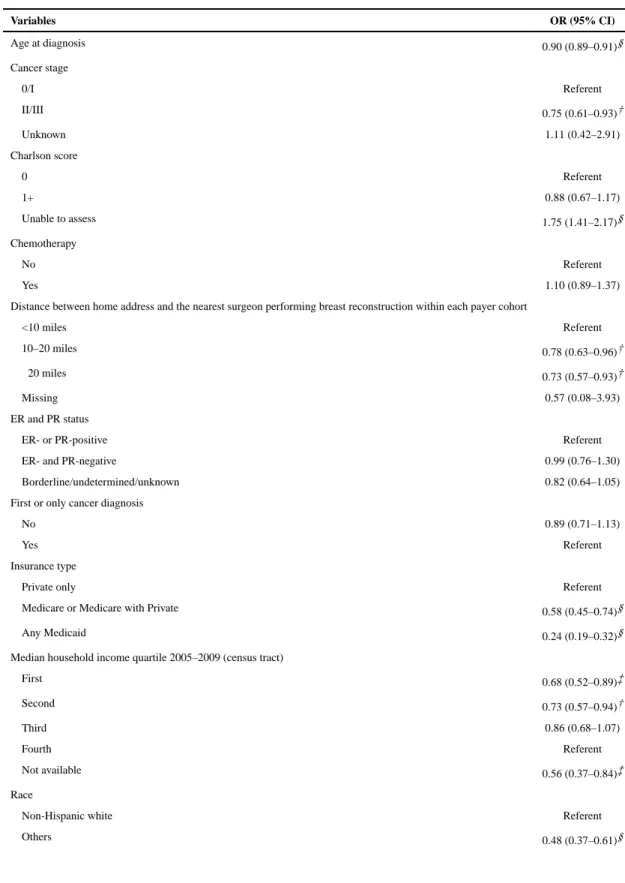
Distance to a breast reconstructive surgeon was significantly associated with receipt of reconstruction. This effect was independent of other well-known predictors of health disparities, including age, race, rurality, and lower household income. Women living 10 to 20 miles from the nearest surgeon had approximately 22 percent lower odds of undergoing breast reconstruction (OR, 0.78; 95 percent CI, 0.63 to 0.96), and women living 20 miles or more from the nearest surgeon had 27 percent lower odds (OR, 0.73; 95 percent CI, 0.57 to 0.93) compared with women who lived within 10 miles (Fig. 2).
Women with federally funded health care [i.e., Medicaid (OR, 0.24; 95 percent CI, 0.19 to 0.32) and Medicare (OR, 0.58; 95 percent CI, 0.45 to 0.74)] had significantly lower odds of undergoing reconstruction compared with women with private insurance. Minority women had 50 percent lower odds of receiving reconstruction compared to non-Hispanic whites
(OR, 0.48; 95 percent CI, 0.37 to 0.61) (Table 2). Consistent with previous studies,5,6
increasing age at diagnosis, advanced cancer stage, and receipt of radiation therapy also decreased the odds of reconstruction. Effect sizes were of similar magnitude and precision in the sensitivity analyses, excluding observations with missing distance information.
Among women who received reconstruction (n = 1130), distance to the actual performing surgeon was not associated with whether or not a woman received immediate versus delayed reconstruction (Table 3). However, delayed reconstruction was associated with rural county of residence, chemotherapy, and radiation therapy. Women living in rural counties were 63 percent more likely to receive delayed reconstruction after controlling for other covariates (OR, 1.63; 95 percent CI, 1.11 to 2.38) (Table 4).
DISCUSSION
Breast reconstruction has repeatedly been shown to be of psychosocial benefit for breast
cancer patients.1,3 Nevertheless, only 21 percent of our patients underwent postmastectomy
reconstruction, and this is consistent with other reports in the literature.11 Because breast
reconstruction has well-documented psychosocial benefits, it remains concerning that such a
small proportion of women receive treatment.1–3 We believe immediate breast
reconstruction, when possible, is the preferred approach; however, only 16 percent of our patients underwent immediate postmastectomy reconstruction. When queried, nearly half of women who underwent delayed breast reconstruction would have preferred to have it
performed in an immediate setting.12 The aesthetic results of immediate versus delayed
reconstruction are arguably superior11,13 and, more importantly, patients report lower
psychological health disturbance scores when they undergo reconstruction at the time of
mastectomy.14 Although the American College of Surgeons National Accreditation Program
for Breast Centers guidelines require that patients are offered a preoperative referral to a
reconstructive/plastic surgeon,15 this is far from universal. In fact, the study in 2008 by
Alderman et al. revealed that only 33 percent of patients report their general surgeon even
A
uthor Man
uscr
ipt
A
uthor Man
uscr
ipt
A
uthor Man
uscr
ipt
A
uthor Man
uscr
discussed breast reconstruction with them. This was irrespective of tumor behavior (ductal carcinoma in situ versus invasive) and comorbidities. The likelihood of this discussion,
however, was increased in younger patients with higher levels of education.16 Faced with
relatively low use rates of breast reconstruction, we are left to question what barriers remain between patients facing mastectomy and surgeons who can reconstruct their breast(s).
This is the first population-based study to demonstrate distance to care and insurance carrier as significant predictors of receipt of breast reconstruction. Our data also suggest that this particular barrier to care (distance) may be ameliorated when breast reconstruction occurs in a delayed fashion. Clinically, this is not an unexpected finding. The local oncologic team (i.e., breast surgeon, medical oncologist, radiation oncologist, and radiographer) may not routinely include a plastic surgeon or one who accepts the patient’s health insurance. It is also possible that the referring surgeons are consciously or unconsciously aware of patients’ geographic and insurance barriers and that this too affects their decision-making. Age, previously identified as a bias affecting discussion of breast reconstruction, is also a proxy variable for those more likely to have private insurance, as women who were younger, white, and residing in urban areas were more likely to have private insurance.
In the delayed setting, the immediate needs of the cancer patient (i.e., excision and adjuvant therapies) have been addressed and the patient is free to pursue other goals, which may include breast reconstruction. Some limitations, such as travel distance to a reconstructive surgeon, may be addressed by the elective timing of delayed reconstruction (e.g., financial savings or leave from work).
Strengths of our study include access to a unique cancer registry–linked claims database, which includes women from multiple payers. Our study includes claims from federally funded insurance and from private payers. We were also uniquely able to capture both immediate and delayed breast reconstruction claims (i.e., claims >4 months from mastectomy). Furthermore, we have the ability to assess World Health Organization files claims for breast reconstruction by analyzing provider specialty codes. Using specialty information provided in the claims, approximately 95 percent of procedures were performed by plastic surgeons. These patterns of specialty care concurred with the American Society of Plastic Surgeons roster describing active surgeons across the state and, when compared, suggests that nearly all providers of plastic surgery are board certified and self-report as plastic surgeons for billing purposes.
Limitations of our study include unmeasured confounders such as individual income levels, patient choice, and decision-making, which may be more significant in breast reconstruction than in reconstruction of defects caused by other cancers. Distance was measured by a Euclidean (straight-line) method. However, road networks or traffic conditions may also be a consideration when seeking surgery. We also located providers within zip code centroids, which are less sensitive than actual practice address. This study focused on the state of North Carolina, and findings may not be generalizable to other populations. However, North Carolina is the ninth largest state and is racially and geographically diverse (35 percent
racial/ethnic minority; 40 percent rural).17
A
uthor Man
uscr
ipt
A
uthor Man
uscr
ipt
A
uthor Man
uscr
ipt
A
uthor Man
uscr
Relocation of patients or surgeons is not a practical solution to address distance as a barrier to reconstruction. Perhaps, however, a significant impact on breast reconstruction use may be made through novel outreach options. We, and others, have initiated options such as early staged reconstruction techniques and telemedicine. For example, we allow patients to continue all other cancer care in the community (e.g., chemotherapy, physical therapy, radiation therapy) and travel only for breast reconstruction. If the reconstruction is performed early (e.g., within 14 days of locally performed mastectomy), it can achieve
similar or even improved aesthetic results compared with immediate breast reconstruction.18
Furthermore, we offer plastic surgery teleconsultation for patients who are unable to travel to our center. Although eventually they will have to arrange transportation for surgery and follow-up, they are educated as to their options without the financial and logistical
difficulties of travel upfront. We remain optimistic about the potential for outreach. We need more data and additional research into these novel approaches to compare outcomes of staged reconstruction and telemedicine.
Acknowledgments
Work on this study was supported by the Integrated Cancer Information and Surveillance System, University of North Carolina Lineberger Comprehensive Cancer Center, with funding provided by the University Cancer Research Fund through the state of North Carolina.
References
1. Wilkins EG, Cederna PS, Lowery JC, et al. Prospective analysis of psychosocial outcomes in breast reconstruction: One-year postoperative results from the Michigan Breast Reconstruction Outcome Study. Plast Reconstr Surg. 2000; 106:1014–1025. discussion 1026. [PubMed: 11039373] 2. Nano MT, Gill PG, Kollias J, Bochner MA, Malycha P, Winefield HR. Psychological impact and
cosmetic outcome of surgical breast cancer strategies. ANZ J Surg. 2005; 75:940–947. [PubMed: 16336382]
3. Atisha D, Alderman AK, Lowery JC, Kuhn LE, Davis J, Wilkins EG. Prospective analysis of long-term psychosocial outcomes in breast reconstruction: Two-year postoperative results from the Michigan Breast Reconstruction Outcomes Study. Ann Surg. 2008; 247:1019–1028. [PubMed: 18520230]
4. Brandberg Y, Malm M, Blomqvist L. A prospective and randomized study, “SVEA,” comparing effects of three methods for delayed breast reconstruction on quality of life, patient-defined problem areas of life, and cosmetic result. Plast Reconstr Surg. 2000; 105:66–74. discussion 75. [PubMed: 10626972]
5. Alderman AK, McMahon L Jr, Wilkins EG. The national utilization of immediate and early delayed breast reconstruction and the effect of sociodemographic factors. Plast Reconstr Surg. 2003; 111:695–703. discussion 704. [PubMed: 12560690]
6. Jagsi R, Jiang J, Momoh AO, et al. Trends and variation in use of breast reconstruction in patients with breast cancer undergoing mastectomy in the United States. J Clin Oncol. 2014; 32:919–926. [PubMed: 24550418]
7. Christian CK, Niland J, Edge SB, et al. A multi-institutional analysis of the socioeconomic determinants of breast reconstruction: A study of the National Comprehensive Cancer Network. Ann Surg. 2006; 243:241–249. [PubMed: 16432358]
8. Wheeler SB, Carpenter WR, Peppercorn J, Schenck AP, Weinberger M, Biddle AK. Structural/ organizational characteristics of health services partly explain racial variation in timeliness of radiation therapy among elderly breast cancer patients. Breast Cancer Res Treat. 2012; 133:333– 345. [PubMed: 22270934]
9. Goyal S, Chandwani S, Haffty BG, Demissie K. Effect of travel distance and time to radiotherapy on likelihood of receiving mastectomy. Ann Surg Oncol. 2015; 22:1095–1101. [PubMed: 25245129]
A
uthor Man
uscr
ipt
A
uthor Man
uscr
ipt
A
uthor Man
uscr
ipt
A
uthor Man
uscr
10. Hart LG, Larson EH, Lishner DM. Rural definitions for health policy and research. Am J Public Health. 2005; 95:1149–1155. [PubMed: 15983270]
11. Sisco M, Du H, Warner JP, Howard MA, Winchester DP, Yao K. Have we expanded the equitable delivery of post-mastectomy breast reconstruction in the new millennium? Evidence from the national cancer data base. J Am Coll Surg. 2012; 215:658–666. discussion 666. [PubMed: 22921327]
12. Nelson JA, Fischer JP, Radecki MA, et al. Delayed autologous breast reconstruction: Factors which influence patient decision making. J Plast Reconstr Aesthet Surg. 2013; 66:1513–1520. [PubMed: 23886556]
13. Kroll SS, Baldwin B. A comparison of outcomes using three different methods of breast reconstruction. Plast Reconstr Surg. 1992; 90:455–462. [PubMed: 1387483]
14. Al-Ghazal SK, Sully L, Fallowfield L, Blamey RW. The psychological impact of immediate rather than delayed breast reconstruction. Eur J Surg Oncol. 2000; 26:17–19. [PubMed: 10718173] 15. National Accreditation Program for Breast Centers. NAPBC Standards Manual 2014 Edition.
Chicago, Ill: American College of Surgeons; 2014.
16. Alderman AK, Hawley ST, Waljee J, Mujahid M, Morrow M, Katz SJ. Understanding the impact of breast reconstruction on the surgical decision-making process for breast cancer. Cancer. 2008; 112:489–494. [PubMed: 18157830]
17. United States Census Bureau. [Accessed January 21, 2016] 2014 data. Available at:
www.census.gov
18. Zenn MR. Staged immediate breast reconstruction. Plast Reconstr Surg. 2015; 135:976–979. [PubMed: 25811563]
A
uthor Man
uscr
ipt
A
uthor Man
uscr
ipt
A
uthor Man
uscr
ipt
A
uthor Man
uscr
Fig. 1.
Cohort creation.
A
uthor Man
uscr
ipt
A
uthor Man
uscr
ipt
A
uthor Man
uscr
ipt
A
uthor Man
uscr
Fig. 2.
Proportion of breast cancer patients undergoing reconstruction after mastectomy and geographic density of providers by insurance type from 2003 to 2006 in North Carolina.
A
uthor Man
uscr
ipt
A
uthor Man
uscr
ipt
A
uthor Man
uscr
ipt
A
uthor Man
uscr
A
uthor Man
uscr
ipt
A
uthor Man
uscr
ipt
A
uthor Man
uscr
ipt
A
uthor Man
uscr
ipt
Table 1
Cohort Creation
Selection Criteria
No. of Included Patients (%)
No. of Excluded Patients (%)
Female breast cancer (exclusion of inflammatory breast cancer) diagnosed between 2003 and 2006, not diagnosed by death certificate or autopsy
27,638
Excluded distant metastatic patients for 2-yr cohort 26,580 (96) 1058 (4)
Include only one breast cancer diagnosis patients 25,833 (97) 747 (3)
Exclude other origin cancer diagnosed within 3 yr before and 1 yr after breast cancer diagnosis
25,283 (98) 550 (2)
Received mastectomy 7517 (30) 17,766 (70)
Received mastectomy within 6 mo after diagnosis 6784 (90) 733 (10)
Continuous coverage through 2 yr after mastectomy 5407 (80) 1377 (20)
A
uthor Man
uscr
ipt
A
uthor Man
uscr
ipt
A
uthor Man
uscr
ipt
A
uthor Man
uscr
T ab le 2Cohort Summary Categories
Br east Reconstruction * † p T otal (%) No Reconstruction Immediate Delay ed
No. of patients
5381
4251 (79%)
863 (16%)
267 (5%)
Age at diagnosis
<0.0001
Mean ± SD
66 ± 13.2
69.3 ± 11.7
54.9 ± 11.3
50.3 ± 11.2
Range
22–98
30–98
22–93
23–79
Age group at diagnosis, yr
<0.0001
<50
735 (14)
297 (7, 40)
299 (35, 41)
139 (52, 19)
50–59
883 (16)
541 (13, 61)
270 (31, 31)
72 (27, 8)
60–69
1312 (24)
1070 (25, 82)
199 (23, 15)
43 (16, 3)
≥70
2451 (46)
2343 (55, 96)
95 (11, 4)
13 (5, 1)
Distance between home address and the nearest sur
geon performing breast reconstruction
<0.0001
<10 miles
2934 (55)
2246 (53, 77)
533 (62, 18)
155 (58, 5)
10–20 miles
1289 (24)
1028 (24, 80)
200 (23.16)
61 (23, 5)
≥20 miles
1149 (21)
970 (23, 84)
128 (15, 11)
51 (19, 4)
Missing
<11
<11
<11
0 (0, 0)
Distance between home address and the actual performing sur
geon
<0.0001
<10 miles
410 (8)
0 (0, 0)
320 (37, 78)
90 (34, 22)
10–20 miles
283 (5)
0 (0, 0)
224 (26, 79)
59 (22, 21)
≥20 miles
406 (8)
0 (0, 0)
299 (35.74)
107 (40.26)
Missing
31 (1)
0 (0, 0)
20 (2, 65)
<11
Not applicable
4251 (79)
4251 (100, 100)
0 (0, 0)
0 (0, 0)
Race
<0.0001
Non-Hispanic white
4405 (82)
3422 (80, 78)
751 (87, 17)
232 (87, 5)
Others
976 (18)
829 (20, 85)
112 (13, 11)
35 (13, 4)
Rural (county)
<0.0001
No
3333 (62)
2499 (59, 75)
658 (76, 20)
176 (66, 5)
Y
es
2048 (38)
1752 (41, 86)
205 (24, 10)
91 (34, 4)
Median household income quartile 2005–2009 (census tract)
A
uthor Man
uscr
ipt
A
uthor Man
uscr
ipt
A
uthor Man
uscr
ipt
A
uthor Man
uscr
ipt
Categories Br east Reconstruction *† p T otal (%) No Reconstruction Immediate Delay ed First 1268 (24)1089 (26, 86)
133 (15,10)
46 (17, 4)
Second
1258 (23)
1040 (24, 83)
156 (18,12)
62 (23, 5)
.
Third
1267 (24)
976 (23, 77)
219 (25,17)
72 (27, 6)
.
F
ourth
1258 (23)
864 (20, 69)
318 (37, 25)
76 (28, 6)
Not a
v
ailable
330 (6)
282 (7, 85)
37 (4, 11)
Less than 11
Cancer stage
<0.0001
0/I
3096 (58)
2370 (56, 77)
609 (71, 20)
117 (44, 4)
II/III
2238 (42)
1840 (43, 82)
249 (29, 11)
149 (56, 7)
Unkno
wn
47 (1)
41 (1, 87)
<11 <11 Insurance type <0.0001 Pri v ate only 1241 (23)
543 (13, 44)
515 (60, 41)
183 (69, 15)
Medicare or Medicare with pri
v
ate
3002 (56)
2691 (63, 90)
266 (31, 9)
45 (17, 1)
An
y Medicaid
1138 (21)
1017 (24, 89)
82 (10, 7)
39 (15, 3)
Radiation therap
y
<0.0001
No
4262 (79)
3337 (78, 78)
749 (87, 18)
176 (66, 4)
Y
es
1119 (21)
914 (22, 82)
114 (13, 10)
91 (34, 8)
Chemotherap
y
<0.0001
No
3491 (65)
2884 (68, 83)
528 (61, 15)
79 (30, 2)
Y
es
1890 (35)
1367 (32, 72)
335 (39, 18)
188 (70, 10)
Y
ear of diagnosis
0.2413
2003
1368 (25)
1084 (25, 79)
225 (26, 16)
59 (22, 4)
2004
1376 (26)
1080 (25, 78)
221 (26, 16)
75 (28, 5)
2005
1280 (24)
1032 (24, 81)
180 (21, 14)
68 (25, 5)
2006
1357 (25)
1055 (25, 78)
237 (27, 17)
65 (24, 5)
Charlson score
<0.0001
0
2043 (38)
1622 (38, 79)
306 (35, 15)
115 (43, 6)
1+
1068 (20)
974 (23, 91)
72 (8, 7)
22 (8, 2)
Unable to assess
2270 (42)
1655 (39, 73)
485 (56, 21)
130 (49, 6)
First or only cancer diagnosis
No
921 (17)
780 (18, 85)
117 (14, 13)
24 (9, 3)
A
uthor Man
uscr
ipt
A
uthor Man
uscr
ipt
A
uthor Man
uscr
ipt
A
uthor Man
uscr
Categories Br east Reconstruction *† p T otal (%) No Reconstruction Immediate Delay ed Y es 4460 (83)3471 (82, 78)
746 (86, 17)
243 (91, 5)
T
ype of reconstruction
<0.0001
None
4251 (79)
4251 (100, 100)
0 (0, 0)
0 (0, 0)
Implant-based
744 (14)
0 (0, 0)
608 (70, 82)
136 (51, 18)
Autologous with tissue e
xpander or implant
119 (2)
0 (0, 0)
84 (10, 71)
35 (13, 29)
Autologous alone
252 (5)
0 (0, 0)
162 (19, 64)
90 (34, 36)
Not otherwise specif
ied
15 (0)
0 (0, 0)
<11
<11
ER and PR status
0.0290
ER- or PR-positi
v
e
2204 (41)
1742 (41, 79)
358 (41, 16)
104 (39, 5)
ER- and PR-ne
g
ati
v
e
622 (12)
485 (11, 78)
90 (10, 14)
47 (18, 8)
Borderline/undetermined/unkno
wn
2555 (47)
2024 (48, 79)
415 (48, 16)
116 (43, 5)
ER, estrogen receptor; PR, progesterone receptor
.
* There are no missing observ
ations in breast reconstruction.
† T
w
o numbers in parenthesis means (column %, ro
A
uthor Man
uscr
ipt
A
uthor Man
uscr
ipt
A
uthor Man
uscr
ipt
A
uthor Man
uscr
ipt
Table 3
Model for Receipt of Any Postmastectomy Breast Reconstruction
Variables OR (95% CI)
Age at diagnosis 0.90 (0.89–0.91)§
Cancer stage
0/I Referent
II/III 0.75 (0.61–0.93)†
Unknown 1.11 (0.42–2.91)
Charlson score
0 Referent
1+ 0.88 (0.67–1.17)
Unable to assess 1.75 (1.41–2.17)§
Chemotherapy
No Referent
Yes 1.10 (0.89–1.37)
Distance between home address and the nearest surgeon performing breast reconstruction within each payer cohort
<10 miles Referent
10–20 miles 0.78 (0.63–0.96)†
≥20 miles 0.73 (0.57–0.93)†
Missing 0.57 (0.08–3.93)
ER and PR status
ER- or PR-positive Referent
ER- and PR-negative 0.99 (0.76–1.30)
Borderline/undetermined/unknown 0.82 (0.64–1.05)
First or only cancer diagnosis
No 0.89 (0.71–1.13)
Yes Referent
Insurance type
Private only Referent
Medicare or Medicare with Private 0.58 (0.45–0.74)§
Any Medicaid 0.24 (0.19–0.32)§
Median household income quartile 2005–2009 (census tract)
First 0.68 (0.52–0.89)‡
Second 0.73 (0.57–0.94)†
Third 0.86 (0.68–1.07)
Fourth Referent
Not available 0.56 (0.37–0.84)‡
Race
Non-Hispanic white Referent
A
uthor Man
uscr
ipt
A
uthor Man
uscr
ipt
A
uthor Man
uscr
ipt
A
uthor Man
uscr
Variables OR (95% CI)
Radiation therapy
No Referent
Yes 0.43 (0.34–0.54)§
Rural (county)
No Referent
Yes 0.65 (0.54–0.79)§
Year of diagnosis
2003 Referent
2004 1.47 (1.12–1.92)‡
2005 1.25 (0.91–1.73)
2006 1.42 (1.03–1.96)†
*
Logistic regression result (reconstruction = 1 vs. not = 0) OR < 1: less likely to undergo reconstruction (use continuous age variable). Total no. of observations, 5381; total no. of observations used, 5381; model fit Akaike information criterion = 3803.092.
† p < 0.05.
‡ p < 0.01.
A
uthor Man
uscr
ipt
A
uthor Man
uscr
ipt
A
uthor Man
uscr
ipt
A
uthor Man
uscr
ipt
Table 4
Model for Receipt of Delayed Reconstruction*
Variables OR (95% CI)
Age at diagnosis 0.98 (0.96–1.00)†
Cancer stage
0/I Referent
II/III 1.36 (0.90–2.05)
Unknown 1.56 (0.16–15.17)
Charlson score
0 Referent
1+ 1.13 (0.63–2.05)
Unable to assess 1.11 (0.76–1.62)
Chemotherapy
No Referent
Yes 2.42 (1.62–3.63)‡
Distance between home address and the actual performing surgeon
<10 miles Referent
10–20 miles 0.81 (0.54–1.22)
≥20 miles 0.88 (0.59–1.31)
Missing 1.44 (0.51–4.06)
ER and PR status
ER- or PR-positive Referent
ER- and PR-negative 1.45 (0.92–2.29)
Borderline/undetermined/unknown 1.22 (0.76–1.98)
First or only cancer diagnosis
No 0.82 (0.50–1.36)
Yes Referent
Insurance type
Private only Referent
Medicare or Medicare with private 0.93 (0.56–1.54)
Any Medicaid 1.24 (0.76–2.04)
Median household income quartile 2005–2009 (census tract)
First 1.14 (0.69–1.89)
Second 1.42 (0.91–2.20)
Third 1.33 (0.89–1.98)
Fourth Referent
Not available 0.95 (0.42–2.11)
Race
Non-Hispanic white Referent
Others 0.76 (0.48–1.21)
Radiation therapy
A
uthor Man
uscr
ipt
A
uthor Man
uscr
ipt
A
uthor Man
uscr
ipt
A
uthor Man
uscr
Variables OR (95% CI)
Yes 1.55 (1.03–2.34)†
Rural (county)
No Referent
Yes 1.63 (1.11–2.38)†
Type of reconstruction
Implant-based Referent
Autologous with tissue expander or implant 1.37 (0.85–2.22)
Autologous alone 2.24 (1.55–3.22)‡
Not otherwise specified 1.78 (0.44–7.26)
Year of diagnosis
2003 Referent
2004 1.52 (0.92–2.50)
2005 1.40 (0.75–2.61)
2006 1.24 (0.66–2.33)
*
Logistic regression result (immediate = 0 vs. delay = 1) OR < 1: less likely to undergo delayed reconstruction (use continuous age variable); 1130 read, 1130 used. Model fit Akaike information criterion = 1131.078.
† p < 0.05.