ADRENARCHE DURING THE GREAT RECESSION AS AN ENVIRONMENTAL CHALLENGE TO PSYCHOSOCIAL DEVELOPMENT: AN
EVOLUTIONARY-DEVELOPMENTAL PERSPECTIVE
Chelsea G. Nehler
A dissertation submitted to the faculty at the University of North Carolina at Chapel Hill in partial fulfillment of the requirements for the degree of Doctor of Philosophy in the Department
of Psychology and Neuroscience (Developmental).
Chapel Hill 2018
ABSTRACT
Chelsea G. Nehler: Adrenarche During the Great Recession as an Environmental Challenge to Psychosocial Development: An Evolutionary-Developmental Perspective
(Under the direction of Jean-Louis Gariépy)
Adrenarche is an important developmental period to consider in relation to both physical and psychosocial outcomes. The reorganization of the stress response system during adrenarche, understood as physiological adjustment to environments that may vary from safe and supportive to unsafe and unsupportive, not only results in specific physiological patterns of response to stress, but also leads to specific social, sexual, emotional, and parenting behavioral profiles. In this dissertation, I elaborated on the connections between adverse developmental contexts and the development of behavior problems in children and adolescents using the Adaptive
Calibration Model of Stress Responsivity. I used the Great Recession of 2007-2009 as a natural window to examine how changes in economic circumstances—the introduction of economic adversity—can affect the life course, especially when experienced during adrenarche. I hypothesized that declining wealth in general and during adrenarche would not only predict behavior problems in adolescence, but it would also affect menarche and physical development, such that sexual maturation would be a mediator of wealth and psychosocial adjustment. To test these hypotheses, I used nationally representative panel data from the Panel Study of
ACKNOWLEDGMENTS
Foremost, I must thank my dedicated committee for their encouragement, insights, and feedback throughout this process. From its theoretical foundation to the finer details of the methods, their sincere curiosity helped to make this the strongest dissertation it could be. I am especially indebted to Drs. Gariépy and Kurtz-Costes for their invaluable feedback on multiple early drafts of the prospectus and this final document, which not only benefitted the dissertation but also my thinking and writing moving forward.
Several mentors, although not directly involved with this dissertation, have contributed to my development as a psychologist and as a person. Drs. Cheatham, Panter, and Sideris forever have my gratitude for their sage advice, good humor, and cheerful devil’s advocacy throughout my graduate career; without which I surely would not have reached this point.
I thank my dear friends, Devin Christensen, Adam Hoffman, Rebekah Layton, and Tara Walhart for always offering their ears to hear my failures and my triumphs; for tolerating my reclusiveness during this process and welcoming me back when I emerged; for commiserating with their own experiences and sharing their wisdom; and, most of all, for their enduring love. These were gifts I can only aspire to deserve and reciprocate in time.
TABLE OF CONTENTS
LIST OF TABLES ... x
LIST OF FIGURES ... xi
CHAPTER 1: INTRODUCTION ... 1
Theoretical Perspectives on Behavior Problems... 3
Economic Adversity and Developmental Outcomes ... 5
Environment and Evolution ... 8
The Adaptive Calibration Model ... 9
Adrenarche and Puberty ... 12
Variations in Pubertal Timing ... 14
The Great Recession ... 17
The Current Study ... 19
Hypotheses ... 20
1. Wealth Changes ... 20
2. Wealth and Behavior... 20
3. Pubertal Timing ... 20
4. Developmental Timing ... 20
5. Girls and Boys: ... 20
Dataset... 21
Participants ... 22
Procedure ... 23
Measures ... 24
CHAPTER 3: RESULTS ... 28
Latent Class Growth Models of Wealth... 29
Structural Equation Modeling of Wealth and Physical and Psychosocial Development ... 32
The Role of Developmental Timing in Moderating Hardship ... 34
CHAPTER 4: DISCUSSION ... 36
Characterizing Wealth Changes ... 36
The Effect of Wealth Change on Behavior Problems ... 40
The Mediating Role of Physical Development ... 43
Sex and Race ... 45
Limitations and Future Directions ... 46
APPENDIX ... 66
LIST OF TABLES
Table 1 – Operationalization of key theoretical constructs ...51
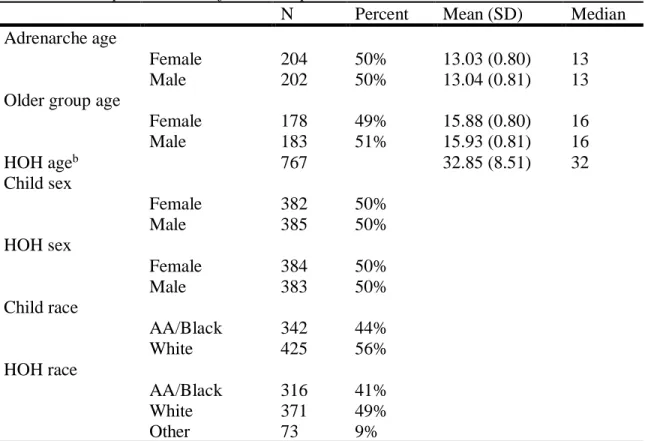
Table 2 – Descriptive statistics for the sample ...52
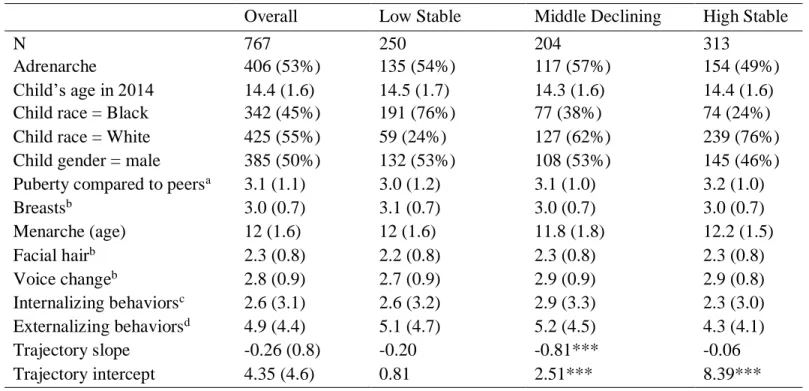
Table 3 – Means of key child-level study variables, overall and by wealth class ...53
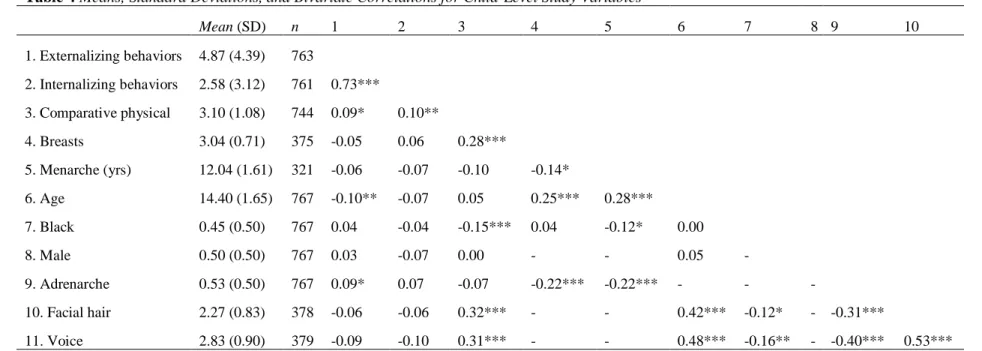
Table 4 – Means, standard deviations, and bivariate correlations for child-level variables ...54
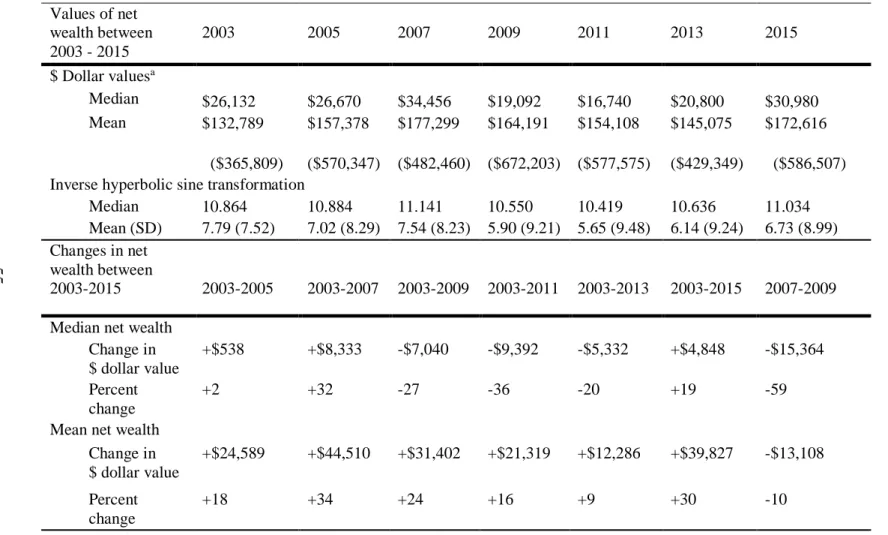
Table 5 – Twelve years of household net wealth ...55
Table 6 – Time varying covariates...56
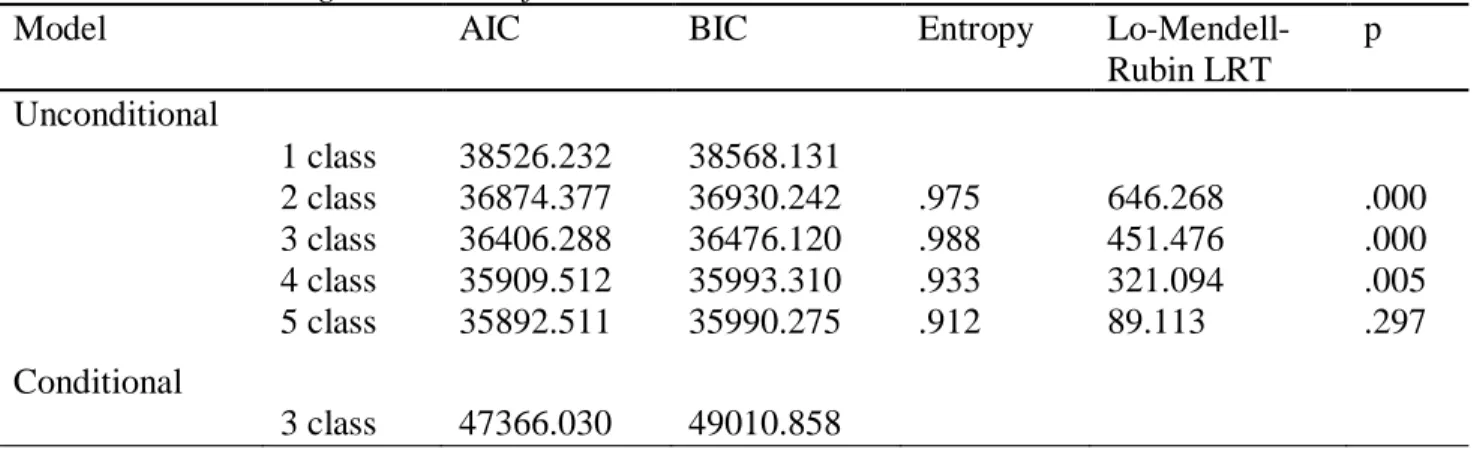
Table 7 – Latent class growth model fit statistics ...57
LIST OF FIGURES
CHAPTER 1: INTRODUCTION
“…children and adolescents have evolved to function competently—to navigate the kinds of challenges and opportunities in their environment that recurrently influenced the fitness of their ancestors—across a variety of contexts” (Belsky, Schlomer, & Ellis, 2012).
Adrenarche is an important developmental period to consider in relation to both physical and psychosocial outcomes. Researchers in developmental science sometimes view middle childhood as a stable or waning period of development in contrast to the dynamic periods of infancy or puberty (Byrne et al., 2017). Development does slow with respect to some domains, but adrenarche, which occurs between the ages of 5 and 10, is a critical period in the
reorganization of the stress response system (Campbell, 2006). As with other critical periods, during adrenarche the developmental context has implications for children’s bodies and their subsequent behaviors during adolescence and, perhaps, for the rest of their lives.
sympathetic and parasympathetic nervous systems (Del Giudice, Ellis, & Shirtcliff, 2011). The reorganization of the stress response system during adrenarche, understood as physiological adjustment to environments that may vary from safe and supportive to unsafe and unsupportive, not only results in specific physiological patterns of response to stress, but also leads to specific social, sexual, emotional, and parenting behavioral profiles (Del Giudice et al., 2011). My research specifically focuses on the behavior profiles that are associated with the physiological patterns predicted by the ACM theory.
Internalizing and externalizing behavior problems among young adolescents might emerge because of stressful experiences that occur during adrenarche (Dorn, Hitt & Rotenstein, 1999; Sontag-Padilla et al., 2012). A context such as economic strain poses many challenges to children’s development, in part due to the implications of economic duress for parents’ ability to provide secure and nurturing environments (Conger et al., 1992; Gordon-Simons et al., 2016). As proximal actors, parents have a great deal of influence on their children’s social behavior, but it is also important to understand other mechanisms through which distal factors like the global economy might operate on children’s social development. These mechanisms include, but are not limited to, altering the organization of the stress response system and accelerating or slowing the timing and tempo of sexual maturation. Thus, both the developmental period when economic strain is experienced and the degree of hardship it imposes on families may be important factors contributing to the differential development and intractability of adolescent behavior problems.
development. Parenting factors are implicated by the consideration of evolutionary forces, so discussion of these factors is necessary throughout; indeed, parents are parenting in the same context as their children are developing, so they are inseparable from one another. I continue with an explanation of how economic adversity differentially affects the physical and
psychosocial developmental trajectories of children depending upon their age and sex, and how the two trajectories are related. Finally, I propose using the Great Recession of 2007-2009 as a natural window to examine how changes in economic circumstances—the introduction of
economic adversity—can affect the life course, especially when experienced during adrenarche. Theoretical Perspectives on Behavior Problems
Internalizing and externalizing behavior problems among disadvantaged children and adolescents have been studied extensively, especially with reference to proximal antecedents. In several studies, parenting factors mediated or moderated the relation between low socioeconomic status (SES) and behavior problems (Conger & Donnellan, 2007; Gordon Simons et al., 2016). Heightened family dysfunction and household chaos, and less parental warmth and monitoring, for example, are associated with poor behavioral outcomes among low-SES children (Diener, Nievar, & Wright, 2003; Mills-Koonce et al., 2016).
meritocratic “culture of poverty” model: poor children and their parents are poor and remain poor because of their behaviors and values (see Lewis, 1969). If behavior problems are more common among low-SES children, the social selection perspective explains that those children and their families have self-selected into economic insufficiency through the expression of those behaviors. Evidence has not tended to support this theory and scholars who work in this area do not tend to use it (Dohrenwend et al., 1992).
Conversely, the social causation theory emphasizes the role of the environment. It posits that the behaviors of both parents and their children arise in response to a stressful environment. As opposed to focusing on the impact that individual behavior has on the environment, social causation contends that so-called “problem behaviors” are socially caused adaptations that follow, rather than precede, economic adversity (Dohrenwend et al., 1992). This perspective has been supported in the literature (e.g. Costello, Compton, Keeler, & Angold, 2003; Gennetian & Miller, 2002). I will elaborate on some of those findings in the following sections.
Finally, the interactionist perspective combines the social selection and social causation theories (Schofield et al., 2011). This combination leaves room for evolutionary-developmental principles. The interactionist theory presupposes that grandparents and parents have acquired and transmitted to their offspring adaptive behavioral traits (through socialization or heritability) that allowed them to survive (or thrive) in their environment. It may be those same traits that now prevent the offspring’s socioeconomic mobility and limit their adaptive functioning in their particular context. According to evolutionary-developmental theory, aggressive personality traits, for example, can be adaptive phenotypes that support individuals in surviving their environments, establishing themselves within a social hierarchy, and seeking out mates.
transmitted through generations and the success of the youngest generation in transitioning into adult roles (e.g. Conger, Martin, Masarek, Widaman, & Connellan, 2015). Adolescents who inherit aggressive personality traits are more likely to be aggressive adults and hostile toward their partners, are more likely to have hostile partners themselves, and are less likely to be economically successful adults (Conger et al., 2015). Intergenerational transmission of traits that were shaped by adverse environments (socially caused) affect the individual’s own
socioeconomic mobility (socially selected) (Schofield et al., 2011). If children enduring adverse economic conditions display what appear to be behavior problems, the interactionist theory would support the assertion that generations of ancestral adaptations to hardship have led up to that point (Belsky et al., 2012; Schofield et al., 2011).
Economic Adversity and Developmental Outcomes
The Great Smoky Mountain study (Costello et al., 2003) and the experimental Minnesota Family Investment Program (Gennetian & Miller, 2002) both provide evidence for the social causation perspective, and they demonstrate the direct role of adversity in children’s
not test for mediation. Unlike other studies that have highlighted personal characteristics of parents such as warmth, sensitivity, or hostility, these results from the Great Smoky Mountain Study point out a parenting stressor that is driven by the socioeconomic context; the lack of time to supervise is a consequence of living and parenting in an adverse environment that may be relieved when the environment is changed for the better.
The research reviewed here found salient differences in the extent to which the
environment impacted development by the age, gender, and initial social class of the child. For example, Gennetian and Miller (2002) observed that the beneficial behavioral effect of the income increase was stronger in children who were between the ages of 6 and 9 at the beginning of the intervention, and the effect was stronger for girls than boys. The children of the Great Depression under investigation by Elder (1974) were all around the ages of 8 or 9 years old at the onset of the Depression in 1929. Elder (1981) documented significant life course differences between this cohort and an older cohort who endured the Depression during their adolescence. In many studies Elder and his collaborators noted differences in life course outcomes between boys and girls (Elder et al., 1985; Elder, 1981; Conger, Conger, Matthew, & Elder, 1999), differences among children of various ages at the time of adverse events (Elder, 1981; Elder, 1998), and differences by initial social class (Elder, 1981). Finally, Costello et al. (2003) reported that the psychiatric benefits of income increases were only significant among families who were poor prior to the increase and were lifted out of poverty, but not among those who were never poor, nor among those who remained poor.
In the current study, I will explore how changes in families’ wealth, in concert with their initial wealth and children’s sex, race, and age, impact children’s psychosocial well-being in adolescence. Both the social causation and interactionist perspectives predict significant negative effects of economic strain on children’s development, but they cannot provide a sufficient
Environment and Evolution
Ellis et al.’s (2009) elaboration on the fundamental dimensions of environmental risk provides insight into the sources of developmental variation in life outcomes, in particular psychosocial wellbeing. Harsh and unpredictable environments exert evolutionary and developmental pressures on caregivers and their offspring that ensure the continuation of the species. Ellis et al. (2009) argue that harsh and unpredictable conditions differentially impact human beings’ reproductive strategies in a context-dependent manner. In the framework used by Ellis et al. (2009) and other theorists, these reproductive strategies are better represented by the term “life history strategies.” Life history strategies “are coordinate suites of morphological, physiological, and behavioral traits that determine how organisms allocate resources to key biological activities” including both reproduction and parenting behaviors (Belsky et al., 2012; Del Giudice, 2014, p. 197; see also West-Eberhard, 2005 who introduced the concept). From this perspective, exposure to environmental cues of harshness or unpredictability affect, at a critical developmental switch point, the calibration of the stress response system, physical development, and social and sexual behaviors, with direct effects on life histories and their associated adaptive strategies (Belsky, Ruttle, Boyce, Armstrong, & Essex, 2015; Ellis & Essex, 2007;
West-Eberhard, 2003).
been operationalized as residential changes, mother’s male partner transitions, caregiver employment instability, and food insecurity (Belsky et al., 2012).
In societies where competition for scarce resources is high and social support is limited, Ellis et al. (2009) predict that individuals will employ a “fast” life history strategy in which they reach physical maturation and reproduce earlier. Individuals on a fast life history trajectory optimize their reproductive fitness by producing numerous offspring and limiting parental investment in those offspring. Developing nurturing skills and resources and actually nurturing offspring reduces the time available to seek out mates and continue to reproduce. Where there is less competition for scarce resources, or more social support amidst scarcity, individuals are expected to employ a “slow” life history strategy in which physical maturation and reproduction are delayed. Thus, a slow life history strategy is expected of individuals developing in relatively comfortable and predictable environments (Ellis et al., 2009). These parents do not encounter the cost pressures of parenting that individuals on a fast strategy experience, so they are able to develop the skills and acquire the resources necessary to optimally nurture their offspring. The connections among the environment, life history strategies, and psychosocial wellbeing are explained in the next sections.
The Adaptive Calibration Model
The Adaptive Calibration Model of stress responsivity (ACM) is an
evolutionary-developmental theory that accounts for individual differences in physical and behavioral patterns of adjustment to the environment. While not diminishing the role of family-level factors, the ACM (Del Giudice et al., 2011) treats psychosocial outcomes and their antecedents as
(Ellis et al., 2009). Del Giudice et al. (2011) propose that behavioral phenotypes traditionally viewed as maladaptive are sometimes natural sequelae arising from the interaction of biological imperatives with harsh and unpredictable environments. When facing such contexts, children modulate their physical and psychosocial development in ways that optimize their reproductive success. These authors do not minimize the harm psychosocial maladjustment can do to children and adolescents’ social and emotional well-being; rather, they provide an evolutionary
explanation that allows for a different heuristic for research and applied practice (Frankenhuis & Del Giudice, 2012).
the vigilant phenotype proposed by the ACM described later.
According to Del Giudice et al. (2011), a sensitive pattern emerges in children from protected and safe environments and is correspondingly associated with greater positivity, lower risk-taking, and delayed fertility. The behavioral profile of the buffered pattern is similar to that of the sensitive pattern, but it is thought to emerge from moderate levels of environmental stress. Individuals in these two profiles would score relatively low on both subscales of the BPI, but the sensitive pattern might show slightly more incidences of mood swings or irritability because sensitive children are more labile in their responses to stress, whereas buffered children are less plastic and react more consistently (Del Giudice et al., 2011).
developmental periods known as adrenarche and adolescence, and may do so in a sex-specific way (Del Giudice et al., 2011).
Adrenarche and Puberty
The ACM offers a developmental perspective proposing that there are specific periods during which children are more susceptible to both harmful and beneficial environmental inputs. Times of developmental reorganization called switch points, akin to sensitive periods, are when children are most susceptible to this modulation (Del Giudice, 2014). At these switch points, characteristics of the environment gain new salience as contributors to the development of life history strategies in particular (i.e., placing children on tracks that will eventually lead to either a rapid strategy with early sexual development, activity, and reproduction, or a slow strategy with later sexual development). Evolutionary-developmental theory states that switch points in
development enable children to adapt physiologically and socially to changing conditions in their environment (West-Eberhard, 2003). This is a for-better-and-for-worse adaptation, for it enables children to both weather scarcity and capitalize on abundance (Belsky & Pluess, 2009; Ellis & Del Giudice, 2014). The onset of adrenarche is one such period of reorganization preceding puberty, which Del Giudice et al. (2011) point to as crucial to understanding the behavioral phenotypes associated with children who grow up in adverse environments.
Adrenarche is posited as a switch point in the physical and emotional development of human children that occurs during the transition to middle childhood, between 6 and 9 years of age (Del Giudice, 2014). Although it is considered by some as an early stage of puberty
(Campbell, 2006), adrenarche is itself a distinct period of physical and social development. During this period, sexually differentiated brain pathways are activated by secretion of
boys and girls emerge, and pre-existing differences widen in physical, emotional, and social domains. Importantly, DHEA and other adrenal androgens are thought to extend the brain’s plasticity through this period, allowing the child to adapt to changing environmental conditions during this important time of reorganization (Campbell, 2011; Del Giudice, 2014).
Del Giudice has argued extensively (e.g. 2014; Del Giudice et al., 2011; Del Giudice, 2009; Ellis & Del Giudice, 2014) that life history strategies are adopted during the period of adrenarche—if only temporarily until another switch point occurs. If children’s environments are threatening or unpredictable throughout early childhood, or acutely during adrenarche, life history theory suggests that children may adopt a fast strategy: early sexual onset, promiscuity, and social aggression. Alternatively, if children’s environments are predictable and safe, children may adopt a slow strategy: delayed sexual onset, stable relationships, and prosociality. This slow strategy may also emerge despite environmenta harshness, such as food scarcity, when those and other conditions are stable and social support is high (Del Giudice, 2014; Hochberg & Belsky, 2013).
It stands to reason that environmental cues motivating fast life history strategies during or preceding adrenarche would also accelerate pubertal development in the service of earlier
only investigated how the timing of adrenarche itself consequently affects pubertal timing (e.g. Belsky et al., 2015; Ellis & Essex, 2007; Byrne et al., 2017), but not how or whether exposure to environmental stressors during adrenarche influences pubertal timing, which is addressed in the current study. Notably, Hochberg and Belsky (2013) argue from a life history perspective that attachment styles and internal working models formed during adrenarche influence the timing of puberty, with insecure attachments during adrenarche motivating faster life history strategies. Whereas poverty itself does not consistently appear to be a strong predictor of poor attachment (Diener, Nievar, & Wright, 2003), SES does predict maternal psychosocial maladjustment, which is associated with maternal insensitivity, children’s socioeconomic status in adulthood, and children’s behavioral symptoms (Bouvette-Turcot et al., 2017). It is plausible, then, that adrenarche is a sensitive period of development especially in response to maternal cues regarding the stability and safety of the immediate environment. The adaptations during this period affect pubertal timing, attachment styles, and finally, life history strategies.
Variations in Pubertal Timing
Irrespective of adrenarche, the timing of pubertal onset and its tempo are directly affected by harsh and unpredictable early environments. For example, Arim, Tramonte, Shapka,
Dahinten, and Wilms (2011) found in a longitudinal study of 8440 Canadian adolescents that family circumstances such as low paternal education and unemployment are significant
jointly influenced by environmental, nutritional, hormonal, and genetic factors, but these factors are not independent of one another. Harsh and unpredictable environments may affect the availability of food, and thus the nutritional status of the developing child (e.g. Kimbro & Denney, 2015; Leete & Bania, 2010; Slopen, Fitzmaurice, Williams, & Gilman, 2010). As discussed previously, those same environments may induce a hormonal stress response that interacts with adrenal or gonadal hormones (Belsky et al., 2015). Likewise, emerging animal research on epigenetic control of puberty has uncovered epigenetic alterations of genomic activity in response to environmental cues (Lomniczi, 2013; Rzeczkowska, Hou, Wilson, & Palmert, 2014). There are many points of contact for the environment to activate an evolutionary machinery that either supports a preference to conceive many offspring, or to reap opportunities for better nurturing fewer offspring.
The case of earlier puberty among Black males and females in the United States
environmental cues, genetic predispositions are unlikely to be driving the whole effect (Hochberg & Belsky, 2013). Researchers evaluating puberty in any way must keep these differences in mind and make conscientious statistical decisions regarding group differences, which I do in the current study.
Across racial groups and for both sexes, the timing of puberty is associated with various psychosocial outcomes that map on to life history strategies. Hochberg and Belsky (2013) argue that early puberty has been treated inappropriately as a risk factor for aggression and delinquency and not fully appreciated as a fitness optimization strategy in response to environmental
challenges. Del Giudice et al. (2011) suggest that males on a fast life history track will behave in a high-externalizing manner in the service of mating and risk-taking; these males are reactive to confrontation, impulsive, and irritable, aiming to establish themselves in their peer group as dominant. This description is also sometimes true of males who enter puberty earlier (Mensah et al., 2013). Females on a fast life history track are expected to behave in a high-internalizing manner in the service of tending-and-befriending others to seek protection from external threats in the environment; fast life history females are expected to be more withdrawn, anxious, and irritable while also seeking out sexual partnerships (Del Giudice, 2011). These characteristics are sometimes also found among females who enter puberty earlier (Galvao et al., 2015; James et al., 2012). In the current study, I analyze how antecedents of and problems of psychosocial
The Great Recession
The Great Recession in the United States during the early 2000s presents an opportunity to evaluate how sudden and dramatic changes in children’s households’ economic circumstances interact with their development in the framework of the Adaptive Calibration Model. The Great Recession of December 2007 - June 2009 was the most severe and longest-lasting economic downturn in the United States since the Great Depression. The Recession was precipitated by the collapse of the U.S. housing market, and waves of foreclosures ensued as home values
plummeted. The resulting loss of wealth contributed to shrinking the nation’s gross domestic product by 5% (Bureau of Labor Statistics, 2012) as the unemployment rate increased from 4.7% to a peak of 10% in the autumn following the Recession (BLS, 2012). In the years during and following the Recession, 7.4 million workers lost their jobs (Kochhar, 2011), and nearly 10 million homes were foreclosed upon (Hall, Crowder, & Spring, 2015) while millions more experienced mortgage distress (Anonymous, n.d.). Enrollment in all public safety net programs increased. During the five-year period capturing the Recession and its recovery, the
Supplemental Nutrition Assistance Program (SNAP) caseloads increased 76% to 46 million individuals, and nearly half of enrollees were children (Popkin, Scott, & Galvez, 2016). If employment, homeownership, and safety net usage are barometers of economic well-being in a country, all indications suggest that this was a calamitous period for families across the
socioeconomic spectrum.
Whereas recession is a predictable stage of the business cycle, and there have been 10 recessions since 1948 (BLS, 2012), growing inequality between the wealthy and poor
the official federal poverty level. Their families reap few benefits when the economy is strong, and suffer disproportionately when it declines. Across the country, households lost between 17% and 91% of their wealth during the Great Recession (Rauscher & Elliot, 2016; Friedline, Nam, & Loke, 2014). Households headed by racial and ethnic minorities, women, and singles saw the greatest losses as a proportion of their existing wealth (Friedline et al., 2014; Pfeffer et al., 2013).
During economic downturns such as the Great Recession, families already living in poverty are more vulnerable to shocks to their income, employment status, food security, and housing (e.g. Leete & Bania, 2010; Chen, Miller, Yu, & Brody, 2016); readers will recall that these indicators are harshness and unpredictability operationalized. For many families and children, this period was just that—harsh and unpredictable. Schneider, Waldfogel, and Brooks-Gunn (2015) found significant increases in internalizing and externalizing behaviors, alcohol and drug use, and vandalism among 9-year-old sons of single-parents due uniquely to parents’ uncertainty about the national economy; these increases were only partially explained by parenting factors.
Numerous other studies have been published in the last three years on the effects of the Great Recession on children, families, and adults. Overall, losses in housing wealth alone accounted for significant increases in psychological distress and maladaptive changes in health behaviors among adult homeowners (Yilmazer, Babiarz, & Liu, 2015). Among African
American youth, sustained downward mobility during the Recession was associated with
epigenetic aging, increased allostatic load, and poor self-reported health (Chen et al., 2016). In a systematic review of literature on the health effects of foreclosures on adults, which included several studies published following the Great Recession, Downing (2016) found that
psychological well-being and more antisocial behaviors including child abuse (Wood et al., 2012; as cited in Downing, 2016). Finally, Amin et al. (2011) found that fathers’ unemployment status was a significant predictor of early puberty for girls, and low paternal education was a predictor of early puberty for boys. Taken together, these studies demonstrate that the Great Recession was a time of uncommon environmental challenge that affected many families and children on social, emotional, and biological levels. Less than a decade after the Recession officially ended, it remains to be seen whether there have been lasting effects on children who lived through it.
The Current Study
The current study builds upon the extant literature by elucidating the connections among early life stress, developmental switch points, puberty, and adolescent psychosocial wellbeing from the perspective of the Adaptive Calibration Model. Using nationally representative longitudinal panel data, I model how the long-term stability or instability of household wealth affected children’s physical development and their subsequent psychosocial wellbeing in adolescence.
Hypotheses
1. Wealth Changes: I predict that a three class solution will best characterize the patterns of net wealth changes in the data. The first will be a high-income and stable group, the second will be a middle-income and declining group, and the third will be a low-income and declining group.
2. Wealth and Behavior: I expect that children in households with declines in wealth during the Recession will exhibit more internalizing and externalizing behaviors as adolescents regardless of age during the event or their sex.
3. Pubertal Timing: I expect that pubertal timing will partially mediate the relation between declines in wealth and internalizing and externalizing behaviors, such that earlier puberty will be associated with more behavior problems.
4. Developmental Timing: I expect that pubertal timing will partially mediate the relation between changes in wealth and internalizing and externalizing behaviors of adolescents who were in adrenarche during the economic event, and the relation will not be as robust among adolescents who were older at the time.
5. Girls and Boys:
1. I expect that for girls, declines in wealth during adrenarche and earlier puberty will correspond to higher levels of internalizing behavior problems. This relation will be weaker among girls who were older during the economic event.
CHAPTER 2: METHODS
Dataset
The Panel Study of Income Dynamics (PSID) is the longest-running national survey of families in the United States. Its objective was initially to track income and poverty dynamics during the War on Poverty. The PSID began collecting data in 1968 from a nationally
representative sample of 3000 households (response rate = 76%) as well as an additional low-income sample of 2000 households from the Survey of Economic Opportunity. Both samples are probability samples, but their combination resulted in an unequal probability distribution that is addressed using sample weights for census region, head of household race/ethnicity, sex, and age, and the family’s total income. PSID interviewed these families annually until 1996 and biennially thereafter. PSID followed successive generations of PSID families as they split off and started their own households. The current PSID dataset contains information from 75,000
individuals and up to 6 generations of families. Re-interview and re-contact rates for the current study period range from 89%-95%.
weights of the child’s race/ethnicity, sex, age, and census region are considered. The CDS data collection included interviews with primary and other caregivers, interviews with children and adolescents, and in some cases interviews with teachers as well as an in-home assessment. The current study only makes use of data collected from primary caregivers and their adolescents. Participants
Adolescents whose families had participated in the 2013 Core PSID survey and whose birth year was between 1997 and 2013 were eligible for participation in CDS. In total, 5,816 children were deemed eligible by PSID primary investigators, and 4,333 children residing in over 2,500 households comprise the final CDS sample. The current study makes use of a subset of those data. Adolescents who were between the ages of 5 and 10 at the beginning of the
Recession (i.e., in 2007) and between 12 and 17 during the 2014 CDS data collection (N = 1098) were age-eligible for the current study; 832 of age-eligible adolescents had consented to
participate in the child interview portion of the CDS, which was necessary for the current study. Additionally, of those adolescents who were interviewed, only those who reported their
race/ethnicity as Black or White (N = 777) were eligible for the current study. However, the sample was again reduced due to methodological constraints requiring sufficient covariate data; 10 adolescents and their households were excluded (by Mplus) due to irreconcilable patterns of missingness. The final sample is approximately evenly divided between Black (45%; n = 342) and White (55%, n = 425), and male (50%; n = 385) and female (50%; n = 382) youth. The average 2014 age of the sample was 14.4 years old (SD = 1.65).
household may not have been the primary caregivers of the study children. Procedure
Core PSID biennial interview. The current study examines core household data collected in 2003, 2005, 2007, 2009, 2011, 2013, and 2015. These data were collected with reference to the family circumstances during the prior year, so the current study concerns household wealth trends from 2002 to 2014. Interviews were mostly conducted by phone; in the years under investigation, 96-98% of responses were collected by phone. The average interview length in 2003 was 72 minutes and has remained between 70 and 80 minutes since.
The biennial interview collects information about household members’ employment, wages and income, other assets, mortgage and other debts, education, and other variables not used in this study. Specific PSID measures used in the current study are described later.
Primary caregiver interview. During the 2014 CDS study, primary caregivers were
interviewed by phone about themselves, their households, and each child in their households. They responded to a battery of measures assessing the physical health, psychological well-being, personalities, and social behaviors of their custodial children and adolescents. On average, interviews took 75 minutes to complete.
Child interview. All adolescents in the current study were interviewed in 2014 by
Measures
All study measures where applicable appear in the Appendix.
Net wealth. A continuous and time-varying measure of wealth was calculated using data from households’ responses in each of the seven biennial waves regarding their financial assets in home equity, checking and savings accounts, bonds, CDs, stocks, mutual funds, retirement wealth, investments trusts, ownership in farms and/or businesses, real estate, and vehicles. In addition, net wealth takes into account debts including credit cards, student loans, and
Marital status. At each time point, heads of household reported their current marital status. They responded whether they were currently married or permanently cohabiting with a partner in the family unit. For this study, this response was coded as “1”. All other responses were collapsed as non-married, or “0”. These included never married, widowed, divorced, and separated, all of which stipulated that there was no spouse or partner present in the household.
Homeownership. At each time point, heads of household reported whether they owned, rented, or neither owned nor rented their homes. This trichotomous response was collapsed into either homeowner (1) or non-homeowner (0).
Education. At each time point, heads of household reported how many years of
education they had completed. Twelve years indicated that they received a high school diploma, and years exceeding 12 included community college, 4-year college, and post-baccalaureate education. The current study treated education as a continuous variable.
Household size. At each time point, heads of household reported on how many minors and adults in the family unit lived in the household at the time of the interview. The current study treated this as a continuous variable.
Total family income. The taxable and social security income of the head of household, spouse of the head, and other family unit members were summed to provide a value of the total family income earned or received during the year preceding each of the biennial interviews. This value then inflated to 2014 values using the CPI and transformed using the Inverse Hyperbolic Sine transformation.
Great Recession (i.e., between the ages of 5 and 7 in 2007) were placed in the adrenarche group. Adolescents who were between 8 and 10 comprised the non-adrenarche group. Adolescents’ age at the time of the 2014 interview was compute by the CDS/PSID based on caregivers’ report of their date of birth. I calculated adolescents’ age at the time of the onset of the Great Recession in years by subtracting 7 years from their computed age in 2014. Because birthdates are not
publicly available, I was unable to calculate a more precise age.
Physical development. In the 2014 interviews, adolescents self-reported their physical
development in response to sex-specific questions. Girls were asked whether their breasts had begun to grow (1 = not yet begun to grow; 4 = growth that seems complete) and whether and at what age they first began menstruating. Boys were asked whether they had begun to grow facial hair (1 = not yet begun to grow; 4 = growth that seems complete) and if their voices had
deepened (1 = not yet started changing; 4 = changed completely). Both boys and girls rated their physical development relative to their peers on a 5-point scale (1 = younger than most: 5 = older than most). The items measured on 4- and 5-point scales were treated as indicators of a latent variable of physical development, and the age of menarche was treated separately.
Internalizing and externalizing behavior problems. The Behavior Problems Index (BPI; Achenbach & Edelbrock, 1981; Peterson & Zill, 1986) was administered to primary caregivers in 2014 to measure the frequency, range, and type of behavior problems among children and adolescents. The BPI contains 30 items regarding behaviors that load onto
dichotomous responses as either present (sometimes true or often true) or absent (untrue). None of the items were reverse scored. Subscale scores were obtained by summing the relevant items; higher scores indicate higher levels of behavioral disorder. Cronbach’s alphas for the full sample of all CDS-eligible children with sufficient data (N = 3460 – 3869) indicated strong reliability for each of the internalizing (α = .84) and externalizing (α = .88) subscales.
Race. Primary caregivers reported their adolescents’ race/ethnicity and adolescents also self-reported their own race/ethnicity during the 2014 interviews. Both were given a list of options, but were not permitted to select multiple races or ethnic groups (1 = White; 2 = Black, African-American, or Negro; 3 = American Indian or Alaska Native; 4 = Asian; 5 = Native Hawaiian; 5 = Pacific Islander; 7 = Other-specify). Only children who selected White or Black as their primary racial or ethnic group are included in this study (their PCGs could be of any racial/ethnic group). This requirement encompassed 93% of the CDS study sample, so a small portion were excluded due to their race. Some adolescents reported their race/ethnicity two or three times in the course of the interview, however. This resulted in a race/ethnicity answer change in 55 cases. For these youth, their race/ethnicity was designated as the most frequent response across parent and adolescent reports of the adolescent’s race/ethnicity (n = 32). In cases where there was a tie, the adolescent’s first answer was retained and subsequent answers
CHAPTER 3: RESULTS
Before any hypotheses were tested, descriptive statistics, bivariate correlations, and missing data were examined. Ten adolescents were dropped from the initial sample because data were missing for multiple physical or psychosocial outcomes, or their households were missing several covariates necessary to classify their latent class trajectory. Thus, the sample for the final analyses is 767 children. Over 90% of these households had complete net wealth data for the seven time periods modeled.
Means and standard deviations of the key child-level study variables are presented in the first column of Table 2, and correlations among key child-level variables are in Table 3. The indicators of physical development show some individual variability, especially among those specific to boys (facial hair and vocal changes). On average, boys reported that their facial hair had barely begun to grow (M = 2.3, SD = 0.8) and their voices had definitely begun to change (M = 2.8, SD = 0.9), while girls reported that their breasts had begun to grow (M = 3.0, SD = 0.7). Boys and girls both reported that their physical development relative to their peers was “about average” (M = 3.1, SD = 1.1). Very small but significant correlations were observed between comparative physical development and both types of behavior problems such that the parents of adolescents who were more developed relative to their peers indicated slightly more internalizing (r(735) = .09, p < .05) and externalizing (r(737) = .10, p < .01) behavior problems.
on the CPI and then transformed using the inverse hyperbolic sine function in order to account for the positive skew. Mean and median wealth and income trended downward across this time period with marked drops between 2007 and 2011.
Latent Class Growth Models of Wealth
To test Hypothesis 1, I estimated unconditional latent class growth models (LCGM) using the Mixture Model add-on for Mplus 8 (Muthén & Muthén, 2017). I evaluated model fit throughout the current study using CFI, RMSEA, and Chi-Square. Excellent model fit is
indicated by a CFI greater than or equal to .90 (Hu & Bentler, 1999), an RMSEA value less than or equal to .06 (Browne & Cudeck, 1993), and a normed Chi-Square no greater than two-times the degrees of freedom for the model (Tabachnick & Fidell, 2007). Taking into account the large sample size, adequate model fit would be indicated by a normed Chi-Square of 3.0 (Kline, 2005). I first fit an initial linear latent growth model (LGM) with no latent classes to confirm that an approximately linear change process with respect to household wealth was indeed occurring. This model fit the data serviceably, given that this was a probative model not used for further analyses (2(23) = 188.12, p < .001; CFI = .918, TLI = .925; RMSEA = .096). The latent
intercept and slope accounted for significant variance in the values of household wealth across time; however, as expected, the results suggested a great deal of variability in both starting points and rates of change over time. This model supported both further exploration into the linear change process as well as mixture modeling to discern whether latent classes were contributing to the variance around the intercept and slope parameters.
comparison. The null hypothesis was that there were not multiple latent classes present, so additional classes were tested against this assumption. Table 7 describes the model fit statistics for the 1, 2, 3, 4, and 5 class models of wealth trajectories tested. The Lo-Mendell-Rubin likelihood ratio test (LRT) provides a comparison of the improvement to model fit of an added class to a model with c-1 classes (Lo, Mendell, & Rubin, 2001). Five classes failed to further improve the model, so retaining 5 classes was not justified. Three and four class solutions were both preferable over a two-class solution, contrary to the results reported by Friedline et al. (2013) who used a different subset and time range of the PSID data. The Lo-Mendell-Rubin LRT indicated that the fourth class significantly improved model fit over three, but the entropy value, an indicator of the statistical ability to distinguish between classes, declined. Additionally, the four-class solution added a class with few households (n = 58, 7.5%). Therefore, I retained the three-class solution for further analyses because of the issues identified, and because three
classes were initially hypothesized. Figure 1 depicts the sample mean wealth trajectories for each class across time. I will discuss these in greater detail later.
In order to assign households to the best class representing their wealth trajectories, I used the optimal three class solution as the basis for a conditional model with time invariant and time varying covariates. The fit for the conditional model is also provided in Table 7. Including the covariates and predictors of class membership resulted in an expected decrement to the AIC and BIC.
age as time invariant predictors of class, the intercept, and the slope. Education did change significantly over time (also confirmed by a linear LGM). Marital status and homeownership both changed repeatedly for some households, while others remained constant. Among those with complete data across the seven time points, 44% always reported being married while 23% always reported being unmarried, and 30% of the sample changed status at least once in the time range investigated. Likewise, 39% of households always reported owning their homes, 22% never owned their home, and homeownership status changed at least once among 39% of
households. Given the presence of change in at least one third of households in marital status and homeownership, these indicators along with head of household education were estimated as time varying covariates. Employment status was intended to be included as a covariate, but the pattern of missingness within this subsample would have prohibited the majority of households from being modeled, so it was excluded from analyses. Friedline et al. (2013) also excluded
employment information from their model of net wealth. Employment is collinear with income as well as education, so the dichotomous indicator of employed/unemployed would not have made a substantial contribution to the model.
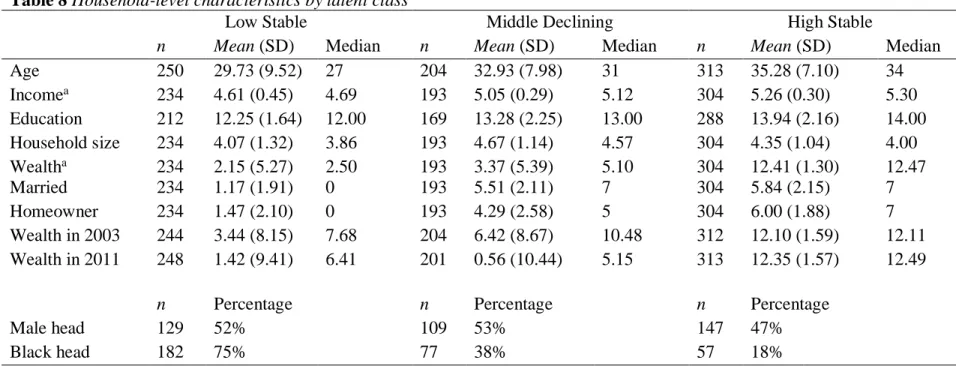
with regard to other key variables including age, the race of the head of household, wealth, marriage, and homeownership (see Table 8).
In preparation to test the hypotheses regarding class membership and children’s physical and psychosocial outcomes, I also examined differences among classes with regard to the adolescent-level data. This information is in Table 2. Adolescents in the low stable group were predominantly Black (n = 191, 76% of group), and adolescents in the high stable group were predominantly White (n = 239, 76% of group). Across the three classes, adolescents did not appear to differ with respect to their physical development. However, the mean values for parent-reported internalizing and externalizing behavior problems seemed to be higher among
adolescents in the middle declining class (M = 2.9, SD = 3.3; M = 5.2, SD = 4.5 respectively) compared to the other two groups.
Structural Equation Modeling of Wealth and Physical and Psychosocial Development
I began the model building steps to test Hypotheses 2-5 by constructing a latent variable of physical development using adolescents’ reported comparative physical development, breast development, voice changes, and facial hair growth. I excluded age of first menstruation from the latent factor because it did not correlate with the other variables. The other physical development variables are physical changes that appear more gradually, whereas menarche marks a discrete shift in girls’ physical changes. Age at first menstruation also provides separate timing and tempo information about girls’ physical development, so it was included in the model separately as a unique manifest variable. The model fit the data well (2(17) = 47.23, p < .001;
According to Hypothesis 2, children in households with steep declines in wealth during the Recession would exhibit more internalizing and externalizing behavior problems regardless of their age or sex. I tested this hypothesis using a single-group structural equation model (SEM). Class membership was dummy-coded and two classes were regressed on physical development, menarche, and internalizing and externalizing behavior problems using a third class as the reference group to avoid the dummy variable trap. This process was conducted three times in order to use each class as a reference group and make all the relevant comparisons. Internalizing and externalizing behavior problems were permitted to correlate, as well as physical
development and menarche. Race and sex were included as controls and also regressed on physical development, menarche, and behavior problems. This model fit the data well (2(20) =
46.44, p < .001; CFI = .969, TLI = .930; RMSEA = .042). Figure 3 shows the path diagram for this model using low stable as the reference class. The declining group exhibited more
internalizing ( = .17, p < .05) and externalizing ( = .20, p < .05) behavior problems than the
low stable group.
The Role of Developmental Timing in Moderating Hardship
To address my fourth hypothesis regarding the role of developmental timing, I first tested the invariance of the model with respect to the child’s age group during the Recession. The child’s age group during the Recession was determined by subtracting 7 years from their 2014 age in years. Adolescents who were between 5 and 7 during the Recession were categorized as in adrenarche (1), and adolescents who were between 8 and 10 during the Recession were
categorized as post-adrenarcheal (0). A test of full invariance estimates the groups’ models separately, but with each parameter constrained to be equal across the groups. Poor fit resulting from this model would indicate that the two groups differ significantly with respect to the relations among the variables modeled, and therefore should be free to vary. The test of full invariance yielded an ill-fitting model, 2(63) = 191.27, p < .001; CFI = .847, TLI = .735,
RMSEA = .073. In particular, the adrenarche group contributed the most to the model misfit (indicated by a larger chi-square contribution relative to the older group), suggesting that the model fit especially poorly for this group.
I next allowed the parameters to vary between the two groups. The path diagram for the adrenarche group is Figure 4, and the path diagrams for the older group are Figures 5a and 5b. All estimated paths are shown in these diagrams, and significant paths (p < .05) are indicated by solid black lines with partially standardized parameter estimates. Among adolescents who were around the age of adrenarche during the Recession, membership in the low stable wealth class predicted fewer internalizing ( = -.27) and externalizing ( = -.29) behavior problems and less
-.39). Moreover, girls tended to be significantly more physically developed than boys in this group ( = -.44).
Among adolescents who were older during the Recession, the pattern of results is
different. Membership in the low stable class predicted higher levels of physical development in 2014 compared with the high stable class ( = .35). Membership in the middle declining class predicted an earlier onset of menarche than in the low stable class ( = -.39) which, in turn, predicted higher levels of both internalizing ( = -.18) and externalizing ( = -.21) behavior problems across all classes. Black adolescents also reported earlier menarche ( = -.36), but also fewer internalizing problems ( = -.34). Once again, I used the Mplus “Model Indirect”
command to obtain tests of indirect effects, or mediation, between wealth class and behavior problems through menarche, and also between race/ethnicity and behavior problems through menarche. These tests were not significant. Neither physical development nor menarche
mediated the relations observed between wealth class and behavior problems, nor race/ethnicity and behavior problems.
CHAPTER 4: DISCUSSION
The current study used emerging evolutionary-developmental theories such as the ACM to examine how childhood hardship may affect long-term physical development and its
behavioral correlates. I aimed to characterize American households’ changes in wealth across the decade containing the Great Recession and to use that characterization to predict children’s later physical and psychosocial outcomes. Moreover, this study aimed, and is among the first, to evaluate recent claims that adrenarche is a sensitive period during which children are particularly susceptible to changing environmental conditions. Results suggested that there are marked physical and behavioral differences among children who endure chronic hardship, those who endure sudden and acute hardship, and those who do not. Additionally, results indicated that a child’s age at the time of exposure does contribute to differential outcomes, but not in the hypothesized manner. In the following sections, I summarize the results of the study and offer some explanations for the unexpected patterns that emerged. I conclude with a discussion of the limitations of the current study and suggest future programs of research that build upon these results.
Characterizing Wealth Changes
25% of households lost at least 75% of their wealth, and more than 50% of households lost 25% of their wealth (Pfeffer, Danziger, & Schoeni, 2013). Using a modeling strategy similar to the current study, Friedline et al. (2013) identified two latent classes: high stable and declining. I predicted that a three class model would be a better fit, with the additional class dividing Friedline’s “declining” group into middle declining and low declining classes. Figure 1 appears to depict these two hypothesized groups; however, the group with the lowest intercept is not significantly changing over time, so this group was named low stable and represented households that consistently had relatively little wealth throughout this time period.
In the present study, the middle declining class began with more wealth than the low stable class, but eventually dropped to match the low stable class. The magnitude of wealth losses in the middle declining group was significant, but also noteworthy is this group’s sluggish recovery following the Great Recession. On average, households in the middle declining class lost 91% of their wealth between 2003 and 2013, and had only recovered 39% of their 2003 wealth by 2015. Individuals’ perceptions of their economic circumstances were not observed in this study. Had they been, it is possible that households in this group perceived their economic circumstances to be more dire than households in the stable groups. They lost more of their wealth and they lost it faster than the average household in the sample. In fact, their losses were more than the average household in the United States (median losses of 28% in the first decade of the 21st century; Pew, 2012).
tested that a high stable group retained much of its wealth through the Recession, and some households in lower classes endured disproportionate losses. This is largely consistent with what has been reported in previous economic studies of the Great Recession (e.g. Pew, 2012; Pfeffer et al., 2013; Rauscher & Elliot, 2015; Yilmazer et al., 2015). The vanishing wealth of what might be considered the "middle class" in this study is striking and fully consistent with other
nationwide studies. Unlike persistently low-income and upper-income groups, wealth is largely stored in home equity among the middle class (Pew, 2012). Apart from investing in homes, this group lacks the significant resources of the upper class to invest in productive assets or to save money, rendering their wealth more vulnerable to shocks due to its non-liquidity and lack of asset diversification (Pew, 2012; Pfeffer et al., 2013). At any time point in the present study, roughly 30% of households were homeowners in the middle declining group and about 12% in the low stable group. Put another way, 70% of the middle declining class owned their homes over this time period, compared to 21% of low stable and 83% of the high stable classes. Following the Great Recession, when home equity was diminished by catastrophic
macroeconomic forces and many homes were foreclosed upon, the net wealth of the middle class began to resemble that of the lower class. In 2007, 64% of homeowners in the sample were members of the middle declining group, and at time points during the Recession this share was reduced to 60% in 2009, 59% in 2011, and 56% in 2013. In this respect, the stability of non-homeownership in the low stable group might have been protective during the Great Recession, but as I will discuss the wealth poverty experienced in this group was significantly associated with some maladaptive outcomes nonetheless.
the wealth changes described above. Of special relevance is the interactionist model that
combines social causation and social selection perspectives. From this perspective, the enduring physical and behavioral adaptations observed among low-SES groups, such as early puberty (Arim et al., 2011; Belsky et al., 2015), obesity (Pratt et al., 2017) and impulsive behaviors (Ackerman, Kogos, Youngstrom, Schoff, & Izard, 1999), may be attributed to pervasive economic inequality in the United States. Inequality does so by creating vulnerability to destabilization in the middle class and by keeping environmental change-for-the-better out of reach in the lower class. The interactionist model posits that the physical and mental health disparities observed between poor and wealthier populations results from a process of social selection that confines specific groups to circumstances devoid of opportunity. I am not the first to make the claim that inequality is at the core of many social ills (e.g. Piketty, 2014), but the current study provides some suggestive evidence for its validity. The interactionist theory along with the Adaptive Calibration Model of stress reactivity provide both proximal and distal explanations for the associations between the lack of wealth and individual development observed in this study and in the extant literature.
effects on physical development in the older children were directly related to their wealth group. Specifically, children who were persistently disadvantaged were likely to show more advanced secondary indices of physical development, and female children who experience sudden wealth declines were more likely to begin menstruating at a younger age. Among the older group only, early menarche was significantly associated with a greater incidence of internalizing and externalizing behavior problems, but menarche did not mediate the link between wealth and behavior.
The Effect of Wealth Change on Behavior Problems
In Hypothesis 2, I predicted that adolescents whose families experienced significant declines in wealth during the period containing the Great Recession would exhibit more internalizing and externalizing behavior problems as reported by their caregivers regardless of their age or sex. This hypothesis was partially supported. The single-group SEM revealed significant positive paths between the middle declining class and internalizing and externalizing behavior problems. On average, caregivers of adolescents in the middle declining class
reported .64 more internalizing behaviors and .76 more externalizing problems than caregivers in the high stable class. These effects are small and are not likely contributing to children moving in or out of clinically significant ranges of behavior problems. However, the directions of results provide some insight into possible developmental differences between persistent and sudden adversity.
adolescent internalizing and externalizing behavior problems as compared to the low or high stable households. However, the effects were small in magnitude. On average, caregivers of adolescents in the middle declining group reported .93 more internalizing and 1.21 more externalizing behavior problems than caregivers of adolescents in the low stable class. The low incidence of behavior problems (2.6 for internalizing and 4.9 for externalizing) and a large variance (SD = 3.1 and 4.4, respectively) in the overall sample likely contributed to the small effect.
For children between the ages of 5 to 7, the low stable group stood out as less prone to internalizing and externalizing problems than the middle declining class. Although I did not expect lower levels of behavior problems in the low stable class compared to the other two, this finding might reflect adjustments to conditions of adversity, class differences in parental
expectations of adolescents’ behavior, or parental insensitivity to adolescents’ behavior and emotional states. It might also be attributable to measurement error. For example, Guttmannova, Szanyi, and Cali (2008) demonstrated that the two-factor configuration of the Behavior Problem Index functions differently across ethnic groups, and that patterns of factor loadings derived from the same sample vary across time within Black and Hispanic ethnic groups. Because Black households (75%) were disproportionately represented in the low stable class compared to White households (25%), it is possible that the present finding reflects the effect reported by
Guttmannova and colleagues.
effects of wealth on behavior problems by age group, except to posit that physical development in the adrenarcheal group would at least partially mediate the pathways between wealth classes and adolescent behavior problem. This hypothesis was not supported for adrenarcheal or post-adrenarcheal children. Instead, physical development appeared to play no role in the
development of behavior problems in adrenarcheal children, and wealth appeared to play no role in behavior problems in adolescents who were older. Findings related to physical development are discussed in a later section.
The ACM might provide an explanation for these divergent patterns. Internalizing and externalizing behavior problems were conceived as broad behavioral proxies for the patterns of adaptation postulated by the ACM to be associated with differences in physiological stress reactivity. Specifically, I posited that the behavioral patterns associated of the vigilant-withdrawn and vigilant-agonistic profiles identified by Del Giudice et al. (2011) would correspond to
presence of significant paths from wealth to behavior problems among those children who were younger and not older at the time of the recession. Conversely, gonadarche is characterized by the activation of the hypothalamic-gonadal-axis (HGA), responsible for the primary and secondary physical changes of puberty. Experiencing stressors like wealth shocks during
gonadarche, but not adrenarche, might explain the accelerated pubertal development in the older group.
The Mediating Role of Physical Development
In Hypothesis 3, I predicted that associations between wealth declines and behavior problems would be mediated by physical development. Specifically, I predicted that adolescents whose families experienced significant declines in wealth during the period containing the Great Recession would exhibit more outward signs of pubertal changes in 2014 than adolescents in other groups, and that those changes would mediate the causal link between wealth and behavior. The results partially supported the first part of this hypothesis, although the prediction that these effects would be especially robust among adrenarcheal children was not supported.
For example, a girl who begins menstruating early into her 12th birthday is developmentally
similar to the girl who begins shortly before her own 12th birthday; with only age in years
available, these girls were considered in the present study menstruating a full year apart, at 11 and 12 years of age respectively.
I also found negative effects of both high and low stable wealth on secondary physical development adolescents who were in adrenarche during the Recession. Adolescents who were in low stable households were less physically developed and had begun menarche later than children in middle declining households, and adolescents who were in high stable households were also less physically developed than children in middle declining households. These results were not specifically hypothesized, but they are consistent with the ACM. Children in stable households (both poor and wealthy) may have adopted slow life history strategies. Among wealthy children, circumstances can reasonably be expected to remain the same, so their physical development is slower and reproductive capacity diminished in the service of acquiring more resources to effectively nurture their offspring. Among children in the low stable class, a slow life history strategy might be necessitated by energetic stress, which includes malnutrition, low energy intake, and internal stressors such as disease (Del Giudice et al., 2011). A slow life history strategy might be an optimal adaptation to persistent resource scarcity among low-wealth households. Alternatively, adolescents who were in adrenarche in 2007 were younger during the 2014 data collection than the post-adrenarcheal children, so these results might also be a
reflection of those age differences.
These effects were partially reversed among children who were older during the
stable class is the duration of exposure to adverse circumstances. Children who were classified as older and whose households belonged in the low stable group had been exposed to low-wealth (presumably challenging circumstances) longer than children who were younger in the same time period in the same wealth class. The cumulative effects (Holochwost et al., 2016) of enduring persistent economic strain are logically likely to be greater among older children and may explain the more rapid physical development observed among the consistently disadvantaged children in this age group. Again, this may also be a reflection of the age differences between the groups when physical development data were collected (ages 12-14 and 15-17).
Sex and Race
Hypothesis 5 predicted that the associations observed in the first SEMs would differ by sex; specifically, that younger girls would display more internalizing behavior problems as a function of declining wealth, mediated by physical development, compared to older girls. Younger boys were expected to display more externalizing problems as a function of declining wealth, mediated by physical development, compared to older boys. However, the model as specified was ineligible for a multiple groups model comparison between sexes due to the missingness related to sex-specific questions. Specifically, boys contributed more information to the latent variable of physical development than girls, and only girls reported on menarche. The multiple groups model was unable to converge due to these patterns of missingness.