INL/EXT-08-13979
U.S. Department of Energy Office of Electricity Delivery and Energy Reliability
NSTB
Common Cyber Security
Vulnerabilities Observed in
Control System
Assessments by
the INL NSTB Program
November 2008
November 2008
INL/EXT-08-13979
Common Cyber Security Vulnerabilities Observed in
Control System Assessments by the INL NSTB
Program
November 2008
Idaho National Laboratory
Idaho Falls, Idaho 83415
http://www.inl.gov
Prepared for the U.S. Department of Energy
Office of Electricity Delivery and Energy Reliability Under DOE Idaho Operations Office
Common Cyber Security Vulnerabilities Observed in
Control System Assessments by the INL NSTB
Program
INL/EXT-08-13979
EXECUTIVE SUMMARY
Idaho National Laboratory (INL) performs cyber security assessments of control systems under private sector and government programs. This report applies to assessments conducted on behalf of the National Supervisory Control and Data Acquisition (SCADA) Test Bed (NSTB) program. The mission is to help industry and government improve the security of the control systems used in critical energy infrastructures throughout the United States. A key part of this mission is the assessment of control systems to identify vulnerabilities that could put critical infrastructures at risk from a cyber attack.
This document presents results from 16 control system assessments
performed under the NSTB program from 2003 through 2007. Information found in individual stakeholder reports is protected from disclosure. Researchers recognized that many systems had similar types of findings, and that this information could be of great benefit to those in industry responsible for control system security. For this reason, vulnerability information was collected, analyzed, and organized into general categories based on a control system security metrics approach.
Common vulnerabilities were derived from similar assessment findings and grouped into general security dimensions and sub-categories based on analysis using an INL-developed taxonomy. Mitigation strategies for these findings are provided in each section.
Information found in this report can benefit vendors, asset owners, and other stakeholders responsible for securing the systems that control the nation’s critical infrastructure. System vendors learn of common weaknesses in control system applications, services, and protocols, and how to better secure their products while asset owners can evaluate possible weaknesses in their installed system configurations and how they can fix or mitigate them with secure firewall configurations, intrusion detection systems, and network architectures.
Understanding the types of vulnerabilities commonly found and how to mitigate them can serve to help protect the systems currently in development as well as those already installed in critical infrastructure applications.
The current overall impact of the INL NSTB program on the stakeholder community encompasses strong user interest in the information from the assessment reports. Utilities have requested assessments of their sites, and both utilities and vendors have requested follow-up assessments on the vendors’ control system software. Knowledge gained through control system security assessments has been shared with over 1,800 individuals through security
awareness training, and specific vendor-approved findings have been presented at vendor user group conferences.
This document represents a steadily growing understanding of control system security issues and methods for mitigating current vulnerabilities as well as new technologies and approaches being developed in response to security challenges. The effort is expanding to new technologies, such as substation automation and Smart Grid, as the program seeks a continuing understanding of the systems being planned for and deployed in the energy sector critical infrastructure.
CONTENTS
EXECUTIVE SUMMARY ...iii
ACRONYMS... vii
1. INTRODUCTION ... 1
2. ASSESSMENT METHODOLOGIES ... 2
2.1 Laboratory Assessments ... 3
2.2 Onsite Assessments... 3
2.3 Impact on Stakeholder Community ... 4
3. COMMON ASSESSMENT FINDINGS... 5
3.1 Security Group Knowledge Security Dimension ... 7
3.1.1 Vulnerability Category: Change Management Deficiencies... 7
3.1.2 Vulnerability Category: Documentation Deficiencies ... 8
3.1.3 Vulnerability Category: Procedure Deficiencies... 9
3.1.4 Security Group Knowledge Summary ... 9
3.2 Attack Group Knowledge Security Dimension... 9
3.2.1 Vulnerability Category: Information Leaks ... 10
3.2.2 Vulnerability Category: Open Source Information Available ... 12
3.2.3 Attack Group Knowledge Summary... 13
3.3 Access Security Dimension... 13
3.3.1 Vulnerability Category: Firewall Filtering Deficiencies... 14
3.3.2 Vulnerability Category: Remote Access Deficiencies ... 15
3.3.3 Vulnerability Category: Physical Access... 16
3.3.4 Access Security Dimension Summary ... 17
3.4 Vulnerability Security Dimension... 18
3.4.1 Vulnerability Category: Lack of Input Validation ... 18
3.4.2 Vulnerability Category: Vulnerable Communication Protocols ... 21
3.4.3 Vulnerability Category: Weak User Authentication ... 23
3.4.4 Vulnerability Category: Least Privileges Not Enforced ... 24
3.4.5 Vulnerability Category: Unpatched Systems ... 26
3.4.6 Vulnerability Security Dimension Summary ... 27
3.5 Damage Potential Security Dimension ... 28
3.6 Detection Security Dimension ... 29
3.7 Recovery Security Dimension... 29
4. SUMMARY ... 30
5. REFERENCES ... 32
Appendix A Taxonomy Methodologies... 33
Appendix B Terms and Definitions ... 39
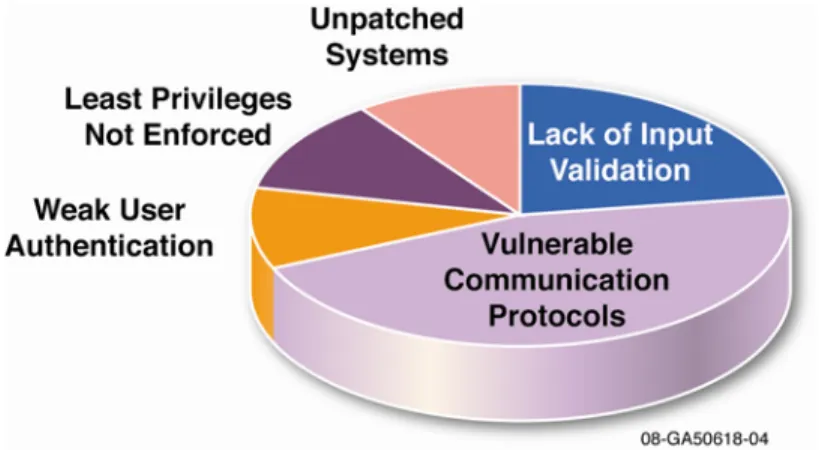
Figure 1. Frequency of access dimension common vulnerabilities by category... 17 Figure 2. Frequency of vulnerability security dimension common vulnerabilities by category. ... 28
TABLES
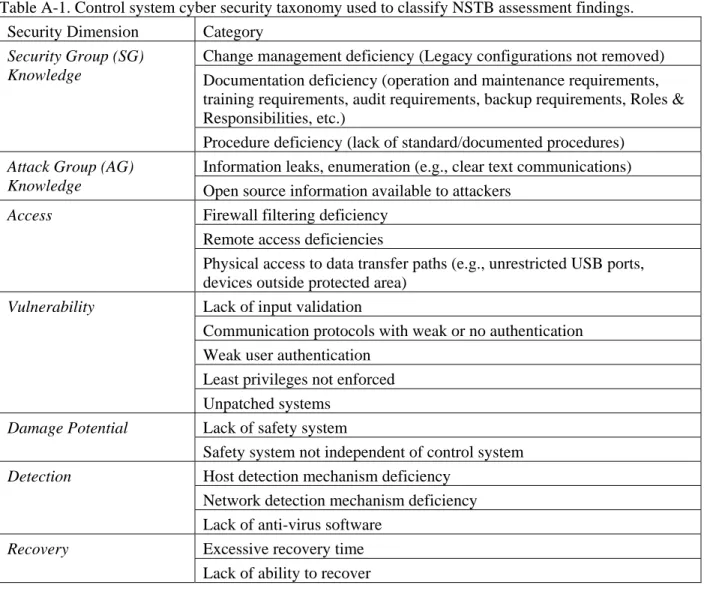
Table 1. Summary of common NSTB control system system assessment findings to date. ... 6 Table 2. Frequency of security group knowledge common vulnerabilities by category. ... 9 Table A-1. Control system cyber security taxonomy used to classify NSTB assessment findings. ... 37
ACRONYMS
ACL Access Control List
AG Attack Group
ARP Address Resolution Protocol BEA Battelle Energy Alliance
CIA Confidentiality, Integrity, Availability CMU Carnegie Mellon University
CRADA Cooperative Research and Development Agreement CWE Common Weaknesses Enumeration
DMZ Demilitarized Zone
DNP Distributed Network Protocol DOE Department of Energy
DOE-OE Department of Energy-Office of Electricity Delivery and Energy Reliability DoS Denial-of-Service
EMS Energy Management System
FEP Front-end Processor
FTP File Transfer Protocol HMI Human Machine Interface HTTP Hypertext Transfer Protocol
HTTPS Hypertext Transfer Protocol over Secure Socket Layer IAM Information Security Assessment Methodology ICCP Inter-Control Center Communications Protocol IDS Intrusion Detection Systems
IEC International Electrotechnical Commission IED Intelligent Electronic Device
INFOSEC Information Security INL Idaho National Laboratory
IP Internet Protocol
IT Information Technology
LAN Local Area Network
MAC Media Access Control MITM Man-in-the-Middle MS Microsoft
NFS Network File System
NIST National Institutes of Technology NSA National Security Agency
NSTB National Supervisory Control and Data Acquisition Test Bed PLC Programmable Logic Controllers
RTU Remote Terminal Unit
SCADA Supervisory Control and Data Acquisition
SG Security Group
SIS Safety Instrumental System SNL Sandia National Laboratory SQL Structured Query Language
SSH Secure Shell
SSL Secure Sockets Layer
TASE Telecontrol Application Service Element USB Universal Serial Bus
VPN Virtual Private Network VTP Virtual Trunking Protocol WAN Wide Area Network
Common Cyber Security Vulnerabilities Observed in
Control System Assessments by the INL NSTB
Program
1. INTRODUCTION
The U.S. Department of Energy (DOE) established the National Supervisory Control and Data Acquisition (SCADA) Test Bed (NSTB) program to assist industry and government improve the security of control systems used in the nation’s critical energy infrastructures. The NSTB Program is funded and directed by the DOE Office of Electricity Delivery and Energy Reliability (DOE-OE). A key part of the program is the assessment of control systems to identify and provide mitigation approaches for
vulnerabilities that could put the systems at risk to a cyber attack.
Assessments are performed in the Idaho National Laboratory (INL) SCADA Test Bed and in operational installations at utilities, generation plants, and energy management facilities. Control system vendor software is tested in the SCADA Test Bed at INL. Operational control system assessments use nonintrusive methods, such as reviewing the production system network diagrams and firewall rules, and performing a hands-on assessment of a duplicate non-production installation of the system.
SCADA systems are of the greatest interest in the assessments because they are the most common type of control system in the energy sector, controlling equipment ranging from valves in oil and gas pipelines to switches and breakers in the national electric grid. If compromised, an attacker could utilize these systems to cause catastrophic damage or outages directly or by exploiting paths to critical end devices or connected SCADA systems.
2. ASSESSMENT METHODOLOGIES
The primary goal of the INL cyber assessment tasks is to improve the security of the energy infrastructure by delivering to each industry partner a report of all security problems found during the assessment along with associated recommendations for improving the security of their product or infrastructure (as appropriate). With this in mind, INL has performed assessments on a large variety of systems. Some systems have been assessed after being set up in the INL test bed while others have been assessed onsite in production facilities. Regardless of where the work took place, an assessment plan and methodology are tailored to provide the most value to the customer owning the system. To accomplish this, assessment methodologies differed significantly between laboratory and onsite assessments, and even across systems.
System configurations varied considerably depending on control system functionality, negotiated objectives, and whether the assessment was conducted in the laboratory or onsite. In all cases, the architecture and boundaries for the system under test are carefully determined. Assessment targets are developed individually for each assessment based on the system configuration and assessment focus because a comprehensive system assessment is not possible given project funding and the complex nature of control systems. Although a common approach is used for all assessments, the details of each
assessment vary; the fact that a vulnerability was not listed on a particular system report does not imply that it did not exist on that system. Common vulnerabilities listed in this report are therefore limited to those tested for and found in multiple systems.
Laboratory assessments are designed to evaluate vendor-specific products and services, such as custom protocols, field equipment, applications, and services. The model is to assess systems in multiple phases: (1) a baseline system assessment that identifies vulnerabilities in the vendor’s default
configuration, and (2) an evaluation of the system following implementation of mitigation strategies based on baseline assessment results. In some cases, more than two assessments have been performed on different versions of a control system. After a system has been tested in the laboratory, an assessment is usually performed on an asset-owner installed version of the system. This provides an opportunity to work with owners and operators and help validate the impact and possible mitigation strategies for vulnerabilities identified in the laboratory assessment.
Assessment projects typically leverage a full-disclosure approach with the vendor and asset-owner partners. The INL focus is on the control system and its perimeter. By collecting background architecture, policy, and configuration data from a project partner, the team can perform a more thorough assessment of the system. Penetration testing is a security validation process performed by many commercial entities. INL does not simulate a blind attack or penetration of the system, but instead works with the project partner to gain the best understanding possible and provide insight to help mitigate vulnerabilities found in their control systems.
A laboratory assessment generally starts with a basic information technology (IT) assessment of the system, including port scanning, vulnerability scanning, network mapping, password cracking, and network sniffing and fuzzing. Typical tools used in testing can be found in the Permann and Rohde report.1 In addition to the IT assessment, specific targets or functional pieces of the system are evaluated. These targets are referred to as Assessment Targets. Testing is often conducted on the control system local area network (LAN), with the assumption that the attacker has penetrated perimeter protection and is on the control system network. Typical assessment targets may be “Changing Alarms and Commands” or “Unauthorized Database Access.” If the test environment contains connections external to the control system network, such as to the corporate network, field equipment, or Demilitarized Zone (DMZ), these connections can be assessed. Typical assessment targets for this portion of the control system may be “Compromise the Front End Processor” or “Assess Vulnerabilities in DMZ Servers.”
Assessment targets are given a priority based on the level of functionality they provide to the system and their operational impacts to the system. Each target is allocated an appropriate amount of testing time according to its priority level. The time frame may be modified during the assessment based on testing results. Depending on the complexity of the system, testing time for laboratory assessments is generally allotted up to 900 cyber security researcher-hours. The impact to the system is described and a mitigation strategy is proposed for each finding identified.
Onsite system assessments generally assess how securely external connections, firewall
configurations, intrusion detection systems (IDS), network architecture, and any other components are deployed and installed. These assessments generally leverage findings from laboratory assessments with the associated control system vendor. This has been coined “ground truthing” because laboratory assessment findings are validated on installed systems. This interaction includes discussion on the viability of possible mitigations and defenses. Onsite assessments generally include 2 weeks of assessment at the asset owner’s site, and can take up to 300 cyber security researcher-hours.
Assessment plans are tailored to each system and to each vendor. Objectives outlined in the assessment plan cover steps that might be potential goals of a real attacker attempting to exploit the control system and cause damage to equipment, interrupt service, or harm people or the environment.
2.1 Laboratory Assessments
Laboratory assessments are performed under Cooperative Research and Development Agreements (CRADAs) or Nondisclosure Agreements (NDAs) between the system vendors and Battelle Energy Alliance (BEA). BEA, which currently manages the INL contract, is hereafter referred to as INL. Under these agreements, the vendors provide hardware, software, and technical support. INL develops the test plans, performs the cyber security assessments, and reports the results. These agreements also protect the vendor from public disclosure of the assessment findings.
Assessments are usually performed on the latest release of the vendors’ systems using a base, typical or turnkey installation. This allows INL to influence the system that is currently under development. Identifying a baseline or default architecture is generally difficult since every installation includes some degree of custom configuration. Vendors may support multiple operating systems, features, and control system protocols. Customers can choose from an assortment of functionality, which can be separated on different servers or combined on one, and many levels of redundancy can be provided. Therefore, INL works closely with each vendor to ensure that to the extent possible, the components most commonly found in customer facilities are included in the test architecture.
2.2 Onsite Assessments
Onsite assessments are performed under a CRADA or NDA agreement between INL and the industry partner. Onsite assessments differ from laboratory assessments largely in the amount of time spent on testing and the functional areas of a system the testing focuses on. Onsite assessments are completed in 2 or 3 weeks, as compared to 2 or 3 months for more in-depth laboratory assessments. Since an intrusive examination of the operational control system itself is not appropriate and system owners and operators cannot modify the control system software themselves, the focus for onsite assessments is usually network security and perimeter protection. These are the main areas they have direct control of for mitigating findings on their assessment and the associated vendor assessment.
The focus of the assessment is changed in order to analyze a fielded system and how it is
implemented and protected in production. This changes the assessment to resemble a “network security layers of defense” analysis. This includes a review and tour of the production system to help identify through documentation, observation, and conversation any possible security problems with the production
system and network configuration without putting the operational system at risk. Analysis of the actual site’s control system software is done on a backup or test system so that the custom installation can be evaluated based on vulnerabilities found in the associated vendor laboratory assessment. Any mitigating recommendations can then be given to the customer while the vendor fixes the underlying problem.
2.3 Impact on Stakeholder Community
Since the inception of the program, the reports generated from the assessment of control system products and installations have been used by vendors and asset owners to understand and mitigate cyber vulnerabilities found during each assessment. Although not all findings have been addressed, most systems have been modified to improve security based on assessment reports. Some of the vendors have been forthright in sharing the results with their customers and some have felt that any disclosure of vulnerabilities could lead to exposure of their customers to potential cyber attacks. Whether results were shared with control system customers or not, security awareness has been increased by sharing control system security knowledge gained through the assessment process. Cyber security and control system researchers have presented results and provided security training to attendees of the various vendor user group conferences. Most user groups have established breakout sessions and working groups dedicated wholly to control system cyber security issues. Some of these sessions have evolved into user
consortiums and other arrangements with vendors to fund additional control system assessments. The NSTB onsite assessments have been conducted at utilities in order to help secure the particular site, verify laboratory findings, and gather common recommendations that are then shared with other utilities. This brings laboratory vendor assessments full circle to help the control system software, its implementations in the field, and the associated critical infrastructure become more secure.
3. COMMON ASSESSMENT FINDINGS
The INL Control Systems and Cyber Security Test Center is a research facility designed to evaluate control systems representative of those used in the United States critical energy infrastructure. It was established through a collaboration of the DOE-OE NSTB and the Department of Homeland Security Control System Security Program to assess and help improve the security of control systems, which have not had the exposure, scrutiny, and security culture change that common IT applications have received. Understanding the unique priorities, vulnerabilities, impacts, limitations, and operation inherent in control systems has been a research effort with evolving assessment procedures. As a result, assessments are customized and tailored to the specific control system and the aspects of the system that its vendor and INL determine require the most scrutiny. Assessments are a combination of targets based on perceived vulnerability, impact or exposure of system components and functionality, and evaluation of security measures built into, or placed around, the control system.
Even though there is a common general theme and assessment methodology, all systems have not been tested for the same vulnerabilities. For example, many assessment goals are result-based, which tests whether an action such as causing a breaker to close could be accomplished by any means, instead of a methodical assessment approach that tests for a given set of potential security flaws. Another factor that contributed to the disparity of vulnerability tests was that all systems configured for assessment do not have the same set of components and functionality. Control systems inherently have many configuration options, such as:
• Operating system
• Functionality shared on the same computer
• Amount of redundancy
• Connected field devices
• Protocols used to communicate with field devices
• Security features such as security zones, intrusion detection, and update methods.
The size and architecture of assessed systems varied widely. For example, assessed systems ranged from:
• A control system with the most basic functionality on a single LAN with a few computers
• A control system with partial optional functionality, simulated data, and some network security defense devices
• All available control system functionality connected to a remote terminal unit (RTU) with the recommended network architecture and perimeter defenses
• An operational system connected to the U.S. power grid with duplicate system for interactive testing. This disparity leads to differences in assessment focus based on what was available on the system for assessment and priority lists for which part of the system will be evaluated in the allotted timeframe.
Common NSTB assessment findings in this report were not derived from a comprehensive or even consistent set of assessments or fully operational control systems. The common assessment findings that follow are similar security problems found on two or more unique control system configurations. It cannot be inferred that vulnerabilities not included in this report are not common to control systems or that three similar findings under a common vulnerability means that only three systems assessed were susceptible to that vulnerability.
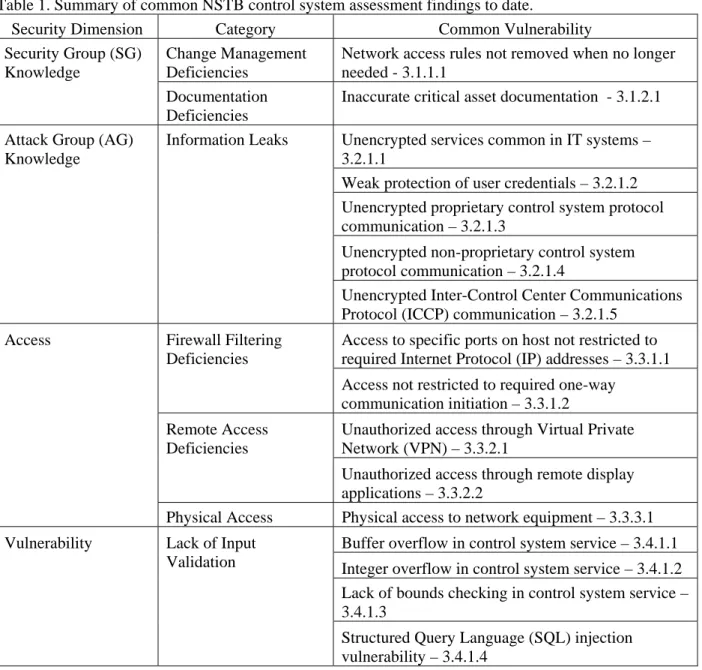
Table 1 lists the common vulnerabilities categorized based on the taxonomy described in Appendix A. The security dimensions represent the main system attributes that affect the risk of loss from cyber attacks. These security dimensions are further subdivided into categories of problems that lead to vulnerabilities. A common vulnerability describes findings from a minimum of two assessments.
The assessment findings described in this report are organized according to the security dimension and category in which they belong. Vulnerability descriptions are generalized to remove specific vendor-identifying information and details that would hinder the ability to group common vulnerabilities. Sanitized assessment details are included inside each common vulnerability description to aid in
understanding the real issues. Multiple assessments may have findings that match the same vulnerability details, and one assessment may have multiple specific detailed vulnerabilities relating to one common vulnerability. Some common vulnerabilities have only one detailed example that describes all findings from the associated assessments. The number of systems with a given vulnerability are not listed to avoid any implication that all systems were tested for that vulnerability and to help lend anonymity to the control systems associated with common vulnerabilities and related specific details.
Table 1. Summary of common NSTB control system assessment findings to date.
Security Dimension Category Common Vulnerability Change Management
Deficiencies
Network access rules not removed when no longer needed - 3.1.1.1
Security Group (SG) Knowledge
Documentation Deficiencies
Inaccurate critical asset documentation - 3.1.2.1 Unencrypted services common in IT systems – 3.2.1.1
Weak protection of user credentials – 3.2.1.2 Attack Group (AG)
Knowledge
Information Leaks
Unencrypted proprietary control system protocol communication – 3.2.1.3
Unencrypted non-proprietary control system protocol communication – 3.2.1.4
Unencrypted Inter-Control Center Communications Protocol (ICCP) communication – 3.2.1.5
Access to specific ports on host not restricted to required Internet Protocol (IP) addresses – 3.3.1.1 Firewall Filtering
Deficiencies
Access not restricted to required one-way communication initiation – 3.3.1.2
Unauthorized access through Virtual Private Network (VPN) – 3.3.2.1
Remote Access Deficiencies
Unauthorized access through remote display applications – 3.3.2.2
Access
Physical Access Physical access to network equipment – 3.3.3.1 Buffer overflow in control system service – 3.4.1.1 Integer overflow in control system service – 3.4.1.2 Vulnerability Lack of Input
Validation
Lack of bounds checking in control system service – 3.4.1.3
Structured Query Language (SQL) injection vulnerability – 3.4.1.4
Security Dimension Category Common Vulnerability
Control system protocol uses weak integrity checks – 3.4.2.4
Standard IT protocol encryption can be defeated – 3.4.2.1
Standard IT protocol uses clear text authentication Communication
Protocols with Weak or No Authentication
Control system protocol uses weak authentication – 3.4.2.2
Improper security configuration – 3.4.3.1 No password required – 3.4.3.2
Weak User Authentication
Weak passwords – 3.4.3.3
Unauthorized directory traversal allowed – 3.4.4.1 Services running with unnecessary privileges – 3.4.4.2
Least Privileges not Enforced
Control system protocols with unnecessary functionality – 3.4.4.3
Unpatched operating system – 3.4.5.1 Unpatched Systems
Unpatched third-party application – 3.4.5.2
3.1 Security Group Knowledge Security Dimension
The security group knowledge ideal is defined as aspects of the system or associated management processes that impact the ability of the security group to know the system and manage changes to the system. Assessment findings show that inadequate documentation and communications prevented security groups from having accurate knowledge of network and asset configurations.
3.1.1 Vulnerability Category: Change Management Deficiencies
The security group knowledge of the system may not be accurate if changes to the system are not properly managed. If there are no tools or processes to support the tracking of changes, the security group knowledge of the control system will be outdated. Unmanaged changes lead to more access allowed than necessary because legacy firewall exceptions, undocumented connections, and unused user accounts exist. 3.1.1.1 Common Vulnerability: Network access rules not removed when no longer
needed
Rules that allowed unnecessary network access were found during assessments (see Section 4.3). This indicated that network equipment was not being updated when the network configuration or
communication paths changed. This showed a lack of change management procedures for removing firewall rules when hosts were removed from the network. Legacy firewall configurations indicate inaccurate knowledge of the current network and may indicate that network administrators are not aware of some potential attack paths. Unneeded firewall access rules may expose vulnerabilities on hosts for potential exploitation. The unneeded firewall rules also may increase the possibility of introducing errors while making modifications to firewall configurations.
The following are three specific assessment findings associated with this vulnerability:
• All hosts on the control system LAN have unrestricted access to the IP address of a since-removed external server
• Routers have what appear to be legacy configuration entries.
Recommendation: Change management procedures need to be created and enforced to ensure unneeded access rules are removed as they become unnecessary.
3.1.1.2 Mitigations for change management deficiencies category
Change management is necessary for accurate system state knowledge and accountability. It is also necessary for compliance to industry regulations. Create and follow change management processes to update router, switch, and firewall configurations, user accounts, etc. This change management procedure should also include compliance and security group documentation updates.
3.1.2 Vulnerability Category: Documentation Deficiencies
There are different types of technical documentation and all play an important role for the smooth operation of systems and organizations. It is important to maintain current information on hardware and software component configurations used in the control system’s architecture. Other materials are important for maintaining systems, such as user guides for installation, reference, and repair. Business policy and procedures, emergency response procedures, security policies, as well as training manuals improve the communication and management process.
3.1.2.1 Common Vulnerability: Inaccurate documentation
In many onsite assessments, documentation was found to either be inaccurate or outdated. Inaccurate network and asset documentation may lead to inadequate access control implementations and other security protections by the security group.
Four specific assessment findings associated with this vulnerability are:
• Critical asset documentation was incorrect or outdated
• There was a disconnect between the corporate IT networking and control system networking groups, which fostered misconfiguration of critical networking resources
• Network did not match drawings or documentation
• IT and control system departments used different names for the same servers.
Recommendation: Timely and accurate communications between the IT and control system departments needs to be promoted. Integrated plant-specific security plans, policies, and procedures need to be
established with the support of senior management, IT and control system groups to be applied and standardized between facilities or subsystems within a facility.
Specifically, configuration management procedures that apply to keeping documentation current when assets are acquired or removed must be used and enforced. Periodic reviews and audits should be scheduled to ensure configuration documentation is accurate.
3.1.2.2 Mitigations for documentation deficiencies category
Once the asset documentation has been completed, documents must be kept current through the same change management procedures that keep the network, host, and account configurations current.
procedures should be followed to update any affected network and critical asset regulatory compliance and security group documentation.
3.1.3 Vulnerability Category: Procedure Deficiencies
No common vulnerabilities were found in the procedure deficiencies category. This does not mean that there were not common procedure deficiencies in the systems assessed. It should only be inferred that due to the nature of the custom assessment plans and systems, common security group procedure
problems were not tested for and discovered in at least two systems.
3.1.4 Security Group Knowledge Summary
Two categories with common vulnerabilities were identified in the security group knowledge dimension. Change management deficiencies led to legacy network access rules not being removed from firewalls and routers, which allowed access paths to hosts and ports that were no longer needed.
Documentation deficiencies resulted in inaccurate critical asset documentation (see Table 2).
Table 2. Frequency of security group knowledge common vulnerabilities by category.
Vulnerability Category Number of Unique Detailed Finding Descriptions
Documentation Deficiency 4
Change Management Deficiency 3
Procedure Deficiency 0
3.1.4.1 Summary of Recommendations for Security Group Knowledge Dimension System tools and associated management processes should provide the security group with current and accurate knowledge of the system and manage changes to the system. This includes configuration and change management tools and procedures that support the tracking of changes, collection and analysis of system logs, and forensics. Common findings indicate the need for a greater focus on documentation and information sharing of accurate network and asset configurations.
Once the asset documentation has been completed, documents must be kept current using the same configuration control procedures used for network, host, and account configurations. Whenever assets are added or removed, or the network is reconfigured, the change management procedures must be followed to update any affected network and critical asset regulatory compliance and security group
documentation.
Change management processes must be enforced to ensure system knowledge and documentation is current and accurate.
3.2 Attack Group Knowledge Security Dimension
The Attack Group Knowledge dimension of security is the set of system attributes, processes, or actions that provide potential attackers with the means to gain information about the system.
An attacker must find information about the target control system and discover details about the process under its control before he can create an attack against it. If the attacker’s goal is merely to shut down the process, very little discovery is needed. However, if the attacker intends a surgical attack or process manipulation, specific details are needed. Some primary sources of information about the process
on the control system LAN are the traffic, points database, and the operator’s screens. The points database assigns numbers to each device, such as a switch or breaker. An attacker planning a surgical strike on the process needs the point information because, at the protocol level, each device is often referred to by number only. The operator’s screens are generally the easiest way to understand the process.
Assessment findings show that use of clear text communications and access to system source code and configuration data are potential weaknesses that could aid an attacker in compromising the integrity of the control system. The open source availability of information regarding the software, devices, topology, configuration, and purpose of a control system was not significantly addressed in any of the assessments to date.
3.2.1 Vulnerability Category: Information Leaks
Credentials sent across the network in clear text leave the system at risk to the unauthorized use of a legitimate user’s credentials. If an attacker is able to capture a username and password, he will be able to log onto the system with that user’s privileges. Any unencrypted information concerning the control system’s source code, topology, or devices is a potential boon for an attacker and should be limited. 3.2.1.1 Common Vulnerability: Unencrypted Services Common in IT Systems
Unsecure services developed for IT systems have been adopted for use in control systems for common IT functionality. Although more secure alternatives exist for most of these services, active unused or obsolete services still exist in many control systems. Unfortunately, this has led to
vulnerabilities readily accessible to an attacker who has gained a toe hold on the control system or has access to an unencrypted communication channel to or from the system. For example, management of network devices using clear text communication provides an attacker the opportunity to learn about the system’s configuration and to more effectively plan his continued attack. Further, the storage of control system artifacts, such as source code and system configuration on an unprotected file system, provides significant potential for information mining by an attacker.
The following are six specific assessment findings associated with this vulnerability:
• Use of clear text IT protocols on control system LAN (e.g., telnet, ftp, “r” services). This finding was common to multiple assessments.
• Network File System (NFS), which has relatively limited security features, is used as the network file system.
• The clear text IT protocol, telnet, is used to access and manage network equipment.
• The clear text IT protocols, File Transfer Protocol (FTP) and Hypertext Transfer Protocol (HTTP), are used for configuration and file transfers to RTUs.
• Access to clear text vendor proprietary services for management of network equipment is not limited solely to the necessary devices.
• Management of network equipment from the corporate network into the control network is accomplished using a clear text service.
Recommendation: Encryption is the obvious answer to information leaks due to clear text
communication. Unfortunately, encryption is not always feasible on control system networks. Timing concerns may make encryption impractical, and, in addition, encryption reduces the ability to monitor network traffic and to troubleshoot the system.
Unsecure versions of common IT services should be replaced where possible by their secure versions. Control systems use common IT protocols for common IT functionality, such as network device
management, remote logins, or file transfers. Since they are not used for real-time functionality, they can be replaced with their secure counterparts in most cases. Secure shell (SSH) can replace all file transfer and remote login protocols such as FTP, telnet, and rlogin with encrypted versions. Any communication can be “tunneled” through SSH. Hypertext Transfer Protocol (HTTP) can be sent over the Secure Socket Layer (HTTPS). There are more secure network file sharing solutions available also. Control system vendors and customers should follow IT security practices and use the current secure versions of common protocols. When replacement is not feasible, access to the services should be minimized and unencrypted communication should be limited to within the control system whenever possible. Communications between security zones should be secured as much as possible.
3.2.1.2 Common Vulnerability: Weak protection of user credentials
User credentials should be vigorously protected and made inaccessible to an attacker. Whenever credentials are passed in clear text, they are susceptible to being captured and then cracked if necessary by the attacker. If stored password hashes are not properly protected, they may be accessed by an attacker and cracked. In every case, the lack of protection of user credentials may lead to the attacker gaining increased privileges on the control system and thus being able to more effectively advance his attack.
The following are two specific assessment findings associated with this vulnerability:
• Services such as FTP, telnet, and rlogin transmit user credentials in clear text
• Password hash files are not properly secured.
Recommendation: Properly secure password files by making hashed passwords more difficult to acquire (e.g., restrict access by using a shadow password file or equivalent on UNIX systems). Replace or modify services so that all user credentials are passed through an encrypted channel.
3.2.1.3 Common Vulnerability: Unencrypted proprietary control system protocol communication
Clear text communications without authentication and integrity checks offer an attacker the opportunity to intercept and alter the communications. The captured communications may be used to reverse engineer the proprietary protocols and to modify or insert commands in ways which suit the attacker’s purpose.
The following are two specific assessment findings associated with this vulnerability:
• A proprietary protocol and service required the firewall to allow incoming connections to the control system on a large number of ports using unencrypted communication
• A common finding was that the backbone control system proprietary communication protocol was clear text and susceptible to being reverse engineered.
Recommendation: When possible, standard secure versions of services should be used. When
proprietary protocols are used, they should, ideally, be encrypted and every message’s integrity validated. If it is not feasible to encrypt messages or provide encrypted channels, access to the proprietary protocols and associated communications should be kept to a minimum level and, preferably, kept within the confines of a well-protected control system security zone.
3.2.1.4 Common Vulnerability: Unencrypted Non-proprietary Control System Protocol Communication
Clear text communications without authentication and integrity checks offer an attacker the opportunity to intercept and alter the communications. The captured communications may be used to
better understand the specific structural function of the various field devices in the system, and to modify or insert commands in ways which suit the attacker’s purpose.
The following is a specific common assessment finding associated with this vulnerability:
• Communication between the front end processor (FEP) and RTUs was unencrypted and susceptible to reverse engineering to effectively alter values to and from field devices.
Recommendation: Future protocols should be designed with greater security including encrypted messaging. If possible, immediate application of encrypted channels would be beneficial. If supported by the field devices, it would be useful to configure the field equipment to only allow connections from the IP addresses of the systems that are expected to connect to those devices. While not preventing
information leakage, this mitigation could make a successful attack more difficult. 3.2.1.5 Common Vulnerability: Unencrypted ICCP communication
The Inter-Control Center Communications Protocol (ICCP) is an open protocol used internationally in the electric power industry to exchange data among utilities, regional transmission operators,
independent power producers, and others. The clear text data exchange may provide many opportunities for an attacker to intercept, understand, and alter the data being exchanged.
A specific assessment finding associated with this vulnerability is clear text ICCP traffic. Recommendation: The preferred mitigation is to adopt the secure version of ICCP so that all communication is appropriately encrypted. This solution is dependent on whether data-sharing peers support secure ICCP. Whether ICCP is encrypted or not, the connection is still with an outside entity; treat ICCP as an untrustworthy connection, place the ICCP server in a separate DMZ, and monitor it closely.
3.2.1.6 Mitigations for Information Leaks Category
Availability of system information including topology, configuration, user credentials, protocol specification, and specific device function are of significant value to an attacker. As a consequence, a variety of mitigations would reduce the potential for information leakage.
Wherever encryption of messages is feasible, it should be done. This may include the replacement of standard insecure services with their secure counterparts or may, in some cases, involve migration away from unencrypted proprietary protocols to more standard and secure services.
Control system communications should be isolated to the extent possible with a network partitioning and defense-in-depth strategies that use switches, firewalls, access control lists, and DMZs, thus
minimizing an attacker’s access to different portions of the control system’s messaging.
Also, all unnecessary system documentation should be removed from the system. Required system documentation should only reside on the necessary system devices, which should be minimized, and access to that information should be restricted to the greatest extent possible.
3.2.2 Vulnerability Category: Open Source Information Available
Availability of open source information concerning the software, devices, topology, configuration, and purpose of a control system may be the first criteria in an attacker’s identification and selection of a target. To a degree, the accessibility of the information is not strictly in the control of individual owners or vendors. However, it is possible to establish a process to baseline the information that has been made
publicly available on the product, and to then track and respond to the increase or decrease of the available information over time.
3.2.2.1 Common Vulnerability: Default Passwords
In the assessments used to generate the set of common vulnerabilities, there was no systematic investigation of open source information related to the control system, and little analysis of the potential uses of such information to an attacker. The investigations that were done focused on default passwords and their use in the operational system. If default passwords are retained, it would be a significant
windfall for an attacker. However, this potential vulnerability was not found on multiple assessments, and therefore does not yet qualify as a common vulnerability.
Recommendation: Not applicable.
3.2.2.2 Mitigations for open source information available category
The first step in mitigation of the potential vulnerabilities associated with publicly available, open-source information is to become aware of the information that is published and available about the control system.
The second step is to develop mitigations for the publicly available information. In the case of
information about a code error or security flaw being published, a good patch management program might be used to ensure that timely solutions to counter the threat are implemented. Information, such as default passwords, can be assumed to be available information and should be changed. A full discussion of possible mitigations is pending a more thorough investigation of the types and qualities of open source information that is available to potential attackers and commonality of the resulting vulnerabilities.
3.2.3 Attack Group Knowledge Summary
Only one category with common vulnerabilities was identified in the attack group knowledge dimension. Information leaks were caused by unencrypted control system protocols and common IT services, and weak protection of user credentials.
3.3 Access Security Dimension
Access is the dimension of security that provides a potential attacker with the ability to send or receive data to or from a component of the control system from the attacker’s location. The first step in gaining control of a control system is to gain unauthorized access to the control system LAN. Fortunately, most control system networks are no longer directly accessible from the Internet. It is now common industry practice to separate the business LAN from the control system LAN with a firewall. The firewall helps prevent unauthorized access and isolates the control system LAN from worms and other maladies that may infect the corporate network. Often a separate LAN, the DMZ, is created to share data between the corporate and control system LANs and to keep non-control system applications off the control system LAN.
To access the control system LAN, the attacker must first bypass the perimeter defense provided by the firewall or find another avenue onto the control system LAN. The attacker can use a number of proven techniques, such as piggybacking, on a connection or exploiting a service allowed through the firewall, discovering an auto-answer modem or connection circumventing the firewall, or gaining access
through a trusted peer site. The attacker does need to maintain access to the control system network in order to accomplish the rest of the attack.
Vulnerabilities that were reported fell into the categories of physical access attack vectors, network partitioning deficiencies, firewall filtering deficiencies, and services allowed into the control system. Most access violation findings fell into the firewall filtering deficiencies category. Inadequate incoming access restrictions findings outweighed all other access control vulnerabilities reported.
3.3.1 Vulnerability Category: Firewall Filtering Deficiencies
Firewall and router filtering deficiencies include access to control system components through external and internal networks. The lack of incoming access restrictions creates access paths into critical networks.
The lack of outgoing access restrictions allows access from internal components that may have been compromised. For an attacker to remotely control exploit code running on the user’s computer, a return connection must be established from the victim network. If outbound filtering is implemented correctly, the attacker will not receive this return connection and cannot control the exploited machine.
3.3.1.1 Common Vulnerability: Access to Specific Ports on Host not Restricted to Required IP Addresses
Detailed findings under this common vulnerability involve firewall rules restricting access to specific ports, but not IP addresses. A common finding was that network device access control lists did not restrict management access to the required IP addresses.
Another common detailed finding was that firewall rules allowed access to unused IP addresses. This was because legacy configuration of the firewall allowed access to unused IP addresses. This provides an attack path by using this IP address in order to be allowed through the firewall.
The remaining specific assessment details associated with this vulnerability involved access to specific ports being given to either an entire address space or were not restricted by IP address at all. Assessment findings that fall under this vulnerability are firewall rules that are based on address groups that include a wider range than should be allowed.
The following are four specific assessment findings associated with this vulnerability:
• Network device access control lists did not restrict management access to the required IP addresses
• Unrestricted telnet access allowed to DMZ network equipment
• Legacy configuration of firewall allows access to unused IP addresses
• Access to resources specified in the firewall rules apply to entire corporate network.
Recommendations: Firewall rules that apply to functional groups should use defined finite groups that are restricted to required IP addresses. Firewall rules that are no longer needed should be removed as part of a change management procedure or periodic system review or audit. Access control lists should be used to limit management access of network equipment to only those who need it.
3.3.1.2 Common Vulnerability: Access not Restricted to Required One-way Communication Initiation
Detailed findings under this common vulnerability involve firewall rules that do not restrict access based on direction.
Two specific assessment findings associated with this vulnerability are:
• Bi-directional rules allow connectivity to and from the control system DMZ for various control system protocols
• Network equipment allowed to initiate connections to management servers.
Recommendation: Ensure that the communications paths require bi-directional communication. If not required, modify each rule to only allow one-way communication initiation. For example, if devices such as networking hardware have no need to initiate sessions out of the DMZ, remove the configuration rules that allow this.
3.3.1.3 Mitigations for Firewall Filtering Deficiencies Category
A well-configured firewall is critical to control system LAN security. Communications should be restricted to only what is necessary for system functionality. System traffic should be monitored, and rules should be developed that allow only necessary access. Any exceptions created in the firewall rule set should be as specific as possible, including host, protocol, and port information.
3.3.2 Vulnerability Category: Remote Access Deficiencies
Unauthorized access may be gained through vulnerable or misconfigured services allowed into the control system. Remote access paths can possibly provide access to control system components through external and internal networks.
3.3.2.1 Common Vulnerability: Unauthorized Access Through VPN
Virtual private network (VPN) access is commonly used for remote access into control systems for vendor maintenance access and possibly system administrator access.
The following are two specific assessment findings associated with this vulnerability:
• Selective VPN access routes into the control system network were misconfigured
• VPN concentrator was configured incorrectly.
Recommendations: Make sure VPN access is configured correctly and securely. When using a VPN, the VPN concentrator should enforce the security policy instead of relying on the client to enforce security upon itself.
The remote end-point joins the trusted domain when it is allowed to remotely connect to the control system network. If VPN endpoints (hosts) are compromised, an attacker can utilize the VPN connection when it is established. Therefore, it is important that these hosts be secured as much as possible. End-point management software can be used to determine the security posture of the remote device and how it is allowed to connect to the protected network. VPN access should only be granted to the minimum set of hosts and users necessary.
3.3.2.2 Common Vulnerability: Unauthorized Access Through Remote Display Applications
Remote display applications (such as Remote desktop, Citrix, VNC, PC Call Anywhere,
Hummingbird, etc.) are commonly used for remote access into the control system from other networks. This provides possible attack paths if these applications can be exploited.
• Remote desktop passwords were common between security zones (corporate and control system networks)
• It was possible to escalate privileges from a non-control system application remotely published by the display application to a control system application.
Recommendations: Make sure remote display access is configured correctly and securely, and is kept patched. Ensure access is limited to authorized personnel. Credentials for different security zones should be different to prevent unauthorized access due to knowledge of authentication information in another zone. Remote display applications should not be relied on to “sandbox” a user into the display
application’s environment to prevent the user from accessing the underlying system. 3.3.2.3 Mitigations for Remote Access Deficiencies
In order to gain remote access, an attacker must find a path through the perimeter defenses. This can be done by piggybacking on a connection or exploiting a service allowed through the firewall. Therefore, all connections allowed in and out of the control system network(s) need to be configured securely and monitored. Secure remote access services should be used and kept patched and current from
vulnerabilities, which could allow an attacker to gather connection credentials or utilize the connection for their own purposes.
Remote access extends the attack surface to include the remote endpoints. If an attacker is able to compromise a remote endpoint they can use the privileges of that endpoint to facilitate further attacks into the critical network. Therefore the security of the endpoints is critical and needs to be maintained.
3.3.3 Vulnerability Category: Physical Access
Physical access vulnerability allows unauthorized physical access to critical assets. This includes physical access to control system field devices that can be physically controlled or damaged, and physical connection points into the data transfer paths of the control system such as Universal Serial Bus (USB), switch, and other ports. Examples are devices located outside the protected area and any other path that allows unrestricted physical access to critical assets.
A well-accepted rule of computer security is that once an attacker has acquired physical access to a machine, it is generally trivial for that attacker to fully compromise the system. As technology improves, this is becoming less of an issue, but for now, if an attacker has physical access to a machine, the attacker can generally breach its security.
3.3.3.1 Common Vulnerability: Physical Access to Network Equipment
Unauthorized network access through physical access to network equipment includes the lack of physical access control to the equipment. It also includes the lack of security configurations functions that limit functionality even if physical access is obtained. The common finding was a lack of port security on network equipment. A malicious user who has physical access to an unsecured port on a network switch could plug into the network behind the firewall to defeat its incoming filtering protection.
The specific assessment finding was no port security on the network switch.
Recommendation: Port security should be implemented to limit connectivity to hardware interfaces. Given the static nature of control system environments, port security can be used to ensure Media Access Control (MAC) addresses do not change and new devices are not introduced to the network. Actions, such as limiting known MAC addresses to specific interfaces and disabling unused interfaces, should be implemented to assist in network security. Given the static nature of the environment, port security can be used to ensure MAC addresses do not change and new devices are not introduced to the network.
3.3.3.2 Mitigations for Physical Access Category
Follow CIP-006-1, “Physical Security of Critical Cyber Assets.” Protect all critical cyber assets by isolating them in secured areas inside the physical security perimeter.
Physical access to an asset generally implies compromise. There are a number of simple steps a user can take to mitigate the risk of attacks via physical access. The first and most important of these is to not allow physical access to a system by untrustworthy people. Additional security measures should also be taken, which restrict access and damage potential once physical access is obtained (i.e., network port security and strong authentication).
3.3.4 Access Security Dimension Summary
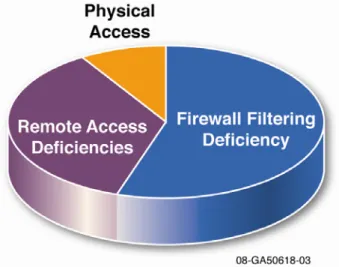
Three categories with common vulnerabilities were identified in the access security dimension: firewall filtering deficiencies, remote access, and physical access. Firewall filtering deficiencies allowed access to ports on more IP addresses than necessary and did not restrict the direction the connections could be initiated. Unauthorized remote access could be gained by taking advantage of VPN and remote display communication paths. The lack of physical access protections allowed access to the control system network (see Figure 1).
Figure 1. Frequency of access dimension common vulnerabilities by category. 3.3.4.1 Summary of Recommendations for Access Security Dimension
Disable or remove unused services. Documentation, traffic analysis, shutting off individual services, and other such methods can be used to identify the services necessary on each control system component. This should be done by the control system vendor. After used services are identified, they should be analyzed for necessity, especially if they are associated with known vulnerabilities. All necessary
communication should be done using secure services that are kept patched and up-to-date to help prevent attackers from utilizing the allowed connection for their own purposes.
Use a firewall to prevent access to ports and services that are unneeded or cannot be disabled or removed. Firewall rules also need to restrict access to only the required IP addresses and the required communication directions. Change management procedures and periodic network reviews.
Do not allow physical access to the critical assets. Additional security measures should also be taken to restrict access and damage potential once physical access is obtained.
3.4 Vulnerability Security Dimension
The vulnerability security dimension is that dimension that deals with weaknesses in the control system that allows an attacker to advance towards or accomplish malicious objectives. Vulnerabilities may be software flaws or configuration mistakes.
After an intruder has discovered enough information regarding the control system, he may be able to attack or manipulate it. In general, the easiest way for an intruder to control control system components is to send commands directly to the front-end equipment. Most front-end equipment, such as RTU,
programmable logic controllers (PLCs), protocol converters, or FEPs lack even basic authentication. To control such equipment, in most cases, an attacker need only establish a connection and issue a properly formatted command. The operator’s screen could possibly be exported back to the attacker as well, giving him operator-level awareness and control of the process.
An attacker could also perform man-in-the-middle (MITM) attacks on the control system protocols. Once the attacker knows the protocol, he can modify the packets in transit. By inserting packets into the network, he can issue arbitrary commands. By modifying replies, he can give the operator a false picture of the control system state. Thus, the attacker could both spoof and control the system.
Because control systems are not as prevalent as IT systems and have not been targeted by vulnerability discovery groups, and because of the nature of testing at the NSTB, many of the
vulnerabilities documented in the assessment reports were discovered by the assessment team and are therefore undisclosed, or zero day vulnerabilities.
3.4.1 Vulnerability Category: Lack of Input Validation
Input validation is used to ensure that the content provided to an application does not grant an attacker access to unintended functionality or privilege escalation. It is the result of programmer oversight.
3.4.1.1 Common vulnerability: Buffer Overflow in Control System Service
Buffer overflows result when a program tries to write more data into a buffer than the space it was allocated in memory. The “extra” data then overwrites adjacent memory, and ultimately results in
abnormal operation of the program. A careful and successful memory overwrite can cause the program to begin execution of arbitrary code provided by the attacker resulting in the system being remotely
controlled.
Network protocol implementations that do not check input strings for length put the system at risk for buffer overflow exploits. The C and C++ programming languages are especially vulnerable, containing string and memory function calls that can be used insecurely Other languages, such as Fortran, can also be vulnerable.
Services written by control system vendors frequently suffer from coding practices that allow attackers to supply unexpected data and thus modify program execution. Even though some control system protocols are commonly used, the services that receive and interpret are usually customized to the vendor product. Vulnerabilities in these services were a main target of many laboratory assessments because buffer overflows in the control system services are possible entry points onto the control system LAN (if the traffic is allowed).
The following are six specific assessment findings associated with this vulnerability:
• Multiple assessments found buffer overflows in control system protocol implementations
• Multiple assessments found buffer overflows in proprietary Distributed Network Protocol (DNP) implementations
• Buffer overflows were found in FEP programs
• A buffer overflow was found in a proprietary real-time database
• Buffer overflows were found in ICCP implementations.
Recommendation: All code should be written to validate input data. All programmers should be trained in secure coding practices and all code should be reviewed and tested for input functions that could be susceptible to buffer overflow attacks. All input should be validated, not just those proven to cause buffer overflows. Input should be validated for length, and buffer size should not be determined based on an input value. This is especially important in the C and C++ programming languages, which contain string and memory function calls that can be used insecurely.
Even if values are never input directly by a user, it cannot be assumed that data will always be correctly formatted or that hardware or operating system protections are sufficient. Most buffer overflows identified in NSTB assessments were in the server applications that process control system protocol traffic. In most cases, values input from network traffic were intercepted and altered in transit. Network data bounds and integrity checking should therefore be implemented.
3.4.1.2 Common vulnerability: Integer overflow in control system service
Integer overflows result when an arithmetic operation attempts to create a numeric value that is larger than can be represented within the available storage space. For instance, adding 1 to the largest value that can be represented constitutes an integer overflow. The most common result in these cases is for the value to “wrap” around to the lowest value possible. This can lead to unintended behavior if the value is
assumed to be positive and wraps around to a negative value. Many other unexpected situations may occur from operations that create invalid values that are too small or large, including potential buffer overflows if the unexpectedly small number is used as the number of bytes to allocate for a buffer.
Control system applications frequently suffer from coding practices that allow attackers to supply unexpected data and thus modify program execution. Even though control system applications pass valid data values during normal operation, a common vulnerability discovery approach is to alter or input unexpected values.
The following is a specific finding associated with this vulnerability that was identified in multiple assessments:
• Integer overflow found in control system protocol.
Recommendation: All code should be written to validate input data. All programmers should be trained in secure coding practices and all code should be reviewed and tested for input functions that could be susceptible to buffer overflow attacks. All input should be validated, not just those proven to cause buffer overflows. Input values should be validated.
Even if values are never input directly by a user, it cannot be assumed that data will always be correctly formatted or that hardware or operating system protections are sufficient. It is possible for control system traffic to be intercepted and altered in transit. Network data value and integrity checking should therefore be implemented.
3.4.1.3 Common Vulnerability: Lack of Bounds Checking in Control System Service The lack of input validation for values that are expected to be in a certain range, such as array index values, can cause unexpected behavior. For instance, if input is not validated, negative or too large numbers can be input for array access and cause essential services to crash.
Control system applications frequently suffer from coding practices that allow attackers to supply unexpected data and thus modify program execution. Even though control system applications pass valid data values during normal operation, a common vulnerability discovery approach is to alter or input unexpected values.
The following are specific assessment findings associated with this vulnerability:
• Crashed control system communications service by altering input value to negative number
• Lack of validation of number of points sent resulted in denial-of-service (DoS)
• DoS caused by out of range index values.
Recommendation: All code should be written to validate input data. All programmers should be trained in secure coding practices and all code should be reviewed and tested for input functions that could be susceptible to buffer overflow attacks. All input should be validated, not just those proven to cause buffer overflows. Input values should be validated.
Even if values are never input directly by a user, it cannot be assumed that data will always be correctly formatted or that hardware or operating system protections are sufficient. It is possible for control system traffic to be intercepted and altered in transit. Network data value and integrity checking should therefore be implemented.
3.4.1.4 Common Vulnerability: SQL Injection Vulnerability
Structured Query Language (SQL) injection vulnerabilities were identified in multiple assessments because control systems use real-time databases, configuration databases, and multiple historian databases in different security zones. Compromise of any of these databases may provide valuable information and the opportunity to insert or corrupt data, as well as control of the database server.
SQL injections were found by looking at the source code of applications and by trial and error. SQL injections typically occur when the developer is creating an SQL query that includes data provided from a user and does not filter escape sequences.
The following are three specific assessment findings associated with this vulnerability:
• Multiple SQL injection vulnerabilities found for control system commercial database
• Shell commands invoked through SQL queries on DMZ historian server
• Non-parameterized SQL statements are contained in some of the back-end Java coding; this may be susceptible to second order SQL injections.
Recommendation: Fix the vulnerable method of building SQL queries from non-validated user input by either adding filters to check user input and properly escaping any character that might lead to an SQL injection or switching to prepared SQL query statements. With prepared statements, the SQL query is compiled with placeholders and those placeholders are later filled with the data provided by the user. Since the SQL statement has already been compiled, it is not possible to perform an SQL injection.
Care still has to be taken to make sure there are no SQL injections within procedures and functions defined on the database. The prepared statements only prevent SQL injections from the user interface