Accounting for Shares and Debentures
Notes
You may have come across the name of organisation with suffix limited (Ltd.), for example Hindustan Motors Ltd. or Hindustan Aeronautics Ltd. etc. Have you ever thought what does this indicate? Names of organisations with Ltd. indicate that these are forms of oganisations which are different from sole proprietorship or partnership. These are called joint stock companies.
As you know that the sole proprietorship and partnership forms of organisation could not meet the growing needs of huge capital and managerial skills required for increased scale of business and growing economic activities. The liability of owner/owners of these organisations is unlimited. In order to overcome these problems a new form of business organisation known as company came into existance.
In this lesson, we shall study about company, its features and the methods of raising capital through issue of shares.
OBJECTIVES
After studying this lesson you will be able to :
l state the meaning of company as a form of business organisation;
l describe the characteristics of company;
l describe various types of companies;
l distinguish between public and private company;
l explain various types of shares;
l distinguish between equity shares and preference shares;
l explain the types of share capital.
22
Notes Accounting for Shares and
Debentures
22.1 COMPANY–MEANING AND CHARACTERISTICS
A company is a voluntary association of individuals formed to carry on business to earn profits or for non profit purposes. These persons contribute towards the capital by buying its shares in which it is divided. A company is an association of individuals incorporated as a company possessing a common capital i.e. share capital contributed by the members comprising it for the purpose of employing it in some business to earn profit.
As per Companies Act 1956, a company is formed and registered under the Companies Act or an existing company registered under any other Act”.
Characteristics of a Company
Following are the main characteristics of a company:
l l l l
l Artificial legal person
A company is an artficial person as it is created by law. It has almost all the rights and powers of a natural person. It can enter into contract. It can sue in its own name and can be sued.
l l l l
l Incorporated body
A company must be registered under Companies Act. By virtue of this, it is vested with corporate personality. It has an identity of its own. Although the capital is contributed by its members called shareholders yet the property purchased out of the capital belongs to the company and not to its shareholders.
l l l l
l Capital divisible into shares
The capital of the company is divided into shares. A share is an indivisible unit of capital. The face value of a share is generally of a small denomination which may be of Rs 10, Rs 25 or Rs 100. l l l l l Transferability of shares
The shares of the company are easily transferable. The shares can be bought and sold in the stock market.
l l l l
l Perpetual existence
A company has an independent and separate existence distinct from its share holders. Changes in its membership due to death, insolvency etc. does not affect its existence and its continuity.
Accounting for Shares and Debentures Notes l l l l l Limited Liability
The liablity of the shareholders of a company is limited to the extent of face value of shares held by them. No shareholder can be called upon to pay more than the face value of the shares held by them. At the most the shareholders may be asked to pay the unpaid value of shares.
l l l l
l Representative Management
The number of shareholders is so large and scattered that they cannot manage the affairs of the company collectively. Therefore they elect some persons among themselves to manage and administer the company. These elected representatives of shareholders are individually called the ‘directors’ of the company and collectively the Board of Directors.
l l l l
l Common seal
A common seal is the official signature of the company. Any document bearing the common seal of the company is legally binding on the company.
INTEXT QUESTIONS 22.1
I. Fill in the blanks with correct word/words relating to the chracterstics of the company:
(i) A company is created by law. Hence a company is ...
(ii) An indivisible unit of capital of a company is called a ...
(iii) A ... is the official signature of the company.
(iv) The shareholders elect some persons of their choice to manage the affairs. It explains the ... character of the company.
II. Identify the correct statement by marking (√) and incorrect one by marking (×):
(i) The property of a company belongs to its shareholders.
(ii) The liability of every member of company is restricted to the face value of shares held by them.
(iii) The members of a company cannot transfer their shares freely.
Notes Accounting for Shares and
Debentures
22.2 TYPES OF COMPANIES
Companies can be classified under the following heads: 1. On the basis of formation.
2. On the basis of liability. 3. On the basis of ownership.
1. On the basis of formation.
On the basis of formation companies can be categorised as:
(a) Statutory Company
A company formed by a Special Act of parliament or state legislature is called a Statutory Company. Reserve Bank of India, Industrial Financial Corporation of India, Life Insurance Corporation of India, Delhi State Finance Corporation are some of its examples.
(b) Registered Company
A company formed and registered under the Companies Act, 1956 or earlier Companies Acts is called a Registered Company. The working of such companies is regulated by the provisions of the Companies Act.
2. On the basis of liability
On the basis of liabilty, companies can be catagorised as:
(a) Company limited by shares
The liability of the member of such company is limited to the face value of its shares.
(b) Company limited by guarantee
The liabilty of each member of such company is limited to the extent of guarantee undertaken by the member. It may arise in the event of its being wound up.
(c) Unlimited Company
The company not having any limit on the liability of its members, is called an unlimited company. Liability in such a case extends to the personal property of its shareholders. Such companies do not use the word ‘limited’ at the end of their name.
(d) Company under section 25
A company created under section-25 is to promote art, culture and societal aims. Such companies need not use the term limited at the end of their name.
Accounting for Shares and Debentures
Notes
Punjab, Haryana, Delhi chambers of commerce, etc. are the examples of such companies.
3. On the basis of ownership
On the basis of ownership, companies can be catagorised as :
(a) Private Company
A private company is one which by its Articles of Association : (i) restricts the right of members to transfer its shares;
(ii) limits the number of its members to fifty (excluding its past and present employees);
(iii) prohibits any invitation to the public to subscribe to its shares, debentures.
(iv) The minimum paid up value of the company is one lakh rupees (Rs 100000).
The minimum number of shareholders in such a company is two and the company is to add the words ‘private limited’ at the end of its name. Private companies do not involve participation of public in general.
(b) Public Copmpany
A company which is not a private company is a public company. Its Articles of association does not contain the above mentioned restrictions.
Main features of a public company are :
(i) The minimum number of members is seven.
(ii) There is no restriction on the maximum number of members. (iii) It can invite public for subscription to its shares.
(iv) Its shares are freely tansferable.
(v) It has to add the word ‘Limited’ at the end of its name. (vi) Its minimum paid up capital is five lakhs rupees (Rs 500,000).
(c) Government Company
A Government company is one in which not less than 51% of its paid up capital is held by (1) Central Government or (2) State Government, or (3) partly by Central Government and partly by State Governemt. Example of a Government company is Hindustan Machine Tools Limited, (HMT) State Trading Corporation (STC). Minerals as metals training corporation (MMTC).
Notes Accounting for Shares and
Debentures (d) Foreign company
A foreign company is one which is incorporated outside India but has a place of business in India, for example Philips, L.G, etc. standard materials.
(e) Holding company and Subsidiary company
A holding company is a company which controls another company (called subsidiary company) either by acquiring more than half of the equity shares of another company or by controlling the composition of Baord of Directors of another company or by controlling a holding company which controls another company.
(f) Listed company and unlisted company
A company is required to file an application with stock exchange for listing of its securities on a stock exchange. When it qualifies for the admission and continuance of the said securities upon the list of the stock exchange, it is known as listed company. A company whose securities do not appear on the list of the stock exchange is called unlisted company.
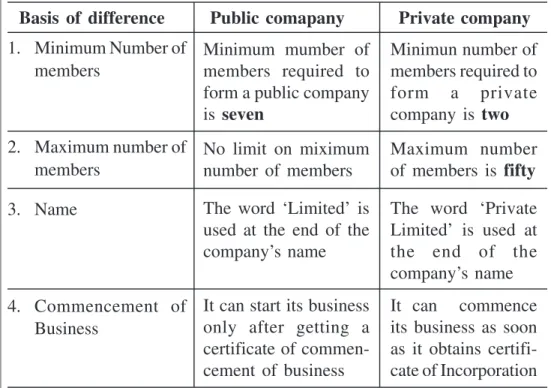
Difference between public company and private company.
The major differences between public company and private company are as follows:
Table 21.1 Difference between Public company and Private company
Basis of difference Public comapany Private company
1. Minimum Number of members 2. Maximum number of members 3. Name 4. Commencement of Business Minimum mumber of members required to form a public company is seven
No limit on miximum number of members
The word ‘Limited’ is used at the end of the company’s name
It can start its business only after getting a certificate of commen-cement of business Minimun number of members required to form a private company is two Maximum number of members is fifty
The word ‘Private Limited’ is used at the end of the company’s name It can commence its business as soon as it obtains certifi-cate of Incorporation
Accounting for Shares and Debentures Notes 5. Invitation to public 6. Transfer of shares 7. Number of directors 8. Minimum Capital INTEXT QUESTIONS 22.2
I. Fill in the blanks with correct words/figures given in brackets:
(i) The minimum number of members of a public limited company is …………(two, five, seven)
(ii) A Government company is one in which not less than …....…of its paid up capital is held by government. (50%, 51%, 75%)
(iii) The minimum paid up capital of a private limited company is……. (one lakh, five lakh, Ten lakh)
(iv) A foreign company is one which is incorporated ....……. (In India, Outside India).
II. Name the type of company in the following cases:
(i) A company that imposes restriction on transfer of its shares by its Articles of Association.
(ii) A company with a liability of its members limited to the extent of the amount unpaid on its shares.
(iii) A company formed by a Special Act enacted by parliament or state legislature.
(iv) A company not having any limit or the liability of its members.
(v) A company which controls another company. It invites public to subscribe to its shares
There is no restriction on transfer of its shares
It must have at least
three directors
It must have a minimum paid up capital of five lakh rupees (Rs 500000)
It cannot invite public to subscribe to its shares
There is restriction on the transfer of its shares
It must have at least
two directors It must have a minimum paid up capital of one lakh (Rs 100000).
Notes Accounting for Shares and
Debentures
22.3 SHARES-MEANING AND ITS KINDS
A joint stock company divides its capital into units of equal denomination. Each unit is called a share. These units i.e. shares are offered for sale to raise capital. This is termed as issuing shares. A person who buys share/ shares of the compnay is called a shareholder and by acquiring share or shares in the company he/she beomes one of the owners of the company
Thus, a share is an indivisible unit of capital. It expresses the proprietory relationship between the company and the shareholder. The denominated value of a share is its face value. The total capital of a company is divided into number of shares.
Kinds of shares
According to the Companies Act, a company can issue the following types of Shares:
(i) Preference shares (ii) Equity shares
(i) Preference shares
A preference share is one which carries following preferential rights over other type of shares called equity shares in regard to the following :
l Payment of dividend
l Repayment of capital at the time of winding up of the company.
(ii) Equity shares
All shares which are not preference shares are equity shares. Holders of these shares receive dividend out of the profits of the company after the payment of dividend has been made to the preference shareholders.
Equity shareholders have the right to elect directors of the company. Equity shares are the permanent source of capital :
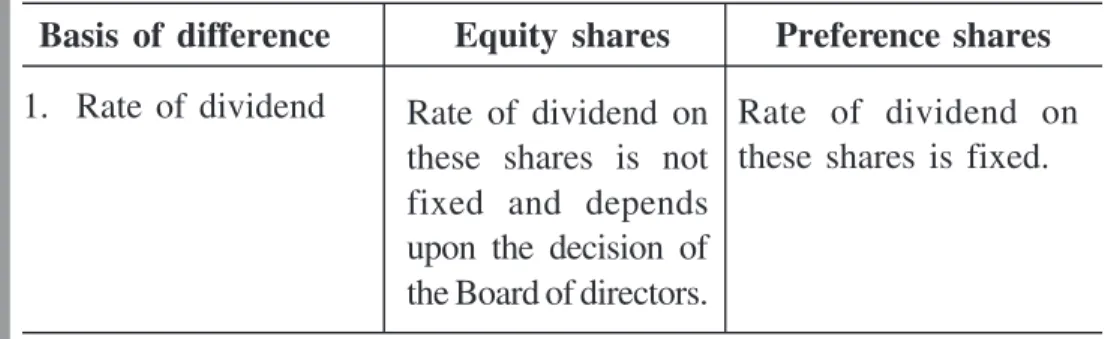
Table 22.2 Difference between Equity shares and Preference shares.
Basis of difference Equity shares Preference shares
1. Rate of dividend Rate of dividend on these shares is not fixed and depends upon the decision of the Board of directors.
Rate of dividend on these shares is fixed.
Accounting for Shares and Debentures
Notes
2. Payment of dividend.
3. Refund of share capital on winding up of the company.
4. Voting rights.
5. Redemption
INTEXT QUESTIONS 22.3
Fill in the blanks with suitable word/words.
(i) In a company, main source of finance is ……. (ii) A ...…… is an indivisible unit of capital
(iii) ...…… have the right to elect directors of the company
(iv) ...…… have the preferential right as the refund of capital in case of winding up of company over ...……
22.4 SHARE CAPITAL–MEANING AND ITS TYPES
A joint stock company estimates its future capital requirements. The amount of the capital is mentioned in the capital clause of the Memorandum of Association registered with the Registrar of the Companies. Total capital is divided into a number of small indivisible units of fixed amount and each such unit is called a share. A share is nothing but a share in the capital of the company. As the total capital of the company is divided into shares, the capital of the company is called share capital. Share capital of the company is divided into following categories :
Dividend on these shares is paid after payment of dividend made to preference shareholders.
On winding up of the company equity share holders get refund of capital only after preference share holders have been paid off.
Shareholders have voting rights in all matters.
Shares cannot be redeemed during the life of the company.
Dividend on these shares is paid before payment of dividend made to equity shareholders.
Preference shareholders have a preference over equity shareholders in regard to refund of capital in case of winding up of the company.
Shareholders can vote only in special circum-stances.
Shares can be redeemed as per terms of issue.
Notes Accounting for Shares and
Debentures l l l l l Nominal/Authorised/Registered capital
It refers to the maximum amount of share capital which a company is authorised to issue as per its Memorandum of Association.
l l l l
l Issued capital
Issued capital is that part of the authorised capital which the company offers to public, that may include vendors, for subscription or purchase. A company may issue its entire authorised capital or may issue it in parts from time to time as per the needs of the company. It means and includes the nominal value of shares issued by the company for (a) cash, and (b) consideration other than cash to (i) promoters of a company, and (ii) others.
l l l l
l Subscribed capital
It is that part of issued capital which is taken up or subscribed by those who are offered for subscription. Company may receive application for equal to, more than or less than shares issued. This capital can be equal to or less than the issued capital. The portion of nominal value of the issued share capital which is actually paid (or subscribed) by the shareholders forms part of the subscribed capital.
l l l l
l Called up capital
It is that part of the issued/subscribed capital which is called up by company to pay on the allotted shares and is to be paid by the shareholders. The portion of the issue price of the shares which a company has demanded or called from shareholders is known as called up capital
l l l l
l Uncalled capital
Uncalled Capital is that portion of the issued/subscribed capital that is not called up by the company on the shares allotted.
l l l l
l Paid up capital
It is the portion of called up capital which is paid by the shareholders, to calculate the paid up capital, the amount of instalments in arrears is deducted from the called up capital.
l l l l
l Unpaid capital
That part of the called up capital which is called but is not paid by the shareholders is called unpaid capital. i.e. calls-in-arrears.
Accounting for Shares and Debentures Notes l l l l l Reserve capital
Company may keep some part of its share capital uncalled and kept in reserve to be called only in case of need at the time of its winding up. This is known as Reserve capital. For this, a special resolution will have to be passed by the company. Thus it is that portion of the uncalled capital which a company has decided to call only in case of liquidation of the company.
INTEXT QUESTIONS 22.4
1. Fill in the blanks with suitable word/words
(i) Share capital is the amount of capital raised through ………….. (ii) Capital stated in the capital clause of the Memorandum of
Association is called …………..
(iii) That part of the authourised capital which is offered to public for subscription is called …………..
(iv) That part of the uncalled capital which is kept in reserve to be called only on winding up of the company is termed as ……….. 2. Write ‘correct’ for correct statement and ‘wrong’ for incorrect statement
for the following:
(i) Subscribed capital is either equal to or less than issued capital (ii) Issued capital is stated in the capital clause of Memorandum of
Association
(iii) Liability of a shareholder is limited upto the face of value of the share
(iv) Reserve capital can be called by the company any time.
WHAT YOU HAVE LEARNT
l Company is an association of persons who contribute to its capital and is registered under Companies Act, 1956
Notes Accounting for Shares and
Debentures l Types of companies are:
l Private companies are companies which by their Articles of Association
(i) Restrict the maximum number of members to fifty
(ii) Restrict the transferability of shares
(iii) Put restriction on inviting public to buy its shares
(iv) Minimum paid up capital of such company is one Lakh rupees.
l Private company must add the words ‘Private Limited’ as a suffix to its name.
l Companies that are not private companies are public companies.
l Company raises its capital through issue of shares.
l Shares are of two types : Equity shares and preference shares. Preference shares carry preference over other shares with regard to payment of dividend and refund of capital in case of its winding up. Shares other than preference shares are called ‘equity shares’.
l Share capital
Authorised/ Issued Subscribed Called up Uncalled Paid up Unpaid Reserve Nominal
Accounting for Shares and Debentures
Notes
TERMINAL QUESTIONS
1. Define company. Explain in brief its characteristics.
2. What are preference shares? Distinguish between equity share and preference shares.
3. List the various restrictions on a private company. Distinguish between a public company and a private company.
4. What is share capital? Explain different types of share capital.
5. Explain different types of companies.
ANSWERS TO INTEXT QUESTIONS
Intext Questions 22.1
I. (i) an artificial person (ii) share
(iii) common seal (iv) representative
II. (i) × (ii) √ (iii) × (iv) √
Intext Questions 22.2
I. (i) Seven (ii) 51% (iii) one Lakh (iv) outside India
II. (i) private
(ii) company limited by shares
(iii) government company
(iv) unlimited liability company
(v) Holding comapny
Intext Questions 22.3
(i) share capital
(ii) share
(iii) Equity shareholders
Notes Accounting for Shares and
Debentures Intext Questions 22.4
1. (i) issue of shares (ii) Authorised capital
(iii) Issued capital (iv) Reserve capital
2. (i) Correct (ii) Incorrect (iii) Correct (iv) Incorrect
Activity : Your father is a shareholder of a company. Every year he receives report from the company. This report is called annual report of the company. After going through the report, find out the followings :
1. Name of the company with suffix Ltd. or Private Ltd.
2. Types of capital :
(a) Authorised ...
(b) Issued ...
(c) Called up ...
(d) Call in Arrears ...