ETSI TS 102 176-1
V2.0.0
(2007-11)
Technical SpecificationElectronic Signatures and Infrastructures (ESI);
Algorithms and Parameters for Secure Electronic Signatures;
Part 1: Hash functions and asymmetric algorithms
Reference RTS/ESI-000054-1
Keywords
e-commerce, electronic signature, security
ETSI
650 Route des Lucioles
F-06921 Sophia Antipolis Cedex - FRANCE Tel.: +33 4 92 94 42 00 Fax: +33 4 93 65 47 16
Siret N° 348 623 562 00017 - NAF 742 C Association à but non lucratif enregistrée à la
Sous-Préfecture de Grasse (06) N° 7803/88
Important notice
Individual copies of the present document can be downloaded from:
http://www.etsi.org
The present document may be made available in more than one electronic version or in print. In any case of existing or perceived difference in contents between such versions, the reference version is the Portable Document Format (PDF). In case of dispute, the reference shall be the printing on ETSI printers of the PDF version kept on a specific network drive
within ETSI Secretariat.
Users of the present document should be aware that the document may be subject to revision or change of status. Information on the current status of this and other ETSI documents is available at
http://portal.etsi.org/tb/status/status.asp
If you find errors in the present document, please send your comment to one of the following services:
http://portal.etsi.org/chaircor/ETSI_support.asp
Copyright Notification
No part may be reproduced except as authorized by written permission. The copyright and the foregoing restriction extend to reproduction in all media.
© European Telecommunications Standards Institute 2007. All rights reserved.
DECTTM, PLUGTESTSTM and UMTSTM are Trade Marks of ETSI registered for the benefit of its Members. TIPHONTM and the TIPHON logo are Trade Marks currently being registered by ETSI for the benefit of its Members.
Contents
Intellectual Property Rights ...6
Foreword...6
Introduction ...6
1 Scope ...8
2 References ...9
2.1 Normative references ...10 2.2 Informative references...123 Definitions
and
abbreviations...13
3.1 Definitions ...13
3.2 Abbreviations ...13
4 Maintenance
of the document ...13
5 Hash
functions...14
5.1 General ...14
5.2 Recommended one way hash functions...15
5.2.1 SHA-1 ...15 5.2.2 RIPEMD-160 ...16 5.2.3 SHA-224 ...16 5.2.4 SHA-256 ...16 5.2.5 WHIRLPOOL...16 5.2.6 SHA-384 ...16 5.2.7 SHA-512 ...17
6 Signature
schemes ...17
6.1 Signature algorithms...17 6.1.1 General...176.1.2 Recommended signature algorithms ...17
6.1.2.1 RSA...17
6.1.2.2 DSA...18
6.1.2.3 Elliptic curve analogue of DSA based on a group E(Fp) ...18
6.1.2.4 Elliptic curve analogue of DSA based on a group E(F2m) ...19
6.1.2.5 EC-GDSA based on a group E(Fp) ...20
6.1.2.6 EC-GDSA based on a group E(F2m)...20
6.2 Recommended key pair generation methods ...20
6.2.1 General...20
6.2.2 Recommended key pair generation methods ...21
6.2.2.1 Key and parameter generation algorithm rsagen1...21
6.2.2.2 Key and parameter generation algorithm dsagen1 ...21
6.2.2.3 Key and parameter generation algorithm ecgen1 for ecdsa-Fp ...21
6.2.2.4 Key and parameter generation algorithm ecgen2 for ecdsa-F2m...22
6.2.2.5 Key and parameter generation algorithm ecgen1 for ecgdsa-Fp ...22
6.2.2.6 Key and parameter generation algorithm ecgen2 for ecgdsa-F2m...22
7 Signature suites ...22
7.1 General ...22
7.2 Padding methods ...23
7.3 Recommended signature suites ...24
8
Random number generation methods...25
8.1 General ...25
8.2 Recommended random number generation methods ...25
8.2.1 Random generator requirements trueran...25
9 Recommended
hash
functions
and key sizes versus time ...27
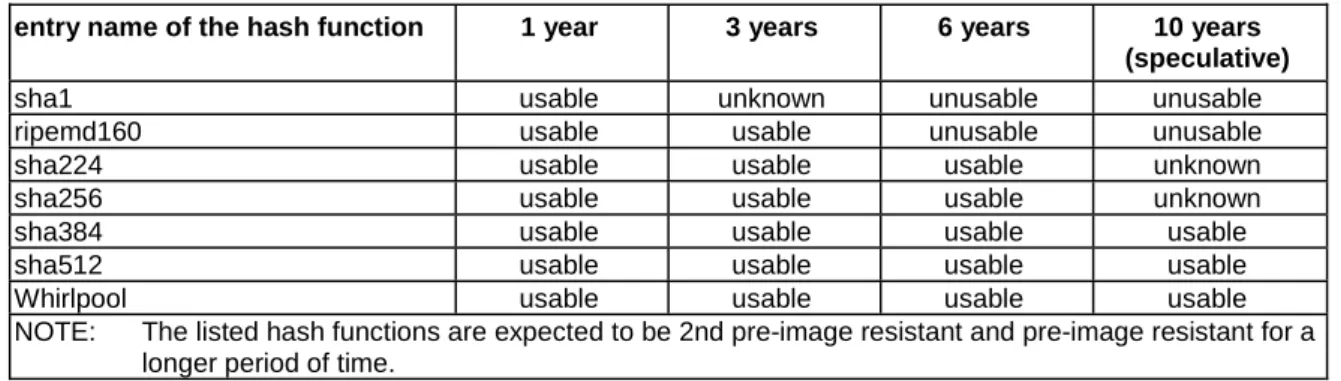
9.1 Basis for the recommendations ...27
9.2 Recommended hash functions versus time...28
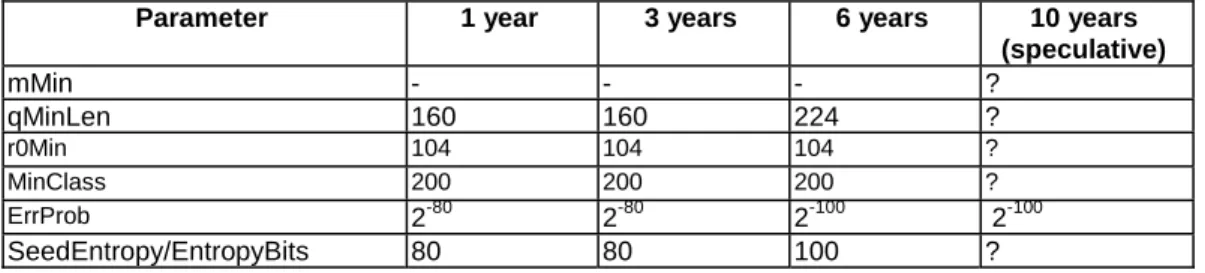
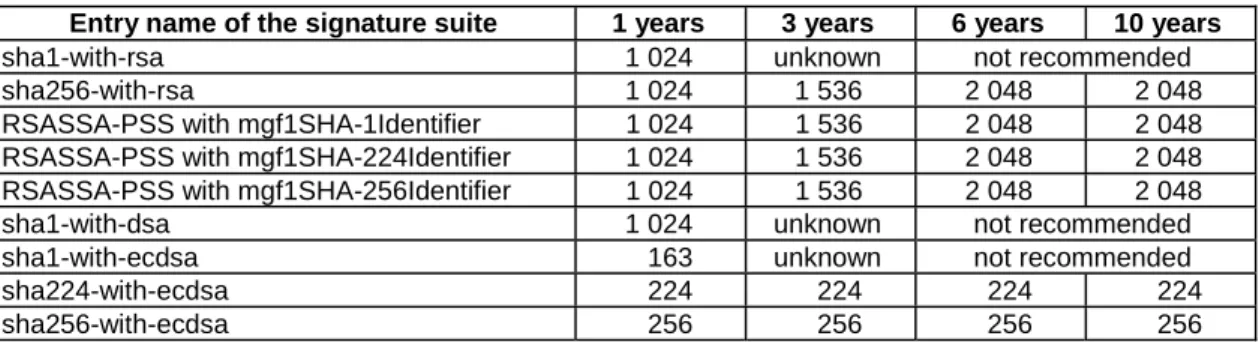
9.3 Recommended key sizes versus time ...29
10
Time period resistance of hash functions and keys ...31
10.1 Time period resistance for hash functions ...31
10.2 Time period resistance for signer's key ...32
10.3 Time period resistance for trust anchors...32
10.4 Time period resistance for other keys...32
11
Practical ways to identify hash functions and signature algorithms...32
11.1 Hash functions and signature algorithms objects identified using OIDs ...33
11.1.1 Hash functions ...33
11.1.2 Signature algorithms ...33
11.1.3 Signature suites ...34
11.2 Hash functions and signature algorithms identified objects using URNs...35
11.2.1 Hash functions ...35
11.2.2 Signature algorithms ...35
11.2.3 Signature suites ...35
11.3 Recommended hash functions and signature algorithms objects that do not yet have an OID or a description ...36
11.4 Recommended hash functions and signature algorithms objects that do not yet have a URN or a description ...36
Annex A (normative):
Algorithms for various data structures...37
A.1 Advanced Electronic Signatures based on TS 101 733...37
A.2 Advanced Electronic Signatures based on TS 101 903...38
A.3 Signer's
certificates...38
A.4 CRLs...39
A.5 OCSP
responses ...39
A.6 CA
certificates...40
A.7 Self-signed certificates for CA issuing CA certificates...40
A.8 TSTs based on RFC 3161 and TS 101 861 ...41
A.9 TSU
certificates...41
A.10 Self-signed certificates for CAs issuing TSU certificates ...41
A.11 Attribute certificates ...42
A.12 AA certificates...42
Annex B (informative):
Recommended key sizes (historical)...43
B.1
Changes in 2005 ...43
B.2
Changes in 2007 ...45
Annex C (informative):
Generation of RSA modulus ...46
Annex D (informative):
Generation of elliptic curve domain parameters ...47
D.1 ECDSA and ECGDSA based on a group E(Fp)...47
D.2 ECDSA and ECGDSA based on a group E(F2m)...48
D.3 The
class
number condition...49
E.1
Classes of random number generators...51
E.2
On tests for NRNGs ...52
Annex F (informative):
Algorithms identifiers defined in various documents...53
F.1
Algorithms identifiers defined in RFC 3278 ...53
F.2
Algorithms identifiers defined in RFC 3279 ...53
F.3
Algorithms identifiers defined in RFC 3370 ...54
F.4
Algorithms identifiers defined in RFC 3447 ...54
F.5 Algorithm
identifier defined in RFC 3874 ...54
F.6
Algorithms identifiers defined in XML-Signature Syntax and Processing W3C Recommendation ...54
F.7
Algorithms identifiers defined in XML Encryption Syntax and Processing. W3C
Recommendation...55
F.8
Algorithms identifiers defined in RFC 4050 ...55
F.9
Algorithms identifiers defined in RFC 4051 ...55
F.10 Algorithms identifiers defined in RFC 4055 ...56
Annex G (informative):
Abstracts of ISO/IEC 10118-3 and ISO/IEC 9796-2 ...57
Annex H (informative):
Signature maintenance ...58
Annex I (informative):
Major changes from previous versions ...59
Annex J (informative):
National Bodies ...60
Annex K (informative):
Bibliography...65
Intellectual Property Rights
IPRs essential or potentially essential to the present document may have been declared to ETSI. The information pertaining to these essential IPRs, if any, is publicly available for ETSI members and non-members, and can be found in ETSI SR 000 314: "Intellectual Property Rights (IPRs); Essential, or potentially Essential, IPRs notified to ETSI in respect of ETSI standards", which is available from the ETSI Secretariat. Latest updates are available on the ETSI Web server (http://webapp.etsi.org/IPR/home.asp).
Pursuant to the ETSI IPR Policy, no investigation, including IPR searches, has been carried out by ETSI. No guarantee can be given as to the existence of other IPRs not referenced in ETSI SR 000 314 (or the updates on the ETSI Web server) which are, or may be, or may become, essential to the present document.
Foreword
This Technical Specification (TS) has been produced by ETSI Technical Committee Electronic Signatures and Infrastructures (ESI).
The present document is part 1 of a multi-part deliverable covering the Algorithms and Parameters for Secure Electronic Signatures, as identified below:
Part 1: "Hash functions and asymmetric algorithms";
Part 2: "Secure channel protocols and algorithms for signature creation devices".
Introduction
The present document provides for security and interoperability for the application of the underlying mathematical algorithms and related parameters for electronic signatures in accordance with the Directive 1999/93/EC [1] of the European Parliament and of the Council of 13 December 1999 on a Community framework for electronic signatures. On the other side the present document is not a legal document answering the question which key lengths or use dates are sufficient to ensure a certain level of liability. In particular the reader is advised that some national signature laws or regulations may require a different level of security for qualified electronic signatures than recommended here by the key lengths and use dates in the present document. The present document is based on cryptographic analysis of the algorithms and it recommends using at least the parameters given here.
The present document defines a list of hash functions, as well as a list of signature schemes together with the
requirements on their parameters, as well as the recommended combinations of these schemes with hash functions and padding method in the form of "signature suites" to be used with the data structures defined in the documents developed under the European Electronic Signature Standardization Initiative (EESSI). The present document contains several informative annexes which provide useful information on a number of subjects mentioned in the text.
The present document is not a general purpose document dealing with hash functions and asymmetrical algorithms in general. The goal of the present document is not to list all "good" signature algorithms but those that are most important to be used in the context of advanced electronic signatures. In addition, the intent of the present document is not to have a catalog of all algorithms suitable for advanced electronic signatures, but to limit the list to a reasonable set so that interoperability can be achieved. Interoperability with security is the main issue.
The primary criterion for inclusion of an algorithm in the document is "Secure, widely used and deployed in practice". Whereas all listed algorithms have been checked for security by cryptographic experts, it cannot be concluded from the document, that an algorithm not listed would be insecure.
The second part of this technical standard (protocols and algorithms for SCDev secure channels) defines protocols and symmetric algorithms that may optionally be used to construct a secure channel providing either only integrity or both integrity and confidentiality between an application and a signature creation device (SCDev). Such a secure channel may be used during the operational phase of a signature creation device:
• when the key pair is not generated by the SCDev, to remotely download in the SCDev both a private key and the associated public key certificate;
• when the key pair is generated by the SCDev, to remotely download in the SCDev a public key certificate and associate it with the previously generated private key.
1 Scope
The present document is targeted to support advanced electronic signatures and the related infrastructure. The present document defines a list of hash functions and a list of signature schemes, as well as the recommended combinations of hash functions and signatures schemes in the form of "signature suites".
The primary criteria for inclusion of an algorithm in the present document are: • the algorithm is considered as secure;
• the algorithm is commonly used; and
• the algorithm can easily be referenced (for example by means of an OID).
This does not mean that other hash functions and signature suites cannot be used, but either they do not correspond to the above criteria or their security has not been assessed.
The document also provides guidance on the hash functions, signature schemes and signature suites to be used with the data structures used in the context of electronic signatures. For each data structure, the set of algorithms to be used is specified. Each set is identified by an identifier which is either an OID (Object IDentifier) or a URI /URN.
The use of such identifiers is necessary so that interoperability can be achieved. In order to allow for data interchange, the document references algorithms in terms of OIDs and URIs / URNs together with algorithm parameters.
Different requirements apply to the issuers and to the users of the data structures in order to allow for interoperability. RFC documents use the terms SHALL, SHOULD, MAY, RECOMMENDED in order to allow for interoperability. The same terminology is used in the present document (see RFC 2119 [25]).
Issuers of the data structures (e.g. CSPs, CRL Issuers, OCSP responders, TSUs) need to know the algorithms and key sizes they SHOULD or MAY support. There SHOULD be at least one algorithm recommended to support, but may be more than one.
Users of the data structures (i.e. signers or verifiers of electronic signatures) need to know the algorithms and key sizes they SHALL, SHOULD or MAY support. For users and for each data structure, there must be at least one algorithm to support, but may be more than one.
These requirements are listed in annex A.
Annex B provides historical information on the recommended hash functions, algorithms and key sizes for the generation and verification of electronic signatures. This annex will be periodically updated.
Annex C provides more information on the generation of RSA modulus.
Annex D provides more information on the generation of elliptic curve domain parameters. Annex E addresses the generation of random data.
Annex F lists the algorithm identifiers defined in various documents.
Annex G provides a short abstract of ISO/IEC 10118-3 [3] and ISO/IEC 9796-2 [17]. Annex H provides some guidance on signature maintenance.
Annex I lists the major changes from the previous versions.
The present document defines a set of algorithms (i.e. hash functions, signature schemes and signature suites) and the corresponding parameters that are recommended to be used. If such algorithms are used according to the context where they are expected to be used, then a reasonable security level can be assumed.
The algorithms defined in the present document are usable in particular with the following documents: • TS 101 733 [18]: "Electronic Signatures and Infrastructures (ESI); Electronic Signature Formats"; • TS 101 903 [19]: "XML Advanced Electronic Signatures (XAdES)";
NOTE: XML language is defined in RFC 3275 [10]. • TS 101 861 [20]: "Time stamping profile";
• TS 101 456 [33]: "Electronic Signatures and Infrastructures (ESI); Policy requirements for certification authorities issuing qualified certificates";
• TS 102 042 [34]: "Electronic Signatures and Infrastructures (ESI); Policy requirements for certification authorities issuing public key certificates";
• CWA 14169 [35]: "Secure Signature-Creation Devices "EAL 4+"";
• CWA 14170 [36]: "Security requirements for signature creation applications"; • CWA 14171 [37]: "Procedures for electronic signature verification";
• CWA 14167-1 [38]: "Security Requirements for Trustworthy Systems Managing Certificates for Electronic Signatures - Part 1: System Security Requirements";
• CWA 14167-2 [39]: "Security Requirements for Trustworthy Systems Managing Certificates for Electronic Signatures - Part 2: Cryptographic module for CSP Signing Operations with Backup - Protection Profile"; • CWA 14167-3 [40]: "Security Requirements for Trustworthy Systems Managing Certificates for Electronic
Signatures - Part 3: Cryptographic module for CSP key generation services - Protection profile (CMCKG-PP)";
• CWA 14167-4 [41]: "Security Requirements for Trustworthy Systems Managing Certificates for Electronic Signatures - Part 4: Cryptographic module for CSP signing operations - Protection profile - CMCSO PP"; • RFC 3280 [2]: "Internet X.509 Public Key Infrastructure Certificate and Certificate Revocation List (CRL)
Profile";
• RFC 3281 [21]: "An Internet Attribute Certificate profile for authorization";
• RFC 3161 [9]: (2001): "Internet X.509 Public Key Infrastructure Time-Stamp Protocol (TSP)"; • RFC 2560 [22]: "X.509 Internet Public Key Infrastructure Online Certificate Status Protocol - OCSP". Patent related issues are out of the scope of the present document.
2 References
The following documents contain provisions which, through reference in this text, constitute provisions of the present document.
References are either specific (identified by date of publication and/or edition number or version number) or non-specific.
• For a specific reference, subsequent revisions do not apply.
• Non-specific referencemay be made only to a complete document or a part thereof and only in the following cases:
- if it is accepted that it will be possible to use all future changes of the referenced document for the purposes of the referring document;
Referenced documents which are not found to be publicly available in the expected location might be found at
http://docbox.etsi.org/Reference.
For online referenced documents, information sufficient to identify and locate the source shall be provided. Preferably, the primary source of the referenced document should be cited, in order to ensure traceability. Furthermore, the reference should, as far as possible, remain valid for the expected life of the document. The reference shall include the method of access to the referenced document and the full network address, with the same punctuation and use of upper case and lower case letters.
NOTE: While any hyperlinks included in this clause were valid at the time of publication ETSI cannot guarantee their long term validity.
2.1 Normative
references
The following referenced documents are indispensable for the application of the present document. For dated references, only the edition cited applies. For non-specific references, the latest edition of the referenced document (including any amendments) applies.
[1] Directive 1999/93/EC of the European Parliament and of the Council of 13 December 1999 on a Community framework for electronic signatures.
[2] IETF RFC 3280 (2002): "Internet X.509 Public Key Infrastructure Certificate and Certificate Revocation List (CRL) Profile".
[3] ISO/IEC 10118-3 (2004): "Information technology - Security techniques - Hash functions - Part 3: Dedicated hash functions".
NOTE: See annex G for main content description.
[4] FIPS Publication 180-2 (2002): "Secure Hash Standard". NOTE: Change Notice to include SHA-224.
[5] IEEE P1363 (2000): "Standard Specifications for Public-Key Cryptography". [6] FIPS Publication 186-2 (2000): "Digital Signature Standard (DSS)".
NOTE: With change notice from October 5, 2001.
The Draft FIPS 186-3 (2006) is published but not confirmed yet.
[7] ANSI X9.62 (2005): "Public Key Cryptography for the Financial Services Industry: The Elliptic Curve Digital Signature Algorithm (ECDSA)".
NOTE: This standard is consistent with Elliptic Curve Cryptography (SEC 1) Part 1, Version 1.0, Certicom, 2000 (http://www.secg.org/collateral/sec1-final.pdf). The current draft is Version 1.7
(http://www.secg.org/download/aid-631/sec1-1point7.pdf).
[8] ISO/IEC 15946-2 (2002): "Information technology - Security techniques - Cryptographic techniques based on elliptic curves - Part 2: Digital signatures".
NOTE: This IS is confirmed until the update of ISO/IEC 14888-3 is ready.
[9] IETF RFC 3161 (2001): "Internet X.509 Public Key Infrastructure Time-Stamp Protocol (TSP)". [10] IETF RFC 3275 (2002): "(Extensible Markup Language) XML-Signature Syntax and Processing". [11] IETF RFC 3278 (2002): "Use of Elliptic Curve Cryptography (ECC) Algorithms in Cryptographic
Message Syntax (CMS)".
[12] IETF RFC 3279 (2002): "Algorithms and Identifiers for the Internet X.509 Public Key Infrastructure Certificate and Certificate Revocation List (CRL) Profile".
[14] IETF RFC 3447 (2003): "Public-Key Cryptography Standards (PKCS) #1: RSA Cryptography Specifications Version 2.1".
[15] IETF RFC 4055 (2005): "Additional Algorithms and Identifiers for RSA Cryptography for use in the Internet X.509 Public Key Infrastructure - Certificate and Certificate Revocation List (CRL) Profile".
[16] DIN V 66291-1: "Chip cards with digital signature application/function according to SigG and SigV".
NOTE: See CWA 14890-1 section 13.3.1 for an English translation: "Application Interface for smart cards used as Secure Signature Creation Devices - Part 1: Basic requirements".
[17] ISO/IEC 9796-2 (2002): "Information technology - Security techniques - Digital signature schemes giving message recovery - Part 2: Integer factorization based mechanisms" (not to be confused with ISO/IEC 9796-2 (1997): Mechanisms using a hash-function).
NOTE: See annex G for main content description.
[18] ETSI TS 101 733: "Electronic Signatures and Infrastructures (ESI); Electronic Signature Formats". [19] ETSI TS 101 903: "XML Advanced Electronic Signatures (XAdES)".
[20] ETSI TS 101 861: "Time stamping profile".
[21] IETF RFC 3281 (2002): "An Internet Attribute Certificate profile for Authorization". [22] IETF RFC 2560 (1999): "X.509 Internet Public Key Infrastructure Online Certificate Status
Protocol - OCSP".
[23] IETF RFC 3852 (2004): "Cryptographic Message Syntax (CMS)".
[24] IETF RFC 3270 (2002): "Multi-Protocol Label Switching (MPLS) Support of Differentiated Services".
[25] IETF RFC 2119 (1997): "Key words for use in RFCs to Indicate Requirement Levels". [26] ISIS-MTT Interoperability Specification (2004), TeleTrusT e.V. Deutschland.
NOTE: see http://www.isis-mtt.de.
[27] IETF RFC 3874 (2005): "A 224-bit One-way Hash Function: SHA-224".
[28] IETF RFC 4050 (2005): "Using the Elliptic Curve Signature Algorithm (ECDSA) for XML Digital Signatures".
[29] IETF RFC 4051 (2005): "Additional XML Security Uniform Resource Identifiers (URIs)". [30] W3C Recommendation - 12 February 2002: "XML-Signature Syntax and Processing". NOTE: http://www.w3.org/TR/2002/REC-xmldsig-core-20020212/.
[31] W3C Recommendation - 10 December 2002: "XML Encryption Syntax and Processing". NOTE: http://www.w3.org/TR/2002/REC-xmlenc-core-20021210/.
[32] ISO/IEC 14888-3 (2006): "Information technology - Security techniques - Digital signatures with appendix - Part 3: Discrete logarithm based mechanisms".
[33] ETSI TS 101 456: "Electronic Signatures and Infrastructures (ESI); Policy requirements for certification authorities issuing qualified certificates".
[34] ETSI TS 102 042: "Electronic Signatures and Infrastructures (ESI); Policy requirements for certification authorities issuing public key certificates".
[36] CWA 14170: "Security requirements for signature creation applications". [37] CWA 14171: "Procedures for electronic signature verification".
[38] CWA 14167-1: "Security Requirements for Trustworthy Systems Managing Certificates for Electronic Signatures - Part 1: System Security Requirements".
[39] CWA 14167-2: "Security Requirements for Trustworthy Systems Managing Certificates for Electronic Signatures - Part 2: Cryptographic module for CSP Signing Operations with Backup - Protection Profile".
[40] CWA 14167-3: "Security Requirements for Trustworthy Systems Managing Certificates for Electronic Signatures - Part 3: Cryptographic module for CSP key generation services - Protection profile (CMCKG-PP)".
[41] CWA 14167-4: "Security Requirements for Trustworthy Systems Managing Certificates for Electronic Signatures - Part 4: Cryptographic module for CSP signing operations - Protection profile - CMCSO PP".
2.2 Informative
references
[42] ISO/IEC 18032 (2005): "Information technology - Security techniques - Prime number generation".
[43] Wiener, M., "Cryptanalysis of short RSA secret exponents", IEEE Transactions on Information Theory, Vol. 36 1990.
[44] Boneh, D. and Durfee, G., "Cryptanalysis of RSA with private key less than N0.292", Proc. Eurocrypt '99, LNCS, J. Stern (ed.), Springer-Verlag, 1999. Final version in IEEE Trans. Information Theory, Vol. 46 2000.
[45] Durfee, G. and Nguyen, P., "Cryptanalysis of RSA with short private exponent", Proc. Asiacrypt '99, LNCS, Springer-Verlag, 1999.
[46] R.L. Rivest, R.D. Silverman, "Are 'Strong' Primes needed for RSA?", Peprint 1999 December 1, 1998.
NOTE: http://cnscenter.future.co.kr/resource/rsc-center/vendor-wp/RSA/sp2.pdf
[47] ECC Brainpool Standard Curves and Curve Generation.
NOTE: http://www.teletrust.de/fileadmin/files/oid/oid_ECC-Brainpool-Standard-curves-V1.pdf
[48] ISO/IEC 18031 (2005): "Information technology - Security techniques - Random bit generation". [49] ANSI X9.82 (2006) Random Number Generation Parts 1.
[50] AIS 20: "Application Notes and Interpretation of the Scheme: Functionality classes and evaluation methodology for deterministic random number generators"., Version 1.
NOTE: Available at http://www.bsi.bund.de/zertifiz/zert/interpr/ais20e.pdf
[51] ANSI X9.17-1985 (1985): "Financial Institution Key Management (wholesale)".
[52] Ruhkin, A. et al., "A Statistical Test Suite for Random and Pseudorandom Number Generators for Cryptographic Applications", NIST Special Publication 800-22 with revisions dated 15.05.2001; available at Menezes, A., van Oorschot, P. and Vanstone, S., "Handbook of Applied Cryptography (chapter 5)", CRC Press, 1997, http://www.cacr.math.uwaterloo.ca/hac.
[53] AIS 31: Functionality Classes and Evaluation Methodology for Physical Random Number Generators, Version 3.1 (25.09.2001).
[54] Maurer, U., "A universal statistical test for random bit generators", Advances in Cryptology - Crypto '90, LNCS 537, pp. 409-420, 1991.
3 Definitions
and
abbreviations
3.1 Definitions
For the purposes of the present document, the following terms and definitions apply: bit length: bit length of an integer p is r if 2r-1
≤
p < 2rsignature policy: set of rules for the creation and validation of an electronic signature, that defines the technical and procedural requirements for electronic signature creation and validation, in order to meet a particular business need, and under which the signature can be determined to be valid
signature scheme: triplet of three algorithms composed of a signature creation algorithm, a signature verification algorithm and a key generation algorithm
NOTE: The key generation algorithm generates the keys for the two others algorithms.
signature suite: combination of a signature scheme with a padding method and a cryptographic hash function
3.2 Abbreviations
For the purposes of the present document, the following abbreviations apply:
AA Attribute Authority
AC Attribute Certificates
CA Certification Authority
CRL Certificate Revocation List
CRT Chinese Remainder Theorem
CSP Certification-Service-Provider
CWA CEN Workshop Agreement
DRNG Deterministic Random Number Generator DSA Digital Signature Algorithm
ECC Elliptic Curve Cryptography
ECDSA Elliptic Curve Digital Signature Algorithm
ECGDSA Elliptic Curve German Digital Signature Algorithm MGF Mask Generation Function
NRNG Non-deterministic Random Number Generator OCSP Online Certificate Status Protocol
OID Object IDentifier
RfC Request for Comments
RNG Random Number Generator
RSA Rivest, Shamir and Adleman algorithm SCDev Secure Signature Creation Device
TST Time-Stamp Token
TSU Time-Stamping Unit
URI Uniform Resource Identifier
URN Uniform Resource Number
4
Maintenance of the document
As a response to relevant developments in the area of cryptography and technology, activities for the maintenance of the present document shall enable dynamic updating of the lists of recommended algorithms and signature suites. The current list of recommended cryptographic hash functions and signature algorithms is given in the present document.
The maintenance activities will introduce new cryptographic hash functions and signature algorithms and will lead to remove cryptographic hash functions and signature algorithms from the list and need to respond to the following situations:
1) The need to introduce new algorithms and relevant parameters will call for a mechanism that is rather
dynamic. Since it is important to maintain interoperability, updates may result from the adoption or removal of an algorithm in a document on which an ETSI TS or CWA is based upon.
2) Advances in cryptography will call for a phasing out of some algorithms or parameters. Such phasing out will normally be known well in advance.
3) In the case of new attacks the immediate need to remove an algorithm could arise.
The maintenance activity will be carried by ETSI. For cases 1 and 2, ETSI shall review the present document at regular intervals of at most two years. In case 3, ETSI shall update the present document as soon as possible. In that case, affected algorithms should no longer be used even before the present document will be revised. However, immediate response is up to legislation and/or supervision of CSPs. For that reason an informative annex J is included that list National Bodies, known at the issuing time of this Technical Specification.
The maintenance activity for cases 1 and 2 allow for some transition period during which the algorithm/parameter values to be revised may be used in already issued certificates and electronic-signature products. However, the revised items should not be considered for use in certificates to be issued and new electronic-signature products. The transition period shall allow vendors using the revised items to alter their production process. If the security implications of a revision are considered very serious, the certificates and electronic-signature products using the revised item should be withdrawn before their planned expiry date and other measures, like archival time stamps according to TS 101 733 [18] should be undertaken to preserve the security status of electronic signatures based on it.
In order to allow an easy follow up of the present document, a history of the tables provided in the main body of the document will be maintained and kept as annexes.
5 Hash
functions
5.1 General
A hash function takes as input a variable-length message and produces as output a fixed-length hash value.
NOTE: In the present document, "hash function" means a hash function with the three properties defined in this clause (i.e. clause 5.1).
Hash functions may be used in a variety of cases, such as:
• Advanced Electronic Signatures include the identifier of the hash function used to compute the digital signature.
• Time-Stamp tokens include the identifier of the hash algorithm used to compute the hash value for the time-stamped data.
• Public key certificates include the identifier of a signature suite which defines the hash function used to compute the digital signature.
For the purpose of generating signatures the following (informally defined) three properties are required from the hash function h:
1) Pre-image resistance: Given y = h(m) (but not m) it is practically infeasible to find m. Without this property, a signature scheme may otherwise be vulnerable to an attack based on generating the signature "backwards", applying the verification function to a randomly chosen signature value.
2) 2nd pre-image resistance: Given h(m) and m, it is practically infeasible to find another m' ≠ m such that
h(m) = h(m'). For signatures, this property protects from re-using an already existing signature for another message.
3) Collision resistance: It is practically infeasible to find any pair of distinct values m, m' such that h(m) = h(m'). This property is obviously needed to protect signature against chosen message attacks.
While one can construct examples of functions that are collision resistant, but not pre-image resistant, one would for practical purposes nevertheless expect that the above list of properties is ordered by difficulty for an attacker,
i.e. breaking pre-image resistance is the most difficult. New attacks against hash function MD5 and SHA-1 succeeded, it was shown that MD5 is not collision resistant by constructing classes of messages-pairs with the same hash value. Whereas the loss of collision resistance does not imply that a pre-image or second pre-image can easier be constructed, it is recommended to migrate to other hash functions, if the collision resistance becomes weaker.
In addition to this, more subtle properties are often required as a consequence of mathematical properties of the signature scheme itself. For instance, "h" should not preserve algebraic structure. The perhaps best known example is the multiplicativity of the (naive) RSA scheme, which would otherwise give a valid signature for a x b from two valid signatures of a and b.
The above properties have led to some signature schemes being defined and proven secure in the so-called Random Oracle Model, where one assumes "h" "behaves" like a completely random function. Intuitively, a completely random function should have all of the above properties as long as the range of the function is large enough.
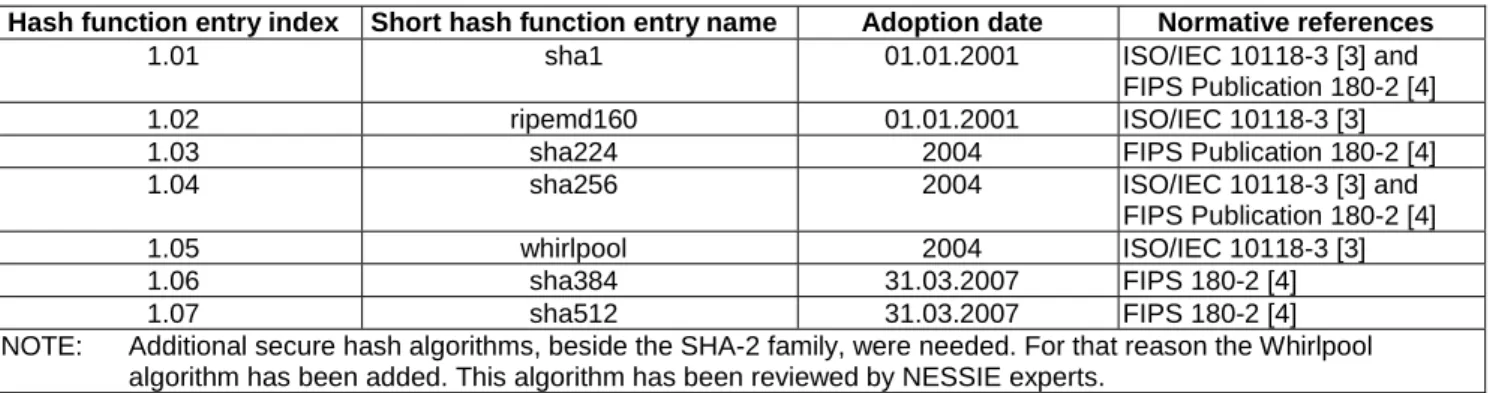
The list of currently recommended hash functions is given in table 1. Each hash function has a unique entry index represented by a string beginning with "1." followed by a two-digit entry number.
Table 1: The list of recommended hash functions
Hash function entry index Short hash function entry name Adoption date Normative references
1.01 sha1 01.01.2001 ISO/IEC 10118-3 [3] and
FIPS Publication 180-2 [4]
1.02 ripemd160 01.01.2001 ISO/IEC 10118-3 [3]
1.03 sha224 2004 FIPS Publication 180-2 [4]
1.04 sha256 2004 ISO/IEC 10118-3 [3] and
FIPS Publication 180-2 [4]
1.05 whirlpool 2004 ISO/IEC 10118-3 [3]
1.06 sha384 31.03.2007 FIPS 180-2 [4]
1.07 sha512 31.03.2007 FIPS 180-2 [4]
NOTE: Additional secure hash algorithms, beside the SHA-2 family, were needed. For that reason the Whirlpool algorithm has been added. This algorithm has been reviewed by NESSIE experts.
5.2
Recommended one way hash functions
5.2.1 SHA-1
SHA-1 MAY be used to hash a message, M, having a length of up to 264-1 bits.
The final result of SHA-1 is a 160-bit message digest. The SHA-1 algorithm is described in ISO/IEC 10118-3 [3] and FIPS Publication 180-2 [4].
NOTE 1: Several attacks against SHA-1 have been discovered since February 2005. Although a collision of the full 80-round SHA-1 has not yet been published, at least SHA-224 and SHA-256 SHOULD be implemented for any new product for electronic signatures. One should also develop plans how to switch quickly to other hash functions for electronic signatures in the case that SHA-1 and/or RIPEMD160 in fact turn out to be too weak.
NOTE 2: All known collision attacks on SHA-1 require full control of certain substrings within the data to be hashed and knowledge of the data bits prior to these strings. This is be considered as a realistic attack scenario for documents signed by signers (in particular, when a kind of "active" program element may be hidden in the document). On the other hand for X.509 certificates such attacks can be prevented by the CA by including a reasonable amount of entropy (i.e. data bits neither known to nor predictable by the attacker) in the certificate string prior to any data bits controllable by the attacker. This method leads to a considerably higher resistance of certificates against collision attacks.
5.2.2 RIPEMD-160
RIPEMD-160 MAY be used to hash a message. RIPEMD-160 is a 160-bit cryptographic hash function, designed by Hans Dobbertin, Antoon Bosselaers, and Bart Preneel. It is described in ISO/IEC 10118-3 [3]. It is replacing the 128-bit hash function RIPEMD. The maximal message size is 264-1 bits.
NOTE: RIPEMD-320 is constructed from RIPEMD-160 by initializing the two parallel lines with different initial values, omitting the combination of the two lines at the end of every application of the compression function, and exchanging a chaining variable between the 2 parallel lines after each round. The security level of the 320-bit extension of RIPEMD-160 is the same as that of RIPEMD-160 itself. Similarly the 256-bit extension of RIPEMD-128, i.e. RIPEMD-256 is the same as that of RIPEMD-128.
5.2.3 SHA-224
SHA-224 MAY be used to hash a message, M, having a length of up to 264-1 bits and the output size is 224 bits. The
function is defined in the exact same manner as SHA-256 (clause 5.2.4), except for the initial value and the truncation of the final hash value. The SHA-224 algorithm is described in FIPS Publication 180-2 [4].
The specification for SHA-224 is identical to SHA-256, except that different initial values are used, and the final hash value is truncated to 224 bits. Therefore it is NOT RECOMMENDED to use SHA-224, if SHA-256 can be used instead without truncation.
5.2.4 SHA-256
SHA-256 MAY be used to hash a message, M, having a length of up to 264-1bits.
The final result of SHA-256 is a 256-bit message digest. The SHA-256 algorithm is described in FIPS Publication 180-2 [4].
5.2.5 WHIRLPOOL
WHIRLPOOL is a hash function designed by Vincent Rijmen and Paulo S. L. M. Barreto that operates on messages less than 2256-1 bits in length, and produces a message digest of 512 bits.
Whirlpool MAY be used to compute the imprint of a message placed in a time-stamp token.
Whirlpool MAY only be used with a secure signature scheme supporting key sizes that match the Whirlpool output, i.e. 512 bits. DSA and ECDSA cannot be used with Whirlpool. However, it MAY be used with the RSA algorithm. The WHIRLPOOL algorithm is described in ISO/IEC 10118-3 [3].
NOTE: The Whirlpool output, i.e. 512 bits, is more than what may be needed, but there is currently no Whirlpool algorithm variant defined by an OID/URN with an output less than 512 bits, beside the general rule to take the leftmost bits of the output. Whirlpool has been included as an alternative to the SHA-2 family and can be used either to compute a hash value (for a time-stamp token) or with the RSA algorithm.
5.2.6 SHA-384
SHA-384 MAY be used to hash a message, M, having a length of up to 2128-1 bits and the output size is 384 bits. The
function is defined in the exact same manner as SHA-512 (clause 5.2.7), except for the initial value and the truncation of the final hash value. The SHA-384 algorithm is described in FIPS Publication 180-2 [4].
The specification for SHA-384 is identical to SHA-512, except that different initial values are used, and the final hash value is truncated to 384 bits. Therefore it is NOT RECOMMENDED to use SHA-384, if SHA-512 can be used instead without truncation.
5.2.7 SHA-512
SHA-512 MAY be used to hash a message, M, having a length of up to 2128-1bits.
The final result of SHA-512 is a 512-bit message digest. The SHA-512 algorithm is described in FIPS Publication 180-2 [4].
6 Signature
schemes
A signature scheme consists of three algorithms: a key generation algorithm and a signature creation algorithm and a signature verification algorithm. The latter are identified hereafter as a pair of algorithms. Each pair has its own name.
6.1 Signature
algorithms
6.1.1 General
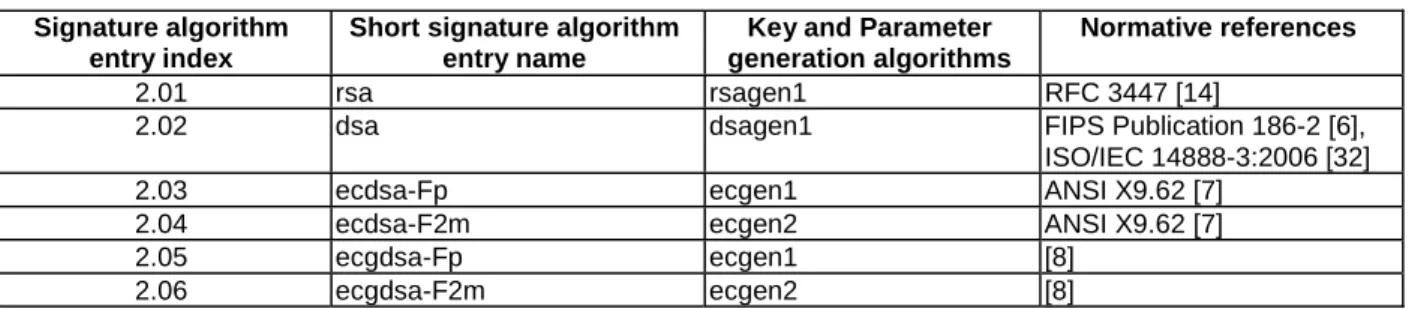
The list of currently recommended signature algorithms is given in table 2. Each signature algorithm has a unique entry index represented by a string beginning with "2." followed by a two-digit entry number.
Table 2: The list of recommended signature algorithms Signature algorithm
entry index
Short signature algorithm entry name
Key and Parameter generation algorithms
Normative references
2.01 rsa rsagen1 RFC 3447 [14]
2.02 dsa dsagen1 FIPS Publication 186-2 [6],
ISO/IEC 14888-3:2006 [32]
2.03 ecdsa-Fp ecgen1 ANSI X9.62 [7]
2.04 ecdsa-F2m ecgen2 ANSI X9.62 [7]
2.05 ecgdsa-Fp ecgen1 [8]
2.06 ecgdsa-F2m ecgen2 [8]
The following clauses describe the parameters and key generation algorithms for the signature algorithms listed in table 2.
6.1.2 Recommended
signature
algorithms
6.1.2.1 RSA
The RSA algorithm's security is based on the difficulty of factoring large integers. The RSA computations SHALL be performed as described in RFC 3447 [14]. To generate the key pair two prime numbers, p and q, are generated randomly and independently, satisfying the following requirements:
• the bit length of the modulus n = p q must be at least MinModLen; its length is also referred to as ModLen; • p and q should have roughly the same length, e.g. set a range such as 0,1 < | log2p - log2q | < 30;
• the set of primes from which p and q are (randomly and independently) selected SHALL be sufficiently large and reasonably uniformly distributed.
The private key consists of a positive integer d (the private exponent) and the modulus n. The public key consists of a positive integer e (the public exponent) and the modulus n.
CRT (Chinese Remainder Theorem) implementations are also allowed, in which case the private key will contain more values derived from the factorization of the modulus n.
6.1.2.2 DSA
The DSA algorithm's security is based on the difficulty of computing the discrete logarithm in the multiplicative group of a prime field Fp. The DSA computations SHALL be performed as described in FIPS Publication 186-2 [6] with the change notice. The same algorithm is also specified in ISO/IEC 14888-3 [32] which can be used for information and for selection of larger parameters. The public parameters p, q and g MAY be common to a group of users. The bit length α of the prime modulus p SHALL be at least pMinLen bits long. The bit length β of q, which is a prime divisor of (p-1), SHALL be at least qMinLen bits long. g SHALL be computed as indicated in FIPS Publication 186-2 [6] with the change notice.
According to ISO/IEC 14888-3 [32] only the following choices for α and β are specified: α = 1024, β = 160;
α = 2048, β = 224; α = 2048, β = 256; α = 3072, β = 256.
The value of β determines the defined in FIPS 180-2 [4] hash function to be used. This requires for β = 160 the function SHA-1, which should not be used for new applications as recommended in clause 9.2.
NOTE: SHA-224 does not provide security advantages over SHA-256. If it is not required by a signature length restriction, since a signature with β =224 occupies 448 bits whereas a signature with β =256 needs 512 bits, it is RECOMMENDED to use parameters with β =256.
The private key consists of:
• the public parameters p, q and g;
• a statistically unique and unpredictable integer x, 0 < x < q, which is signatory-specific; and
• a statistically unique and unpredictable integer k, 0 < k < q, which must be regenerated for each signature. If the distribution of k is significantly different from uniform within the interval then there may be weaknesses. Bleichenbacher has presented an attack which can be sub-exhaustive depending on the size of the bias and the number of signatures produced using a single secret key. The value of k must be kept secret as well as the private key, even if k is only partially known there exists an attack (Nguyen/Shparlinski).
The public key consists of p, q, g and an integer y computed as y = gx mod p.
When computing a signature of a message M, no padding of the hashcode is necessary. However, the hashcode must be converted to an integer by applying the method described in appendix 2.2 of FIPS Publication 186-2 [6] with the change notice.
6.1.2.3
Elliptic curve analogue of DSA based on a group E(F
p)
This signature algorithm is referred to as ecdsa-Fp. The algorithm SHOULD be applied as specified in ANSI X9.62 [7]. The same algorithm is also specified in ISO/IEC 14888-3 [32], IEEE P1363 [5] and ISO/IEC 15946-2 [8] which can be used for information. According to ISO/IEC 15946-2 [8]:2002 the elliptic curve analogue of DSA can be used with non-SHA hash functions. An OID for the combination with RIPEMD-160 is given in clause 11.1.3.
The security of the ecdsa-Fp algorithm is based on the difficulty of computing the elliptic curve discrete logarithm. The public parameters are as follows:
• p prime;
• q large prime at least qMinLen bits long, p ≠ q;
• E elliptic curve over a finite field Fp whose order n is divisible by q; and • P point on E(Fp) of order q.
The public parameters MAY be common to a group of users. The quotient h of the group order n divided by q may be considered as a public parameter too.
The class number of the maximal order of the endomorphism ring of E SHALL be at least MinClass = 200. The value r0: = min (r: q divides pr-1) SHALL be greater than r0Min=104.
h = n/q must be less or equal 4 according to http://www.secg.org/download/aid-631/sec1_1point7.pdf (note that the current working draft of this document [7] requires only h ≤ 2t/8, where 2t is the bit length of p).
In FIPS Publication 186-2 [6] five curves over a prime field are defined. The ECC Brainpool paper on standard curves and curve generation (see bibliography) contains an alternative set of curves over prime fields with 160 192, 224, 256, 320, 384 and 512 bits. All these curves fulfil the above requirements.
The private key consists of:
• the public parameters E, m, q and P;
• a statistically unique and unpredictable integer x, 0 < x < q, which is signatory-specific; and
• a statistically unique and unpredictable integer k, 0 < k < q, which must be regenerated for each signature. The public key consists of E, q, P and Q, a point of E, which is computed as Q = xP.
6.1.2.4
Elliptic curve analogue of DSA based on a group E(F
2m)
This signature algorithm is referred to as ecdsa-F2m. The algorithm SHALL be applied as specified in ANSI X9.62 [7]. The same algorithm is also specified in ISO/IEC 14888-3 [32], IEEE P1363 [5], and ISO/IEC 15946-2 [8] which can be used for information. The security of the ecdsa-F2m algorithm is based on the difficulty of computing the elliptic curve discrete logarithm.
The public parameters are as follows: • m prime number;
• q large prime at least qMinLen bits long;
• E elliptic curve over a finite field F2m whose order n is divisible by q;
• it must not be possible to define E over F2; and • P point on E(F2m) of order q.
h = n/q must be less or equal 4 (see http://www.secg.org/download/aid-631/sec1_1point7.pdf, note that the current working draft of this document [7] requires only h ≤ 2t/8, where 2t is the bit length of p).
The class number of the maximal order of the endomorphism ring of E SHALL be at least MinClass = 200. The value r0:=min(r: q divides 2mr-1) SHALL be greater than r0Min = 104.
In FIPS Publication 186-2 [6] five pseudorandomly generated curves over F2m are defined. All these curves satisfy the
above requirements. Note that the Koblitz curves given in FIPS Publication 186-2 [6] are defined over F2 and hence do not fulfil the fourth requirement.
A field representation is required, common to both the signatory and the verifier, so that signatures can be interpreted correctly. The representations given in IEEE P1363 [5] and FIPS Publication 186-2 [6] are recommended. Thus if a polynomial basis is required then an irreducible trinomial of the form xm + xa + 1 with minimal a should be used. If such a polynomial does not exist then an irreducible pentanomial of the form xm + xa + xb + xc + 1 should be used; a should be minimal, b should be minimal given a and c should be minimal given a and b.
The private key consists of:
• the public parameters E, m, q and P;
• a statistically unique and unpredictable integer x, 0 < x < q, which is signatory-specific; and
• a statistically unique and unpredictable integer k, 0 < k < q, which must be regenerated for each signature. The public key consists of E, q, P and Q, a point of E which is computed as Q=xP.
6.1.2.5
EC-GDSA based on a group E(F
p)
This signature algorithm is referred to as ecgdsa-Fp. The algorithm SHALL be applied as specified in
ISO/IEC 15946-2 [8]. The security of the ecgdsa-Fp algorithm is based on the difficulty of computing the elliptic curve discrete logarithm.
The ecgdsa-Fp algorithm is a variant of the ecdsa-Fp algorithm with a modified signature creation equation and verification method. The parameters are the same as for ecdsa-Fp and therefore should satisfy all the constraints given in clause 6.1.2.3.
NOTE: The basic difference between ECDSA and EC-GDSA is that during signature creation k does not need to be inverted for ECGDSA. Under certain circumstances this can be advantageous for the design and performance of the SCDev.
6.1.2.6
EC-GDSA based on a group E(F
2m)
This signature algorithm is referred to as ecgdsa-F2m. The algorithm SHALL be applied as specified in
ISO/IEC 15946-2 [8]. The security of the ecgdsa-F2m algorithm is based on the difficulty of computing the elliptic curve discrete logarithm.
The ecgdsa-F2m algorithm is a variant of the ecdsa-F2m algorithm with a modified signature creation equation and verification method. The parameters are the same as for ecdsa-F2m and therefore should satisfy all the constraints given in clause 6.1.2.4.
NOTE: For the difference between ECDSA and ECGDSA see the note in clause 6.1.2.5.
6.2
Recommended key pair generation methods
6.2.1 General
Key pair generation methods are not part of the definition of a signature suite and may evolve without the need to change the identifier of the signature suite.
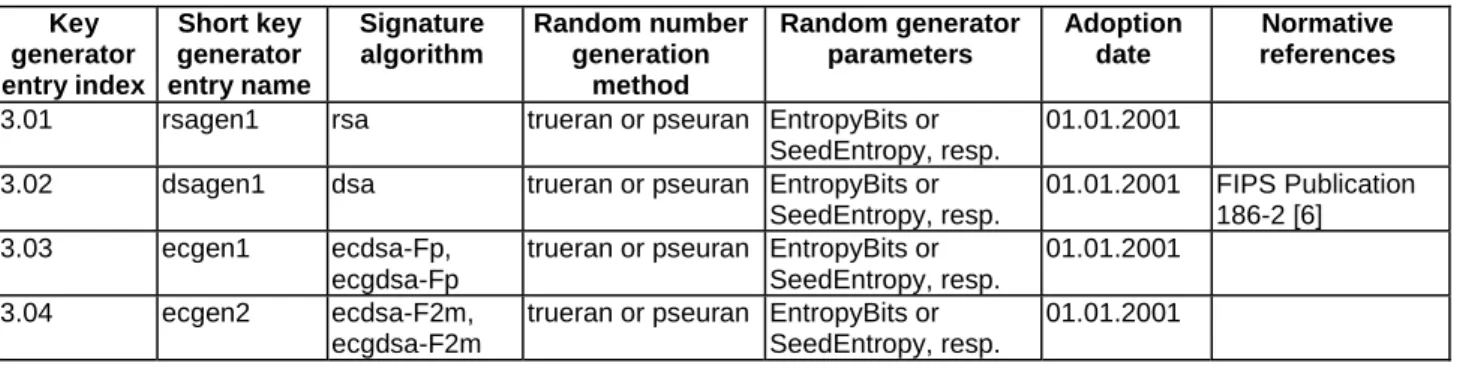
Table 3 summarizes the recommended key pair generation methods for all signature algorithms considered in the present document. Each key pair generation method has a unique entry index represented by a string beginning with "3." followed by a two-digit entry number.
Table 3: The list of recommended key pair generation methods Key generator entry index Short key generator entry name Signature algorithm Random number generation method Random generator parameters Adoption date Normative references 3.01 rsagen1 rsa trueran or pseuran EntropyBits or
SeedEntropy, resp.
01.01.2001 3.02 dsagen1 dsa trueran or pseuran EntropyBits or
SeedEntropy, resp.
01.01.2001 FIPS Publication 186-2 [6]
3.03 ecgen1 ecdsa-Fp,
ecgdsa-Fp
trueran or pseuran EntropyBits or SeedEntropy, resp.
01.01.2001
3.04 ecgen2 ecdsa-F2m,
ecgdsa-F2m
trueran or pseuran EntropyBits or SeedEntropy, resp.
6.2.2
Recommended key pair generation methods
6.2.2.1
Key and parameter generation algorithm rsagen1
Generate p and q as indicated in clause 6.1.2.1 by applying a random number generation method satisfying the requirements trueran (see clause 8.2.1) or using a method satisfying pseuran (see clause 8.2.2) with an appropriate size seed. Each prime SHALL effectively be influenced by EntropyBits bits of true randomness or a seed of entropy SeedEntropy bit. Random numbers SHALL be tested for primality until one of them is found to be prime with a probability of error (i.e. of actually being composite) of at most ErrProb. Details on generating random primes can be found in ISO/IEC 18032 [42], in particular clause 8.2. Examples of algorithms to produce RSA moduli, i.e. pairs of primes satisfying the condition 0,1 < | log2p - log2q | < 30 are given in annex C.
NOTE 1: Annex A of ISO/IEC 18032 [42] contains a table of error probabilities for different probabilistic primality tests.
EXAMPLE: For a random number of 1 024 bit tested with three successful iterations of the Miller-Rabin test the probability that this number is not a prime is about 2-93.
The private exponent d and the public exponent e must satisfy ed ≡ 1 (mod lcm (p-1, q-1)) which is automatically the case if ed ≡ 1 (mod (p-1)(q-1)). The private exponent d must not be too small (Wiener 1990 [43], Boneh and Durfee 1999 [44], Durfee and Nguyen 1999 [45],); it is sufficient to choose d in a range at least
n
from its minimum and maximum values.In practice by randomly choosing the public exponent e (subject to the condition gcd(e,(p-1)(q-1))=1) the corresponding private exponent d will satisfy that condition with very high probability. If e is chosen small (e.g. less than n0.125) the condition on d will automatically be satisfied.
NOTE 2: It may also be recommendable to choose e not too small (e ≥ 216+1) as for example results of Boneh and
Venkatesan suggest that for very small e the RSA problem could be easier than factoring. Nevertheless in contrast to RSA encryption small public exponents generally are not a direct threat for RSA signatures. A small public exponent (e.g. e = 3) MAY be used if performance is critical, otherwise e ≥ 216+1 is RECOMMENDED.
A new modulus has to be produced for each user of the signature scheme even if different public exponents are used. In practice if the moduli and public exponents are produced as described above (i.e. random modulus and choosing the public exponent) the probability of producing the same modulus or secret exponent is negligible.
NOTE 3: It is not recommended to use a prime selection algorithm which prefers a special class of primes. For example according to Rivest and Silverman [46] the use of "strong" primes would not improve security in practice.
6.2.2.2
Key and parameter generation algorithm dsagen1
The primes p and q SHALL be generated as described in appendix 2.2 of FIPS Publication 186-2 [6] with primality of an integer regarded as satisfied if the probability that it is composite is at most ErrProb.
Generate x by applying a random number generation method satisfying the requirements trueran (see clause 8.2.1) or using a method satisfying pseuran (see clause 8.2.2) with an appropriate size seed. Each value of x SHALL effectively be influenced by EntropyBits bits of true randomness or a seed of entropy SeedEntropy bit. Generate k using one of these methods; k does not have to be generated using exactly the same method as x. Possible methods for this can be found in FIPS Publication 186-2 [6] which contains a Change Notice (due to Bleichenbacher's attack).
6.2.2.3
Key and parameter generation algorithm ecgen1 for ecdsa-Fp
The prime numbers p and q, and the point P on E(Fp) SHALL be selected so that the conditions in clause 6.1.2.3 are satisfied with primality of an integer regarded as satisfied if the probability that it is composite is at most ErrProb. Possible methods to generate p, q, E and P are specified in [7], in the ECC Brainpool paper on standard curves and curve generation [47] and also in clause D.1.
In situations where an intentional choice of weak public parameters (subject to an unknown "insider" attack) seems to be possible a countermeasure is to request that these parameters are generated verifiably at random. In such situations it is recommended to do so at least for the generation of the curve E. In [7], in the ECC-Brainpool paper on standard curves and curve generation and in clause D.1 possible methods for this are described.
Generate x by applying a random number generation method satisfying the requirements trueran (see clause 8.2.1) or using a method satisfying pseuran (see clause 8.2.2) with an appropriate size seed. Generate k using one of these methods; k does not have to be generated using exactly the same method as x. Each value of x and k SHALL effectively be influenced by EntropyBits bits of true randomness or a seed of entropy SeedEntropy bit.
6.2.2.4
Key and parameter generation algorithm ecgen2 for ecdsa-F2m
The prime numbers m and q, the elliptic curve E over F2m and the point P on E(F2m) SHALL be selected so that the conditions in 6.1.2.4 are satisfied with primality of an integer regarded as satisfied if the probability that it is composite is at most Err Prob. Possible methods to generate m, q, E and P are specified in [7] (and also in D.2).
In situations where an intentional choice of weak public parameters (subject to an unknown "insider" attack) seems to be possible a countermeasure is to demand that these parameters are generated verifiably at random. In such situations it is recommended to do so at least for the generation of the curve E. In [7] a possible method for this is described
(compare also clause D.2).
Generate x by applying a random number generation method satisfying the requirements trueran (see clause 8.2.1) or using a method satisfying pseuran (see clause 8.2.2) with an appropriate size seed. Generate k using one of these methods; k does not have to be generated using exactly the same method as x. Each value of x and k SHALL effectively be influenced by EntropyBits bits of true randomness or a seed of entropy SeedEntropy bit.
6.2.2.5
Key and parameter generation algorithm ecgen1 for ecgdsa-Fp
The parameter and key generation methods should be the same as the ecdsa-F2m methods described in clause 6.2.2.3.
6.2.2.6
Key and parameter generation algorithm ecgen2 for ecgdsa-F2m
The parameter and key generation methods should be the same as the ecdsa-F2m methods described in clause 6.2.2.4.
7 Signature
suites
7.1 General
To meet this security requirement and to allow signing of more or less arbitrary long messages, a signature suite requires a hash function, so that the signing/verification algorithms operate on a fixed-size hash of the message. An important issue is to tie the hash function to the signature scheme. Without this, the weakest available hash function could define the overall security level.
Due to possible interactions which may influence security of electronic signatures, algorithms and parameters for secure electronic signatures SHALL be used only in predefined combinations referred to as the signature suites. A signature suite consists of the following components:
• a hash function; • a padding method;
• a signature algorithm and its associated parameters.
If any of the components of a suite is modified, then the suite must be modified accordingly. The list of recommended hash functions is defined in clause 5.1.
The list of recommended padding methods is defined in clause 7.2. The list of recommended signature algorithms is defined in clause 6.1.
The list of currently recommended signature suites is given in clause 7.3.
Key generation is not part of the way to identify a signature suite and may change over time. Key generation methods are addressed in clause 6.2.
Some key generation methods and some signature suites require to generate a (pseudo-) random number. The (pseudo) random number generation method is not part of the way to identify a signature suite and may change over time. (Pseudo) random number methods are addressed in clause 8.
7.2 Padding
methods
Padding is algorithm dependent and some algorithms need non-trivial padding. This is the case for the RSA algorithm. Signature algorithms with appendix require methods that encode a message into an integer message representative that will be the input for the signature primitive. This encoding method can be deterministic, for example a padding of a fixed string to the hash value computed from the message, but may be also randomized, incorporating a (randomly generated) salt value, which are converted to and from message representatives. Although these latter encodings are not true padding schemes, they are listed here.
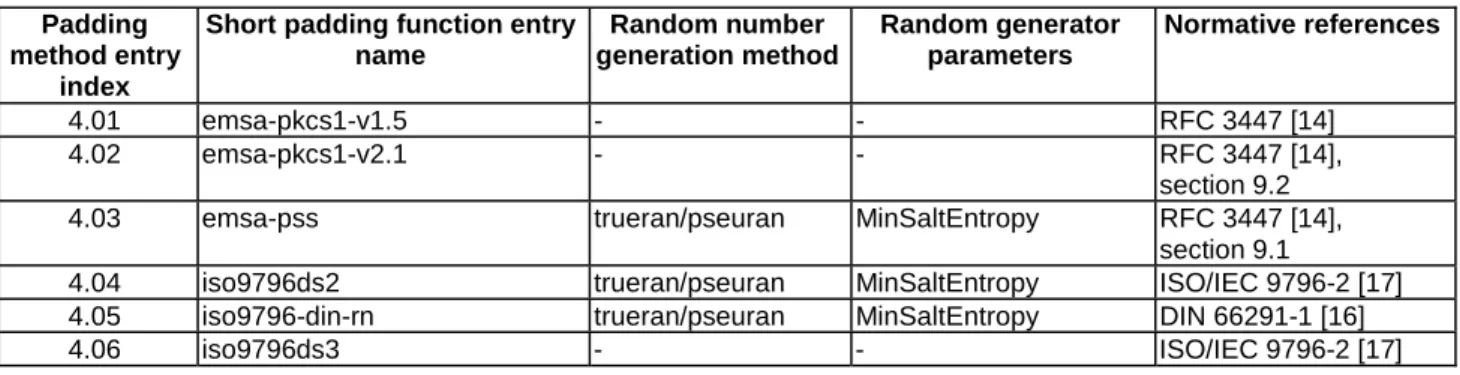
The list of currently recommended padding methods is given in table 4. Each padding method has a unique entry index represented by a string beginning with "4." followed by a two-digit entry number.
Table 4: The list of recommended padding methods Padding
method entry index
Short padding function entry name Random number generation method Random generator parameters Normative references 4.01 emsa-pkcs1-v1.5 - - RFC 3447 [14] 4.02 emsa-pkcs1-v2.1 - - RFC 3447 [14], section 9.2
4.03 emsa-pss trueran/pseuran MinSaltEntropy RFC 3447 [14],
section 9.1
4.04 iso9796ds2 trueran/pseuran MinSaltEntropy ISO/IEC 9796-2 [17]
4.05 iso9796-din-rn trueran/pseuran MinSaltEntropy DIN 66291-1 [16]
4.06 iso9796ds3 - - ISO/IEC 9796-2 [17]
Each salt value SHALL effectively be influenced by at least MinSaltEntropy bits of true randomness or a seed of entropy at least MinSaltEntropy bits. This rule implies that the salt length is at least MinSaltEntropy bits.
NOTE 1: The above rule of MinSaltEntropy bits salt entropy is not meant in the strict and exclusive manner as the demand for EntropyBits/SeedEntropy bits of entropy for key generation in clause 6.2, it is a
recommendation. For example Coron (see bibliography) showed that for emsa-pss already a significantly shorter than 64 bit salt length allows a reduction of the security of the signature scheme to the RSA problem under realistic assumptions. Nevertheless such a reduction analysis does not take into account every kind of possible weaknesses e.g. side channels. So the salt length should not be set too short if higher security is required.
The emsa-pkcs1-v1.5 padding method is included, but it is NOT RECOMMENDED for new implementations, since it will be phased out.
NOTE 2: Up to April 2007, no real attack on emsa-pkcs1-v1.5 has been publicized.
The emsa-pss method is included as, despite not being widely used, it has been stable for a long time and is a good improvement to the two emsa-pkcs1 schemes (i.e. -v1.5 and -v2.1 which only differ by the encoding method) and it is better suited for long term use. The padding method emsa-pss is parameterized by the choice of hash function and a mask generation function MGF, defined in PKCS#1 (RFC 3447 [14]). In the present document, MGF is based ALWAYS on the corresponding hash function used, e.g. SHA-1 or SHA-256.
The method iso9796ds2 is "digital signature scheme 2" in ISO/IEC 9796-2 [17].
The method iso9796-din-rn is the variant of a scheme from ISO/IEC 9796-2 [17] called "DSI according to ISO/IEC 9796-2 [17] with random numbers" in DIN V 66291-1 [16]. It is described in annex A of [16].
NOTE 3: This is a variant on Digital Signature Scheme 1 of ISO/IEC 9796-2 [17]. The Digital Signature Scheme 1 has wide deployments and is secure but maybe in the future not be recommended for new systems. The method iso9796ds3 is "digital signature scheme 3" in ISO/IEC 9796-2 [17].
NOTE 4: iso9796ds1 no longer represents state-of-the-art and in a paper presented by Coron, Naccache, Stern at Crypto 99 it is shown that the effort to break this padding scheme is about 261 instead of 280.
7.3
Recommended signature suites
A signature suite is defined using three parameters: • a hash function;
• a padding method;
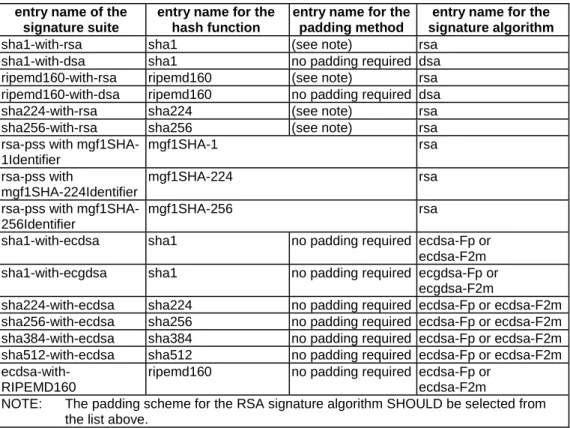
• a signature algorithm and its associated parameters. Table 4.a entry name of the
signature suite
entry name for the hash function
entry name for the padding method
entry name for the signature algorithm
sha1-with-rsa sha1 (see note) rsa
sha1-with-dsa sha1 no padding required dsa
ripemd160-with-rsa ripemd160 (see note) rsa
ripemd160-with-dsa ripemd160 no padding required dsa
sha224-with-rsa sha224 (see note) rsa
sha256-with-rsa sha256 (see note) rsa
rsa-pss with mgf1SHA-1Identifier
mgf1SHA-1 rsa rsa-pss with
mgf1SHA-224Identifier
mgf1SHA-224 rsa rsa-pss with
mgf1SHA-256Identifier
mgf1SHA-256 rsa sha1-with-ecdsa sha1 no padding required ecdsa-Fp or
ecdsa-F2m sha1-with-ecgdsa sha1 no padding required ecgdsa-Fp or
ecgdsa-F2m
sha224-with-ecdsa sha224 no padding required ecdsa-Fp or ecdsa-F2m sha256-with-ecdsa sha256 no padding required ecdsa-Fp or ecdsa-F2m sha384-with-ecdsa sha384 no padding required ecdsa-Fp or ecdsa-F2m sha512-with-ecdsa sha512 no padding required ecdsa-Fp or ecdsa-F2m
ecdsa-with-RIPEMD160
ripemd160 no padding required ecdsa-Fp or ecdsa-F2m
NOTE: The padding scheme for the RSA signature algorithm SHOULD be selected from the list above.
These are the signature suites based on the currently recommended algorithms.
While SHA-1 and RIPEMD 160 are still secure, it is RECOMMENDED to start moving to signature suites with hash functions that have a hash value greater than 160 bits. SHA-512 is RECOMMENDED for very long term signatures, otherwise SHA-256 SHOULD be used.
8
Random number generation methods
8.1 General
The key generation methods and some signature suites require the generation of a random number.
NOTE: For detailed information about random number generation and terminology see ISO/IEC 18031 [48]. Some basic information is also given in annex E.
The random number generation methods combined with the key generation methods have to ensure that the expected effort of guessing a cryptographic key is at least equivalent to guessing a random value that is EntropyBits bit resp. SeedEntropy bit long. This can be satisfied with respect to different demands like information theoretic vs. just
complexity theoretic security, backward secrecy and/or forward secrecy and so on. Clause 8.2 and annex E in particular specify by which RNGs these demands can be satisfied.
8.2
Recommended random number generation methods
Table 5 lists the recommended random number generation methods. Each random number generation method has a unique entry index represented by a string beginning with "5." followed by a two-digit entry number. The terms "trueran" and "pseuran" denote the requirements for NRNGs and DRNGs respectively (i.e. non-deterministic and deterministic random number generators).
Table 5: The list of recommended random number generation methods Random generator
entry index
Short random generator entry name
Random generator parameters
Adoption date Normative references
5.01 trueran EntropyBits 01.01.2001
5.02 pseuran SeedEntropy 01.01.2001
It is strongly recommended to use trueran methods for generating keys that are used more than once. In the case of the one-time keys k for DSA, ECDSA and ECGDSA there is less urgency for that.
8.2.1
Random generator requirements trueran
A random number generator satisfying trueran has to be a pure or hybrid physical NRNG.
NOTE 1: Non-physical NRNGs are excluded as the designer has no real control of the amount of the produced entropy.
Thus a random number generator satisfying trueran is based on a physical primary entropy source and possibly a cryptographic or mathematical post-treatment of the output of the primary entropy source.
The recommended requirements for these components are:
• (TR1): There is a stochastical model for the primary entropy source which is found consistent with thorough adapted tests of prototypes of the source.
• (TR2): The primary entropy source is subjected to an adapted statistical online test. "Online" means that the test will detect any non-tolerable loss of quality of the primary entropy source during operation sufficiently soon after such an event occurs and that there will then at once be suitable countermeasures (e.g. stop of the generator). "Adapted" means adapted to the statistical model of the primary entropy source. The original output of the primary entropy source should be tested not the output of the post-treatment instead of that (there may be justified exceptions to this general rule).