Technical Report
Validation of Problem Drinking Screening
Instruments for DWI Offenders
John H. Lacey Ralph K. Jones Connie H. Wiliszowski
May 1999
Prepared for:
U.S. Department of Transportation National Highway Traffic Safety Administration
Washington, DC 20590
Technical Report Documentation Page
1. Report No. 2. Government Accession No. 3. Recipients Catalog No.
DOT HS 808 881
4. Title and Subtitle Report ate
May 1999 Validation of Problem Drinking Screening Instruments
for DWI Offenders
6. Performing Organization Code
7. Author(s) 8. a orming rganization eport o.
Lacey, J.H.; Jones, R.K. and Wiliszowski, C.H.
9. Performing Organization Name and Address 10. Work Unit No. (TRAIS)
Mid-America Research Institute
611 Main Street 11. Contract or rant No.
Winchester, MA 01832 DTNH22-90-C-07287
12. Sponsoring Agency Name and Address 13. Type of Report and eno Covered
National Highway Traffic Safety Administration Final Report
Office of Research and Traffic Records 14. Sponsoring Agency Code
4007 h Street, S.W., Washington, DC 20590
15. Supplementary Notes
Dr. James Frank was the COTR for this project.
16. Abstract
This document summarizes the results of a validation study for five adult screening instruments in use fo preliminary screening of DWI offenders for problem drinking. The instruments were the Driver Risk Inventor) (DRI), the Michigan Alcohol Screening Test (MAST), Mortimer-Filkins Questionnaire (without the interview and the Substance Abuse/Life Circumstance Evaluation (SALCE). As an additional task, the project was aske to validate a combination of the consumption questions from the Alcohol Clinical Index and the four CAGE questions. A criterion instrument (the Comprehensive Adult Interview) was developed during the project b a panel of acknowledged leaders in the field of problem drinking assessment. All of the screening instrument (six total) were administered to 609 consenting adult DWI program participants in Pennsylvania an Massachusetts. The assessment instruments correctly identified problem drinkers, as classified by the criterio instrument, across a range of 72% to 92% of the time. In general, the more sensitive an instrument was, th less specific it tended to be. In other words, a cost of identifying a higher proportion of the problem drinker was that more persons who were not problem drinkers were incorrectly classified as such.
17. Key ors 18. Distribution Statement
problem drinkers, DRI, MAST, SALCE, This report is available from the National Technical Mortimer-Filkins, CAGE, ACI, assessment, Information Service, Springfield, Virginia
impaired driving, DWI (703) 487-4650.
19. Security Classif. (of this report) ecuriy Classif. (of t is page No. of ages 22. Price
136
ACKNOWLEDGMENTS
The authors are grateful to the many individuals who worked on this project. We would like to acknowledge Dr. Adele Harrell at the Urban Institute who was instrumental in conducting the expert panel meetings and in developing data collection procedures.
The authors would especially like to thank the following individuals, listed below in no particular order, for promoting the implementation of the study in their respective locations:
■ Donna Laurnavich, DUI Administrator, Allegheny County Alcohol Highway Safety Program, Pittsburgh, Pennsylvania
■ Betty McBride, Center for Substance Abuse, McKeesport, Pennsylvania
■ Cynthia Kovacevic, Center for Chemical Dependency Treatment, St. Francis Medical Center, Pittsburgh, Pennsylvania
■ Precious Roberts, Alternatives DUI Program, Pittsburgh, Pennsylvania
■ Dennis McCarty, former Director of the Bureau of Substance Abuse Services for the Commonwealth of Massachusetts.
■ Vic Gregoire, Thayer Institute, Worcester, Massachusetts
■ Lavinia DeStefano, Director of Boston ASAP, Boston, Massachusetts
■ Arthur Carvalho, Assistant Director of Boston ASAP, Boston, Massachusetts
■ Charles Leventis, CAB/CASP, Salem, Massachusetts
■ Eric Brungard, Middlesex County DUIL, Waltham, Massachusetts
A
TABLE OF CONTENTS
ACKNOWLEDGMENTS ... iii
1- INTRODUCTION ... 1 BACKGROUND ... 1 BASIC APPROACH ... 1 Criterion Measure ...1 Instruments Studied ... 2Data Collection Sites ... 2
Data Collection Approach ... 2
Analysis Approach ... 3
Discussion and Recommendations ... 3
ORGANIZATION OF THE REPORT ... 3
2 - IDENTIFICATION AND RECRUITMENT OF EXPERT PANEL ... 5
SPECIFIC CRITERIA FOR PANEL SELECTION ... 6
Specialized Subject-Area Knowledge ... 6
Comprehensive Knowledge of Problem-Drinker Assessment ... 7
Knowledge About Pertinent Databases ... 8
Professional Reputation and Credentials ... 8
Effectiveness as a Panel Member ... 9
PROCEDURES FOR RATING POTENTIAL PANELISTS ... 9
SELECTED PANELISTS ... 9
3 - CRITERION DEVELOPMENT ... I
12
SPECIFIC DOMAINS ... 13
Consumption ofAlcohol ... 13 Alcohol Dependence .... 13 Consequences of Drinking ... 13 Vulnerability ... 14SOURCES ... 14
PROBLEM DRINKER DEFINITION ... 15
DRAFT QUESTIONNAIRES ... 16
4 - INSTRUMENTS SELECTED FOR VALIDATION ... 17
MICHIGAN ALCOHOL SCREENING TEST (MAST) ... 17
MORTIMER FILKINS ... 19
SUBSTANCE ABUSE LIFE CIRCUMSTANCES EVALUATION (SALCE)
DRIVER RISK INVENTORY (DRI) ... 23
CAGE ...25
5 -DATA COLLECTION METHODS ... 28
BASIC APPROACH ... 28
Assembly of Survey Packets ... 28
General Interview Procedures ... 29
Collateral Interviews ... 31
Compilation of Survey Forms ... 32
SPECIFIC DATA COLLECTION PROCEDURES ... 32
Pittsburgh Area ... 32
Site Description ... 32
Data Collection Procedures Specific to the Pennsylvania Sites ... 33
Sample Size ... 33
Boston Area ... 33
Site Description ... ... 33
Data Collection Procedures Specific to the Massachusetts Sites .... 34
Sample Size ... 34
6- ANALYSIS ... ...35
DATA ANALYSIS APPROACH ... 35
Operationalizing a Classification Scheme for the Criterion Instrument Operationalizing the Classification Schemes for the Screening Instruments Computing Each Instrument's Classification of Each Subject ... 36
Comparing the Classifications ... 36
RESULTS ... 37
7 - CONCLUSIONS AND RECOMMENDATIONS ... 39
REFERENCES ... 41
APPENDIX A - TABLES ... 43
APPENDIX B - ADULT CRITERION INSTRUMENT ... 53
APPENDIX C - ADOLESCENT CRITERION INSTRUMENT ... 69
APPENDIX D - DRAFT ADULT CRITERION INSTRUMENT CONTAINING SOURCES ... 89
APPENDIX E - DRAFT ADOLESCENT CRITERION INSTRUMENT CONTAINING SOURCES ... 105
TABLES
Table 1: Sources of Items in Assessment Instruments ... 15
Table 2: Minimum Domain Scores for Establishing Various Drinking-Problem Risk Levels ... 16
Table 3: Positive BACs of Clients At Time of Project Participation By Fre quency ... 30
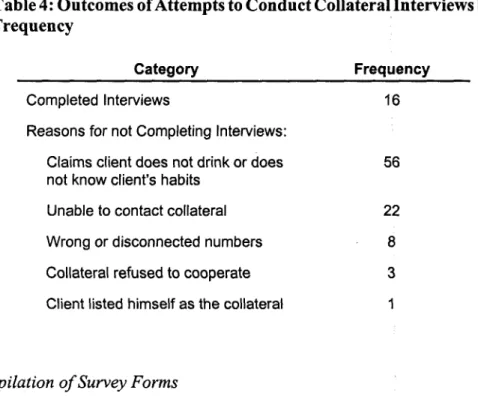
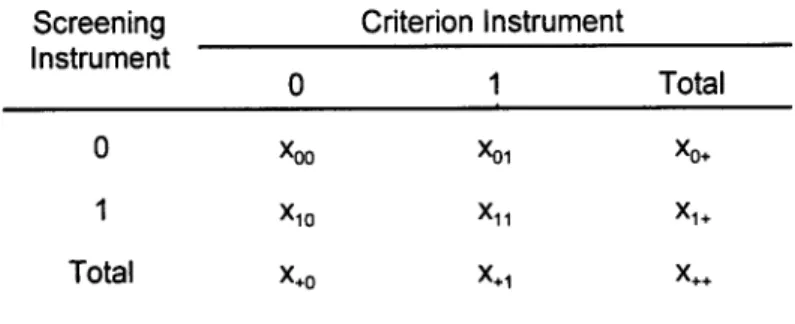
Table 4: Outcomes of Attempts to Conduct Collateral Interviews by Frequency 32 Table 5: 2x2 Table for Comparing a Given Instrument ... 37
Table 6: Comparison of the Performance of Various Screening Instruments 37 Table 7: Percentage of Subjects Correctly Diagnosed by Various Screening Instruments ... 38
Table A-1: Adult Problem Drinkers, Criterion Rating Means as a Function of Criterion and Criterion Group ... 44
Table A-2: Adult Problem Drinkers, Criterion Rating Means as a Function of Criterion and Criterion Group (Continued) ... 45
Table A-3: Adult Problem Drinkers, Rating Means Sorted by Discriminability Mean as a Function of Criterion and Criterion Group ... 46
Table A-4: Adult Problem Drinkers, Rating Means Sorted by Discriminability Mean as a Function of Criterion and Criterion Group (Continued) ... 47
Table A-5: Means of Criterion Ratings, Adult Problem Drinkers by Criterion Group ... 48
Table A-6: Sources of Items - Consumption ... 49
Table A-7: Sources of Items - Dependence ... 50
Table A-8: Sources of Items - Consequences ... 51
Table A-9: Sources of Items - Vulnerability ... 52
Table A-10: Other Sources ... 52
A
1- INTRODUCTION
This report describes a validation study of several problem drinker screening instruments which are in widespread use by courts to determine the need for further assessment and treatment of DWI offenders for problem drinking. The project entitled "Problem Drinker Assessment Instrument Validation" was conducted under contract number DTNH22-90-C-07287 for the National Highway Traffic Safety Administration (NHTSA).
BACKGROUND
Throughout the United States there is a growing trend for courts to conduct a preliminary screening of DWI offenders for alcohol problems either prior to sentencing or as a component of the sentence. This screening typically takes the form of the administration of a relatively brief screening instrument. The results of that test are used to help decide whether the DWI offender is sent on to further assessment and treatment as a part of the sentence for DWI. Among the findings of an earlier study conducted for NHTSA, "Assessment of Classification Instruments Designed to Detect Alcohol Abuse" (DOT HS 807 475) were that: the instruments were administered by persons with a wide variety of qualifications; that in some cases the results from the screening instruments were used to make the final determination of whether an offender received treatment; and that most instruments in widespread use had not been independently validated against an objective criterion measure.
This study is intended to address the last observation noted above by developing a criterion measure and subjecting some of the more widely used screening instruments to an independent validation study using a criterion measure which could be replicated.
BASIC APPROACH
Criterion Measure
Most validation studies of instruments of this nature have used as criterion measures either a clinician's opinion or another widely used instrument. NHTSA desired that a new criterion measure be developed which could be administered in a standardized manner so that other similar validation studies could be conducted. To that end, a panel of acknowledged leaders in the field of problem drinking assessment was convened to guide the development of a criterion measure which might be considered a "gold standard" for these purposes. They helped develop two quantifiable criterion measures (one for adults and one for adolescents) which could be supplemented by queries of other persons (collaterals), official records and a measure of breath alcohol concentration of the persons being assessed. The adult
Validation of Problem Drinking Screening Instruments for DWI Offenders
tool (Appendix A - Comprehensive Adult Interview) was used as the criterion measure for this study and is discussed in greater detail later in the report. The adolescent criterion instrument appears in Appendix C.
Instruments Studied
Four screening instruments for adults were selected for this validation study. Because resources were available to study only four screening instruments, an attempt was made to identify from among the many instruments in current use ones which, based on the earlier study, were known to be in widespread use and were constructed using sound psychometric procedures. Additionally, we wished to examine both hand-scored and computer-scored instruments. This essentially translated into ones which were in the public domain and thus fairly inexpensive to obtain (hand-scored) and proprietary instruments which had somewhat higher costs associated with them (computer-scored). The expert panel was asked to review the list of possible instruments and make recommendations. The four DWI adult screening instruments studied were the Michigan Alcohol Screening Test (MAST), the Mortimer-Filkins Questionnaire(without the interview), the Driver Risk Inventory (DRI) and the Substance Abuse/Life Circumstance Evaluation (SALCE).
As an additional task, NHTSA requested that we validate a combination of the consumption questions from the Alcohol Clinical Index and the four CAGE questions. These questions were suggested by the expert panel as a possible shorthand way of identifying problem drinkers on a telephone questionnaire NHTSA was developing.
Data Collection Sites
Data were collected from adult subjects in DWI programs in Allegheny County (Pittsburgh), Pennsylvania and the Greater Boston, Massachusetts area. These sites were selected primarily because they generated a sufficient number of DWI offenders to satisfy our sample size needs, they served a heterogeneous population of offenders, and program administrators expressed interest in the project and a willingness to allow their staff or graduate students to administer the instruments and criterion measure.
Data Collection Approach
All of the screening instruments were administered to 609 consenting adult DWI program participants. A mix of first and multiple offenders participated. Anonymity was assured and the instruments were administered by persons who did not have direct responsibility for the subject's program activity. The order of administration of instruments was counterbalanced to obviate any possible order effect.
Introduction
Analysis Approach
Each instrument was scored according to its scoring instructions to categorize each individual as problem drinker or non-problem drinker. These results were then compared with that obtained using the criterion measure. Tables were presented showing the degree of agreement, proportion of false positives and false negatives for each instrument in comparison with the criterion measure.
Discussion and Recommendations
The instruments correctly identified problem drinkers, as determined by the criterion measure, across a range of 72 to 92 percent of the time. They also varied in terms of specificity. In general, the more sensitive an instrument was, the less specific it tended to be. In other words, a cost of identifying a higher proportion of the problem drinkers was that more persons who were not problem drinkers were incorrectly classified as such.
ORGANIZATION OF THE REPORT
Chapter 2 details the identification of the expert panel and development of the criterion measure. Chapter 3 explains the development of the criterion instrument. Chapter 4 discusses the instruments selected for validation. Chapter 5 addresses the data collection and processing procedures used to compile the information obtained from the interviews. Chapter 6 presents the analysis approach and results. Chapter 7 contains discussion and recommendations of this report.
2 - IDENTIFICATION AND RECRUITMENT OF EXPERT PANEL
It was NHTSA's desire to develop a criterion measure which could be objectively applied and was thus readily replicable. Thus the more traditional criterion measure for such validation studies, a clinical evaluation by a mental health professional, was not appropriate to this study. Rather, it was decided that a measure developed with the advice and assistance of a number of acknowledged leaders in the field of problem drinking assessment should be created. The first step in this process was to assemble an expert panel. This chapter describes that process.
It was vital to the development of the criterion measure that the expert panel be comprised of acknowledged leaders in the field with impeccable credentials and which, as a group, had expertise in all of the areas required. The identification of these individuals was a multi-step process. We first developed a list of required areas of expertise and desired panelist attributes. We then identified a number of individuals who had expertise in the field. The next step was to recruit other persons with knowledge of the field and familiarity with the practitioners in the field to rate potential panelists. Once ratings were received and the desired panelists identified, they were recruited to the task.
The major charge to the panel was to develop criteria that could be used in the validation of screening instruments intended to identify problem drinkers within the DWI population.
Two types of experts were needed on the panel, those with expertise in the various specialties involved in formulating criteria for assessing problem drinking, and those with comprehensive knowledge and experience in developing and administering such protocols. The former type of individual was considered more important to this phase of the project, because we were developing validation criteria rather than a protocol. The latter type of individual was needed to help ensure that the validation criteria were practical and could be applied in an operational setting. For panel members who had developed instruments, it was important to identify persons who would strive to serve project goals rather than particular interests. Additionally, we tried to identify persons who did not have a financial interest in the sale of instruments.
We also needed members who were knowledgeable in certain ancillary areas that supported the development of practical criteria. For example, the panel needed to include some (but not necessarily all) members with knowledge of databases that related to pertinent specialties. For instance, data in driving records could be used in a particular validation criterion, so one or more panel members needed to be familiar with the nature, validity, accessibility, and cost of such records.
The criteria recommended by the panel would be subject to considerable scrutiny by a wide range of constituencies. Thus, we needed panel members who had a high level of professional credibility in their areas of specialty and well-established
Validation of Problem Drinking Screening Instruments for DWI Offenders
and published widely in pertinent areas. Further, panel members had to be willing to expend enough time to work on this project, and be able to participate in a consensus-building process.
Because a number of skills were necessary to the panel and the number of panelists was limited, we endeavored to identify potential panelists who had multiple skills that were pertinent to the panel activities. Most potential panelists had expertise in at least two or three specific areas that were critical to developing validation criteria for problem-drinker assessment instruments.
SPECIFIC CRITERIA FOR PANEL SELECTION Specialized Subject-Area Knowledge
Knowledge and experience in the following areas were deemed essential. Drinking Practices
Definitions of Problem Drinking
Knowledge of the several approaches to defining problem drinking provided useful information in developing the criteria, which in effect formed an operational definition of problem drinking. The criteria-setting process had to take into account the thinking of the research communities on this issue. Patterns of Problem Drinking in Various Populations
The initial charge in this project was to develop operational criteria for two broad sub-populations; adult and adolescent problem drinkers within the DWI population. Additionally, it was necessary to have insights into whether criteria that were developed would be appropriate across ethnic groups within these two sub-populations.
Correlates of Problem Drinking
The criteria developed would, in essence, be a set of correlates of problem drinking. It was essential that the panel have members who had studied this area.
Identification and Recruitment of Expert Panel
Alcohol Effects on People Physiological
A group of potential criteria fell into the general category of biological markers of problem drinking. The panel needed the capability of addressing two basic issues here: specific physiological criteria that would be appropri ate; and feasibility of gathering such information from likely study popula tions.
Behavioral
Many of the potential criterion measures were indicators of the social behavioral effects of problem alcohol consumption. Such indicators might include contacts with criminal justice system agencies and contacts with mental health agencies, among others. It was essential that expertise in this area be present on the panel.
Treatment of Alcoholism and Alcohol Abuse Symptoms and Diagnosis
Knowledge of the symptoms of problem drinking and skills in diagnosing a subject with a given set of symptoms were required for identifying problem drinking in the clinical setting. Objectively measurable factors in this process were likely to be components of the assessment validation criteria.
Selection of Treatment
The charge of the instruments was to identify problem drinkers within the DWI population for whom traditional sanctions (e.g., fines, jail, etc.) were not sufficient and thus treatment was indicated. Therefore, it was important that the panel contain members expert in identification of appropriate treatment for problem drinkers, particularly those encountered in the DWI population. Knowledge in this area would provide insight about the characteristics of patients for whom treatment would be effective.
Comprehensive Knowledge of Problem-Drinker Assessment Construction and Validation of Psychometric Tests
Persons with experience in this area would be able to provide valuable input about some of the barriers and solutions to obtaining appropriate validation
Validation of Problem Drinking Screening Instruments for DWI Offenders
criterion information and could provide input on how those steps might affect methodological issues.
Developing and Administering Specific Assessment Protocols
Familiarity with the process and pitfalls of field tests of criterion variable validity and diagnostic practices was useful in identifying problems the project might have encountered in measuring a criterion designed to be an independent and superior measure of the need for treatment.
Knowledge About Pertinent Databases
It was possible that many of the criterion variables considered would be available from official or medical databases. Therefore, it was important that the panel contain persons with expertise in the potential database areas listed below. It was highly unlikely that such individuals would be records specialists. They were more likely to have acquired their database knowledge in the course of their primary research and professional activities.
Motor Vehicle Department Records Traffic Accident Records
Driver Records Medical Records
Addiction Treatment Agency Records Criminal Justice System Records
Police Agency Records Court Records
Sanctioning Agency Records Social Service A egncy Records
Other criteria which were important to the credibility of the panel and its functioning were:
Professional Reputation and Credentials
Academic degrees
Research activities
Publications
Work experienceIdentification and Recruitment of Expert Panel
Effectiveness as a Panel Member
Ability to work as a member of the group
Willingness to put forth the necessary time and effort Required areas of expertise
The following procedures were used to rate potential panelists against the selection criteria outlined above.
PROCEDURES FOR RATING POTENTIAL PANELISTS
Four experts in the field: two from granting agencies and two senior researchers in the field who would not be available to participate in the panel activities were first asked to rate each of several potential nominees on their level of expertise or qualifications in each of the above areas. They were also asked to suggest additional nominees and rate them. A grid was developed and provided for these purposes. For each of the additional nominees, the other expert raters were polled by phone by project staff for their ratings.
After the first round of ratings, a shorter list of nominees was prepared and the expert raters were again polled and asked to provide opinions about potential panelists' overall knowledge and reputation separately on groupings of categories of expertise. These were: definitions of problem drinking; patterns of problem drinking; correlates of problem drinking; symptoms of problem drinking; and treatment for problem drinking.
The results of this series of ratings were reviewed by project staff. A list of recommended panelists, along with supporting documentation, was submitted to NHTSA for review. After NHTSA approval, project staff recruited panel members. Fortunately, all of those identified agreed to serve.
SELECTED PANELISTS
Brief biographical sketches (current in 1992) of the selected panel members panel appear below.
Thomas F. Babor, Ph.D.
Ph.D. 1971 in Social Psychology from the University of Arizona. He was the Director of the Alcohol Research Center at the University of Connecticut Health Center and a professor in the School of Medicine at the University of Connecticut, Framingham. As director ofthe large, multi-site National Institute on Alcohol Abuse and Alcoholism (NIAAA) study of client treatment matching, he brought to the panel in-depth understanding of the symptoms of alcohol abuse requiring intervention.
Validation of Problem Drinking Screening Instruments for DWI Offenders
Howard Blane, Ph.D.
Ph.D. in Clinical Psychology from Clark University. He was the Director of Research at the Institute of Research in Psychology, SUNY, Buffalo, and has been a leading figure in alcohol research for the past 30 years. He was Principal Investigator of an NIAAA alcohol research center. He has worked extensively on epidemiologic studies of problem drinking and correlates.
John E. Donovan, Ph.D.
Ph.D. in Social Psychology from the University of Colorado. From 1977 - 1993 he was a Research Associate in the Research Program in Problem Behavior, Institute of Behavioral Science, University of Colorado. His research interests have focused on alcohol and drug use among adolescents and young adults. He has also conducted a study on drunk driving and risky driving among adolescents. He currently directs a research program in that area at the Western Psychiatric Institute in Pittsburgh, Pennsylvania.
Roger H Peters, Ph.D.
Ph.D. in Clinical Psychology from Florida State University. Assistant Professor, University of South Florida, Florida Mental Health Institute. His research has included evaluation of national model in jail drug and alcohol treatment programs for the Bureau of Justice Assistance and an evaluation of the State of Florida assessment and treatment programs for DWI offenders.
Harvey Skinner, Ph.D.
Ph.D. in Psychometrics from the University of West Ontario. He is considered a Health Psychologist. Since 1989 he has been chair and professor of the Department of Behavioral Sciences at the University of Toronto, Ontario. From 1976-1988, he was a senior scientist with the Addiction Research Foundation. He was one of the first to advance the argument for two-step screening for alcohol problems to save resources and expenses in identifying clients appropriate for treatment. His special interests are diagnostics and assessment.
Ken Winters, Ph.D.
Ph.D. in Clinical Psychology from SUNY, Stony Brook. Since 1985, he has been Director of the Chemical Dependency Adolescent Assessment Project supported by the Amherst Wilder Foundation, St. Paul, Minnesota. He has extensive experience in developing and field testing screening instruments for determining chemical
Identification and Recruitment of Expert Panel
dependency in adolescents. His interests are in drug and alcohol abuse and applied clinical research.
Additionally, Patricia F. Waller, Director of the University of Michigan Transportation Institute agreed to moderate the panel meetings.
Patricia F. Waller
Ph.D. in Psychology from the University of North Carolina, she worked as a clinical psychologist in North Carolina, Virginia and Massachusetts, and taught and conducted research at the University of North Carolina (UNC) and elsewhere. She served as Associate Director for Driver Studies for the UNC Highway Safety Research Center. She served as founding director (1987-1989) of the UNC Injury Prevention Research Center, one of the first five centers of excellence in injury prevention research funded by the Centers for Disease Control. In 1989 she left UNC to become director of The University of Michigan Transportation Research Institute (UMTRI). She holds academic appointments in The University of Michigan School of Medicine, School of Public Health, and Department of Psychology.
3 - CRITERION DEVELOPMENT
The panel carried out its work in three sessions held in Washington, DC at approximately two month intervals. At the first meeting, the panel was given its basic charge of developing a criterion measure which would identify problem drinkers whose level of drinking and associated problems indicated either a need for treatment or a thorough diagnostic assessment. To assist the panel in their deliberations, alternative criterion measures suggested by a review of the literature were provided before the first meeting. The criterion measures were grouped into four categories according to the source of the data: self-report measures, official records, biochemical tests and collateral reports.
Self-report measures included alcohol consumption levels (quantity), frequency of alcohol consumption, and negative consequences such as family problems and trouble with the law. Official records such as criminal records, driving history, health care providers for services or benefits were other sources of data which could be used to identify alcohol abusers. Biochemical tests could be collected as part of a court's investigation of a case or when available from existing medical records. Simultaneous use of two or more conventional laboratory markers generally has been proven more successful than the use of a single marker. Laboratory findings from the following list could represent objective chemical markers of problem drinking and alcoholism in uncooperative patients who denied any drinking problem.
1. Blood alcohol concentration (BAC) / Blood Alcohol Level (BAL). This requires measurement within a short time of arrest, and may be difficult to obtain for all offenders. Detects only current use, not chronic abuse.
2. GGT assay-blood levels of Gammaglutamyltransferase. The enzyme has been found to be a relatively sensitive index of liver damage in clinical studies of alcoholics and heavy drinkers.
3. Urinary dolichols (substances involved in the formation of certain protein-carbohydrate compounds) have been reported to be significantly more sensitive than GGT for detecting alcoholism.
4. Analysis of carbohydrate-deficient transferrin (CDT). A new technique permitting rapid detection and measurement. Excessive alcohol consumption has been associated with increasing levels of the carbohydrate-deficient form of transferrin, a protein that transports iron.
5. Blood level of the mitochondrial liver enzyme aspartateaminotransferase (AST) and its ratio with total AST has been found effective in discriminating between alcoholics and other subjects, and in detecting excessive drinking. 6. Examination of the use of acetaldehyde (ACH), the major metabolite of
alcohol. All known pathways of alcohol metabolism result in producing ACH. ACH binds to certain proteins to form acetaldehyde adducts (Aas), which may prove to have strong diagnostic relevance.
Criterion Development
Collateral reports provide the last criterion measure category. These are reports which might be obtained from relatives, friends or co-workers. Because problem drinkers tend to deny that they have a problem or deliberately under-report their consumption, reports from others who have the opportunity to observe the offenders' drinking behavior and consequences have been used in the past. Supervisors and co workers of employed offenders could be asked about on-the-job drinking or impairment, while spouse/partners or friends could be asked about weekend and evening consumption and impairment.
SPECIFIC DOMAINS
The panel discussion at the first meeting focused on the specific domains which were to be addressed by the criterion measure and sources of test items which could be used to tap those domains. The four domains the panel members identified are described below:
1. Consumption ofAlcohol
Excessive use of alcohol as indicated by such criteria as a high BAC at arrest or in an emergency room; reports of heavy drinking; heavy drinking symptoms at arrest; rapid drinking; inappropriate drinking contexts; early onset of drinking and drinking related problems; recent use of other drugs; prior problems with drugs; and biological markers indicating heavy drinking. 2. Alcohol Dependence
Physical and/or psychological dependence on alcohol, including symptoms set forth in DSM-IIIR (e.g., withdrawal, tolerance, pre-occupation with drinking, loss of control of drinking, and persistence in drinking despite consequences); a history of dependence as indicated by prior episodes of delirium tremens (DTs) and treatment for alcohol abuse; medical problems associated with dependence such as gross tremor, nystagmus, and impaired cognitive function, and acute abstinence syndrome.
3. Consequences of Drinking
Indications that a person has experienced the consequences of alcohol abuse. Two types of such consequences were identified, psychosocial and biomedi cal. Psychosocial consequences include arrests for DWI and chemical test refusal; arrests for certain non-traffic offenses such as domestic violence; contacts with social service agencies; and life role dysfunctions involving the workplace, family, marital relations, finances, legal matters, drugs, psychiat
Validation of Problem Drinking Screening Instruments for DWI Offenders
ric problems, and psychosocial distress. Biomedical consequences include a history of trauma; impaired liver function; gastro-intestinal problems; hypertension; cardiopulmonary problems; impaired sexual function; and blackouts and hangovers.
4. Vulnerability
The presence of factors indicating a vulnerability or predisposition to alcohol abuse. Such factors include a family history of alcohol abuse, substance abuse, or personality disorders; a history of anti-social behavior; and a high level of childhood risk factors, both organic and environmental.
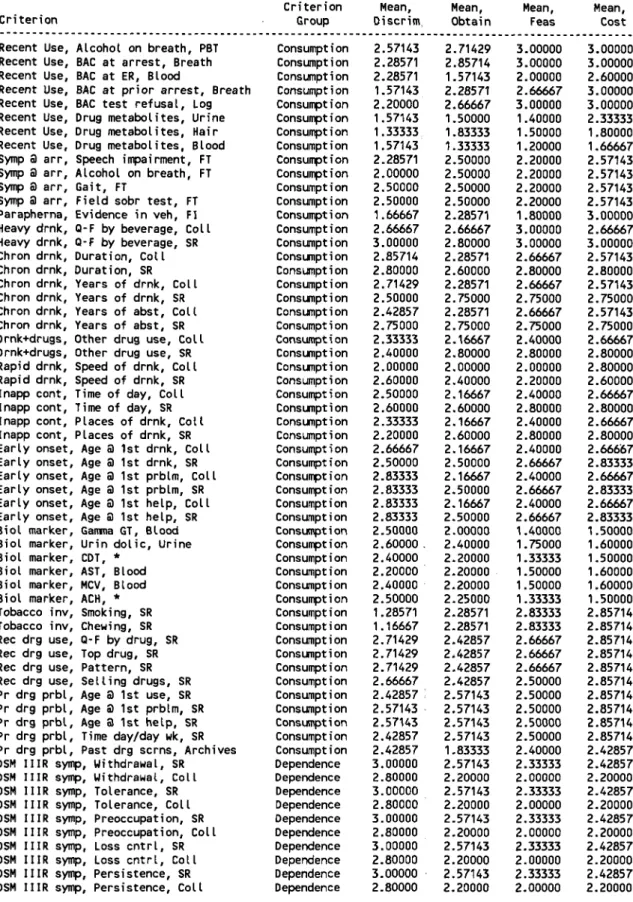
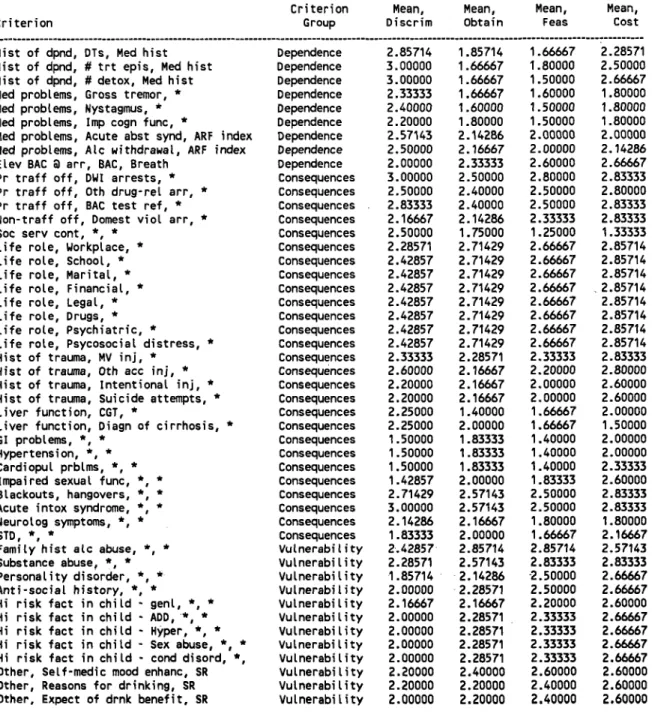
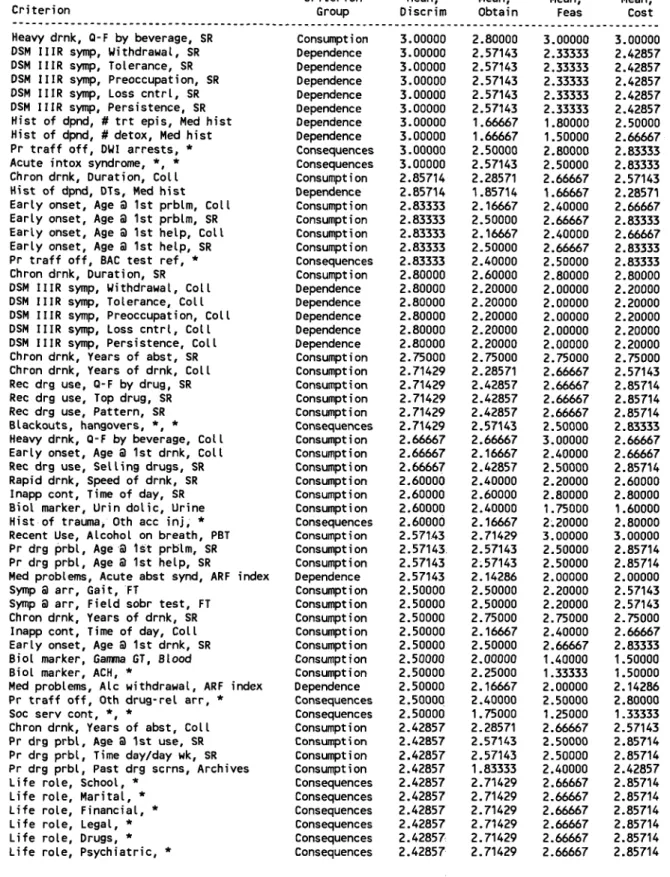
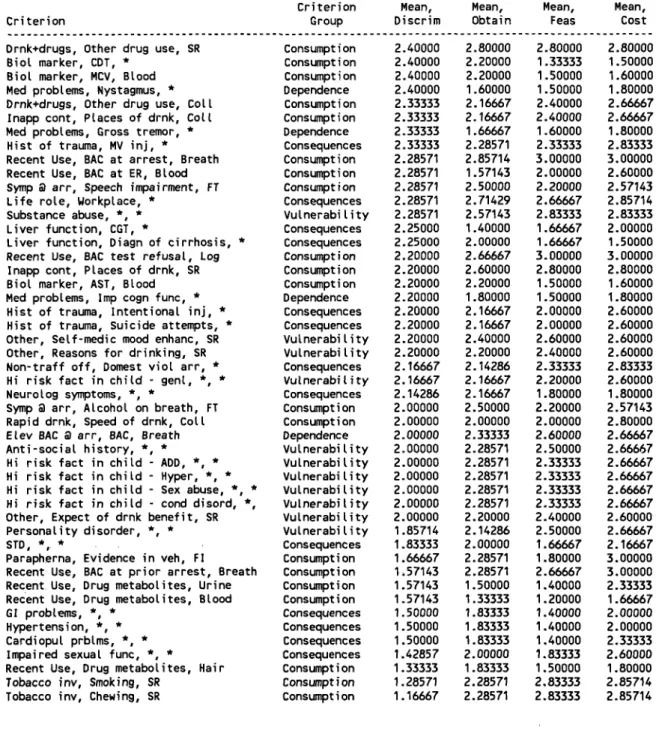
Panelists rated the adult problem drinking criterion variables. The results of the ratings are presented in a series of tables in Appendix A. The first tables (Table A-1 and Table A-2) provide mean ratings for all variables combined within each general category. The higher the mean, the better. Thus for cost, the higher the mean, the lower the cost. Tables A-3 and A-4 provide the mean value on discriminability, obtainability, feasibility and cost for each variable, presented in the sequence they appear on the form. Table A-5 provides the same information with the variables sorted in order of mean discriminability score. The information was used to decide what variables were most appropriate for the criterion measure.
The panelists then discussed sources of questionnaire items to measure these domains.
SOURCES
Project staff gathered and tabulated those items which could be obtained during the first meeting and they were reviewed by the expert panel. Certain items were selected as likely being appropriate for the criterion measure and others were drafted. The panel came to the opinion that sufficient information could be obtained to make a determination of problem drinking through official traffic records, questionnaire responses supplemented by information to be gathered from collaterals (friends, relatives, etc.), and a BAC measurement at time of testing.
The development of the criterion instrument began with a review of existing assessment instruments. Portions of several of those instruments were identified as potential components for the proposed criterion instrument. The chart below outlines the abbreviations for the various assessment instruments.
Criterion Development
Table 1: Sources of Items in Assessment Instruments
Abbreviation Full Name
AEQ Alcohol Expectancy Questionnaire ADI Adolescent Diagnostic Interview APSI Adolescent Problem Severity
Index
ASI Addiction Severity Index CDP Comprehensive Drinking Profile
DIS Diagnostic Interview Schedule Form 90C Form 90C
HAP Health Attitudes and Practices IAP Individual Assessment Profile RDC Research Diagnostic Criteria
TS Trauma Scale
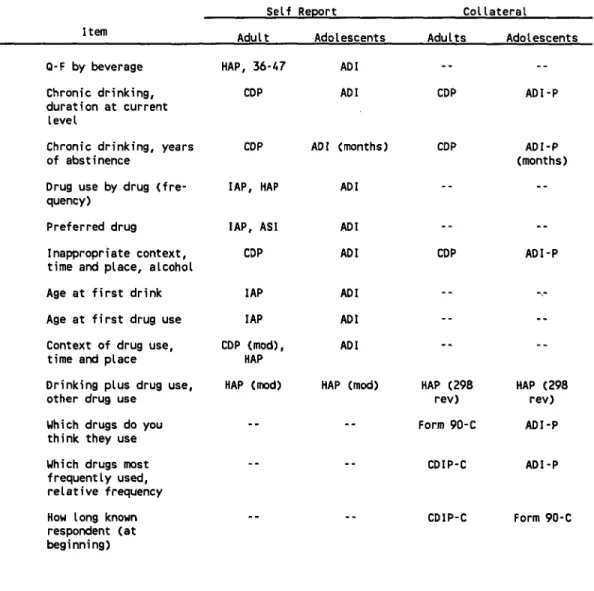
Items were categorized by each criterion topic (Consumption, Dependence, Consequences and Vulnerability) and sources of questions on existing assessment instruments were identified. The four tables in Appendix A (Tables A-6, A-7, A-8 and A-9) outline these items separated by Self Report and Collateral and further by Adult and Adolescents. The last table (Table A- 10) identifies sources of information other than existing assessment instruments, such as records and biochemical tests.
PROBLEM DRINKER DEFINITION
Panel members were asked to help identify persons within the convicted DWI population who should be categorized as problem drinkers. As indicated in the previous section, the expert panel identified four critical domains which contribute to the classification of a DWI offender as a problem drinker. Again, these are alcohol consumption, consequences of alcohol consumption, dependance on alcohol and history of alcohol treatment. The definition below incorporates each of those domains.
A problem drinker is a person who:
■ consumes five or more drinks per day on eight or more days each month; or
■ has experienced five or more adverse consequences of drinking such as job loss, arrests, family or health problems or the like; or
Validation of Problem Drinking Screening Instruments for DWI Offenders
n
exhibits three or more symptoms of dependance such as needing to drink
more in order to have an effect, withdrawal symptoms or the like; or
n had treatment for alcohol problems two or more times.
Persons who exhibit the characteristics described above to a lesser degree in two or more of the categories would also be categorized as problem drinkers. The thresholds for categorization as a problem drinker requiring two or more domains are:
n
consumes five or more drinks per day on from four to seven days per month;
n
has experienced three or four adverse consequences of drinking;
n
exhibits one or two symptoms of alcohol dependance;
• and has had previous treatment for alcohol problems.
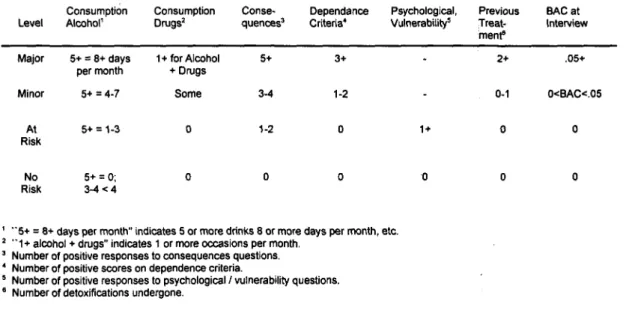
Table 2: Minimum Domain Scores for Establishing Various Drinking-Problem Risk Levels
Consumption Consumption Conse- Dependance Psychological, Previous BAC at Level Alcohol' Drugs' quences' Criteria' Vulnerability5 Treat- Interview
menu
Major 5+ = 8+ days 1 + for Alcohol 5+ 3+ 2+ .05+ per month + Drugs
Minor 5+ = 4-7 Some 3-4 1-2 0-1 0<BAC<.05
At 5+ = 1-3 0 1-2 0 1+ 0 0
Risk
No 5+=0; 0 0 0 0 0 0
Risk 3-4 < 4
"5+ = 8+ days per month" indicates 5 or more drinks 8 or more days per month, etc. 2 "1+ alcohol + drugs" indicates 1 or more occasions per month.
Number of positive responses to consequences questions. Number of positive scores on dependence criteria.
5 Number of positive responses to psychological / vulnerability questions. 6 Number of detoxifications undergone.
DRAFT QUESTIONNAIRES
Between the first panel meeting and the second, project staff gathered additional items from sources indicated by the panel and prepared listings of all items for further consideration by the panel. Their ratings of items were scored and provided to the panelists at the second panel meeting. At the second panel meeting, draft criterion questionnaires were constructed which contained acompilation of items from existing instruments. Complete copies of the adult draft questionnaire and the adolescent draft questionnaire appear in Appendices D and E.
4 - INSTRUMENTS SELECTED FOR VALIDATION
The basic selection criteria which qualified instruments for inclusion in the validation study were that the instruments be in widespread use, that the developers had used sound psychometric techniques, and that the tests selected represented both hand and computer administration and scoring techniques. We initially examined the results of the review of instruments and survey of states from Popkin, Kannenberg, Lacey and Waller (1988) to identify instruments which met these criteria. A list of candidate instruments was prepared and supplemented with information about more recently developed instruments. This listing was presented to the expert panelists and they assisted in the selection of four instruments for the adult validation study. These four instruments were the Michigan Alcohol Screening Test (MAST), the Mortimer-Filkins Questionnaire, the Substance Abuse Life Circumstances Evaluation (SALCE), and the Driver Risk Inventory (DRI).
In addition, during the project NHTSA requested that we suggest a limited number of questions which could be included on a telephone interview which could be used to classify respondents as problem drinkers. We queried the panel and they suggested using the CAGE (Ewing, 1984) questionnaire combined with six consumption questions from the Alcohol Clinical Index (Skinner and Holt, 1987). NHTSA requested that we also include that set of questions in the validation study. Descriptions of the instruments from the 1988 report follow, along with tabular summaries of pertinent characteristics of the instruments. The actual questionnaires appear in Appendices.
MICHIGAN ALCOHOL SCREENING TEST (MAST)
The MAST, at the time of this study, was one of the most widely used instru ments for screening for alcohol problems, and consequently, there was considerable information available on it. However, there were a number of problems with its use. First, it could easily be "faked" by anyone trying to look "too good" or "too bad," and there were no validation scales included. Second, it was developed simply by "eye balling" the way in which items differentiated between two groups of subjects, so that there were questions concerning the levels at which different items were weighted.
Like other screening instruments, it was designed for use in conjunction with an interview by a counselor. Because of the obvious nature of the questions, there was some indication that this instrument might be useful in detecting persons who acknowledge having an alcohol problem, a use that might not be particularly applicable when dealing with convicted impaired drivers, especially young convicted drunken drivers. There was data becoming available on female subjects, which might increase the instrument's versatility.
Validation of Problem Drinking Screening Instruments for DWI Offenders
The ease and low cost of administering the MAST, as well as the number of studies in which it was used, suggested that it might be a useful instrument so long as its limitations were recognized.
MICHIGAN ALCOHOL SCREENING TEST (MAST)
GENERAL
Developed by Melvin Selzer (1971) at the University of Michigan
n Available from Melvin Selzer, 6967 Paseo Laredo, La Jolla, CA 92037
n 10-15 minutes to administer
n $5 charge for a copy of the MAST at the time of this study; no fee for its use DESCRIPTION
n 24 items (Y/N), self or counselor-administered (latter more valid)
n 3 categories: no drinking problem, possible problem, alcoholism
n Another instrument, NDP (Numerical Drinking Profile) includes the MAST along with personal data items
EVALUATION
n Quick, inexpensive, easy to score and interpret
n High face validity may interfere with self-report accuracy. (May be more appropriate for self-acknowledged alcoholics or for ranking respondents along a continuum of alcohol involvement/deterioration.)
n High rate of false positives (33%, see Jacobson, 1983)
n Norms based on initial validation sample (n=526) of hospitalized alcoholics, DWIs, Drunk & Disorderlies, drivers with excessive violations, and controls (Selzer, 1971); subsequent studies provide information on female norms (see Jacobson, 1983)
n Reliability
Internal consistency: ranges between r=0.83 and 0.95 (Mischke and Venneri, 1987)
n Validity
Concurrent: r+0.65 w/alcoholism counselor decisions (Mischke and Venneri, 1987). Significantly more repeat offenders than first offenders were identified as alcoholic by the MAST (Yoder and Moore, 1973)
Internal: 71 % of items significantly discriminated between problem and non-problem drinkers (Mischke and Venneri, 1987)
Instruments Selected for Validation
MORTIMER FILKINS
This instrument, unlike most of those reviewed in this report, was developed and specifically designed for assessing DWI offenders. Developed in 1971, it has been used far more widely than most of the other instruments reviewed, yet there were not a great deal of published data available. Different studies reported divergent findings in terms of its accuracy in differentiating between problem drinkers and controls, DWI recidivists and controls, or test scores and counselor judgements. There were no truthfulness scales to detect faking "good" or "bad."
While the instrument appeared to be psychometrically sound, its administration and scoring procedures are lengthy. It requires 45 to 90 minutes to administer, depending on whether the questionnaire is administered alone or in conjunction with an interview, as is intended. Many evaluation programs can not allocate so much time.
Validation of Problem Drinking Screening Instruments for DWI Offenders
MORTIMER-FILKINS QUESTIONNAIRE
GENERAL
n Developed by R. Mortimer and L. Filkins, University of Michigan Highway Safety Research Institute, 1971
n Available through the National Highway Traffic Safety Administration, Traffic Safety Programs, Office of Traffic Injury Control Programs (NTS-11) 400 Seventh St., N.W. Washington, D.C. 20590
n 45-90 min to administer
n No cost for the instrument, manual, and scoring keys; user bears only the cost of reproducing the instrument
DESCRIPTION
n
58 item (T/F, YIN, short answer) questionnaire plus interview; individual or
group administration
n 3 categories: social drinker, presumptive problem drinker, problem drinker
n Specifically designed for court assessment of DWI/DUI offenders; used extensively by many states for evaluation of drinking drivers
EVALUATION
n Time consuming to administer; validity may be compromised when interview is omitted due to time constraints
n Normed on sample of alcoholic inpatients, outpatients, and incarcerated offenders and a sociographically heterogeneous sample of controls
n Reliability
Internal consistency: questionnaire- r=0.95, interview- r=0.97, total score r=0.98 (Mortimer et at., 1971)
n Validity
Concurrent: Initial validation study (192 problem drinkers vs. 297 controls) yielded 92% hits, 99% correct rejections; correlations between scores and criterion group membership: questionnaire- r=0.85, interview- r=0.91, total score- r=0.92 (Mortimer et al., 1971)
Study of DWI recidivists vs controls (n=1800) reported unacceptably high false positive (19%) and false negative (70%) rates (Wendling and Kolody, 1982)
r=0.46 between test scores and counselor decisions (Mischke & Venneri, 1987)
MF's criterion-related validity seems to depend on cutoff score used for problem drinker classification
Internal: 67% of items significantly discriminated between criterion groups in DWI sample (Mischke & Venneri, 1987)
Instruments Selected for Validation
SUBSTANCE ABUSE LIFE CIRCUMSTANCES EVALUATION (SALCE)
The initial version of the SALCE was adapted from the Criteria for the Diagnosis of Alcoholism developed by the Criteria Committee of the National Council on Alcoholism. It was not designed to differentiate alcoholics from non-alcoholics but rather to "characterize an individual's need to alter his/her use of alcohol or other drugs. More specifically, the test's function is to identify behavioral, attitudinal and clinical indicators of this need." It was developed especially for use with DWI offenders and attempted "to assess drinking behavior on a continuum from `nonproblem social drinking' to `severe problem drinking' and/or `alcohol addic tion'."
The test was designed to be used in conjunction with an interview. The test developers reported validation studies comparing the SALCE with professional assessments and with the Mortimer-Filkins. Using five assessment categories of drinking, they reported a high level of agreement between the SALCE and the ratings by the professional assessors. Compared to the Mortimer-Filkins, the SALCE identified a higher proportion of DWI offenders as problem drinkers rather than social or presumptive problem drinkers. Thus, the SALCE tended to classify the same respondents as having more serious drinking problems than did the Mortimer-Filkins.
Validation of Problem Drinking Screening Instruments for DWI Offenders
SUBSTANCE ABUSE LIFE CIRCUMSTANCES EVALUATION (SALCE)
GENERAL
n ADE, Inc, 1983,1986
n Located at 20 West Washington St. - Suite 12B, Clarkston, MI 48016
n 15 min (+ 5 min computer [IBM] analysis + 20 min interview)
n
$10/test (= $450 one-time administration fee) at the time of this study
DESCRIPTION
n 85 T/F and scaled items, self-administered
n 5 categories: (D I-no use; D2- use with no reported problems; D3- substance
use with minimal problems; D4- substance use with problems; D5- substance use with physical or psychological symptoms of addiction)
n Combines former ADE (Automated Drinking Evaluation) instrument with a Life Circumstances rating
EVALUATION
n Easily administered and scored (computerized evaluation)
n Includes measure of test-taking attitude
n Flags responses to critical items
n Includes treatment recommendations
n Normed on DWI population; annual updating on demographics
n Reliability
Internal consistency: r=.93
n Validity
Concurrent: 61% perfect agreement (93% within one category) between SALCE assessments and assessments based on personal interview (by probation officers, ADETS staff, hospital staff and counselors [n=2000]) SALCE scores are generally consistent with MAST scores but SALCE identifies more problem drinkers.
Instruments Selected for Validation
DRIVER RISK INVENTORY (DRI)
This instrument appears to be the most carefully constructed from a psychometric standpoint. It was developed specifically for screening convicted impaired drivers, presumably for purposes of disposition decisions. Reliability is well established and validity is based on the instrument's relationship to other established measures. Data from respondents are retrieved from users to update norms annually while allowing additional specification of norms for particular geographic or demographic subgroups.
The instrument consists of 131 items that can be read by someone who has passed the written driver's license examination. The test provides results on five measures, including one on alcohol. For each measure, the testee is classified according to risk level along a four point scale ranging from low risk to high risk. A truthfulness scale alerts the evaluator to the presence of response bias in the protocol. One of the scales is designed to detect irresponsible driving and provides an assessment of driver risk, a particularly useful feature for evaluating the DWI offender that does not exist in any other instrument we reviewed. Automated scoring provides a written summary of the findings, in addition to the actual scores on the scales and the items. The results also include recommendations for disposition.
In settings where it has been adopted as the primary screening instrument for processing convicted impaired drivers, substance abuse counselors have reported that it improved the quality of their decisions while making the task less time-intensive. The documentation does not include information on outcome measures, that is, there are no studies to report how effectively the instrument identifies persons who subsequently benefit from one type or another of treatment or disposition.
Nevertheless, of the instruments reviewed (in the 1988 report), this test was the most carefully constructed. However, there remains the need for careful follow-up. validation research to determine whether it truly achieves what its developers purport. More information is also needed assessing the usefulness of the various dispositions employed.
Validation of Problem Drinking Screening Instruments for DWI Offenders
DRIVER RISK INVENTORY (DRI)
GENERAL
n
Developed by Lindeman and Scrimgeour, Behavior Data Systems, Ltd.
(Copyright 1987) PO Box 32308, Phoenix, AZ 85064
n 20 min (+ 5 min scoring, automated only [IBM compatible])
n Approximately $10/test, discounts for volume purchases and for participation in DRI research
DESCRIPTION
n 131 items (empirically selected via item analysis)
n Individual or group self-administration, on-line or paper-&-pencil
n Appropriate for men & women; Spanish version available
n 5 independent scales, each with risk level classification (normed on DWI population: I. Truthfulness; II. Alcohol; III. Drugs; IV. Driver Risk; V. Stress Quotient)
EVALUATION
n Easily administered and scored (computerized evaluation)
n Uses direct, non-offensive, uncomplicated language
n Truthfulness measure adjusts DRI scale scores
n Includes treatment recommendations
n Flags responses to critical items
n Report (3-page summary) may be tailored for the courts, treatment provider, and/or the offender
n Normed on DWI population; some scales have sex-specific norms. - Annual updating on demographics.
n Reliability
Internal consistency: r=0.74 - 0.90 across scales
n Validity
Concurrent: r= 0.44 - 0.63 between DRI scale scores & DWI
screener/evaluator ratings. Significant correlation between Alcohol scale & BAC, r = 0.24 (p<.001) and between Driver Risk scale & prior violations and crashes, r =0.16 (p<.02) to r= 0.37 (p<.001).
Significant correlations between DRI scales (especially Alcohol) and other tests (MAST, Mortimer-Filkins, and Sandler)
Instruments Selected for Validation
CAGE
This instrument was initially designed for use by general practitioners to screen for possible alcohol problems. It is especially simple to use and has the advantage that it is apparently non-threatening to the testee. Whether this characteristic would still hold true for convicted impaired drivers is not clear. The CAGE consists of four items, and the name of the test derives from the key drinking-related concept measures within each item, namely, Cut down, Annoyed, Guilty, Eye-opener.
The CAGE is much too brief to serve as a comprehensive diagnostic tool. Nevertheless, in a study of DWI offenders by Mischke and Venneri (1987), the CAGE showed higher agreement with counselor decisions than did either the MAST or the Mortimer-Filkins. In spite of the high level of agreement, Mischke and Venneri concluded that "The overall performance of the CAGE in this study suggests little support for its use in DWI assessment." The support for this conclusion was not clearly stated.
The authors of the 1988 report agreed that the brevity of the CAGE precluded its use other than as a tool in preliminary screening of convicted impaired drivers. However, it should be cautioned that it has not been demonstrated what effect, if any, the judicial aspect of the impaired driving system may have on client response. The Mischke and Venneri study combined both pre- and post-conviction offenders and made no attempt to isolate the influence of conviction status. The point is of particular significance in that the CAGE includes no validation scales, and at least some authors express the opinion that the DWI population "attempts to avoid detection of an alcohol-related problem..." (Mischke and Venneri, 1987).
The major useful contribution of the CAGE appears to lie in its potential as a simple, inexpensive, non-threatening screening instrument that could provide the basis for further evaluation where indicated. However, for the purposes of this study, the CAGE was evaluated as a component for a potential telephone interview.
Validation of Problem Drinking Screening Instruments for DWI Offenders
CAGE (Cut down, Annoyed, Guilty, Eye-opener)
GENERAL
n Developed by Ewing and Rouse in 1970 (see Ewing, 1984)
n Available from Center for Alcohol Studies, UNC School of Medicine, CB# 7140, Chapel Hill, NC 27599
n Time varies depending on length of interview or questionnaire in which questions are embedded
n
Cost of personnel time to administer interview
DESCRIPTION
n 4 items (Y/N) embedded in (social history) interview or questionnaire
n 1 positive response merits further investigation of a problem
n 2-4 positive responses indicate high likelihood of alcoholism
n Each letter in name represents a word in one of the 4 items:
3 Have you ever felt the need to Cut down on your drinking?
3 Have people Annoyed you by criticizing your drinking?
3 Have you ever felt badly or Guilty about your drinking?
3 Have you ever had a drink first thing in the morning (Eye-opener)? EVALUATION
n Brief, simple, non-threatening instrument
n May be performing as a unidimensional cumulative scale
n Should not be used as a single index of problem drinking w/DWIs (Mischke & Venneri, 1987)
n No norms data other than validation studies
n Reliability
Internal consistency: r = 0.71 (Mischke & Venneri, 1987)
n Validity
Concurrent: range ofr = 0.50 (sample of DWI offenders; Mischke & Venneri, 1987) to 0.89 (sample of hospitalized psychiatric patients; Mayfield et al., 1974) between test scores and counselor decisions.
True positives = 85%, true negatives = 89%; n = 521 inpatients (Bush et al., 1987)
Internal: all four items significantly discriminated between criterion groups (Mischke & Venneri, 1987)
As can be seen from the reviews above, from the earlier report, and in the opinion of the expert panel, all of the instruments, with the exception of the CAGE, were
Instruments Selected for Validation
perceived to have promise for identifying problem drinkers from within the DWI population. The MAST and the Mortimer-Filkins instruments were by far receiving the most widespread use in the DWI screening field and, though subjected to some validation studies, were in need of further validation. The DRI and SALCE, more recently developed instruments, had not been independently validated. However, they were in increasingly widespread use and thus in need of an objective validation. Though the Mortimer-Filkins can be administered as a questionnaire supple mented by an interview, we found that many jurisdictions were administering the questionnaire alone. Additionally, many of the jurisdictions which were also conducting the interview had modified it to suit what were perceived to be local needs. Since both whether and how the accompanying interview was being used was not at all uniform throughout the country, it was most appropriate to validate the questionnaire as a stand alone instrument.
The CAGE was studied because it was being incorporated into NHTSA telephone surveys to categorize respondents as problem drinkers or not. For this study, the CAGE was supplemented by six alcohol consumption questions taken from the Alcohol Clinical Index (Skinner and Holt, 1987).
For the DRI and the SALCE, we used the most current version of the instrument and scoring algorithm as provided by the developers. In the case of these proprietary instruments, both developers graciously provided the instruments to the project free of charge.
5 -DATA COLLECTION METHODS
BASIC APPROACH
The objective of the field test was to evaluate five instruments against the adult criterion measure developed by the panel of experts. The five instruments (DRI, MAST, Mortimer-Filkins, SALCE, and CAGE plus consumption questions) and the criterion measure (Comprehensive Adult Interview) were administered to DWI clients who volunteered to participate in the study. None of the clients received any money, but other incentives (discussed under each site description) were sometimes offered to encourage participation. The clients were at least 22 years of age and had been convicted of at least one DWI offense. All of the study participants signed consent forms which stated they understood all of the information collected as part of the study would be kept confidential and that their participation would in no way affect the services they were receiving at their program or the way their case would be handled by the courts. Mid-America certified that there would be no way individuals could be identified. In fact, in several of the programs, numbers only were used to identify individuals.
The Comprehensive Adult Interview was administered by trained, qualified interviewers from the seven participating programs. All interviewers were required to sign a staff confidentiality pledge promising not to disclose confidential information obtained from the study to anyone except authorized Mid-America staff. Program management agreed to allow the interviewers to withhold any incriminating information about the clients that might have been discovered during the course of this study. All study participants were assured of privacy in accordance with generally accepted measures for protection of human subjects.
Assembly of Survey Packets
Individual survey packets were assembled at Mid-America Research for each study participant. A cover sheet to record background and collateral information on the client was pasted on the outside of a large manila envelope. Information obtained from the cover sheet included the research site, the client number (the number assigned by Mid-America to each packet), the random order sequence of survey forms (discussed next), the date, the client's name (if the program allowed), date of birth, arrest date, court date, state of license, BAC at time of most recent arrest, number of previous DWI offenses, and if the client had given consent for a collateral (i.e., relative, friend or co-worker presumably familiar with the client's drinking habits) to be interviewed by Mid-America staff.
One copy of the questionnaires (DRI, MAST, Mortimer-Filkins, SALCE, and CAGE + consumption questions) were placed inside the individual manila envelopes. There was concern that when the clients completed the five written survey instruments, the order of completion might affect the information reported on
Data Collection Methods
individual survey forms. For example, fatigue or impatience might affect a client's responses. To counter these possible effects, the instruments were random ordered inside the individual packets. All of the instruments were coded as to their order within a packet. Clients were instructed to complete the instruments in the order in which they appeared in the packet. Each instrument within a packet contained the same client number but a different letter. The letter signified the order in which each survey instrument should be completed. The first instrument in each packet to be completed was lettered "A," the second "B," and so forth, so if a client dropped or shuffled papers by mistake, he/she would still know the order in which to complete each instrument. By random ordering the instruments, each instrument received an equal chance of being completed first as second, third, etc. Thus no instrument received any advantage or disadvantage from the order in which it was completed. General Interview Procedures
At most of the sites, clients were not told about the study beforehand; the study took the place of a regularly scheduled treatment or education program session. Groups of clients were assembled and everyone completed the written surveys together in a room supervised by a monitor. The purpose of the study was explained to clients by the monitor and information sheets and consent forms were handed out to the participants. Packets were given to clients with instructions to not open the packet, but to complete the form on the front of the envelope packet. It was explained that each person would be completing identical surveys, but in a different order. They were told that as they worked on completing the surveys, they would be called out individually and asked to take a confidential breath test and then they would be interviewed. The length of time required of each client to participate in the study normally ranged from 1-1 /4 hours to 2 hours.
The clients were instructed by the monitor to complete the five written instruments in the order they were arranged inside the packet, and to answer each question honestly and to the best of their ability. It was explained that they would be answering similar questions repeatedly, and they were asked to be patient in dealing with the redundancy. As was expected, individual personalities played a part in how clients reacted to the time and efforts required by this study. However, it was interesting to note that most of the clients who were irritated initially at the length of time required to complete the forms, relaxed during the one-on-one interviews and generally became more cooperative.
Qualified individuals at each location were trained by Mid-America staff to conduct the Comprehensive Adult Interview. Interviewers were instructed to not elaborate on the questions being asked to each client. The Comprehensive Adult Interview was conducted randomly throughout the time the clients were completing the other five instruments. Some clients were interviewed before they began completing the written instruments, some were interrupted at various times while they were working on the written instruments, and some had completed all of the written instruments before they were interviewed.
Validation of Problem Drinking Screening Instruments for DWI Offenders
The Comprehensive Adult form was completed by an interviewer during a one-on-one interview with the client. An interviewer asked a client to bring the packet of surveys he or she was working on and accompany the interviewer to a separate location where the oral interview could be conducted privately. The interviewer recorded the client number from the individual packet on the Comprehensive Adult Interview form, so that the adult form could be inserted into the corresponding envelope after the session.
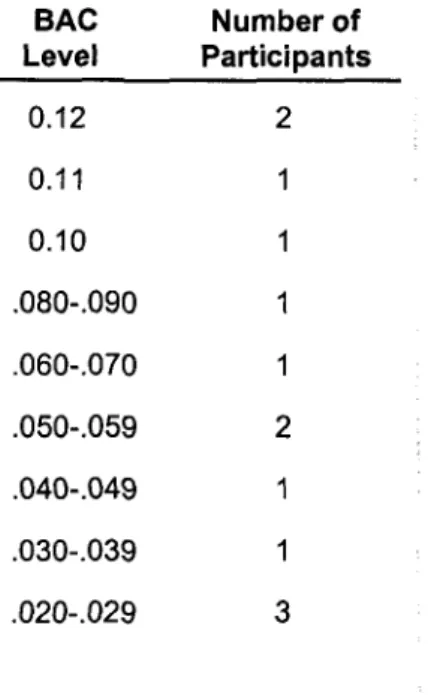
Before each individual interview, the interviewer asked the client to blow into a PBT (portable breath tester). Clients were assured the BAC readings would be kept confidential and used only for the research project. All of our clients for this study were already participating in treatment or educational programs; because of this, the consumption of alcoholic beverages was prohibited. Nonetheless, thirteen people registered BAC levels between .02 and .12 when tested.
Table 3: Positive BACs of Clients At Time of Project Participation By Frequency
BAC Number of Level Participants 0.12 2 0.11 1 0.10 1 .080-.090 1 .060-.070 1 .050-.059 2 .040-.049 1 .030-.039 1 .020-.029 3
Interviewers were instructed to speak clearly and take whatever time was necessary to administer the oral adult interview, but they were instructed not to elaborate on the questions. At the end of each interview, the client was personally thanked by the interviewer for participating in the study and the client was then asked to return to the group and continue to complete the five written surveys. The interviewer spent a few minutes alone checking the form, writing observations, and then returned the completed form to the monitor and asked another client to accompany him/her for an interview. It was the responsibility of the monitor to check and make certain the interviewer had recorded the client number on the adult
Data Collection Methods
form. Study participants handed completed packets to the monitor before leaving. The monitor placed the Comprehensive Adult questionnaires inside the correspond ing packets at the end of each group session and forwarded completed packets to Mid-America.
Slight variations of the procedures discussed above are addressed later under SPECIFIC DATA COLLECTION PROCEDURES sections found under both the Pittsburgh Area and Boston Area sections of this chapter.
Collateral Interviews
Study participants were asked to complete a background and collateral information sheet located on the front of their individual packet. This form contained two questions regarding collateral information:
Is there a family member or significant other familiar with your use of alcohol? Y N
Would you be willing to have them interviewed for research purposes? Y N
If study participants left this section blank, or if they answered yes to the first question, but no to the second question, the interviewers were instructed to discuss the collateral interview after the oral interview had been completed. The interviewer explained a "collateral" was someone who knows the client, i.e. best friend, employer, co-worker, spouse, girl/boyfriend, or parent. As a final part of the research study, a Mid-America staff member would contact this person and ask them approximately 20 questions about the collateral's perceptions of the client's use of alcohol or drugs. It was explained that the entire interview would take no more than five minutes and the information would be held in strictest confidence.
Several of the programs supported our efforts to conduct collateral interviews while others did not, based on privacy issues. Without any compulsory means, project staff were generally unable to persuade clients to provide collateral information. All 609 clients were asked and 106 consented to provide us with the name and telephone number of a collateral. However, Mid-America staff members confronted many problems when attempting to conduct the telephone interviews. When contacted, many of the collaterals said either the person did not drink, or they did not feel comfortable discussing the issue, or they did not know the client or his/her habits well enough to answer questions. Three people refused to be interviewed; one said the client had changed his mind about allowing the collateral interview. In addition, some of the telephone numbers provided were wrong and several of the collaterals had moved and the phone numbers were not in service. As names of clients had been separated from their data collection forms in compliance with privacy guarantees, we had no way of contacting them to verify information they had provided or request additional collaterals. In the end, only 16 collateral interviews were completed.