Hardness, Calcium
DOC316.53.01175
Titration Method with EDTA
Method 8204
10–4000 mg/L as CaCO
3Digital Titrator
Scope and application:
For water, wastewater and seawater.
Test preparation
Before starting
Magnesium is not included in the results but must be in the sample for a sharp endpoint. If the sample does not contain magnesium, add 1 to 2 drops of Magnesium Standard Solution, 10-g/L as CaCO3, to the sample before the test is started. As an alternative to the CalVer 2 Calcium Indicator Power Pillow (85299), use two CalVer 2 Calcium Indicator Power Pillows (94799) or 0.1 g scoop of CalVer 2 Calcium Indicator Powder.
The optional TitraStir Titration Stand can hold the Digital Titrator and stir the sample.
Review the Safety Data Sheets (MSDS/SDS) for the chemicals that are used. Use the recommended personal protective equipment.
Dispose of reacted solutions according to local, state and federal regulations. Refer to the Safety Data Sheets for disposal information for unused reagents. Refer to the environmental, health and safety staff for your facility and/or local regulatory agencies for further disposal information.
Items to collect
Description Quantity
CalVer 2 Calcium Indicator Powder Pillow 1 pillow
Potassium Hydroxide Standard Solution, 8 N 1 or 2 mL
EDTA Titration Cartridge (refer to Sample volumes and digit multipliers on page 3) 1
Digital Titrator 1
Delivery tube for Digital Titrator 1
Graduated cylinder (use a size that is applicable to the selected sample volume) 1
Erlenmeyer flask, 250 mL 1
Water, deionized varies
Refer to Consumables and replacement items on page 5 for order information.
Sample collection
•
Collect samples in clean glass or plastic bottles that have been cleaned with a
detergent and rinsed with 1:1 nitric acid and deionized water.
•
To preserve samples for later analysis, adjust the sample pH to 2 or less with
concentrated nitric acid (about 2 mL per liter). No acid addition is necessary if the
sample is tested immediately.
•
Keep the preserved samples at room temperature for a maximum of 6 months.
•
Before analysis, adjust the pH to 7 with Potassium Hydroxide Standard Solution.
•
Correct the test result for the dilution caused by the volume additions.
Test procedure
1. Select a sample volume and titration cartridge from Table 1 on page 3.
2. Insert a clean delivery tube into the digital titration cartridge. Attach the cartridge to the Digital Titrator.
3. Hold the Digital Titrator with the cartridge tip up. Turn the delivery knob to eject air and a few drops of titrant. Reset the counter to zero and clean the tip.
4. Use a graduated cylinder or a pipet1 to measure the sample volume from Table 1 on page 3.
5. Pour the sample into a clean, 250-mL Erlenmeyer flask.
6. If the sample volume is 100 mL, add 2 mL of 8 N Potassium Hydroxide Standard Solution. If the sample volume is 50 mL or less, add 1 mL of 8 N Potassium Hydroxide Standard Solution.
7. Swirl to mix. 8. If the sample volume is less than 100 mL, dilute to approximately 100 mL with deionized water.
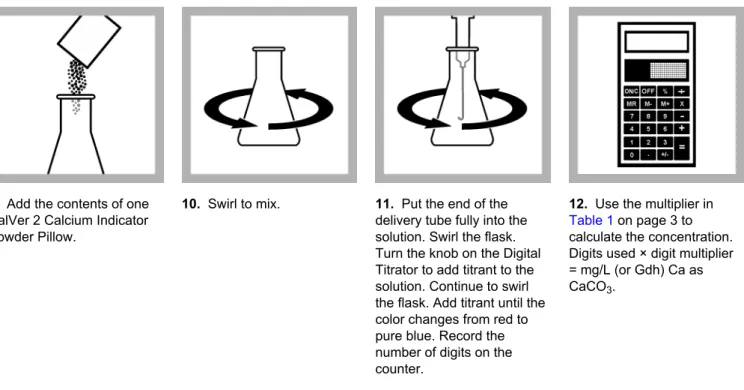
9. Add the contents of one CalVer 2 Calcium Indicator Powder Pillow.
10. Swirl to mix. 11. Put the end of the delivery tube fully into the solution. Swirl the flask. Turn the knob on the Digital Titrator to add titrant to the solution. Continue to swirl the flask. Add titrant until the color changes from red to pure blue. Record the number of digits on the counter.
12. Use the multiplier in Table 1 on page 3 to calculate the concentration. Digits used × digit multiplier = mg/L (or Gdh) Ca as CaCO3.
Sample volumes and digit multipliers
Select a range in
Table 1
or
Table 2
as applicable, then read across the table row to find
the applicable information for this test. Use the digit multiplier to calculate the
concentration in the test procedure.
Example:
A 50-mL sample was titrated with 0.800 M EDTA titration cartridge and the
counter showed 250 digits at the endpoint. The concentration is 250 digits × 2.0 =
500 mg/L as CaCO
3(or with the 0.714 M EDTA titration cartridge, 250 x 0.1 = 25 mg/L
Gdh).
Table 1 Sample volumes and digit multipliers—mg/L
Range (mg/L as CaCO3) Sample volume (mL) Titration cartridge Digit multiplier
10–40 100 0.0800 M EDTA 0.1
40–160 25 0.0800 M EDTA 0.4
100–400 100 0.800 M EDTA 1.0
200–800 50 0.800 M EDTA 2.0
500–2000 20 0.800 M EDTA 5.0
1000–4000 10 0.800 M EDTA 10.0
Table 2 Sample volumes and digit multipliers—Gdh
Range (Gdh as CaCO3) Sample volume (mL) Titration cartridge Digit multiplier
1–4 100 0.1428 M EDTA 0.01
4–16 25 0.1428 M EDTA 0.04
10–40 50 0.714 M EDTA 0.1
25–100 20 0.714 M EDTA 0.25
Conversion units
To change the units or chemical form of the test result, multiply the test result by the
factor in
Table 3
.
Table 3 Conversions
mg/L Ca as CaCO3 to... multiply by... Example
mg/L as Ca 0.40 1000 mg/L as CaCO3 x 0.40 = 400 mg/L Ca
German degrees hardness (Gdh) 0.056 1000 mg/L as CaCO3 × 0.056 = 56 Gdh
Grains per gallon (gpg) 0.058 1000 mg/L as CaCO3 x 0.058 = 58 gpg
Interferences
W A R N I N G
Chemical hazard. Potassium cyanide is toxic. Make sure to add potassium cyanide to the sample after the Potassium Hydroxide has been added. Keep cyanide solutions at more than pH 11 to prevent exposure to hydrogen cyanide gas. Dispose of reacted solutions according to local, state and federal regulations.
An interfering substance can prevent the color change at the titration endpoint. A smaller
sample volume can often dilute the interfering substance to a level at which the
substance does not interfere.
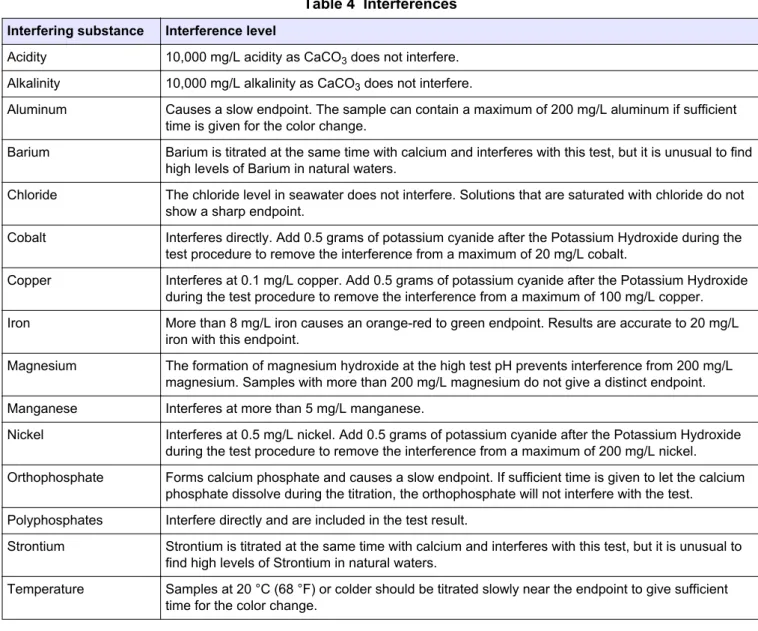
Table 4
shows the substances that can interfere with this
test.
Table 4 Interferences
Interfering substance Interference level
Acidity 10,000 mg/L acidity as CaCO3 does not interfere. Alkalinity 10,000 mg/L alkalinity as CaCO3 does not interfere.
Aluminum Causes a slow endpoint. The sample can contain a maximum of 200 mg/L aluminum if sufficient time is given for the color change.
Barium Barium is titrated at the same time with calcium and interferes with this test, but it is unusual to find high levels of Barium in natural waters.
Chloride The chloride level in seawater does not interfere. Solutions that are saturated with chloride do not show a sharp endpoint.
Cobalt Interferes directly. Add 0.5 grams of potassium cyanide after the Potassium Hydroxide during the test procedure to remove the interference from a maximum of 20 mg/L cobalt.
Copper Interferes at 0.1 mg/L copper. Add 0.5 grams of potassium cyanide after the Potassium Hydroxide during the test procedure to remove the interference from a maximum of 100 mg/L copper. Iron More than 8 mg/L iron causes an orange-red to green endpoint. Results are accurate to 20 mg/L
iron with this endpoint.
Magnesium The formation of magnesium hydroxide at the high test pH prevents interference from 200 mg/L magnesium. Samples with more than 200 mg/L magnesium do not give a distinct endpoint.
Manganese Interferes at more than 5 mg/L manganese.
Nickel Interferes at 0.5 mg/L nickel. Add 0.5 grams of potassium cyanide after the Potassium Hydroxide during the test procedure to remove the interference from a maximum of 200 mg/L nickel. Orthophosphate Forms calcium phosphate and causes a slow endpoint. If sufficient time is given to let the calcium
phosphate dissolve during the titration, the orthophosphate will not interfere with the test. Polyphosphates Interfere directly and are included in the test result.
Strontium Strontium is titrated at the same time with calcium and interferes with this test, but it is unusual to find high levels of Strontium in natural waters.
Temperature Samples at 20 °C (68 °F) or colder should be titrated slowly near the endpoint to give sufficient time for the color change.
Table 4 Interferences (continued)
Interfering substance Interference level
Zinc Interferes at 5 mg/L zinc. Add 0.5 grams of potassium cyanide after the Potassium Hydroxide during the test procedure to remove the interference from a maximum of 100 mg/L zinc. Highly buffered samples
or extreme sample pH
Can prevent the correct pH adjustment (of the sample) by the reagents. Sample pretreatment may be necessary.
Accuracy check
Standard additions method (sample spike)
Use the standard additions method to validate the test procedure, reagents, apparatus,
technique and to find if there is an interference in the sample.
Items to collect:
•
Hardness Voluette Ampule Standard Solution, 10,000 mg/L as CaCO
3•
Ampule Breaker
•
Pipet, TenSette, 0.1–1.0 mL and pipet tips
1.
Use the test procedure to measure the concentration of the sample.
2.
Use a TenSette pipet to add 0.1 mL of the standard solution to the titrated sample.
3.
Titrate the spiked sample to the endpoint. Record the number of digits on the counter.
4.
Add one more 0.1-mL addition of the standard solution to the titrated sample.
5.
Titrate the spiked sample to the endpoint. Record the number of digits on the counter.
6.
Add one more 0.1-mL addition of the standard solution to the titrated sample.
7.
Titrate the spiked sample to the endpoint. Record the number of digits on the counter.
8.
Compare the actual result to the correct result. The correct result for this titration is 10
digits of 0.800 M titration cartridge or 100 digits of 0.0800 titration cartridge (11 digits
of 0.714 M or 56 digits of 0.1428 M titrant) for each 0.1-mL addition of the standard
solution. If much more or less titrant was used, there can be a problem with user
technique, reagents, apparatus or an interference.
Summary of method
Potassium hydroxide is added to the sample to adjust the pH to 12 to 13, which causes a
magnesium hydroxide precipitate to form. CalVer 2 Calcium Indicator is then added,
which reacts with calcium to give a red color. The EDTA titrant is added, which reacts
with all the free calcium. After the EDTA has reacted with all of the free calcium ions, the
EDTA removes the calcium from the indicator. The indicator color then changes from red
to blue.
Consumables and replacement items
Required reagents
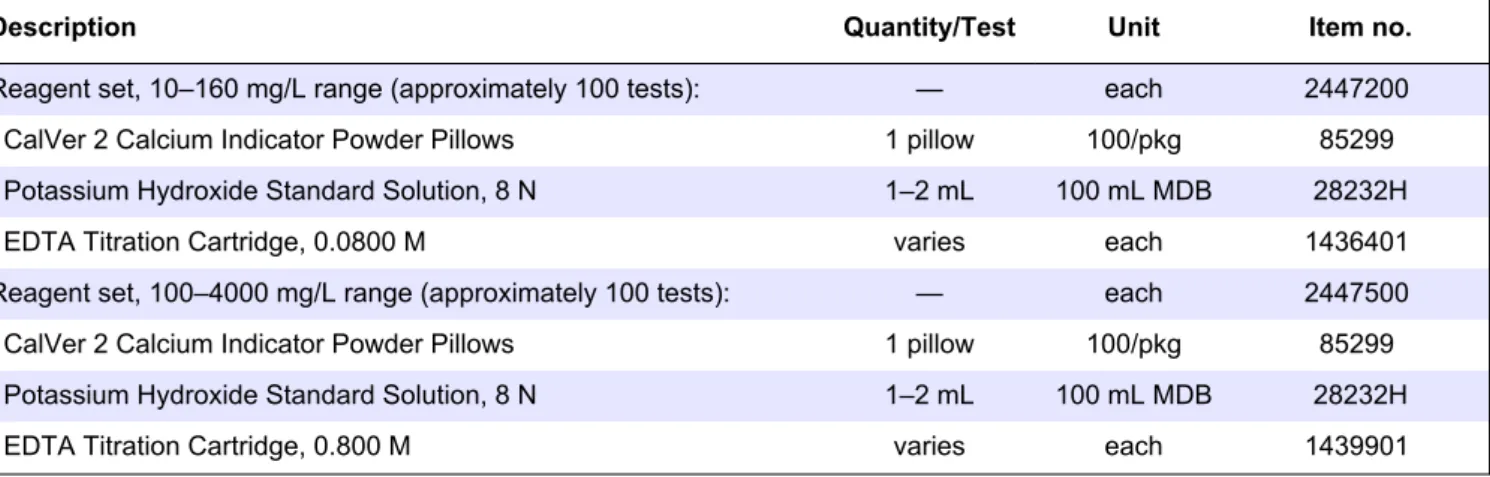
Description Quantity/Test Unit Item no.
Reagent set, 10–160 mg/L range (approximately 100 tests): — each 2447200
CalVer 2 Calcium Indicator Powder Pillows 1 pillow 100/pkg 85299
Potassium Hydroxide Standard Solution, 8 N 1–2 mL 100 mL MDB 28232H
EDTA Titration Cartridge, 0.0800 M varies each 1436401
Reagent set, 100–4000 mg/L range (approximately 100 tests): — each 2447500
CalVer 2 Calcium Indicator Powder Pillows 1 pillow 100/pkg 85299
Potassium Hydroxide Standard Solution, 8 N 1–2 mL 100 mL MDB 28232H
Consumables and replacement items (continued)
Description Quantity/Test Unit Item no.
Reagent set, 1–16 G.d.h. range (approximately 100 tests): — each 2447300
CalVer 2 Calcium Indicator Powder Pillows 1 pillow 100/pkg 85299
Potassium Hydroxide Standard Solution, 8 N 1–2 mL 100 mL MDB 28232H
EDTA Titration Cartridge, 0.1428 M varies each 1496001
Reagent set, 10–100 G.d.h. range (approximately 100 tests): — each 2447400
CalVer 2 Calcium Indicator Powder Pillows 1 pillow 100/pkg 85299
Potassium Hydroxide Standard Solution, 8 N 1–2 mL 100 mL MDB 28232H
EDTA Titration Cartridge, 0.714 M varies each 1495901
Required apparatus
Description Quantity/test Unit Item no.
Graduated cylinders—Select one or more for the sample volume:
Cylinder, graduated, 5 mL 1 each 50837
Cylinder, graduated, 10 mL 1 each 50838
Cylinder, graduated, 25 mL 1 each 50840
Cylinder, graduated, 50 mL 1 each 50841
Cylinder, graduated, 100 mL 1 each 50842
Digital Titrator 1 each 1690001
Delivery tube for Digital Titrator, J-hook tip 1 5/pkg 1720500
Flask, Erlenmeyer, 250 mL 1 each 50546
Pipet, TenSette®, 0.1–1.0 mL 1 each 1970001
Pipet tips, for TenSette® Pipet, 0.1–1.0 mL 1 50/pkg 2185696
Recommended standards
Description Unit Item no.
Calcium Hardness Standard Solution, 10,000-mg/L as CaCO3, 10-mL Voluette ampule 16/pkg 218710
Hardness Quality Control Standard, high range 500 mL 2833349
Hardness Quality Control Standard, low range 500 mL 2833449
Optional reagents and apparatus
Description Unit Item no.
Ampule Breaker, 10-mL Voluette® Ampules each 2196800
CalVer® 2 Calcium Indicator Powder 113 g 28114H
CDTA Magnesium Salt Powder Pillow 100/pkg 1408099
Delivery tube for Digital Titrator, 90-degree bend for use with TitraStir Titration Stand 5/pkg 4157800
Magnesium Standard Solution, 10 g/L as CaCO3 29 mL 102233
Nitric Acid, concentrated 500 mL 15249
Nitric Acid Solution, 1:1 500 mL 254049
Optional reagents and apparatus (continued)
Description Unit Item no.
Pipet, volumetric, Class A, 10 mL each 1451538
Pipet, volumetric Class A, 20 mL each 1451520
Pipet, volumetric, Class A, 25 mL each 1451540
Potassium Cyanide, ACS 100 g 76714
Potassium Hydroxide, 8 N 500 mL 28249
Sampling bottle with cap, low density polyethylene, 500 mL 12/pkg 2087079
Sampling bottle, with cap, low density polyethylene, 250 mL 12/pkg 2087076
Spoon, measuring, 0.1 g each 51100
Stir bar, octagonal each 2095352
TitraStir® Titration Stand, 115 VAC each 1940000
HACHCOMPANY WORLD HEADQUARTERS Telephone: (970) 669-3050 FOR TECHNICAL ASSISTANCE, PRICE INFORMATION AND ORDERING:
Call 800-227-4224 In the U.S.A. – toll-free