Complementary test in EG2050 System Planning,
9 April 2015, 14:00-18:00, the seminar room
Instructions
Only the problems indicated on the attached answer sheet have to be answered (the score of the remaining problems is kept from the exam). Motivations and calculations do not have to be pre-sented.
The maximal score of the complementary test is 40 points including the points that are kept from the exam. You are guaranteed to pass if you get at least 33 points.
Allowed aids
In this complementary test you are allowed to use the following aids: • Calculator without information relevant to the course.
• One handwritten, single-sided A4-page with your own notes (original, not a copy), which should be handed in together with the answer sheet.
3
Problem 1 (4 p)
Answer the following theoretical questions by choosing one alternative, which you find correct.
a) (2 p) Which players have the responsibility to maintain the frequency of the power system
within nominal values (for example 49.9–50.1Hz in the Nordel system)? 1. All producers have a shared responsibility for the frequency.
2. The largest power companies have a shared responsibility for the frequency. 3. All consumers have a shared responsibility for the frequency.
4. The balance responsible players have a shared responsibility for the frequency. 5. The system operator is responsible for the frequency.
b) (2 p) The following applies to a power exchange using a price cross: I) Players who are selling
to the exchange state the lowest price for which they are willing to sell, II) Players who are buying from the exchange state the highest price they are willing to pay, III) All players whose bids are ac-cepted will trade at the price submitted in the bid.
1. Only I is true. 3. Only II is true. 3. Only III is true.
4. I and II are true but not III. 5. All the statements are true.
Problem 2 (6 p)
a) (3 p) The figure below shows the electricity price in a certain electricity market during one
day. Assume that there is perfect competition in this electricity market and that all players have ac-cess to perfect information. How much will be generated during this day in a power plant with the variable operation cost 350¤/MWh and the installed capacity 200MW?
b) (3 p) The figures below shows the supply and demand curves of a certain electricity market.
What will the electricity price become in this electricity market if we assume perfect competition, perfect information and that there are neither transmission, reservoir nor capacity limitations?
h
time
10 8 6 4 2
¤/MWh price
500
400 300
100 200
20 18 16 14 12
0 22 24
50 40 30 20 10 50
40
30
10 20
50 40 30 20 10 50
40
30
10 20
Hydro
Nu-Fossil fuels
TWh/year
supply
¤/MWh price
TWh/year
demand
¤/MWh price
5
Problem 3 (6 p)
Consider a power system where the primary control is divided in a normal operation reserve and a disturbance reserve. The normal operation reserve has the gain 5 000MW/Hz and is mainly
de-signed to manage normal variations in for example load and wind power generation. The distur-bance reserve has the gain 2 250MW/Hz and is mainly designed to manage outages in larger
power plants. The normal operation reserve is available in the frequency range 49.9–50.1Hz and the disturbance reserve is available in the frequency range 49.5–49.9Hz.
a) (2 p) At 14:05 there is balance between production and consumption in the system and the
frequency is 50.02Hz. At this time a lightning strike in a substation causes 250MW of generation to be lost. The concerned power plants were not part of the primary control. What will the fre-quency be once the primary control has stabilised the frefre-quency in the system again?
b) (2 p) At 14:10 there is balance between production and consumption in the system and the
frequency is 49.98Hz. At this time the generation in an off-shore wind farm increased by 50MW.
The wind farm is not participating in the primary control. What will the frequency be once the pri-mary control has stabilised the frequency in the system again?
c) (2 p) At 14:15 there is balance between production and consumption in the system and the
frequency is 49.96Hz. At this time a lightning strike in a substation causes 750MW of generation
to be lost. The concerned power plants were not part of the primary control. What will the fre-quency be once the primary control has stabilised the frefre-quency in the system again?
Problem 4 (12 p)
AB Vattenkraft owns three hydro power plants located as in the figure above. The company sells power to customers with firm power contracts, but they also expect to be able to purchase or sell a certain volume per hour in the power exchange ElKräng. Assume that the company has f0rmulated its short-termplanning problem as an LP problem and that the following symbols have been introduced:
Indices for the power plants: Forsen 1, Fallet 2, Strömmen 3.
i =expected future production equivalent for water stored in reservoir i, i = 1, 2, 3,
Dt =contracted load hour t, t = 1, …, 24,
t =expected electricity price at ElKräng hour t, t = 1, …, 24,
25=expected electricity price at ElKräng after the end of the planning period, =maximal contents of reservoir i, i = 1, 2, 3,
Mi, t =contents of reservoir i at the end of hour t, i = 1, 2, 3, t = 1, …, 24,
i, j =marginal production equivalent in power plant i, segment j, i = 1, 2, 3, j = 1, 2,
pt =purchase from ElKräng hour t, t = 1, …, 24,
=maximal purchase from ElKräng hour t, t = 1, …, 24,
Qi, j, t =discharge in power plant i, segment j, during hour t, i = 1, 2, 3, j = 1, 2, t = 1, …, 24,
=maximal discharge in power plant i, segment j, i = 1, 2, 3, j = 1, 2,
rt =sales to ElKräng hour t, t = 1, …, 24,
=maximal sales to ElKräng hour t, t = 1, …, 24,
Si, t =spillage from reservoir i during hour t, i = 1, 2, 3, t = 1, …, 24, =maximal spillage from reservoir i, i = 1, 2, 3.
a) (4 p) Formulate the objective function if the aim of the planning problem is to maximise the
income of sold electricity at ElKräng plus the value of stored water minus the costs of purchasing
Forsen
Strömmen Fallet
Mi
pt
Qi j
rt
7
b) (4 p) Formulate the load balance constraint for hour t in the short-term planning problem of
the company. Use the symbols defined above.
c) (4 p) Formulate the limits for the optimisation variables defined above for the planning
Problem 5 (12 p)
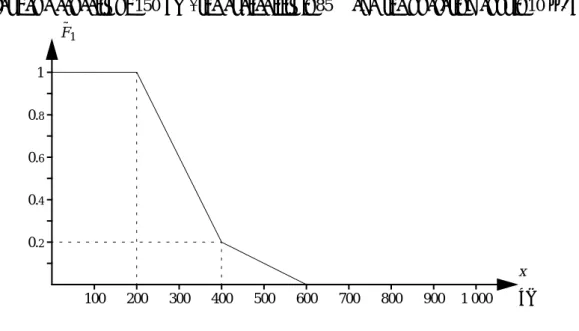
Ebbuga is a town in East Africa. The town is not connected to a national grid, but has a local sys-tem of its own. The local grid is supplied by a hydro power plant and a diesel generator set. The hydro power plant does not have a reservoir, but the water flow is always sufficient to generate the installed capacity (450kW) and the risk for outages in the power plant is negligible. The diesel
gen-erator set has a capacity of 150kW, the availability is 85% and the operation cost is 10¤/kWh.
a) (1 p) What is the expectation value of the load?
Hint: Study EENS0!
b) (3 p) The expected energy not served when considering both the hydro power plant and the
diesel generator is 9.5625kWh/h. Calculate the expected total operation cost per hour for the sys-tem.
c) (2 p) Use probabilistic production cost simulation to compute the risk of power deficit in
Eb-buga.
d) (3 p) To consider the losses in the grid, a Monte Carlo simulation has been performed of the
power system in Ebbuga. The simulation is using control variates. The simplified model corre-sponds to the model used in probabilistic production cost simulation, whereas the detailed model considers such factors as how the losses depends on which power plants that are operated, and how the load is distributed within the system. The results are shown in table 1. Which estimate of ETOC is obtained for the detailed model when using the control variate method?
Table 1 Results from a Monte Carlo simulation of the power system in Ebbuga.
Number of scenarios,
n
Results from the detailed model,
Results from the simplified model,
1 000 85 139 17 028
kW
x
1 000
F˜1
1
0.8
900 800 700 600 500 400 300 200 100
0.6
0.2
0.4
toci
i=1
n
toc˜ i
i=1
n
9
f) (1 p) The expectation value E[X] is to be determined using stratified sampling. Assume that L
strata have been defined. Let xh, i denote the i:th observation of X from stratum h and let h denote the stratum weight of stratum h. The total number of observations is n, and we use the symbol nh to denote the number of observations from h. How is the estimate mX calculated?
1. mX =
2. mX =
3. mX =
1
n
---
hxh i . i=1
nh
h=1 L
1
n
--- h xh i .
i=1 nh
h=1 L
h
nh
--- xh i .
i=1 nh
h=1 L
Answer sheet
Name: ... Personal number: ...
Problem 1
a)Alternative ... is correct.
b)Alternative ... is correct.
Problem 2
a) ... MWh b) ... ¤/MWh
Problem 3
a) ... Hz b) ... Hz
c) ... Hz
Problem 4
a) ...
...
b) ... c) ...
... ... ... ...
Problem 5
Sug gested solutio n fo r co mp lem en ta ry te st i EG 205 0 S ystem P lann
ing, 9 Ap
ril 2015 . Proble m 1 a) 5, b) 4. Proble m 2 a) T he po w er plant will ge nerate
its installed ca
paci
ty
during those hours wh
en the elect
ri city price is higher tha n 35 0 ¤/MW h. D ra w
ing a line a
t the lev
el 35 0 ¤/ M W h s ho w s th at the po w er pl an t w ill g ener ate 20 0 MW during 17 hours , w hic h
results in a
total g eneration of 34 0 0 MW h. b) T he e lectric ity p rice is deter m in ed b y the int ersectio n of the supp ly a nd dema nd cur ves . T he inte rse ctio n ca n be fo und g ra ph ica lly b y dra w in g bo th cu rv
es in th
e sa m e figure . A n a lter na tiv e m eth od o f s ol uti on is to a ssume a n elec tricity pric e, , bet w ee n 30 an d 45 ¤/ M W h. T he sup ply a t thes
e price lev
els can be
w ritt en as 30 (h yd
ro & n
uclea r) + ( – 2 5 ) (f
ossil fuels) an
d the deman
d
ca
n be w
ri tten 40 – ( – 3 0 )/ 4 . T hes e tw o exp res si on s sh ould be e qual, whic h results in th e el ec tr ic -ity price = 34 ¤/ M W h. Proble m 3 a) T he dec rea se in elec tricity g ene ratio
n results in a
fre quen cy decre ase f = G / R = 25 0/5 0 0 0 = 0. 05 Hz, i.e ., th e n ew fre quen cy is 50 . 02 – 0. 05 = 49 . 97 Hz. b) T he in crea se in ele ctricit y g ene rati on
results in a
f re qu enc y in cre as e f = G / R = 5 0 /5 00 0 = 0. 01 Hz, i.e ., th e n ew fre quen cy is 49 . 98 + 0. 01 = 4 9 . 99 Hz. c) T he n or m al o pe rati on re se rv e ca n in crea se the g en era tion b y 0. 06 · 5 0 00 = 30 0 MW if th e fre-quency is 49 . 96 Hz. T he fre quen cy is th en 49 . 9 Hz. T he r em aining 45 0 MW g en eration increase m ust b e m an ag ed b
y the disturba
nce reser
ve
, whic
h results in a frequency d
ecrease f = G / R = 45 0/2 2 5 0 = 0. 2 Hz Hz, i.e ., th e n ew fre quen cy is 49 . 9 – 0. 2 = 4 9 . 7 Hz. h ti m e 10 8 6 4 2 ¤/ MWh pr ic e 50 0 40 0 30 0 10 0 20 0 20 18 16 14 12 0 24 22 Proble m 4 a) ma x imis e + 25 (( 1 + 3 ) M1, 24 + ( 2 + 3 ) M2, 2 4 + 3 M3, 2 4 ) .
b) c) T
he op timi sa tio n v ariab les in vo lv ed in the p ro bl em a re tr ad in g at ElKrä ng, reser vo ir co nt en ts , di sc har ge a nd spilla ge , w hic h yield s the follo wing limits: 0 pt t = 1 , …, 24 , 0 rt t = 1 , …, 24 , 0 Mi, t i = 1, 2, 3 , t = 1
, …, 24
, 0 Qi, j, t i = 1, 2, 3 , j = 1 , 2 , t = 1 , …, 24 , 0 Si, t , i = 1, 2, 3 , t = 1
, …, 24
. Proble m 5 a) E [ D ] = EE NS 0 = = 20 0·
1 + 20
0·
(1
+ 0.
2
)/
2 + 2
00·
0
.
2
/2 = 34
0 kW h/ h. b) T he exp ecte d g ene ra tio
n in th
e diese l g ene rato r set s is EG 2 = EE NS 1 – EE NS 2 = – EE NS 2 = { si n ce the h
ydro power pla
n t i s 10 0 % we ge t = } = 0 . 15 ·1 5 0 /2 – 9. 562 5 = 1. 68 75 kW h/ h. Henc e, th e exp ecte d o pera tio n co st is ET O C = 10 EG 2 = 16 . 87 5 ¤/ h. c) T
he risk of
po w er def icit is gi ve n b y LOLP = = 0 + 0 . 15 · 0 . 15 = 2. 25 %. d) mTO C = = + 16 . 8 75 = = + 16. 87 5 = 84 . 986 ¤/ h. e) T he in ve rse tra nsf or m m eth od sta tes tha t D = wh ere U is a U (0, 1 ) -distributed ran-do m n umb er . S in ce it is the du ra tio n cur ve t ha
t is gi
ve n in th e p ro bl em , w e ma y a s w ell use th e transfor m D = T he o ri gin al ra nd om n um ber m ust th en ha ve bee n U = = 0 . 34 8 . Henc e, U
* = 1
– U = 0. 652 , whic h result s in D * = = 28 7 kW . f) 3. t rt pt – t 1 = 24
ij
Qij t j 1 = 2 pt + i 1 = 3 Dt rt . + = pi , ri , Mi
, Qij
F ˜ 0 x x d 0 F ˜ 1 x x d 45 0 F ˜ 1 x F ˜ 0 x F ˜ 2 600 0. 85 F ˜ 1 600 0. 15 F ˜ 1 45 0 + = mTOC T O C ˜ – TO C ˜ +
1--- n
to ci to ci ˜ i 1 = n – i 1 = n 1 1 00 0 ---85 13 9 1 7 02 8 – FD 1 – U , F ˜ D 1 – U . F ˜ D 363 F ˜ D 1 – U *