Enabling SOA Using
WebSphere Messaging
Carla Sadtler
Philipp Huber
SangMin Yi
Service-oriented architecture and
messaging
ESB implementation with
WebSphere Message Broker
ESB implementation with
WebSphere ESB
Enabling SOA Using WebSphere Messaging
March 2006
First Edition (March 2006)
This edition applies to WebSphere Message Broker Version Version 6.0, WebSphere Application
Note: Before using this information and the product it supports, read the information in
Contents
Notices . . . vii
Trademarks . . . viii
Preface . . . ix
The team that wrote this redbook. . . ix
Become a published author . . . x
Comments welcome . . . x
Chapter 1. Introduction . . . 1
1.1 SOA overview . . . 2
1.1.1 The driver for SOA . . . 2
1.1.2 Architectural approach . . . 2
1.1.3 Design principles . . . 3
1.2 SOA and messaging . . . 8
1.3 Using an enterprise service bus . . . 10
1.4 The IBM SOA Foundation . . . 13
1.4.1 SOA life cycle . . . 14
1.4.2 SOA Reference Architecture . . . 14
1.5 For more information . . . 17
Chapter 2. Product selection . . . 19
2.1 IBM SOA Foundation products for messaging . . . 20
2.2 WebSphere Application Server . . . 22
2.3 WebSphere MQ. . . 28
2.4 WebSphere ESB . . . 31
2.4.1 Mediation functions in WebSphere ESB versus WebSphere Application Server . . . 33
2.5 WebSphere Message Broker . . . 34
2.6 ESB product comparison. . . 37
2.7 WebSphere Process Server . . . 40
Chapter 3. Runtime topology selection. . . 45
3.1 Getting started . . . 46
3.1.1 Starting with simple messaging connections . . . 46
3.1.2 Adding an ESB for enhanced connectivity . . . 47
3.1.3 Adding a business process engine for service orchestration . . . 49
3.2 Advanced topologies . . . 50
3.2.1 WebSphere MQ . . . 51
3.2.3 WebSphere ESB and WebSphere Process Server . . . 55
3.2.4 Application server and queue manager cluster . . . 59
3.3 End-to-end scenario . . . 60
Chapter 4. Application design . . . 63
4.1 Introduction to messaging . . . 64
4.2 Messaging models . . . 65
4.2.1 Point-to-point . . . 65
4.2.2 Publish-subscribe . . . 66
4.2.3 Point-to-point versus publish-subscribe . . . 67
4.3 Messaging styles . . . 68 4.3.1 Asynchronous communication . . . 68 4.3.2 Pseudo-synchronous communication . . . 69 4.4 Messaging patterns . . . 70 4.4.1 Fire-and-forget . . . 70 4.4.2 Request-reply . . . 71
4.4.3 Selecting a messaging pattern . . . 76
4.5 Messaging application design . . . 77
4.5.1 Application design in general . . . 77
4.5.2 Message consumers . . . 80
4.5.3 Message producers. . . 85
4.5.4 Message producer and consumer in combination . . . 87
4.6 Designing a messaging-based SOA . . . 89
4.6.1 SOA approach. . . 89
4.6.2 Service identification . . . 90
4.6.3 Service specification . . . 92
4.6.4 Service realization . . . 93
4.6.5 Design considerations . . . 94
4.7 For more information . . . 108
Chapter 5. Point-to-point runtime configuration . . . 109
5.1 WebSphere MQ configuration . . . 110
5.1.1 Create the queue managers . . . 111
5.1.2 Create a remote queue definition . . . 112
5.1.3 Create a transmission queue . . . 113
5.1.4 Create a sender channel . . . 114
5.1.5 Create a local queue . . . 115
5.1.6 Create a receiver channel . . . 116
5.1.7 Start the sender channel . . . 116
5.1.8 Test the connection . . . 117
5.2 Connect WebSphere ESB to WebSphere MQ . . . 118
5.2.3 Start the connection . . . 132
5.2.4 Test the connection . . . 134
5.3 Configuring a queue sharing group . . . 138
5.3.1 Set up the DB2 environment to support MQ shared queue . . . 138
5.3.2 Set up the CFRM policy with the MQ structures . . . 163
5.3.3 Add the MQ data sharing group entry to the DB2 table . . . 163
5.3.4 Update the ZPARM . . . 166
5.3.5 Update the queue manager procedures . . . 169
5.3.6 Define the shared queues between the two MQ subsystems . . . 171
5.3.7 Starting WebSphere MQ . . . 173
5.3.8 For more information . . . 179
Chapter 6. Integration scenarios with WebSphere ESB . . . 181
6.1 Using WebSphere ESB . . . 182
6.1.1 Developing mediations . . . 186
6.1.2 Deploying mediations . . . 187
6.2 Integration scenario . . . 187
6.3 XML-to-XML mapping using a mediation flow . . . 188
6.3.1 Mediation overview . . . 188
6.4 XML-to-XML transformation using XSLT mapping . . . 189
6.4.1 Create the mediation module . . . 190
6.4.2 Create the business objects . . . 190
6.4.3 Build the interfaces . . . 197
6.4.4 Build the mediation module . . . 199
6.4.5 Bind the export and import nodes to JMS . . . 208
6.4.6 Prepare the runtime . . . 209
Chapter 7. Integration scenarios with WebSphere Message Broker . . . 217
7.1 Using WebSphere Message Broker . . . 218
7.1.1 Message flow development. . . 221
7.1.2 Message flow deployment and broker administration . . . 222
7.1.3 Sample message flow . . . 223
7.2 Integration scenarios . . . 226
7.3 XML-to-XML mapping using a Mapping node . . . 227
7.3.1 Create the message sets containing the XML DTD files. . . 228
7.3.2 Create the message flow . . . 230
7.3.3 Deploy the message flow to the broker . . . 234
7.3.4 Create the WebSphere MQ queues . . . 236
7.3.5 Test the message flow . . . 236
7.3.6 Using JMS nodes . . . 237
7.4 XML-to-XML transformation using XSLT. . . 245
7.4.1 Create the message sets . . . 246
7.4.3 Create the message flow . . . 251
7.4.4 Create the WebSphere MQ queues . . . 253
7.4.5 Deploy and test the message flow . . . 253
7.5 XML-to-COBOL mapping . . . 255
7.5.1 Create the message sets . . . 256
7.5.2 Create the message flow . . . 257
7.5.3 Create the WebSphere MQ queues . . . 261
7.5.4 Test the message flow . . . 261
7.6 Routing messages. . . 262
7.6.1 Create the message flow . . . 263
7.6.2 Define the filters . . . 265
7.6.3 Create the WebSphere MQ queues . . . 266
7.6.4 Deploy and test the message flow . . . 266
Appendix A. Sample files . . . 269
Sample XML files . . . 270 Sample DTD files . . . 271 Related publications . . . 275 IBM Redbooks . . . 275 Other publications . . . 275 Online resources . . . 276
How to get IBM Redbooks . . . 277
Help from IBM . . . 277
Notices
This information was developed for products and services offered in the U.S.A.
IBM may not offer the products, services, or features discussed in this document in other countries. Consult your local IBM representative for information on the products and services currently available in your area. Any reference to an IBM product, program, or service is not intended to state or imply that only that IBM product, program, or service may be used. Any functionally equivalent product, program, or service that does not infringe any IBM intellectual property right may be used instead. However, it is the user's responsibility to evaluate and verify the operation of any non-IBM product, program, or service.
IBM may have patents or pending patent applications covering subject matter described in this document. The furnishing of this document does not give you any license to these patents. You can send license inquiries, in writing, to:
IBM Director of Licensing, IBM Corporation, North Castle Drive Armonk, NY 10504-1785 U.S.A.
The following paragraph does not apply to the United Kingdom or any other country where such provisions are inconsistent with local law: INTERNATIONAL BUSINESS MACHINES CORPORATION PROVIDES THIS PUBLICATION "AS IS" WITHOUT WARRANTY OF ANY KIND, EITHER EXPRESS OR IMPLIED, INCLUDING, BUT NOT LIMITED TO, THE IMPLIED WARRANTIES OF NON-INFRINGEMENT,
MERCHANTABILITY OR FITNESS FOR A PARTICULAR PURPOSE. Some states do not allow disclaimer of express or implied warranties in certain transactions, therefore, this statement may not apply to you. This information could include technical inaccuracies or typographical errors. Changes are periodically made to the information herein; these changes will be incorporated in new editions of the publication. IBM may make improvements and/or changes in the product(s) and/or the program(s) described in this publication at any time without notice.
Any references in this information to non-IBM Web sites are provided for convenience only and do not in any manner serve as an endorsement of those Web sites. The materials at those Web sites are not part of the materials for this IBM product and use of those Web sites is at your own risk.
IBM may use or distribute any of the information you supply in any way it believes appropriate without incurring any obligation to you.
Information concerning non-IBM products was obtained from the suppliers of those products, their published announcements or other publicly available sources. IBM has not tested those products and cannot confirm the accuracy of performance, compatibility or any other claims related to non-IBM products. Questions on the capabilities of non-IBM products should be addressed to the suppliers of those products.
This information contains examples of data and reports used in daily business operations. To illustrate them as completely as possible, the examples include the names of individuals, companies, brands, and products. All of these names are fictitious and any similarity to the names and addresses used by an actual business enterprise is entirely coincidental.
COPYRIGHT LICENSE:
This information contains sample application programs in source language, which illustrates programming techniques on various operating platforms. You may copy, modify, and distribute these sample programs in any form without payment to IBM, for the purposes of developing, using, marketing or distributing application programs conforming to the application programming interface for the operating platform for which the sample programs are written. These examples have not been thoroughly tested under all conditions. IBM, therefore, cannot guarantee or imply reliability, serviceability, or function of these programs. You may copy, modify, and distribute these sample programs in any form without payment to IBM for the purposes of developing, using, marketing, or distributing application programs conforming to IBM's application
Trademarks
The following terms are trademarks of the International Business Machines Corporation in the United States, other countries, or both:
Eserver® Eserver® Redbooks (logo) ™ developerWorks® z/OS® CICS® DB2® Everyplace® HACMP™ IBM® IMS™ Parallel Sysplex® Rational® Redbooks™ RETAIN® SupportPac™ Tivoli® WebSphere® Workplace™
The following terms are trademarks of other companies:
EJB, Java, Java Naming and Directory Interface, JDBC, JSP, J2EE, and all Java-based trademarks are trademarks of Sun Microsystems, Inc. in the United States, other countries, or both.
Visual Basic, Windows, and the Windows logo are trademarks of Microsoft Corporation in the United States, other countries, or both.
Linux is a trademark of Linus Torvalds in the United States, other countries, or both. Other company, product, or service names may be trademarks or service marks of others.
Preface
Successfully implementing an SOA requires applications and infrastructure that can support the SOA principles. Applications can be enabled by creating service interfaces to existing or new functions hosted by the applications. The service interfaces should be accessed using an infrastructure that can route and transport service requests to the correct service provider. As organizations expose more and more functions as services, it is vitally important that this infrastructure should support the management of SOA on an enterprise scale. This IBM® Redbook looks at how the IBM messaging products support an SOA environment. In particular, it will look at WebSphere® Application Server, WebSphere Enterprise Service Bus, WebSphere MQ, and WebSphere Message Broker in an SOA environment. It discusses how they support SOA, compare the potential ESB product implementations, and show examples of building the infrastructure and creating mediations.
The team that wrote this redbook
This redbook was produced by a team of specialists from around the world working at the International Technical Support Organization, Raleigh Center.
Carla Sadtler is a certified IT Specialist at the ITSO, Raleigh Center. She writes
extensively about the WebSphere and Patterns for e-business areas. Before joining the ITSO in 1985, Carla worked in the Raleigh branch office as a Program Support Representative. She holds a degree in mathematics from the University of North Carolina at Greensboro.
Philipp Huber is an Advisory IT Specialist at IBM Switzerland. He has been with
IBM for six years, working primarily on design and development of
J2EE™-based e-business applications. Philipp holds a degree in Technical Computer Science from the University of Applied Science Aargau, Switzerland. His areas of expertise include object-oriented analysis and design, messaging and J2EE application design and development using Rational® Application Developer, WebSphere Application Server, and WebSphere MQ.
SangMin Yi is a an Advisory IT Specialist of WebSphere Business Integration
solutions. He joined IBM seven years ago and works in the IBM Software Group. He is a specialist for IBM Web services technologies and service-oriented architecture and lectures on these topics in a major company in Korea. Before joining IBM, he worked as a producer in a broadcasting system.
Thanks to the following people for their contributions to this project: Rich Conway and Julie Czubik
International Technical Support Organization, Poughkeepsie Center Geert Van de Putte
International Technical Support Organization, Raleigh Center Katie Johnson
Product Manager, WebSphere Enterprise Service Bus, IBM US Adrian Spender
WebSphere ESB Development, IBM UK Joerg Wende
IBM Germany
Become a published author
Join us for a two- to six-week residency program! Help write an IBM Redbook dealing with specific products or solutions, while getting hands-on experience with leading-edge technologies. You'll team with IBM technical professionals, Business Partners and/or clients.
Your efforts will help increase product acceptance and client satisfaction. As a bonus, you'll develop a network of contacts in IBM development labs, and increase your productivity and marketability.
Find out more about the residency program, browse the residency index, and apply online at:
ibm.com/redbooks/residencies.html
Comments welcome
Your comments are important to us!
We want our Redbooks™ to be as helpful as possible. Send us your comments about this or other Redbooks in one of the following ways:
Use the online Contact us review redbook form found at:
ibm.com/redbooks
Mail your comments to:
IBM Corporation, International Technical Support Organization Dept. HZ8 Building 662
P.O. Box 12195
Chapter 1.
Introduction
This chapter provides an introduction to service-oriented architecture (SOA), the enterprise service bus (ESB), and the IBM SOA strategy. The purpose of this chapter is to solidify the concept of SOA as it pertains to messaging.
1.1 SOA overview
SOA defines integration architectures based on the concept of a
service
. Applications collaborate by invoking each others’ services, and services are composed into larger sequences to implement business processes.1.1.1 The driver for SOA
The main driver for SOA is to define an architectural approach that assists in the flexible integration of IT systems. Organizations spend a considerable amount of time and money trying to achieve rapid, flexible integration of IT systems across all elements of the business cycle. The drivers behind this objective include: Increasing the speed at which businesses can implement new products and
processes, can change existing ones, or can recombine them in new ways Reducing implementation and ownership costs of IT systems and the
integration between them
Enabling flexible pricing models by outsourcing more fine-grained elements of the business than were previously possible or by moving from fixed to variable pricing, based on transaction volumes
Simplifying the integration work that is required by mergers and acquisitions Achieving better IT utilization and return on investment
Achieving implementation of business processes at a level that is
independent from the applications and platforms that are used to support the processes
SOA prescribes a set of design principles and an architectural approach to achieve this rapid, flexible integration.
1.1.2 Architectural approach
SOA is an integration architecture approach based on the concept of a service. The business and infrastructure functions that are required to build distributed systems are provided as services that collectively, or individually, deliver application functionality to end-user applications or other services.
SOA specifies that within any given architecture, there should be a consistent mechanism for services to communicate. That mechanism should be loosely coupled and support the use of explicit interfaces.
SOA brings the benefits of loose coupling and encapsulation to integration at an enterprise level. It applies successful concepts proved by Object Oriented
development, Component Based Design, and Enterprise Application Integration technology to an architectural approach for IT system integration.
Services are the building blocks of SOA, providing interfaces to functions out of which distributed systems can be built. Services can be invoked independently by either external or internal service consumers to process simple functions, or can be chained together to form more complex functionality and so to quickly devise new functionality.
What a service is
A service can be defined as any discrete function that can be offered to an external consumer. This can be an individual business function or a collection of functions that together form a process. For example, the process of a car dealer selling a car to a new client involves process steps like:
1. Create client.
2. Correlate car and client.
Each of these steps can be designed as an independent service. A higher-level service could use both and bind the single process steps to one process. A service consists of the following three parts, which together are able to deliver usable service functionality:
Service contract
The service contract provides the formal specification of a service and contains information like purpose, functionality, format of request and reply, pre-conditions and post-conditions, exception handling, quality of service, and so on. A formal interface definition provided by IDL or WSDL can be seen as an optional part of the service contract.
Service interface
The service interface exposes the implementation of the functionality. Although the description of the interface is part of the service contract, the physical implementation is contained in the service producer and consumer. Service implementation
The service implementation provides the business logic that is exposed by the service interface.
1.1.3 Design principles
To meet the requirements of the drivers, a set of design principles is needed to refine the desired characteristics of the system. Because services are a crucial part of SOA, the principles mostly define their behavior and interaction.
Granularity
Services should be delivered at a level of granularity and abstraction that is meaningful to the service requestor. Many descriptions of SOA refer to the use of large-grained services; however, some powerful counter examples of successful, reusable, fine-grained services exist. For example, getBalance is a very useful service, but hardly large grained.
More realistically, there will be many useful levels of service granularity in most SOAs. For example, all of the following are services; however, they have different granularity. Some degree of choreography or aggregation is required between each granularity level for them to be integrated in an SOA:
Technical Function Services
For example, auditEvent, checkUserPassword, and checkUserAuthorization Business Function Services
For example, calculateDollarValueFromYen and getStockPrice Business Transaction Services
For example, checkOrderAvailability and createBillingRecord Business Process Services
For example, openAccount, createStockOrder, reconcileAccount, and renewPolicy
A service can be any business or technical function; however, in an SOA it is preferable that the function is genuinely reusable. It is therefore inevitable that conventions will need to be defined for assigning services to corresponding abstraction layers. A criteria for this definition may be the level on which a service provides a reasonable amount of reuse.
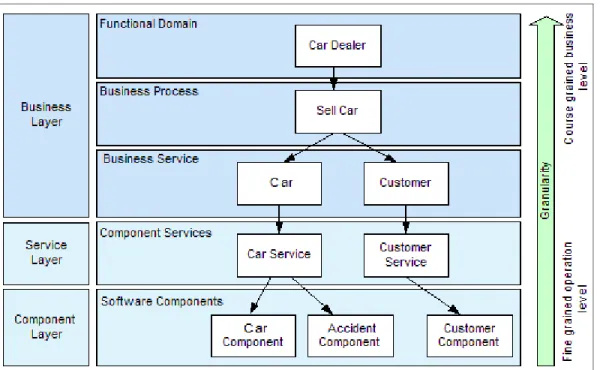
Figure 1-1 on page 5 provides an overview of the different abstraction levels within an SOA.
Figure 1-1 SOA abstraction layers
Figure 1-1 is described below: Functional domain
Acts as the owner of different business processes. For example, a car dealer needs to have a process for selling cars.
Business process
A business process typically has a state attached to it and often acts as a controller or workflow engine by calling different lower-level services
providing parameters that reflect the actual state of the process. For example, the selling of a car involves the credit check for a client as well.
Business services
A business service is atomic in nature but orchestrates the invocation of lower-level component services into a business-level process. A business service is stateless from the view of the requestor but may hold internal state while calling lower-level services. Business services can be called
synchronously or asynchronously. For example, a car business service provides the functionality of checking if a specific car is reserved for a client before it performs the selling.
A component service is a simple atomic action on a simple entity that does not depend on another service to function. For example, database access to a single table like the car table can be thought of as a component service. Software components
This layer contains enterprise resources, existing systems, or applications including packaging application and historical application. For example, the car table within the database is a software component.
Fine-grained services are best consumed by more coarse-grained services instead of directly by the end applications. If an application is built using fine-grained services, the application will have to invoke multiple services over the network, each of which exchanges a small amount of data. Consumers of coarse-grained services are not exposed to the fine-grained services that they use.
Modularity
In an SOA, services are described as being modular and self-contained. A service supports a set of interfaces. These interfaces should be cohesive, which means they should all relate to each other in the context of a module. An appropriate service modularity in an SOA enables the aggregation of the services into an application with a few well-known dependencies.
There exists a set of criteria to help determine wether a service is sufficiently modular:
Modular decomposability (top-down approach)
The modular decomposability of a service refers to the breaking of an application into many smaller modules. The goal is to identify the smallest unit of software that can be reused in different contexts.
Modular composability (bottom-up approach)
The modular composability of a service refers to the implementation of services that can be reused as they are to implement a new system. In contrast to the bottom-up approach, which is more focused on the application functions, the top-down approach is focused on the business problem. Modular understandability
The modular understandability of a service refers to the ability of a person to understand the function of a service without knowing the others. For example, a service name called CustomerSellCar that mixes the semantics of the customer service and a car service limits the modular understandability. If a service is not understood from a functional perspective, it might never be reused.
The modular continuity of a service refers to the impact of a change in one service requiring a change in others or in the consumers of the service. An interface that does not sufficiently hide the implementation details of a service creates a domino effect when changes are needed.
Modular protection
The modular protection of a service is sufficient if an abnormal condition in the service does not cascade to other services or consumers. For example, validating user input at its source prevents the propagation through the application.
Taking these criteria into consideration noticeably increases the modular design of services.
Loose coupling
Services are described as being loosely coupled. The systems must have some common understanding to conduct an interaction. Instead, to achieve the benefits of loose coupling, consideration should be given to how to couple or decouple various aspects of service interactions, such as the platform and language in which services are implemented, the communication protocols used to invoke services, and the data formats used to exchange input and output data between service consumers and providers.
Language independence
The language independence of services refers to their ability to communicate with other services independent of the programming language that both are written with.
Transport protocol transparency
The transport protocol transparency of services refers to their ability to communicate with other services independent of the protocol that both are connected with. From a requestor’s perspective, the transport protocol that the provider is using has no impact on how a request is made.
Location transparency
The location transparency of services refers to their ability to communicate with other services without knowledge of where they really reside. From a requestor’s perspective, the location of the service has no impact on how a request is made.
Data format independence
Data format independence of services refers to their ability to communicate with each other without using exactly the same schema (structure, element types) for the data they need to exchange. From a requestor’s perspective, the schema that a provider expects has no impact on how a request is made.
Platform independence
The platform independence of services refers to their ability to communicate with others independent of the kind of platform they are located on.
Communication model transparency
The communication model transparency of services refers to their ability to communicate with each other independent of whether they are connected through a synchronous or asynchronous medium.
1.2 SOA and messaging
Successfully implementing an SOA requires applications and infrastructure that can support the SOA principles. Applications can be enabled by creating service interfaces to existing or new functions hosted by the applications. The service interfaces should be accessed using an infrastructure that can route and transport service requests to the correct service provider. As organizations expose more and more functions as services, it is vitally important that this infrastructure should support the management of SOA on an enterprise scale.
Benefits of messaging in an SOA environment
The design principles of granularity and modularity are resolved primarily at the application level. In contrast, the aspect of loose coupling can be greatly addressed by using messaging middleware. The use of such middleware supports the principles of an SOA implementation by:
Decoupling the consumer’s view of a service from the actual implementation of the service
Decoupling technical aspects of service interactions Integrating and managing services in the enterprise
Decoupling the consumer’s view of a service from the actual implementation greatly increases the flexibility of the architecture. It allows the substitution of one service provider for another (for example, because another provider offers the same services for lower cost or with higher standards) without the consumer being aware of the change, or needing to be altered to support it.
This decoupling is better achieved by having the consumers and providers interact via an intermediary. Intermediaries publish services to consumers
.
The consumer binds to the intermediary to access the service, with no direct coupling to the actual provider of the service. The intermediary maps the request to the location of the real service implementation.Figure 1-2 shows the requestor and the provider connected using a messaging infrastructure as an intermediary.
Figure 1-2 Decoupling requestor and provider using messaging as intermediary
Table 1-1 shows an overview of the coupling aspects related to the use of messaging middleware.
Table 1-1 Coupling aspects of messaging middleware
Coupling aspect Justification
Language independence The payload of a message can be passed in a language-independent manner. An appropriate interface to the messaging middleware needs to exist for requestor and provider.
Transport protocol transparency The transport protocol used is encapsulated by the interface of the messaging infrastructure. A requestor does not need to know if a provider is connected using the same transport protocol. Location transparency For a service requestor or provider the
messaging infrastructure is just a
communication medium. A requestor does not need to know the route a message takes as long as it gets the result it expects.
Data format independence The payload of a message is passed in a data format independent manner.
Platform independence Messaging infrastructure supports the communication between different platforms and even provides mapping functionality between different data and encoding formats. Communication model transparency Messaging not only supports the synchronous
communication model but also the asynchronous, thus providing enhanced flexibility in binding and orchestrating services.
1.3 Using an enterprise service bus
An enterprise service bus (ESB) provides an infrastructure that removes any direct connection between service consumers and providers. Consumers connect to the bus and not the provider that actually implements the service. This type of connection further decouples the consumer from the provider. A bus also implements further value add capabilities. For example, security and delivery assurance can be implemented centrally within the bus instead of having this buried within the applications.
Integrating and managing services in the enterprise outside of the actual implementation of the services in this way helps to increase the flexibility and manageability of SOA. The primary driver for an ESB, however, is that it
increases decoupling between service consumers and providers. Protocols such as Web services define a standard way of describing the interface to a service provider that allow some level of decoupling, as the actual implementation details are hidden. However, the protocols imply a direct connection between the consumer and provider.
Although it is relatively straightforward to build a direct link between a consumer and provider, these links can lead to an interaction pattern that consists of building multiple point-to-point links (Figure 1-3) that perform specific
interactions. With a large number of interfaces this quickly leads to the build up of a complex spaghetti of links with multiple security and transaction models. Routing control is distributed throughout the infrastructure, and probably no consistent approach to logging, monitoring, or systems management is implemented. This environment is difficult to manage or maintain and inhibits change.
Figure 1-3 Direct connection integration style
Direct Connection
Service Consumer Service Consumer Service Consumer Service Provider Service Provider Service ProviderA common approach to reduce this complexity is to introduce a centralized point through which interactions are routed, as shown in Figure 1-4.
Figure 1-4 Central hub integration style
This hub and spoke architecture is a common approach that is used in
application integration architectures. In a hub, the distribution rules are separated from applications. The applications connect to the hub and not directly to any other application. This type of connection allows a single interaction from an application to be distributed to multiple target applications without the consumer being aware that multiple providers are involved in servicing the request. This connection can reduce the proliferation of point-to-point connections.
Note that the benefit of reducing the number of connections only truly emerges if the application interfaces and connections are genuinely reusable. For example, consider the case where one application needs to send data to three other applications. If this is implemented in a hub, the sending application must define a link to the hub, and the hub must have links that are defined to the three receiving applications, giving a total of four interfaces that need to be defined. If the same scenario was implemented using multiple point-to-point links, the sending application would need to define links to each of the three receiving applications, giving a total of just three links. A hub only offers the benefit of reduced links if another application also needs to send data to the receiving applications and can make use of the same links as those that are already defined for the first application. In this scenario, the new application only needs to define a connection between itself and the hub, which can then send the data correctly formatted to the receiving applications.
Hubs can be federated together to form what is logically a single entity that provides a single point of control but is actually a collection of physically distributed components. This is commonly termed a bus
.
A bus provides aHub and Spoke
Service Consumer Service Consumer Service Consumer Service Provider Service Provider Service Provider Hub: ESBconsistent management and administration approach to a distributed integration infrastructure.
ESB capabilities
This section discusses the capabilities an ESB must have to support the requirements of an SOA enabling infrastructure component. Understanding the capabilities allows you to assess the suitability of individual technologies or products for implementing an ESB by analyzing the functionality that they offer. In discussions on ESB, the most commonly agreed upon elements for defining an ESB are:
The ESB is a logical architectural component that provides an integration infrastructure that is consistent with the principles of SOA.
The ESB can be implemented as a distributed, heterogeneous infrastructure. The ESB provides the means to manage the service infrastructure and the
capability to operate in a distributed, heterogeneous environment. Table 1-2 summarizes the capabilities that an ESB should have in order to provide an infrastructure consistent with these elements, and thus consistent with the benefits of SOA.
Table 1-2 Capabilities of an ESB
Category Capabilities Reason
Communication Routing
Addressing
At least one messaging style (request/response, publish/subscribe)
At least one transport protocol that is or can be made widely available
Provides location
transparency and supports service substitution
Integration Several integration styles or adapters Protocol transformation Supports integration in heterogeneous environments and supports service substitution Service interaction Service interface definition
Service messaging model
Substitution of service implementation
Separates application code from specific service protocols and
implementations Management Administration capability A point of control over
Let us take a closer look at each of these categories: Communication
The ESB needs to supply a communication layer to support service
interactions. It should support communication through a variety of protocols. It should provide underlying support for message and event-oriented
middleware and integrate with existing HTTP infrastructure and other enterprise application integration (EAI) technologies. As a minimum capability, the ESB should support at least the protocols that make sense given the requirements of a specific situation. The ESB should be able to route between all these communication technologies through a consistent naming and administration model.
Integration
The ESB should support linking to a variety of systems that do not directly support service-style interactions so that a variety of services can be offered in a heterogeneous environment. This includes existing systems, packaged applications, and other EAI technologies. Integration technologies might be protocols (for example, JDBC™, FTP, or EDI) or adapters such as the J2EE Connector Architecture resource adapters or WebSphere Business
Integration Adapters. It also includes service client invocation through client APIs for various languages (Java™, C+, or C#) and platforms (J2EE or .Net), CORBA, and RMI.
Service interaction
The ESB needs to support SOA concepts for the use of interfaces and support declaration service operations and quality of service requirements. The ESB should also support service messaging models consistent with those interfaces, and be capable of transmitting the required interaction context, such as security, transaction, or message correlation information. Management
As with any other infrastructure component, the ESB needs to have administration capabilities so that it can be managed and monitored to provide a point of control over service addressing and naming. In addition, it should be capable of integration into systems management software.
1.4 The IBM SOA Foundation
IBM SOA Foundation is an integrated, open-standards-based set of software, best practices, and patterns that can help you get started with your SOA. It is designed to help you extend the value of the applications and business processes that currently run your business.
You can read about the IBM SOA Foundation in IBM SOA Foundation: providing what you need to get started with SOA at:
ftp://ftp.software.ibm.com/software/soa/pdf/SOA_g224-7540-00_WP_final.pdf
The following is a quick summary of the highlights.
1.4.1 SOA life cycle
SOA can be thought of in terms of a life cycle consisting of the following stages: The
model
phase consists of gathering business requirements and designingbusiness processes.
In the
assemble
phase the processes are implemented by assembling new and existing services to form these business processes. In the
deploy
phase, these assets are deployed into a secure integrated services environment. And last, in the
manage
phase, these business processes are monitored and managed from both an IT and business perspective. Information gathered in this phase is fed back into the life cycle to enable improvement.Governance and processes underpin these life-cycle stages to provide guidance and oversight for the SOA project.
Each life-cycle stage is supported by software that has been chosen to be a part of the IBM SOA Foundation.
1.4.2 SOA Reference Architecture
IBM SOA Foundation is based on the SOA Reference Architecture, which defines the comprehensive IT services required to support your SOA at each stage in the SOA life cycle. The SOA Reference Architecture includes
development environment, services management, application integration, and runtime process services. The capabilities of the architecture can be
implemented on a build-as-you-go basis as new requirements are addressed over time.
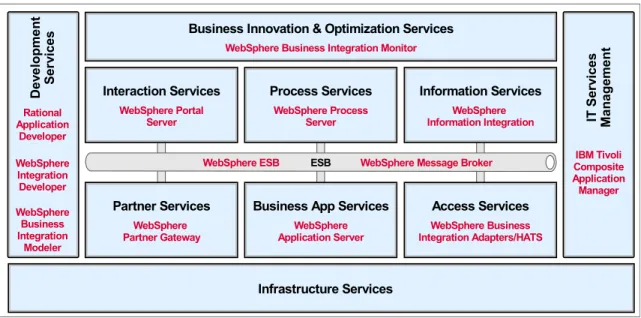
Figure 1-5 on page 15 shows the SOA Reference architecture and a sampling of the supporting software.
Figure 1-5 SOA Reference Architecture with product mapping
The following services are defined in the SOA Reference Architecture:
Infrastructure services
optimizes throughput availability and performance. Partner services
connects with trading partners.
Business application services
provides a scalable, highly available, and secure application environment.
Access services
facilitates interaction with existing information and application assets using application adapters or host access services.
Interaction services
manages collaboration between people, processes, and information.
Process services
orchestrates and automates business processes.
Information services
manages diverse data in a unified manner.
Business innovation and optimization services
provide real-time business information monitoring to facilitate better decision making.
Enterprise service bus
facilitates communication between services. Development services
provides an integrated environment to design andcreate solution assets.
IT service management
manages and secures services, applications, and resources. Interaction Services WebSphere Portal Server Process Services WebSphere Process Server Information Services WebSphere Information Integration Partner Services WebSphere Partner GatewayBusiness App Services WebSphere Application Server Access Services WebSphere Business Integration Adapters/HATS Infrastructure Services
WebSphere ESB ESB WebSphere Message Broker Rational Application Developer WebSphere Integration Developer WebSphere Business Integration Modeler
Business Innovation & Optimization Services WebSphere Business Integration Monitor
IBM Tivoli Composite Application Manager Dev e lo pme n t Ser vices IT Serv ices M ana g eme nt
Model and assemble phases
The Development Services provide services for the model and assemble phases of the SOA life cycle. The IBM development tools are based on a common platform, making the learning curve easy as you progress from tool to tool. These development tools are tailored to the task at hand and align with the runtime environments.
Rational Application Developer is the primary development tool for WebSphere Application Server applications. With this tool, you can create J2EE assets such as servlets and EJBs, test the code, and deploy to the runtime server. Among the many useful features are the Web services tools that provide wizards to assist you in creating Web services clients, Web services providers, and in wrapping existing applications as services.
WebSphere Integration Developer is the primary development tool for
WebSphere Process Server and WebSphere ESB. With this tool you can create a business process with BPEL, configure adapters, create mediations, test the code, and deploy to the runtime server.
Manage phase
The IT Service Management provides services for the manage phase, including the management and security of services, applications, and resources. The following IBM products support the manage phase:
IBM WebSphere Business Monitor
IBM Tivoli® Composite Application Manager
IBM Tivoli Identity Manager and IBM Tivoli Access Manager
Deploy phase
The remainder of the services are involved in the deploy phase, providing runtime services. The following IBM products support the deploy phase: IBM WebSphere Process Server
IBM WebSphere ESB and IBM WebSphere Message Broker IBM WebSphere Partner Gateway and IBM WebSphere Adapters IBM WebSphere Portal
IBM WebSphere Everyplace® Deployment IBM Workplace™ Collaboration Services IBM WebSphere Information Integrator IBM WebSphere Application Server IBM WebSphere Extended Deployment
1.5 For more information
For more information about the concepts covered in this chapter, see: IBM Service Oriented Architecture (SOA) Web page
http://www-306.ibm.com/software/solutions/soa/
IBM SOA Foundation: providing what you need to get started with SOA ftp://ftp.software.ibm.com/software/soa/pdf/SOA_g224-7540-00_WP_final.pdf
Patterns: SOA with an Enterprise Service Bus in WebSphere Application Server V6, SG24-6494
Chapter 2.
Product selection
This chapter discusses the IBM products that form the foundation for messaging in the IBM SOA strategy. It will help you determine what products may be appropriate for your situation.
2.1 IBM SOA Foundation products for messaging
In this book we take a look at the set of products shown in Figure 2-1. These products form the heart of the IBM SOA strategy. In particular, we take these within the context of a messaging solution.
Figure 2-1 IBM SOA products for messaging
Figure 2-1 is explained below:
Foundation and messaging infrastructure
WebSphere Application Server
provides the runtime environment for J2EE applications. WebSphere Application Server provides the J2EE containers required to execute the applications, as well as the services that enable the execution of specific Java application components. WebSphere Application Server hosts a JMS-based messaging engine that provides enhanced messaging functionality and a Web services engine that is capable of hosting and invocating SOAP-based Web services.WebSphere MQ
provides the transport mechanism for messages.WebSphere MQ
Messaging ProviderFoundation and
Messaging
Infrastructure
Business
Process
WebSphere
Process Server
Business processes using BPEL + WebSphere ESBWebSphere ESB
Enterprise Service Bus functions Web services connectivity + WebSphere Application Server Network DeploymentESB
WebSphere
Message Broker
Advanced Enterprise Service Bus functionsMessaging connectivity
WebSphere
Application Server
J2EE applicationsDefault Messaging Provider Connectivity with WebSphere MQ
messages across a broad range of hardware and software platforms like Windows®, z/OS®, .NET, and J2EE and is accessible using various programming languages and interfaces like Visual Basic®, C++, Java, COBOL, PL/I, as well as MQI and JMS.
ESB
The enterprise service bus (ESB) layer provides flexible connectivity and integration for Web services and messaging-focused applications.
WebSphere Enterprise Service Bus (WebSphere ESB)
provides ESB functionality for standards-based applications. Built on WebSphereApplication Server, WebSphere ESB takes advantage of its many features, including high availability, scalability, and performance. Beyond the basic programming-based mediation functionality available in WebSphere
Application Server, WebSphere ESB provides a mediation layer with pre-built mediations for XML transformation, content-based routing, and message logging. Like WebSphere Process Server, WebSphere ESB supports Service Component Architecture (SCA) and Service Data Objects (SDO) to provide a unified programming model.
WebSphere Message Broker
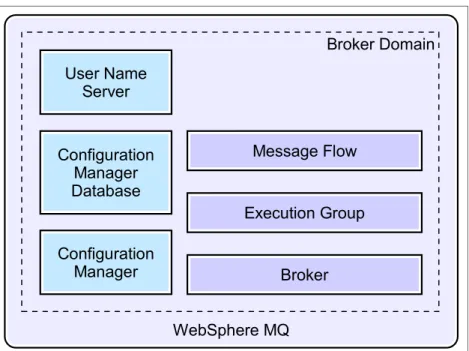
provides advanced ESB functionality for universal support of messaging applications. Built on WebSphere MQ, WebSphere Message Broker takes advantage of the services provided by the messaging infrastructure and enhances them by adding a runtimeenvironment that supports message processing like message transformation and routing.
Business process
WebSphere Process Server
provides services to enable the integration of composite applications. It addresses issues of system and technology heterogeneity by applying the IBM SOA programming model consisting of SCA and SDO. SCA and SDO allow the definition of service component interfaces, implementations, and references in a technology-neutral way that can be bound later to the technology chosen. On top of thistechnology-neutral service component layer is a Business Process Execution Language (BPEL)-based orchestration and runtime environment for the dynamic composition of the service components to processes.
2.2 WebSphere Application Server
The foundation of the WebSphere brand is the application server, which provides the runtime environment and management tools for J2EE and Web services based applications. WebSphere Application Server provides qualities of service like clustering, failover, scalability, and security. It also includes a built-in
messaging provider, which can be configured to connect to an existing WebSphere MQ network.
WebSphere Application Server is available in three packages: WebSphere Application Server Express
The Express package is geared to those who need to get started quickly with e-business. It is specifically targeted at medium-sized businesses or
departments of a large corporation, and is focused on providing ease of use and ease of application development. It contains full J2EE 1.4 support but is limited to a single-server environment. WebSphere Application Server - Express is bundled with the Rational Web Developer application development tool.
WebSphere Application Server
The WebSphere Application Server package provides the next level of server infrastructure. Though the server is functionally equivalent to the server shipped with Express, this package differs slightly in packaging and licensing.
IBM Message Service API (XMS):
This book focuses on JMS applications; however, you should be aware of the IBM Message Service API (XMS). XMS is a programming API that allows access from C, C++, and .NET applications to the following IBM messaging servers:
WebSphere MQ
WebSphere Message Broker real-time transport
WebSphere Application Server V6 default messaging provider Similar to JMS, it provides a mechanism for non-Java applications to participate in point-to-point and pub/sub messaging. It supports both synchronous and asynchronous messaging styles.
Introducing XMS -- The IBM Message Service API
http://www-128.ibm.com/developerworks/websphere/library/techarticles/0509 _phillips/0509_phillips.html
The development tool included is a trial version of a Rational Application Developer, full J2EE 1.4 compliant development tool.
WebSphere Application Server Network Deployment
WebSphere Application Server Network Deployment is an even higher level of server infrastructure in the WebSphere Application Server family. It extends the WebSphere Application Server base package to include
clustering capabilities, Edge components, and high availability for distributed configurations. These features become more important at larger enterprises, where applications tend to service a larger client base, and more elaborate performance and availability requirements are in place.
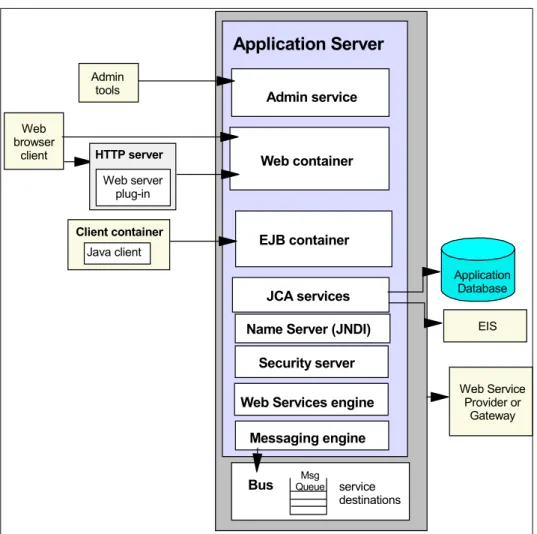
The basic architectural model for WebSphere Application Server is shown in Figure 2-2 on page 24.
Figure 2-2 Architectural model of WebSphere Application Server
The architectural model for Network Deployment is similar to this, but adds a deployment manager for central administration and management for all
application servers grouped together in a cell. In Network Deployment, the admin services resides in the deployment manager. Multiple servers are possible and application server clustering is used for workload management and high availability.
WebSphere Application Server V6 provides full support for the J2EE 1.4
specification. The J2EE specification defines the concept of containers to provide runtime support for applications. There are three types of containers in the application server implementation:
Web container Web browser client HTTP server Web server plug-in
Application Server
Admin tools Admin service EJB container Java client Client containerName Server (JNDI) Security server Web Services engine
Messaging engine
Web Service Provider or
Gateway
Bus QueueMsg service destinations
Application Database
JCA services
The Web container processes HTML, servlets, JSP™ files, and other types of server-side includes. It provides infrastructure support like Web container transport chains, session management, and Web services engine. EJB™ container
The EJB container provides all the runtime services that are needed to deploy and manage enterprise beans. It is a server process that handles requests for both session and entity beans. The container provides low-level services including threading and transaction support.
Client container
The client container is a separately installed component on the client’s machine. It allows the client to run applications in an environment that is compatible with J2EE.
In addition to the definition of containers as a runtime environment for application components, J2EE prescribes the support of the J2EE Connection Architecture (JCA) that provides connection management for access to enterprise information systems (EIS). The connection between the enterprise application hosted by the application server and the EIS is done through the use of EIS-provided
resource-adapters, which are plugged into the application server. The
architecture specifies the connection management, transaction management, and security contracts that exist between the application server and the EIS. Each application server hosts a name service that provides a Java Naming and Directory Interface™ (JNDI) name space. The service is used to register resources hosted by the application server. The JNDI implementation in WebSphere Application Server is built on top of a Common Object Request Broker Architecture (CORBA) naming service (CosNaming). The naming architecture is used by clients of WebSphere applications to obtain references to objects related to those applications. These objects are bound into a mostly hierarchical structure, referred to as a namespace. The namespace can be accessed and manipulated through a name server.
WebSphere Application Server security provides flexibility by providing pluggable modules that can be configured according to requirements and existing IT resources. The application server’s security features sit on top of the operating system security and the security features provided by other components, including the Java language. The WebSphere Application Server supports J2EE security with the required role mapping as well as Java 2 security and JAAS support. The authentication features support LTPA and SWAM and the applied user registry can be based on the local operating system, LDAP, or a custom registry.
The WebSphere Application Server supplies messaging providers for its own messaging implementation (default messaging provider) and for WebSphere MQ (WebSphere MQ JMS provider). It also supports generic JMS providers.
The default messaging provider is WebSphere Application Server’s JMS API implementation (connection factories, JMS destinations, and so on) for messaging. The concrete destinations (queues and topic spaces) behind the default messaging provider are implemented in the service integration bus. (Similarly, the WebSphere MQ JMS provider is the JMS API implementation with WebSphere MQ implementing the real destinations for the JMS interface.) Application server access to the service integration bus is managed by the messaging engine.
WebSphere messaging provides a consolidation of support for queuing, pub/sub, and Web services, thus providing a platform for several key messaging and interaction patterns. For example, both pseudo-synchronous request-reply messaging and asynchronous fire-and-forget messaging are supported. Messaging engines connect to a service integration bus that provides message transport. Message producers and consumers communicate by interacting with the bus, not directly with each other. A key feature of the bus is the ability to use a variety of protocols to send and receive messages to and from the bus. For example, a message can be sent into the bus as a Web services request message based on the SOAP protocol over HTTP. The bus can then forward this message to a JMS consumer. The messaging engine supports the concept of mediations. A mediation is a piece of code that is associated with a destination, the logical target for a message. Mediation code operates on a message as it traverses that destination and thus supports, for example, message
transformation and routing.
The Web services engine of the WebSphere Application Server supports SOAP-based Web service hosting as well as invocation. It contains support for various Java and Web services standards including WS-I Basic Profile,
WS-Security, JAX-RPC, JAXR, SAAJ, and UDDI.
Web server plug-ins enable the Web server to send requests for dynamic content, such as servlets, to the application server. A configuration file that contains information about the application server configuration is generated at the application server and copied to the Web server for use by the plug-in. The plug-in provides load balancing among application servers.
With Network Deployment, clustering application servers automatically enables plug-in workload management for the application servers and the servlets they host. The routing is based on weights associated with the cluster members. If all cluster members have identical weights, the plug-in sends equal requests to all
application servers. Multiple application servers with the EJB containers can be clustered, enabling the distribution of EJB requests between the EJB containers. WebSphere Application Server Network Deployment also provides high
availability features. The following is a quick overview of the failover capabilities: Web container failover
The Web server plug-in in the Web server is aware of the configuration of all Web containers and can route around a failed Web container in a cluster. Sessions can be persisted to a database or in-memory using data replication services.
EJB container failover
Client code and the ORB plug-in can route to the next EJB container in the cluster.
Critical services failover
Hot standby and peer failover for critical services (such as workload management routing, PMI aggregation, JMS messaging, transaction
manager, and so on) is provided through the use of high availability domains. A high availability domain defines a set of WebSphere processes (core group) that provides high availability functions to each other.
One or more members of the core group can act as a high availability coordinator, managing the HA activities within the core group processes. If a high availability coordinator server fails, another server in the core group takes over the duties of that coordinator. High availability policies define how the failover occurs. Workload management information is shared between core members and failover of critical services is done among them in a peer-to-peer fashion. Little configuration is necessary, and in many cases, this function works with the defaults that are created automatically as you create the processes.
JMS messaging failover
The messaging engine keeps messages in a remote database. When a server in a cluster fails, WebSphere selects an online server to run the Messaging Engine and the workload manager routes JMS connections to that server.
WebSphere Application Server provides a browser-based administrative console for administration. Command-line and scripting administration is also provided. You can find more information about the WebSphere Application Server at the WebSphere Application Server home page:
2.3 WebSphere MQ
IBM WebSphere MQ is an established and reliable message queuing
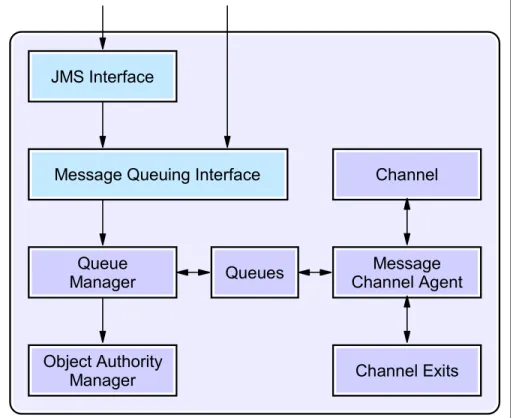
middleware platform. A message queuing infrastructure built upon WebSphere MQ technology can provide an available, reliable, scalable, secure, and maintainable transport for messages with exactly once delivery assurance. Figure 2-3 shows the architectural overview for WebSphere MQ, including the interface for Java Message Service (JMS) and the Message Queuing Interface (MQI).
Figure 2-3 Architectural model of WebSphere MQ
MQI is the core API provided by WebSphere MQ. It is a procedural API suitable for applications developed within procedural programming languages. The MQI also defines structures, constants, and basic data types required to interact with WebSphere MQ. Procedural languages like C and COBOL most likely utilize MQI directly, while object-oriented languages like Java and C++ are supported with object-oriented APIs built upon MQI.
JMS Interface
Message Queuing Interface
Channel
Queue
Manager
Queues
Channel Agent
Message
Object Authority
WebSphere MQ also supports XMS, a programming API that allows access from C, C++, and .NET applications.
Queue managers are the core element within a WebSphere MQ messaging infrastructure. They provide queuing services to applications and manage the queues that belong to them. Queue managers ensure that object attributes are changed according to the commands they receive. They trigger special events when certain conditions are met and they put messages onto the correct queue. Every application that wants to access a WebSphere MQ messaging
infrastructure needs to be connected to a queue manager within this
infrastructure. Applications can only retrieve messages from queues hosted by the queue manager to which they are connected, but they can send messages to queues hosted by other queue managers, as long as a network link exists between both queue managers. A machine with a WebSphere MQ installation can host multiple queue managers; the amount is limited only by the resources of the machine.
WebSphere MQ defines different kinds of queues: Local queues
Local queues are the only type of queues that represent a real queue and hold messages.
Transmission queues
Transmission queues utilize message channels to transmit messages to remote queue managers. They provide a queue manager with knowledge of how to route messages to a single destination queue manager. Any
messages sent with a queue manager namethe same as the name of the transmission queue are placed upon that transmission queue.
Alias queues
An alias queue is a representation of another target queue, which has a different name. Alias queues can be used to enhance flexibility regarding naming.
Model queues
Model queues provide the attributes of a local queue that can be created dynamically by an application. Dynamically created queues are instances of local queues and can hold messages. They can, for example, be used as dynamic reply queues in request-reply scenarios.
Remote queues
Remote queues are used to define routes to other queue managers within the WebSphere MQ messaging infrastructure. This involves mapping queue manager names to transmission queues, and mapping queue names to different queue names on remote queue managers.
A channel is a communication object used by distributed queue managers. There are two types of channels:
Message channels, which are unidirectional and transfer messages from one queue manager to another
MQI channels, which are bidirectional and transfer MQI calls from a WebSphere MQ client to a queue manager and responses from a queue manager to the client
Every channel in WebSphere MQ is a network link between two Message Channel Agents (MCAs). A connection performed by an application connecting to a queue manager is also performed by an MCA, even though it is not performed from within a queue manager.
Channel exits are user-written libraries that are called at defined places in the processing sequence of an MCA. They can be used to do additional processing on messages, for example, encryption or data compression. Based on the functionality and place where they are called, there are different types of exits (message exit, message-retry exit, receive exit, security exit, send exit, and auto-definition exit).
WebSphere MQ provides features to assure security of access, authentication of identity, and security and integrity of communication. The Object Authority Manager (OAM) is the default authorization service for command and object management. All actions performed by an application connected to a queue manager are authenticated by the OAM.
WebSphere MQ provides high availability through workload balancing and failover capabilities. It supports the concept of queue manager clusters consisting of a set of queue managers. Applications requesting a particular service can connect to any queue manager within the cluster. The queue manager to which the application is connected automatically load balances the request with the others. Queue managers can dynamically join or leave clusters and can be hosted on different machines, which is especially useful in a
distributedenvironment where capacity is scaled to accommodate the current load through multiple servers rather than one mainframe or high-capacity server. WebSphere MQ provides reliability and data integrity by supporting units of work as well as persistent and non-persistent messages.
Units of work performed by applications accessing a WebSphere MQ
infrastructure can include sending and receiving messages, as well as updates to databases. WebSphere MQ can coordinate all resources to ensure that a unit of work is only completed if all actions within that unit of work complete
infrastructure can be included in units of work that are coordinated by WebSphere Application Server.
WebSphere MQ supports the concept of persistent and non-persistent
messages. Persistent messages are retained during system failures but provide comparable low performance, while non-persistent messages provide high performance but may be lost during system failures.
WebSphere MQ contains monitoring and accounting functionality. It provides real-time performance information about flow of messages, it allows report generation for queue manager usage on application level base, and it provides facilities to identify the route that a messages took through a WebSphere MQ infrastructure or interconnected WebSphere MQ infrastructures.
Administration of WebSphere MQ is typically done using control commands or the WebSphere MQ Explorer administrative interface (Windows or Linux® only). You can find more information about IBM WebSphere MQ at the WebSphere MQ home page:
http://www.ibm.com/software/integration/wmq/
2.4 WebSphere ESB
WebSphere ESB is designed to provide an enterprise service bus for IT environments built around open standards and SOA. It delivers easy-to-use functionality built on the messaging and Web services technologies of WebSphere Application Server.
Figure 2-4 Architectural model of WebSphere ESB
WebSphere Application Server is the foundation for WebSphere ESB, providing not only the required quality of service, the J2EE runtime environment, and the messaging engine, but also by providing broad support regarding open
standards and Web services. WebSphere ESB is built on the Network
Deployment package, providing a wide range of capabilities for large enterprise networks, including clustering, failover, and scalability features.
On top of the infrastructure provided by WebSphere Application Server, WebSphere ESB implements a mediation layer consisting of a mediation base and mediation functions. The newly provided mediation framework is different from the one implemented by WebSphere Application Server, as it is based on the Service Component Architecture (SCA). It allows enhanced flexibility, encapsulation, and reuse. Mediations implemented for WebSphere Application Server can still be used together with WebSphere ESB, but the new tooling provided for WebSphere ESB does not support the modification of these mediations.
The mediation base is provided by SCA and Service Message Objects (SMO). SCA supports the description of every mediation module through a
technology-neutral interface. SMO is based on SDO and supports the
representation of a binding-specific data format in a common, neutral way. The application of this SCA/SMO-based programming model allows for the
configurable assembly of different mediation modules to a mediation flow, thus enabling a very flexible and encapsulated solution.
Service Component
Architecture Service MessageObjects Mediation Functions Database Lookup Message Filter and Router Custom Message Logger XSLT Message Transformation
WebSphere Application Server (J2EE Runtime) Mediation