AWERProcedia Information
Technology & Computer Science
Vol 03 (2013) 1032-1039
3
rdWorld Conference on Information Technology (WCIT-2012)
e-Service continuance usage framework
Yasemin Çetin Kaya *, Middle East Technical University, Universiteler Mahallesi, Dumlupınar Bulvarı, No:1, 06800, Ankara, Turkey.
Sevgi Özkan, Middle East Technical University, Universiteler Mahallesi, Dumlupınar Bulvarı, No:1, 06800, Ankara, Turkey.
Suggested Citation:
Kaya, Ç., Y. & Özkan S. e-Service continuance usage framework, AWERProcedia Information Technology &
Computer Science. [Online]. 2013, 3, pp 1032-1039. Available from:
http://www.world-education-center.org/index.php/P-ITCS. Proceedings of 3rd World Conference on Information Technology (WCIT-2012), 14-16 November 2012, University of Barcelon, Barcelona, Spain.
Received 2 January, 2013; revised 19 July, 2013; accepted 17 September, 2013. Selection and peer review under responsibility of Prof. Dr. Hafize Keser.
©2013 Academic World Education & Research Center. All rights reserved.
Abstract
e-Services provide high performance to the user. In order to fulfil the expected benefit from e-service end-users should continue to use it. Therefore, it is important to investigate the factors that affect the continuance usage of end users. This study aims to develop an e-service continuance framework that predicts and explains e-service continuance usage and covers different belief determinants of usage intention. Actual users are included to the factor determination process and this approach brings about more accurate and effective results. This study contributes to the literature by identifying the factors that influence e-service usage for behavioral, normative and control beliefs.
Keywords: continuance usage, e-service adoption, framework development;
1.Introduction
With the ever-expanding improvements in the information and communications technology (ICT), technologic products and applications such as computers, cellular phones, and internet take an important part in our daily lives. Mobile and fixed broadband subscription has been increasing in the world (ITU, 2011). These technologies provide many advantages to the users in terms of time, cost and efficiency. Firms and governments that provide services to the users reshaped their service in parallel with the technological improvements. Consequently, “e-service” that means providing service over electronic networks such as internet is emerged (Rust & Kannan, 2002).
ICT offers high performance and efficiency to the users; however, many systems are not used properly and sufficiently due to the users’ adoption problems such as not being aware and disposed. Unless the system is used, it does not provide benefit to the user (Money & Turner, 2004). Correspondingly, continuance usage ensues as an important concept. Bhattacherjee(2001a) defines the IT continuance as “use of an IT by individual users over the long-term after their initial acceptance”. End-users should continue to use IT in order to fulfill the expected benefit from this IT. Therefore, it is important to investigate post-adoptive behavior and the factors that affect the continuance usage of end users.
There are many researches studies in this field. Some of these researches use existing models in the literature such as Unified Theory of Acceptance and Use of Technology (UTAUT) in different areas whereas others extend these models with a few additional constructs. Also, combining two models is another approach that used in adoption field. Though, each domain and application has idiosyncrasies and user profile. Therefore, identifying the domain specific constructs and considering the request and needs of actual users play a crucial role for effective model development.
However, there are few studies specially focusing on the post-adoption process of e-service use (Bhattacherjee, 2001a; Bhattacherjee, 2001b; Venkatesh & Bala 2008). In that regard, there is a need for a framework that bear in mind numerous factors covering all available belief types for e-service use, in order to comprehend the continuance usage of an e-service thoroughly. The primary purpose of this study is to systematically develop a framework that predict and explain e-service continuance usage by focusing on different belief determinants of usage intention. Theory of Planned Behavior (TPB) is frequently used model in the behavioral (Ajzen, 1991). TPB examines the behavior in a primary manner, simple-structured and open for improvement. Therefore, this research is ground on TPB. To fulfill these needs a framework that covers all belief types; behavioral, normative and control, has been progressively developed with the inclusion of the actual users to the process.
Both technology adoption and continuance usage researchers and application developers will make us of the results of this study during research, plan, design, development and revision phases. The findings can provide useful recommendations to development of practice and policy making that is customer-oriented and evidence-based.
2.Background
e-Service is defined as the provision of a service over electronic networks (Rust & Kannan,2002). These electronic networks include internet, wireless network and electronic environment (ATM, kiosk, smart card network). Its revenue mainly based on profit from customer relationships and service enhancement (Rust & Kannan, 2003).
In the context of e-service, adoption can be defined as a process that begins with awareness of the e-service and progresses through a series of steps that end in appropriate and effective usage of e-service. e-Services can be grouped according to the provider and user of the services: business to
consumer e-services and government to citizen e-services. This research focused on the business to customer e-service adoption.
Principal factor in the TPB is the individual’s intention to perform a given behavior. Ajzen (1991) stated that there are three different types of drivers that lead behavior. These are motivational factors, non-motivational factors and intention. Motivational factors indicate the power of will to try, and required effort intended to use. Non-motivational factors include availability of requisite opportunities and resources (such as, skills, time and money). Intention wraps the motivational factors. Ajzen(1991) stated that “behavior is a function of salient information, or beliefs, relevant to the behavior”(p 189). Beliefs denote the information that an individual has about the impendent behavior that is service use in e-service domain. Ajzen(1991) grouped beliefs under three types in TPB: behavioral beliefs, normative beliefs and control beliefs. Each belief types keep different information about the system use (i.e. e-service use). During the behavior formation, all belief types influence the behavior but with a varying weight or importance. In behavior prediction studies these three beliefs are considered altogether.
3.Method
Involving the actual user of the system to the framework development brings about more accurate and efficient results. Therefore, target group analysis was conducted. Ajzen and Fishbein (1980) recommend that new sets of beliefs and salient referents are required to obtain for each new behavior, system, and population. They suggest using open-ended questions to clarify the factors that affect the beliefs of the potential system users. A paper-based questionnaire was prepared for this purpose. The questionnaire was distributed to 65 undergraduate students from Middle East Technical University. Their ages are range from 18 to 22. This participant group was chosen due to their actively and frequently e-service use in their daily life. Data of the 41 questionnaires were usable for analysis. This questionnaire had two parts. Details of the each part are given below separately. The results of this procedure were used to validate the respondents' salient beliefs are captured by the constructs included in the study and testing for criterion validity.
3.1.Part1- Open Ended Questions
First part composed of the six open-ended questions for belief types. Open-ended questions for each belief types are given in Table 1.
Table 1. Open Ended Questions
Belief Type Questions
Behavioral Beliefs What do you believe are the advantages of using an e-service? What do you believe are the disadvantages of using an e-service? Control Beliefs What factors or circumstances would enable you to use an e-service?
What factors or circumstances would make it difficult for you to use an e-service? Normative Beliefs Please list the individuals or groups who would approve or think you should use
an e-service?
Others What else comes to mind when you think about using an e-service?
3.2.Part 2-Factor Ranking
In the second part of the questionnaire, eleven essential factors that comprise all belief types and validated in the literature. These factors are computer skills, ease of use, incentive, monetary value, perceived behavioral control, personalization, pervasiveness, service quality, subjective norm, trust and usefulness. First participants asked to mark the factors from 1 to 7 according to the level of
influence of your e-service usage. 1 refers to not strongly influence whereas 7 refers to strongly influence. Then, they selected five factors according to order of importance to their service use.
4.Results
Target group analysis composed of two parts; open-ended questions and factor ranking. Results of the each part are given below separately.
4.1.Part1- Open Ended Questions
Behavioral Beliefs: Participants mentioned time saving, ease of use, usefulness, easy access, incentives and enjoyment advantages of e-service usage. Also, security, service quality, computer self-efficacy and service cost are declared as disadvantages. Table 2 summarized the advantages and disadvantages of the e-service use that were identified by the participants. The number in the brackets denotes the number of participants that mention about this factor.
Time saving is the most mentioned advantage. Participants emphasized the queue and extra time requirement of the traditional services. Other advantage is labeled as ease of use that comprises easy usage and info gathering factors. Also, participants referred to the benefits of using e-service such as make life easier. Easy access is another feature that provides advantages to the user. Easy to reach, easy access, ease of available and availability are grouped under this advantage.
According to the results, security issue is the most important disadvantage of e-service usage. Service cost and quality follow the security. Also, complicated use, computer self-efficacy and not knowing how to use the e-service are grouped under computer self-efficacy label as a disadvantage.
Table 2. Advantages and Disadvantages of Using e-service
Label Responses Total*
A
d
van
tages
Time saving Time saving(10), Required little time(2), Not waiting for a queue(2), You
do not have to wait hours(1), Fast(1) 16
Ease of use Easy(6), Easy to use(6), Easily getting the info about activities(1), Easy pay
back(1) 14
Usefulness
Usefulness(2), You are not tired(1), It makes life easier(2), Enable to choose the location of my ticket(2), Buy whenever you want(1), Early booking(1), No need to go out for buying products(1)
10
Easy Access Easy access(4), Availability(1), Easy to reach(1), Ease of available(1) 7 Monetary
value
Monetary value(1)
1
Incentive Incentive 1
Enjoyment You are not bored(1) 1
D
isad
van
tages
Security Security(6), Not trustable(3), Fake products(1), Risk( internet connection,
personal information) (1) 11
Service Cost Extra money for service usage- service price (5) 5 Service
Quality
Inadequate service quality (1), Require to buy exact ticket(1), Tickets/reservations may be cancelled(1), Following steps and typing credit card number is boring(1)
4
Computer Self-Efficacy
Computer Self-efficacy(1), Complicated to use( 1), Not knowing how to
use the e-service(1) 3
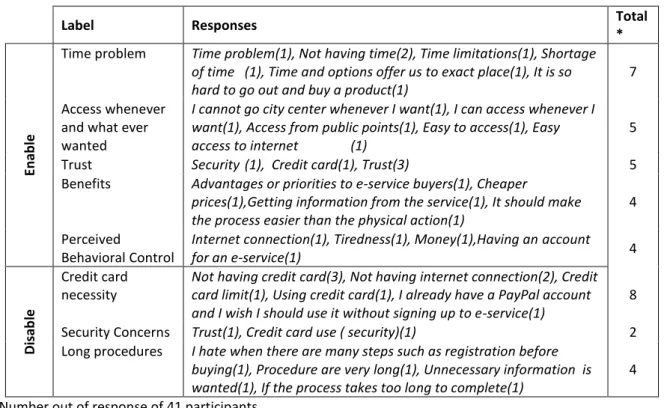
Control Beliefs: According to the answer of the participants time problems, access whenever and wherever wanted, trust enable participant to use e-services. Time problems factor has the highest percentage (% 28) among the factors that enable. They mentioned about shortage of time and e-service makes easy to buy products or getting information. Then access whenever and whatever wanted comes with the 20%. One of the participant state that “I cannot go city center whenever I want”, carrying out a transaction online at home is more effective way than the traditional services.
Results showed that credit card necessity, security concerns and long procedures make difficult e-service usage of participants.
Table 3 summarized the factors that enable and disable the e-service use. The number in the brackets denotes the number of participants that mention about this factor
Table 3. Factors that Enable and Disable e-service Use
Label Responses Total
*
En
ab
le
Time problem Time problem(1), Not having time(2), Time limitations(1), Shortage of time (1), Time and options offer us to exact place(1), It is so hard to go out and buy a product(1)
7
Access whenever and what ever wanted
I cannot go city center whenever I want(1), I can access whenever I want(1), Access from public points(1), Easy to access(1), Easy
access to internet (1)
5
Trust Security (1), Credit card(1), Trust(3) 5
Benefits Advantages or priorities to e-service buyers(1), Cheaper
prices(1),Getting information from the service(1), It should make the process easier than the physical action(1)
4
Perceived
Behavioral Control
Internet connection(1), Tiredness(1), Money(1),Having an account
for an e-service(1) 4 D isab le Credit card necessity
Not having credit card(3), Not having internet connection(2), Credit card limit(1), Using credit card(1), I already have a PayPal account and I wish I should use it without signing up to e-service(1)
8
Security Concerns Trust(1), Credit card use ( security)(1) 2 Long procedures I hate when there are many steps such as registration before
buying(1), Procedure are very long(1), Unnecessary information is wanted(1), If the process takes too long to complete(1)
4
* Number out of response of 41 participants
Normative Beliefs: Ajzen and Fishbein(1980) recommend that sources of social norms incorporated in the study are relevant to the target group. Referents groups of participants are friends, family members, colleagues, fan groups, other customers. Among them friends has the highest percentage (% 33). These groups and individuals cover groups identified in the e-service adoption literature. Moreover, results of Venkatesh, Morris, Davis & Davis (2003) study demonstrated that when the system use is voluntary social influence does not influence the intention to system use. Our result is consistent with it; 24% of the participants answered this question as no one.
Others: Participants mention about the followings for this question:
• For what purposes they use e-service; good for getting information, compare information and buy any kinds of goods online
• What kinds of e-service they us; watching a video and lecture, buy any kind of goods online • Their complaint with the e-service: “taking extra money for the providing a service
electronically is meaningless”
• Benefits of using e-service; make life easier, keep my time, quick and easy to use, cheaper price, useful.
The results of this procedure were used to validate the respondents' salient beliefs are captured by the constructs included in the study and testing for criterion validity.
4.2 Part 2-Factor Ranking
This part was analyzed in two steps. In first step, participant’s marks for the factors that were range from 1(not strongly influence) to 7(strongly influence) were investigated. Mean of the each mark was calculated. Results showed that ease of use (EOU) has the highest mean(6.05), and usefulness(5.85), trust(5.66), system quality (SQ)(5.66) and pervasiveness(5.36) come respectively. The mean of the each factor was above 4 (mid-point). Therefore, we can conclude that each factor at least slightly influence e-service usage of the participants
In the second step, data of the participants’ five factors choice, according to order of importance to their service use, was analyzed. These factors were analyzed by frequency and weighted mean. One point is added to factor frequency value if it was in the five important factor list of a participant. SQ has the highest frequency value that is 31. Then EOU (30), trust (29), usefulness (28) and monetary value (19) come respectively.
Then, weighted mean was calculated for each factor; points were added according to its rank on a participant list. For example, if a factor is ranked as the second factor in a participant list, four points is added to the total or if a factor is not on the list of a participant zero point is added to the total. This process was repeated for each participant. Then, the total was divided to the number of the participants and weighted mean was obtained. Trust has the highest weighted mean (3.08), and then EOU (2.62), usefulness (2.49), SQ (2.43) and monetary value (1.08) comes respectively.
According to the results of this part EOU, monetary value, pervasiveness, SQ, trust and usefulness take part in the first six factors for all calculation value; mean, frequency and weighted mean. The results of this part were used to validate the respondents' salient beliefs are captured by the constructs included in the study.
5.e-Service Continuance Usage Framework Building
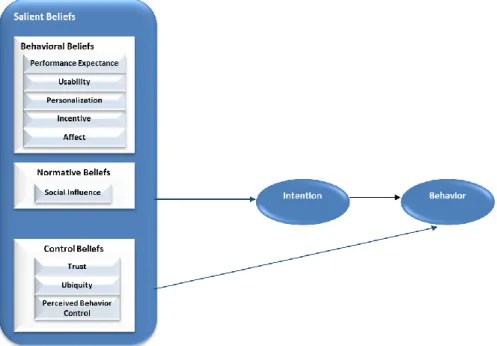
Constructs of the model were chosen according to the results of the target group analyses. According to the target group analysis time saving, ease of use, usefulness, easy access, incentives and enjoyment are advantages of e-service usage (see Table 2). In the light of this information, performance expectance, usability, personalization, incentives and affect constructs are selected for the model as behavioral beliefs. Affect comprises the perceived enjoyment, intrinsic motivation factors in the literature.
There are two types of normative beliefs: social influence and informational influence. Previous works indicated that when the system use is voluntary social norm (or social influence) do not affect the intention to use (Venkatesh et al., 2003). The literature suggests that social norm has a weak role in online behaviors. In parallel, the target group analysis in this research
study revealed that 24% of the participants were not influenced by anybody while using e-services. As a consequence, this study investigates the effect of informational influence on the intention.
Target group analysis showed that time problems, access whenever and wherever wanted, trust enable participant to use e-service, whereas credit card necessity, security concerns and long procedures make difficult their e-service usage (see Table 3). Therefore, trust to the service, ubiquity and perceived behavioral control constructs are included in the model as control beliefs.
Figure 1, represents the constructs of the e-Service Continuance Usage Framework.
6.Conclusions and Future Directions
This study aims to develop an e-service continuance framework that predicts and explains e-service continuance usage and covers different belief determinants of usage intention. First, target group analysis was carried to validate that actual users’ salient beliefs are captured by the constructs included in the study. Then, framework has been established according to the results of these analyses. This framework contributes to the literature by identifying the factors that influence the e-service usage for behavioral, normative and control beliefs. Besides the findings in the literature, actual users were included to the factor determination process. This approach brings about more accurate and effective results.
Further research, via using this framework, may investigate how usage perception is formed and altered with the increasing experience with e-service. Such studies will approve the validity of this framework and will lead to accumulation of further research in this field. The following steps may be performed. First, a scale is developed and reliability and validity analysis is carried out. Then, a confirmatory study is conducted.
Also, application developers will be benefit from this framework while planning, designing and developing systems. The findings can provide useful recommendations to development of practice and policy making that is customer-oriented and evidence-based.
References
International Communication Union (ITU). (2011). Yearbook of Statistics - Telecommunication/ICT Indicators 2001-2010, 37th Edition.
Rust, R.T. & Kannan, P.K..(2002). E-Service: New Directions in Theory and Practice. New York, NY: ME Sharpe. Money, W. & Turner, A. (2004). (Ed.)Application of the Technology Acceptance Model to a Knowledge
Management System, Proceedings of the 37th Hawaii International Conference on System Sciences, Washington: IEEE.
Bhattacherjee, A. (2001a). An empirical analysis of the antecedents of electronic commerce service continuance, Decision Support Systems, 32, 201–214.
Bhattacherjee, A. (2001b ). Understanding Information Systems Continuance: An Expectation-Confirmation Model, MIS Quarterly, 25(3); 351-370.
Venkatesh, V. & Bala, H. (2008). Technology Acceptance Model 3 and a Research Agenda on Interventions, Decision Sciences, 29(2); 273-315.
Ajzen, I. (1991). The Theory of Planned Behavior. Organizational Behavior and Human Decision Processes, 50; 179-211.
Rust R. T. & Kannan P. K (2003). E-service: a New Paradigm for Business in the Electronic Environment, Commun.. ACM, 46(6), 36-42.
Ajzen, I., & Fishbein, M.(1980). Understanding Attitudes and Predicting Social Behavior, NJ: Prentice-Hall Inc. Venkatesh V., Morris M. G., Davis G. B. & Davis F. D. (2003). User Acceptance of Information Technology: Toward