COMPOSERS AS ETHNOGRAPHERS:
DIFFERENCE IN THE IMAGINATIONS OF COLIN MCPHEE, HENRY COWELL, AND LOU HARRISON
Ethan Lechner
A dissertation submitted to the faculty of the University of North Carolina at Chapel Hill in partial fulfillment of the requirements for the degree of Doctor of Philosophy in the Department of Music.
Chapel Hill 2008
Approved by:
Severine Neff (chair)
Annegret Fauser
David García
Sarah Weiss (advisor)
ABSTRACT
ETHAN LECHNER: Composers as Ethnographers: Difference in the Imaginations of Colin McPhee, Henry Cowell, and Lou Harrison
(Under the Direction of Sarah Weiss)
This is a study of the ideas of musical difference held by three twentieth-century
composers—Colin McPhee, Henry Cowell, and Lou Harrison. Each wrote about culture,
and was thus in a broad sense an ethnographer, and each was influenced by non-Western
musics in the development of innovative compositional techniques. I discuss how their
very different views on non-Western musics were inextricable from other aspects of their
professional work. I compare their ideas to those of his closest colleagues and contrast
them with dominant anthropological understandings of culture difference in the twentieth
century, particularly the attitude of cultural relativism dominant in Ethnomusicology. In
the introduction I discuss the importance of formulations of differences to American
modernist composers generally, in particular the lines of differentiation they drew among
their own music, “conventional” Western music, European music, Romantic music,
“Oriental music,” and “primitive music.” I argue that modernists very often formulated
their representations of non-Western musics through the same process of negation of
ACKNOWLEDGEMENTS
I would like to thank my committee members, Annegret Fauser, David García,
Severine Neff, and Philip Vandermeer, who have all provided tremendous intellectual
and personal guidance. In particular I must thank Sarah Weiss, who has been a treasured
mentor and a source of inspiration. Thanks to Fulbright-Hays and the UNC-Chapel Hill
Graduate School for financial assistance. Thanks to Carol Oja, Leta Miller, and David
Harnish, who shared insights.
There were many librarians and archivists who offered assistance in this study. In
particular I would like to thank the archivists at the UCLA Ethnomusicology Archives,
the New York Public Library Performing Arts Division, the Library of Congress, and the
North Carolina State Archives. Also, special thanks must go to Charles Hanson at the
University of California at Santa Cruz Special Collections, who dug through the as-yet
uncatalogued materials in the Lou Harrison Archive to find items useful to this study.
The music librarians at the University of North Carolina at Chapel Hill have provided
tremendous support and guidance for years. I am especially grateful for the courtesy and
humor of Philip Vandermeer, Diane Steinhouse, and Eva Boyce.
I would not have been able to start on this dissertation, let alone complete it, without
the support of family and friends, colleagues and mentors. In particular I would like to
unceasing. Thanks to my Mother and brother Walden who proofread exactingly and
offered many useful suggestions.
There are many more who have shared in this effort. They are too many to name,
PREFACE
My original goal for this dissertation was to come to an understanding of cultural
difference that could account for hybridity in the compositions of a variety of composers.
In the end, I do not claim to have come to such an understanding, or to have arrived at an
analytical approach that can account for music that subsumes difference in the manners
of works as varied as Colin McPhee’s Tabuh-tabuhan, Henry Cowell’s United Quartet,
and Lou Harrison’s Double Concerto. My subjects have not cooperated with that aim.
Each approached the issue of cultural difference uniquely—though certainly not in
isolation from others grappling with the same issues—so that I have been drawn away
from my original goal of explicating a single method by which to analyze them all, and
have been forced to delve more deeply into their particularities. The analyses that I have
done, then, have necessarily become specific to the terms by which each of these
composers dealt with the same concerns that were originally my own: namely, the
bafflement of cultural difference, and how, in the context of music, differences
sometimes dissolve into sameness.
I had originally planned to develop a theory of intentional hybridization in
composition. Through the development of the study, I have been forced to come to terms
with the insight that meaning (defined broadly to encompass all aspects of musical
by the listener willingly or unwillingly. This implies that hybridity is also not something
that can be considered immanent to music and analyzed as such, but is something that
must be considered in the terms by which it is ascribed. Thus, the central question of the
project has been transformed from How can the hybrid qualities of the musics of various
composers be understood? to How did various composers understand their musics as
hybrid, on what terms did they stake their claims to hybridity, and how did they articulate
their claims to others? The result is that the word hybrid, which was the central concept
TABLE OF CONTENTS
LIST OF TABLES………..xi
LIST OF MUSICAL EXAMPLES………xii
LIST OF ABBREVIATIONS………..xiii
Chapter I. Introduction……….14
Similitude as a Key to Hybrid Composition………..31
Contemporary Paradigms of Constructing Difference………..34
Issues in this Project’s Assemblage………...42
II. Colin McPhee and “The Absolute Music of Bali”………. 49
Omission and Metaphor in A House in Bali………. 53
American Modernist Views of “the Primitive” in the 1920s and ‘30s………. 64
A 1935-36 Return Visit: Textual Issues of Ethnography in “The ‘Absolute’ Music of Bali” and Tabuh-tabuhan……… 75
New Musical Resources……….. 119
Mr. Ch and Chinese Meter………...131
Neo-Primitivism and the Proletariat……… 139
“Primitives,” Dance, and Percussion………... 144
"The Nature of Melody”………. 148
Joseph Yasser………...155
The United Quartet………. 161
The Schillinger System……… 167
Conclusion………...173
IV. Lou Harrison and the “Whole Round World of Music”………..177
Prelude: The Question of the Double Concerto………... 177
Introduction………..179
The Dawning of a New Reality: Black Mountain College and the influence of Harry Partch……… 181
Harrison’s “Reality” Part 1: Similitudes through Dualism………..190
The “Reality” Part 2: The Construction of Similitudes through the Hierarchical Ordering of Trans-National Musical Concepts………. 210
Rational Eccentricity………... 219
Another “Reality” from Cultural Relativism………... 222
Conclusions………..234
V. Conclusions: Reflections upon Modernism as a Peculiar Style of Concern with Difference………... 237
LIST OF TABLES
Table
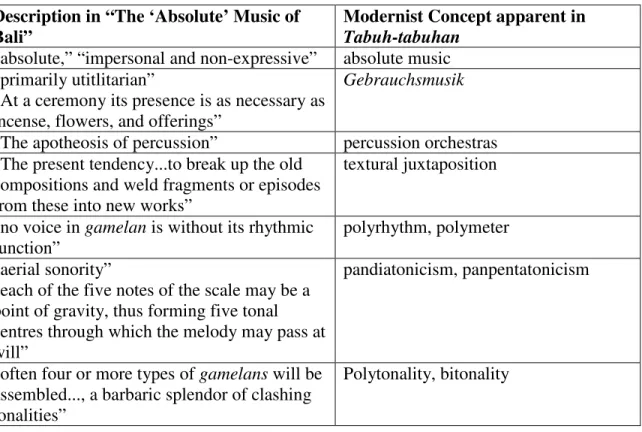
1. McPhee’s Metaphors Between Balinese Gamelan and
Modernist Composition………...64
LIST OF MUSICAL EXAMPLES
Example
1. “Shifting accents…that sound as though composed
of units of five notes” (AMB, 168).……….79
2. Syncopations of the 3 + 3 + 2 variety (movement 1 “Ostinatos,” mm. 49-52, piano I)………82
3. “The melodic outline is generally restricted to some form or other of a pentatonic scale. . .” (AMB, 169)………...84
4. Flute and Piano I figuration at the opening of Tabuh-tabuhan (mvt. 1 “Ostinatos,” mm. 1-6)………...85
5. Movement 2, mm. 93-96. “A barbaric splendor of clashing tonalities”………86
6. Two juxtaposed textural blocks (Tabuh-tabuhan, movement 1, mm. 7-11)………....88
7. The Overtone Series (NMR)……….108
8. Examples of Polymeter (NMR)………114
9. Quartet Euphometric (or Romantic)...117
10. 2nd Movement, United Quartet……….153
11. Excerpt from Gending Hephaestus, Violin Staff Notation………..191
12. The same excerpt, Kepatihan Notation………...191
LIST OF ABBREVIATIONS
Frequently cited works are identified with full reference in the first citation, and subsequently with the following abbreviations:
AMB Colin McPhee, “The Absolute Music of Bali”
HIB Colin McPhee, A House in Bali
CTW Carol Oja, Colin McPhee: Composer in Two Worlds
McPhee Coll. Colin McPhee Collection, UCLA Ethnomusicology Archives
CAW Miller and Lieberman, Lou Harrison: Composing a World
LHR Peter Garland, ed., A Lou Harrison Reader
GOM Harry Partch, Genesis of a Music
MP Lou Harrison, Music Primer
Cowell Coll. Henry Cowell Collection, New York Public Library for the Performing Arts
NMR Henry Cowell, New Musical Resources
NOM Henry Cowell, The Nature of Melody
Chapter I: Introduction
“Loosely speaking, every one interested in modern music realizes there is some resemblance between certain aspects of primitive and of contemporary music.”
Henry Cowell, 1933
In his introductory overview of “modernism” for the Oxford History of Western
Music, Richard Taruskin comments on the special relationship the movement had with its
time:
To make an ism out of being modern is on the face of it paradoxical, since if modern simply means "of or pertaining to present and recent time" (as one dictionary defines it), then everyone is modern by default, and always has been, since we cannot live at any other time than the present. To be modernist, then, is more than to be modern. Modernism is not just a condition but a commitment. It asserts the superiority of the present over the past (and, by implication, of the future over the present), with all that that implies in terms of optimism and faith in progress."1
Based on my own examination of United States composers of the first half of the
twentieth century, it appears that Taruskin’s statement can be amplified somewhat.
Modernism was characterized not only by enthusiasm for the progressive aspects of the
present, but also by antipathy for the present’s recalcitrant mainstream. Modernism’s
feelings for the immediate past (specifically the nineteenth century) were largely
disdainful, while its feelings for the long past were often admiring. With respect to the
1
Richard Taruskin, The Early Twentieth Century, volume 4 of The Oxford History of Western Music
rest of the world, modernism in the U.S. was often pointedly dismissive towards Europe,
while it was concerned with gaining deeper understanding and appreciation of the musics
of the non-West and its own “folk” and indigenous “primitives.” As will be seen, within
the minds of modernists all of these issues were inextricably related.
For modernism, particularly in America, cultural difference was always an immediate
concern, even when it was not the explicit concern. This fact is reflected in the intensive
study of non-Western musics in which modernists frequently engaged, and which is
documented in their writings. It is also reflected in the frequent allusions to non-Western
musics in their compositions. In this dissertation I examine how in both of these idioms,
writing and composition, modernists represented both particular non-Western musics and
the nature of the world’s cultural divisions in general. This introduction explicates the
most general features of modernist thinking about difference, and the remainder of this
dissertation analyses the written and musical works of Colin McPhee, Henry Cowell, and
Lou Harrison.2
By way of introduction to these issues, consider Stravinsky, who said,
“Expressiveness has never been an immanent feature of music.”3 By what means did
Stravinsky ascertain certainty about the “immanent” features of music? By what methods
of induction or deduction and by what evidence did he arrive at this knowledge? As we
will see, one cannot get far tracing this notion and others like it without encountering the
ideas about cultural difference (and non-difference) that were in circulation at the time,
2
For my purposes here I define modernism circularly. My modernists are those twentieth-century composers who formed a discourse community, whose style of thinking about cultural difference it is my primary purpose here to explicate.
3
both within the modernist composers’ own community and beyond it in other fields.
Knowledge of the “immanent features” of music, whatever they were believed to be, was
sooner or later connected to ideas about non-Western musics, either developed through
direct observation or, as frequently, through imaginative imputation.
Indeed, Stravinsky made his above statement about the nature of music—as a
universal phenomenon—in the course of describing the Russian folk poetry, in which he
had observed this essential, elemental quality of non-expression (and upon which he had
imputed it). It was as if, by simple virtue of being distant from Western European
bourgeois culture, Russian folk peasants could by negative association be cited as the
bearers of music’s most elemental, “immanent” properties. It was also as if, by simple
virtue of being Western, the music of the bourgeois concert hall could be regarded as in a
strange way disconnected from its truest nature, its own “primitive” essence.
Stravinsky also stated, “It is in the nature of things—and it is this which determines
the uninterrupted march of evolution in art quite as much as in other branches of human
activity—that epochs which immediately precede us are temporarily farther away from us
than others which are more remote in time.”4 This statement provides a summary of the
modernist position vis-à-vis its others as I have observed it. It indicates a belief in the
unified march of culture, and an acknowledgement of the propensity to value that which
was far removed in time and to regard with antipathy that which came directly before. It
is the aim of this dissertation to elucidate how this style of thought played out, albeit in
quite various ways, in the writings and compositions of Colin McPhee, Lou Harrison, and
Henry Cowell.
4
If there were features of the American modernist preoccupation with difference that
were historically peculiar, certainly the tendency of these composers to construct an
identity for themselves—both as individuals and as a movement—in antithesis to a
constructed other predated them. In very general terms, earlier ideas about cultural
difference, those dominant among anthropologists in the 19th-century United States, had
been largely focused upon paradigms that placed “civilized” society as unambiguously
superior to all others by dint of its supposedly higher evolutionary state. Whether through
explicit, theorized racism or through a notion of unilinear cultural evolution without
racial differentiation as its basis, non-Western peoples were understood as crude and
irrational, and their artistic products were in a significant sense irrelevant to the
“civilized” person.5 If a great deal of effort was expended in proving this to be the case, it
was then possible for a person of distinction to expend little effort looking to other
cultures for artistic and intellectual guidance. Indeed, we can witness many
representations of non-Western people and their music by 19th-century composers in the
U.S. and Europe that were fanciful, sensational, and unconcerned with veracity.
This style of thought has been discussed at length in musicological criticisms of 19th
-century representations of the ethnic other (particularly in opera). It has been frequently
argued that there was an all-but-total disconnect between such musical representations
and that which was represented. There was, in other words, a great deal of fantasy. Susan
McClary, for instance, notes that to consider Bizet’s Carmen as an example of Spanish
5
Three resources on the history of anthropology that I have found invaluable in this study are George W. Stocking, Jr., Race, Culture, and Evolution: Essays in the History of Anthropology (New York: The Free Press, 1968); Adam Kuper, The Invention of Primitive Society: Transformations of an Illusion
music “confuses the image of the ethnic other concocted by the Northern European with
the thing itself…” Bizet did some research into Spanish music by studying arrangements
of Spanish folk songs, but “any ‘authentic’ Spanish flavor Bizet received from this
source too was already heavily mediated.” McClary states definitively that, despite “the
influence of actual Spanish, Spanish-American or gypsy sources…Bizet’s agenda was
not ethnography.” 6
The very broad cultural trend that tended to validate styles of representation that were
fantasies (or all but), has come to be referred to in academic discourse as “Orientalism,”
and in musicological discourse it is often referred to as either “Orientalism” or
“exoticism.” In musicological discussions, the term Orientalism refers most often to
musical representations that were created, as McClary states of Carmen, “not through
instinct or by virtue of … borrowing from ethnic sources, but rather by means of [a] well
developed set of signs that … audiences shared…” (p. 54). To describe an opera as truly
“exoticist” is then to state that the various signs (including musical ones) that it used to
represent the other had only an arbitrary relationship to any actual person or peoples.
For this study, what marks the rise of musical modernism is the intellectual shift
among a few early-twentieth-century composers in which explicitly condescending
attitudes towards the “pre-civilized” were no longer compelling, and the rights of a
composer to freely engage in fantasy was severely curtailed. A corresponding shift in
anthropology was associated with Franz Boas. Beginning roughly with his critique of
6
anthropological racism in The Mind of Primitive Man, anthropologists began focusing
their studies of non-Western peoples into critiques both of the cultural biases in
anthropological theories and of Western societal norms more broadly, rather than
proceeding with an assumption the West’s unassailable superiority, against which
non-Western cultures were measured and inevitably found to be inferior.
Corresponding trends in the arts began to make use of non-Western artistic products
(as observed and as imagined), which had previously been regarded as culturally inferior,
into critiques of prevailing aesthetics. For instance, as we will see in Chapter 2, where
contemporary aesthetic norms called for continuous melodiousness, the other was
invoked as a case for disjunction and percussiveness. When norms called for grand and
amorphous orchestral sounds, the other was invoked as a case for sparseness and clarity.
When norms demanded expressiveness, the other was invoked in the case for
non-expression. The other represented a new source of authority, not based upon its
acquisition of “civilization” but upon its very freedom from it. If faith in the superiority
of “civilization” had produced absolutist arguments about the nature of music as a
universal phenomenon, the new primitivist epistemology countered these with
absolutisms of its own.
Pierre Boulez, for instance, made such statements in the tersest way, for to him there
were only a few very distinct things that were of interest about “Oriental music,” and
those he understood as antitheses to aspects of Western music: “the time structure, the
being admired as a masterpiece but as an element of spiritual life.”7 Beyond these points
there was only “great foolishness” in going to the “the Orient,” for its music “that has
attained perfection is now frozen, and if there is no modern Oriental music it is because
those peoples have lost their vigour.” The particular aspects of “Oriental music” that
interested Boulez differed from those that interested the three composers of this study,
and his tone was far more arrogant than theirs. Yet, his manner of discovering Oriental
music,” seeing it purely as a reflection of his own aesthetic concerns will be echoed in
each chapter of this dissertation.
With the rise of modernism, constructions of difference were coming to serve a new
function and assuming a new form. It was not so much that among artists and
anthropologists discussions of difference were moving past binary paradigms, but that the
way in which such oppositions were drawn began to shift. Before modernism (and to a
great extent continuing concurrently with it), discussions of difference had focused upon
the poverty of value in non-Western culture. This lack was opposed with, and gave shape
to, the high value of the favored arts of “civilization.” Edward Said has described this
dualism as structural to Orientalist thought and furthermore as integral to the construction
of the Western image of itself. He summarizes the 19th-century propensity to categorize
humanity into groups as based upon a
rigidly binomial opposition of “ours” and theirs,” with the former always encroaching upon the latter (even to the point of making “theirs exclusively a function of “ours”)…. “Our” values were (let us say) liberal, humane, correct; they were supported by the tradition of belles-lettres, informed scholarship,
7
rational inquiry; as Europeans (and white men) “we” shared in them every time their virtues were extolled.8
Now with modernism a double opposition was formulated: first was that between the
non-West and the West, in which the non-West was interpreted as a newly significant if
not superior source of influence for artists; second was the opposition between the small
modernist movement and the mainstream of society. This meant that, with these two
oppositions, modernism took the innovative step of correlating its own ideas and styles
with those of non-Western people, rather than with the supposedly superior “West” (with
which it self-identified, if only for rhetorical purposes).
As an example, we can observe Debussy commenting upon Sundanese (West
Javanese) music that he heard in 1889 as, “able to express every shade of meaning, even
unmentionable shades, and which make our tonic and dominant seem like ghosts.”9
Though Debussy’s encounter with gamelan was far more casual than that of the three
American composers I focus upon here, in this structuring of oppositions they were alike.
In remarking upon the relative merits of Sundanese music over Western music, he was on
the one hand remarking that “theirs” was better than “ours.” On the other hand, once we
take a closer look at that which was “ours” we see that Debussy did not in fact
unequivocally identify with it, but that it was precisely what he aimed to distance himself
from. By 1895 when he made these comments he had himself developed a compositional
8
Edward Said, Orientalism (New York: Pantheon Books, 1978). Said’s analysis of the Orientalist tradition has been critiqued by some as reductive. For a critical assessment of Orientalism’s impact on academia, see Daniel Martin Varisco, Reading Orientalism: Said and the Unsaid (Seattle and London: Univ. of Washington Press, 2007). See also James Clifford, “On Orientalism,” in The Predicament of Culture (Cambridge: Harvard Univ. Press, 1988), 255-76.
9
idiom which had distorted conventional tonic and dominant (for instance in Pelléas et
Melisande and Prélude à l’après-midi d’un faune), and he did so, if not in direct imitation
of Javanese music, then with an either/or mentality through which Javanese music and his
own fell into ideological alignment.10 He made this either/or concept more explicit in a
1913 statement of how the Javanese were different from “civilized” peoples:
There were, and there still are, despite the evils of civilization, some delightful native peoples for whom music is as natural as breathing. Their conservatoire is the eternal rhythm of the sea, the wind among the leaves and the thousand sounds of nature which they understand without consulting an arbitrary treatise. Their traditions reside in old songs, combined with dances, built up throughout the centuries. Yet Javanese music is based on a type of counterpoint by comparison with which that of Palestrina is child’s play. And if we listen without European prejudice to the charm of their percussion we must confess that our percussion is like primitive noises at a country fair.11
We may note that each aspect of Debussy’s representation of these “delightful native
peoples” was articulated in antithesis from some aspect of Western culture that had
become tiresome to him. If “their” music was natural, this implied that “ours” was
contrived. If “theirs” was drawn from the elements of humans and nature, “ours” was
10
For a summary of the literature addressing how Debussy was influenced by gamelan, see Annegret Fauser,“French Encounters with the Far East,” chapter 4 in Musical Encounters at the 1889 World’s Fair
(Rochester, NY: University of Rochester Press, 2005). Fauser writes, “In general terms, Debussy’s orchestra, especially in Nocturnes (1987-99) and La Mer (1903-5), has been described as a “stylized gamelan” because of the often layered instrumentation. The superimposition of different timbral, rhythmical, and registral strata is also one of the character traits of works such as Pagodes and has been identified as influenced by the gamelan” (p. 199). Of particular relevance to my present discussion of modernist ideology is Fauser’s observation that the musicological literature has tended to read Debussy’s encounter with the gamelan in terms of a propulsion towards innovation, a peculiarly modernist narrative: “The musical innovations of Debussy’s piano music with respect to structure and harmonic language can thus be understood through his encounters with a new sound-world. His new sonorities then found their basis in complex materials appropriated from a different world, and their presence could thus be attributed to a rupture with tradition—a concept dear to the ideology of modernism—rather than to the more suspicious notion of late-nineteenth-century French eclecticism within a continuous development of the Western tradition” (p. 200). See also Richard Mueller, “Javanese Influence on Debussy’s Fantasie and Beyond,” Nineteenth-Century Music 10 (autumn 1986-87): 157-86;.and Mervyn Cooke, “’The East in the West’: Evocations of the Gamelan in Western Music,” in The Exotic in Western Music, ed. Jonathan Bellman (Boston: Northeastern Univ. Press, 1998), 258-80.
11
inscribed in arbitrary treatises. If “their” percussion was sophisticated, our “civilized”
percussion was, ironically, “primitive.”
What I am identifying as the modernist style of thinking amounted to a reversal but
not necessarily a revision of earlier ethnocentricity. Although Debussy used of the word
“primitive” as a criticism of the percussion of Western culture, he was not actually
overturning the dominant cultural evolutionist paradigm in which “primitives,”
conceived of as aboriginal peoples of Africa, America, Asia, and Australia, were
understood to persist in the same state as Europe’s long past. It was a reversal of the
system of values that underlay the paradigm, but his statement maintained evolutionist
logic. Whether it was good or bad to be “civilized,” what remained certain was that some
people were, and others were not. And what it was to be “not-civilized” could be
determined simply by imagining the opposite of what it was to be “civilized”: to be
uncontrived, to draw one’s music from nature, and have sophisticated percussion
techniques. Even with as limited direct contact as the World’s Fair provided him,
Debussy could deduce such knowledge of the lives of the Javanese performers, for he
possessed, as a supplement to his limited contact with the musicians there, a battery of
preconceptions about the binomial differences between “civilized” and “non-civilized”
peoples.
Many parallels will be found among the three composers of this study. Though in his
publications Cowell often described specific, geographically located musical traditions,
he also frequently referred to both “primitive” and “Oriental” musics as broad classes,
without any reference to actual temporally or geographically located persons or peoples,.
whereas, of course, Westerners did.12 It is most likely that in cases such as this Cowell’s
“primitives” were functions of his Westerners, derived through imaginative assumption
about what would be the opposite of them: if Westerners differentiated between speech
and song, primitives surely did not. “Orientals” then occupied a space along a continuum
drawn between “moderns” and their “primitive” opposites. This form of thinking,
apparent in many anthropological accounts of the “primitive”—in other words most
anthropological writing prior to the rise of Boasian relativism, and many thereafter as
well—has been described by Adam Kuper:
For [the anthropologists] modern society was defined above all by the territorial state, the monogamous family and private property. Primitive society therefore must have been nomadic, ordered by blood ties, sexually promiscuous and communist. . . . [Anthropologists] looked back in order to understand the nature of the present, on the assumption that modern society had evolved from its antithesis.13
Debussy’s representation of the Javanese was more romanticized and less informed
than were the representations by the three composers of this study, but in its structuring
of antitheses it was the same. As will be seen, even after years of study in Bali, McPhee
also constructed his representations of Balinese music so as to conform to certain
pre-formed categories occupying the thinking of his composer colleagues, describing
Balinese music as in many ways the antithesis of 19th-century European music: as
non-expressive, as socially functional, as rhythmically complex, and as orchestrally lean. As
mentioned, Cowell made primitivist statements similar to Debussy’s, and developed
ideas about “primitive” music based simply upon assumptions that it would be the
12
This statement appears in Cowell’s unpublished manuscript, The Nature of Melody (hereafter cited as NOM), Henry Cowell Collection, New York Public Library for the Performing Arts (hereafter cited as Cowell, Coll.).
13
opposite of “cultivated” music. Harrison’s views of Java were different from Debussy’s,
far more informed by careful study of gamelan, but no less determined by what he saw
Javanese music to not be.
As early as 1931, Charles Seeger noted the tendency among his modernist colleagues
to create their own music through negation of conventional styles:
Most modern composition seems to restrict itself to a comparatively narrow variety of moods. In avoiding romantic sentiments, there has been little left except excitement, which is not an emotion or sentiment. . . In its abhorrence of the pretty, the sentimental, the self-pitying revelry, the exuberant optimism and subjectivism of romantic ardor, modern music has run almost entirely to the grotesque, the unsentimental, the merely exciting, and the almost inevitable pessimism of pure objectivity.14
To a great extent, American modernists not only forged self identity and compositional
style through negation of “romantic sentiments,” “prettiness,” and so forth, but conceived
of non-Western musics through a similar process of negation. They defined their bearers
of “the truth about music” in contrast with European styles and particularly with
Romanticism, for instance by representing them as rhythmically rather than harmonically
complex, or as utterly inexpressive, out of contrast with the emotiveness of Romanticism.
This style of constructing the other through contrast from familiar cultural figurations
served a double function. On the one hand, it provided the modernists with an image of
the other from which they could easily draw influence by virtue of its very perfect
dissimilarity from familiar musical style. The other was created on familiar terms
through the simple inversion of its aspects. This constituted an enormously rich way of
developing original material in a heartbeat, and offered a potent opportunity for
modernists to think their way out of the hegemonic modes (not just musical ones). On the
14
other hand, this method of conceptualizing non-Western musics functioned to create a
source of authority for the validation of the music modernists had already composed,
even if it had not in fact been directly inspired by any non-Western image. These two
tendencies went hand in hand, and their reciprocal relationship propelled some of the
stylistic shift of the twentieth century. The modernist created the other in his own image,
while fashioning himself after his imagined other.
This raises the question, whom did the modernist really imagine to be his other?15
Was it the non-Western person, or was it the other musician of his own society who was
stuck in European styles of the 19th century, or in some other sense ignorant of the “truth
about music” as it was apparent to the modernist himself? If the question is which was
the object of the American modernist’s antipathy (at least as evidenced in his
publications), then the answer is clearly the other Western musician. For instance, Boulez
exhibited this attitude in the above quotation, for although he spoke dismissively about
“Oriental musics,” his real adversary, the real other that he sought to intellectually
dominate, was the Western composer who might look for false forms of inspiration in
“Oriental musics.” The reality of “Oriental music” itself was only represented in order to
win an argument that was internal to his own community of composers.16
15
I will occasionally use the pronoun his to refer to a general, non-specific modernist composer. I have chosen to do so as an acknowledgement that musical modernism was a largely male (an often masculinist) historical movement. Otherwise, in referring to members of mixed-gender populations I write he/she,
his/her.
16
A recurrent tendency of the composers of New Music—which will be seen again and
again in the three studies that follow—was their taking exception to the prevailing
musical norms as coercive and tiresome. The non-Western counterexample to these
norms offered both the opportunity and the compulsion to innovate. As noted, it is not
necessarily the case that one of these aspects preceded the other. The desire to innovate
led the modernist to new investigations into the musics of others; meanwhile,
investigations of the musics of other produced revelations that necessitated innovation.
In the effort to challenge Western hegemony modernists frequently found it
imperative to go beyond merely introducing examples of alternative forms of
music-making, and to make absolutist statements about music and humanity staked upon
representations of such other musics. The other offered not merely another example of
how music might be made, but was a key to a singular “truth about music” which
modernists sought to ascertain, in much the same way that Foucault describes 19th
-century scientists having sought the “truth about sex.”17 The tendency to seek the “truth
about music” among modernists might be regarded as part of a larger intellectual
holdover from the nineteenth-century. As Martin describes:
In the late nineteenth and early twentieth centuries ethnic researchers had gone into the field and into the libraries with many varied agendas and subagendas, but most usually with the ethnocentric assumption of objective expert authority and the propensity, in the standard style of nineteenth-century science, to steer their findings into the channels of universal truths about human nature and societies.18
17
The following quote from Foucault on the notion of “suppressed sexuality” as ripe with parallels in the modernist discourse on what might be called “suppressed musicality”: “The notion of repressed sex is not, therefore, only a theoretical matter. The affirmation of a sexuality that has never been more rigorously subjugated than during the age of the hypocritical, bustling, and responsible bourgeoisies is couple with the grandiloquence of a discourse purporting to reveal the truth about sex, modify its economy within reality, subvert the law that governs it, and change its future” (Michel Foucault, The History of Sexuality: An Introduction, trans. Robert Hurley(New York: Vintage Books, 1990), 8. If one replaces the word “sex” with “music” one comes very close to a summary of the position common among modernist composer.
18
Though modernists constantly advocated revolt from the cultural molds of the 19th
-century, ironically their means toward their revolutionary ends were in this case
retentions of the 19th-century scientific positivism. The methods and findings varied
significantly, and yet the tendency to seek such “truths about music” through totalizing
schemas was pervasive, and non-Western culture was one of the key objects of study
toward that aim. This will be seen to be especially clear in the chapters on Cowell and
Harrison that follow.
Modernist composers were usually only casual consumers of anthropological ideas.
For this reason, there is little terminological unity evidenced within modernist
publications when they refer to issues of cultural difference. I will use terms such as
“primitive” and “exotic” in reference to particular threads of modernist thought, even
though they were occasionally used differently by the modernists themselves. The term
“primitive” is an important case in point, for while I have found relatively few uses of the
term in modernist publications, and while primitivism is not often thought of as having
been as significant a movement among early-20th-century composers as among visual
artists, a great deal of the ideas about difference articulated by modernist composers
implied evolutionist and primitivist styles of thought.19
For instance, McPhee was probably equivocal in his regard of the Balinese as
“primitives,” and yet he often implied that the Balinese were the bearers of elemental
human traits, which implied primitivism. When Cowell wrote about “Orientals” he was
19
not speaking about the same category of humanity as “primitives,” and yet he was
referring to an evolutionary schema that implied the existence of “primitives” as a
category less developed than “Orientals.” Furthermore, Cowell sometimes decried the
term “primitive” as condescending, while in the same utterance affirming that there were
categories of humanity ranging from least to most advanced (even at the point when
Cowell lost his taste for the word “primitive,” he continued to refer to a least advanced
stage of human cultural development, the notion of which would have popularly been
called “primitives,” “barbarians,” or “savages”). Harrison did not much refer to
“primitives,” but he did remark that there were “primitives.” His own interests were in
“cultivated Oriental” peoples, a category which took definition in contrast from
“primitive” peoples (Harrison probably was most influenced by Cowell in his
understanding of differences between “primitive” and “cultivated” peoples).
The objective of modernists in this regard was most often counter-institutional, in so
far as their findings about musical “truths” were articulated as challenges to what they
saw as the hegemonic order. As far as this goes these modernists might be regarded as
“relativists,” for non-Western musics were important to them in the critique of
absolutisms in contemporary currency. None of these ethnographer/composers, however,
were epistemological relativists. They did not maintain that knowledge was ultimately
relative to culture, and that universals were actually ethnocentrisms. Each of them held
absolutist views on the “truth about music.” I will discuss the subtlety of this distinction
at length in regard to Cowell, who in spite of and indeed because of his positivistic style
Both the non-Western other and the mainstream Western other were constructions of
the modernist imagination. I wish to emphasize that for the purposes of this study what I
am explicating and critiquing is the non-West only in terms of its existence in the minds
of modernists. I am not, in the following criticisms of the images of difference held by
Colin McPhee, Henry Cowell, and Lou Harrison, attempting to clear away their
“misunderstandings” so that the correct “understandings” may emerge. I reiterate that if
the identity of the non-Western other, of the mainstream other, and of the modernist
himself were all constructions, this is not to say any was simply a fantasy. As noted,
many modernists expended a great deal of effort in their studies of non-Western musical
practices, the three that I focus on being particularly notable examples, and their
representations continue to be compelling in many regards. If, for the purposes of this
study, the other ultimately only existed as images in the mind of these composers, this is
not to say that these were images uninformed by careful study and even interaction.
It is also important to emphasize that, though at moments in this study I will describe
a particular representation of the other having given rise to a particular style, or a
particular stylistic concern having given shape to the representation of the other,
ultimately none of these factors should be understood to have preceded the other two.
The modernist’s conception of his mainstream other was continuously reinvented with
his shifting conception of the non-Western other. His self-conception was continuously
reborn in opposition to his shifting conception of his mainstream opponent. His
non-Western person or peoples were continuously re-imagined as correlates to his shifting
concept of self. This process of reciprocation is discussed in greater concreteness in the
Even in cases, such as that described by Kuper above, in which the attributes of
“primitives” seem to have been invented purely by calculating the antitheses to the
attributes of “civilization,” there is still the question of how and why certain attributes of
civilization became problematized in the first place. How did Kuper’s anthropologists
come to reflect on there being anything peculiar about their territorial states,
monogamous families, and private properties? It was only by encountering, at some
historical moment, that which seemed to be startlingly non-territorial, non-monogamous,
non-private, and hence non-civilized. Similarly, modernist composers’ problematizations
of Western musical norms were the result of modernist engagements with difference in
some form. Constructions of difference as a world-wide phenomenon meanwhile fell into
shape along the ideological fault lines of contemporary Western discourse. Neither came
prior to the other.
Similitude as a Key to Hybrid Composition
If so far I have emphasized the importance of dichotomization in the imagining of
difference by modernist composers, I have done so to a great extent in order to point to
the most important compositional technique that modernist composers employed in their
compositional engagements with difference. This was the flip-side of the construction of
difference: the construction of sameness, or, as I will call it, “similitude.” The
construction of similitude was most precisely a strategy of constructing knowledge of
foreign musics in a manner by which those musics could become sources of influence.
Similitudes were those features of music that could be said to be both “theirs” and “ours,”
and were so, demonstrably, because within a binaristic framework they were not a third
This strategy can be found in use by the three composers I have studied, in spite of
their varied compositional styles and ideas about difference. In his 1935 article “The
‘Absolute’ Music of Bali,”20 McPhee described Balinese music on terms so familiar to
the members of his milieu that the word “Balinese” might have been substituted with
“modern” with little resulting incongruence. He generated these similitudes by
dichotomizing Balinese music with Romanticism. Balinese music was not made of
amorphous masses of orchestral sound, was not performed in concert halls, was not guilty
of hyper-emotional oozing, and was not harmonically overloaded. In all these regards, it
resembled various new ideas of modernist music, and in some of these respects it
resembled McPhee’s own composition Tabuh-tabuhan, which was a Bali-inspired work.
(He did not give these similitudes explicit statement; rather I interpret them as
ethnographic allegory in the sense described by Clifford, see below.) For Tabuh-tabuhan
this meant that McPhee composed each passage so as to speak in the very same “breath”
and in the very same “utterances” about Balinese music and about modernist music. This
unit of similitude, in which two voices speaking two distinct languages were heard within
a single breath, corresponds to what Bakhtin calls the “intentional hybrid.”21
Similitude becomes salient in my analysis of Cowell’s United Quartet (1936) at two
levels. First, Cowell created similitude in the construction of categories of human
20
McPhee, “The ‘Absolutle’ Music of Bali,” Modern Music 12 (May-June 1935): 163-69.
21
making. With these categories he subsumed various musical traditions into units of
sameness: “primitive,” “Oriental,” “archaic” and “classic” musics, along with other
categories that together encompassed all of human musicianship (spanning back
throughout the history of humanity). Second, he created similitude in the “uniting” of the
features of these various categories of humanity, based upon certain “elemental” bases
that he viewed as transcending all of these ethnic/historical divisions. The result was a
work that Cowell not only claimed to be universal, in the sense that it was based upon
musical features so fundamental as to be shared by every human musician, but
comprehensively human, in the sense that it represented aspects of every category of
human music throughout history.
Harrison’s approach to constructing similitudes was also dependent upon the
perception of the sameness of various distant traditions—unifying, for instance, the music
of Indonesia, Ancient Greece, and the modernist composer Harry Partch—by
understanding them to be in antithesis from others—those employing the tuning system
of equal temperament. Harrison, however, went much further than McPhee in imagining
the world, in very many aspects, to be lined up entirely into two forces of opposition, one
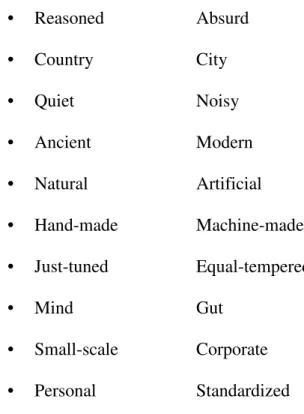
good and one bad. On the one side were the forces of reason, exemplified by Asia,
Greece, and certain modernists, and on the other hand were those of absurdity,
exemplified by dominant urban styles of music making and life. He associated reasonable
phenomena, differentiated them from absurd phenomena, which he then associated with
each other and differentiated from reasoned ones, and so forth. In the end a tremendous
amount of knowledge of the world—his “reality”—was coordinated within a single
Compositionally, this style of associating and differentiating yielded certain
trans-national conceptions of musical materials, which then permitted their combination as
simple workings out of what was “really the same” as it in fact existed in the world. I
discuss the relevance of this compositional method to Harrison’s Double Concerto for
Violin, Cello, and Javanese Gamelan.
The three composers that I have examined have turned out to have only limited
commonalities in terms of their views on difference, and this was in spite of their close
personal relationships. The more closely I have examined each, the more their
dissimilarities in their most fundamental terms of thinking about cultural difference have
become apparent. Certainly not one of them was content merely to work in the mold of
another. Still, each of them focused heavily upon differences and similitudes, and for
each this style of thinking was critical to his style of composing. This fact alone offers
argument for considering these three composers as of a single meaningful cultural
movement called modernism. I discuss the conception of modernism arrived at through
this study further in this introduction.
Contemporary Paradigms of Constructing Difference
Among intellectuals of the first half of the twentieth century, it was commonly
believed that there were “primitives,” peoples who might have existed on various spots
on the globe, persisting in more-or-less the same state as more “civilized” societies had in
their own very distant past.22 Such notions as there being an “primitive” form of society
based upon certain kinship structures, a “primitive” religion which was animism, closely
22
tied to “primitive” consciousness (mythic consciousness), and other “primitive” cultural
forms were commonplace and served as the foundation of inquiry in a variety of fields.
But, as Adam Kuper has pointed out, this long-lasting and pervasive surety about the
existence of “primitive society” was a delusion:
The rapid establishment and the endurance of a theory is not particularly remarkable if the theory is substantially correct. But hardly any anthropologist today would accept that this classic account of primitive society can be sustained. On the contrary, the orthodox modern view is that there never was such a thing as “primitive society.” Certainly, no such thing can be reconstructed now. There is not even a sensible way in which one can specify what a “primitive’ society” is. The term implies some historical point of reference. It presumably defines a type of society ancestral to more advanced forms, on the analogy of an evolutionary history of some natural species. But human societies cannot be traced back to a single point of origin, and there is no way of reconstituting prehistoric social forms, classifying them, and aligning them in a time series. There are no fossils of social organization.23
And he continues:
The persistence of the model is particularly problematic since various of its basic assumptions were quite directly contradicted by ethnographic evidence and by the logic of evolutionary theory itself. The difficulties were clearly stated by some of the leading scholars in the field (notably Westermarck, Boas, and Malinowski). Notwithstanding, social anthropologists busied themselves for over a hundred years with the manipulation of a fantasy… (p. 8)
Given the commonness of the belief among highly respected thinkers in the existence
of various “primitive” cultural forms, it is not surprising that many composers and music
theorists assumed that there must be some particular sort of music possessed by
“primitive” peoples all over the world. Even if the notion of “primitive” music was
untenable in light of the data available (and arguments launched in 1911 by Franz
23
Boas24), all three of the composers of my study, to one extent or another, worked under
its sway, as did most of their colleagues.
Primitivism, a reversal of more commonplace styles of evolutionist thinking that
found value in “primitive” cultural forms (rather than regarding them as inferior to the
products of “civilization), was common among artists and intellectuals in the early
twentieth century. Rather than viewing “primitives” as crude and barbaric, primitivists
saw them as more in touch with the fundamental aspects of human existence. Yet
primitivism only reversed the assignment of value in the evolutionist view of culture, and
in other respects maintained the ethnocentrism inherent to it. In the primitivist view, the
history of all the world’s peoples was still a single march of culture, with Western culture
having traveled the furthest.
The only question was whether it was better to be where “we” (as civilized people)
were, or to be where “we” had come from. In the evolutionist view, culture was not
something possessed uniquely by each group of people, but was singular and was
accumulated, with Euro-American society possessing it in the greatest degree. I use the
term primitivism exclusively in this sense, as an ideology that assumed the existence of
“primitives” in the contemporary sense grounded in cultural evolutionist theory, and not
in reference to other ideologies of valuation of long-past peoples living in simpler states.
Therefore I will not use the word primitivism to describe Harrison’s interest in Chinese,
Korean, and Javanese musics, because he did not regard these groups as “primitive” nor
did his conception of their significance have to do with a belief in unilinear evolution. He
did, however, share with primitivists the idea that non-Western peoples existed in a state
24
Boas, The Mind of Primitive Man (New York: Macmillan, 1911). In my understanding of the extent of Boas’s critique of received ideas on race and evolution, I rely upon Martin, The Languages; Stocking,
that was more fundamentally and “naturally” human, and that it is desirable for moderns
to “regain” certain of those peoples’ attributes. I do use the term primitivist in connection
with McPhee and Cowell.
Sigmund Freud’s ideas on difference provide a useful parallel to the primitivist
thinking among some composers. Though Freud was not an anthropologist, he was highly
concerned with anthropology because its concept of the “primitive” represented a key to
his own endeavors in the field of psychology. The “primitive” was essential man,
possessing the essential psychology of man (which Freud also found that his hysterical
patients possessed). He held the evolutionist view that civilization had advanced out of
“primitive” states, and yet, as Martin describes, Freud did not imagine that in “civilized
society” the irrational and savage aspects of the psyche had been conquered. “We” had
never ceased being “primitives”:
We live in the presence of in the presence of our ultimate ancestors’ urges and deeds and we always will. Our understandings and institutions might differ from those of primitive peoples, but our psychological and moral makeup is a
continuing heritage.25
Martin describes how, unlike other evolutionists who imagined that civilization came
about through the “triumph of knowledge over ignorance, of reason over superstition,”
for Freud civilization arose to a large extent by “the suppression of instincts” (p. 119).
This attitude characterizes a great deal of modernist speculation about difference: that
there were musical instincts possessed and acted upon by non-Western peoples that were
merely suppressed in “our” own society. The modernist composers that I study do not
seem to have been greatly influenced by Freud, yet it was not necessary to have been
25
directly influenced by Freud in order to sympathize with his regard of “primitives” as a
key to understanding human nature and the “truth about music.”26
Mark Slobin has remarked that, for much of the twentieth century the idea of the
“primitive” was one of three fundamental categories used in the study of non-Western
musics, along with “Oriental” and “folk”:
The study of world musics moved out of what would nowadays be called an Orientalist stance only in the 1960s. Till then, few people seriously questioned the notion that beyond the Western classical tradition there were three kinds of music to be studied: Oriental, folk, and primitive. This triad underlaid many works and was implicit in the training of my generation of researchers. “Oriental” of course referred to those Asian “high cultures” that had long-term, accessible internal histories and that could be “compared” with similar European systems.
“Primitive” encompassed all the “preliterate” peoples of the world, who had to rely on oral tradition for transmission and who had no highly professionalized “art musicians” in their midst. The “folk” were the internal primitives of
Euro-America.27
These categories pervading the thinking of early ethnomusicology were held by McPhee,
Cowell, and Harrison. Cowell, who was perhaps the most informed on theories of
difference in the social sciences broadly, kept particular stock in these three categories. In
Chapter 3 I will discuss in detail the use he made of them.
Not all of the modernist composers who expressed primitivist views would have
subscribed to cultural evolutionism in full form. Many were not interested in developing
full fledged and consistent theories of culture, but only in referencing concepts such as
“the primitive” in a more casual way. None was beholden to any schema of organized
26
Of the three composers discussed in this dissertation, McPhee was the most in sympathy with Freudian ideas, perhaps due to the influence of his wife Jane Belo, an anthropologist with Freudian leanings, and his close association with Margaret Mead, who, though not precisely a Freudian, frequently made observations about human psychology through her anthropological work. I have not found any the three composers central to this dissertation to have spoken at length in psychoanalytical terms, and Harrison’s rationalist epistemology all but excluded entirely psychoanalytical interests in the subconscious and irrational.
27
understanding of human difference. Though I will describe in each chapter a single
conception of difference possessed by each composer, in actuality what I point to in each
case were merely recurring styles of thought, not philosophies which they followed with
perfect consistency. Like most modernist composers, McPhee, Cowell, and Harrison read
eclectically and their ideas neither fell squarely along the lines of a particular established
paradigm nor were perfectly integrated. Like other modernists they were capable of
valuing “primitive” or “Oriental” culture at one moment, and holding up the value of the
modern civilized world at the next, as it suited their various agendas and appeared to be
sensible given the evidence they possessed.
Though the terms “primitive” and “primitivism” were employed by modernist
composers, they were not used with great consistency. It was sometimes the case that
other words, such as “exotic,” were used, even while the ideas expressed were distinctly
primitivist. I have attempted to use such terms with greater consistency than they
received in the modernist writings I analyze. The result may be some discrepancy
between my own use of terms and their use in the quotations of modernist composers I
provide.
The composers that I study were either just as interested in the musics of “Orientals”
as they were of “primitives,” or were all but exclusively interested in “Orientals.”
Nevertheless, I have given a great deal of attention to primitivist notions, because they
are a key to understanding how these composers conceived of “Orientals.” John Corbett
has described the relationship between these two concepts in the minds of experimentalist
composers:
Already, right at the outset of the proverbial golden years of American
an overriding interest in non-Western music: “Oriental” music is linked, at least by persistent proximity, with the “primitive,” and both are looked to for their rejuvenative powers in a period of mounting dissatisfaction with conventional Western musical civilization.28
Cowell often spoke of “primitives” and “Orientals” together, not because he regarded
them as the same, but because they were conceptually linked: “primitives” represented
the stage of human evolution at its origins, while “Orientals” represented a stage of
evolution that was higher than that of “primitives”—Oriental music, like Western music,
was “cultivated”—but lower than that of Euro-Americans (actually Cowell objected to
the words “higher” and “lower” in this context because of their Eurocentric connotation,
but he nevertheless maintained a unilinear understanding of human societies’ evolution
that implied higher and lower degrees of evolution). To the extent that Harrison’s
thinking about non-Western musics was organized within these categories, he was all but
exclusively interested in “Orientals,” not in “primitives.”
Although there seems to be an unavoidable degree of arrogance attendant with
cultural evolutionism, holding as it did that all societies were engaged in a march of
progress inevitably directed to the state of advancement of Euro-American society (and
implying, at the very least, that modern people were the only ones qualified to claim the
wisdom of hindsight upon the history of humanity and foresight into its future), not all
evolutionist arguments carried an equal degree of condescension. The phenomenon of
primitivism attests to this variance, for it held that the evolution away from more
emergent states of humanity had in fact been a decline, and not an achievement.
28
The dominant philosophy of anthropology in the twentieth century has perhaps been
cultural relativism, which is often described as having supplanted cultural evolutionism. I
discuss cultural relativism in both the chapter on Cowell and again more fully in the
chapter on Harrison. The principle as I define it in that latter chapter may, again, not be
exactly the same as usages of the term found elsewhere. I had originally sought a
standard meaning of cultural relativism with which to frame the argument of that section,
but found that the meaning has varied in different corners of the field and has been the
subject of debate. It is also inevitably the case that explicit articulations of a philosophy
for the purposes of methodological orientation for a field and the actual ways that
researchers carry out their inquiries do not match perfectly. I have opted to define the
term myself in a manner that reflects the intellectual trends that I have observed in
Ethnomusicology. In regards to the non-unity of cultural relativism as a philosophy of
difference, see Alison Dundes Renteln.29 Renteln argues that the principle has been
poorly articulated by both its advocates and opponents, and that the result has been much
unnecessary argument over the theory’s merits.30
29
Renteln, “Relativism and the Search for Human Rights,” American Anthropologist 90, no. 1 (March 1988): 56-72.
30
For a sample from the debate on cultural relativism in the 1950s, see Frank E. Hartung, “Cultural Relativity and Moral Judgments,” Philosophy of Science 21, no. 2 (April 1954): 118-126; and Herskovits’s defenses of the theory “Tender- and Tough-Minded Antrhopolgy and the Study of Values in Culture,”
Southwestern Journal of Anthropology 7 (1951): 22-31; and “Some Further Comments on Cultural Relativism, American Anthropologist 60, no. 2 (April 1958): 266-273. Some more recent discussions include Wilcomb, E. Washburn, “Cultural Relativism, Human Rights, and the AAA,” American Anthropologist 89, no. 4 (December 1987): 939-943; James W. Fernandez, “Tolerance in a Repugnant World and other Dilemmas in the Cultural Relativism of Melville J. Herskovits,” Ethos 18, no. 2 (June 1990): 140-164; Amy Gutmann, “The Challenge of Multiculturalism in Political Ethics,” Philosophy and Public Affairs 22, no. 3 (Summer 1993): 171-206; and William Max Knorrp, Jr., “What Relativism Isn’t,”
Issues in this Project’s Assemblage
Although I hope for this dissertation to contribute to a general historical picture of
ideologies of cultural difference held in the modernist composers’ community, I have
approached the question through detailed and focused studies of only three composers.
The obvious disadvantage of this approach is that focus upon three composers cannot go
very far in yielding a broad picture of the movement, and I freely admit that ideas of
difference and their significance to composition among 20th-century composers were far
more diverse than that which is represented in this dissertation. It is because of this very
fact of the intense internal diversity within the modernist movement that I have found it
necessary to focus upon three composers in such depth. Each of them possessed quite
idiosyncratic ideas on difference that only have come into full light through detailed
consideration of a broad selection of their publications. In studying a movement of
individuals who were eager not to reproduce conventional modes of thought—or even
those of their closest colleagues—I have found it essential to proceed from a careful
consideration of individual cases in order to produce worthy historical generalizations. At
the same time, these individuals were certainly not islands, and in each chapter I offer
comparisons between the ideas of the focus composer and those of some of his closest
colleagues.
The three composers that I picked for focused analysis each gave cultural difference
(and non-difference) an especially central place in his compositional and theoretical
endeavors. There were others who did the same, and whom I might also have chosen. I
hope in a future version of this project to include more modernist voices in my analysis. I
modernists, especially as they related to the study of cultural difference. I selected
McPhee and Harrison because each of them made special study of Indonesian musics
(Balinese and Javanese respectively) and, as I have myself been conducting fieldwork in
Indonesia since 2002, I felt well equipped to study them.31 Since we share a field, I have
found that I have been able to come particularly quickly to a critical perspective upon
their representations of Balinese and Javanese musical culture. Strictly speaking,
however, my critical study does not rely upon my first-hand experiences in Indonesia. I
do not “correct” McPhee or Harrison’s representations of Indonesia based upon my own
understandings of Indonesian musical culture, but rather critique their arguments based
on features immanent to them and contrast their representations with others produced by
scholars working in other milieus, guided by other methods and interests. In the end, the
only population that this dissertation seeks to represent is that of modernist composers,
not Indonesians.
The study on McPhee addresses textual issues of his ethnographic writing and relates
them to his composition Tabuh-tabuhan; the two studies on Cowell and Harrison are
meanwhile mostly concerned with epistemological issues. This disunity has arisen
because of these composers’ different writing styles and research styles—McPhee was
the only one of the three to engage in extensive field research. McPhee’s publications
about Bali have limited unity in tone and content, perhaps because they were spread out
in time (his first came in 1935, while his most significant ethnographic work, Music in
Bali, was only released posthumously in 1966, long after his fieldwork had been
concluded). Cowell, meanwhile, wrote more prolifically—and it seems less
31