Preprint Version – for submission
Constraints on Vacuum Energy
from Structure Formation and
Nucleosynthesis
Fred C. Adams,
1,2Stephon Alexander,
3Evan Grohs,
1and Laura Mersini-Houghton
41Physics Department, University of Michigan, Ann Arbor, MI 48109
2Astronomy Department, University of Michigan, Ann Arbor, MI 48109
3Physics Department, Brown University, Providence, RI 02912
4Physics Department, University of North Carolina, Chapel Hill, NC 27599
E-mail: [email protected]
Abstract. This paper derives an upper limit on the density ρΛ of dark energy based on the requirement that cosmological structure forms before being frozen out by the eventual acceleration of the universe. By allowing for variations in both the cosmological parameters and the strength of gravity, the resulting constraint is a generalization of previous limits. The specific parameters under consideration include the amplitude Q of the primordial den-sity fluctuations, the Planck mass Mpl, the baryon-to-photon ratio η, and the density ratio ΩM/Ωb. In addition to structure formation, we use considerations from stellar structure and
Big Bang Nucleosynthesis (BBN) to constrain these quantities. The resulting upper limit on the dimensionless density of dark energy becomes ρΛ/Mpl4 <10−90, which is ∼ 30 orders of magnitude larger than the value in our universe ρΛ/Mpl4 ∼ 10−120. This new limit is much less restrictive than previous constraints because additional parameters are allowed to vary. With these generalizations, a much wider range of universes can develop cosmic structure and support observers. To constrain the constituent parameters, new BBN calculations are carried out in the regime where η andG=Mpl−2 are much larger than in our universe. If the BBN epoch were to process all of the protons into heavier elements, no hydrogen would be left behind to make water, and the universe would not be viable. However, our results show that some hydrogen is always left over, even under conditions of extremely largeη and G, so that a wide range of alternate universes are potentially habitable.
Contents
1 Introduction 1
2 Constraint on the Energy Density of the Vacuum 2
2.1 Definitions 2
2.2 Review of Perturbation Growth 3
2.3 Constraint on Vacuum Energy 4
3 Limits on the Input Parameters 5
3.1 Density Fluctuation Amplitude 5
3.2 Baryon to Photon Ratio 6
3.3 Gravitational Constant (Planck Mass) 6
3.4 Generalized Constraints from BBN 8
3.5 Ordering of Time Scales and the Ratio of Densities 11
4 Conclusion 12
1 Introduction
Our current understanding of the universe falls in a curious regime. On one hand, we can explain the basic properties of the universe with relatively simple equations and relatively few basic cosmological parameters. Observations of the Cosmic Microwave Background Radiation [26] and the expansion rate [19, 22] provide us with a description of the universe with a precision approaching a few percent [23]. On the other hand, one of the required parameters in this paradigm is the energy density of the vacuum, denoted here as ρΛ and often called the dark energy. Existing observations indicate that the density of the dark energy is nearly constant with time, so that it acts much like a cosmological constant. In addition, the value of the vacuum energy density is comparable to the closure density of the universe at the present cosmological epoch, so that the vacuum energy density is much smaller than the benchmark value given by the Planck mass, i.e.,
ρΛ
M4 pl
∼10−120 1. (1.1)
This expression, and the rest of the paper, is written in units where ~= c =kB = 1. One
would like an explanation for this extreme ordering of energy scales, but no general consensus currently exists [31].
z = 4.5. Weaker bounds — corresponding to larger values of the upper bound — can be derived by relaxing the assumption that structures must form by the current epoch or that the perturbations must begin with the small amplitudes realized in our universe [4, 17, 18]. These generalizations allow the upper limit to be much larger, i.e., ρΛ < 109ρ0. Given that the vacuum energy density could be a billion times larger than its observed value, anthropic arguments are not overly constraining.
The goal of this paper is to reexamine the upper limit on the density of dark energy for a more general class of universes by allowing additional parameters to vary. Here we consider variations in the amplitude Q of the primordial density fluctuations, the baryon-to-photon ratioη, the total matter densityΩM, the baryon densityΩb, and the strength of gravity (given
by the Planck massMpl). Because different values for the gravitational constant (equivalently,
Mpl) affect stellar structure, we require that stars are operational, which enforces an upper limit on the strength of gravity (a lower limit on Mpl). The values of η and Mpl affect the yields from Big Bang Nucleosynthesis (BBN). Here we carry out new BBN calculations in the regime where the values of both η andMplare much larger than in our universe, and use the results to enforce the requirement that enough hydrogen remains to provide water. These calculations explore a new regime of parameter space and illustrate the difficulty of rendering the universe lifeless due to the BBN epoch.
A secondary goal of this paper is to consider the overarching issue of the possible fine-tuning of the universe [6, 10, 27, 28]. It is often claimed that even small variations in the fundamental constants of physics and/or the parameters of cosmology would make it impos-sible for the universe to develop complex structures and hence observers [7,8,14,20]. Here we explicitly consider the possible range of values for ρΛ. In addition, in order to evaluate our constraint on the energy density of the vacuum, we must consider the range of possible variations for the fluctuation amplitude Q, the baryon to photon ratio η, the Planck mass
Mpl, and the ratioΩM/Ωb. We find that all of these quantities, as well as the vacuum energy
density ρΛ itself, can vary over wide ranges without rendering the universe inhospitable. This paper is organized as follows. We first provide a brief review of the basic elements of structure formation and then derive the constraint on ρΛ resulting from the requirement that structure form before the universe becomes vacuum dominated (Section 2). The resulting constraint depends on the values of the parameters (Q, η, Mpl,ΩM/Ωb); the allowed range of
these parameters are discussed and constrained in Section3. The paper concludes in Section
4 with a summary of the results and a discussion of their implications.
2 Constraint on the Energy Density of the Vacuum
2.1 Definitions
The equation of motion for the scale factora(t) of the universe has the form
˙
a a
2
= 8πG
3 [ρΛ+ρM +ρR], (2.1)
where we have assumed that the universe is spatially flat, which would be the case if infla-tion occurs under standard condiinfla-tions. The densities on the right-hand-side of the equainfla-tion correspond to the vacuum energy (ρΛ), matter (ρM), and radiation (ρR). For the sake of
equality. If we use this value as a reference density scale, then we can define a corresponding reference time scale
teq≡
8πGρeq 3
−1/2
, (2.2)
and the equation of motion reduces to the form
˙
a a
2
= ΩV + ΩMa−3+ ΩRa−4, (2.3)
where ΩV = ρΛ/ρeq, ΩM = ρM/ρeq, and ΩR = ρR/ρeq. The time variable in the reduced equation of motion is related to the physical time tphys (coordinate time) according to t =
tphys/teq. Flatness of the universe also implies the constraint
ΩV + ΩM + ΩR= 1. (2.4)
If we also let the scale factor a = 1 at the epoch of equality, then ΩM = ΩR ≡ Ω, and we
redefine λ=ΩV = 1−2Ω. The equation of motion now becomes
˙
a a
2
=λ+ Ω
a−3+a−4
, (2.5)
whereΩ≈1/2andλ1. For future reference, the temperature of the universe at the epoch of equality can be written in the form [27,28]
Teq =η mp ΩM
Ωb
, (2.6)
where the parameter η is the baryon to photon ratio andmp is the proton mass. Notice also that we are ignoring the neutrino contribution to the energy density of radiation.
2.2 Review of Perturbation Growth
The usual equation of motion [16] for the growth of density fluctuations δk = ρk/ρ0 in an expanding universe has the form
¨
δk+ 2
˙
a aδ˙k+
vs2k2
a2 −4πGρM
δk= 0. (2.7)
This equation is written in physical units, where ρk is the density perturbation, k is the
wavenumber of the perturbation, andρM is the density of the matter. Here we consider only
long wavelength modes kkJ, wherekJ is the Jeans wavenumber, so that we can drop the
subscript and ignore the pressure term. Converting to the dimensionless units of the previous section, using the reference time scale teq and density scaleρeq, the equation of motion forδ becomes
¨
δ+ 2a˙
aδ˙−
3 2Ωa
−3δ= 0. (2.8)
The remaining equation of motion for the Hubble expansion has the form
˙
a a
2
=λ+ Ω
a−3+a−4
whereλ≡1−2Ω. By definition, growth starts att= 1, when the initial conditions are
a= 1, δ= 1, and δ˙= 0. (2.10)
Note that since the equation of motion for the density perturbation is linear, we can assume any value for the starting state and re-scale it later.
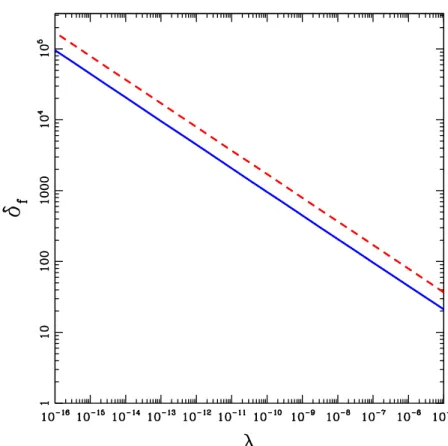
With the above formulation, we have a one parameter family of models for structure formation. Moreover, as long as λ 6= 0, the perturbation δ → δf = constant in the limit
t → ∞. For the initial condition δ(t = 1) = 1, the final value δf thus represents the total amount of growth available for a given value of the vacuum contribution. This growth factor is shown in Figure 1, plotted here as a function of λ. To leading order, we expect the amplitude of a density perturbation to grow linearly with the scale factor a(t) during the matter dominated era and then to saturate (freeze out) when the universe becomes vacuum dominated. The total growth factor should be approximately δest ∼ (2λ)−1/3. This factor is shown as the dashed curve in Figure 1. Note that the approximate expression (dashed curve) closely follows the more exact value (solid curve) calculated by numerically evaluating equations (2.9) and (2.8) subject to the initial conditions of (2.10).
Notice also that the linear treatment is approximate. We can correct for this deficiency by writing the growth factor in the form
δest=Aλ−1/3, (2.11)
where A is a dimensionless parameter of order unity. In the original derivation of this con-straint [30], this parameter is given byA = (500/729)1/3 ≈0.882. Although we include the factor A for completeness here, the exact value will not matter: as shown below, the bound changes by 30 orders of magnitude.
2.3 Constraint on Vacuum Energy
We can now write down the constraint due to the requirement that cosmological structures can form. The initial size of perturbations is set by the parameter Q, and the growth factor is given by equation (2.11). In order for the perturbations to become nonlinear before being frozen out due to the acceleration of the expansion, we require
λ < A3Q3. (2.12)
In our universe the parameter Q∼10−5 [25,26]. In any universe, we expect Q1 in order for habitable galactic structures to form [3, 20, 27, 28], so that the above constraint also impliesλ1. As a result, for the time scales and temperature scales evaluated at the epoch of equality, any corrections due to the nonzero value of λmust be small. Notice also that this constraint is essentially the same as that given by equation (29) of [27], or by equation (4) of [17].
Recall that λ is the fractional contribution of the vacuum to the energy density at the epoch of equality. It is useful to write the constraint (2.12) in terms of the (constant) energy density ρΛ of the vacuum, i.e.,
ρΛ
M4 pl
≤A3Q3 ρeq M4 pl
= (2A3aR)Q3η4
mp
Mpl
4
ΩM
Ωb
4
Figure 1. Growth factor as a function of the vacuum energy density, expressed here as the fraction of the total energy density at the time of equality (between radiation and matter). The solid blue curve shows the result from numerical integration, whereas the dashed red curve shows the approximate resultδf =(2λ)−1/3(see text).
where we have scaled ρΛ by its “natural” value implied by the Planck mass. To obtain the final equality, we have used the expression ρeq = 2aRTeq4, whereaR=π2/15 is the radiation
density constant, along with the expression (2.6) for the crossover temperatureTeq.
In our universe, mp/Mpl ∼10−19, η ∼10−9, ΩM ∼6Ωb, and Q∼10−5, so the
dimen-sionless vacuum energy ρΛ/Mpl4 ∼10−124. In order to place an upper bound on this quantity, we need to separately constrain the possible ranges for the parametersQ,η,Mpl, andΩM/Ωb.
3 Limits on the Input Parameters
As outlined above, if we use the values of Q, η, and Mpl found in our universe, then the bound on the vacuum energy density from equation (2.13) leads to a value of ρΛ roughly comparable to that inferred by observational data. Instead of using the observed values for (Q, η, Mpl), however, we instead need to find upper bounds on these quantities. These bound are discussed below.
3.1 Density Fluctuation Amplitude
when the background density is larger. This ordering of time scales results in galaxies that are denser. If galaxies are too dense, then planets in habitable orbits can be disrupted through scattering interaction with passing stars [27]. Since galaxies have a wide range of densities, however, this effect does not render the entire galaxy uninhabitable. Instead, it limits the fraction of stars that could in principle harbor habitable planets [3]. If we take an optimistic view, the fluctuation amplitude Qcould be as large as Q∼10−2, which implies that about half of the stars in a galaxy the size of our Milky Way would remain habitable. This value of
Q, in turn, allows the bound in equation (2.13) to be larger (than for the parameters in our universe) by a factor of109.
3.2 Baryon to Photon Ratio
Bang Nucleosynthesis (BBN) provides a constraint on the value of the baryon to photon ratio
η. In our universe, this ratio must be η ∼ 10−9 in order for the early universe to produce (roughly) the observed abundances of the light elements (deuterium, lithium, and helium). The abundances of these nuclear species could be different in other universe, varying by large factors, with no detrimental effects. A universe could end up sterile, however, if the BBN epoch processes all of the hydrogen into helium or other heavier nuclei. Such a universe, with little or no hydrogen, would not have the basic raw materials to make water.
Calculations of the BBN epoch show that the baryon-to-photon ratioηcan be increased by many orders of magnitude and still allow substantial hydrogen to remain unprocessed. Here we present results computed using the BURST code [12] for BBN, which is updated from the standard version of the BBN code [24,29]. To start, we fix all of the parameters at their standard values but allow variations in the value of the baryon-to-photon ratio η. Note that the gravitational constant G is varied in the following section, and then both η and G
are allowed to vary at the same time.
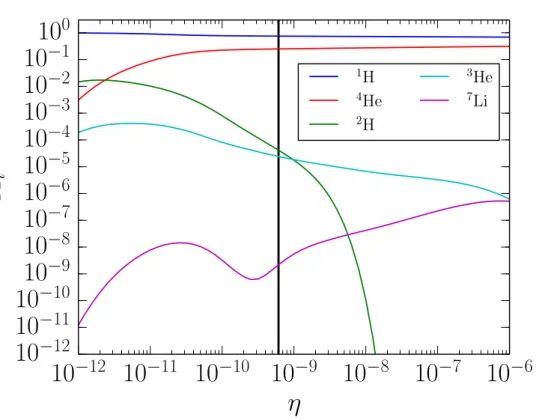
Figure 2 shows the resulting BBN yields for a range of η values. For small values of
η, much smaller than the values for our universe, the mass fraction of helium-4 is small — even smaller than that of deuterium. As η increases, the nuclear reaction rates increase, and the mass fraction of helium-4 increases. The abundances of deuterium and helium-3 decrease with increasing η, as they are burned into helium-4.
In the limit of largeη, the mass fraction of helium-4 reaches a limiting value ofY4∼0.3. This limit corresponds to the regime where essentially all of the neutrons are burned into helium-4. Notice also that the abundances of the other nuclear species decrease with increasing
η. With all of the neutrons incorporated into helium-4, none are left for constructing the remaining light elements. For example, withη= 10−6, after helium-4 the next most abundant nuclear species is helium-3, with a mass fraction of only3×10−7. As a result, a large fraction of protons always remains to potentially be incorporated into water. We can thus increase the value of η by a factor of at least103 and allow the universe to remain viable. This increase, in turn, allows the limit of equation (2.13) to increase by a factor of1012.
3.3 Gravitational Constant (Planck Mass)
10
−
12
10
−
11
10
−
10
10
−
9
10
−
8
10
−
7
10
−
6
η
10
−
12
10
−
11
10
−
10
10
−
9
10
−
8
10
−
7
10
−
6
10
−
5
10
−
4
10
−
3
10
−
2
10
10
−
1
0
X
i
1H
4He
2H
3He
7Li
Figure 2. BBN yields as a function of the baryon to photon ratioη. The curves show the resulting mass fraction at the end of the BBN epoch for helium-4 (red), as well as the corresponding mass fractions Xi for deuterium (green), helium-3 (cyan), and lithium-7 (purple). The blue curve shows the mass fraction of free protons. The vertical black line marks the estimated value of η= 6×10⁻¹⁰ for our universe.
is proportional to G2 ∼Mpl−4, so this limit can be increased by a factor of ∼4×10¹⁰ due to the allowed range of the gravitational constant.
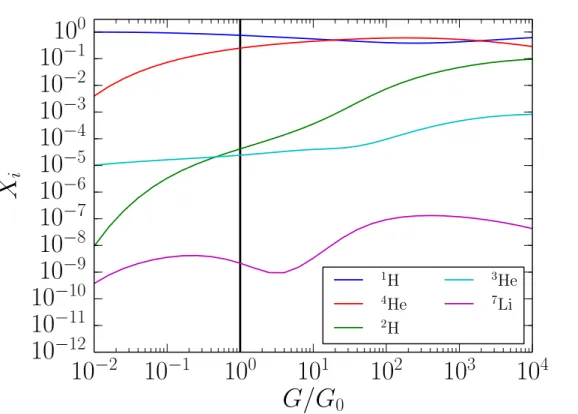
Possible variations in the gravitational constant can also change the predictions of BBN due to corresponding changes in the expansion rate of the universe, where H = ˙a/a∝G1/2. Figure3shows the yields from BBN, where the gravitational constant is varied over six orders of magnitude, from 100 times smaller than the value in our universe to 104 times larger. For most of the range shown, the abundances of all of the light elements increase with G. For sufficiently large values ofG, however, the expansion rate is so fast that not all of the neutrons can be made into helium-4. As a result, the mass fraction of helium-4 has a maximum value of
Y4 ∼0.53, which occurs atG/G0 ∼100. Even with this maximum mass fraction of helium-4, the universe retains about half of its protons to make water. As result, BBN does not greatly constrain the habitability of universes in this context.
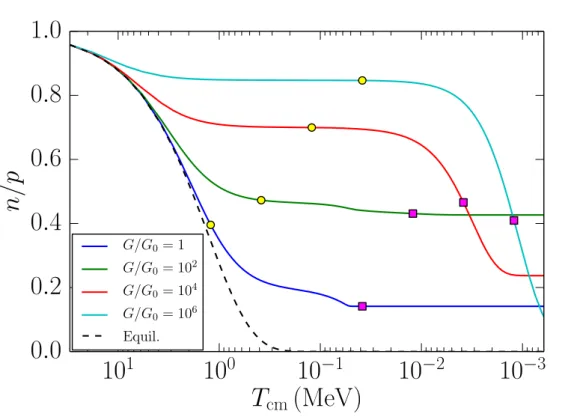
We can understand the BBN yields shown in Figure3as follows. For small values ofG, the expansion rate is slow, and the freezing of the weak interactions occurs later in cosmic history. As a result, protons and neutrons remain in Nuclear Statistical Equilibrium (NSE) longer and the n/p ratio is smaller. As G increases, the expansion rate increases, freeze-out of weak interactions occurs earlier, and the n/p ratio is larger. Figure4 shows the ratio n/p
10
−
2
10
−
1
10
0
10
1
10
2
10
3
10
4
G/G
0
10
−
12
10
−
11
10
10
−
10
−
9
10
−
8
10
−
7
10
−
6
10
−
5
10
−
4
10
−
3
10
−
2
10
−
1
10
0
X
i
1H
4He
2H
3He
7Li
Figure 3. BBN yields as a function of the gravitational constant,G/G0, scaled to the value in our universe. The curves show the resulting mass fraction at the end of the BBN epoch for helium-4 (red), as well as the corresponding mass fractionsXi for deuterium (green), helium-3 (cyan), and lithium-7 (purple). The blue curve shows the mass fraction of free protons. The vertical black line marks the value ofGfound in our universe.
n/p ratio to track its NSE value (shown as the black dashed curve) to lower temperatures, thereby resulting in lower neutron abundances during the BBN epoch. At sufficiently late times, free neutrons decay, andn/p→0. Note that the temperature decreases with increasing time, but the relation Tcm(t) depends on the value of the gravitational constant. This trend is illustrated in Figure 4, where the circles mark the location on the curves where timet= 1 sec, and the squares delimit t = 1000 sec. Since most of the neutrons are processed into helium-4, its abundance generally grows with increasing G. The abundances of deuterium and helium-3 also increase. As noted above, for sufficiently large values ofG, the abundance of helium-4 decreases again. A partial explanation is provided by Figure 4, which shows that the n/p ratio is not monotonic with increasing strength of gravity. The value of n/p at the end of the BBN epoch (right side of the figure) increases as G/G0 increases from unity to 100, but then decreases with further increase in G/G0 from 100 to 106. This decrease in the number of neutrons leads to less helium production for large values of G/G0.
3.4 Generalized Constraints from BBN
Figure 5 shows the abundance of hydrogen in the dual parameter space of G/G0 versus η. We plot contours of constant mass fraction for all hydrogen isotopes, XH, i.e., the summation of the single-proton hydrogen and deuterium mass fractions
10
−
3
10
−
2
10
−
1
10
0
10
1
T
cm
(MeV)
0
.
0
0
.
2
0
.
4
0
.
6
0
.
8
1
.
0
n/p
G/G0= 1
G/G0= 102
G/G0= 104
G/G0= 106 Equil.
Figure 4. Neutron to proton ratio during the BBN epoch. The ratio n/p is plotted versus the temperature parameter Tcm for different choices of the gravitational constant, as labeled (see Ref. [13] for a precise definition ofTcm). The black dashed curve shows then/pratio expected in Nuclear Statistical Equilibrium. The yellow circles (magenta squares) mark the locations on the curves where timet = 1 second (1000 seconds).
Figures 2and 3both show that when we maximize either ηor G/G0 while holding the other parameter fixed, hydrogen results as the most abundant element. We would expect that BBN would produce a majority of hydrogen when we maximize both parameters. Figure 5 shows the opposite behavior: XH falls to below 10% in the upper right-hand corner. The error in the logic resides in the phasing of the freeze-out of two sets of reactions: the weak interactions responsible for setting the ratio of neutrons to protons (denoted n/p); and the strong and electromagnetic nuclear reactions responsible for the synthesis of elements with mass number
A >1. There are six weak interactions which dictaten/p, schematically shown as the forward and reverse reactions
νe+n↔p+e−, (3.2)
e++n↔p+νe, (3.3)
n↔p+e−+νe, (3.4)
wheree±denotes positrons and electrons,νedenotes the electron neutrino, andνedenotes the
10
−
12
10
−
11
10
−
10
10
−
9
10
−
8
10
−
7
10
−
6
η
10
−
2
10
−
1
10
0
10
1
10
2
10
3
10
4
10
5
10
6
G/G
0
0.10
0.15
0.20
0.30
0.45 0.60
0.75 0.90 0.95 0.99
Figure 5. Contours of the remaining Hydrogen mass fraction (including all isotopes) after BBN for universes with varying η and G/G0. The thick contour marked 0.75 corresponds to hydrogen abundances comparable to that of our universe. The red star marks the location of our universe in the plane. The hydrogen abundance falls below 10 percent for the upper right part of the diagram, where G/G0∼106 andη
∼10−6.
rates will always be larger than the expansion rate at early times, and become subsidiary at later times. If we increase the strength of the gravitational constant, we precipitate an earlier epoch when the expansion rate surpasses the lepton capture rates. The result is that n/p
goes out of equilibrium earlier, dictating a larger free neutron abundance at this time.
Figure3shows that the end state of most free neutrons is their provisional incorporation into 4He nuclei. For 1 . G/G0 . 100, the rate of decrease in X1H is close to the rate of increase inX4He. However, Figure3 also shows a local minimum forX1HwhenG/G0 '100. At this point, the Hubble expansion rate is fast enough that the reactions for synthesis of 4He, primarily the strong reaction 3He(3He,2p)4He, begin to freeze-out at an earlier epoch. The overabundance of neutrons either resides in other nuclei, specifically deuterium (D) and 3He, or continues to exist as free neutrons. The forward rate in equation (3.4) is free neutron
decay which is invariant with temperature at late times. Any remaining free neutrons at the conclusion of BBN will transmute to free protons (see Figure 4). Figure 3 shows that 1H mass fraction increases at a larger absolute rate than those of D and3He, implying that
input particles in any particular reaction. Conversely, the rates for the reactions in equations (3.2) – (3.3) are insensitive toη, implying that n/p will be roughly the same for allη at the epoch when the lepton-capture rates freeze out. The nuclear reactions are more rapid with increasingη, implying a later epoch of nuclear freeze-out, implying a longer span of time for the assembly of the larger nuclei. Figure5shows for any value ofG/G0, increasingηincreases
n/p, or conversely decreasesXH.
In any case, the results of Figure 5 show that the mass fraction of hydrogen remaining after the epoch of BBN drops to below 0.10 in the upper corner of the diagram, whereη∼10−6 and G/G0 ∼106. Although some protons must remain after BBN in order for the universe to have the raw material for water, the minimum mass fraction is not known. Here we use 10 percent as a benchmark value. The resulting upper limit for the gravitational constant,
G/G0 <106 is comparable to that obtained by requiring stars to function [1, 2]. The value of η can be larger than that in our universe by a factor of more than 1000.
Although we use the 10 percent hydrogen abundance as a benchmark for habitable universes, it is of interest to consider the location of the contour for XH = 0in an extended version of the parameter space shown in Figure 5. To answer this question, we consider the neutron to proton ratio n/p in chemical equilibrium,
n/p= exp
−δmnp
T + µe
T −ξνe
, (3.5)
where δmnp ∼ 1.3 MeV is the mass difference between a neutron and a proton, µe is the
chemical potential of the electrons, and ξνe = µνe/Tcm is the electron neutrino degeneracy parameter [13]. The parameter ξνe is a co-moving invariant if we scale the electron neutrino chemical potential with a temperature-like quantity different from the plasma temperature. In this setting, Tcm is the co-moving temperature parameter and allows for the neutrinos to be out of thermal equilibrium with the primeval plasma [13]. Bothµe/T and ξνe are small compared toδmnp/T, son/pis strictly less than unity. Figures2and3show that forn/p <1,
the proton excess is mainly preserved in 1H. Therefore, under the assumptions that µe/T
and ξνe are small, theXH= 0contour is never reached. The contours in Figure5continue to be spaced at larger intervals when both η andG/G0 are increased. The contour for XH= 0 would therefore be an asymptote assuming µe/T andξνe are small.
The assumptions outlined above may not hold for every possible universe within the multiverse. The electron chemical potential is proportional to the baryon asymmetry, char-acterized by η. If η sufficiently large, of order δmnp/T ∼ 1, then the ratio n/p could be
larger than unity. However, for η close to unity, BBN would occur under matter-dominated conditions (see the following subsection) where inhomogeneities are important [5, 15]. This scenario is much different than the parameter space considered in Figure 5, where the back-ground medium is homogeneous and radiation-dominated. Alternatively, if the parameter
ξνe is large and negative, i.e., if there exists an overabundance of antineutrinos to neutrinos, then BBN continues to occur in radiation-dominated conditions with n/p > 1. In this case we would expect very little 1H and possibly a significant fraction of nuclei heavier than 4He — depending on the specific value of n/p. These alternate scenarios should be explored in future work, but are beyond the scope of this present paper.
3.5 Ordering of Time Scales and the Ratio of Densities
big bang nucleosynthesis. Since we are not considering variations in the nuclear properties, the energy of nuclear reactions must be of order a few MeV. We can parameterize this level by writing
Tbbn =bme, (3.6)
where me is the electron mass (0.511 MeV) and b is a constant of order unity. The ordering
constraint implies that
Teq < Tbbn or η ΩM
Ωb
< bme mp ∼
10−3. (3.7)
As discussed above, if we require the universe to retain at least 10 percent of its hydrogen after BBN, then the baryon to photon ratio η < 10−6 (see Figure 5). With the value for η and the ratio ΩM/Ωb ≈6 found in our universe, the epoch of BBN falls well before that of
equality.
In the bound on the energy density of the vacuum, given by equation (2.13), the product
η(ΩM/Ωb) appears on the right-hand-side. If we set η = 10−6 in order to evaluate the
bound on ρΛ, then equation (3.7) implies that the largest value of the density ratio must be
ΩM/Ωb ≈100, which is larger than the value in our universe by a factor of ∼15.
The bound of equation (2.12) also indicates that the time of vacuum domination tΛ must occur after the time of matter domination teq. This result, in conjunction with that of equation (3.7), indicates that the time scales must obey the ordering
tBBN < teq< tΛ. (3.8)
4 Conclusion
The main result of this paper is an upper bound on the density ρΛ of the vacuum energy, given by equation (2.13), which represents a generalization of previous treatments. If we evaluate the right-hand-side of the equation using the values for (Q, η, Mpl) found in our universe, the result is roughly comparable to the ratio ρΛ/Mpl4 that is observed. This finding is essentially a restatement of the coincidence problem – in our universe structure has formed recently and the energy density is now becoming dominated by the vacuum. This paper shows (Section 3) that a viable alternate universe could have larger fluctuation amplitude Q (by a factor of∼103), larger baryon to photon ratio η (by a factor of∼103), and stronger gravity (so that Mpl is smaller by a factor of ∼ 103). With the maximum value of η, the ratio of densities ΩM/Ωb can be larger by a factor of∼ 15. With these generalizations, the density
of the vacuum energy can be much larger than that of our universe: The constraint takes the form ρΛ/Mpl4 < 10−90 so that ρΛ could be larger than the observed value by∼ 30 orders of magnitude.
This generalization of the bound onρΛis significant. As emphasized in the original paper of Weinberg [30], if the maximum allowed value for the energy densityρΛ is much larger than the empirically allowed value, “then we would have to conclude that the anthropic principle does not explain why the cosmological constant is as small as it is”. Given that ρΛ could be ∼30 orders of magnitude larger, relative to the Planck scale, and still allow structure to form, we argue that the anthropic principle has limited predictive power in this context.
are synthesized into non-hydrogen isotopes (Figure 5). The hydrogen mass fraction remains greater than 10 percent even when the parametersη andGare larger than103 and106 times the values realized in our universe. Moreover, the results from Section3.4indicate that some hydrogen almost always remains after the epoch of BBN. In order to process all of the protons into heavier elements, the neutron to proton ratio must exceed unity (n/p >1), which in turn requires extreme conditions (e.g., matter dominated BBN, large νe degeneracy parameter,
and/or largeη ∼1). These results show that the BBN epoch does not represent an example of fine-tuning. The input parameters can be varied by many orders of magnitude and still allow the universe to remain viable.
The results of this paper have implications for the broader issue of the possible fine-tuning of the universe. The main result of this paper is that the density of the vacuum energy
ρΛ could be larger by more than 30 orders of magnitude and still allow for structure formation (with appropriate adjustments to other parameters). Of course, the density ρΛ could also be 30 orders of magnitude smaller and the universe would continue to develop cosmic structure. We thus argue that the value of ρΛ need not be overly fine-tuned for the universe to produce observers.
The results of this paper also show that the epoch of Big Bang Nucleosynthesis generally does not leave the universe with no hydrogen. Specifically, the mass fraction of hydrogen remains larger than 10 percent even when the baryon to photon ratio η is larger by a factor of103 and the gravitational constantGis larger by a factor of106. The density ratioΩ
M/Ωb
can be larger by a factor of∼15 ifη takes on its maximum value, but can be much larger for smaller values ofη. As a result, the universe can remain chemically viable without fine-tuning the parameters of the BBN epoch.
Finally, we have used previous results to constrain the other relevant parameters of the problem. The amplitude Q of the primordial density fluctuations spans a range of a factor
∼ 104, from 10 times smaller [27, 28] to 103 times larger [3]. Additional considerations of stellar structure show that working stars can exist for values of G and the fine-structure constant α that vary over many orders of magnitude [1]. This claim holds up in the face of additional constraints, including that the stars have sufficiently hot surface temperatures and long lifetimes [2], and that stars can form within their parental galaxies [21,32]. Taken together, all of these results indicate that the universe is not overly fine-tuned, in that both the constants of physics (α, G) and the cosmological parameters (Q, η, ρΛ,ΩM/Ωb) can vary
over a wide range and still allow the universe to develop astrophysical structures and perhaps even life.
Acknowledgments
We would like to thank I. Dell’Antonio, A. Erickcek, and J. Levicky for useful discussions. This work was supported by JT Foundation through Grant ID55112: Astrophysical Structures in other Universes, and by the Bahnson Trust Fund.
References
[1] F. C. Adams,Stars in other Universes: Stellar structure with different fundamental constants, J. Cosmol. Astropart. Phys.08(2008) 010
[3] F. C. Adams, K. R. Coppess, and A. M. Bloch,Planets in other Universes: Habitability constraints on density fluctuations and galactic structure, J. Cosmol. Astropart. Phys.09
(2015) 030
[4] A. Aguirre and M. Tegmark,Multiple Universes, Cosmic Coincidences, and other Dark Matters,J. Cosmol. Astropart. Phys.01(2005) 003
[5] J. H. Applegate, C. J. Hogan, and R. J. Scherrer,Cosmological Baryon Diffusion and Nucleosynthesis,Phys. Rev.D 35(1987) 1151
[6] L. A. Barnes,The Fine-Tuning of the Universe for Intelligent Life,Pub. Astron. Soc. Australia
29(2012) 529
[7] J. D. Barrow and F. J. Tipler,The Anthropic Cosmological Principle, Oxford Univ. Press (1986)
[8] B. J. Carr and M. J. Rees,The Anthropic Principle and the Structure of the Physical World, Nature278(1979) 611
[9] B. Carter,The Anthropic Principle and its Implications for Biological Evolution,Philos. Trans. R. Soc. LondonA310(1983) 347
[10] P.A.M. Dirac,The Cosmological Constants,Nature139(1937) 323
[11] E. Grohs and G. M. Fuller,The Surprising Influence of Late Charged Current Weak
Interactions on Big Bang Nucleosynthesis,Nuclear PhysicsB911(2016) 955, arXiv:1607.02797
[12] E. Grohs, G. M. Fuller, C. T. Kishimoto, and M. W. Paris,Probing Neutrino Physics with a Self-Consistent Treatment of the Weak Decoupling, Nucleosynthesis, and Photon Decoupling Epochs, J. Cosmol. Astropart. Phys.5(2015) 017
[13] E. Grohs, G. M. Fuller, C. T. Kishimoto, and M. W. Paris,Lepton Asymmetry, Neutrino Spectral Distortions, and Big Bang Nucleosynthesis, (2016), arXiv:1612.01986
[14] C. J. Hogan,Why the Universe is Just So, Rev. Mod. Phys.72(2000) 1149
[15] K. Jedamzik, G. M. Fuller, G. J. Mathews, and T. Kajino,Enhanced Heavy-element Formation in Baryon-inhomogeneous Big Bang Models,Astrophys. J.422(1994) 423
[16] E. W. Kolb and M. S. Turner,The Early Universe, Addison-Wesley (1990)
[17] H. Martel, P. R. Shapiro, and S. Weinberg,Likely Values of the Cosmological Constant, Astrophys. J.492(1998) 29
[18] L. Mersini-Houghton and F. C. Adams,Limitations of Anthropic Predictions for the
Cosmological ConstantΛ: Cosmic heat death of anthropic observers,Class. Quant. Grav. 25
(2008) 165002
[19] S. Perlmutter et al. [Supernova Cosmology Project Collaboration],Measurements ofΩandΛ from 42 High-Redshift Supernovae, Astrophys. J.517(1999) 565
[20] M. J. Rees,Just Six Numbers, Basic Books (2000)
[21] M. J. Rees and J. P. Ostriker,Cooling, Dynamics and Fragmentation of Massive Gas Clouds: Clues to the masses and radii of galaxies and clusters,Mon. Not. R. Astron. Soc.179(1977) 541
[22] A. G. Riess et al.,Observational Evidence from Supernovae for an Accelerating Universe and a Cosmological Constant,Astron. J. 116(1998) 1009
[23] A. G. Riess et al.,A 3% Solution: Determination of the Hubble Constant with the Hubble Space Telescope and Wide Field Camera 3,Astrophys. J.730(2011) 119
[25] G. F. Smoot et al.,Structure in the COBE Differential Microwave Radiometer First-year Maps,Astrophys. J.396(1992) L1
[26] D. N. Spergel et al.,Three-Year Wilkinson Microwave Anisotropy Probe (WMAP) Observations: Implications for Cosmology,Astrophys. J. Suppl.170(2007) 377
[27] M. Tegmark and M. J. Rees,Why Is the Cosmic Microwave Background Fluctuation Level 10−5? Astrophys. J.499(1998) 526
[28] M. Tegmark, A. Aguirre, M. J. Rees, and F. Wilczek,Dimensionless Constants, Cosmology, and other Dark Matters, Phys. Rev.D 73(2006) 3505
[29] R. V. Wagoner,Big-Bang Nucleosynthesis Revisited,Astrophys. J.179(1973) 343
[30] S. Weinberg,Anthropic Bound on the Cosmological Constant,Phys. Rev. Lett. 59(1987) 2607
[31] S. Weinberg,The Cosmological Constant Problem,Rev. Mod. Phys.61(1989) 1