Durham Research Online
Deposited in DRO: 09 December 2016
Version of attached le: Accepted Version
Peer-review status of attached le: Peer-reviewed
Citation for published item:
Resing, W.C.M. and Bakker, M. and Pronk, C.M.E. and Elliott, J.G. (2017) 'Progression paths in children's problem solving : the inuence of dynamic testing, initial variability, and working memory.', Journal of experimental child psychology., 153 . pp. 83-109.
Further information on publisher's website:
https://doi.org/10.1016/j.jecp.2016.09.004
Publisher's copyright statement:
c
2016 This manuscript version is made available under the CC-BY-NC-ND 4.0 license http://creativecommons.org/licenses/by-nc-nd/4.0/
Additional information:
Use policy
The full-text may be used and/or reproduced, and given to third parties in any format or medium, without prior permission or charge, for personal research or study, educational, or not-for-prot purposes provided that:
• a full bibliographic reference is made to the original source
• alinkis made to the metadata record in DRO
• the full-text is not changed in any way
The full-text must not be sold in any format or medium without the formal permission of the copyright holders. Please consult thefull DRO policyfor further details.
Durham University Library, Stockton Road, Durham DH1 3LY, United Kingdom Tel : +44 (0)191 334 3042 | Fax : +44 (0)191 334 2971
1
RUNNING HEAD: Progression paths in children’s problem solving
Progression paths in children’s problem solving:
The influence of dynamic testing, initial variability and working memory
Wilma C.M. Resing1, Merel Bakker1, Christine M.E. Pronk1, & Julian G. Elliott2
1
Developmental and Educational Psychology
Leiden University, the Netherlands
2
School of Education
Durham University, UK
Personal Uncorrected Copy
JOURNAL OF EXPERIMENTAL CHILD PSYCHOLOGY, 153 (2017) 83–109
http://dx.doi.org/10.1016/j.jecp.2016.09.004
2
Progression paths in children’s problem solving:
The influence of dynamic testing, initial variability and working-memory
Abstract
The current study investigated developmental trajectories of analogical reasoning performance of
104 7-to-8-year-old children. We employed a microgenetic research method and multilevel
analysis to examine the influence of several background variables and experimental treatment on
the children’s developmental trajectories. Our participants were divided into two treatment
groups: repeated practice alone and repeated practice with training. Each child received an initial
working-memory assessment, and was subsequently asked to solve figural analogies on each of
several sessions. We examined children’s analogical problem-solving behavior and their
subsequent verbal accounts of their employed solving processes. We also investigated the
influence of verbal and visual-spatial working-memory capacity and initial variability in
strategy-use on analogical reasoning development. Results indicated that children in both treatment groups
improved but gains were greater for those who had received training. Training also reduced the
influence of children’s initial variability in the use of analogical strategies with the degree of
improvement in reasoning largely unrelated to working memory capacity. Findings from this
study demonstrate the value of a microgenetic research method and the use of multilevel analysis
to examine inter- and intra-individual change in problem-solving processes.
3
Progression paths in children’s problem solving:
The influence of dynamic testing, initial variability and working-memory
Introduction
Fine-grained investigation of children’s cognitive abilities, including the influence of
training, is complex, and children’s performance on reasoning and problem solving tasks has
proven significantly more variable over time than many researchers and practitioners had
assumed (Bjorklund & Rosenblum, 2001; Siegler, 2007). Substantial variability in solving
cognitive tasks, between and within participants, has been demonstrated in a variety of domains,
such as math, spelling and problem solving (Siegler, 1996). Studying this variability could
provide us with more insights in how children determine the best ways of solving tasks. This
approach may also help us gain a greater understanding of individual differences in the
development of strategy-use over time and with increasing experience (Siegler, 2006).
Our study sought to examine variability in children’s strategic behavior in analogy
solving when receiving either a series of unguided practice sessions alone or this in combination
with a training procedure derived from dynamic testing. We also studied the possible influence of
working memory differences on analogy performance, as a differential relationship between
working memory and analogical reasoning has been found for children trained in dynamic testing
settings (e.g., Stevenson, Bergwerff, Heiser, & Resing, 2014; Swanson, 1994; 2011). The main
focus of our study was therefore on ‘the rate of change’ and ‘variability’ dimensions of Siegler’s
(1996) ‘overlapping waves’ theory.
Inductive reasoning tasks, such as classification, analogies or series completion, all require
comparable underlying problem-solving processes: starting with specific observations of the task
4
and formulated. This rule finding process can be reached by means of systematic comparison
processes, which involve finding similarities and/or differences between task attributes and/or
relations among attributes (Holyoak & Nisbett, 1988; Klauer & Phye, 2008; Perret, 2015).
Analogical reasoning involves a basic inductive process that plays an important role in a number
of higher cognitive processes (Halford, 1993; Morrison et al., 2004; Richland & Simms, 2015). In
analogical studies, base items (for example, white: black) and targets (for example, snow: ??)
domain have to be compared in order to find and formulate a relational correspondence existing
between them (e.g., Holyoak, 2012, Thibaut & French, 2016).
The development of analogical reasoning in children and its role in instruction and
classroom learning have been the focus of much research (Csapó, 1997; Goswami, 2002; Klauer
& Phye, 2008; Kolodner, 1997; Richland, Morrison, & Holyoak, 2006; Richland & Simms, 2015;
Singer-Freeman, 2005; Vosniadou, 1989). The development and training of children’s ability to
reason by analogy have also been studied extensively (Alexander et al., 1989; Alexander,
Willson, White, & Fuqua, 1987; Goswami, 2013). In most studies, children older than 6 years
have displayed clear improvements in analogical reasoning after receiving a (brief) period of
training or, alternatively, after having been given extensive instructions or training for, for
example, verbal analogies (Resing, 2000), physical problem analogies (Tunteler & Resing, 2007),
concrete pictorial analogies (Hessels-Schlatter, 2002;Stevenson, Resing, & Froma, 2009), and
classic geometric analogies (Hosenfeld, Van der Maas, & Van den Boom, 1997; Tunteler, Pronk,
& Resing, 2008). In contrast, younger children have tended only to show such gains when they
had received extensive training (Alexander et al., 1989; Tunteler & Resing, 2007).
Studies focusing on the development of inductive (analogical) reasoning have often
utilized cross-sectional designs (e.g., Chen, 1996; Chen & Daehler, 1989; Richland et al., 2006;
5
an incomplete picture of the dynamics of variability and change (e.g., Granott, 2002; Kuhn, 1995,
2002; Siegler, 2006). Very few studies have compared changes in analogical reasoning over time
which have been induced by repeated practice and/or training (e.g., Alexanderet al., 1989;
Hosenfeld et al., 1997), a shortfall which the current study sought to address.
One valuable approach to investigating learning trajectories is that which employs a
microgenetic research design (Siegler, 2006; Winne & Nesbit, 2010). Such designs are
characterized by frequently repeated (trial-by-trial) assessment sessions given within a relatively
short period of time. They typically utilize somewhat basic instructions or unguided practice
sessions, and typically yield highly frequent of observations relative to the rate of change. Hence,
changes in reasoning can become visible closely to the moment they happen, thus enabling the
discovery of natural developmental and learning trajectories. These trajectories may be
considered natural if the practice sessions include no explicit forms of training, such as the
provision of elaborate instructions or prompting (Flynn & Siegler, 2007; Siegler, 2006; Siegler &
Crowley, 1991). In the present study we investigated whether problem solving trajectories
involving analogy tasks showed differing pathways when these were acquired through more
‘natural’ unprompted opportunities than when a short training procedure is included.
Dynamic testing, using a test-training-test format, has become increasingly used
for the study of inductive reasoning (Bethge, Carlson, & Wiedl, 1982; Hessels-Schlatter, 2002;
Resing & Elliott, 2011; Tzuriel & Flor-Maduel, 2010). Key to this approach is the incorporation
of feedback and training during the testing phases (Elliott, Grigorenko, & Resing, 2010;
Sternberg & Grigorenko, 2002). Conventional, static tests are considered to be a satisfactory
means of assessing already developed abilities. In contrast, dynamic measures are designed to
assess developing or yet-to-develop abilities which are the products of underlying, but often
6
Grigorenko, 2006). Dynamic testing has been found to yield insights into strategies used by the
examinee and their responsiveness to examiner assistance and support. In line with the pioneering
studies of Campione, Brown, Ferrara, Jones & Steinberg (1985), we sought to examine children’s
potential for learning in the domain of analogical reasoning. Our primary focus was on the
number of prompts needed to solve the analogy items. Here, the elements of the task that cannot
be accomplished unassisted are controlled, with graduated standardized support given whenever
the child is unable to make unaided progress.
In the current study we combined both dynamic and microgenetic methods of studying
children’s development and learning. We examined whether a dynamic testing approach in
combination with unguided practice, versus unguided practice alone, would result in different
developmental trajectories in young children’s solving of analogy tasks.
The first few years of primary school are considered to be a period of rapid development
of analogical reasoning ability (Siegler & Svetina, 2002), a time when high levels of
intra-individual variability in solving analogies are likely to be found. Siegler (2007), for example,
posits that cognitive variability is an important variable in understanding, predicting, and
describing the amount and type of cognitive change. He refers to cognitive variability as the
differences between children in terms of change agents, growth trajectory, generalization, and
speed of change, but also changes within the individual child’s repertoire of strategies. As a way
to accurately assess variable strategy-use, Siegler (2007) stresses the value of trial-by-trial
assessments focusing on the acquisition of new strategies, an increased usage of the most
advanced strategies, increasingly efficient execution of strategies, and improved choices among
strategies. In the current study, we employed a microgenetic, trial-by-trial assessment in order to
investigate variability in children’s use of strategies when solving analogies and gauge their
7
In a microgenetic study of matrix completion, Siegler and Svetina (2002) found that the
performance of 6-8 year old children improved considerably on a multiple choice matrix task as a
result of repeated practice experiences. After discovery of the correct way of solving the tasks,
children’s use of the improved strategy rapidly became dominant. However, patterns in
strategy-use may differ when items require the construction of a solution, rather than selection using a
multiple-choice format. Tunteler et al. (2008) conducted a microgenetic study with 6-7-year-old
children, using open-ended (constructed response) geometric analogies, behavioral and verbal
outcome measures, and minimal instruction. Their results indicated that improvement in
analogical reasoning often consisted of progression from incomplete to complete analogical
answers. Children appeared to possess some rudimentary form of analogical reasoning skill that
was accelerated by the opportunity to practice. After training, however, the children were largely
able to explain their use of correct analogical strategies in solving the tasks. Further investigation
revealed several subgroups of children that varied in the extent to which they could provide oral
explanations of their approach to solving the problems (Tunteler et al., 2008). We sought to build
on these findings in the current study by investigating both inter- and intra-individual paths of
change by examining a) children’s behavioral strategies and b) their subsequent accounts of the
procedures they had employed to tackle the problems.
An accumulating body of evidence suggests that working-memory capacity has a bearing
upon the ability to solve complex reasoning tasks (Halford, Wilson, & Philips, 2010; Morrison et
al., 2004; Primi, 2001). Many studies have explored the manner and extent to which inductive
reasoning is related to working-memory capacity (Arendasy & Sommer, 2005; Engle, Tuholski,
Laughlin, & Conway, 1999; Meo, Roberts, & Marucci, 2007; Richland et al., 2006; Viskontas,
Morrison, Holyoak, Hummel, & Knowlton, 2004; Waltz, Lau, Grewal, & Holyoak, 2000). When
8
and processing the terms of the analogy (Sternberg & Rifkin, 1979). The type of relationship or
task that needs to be managed appears to be influenced by the differential involvement of
separate components of working memory. Various components have been investigated in a
variety of inductive reasoning or academic tasks in different age groups (Alloway & Passolunghi,
2011; Raghubar, Barnes, & Hecht, 2010). Age-related, differential involvement of these
components in different types of tasks, were, among others, demonstrated by Alloway,
Gathercole and Pickering (2006). They found that children as young as 4 years exhibit a
structural organization of memory into both a domain-general component for processing
information and verbal and visual-spatial domain-specific components for storage. In the present
study, we focused on the potentially differential involvement of verbal and visual-spatial
working-memory components in analogical reasoning development. This was a consequence of
earlier research in dynamic testing which has reported that both visual-spatial and verbal
reasoning components play a role in solving visual-spatial analogies. This is particularly apparent
when, as part of the assessment, children are asked to explain their problem solving procedures
(Stevenson, Heiser, & Resing, 2013; Tunteler et al., 2008). In the present study we explicitly
focused on the differential involvement of verbal and visual-spatial working-memory
components, to examine their possible role in respect of changes in analogical reasoning over
time. We thought it important to examine these components separately with a working-memory
assessment that made sufficient storage and processing demands (Alloway, 2007) and which
would help us explore their influence on analogical reasoning (Resing, Xenidou-Dervou, Steijn &
Elliott, 2012).
Multi-level growth-curve analysis (e.g., Hox, 2010; see Method) enabled us to model the
average growth trajectories of both groups of children and each child individually (Hox, 2010).
9
also Siegler, 2007). We investigated systematic variation between these trajectories as a function
of our background variables – the verbal and spatial working-memory components – and the
experimental treatment [i.e. the dynamic test training procedure (Van der Leeden, 1998)]. In
addition, our study also included initial variability in strategy-use as a potentially interesting
background variable.
In sum, the aim of the current study was to model the influence over time of a) repeated
unguided practice, b) repeated unguided practice plus training derived from a dynamic testing
procedure, c) verbal and visual-spatial working memory, and d) initial variability in
problem-solving procedures, on the problem-problem-solving processes and individual outcome trajectories of
young children. Using figural analogies tasks, we examined whether unguided practice with or
without dynamic training would result in different changes in strategy-use and in performance
accuracy. In addition, we anticipated that measures of working memory and initial variability in
children’s problem solving would provide us with a richer understanding of factors underpinning
individual growth trajectories in analogical reasoning.
Firstly, we examined whether grade 2 children changed their approach to tackling figural
analogy tasks on the basis of repeated unguided practice and having received, or not received, the
dynamic testing intervention. The specific components measured were the children’s accuracy on
the task, the use of various task-solution components as a measure of the (in)completeness of
children’s performance on these tasks and their verbal explanations of their activity as a measure
of the quality of their solving strategies (Tunteler & Resing, 2010). We hypothesized that a)
repeated practice would lead children to independently adopt more advanced solution methods.
However, we further hypothesized that b) trained children would make greater gains than those
10
Secondly, it was expected that spatial working-memory capacity would be related to
figural analogical reasoning performance at the first session and also to improvement following
repeated practice. Our reasoning for this was that children have to remember visuo-spatial
information, for example, the position, size, color, and orientation of the various attributes of both
the base and the target domains of the analogy in order to construct relational representations
(Logie, Gilhooly, & Wynn, 1994; Rasmussen & Bisanz, 2005, Tunteler et al., 2008). Children
with smaller spatial working-memory capacity were expected to make limited progress as a result
of repeated practice as their workspace for constructing relational representations is assumed to
be more limited (Halford et al., 2010). Those who had received training, however, were expected
to subsequently demonstrate a higher rate of progress (Carr & Schneider, 1991; Halford et al.,
2010; Morrison, Doumas, & Richland, 2011). The rationale behind this hypothesis was that
dynamic testing was expected to alleviate any working-memory limitation by breaking down the
analogical reasoning process into small steps that can be processed serially and by providing
relational knowledge (Halford et al., 2010; Morrison et al., 2011). This might help these children
to catch up with peers with superior working-memory capacity. Children with larger spatial
working-memory capacity, on the other hand, were expected to show a more gradual pattern and
rate of change over time when receiving repeated practice alone, but nevertheless gain additional
benefit from the training procedure (Tunteler & Resing, 2010).
Thirdly, it was expected that the relationship between verbal working-memory capacity
and performance on the figural analogies test would become less strong, both over time and after
training on the grounds that our dynamic training procedure would reduce cognitive load
(Alloway & Gathercole, 2006; Haavisto & Lehto, 2004; Halford et al., 1998, 2010; St.
11
Fourthly, we anticipated that variability in an individual’s strategy-use at the first session
would be positively related to rate and amount of change in solving analogies, especially for the
unguided practice sessions (Siegler, 2007). However, the progress of children receiving training
in addition to repeated practice was expected to be less related to their initial performance as the
assistance was intended to tap into underlying variability in potential rather than current,
unassisted performance (Grigorenko, 2009). We therefore predicted that those children who
displayed limited analogical reasoning before training would improve more rapidly than their
peers, whereas higher performers before training would show a more gradual increase in the
quality of their reasoning (Tunteler et al., 2008; Tunteler & Resing, 2007).
Finally, the paths of change in children’s solving procedures were explored through
inspection of the various group progression lines regarding the number of correctly solved
analogies, the use of transformations, and their explanations of the approaches they adopted. We
visually inspected how children [differentially] changed their solving procedures over sessions
towards the use of more sophisticated problem-solving procedures (Siegler, 2006). The influence
of children’s level of working memory, variable analogical solving skills at the start of the
experiment, and training on this progression in solving procedures was further explored.
Method Participants
One hundred-and-four children (51 boys and 53 girls) with a mean age of 7.8 years (age range
7.0–8.7 years) participated in the study. The children were recruited from eight primary schools,
located in midsized towns in the Netherlands. The schools were selected on the basis of their
willingness to participate in what was clearly a time-consuming exercise. The children attended
classes at second grade level and represented a full range of socio-economic backgrounds.
12
at school and at home for all participants. Data collection was undertaken by trained postgraduate
students with experience of educational testing. All children took full part in the relevant testing
sessions.
Design
The study employed a pre-test-post-test-2-experimental-groups randomized block design, with
blocking based on the Exclusion subtest from a Dutch child intelligence test, the RAKIT
(Bleichrodt, Drenth, Zaal, & Resing, 1984). On the basis of the blocking procedure, children in
each school were, randomly allocated to one of two treatment groups: an ‘unguided practice’
group; or an ‘unguided practice plus training’ group, subsequently identified in this paper as the
‘training group’. During the first week of the study, each child was given an inductive reasoning
test (Exclusion) and measures of spatial and verbal working memory. Subsequently, a
microgenetic design with two pre-tests and two post-tests was employed. Children in the training
group received training between the pre-test and post-test sessions. In all other respects they
received the same inputs as the children in the unguided practice group. Thus, other than the
training session, both groups tackled the same analogy items without other forms of training,
instruction, help or feedback. Unguided practice sessions ranged from 20-40 minutes per child
and were of equal duration for both groups of children. The training session took 30-60 minutes
per child. Table 1 provides an overview of the experimental design used in this study.
Insert Table 1
Instruments
13
child’s ability to detect rules by means of induction, an important prerequisite for successful
inductive/analogical reasoning. The subtest (α=.87) consists of 40 items each containing four
abstract figures. Three of the figures can be grouped together according to a rule, and the child’s
task is to select the figure that does not conform to this.
Verbal and spatial recall. The screening measure from the computerized Automated Working Memory Assessment (AWMA) battery (Alloway, 2007), administered during the
pre-testing phase, was used to measure verbal and visual spatial working-memory capacity. The
AWMA assesses both the simultaneous storage and processing of information. The screening
version exists of two working-memory subtests: Listening recall (verbal WM; test-retest
reliability r=.88) and Spatial recall (visuo-spatial WM; test-retest reliability r=.79)). The listening
recall subtest utilizes sequences of spoken sentences. The child must indicate whether the spoken
sentence is true or false. At the end of each item, the child has to recall the final word of each
sentence, in the order in which the sentences were presented. In the spatial recall subtest, the
child sees a picture with two abstract shapes; the shape at the right has a red dot somewhere. The
shape might be rotated or flipped. They are then required to indicate whether the shapes to the
left and right are the same or not. At the end of each item, the correct location of the red dot must
be identified (Alloway, 2007).
Animalogica: Dynamic test of Figural reasoning
Figural analogies: pre- and post-tests. The analogical reasoning tasks utilized in this
study consisted of an adapted open-ended response version of the concrete figural test
Animalogica (see, Stevenson et al., 2009; Stevenson, Touw, & Resing, 2011; Stevenson, Heiser,
& Resing, 2016). To solve the analogies (A:B = C: ?, see Figure 1), the children were required to
encode item attributes and infer a rule between two given animal pictures (A, B [the base]) and
14
had to be selected (from a range of possibilities), so that the relationship between the third and
fourth picture equaled that of the first two pictures (e.g., Sternberg & Rifkin, 1979). This
open-ended response version enables children to identify the correct rule and then search for the right
answer pictured on one of 36 cards, variously showing six types of animals, three colors, and two
sizes. The cards were printed on both sides with the same images, although facing in opposite
directions, enabling the child to transform both quantity and orientation of the animals for solving
the analogy. Four parallel sets of 20 items each, increasing in difficulty level, were used. The sets
were designed to look different to the children but the changes in animal type and color were of a
similar level of difficulty.
Insert Figure 1
The items of each set varied in difficulty level from two to six transformations involving, size,
color, quantity, orientation, position, and type of animal. In the analogy in Figure 1at the left, for
example, we can detect one small yellow lion (A) that has been transformed into two small
yellow lions (B). We also see two small blue horses looking into the same direction as the lions
(C), so we need to look for one small blue horse looking to the right to fill D. Based on the cards
representing children’s responses, it was possible to see which transformations children had used
to construct their answer, and if and how many of the transformations necessary to solve the
items were actually used.
Figure analogies training. The training procedure used in the present investigation was
originally pioneered by Campione et al., (1985), and has been successfully further developed and
utilized in studies on dynamic testing (Resing, 2000; Resing & Elliott, 2011). The procedure
involves the use, during training, of a series of adaptive and standardized, hierarchically ordered,
15
prompts are only provided when a child is unable to proceed independently. Thus, the children
are provided with the minimum number of prompts possible to enable progression through the
test. The training of the dynamic test procedure consisted of an age-adapted set of 7 concrete
figural analogies similar to those employed in the other sessions (adapted from Stevenson et al.,
2009, 2011). The procedures involved are described in Appendix A. Stevenson et al. (2016)
reported internal consistencies for the pre-test and training procedure (α=.78, =.78) and post-tests
1 and 2 (α=.90 and .85, respectively).
Procedure
All children were, seen individually, once a week over a two month period. The same testers
were employed across the full series of six sessions. During the first week of the study, the
children were given inductive reasoning and spatial and verbal working memory tasks.
Subsequently, two pre-tests and two post-tests were administered (see overview of design).
Between these, children in the training group received 30-60 minutes of training. The length of
these sessions depended, in part, upon the number of hints they required. Other than the training
session, both groups tackled the same analogy items without any other forms of training,
instruction, help or feedback. Unguided practice sessions ranged from 20-40 minutes per child
and were of equal duration for both groups.
At the start of each session, the child was presented with a booklet containing the
analogies, and baskets with small animal cards for constructing the correct answers in accordance
with the transformations used in the items. The examiner showed the animal cards and explained
their features: color, size, and the possibility to flip to the opposite direction. The examiner then
identified the first analogy and stated that this was a ‘kind of puzzle’ with three boxes containing
animals and a fourth empty box (C-term or D-term), in which the child needed to construct the
16
asked how he or she had solved ´the puzzle´. All verbal and behavioral responses were recorded
by video and audio. Examiners also recorded children’s behaviors and explanations on coded
response forms. One author always checked and double-checked the scoring of children’s
solutions using these recordings.
Scoring and analyses
Scoring. Each child obtained, per practice session, a ‘Complete Analogies Score’: the sum of all analogies that were completely and accurately solved (score range 0-20); a
‘Transformations Correct Score’: the sum of accurate transformations as evidenced by the
child’s behavioral solutions. These were calculated from data on the answer forms and findings
were subsequently double-checked by means of scrutiny of the video materials (score range
0-110). The transformations refer to the changes that occur in the items in relation to size, color,
quantity, orientation, position, and type of animal. We counted the number of transformations
children laid down correctly, both vertically and horizontally in the matrix. In the left part of
Figure 1, for example, there are three transformations: the quantity changes horizontally (one to
two animals), the type of animal changes vertically (lion to horse) as does the color of the
animals (blue to red). The matrix at the right of Figure 1 includes 6 transformations (horizontally:
position, quantity, orientation, and type of animal, and vertically: size and color). If there were
similar transformations in both columns and rows, they were counted twice. The children also
obtained a ‘Transformations Explained Score’: the sum of all accurate transformations that were
followed by explanations as to ‘how they solved the puzzle’ (score range 0-110). The child had to
verbalize each transformation, for example, “this one is blue also”, or “here it was a horse and
now it is a dog” or “here I see one dog and over there, there are two dogs”. Utterances that
indicated no underlying reasoning such as “just like that”, with, or without pointing, were not
17
employed as a measure for accuracy, the number of Transformations Correct Score as a measure
for the (in)completeness of the children’s problem solving, and the Transformations Explained
Score as a measure of the quality of their problem solving strategies.
We identified two groups of children on the basis of their problem-solving behavior at the
first session: 1) children showing consistent inadequate, non-analogical reasoning (<20 percent
correctly solved items), and 2) children showing variable, adequate and inadequate, reasoning
(20-80 percent correctly solved items). This 20% benchmark was chosen on the basis of the mean
of the scores at pre-test: the Animalogica tasks had a high level of difficulty. Children answered,
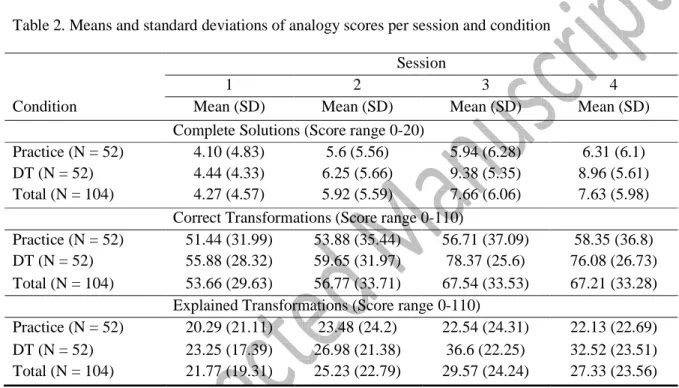
on average, about 4 items correctly during the pre-test (see Table 2). Only one participant
answered more than 80 percent of the items correctly (i.e., consistent analogical strategy-use).
This child was reassigned to the group of children who showed variable strategy-use.
Analyses. Repeated measures analysis is frequently used to analyze data derived from repeated measurements of the same individuals. However, microgenetic data sets can be
considered to be comprised of multilevel data, where repeated measurements are nested within
individuals (Hox, 2010; Kreft & De Leeuw, 1998; Van der Leeden, 1998). Multilevel analysis
(MLA) was used to analyze the data because it allowed us to model the intervention and effects
of practice separately, and over time. The analyses were carried out in R (R Core Team, 2014), as
a series of logical steps involving the increased addition of predictors, in line with our
hypotheses.
Linear Mixed Modelling analysis, utilizing a multilevel approach (MLA applied with the
lme4 package for R Statistical Software; Bates, Maechler, Bolker, & Walker, 2015), appeared to
be particularly valuable for the present study as it enabled us to inspect growth trajectories based
on data obtained from repeated measurement moments (Level-1), for each individual (Level-2). It
18
background variables and experimental treatment (Van der Leeden, 1998). Additionally, Linear
Mixed Modeling enabled us to add two types of explanatory variables to the model:
time-constant and time-varying variables. This allowed us to model both the average growth
trajectories of various groups of children, as well as the individual growth trajectories of each
child (Hox, 2010). The raw data were used to describe the development of children’s analogical
reasoning performances defined in terms of accuracy, number of transformations, and number of
transformations mentioned in verbalizations, over sessions (see Table 2). Then, a series of models
was compared for each of the three dependent variables using maximum likelihood estimation
(FML).
First, an unconditional means model (model 0) was carried out that included a random
intercept representing fixed (average) and random (variance) effects to examine variation in the
intercept (i.e., variable mean) of each variable. In model 1, the unconditional growth model, we
included the linear effect of time. These models were carried out to analyze the variance in the
three dependent variables between children and over time within children, respectively. The
subsequent models included predictor variables to explain remaining variance. The following
predictors were added to the model: group verbal and spatial working memory, and initial
variability.
Each successive model included an additional predictor variable or interaction between
predictors. The linear effects of time were included in all models except for model 0. Likelihood
ratio (LR) tests (using the Chi-square distribution) and fit indices (AIC and BIC) were examined
to assess how the model fit of the new model compared to that of the previous fitted model. All of
the variables contained a meaningful 0-point to facilitate the interpretation of the outcomes of the
analyses (Hox, 2010). For reference purposes, the regression equations for the final models are
19
After running the MLA’s, we focused on more in-depth analyses of group-growth curves
of analogical reasoning over time. Siegler (2007) posited the benefit of trial-by-trial assessments
in microgenetic studies. To achieve this, we examined: the number of complete analogical
solutions; the number of correct transformations the child produced in both incomplete and
complete analogical solutions; and the number of these correct transformations for which the
child was able to describe their strategy.
Results
Psychometric analyses regarding the pre-test outcomes revealed a high internal consistency for
the number of complete analogical solutions (α=.90) .Test-retest coefficients were calculated for
test session 1 and test session 2 (complete analogical solutions, r=.86, p<.001; transformations
correct, r= .94, p<.001; transformations explained, r=.89, p<.001).
Before examining the findings from each of our research questions in detail, we checked
for possible initial differences between the training and practice groups using t-tests. There were
no differences between the groups in the Exclusion test (t(102)=−-1.14, p=.26) and in the number
of complete analogical solutions (t(102)=0.39, p=.70), transformations (t(102)=0.76, p=.45), or
explanations (t(102)=0.78, p=.44) at Session One. Means and standard deviations per session and
group are provided in Table 2. Verbal working memory scores (t(102)=0.47, p=.64) and spatial
working memory scores (t(102)=-0.50, p=.62) also did not differ between the two groups (see
Table 3).
Insert Tables 2 & 3
Growth curve analyses (MLA) were based on raw scores, and were used to model growth
20
and c) explained transformations. Several hierarchical analyses were performed to find the best
fitting growth model for each dependent variable separately.
Complete solutions (accuracy)
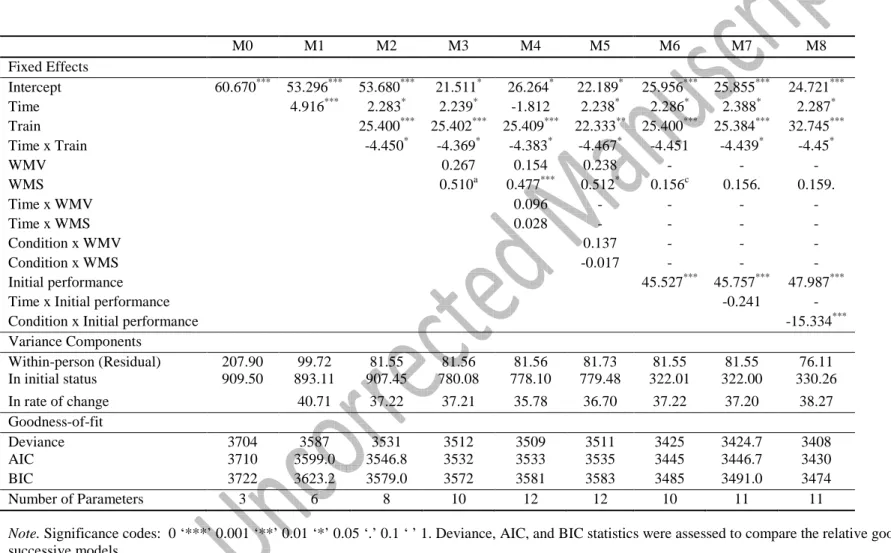
Model 0 (the unconditional means model, see Table 4) revealed a significant fixed effect of the
intercept (p<.001). The intra-class correlation coefficient (ICC) indicated that 76% of the total
variation in the analogy scores was attributable to inter-child differences. We included our time
predictor into the level-1 sub-model in order to explain the residual within-child variance (7.98).
In model 1 (the unconditional growth model), the fixed effect of linear time was, as
expected, significant. Children, on average, increased in accuracy across sessions. There was a
positive covariance (.22) between the slope and intercept, which revealed that those with higher
initial analogy scores generally demonstrated higher rates of growth. Inspection of the variance
components revealed large remaining variance in complete solutions both between, and within,
children. The R2 value indicated that 52.2% of the within-person variation in accuracy was
accounted for by the linear effect of time.
Insert Table 4
In model 2, (continuing examination of hypothesis 1), the positive fixed effect for group
showed that the children generally increased their accuracy across sessions as the estimated rate
of change (0.902) for repeated practice showed. The trained children obtained, as expected,
higher scores than children in the unguided practice group. This difference in performance took
place, in particular, between session 2 and 3. The negative time x group effect indicated that
trained children’s reasoning accuracy, unexpectedly, decreased from the first to second post-test
21
intra- variance children’s accuracy scores. The variance in Time indicated that unexplained
variance accounted for children’s rate of change.
Insert Figure 2
In model 3 we inspected the effects of both verbal and spatial working memory on initial
status (see hypotheses 2 and 3). An LRT indicated that the inclusion of these predictors resulted
in an improved model (X2=23.66, df=2, p<.001). As expected, spatial working memory
significantly added to the prediction of the number of complete solutions at pre-test. Children
with greater spatial working-memory capacity obtained higher accuracy scores at session 1. The
fixed effect of verbal working memory was not significant. Model 4 added the interaction effects
between time and verbal working memory and spatial working memory respectively, and this led
to a significant improvement in model fit (X2=9.01, df= 2, p=.01). The interaction of verbal but
not spatial working memory with time was significant. Contrary to our expectations, spatial
working memory was not related to improvement through repeated practice. The interaction
between time and spatial working memory was therefore not further included in modelling.
Model 5 added the interaction effects of group with verbal working memory and spatial working
memory respectively. Model fit did not improve, indicating that the children were able to benefit
from dynamic testing and improve their analogical reasoning performance irrespective of the
capacity of their working memory. The inclusion of the three-way interactions (spatial working
memory x group x time and verbal working memory x group x time) also did not improve model
fit.
In model 6, initial variability was included and this led, unsurprisingly, to an
22
interaction between initial variability and time in model 7 did not result in a better fitting model.
Contrary to our expectations, variability in children’s strategy-use at the first session was not
related to the rate of change in solving analogies. In model 8, we included the interaction of
initial variability and group, which significantly improved model fit compared to model 6
(X2=6.81, df=1, p<.01). The negative interaction effect revealed, as expected, that the
dynamic-test training reduced the influence of children’s initial variability in the use of analogical
strategies. Including the three-way interaction of initial variability x group x time did not improve
model fit. Results of the likelihood ratio tests and inspection of the AIC and BIC indices showed
that model 8 was the best fit to our data. Model validation with residual plots (Package ‘ggplot2’;
Wickham, & Chang, 2015) did not reveal any violation of assumptions.
Summary for accuracy. Our final model revealed that the training was successful in improving children’s accuracy. However, the benefits of training were not fully sustained
throughout the study sessions. Our findings further indicated that children with low initial
variability in analogical reasoning profited more from the dynamic-test training than children
who already demonstrated some analogical reasoning at pre-test. At this first session, spatial
working memory was positively related to the number of complete analogical solutions, whereas
(in the final model) verbal working memory was a significant predictor of children’s initial status
and rate of change. Children with greater verbal working-memory capacity were found to
improve more in accuracy across test sessions.
Number of (explained) transformations
The outcomes of the various models we tested regarding children’s use of correct
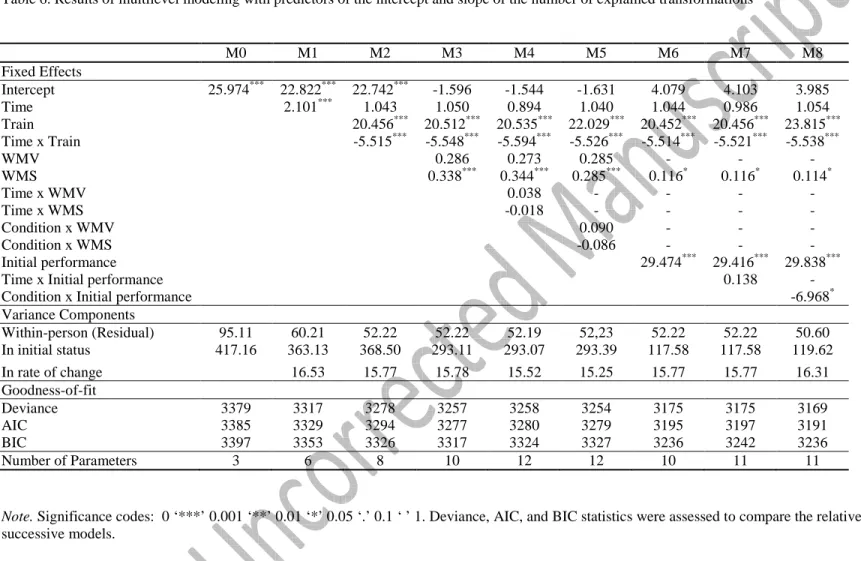
transformations and the number of explained transformations are depicted in Tables 5 and 6,
respectively. The unconditional means model (model 0) of both outcome variables showed a
23
found, indicating that 81% of the total variation in the number of (explained) transformations was
attributable to inter-child differences. The unconditional growth model (model 1) of both
outcome variables revealed significant fixed effects of linear time. The R2 values indicated that
52% and 36.7% of the within-child variation in the number of transformations and the number of
explained transformations respectively, was systematically associated with linear time.
Insert Tables 5 and 6
Model 2 included group as a predictor. A significant time effect was found for the number
of transformations, indicating that children, on average, increased their number of correct
transformations across sessions as a result of repeated practice. Unexpectedly, however, repeated
practice did not lead children to significantly increase their number of explained transformations
across sessions. The significant fixed effects of group in the models of both outcome variables
revealed that the trained children correctly produced and explained more transformations than
those who only had unguided practice. This difference seemed to be most evident between
sessions 2 and 3. However, the effect of training again decreased at the last session for both
outcome variables (transformations and explained transformations), as indicated by negative time
x group effects (see Figure 2).
In model 3, we included the main effects of verbal and spatial working memory. This
resulted in improved models for the number of both transformations (X2=18.87, df=2, p<.001)
and explained transformations (X2=21.18, df=2, p<.001). As expected, spatial working memory
but not verbal working memory added significantly to the prediction of the number of (explained)
transformations at the first session. Model 4 included the interaction effects of time with verbal
24
transformations, or explained transformations. In model 5 the interaction effects of group with
verbal working memory and spatial working memory were added. Similar to model 4,
non-significant improvements were revealed, indicating that verbal and spatial working memory
capacity did not influence children’s training benefits. The 3-way interactions (spatial working
memory x group x time and verbal working memory x group x time) failed to improve model fit
for both the number of transformations and the number of explained transformations. The main
effect of verbal working memory was no longer included in the models of these outcome
variables after this point.
The main effect of initial variability was included in model 6, which, again, led to an
improvement in model fit for both outcome variables as indicated by smaller AIC and BIC fit
indices. The interaction of initial variability and time in model 7 did not result in a better fitting
model for the number of transformations or explained transformations.
We included the interaction between initial variability and group in model 8, which led to
a significant improvement in fit compared to model 6 for the number of transformations
(X2=16.89, df=1, p<.001) and the number of explained transformations (X2=6.14, df=1, p=.01).
The negative interaction effect indicated that dynamic-test training reduced the influence of
children’s initial variability in the use of analogical strategies. Including the interaction of initial
variability x group x time did also not improve model fit for the number of transformations or
explained transformations. Again, model 8 was selected as having the best fit to the data for both
outcome variables. Model validation (‘ggplot2’) showed that assumptions were met.
Summary for (explained) transformations. The final models indicated that dynamic-test training was successful in improving children’s number of transformations and explained
transformations. However, as has been shown, the initial benefits of training were not fully
25
variability in analogical reasoning profited more from the dynamic-test training than children
who were already capable of some analogical reasoning at the first session. Results also showed
that spatial working memory was positively related to the number of transformations and the
number of explained transformations at pre-test. The MLA results for (explained) transformations
and for accuracy differed slightly. For accuracy, results indicated that verbal working memory
influenced children’s initial status and rate of change. Verbal working memory was, however, not
influential for children’s initial status or rate of change regarding their (explained)
transformations.
Growth-curve trajectories of several subgroups
After running the MLA’s, we focused on more in-depth analyses of growth curves of analogical
reasoning over time. The results indicated that the most influential variables on children’s
reasoning performance were: group, spatial working-memory capacity, and initial variability.
Spatial working memory was dichotomized into a ‘lower score’ and ‘higher score’ category,
based on the median score. This allowed us to visually inspect the progression in reasoning
performance across sessions for eight subgroups (see Table 7).
Insert Table 7
The differential growth in reasoning performance across sessions of the eight subgroups
for the three dependent variables is shown in Figures 3, 4 and 5.
26
These figures show that children who displayed limited capacity for analogical reasoning at the
first session (low variability), made gains after they had received training. Rapid improvement
was apparent for all three of the outcome variables. However, these children showed, on average,
a dip in performance at the last session for all outcome variables. In contrast, children who
displayed greater evidence of analogical reasoning at the first session (high variability) showed a
more gradual increase in the quality of their reasoning.
Discussion
The main purpose of the current study was to examine whether dynamic training versus unguided
practice resulted in different change paths in strategy-use and in performance accuracy. On the
basis of the literature (Halford et al., 2010; Richland et al., 2006) it was anticipated that measures
of visual-spatial and verbal working memory and initial variability in children’s problem-solving
would provide a richer understanding of factors underpinning individual and group growth
trajectories in analogical reasoning. Our study also sought to provide a meaningful context in
which to investigate the potential value of new ways (both methodological and statistical) to
examine inter- and intra-individual change in problem-solving processes within a collaborative
testing context. For this reason, our study employed a microgenetic, trial-by-trial assessment to
investigate variability in children’s strategy-use and to gauge subsequent progress in their use of
problem-solving strategies after either intervention or unguided practice.
Our study outcomes revealed that, although repeated practice led to greater accuracy and
a superior behavioral strategy-use (with the training adding significantly to this effect), unguided
practice alone did not significantly change children’s verbal explanations of strategy-use. In
contrast, after training, children showed significant improvements in solving the analogy tasks
and in both their behavioral strategy-use and verbal accounts. Having tackled each task, each
27
instruction appeared to be necessary to deepen the children’s understanding of how to solve the
problems. This deeper understanding seemed to be a necessity before an adequate verbal
explanation could be offered (e.g., Crowley & Siegler, 1999) [see also, Rittle-Johnson (2006) for
a similar finding]. A related explanation for the limited benefits of unguided practice might be
that children in our study had to construct their answers to open-ended tasks. Stevenson, Heiser,
& Resing (2016) found that after training, children who had to construct their responses provided
higher quality explanations than those who received a multiple-choice format. It seems likely that
the combination of training and the construction of the answer helped to deepen the child’s
understanding.
Our findings only partially confirm those reported by Tunteler et al. (2008) and Tunteler
and Resing (2010), who, in their microgenetic studies with classical geometric analogies, found
differential progression paths for trained and unguided practice groups, but growth in verbal
explanations over time for children in both groups. This may reflect the greater challenge of the
items utilized in the present study. Oral explanations of problem solving also reflect
metacognitive skills (Efklides, 2006) and do not necessarily parallel children’s problem-solving
processes, particularly if they are young (Ericsson & Simon, 1984; Veenman, 2015). It seems,
therefore, that children can (partially) construct an answer but (still) operate at different levels of
verbal and behavioral strategy-use, being able to offer a verbal account only after training
(Resing et al., 2012) [see also, Rittle-Johnson, Fyfe, Loehr, and Miller (2015) for related findings
in the early numeracy domain].
Contrary to our expectations, initial variability in the child’s performance appeared not to
be related to change across test sessions (e.g., Siegler, 2007; Tunteler & Resing, 2007). Children
with low initial variability in solving analogies profited from the training as well as those who
28
training apparently provided them with better tools for constructing and explaining their answers.
While dynamic testing appeared to improve the performance of children, irrespective of
variability, we were rather surprised to discover that performance dipped at the final
measurement, although inspection of individual growth curves also showed large inter- and
intra-individual differences in change paths. The growing understanding of how to solve the tasks as
evidenced for many of our participants seemed to be time and/or context-bound and did not
transfer to a parallel task administered two weeks later. These outcomes may suggest that training
was insufficiently extensive, or needed to be provided more frequently over a longer period.
Another explanation, supported by the differential patterns of growth-curve trajectories observed,
is that specific subgroups of children might require a more tailored form of scaffolded instruction
and feedback (Siegler & Svetina, 2002) operating within their zone of proximal development
(Alibali & Goldin-Meadow, 1993; Granott, 2002; Wood, Bruner, & Ross, 1976). Of course, some
children may have lost interest in having to solve the tasks repeatedly, and may have become less
motivated to explain all of the various transformations for every item that they were asked to
solve (Siegler & Engle, 1994).
Spatial working memory was as expected found to be related to children’s visual-spatial
encoding [visual processing being an important component of figural tasks (Laski & Siegler,
2014; Rasmussen & Bisanz, 2005; Van der Ven, Boom, Kroesbergen, & Leseman, 2012)],
although this was not associated with improvement on the tasks. In contrast, verbal
working-memory positively influenced both children’s initial ability and rate of change but only in relation
to full construction (accuracy) of the tasks (see also Siegler, 2006). It was not, however, related to
the (change) in number of dimensions detected in the task material, or the number and
progression of verbal explanations. These findings seem to differ from those of an earlier study
29
up with their peers after training. While the reasons for this discrepancy are unclear, it should be
noted that the tasks in the present study were more demanding in terms of cognitive load and
most participants, struggled, especially at the initial stage (Halford et al., 2010). However, the
role of working memory (both spatial and verbal) appeared to diminish as discrete aspects of task
performance are considered. As children had to construct their answers, it was possible to
examine a range of performance variables: the outcome (accurate/inaccurate), the number of
objects/features that change and which have to be detected by the child (ranging from 1-6)), and
the number of verbal explanations. The graduated prompts training focused on this process of
finding changing features in order to solve the analogies. Apparently, as a result of the training,
cognitive load diminished, but not sufficiently to completely overcome differences in working
memory. An explanation for this finding might be that, of course, a child must start with
encoding the task features (visual-spatial), but after this first step, the inductive reasoning process
necessarily has more of a verbal character. Training is given orally as well. To be able to analyze,
find, and explain the task solution, the child needs sound verbal reasoning (and working memory)
ability. In addition, other aspects of higher-order executive functioning not measured in this
study, for example, inhibitory control skills (Richland and Burchinal, 2013) appear to play an
important role in solving analogies.
Our findings support Siegler’s (2006) “overlapping waves” theory, whereby high initial
variability of an individual’s strategy-use is likely to predict more substantial later learning.
Interestingly though, growth trajectories of children with larger (spatial) working-memory
capacity, who had received training, suggested that a given level of initial performance was not
always necessary for rapid learning to occur. Dynamic testing appeared to be a necessary step for
some to learn how to solve the analogy problems: after this, some children displayed a rate of
30
This study has sought to provide both a methodological and a substantive contribution.
Firstly, advanced multilevel analyses were used in combination with a microgenetic design to
examine verbal and visual-spatial working-memory components separately (Alloway et al.,
2006), and in combination with initial variability and the effects of training versus unguided
repeated practice. Secondly, our means of analysis (multilevel analysis for repeated measurement
data) enabled us to inspect group-growth trajectories in combination, rather than in isolation, with
systematic variation between these trajectories as a function of the background variables and
experimental treatment (Van der Leeden, 1998). Furthermore, our analogy tasks were
open-ended; children had to construct their answers so enabling us to undertake fine-grained analyses
of children’s solving processes (e.g., Harpaz-Itay, Kaniel, & Ben-Amram, 2006; Resing & Elliott,
2011; Tzuriel & Galinka, 2000). Although we know that such tasks are more difficult than
multiple choice tasks (e.g., Behuniak, Rogers, & Dirir, 1996; In’nami & Kozumi, 2009; Martinez,
1999), and individuals require more help during training to solve these tasks (Stevenson et al.,
2016), these type of tasks may improve learning after extensive instruction.
Our study had some limitations. Firstly, our design required a large number of contact
hours with the schools and participating children. While many of them were clearly enthusiastic
participants, others may have become less motivated or attentive over time, particularly where
difficulties were experienced. This was the main reason why children were given just one, rather
short training session, which might have led to less than optimal difference between the test
outcomes of the trained and non-trained children. Secondly, only two subtests measuring
(aspects) of verbal and figural working memory were administered. To strengthen our
conclusions regarding the respective roles of verbal and figural working memory in solving
analogies before and after training/practice, we would ideally need more measures, based on a
31
general fluid intelligence, for example Engle et al., 1999. A more comprehensive measurement of
the verbal memory component may be particularly valuable given the complexity of analogies
and inductive reasoning tasks in general. In addition, the current study could only provide some
global information regarding the underlying change mechanisms in various subgroups. The
relatively small numbers of children in subgroups formed on the basis of working memory and
initial variability, for example, did not permit us to offer very fine grained conclusions regarding
variability in change over time. As noted above, we clearly saw large individual differences,
variable strategy use, and variable learning progression related to working memory, but only
when comparing children at a more individual level. Larger training programs (e.g., Tzuriel &
George, 2009) with long-term follow-up, and more specific and in-depth measurement of various
aspects of working memory are needed to confirm the individual growth curves we found.
Analogical reasoning is of fundamental importance for the understanding, transfer, and
retention of many key educational principles in school (Vendetti, Matlen, Richland, & Bunge,
2015). However, laboratory studies suggest that this is not always a spontaneous process (Gick &
Holyoak, 1980; 1983) and children can be easily distracted by irrelevant information, for
example, perceptual features rather than underlying relationships (Richland et al., 2006). Clearly,
the skill of the teacher in supporting the child’s use of analogical reasoning is key to effective
learning (Richland & Simms, 2015) yet teachers are unlikely to feel confident in how best to
support individual children. While we know that differences in the nature and frequency of adult
prompts geared to encourage the comparison of analogical relationships can have a significant
influence upon children’s learning and retention (Vendetti et al., 2015), we still have much to
learn about the most effective ways of offering differential instruction that reflects individual
32
While the current study did not focus in detail on underlying change mechanisms,
comparison of the variability and quality of growth-trajectories of different subgroups (such as
those identified in the present study) may help to reveal specific strengths and weaknesses that
influence particular learning trajectories. This information could be used to better predict
children’s growth-trajectories and ameliorate potential problems by the use of specialized and
targeted instruction or scaffolding. While working memory capacity has been found to influential
for all forms of relational reasoning, including that of analogical reasoning, our findings
suggested a somewhat complex picture about its relationship to the children’s progress. Further
research is needed to ascertain which components of working memory are most influential for
successful performance and for ongoing development, and whether such factors might be
different for high versus low performing children (Grossnickle et al., 2016). Dynamic testing may
ultimately contribute to a greater understanding of how differential forms of instruction, ranging
from metacognitive to more concrete (Resing, 2000, 2013), can be tailored for children with
different cognitive processing profiles.
In a diagnostic context, and in future research, it may prove useful to add a task whereby
the child is asked to construct one or more problems for the examiner (in this case a figural
analogy) (Bosma & Resing, 2006; Harpaz-Itay et al., 2006; Kohnstamm, 1967). Findings from
these studies suggest that such a task may further activate higher-level metacognition, additional
strategies and superior explanations.
Within the field of educational psychology, there continues to be significant debate about
the value of domain general cognitive assessment for the purposes of informing educational
intervention (Compton, Fuchs, Fuchs, Lambert, & Hamlett, 2012; Elliott & Resing, 2015;
Fletcher et al., 2011; Fletcher & Vaughn, 2009; Hale et al., 2008, 2010; Reynolds & Shaywitz,