Managing Global Guilt and Local Norms
Governance in the Sri Lankan Clothing Industry
Annelies M. Goger
A dissertation submitted to the faculty of the University of North Carolina at Chapel Hill in partial fulfillment of the requirements for the degree of Doctor of Philosophy in the Department of Geography.
Chapel Hill 2013
Approved by:
Dr. John Pickles
Dr. Gary Gereffi
Dr. Banu Gökariksel
Dr. Nichola Lowe
ABSTRACT
ANNELIES M. GOGER: Managing Global Guilt and Local Norms: Governance in the Sri Lankan Clothing Industry
(Under the direction of John Pickles)
This dissertation examines how multiple forms of governance shape ethical
production in Sri Lankan clothing supply chains. With multi-sited research in Sri Lanka,
the United States, and Europe, it foregrounds how mid-level managers, as embodied
subjects in clothing supply chains, conceptualize and practice ethical trade as they
navigate demands to be globally competitive, comply with global standards, and respect
local ethical norms. I found that the Sri Lankan apparel industry’s attempts to promote
ethical manufacturing have led to mixed and uneven effects, meaning that the results did
not straightforwardly confirm the hypothesis in the global value chain literature that
private governance and industrial upgrading lead to global competitiveness and enhanced
wellbeing. Because a series of mediating factors have shaped how the ethical initiatives
played out in Sri Lanka, I argue for a more de-centered theory of governance that is
attentive to multiple fields of power and forms of struggle occurring through GPNs. I also
argue for a sustained critical engagement with the concept of upgrading and its effects on
social and economic worlds.
This project makes three key contributions to broader debates about globalization.
First, it draws on feminist methods and critical policy studies to promote a deeper
geography. This is important because the global value chain framework is increasingly
gaining currency in mainstream development institutions, but there is also growing
criticism about the foundational concepts of governance and upgrading in this
framework. Second, I focus on the role of management knowledges and practices in
processes of upgrading. Managers are situated at the nexus of global-local power
relations and yet very little is understood about how ethical concerns are prioritized,
adapted, and contested (or not) through everyday management cultures and practices.
My third contribution is to challenge conceptualizations of ethical production that are
fixed and binary, such as the assumption that there is an easy answer to questions like,
“Was this t-shirt ethically made?” Instead, I reframe ethical initiatives as processes that
are ongoing, embodied, and shaped by relations of dominance and subordination at
To Opa, Dirk Tump, for introducing me to the life of the mind,
And
ACKNOWLEDGEMENTS
There are numerous people that I would like to recognize for their support of this
project. I hope that these words convey a modicum of the depth of my gratitude to
everyone who has contributed to this project, directly and indirectly. First, my tireless
advisor, John Pickles, showed unwavering dedication at the times when it was needed
most, offered me access to several collaborative research networks, and never failed to
come up with new possibilities and ways of seeing things. Wendy Wolford’s brilliant,
on-the-spot insights and tenacity of her own inspired me to venture into “the interstices” of
the field and feel confident in doing so. Banu Gökariksel motivated me to bring feminist
research into the core of this project, always conveyed a sense of encouragement, and
many times helped me transform an overwhelming morass into doable tasks. Gary
Gereffi, connected me to a wonderful global community of scholars, provided very keen
and insightful advice, and kept me grounded in the fundamentals of the GVC analytic.
Finally, Nichola Lowe, asked extremely constructive questions that reconnected me to
my roots in urban and regional studies.
I also appreciate my “honorable committee members” and other faculty at UNC
who have generously offered support, intellectual inspiration, and other insights along the
way, including Elizabeth Havice, Lawrence Grossberg, Altha Cravey, Sara Smith, Nina
Martin, Arturo Escobar, and Meenu Tewari. Outside of UNC, I am especially grateful to
Jennifer Bair for mentoring me through my first encounters with publishing. Kanchana
opened up opportunities to collaborate in the future. Stephanie Barrientos and Adrian
Smith generously offered assistance, institutional support, and advice about fieldwork;
Joshua Barkan offered thorough feedback on Chapter Six; and Jeanne Marecek provided
essential and accurate advice about how to navigate difficult and confusing situations in
Sri Lanka. I also wish to thank my advisors at earlier stages in my academic career,
Dessima Williams and Karen Chapple, for cultivating my interests in development, social
justice, and workforce development and being excellent mentors. The marks of several of
my previous professors also come through in this work, and I especially appreciate
Ananya Roy, AnnaLee Saxenian, Manuel Castells, Gordon Fellman, Laura Goldin,
Shulamit Reinharz, and Thomas King for their inspiration.
The wider community at UNC has truly been an honor to be a part of, and I would
not have made it this far without it. I am particularly grateful to Elizabeth Hennessey, my
writing partner-in-crime, who I have learned a great deal from and my work is better for
it. Also high on the list are my other writing group members (at various stages), Freya
Thimsen, Lahnna Catalino, Joe Wiltberger, Julie Tuttle, and Christine Boyle. I appreciate
Joe Franklin’s help and support through my exams and assistance with grant applications;
especially because he knew they would take me far away, but he did it anyway. On a
broader level, I am grateful for the many great friends and colleagues that I have met
here, especially Murat Es, Rolien Hoyng, Laura Gutierrez Escobar, Christian Sellar,
Joseph Palis, Craig Dalton, Aron Sandell, Dennis Arnold, Tu Lan, Katie Akin, Tracy
Hadden-Loh, Emily Price Phillips, Brenda Baletti, Ashley Carse, Sara Safransky,
Michelle Christian, Shengjun Zhu, and so many more... I also extend my deepest
behind the scenes making the Geography department run smoothly (and saving me in
several moments of administrative gridlock).
Beyond UNC, I have several other friends who have been especially supportive of
this project. First, the initial inspiration to work in Sri Lanka came from Achala
Navaratne, who piqued my interest in the topic and helped me establish my first
connections in the garment industry. Sanjana Kuruppu also opened many doors for me
early on and directed me to what turned out to be the most interesting questions. Sapna
Elizabeth Gardner Thottathil was my other fantastic writing partner-in-crime and my
fieldwork confidant. Masumi Hayashi-Smith was the best housemate one could ask for in
Colombo, and I will always fondly remember the summer we spent with Maria Ritzema
and Bandara Herath learning Sinhala. Ashan Munasinghe provided excellent research
assistance and astute insights throughout my research, and the fieldwork would have been
so much less productive without him. Kumari Samanmali also helped me track down
some newspaper articles. Janaka Wijayasiri graciously helped me obtain data that I had
been trying to get for years. I extend my most sincere gratitude to my other close friends
who supported me in many ways throughout this process, especially Bharat
Chandramouli, Soumya Natarajan, Kelvin Black, Deepa Bhat, Eve Crevoshay, Molly
Jacobs, Kate Williams, Micheline Magnotta, Suzie Welty, Sydney Cooke, Nirupa Mohan,
Sadhana Mohan, Dulika Rathnayake, Nichola Minott, Joaquin Rosales, Hector
Dominguez, Bernardo Brown, Valentina De Marchi, Luce Mariniello, Maija Amaro,
Brooke Mundell, Beverly Fleming, and Rhonda Neuhaus.
I received generous financial support from the Social Science Research Council
Mellon foundation), the U.S.-Sri Lanka Fulbright Commission’s U.S. Student Program,
the National Science Foundation Doctoral Dissertation Improvement Grant, the Weiss
Urban Livability Doctoral Fellowship, the American Institute for Sri Lankan Studies
Dissertation Planning Grant, the UNC Global Initiative/Center for Asian Studies
Pre-dissertation Travel Grant, the UNC Department of Geography Travel Grant, the U.S.
Department of Education Foreign Language and Area Studies grant, and the Center For
European Studies Graduate Research Travel Grant. This project would not have been
possible without this support. I am especially grateful to the Social Science Research
Council and the Fulbright Commission for supporting my return research after a medical
leave and to Tissa Jayatilaka, Ramya Chamalie, Daniella Sarnoff, John Rogers, and Ira
Unamboowe for their extraordinary support and assistance.
I would like to acknowledge that Elsevier has granted permission to reprint a
modified version of the article, “The making of a ‘business case’ for environmental
upgrading: Sri Lanka’s eco-factories,” which appears in this dissertation as Chapter Five.
This article was published in the Elsevier journal Geoforum in June 2013. Pion, Ltd. has
granted permission to reprint a modified version of the article, “From disposable to
empowered: Re-articulating labor in Sri Lankan apparel factories,” as Chapter Six of this
dissertation. This article was accepted for publication in the Pion journal Environment
and Planning A on April 3, 2013. Taylor & Francis has granted permission to reprint a
modified version of, “Ethical branding in Sri Lanka: A case study of Garments Without
Guilt,” in J. Bair, M. Dickson & D. Miller (eds.), Workers’ rights and labor compliance
I wish to extend a special thanks to the participants of this study, who generously
gave me their time and reflections about their work and the larger picture of ethical trade
and apparel production. I am especially grateful to those who helped open doors for me,
connected me to other contacts, and gave me feedback on work-in-progress.
Most of all, I thank my family. I especially appreciate all of the sacrifices,
dedication, and hard work of my parents, Francis Goger and Elisabeth Tump Goger. They
made it possible for my siblings and me to get university degrees, which they did not
have access to themselves. If nothing else, I hope this communicates that their hard work
has paid off, even though they deserve so much more. Thanks also to my sister, Nicole,
brother, Michael, and Margaretha Tump (Oma). I am also grateful to my aunt, Deborah
Goger, who repeatedly offered her love and support throughout this project; and to my
cousin, Carol Caruso, who generously donated her car to me. I am humbled to have all of
TABLE OF CONTENTS
LIST OF TABLES ... XIII LIST OF FIGURES ... XV LIST OF ABBREVIATIONS ... XVI
CHAPTER ONE: Introduction ... 1
1.1WHY APPAREL, AND WHY SRI LANKA? ... 7
1.2THEORETICAL FRAMEWORK ... 9
1.2.1 Global commodity chains, value chains, and production networks ... 10
1.2.2 Cultural and relational turns in economic geography ... 16
1.2.3 Feminist industrial ethnographies and studying workplaces ... 20
1.3KEY CONCEPTS ... 23
1.3.1 Governance ... 24
1.3.2UPGRADING ... 28
1.4RESEARCH METHODS ... 31
1.5POSITIONALITY, PARTIALITY, AND ETHICAL DILEMMAS ... 37
1.5.1 Positionality and self-presentation ... 39
1.5.2 Ethical dilemmas ... 42
1.6OUTLINE OF CHAPTERS ... 44
CHAPTER TWO: Ethical trade in an era of crisis ... 47
2.1ETHICAL TRADE: THE EARLY YEARS,1996-2005 ... 49
2.2UNSTABLE POLITICAL ECONOMIES OF GLOBAL APPAREL TRADE ... 52
2.2.1 Trade liberalization ... 53
2.2.2 The global economic crisis ... 57
2.3.1 Trade patterns for apparel ... 60
2.4THE ETHICAL TRADE RE-WIRE: ORGANIZATIONAL AND CONCEPTUAL SHIFTS ... 63
2.4.1 Restructuring of the ethical trade complex ... 64
2.4.2 Shifting priorities: from standardization to competitive differentiation ... 68
2.5CONCLUSION ... 71
CHAPTER THREE: Building A “Knowledge-Based” Apparel Sector ... 75
3.1ORIGINS OF THE GARMENT INDUSTRY IN SRI LANKA ... 77
3.2ORGANIZING A RESPONSE TO RISING GLOBAL COMPETITIVENESS ... 81
3.3THE POST-QUOTA SHAKEOUT ... 84
3.4COMPETITIVENESS STRATEGIES AND INDUSTRIAL UPGRADING ... 92
3.4.1 Product upgrading ... 94
3.4.2 Process upgrading ... 95
3.4.3 Functional upgrading ... 96
3.4.4 Other forms of innovation and upgrading ... 98
3.5CONCLUSION ... 103
CHAPTER FOUR: Garments without guilt: a national branding strategy ... 106
4.1RETHINKING THE SPACES OF ETHICAL GOVERNANCE ... 109
4.2STATE-LED ZONING STRATEGIES AND LOCAL ARTICULATIONS OF ETHICAL CONCERN ... 113
4.2.1 The state’s first zoning strategy: enclaves of liberalization ... 113
4.2.2 Moral anxieties and state-led rezoning ... 117
4.3GARMENTS WITHOUT GUILT AND ITS ANTECEDENTS ... 122
4.3.1 The Garments Without Guilt initiative ... 123
4.4CHALLENGES AND LIMITATIONS OF GARMENTS WITHOUT GUILT ... 131
CHAPTER FIVE: Sri Lanka’s eco-factories: A “business case” for whom? ... 141
5.1BUSINESS CASE CORPORATE SOCIAL RESPONSIBILITY AND THE ENVIRONMENTAL TURN146 5.2REVISITING THEORIES OF UPGRADING IN APPAREL GLOBAL VALUE CHAINS ... 149
5.3MODEL ECO-FACTORIES ... 150
5.3.1 Plan A: integrating CSR into core business practices ... 150
5.3.2 Piloting eco-factories for Plan A: enhancing supplier competitiveness ... 152
5.3.3 Sri Lankan apparel industry: an “ethical” competitiveness strategy ... 154
5.3.4 Large firms use model eco-factories to differentiate Sri Lankan apparel ... 156
5.3.5 How did the model eco-factories deliver value, and for whom? ... 160
5.4COMPLEXITIES OF MAKING A BUSINESS CASE: WHO PAYS AND WHO CAPTURES GAINS? 164 5.5CONCLUSION ... 169
CHAPTER SIX: From disposable to empowered: Re-articulating labor in lean factories ... 174
6.1UPGRADING AS A PROCESS OF EVERYDAY DIS/ARTICULATIONS ... 178
6.2LOGICS OF DISPOSABILITY IN GLOBALIZED PRODUCTION ... 181
6.3MOMENT 1:DISARTICULATING DISPOSABILITY BY ADVANCING WOMEN ... 184
6.4MOMENT 2:THE CULTURAL POLITICS OF A LEAN TRANSFORMATION ... 187
6.5MOMENT 3:DISRUPTIONS TO THE RE-ARTICULATIONS OF WORK AND WORKERS ... 193
6.6CONCLUSION ... 197
CHAPTER SEVEN: Towards a better understanding of ethico-political encounters in global production networks ... 201
7.1RETHINKING ETHICAL TRADE ... 203
7.2CONNECTING ECONOMIC GEOGRAPHIES ... 207
7.3NORMATIVE MANAGEMENT IDEAS ON-THE-MOVE ... 211
7.4CONCLUDING REMARKS ... 215
REFERENCES ... 218
Table 1: Fieldwork Locations ... 33
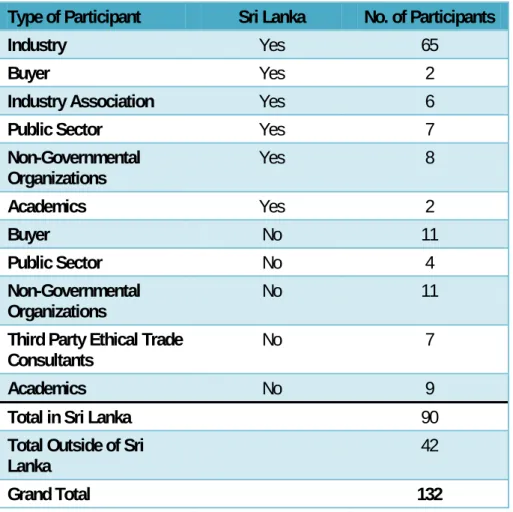
Table 2: Key Informant Interview Participants By Type ... 35
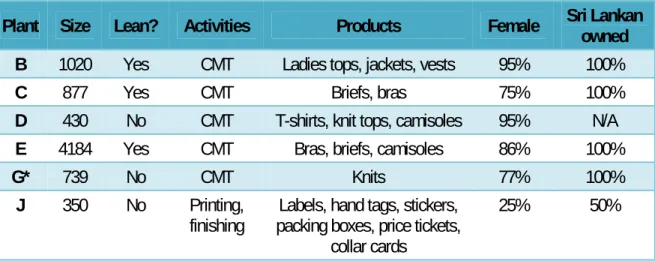
Table 3: Description of Factories Visited ... 36
Table 4: World exports of Apparel in US$ Billions ... 62
Table 5: Sri Lankan Apparel Export Values ... 86
Table 6: Changing Market Shares of the Top Ten Firms in Sri Lanka... 89
Table 7: Comparison of Garments Without Guilt Principles with Other Standards... 125
Table 8: Some Common Elements of the Model Eco-Factories ... 159
LIST OF FIGURES
Figure 1: Global Value Chains ... 11
Figure 2: The Upgrading Hypothesis in Global Value Chains Research ... 13
Figure 3: Complexities of the Upgrading Hypothesis in Global Value Chains .... 29
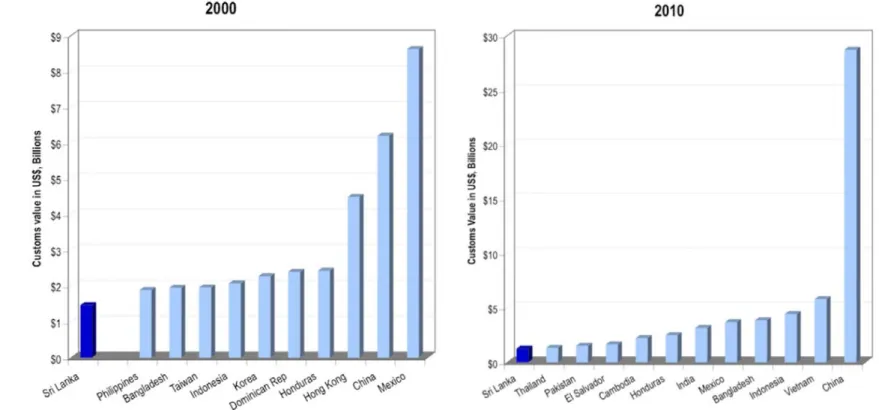
Figure 4: US Apparel Imports, 2000 and 2010 ... 61
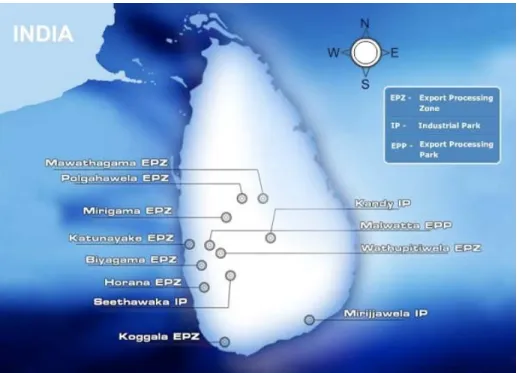
Figure 5: Export processing zones and industrial parks in Sri Lanka ... 78
Figure 6: Industrial concentration in Sri Lanka ... 79
Figure 7: Southern Expressway, opened in November 2011 ... 80
Figure 8: Sri Lanka’s apparel exports to the world, 2000-2011 ... 85
Figure 9: United States Imports of Bras by Customs Value ... 87
Figure 10: Sri Lanka Apparel: Employment and Number of Factories Over Time ... 88
Figure 11: A “Golden Needle” Campaign Advertisement, 2011 ... 92
Figure 12: Photographs of Model Eco-Factories ... 157
LIST OF ABBREVIATIONS
200 GFP – 200 Garment Factories Programme
BSR – Business for Social Responsibility
CEO – Chief Executive Officer
CMT – Cut, Make, Trim (assembly operations)
CSR – Corporate Social Responsibility
DNA - DeoxyriboNucleic Acid
ETI – Ethical Trading Initiative
EPZ – Export Processing Zone
EU – European Union
EU-15 – A subset of European Union countries that includes Austria, Belgium, Denmark, Finland, France, Germany, Greece, Ireland, Italy, Luxembourg, Netherlands, Portugal, Spain, Sweden, and the United Kingdom
FIP – Factory Improvement Program
GCC – Global Commodity Chain
GPN – Global Production Network
GSP – Generalized System of Preferences
GVC – Global Value Chain
GWG – Garments Without Guilt
HS – Harmonized System Codes
IFC – International Finance Corporation
ILO – International Labor Organization
ISI – Import Substitution Industrialization
JAAF – Joint Apparel Association Forum
M&S – Marks and Spencer
MFA – Multi-Fibre Arrangement
NGO – Non-Governmental Organization
OEM – Original Equipment Manufacturing
SAARC - South Asian Association for Regional Cooperation
SITC – Standard International Trade Classification
SME – Small and Medium-Sized Enterprises
UK – United Kingdom
UN – United Nations
CHAPTER ONE: Introduction
For over three decades now, globalization has been a central problematic in
economic geography and a dominant way of conceptualizing processes of economic
change (Dicken, 2007). The distinctive features of the “neo-liberal” era of globalization
from the late 1970s-forward included the dissemination of new communication
technologies, a shift from mass production (Fordism) to flexible production
(post-Fordism), the global integration of finance capital and banking systems, and the rise of
the World Factory (Castells, 1996; Harvey, 1989; McMichael, 2008; Piore and Sabel,
1984). Although some portray globalization as a homogenizing, totalizing force, such as
Harvey’s notion of time-space compression (1989), others emphasize its unevenness,
relationality, and heterogeneity (Dicken, 2007; Massey, 1984; Ong, 2006). One general
aim of this dissertation is to begin to forge connections between these understandings of
globalization (Nagar, et al., 2002).
Alongside globalization processes, the hegemonic approach to development
policy has changed from a focus on state-led import substitution models to market-led,
export-oriented competitiveness strategies (McMichael, 2008). Peck (2002) and Jessop
(1999) characterize these changes in governance as a “rolling-back” of the
Keynesian/Fordist welfare state and the “rolling-forward” of the neoliberal/supply side
state that has less protections for labor and public goods. After dramatic phases of
questioned the wisdom of pro-globalization, “free trade” policies and were particularly
concerned about what they saw as the declining institutional mechanisms for regulating
capital (Dicken, 2007), commonly framed as a “governance deficit” problem (Gereffi and
Mayer, 2006) or the “race-to-the-bottom” (Appelbaum, et al., 2005).
The clothing industry has been at the forefront of these debates about global
governance failures. In the mid-1990s, consumer groups and labor unions publicized
widespread abuses in apparel global commodity chains (GCCs),1 the globally dispersed
but functionally coordinated networks of firms that produce goods for final consumption
(Gereffi, 1994). This marked the apparel industry with a reputation for practices such as
long hours of work, unsafe working conditions, child labor, and unstable employment.
This was the beginning of the ethical trade movement, largely based in the United States
(US) and European Union (EU). In response, major clothing brands (“buyers”),
multi-stakeholder groups, and third-party organizations began to implement various universal
compliance codes and monitoring systems—herein called “compliance” (Esbenshade,
2004; O’Rourke, 2003; Pearson and Seyfang, 2001). These private, voluntary compliance
systems aimed to “raise the floor” to promote universal labor and environmental
standards. However, growing evidence suggests that compliance has been moderately
effective, at best (Barrientos and Smith, 2007; Esbenshade, 2004; Jenkins, 2001;
O’Rourke, 2003). Therefore, many activist groups and academics have asserted that
monitoring alone is insufficiently effective to address the root causes of non-compliance
1 In the more recent literature, it is more common to refer to these networks of firms as
(Barrientos and Smith, 2007; Esbenshade, 2004; Hale, 2000; Nadvi, 2008; O’Rourke,
2003). Many place the blame on the lack of mechanisms for global institutional authority,
the failures of buyers to incentivize compliance sufficiently and of producers
(“suppliers”) that cut corners and squeeze2 labor in order to compete or even survive.
By the early 2000s, the Sri Lankan garment industry had a reputation among
buyers for being a more ethical apparel producing country (JAAF, 2002). This reputation
was largely built on the basis that child labor was against local norms (so it was virtually
non-existent) and relatively strong national legislation for protecting the International
Labor Organization (ILO) Core Labor Standards (Ruwanpura and Wrigley, 2011;
Sivananthiran, 2009). Therefore, when the phase-out of the Multi-Fibre Agreement
(MFA) quota system loomed on the horizon, Sri Lankan industry associations determined
that one of their main competitiveness strategies would be to market the country as an
ethical sourcing destination for apparel (JAAF, 2002). They created a branding initiative
called Garments Without Guilt (GWG), which included a certification scheme audited
by a third-party, a charter, a set of principles, a series of specific firm-based corporate
social responsibility (CSR) programs, and a public relations campaign (funded by the
industry and the Sri Lankan government). The industry leaders hoped that Sri Lanka
could establish a niche for ethical production; thereby, attracting more orders from
high-end, image-conscious buyers. In other words, under intensifying competitive pressures
from quota phase-out they sought to pursue a “high road” strategy, meaning they
intentionally wanted to stay competitive by racing-to-the-top (instead of the bottom). This
2 Squeezing is the buying practice of asking suppliers to improve compliance while
is commonly called “upgrading,” or increasing global competitiveness by capturing a
higher share of value at the firm or sector level or enhancing market position (Gereffi,
1999).
Having an industry-led ethical trade initiative like this is quite rare (with a few
exceptions such as Morocco, Rossi, 2013), because it is often hard to get suppliers to buy
into the notion that being more ethical can promote competitiveness. Moreover, suppliers
are not very involved in setting ethical and fair trade agendas (Raynolds, Murray and
Wilkinson, 2007). They are often considered standards takers, not standards setters
(Nadvi, 2008). Therefore, the Sri Lankan case allows an examination of the difference it
makes to have suppliers involved and actively engaged in debates that are essentially
about changing supplier behaviors. How might centering the analysis on suppliers—as an
assemblage of embodied subjects involved in the everyday management of production—
challenge us to think about governance, upgrading, and ethical trade in global production
networks (GPNs) in new and more nuanced ways?
I consider the continued absence of involvement from suppliers in ethical trade
debates as symptomatic of a larger problem with how global governance and upgrading
are conceptualized in the literature on economic globalization and value chains. I am not
suggesting that that exploitative supplier behaviors and bad management don’t exist.
Rather, I start from the premise that framing the problem as a governance deficit and
promoting upgrading as a technical fix downplays the complex politics that occur through
global value chains (GVCs). What is at stake here is that this framing of governance as an
absence of authority, or “vacuum,” downplays multi-scalar dynamics of power and
mediated through geographies of social difference and multiple fields of power (Massey,
1993, 1994).
The overarching question of this dissertation is: how are power-geometries at
multiple scales shaping conceptions and practices of ethical production in Sri Lankan
clothing supply chains? Basically, this is a question about governance, ethico-politics,
and the creation and distribution of value in GVCs/GPNs. I used ethnography, elite
network interviews, participant observation, and discourse analysis to study ethical
governance and upgrading processes through the middle of GVCs that span from Europe
and the US into Sri Lanka. In particular, I am attentive to how ideas of “better”
management travel and encounter moments of friction through supply chains, the
processes by which they are adapted and legitimated, and their effect on supplier
competitiveness. My research was multi-sited, investigating apparel buyers and ethical
trade institutions in Europe and the United States and in the Sri Lankan export-oriented
apparel sector.
There are three key objectives in this dissertation. The first is to draw on feminist
methods and critical policy studies to promote a deeper engagement between the
commodity chain literatures and relational economic geographies. This is important
because the commodity chain literatures are increasingly gaining currency in mainstream
development institutions, but as this happens there is also growing debate about the
conceptual limitations of governance and upgrading in these approaches (Selwyn, 2013;
Tokatli, 2012). The second objective is to foreground the role of management
knowledges, practices, and subjectivities in processes of social and economic upgrading,
little is understood about how ethical concerns are prioritized, adapted, and contested (or
not) through everyday management cultures and practices.
The third and final objective is to challenge conceptualizations of ethical
production that are fixed and binary, such as the common but self-serving assumption
that there can be easy answers to questions like, “Was this t-shirt ethically made or not?”
Instead I draw on the feminist and relational geography literature to reframe ethical
initiatives as processes that are ongoing, embodied, and shaped by “unstable spatialities”
of dominance and subordination at multiple scales (Chari, 2004). In order to draw out
“the power-geometry of it all” (Massey, 1993: 62), the core chapters are comprised of
specific case studies that analyze governance relations in ethical initiatives from three
different perspectives: the organization of the industry sector (Chapter Four),
buyer-supplier relations (Chapter Five), and manager-worker relations (Chapter Six). In this
way, I unpack how managers, positioned between consumer guilt about their complex,
multi-scalar politics of ethical trade, upgrading, and competitiveness.
I found that the Sri Lankan apparel industry’s attempts to be more ethical and
adopt “better” management have led to mixed and uneven effects. Nevertheless, the case
studies show that new logics and practices of private governance are emerging in Sri
Lankan GVCs that do not fit neatly into what we would expect based on existing theories
of governance and upgrading—that upgrading and ethical trade lead to competitiveness
and improved well-being. This introduction lays out the theoretical frameworks that I
draw upon in this study in order to situate my interventions in the literature. Section 1.1
explains my justification for researching the apparel industry in Sri Lanka. Then, in the
commodity chains literatures, economic geography, and feminist industrial
ethnographies. Subsequently, I turn to the key concepts of governance and upgrading to
more clearly articulate my interventions with regard to the debates about them in the
commodity chains literatures. In Section 1.4, I explain my research methods and
challenges in detail. Finally, I conclude with an outline of chapters.
1.1 Why apparel, and why Sri Lanka?
I chose the apparel industry for several reasons. Because the apparel industry is a
labor-intensive sector that has relatively low start-up costs, it was among the first
industries to globalize with the rise of neoliberal, export-oriented development policies
starting in the late 1970s. The clothing industry is historically considered a jump-start
industry for industrialization in low-income countries (Fernandez-Stark, et al., 2011;
Gereffi and Memedovic, 2003). As a result, the apparel industry often figures
prominently in struggles over rapid social change and national debates what it means to
become “modern” (Hewamanne, 2008; Lynch, 2007; Mills, 1999). This means that the
apparel industry is an industry in which novel ethical trade initiatives frequently
originate. At the same time, in major consumer markets the clothing industry is a poster
child for “backwardness” and the failures of global governance, because the industry has
been marked by international scandals over problems such as child labor, excessive
overtime, and other forms of exploitation. In these ways, apparel is an extremely
important industry for understanding questions about globalization, development,
modernization, ethical trade, and global governance.
Second, apparel GVCs are rife with power differentials. It is the quintessential
access and coordinate globally geographically dispersed production networks (Gereffi,
1994), but at the same time suppliers employ an overwhelmingly young, female
workforce who are frequently migrant laborers. In addition, apparel supply chains are
typically long and complex, with many layers of suppliers and management. These
complex power relations make apparel especially well suited for studying how global
power dynamics within firm networks shape industrialization and regional development
processes. Although there is a substantial literature on ethical trade in the apparel industry
to draw from (across multiple disciplines), the problems of ethical trade continue to haunt
the sector. For this reason, the apparel industry occupies a front-and-center position in
social movements and popular debates about ethical trade.
There are several reasons why Sri Lankan apparel industry is an excellent case for
the purposes of understanding upgrading processes, governance, and ethical trade. First,
it provides a test of the hypotheses of the GVC/GPN literature about the potential for
upgrading to increase competitiveness and bring about regional development (Gereffi,
1995; Barrientos, Mayer, et al., 2011). Sri Lankan apparel producers not only crafted a
competitiveness strategy around the ethical niche to survive quota phase-out; but also, the
JAAF decided to pursue a variety of industrial upgrading strategies and to develop Sri
Lanka’s capacity as a regional hub for apparel sourcing. This strategic, industry-led
effort to pursue both economic and social upgrading makes Sri Lanka a compelling place
to investigate how “better” management practices affected the workplace, industrial
organization, and global competitiveness of Sri Lankan suppliers.
Second, within Sri Lanka, the garment industry has a long-standing reputation for
political debates as promiscuous and a threat to Sri Lankan values (Hewamanne, 2008;
Lynch, 2007; Shaw, 2004). Because apparel companies produce many bras and
underwear for export markets and due to the colonial legacy, “Western” capital is often
viewed as morally corrupting. In addition, the rise of female participation in the labor
force upon trade liberalization represented a change from the previous roles for women,
which positioned female garment workers as popular icons of these changes (Jayaweera,
2003; Lynch, 2007). In the context of a shortage of skilled labor, which the industry
needed in order to pursue its upgrading goals, it has been necessary for the industry to
respond to this domestic reputation problem to recruit and retain workers. In this way,
strong local and national articulations of ethical concern influenced the way that
managers conceptualized and prioritized ethical initiatives, especially in rural and
semi-rural factories. Therefore, a tighter labor market and state-led semi-rural industrialization
policies in Sri Lanka can contribute to a greater understanding of how local norms and
authority structures shape firm practices within GVCs/GPNs. Foregrounding the
emergence of “better” management within more ethical supply chains in Sri Lanka brings
these ethico-political struggles into sharper relief.
1.2 Theoretical framework
This dissertation engages broadly with questions about globalization, governance,
expertise, and uneven development (Dicken, 2007; Harvey, 1989; Mitchell, 2002).3 More
3 A comprehensive review of the literature on globalization and industrial restructuring
specifically, this study contributes to the commodity chains literatures in economic
geography and economic sociology (Coe, et al., 2004; Gereffi, 1994; Gereffi, et al.,
2005); however, it draws on feminist and economic geography to advance a more
relational conceptualization of governance in the economic globalization literatures. This
section reviews the contributions and criticisms of the commodity chains literatures, with
an emphasis on how the foundational concepts of governance and upgrading are
connected to debates about ethical trade. Then, I turn to relational economic geography,
considering how the concepts of power geometries, policy mobilities, and
dis/articulations inform debates about governance in GCCs/GPNs. Finally, I draw on
feminist industrial ethnographies to conceptualize supply chain governance as an
embodied, everyday process of struggle over the creation and distribution of value. With
this literature, I make the case for foregrounding mid-level managers as critical but
understudied actors who shape the representational, ideological, and concrete spaces of
production at multiple scales.
1.2.1 Global commodity chains, value chains, and production networks
The GCC framework emerged in the mid-1990s, building from World Systems
theory and Michael Porter’s work on global competitiveness (Wallerstein, 1976; Gereffi,
1994; Porter, 1990).4 This framework has made important contributions to understanding
globalization processes. One of the most salient contributions was to shift the unit of
analysis in development studies from the nation state to the inter-firm, cross-border
4 A detailed review of the debates between GCC, GVC, and GPN advocates is not within
linkages that form to produce commodities. Another important contribution was to enable
an analysis of sector-specific, meso-level case studies within and between countries,
rather than folding all industry sectors into macro-level analysis (Gereffi and Memedovic,
2003). With these interventions, GCC scholars sought to understand the conditions under
which insertion into global commodity trade circuits contribute to broad-based regional
development (Gereffi, 1995).
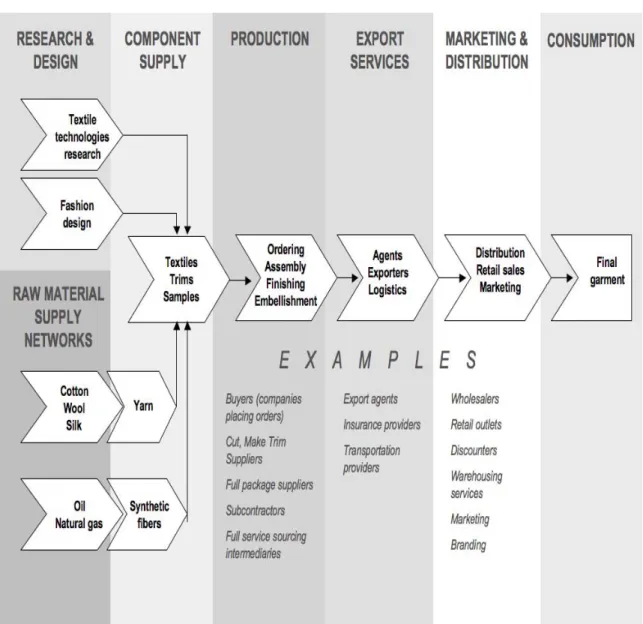
In the early 2000s, prominent GCC scholars shifted to using the GVC framework
to take attention away from products and toward value-added as a key driving mechanism
of competitiveness (see Figure 1; Sturgeon, 2009). The theory of value chain governance
was revised to put transaction costs at the center of the analysis and assert that the
governance model operationalized in a value chain depends on the complexity of
information needed to complete transactions, the codifiability of knowledge used in
transactions, and the fit between the capability of suppliers and needs of the lead firms
(Gereffi, et al., 2005). Although this enabled the framework to incorporate a wider array
of industry sectors than the GCC approach, it also restricted the scope to focus primarily
on inter-firm governance between lead firms and first tier suppliers (Bair, 2009; Gereffi,
et al., 2005).
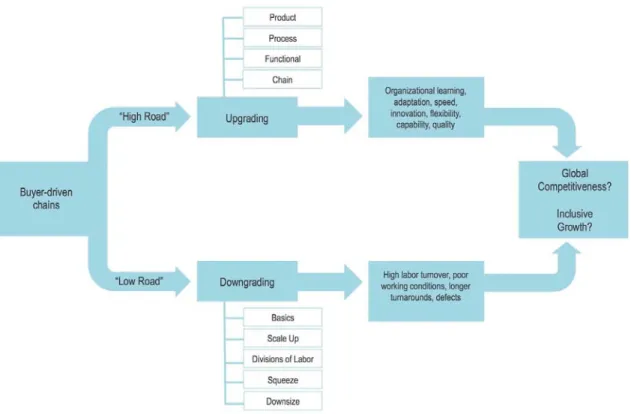
The foundational concepts of governance and upgrading in the GVC literature are
based on the proposition that a “high road” development trajectory is possible, in contrast
to the “low road” of downgrading—chasing the lowest costs and least regulation to be
globally competitive (see Figure 2). In the high road trajectory, governance from lead
firms in GVCs stimulates organizational learning and global competitiveness among
suppliers, which in turn generate “inclusive” regional economic growth that enhances the
well-being of firms, workers, and society as a whole (Gereffi, 1995; Bair, 2005; Gereffi,
et al., 2005; Gibbon, et al., 2008). By contrast, in the low road trajectory, firm efforts to
achieve competitiveness by squeezing workers or cutting other corners may benefit
individual firms or capitalists but fail to trigger widespread economic development—a
phenomenon Kaplinsky (1998) calls “immiserating growth.” This high/low road
bring about mutually beneficial outcomes for capital and labor given the “right”
institutional framework (Selwyn, 2013).
Figure 2: The Upgrading Hypothesis in Global Value Chains Research
Although the GVC framework has been increasingly incorporated into
mainstream development institutions, critical perspectives on GVCs have come from
various angles.5 Some argue that it treats the firm like a “black box,” missing the internal
struggles and everyday activities of individual actors (Coe, Dicken and Hess, 2008; Hess,
2008). Many also contend that the GVC framework insufficiently incorporates the role of
labor and the state, treating them as passive recipients of firm actions rather than as
influential agents in their own right (Carswell and De Neve, 2013; Coe and Jordhus-Lier,
5 The literature on GVCs is vast, and for the sake of brevity only the most common and
2010; Herod, 2001; Rainnie, et al., 2011; Selwyn, 2012; Smith, et al., 2002; Werner,
2012). In addition, the “inclusionary bias” critique asserts that the GVC framework
focuses too much on successful firms, omitting not only cases of downgrading,
displacement, and firm closure but also how exclusions are part-and-parcel of upgrading
practices (Bair and Werner, 2011; Gibbon and Ponte, 2005). Finally, several scholars
have indicated that at the root of many of these debates over the terminology and future
directions of commodity chain research is the absence of a coherent theory of value in the
GVC framework (Bair, 2005; Gibbon, et al., 2008; Guthman, 2009; Smith, et al., 2002).6
There are also more targeted critiques of governance and (especially) upgrading, which I
will return to later.
In an effort to avoid some these and other problems they saw with the GCC/GVC
frameworks, a group of scholars in economic geography promoted an alternative
framework using the terminology of GPN. Drawing from the “cultural turn” in economic
geography, they attempted to theorize the broader, relational dynamics of economic
globalization in the GPN framework (Coe, et al., 2004; Dicken, et al., 2001; Henderson,
et al., 2002; MacKinnon, 2012). They describe two key differences between GCC/GVC
and GPN approaches. First, GCC/GVC researchers utilize a more linear and vertical
conceptualization of economic relations, while GPNs are conceptualized in terms of
relational networks that have “horizontal” and “vertical” dimensions (Coe, Dicken and
6 A thorough review of different theories of value and their relevance to GVC/GPN
research (such as neo-Ricardian, neo-Marxian, Sraffa, etc.) is beyond the scope of this dissertation. My contribution to these debates is to highlight how power geometries within GVCs/GPNs shape the process of value creation and distribution, building on the insights from contextual theories of value, which do not treat value creation, value
Hess, 2008). Second, GCC/GVC research focuses primarily on inter-firm governance,
while GPN research aims to consider “all relevant sets of actors and relationships” (ibid.,
272). In addition to these key interventions, the GPN scholars proposed addressing the
firm-as-a-black box problem by incorporating complex intra-firm dynamics of struggle
and collaboration that take place through commodity production networks (Coe, Dicken
and Hess, 2008).
Although this re-conceptualization represented an important and ambitious
attempt to emphasize the spatio-temporality of the global economy, in practice GPN
research has not been that different from GCC/GVC research, has suffered from a lack of
focus because of its all-inclusive framing, and has inadequately held true to its more
critical aims such as a proposed engagement with actor-network theory (Levy, 2008; Coe,
et al., 2008). With regard to the aims of this dissertation, there are also several other ways
in which the GPN approach is a step in the right direction, but doesn’t quite go far
enough. First, until recently, the GPN researchers (like GCC/GVC researchers) have not
engaged much with a long tradition of feminist industrial ethnography or feminist cultural
economies literatures (Collins, 2003; Gibson-Graham, 2006; Nagar, et al., 2002; Ong,
1987; Salzinger, 2003; Wright, 2006), despite the clear potential that these literatures
have for advancing understandings of embeddedness and uneven power relationships
within firms.7 Second, the role of normative and ideological forms of power in shaping
economic and social behavior in global firm networks has also been neglected until
7 Exceptions to this include Coe, 2013; Coe and Jordhus-Lier, 2011, Yeung, 2005, and to
recently (Hess, 2008; Gibbon, et al., 2008), despite the initial intent to engage with
actor-network theory. Finally, some scholars assert that the GPN approach has, in practice,
been equally as capital-centric as GVC scholarship, especially in its relatively uncritical
incorporation of the upgrading concept (Werner, 2012).
Although I am mindful of the ontological and epistemological differences
between the GVC and GPN approaches, I incorporate some of the analytical insights of
each into my analysis of governance and upgrading (Bair, 2008). In doing so, I use the
GVC framework more narrowly in my analyses of inter-firm networks, and I draw more
from the GPN framework when analyzing the broader relational dynamics of commodity
production such as situating Sri Lankan ethical production initiatives in the local or
national context. At the same time, in an attempt to address some of the lacuna mentioned
above, my research aims to forge deeper linkages with the cultural economy and feminist
industrial ethnography literatures than either the GVC or GPN have done. This aim, as
well as my focus on management knowledges and practices, requires more engagement
with how ideological and normative understandings of power shape firm behaviors and
programs of governance as well (Ponte and Gibbon, 2005; Hughes, 2001). Next, I
summarize the cultural economy literatures in economic geography and explore their
relevance for the questions of this study.
1.2.2 Cultural and relational turns in economic geography
In the mid-1990s, economic geography began a serious engagement with the
“cultural turn” (Crang, 1997; Thrift and Olds, 1996; Amin and Thrift, 1997;
Gibson-Graham, 2006). This was part of a broader trend starting in the late 1970s in the social
on scientific explanation and towards hermeneutic epistemologies that emphasize
meaning (Sayer, 1984). Influenced by post-structuralism, feminism, and post-colonial
studies, the cultural turn emphasized the positionality, partiality, and the conjunctural
situated-ness of knowledges, as opposed to assuming the existence of singular, objective
truths and meta-narratives (Foucault, 1995; Haraway, 1991; Latour, 1993; Mohanty,
1991). Thus, these cultural and relational economic geographies emphasize the
co-constitution of the “economic” and the “cultural,” rather than assuming that the economic
and the social are separate categories that take on centered and universal meanings
everywhere and to everyone (Thrift and Olds, 1996). Critical of structural Marxist
political economy and arguing for a socially differentiated understanding of concepts
such as time-space compression (Harvey, 1989; Massey, 1993), it emphasizes
understanding the “economic” through everyday practices that are situated and
embodied—taking into account how actors shape and are shaped through hegemonic
discourses and spatio-temporal relations. Moreover, relational geographies aim to grapple
with the messy (but not too messy) encounters between the general and the particular, the
micro and the macro, the structural and culturally relative, the static and the flux, and the
global and the local (Massey, 1984; Peck, 2005; Tsing, 2005).
From what is now a long-standing but heterogeneous relational economic
geography tradition, I pull out two particular strands that are fecund for the task of
rethinking understandings of global governance in ethical trade programs. First, I seek to
re-invigorate Massey’s (1993) concept of power-geometry as a way to explain how the
chapters of this dissertation are woven together. Power-geometry arose as a critique of
and social life in the post-modern era of globalization and hyper-mobility, or as Marx
(1972) asserts in the Grundrisse, the “annihilation of space by time.” Massey (1993: 62)
argues that the power-geometry of time-space compression refers to how “different social
groups and different individuals are placed in very distinct ways in relation to these flows
and interconnections.” In this way, the concept of power-geometry is about how multiple
fields of power (gender, ethnicity, etc.), each with their own internal hierarchies, interact
across scales, dimensions, and interconnected places (Massey, 1993). Therefore, her
critique, even though it remains rather abstract, offers a promising way to think about
how economic change is mediated through complex, multi-scalar geometries of power
rather than determined by the logics of capital alone. It emphasizes the politics of
mobility and access much more than either the GVC or GPN concepts of governance.
From power-geometry, then, I begin to formulate a de-centered understanding of
governance, one that analyzes how multiple forms of power operate simultaneously
through the geometry of social-material relations (Bridge, 1997). In this way, the concept
of power-geometry enables us to re-cast the (un)ethical trade problem as a surfeit of
authorities, rather than a deficit, and as an ongoing ethico-political struggle, rather than
an apolitical improvement project (Ferguson, 1990; Li, 2007). Given that this is, indeed,
an extremely open interpretation of how fields of power co-exist and interact, I narrow
the scope by maintaining a methodological focus on managers navigating the intersection
of many of these power fields and by analyzing a different kind of relationship in each
substantive chapter (buyer-supplier, labor-management, etc.). Taken together, the
chapters offer more than the sum of their parts, because the concept of power-geometry
of governance out of these seemingly fragmented pieces. For example, power-geometry
allows me to draw more analytically “thick” connections between “local”
labor-management relations and “global” buyer-supplier relations (Nagar, et al., 2002).
The second strand of relational economic geography that I build on is a more
recent arrival in economic geography debates, critical policy studies and “policy
mobilities” (Larner and Laurie, 2010; McCann, 2008; Peck and Theodore, 2010). With
contributions from a wide range of disciplines (including politics, anthropology,
institutional analysis, city and regional planning, and sociology), these approaches
provide analytical inspiration for my research on the emergence of “better” management
norms and practices and how they “move” and adapt as they gain currency through local
institutional and national settings. This research focuses on themes such as the “mobile
technologies” of neoliberal governmentality (Ong, 2006), the conditions of emergence of
policy experts and expertise (Larner and Laurie, 2010; Mitchell, 2002; Roy, 2012), and
ethnographies of states and non-state forms of governance (Gupta and Sharma, 2006;
Jessop, 1999). Critical policy studies seeks to understand how “good” policy and “best”
practices are made and how they travel through space and place, shaping and being
shaped by the everyday settings and embodied subjects that take part in translating them
(Larner and Laurie, 2010; Peck and Theodore, 2010). The methodological approach tends
to focus on discourse analysis and multi-sited ethnography to follow “global policy
chains,” a terminology inspired by the GVC framework (Roy, 2012: 33), and trace the
organization of consent and moments of friction (Li, 2007; Tsing, 2005). Yet,
ethnography here is conceptualized as an “ethnography of circulations” rather than an
ideas on-the-move rather than extended place-based dwelling (Appadurai, 2001;
Burawoy, 2001; Peck and Theodore, 2010; Roy, 2012).
I adapt this analytic for thinking about the emergence of normative rationalities of
rule and global processes of expertise formation and dissemination, applying it to study
management in and of GPNs rather than policy. Focusing on supply chain mid-level
management as “epistemic communities” allows an analysis of how management
knowledges circulate and take shape through contested international terrains of social and
economic power relations (Larner and Laurie, 2010). Because mid-level managers are
situated at the critical nexus of trying to implement multiple compliance programs from
different global buyers, meet tight production deadlines and high quality standards, and
maintain a productive, motivated, and skilled workforce, this research foregrounds how
translating ideas of “good” management into practice is a difficult, incomplete,
resource-intensive, and contradictory process. My research in Europe and the U.S. situates these
on-the-ground management ethnographies in the broader relations of international
political economy and macro-institutional power (ibid.; Peck and Theodore, 2010).
1.2.3 Feminist industrial ethnographies and studying workplaces
The third major body of theory that this project engages is feminist geographies
and industrial ethnographies, which has had a strong influence on the methodological
approach of this research (Ong, 1987; Fernández-Kelly, 1983; Kondo, 1990; Wolf, 1992;
Mills, 1999; Chari, 2004; Salzinger, Wright, 2006). As a whole, this body of literature
uses micro-level ethnography, participant observation, and discourse analysis to
understand how the globalization of production articulates with existing structures of
and identities of female workers. For example, several studies focus on how feminized
labor regimes were produced for employment in free trade zones and other newly
industrialized places with the shift to export-oriented development strategies and rise of
structural adjustment programs (Cravey, 1998; Hewamanne, 2008; Ong, 1991; Wolf,
1992). The overarching theme is to analyze the variegated ways in which capital uses
gendered ideologies to recruit and discipline workers, discursively emphasizing the
“cheapness” of women’s labor (Elson and Pearson, 1981; Wright, 2006), their
subordination as “daughters” (Wolf, 1992), their roles as wives and mothers (Kondo,
1990), their potential to become feminized consumers (Lynch, 2007; Mills, 1999), and/or
their sexualized bodies (Wright, 2006). Over time, the debates in this literature have
shifted from assessing how transnational production affects women to grappling with
how gendered relations and transnational production are co-constituted (Bair, 2010). In
addition, the feminist ethnographies of global production provide sophisticated analytical
tools for conceptualizing managers as embodied subjects (Ong, 1987; Salzinger, 2003;
Wright, 2006). Feminist inquiry, in general, is attentive to the ways in which difference
shapes the organization of social worlds, including the economic, in particular
conjunctures (Bair, 2010).
At the same time, because of its ethnographic emphasis on being grounded in
particular factory settings, the feminist industrial ethnographies so far do not thoroughly
incorporate hierarchical dynamics of power that operate through firm networks (Bair,
2010), which is what the GVC approach has focused much of its analysis on (Gereffi,
1994; Gereffi et al., 2005). Therefore, one of my contributions to the feminist industrial
dynamics into the analysis. My key other contribution is to show how logics of women’s
advancement and empowerment that are used to discipline and recruit female workers in
Sri Lanka compared with the more well-documented logics of disposability and
cheapness (Wright, 2006). As a whole, I am responding to the call from feminist scholars
have called for more multi-sited and mixed methods studies of economic globalization
that integrate the epistemologies of feminist and economic globalization (McDowell,
2008; Nagar, et al., 2002).
In the Sri Lankan context, my research builds on two recent Sri Lankan apparel
industry ethnographies lay important foundations for my research (Lynch, 2007;
Hewamanne, 2008). These studies were based on extended ethnographic research in a
small set of factories in Sri Lanka, one in a rural setting (Lynch, 2007) and the other
based in export processing zones (Hewamanne, 2008). These projects enable me to
situate ethical initiatives in the broader historical context of post-colonial development
and changing gender roles in Sri Lanka, such as how and why the industry went to such
great lengths to improve the image of garment work in Sri Lanka and market itself as an
“ethical” garment producer to global buyers. In addition, there have been numerous
studies with an empirical focus on how garment workers navigate the complex terrains of
social change and industrialization, especially in Sri Lanka’s export processing zones
(Gunawardana, 2007; Hewamanne, 2008; Lynch, 2007; Ruwanpura, 2013; Shaw, 2004).
However, thus far, there have been few meso-level studies that connect this work with the
overall sectoral dynamics of the industry and its linkages with global firms (one
Sri Lanka in important ways through its emphasis on multi-sited research and the
everyday practices of management.
There are several key themes specific to the feminist geography literature as well,
such as research on the cultures of institutions, workplaces, organizations, nations, places,
industries, and classes (McDowell, L., c.f. Hughes, 1999: 364). These geographers
re-conceptualize “the firm” to take account of how workplace cultures, tensions, and
normative customs and habits shape how business is conducted (Massey, 1995a;
McDowell, 1997; Schoenberger, 1997). Moreover, feminist economic geographers often
shift from place-based ethnography to multi-sited ethnography, in order to be able to
understand how power relations, discourses, and practices circulate and connect in and
through globalization (Marcus, 1998; Burawoy, 2001). Typically, this means
interviewing elite networks, which brings about different methodological challenges,
especially with regard to access, time limitations on-site, positionality, and expense
(Freidberg, 2001; McDowell, 1998; Parry, 1998). As described further in the
methodology section, my research is in line with this geography-specific tradition of
conducting multi-sited, global ethnography of elite networks.
1.3 Key concepts
In this section, I summarize the debates about two of the foundational concepts of
the commodity chains literatures. There has been an extensive level of debate over these
whether and why they should be as foundational as they are8 (Brewer, 2011; Selwyn,
2013). I engage with these concepts throughout the dissertation, and they engender many
of the developmentalist imaginaries that I wish to de-center and unsettle. Therefore, this
section helps to clarify exactly what pieces of the complex GVC/GPN frameworks I aim
to take up in this dissertation, as well those that I do not.
1.3.1 Governance
In the GVC literature, governance, in the most general sense, refers to private
governance—non-governmental institutions that enable and constrain economic activities
in the global economy (Mayer and Gereffi, 2010). The rise of various forms of private
governance is widely considered a response to the “governance deficit,” the inadequacy
of public governance institutions to address the negative externalities of globalization and
footloose capital such as child labor, environmental pollution, or excessive overtime—the
“race to the bottom” (ibid.) In short, a governance deficit is portrayed as a lack, or
absence, of authority.
This governance deficit narrative is often told as a Polanyian (1957) story:
globalization led to a dis-embedding of markets from state-led regulations and territorial
authority, and the counter-movements against this represented an effort to re-embed
markets through codes, compliance systems, monitoring, certification schemes, labels,
protests, and watchdog campaigns (Barrientos, Mayer, et al., 2011; Mayer and Gereffi,
2010; Pearson and Seyfang, 2001). Mayer and Pickles (2010) expand upon this dynamic
8 Although I take seriously these more extreme critiques (such as proposing we do away
by incorporating a broader range of governance regimes into their conceptualization of
these processes of embedding, dis-embedding, and re-embedding. This conceptualization
is a step towards thinking about governance in terms of power-geometries. One of the
important fields of power is the ethical trade counter-movement in major consumer
markets, or what Freidberg (2004: 513) refers to as an “ethical complex.” It represents a
desire—largely on the part of consumers, domestic producers and trade unions in wealthy
nations, and activist groups—to that pressured buyers to improve labor and
environmental standards globally in an attempt to resolve the absence of governance.
Within the GVCs literature, however, governance typically refers to the power
dynamics of private firms in the chain, such as which firm controls market access and
coordinates the chain and how attributes such as product specifications and capital
intensity correspond to specific types of governance structures (Gereffi, 1994; Gereffi, et
al., 2005). Hess (2008) characterizes this conception of governance as one in which
power is understood as centralized and deployed in a hierarchical, structural relation of
dominance and subordination between firms in the chain. In this context, apparel is
typically considered a “buyer-driven” chain, meaning that global buyers and retailers are
often the lead firms coordinating activities of firms in the chain and setting standards for
market participation (Gereffi, 1994). For the purposes of ethical trade, GVC scholars
argue that because apparel GVCs are buyer-driven, buyers that emphasize codes and
compliance standards have the potential to enforce higher supplier compliance with
international standards under certain conditions (Mayer and Gereffi, 2010). Nevertheless,
these scholars also argue that private governance alone is not sufficient to improve
stronger public governance institutions and mechanisms. In other words, the problem is
framed in terms of how to govern more, with the intervention justified by the absence. I
contend, however, that the concept of governance itself should be more carefully
theorized to account for the multiple ways in which power-geometries operating through
different spatio-temporal contexts interact with and mediate the “global” (and
vice-versa).
The GPN framework offered a much more nuanced and less structuralist
understanding of power in its earliest incarnations, drawing explicitly from actor-network
theory and its influences in economic geography (Dicken, et al., 2001; Thrift, 1997;
Latour, 1993). However, for some reason, this was substantially narrowed in the
subsequent theoretical development of the GPN framework, in which they posited (only)
three key forms of “networked” power: corporate, institutional, and collective
(Henderson, et al., 2002). In more recent GPN scholarship, there have been attempts to
recuperate the more critical understandings of power and governance (Hess, 2008; Coe,
et al., 2008), this time emphasizing cultural political economy and identifying specific
thematic areas that need attention (Coe, et. al., 2008). Hess (2008) contrasts GVC
concepts of centralized power with GPNs, describing the GVC understanding of power as
networked and de-centralized. As a result of these efforts to revisit the GPN framework,
there has been a notable increase in GPN research on some of the underdeveloped themes
that they mentioned, especially a promising effort to connect with work on labor agency
and labor geographies (Carswell and De Neve, 2013; Castree, 2007; Coe, 2013; Coe and
Jordhus-Lier, 2011; Cumbers, et al., 2008; Herod, 2001; Rainnie, et al., 2011).
authors adopt a structuralist, relational, or hybrid approach to understanding power, so it
is difficult at times to grasp how GPN theories of governance and value cohere at some
level and differ markedly from GVC approaches.
In building a more de-centered concept of governance, I draw on the concept of
power-geometry because it provides a scaffolding for striking a balance between overly
structural and overly relational theories of power (Massey, 1993; Allen, 2003). Even
though I am aware that the theoretical frameworks that I am using in this dissertation
have different ontological and epistemological origins, each of them can only offer a
partial perspective on power relations and governance. My aim here is to explore how
connecting them can move the respective internal debates in new directions. I am not the
first (nor the last) to attempt to draw relational and feminist geographies into debates
about global commodity production nor to try to build bridges between structural and
post-structural understandings of economic change (Bair, 2010; Collins, 2003; Salzinger,
2003; Werner, 2012; Wright, 2006). However, unfortunately, these ways of approaching
studies of economic globalization still remain largely separate and have been for some
time (Nagar, et al., 2002). In bringing in an analysis of management knowledges, I also
draw on previous attempts to bring attention to forms of governmentality in GVCs/GPNs
(Gibbon and Ponte, 2008; Hess, 2008; Hughes, 2001). For example, Gibbon and Ponte
(2008) draw on Foucault’s (1991) concept of governmentality to analyze discourses in
supply chain management journals, tracing the emergence of different priorities as
business norms and conventions shifted over time. My goal is for the chapters of this
dissertation to work together to build a de-centered theory of governance that is robust
enough to forge a middle path between what are often theoretically (but not concretely)
separated as micro—macro, bottom-up—top-down, or global—local.
1.3.2 Upgrading
Critical to the high road hypothesis of private governance is the notion that
upgrading leads to global competitiveness at a national or sectoral-scale, and that
competitiveness then can contribute to regional development. Humphrey and Schmitz
(2002) identified four types of upgrading: product, process, functional, and chain
upgrading. Upgrading is considered a pathway to broad-based development because of its
potential to stimulate organizational learning, enhance workforce skills, generate higher
wages, create additional jobs, and enhance the competitiveness of a country or industry
sector relative to other countries. This conceptualization of upgrading revolves around the
Schumpeterian notion of economic rent, in which a firm innovates and maintains a
short-term monopoly over the innovation to capture profits. Soon after, competitive firms
mimic the innovation and erode the profitability of the original innovator, and this spurs
further innovation (Kaplinsky 1998; Schrank, 2004; Werner, 2012). In short, it is a
technical/organizational fix to the problem of falling rate of profit (Marx, 1976).
While I use the GVC framework because it is helpful for analyzing hierarchical
dynamics of power through the value chain, I am also contributing to an ongoing critical
engagement with the concept of upgrading (Gibbon and Ponte, 2005; Pickles, et al.,
2006; Schrank, 2004). Earlier debates about upgrading tended to focus on how firms will
diversify their strategies in an intensifying environment of competition as a matter of
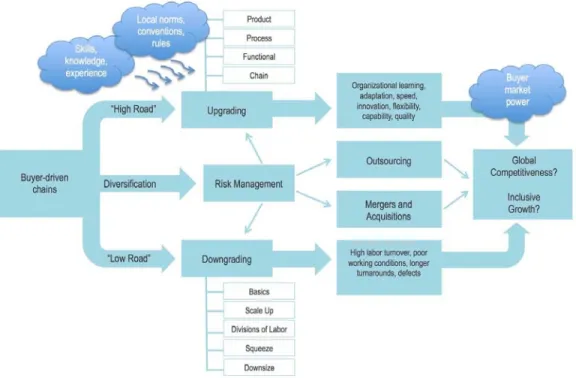
[Firm] advancement is not unidirectional (moving into higher and higher value-added activities and leaving lower value-value-added ones behind), but rather that it is about branching out in multiple directions without withdrawing from profitable activities, including supplying others as full-package or even as cut-make-trim manufacturers. As these examples will show, wearing multiple hats may, in fact, be the most common business strategy among successful manufacturing suppliers (Tokatli, 2012: 6)
Thus, as shown in Figure 3, these scholars suggest expanding the low/high road theory of
firm competitiveness so that it also includes diversification strategies that firms use for
risk management and survival.
Figure 3: Complexities of the Upgrading Hypothesis in Global Value Chains
Schrank (2004) takes upgrading critique further by asserting that upgrading may
bring competitive advantages in the short run, but in the long-run upgrading becomes a
matter of survival because the returns to upgrading are devalued as higher-value practices
become more widespread. Brewer (2011) concurs, calling this the “upgrading paradox.”
In fact, a recent wave of scholarship has been especially critical of the GVC/GPN