Conformational Occlusion of Blockade Antibody Epitopes, a
Novel Mechanism of GII.4 Human Norovirus Immune Evasion
Lisa C. Lindesmith,aMichael L. Mallory,aKari Debbink,bEric F. Donaldson,aPaul D. Brewer-Jensen,aExcel W. Swann,a Timothy P. Sheahan,aRachel L. Graham,aMartina Beltramello,cDavide Corti,cAntonio Lanzavecchia,d,eRalph S. Barica
aDepartment of Epidemiology, University of North Carolina, Chapel Hill, North Carolina, USA
bDepartment of Natural Sciences, Bowie State University, Bowie, Maryland, USA
cHumabs BioMed SA, Bellinzona, Switzerland
dInstitute for Research in Biomedicine, Bellinzona, Switzerland
eInstitute of Microbiology, Zurich, Switzerland
Received2 November 2017Accepted5 January 2018Published7 February 2018 CitationLindesmith LC, Mallory ML, Debbink K, Donaldson EF, Brewer-Jensen PD, Swann EW, Sheahan TP, Graham RL, Beltramello M, Corti D, Lanzavecchia A, Baric RS. 2018. Conformational occlusion of blockade antibody epitopes, a novel mechanism of GII.4 human norovirus immune evasion. mSphere 3:e00518-17. https://doi.org/10.1128/mSphere.00518-17.
EditorAna Fernandez-Sesma, Icahn School of Medicine at Mount Sinai
Copyright© 2018 Lindesmith et al. This is an open-access article distributed under the terms of theCreative Commons Attribution 4.0 International license.
Address correspondence to Ralph S. Baric, [email protected].
Hiding in plain sight: a gut virus's sneaky tricks to make you sick
ABSTRACT Extensive antigenicdiversitywithintheGII.4genotype of human noro-virusisamajordriverofpandemicemergenceandasignificantobstacleto develop-ment ofcross-protective immunityafter naturalinfection andvaccination.However, human and mouse monoclonal antibodystudies indicate that, although rare, anti-bodies to conserved GII.4 blockade epitopes are generated. The mechanisms by whichtheseepitopes evadeimmunesurveillanceareuncertain.Here,wedeveloped anewapproachforidentifyingconservedGII.4norovirusepitopes.Utilizingaunique set of virus-like particles (VLPs) representing the in vivo-evolved sequence diversity withinanimmunocompromisedperson,weidentifykey residueswithinepitopeF,a conservedGII.4blockadeantibodyepitope.Theresiduescriticalforantibodybinding are proximal toevolving blockadeepitope E. Likeepitope F, antibody blockade of epitopeEwastemperature sensitive,indicatingthatparticleconformationregulates antibodyaccess notonly totheconserved GII.4blockadeepitopeFbutalso tothe evolvingepitopeE.ThesedatahighlightnovelGII.4mechanismstoprotectblockade antibodyepitopes, mapessential residuesofaGII.4conserved epitope,andexpand our understanding of how viral particle dynamics may drive antigenicity and antibody-mediated protection by effectively shielding blockade epitopes. Our data support thenotion thatGII.4 particlebreathingmay wellrepresent amajor mecha-nism of humoralimmune evasionsupportingcyclicpandemicvirus persistenceand spreadinhumanpopulations.
IMPORTANCE Inthis study,weusenorovirusvirus-like particlestoidentifykey resi-dues of a conserved GII.4blockade antibodyepitope. Further, weidentify an addi-tional GII.4 blockade antibody epitope to be occluded, with antibody access gov-erned by temperature and particle dynamics. These findings provide additional support forparticle conformation-based presentation of binding residues mediated by a particle “breathing core.” Together, these data suggest that limiting antibody access to blockade antibody epitopes may be a frequent mechanism of immune evasionforGII.4humannoroviruses.Mappingblockadeantibodyepitopes,the inter-actionbetweenadjacentepitopesontheparticle,andthebreathingcorethat medi-ates antibody access to epitopes provides greater mechanistic understanding of epitope camouflage strategies utilized by human viral pathogens to evade immu-nity.
A
ntigenic diversity is a hallmark of many successful RNA viruses. However, require-ments for structure integrity and maintenance of key capsid functions such as receptorbindingandcellfusionrequireessentialresiduestoremainconserved over time,representingpotentialcross-protectiveantibody(Ab)epitopes(1–3).Tocombat thisweakness,manyhumanRNAviruses,includingseasonalinfluenzavirus(4),human immunodeficiencyvirus(5),hepatitisCvirus(6),Ebolavirus(7),WestNilevirus(8),and human norovirus (9), have evolved strategies to camouflageneutralizing antigenic sites.Localmechanismsofcamouflageincludeshieldingoftheepitopewith carbohy-drates (4,10) or lipids (11, 12)or by structurally occludingthe siteby burying the epitopesbeneaththesurfacetopology(6,13–15).Othermechanismsinclude“particle breathing,” described as dynamic conformational changes in the virion that limit antibodyaccessto occludedepitopes(5,7–9, 16,17).Effective useoftheseevasive mechanismsprovidesanadvantagetoviruseswithhighpopulationexposure, includ-inghumannorovirus.Humannorovirusistheleadingcauseofacutegastroenteritis,causingmorethan21 million infections per year in the United States and approximately 200,000 deaths worldwide, primarily in the young and aged populations (18). This heavy disease burden on particularly vulnerablepopulationswarrants developmentof anorovirus vaccine.Theprimaryobstacletoasuccessfulvaccineistheextensiveantigenicdiversity betweennorovirusstrainsandwithinthepandemicGII.4strains(19–21).Likeinfluenza Avirus,themajorcapsidsequenceofthenorovirusGII.4strainsisundergoingepochal evolution,resultinginemergentimmuneescapevariantsevery2to5years(20,22,23). Using an in vitro surrogate neutralization assay to measure antibody blockade of norovirusvirus-likeparticle(VLP)bindingtocarbohydrateligand, showntocorrelate withprotectionfrominfection,fourevolving“blockade”antibodyepitopeshavebeen characterized (24, 25).Epitope Aisimmunodominant (~40% of theserumblockade antibodyresponse)andchangeswitheachepidemiologicallysignificantstrain(26–28). Epitope D lies along theridge of the carbohydrate-binding domain andis both a blockade antibody epitope and a mediator of carbohydrate binding affinities (25). EpitopesAandDfacethemostexteriorpartoftheviralparticle(theP2subdomain) and are easily accessible to potent blockadeantibodies (9). Epitope E is lateral to epitope D and is less exposed to the surface (25, 29). Finally, epitope F is highly conservedacrossGII.4strains,anditsstructurallocationisunknown(9,25).Norovirus infection and vaccination elicit antibodies to subdominant epitope F. Antibody binding to epitope Fis mediated by residues outside the antibody-binding site. Residues310,316,484, and493,theNERKmotif,arehighlyconservedacrossGII.4 strains (9)andare locateddistalto thetopsurfaceofthe particlewhereepitopes AandDarelocated.IncubationtemperatureandmutationsintheNERKmotifaffect antibodyaccesstoepitopeFbyallostericeffectsonparticleconformationwithan unclear mechanism (25,30).
and particle dynamics. These data indicate that limiting antibody access to blockade antibody epitopes may be a frequent mechanism of immune evasion for GII.4 human noroviruses. Mapping a blockade antibody epitope, the interaction between adjacent epitopes on the particle, and the breathing core that mediates antibody access to epitopes provides greater mechanistic understanding of epitope camouflage strategies utilized by human viral pathogens.
RESULTS
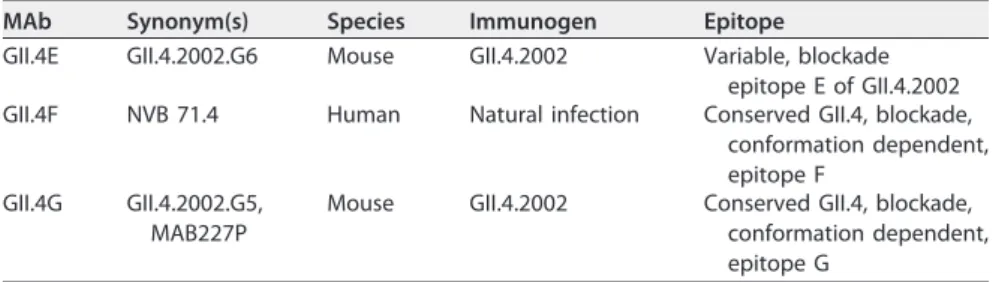
Residues 327 and 404 are key binding sites of the GII.4 conserved blockade antibody epitope. GII.4F or GII.4G MAbs recognize two spatially close conserved blockade epitopes with restricted access based on particle conformation (9). The spatial locations of targeted residues (Table 1) remain unknown, although NERK motif modi-fications in part regulate access to these epitopes (9). To map GII.4F or GII.4G residues, VLPs representing time-ordered GII.4.2006a norovirus strains that evolved within an immunocompromised transplant patient over 683 days (31, 32) were synthesized, expressed, and characterized for binding of GII.4F or GII.4G MAbs by enzyme immu-noassay (EIA) (Fig. 1). GII.4G MAb appears to bind to a unique conserved epitope, designated epitope G, that may overlap epitope F and was preserved during the period of monitoring, as assessed by both binding and blockade assays. In contrast, by day TABLE 1 Characteristics of monoclonal antibodies used in this study
MAb Synonym(s) Species Immunogen Epitope
GII.4E GII.4.2002.G6 Mouse GII.4.2002 Variable, blockade epitope E of GII.4.2002 GII.4F NVB 71.4 Human Natural infection Conserved GII.4, blockade,
conformation dependent, epitope F
GII.4G GII.4.2002.G5, MAB227P
Mouse GII.4.2002 Conserved GII.4, blockade, conformation dependent, epitope G
FIG1 Long-terminvivoevolutionresultsinlossofGII.4epitopeF,aconservedGII.4blockadeantibody
epitope.(A)Virus-likeparticlesrepresentingnorovirussequencesisolatedfromanimmunocompromised
transplantpatientovera683-dayperiodwereevaluatedforbindingtoMAbsGII.4FandGII.4Gbyenzyme
immunoassay.BothMAbsrecognizeconservedGII.4blockadeepitopesthatoverlapeachotherandare
occluded bystructural conformation. Errorbars represent 95% confidence intervals. Values that are
significantlydifferent(P⬍0.05)fromtheday1valueareindicatedbyanasterisk.(B)Afteraminimumof
581daysofinvivoevolution,capsidsequencechanges,indicatedbycolorchanges,resultedinlossof
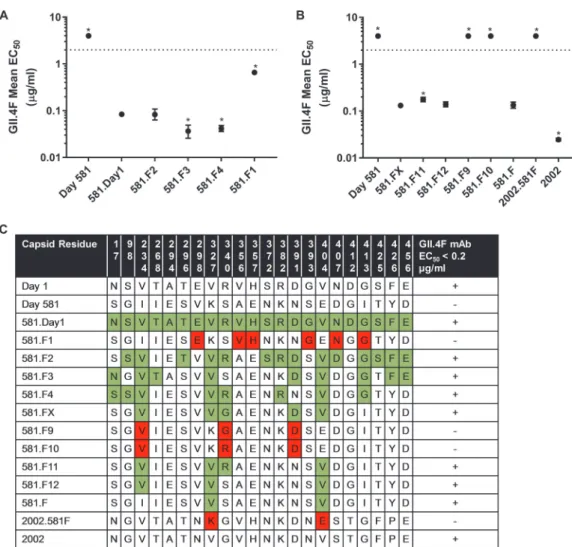
FIG 2 Residues 327 and 404 are key binding sites for GII.4F MAb. (A and B) To map the epitope for the GII.4F MAb, amino acid changes in the capsid protein between day 1 and day 581 strains were compared and sets of changes were introduced
into the 581 backbone sequence. Chimeric VLPs were evaluated for MAb binding by EIA, and EC50titers were determined.
Values significantly different (P⬍0.05) from 581.Day1 (A) or 581.FX (B) are noted with an asterisk. (C) Residues that were
changed are shown in color to indicate gain (green) or loss (red) of GII.4F MAb binding. Changing valine at residues 327 and 404 resulted in an increase in binding of GII.4F MAb to 581 (581.F), while replacing valine at residues 327 and 404 in GII.4.2002 (2002.581F) resulted in a loss of binding of the GII.4F MAb.
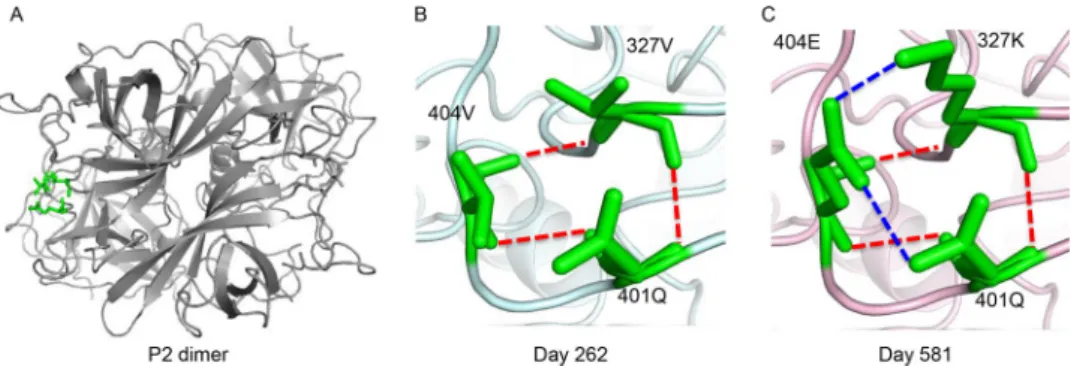
FIG 3 Homology models of epitope F interactions between days 262 and 581 viruses. (A) Amino acid positions 327, 401, and 404 are shown in green on the P2 dimer for context. (B and C) Three hydrogen bonds (red dashed lines) are evident among residues 327V, 401Q, and 404V in the day 262 model (B), while the original three hydrogen bonds (red dashed lines) plus two additional hydrogen bonds (blue dashed lines) are formed in the day 581 model (C) among 327K, 401Q, and 404E.
interacts with E404 via electrostatic interaction, which likely rearranges the local structural neighborhoodof epitope F. Inaddition, modeling of the hydrogen bond networksbetweenresiduesV327,Q401,andV404suggeststhatthreehydrogenbonds are formed in the day 262 isolate (Fig. 3, red dashed lines), while two additional hydrogenbonds(bluedashedlines)areformedintheday 581model among327K, 401Q,and404E.TheseadditionalbondslikelycontributetothelossofGII.4Fbinding today581VLPs.
Residue 234 influences GII.4F MAb access to the conserved blockade antibody epitope. Aspreviouslydescribed,GII.4FMAbblockadepotency ismediatedbyboth thenumberofaccessiblebindingsitesaswellasbytheaffinityoftheantibodyforthe target epitope (9). To understand thecontributions to binding of the five residues includedin581.FX,chimericVLPscontainingadmixturesofresidues234,327,340,391, and 404 (581.F9-F12) were tested for GII.4F MAb binding by EIA (9, 33). VLPs are composedof90copiesofadimerofthecapsidprotein,accountingforatotalof180 copiesofnonquaternaryepitopes.Changesinthemaximumnumberofbindingsites (Bmax)reflectaccesstobindingofantibodytothetheseepitopes(34).Kd(dissociation
constant, relative affinity) is dependent on the strength of molecular interaction betweentheepitopeandtheantibody.Changesinresidues340and391didnotaffect GII.4FMAbrelativeaffinityoraccess(Fig.4).TheKdwasconsistentbetweentheVLPs
withvalinesatpositions327and404(1.1nM),indicatingthattheseresiduesdefinepart ofGII.4epitopeF.V234wasnotassociatedwithchangesinKd.TheV234VLPs(581.FX
and581.F12)(Fig.4)hadhigherBmaxsthan581.F(K327VandE404V),indicatingthat
residue234maybeinfluencingGII.4FMAbbindingvialong-rangeallostericeffects, asdescribedfortheNERKmotif(9).TheNERKmotifandresidue234(the“breathing core”)are distaltothe epitopeand nearthe dimerinterface(Fig. 5).
Antibody access to evolving blockade antibody epitope E depends on global particle and local conformation. EpitopeE,likeepitopeF,islateraltoepitopesAand D,whichlinetheoutermostsurfaceoftheviralparticle(25).EpitopeEandFresidues arewithin7to23Åofeachother.Todeterminewhetherparticleconformationalso regulatesantibodyaccesstoepitopeE,GII.4.2002blockadebyMAbGII.4E(Table1) (29) wastestedatroomtemperatureand37°C,aspreviouslydescribed(Fig.6) (9).Increased temperatureofincubationresultedina2.7-folddecreasein50%effective concentra-tion(EC50)titeranda3.2-foldincreaseinblockadecurveslopeforGII.4Eblockadeof
GII.4.2002 (Fig. 6A), indicating that GII.4E access to evolving blockade epitope E improvesathighertemperature.Theseresultsaresimilartothosereportedforepitope FandGblockadeandsuggestthatparticledynamicsalsoregulateantibodyaccessto epitopeE(9).
MAb GII.4E (Fig. 6B). Exchange of either epitope E (581.2002E) or F (581F) residues from GII.4.2002 into the 581 backbone did not confer GII.4E binding. However, exchange of both epitopes E and F (581.2002E/F) resulted in an increase in GII.4E binding. Con-versely, exchange of epitope F residues from 581 into the 2002 (2002.581F) backbone increased 2.9-fold the EC50titer of GII.4E for GII.4.2002. These data indicate that epitope
F residues affect the binding of epitope E antibodies. To distinguish the effects of epitope E and F residues on GII.4E binding, chimeric VLPs were tested for GII.4E binding by EIA, andBmaxandKdvalues were calculated (Fig. 6C). Exchange of day 581 epitope
FIG 4 GII.4F antibody access to epitope F is influenced by residue 234, a residue outside the epitope.
GII.4F MAb EC50titer is mediated by both the maximum number of binding sites available (Bmax) and the
relative affinity of the antibody for the epitope. To distinguish the effects of the five residues comprising 581.FX, chimeric VLPs containing admixtures of residues (orange) were tested for GII.4F MAb binding by
EIA, andBmaxandKdvalues were calculated. Changes in residues 340 and 391 did not change GII.4F MAb
binding or access (red). TheKdfor the epitope was consistent between the VLPs with valine at positions
327 and 404, identifying these residues as part of the GII.4 epitope F (green). In comparison, 234V was
not associated with changes inKd(red). The 234V VLPs had higherBmaxvalues than the 581.F VLPs,
indicating that residue 234 may be influencing GII.4F MAb binding via long-range allosteric effects, as
described for the NERK motif. Bold values are significantly different (P⬍0.05) from the values for 581.F.
⬍LOD, less than the limit of detection.
FIG5 ResiduesimportantformediatingGII.4norovirusantigenicity.AhomologymodelofaP2domain
dimer(lightgrayandmagentamonomers)ofGII.4.2006abound toAantigen(redandgreen)with
identifiedblockadeantibodyepitopesA(blue),D(black),E(orange),andF(purple)andthe“breathing
core”residues(NERKplusresidue234)thatmediateglobalparticleconformation(yellow)colorcoded.
F residues into the 2002 backbone (2002.581F) did not change theKd(0.33 nM) for
FIG 6 GII.4E MAb binding is regulated by global particle conformation and surrounding local topology. (A) GII.4.2002 VLP
binding to ligand was blocked by GII.4E at either room temperature (black) or 37°C (red), and mean percent control binding
compared to no antibody was fit by sigmoidal dose-response curve analysis, with the Hill slopes and EC50s calculated.
Incubation at 37°C resulted in a steeper curve and lower EC50titer, indicating that antibody access to epitope E is
dependent upon particle conformation, as described for epitopes F and G. (B) Exchange of both epitope E and F residues into the 581 backbone (581.2002E/F) improved binding of GII.4E MAb compared to exchanging only either epitope E
(581.2002E) or epitope F (581.F) residues. Values that are significantly different (P⬍0.05) from the value for 581.2002E/F
are indicated by an asterisk. (C) To distinguish the effects of epitope E and F residues on GII.4E binding, chimeric VLPs
(orange) were tested for GII.4E binding by EIA, andBmaxandKdvalues were calculated. Exchange of day 581 epitope F
residues into the 2002 backbone (2002.581F) did not change theKdfor GII.4E but did decrease theBmax, indicating that
epitope F residues mediate GII.4E epitope access. In support of this hypothesis, exchange of both epitope E and F residues from the 2002 backbone into the 581 backbone (581.2002E/F) was necessary to restore GII.4E binding. Bold values are
significantly different (P⬍0.05) from GII.4.2002. Green shading indicates residues involved in GII.4E epitope binding and
access to the epitope. LOD, less than the limit of detection.
GII.4EbutdiddecreasetheBmax.Therefore,epitopeFresiduesarenotpartofepitope
E butinstead regulate GII.4E epitopeaccess. These data indicate that local particle conformationalsoregulatesantibodyaccesstoblockadeepitopes.
DISCUSSION
norovirusblockadeantibodyepitope(epitopeF)recognizedbyahumanmonoclonal antibody,identifytwoadditionalconformation-dependentepitopes(epitopesEandG), andexpandthesetofresiduesthatinfluenceparticledynamicsandantibodyaccessto occluded blockade antibody epitopes. These are important steps in designing an engineeredcross-protectivenorovirusVLPvaccinecandidate.
The implicationsof norovirusinfection inimmunocompromised individuals isan expandingareaofstudy.Virussequencingfromserialstoolsamplesindicatesthateven under the atypical(reduced) immune pressure exerted in an immunocompromised patient,noroviruscontinuestoevolveviaantigenicdriftatblockadeantibodyepitopes (Fig.1) (32).Thisprocessmimicsviralevolutionwithinthegeneralpopulationthatleads to theemergence of new viruses(20, 23). An extendedperiod of in vivo evolution allowedthefirstidentifiedchangeinepitopeF.Valineatpositions327and404arepart ofepitopeFandareconservedacrossGII.4norovirusstrainscirculatingfrom1974to 2015.OccludedepitopesofotherhumanRNAvirusesareessentialforreceptorbinding, viralfusion,andcapsidassembly/disassembly,functionsessentialfor infection/replica-tion (1–3). It is unknown whether particle conformation plays similar roles in the noroviruslifecycleorwhetherantibodybindingtoepitopeFaffectsparticledynamics necessaryforligandbindingorstericallyblocksligandinteraction.Theprimary limita-tiontothisstudyisthelackofareversegeneticssystemtotestthesepossibilities.The newlydevelopedhumannorovirusreplicationsystem(39)maysomedaybeamenable to areverse geneticsapproachtostudying viralmutants andelucidatetheroles of epitopeFresidues.ItispossiblethatV327 andV404 arenotpart ofepitope F,but instead,mutationsattheseresiduessuchasthoseobservedinthisstudycouldprevent conformationaltransitionsnecessaryforantibodybinding.However,thisexplanationis unlikely,asantibodyaccesstotheoverlappingepitopeGandtheneighboringepitope Eremainstemperaturesensitive,indicatingthatparticleplasticityismaintainedinthe 581VLP(327K.404E).
Unlikeresidues327and404,residue234isburiednearthedimerinterfaceanddoes not participate inGII.4F binding. Instead, residue 234 regulates antibody access to occluded epitopes by mediating particle conformation, similarly to what has been describedforresidues310,316,484,and493(NERKmotif)(9).Thesedataindicatethat residue 234, the NERK motif, and possibly other unidentified amino acids form a “breathing core” that works inconcert to regulate global particle structure driving antigenicityandligandbinding(Fig.5).Similarly,recentdetailedbioinformaticstudies withamonoclonalantibodywithbroadmousenorovirusneutralizationpotency iden-tified asingle aminoacid outsidetheantibody-binding sitethatmediatedantibody bindingbychangingparticleconformation(40).Amutationdistaltothesurfacealtered interfacialinteractionsbetween thePdomainsof thedimersaffectingthestructure throughoutthePdomain.ThesedatasupportpreviousfindingsontheNERKmotifon humannorovirusparticledynamicsandtheallostericeffectdistantresiduescanhave onantibodybindingandsuggest conformation-basedepitopecamouflagemaybea mechanismofimmuneevasionconservedacrossnoroviruses.Mutationsinthe breath-ingcorecouldmodulateepitopepresentation,alteringtheeffectivenessofantibody responses inprotection from infection and influencingthe repertoire of antibodies madefollowingvaccinationandinfection(38).TheNERKmotifishighlyconservedin GII.4strainsfrom1974to2006.ContemporarystrainsGII.4.2009and2012both intro-ducedmutationatresidue310,whichresultedinalteredantibodyaccesstoepitopeF (9).Althoughspeculative,changesatresidue310mayhavebeendrivenbypressureto alterprotectionofepitopeF.Further,controllingparticledynamicsmayhavepractical implicationsforVLPimmunogenswhereviralentryisnotmaintained.Anengineered VLP designedtohave decreasedfluctuationbytemperature couldimprove thermo-stabilityandshelflifeofVLP-basedvaccines(41),aswellasenhanceantigen presen-tationstability(42).
FIG7 SequenceandspatialflexibilitywithinthecapsidofGII.4norovirusesmitigatesantibody-mediated
protectiveimmunity.Threemechanismsofimmuneevasionareproposedhere.First,antibodybinding
toepitopescanbeoccludedbysterichindranceresultingfromparticlecontractionduring“breathing”
(epitopes E,F,andG).Second, antibodybinding toepitopescanbeoccluded bysterichindrance
resultingfromlocalparticleconformation(epitopesEandF).Third,antigenicdriftinhighlyantigenic,
surface-exposedepitopes(epitopesA,D,andE)canfacilitateantibodyescapeovertime.
hereindicatethatthedelineatingfactorbetweenoccludedandnonoccludedepitopes is likely location on the viral particle. Evolving blockade epitope E lies near the transitionfromthemost-surface-exposedP2subdomainofthecapsidproteinandthe less-surface-exposed P1subdomain.EpitopeEisvariablebetweenpandemicstrains, andantibodyaccessisoccluded(25, 29).Althoughavirionhasthesamenumberof epitopesA,E,F,andG,antibodiestoepitopesE,F,andGarerare,comparedtoepitope A.Onlyasinglemonoclonalantibodytoeachepitopehasbeencharacterizedthusfar (25,29), possiblyreflectingimmunesuppressionmechanismsthatinfluencethe anti-genicityoftheseepitopes.ThecoordinatesofepitopeGareunknown,butlikeepitope E,arenearbyand/oroverlappingwithepitopeF(9).Mutationinthebreathingcoreand temperaturesensitivityofantibodyblockadeindicatethatantibodyaccesstoepitopes E,F,andGismediatedattheglobalparticlelevel.Theobservationthatexchangeof both epitope E and F residues from the 2002 backbone into the 581 backbone (581.2002E/F), but not epitope E residues alone, was necessary to increase GII.4E binding, indicates that antibody access is also mediated at the local level by the conformationofsurroundingresidues(43).Theseconformation-dependentregulatory mechanismsarelikelytoextendtootherepitopeswithintheP1subdomain.Additional humanmonoclonalantibodiesresultingfromnorovirusinfectionandvaccinationare needed to identify other epitope signatures and the interdependence of distinct epitopeswithinacontinuousantigen.
⬍0.05.BmaxandKdvalues were estimated by one-site specific binding nonlinear curve fit of mean OD
values in GraphPad Prism 7.02 (9, 33).
particlestructure(mediatedbycloselysurroundingresidues)impactantibodyaccessto blockade epitopes. These topological changes effectively reduce antibody binding without requiring changesin theresiduesthat comprisethe actualepitopes. These structureconformation-basedimmuneevasionstrategiesareparticularlyadvantageous forprotectingessentialconservedmotifsthatcouldbetargetedbyantibodies. Noro-virusjoinsothersuccessfulhumanpathogenssuchasHIV(5),influenzavirus(10),Ebola virus(7),WestNilevirus(8),andpoliovirus(14)thatuseconformation-basedshielding ofkeyessentialresiduestoevadedevelopmentofprotectiveimmunity.Furtherstudy isneededtotesttheeffectsofbreathingcoremutationsonpresentationofepitopes E,F,andG.Concurrentwithmodifyingthebreathingcoretochangeepitopeaccess, surfaceresiduesthatstericallyblockantibodyaccesstotheoccludedepitopesmaybe identified. Changing thesesurface residues may be an easierpath to design aVLP immunogen with preferentialpresentation of conserved epitopes and better cross-reactivitywithemergentGII.4strains(6,36),aprimarygoalfornorovirusvaccinology. Theseconceptsthatcharacterizehowviralparticledynamicsinfluenceantigen presen-tationandantibodyaccesstoblockadeepitopesmaybeapplicabletovaccine strate-giesforotherhighlypenetrant,antigenicallydiverseviruses.
MATERIALSANDMETHODS
Virus-likeparticles.Syntheticallyderived(BioBasicInc.,Amherst,NY)ORF2geneswereinserted
directlyintotheVenezuelanequineencephalitisreplicon vector.Virus-likeparticles(VLPs)were
ex-pressedinbabyhamsterkidneycells(ATCCCCL-10TM)andpurifiedbyvelocitysedimentationinsucrose
(44).VLPproteinconcentrationsweredeterminedbytheBCAproteinassay(Pierce,Rockford,IL).Uranyl
acetate-stainedVLPswerevisualizedbytransmissionelectronmicroscopy(seeFig.S1inthe
supple-mentalmaterial).
Enzymeimmunoassay.Thewellsonenzymeimmunoassay(EIA)plateswerecoatedwith0.25g/ml
VLPinphosphate-bufferedsaline(PBS)for4handblockedovernightat4°Cin5%drymilkinPBS
containing0.05%Tween20(PBS–0.05%Tween20)beforetheadditionofdecreasingtwofoldserial
dilutions of monoclonal antibody (MAb). Bound MAb was detected by anti-humanor mouse IgG
conjugatedtohorseradishperoxidase(anti-human/mouseIgG-HRP)(GEHealthcare)andcolordeveloped
with1-StepUltraTMBELISAHRPsubstratesolution(ThermoFisher).Eachstepwasfollowedbywashing
withPBS–0.05%Tween20,andallreagentsweredilutedin5%drymilkinPBS–0.05%Tween20.All
incubationsweredoneat37°C.Todetermine50%effectiveconcentrations(EC50s)forantibodieswith
opticaldensities(ODs)ⱖ3⫻backgroundat 2g/ml,EIAdatawerelog transformedandfitusing
sigmoidaldose-responseanalysisofnonlineardatainGraphPadPrism7.02(GraphPadSoftware,LaJolla,
CA)(9).MonoclonalAbsbelowthelimitofdetectionwereassignedanEC50of2⫻theassayupperlimit
ofdetectionforstatisticalcomparison.EC50sbetweenVLPswerecomparedusingtheone-wayanalysis
ofvariance(ANOVA)withDunnett’sposttest.AdifferencewasconsideredsignificantiftheP valuewas
AntibodyblockadeofVLPbinding assay(blockade).VLPs(0.25g/ml)werepretreatedwith
decreasingconcentrationsofMAbfor1handaddedtowellscoatedwithpiggastricmucintypeIII
(Sigma-Aldrich,St.Louis,MO)for1h.BoundVLPwasdetectedasdescribedaboveusinganti-VLPrabbit
hyperimmunesera.Percentcontrolbindingisdefinedasthelevelofbindinginthepresenceofantibody
pretreatmentcomparedtothelevelof bindingintheabsenceofantibodymultiplied by100.The
blockadedatawerefitusingsigmoidaldose-responseanalysisofnonlineardatainGraphPadPrism702.
EC50andHillslopevalueswerecalculatedforantibodiesthatdemonstratedblockadeofatleast50%at
thedilutionseriestested.Antibodiesthatdidnotblock50%ofbindingatthehighestdilutiontested
wereassignedanEC50oftwotimestheassayupperlimitofdetectionforstatisticalcomparison(9).
Increasingantibody-VLP-ligandincubationsto40°C(simulatingfever)decreasestheblockadeEC50about
twofold,oronedilution,inpreliminarystudies.
Structuralmodeling.StructuralhomologymodelsrepresentingthecapsidPdomainofGII.4.2006A
(GenBankaccessionnumberEF126964.1)andimmunocompromisedpatientvirusdays262and581(31)
weregeneratedusingSwiss-Model.Todothis,capsidaminoacidsequencesfortheseviruses were
uploaded intotheSwiss-Modelmodeling server (https://swissmodel.expasy.org/interactive),andthe
appropriatebackgroundtemplatewaschosenbyclicking“searchfortemplates”andthenchoosingthe
knownstructurewiththehighesthomologyscore.Forallsequences,thechosentemplatewasPDB
accessionnumber 3SLD,whichisthecrystalstructurefortheGII.4.2004capsidboundtoAtrisaccharide
(45).Modelsofthecapsiddimerswerecreatedusingthe 3SLDtemplateanddownloadedin.pdbformat.
ModelswererenderedusingMacPymolversion1.8.0.4(https://www.pymol.org/).Hydrogenbondswere
identifiedamongspecificaminoacidsbyselectingthoseaminoacidsandusingthe“Action”command
tochoose“find,”then“polarcontacts,”andthen“withinselection.”Thedistanceinangstromsbetween
epitopes EandF wascalculated usingPymol’smeasurement tool. Thelow endof therange was
determinedbymeasuringthedistancebetweentheclosestresidueswithineachepitope,andthehigh
endoftherangewasthedistancebetweenthefurthestresidueswithineachepitope.Togeneratethe
1. Wu NC, Wilson IA. 2017. A perspective on the structural and functional constraints for immune evasion: insights from influenza virus. J Mol Biol
429:2694 –2709.https://doi.org/10.1016/j.jmb.2017.06.015.
2. Kaminski DA, Lee FE. 2011. Antibodies against conserved antigens pro-vide opportunities for reform in influenza vaccine design. Front Immunol
2:76.https://doi.org/10.3389/fimmu.2011.00076.
3. Quiñones-Parra S, Loh L, Brown LE, Kedzierska K, Valkenburg SA. 2014. Universal immunity to influenza must outwit immune evasion. Front
Microbiol 5:285.https://doi.org/10.3389/fmicb.2014.00285.
4. Tate MD, Job ER, Deng YM, Gunalan V, Maurer-Stroh S, Reading PC. 2014. Playing hide and seek: how glycosylation of the influenza virus hemag-glutinin can modulate the immune response to infection. Viruses
6:1294 –1316.https://doi.org/10.3390/v6031294.
5. Kwong PD, Doyle ML, Casper DJ, Cicala C, Leavitt SA, Majeed S, Steen-beke TD, Venturi M, Chaiken I, Fung M, Katinger H, Parren PW, Robinson J, Van Ryk D, Wang L, Burton DR, Freire E, Wyatt R, Sodroski J, Hendrick-son WA, Arthos J. 2002. HIV-1 evades antibody-mediated neutralization through conformational masking of receptor-binding sites. Nature 420:
678 – 682.https://doi.org/10.1038/nature01188.
6. Prentoe J, Velázquez-Moctezuma R, Foung SK, Law M, Bukh J. 2016. Hypervariable region 1 shielding of hepatitis C virus is a main contrib-utor to genotypic differences in neutralization sensitivity. Hepatology
64:1881–1892.https://doi.org/10.1002/hep.28705.
7. Francica JR, Varela-Rohena A, Medvec A, Plesa G, Riley JL, Bates P. 2010. Steric shielding of surface epitopes and impaired immune recognition induced by the Ebola virus glycoprotein. PLoS Pathog 6:e1001098.
https://doi.org/10.1371/journal.ppat.1001098.
8. Dowd KA, Jost CA, Durbin AP, Whitehead SS, Pierson TC. 2011. A dynamic landscape for antibody binding modulates antibody-mediated
neutralization of West Nile virus. PLoS Pathog 7:e1002111.https://doi
.org/10.1371/journal.ppat.1002111.
9. Lindesmith LC, Donaldson EF, Beltramello M, Pintus S, Corti D, Sw-anstrom J, Debbink K, Jones TA, Lanzavecchia A, Baric RS. 2014. Particle conformation regulates antibody access to a conserved GII.4
norovirus blockade epitope. J Virol 88:8826 – 8842.https://doi.org/10
.1128/JVI.01192-14.
10. Zarnitsyna VI, Ellebedy AH, Davis C, Jacob J, Ahmed R, Antia R. 2015. Masking of antigenic epitopes by antibodies shapes the humoral im-mune response to influenza. Philos Trans R Soc Lond B Biol Sci 370:
20140248.https://doi.org/10.1098/rstb.2014.0248.
11. Wu YW, Mettling C, Wu SR, Yu CY, Perng GC, Lin YS, Lin YL. 2016. Autophagy-associated dengue vesicles promote viral transmission
avoiding antibody neutralization. Sci Rep 6:32243. https://doi.org/10
.1038/srep32243.
12. Brimacombe CL, Grove J, Meredith LW, Hu K, Syder AJ, Flores MV, Timpe
JM, Krieger SE, Baumert TF, Tellinghuisen TL, Wong-Staal F, Balfe P, McKeating JA. 2011. Neutralizing antibody-resistant hepatitis C virus
cell-to-cell transmission. J Virol 85:596 – 605.https://doi.org/10.1128/JVI
.01592-10.
13. Harada S, Yoshimura K. 2017. Driving HIV-1 into a vulnerable corner by taking advantage of viral adaptation and evolution. Front Microbiol
8:390.https://doi.org/10.3389/fmicb.2017.00390.
14. Lin J, Cheng N, Hogle JM, Steven AC, Belnap DM. 2013. Conformational shift of a major poliovirus antigen confirmed by immuno-cryogenic
electron microscopy. J Immunol 191:884 – 891.https://doi.org/10.4049/
jimmunol.1202014.
15. Scharf L, Wang H, Gao H, Chen S, McDowall AW, Bjorkman PJ. 2015. Broadly neutralizing antibody 8ANC195 recognizes closed and open
states of HIV-1 Env. Cell 162:1379 –1390.https://doi.org/10.1016/j.cell
.2015.08.035.
16. Strauss M, Schotte L, Karunatilaka KS, Filman DJ, Hogle JM. 2017. Cryo-electron microscopy structures of expanded poliovirus with VHHs sam-ple the conformational repertoire of the expanded state. J Virol 91:
e01443-16.https://doi.org/10.1128/JVI.01443-16.
17. Sabo MC, Luca VC, Ray SC, Bukh J, Fremont DH, Diamond MS. 2012. Hepatitis C virus epitope exposure and neutralization by antibodies is
affected by time and temperature. Virology 422:174 –184.https://doi
.org/10.1016/j.virol.2011.10.023.
18. Patel MM, Widdowson MA, Glass RI, Akazawa K, Vinjé J, Parashar UD. 2008. Systematic literature review of role of noroviruses in sporadic
gastroenteritis. Emerg Infect Dis 14:1224 –1231.https://doi.org/10.3201/
eid1408.071114.
19. Lindesmith LC, Donaldson EF, Baric RS. 2011. Norovirus GII.4 strain
antigenic variation. J Virol 85:231–242. https://doi.org/10.1128/JVI
.01364-10.
20. Lindesmith LC, Donaldson EF, Lobue AD, Cannon JL, Zheng DP, Vinje J, Baric RS. 2008. Mechanisms of GII.4 norovirus persistence in human
populations. PLoS Med 5:e31.https://doi.org/10.1371/journal.pmed
.0050031.
21. Cannon JL, Lindesmith LC, Donaldson EF, Saxe L, Baric RS, Vinjé J. 2009. Herd immunity to GII.4 noroviruses is supported by outbreak patient
sera. J Virol 83:5363–5374.https://doi.org/10.1128/JVI.02518-08.
22. Bok K, Abente EJ, Realpe-Quintero M, Mitra T, Sosnovtsev SV, Kapikian AZ, Green KY. 2009. Evolutionary dynamics of GII.4 noroviruses over
a 34-year period. J Virol 83:11890 –11901.https://doi.org/10.1128/JVI
.00864-09.
23. Siebenga JJ, Vennema H, Renckens B, de Bruin E, van der Veer B, Siezen RJ, Koopmans M. 2007. Epochal evolution of GGII.4 norovirus capsid
proteins from 1995 to 2006. J Virol 81:9932–9941.https://doi.org/10
.1128/JVI.00674-07.
fromtheProteinDataBankinEurope(https://www.ebi.ac.uk/pdbe)andvisualizedinUCSFChimera
(version1.12).ThecontourlevelwassetR2.87andcoloredusingthe“surfacecolor”function.
SUPPLEMENTALMATERIAL
Supplemental material for this article may be found at https://doi.org/10.1128/ mSphere.00518-17.
FIG S1,TIFfile,2.7MB.
ACKNOWLEDGMENTS
We thankVictoriaMaddenofMicroscopyServicesLaboratory, Departmentof Pa-thologyandLaboratoryMedicine,UniversityofNorthCarolina,ChapelHill,forexpert technicalsupport.
ThisworkwassupportedbygrantstoRalphBaric fromtheNationalInstitutesof Health, NationalInstituteof AllergyandInfectious Diseases(R56 A15-0756andU19 AI109761CETR)andtheWellcomeTrust(A17-0915-001).
Thefundershadnoroleinstudydesign,datacollectionandinterpretation,orthe decisiontosubmittheworkforpublication.
A.L. and D.C. hold shares in Humabs BioMed. M.B. and D.C. are employees of HumabsBiomedSA.L.C.L.,M.L.M.,K.D.,E.F.D.,P.D.B.-J.,R.L.G.,T.P.S.,andR.S.B.declare noconflictsofinterest.
24. Carmona-Vicente N, Vila-Vicent S, Allen D, Gozalbo-Rovira R, Iturriza-Gómara M, Buesa J, Rodríguez-Díaz J. 2016. Characterization of a novel conformational GII.4 norovirus epitope: implications for norovirus-host
interactions. J Virol 90:7703–7714.https://doi.org/10.1128/JVI.01023-16.
25. Lindesmith LC, Beltramello M, Donaldson EF, Corti D, Swanstrom J, Debbink K, Lanzavecchia A, Baric RS. 2012. Immunogenetic mechanisms driving norovirus GII.4 antigenic variation. PLoS Pathog 8:e1002705.
https://doi.org/10.1371/journal.ppat.1002705.
26. Debbink K, Donaldson EF, Lindesmith LC, Baric RS. 2012. Genetic map-ping of a highly variable norovirus GII.4 blockade epitope: potential role
in escape from human herd immunity. J Virol 86:1214 –1226.https://doi
.org/10.1128/JVI.06189-11.
27. Lindesmith LC, Costantini V, Swanstrom J, Debbink K, Donaldson EF, Vinjé J, Baric RS. 2013. Emergence of a norovirus GII.4 strain correlates with changes in evolving blockade epitopes. J Virol 87:2803–2813.
https://doi.org/10.1128/JVI.03106-12.
28. Allen DJ, Gray JJ, Gallimore CI, Xerry J, Iturriza-Gómara M. 2008. Analysis of amino acid variation in the P2 domain of the GII-4 norovirus VP1 protein reveals putative variant-specific epitopes. PLoS One 3:e1485.
https://doi.org/10.1371/journal.pone.0001485.
29. Lindesmith LC, Debbink K, Swanstrom J, Vinjé J, Costantini V, Baric RS, Donaldson EF. 2012. Monoclonal antibody-based antigenic mapping
of norovirus GII.4-2002. J Virol 86:873– 883.https://doi.org/10.1128/JVI
.06200-11.
30. Lindesmith LC, Ferris MT, Mullan CW, Ferreira J, Debbink K, Swanstrom J, Richardson C, Goodwin RR, Baehner F, Mendelman PM, Bargatze RF, Baric RS. 2015. Broad blockade antibody responses in human volunteers after immunization with a multivalent norovirus VLP candidate vaccine: immunological analyses from a phase I clinical trial. PLoS Med 12:
e1001807.https://doi.org/10.1371/journal.pmed.1001807.
31. Schorn R, Höhne M, Meerbach A, Bossart W, Wüthrich RP, Schreier E, Müller NJ, Fehr T. 2010. Chronic norovirus infection after kidney transplantation: molecular evidence for immune-driven viral evolution.
Clin Infect Dis 51:307–314.https://doi.org/10.1086/653939.
32. Debbink K, Lindesmith LC, Ferris MT, Swanstrom J, Beltramello M, Corti D, Lanzavecchia A, Baric RS. 2014. Within-host evolution results in
antigenically distinct GII.4 noroviruses. J Virol 88:7244 –7255.https://doi
.org/10.1128/JVI.00203-14.
33. Lee PD, Mukherjee S, Edeling MA, Dowd KA, Austin SK, Manhart CJ, Diamond MS, Fremont DH, Pierson TC. 2013. The Fc region of an antibody impacts the neutralization of West Nile viruses in different
maturation states. J Virol 87:13729 –13740.https://doi.org/10.1128/JVI
.02340-13.
34. Dowd KA, Pierson TC. 2011. Antibody-mediated neutralization of
flaviviruses: a reductionist view. Virology 411:306 –315.https://doi.org/
10.1016/j.virol.2010.12.020.
35. Reeck A, Kavanagh O, Estes MK, Opekun AR, Gilger MA, Graham DY,
Atmar RL. 2010. Serological correlate of protection against
norovirus-induced gastroenteritis. J Infect Dis 202:1212–1218.https://doi.org/10
.1086/656364.
36. Kwong PD, Wilson IA. 2009. HIV-1 and influenza antibodies: seeing
antigens in new ways. Nat Immunol 10:573–578. https://doi.org/10
.1038/ni.1746.
37. Rodrigues CMC, Pinto MV, Sadarangani M, Plotkin SA. 2017. Whither
vaccines? J Infect 74(Suppl 1):S2–S9.https://doi.org/10.1016/S0163-4453
(17)30184-6.
38. Zhou T, Doria-Rose NA, Cheng C, Stewart-Jones GBE, Chuang GY, Cham-bers M, Druz A, Geng H, McKee K, Kwon YD, O’Dell S, Sastry M, Schmidt SD, Xu K, Chen L, Chen RE, Louder MK, Pancera M, Wanninger TG, Zhang B, Zheng A, Farney SK, Foulds KE, Georgiev IS, Joyce MG, Lemmin T, Narpala S, Rawi R, Soto C, Todd JP, Shen CH, Tsybovsky Y, Yang Y, Zhao P, Haynes BF, Stamatatos L, Tiemeyer M, Wells L, Scorpio DG, Shapiro L, McDermott AB, Mascola JR, Kwong PD. 2017. Quantification of the impact of the HIV-1-glycan shield on antibody elicitation. Cell Rep
19:719 –732.https://doi.org/10.1016/j.celrep.2017.04.013.
39. Ettayebi K, Crawford SE, Murakami K, Broughman JR, Karandikar U, Tenge VR, Neill FH, Blutt SE, Zeng XL, Qu L, Kou B, Opekun AR, Burrin D, Graham DY, Ramani S, Atmar RL, Estes MK. 2016. Replication of human noroviruses in stem cell-derived human enteroids. Science 353:
1387–1393.https://doi.org/10.1126/science.aaf5211.
40. Kolawole AO, Smith HQ, Svoboda SA, Lewis MS, Sherman MB, Lynch GC, Pettitt BM, Smith TJ, Wobus CE. 2017. Norovirus escape from broadly neutralizing antibodies is limited to allostery-like mechanisms. mSphere
2:e00334-17.https://doi.org/10.1128/mSphere.00334-17.
41. Adeyemi OO, Nicol C, Stonehouse NJ, Rowlands DJ. 2017. Increasing type 1 poliovirus capsid stability by thermal selection. J Virol 91:e01586
-16.https://doi.org/10.1128/JVI.01586-16.
42. Singharoy A, Polavarapu A, Joshi H, Baik MH, Ortoleva P. 2013. Epitope fluctuations in the human papillomavirus are under dynamic allosteric control: a computational evaluation of a new vaccine design strategy. J
Am Chem Soc 135:18458 –18468.https://doi.org/10.1021/ja407489r.
43. Das SR, Hensley SE, Ince WL, Brooke CB, Subba A, Delboy MG, Russ G, Gibbs JS, Bennink JR, Yewdell JW. 2013. Defining influenza A virus hemagglutinin antigenic drift by sequential monoclonal antibody
selec-tion. Cell Host Microbe 13:314 –323.https://doi.org/10.1016/j.chom.2013
.02.008.
44. Debbink K, Costantini V, Swanstrom J, Agnihothram S, Vinje J, Baric R, Lindesmith L. 2013. Human norovirus detection and production, quan-tification, and storage of virus-like particles. Curr Protoc Microbiol 31:
15K.1.1–15K.1.45.https://doi.org/10.1002/9780471729259.mc15k01s31.
45. Shanker S, Choi JM, Sankaran B, Atmar RL, Estes MK, Prasad BV. 2011. Structural analysis of histo-blood group antigen binding specificity in a norovirus GII.4 epidemic variant: implications for epochal evolution. J