HOUSE BUYING AS HOPE MECHANISM:
THE CULTURE OF HOMEOWNERSHIP IN HONG KONG (1970S – 2010S)
Chung-kin Tsang
A dissertation submitted to the faculty at the University of North Carolina at Chapel Hill in partial fulfillment of the requirements for the degree of Doctor of the Philosophy in the
Department of Communication.
Chapel Hill 2018
Approved by: Lawrence Grossberg Sarah Dempsey Po-keung Hui
iii
ABSTRACT
Chung-kin Tsang: House Buying as Hope Mechanism: the Culture of Homeownership in Hong Kong (1970s – 2010s)
(Under the direction of Lawrence Grossberg)
Hong Kong, a global financial hub, is well-known for being the world's “freest” economy, and the least affordable city for housing. The rapid and stable financialization process through which Hong Kong was transformed from a light industrial city in the 1970s to a financial hub with real estate as the engine of growth since the 1980s was not only a top-down imposition; it also relied on securing the consent across the population, albeit temporarily and contingently, in a unique context. By piecing academic and non-academic literatures together, this research proposes that homeownership and financialization were articulated jointly by the British colonial state and the local population from the 1970s to the 1990s into a cultural mechanism of hope – House Buying.
iv
v
ACKNOWLEDGEMENTS
The completion of a dissertation always requires a massive amount of material, emotional and intellectual supports, and the purpose of Acknowledgements is to reveal these otherwise hidden conditions.
I am very lucky to be supported by many teachers, friends, and family members. My supervisor, Lawrence Grossberg, has had a no-nonsense commenting style that can always make me stressful, and hence push me further forwards. And I will always remember the fried chicken in Mama Dips, and the Chinese buffet in 35 Cafe. Meaghan Morris has faith in my abilities, encouraged me to pursue the academic career, and treated me an expensive French meal in Wanchai. Donna Chu has been my interlocutor on intellectual and emotional issues throughout this long journey from the first day, and has forced me to join parties that rescue me from isolation and loneliness. And if my memory is reliable, I drank almost a whole bottle of expensive Japanese whisky in one of these parties. I regularly met with Ng Chun-hung and Charles Cheung in the Japanese restaurant Oishi around HKU. Ng always advised me with caring and inspirational aphorisms like shedding light in the darkness, and Cheung has never hesitated to give me a helping hand whenever I was in need.
vi
suggestions. I discussed with Joseph Li and Dennis Leung numerous times about the framework, and they continued to sort out the findings together with me. Shannon Wong Lerner and I have always been supporting each other in our long journey of dissertation writing. And Grover Wehman-Brown helped me copyedit this dissertation and unconfused the confusing sentences and paragraphs.
Many friends in Chapel Hill and Hong Kong have helped and stayed with me. Alex Chan, Jackie Tang and Kaman Lau hung around with me in Chapel Hill, and spent time together in Mint & Basil, Buns, University Mall and South Point. My classmates, Adam Rottinghaus and Justin Flores, housed me when I traveled between Hong Kong and Chapel Hill. Wayne Erik Rysavy, HyunJoo Mo, Tu Lan, and Jing Jiang drove me to do grocery shopping in Harris Teeter, and thus sustained my life in critical moments. In Hong Kong, Daisy Chu, Moffy Lee, Kelvin Yau and Kathy Yu are my interlocutors on social and cultural issues, and Alex Leung is my long-term gym comrade. Kitty Ho, Sampson Wong and the Alcohol Salon they host also gave me a sense of self-worth amid my darkest hour in dissertation writing. Karen Chan, Kim Lee and Benny To generously offered me teaching opportunities that secured my living expenses and tuition fee.
vii
TABLE OF CONTENTS
ABSTRACT ... iii
ACKNOWLEDGEMENTS ... v
LIST OF FIGURES ... ix
CHAPTER 1 – INTRODUCTION ... 1
1.1 Making a Dialogue in the Financialization of Housing and Hope ... 8
1.2 Engaging in Local Discussion ... 12
CHAPTER 2 – FINANCIALIZATION AND HOPE: THE CASE OF HONG KONG.. 20
2.1 Approaches to Financialization and Housing ... 20
2.2 Cultural Mechanism of Hope – the Case of Hong Kong ... 30
2.3 Thinking through Hope – the Social Subject, the Good Life, and Temporal Mapping of the Future ... 32
2.4 House Buying as Hope Mechanism under the Discourse of the Market ... 37
2.5 Gloominess in Hong Kong among Young Adults ... 47
CHAPTER 3 – HISTORICAL FORMATION AND POLITICAL EFFECT OF HOUSE BUYING IN HONG KONG (1970S – 1990S)... 56
3.1 The Watershed of Hong Kong – 1966 and 1967 Riots ... 59
3.2 Three Steps of “Housing Ladder” in Hong Kong ... 64
3.3 Self-reliance in the Official Discourse ... 71
viii
3.5 Financialization of Homeownership – Homeownership as a Good Investment
Decision ... 82
3.6 Belief in Open Opportunities, Generally-felt Optimism and Hope in the Tunnel with Undercurrents of Social Inequality ... 90
CHAPTER 4 – COLLAPSE OF HOUSING LADDER AND NARROWING OF OPPORTUNITY STRUCTURE IN THE STRUGGLED PERIOD ... 97
4.1 Social Policy: Failed Response from the State ... 99
4.2 Political: Corporatist State ... 105
4.3 Economic: Deindustrialization and Financialization ... 109
4.4 Social: Increasing Social Polarization and Narrowing of Opportunity Structure 115 4.5 Cultural: Emergence of Post-materialist Values and Discourses ... 120
CHAPTER 5 – HOPE THROUGH WAITING FOR THE COMING CRISIS ... 128
5.1 Gloominess of Young Adults with Social Awareness ... 133
5.2 Identifying the Social Factors in Stagnation ... 137
5.3 Imagination of a Stagnant Social Plane ... 139
5.4 Self-government in Waiting – “Heroism of the Stuck” (the Case of Australia) .. 147
5.5 The “Coming Crisis”... 150
5.6 Self-reliance – Buying a House as a Shackle and/or a Safety Net ... 157
5.7 Undercurrents besides House Buying ... 164
CHAPTER 6 – DISCUSSION... 168
6.1 Passive and Active Hope ... 169
6.2 Hope as the Resource of Survival ... 172
ix
LIST OF FIGURES
Figure 1.1 Hope Mechanism of House Buying (The Formative Period: 1970s - 1990s) ... 3
Figure 1.2 Hope Mechanism of House Buying (The Struggle Period: 2010s) ... 5
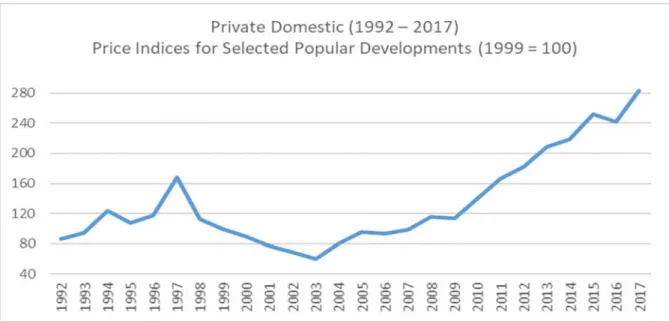
Figure 2.1 Price Indices for Selected Popular Developments (1992 - 2017) ... 53
Figure 2.2 Median Monthly Employment Earnings of Employed Persons (2001 – 2016) ... 53
Figure 2.3 Domestic Households by type of Housing (2015). ... 54
Figure 3.1 Historical Timeline of Hong Kong before 1967 ... 59
Figure 3.2 Historical Timeline of Hong Kong from the 1970s to the 1990s ... 61
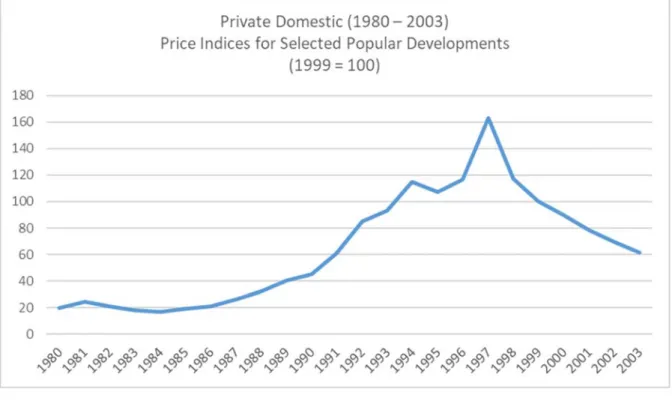
Figure 3.3 Private Domestic (1980 – 2003) Price Indices for Selected Popular Developments. ... 67
Figure 3.4 Percentage of Households Living in Self-owned Premises (1986 – 2001). ... 79
Figure 3.5 Median monthly household income indices for a family of four (1981 - 2001). ... 84
Figure 3.6 Share of total household expenditure on housing (1981 - 2005). ... 84
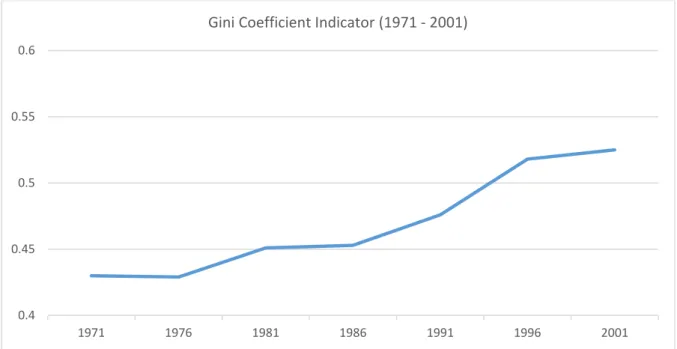
Figure 3.7 Gini Coefficient Indicator (1971 – 2001). ... 95
Figure 4.1 Historical Timeline of Hong Kong from 1997 to the 2010s ... 98
Figure 4.2 Year-on-year % change in Gross Domestic Product (GDP) (1997 - 2016). ... 111
Figure 4.3 Unemployment Rate (%) (1997 – 2017). ... 112
Figure 4.4 Gini Coefficient Indicator (1971 – 2016). ... 115
Figure 4.5 Number of Persons Engaged by Industry Section (1981 – 1996). ... 116
Figure 4.6 Number of Persons Engaged by Industry Section (2000 – 2017). ... 117
Figure 5.1 Background of Focus Group Interviewees in 2014 and 2016 ... 132
1
Chapter 1 – Introduction
Hong Kong is a peculiar case in the financialization of housing. Housing in Hong Kong has at least three bizarre characteristics. First, Hong Kong’s private housing prices have been exceptionally high. It has been the least affordable private housing market in the world since 2010 for eight consecutive years, far surpassing other developed cities, in a one of a kind way. Hong Kong’s housing unaffordability ratio was 19.4 in 2017, while the ratios of the cities at the second and the third places were “only” around 12 – 13.1 Meanwhile, Hong
Kong was the second-most unequal city in the world behind New York in terms of income in 2016.2 Second, despite the skyrocketing housing price, homeownership has been the most desirable life goal local population have said they desire to achieve according to many surveys and studies throughout the late 2000s and the 2010s.3 Third, Hong Kong has been
one of the major global financial hubs since the 1980s; it is fueled by a finance-led growth regime that is real-estate-centric. This model is different from the Anglo-Saxon model of financialization based on capital gains, dividends, interest, and pension income from
sufficient stocks of property.4 The Hong Kong government, since its early colonial era, which
1 The unaffordability ratio is calculated by dividing the median house price with median pre-tax household income. The survey suggests that a region with more than 5.1 is “severely unaffordable”. The ratio of Hong Kong in 2017 was 19.4, far surpassed the runner-up and second runner-up cities, Sydney (12.9) and Vancouver (12.6). Demographia (2018). “14th Annual Demographia International Housing Affordability Survey”.
2 Census and Statistics Department, HKSAR. (2017). “Thematic Report on Household Income Distribution in Hong Kong”. P. 9.
3 HKUPOP (2009) “Back to Basics: a survey on Risk, Protection and Long-term financial planning”, Bauhinia Foundation Research Centre (2010) “Research on the Diversity of Youth Aspiration”, HKUPOP (2013) “Opinion Survey on Wealth Management and Life Planning of Hong Kong Post 80 & 90 Generations”, HKUPOP (2014) “Survey on Public Attitude towards Financial Management 2014”, & HKUPOP (2015) “Survey on Public Attitude towards Financial Management 2015”.
2
began in 1842 and after the handover of sovereignty from the British to the Chinese in 1997, has carefully managed the land supply. Government revenue has relied heavily on land-related income.5 Five major real estate conglomerates dominate the private housing market
and have extended their reach to other businesses that service the operation of daily life, like supermarkets, telecommunications, energy and transportation.6
This research project answers the following questions: Why does and how has
homeownership occupied the position of the most desirable life goal in Hong Kong society – the least affordable private housing market in the world? What are the political effects of the desire towards homeownership on the population? How do these effects mitigate and/or channel the social discontent that derives from having one of the greatest gaps between rich and poor in the world?
My research proposes that a perspective of hope is key to answer the above questions. Understanding homeownership as a hope mechanism, a phenomenon I name House Buying,7
contributes a cultural and temporal understanding of how the financialization of housing in Hong Kong is able to operate amid severe social inequality. Hope, in this research, is understood as an accumulation of expectations based on personal efforts, care, attention, knowledge, and experience, which is articulated by and mediated through discourses. I use the term mechanism to describe the combinations of objective social structures and
A. & Lee, J. (2003b). “Financialization and the Role of Real Estate in Hong Kong’s Regime of Accumulation”.
5 For instance, 31.9% of the government revenue in 2014 – 2015 came from land-related income. Research Office, Legislative Council Secretariat. (7th December 2015). “Fact Sheet: Major sources of government revenue”.
6 Poon, A. (2011). Land and the Ruling Class in Hong Kong.
3
discourses that articulate the socially defined, yet personally internalized, subject positions, trajectories, benchmarks, and life goals.
Society has always been distributing hope through different mechanisms, and House Buying is one of the dominant mechanisms in the history of Hong Kong since the 1970s. “House Buying” is deliberately used to name this hope mechanism to emphasize the
inseparable connection between homeownership and real estate investment in the context of Hong Kong. While the English language separates “home” and “real estate” into the social and economic realms respectively, in Hong Kong’s Cantonese language, people use maai (buying) lau (house) to signify the act of acquiring homeownership.8
Figure 1.1 Hope Mechanism of House Buying (The Formative Period: 1970s - 1990s)
House Buying as a hope mechanism connects subject formation, life goals, and temporal mapping of the future. This research traced the historical development of House Buying, and argues that House Buying was established in Hong Kong during the period of the 1970s to the 1990s, and that the discourse among the young adults of Hong Kong has
4
changed in the 2010s. In the 1970s to the 1990s period, which I call the Formative Period of House Buying (as shown in Figure 1.1), the self-reliant subject emerged through articulations as evidenced in both the official discourse of the colonial state and the experience of the local population. In this period, homeownership became the symbol of the middle-class good life and good investment decisions, and were connected through a temporal mapping of the future. This temporal mapping combined two elements – a housing path constructed by the colonial state as a hierarchical housing ladder with three steps (public rental housing, subsidized homeownership and private homeownership), and an imagination of the social plane as a structure with open opportunity. This mechanism produced individualization, self-governing, and hope effects – Hong Kong people believed that their waiting in the housing ladder would be temporary, and would eventually pay off in the future. One would enjoy the middle-class good life if one was self-reliant, worked hard and invested wisely.
The 1997 Asian Financial Crisis and the subsequent economic recession until 2003 changed the temporal mapping that was central to the above hope mechanism. First, the housing ladder collapsed following the HKSAR government’s retreat from active
participation in the housing market, ending the subsidized homeownership program in 2003.9 Second, the objective opportunity structure among the local population, especially the new comers to the job market, was narrowing even though the economy had steadily recovered since 2004. On one hand, the deindustrialization and the expansion of the tertiary sectors began in the 1990s and became more drastic in the 2000s. Young adults who had lower educational qualifications often end up in the entry level jobs in the retail sectors, and suffer
9 The government officially stated that, it “should withdraw from its role as property developer”. “…Home ownership should be a matter for the market with which Government should refrain from competing.” Legislative Council, HKSAR. (2003). “A Statement on Housing Policy by Hon. Michael M Y SUEN, GBS, JP Secretary for Housing, Planning and Lands”. P. 3 & P. 15.
5
from job insecurity and temporary contract work.10 On the other hand, polarization has also happened among the middle-class. Local professionals, like teachers and doctors, do not benefit from the opportunities created from the rapid economic development of China starting from 2003.11 These opportunities fall mostly to the high-end, transnational workers in the sectors of trade, commerce and finance.
Figure 1.2 Hope Mechanism of House Buying (The Struggle Period: 2010s)
Following the above structural changes, this research discusses the modification in House Buying as hope mechanism in the 2010s, which I call the Struggled Period. (See Figure 1.2) Scholars have proposed that in the aftermath of the increasing social polarization and widening gap between the rich and poor on one hand, and a series of social movement since 200312 on the other, Hong Kong has showed signs of the emergence of a stronger civil
10 Lee, K. M. and Law, K. Y. (2014). “Economic Insecurity and Social Protection for Labour: The Limitations of Hong Kong’s Adhocism during the Financial Crises”.
11 Lui, T. L. (2008). “Fear of Falling”.
6
society,13 progressive localism,14 and post-materialism.15 The younger generation has
especially had much stronger social awareness about social inequality and injustice than the older generations.16 Against this backdrop, this research interviewed a total of 73 young adults (20s to 30s years old who are relatively better educated) in 12 focus groups during the summers of 2014 and 2016. As shown in these discussions, having stronger social awareness cannot be taken as rejecting the status quo of commodification and financialization of
homeownership. House Buying as hope mechanism persisted with a modified formula under the discourse of “waiting for the coming crisis”.
The young adults in these focus groups all shared indications that they had a gloomy imagination about the Hong Kong society as a stagnant social plane – “a pool of stagnant water”.17 “Stagnation” signifies a condition which a person is not suffering from immediate problems, like homelessness or unemployment, but is concerned about the sluggish, if not worsening, future direction of the society. Unlike the relatively depoliticized older
generations, these young adults in general could effectively articulate their personal
frustrations beyond an existential account. They could connect their discontent with problems in the social system, like the collapse of the housing ladder and the collaboration between the state and the real estate conglomerates, yet they also shared a strong sense of political
impotence.
13 Ma, N. (2007). Political Development in Hong Kong: State, Political Society, and Civil Society.
14 Chen, Y. C. and Szeto, M. M. (2015). “The Forgotten Road of Progressive Localism: New Preservation Movement in Hong Kong”.
15 Lee, F. L. F. and Tang, K. Y. (2013). “Economic Development, Political Change, and the Post-material Turn of Hong Kong Young People”. (in Chinese).
16 Ibid.
7
As I show in my analysis of their discussions about the issue of homeownership, most of the social discontent was not connected to a reflection on the capitalist system in Hong Kong, but was channeled into a response to these conditions by being self-reliant through the market. Pursuing homeownership in the private market was desirable and seen as a symbol of a safety net. Yet, without the housing ladder, waiting for the “coming crisis” became the way they hoped to achieve this goal. Especially within the middle-class and the higher-educated groups, the young adults were waiting and preparing themselves for the next crisis, like SARS,18 a terrorist attack, or the next financial crisis. The supposedly devastating crisis, which most people want to avoid, now has become domesticated and welcomed by these young adults to be an excellent investment opportunity. These young adults justify this hope through waiting for a crisis by referring to the economic opportunities present within a historical narrative of the housing market in Hong Kong. To these participants, this economic narrative “revealed” that crisis is part of the “normal” economic cycle. It will certainly come, and will eventually go. Homeownership, more than being an ordinary good investment object, is too “risk-free” to even be called an “investment” in this historical narrative. The fall of its price is only temporary, and will be restored in the future. Hence, one should grab the opportunity in the coming crisis to achieve homeownership, which has become the taken-for-granted ultimate destination of one’s savings. People gain hope, no matter how slim and distant this hope is, by waiting for the coming crisis, and continue their day-to-day work and plan for the future.
Through the discourse of “waiting for the coming crisis”, House Buying as a hope mechanism is modified, and still produces the political effects of individualization and self-governing amid increasing social inequality. In this discourse, the social system is
8
problematic and cannot be changed easily but at least the problems in people’s personal life can be solved through using homeownership as the safety net. The image of the home as a safety net is contradictory because homeownership cannot enable people to live within a shelter and to sell the property as an investment object simultaneously. But, the young adults take for granted its wealth accumulation effect in a booming housing market, and reconcile this contradiction through possible financial methods like scaling down to a cheaper apartment, re-mortgage and reverse mortgage.19
1.1 Making a Dialogue in the Financialization of Housing and Hope
This research intervenes into two academic dialogues – the financialization of
housing, and local housing studies in Hong Kong. The first body of literatures will be further reviewed in Chapter 2. Here I only briefly highlight the studies this research has learned from and developed into the concept of hope mechanism.
After the financial crisis in 2008, financialization became a popular topic of scholarly inquiry. The micro approach to financialization in the realm of real estate and housing
concerned the importance of the mortgage and its influence on people’s everyday life, as well as the social need of sheltering and home-making. Hope is a shared, yet theoretically
underdeveloped common theme throughout these analyses. Garcıa-Lamarca and Kaika20
conduct a historical review to study the trajectory of financialization in Spain as a biopolitical process since 1939. Mortgage contracts in this context promised the local population a future
19 Re-mortgage and reverse mortgage will be further discussed in Chapter 5 Section 5.6. “Re-mortgage” is to take advantage from the inflated housing price through taking loan from the bank, and “reverse mortgage” is usually treated as a pension funding.
9
with the optimization of income and wealth, yet connected their livelihoods with risk in the global capitalism and real-estate speculation.
Pellandini-Simanyi, Hammer, and Vargha21 discuss the calculative behavior over
future planning in choosing mortgage plans, and explored the interaction between financial knowledge, and the local cultural and social context. They study the promotion of new financial knowledge about mortgage loans in the Hungarian context, and find that the state-subsidized mortgage borrowers were indeed more calculative than the market-based mortgage borrowers. The former group made use of their existing cultural framework – the knowledge and common-sense learned in the previous socialist state era – to spot and take advantage from the loopholes of state policy.
Lastly, and most related to this research is Allon’s22 study of the subprime mortgage
borrowers in the US. Allon identify an affective dimension among these borrowers who imagined the future, hopefully and anxiously, through using mortgage “as key to the freedom of a more secure future”.23 These borrowers shared “a feeling of being propelled into a better
future, of no time to lose, not even the time to read the fine print of mortgage documents”.24
Together these studies provide a historical review about how financialization interacts with the webs of the local cultural and social contexts with an imagination towards the future.
My research proposes to understand hope as a mechanism to extend the shared element of hope in the above studies. I derive the concept of hope mechanism from Ghassan
21 Pellandini-Simanyi, L. Hammer, F. & Vargha Z. (2015). “The Financialization of Everyday life or the Domestication of Finance”.
22 Allon, F. (2015). “Everyday Leverage, or Leveraging the Everyday”. 23 Ibid. P. 700.
10
Hage’s discussion25 about hope. In his book, he focuses on the scarcity of hope as the context behind the paranoid nationalists in Australia. He proposes that capitalism and the nation-state have been distributing hope in a relatively egalitarian way. Having hope to move upward socially is the secret to ease the discontent that arises alongside social inequality, and it is necessary to uphold the status quo.
The secret of capitalism is its capacity in hope distribution: This capacity to distribute hope (particularly the capitalist-specific dreams of upward social mobility) in the midst of massive social inequality has been the secret of the ability of the nation-state to provide such an enduring framework for capitalist accumulation.26
Recent developments in hope studies further enrich our understanding of hope as the secret to maintaining social stability by grounding the study of hope in specific social and cultural context. Zigon’s study27 of Moscow argues that hope has specific historical and religious roots developed in the communist regime. Eggerman and Panter-Brick’s28 study of the suffering in Afghanistan shows how the bedrock of their long-lived hope that is evident in their cultural values are based on religious belief. Finally, Jansen’s29 recent research of the Bosnian and Herzegovinian context connects hope with the belief in returning to “normal lives”.
Methodologically, Jansen30 and Robbins31 both argue for the historicization of and
attention to how particularized items and goals are arranged in the study of hope. Jansen, in his above research, emphasizes that historicization “allows us to foreground contingency by
25 Hage, G. (2003). Against Paranoid Nationalism: Searching for Hope in a Shrinking Society. 26 Ibid. P. 14.
27 Zigon, J. (2009). “Hope dies last - Two aspects of hope in contemporary Moscow”.
28 Eggerman, M. and Panter-Brick, C. (2010). “Suffering, hope, and entrapment: Resilience and cultural values in Afghanistan”.
29 Jansen, F. (2016). “For a Relational, Historical Ethnography of Hope: Indeterminacy and Determination in the Bosnian and Herzegovinian Meantime”.
30 Ibid.
11
investigating the conditions of existence and possibility of particular instances of hope as relational phenomena in particular historical moments”.32 Likewise, Robbins also asks us to look at history to identify the grounds of hoping in a given context.33 Instead of asking “what
can I hope?”, he proposes to ask, “looking at history”, what grounds do I have for hoping? “Grounds” in this sense are the conditions of possibility that enable and limit one to look forward to the happenings in the future.34 On the “grounds”, he particularly pays attention to
particularized items and goals. Each item or goal, which lies seemingly within our reach, leads us forward one-step-at-a-time.
In a recent special issue on hope studies in the Journal of History and Anthropology, Kleist and Jansen35 list a series of specific questions that the authors in the issue tried to
answer, and have also inspired my research to trace hope as a mechanism. These questions highlighted key terms like “temporal reasonings”, “protracted crisis”, “futures in social configurations”, “projects of government”, and “social immobility”, and pointed to a project to study hope in the realm of the concrete and empirical, “how are they generated, distributed, negotiated, sustained and/or transformed—in other words, how do hopes themselves develop over time?”36
32 Jansen, F. (2016). P. 260.
33 He argues that the perspective of “a religiously-inflected, sacrifical ethics” has been dominated in the academic imagination of hope. Robbins, B. (2016).
34 “The sense of history to which I have been appealing would suggest that there might be grounds for hope in the case of global justice or cosmopolitanism because cosmopolitanism can mobilize self-interest on its side. The term ‘reform’ suggests only a range of particularized items or goals that lie within reach and that also–this is what Clarke says–lead beyond themselves. Hope, like cosmopolitanism, is not an all-or-nothing proposition.” Ibid.
35 Kleist, N. and Jansen, S. (2016). “Hope over Time – Crisis, Immobility and Future-Making”.
12
This research responds to their call by proposing House Buying as a hope mechanism. I read the above literatures and questions as pointing towards a contextualized project to tackle social immobility or stagnation as the shared imagination about our social plane in our current time across the globe. This sense of stagnation further triggers people to adopt and be limited by specific ways and temporal frameworks to make sense of the past, present and future. In Moscow and Afghanistan, hope may derive from religious belief, but in Hong Kong, hope has a tradition that rests in being self-reliant by utilizing the market,37 with property being a good investment object. The strength of thinking of hope as a mechanism can help us piece different elements together, and can make sense of its historical trajectory.
1.2 Engaging in Local Discussion
Proposing House Buying as a hope mechanism is also a response to a tendency of taking culture as the mystical cause of the housing problem in the local literatures in the study of homeownership. This tendency is often assumed in the works of the scholars and writers who are more critical of the social and land system of Hong Kong. They aim at uncovering the truth underlying the housing policy, yet were unable to make sense of people’s
“subordination” to the social system. The key exemplars are Alice Poon,38 and a series of publication by a local think tank, Liber Research Community.39 The series follow the
political-economy approach and aim at taking the enchantment out of the myth of “little land, many people” by uncovering the biased land policy of the government that limits the land supply and creates the image of “little land”.
37 This will further be discussed in Chapter 2 Section 2.4. 38 Poon, A. (2011). Land and the Ruling Class in Hong Kong.
13
Alice Poon’s work “Land and the Ruling Class in Hong Kong” is the more influential one. It is one of the few scholarly works that became a bestseller in Hong Kong when it was translated into Chinese in 2010. It has helped the people of Hong Kong recognize the influential roles of real estate conglomerates, and hence its analytical framework is worth examining. Poon provides a detailed discussion of the political economy of land and housing in Hong Kong. Her argument is simple: although Hong Kong has been named as one of the freest economies in the world, “she has in reality been restrained from achieving free market goals, namely, those of promoting competition and consumers’ interests, of maintaining a level playing field in all business sectors and of nurturing fairness and equal opportunities for all.”40 Five major conglomerates that are controlled by a few families have a stranglehold on “Hong Kong’s economic arteries”.41 They are the major land owners and their influence is not limited to property, and extends to many parts of people’s life, including utilities (gas and electricity), transportation (public bus service), and food retail (supermarket).42 The government’s role, according to her discussion, is a “behind-the-scene director”.43 The combination of the land system and the lack of competition laws entrench economic and wealth concentration, while the lords derive their financial power from land and its overwhelming effect on the remainder of society.44
Her basic assumption is that land and housing in Hong Kong are a struggle between two classes: “the humbler social class (ordinary people) and the lordly class (the large
conglomerates)”.45 It is a dependent relation, which she describes as similar to feudalism. But
40 Poon, A. (2011). P. 164.
14
there is at least one more class, or a sub-class in this analysis. It is the “locally born and educated middle class”.46 She suggests that one major difference between Hong Kong’s situation and the feudal regime is that we have “an educated community who has democratic aspirations and expects government to play the role of a referee”.47 But earlier in the chapter, she is surprised that this class remains “strangely reticent about the growing social injustice and the gaping divide that separates the rich from the poor”.48 She is perplexed about why “people in Hong Kong are dangerously apathetic about such phenomenon”.49
This is shared by scholars and critics who are interested in the political economy in housing policy. When I went to a conference about housing and rental control in Hong Kong in the summer of 2014, I heard similar perplexity. The conference was organized by a local university with three speakers: an economist who participated in government’s policy
making; a professor from the host department whose expertise is on social work and housing policy; and a researcher from a concerned group about land and housing issues. The
discussion revolved around whether rental control should be reintroduced in Hong Kong, since its abolition in 2004. During the Q&A section, an old lady from the floor asked, “you all agreed that the present housing problem is very serious. So what can we do to change the situation?” While the economist left early, both the professor and the researcher responded similarly as follows, “unless Hong Kong people change the culture of treating housing as an investment, it’s difficult to turn around.” Peculiarly, this perspective of culture was not discussed in the conference, yet it was assumed to be the major cause of the housing problem in Hong Kong.
46 Ibid. P. 46.
15
To answer Poon’s perplexity and understand Hong Kong people’s “apathy” and economic culture, this research incorporates local research, local literatures, banking pamphlets, and focus group interviews, piecing them together like a jigsaw puzzle50 to map the hope mechanism in the 1970s to the 1990s, and its modification in the 2010s. In the local research, Lee,51 Chan,52 Koo,53 Cheng54 and Cheung and Ma55 are the pioneers. Lee and Koo document the experience and life narratives of homeownership among middle-aged families in the late 1990s. Chan outline the government’s “pro-ownership and anti-rental” policy articulated with the residual Chinese cultural elements, like the concept of “family house”. Cheng, and Cheung and Ma both study the advertisements of homeownership in Hong Kong. Cheng discuss the ideological articulation behind the real estate advertisements, and Cheung and Ma discuss the role of the government’s policy in producing space as a luxury good by assigning the private housing estates with better location and sea view.
Yet the above researches have not developed a theoretical framework to discuss and trace people’s attachment to homeownership. For instance, Cheng’s study shows us a subtle reading of the meanings of the text, yet it also underexplores the contradiction between people’s awareness of the false and manipulative ideological content in the advertisement, and the reasons behind these people’s willing “subordination”. In her ideological framework, Cheng proposes that real estate advertisements in Hong Kong served as “a false connection” to the homebuyers “between their hopes in the cultural world (that of becoming high-class)
50 Grossberg, L. (2010a). Cultural Studies in the Future Tense. P. 53.
51 Lee, J. (1999), Housing, Home Ownership and Social Change in Hong Kong.
52 Chan, K. W. (2000). “Prosperity or Inequality: Deconstructing the Myth of Home Ownership in Hong Kong.”
53 Koo, A. C. H. (2001). Beyond the Hong Kong Dream - Housing Experience and Social Ethos in Hong Kong. Hong Kong: University of Hong Kong.
54 Cheng, H. H. L. (2001). “Consuming a Dream: Homes in Advertisements and Imagination in Contemporary Hong Kong.”
16
and their inadequacies in the material world (their lack of space)”.56 Yet, Cheng also reckons
that these people indeed realized the advertisements were “unrealistic and manipulating”,57
but still they were all buying into the dream the advertisements promoted. Cheng at last is unable to make sense of the reason behind the phenomenon – “their acknowledgement of such manipulation does not seem to prevent them from being manipulated”.58
Cheng’s case shows that studying only the media text itself and its reception may not be adequate. People are not passive recipient of the media content. Indeed, they are social agents who are hoping, planning and calculating about homeownership and its cost and benefit. The advantage of thinking about House Buying as a hope mechanism is that it gives us a full picture that pieces people’s understanding of homeownership, life planning, and social circumstances together; giving us a framework to track its change over time.
Pierre Bourdieu, at the very beginning of his book about the social structures of homeownership in the 1980s France, forcefully cited Bertrand Russell to declare his war on neoclassical economics, “While economics is about how people make choice, sociology is about how they don’t have any choice to make.”59 This research aims at tracing not only the social structures, but also the dominant discursive structure through which the young adults make sense of their choices and future.60 This research follows a cultural studies perspective and “describes how people’s everyday lives are articulated by and with culture. It investigates how people are empowered and disempowered by the particular structures and forces that organize their everyday lives in contradictory ways, and how their (everyday) lives are
56 Cheng, H. H. L. (2001). P. 233. 57 Ibid. P. 230.
58 Ibid.
59 Bourdieu, P. (2005). The Social Structures of the Economy.
17
themselves articulated to and by the trajectories of economic, social, cultural, and political power.”61
Chapter 2 first reviews the existing literatures in financialization and housing, then outlines the concepts of hope and House Buying, including the social subject, the life goal, and the temporal mapping of the future. It proposes that the dominance of the discourse of the market in Hong Kong is the condition that makes House Buying as a hope mechanism
possible. Finally, it traces the recent social movements and the sense of gloominess among the younger generation in Hong Kong, proposing that we should further understand the social discontent through studying the emergence and modification of House Buying.
Chapter 3 traces how House Buying was formed from the 1970s to the 1990s. It first discusses the watersheds in Hong Kong history – the 1966 and 1967 riots that marked the beginning of an era of social reform of the colonial state. It then traces and analyzes the historical trajectory of House Buying. Over the course of the 1970s to 1990s, the following elements emerged and connected. First, the housing ladder was constructed by the colonial state as the housing path, structurally supported by large scale public rental housing projects and subsidized homeownership schemes. This ladder included three steps: public rental housing, subsidized homeownership and private homeownership. Second, the self-reliant subject was jointly articulated by both the colonial state and the local population against the background of refugee experiences in the past and rapid economic development at the present. Third, homeownership was transformed from being merely a shelter to a symbol of the middle-class good life in an increasingly affluent society. Fourth, homeownership was also perceived as a good investment object based on the belief of “little land, many people”, and the faith in the colonial state to carry out social reform and urban planning. Fifth, the
18
social plane of Hong Kong was imagined as a land of opportunity, even though social inequality had been worsening in the 1990s. House Buying in the Formative Period helped produce depoliticizing effect through the prioritization of individualization and
self-government.
Chapter 4 traces the reasons behind the collapse of the housing ladder and the narrowing of the objective opportunity structure in Hong Kong since 1997 to the 2010s. Politically, the handover of sovereignty from the British to the Chinese government in 1997 has not led to decolonialization. Rather, it formalizes the sectoral interests in the political system through influencing the Legislative Council and the election of the head of the HKSAR government. Economically, Hong Kong has completed the process of
deindustrialization and its economy now is a real-estate centric and finance-led growth regime. Socially, the society is increasingly polarized, and the opportunities derived from the Chinese market are unequally distributed. Among the middle-class, the local professionals do not share the benefits of economic growth like the cross-border financial workers do. The above social problems are deepened when the government policy fails to mitigate the social inequality and promotes homeownership as the financial solution for self-reliant individuals. Culturally, a new wave of citizenship and a new discourse of post-materialism seem to be emerging.
19
people into “an enemy of the established order”.62 Through a discourse of “waiting for the coming crisis”, House Buying still channels people’s discontent through being self-reliant in the housing market. These young adults imagine homeownership to be a future safety net as both a shelter and a financial tool.
Chapter 6 engages in the theoretical debates about hope as passivity and activity. By reviewing the theoretical debate over hope, it proposes that these two elements coexisted in a concrete hope mechanism like House Buying in Hong Kong. This discussion expands the existing discussion of the micro approach in the financialization of housing, and contributes a subtler understanding of economic culture in Hong Kong by providing a theoretical
framework to understand how hope operates in a financialized capitalist society.
20
Chapter 2 – Financialization and Hope: the Case of Hong Kong
This chapter reviews the current academic discussion of financialization of
homeownership, and proposes that Hong Kong is a peculiar case in which the colonial state and the population jointly articulated homeownership and financialization together from the 1970s to the 1990s as a cultural mechanism of hope, which I call “House Buying”.63 House
Buying associates homeownership with three components – a self-reliant subject, an image of the good-life, and a temporal mapping of the future based on a housing path which was constructed as the “housing ladder” (from public rental housing, subsidized homeownership to private homeownership) and an imagined social plane with a relatively open opportunity structure. (See Figure 1.1) This mechanism emerges out of the unique colonial context, which is characterized by an absence of the discourse of the nation-state, and instead relies on the dominant discourse of the market. This research proposes that understanding the
transformation of the hope mechanism of House Buying in recent years can help us probe the gloominess and frustration of the life planning of young adults in today’s Hong Kong.
2.1 Approaches to Financialization and Housing
In its 150 years before 1997, Hong Kong was a British colony. During those years, Hong Kong transformed from an entrepôt before the 1950s into a light industrial city in the 1960s and 1970s, and became one of the major global financial hubs in the 1980s. Now, it is
63 I use “House Buying” in capital letter when I delineate it as a hope mechanism. House Buying (maai lau
21
a Special Administrative Region (HKSAR) under the rule of China, yet it still retained its position as a financial hub after the handover in 1997. Its finance-led regime of accumulation is different from the Anglo-Saxon model for the centrality of real estate, resulting in a unique historical development. Unlike the post-war UK and US, with relatively benevolent social protection, Hong Kong has been a colonial state with minimal social welfare and a hands-off approach to the population. Public housing is one of the few exceptions, producing housing of good quality since the 1970s. Why, then, would the local population welcome the
promotion of subsidized homeownership and the construction of the housing ladder in the 1980s, which may have signaled the “neo-liberal” retreat of the state from providing public housing – the most important, affordable and reliable social policy? In pursuing this question, I trace how the state and the population jointly constructed a cultural mechanism of hope as House Buying since the 1970s. This was achieved by articulating financialization and homeownership together with the market discourse, the self-reliant subject formation and an imagination of a social plane with open opportunities.
This section reviews academic approaches to financialization and housing, and then proposes the cultural mechanism of hope – House Buying as the perspective with which to understand the relation of financialized housing to everyday life in Hong Kong. The growing dominance of the financial sector in the economic structure, and the popularization of
financial products in people’s everyday lives has caught the attention of many scholars ranging from political economists to cultural theorists. “Financialization” has become a common keyword in many academic discussions, especially after the global financial crisis in 2008.64 Financialization as a keyword, when used loosely, “is a bit like ‘globalization’ – a
22
convenient word for a bundle of more or less discrete structural changes in the economies of the industrialized world”.65 van der Zwan nonetheless provides a useful topology and
summarizes three approaches in the academic debates of financialization – the macro, the meso and the micro.66
The macro approach points to financialization as an emerging regime of accumulation in the global capitalist system that is superseded industrialization since 1970s. Krippner’s definition would be an exemplar of this approach: financialization is seen as “a pattern of accumulation in which profits accrue primarily through financial channels rather than through trade and commodity production”.67 One core concern of this macro approach is the inherent
instability of financialization. The combination of the accumulation of debt on one hand, and unstable and volatile pricing of assets on the other, alongside recurring crisis and risk are an inevitable part of this finance-led growth regime.68 In this approach, financialization is often
seen as a process that is driven by two key actors: “a wealth-maximizing rentier class or the imperial aspirations of the American state”.69 In the face of heighted international
competition, the capitalist elites divert their investment from production to finance while the American state resolves its “crisis of hegemony” after the Vietnam War.70
The meso approach probes into the influence of financial market and related
shareholder value on the managerial practice in the non-financial corporations. The attention shifts from steady and reliable profit to quarter-to-quarter performance in stock price. The
65 Dore, R. (2008). “Financialization of the global economy”. P. 1097. 66 van der Zwan, N. (2014). Pp. 101 – 102
67 Krippner, G. (2005). The Financialization of the American Economy. P. 174. 68 Stockhammer, E. (2012). “Financialization, Income Distribution and the Crisis”. 69 van der Zwan, N. (2014). P. 105
23
management class in these corporations performs “innovation” and “efficiency” through downsizing, offshoring and contracting-out, and this goes along with shifting the pressure from financial market to the employees.71
The micro approach is concerned with the rise of the citizen as investor and the influence of “financialized imagination”72 on people’s everyday life.73 The structural changes
described in the above macro and meso background include the retreat of the state in social welfare and the fluctuation in economy, increasingly flexible employment practices in the workplace, and the displacement of risk onto individuals. In this context, individuals increasingly resort to financial markets in order to resolve their own financial problems.74
Debts and investment behavior become part of everyday life.75 Under financial capitalism,
there is a preferred subject position – the investor subject. An investor manages money differently when compared to the traditional way of savings. While savings requires delaying gratification – save the money and leave it untouched – investment requires people to
constantly look after the money. Money and the portfolio have to be “constantly fondled, mined daily like a well-stocked refrigerator”.76 The investor, often addressed as a male
subject, as characterized by an entrepreneur-like mentality that embraces and calculates risk
71 For instance, see Dobbin, F., & Zorn, D. (2005). “Corporate malfeasance and the myth of shareholder value”; Widmer, F. (2011). “Institutional investors, corporate elites and the building of a market for corporate control”.
72 For instance, Havien, M. (2014a) proposed that “financialization also refers to the way financial goals, ideas and practices start to shape and influence economic actors outside and beyond the financial sector. So, for instance, increasingly corporations don’t see themselves as producers of goods and services (let alone as employers or community members), but rather as vehicles for financial speculation.” Pp. 106 – 107. Havien, M. (2014a). Crises of Imagination, Crises of Power: Capitalism, Creativity and the Commons.
73 Langley, P. (2006). “The making of investor subjects in Anglo-American pensions”.
74 Havien, M. (2014b). Cultures of Financialization: Fictitious Capital in Popular Culture and Everyday
Life. P. 51.
75 Garcıa-Lamarca, M. & Kaika, M. (2016). “Mortgaged lives - the biopolitics of debt and housing financialization”.
24
actively and is willing to take up the financial responsibility for himself and his family.77
Paradoxically, from the macro perspective, financialization regularly creates crisis and precarity. Yet on the micro level, investment is offered by the state and financial institutions to be the “remedy” to their personal precariousness with the promise that one can thrive or at least safeguard oneself and his/her family through putting effort into acquiring investment knowledge and playing the investment game carefully.78 The investor subject and the cultural
formation of financialization are visible in keywords like, “security” and “creativity”,79 and in
media such as popular children’s culture80 or financial news and media programs.81
Within the above broad discussion of financialization, real estate is a major financial sector alongside finance and insurance (together they are called FIRE) that is an as yet underexplored area in the humanities and cultural studies. Real estate is often rendered as “playing a minor role” or being “seen as one of the bearers of financialization”.82
But real estate has two characteristics that mark its difference from other sectors. First, real estate is the financial name for the built environment, with housing as one of its most important areas. Housing as real estate can be in conflict with other social uses of
77 For the discussion of the gendered subject in financialization, see Joseph, M. (2013). “Gender, entrepreneurial subjectivity, and pathologies of personal finance”; and also Langley, P. (2006).
78 Haiven, M. (2014a). Cultures of Financialization: Fictitious Capital in Popular Culture and Everyday
Life. “As such, the recent application of the metaphor of investment to all areas of social life is far from
innocent. It is both symptomatic and constitutive of a shift towards financialization. That is, the fact that the metaphor of ‘investment’ has become an expedient way for people to articulate their relationships and choices is, from one angle, evidence of the saturation of the general consciousness of society with financial ideas. But it is also a key means by which that saturation is advanced, the way financial modes of thinking and understanding are stitched into and throughout the social fabric. This cultural and linguistic shift both reveals and advances a broader socio-economic reality of financialization.” P. 17.
79 Ibid. P. 1. 80 Ibid. Chapter 3.
81 Wang, J. (2017). “’Stir-frying’ Internet finance: Financialization and the institutional role of financial news in China”.
25
housing including sheltering and family making.83 Second, real estate consists of a unique
financial technology – the mortgage, which is the most accessible financial tool to ordinary people. In recent years, a series of studies84 on the financialization of housing began to
emerge suggesting “the financialization of home forces more and more households to see acquiring a house not just as a home, as a place to live, but as an investment, as something to put equity into and take equity from”.85
The macro approach addresses the specificity of real estate in financialization as an accumulation regime by exploring the mortgage market’s role in the process of capital switching,86 “when capital flows from one sector of the economy to the other”.87 Aalbers
discusses four circuits of capital switching: the primary, which includes production, manufacturing, and industrial sectors; the secondary, which refers to the production and consumption of built environment, like infrastructure for production and housing for consumption; the tertiary, or social infrastructure, like investment in technology, science, conditions of employees, health and education, etc.; and the quaternary – financial markets for the trade in money, credit, securities, etc..88 The role of the mortgage market helped in
83 See Pattillo, M. (2013) and Rolnik, R. (2013) for the academic debate between commodification and social rights of housing. Pattillo, M. (2013). “Housing: Commodity versus Right”; Rolnik, R. (2013). “Late Neoliberalism: The Financialization of Homeownership and Housing Rights”.
84 To name a few: Aalbers, M. (2008) “The Financialization of Home and the Mortgage Market Crisis”; Allon, F. (2015). “Everyday Leverage, or Leveraging the Everyday”; Chua, B. H. (2015) “Financialising public housing as an asset for retirement in Singapore”; Forrest, R. (2015) “The ongoing financialisation of homeownership new times new contexts”; Garcıa-Lamarca, M. & Kaika, M. (2016) “Mortgaged lives - the biopolitics of debt and housing financialisation”; Pellandini-Simanyi, L. Hammer, F. & Vargha Z. (2015). “The Financialization of Everyday life or the Domestication of Finance”; Smith, S. J. (2015). “Owner occupation: at home in a spatial, financial paradox” & van Loon, J. & Aalbers, M. (2017) “How Real Estate Became Just another Asset Class: The Financialization of the Investment Strategies of Dutch Institutional Investors”.
85 Aalbers, M. (2008). P. 152. Likewise, Forrest, R. (2015), in the introduction to the special issue of the financialization of housing, also similar observed that “if we are home owners, we need to be primarily portfolio managers with the equity in our property as our main asset”. P. 2.
86 Aalbers, M. (2008); Fernandez, R. & Aalbers, M. (2016) 87 Aalbers, M. (2008). P. 149.
26
facilitating capital switching from the primary to the secondary circuit. The mortgage market and the loosening of mortgage requirements fueled rising housing prices by allowing the homeowners access to capital.
In the age of the financialization, mortgage markets became “markets in their own right” in the global capitalist system.89 One of the consequences was the securitization of
mortgage loans and secondary mortgage markets. This development of financialized
mortgage markets leads to the global economic crisis caused by subprime mortgages in 2008. Consequently, the fate of local homeowners is now tied to that of global investors. After years of quantitative easing in the US and the Chinese economic stimulus program90 since
2008, the financialization of housing has further expanded. The housing market has been used to absorb the wall of money – the large amount of money generated by the US and the Chinese economic programs, albeit under uneven trajectories based on national institutional structures.91 The financialization of housing can cause problems to the state’s legitimacy if
the government fails to negotiate the demands of social rights and welfare, and to regulate the market forces in relation to the housing needs of the population. Chua,92 a researcher in
housing of Singapore, presents a case for the financialization of public housing as an asset for retirement planning in which such financialization resulted in a crisis of the state’s
legitimacy.
The meso approach concerns the influence of the mortgage market on the urban setting and local community through the role of financial institutions and institutional
89 Ibid. P. 150.
90 It was a US$586 billion stimulus package announced by the Chinese government in 2008. One key area was the investment in housing and infrastructure.
91 Fernandez, R. & Aalbers, M. (2016).
27
investors. On one hand, the mortgage market heightened gender, race and class segregation in the local community, and uneven development between different districts via gentrification and ghettoization.93 For instance, when the federal government in the US intervened into the
private mortgage market by insuring or providing direct home loans, it developed a system of appraisal that evaluated individual dwelling units as well as neighborhoods in order to
determine value and risk.94 But this system was intertwined with racial, ethnic, gender and
anti-urban biases, and nonwhite people and women were by and large penalized.95 The
marginalization of these populations in the mortgage market provided the ideal condition for predatory lending (high interest rates, high fees and onerous non-payment penalties)
following the deregulation of the finance market and the invention of new financial products in the late 1990s.96 On the other hand, van Loon and Aalbers’s research on institutional
investors in Netherlands shows that the investors withdrew from direct ownership of
properties and have been disconnected from the locality since the 1980s. They transform real estate from “opaque, local, non-standardized goods” into an abstract form of finance capital – real estate shares. This financialization of real estate removes the connection between
institutional investors and the geographies of their investment, and turns real estates into “liquid, globally traded financial assets”.97
Adding to the previous discussion of the “investor subject” in financialization, the micro approach highlights the importance of the mortgage and its relation to people’s everyday life and the social need of sheltering and home making. Garcıa-Lamarca and
93 Harvey, D. (1985). The Urbanization of Capital: Studies in the History and Theory of Capitalist
Urbanization; Aalbers, M. (2007). “Geographies of Housing Finance: The Mortgage Market in Milan, Italy”.
94 Stuart, G. (2003). Discriminating Risk: The U.S. Mortgage Lending Industry in the Twentieth Century. 95 Pattillo, M. (2013). Pp. 513 – 514.
96 Rugh, J. & Massey, D. (2010). “Racial Segregation and the American Foreclosure Crisis”.
28
Kaika98 exemplify this approach. They propose that financialization isn’t only a process of
macroeconomic and policy change, but also a biopolitical process that recruits the local population and their livelihoods. Mortgage contracts connect the livelihood of local populations to the global capitalist system and real-estate speculation with the promise of optimizing income and wealth. Through the concept of “mortgaged lives”, they historicize the process of these embodied practices in housing financialization in Spain since 1939 and the further liberalization of mortgages starting from the late 1990s.
The process of embodiment of financial knowledge and mentality isn’t a one-sided, top-down imposition, but a process of negotiating with existing knowledge and social
relations. Pellandini-Simanyi, Hammer, and Vargha99 discuss the domestication of mortgage
loans in Hungary and explore the complex subject formation process of the investor subject through their ethnography of Hungarian mortgage borrowers. They argue that financialization and the promotion of mortgage loans don’t directly lead to people embracing more risk. Rather, the mortgage interacts with and is domesticated within people’s existing social relations and cultural frameworks. For instance, market-based mortgage borrowers are supposedly more influenced by investment knowledge. But, in actual practice, the state-subsidized mortgage borrowers are more financially savvy and calculative than those with market-based mortgage. They make use of the calculative mentality they learned in socialist times to spot profit opportunities, as they were used to taking advantage of the loopholes of socialist state policy and to appropriating state property for personal use. In other words, borrowers of mortgage loan incorporate or domesticate the logic of finance within the realm of their existing cultural and social framework of everyday life.
98 Garcıa-Lamarca, M. & Kaika, M. (2016).
29
Mortgage borrowers’ loan practice also consists of an affective dimension towards the future, and borrowers have a more complex relation to mortgage and debt than the abstraction of social relations by financialization. Allon100 discusses the leveraging effect of debt in
subprime mortgage and its relationship with consumers. Instead of viewing debt as part of the one-sided process of abstraction, depersonalization, and dematerialization in capitalism, Allon proposes that finance rearticulates and reformulates the everyday settings of debt and indebtedness into “evergrowing webs of profit-generating interconnection between the public and the private and between consumer and corporate indebtedness and financial markets”.101
Allon provides evidence of this new affective articulation through a case in Stockton, California, the sub-prime mortgage capital of the United States. Subprime mortgage borrowers in Stockton were actively embracing debt, risk, and the leveraging effect of mortgage loans not only because of rational calculation and the benefits from
asset-acquisition. To them, this was a complex affective attitude, anxious yet hopeful, towards the future that is articulated with the financial tool of mortgage “as key to the freedom of a more secure future” and “a feeling of being propelled into a better future, of no time to lose, not even the time to read the fine print of mortgage documents”.102 This pressing sense of a
future encouraged or even urged people to set foot in the housing market as soon as possible. It is not only financialization and housing in the US that utilizes this element of “hope and futurity”. We can find similar promise towards future life goals and calculated life planning in the aforementioned Spanish and Hungarian context – the promise of optimizing income and wealth in Spain, and the calculation of taking advantage of the mortgage scheme in
100 Allon, F. (2015).
30
Hungary. But this dimension of “hope and futurity” has not been fully explored in these studies.
2.2 Cultural Mechanism of Hope – the Case of Hong Kong
My research explores this “hope and futurity” dimension in the micro approach to financialization and housing. The contribution of this research to the above approach is twofold. On the one hand, it proposes a framework – the cultural mechanism of hope. On the other hand, this aspect is explored within the unique context of Hong Kong as a colonial global city, in which the discourse of the market has been in dominance since the 1970s. I name the cultural mechanism of hope in the financialization of housing in Hong Kong “House Buying”.
Choosing Hong Kong as the case through which to study financialization and housing is not accidental. Hong Kong is one of the major global financial hubs since the 1980s and has been the least affordable city for housing in the world since 2010 for eight consecutive years. Smart and Lee,103 exploring the finance-led regime of accumulation through the macro
approach,104 proposed that the Hong Kong (and Japanese)’s real-estate-centric model is
different from the Anglo-Saxon’s model that is based on capital gains, dividends, interest, and pension income from sufficient stocks of property. One key contextual difference in these two models is the development of the welfare state and its relation to housing. The post-war period of the US was characterized by the relatively liberal and benevolent social protection
103 Smart, A. & Lee, J. (2003a). “Housing and regulation theory – Domestic demand and global financialization”; Smart, A. & Lee, J. (2003b). “Financialization and the Role of Real Estate in Hong Kong’s Regime of Accumulation”.
31
under the New Deal. On the contrary, the colonial state of Hong Kong refused to reform its low taxation system and maintained minimal social welfare in the 1950s and 60s.105
Housing sits at a peculiarly contradictory position in both contexts. In the US context, housing was the “wobbly pillar”106 or the weakest link in the whole system of social
protection where the market remained the dominant force in housing provision. In the Hong Kong context, housing was the area most invested in and controlled by the colonial state since the middle of the 1950s, despite its traditionally hands-off approach to the local population. Since the early 1970s, the colonial government developed the public rental housing project into one of the largest schemes in the world to provide cheap and intensive labor to the development of light industry through subsidizing the rent of the working class. The housing project also won its legitimacy across the population. Since then, the project has housed nearly half of the population with good quality public housing in affordable rate of rent.
Emerging out of this context, the financialization of homeownership is not only about the deregulation of the financial sector and the liberation of mortgage. In Hong Kong, the colonial state began to promote homeownership in the early 1980s. As a city with good quality public housing, the success of homeownership promotion is based not only on the relaxation of mortgage requirements, but also on the persuasion of the colonial state in attracting the local population to give up the good quality public housing units they were enjoying and venture into the private housing market.
I propose that one of the major reasons behind the success of housing privatization was securing the consent of the population in “teeth-gritting harmony”. Financialization and