Integrating Systems Science and Community-Based
Participatory Research to Achieve Health Equity
Leah Frerichs, PhD, Kristen Hassmiller Lich, PhD, Gaurav Dave, MD, DrPH, MPH, and Giselle Corbie-Smith, MD, MSc
Unanswered questions about racial and socioeconomic health disparities may be addressed using community-based participatory research and systems science. Community-based participatory research is an orientation to research that prioritizes developing capacity, improving trust, and translating knowledge to action. Systems science provides research methods to study dynamic and interrelated forces that shape health disparities. Community-based participatory research and systems science are complementary, but their integration requires more research. We discuss paradigmatic, socioecological, capacity-building, colearning, and translational synergies that help ad-vance progress toward health equity. (Am J Public Health. 2016;106:215–222. doi: 10.2105/AJPH.2015.302944)
D
espite a research emphasis on addressing health disparities, there are persistent and widening gaps in health outcomes.1Research evidence has led to recognizing that in-teractions among biology, behaviors, socio-economic status, and environments over time give rise to health disparities in a manner not easily understood or addressed using re-ductionist approaches (e.g., regression, ran-domized controlled trials).2There is a critical need for new research approaches that can improve knowledge about forces shaping health disparities and advance the translation of knowledge into action in real-world systems. Community-based participatory research (CBPR) is recognized for its capacity to ef-fectively engage with communities suffering from health disparities.3CBPR includes the participatory and equitable involvement of community members and researchers, colearning processes and local capacity building, systems development that builds on community strengths, and empowering processes that achieve a balance between research and action.4This approach has produced many benefits, including improved research quality, increased dissemination, the implementation of interventions, and en-hanced community and academic research capacity.5Minkler states,“CBPR is not a research method, but an orientation to re-search.”6(pS81)CBPR not only acknowledges complexity and the need to engage diverseperspectives,6,7but it also draws tools from other disciplines to understand or analyze the complex forces shaping health disparities.
Systems science is an interdisciplinaryfield that involves a diverse array of theories and methodologies with the purpose of improving our ability to understand complex problems.8 Complex problems are composed of hetero-geneous and interacting parts that influence the overall behavior of the system in ways that cannot be easily reduced to a single (or even several) mechanism.9Systems science methods provide both structured qualitative and com-putational techniques to navigate complex systems. Qualitative techniques integrate rel-evant theory and experiential“mental models” to support transdisciplinary learning and col-laboration. Computational techniques provide analytic tools to improve understanding of characteristics of complex problems, including changes over time, delays between cause and effect, nonlinear relationships, and feedback
(i.e.,“ripple effects”that are reinforced or balanced).8Although systems science is known for its potential to understand complexities associated with health disparities,2most sys-tems science research in public health does not meaningfully focus on developing community capacity to address health challenges over time. CBPR and systems science have seldom been considered for their combined potential to address health disparities.2,3Thefit be-tween these diverse, but likely synergistic, approaches has been recognized with limited application to community development is-sues.10–12Public health can benefit from these efforts and advance the use of an approach that integrates CBPR and systems science. We in-troduce systems science and highlight its pro-spective synergy with CBPR.
SYSTEMS SCIENCE
Systems science is an interdisciplinaryfield that is conceptually grounded in a concern with“interrelationships between parts and their relationships to a functioning whole.”13(p539)Overall, thefield seeks to improve clarity about boundaries of and re-lationships within systems. Systems science approaches belie simple categorization, but they range from qualitative problem structuring to quantitative computational methods. Problem-structuring methods contend with problems that are ill-defined or in disagree-ment across system stakeholders and focus on developing a shared understanding of the
ABOUT THE AUTHORS
Leah Frerichs is with the Center for Health Equity Research, Department of Social Medicine, School of Medicine, University of North Carolina, Chapel Hill. Kristen Hassmiller Lich is with the Department of Health Policy and Management, School of Public Health, University of North Carolina, Chapel Hill. Gaurav Dave is with the Department of Medicine, School of Medicine and the North Carolina Translational and Clinical Sciences Institute, University of North Carolina, Chapel Hill. Giselle Corbie-Smith is with the Center for Health Equity Research and the North Carolina Translational and Clinical Sciences Institute, University of North Carolina, Chapel Hill.
Correspondence should be sent to Leah Frerichs, PhD, Postdoctoral Research Associate, University of North Carolina at Chapel Hill, Center for Health Equity Research, 323 MacNider Hall, CB 7240, 333 South Columbia Street, Chapel Hill, NC 27599-7240 (e-mail: [email protected]). Reprints can be ordered at http://www.ajph.org by clicking the“Reprints”link.
system influencing an issue. To do this, problem-structuring methods use structured group facilitation, which often involves visual diagramming techniques.14 Compu-tational methods focus on the development and use of statistical or simulation models to understand well-defined problems related to a system of interest.
In public health, systems science applica-tions have largely been focused on compu-tational methods.8,15–17Although these approaches are highly relevant for their ability to improve the understanding of social and spatial interrelationships related to health dis-parity issues, problem-structuring methods have received less attention than have com-putational methods. Problem-structuring methods can address health disparities, espe-cially when mechanisms contributing to and solutions for addressing them are under debate, unclear, or difficult to quantify. Furthermore, problem-structuring approaches arose (in part) from the recognition that greater stake-holder involvement and commitment was needed to address relatively subjective issues18—making them well suited for CBPR.
Although public health has not emphasized using systems science problem-structuring methods, there are exceptions and emerging examples (e.g., Gillen et al.19; Kitson et al.20). Furthermore, disciplines such as community operations research10,12and community-based system dynamics11exemplify the potential of systems science and CBPR integration to ad-dress health issues. Researchers and community draw from both problem-structuring and computational methods to collaboratively de-fine issues, explore system influences, and im-plement actions, throughout which, attention is given to trust and power dynamics. Yet, more work is needed to advance this type of in-tegration in public health. We have highlighted a few key system science approaches with health disparity–related examples that describe both computational methods most often used in public health21–23and problem-structuring approaches24,25(summaries of these and additional approaches26,27are available as a supplement to the online version of this article at http://www.ajph.orgtable).
Soft Systems Methodology
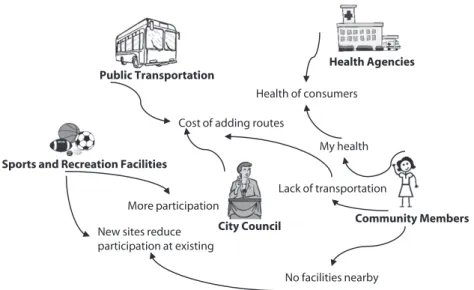
Soft systems methodology is a problem-structuring approach used when the problemis not readily apparent, is evolving, or is perceived differently among system stake-holders (Figure 1). Stakestake-holders participate in creating visual models called“rich pictures” that are used to guide action-oriented pro-cesses to consider system changes.24Often the process is purely qualitative: as changes are implemented, the real-world process and results are compared with the rich pictures, which are subsequently refined and used to guide additional system changes. Researchers sometimes combine soft systems methodol-ogies with computational or other quantita-tive analyses.29–31
A recent study integrated soft systems and geographical information systems analysis to explore and map socioeconomic disparities in physical activity and determine locations for a new recreational facility.31The researchers held a series of interviews, discussions, and workshops with stakeholders (e.g., public transportation providers, recreational services staff) in which they used a rich picture to explore recreational sports participation from each stakeholder’s perspective and to relate and integrate these perspectives. The re-searchers then used geographical information systems analyses to identify locations for a new recreational facility that would achieve bal-ance from the stakeholders’perspectives and
promote use among lower-income communities.
System Dynamics
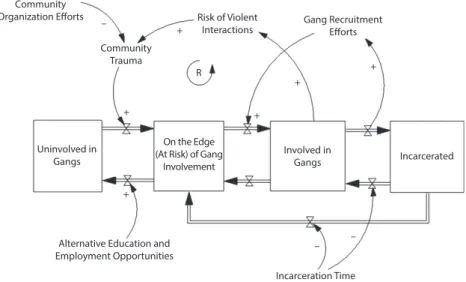
System dynamics is an approach that uses a range of problem-structuring and compu-tational methods to understand and analyze the behavior of complex systems over time (Figure 2).23,32,33System dynamics involves a diagramming language that is amenable to moving from qualitative visual diagrams to quantitative models to hypothesize the cause and effect relationships leading to observed system behavior. For example, models in-volve components called stocks (i.e., variables that accumulate or depreciate over time, e.g., people, diseases, or currency) andflows (i.e., rates that change these stocks, e.g., births, disease incidence, or interest rates) that can be first diagrammed visually (on paper or elec-tronically). The visual diagrams can be translated and built in computer software, quantified and calibrated with data, and used to simulate the impact of possible policies and interventions.
Computational modeling is foundational to system dynamics, but the importance of stakeholder engagement is recogized.34,35 Some researchers have noted the power of
Public Transportation
Health Agencies
Sports and Recreation Facilities
City Council Community Members Cost of adding routes
Lack of transportation More participation
New sites reduce participation at existing
Health of consumers
My health
No facilities nearby
Source. Figure is inspired by Taylor et al.28but is intended to illustrate methods only. Please see Taylor et al.28for information on specific research processes, methods, and outcomes.
stakeholder engagement throughout the modeling process to aid communication, learning, and commitment to action.25,35 Thus, group model building arose as a par-ticipatory process to qualitatively define system problems, build visual and quantita-tive models, and interpret simulation results. In system dynamics, the use of group model
building varies, but it is central to community-based system dynamics,11and examples of community-engaged and par-ticipatory health research using system dy-namics have emerged in the literature.36–39
Bridgewater et al.37developed a system dynamics model by engaging with commu-nity stakeholders (e.g., gang-involved youths,
violence prevention programs) to understand gang-related violence in an urban commu-nity. In the model, stocks included youths uninvolved in gangs, associated with gang members,“on the edge”of becoming a gang member, involved in gangs, and incarcerated. Flows between the stocks represented the transition of youths into and out of gang involvement, which was influenced by var-iables such as community trauma, risk of violent interactions, and gang recruitment efforts. Thefinal model was simulated to test the impact of intervening at variousflows (i.e., transition points into and out of gangs). For example, simulations tested whether re-ducing the recruitment of on the edge youths into gangs (i.e., the rate of transition between on the edge to gang member stocks) or in-creasing incarceration rates (i.e., the rate of transition between gang member to in-carcerated stocks) resulted in the greater re-duction in youth-related violence over time.
Agent-Based Modeling
In the healthfield, agent-based modeling typically involves creating artificial societies (Figure 3).21These artificial societies contain individual entities: agents that represent, for example, people, organizations, or objects. The agents are given spatial or network lo-cations and assigned characteristics and rules for how they interact with each other and their environment over time. Agent-based models are simulated to understand how the agent-level details lead to emergent system behavior. Agent-based modeling has been applied within community-engaged envi-ronmental sustainability and agriculture re-search,40–43but there are fewer examples within community-engaged health research.
Auchincloss et al.44used an agent-based model to explore the role of residential seg-regation and food resource distribution in shaping socioeconomic disparities in dietary behaviors. Agents in the model included food stores (assigned as healthy or unhealthy) and households (assigned as low, medium, or high economic status). Model rules governed where households shopped, where stores were located, and the types of food sold. For example, model parameters and functions shaped where households chose to shop on the basis of food preferences and geographical proximity, where stores chose to locate, and the Community
Organization Efforts –
Community Trauma
+
Risk of Violent
Interactions Gang RecruitmentEfforts
R
+
+
+ +
Uninvolved in Gangs
+
On the Edge (At Risk) of Gang
Involvement
Involved in
Gangs Incarcerated
Alternative Education and
Employment Opportunities –
–
Incarceration Time
Source. Figure is inspired by Bridgewater et al.32but is intended to illustrate methods only. Please see Bridgewater et al.32for information on specific research processes, methods, and outcomes.
FIGURE 2—Example System Dynamics Model: Youth-Related Gang Violence
Healthy food store High-income household
Food Store Attributes: Location, Price Household Shopping Behavior Attributes: Distance to Store, Habit, Preference, Price Unhealthy food store Low-income household
Note. Computational model formulations create interactions of food stores and households that determine the attributes of each food store and household at every time step.
Source. Figure is inspired by Auchincloss et al.40but is intended to illustrate methods only. Please see Auchincloss et al.40for information on speci
fic research processes, methods, and outcomes.
types of food they sold (i.e., healthy or un-healthy) on the basis of customer demand. The simulations indicated that residential segrega-tion reinforced disparities and intervensegrega-tions needed to address food preferences and access to inexpensive healthy foods to improve diets among low-income populations.
Network Analysis
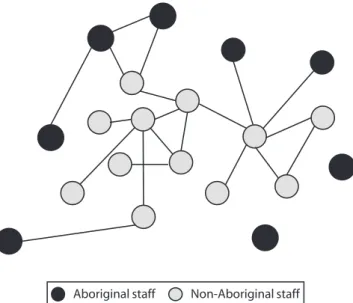
Network analysis focuses on relationships among entities within a system, which can be individual people, organizations, places, or job tasks (Figure 4).22Researchers typically create quantitative models (although qualitative ap-proaches to network mapping are possible) by capturing data about the system entities and their interconnections. Connections might re-flect many links, such as communication, col-laboration, data sharing, influence, assignment, or trust. This information is used to visualize and analyze network structure and properties and answer questions such as“Are there certain individuals more highly connected to others?” and“How do connections influence behav-iors?”Network analysis has been increasingly applied in community-based health research.45–47 For example, several health coalitions have used network analysis to understand and analyze how connections among organizations and agencies influence their efforts.48–51
In Australia, Fuller et al.46used participatory network analysis to engage with clinic staff to understand health service delivery to un-derserved Aboriginal populations. The re-searchers surveyed staff from a health service system—which included traveling clinics for Aboriginal communities and a central co-ordinating clinic—regarding their links to other staff when exchanging information and co-ordinating care. They diagrammed the survey data, which revealed important information about the structure and delivery of care.
SYNERGIES BETWEEN SYSTEMS
SCIENCE AND CBPR
We identified 5 areas of synergy between systems science and CBPR:
1. paradigmatic, 2. socioecological, 3. capacity building, 4. colearning, and
5. translational (data available as a supple-ment to the online version of this article at http://www.ajph.org as Figure S1).
The synergies highlighted are not di-chotomies; that is, the insight and tools from one approach are not wholly unfamiliar to the other. Rather, the approaches often overlap
and emphasize complementary aspects of research that make integration advantageous.
Paradigmatic Synergy
Both systems science and CBPR trace their roots to paradigmatic shifts in scientific thinking away from reductionist, positivist paradigms. For systems science, origins are often traced to general systems theory,52 which arose from concern that reductionist thinking was losing sight of phenomena that could not be broken down into component parts.53CBPR is grounded on critical and constructivist paradigms, which argue that reductionist thinking does not appropriately consider the potential for ever-changing, multiple, and socially constructed realities.7 Both systems science and CBPR acknowl-edge that different theories and methodolo-gies are needed depending on research problems and contexts,7,18,54and both use a mixture of deductive and inductive logic (and quantitative and qualitative methods) to understand and address complex problems.
Systems science and CBPR paradigms frame research in complementary ways with the capacity to generate better quality and more comprehensive information about health disparities. Systems science recognizes the importance of understanding systems as a whole (e.g., how transactions across system components give rise to outcomes over time). CBPR recognizes the importance of social and cultural context and community-developed research perspectives. For exam-ple, their integration could benefit research focused on healthy eating. Systems science could compel the exploration of how“food systems”that involve transactions among policy, food availability, and community norms and beliefs relate to changes in eating behaviors over time. A CBPR approach would engage community stakeholders to frame research questions that improve the understanding of their perceptions and ex-perience of food (e.g., considering variable definitions of healthy food over time).
Socioecological Synergy
A socioecological approach (i.e., the consideration of multiple levels of influence) is inherent in both systems science and CBPR. Systems science recognizes that im-portant variables in systems lie and interact Aboriginal staff Non-Aboriginal staffSource. Figure is inspired by Fuller et al.45but is intended to illustrate methods only. Please see Fuller et al.45for information on specific research processes, methods, and outcomes.
across levels and must be integrated to better understand disparate health outcomes and design more significant interventions.17,19,55 CBPR often involves efforts that target factors at multiple levels, including individual, social, and policy levels.6,56
Systems science and CBPR produce complementary information about multilevel systems with the potential to improve iden-tifying the optimum set of strategies to address health disparities. CBPR identifies and de-velops interventions that build on strengths at multiple levels within a community (e.g., in-dividual leaders, organizations)—a facilitator of successful policy and environmental change.6 However, complex problems such as health disparities can exhibit policy resistance because views of system influences are too narrow and complex problem characteristics (e.g., delays between cause and effect) are not intuitively understood, which often results in well-intentioned efforts with limited or even neg-ative effects.34,35Systems science methods help overcome these challenges by widening system views and simulating models to understand the impact of interventions.34,35
For example, school suspension and ex-pulsion policies are criticized for exacerbating academic deterioration and subsequent problems (e.g., substance abuse).57Social network analysis can elucidate important relationships that underpin students’ prob-lematic behaviors (e.g., peer or family net-works exerting negative social influence) and alternative programs (e.g., interventions that aim to shape positive support networks). This type of analysis can be complemented with a CBPR approach that focuses on community strengths, which would help identify community organizations where such interventions may be ideally situated.
Capacity-Building Synergy
Both systems science and CBPR rely on processes to generate and build knowledge iteratively to improve capacity. Across the range of systems science approaches, initial models (conceptual or computational) are built, tested against the real world, and refined to improve systems thinking capacity.23 CBPR is an ongoing colearning effort in which researchers and the community work collaboratively to gain knowledge and build the capacity to address health issues.58
Systems science and CBPR both gain and use knowledge in ways that, when used to-gether, hold potential to accelerate progress toward addressing health disparities. CBPR often focuses on using knowledge to identify community training and education needs.3,59 In systems science, early models of small pieces of a system have been found to yield important insights, such as information about gaps or redundancies in how an issue is being addressed.11Exemplifying such integration, community-based system dynamics engages communities continually with both problem-structuring and computational methods to identify actions and needed training and to improve a community’s systems thinking capacity over time.11
For example, an early visual model of cardiovascular disease could lead an engaged health clinic to initiate regular screening and counseling for tobacco use. Subsequently, clinic data could be used to build and simulate a model to understand the impact of targeting different subgroups with enhanced or tailored counseling. Throughout the model-building process, CBPR principles would guide continual stakeholder engagement and training needs, building local capacity to make identified changes and understand new problems from a systems perspective.
Colearning Synergy
Equitable community and researcher participation is a central tenet of CBPR.58 Participatory processes are inherent in some systems science approaches (e.g., soft systems, community-based system dynamics, systemic intervention)11,24,25,60and are emerging in others (e.g., network analysis, agent-based modeling).61,62
Systems science and CBPR both have the ability to elucidate new information about mechanisms that influence health disparities. CBPR places the focus on involving com-munity members in the research process to define an issue from their perspective. For example, CBPR has extensively used pho-tovoice, in which communities visually document issues from their perspective in ways that counteract stigmas and stereo-types.63Systems science recognizes that stakeholders hold a wealth of information in their mental database (e.g., relationships be-tween system components, decision points in
a system).23Thus, systems science researchers have developed formal facilitation strategies (e.g., group model-building scripts)64to help researchers engage with stakeholders to un-derstand and extract data from stakeholders’ mental databases to build system models.35 Combining participatory processes from CBPR and systems science may improve the depth and breadth of colearning that occurs. For example, previous research has found that experiencing racial discrimination in-creases health risks, yet the mechanisms and pathways through which this occurs remain poorly understood.65A CBPR data collec-tion tool, such as photovoice, has the po-tential to uncover important perceptions of influences and outcomes of racial discrimi-nation. Participatory system science methods, such as group model building, provide formal strategies with the ability to improve un-derstanding about explicit connections be-tween these influences, outcomes, and health.
Translational Synergy
Finally, there is a key translational synergy. Systems science emphasizes improving knowledge of complex problems, and some approaches have a specific focus on action-oriented approaches. Conversely, CBPR emphasizes translating knowledge into action, and practitioners often seek to de-termine system-oriented actions.66,67The enhanced integration of systems science and CBPR can improve both knowledge of op-timal strategies and their translation to pro-grams and policies to address health disparities.
KEY CONSIDERATIONS FOR
INTEGRATING SYSTEMS
SCIENCE AND CBPR
The synergies we have highlighted pro-vide a rationale for integrating systems sci-ence and CBPR. In a long-term CBPR partnership, multiple systems science methods could be used as questions unfold and information is gained. Problem-structuring methods are apt for early efforts without a strong consensus on priorities and may illuminate more specific questions that require computational methods. For ex-ample, soft systems’rich pictures high-lighting stakeholder views on community health care services might uncover a need for network analysis to understand organiza-tional relationships and their influence on access to care. Which approach to use, and when, involves many decisions and factors (e.g., resources, expertise available). Meth-odology and frameworks from community operations research may provide apt guid-ance.12For example, the systemic in-tervention methodology involves a process of community-engaged critique, judgment, and action to reflect on and determine how to combine multiple theories and method-ologies to address research questions.60This methodology has been successfully used to understand concerns and improve services for homeless youths in 1 community.69
Considering the system problem and social contexts can also inform decisions.70 For example, system problems range from simple to complex, and social contexts can range from agreement among stakeholders to coercive situations with substantial power dynamics. Highly complex problems and coercive situations may merit a long-term resource-intensive combination of high community participation that draws from both problem-structuring and computa-tional approaches. Conversely, if a com-munity is in general agreement about an issue but is exhibiting high complexity, fewer problem-structuring and more computational approaches are likely required.
There are several challenges in integrating systems science and CBPR. Integrating sys-tems science approaches may increase the significant time and resources already com-mitted to CBPR. Additionally, both systems
science and CBPR require training that is not often provided together or in the same educational structures.
Another key consideration is balancing power between researchers and community members. Computational system models have been criticized for their lack of trans-parency, which can exacerbate power dy-namics.71For example, researchers working with a low-income housing cooperative had to pay special attention to formulating and communicating technical aspects of a com-putationalfinancial model that would inform the community’s decisions about issues such as sales policies and rent increases.72However, thoughtful consideration of the expertise each group brings and implementation of in-novative communication strategies can make models accessible and universally utiliatarian.39,72,73
Finally, the use of participatory approaches with systems science methods can raise ethical considerations. For example, network analysis is inherently personal in nature, and main-taining confidentiality would be especially important if community members participate in data collection, analysis, and interpretation. Thus, highly sensitive issues may require additional human participant safeguards or may not be well suited to participatory pro-cesses. However, participatory network analysis has been emerging, and 1 study found that the system-focused nature of the method made the problem structural rather than personal.46
RECOMMENDATIONS AND
CONCLUSIONS
Efforts have successfully integrated systems science and CBPR to address a range of health concerns, but more can and should be done. Their integration can create a shift to trans-disciplinary research frames that widen the consideration of potential social and eco-nomic determinants and produce a stronger translation of“knowledge to action”through optimal combinations of individual, social, policy, and environmental changes. To continue to progress, expanded efforts are needed to explore integration in terms of process and impacts; these efforts should be carefully evaluated to direct practice toward the most effective and efficient methods.
Integrating systems science and CBPR will require inter- and transdisciplinary work that includes teams from diverse backgrounds. Researchers who have training and expertise in CBPR will likely need to reach across disciplines (e.g., business, engineering) tofind systems science researchers and to provide time for meaningful exchange to learn from and balance each other’s strengths and weaknesses. For example, systems science researchers may not have significant partici-patory research experience and so may require training in engaged scholarship and guidance to adapt methods for community accept-ability. Systems science researchers will need to provide training to both community and CBPR researchers in methodology such as diagramming languages.
Academic and research institution policies and resources are needed to foster integration development. A program of research would require studies that range from developing and testing new integrated methods to assessing multilevel outcomes across com-munities that undertake such integrated ef-forts. Overall, problem-structuring methods merit more attention, especially for issues in which computational modeling alone may be fruitless if fundamental beliefs about systemic influences diverge across stakeholders.
Problem-structuring methods should be examined for their ability to achieve a shared understanding of issues that are historically contentious and include diverse perspectives. Also, participatory applications of agent-based modeling have been limited, and new approaches to structure problems and help participants visualize agent-based models may be needed.74Real-world applications and experiences provide the best opportunities for learning. This requires resources and funding opportunities that expand the ability of re-searchers to explore integration in natural settings. In complex and dynamic community settings, funding that favors natural experi-ments with rigorous mixed methods may produce more valuable information than do controlled and randomized experiments.
utility of systems models and the translation to action. CBPR is an approach already known for using a diversity of methods, and although challenges cannot be ignored, adding systems science to the CBPR methodological toolbox could result in accelerated progress in achieving health equity.
CONTRIBUTORS
L. Frerichs conceptualized and led the study. K. Hassmiller Lich, G. Dave, and G. Corbie-Smith contributed to critical revisions and approved thefinal version of the article.
ACKNOWLEDGMENTS
This work was supported by the National Institutes of Health (grants K24 HL105493 and UL1TR0011111).
The authors would like to thank the 3 anonymous peer reviewers for their insightful feedback and helpful com-ments, which helped improve and strengthen this article.
HUMAN PARTICIPANT PROTECTION No protocol approval was necessary because no human participants were involved in this study.
REFERENCES
1. US Institute of Medicine.How Far Have We Come in Reducing Health Disparities? Progress Since 2000: Workshop Summary. Washington, DC: National Academies Press; 2012.
2. Diez Roux AV. Complex systems thinking and current impasses in health disparities research.Am J Public Health. 2011;101(9):1627–1634.
3. Wallerstein NB, Duran B. Using community-based participatory research to address health disparities.Health Promot Pract. 2006;7(3):312–323.
4. Leung MW, Yen IH, Minkler M. Community based participatory research: a promising approach for increasing epidemiology’s relevance in the 21st century.Int J Epi-demiol. 2004;33(3):499–506.
5. Viswanathan M, Ammerman A, Eng E, et al.
Community-Based Participatory Research: Assessing the Evi-dence. Rockville, MD: Agency for Healthcare Research and Quality; 2004.
6. Minkler M. Linking science and policy through community-based participatory research to study and address health disparities.Am J Public Health. 2010; 100(suppl 1):S81–S87.
7. Israel BA, Schulz AJ, Parker EA, Becker AB. Review of community-based research: assessing partnership ap-proaches to improve public health.Annu Rev Public Health. 1998;19(1):173–202.
8. Mabry PL, Olster DH, Morgan GD, Abrams DB. Interdisciplinarity and systems science to improve pop-ulation health: a view from the NIH Office of Behavioral and Social Sciences Research.Am J Prev Med. 2008; 35(2 suppl):S211–S224.
9. Miller JH, Page SE.Complex Adaptive Systems: An Introduction to Computational Models of Social Life. Prince-ton, NJ: Princeton University Press; 2002.
10. Johnson MP, ed.Community-Based Operations Re-search: Decision Modeling for Local Impact and Diverse Populations. New York, NY: Springer; 2012.
11. Hovmand PS.Community Based System Dynamics. New York, NY: Springer; 2014.
12. Midgley G, Ochoa-Arias A.Community Operational Research: OR and Systems Thinking for Community Devel-opment. New York, NY: Kluwer Academic/Plenum Publishers; 2004.
13. Trochim WM, Cabrera DA, Milstein B, Gallagher RS, Leischow SJ. Practical challenges of systems thinking and modeling in public health.Am J Public Health. 2006; 96(3):538–546.
14. Rosenhead J, Mingers J.Rational Analysis for a Prob-lematic World Revisited: Problem Structuring Methods for Complexity, Uncertainty and Conflict. 2nd ed. Chichester, UK: Wiley; 2001.
15. Hammond RA. Complex systems modeling for obesity research.Prev Chronic Dis. 2009;6(3):A97.
16. Leischow SJ, Best A, Trochim WM, et al. Systems thinking to improve the public’s health.Am J Prev Med. 2008;35(2 suppl):S196–S203.
17. Luke DA, Stamatakis KA. Systems science methods in public health: dynamics, networks, and agents.Annu Rev Public Health. 2012;33:357–376.
18. Midgley G.Systemic Intervention: Philosophy, Method-ology, and Practice. New York, NY: Kluwer Academic/ Plenum Publishers; 2000.
19. Gillen EM, Lich KH, Yeatts KB, Hernandez ML, Smith TW, Lewis MA. Social ecology of asthma engaging stakeholders in integrating health behavior theories and practice-based evidence through systems mapping.Health Educ Behav. 2014;41(1):63–77.
20. Kitson NA, Price M, Lau FY, Showler G. Developing a medication communication framework across contin-uums of care using the Circle of Care Modeling approach.
BMC Health Serv Res. 2013;13:418.
21. Gilbert N.Agent-Based Models. Thousand Oaks, CA: Sage; 2008.
22. Scott J.Social Network Analysis. London, UK: Sage; 2012.
23. Sterman JD.Business Dynamics: Systems Thinking and Modeling for a Complex World. Boston, MA: Irwin/ McGraw-Hill; 2000.
24. Checkland P. Soft systems methodology. In: Gass SI, Fu MC, eds.Encyclopedia of Operations Research and Management Science. Lancaster, UK: Springer; 2013:1430–1436. 25. Vennix JA.Group Model Building: Facilitating Team Learning Using System Dynamics. New York, NY: Wiley; 1996.
26. Ackoff RL.Re-creating the Corporation: A Design of Organizations for the 21st century. New York, NY: Oxford University Press; 1999.
27. Mason RO, Mitroff II.Challenging Strategic Planning Assumptions: Theory, Cases, and Techniques. New York, NY: Wiley; 1981.
28. Kotiadis K. Using soft systems methodology to de-termine the simulation study objectives.J Simulat. 2007; 1(3):215–222.
29. Mendoza GA, Prabhu R. Combining participatory modeling and multi-criteria analysis for community-based forest management.For Ecol Manage. 2005; 207(1–2):145–156.
30. Rodriguez-Ulloa R, Paucar-Caceres A. Soft system dynamics methodology (SSDM): combining soft systems methodology (SSM) and system dynamics (SD).Syst Pract Act Res. 2005;18(3):303–334.
31. Taylor MJ, Higgins E, Francis M, Francis H. A multiparadigm approach to developing policy for the location of recreational facilities.Syst Res Behav Sci. 2012; 29(3):240–252.
32. Richardson GP. System dynamics. In: Gass SI, Fu MC, eds.Encyclopedia of Operations Research and Man-agement Science. Lancaster, UK: Springer; 2013: 1519–1522.
33. Homer JB, Hirsch GB. System dynamics modeling for public health: background and opportunities.Am J Public Health. 2006;96(3):452–458.
34. Sterman JD. Learning from evidence in a complex world.Am J Public Health. 2006;96(3):505–514. 35. Vennix JA. Group model-building: tackling messy problems.Syst Dyn Rev. 1999;15(4):379–401. 36. BeLue R, Carmack C, Myers KR, Weinreb-Welch L, Lengerich EJ. Systems thinking tools as applied to community-based participatory research: a case study.
Health Educ Behav. 2012;39(6):745–751.
37. Bridgewater K, Peterson S, McDevitt J, et al. A community-based systems learning approach to un-derstanding youth violence in Boston.Prog Community Health Partnersh. 2011;5(1):67–75.
38. Hovmand PS, Ford DN, Flom I, Kyriakakis S. Victims arrested for domestic violence: unintended consequences of arrest policies.Syst Dyn Rev. 2009;25(3):161–181. 39. Homer J, Milstein B, Wile K, Pratibhu P, Farris R, Orenstein DR. Modeling the local dynamics of cardio-vascular health: risk factors, context, and capacity.Prev Chronic Dis. 2008;5(2):A63.
40. Castella J-C, Trung TN, Boissau S. Participatory simulation of land-use changes in the northern mountains of Vietnam: the combined use of an agent-based model, a role-playing game, and a geographic information sys-tem.Ecol Soc. 2005;10(1):27.
41. Silka L. Community research in other contexts: Learning from sustainability science.J Empir Res Hum Res Ethics. 2010;5(4):3–11.
42. Bousquet F, Le Page C. Multi-agent simulations and ecosystem management: a review.Ecol Model. 2004; 176(3–4):313–332.
43. Delmotte S, Lopez-Ridaura S, Barbier JM, Wery J. Prospective and participatory integrated assessment of agricultural systems from farm to regional scales: com-parison of three modeling approaches.J Environ Manage. 2013;129:493–502.
44. Auchincloss AH, Riolo RL, Brown DG, Cook J, Diez Roux AV. An agent-based model of income inequalities in diet in the context of residential segregation.Am J Prev Med. 2011;40(3):303–311.
45. Campbell N, Schiffer E, Buxbaum A, McLean E, Perry C, Sullivan TM. Taking knowledge for health the extra mile: participatory evaluation of a mobile phone intervention for community health workers in Malawi.
Glob Health Sci Pract. 2014;2(1):23–34.
46. Fuller J, Hermeston W, Passey M, Fallon T, Muyambi K. Acceptability of participatory social network analysis for problem-solving in Australian Aboriginal health service partnerships.BMC Health Serv Res. 2012;12 (1):152.
47. Park MM, Zafran H, Stewart J, et al. Transforming mental health services: a participatory mixed methods study to promote and evaluate the implementation of recovery-oriented services.Implement Sci. 2014;9:119.
49. Manning MA, Bollig-Fischer A, Bobovski LB, Lichtenberg P, Chapman R, Albrecht TL. Modeling the sustainability of community health networks: novel ap-proaches for analyzing collaborative organization part-nerships across time.Transl Behav Med. 2014;4(1):46–59. 50. Provan KG, Veazie MA, Staten LK, Teufel-Shone NI. The use of network analysis to strengthen community partnerships.Public Adm Rev. 2005;65(5):603–613. 51. Freedman DA, Bess KD. Food systems change and the environment: local and global connections.Am J Com-munity Psychol. 2011;47(3–4):397–409.
52. Von Bertalanffy L.General System Theory. London, UK: Penguin; 1968.
53. Ison RL. Systems thinking and practice for action research. In: Reason P, Bradbury-Haung H, eds.The SAGE Handbook of Action Research Participative Inquiry and Practice. London, UK: Sage; 2008:139–158.
54. Flood RL, Jackson MC.Critical Systems Thinking: Directed Readings. Chichester, NY: Springer; 1991.
55. Morrissey JP, Lich KH, Price RA, Mandelblatt J. Computational modeling and multilevel cancer control interventions.J Natl Cancer Inst Monogr. 2012;2012(44): 56–66.
56. Wallerstein NB, Oetzel J, Duran B, Tafoya G, Belone L, Rae R. What predicts outcomes in CBPR? In: Minkler M, Wallerstein NB, eds.Community Based Participatory Research for Health: Process to Outcomes. San Francisco, CA: Jossey-Bass; 2008:371–392.
57. American Academy of Pediatrics Committee on School Health. Out-of-school suspension and expulsion.
Pediatrics. 2003;112(5):1206–1209.
58. Minkler M, Wallerstein N.Community-Based Partic-ipatory Research for Health: From Process to Outcomes. San Francisco, CA: Jossey-Bass; 2008.
59. Minkler M. Community-based research partnerships: challenges and opportunities.J Urban Health. 2005;82(2 suppl 2):ii3–ii12.
60. Midgley G. Systemic intervention for public health.
Am J Public Health. 2006;96(3):466–472.
61. Voinov A, Bousquet F. Modelling with stakeholders.
Environ Model Softw. 2010;25(11):1268–1281. 62. Yonas MA, Burke JG, Brown ST, et al. Dynamic simulation of crime perpetration and reporting to ex-amine community intervention strategies.Health Educ Behav. 2013;40(1 suppl):87S–97S.
63. Lopez ED, Eng E, Robinson N, Wang CC. Pho-tovoice as a community-based participatory research method. In: Israel BA, Eng E, Schulz AJ, Parker EA, eds.
Methods in Community-Based Participatory Research for Health. San Francisco, CA: Jossey-Bass; 2005:326–348. 64. Hovmand PS, Andersen DF, Rouwette E, Richardson GP, Rux K, Calhoun A. Group model-building‘scripts’as a collaborative planning tool.Syst Res Behav Sci. 2012;29(2):179–193.
65. Williams DR, Mohammed SA. Discrimination and racial disparities in health: evidence and needed research.J Behav Med. 2009;32(1):20–47.
66. Andrews JO, Tingen MS, Jarriel SC, et al. Application of a CBPR framework to inform a multi-level tobacco cessation intervention in public housing neighborhoods.
Am J Community Psychol. 2012;50(1–2):129–140. 67. Mulvaney-Day NE, Rappaport N, Alegria M, Codianne LM. Developing systems interventions in a school setting: an application of community-based participatory research for mental health.Ethn Dis. 2006;16 (1 suppl 1):S107–S117.
68. Hassmiller Lich K, Minyard M, Niles R, Dave G, Gillen E. System dynamics and community health. In: Burke JG, Albert SM, eds.Methods for Community Public Health Research. New York, NY: Springer; 2014: 129–170.
69. Boyd A, Brown M, Midgley G. Systemic intervention for community OR: developing services with young people (under 16) living on the streets. In: Midgley G, Ochoa-Arias A, eds.Community Operational Research: OR and Systems Thinking for Community Development. New York, NY: Kluwer Academic/Plenum; 2004:203–252. 70. Jackson MC. Community operational research: purposes, theory and practice. In: Midgley G, Ochoa-Arias A, eds.Community Operational Research: OR and Systems Thinking for Community Development. New York, NY: Kluwer Academic/Plenum; 2004:57–74. 71. Martinez-Moyano IJ. Documentation for model transparency.Syst Dyn Rev. 2012;28(2):199–208. 72. Ritchie C. Housing in the Dearne valley: doing community OR with the Thurnscoe tenants housing co-operative. In: Midgley G, Ochoa-Arias A, eds.Community Operational Research: OR and Systems Thinking for Com-munity Development. New York, NY: Kluwer Academic/ Plenum; 2004:121–142.
73. Richardson GP. Concept models in group model building.Syst Dyn Rev. 2013;29(1):42–55.