CHARACTERIZING THE BLADDER’S RESPONSE TO
ONABOTULINUM TOXIN TYPE A USING A RAT MODEL
Alexis A. Dieter, MD1, Jennifer M. Wu, MD, MPH2, Nazema Y. Siddiqui, MD, MHSc1, Danielle
J. Degoski, BS3, Jillene M. Brooks, MSc3, Paul C. Dolber, PhD4,5,6, and Matthew O. Fraser, PhD3,4,5
1Department of Obstetrics and Gynecology, Duke University Medical Center, Durham, NC
2Department of Obstetrics and Gynecology, University of North Carolina – Chapel Hill, Chapel
Hill, NC
3Institute for Medical Research, Durham Veterans Affairs Medical Center, Durham, NC
4Department of Surgery, Duke University Medical Center, Durham, NC
5Department of Research and Development, Durham Veterans Affairs Medical Center, Durham,
NC
6Department of Surgery, University of Texas Medical Branch, Galveston, TX
Abstract
Objectives—To characterize the response of the rat bladder neuromuscular system to intramural injection of onabotulinum toxin type A (BoNT/A) over 9 weeks using in vivo cystometry (CMG) and in vitro contractility (IVC).
Methods—Chronic bladder catheters were implanted in female Sprague-Dawley rats and either 1) BoNT/A (10 units in 20μl saline) or 2) saline (20μl) was injected in 5 × 4μl doses throughout the bladder wall. At 1, 3, 6 and 9 weeks after injection, conscious restrained CMG was performed. At each time point, 25% of each group (8 BoNT/A and 4 controls) was euthanized and bladders harvested for IVC. We measured IVC in response to electric field stimulation, carbachol, and potassium chloride.
Results—In total 47 animals were included; 31 underwent BoNT/A injection, and 16 received sham (saline). Bladder capacities did not differ significantly between groups for each time point. One week after injection, BoNT/A animals exhibited significantly longer bladder contraction durations and lower voiding efficiencies compared to controls. By 3 weeks these values returned to control levels. For BoNT/A animals, contractile response to carbachol stimulation was enhanced at 3 weeks. Otherwise there were no differences in IVC responses.
Corresponding Author: Alexis A. Dieter, MD, University of North Carolina at Chapel Hill, Department of Obstetrics and Gynecology, Urogynecology and Reconstructive Pelvic Surgery Division, 3032 Old Clinic Bldg., CB#7570, Chapel Hill, NC 27599-7570, Phone: 919-966-4717, Fax: 919-843-9952, [email protected].
HHS Public Access
Author manuscript
Female Pelvic Med Reconstr Surg
. Author manuscript; available in PMC 2017 November 01.Published in final edited form as:
Female Pelvic Med Reconstr Surg. 2016 ; 22(6): 467–471. doi:10.1097/SPV.0000000000000316.
A
uthor Man
uscr
ipt
A
uthor Man
uscr
ipt
A
uthor Man
uscr
ipt
A
uthor Man
uscr
Conclusions—One week following BoNT/A injection, prolonged bladder contractions are noted in rats. This may reflect supraspinal compensation for denervation by increasing the duration of efferent drive during voiding. After 3 weeks post injection we observed no differences in either CMG or IVC responses suggesting either compensatory efferent sprouting, increased gap junction formation, or loss of BoNT/A effect.
Keywords
Neuromodulation; Onabotulinum Toxin Type A; Urinary Bladder; Autonomic Nervous System
INTRODUCTION
The purpose of the lower urinary tract is the storage and periodic release of urine. Storage is promoted via the sympathetic and somatomotor activity while voiding is governed by the sacral parasympathetic nervous system. Overactive bladder (OAB) and urgency urinary incontinence (UUI) are highly prevalent disorders of storage that negatively impact the lives of millions of adults.1 It is widely believed that these problems are the result of an imbalance of the storage and release mechanisms, reflecting inappropriate parasympathetic reflex pathway activity during filling. As such, treatments have historically involved the use of antimuscarinic agents.
A promising new treatment for OAB refractory to anticholinergic medication is onabotulinum toxin type A (BoNT/A), which acts on SNAP-25 to block the release of acetylcholine from presynaptic neurons. While the therapeutic efficacy of BoNT/A is well proven and the mechanism appears to involve functional denervation, there is a limited understanding of how the bladder neuromuscular system may compensate in response to BoNT/A both acutely and chronically.2,3 Early studies have shown that BoNT/A decreases in vivo detrusor pressure 48 hours after injection in rats with chemically-induced detrusor overactivity,4 inhibits in vitro detrusor contractility in bladder strips incubated with BoNT/ A,5 and decreases the release of acetylcholine and norepinephrine from autonomic neurons.6,7 There is also evidence to suggest that BoNT/A acts on afferent neurons to alter sensory signaling in the bladder.8,9 However, much remains to be discovered, including a further delineation of the temporal relationship between neurologic and muscular effects.
Our objective was to determine how the detrusor smooth muscle and autonomic nervous system respond to functional denervation with BoNT/A over a 9-week period in an intact rat model. By utilizing an experimental design of combined cross-sectional and longitudinal cystometric evaluation, we aimed to determine if changes in bladder function in vivo mirrored changes in detrusor smooth muscle contractility in vitro to improve our understanding of smooth muscle physiology and bladder neuromuscular function.
MATERIALS AND METHODS
Experimental Timeline
Experiments were performed at the Durham Veterans Affairs Medical Center (DVAMC) from August 2013 to March 2014. Female Sprague-Dawley rats (Charles River Laboratories,
A
uthor Man
uscr
ipt
A
uthor Man
uscr
ipt
A
uthor Man
uscr
ipt
A
uthor Man
uscr
Boston, MA) weighing 240 to 307 grams were used in the experiments. We observed a total of 47 rats for 1 to 9 weeks. A total of 31 rats received BoNT/A injection and 16 rats received saline injection. Testing was performed at 1, 3, 6, and 9 week time points after injection. Rats were housed in pairs in a temperature-controlled room with a 12:12 hour light-dark cycle and maintained with access to food and water ad libitum. All procedures were conducted with the approval of the Institutional Animal Care and Use Committee of the Durham Veterans Affairs Medical Center (IACUC, protocol identification A085-13-03) and in accordance with the National Institutes of Health Guidelines for the Care and Use of Laboratory Animals.
Chronic Catheter Implantation
On experimental day 0, using sterile technique in Isoflurane anesthetized rats, the bladder was exposed via midline abdominal incision made with a scalpel. A cystotomy was made in the apex of the bladder dome, a PE50 tube with flared tip was inserted into the bladder lumen, and secured with 5-0 silk suture.10 The free end of the catheter was tunneled subcutaneously to the midscapular region, and following BoNT/A or saline injection (see below), the catheter was flushed with saline followed by 1mg/ml gentamycin sulfate in 0.9% saline, flame sealed, and left in a subcutaneous midscapular pocket to be easily retrieved at the time of future CMG evaluations.
BoNT/A Injection
After the bladder catheter was secured in place, the bladder was filled just enough to distend the bladder walls for ease of injection. Ten units of BoNT/A (onabotulinum toxin type A, Allergan Inc., Irvine, CA, USA) in 20μl of saline or 20μl of saline alone (sham procedure for controls) were injected in 5 equally divided doses, one in each wall and one in the dome using a 25μl Hamilton syringe.11 Injection in the bladder tissues was confirmed visually by blebbing of the tissue at the injection site ensuring injection into all walls and the dome. We chose a dose of 10 units as this was above the minimal effective dose of 7.5 units
demonstrated in a previous dose response study on female Sprague-Dawley rats.11
Post-operative Animal Care
The abdominal musculature was closed with Vicryl suture and the skin was closed with surgical wound clips. All animals received twice daily subcutaneous injection of
Buprenorphine (0.5mg per animal) and Enrofloxacin (10mg per animal) for 3 and 5 days, respectively, after surgery.
In Vivo Cystometry
In order to detect the effect of BoNT/A injection and to allow sufficient recovery from surgery we performed conscious restrained cystometry on all animals starting at 1 week after surgery, and then at 3, 6, and 9 week time points, unless harvested for in vitro studies at a previous time point (see below). Animals were acclimated to the restraint by being placed in the Ballman restraint cage for 1 hour per day for 3 days during the week prior to the week 1 cystometry testing. Food and water was provided ad libidum while in restraint. On day of cystometric testing, animals were briefly anesthetized with Isoflurane, mounted in Ballman
A
uthor Man
uscr
ipt
A
uthor Man
uscr
ipt
A
uthor Man
uscr
ipt
A
uthor Man
uscr
restraint cages, the catheter was exposed from the subscapular subcutaneous pocket and connected to an infusion pump with pressure transducer via a 4-way stopcock.10 Animals were allowed to recover from anesthesia, and intravesicle saline was infused at 0.1 ml/min to elicit spontaneous filling and voiding cycles. After a 60-minute recovery period, bladders were emptied and a single fill cystometrogram was performed, followed by 60 minutes of continuous cystometry, followed by one final bladder emptying and single filling
cystometrogram.
True bladder capacity (TBC, mL) and postvoid residual volume (PVR, mL) were measured during single filling cystometrograms. TBC was defined as the volume at which a voiding contraction would occur after complete emptying of the bladder. PVR was obtained by measuring the residual bladder volume obtained after a voiding contraction was completed with at least two values obtained per animal per session. During the 60 minutes of
continuous cystometry functional bladder capacity (FBC, mL), voided volume (VV, mL), and voiding contraction parameters were measured using LabChart 7 data collection software (ADInstruments, Inc. Colorado Springs, CO, USA). The assessor was masked to intervention. FBC was defined as the bladder volume at which a voiding contraction would spontaneously occur during continuous cystometry. If more than one measurement of TBC, FBC and/or PVR was available, we calculated the average to use in our data analysis. Voiding efficiency (VE) was calculated as the average FBC divided by the average TBC.
In Vitro Contractility
To further characterize the detrusor neuromuscular response after BoNT/A injection, we performed IVC on bladder strips. Following cystometry at each time point, 25% of the rats (i.e. 12 per time point) were euthanized, the bladders were excised, and placed into a tissue bath of oxygenated Krebs solution [mmol/L: NaCl 143.34, KCl 4.96, MgSO4 1.29, KH2PO4
1.29, NaHCO3 10.78, glucose 11.85, and CaCl2 2.69]. Full thickness circumferential
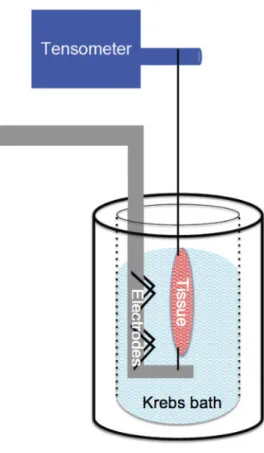
(equatorial) and longitudinal (full length ventral) bladder strips were harvested from each bladder and mounted in separate tissue baths of oxygenated Krebs solution at 37 degrees Celsius. Bladder strips were mounted such that tension was adjusted to 1 gram (Figure 1). Detrusor contractile force (DCF) was measured in response to three stimuli, performed in the same order for each IVC experiment with a washout period in between to allow recovery and return to baseline tension. The first of these was electric field stimulation (EFS), performed to assess neurally-mediated contractility. For EFS, frequency-response curves (0.5 to 32 Hz as escalating doublings) were generated by stimulating the bladder strips every 3 minutes for 10 seconds with 0.05 millisecond pulse width at 100 Volts using an S48 stimulator (Grass Instruments, W. Warwick, RI, USA). Second, carbamylcholine chloride (carbachol; ICN Biomedicals Inc., Aurora, OH, USA) was used to assess smooth muscle response to known quantities of cholinergic agonist. For carbachol stimulation,
concentration-response curves were generated cumulatively with carbachol doses ranging from 10−1 to 103 uM administered in escalating log increments every 3–5 minutes. Finally, a single challenge to potassium chloride (KCl; 60mM) was used to measure inherent muscle contractility. Force generation was measured via tensiometer and recorded using LabChart 7 data collection software (ADInstruments, Inc. Colorado Springs, CO, USA). For each strip, tissue contractility response was normalized to response to KCl 60mM stimulation, which
A
uthor Man
uscr
ipt
A
uthor Man
uscr
ipt
A
uthor Man
uscr
ipt
A
uthor Man
uscr
was assessed at the completion of IVC testing. The entire IVC preparation and experimental protocol took approximately 4–5 hours.
Statistical Analysis
Data were analyzed by two-way ANOVA with repeated measures as appropriate, and with Sidak’s or Tukey’s multiple comparison post-test. For all experiments, p < 0.05 defined significance. All statistical analyses were performed using GraphPad Prism Version 6.0 (GraphPad Software, Inc., La Jolla, CA, USA).
RESULTS
A total of 47 animals underwent baseline injection and catheter implantation. This total included 12 animals per time point (8 BoNT/A and 4 controls) with the exception of the 3-week group, which had 11 animals (4 control and 7 BoNT/A). In this group one BoNT/A animal was excluded after a possible bladder carcinoma was incidentally found at time of laparotomy. Within one week of injection, body weight was noted to be significantly lower in the BoNT/A treated group 1 week after injection with subsequent recovery by the 9-week time point (Figure 2, panel D). Otherwise there were no noted differences in general health status between the groups.
In Vivo CMG
The results from CMG testing are shown graphically in Figure 2. TBC was similar between groups at all time points (Figure 2, panel A). Both groups demonstrated a gradual increase in average TBC over the observation period. At one week after injection, the BoNT/A treated animals exhibited significantly longer bladder contraction duration (Figure 2, panel B) and significantly lower voiding efficiency (Figure 2, panel C) when compared to controls. By 3 weeks after injection these values returned to normal and there was no longer a significant difference between groups with regard to voiding efficiency or bladder contraction duration.
In Vitro Contractility
The responses to EFS in longitudinal and circumferential bladder strips were not affected by BoNT/A (Figure 3, Top Panels). However, the responses of BoNT/A treated animals to carbachol stimulation were significantly enhanced at 3 weeks for both longitudinal and circumferential strips (Figure 3, Bottom Panels). There were no significant differences in KCl-induced contractility within treatment groups when compared between time points.
DISCUSSION
One week following functional denervation with 10 units BoNT/A injected into the detrusor muscle of female Sprague-Dawley rats, in vivo cystometry revealed increased bladder contraction duration and decreased voiding efficiency relative to control. However, at this same time point, there were no detectable differences in responses of bladder strips to any stimulus applied during in vitro contractility studies. Specifically, at this time point there were no differences following BoNT/A treatment in response to: 1) EFS, which tests bladder smooth muscle strip contractile response to nerve stimulation; 2) carbachol, which tests
A
uthor Man
uscr
ipt
A
uthor Man
uscr
ipt
A
uthor Man
uscr
ipt
A
uthor Man
uscr
bladder smooth muscle strip contractile responses to muscarinic receptor stimulation; and 3) KCl, which tests the maximum capability of the muscle fibers to contract. Because we are unable to demonstrate any differences between BoNT/A and control animals at this tissue level, we hypothesize that the changes in voiding at this time point are due to attempted compensation by the central nervous system (CNS) micturition reflex pathways. Assuming that the duration of voiding contraction is driven by the duration of descending micturition signals, it is possible that the CNS increases descending micturition signals in response to reduced in situ bladder contractility and emptying at this time. However, if this is indeed the case, compensatory attempts were insufficient and voiding efficiency was still reduced. Alternatively, the effects seen in our study could be the result of alterations in the afferent sensory signals that may potentially be affected by BoNT/A injection.
Both cystometric bladder contraction duration and voiding efficiency returned to normal by week 3 after injection. At the same 3-week time point, however, there was an enhanced response to carbachol, with no change in response to EFS during in vitro bladder strip testing. The enhanced response to carbachol likely reflects a compensatory increase in muscarinic receptors, as previously described following mechanical denervation.12
By week 6 post-injection, both in vivo cystometric and in vitro contractility results fail to show any differences between BoNT/A and control animals. This is in contrast to the body weight data, which continues to show an effect of the BoNT/A at 6 weeks. Weight loss with bladder injections has been reported previously and our weight data are in line with these previous results.11 In terms of our finding that the bladder effects are not discernable at 6 weeks, we hypothesize that this effect may be due to an additional compensatory response occurring, such as the efferent sprouting that occurs in striated muscle following similar treatments.13 With increased efferent nerve density, the nervous system would theoretically be able to overcome the effect of BoNT/A to regain function prior to full recovery of the neuromuscular synapse.14 Another potential possibility is that the detrusor smooth muscle itself may be compensate by increasing gap junction formation and thereby ameliorating the effect of this dose of BoNT/A. It has been previously demonstrated that bladder smooth muscle can trigger a generalized muscle contraction with activation of only a few muscle cells.15 So, even if the majority of neuromuscular connections are inhibited by BoNT/A, if a critical mass is activated this could in theory cause a full muscle contraction. Importantly this increased electrical coupling of cells also occurs in the setting of detrusor instability,16 and thus further research is needed to clarify if coupling is indeed increased in response to BoNT/A injection as this compensatory response could potentially worsen the underlying OAB/UUI.
We were surprised to see no differences in TBC between the BoNT/A and control animals. There is preliminary research showing that BoNT/A alters sensory activity, including decreases in TRPV1 and P2X3 receptor density, 17 and BoNT/A is being increasingly utilized clinically off label (not labeled for use by FDA) to treat bladder pain syndrome and similar urologic sensory disturbances supporting a sensory effect of BoNT/A.18 We may only conclude that our approach (dose and injection strategy) was insufficient to affect afferent activity to the degree that this would alter TBC. Of note, the BoNT/A group experienced weight loss while control animals did not. Therefore, if corrected for body
A
uthor Man
uscr
ipt
A
uthor Man
uscr
ipt
A
uthor Man
uscr
ipt
A
uthor Man
uscr
weight, one may argue that TBC did increase transiently (relative to total body weight) in BoNT/A treated animals.
This pilot study to assess the effect of BoNT/A in an intact neuromuscular system was well-designed using both in vivo and in vitro assessment techniques over a 9-week time period of observation. Limitations include the small number of animals studied due to the pilot design and the potential effect of long-term catheter implantation on bladder function. Catheter implantation is a necessary requirement in this study design in order to perform repeated cystometric analysis over the time period of observation. We did provide antibiotic
prophylaxis to prevent infection and each group underwent the same implantation technique by the same surgeon to minimize bias. Animals were acclimated to the restraint prior to testing and allowed sufficient recovery from anesthesia before cystometric testing was initiated. Additionally this technique of conscious restrained cystometry has been utilized successfully in our lab as well as by others to study bladder function.10,19–21
In conclusion, we have examined the effect of BoNT/A over a 9-week time period in the detrusor muscle of rats. Our findings suggest that shortly after BoNT/A injection, functional tissue responses are unchanged and an early compensatory mechanism after injection may be an increased duration of efferent drive mediated through supraspinal pathways. Further research is needed to determine if there is increased coupling between the detrusor smooth muscle cells and, if so, to investigate whether this persists after treatment with BoNT/A as this would likely have significant clinical effects with repeated BoNT/A treatments. Further research into the afferent effects of BoNT/A is also needed to delineate the effect of BoNT/A on afferent signaling pathways.
Acknowledgments
AA Dieter was awarded the Thomas Benson Award in Neuromodulation by the Pelvic Floor Disorders Research Foundation for this work. The authors would like to thank the Durham Veterans Affairs Medical Center (DVAMC), the Institute for Medical Research at the DVAMC, and the Duke University Medical Center Departments of Obstetrics & Gynecology and Surgery for their support.
References
1. Coyne KS, Sexton CC, Irwin DE, et al. The impact of overactive bladder, incontinence and other lower urinary tract symptoms on quality of life, work productivity, sexuality and emotional well-being in men and women: results from the EPIC study. BJU Int. 2008; 101:1388–1395. [PubMed: 18454794]
2. Chancellor MB, Fowler CJ, Apostolidis A, et al. Drug Insight: biological effects of botulinum toxin A in the lower urinary tract. Nat Clin Pract Urol. 2008; 5:319–328. [PubMed: 18461049]
3. Duthie JB, Vincent M, Herbison GP, et al. Botulinum toxin injections for adults with overactive bladder syndrome. Cochrane Database Syst Rev. 2011:CD005493. [PubMed: 22161392] 4. Atiemo H, Wynes J, Chuo J, et al. Effect of botulinum toxin on detrusor overactivity induced by
intravesical adenosine triphosphate and capsaicin in a rat model. Urology. 2005; 65:622–626. [PubMed: 15780404]
5. Smith CP, Boone TB, de Groat WC, et al. Effect of stimulation intensity and botulinum toxin isoform on rat bladder strip contractions. Brain Res Bull. 2003; 61:165–171. [PubMed: 12832003] 6. Smith CP, Franks ME, McNeil BK, et al. Effect of botulinum toxin A on the autonomic nervous
system of the rat lower urinary tract. J Urol. 2003; 169:1896–1900. [PubMed: 12686869]
A
uthor Man
uscr
ipt
A
uthor Man
uscr
ipt
A
uthor Man
uscr
ipt
A
uthor Man
uscr
7. Carpenter FG. Motor responses of the urinary bladder and skeletal muscle in botulinum intoxicated rats. J Physiol. 1967; 188:1–11. [PubMed: 5340248]
8. Cruz F. Targets for botulinum toxin in the lower urinary tract. Neurourol Urodyn. 2014; 33:31–38. [PubMed: 23775898]
9. Khera M, Somogyi GT, Kiss S, et al. Botulinum toxin A inhibits ATP release from bladder urothelium after chronic spinal cord injury. Neurochem Int. 2004; 45:987–993. [PubMed: 15337297]
10. Yaksh TL, Durant PA, Brent CR. Micturition in rats: a chronic model for study of bladder function and effect of anesthetics. Am J Physiol. 1986; 251:R1177–1185. [PubMed: 3789199]
11. Behr-Roussel D, Oger S, Pignol B, et al. Minimal effective dose of dysport and botox in a rat model of neurogenic detrusor overactivity. Eur Urol. 2012; 61:1054–1061. [PubMed: 22341129] 12. Braverman AS, Luthin GR, Ruggieri MR. M2 muscarinic receptor contributes to contraction of the
denervated rat urinary bladder. Am J Physiol. 1998; 275:R1654–1660. [PubMed: 9791087] 13. Meunier FA, Schiavo G, Molgo J. Botulinum neurotoxins: from paralysis to recovery of functional
neuromuscular transmission. J Physiol Paris. 2002; 96:105–113. [PubMed: 11755789] 14. de Paiva A, Meunier FA, Molgo J, et al. Functional repair of motor endplates after botulinum
neurotoxin type A poisoning: biphasic switch of synaptic activity between nerve sprouts and their parent terminals. Proc Natl Acad Sci U S A. 1999; 96:3200–3205. [PubMed: 10077661] 15. Fry CH, Sui GP, Severs NJ, et al. Spontaneous activity and electrical coupling in human detrusor
smooth muscle: implications for detrusor overactivity? Urology. 2004; 63:3–10. [PubMed: 15013646]
16. Mills IW, Greenland JE, McMurray G, et al. Studies of the pathophysiology of idiopathic detrusor instability: the physiological properties of the detrusor smooth muscle and its pattern of
innervation. J Urol. 2000; 163:646–651. [PubMed: 10647702]
17. Apostolidis A, Popat R, Yiangou Y, et al. Decreased sensory receptors P2X3 and TRPV1 in suburothelial nerve fibers following intradetrusor injections of botulinum toxin for human detrusor overactivity. J Urol. 2005; 174:977–982. discussion 982–973. [PubMed: 16094018]
18. Russell A, Kavia R, Dasgupta P, et al. The use of botulinum toxin for the treatment of urologic pain. Curr Opin Urol. 2013; 23:570–578. [PubMed: 24047648]
19. Angelico P, Velasco C, Guarneri L, et al. Urodynamic effects of oxybutynin and tolterodine in conscious and anesthetized rats under different cystometrographic conditions. BMC Pharmacol. 2005; 5:14. [PubMed: 16216132]
20. Chen SC, Grill WM, Fan WJ, et al. Bilateral pudendal afferent stimulation improves bladder emptying in rats with urinary retention. BJU Int. 2012; 109:1051–1058. [PubMed: 21883860] 21. Dolber PC, Beyer EC, Junker JL, et al. Distribution of gap junctions in dog and rat ventricle
studied with a double-label technique. J Mol Cell Cardiol. 1992; 24:1443–1457. [PubMed: 1338112]
A
uthor Man
uscr
ipt
A
uthor Man
uscr
ipt
A
uthor Man
uscr
ipt
A
uthor Man
uscr
Figure 1. In Vitro Contractility Set-Up
IVC set-up illustration demonstrating bladder tissue (large oval) mounted between electrodes (for electrical stimulation testing) and attached to the tensometer while being submerged in the bath of Krebs solution
A
uthor Man
uscr
ipt
A
uthor Man
uscr
ipt
A
uthor Man
uscr
ipt
A
uthor Man
uscr
Figure 2. In Vivo Cystometry and Body Weight
Graphs displaying CMG data and body weight data over 9 week observation period with statistical significance as noted. A. True bladder capacity; B. Bladder contraction duration; C. Voiding efficiency; D. Body weight. Darker gray indicates BoNT/A treated animals and lighter gray indicates saline (control) animals.
a, cp < 0.001 for saline vs BoNT/A by Sidaks multiple comparison. bp<0.01 for saline vs BoNT/A by Sidaks multiple comparison.
A
uthor Man
uscr
ipt
A
uthor Man
uscr
ipt
A
uthor Man
uscr
ipt
A
uthor Man
uscr
Figure 3. In Vitro Contractility Testing
Graph of IVC results in BoNT/A treated animals by time point of IVC testing with statistical significance as noted. A. Response of longitudinal strips to EFS; B. Response of
circumferential strips to EFS. C. Response of longitudinal strips to carbachol stimulation. D. Response of circumferential strips to carbachol stimulation.
a, band c p < 0.05 for saline vs BoNT/A by Sidaks multiple comparison.