http://www.scirp.org/journal/jcc ISSN Online: 2327-5227
ISSN Print: 2327-5219
Using Converging Strategies to Reduce
Divergence in Intercultural User
Interface Design
Rüdiger Heimgärtner
Research &Development, Intercultural User Interface Consulting (IUIC), Undorf, Germany
Abstract
This chapter starts with an introduction illuminating the theoretical back-ground necessary for taking culture into account in HCI design. Definitions of concepts used are provided followed by a historical overview on taking culture into account in HCI design. Subsequently, a glimpse of the current state of research in culture-centered HCI design is derived from secondary literature providing the gist of the structures, processes, methods, models and theoretic approaches concerning the relationship between culture and HCI design (“con-verging” strategies). After presenting controversies and challenges, a short discussion of results from empirical studies and design recommendations for culture-centered HCI design lead to implications and trends in future inter-cultural user interface design research to close the knowledge gap (the “diver-gence”) regarding the relationship between culture and Human-Computer Interaction (HCI), i.e. converging the divergence to reach the convergent di-vergence.
Keywords
Culture, HCI, Cross-Cultural, Design, Intercultural, Culture-Centered, Methods, Tools, Standards, Overview, State of Research, Cultural Differences, Communication, Understanding, Empathy, Intercultural Communication, Intercultural HCI Design, Divergence, Convergence, Wave, Process, Cycle
1. Introduction and Problem Discussion
It’s a natural result of the media convergence we’ve seen happening for decades, that companies are now starting to converge to offer a new model and to enjoy the same benefits. Therefore, also in intercultural user interface design (IUID), it is reasonable to look for ideas that are deeply connected to culture, which can How to cite this paper: Heimgärtner, R.
(2017) Using Converging Strategies to Re- duce Divergence in Intercultural User Inter-face Design. Journal of Computer and Com- munications, 5, 84-115.
https://doi.org/10.4236/jcc.2017.54006
Received: January 5, 2017 Accepted: March 11, 2017 Published: March 14, 2017
Copyright © 2017 by author and Scientific Research Publishing Inc. This work is licensed under the Creative Commons Attribution International License (CC BY 4.0).
align with societal changes and can help to stay lean, focused and as profitable as possible without compromising on quality. Cultures are melting together per-manently-implicitly e.g. by the process of globalization and explicitly e.g. by doing IUID. Divergence in IUID is represented by the different perspectives in applying IUID concerning objectives, strategies and processing including pro- cesses, methods, and tools. This divergence in IUID is reduced to the extent cul-tures converging implicitly and converging strategies in IUID are applied expli-citly.
Relationship between Convergence and Divergence in
Intercultural User Interface Design and Related Problems
Up to know, there is still a remarkable knowledge gap (a divergence) regarding the relationship between culture and Human-Computer Interaction (HCI). This gap as well as the gap between developer and other culturally imprinted end- users (i.e. another-different-divergence) must be closed by using “converging” strategies that should ensure to yield successful intercultural user interface de-sign (IUID). Today, such strategies contain at least the method of culture oriented HCI design applying intercultural variables (cf. [1]), user interface characteris-tics (cf. [2]), and intercultural usability engineering (cf. [3]) as well as using HCI dimensions (cf. [4]). These approaches are used to support the design process which finally should lead to good user interfaces of high usability provoking ex-cellent user experience. However, the successful application of these approaches strongly depends on the successful intercultural communication which again depends on the personal ability to mutually understand the web of belief of the others using empathic capabilities (cf. [5]). Experienced designers are aware of this. Young designers have to acquire the experience first. Thereby, several “waves” of diverging and converging emerge, gathering knowledge (converging) and distributing knowledge (diverging). These kinds of ups (converging) and downs (diverging) in processes can be determined also in the overall perspective of designing HCI for the world. Localization (divergence) led to internationali-zation and UI4All (user interfaces for all) (convergence), which in turn recently dissolved again in indigenous perspectives and designed for the wild (diver-gence) (cf. [6]). In addition, this can be observed in the wavelike behavior within the HCI design process from top (abstract-convergence) to the bottom (con-crete-divergence) and vice versa, which is iterative design, i.e. traversing the phases in circles. In this chapter, the mentioned “waves of divergence and con-vergence” in this sense are elucidated in detail in the cultural context to derive implications and recommendation for adapting; optimizing and possibly ex-tending (e.g. by using universals (cf. [7])) the existing “converging” strategies in the field of intercultural user interface design.
2. Method: Literature State of the Art/Literature Review
lite-rature up to now to get an impression about what the most important tasks in intercultural HCI research can, should or must be in the future. The publications compiled by the author within this field of research connecting culture and HCI serve to determine the current state of research in this area and to categorize the main research topics in cultucentered HCI design. The most prominent re-sults of this collection process by the author are presented in the following.
2.1. Terminology
There are several concepts of “culture”. According to the cultural anthropologist Edward T. Hall, culture co-occurs with communication. Culture is a “silent lan-guage” or “hidden dimension” which steers people unconsciously (cf. [8]). Dif-ficulties in communication with members of other cultures arise from that. If one is not conscious of one’s own motives, which are culturally influenced, one cannot understand the motives and actions of others (cf. [5]). The position that is taken in this paper is that culture is a set of facts (structural conditions) representing an orientation system established by collective programming of the mind (cf. [9]) within a group of individuals. Cultural models describe the cultur-al distance, i.e. the differences between cultures and allow the comparison of them with each other (cf. [10]). One of the best-known cultural models is the iceberg model of culture (cf. [11]). Only 10% of the attributes of a culture are visible and conscious. The rest is invisible and unconscious and hence, difficult to investigate. Cultural models help to overcome this methodological gap using
cultural standards and dimensions to look beneath the water surface, i.e. to
There are similar concepts taking cultural aspects in HCI design into account. At least the following concepts exist:
Intercultural HCI design [3] [15] [16] [17]. Cross-cultural HCI design [18] [19].
Culture-oriented HCI design [1].
Culture-centered HCI design [20].
Their connotations are different, which predisposes the concepts to be applied differently in diverse contexts. Intercultural HCI design means the process of HCI design in the cultural context (cf. [21]). Intercultural HCI design describes the user and culture oriented design of interactive systems and products taking the cultural context of the user into account with respect to the respective tasks and product usage (cf. [1] [22]). This approach has grown in academic literature from 1990 to 2000 and emerged from the processes of globalization, internatio-nalization and localization of products. Localization (L10N) means the adapta-tion of the system to certain cultural circumstances for a certain local market, for example the adaptation of the look and feel of the user interface or the internal data structures to the cultural needs of the user (cf. [23]). Internationalization (I18N) of a product means that the product will be prepared for its usage in the desired (in the best case for all) countries (cf. [24]). The internationalization of a software product delivers a basic structure on which a later cultural customiza-tion (localizacustomiza-tion) can be carried out. Globalizacustomiza-tion (G11N) encompasses all ac-tivities with regard to the marketing of a (software) product outside a national market (including I18N and L10N software). The objective is to run successful marketing in one or several regional markets by taking into account the technic-al, economic and legal conditions there [25]. Marcus requested additionally that cross-cultural HCI design should account for dimensions of cultures relating them to user interface characteristics (cf. [18]). Several researchers established the culture-centered HCI design process on research on cross-cultural interface design (cf. [1] [20] [26]) and thereby applying iterative analysis to take the target users and their cultural needs into account. Therefore, the topic of intercultural HCI analysis is particularly interesting from the information sciences point of view since this can yield new knowledge, new requirements and goals for the de-sign of information processing systems involving software engineering, software ergonomics and usability engineering.
2.2. History
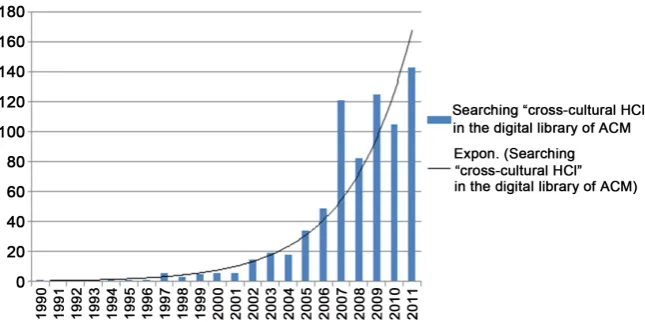
“Intercultural research in Information Systems is a relatively new research area that has gained increasing importance over the last few years [...]” ([27]: 17). Using the key words “cross-cultural HCI” when searching the ACM digital library reveals an exponential rise of publications in this area since 2000 (cf. Figure 1).
Figure 1. Approximating exponential rise of publications regarding cross-cultural HCI design in the ACM digital library.
troduction to the study of cross-cultural of HCI is [30] reviewing the research methodology, the technology transfer and the diffusion of innovation to shed light on the cross-cultural study of human-computer interaction. Another over-view of culture and its effects on HCI is given in [31]. There is also activity vestigating the trends in intercultural HCI (cf. [32]). A review of culture in in-formation systems research to postulate a shift to a theory of inin-formation tech-nology culture conflict is presented in [33]. The relationship between culture and computers can be illuminated by a re-view of the concept of culture and im-plications for intercultural collaborative online learning [34]. An overview of a decade of journal publications about culture and HCI can be found in [35].
From this, several “hypes” can be identified in this area. The first one hap-pened in the early 1990ies. The next one was around 2000 and since about 2010 research in intercultural HCI design has steadily increased. In these “hypes” the number of publications is high indicating high research interest and effort: Before 1990: almost no publications available relating “culture” and “HCI”. 1990-1999: pioneers [11] [29] [36] [37].
2000-2004: basic systematic work [1] [3] [18] [38] [39] [40] [41].
2005-2010: evaluating the new field and the systematic work [20] [42] [43]
[44] [45].
power supply). Adapting software to Unicode is an example of a precondition to process Asian languages at the language level. Adaptation at cultural level con-cerns country-specific aspects including format, currency, colors, modality, me- nu structure, content of the menu, help, number of messages, length of texts, number of hints, degree of entertainment or ratio of information to entertain-ment. At the highest level, cognitive styles that describe types of human thinking such as problem solving or making conclusions can be taken into account (cf. [52] [53]). These processes strongly effect not only the functionality and the user
interface of the product (i.e., monitor, keyboard, soft and hard keys, control
buttons, speech dialogs, within a graphical (GUI) or speech (SUI) user interface, etc.) but also interactive behavior. In cross-cultural HCI design cultural and cognitive aspects must be taken into account in addition to technical and lguistic aspects of localization, in any case. However, in industry, the usage of in-ternationalization concepts beyond the technological and language level has only recently been initiated (cf. e.g., [54] [55]). Thereby, it has been suggested how to cross-culturally implement information systems [56]. Today, in industry at least technical and linguistic aspects are taken into account in designing products for other cultures. In contrast, the academic approach is predominately concerned with cultural and cognitive aspects.
3. Results: Methodologies & Approaches for Converging
Divergences in Intercultural User Interface Design
To bridge the divergence represented by the gap in the knowledge of the differ-ences in intercultural HCI design, converging methods and approaches to re-duce this divergence are presented in the following.
3.1. Intercultural Variables and Method of
Culture-Centered Design
Intercultural variables describe the differences in HCI design regarding the pre-ferences of the users of different cultures [22]. “Intercultural” variables represent knowledge that can be obtained only by observing at least two cultures and their differences, i.e. doing intercultural research (cf. [57]) to obtain relevant know-ledge for internationalization of software and system platforms (cf. Table 1).
Table 1. Intercultural variables according to [22]: 97 et. seqq. (estimated values regarding the difficulty to recognize the variables are added by the author).
Intercultural
variable localization Level of HCI design Relation to of the variables Perceivability
Estimated difficulty to
recognize [0 (easy) - 10
(difficult)]
Dialog design Interaction Direct Hidden/Over long time and deep analysis 10
Interaction
design Interaction Direct Hidden/Over long time and deep analysis 9 System
functionality Function Indirect Visible/Immediately 8 Service
(Maintenance) Function Indirect Visible/Immediately 7 Technical
documentation Function Indirect Visible/Immediately 6 Information
presentation Surface Direct Visible/Immediately 4
Language Surface Direct Visible/Immediately 2
General system
design Surface Indirect Visible/Immediately 0
“visible” variables concerning surface levels and “hidden” variables affecting in-teraction levels, together mirroring the concept of the iceberg metaphor [22]. Both kinds of variables have strong influences on the design and determination of the usability and acceptance of the system. Visible intercultural variables con-cern presentation (colors, time and date format, icons, font size, window size, form, layout, widget position like the position of navigation bar) and language (font, direction of writing, naming) level of a product (appearing above “water surface” in the iceberg metaphor). They can be recognized very easily because they are directly accessible and less determined by cultural context. Non-visible or “hidden” intercultural variables (below the “water surface”) affect dialog de-sign (menu structure and complexity, changing of dialog form, layout, widget positions, information presentation speed, frequency of changing dialogs, screen transitions) and interaction design (navigation concept, system structure, inte-raction path, inteinte-raction speed, usage of navigation bar, etc.) which have strong correlations to the cultural context. These variables concern the interaction and dialog level of a product and need high research priority (e.g. using special tools as suggested by [58]). Cultural variables can be used to develop an approach for the design of intercultural human-machine systems using the “method of cul-ture-oriented design” (MCD) according to [22]: 108 as presented in Figure 2.
Figure 2. Simplified version of the Method of Culture-oriented Design (MCD) (Source:
[17]: 66).
3.2. User Interface Characteristics
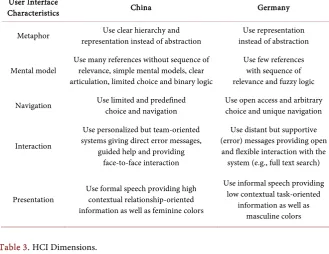
To make cultural dimensions available for user interface design, [18] developed characteristic factors for user interfaces and gives examples that can have an ef-fect on user interface design. The user interface characteristics “metaphor”, “mental model”, “navigation”, “interaction” and “presentation” are connected to the five cultural dimensions of Hofstede. However, Marcus used a purely deduc-tive approach to obtain these connections. Many possible recommendations for web design have been derived by [59] mainly from Hofstede’s knowledge with-out empirical foundation of all connections. Therefore, this formulated model still needs empirical validation (even if, meanwhile, there is some empirical work from Marcus himself, cf. [26]). For instance, according to [18] and [60], Chinese people (and hence users) are rather relationship and family oriented based on traditional powerful social hierarchical structures. In contrast, German users are described as event oriented regarding acts, tools, work, jobs and competition. Some tendencies regarding cultural differences can be used for the intercultural user interface design and further reflections and research. Table 2 shows a sum- mary of general recommendations for intercultural user interface design based on [22].
3.3. HCI Dimensions
Based on the work of [9] [61] [62] and own studies [17] [58] [63] [64] [65] [66], the author introduced the concept of HCI dimensions to support the determina-tion of the reladetermina-tionship between culture and HCI [17]. HCI dimensions (HCIDs) describe the “style of information processing” and the “interactional characteris-tics” of the user with the system. HCIDs are derived from the basic physical di-mensions of space and time as well as from their sub-didi-mensions frequency, speed, duration, density and order) (cf. Table 3).
HCIDs represent the characteristics of HCI by describing the HCI style of the user, i.e. the path of information processing and the interaction style exhibited
Theoretical Analysis
Empirical Analysis
Integration
MMS
Determine intercultural factors by analysing user culture
via cultural dimensions
Derive intercultural variables from
the cultural differences
found
Determine the values for the intercultural variables regarding the desired user culture by
user studies
Connect the variables to the human machine system by
system design
Table 2. Summary of recommendations for intercultural HCI design according to the user interface characteristics regarding China and Germany (summarized by the author in accordance to table 6-3 in [22]: 138 as well as to [22]: 305-317).
User Interface
Characteristics China Germany
Metaphor representation instead of abstraction Use clear hierarchy and instead of abstraction Use representation
Mental model Use many references without sequence of relevance, simple mental models, clear articulation, limited choice and binary logic
Use few references with sequence of relevance and fuzzy logic
Navigation Use limited and predefined choice and navigation Use open access and arbitrary choice and unique navigation
Interaction
Use personalized but team-oriented systems giving direct error messages,
guided help and providing face-to-face interaction
Use distant but supportive (error) messages providing open
and flexible interaction with the system (e.g., full text search)
Presentation Use formal speech providing high contextual relationship-oriented information as well as feminine colors
Use informal speech providing low contextual task-oriented
[image:9.595.208.538.121.375.2]information as well as masculine colors
Table 3. HCI Dimensions.
Derived physical sub-dimensions
[basic physical dimension] Information related HCI dimension Interaction related HCI dimension Frequency [Time] Information frequency Interaction frequency
Speed [Time] Information speed Interaction speed
Sequentiality/Priority/Order
[Time and Space] order/Information parallelism Information order/Interaction parallelism Interaction Density/Quantity [Time and
Space]/Context [Time and Space] Information density
by the user based on the concepts of “information” and “interaction” according to HCI dialogs that are characterized by transmitting pieces of information dur-ing user system interaction (cf. [67]).
Table 4. HCI Dimensions represented by Specifics and Indicators.
HCI dimension Specifics Indicator(s)
Interaction frequency Number of interactions per time unit Mouse clicks and mouse moves per second or per session
Information density Number of information units per space unit Numbe of words per message or on the display
Information/Interaction
parallelism/order Sequence of appearance of information units
Number and sequence of dialog steps (e.g. number of message boxes used to indicate one system error)
For example, the indicator “number of information units per space unit” be-longs to the HCI dimension “information density” and can be expressed by the number of words displayed on the screen. The HCI dimension “interaction fre-quency” contains the variable “number of interactions per time unit” represent- ed by the number of mouse clicks per second.
3.4. Usability Engineering
The usability of a system strongly depends on how the user can cope with the system. This knowledge can be obtained “simply” by ob-serving and asking the user during his interactions with the system. In this case the user articulates his desires and hence his needs regarding the usability of the system. This is trivial and easy, but unfortunately, this method is applied far too little in industrial HCI design even today. This is critical because, if that knowledge is missing in the fi-nal product, it will not be wanted by the user: the customer (user) cannot use it because important features are missing or it takes too long to do a certain task using this system because of wrong design.
The preconditions for intercultural usability engineering are knowledge about the cultural differences in HCI and its considerations in product design and
product realization (cf. [3] [63] [69]). In addition to the common
misunders-tandings between developers and users, which lead to different product design, there are also misunderstandings because of cultural conditions. There is not only a different comprehension of the requirements of the product but also cul-turally dependent perspectives and views of them (cf. [70]). Hence, the developer needs much intercultural knowledge to understand a user from another culture. Furthermore, he needs competency regarding intercultural communication to enable the exchange of information with the user and to know exactly which product the user is likely to have (cf. [71] [72]). With this in mind, [21] pre-sented an empirical study for the development of a framework for the elicitation of cultural influence in product usage to take into account culture and context in HCI design. [73] investigated the impact of culture and gender on web sites. [74] studied the influence of culture in global software engineering by thinking in terms of cultural models. [75] did an empirical study concerning the organiza-tional, cultural and technological use in a developing country.
good usability for users from different cultures [3]. The term “intercultural usa-bility engineering” is commonly used by German usausa-bility engineers [16]. “In-tercultural” in this context refers to the special methods that are necessary to do usability engineering for different cultures [57]. Bad or lacking intercultural usa-bility engineering within the development process of the product increases the development and maintenance costs through requests for change. Detailed anal-ysis of product requirements can save up to 80% of maintenance and imple-mentation costs of such requests for change [76]. Therefore, intercultural HCI design must already begin with the analysis of requirements before starting the design in order to avoid a reduction of the fit between user and product if prod-ucts of one culture are used in another (cf. [77] [78] [79]). At the collection of culture specific user requirements and culture specific assessment of the con-cepts used, it must be determined how far approved methods of usability engi-neering are suitable. The existing cultural models should be taken into account in the process of product design in the context of intercultural usability engi-neering. First, the product developers must be sensitized to the difficulties of cultural influences on product development and product use. Then cultural fac-tors influencing HCI must be provided to the developers and integrated into the product. Finally, the procedures, which serve to capture the knowledge acquired in concrete product design, must be institutionalized.
After the pioneer research of [79], several researchers have invested a great deal of effort to determine the best methods and settings to test the usability and user experience in cultural contexts. There is research to study cross cultural think-aloud usability testing to make some suggestions for an experimental
pa-radigm [42]. Moreover, usability constructs are investigated by doing a cross-
cultural study of how users and developers experience their use of information systems [80]. The differences in usability testing in three countries as well as the interaction design and usability from an Indian perspective was described by [81]. In addition, the influence of cultural background on non-verbal communi-cation in a usability testing situation was investigated [82] and [83] interpreted cross-cultural usability evaluation based on a case study of a hypermedia system for rare species management in Namibia. The situating media in the transfer of rural knowledge in Africa to enfranchise indigenous rural people is research by [84]. Most of these results of the mentioned research were discussed at a work-shop in the frame of the conference “Interact 2011” [46]. The results of the workshop on the international comprehension of usability the application of usability methods were published by [85]. Finally, there is the trend to work on methods to take cross-cultural differences into account in design in general [86].
few especially for driver navigation systems (e.g., [90]). Most studies concern the presentation of information on web pages (e.g., [91]-[98]). Even though there are already the first pragmatic guidelines for intercultural web design [59] or in-tercultural HCI design [1], there are none for inin-tercultural user interface design in specific domains such as driver navigation systems that could be used easily and effectively by HCI designers in this area. This is also supported by the over-view of [99] as well as [100] presenting many activities and models for intercul-tural website design. There are little insights regarding interactive design, as the overview of [45] regarding intercultural information design shows– even if, for a short time, there have also been studies examining stand-alone systems and ap-plications other than web apap-plications (e.g., [27] [89] [101] [102]).
The cultural influences on the values of visible cultural variables of HCI is proven empirically in the literature on internationalization and partly imple-mented in products (cf. [28] [103]) regarding surface level (presentation of in-formation, speech and general design of machine) and functional level (machine functions, service and technical documentation) of localization. Most of these studies concentrate on “visible” cultural variables such as colors (NASA stan-dard for colors (cf. [104] [105]), icons (use of pictorial or abstract icons, cf. [22]: 135), date and time, phone numbers and address formats, spelling, typography, reading and writing directions, sorting methods (cf. [106]: 23-24), extension of texts, text processing, number of characters (cf. [107]: 77) and multimedia [108]. Also the cultural prescription and user perception of information architecture for a culture centered website was contrasted by [109] by doing a case study on Muslim online users. It was asked by [110] why social media can cross seas but not nationalisms while doing a cross-cultural comparative study of user interface in social media. The proverb “talk is silver, silence is golden” in some cultural context was confirmed by [111] via a cross cultural study on the usage of pauses in speech. A cross-cultural evaluation of the facial expressions of avatars de-signed by Western designers was performed by [112]. In contrast, [113] concen-trated on cross-cultural differences and information systems developer values. In addition, [114] investigated culture and its effects on human interaction design with emphasis on cross-cultural perspectives between Korea and Japan. Hence, in the area of intercultural HCI design there is much research regarding the de-sign of cross-cultural web pages and research of international product dede-sign (cf. international workshops of internationalization of products and systems (IWIPS)) as well as many guidelines regarding the visible areas of graphic user interfaces for the internationalization and localization of software.
in-tercultural variables for HCI design. The investigation of cultural differences in the information seeking process by [115] also supported the path to guidelines that available on building IT architecture [116]. Regarding different kinds of
thinking, [117] proposed that the thought patterns of East Asians and
However, all these variables can still be regarded as an open field for research in intercultural HCI design because there is just so little empirical evidence for the results in this area. In this respect, much effort must still be invested to in-vestigate and consider hidden cultural variables in intercultural HCI design.
3.6. Models and Theories
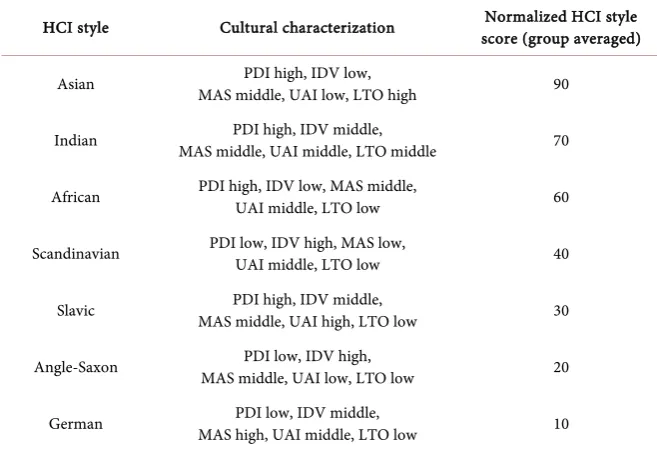
The cultural model (iceberg metaphor) as developed by [11] is relevant for in-ternational user interface design. The relationship of user interface characteris-tics to Hofstede’s cultural dimensions was elaborated by [122]. In contrast to [123], who generated a relationship model in cultural usability testing, [124] postulated a three-perspective model of culture, information systems and their development and use. Other authors based their approach on cultural models to study the relationship between culture and HCI. The influences of culture in global software engineering were analyzed by [74] via thinking in terms of cul-tural models. Based on the results of [17], the author formulated reflections on a preliminary model of culturally influenced human computer interaction to cover cultural contexts in HCI design which encompass the relationships between cultural and HCI dimensions. According to the results of an empirical study done by the author (cf. [44]), some of the correlations between the cultural di-mensions and the HCI didi-mensions as well as their values were determined (cf. [17]) leading to the concept of HCI style scores, which can be computed for the designated cultural group from the Hofstede’s indices. The HCI style score ex-presses the average degree of information density and frequency as well as inte-raction frequency and speed the members in the designated cultural group ex-pect according to the model developed by the author. For instance, the lower the normalized HCI style score (ranging from 0 to 100) the lower the expected amount of information and the lower the interaction frequency. The resulting HCI style scores permit the establishment of clusters of countries that have sim-ilar HCI scores. According to these cultural clusters identified in the HCI style score continuum it can be expected that these country clusters exhibit a similar HCI style because of their similar cultural characterization defined by power distance index (PDI), individualism index (IDV), masculinity (MAS), uncer-tainty avoidance index (UAI) and long term orientation (LTO) (cf. Table 5).
Table 5. HCI Styles around the world.
HCI style Cultural characterization score (group averaged) Normalized HCI style
Asian MAS middle, UAI low, LTO high PDI high, IDV low, 90
Indian MAS middle, UAI middle, LTO middle PDI high, IDV middle, 70
African PDI high, IDV low, MAS middle, UAI middle, LTO low 60
Scandinavian PDI low, IDV high, MAS low, UAI middle, LTO low 40
Slavic MAS middle, UAI high, LTO low PDI high, IDV middle, 30
Angle-Saxon MAS middle, UAI low, LTO low PDI low, IDV high, 20
German MAS high, UAI middle, LTO low PDI low, IDV middle, 10
applied to statistically calculate the corresponding loadings to the HCI style by clustering Hofstede’s indices according to their HCI style score. The findings should refine the currently assumed rules that describe the relationship between cultural imprint and HCI style of a group (with at least 20 members). The ex-planatory value of this descriptive model still must be worked out.
In addition to this model, there are several other approaches towards a theory of culturally influenced human computer interaction. An explanatory theory for using management information systems in the Chinese business culture was de-veloped by [126]. Moreover, [127] applied activity theory as a framework for accommodating cultural factors in HCI studies. Integrating activity theory into a usage-centered design approach is the method of [128] to cover environmental contexts, whereas [129] worked towards a HCI theory of cultural cognition. This systematic usage-centered design approach was extended by [130] o also cover cultural contexts by subjoining a cultural model as a new component. A theory of socio-technical interactions was outlined to explain culture by [131] integrat-ing theory, research and application to understand culture. Usintegrat-ing activity theory to tackle cultural contexts is very prominent (cf. [52] [128] [132]). ADA and CMU theory was compared in order to derive a theory for cultural usability [133]. However, until now, there is no final theory that would explain all rele-vant factors necessary to derive design recommendations for culture-centered HCI design. This still remains a task for the future.
3.7. Processes, Standards and Tools
team “quality standards” of the German UXPA (user experience professionals association) carved out a usability engineering process that can be extended by the necessary roles, tasks, methods, documents and work products, which are necessary to take cultural aspects into account and to fit them into any cultural contexts. A company culture audit was serves to improve development team’s collaboration, communication and cooperation [135]. The intercultural interac-tion analysis tool (IIA tool) was developed to determine the cultural differences in HCI at interaction level [58].
4. Discussion
4.1. Problems and Controversies in Converging Divergences
in Intercultural User Interface Design
4.1.1. Methodological Challenges
The methodological problem in researching culture is that the transmission of simple systems is easier than the integration of complex systems, which can only be achieved by human creativity [136]. This applies primarily to cultural ques-tions, which encompass and integrate the complete context of a member of a culture. This problem also confronts intercultural user interface design, which makes it compellingly necessary to deal with the combination or linkage of cul-ture with HCI design. Therefore, along with the common issues and challenges in HCI and in HCI design (cf. [137] [138]) and in the usability engineering process (cf. [139]), problems also arise because they must work in a cultural context (cf. [5] [21] [140] or [141]). Hence, the problems in adapting HCI to the cultural background of the user must be investigated [142]. Many aspects have to be taken into account simultaneously to obtain possible cultural explanations for their effect on HCI. Alternatively, the effects of culture on HCI cannot be ex-plained by only one single aspect but by many different influences due to the complexity of culture. Another problem in cultural research is that one cannot predict how the single parts of the cultural puzzle will fit together (cf. [136]: 130). This has implications for the use of these methods in intercultural HCI de-sign and intercultural usability engineering (cf. [143]).
4.1.2. Different Approaches
Furthermore, different approaches exist for determining intercultural variables and their values. For instance, cultural dimensions arise from cultural studies that can give insight into the diversity of cultures. From cultural dimensions, in-tercultural factors for HCI design can be derived. The results thus acquired are supported argumentatively and deductively, but not yet confirmed empirically
(cf. [59]: 5 et seq.). Furthermore, the connection between cultural dimensions
influ-ence of cultural markers on the performance of users interacting with the system and hence the connection between culture and usability (confirmed by studies from [37] [40] [41]). However, these results cannot be generalized to be valid for a complete country because the sample sizes are too small and the limited repre-sentativeness of the test persons precludes statistical results of high quality. This is one reason why there are few evident qualitative empirical studies and even fewer purely quantitative studies (cf. [146] as well as [147]) which treat the inte-raction of culturally different imprinted users with the system.
4.1.3. High Research Effort
Hidden variables are difficult to identify because they are only recognizable over time. Therefore, the reason for the lack of results regarding direct hidden inter-cultural variables at the interaction level is also grounded in the difficulty of ac-cessing and measuring them. To work against these methodological difficulties in studying hidden variables, it is reasonable, to a certain degree, to regard inte-raction and dialog design separately. First, the cultural differences in the tion between user and system must be investigated, and then, how the interac-tion affects informainterac-tion flow between user and system must be treated. Finally, how dialog windows should be designed for culturally different users also needs investigation, which should lead to preliminary design recommendations.
4.1.4. Lacking Empirical Confirmation
Not all recommendations have yet been proved empirically ac-cording to the five areas of user interface characteristics, even if there is some research in this area. Röse validated some of the aspects pointed out by Marcus doing qualitative studies in China regarding different layouts for Chinese and German users (cf. [148]). Moreover, regarding metaphors it is the case that in China hierarchical taxonomies and classifying instruments are applied rather than the case in Ger-many because of the high power distance values. Most of the recommendations presented must be tested and confirmed empirically in detail by additional stu-dies before being suggested as best practices or even useful guidelines, if not al-ready done so. Furthermore, parallel to the research literature, empirical inves-tigations regarding intercultural user interface characteristics are necessary, more specifically by comparing several systems of different cultures (benchmark tests) as well as usability evaluations (usability testing) to determine the usability of different systems.
4.1.5. Usage of Cultural Dimensions
presented by [151]: Power distance index (PDI) values for Japan, China and USA differ from those found by Hofstede. Furthermore, although much is said about what should be taken into account culturally, little empirical research is available on this topic as also pointed out, for instance, by [151]. In addition, a different behavior does not necessarily mean a different cultural (propositional) attitude, i.e. a different cognitive state in the web of belief. Restricted apprecia-tion and mediaapprecia-tion of cultural dimensions and models can lead to ineffective or even restricting action strategies [152]. In this case, a little cultural understand-ing proves to be just as bad as or even worse than no cultural understandunderstand-ing at all. Therefore, [152] pleads for dimension independent cultural models because they make the derivation of concrete behavior patterns possible whose explana-tions are founded on concrete manifestaexplana-tions of the culture described in contrast to models that use cultural dimensions. For instance, marrying CIIs with NLP principles as suggested by [17] means “cultural” adaptation at the individual lev-el. The criticism concerning the correctness of Hofstede’s cultural dimensions and their indices reduces confidence in them, which then implies that it is prob-ably better or at least advisable not to build an adaptive system based on these but on parameters that represent the immediate behavior of the user with the system.
On the other hand, supporters of Hofstede’s theory reject these moves away from Hofstede because numerous independent repetition studies in subsequent years confirmed Hofstede’s results. Moreover, Hofstede’s results referred to dif-ferent subgroups of the respective populations and nevertheless showed similar national differences, which agree with Hofstede’s dimension values. Further-more, Hofstede points particularly to the different levels of culture whilst dis-tancing himself from the list of questions (VSM) which was included with his explanations and designed for further use by the readers. According to [153] this is also because one of the consequences of his research and its results (and a starting point for criticism) is the “not reflected” appropriation and assignment of his cultural model which is seen as a useful tool for research (cf. [154]) and a useful starting point to research user interfaces in the cultural context (especially if a well founded theory is the designated goal of the research).
4.2. Research Directions in Converging the Divergence in
Intercultural User Interface Design
inter-national norms and develop tools that finally augment the interinter-national stan-dards of research covering arbitrary cultural contexts in HCI.
4.2.1. Reframing HCI through Indigenous Perspectives
“Reframing” means taking cultural aspects into account at the local level (cul-tural context/indigeniously) in addition to the national level. For the last years the research and literature accounting for cultural contexts in Human Computer Interaction (HCI) design have grown quickly (cf. [20] [155]). In addition, until recently, culture in HCI was considered a matter of internationalization or loca-lization [156]. As computer use spreads around the world, these traditional ap-proaches to culture and HCI have proven to be seriously insufficient apap-proaches. According to [21] and [69], successful intercultural HCI design goes far beyond a regular design process by taking into account different mentalities, thought patterns and problem solving strategies that are anchored in culture. Usage pat-terns differ from culture to culture according to different power structures [9], for example flat vs. hierarchical ones or problem solving strategies being linear vs. non-linear [148]. Hence, the designer must know exactly what the user needs or wants (e.g. why and in which context [71]). In addition, local designers must adapt general HCI methods to their needs (cf., [84] [85] [157]). Feasible recom-mendations and guidelines for the conception, design and evaluation of issues when implementing standard HCI perspectives in local contexts, as exemplified by German developers generating products for Chinese people, can be found in [70]. Related work on culture and HCI has been compiled along with [35] [85]
[158] and by the author [17]. Within culturally different groups one must also
consider dependence on context, situation and experience (cf. [84]). This know-ledge can be determined most precisely by using inquiry approaches or methods based on communication like interviews, focus groups or questionnaires [159]. For successful (intercultural) user interface design and (intercultural) usability engineering it is necessary that the developer understands the user [160], be-cause they have different points of view [161]. Only by taking the perspective of a user by the HCI designer into account in order to grasp their needs depending on their world view, general knowledge, context and purpose of usage can good user interfaces of high usability be achieved. Excellent user experience design should be the result (cf. [135] [162] [163] [164]). However, problems in inter-cultural communication ensuring empathic access to the user requirements in-hibit good usability for system design and the related user experience (cf. [5] [8]). This is because people and groups are shaped by many cultural systems, in-cluding religion, language and training as well as gender and life experience (cf.
[17] [18]) representing a certain “culture”, i.e. being a member of a group
representing the same cultural characteristics.
4.2.2. Recommendations and Solutions for Converging Divergence in Intercultural User Interface Design
well elaborated and comprehensible work products that end in complex but val-uable models, theories and tools for further and broader fruitful future research. For instance, the horizontal orientation of menus in layouts for the Chinese population was determined by [165]. A cross-cultural comparative study of us-ers’ perceptions of a webpage with the focus on the cognitive styles of Chinese, Koreans and Americans was done by [118]. Finally, [166] developed a cul-ture-sensitive image tagging interface. Another example presents [40] who con-ducted an exploratory study of cultural markers based on [167] to build a cultu-rally competent corporate multilingual web site. A pilot study in china was per-formed by [168] to clarify language issues in cross cultural usability testing. Fi-nally, the path to cross-cultural technology design by creating culture-sensitive technology for local users has been augmented by [169].
In any case, it is important to take cultural context into account in designing HCI. A cross-cultural study on knowledge sharing emerged that saving face and sharing personal information is appropriate depending on the situation [170]. A total of 197 Chinese undergraduate students and 111 American undergraduate students participated in the study. The first finding was that both Chinese and American students were more willing to share personal knowledge with in- group members than with out-group members. Furthermore, the results sho wed that common work experience between group members was more impor-tant than common national cultural background in determining a people’s atti-tude towards knowledge sharing. Another interesting finding was that Chinese participants were more willing to share personal information with an American stranger (out-group) than a Chinese stranger (in-group), while American par-ticipants showed no such difference. In summary, these findings indicate that a global organization should take both national culture and in-group/out-group factors into consideration to facilitate knowledge sharing.
In addition, personalization and adaptation to the different user needs is ne-cessary: “[...] Internet strategies should be localized or adjusted to unique cul-tures, since people want different values even from the same services across dif-ferent cultures. [...] Mobile Internet services need to be personalized to individu-al users because vindividu-alue structures and usage patterns are influenced by various factors across countries. To develop personalized services, mobile Internet ser-vice providers need to segment user groups by cultural, demographical, or socio- economic factors and monitor them, which may enable them to chase users’ fast changing needs or values efficiently” ([119]: 237).
5. Conclusion
inter-face design. This is especially the case with respect to the current lack of research regarding culturally imprinted interaction and dialog design based on empirical studies regarding hidden cultural variables. Even if the research concerning cul-ture-centered HCI design is growing enormously, it is the most important to in-tegrate the results from empirical studies considering cultural contexts in HCI design and thereby, provides the basis of both data to feed models and construct theories and the basis of the graduated measuring rod for their verification representing the path to get the convergent divergence in the field of intercul-tural user interface design. Even if there is still a long way to go, there are already converging strategies that have to be exploited and developed further to reduce the divergence in intercultural user interface design. One possible approach to this is to reframe HCI by taking cultural aspects into account at the local level (cultural context/indigenously) in addition to the national level up to the ap-proach of designing in the wild. These procedures can be supported by using a mix of IUID methods applying user interface characteristics, human computer interaction dimensions. It is a matter of future research to determine which combination of converged approaches, methods, processes and tools will survive and lead the research paradigm in order to reduce divergence in IUID.
References
[1] Röse, K. and Zühlke, D. (2001) Culture-Oriented Design: Developers’ Knowledge Gaps in this Area. In: Johannsen, G., Ed., 8th IFAC/IFIPS/IFORS/IEA Symposium on Analysis, Design, and Evaluation of Human-Machine Systems, Kassel,Septem- ber 18-20 2001, 11-16.
[2] Marcus, A. (2007) Global/Intercultural User-Interface Design. In: Jacko, J. and Spears, A., Eds., The Human-Computer Interaction Handbook, Lawrence Erlbaum Associates, Mahwah.
[3] Honold, P. (2000) Intercultural Usability Engineering: Barriers and Challenges from a German Point of View. In: Day, D., Galdo, E.D. and Prabhu, G.V., Eds., Designing for Global Markets: 2nd International Workshop on Internationalisation of Pro- ducts and Systems, 137-147.
[4] Heimgärtner, R. (2014) Intercultural User Interface Design. In: Blashki, K. and Isaias, P., Eds., Emerging Research and Trends in Interactivity and the Human- Computer Interface, Information Science Reference (an Imprint of IGI Global), Hershey, 1-33. https://doi.org/10.4018/978-1-4666-4623-0.ch001
[5] Heimgärtner, R., Tiede, L.-W. and Windl, H. (2011) Empathy as Key Factor for Successful Intercultural HCI Design. In: Marcus, A., Ed., Proceedings of 14th
International Conference on Human-Computer Interaction, Springer Ber-
lin/Heidelberg, 557-566. https://doi.org/10.1007/978-3-642-21708-1_62
[6] Chamberlain, A., Crabtree, A., Rodden, T., Jones, M. and Rogers, Y. (2012) Re- search in the Wild: Understanding in the Wild Approaches to Design and De- velopment. Proceedings of the Designing Interactive Systems Conference, New- castle Upon Tyne, 11-15 June 2012, 795-796.
https://doi.org/10.1145/2317956.2318078
[7] Schwartz, S.H. (1992) Universals in the Content and Structure of Values: Theo- retical Advances and Empirical Tests in 20 Countries. Advances in Experimental Social Psychology, 25, 1-65.
[9] Hofstede, G.H., Hofstede, G.J. and Minkov, M. (2010) Cultures and Organizations: Software of the Mind. McGraw-Hill, Maidenhead.
[10] Hofstede, G. (1984) Culture’s Consequences: International Differences in Work- Related Values. Sage, Beverly Hills, Calif.
[11] Hoft, N.L. (1996) Developing a Cultural Model. In: Del Galdo, E.M. and Nielsen, J., Eds., International Users Interface, John Wiley & Sons, Inc., 41-73.
[12] Thomas, A. (1996) Psychologie interkulturellen Handelns. Hogrefe, Göttingen; Seattle.
[13] Hodicová, R. (2007) Psychische Distanz und Internationalisierung von KMU: Empirische Untersuchung am Beispiel des Sächsisch-tschechischen Grenzraumes. Duv.
[14] Hofstede, G. (1994) VSM94: Values Survey Module 1994 Manual. IRIC, Tilberg, Netherlands.
[15] Röse, K., Liu, L. and Zühlke, D. (2001) Design Issues in Mainland China: Demands for a Localized Human-Machine-Interaction Design. In: Johannsen, G., Ed., 8th IFAC/IFIPS/IFORS/IEA Symposium on Analysis, Design, and Evaluation of Hu- man-Machine Systems, Preprints, Kassel, 17-22.
[16] Zühlke, D. (2004) Useware-Systeme für internationale Märkte. In: Useware- Engineering für technische Systeme, Springer, Berlin, Heidelberg, 142-164.
[17] Heimgärtner, R. (2012) Cultural Differences in Human-Computer Interaction. Oldenbourg Verlag.
[18] Marcus, A. (2001) Cross-Cultural User-Interface Design. In: Smith, M.J.S.G., Ed.,
Proceedings of the Conference on Human-Computer Interface Internat (HCII), Lawrence Erlbaum Associates, Mahwah, NJ, USA, 502-505.
[19] Rau, P.-L.P., Plocher, T. and Choong, Y.-Y. (2012) Cross-Cultural Design for IT Products and Services. Taylor & Francis, Boca Raton, FL.
[20] Shen, S.-T., Woolley, M. and Prior, S. (2006) Towards Culture-Centred Design.
Interacting with Computers, 18, 820-852.
[21] Honold, P. (2000) Culture and Context: An Empirical Study for the Development of a Framework for the Elicitation of Cultural Influence in Product Usage. Interna- tional Journal of Human-Computer Interaction, 12, 327-345.
https://doi.org/10.1080/10447318.2000.9669062
[22] Röse, K. (2002) Methodik zur Gestaltung interkultureller Mensch-Maschine- Systeme in der Produktionstechnik. Univ., Kaiserslautern.
[23] Vdma (2009) Software-Internationalisierung Leitfaden. VDMA Fachverband Soft- ware, Frankfurt a.M.
[24] DR. International (2003) Developing International Software.
[25] Schmitz, K.-D. and Wahle, K. (2000) Softwarelokalisierung. Stauffenburg-Verl., Tübingen.
[26] Marcus, A. (2006) Cross-Cultural User-Experience Design. In: Barker-Plummer, D., Cox, R. and Swoboda, N., Eds., Diagrammatic Representation and Inference, Springer Berlin Heidelberg, 16-24. https://doi.org/10.1007/11783183_4
[27] Kralisch, A. (2006) The Impact of Culture and Language on the Use of the Internet Empirical Analyses of Behaviour and Attitudes Berlin.
[28] Nielsen, J. (1990) Designing User Interfaces for International Use. Elsevier, Amster- dam.
[30] Day, D.L. (1991) The Cross-Cultural Study of Human-Computer Interaction: A Re- view of Research Methodology, Technology Transfer, and the Diffusion of Innova- tion.
[31] Cagiltay, K. (1999) Culture and Its Effects on Human-Computer-Interaction. In: Collis, B. and Oliver, R., Eds., Proceedings of World Conference on Educational Multimedia, Hypermedia and Telecommunications 1999, AACE, Chesapeake, VA, 1626-1626.
[32] Jetter, H.-C. (2004) Interkulturelles UI Design und UI Evaluation Universität Konstanz.
[33] Leidner, D.E. and Kayworth, T. (2006) Review: A Review of Culture in Information Systems Research: Toward a Theory of Information Technology Culture Conflict.
MIS Quarterly, 30, 357-399.
[34] Vatrapu, R. and Suthers, D. (2007) Culture and Computers: A Review of the Concept of Culture and Implications for Intercultural Collaborative Online learning. Lecture Notes in Computer Science: IWIC’07 Proceedings of the 1st Inter- national Conference on Intercultural Collaboration, Springer-Verlag Berlin, Heidel- berg, 260-275. https://doi.org/10.1007/978-3-540-74000-1_20
[35] Clemmensen, T. and Roese, K. (2010) An Overview of a Decade of Journal Publications about Culture and Human-Computer Interaction (HCI). Human Work Interaction Design: Usability in Social, Cultural and Organizational Contexts.
IFIP Advances in Information and Communication Technology, 316, 98-112.
https://doi.org/10.1007/978-3-642-11762-6_9
[36] Aykin, N. (2004) Usability and Internationalization of Information Technology Lawrence Erlbaum Associates Inc.
[37] Badre, A. and Barber, W. (1998) Culturabilty: The Merging of Culture and Usabilty.
Proceedings of the 4th Conference on Human Factors and the Web AT and T Labs, Basking Ridge, NJ, USA.
[38] Hermeking, M. (2001) Kulturen und Technik. Waxmann, München.
[39] Rößger, P. and Hofmeister, J. (2003) Cross Cultural Usability: An International Stu- dy on Driver Information Systems. Human-Computer Interaction.
[40] Sun, H. (2001) Building a Culturally Competent Corporate Web Site: An Explo- ratory Study of Cultural Markers in Multilingual Web Design. Proceedings of the
19th Annual International Conference on Computer Documentation, Sante Fe, 21- 24 October 2001, 95-102. https://doi.org/10.1145/501516.501536
[41] Vöhringer-Kuhnt, T. (2002) The Influence of Culture on Usability Freie Universität Berlin.
[42] Clemmensen, T. and Goyal, S. (2004) Studying cross cultural Think-Aloud Usability TESting—Some Suggestions for an Experimental Paradigm. In: Kjeldskov, J., Skov, M.B. and Stage, J., Eds., Proceedings of the Fourth Danish Human-Computer Inter- action Research Symposium, Centertryk, Aalborg University, Denmark, 16 Novem- ber 2004, 25-28.
[43] Reinecke, K., Reif, G. and Bernstein, A. (2007) Cultural User Modeling With CUMO: An Approach to Overcome the Personalization Bootstrapping Problem.
First International Workshop on Cultural Heritage on the Semantic Web at the 6th International Semantic Web Conference (ISWC 2007), Busan, South Korea.
[44] Heimgärtner, R. (2007) Cultural Differences in Human Computer Interaction: Results from Two Online Surveys. In: Osswald, A., Ed., Open Innovation, UVK, Konstanz, 145-158.
pendium Informationsdesign, Berlin, Heidelberg, 387-424.
https://doi.org/10.1007/978-3-540-69818-0_15
[46] Abdelnour-Nocera, J., Kurosu, M., Clemmensen, T., Bidwell, N., Vatrapu, R., Winschiers-Theophilus, H., Evers, V., Heimgärtner, R. and Yeo, A. (2011) Re- Framing HCI through Local and Indigenous Perspectives. In: Campos, P., Graham, N., Jorge, J., Nunes, N., Palanque, P. and Winckler, M., Eds., Lecture Notes in Com- puter Science. Springer-Verlag, Berlin; New York, 738-739.
https://doi.org/10.1007/978-3-642-23768-3_141
[47] Rau, P.-L.P., Plocher, T. and Choong, Y.-Y. (2012) International Usability Evaluation. In: Patrick Rau, P.-L., Plocher, T. and Choong, Y.-Y., Eds., Cross- Cultural Design for IT Products and Services, CRC Press, 191-200.
https://doi.org/10.1201/b12679-17
[48] Sun, H. (2012) Cross-Cultural Technology Design: Creating Culture-Sensitive Technology for Local Users. Oxford University Press, Oxford; New York.
[49] Lee, I., Choi, G.W., Kim, J., Kim, S., Lee, K., Kim, D., Han, M., Park, S.Y. and An, Y. (2008) Cultural Dimensions for User Experience: Cross-Country and Cross-Product Analysis of Users’ Cultural Characteristics. People and Computers, 1, 3-12.
[50] Sturm, C. (2002) TLCC-Towards a Framework for Systematic and Successful Pro- duct Internationalization. International Workshop on Internationalisation of Pro- ducts and Systems, Austin/Texas, USA.
[51] Esselink, B. (1998) A Practical Guide to Software Localization: For Translators, Engineers and Project Managers. Benjamins, Amsterdam.
[52] Nardi, B.A. (1996) Context and Consciousness: Activity Theory and Human- Computer Interaction. MIT Press, Cambridge, Mass.
[53] Norman, D.A. and Draper, S. (1986) User Centered System Design: New Perspec- tives on Human-Computer Interaction Lawrence Erlbaum Associates.
[54] Kersten, G.E., Kersten, M.A. and Rakowski, W.M. (2002) Software and Culture: Be- yond the Internationalization of the Interface. Journal of Global Information Ma- nagement, 10, 86-101. https://doi.org/10.4018/jgim.2002100105
[55] Aykin, N. (2005) Usability and Internationalization of Information Technology. Mahwah, NJErlbaum.
[56] Law, W.K. and Perez, K. (2005) Cross-Cultural Implementation of Information Sys- tem. Journal of Cases on Information Technology, 7, 121-130.
https://doi.org/10.4018/jcit.2005040108
[57] Honold, P. (1999) Cross-Cultural or Intercultural-Some Findings on International Usability Testing. In: Prabhu, G.V. and Del Galdo, E.M., Eds., First International Workshop on Internationalisation of Products and Systems (IWIPS 1999), New York, Backhouse Press, Rochester, 107-122.
[58] Heimgärtner, R. (2008) A Tool for Getting Cultural Differences in HCI. In: Asai, K., Ed., Human Computer Interaction: New Developments, InTech, Rijeka, 343-368.
https://doi.org/10.5772/5870
[59] Marcus, A. and Gould, E.W. (2000) Cultural Dimensions and Global Web User-Interface Design: What? So What? Now What?
[60] Röse, K., Liu, L. and Zühlke, D. (2001) Design Issues in Mainland China and Western Europe: Similarities and Differences in the Area of Human-Machine- Interaction Design. In: Smith, M.J. and Salvendy, G., Eds., Systems, Social and Internationalization Design Aspects of Human-Computer Interaction,CRC Press, Boca Raton, 532-536.
Approaches. Information Research, 10, 10-14.
[62] Hall, E.T. and Hall, M.R. (2004) Understanding Cultural Differences: [Germans, French and Americans]. Intercultural Press, Yarmouth, Me.
[63] Heimgärtner, R. (2005) Research in Progress: Towards Cross-Cultural Adaptive Human-Machine-Interaction in Automotive Navigation Systems. In: Day, D. and Del Galdo, E.M., Eds., Proceedings of the Seventh International Workshop on Internationalisation of Products and Systems (IWIPS 2005), Amsterdam, 97-111. [64] Heimgärtner, R. (2007) Measuring Cultural Differences in HCI as Preparatory
Work for Cultural Adaptability in Navigation Systems: Results from the Second Online Survey. In: Evers, V. and Mandl, C.S.A.M.A.M.R.A.E.C.M.I.A.T., Eds., Pro- ceedings of the Eighth International Workshop on Internationalisation of Products and Systems, Merida, 28-30 June 2007, Product & Systems Internationalisation, Inc., 43-54.
[65] Heimgärtner, R. (2013) Reflections on a Model of Culturally Influenced Human Computer Interaction to Cover Cultural Contexts in HCI Design. International Journal of Human-Computer Interaction, 29, 205-219.
[66] Heimgärtner, R. and Kindermann, H. (2012) Revealing Cultural Influences in Hu- man Computer Interaction by Analyzing Big Data in Interactions. In: Huang, R., Ghorbani, A., Pasi, G., Yamaguchi, T., Yen, N. and Jin, B., Eds., Active Media Tech- nology, Springer Berlin Heidelberg, 572-583.
https://doi.org/10.1007/978-3-642-35236-2_58
[67] Bernsen, N.O., Dybkjær, H. and Dybkjær, L. (1998) Designing Interactive Speech Systems. Springer, London.
[68] Preim, B. and Dachselt, R. (2010) Interaktive Systeme—Band I: Grundlagen, Gra- phical User Interfaces, Informationsvisualisierung. Springer Verlag, Berlin, Heidel- berg.
[69] Röse, K. (2002) Model of Culture and Their Applicability for Designing User Inter- faces. Proceedings of the Conference WWDU 2002—World Wide Work, Berch- tesgaden.
[70] Heimgärtner, R. and Tiede, L.W. (2008) Technik und Kultur: Interkulturelle Erfahrungen bei der Produktentwicklung für China. In: Rösch, O., Ed., Inter- kulturelle Kommunikation, Berlin, Verlag News & Media, 149-162.
[71] Holzinger, A. (2005) Usability Engineering for Software Developers. Communi- cations of the ACM, 48, 71-74. https://doi.org/10.1145/1039539.1039541
[72] Honold, P. (1999) Cross-Cultural Usability Engineering: Development and State of the Art. Proceedings of HCI International Conferenceon Human-Computer Inter- action: Ergonomics and User Interfaces, L. Erlbaum Associates Inc., 1232-1236. [73] Simon, S.J. (2000) The Impact of Culture and Gender on Web Sites: An Empirical
Study. SIGMIS Database, 32, 18-37. https://doi.org/10.1145/506740.506744
[74] Shah, H., Nersessian, N.J., Harrold, M.J. and Newstetter, W. (2012) Studying the Influence of Culture in Global Software Engineering: Thinking in Terms of Cultural Models. Proceedings of the 4th International Conference on Intercultural Colla- boration, Bengaluru, 21-23 March 2012, 77-86.
https://doi.org/10.1145/2160881.2160894
[75] Dasgupta, S. and Gupta, B. (2010) Organizational Culture and Technology Use in a Developing Country: An Empirical Study. Proceedings of SIG GlobDev Third Annual Workshop, Saint Louis, 12 December 2010.
ceedings of the IWSM/MetriKon Workshop on Software Metrics (IWSM/Metri- Kon’04), Königs Wusterhausen.
[77] Plocher, T. and Honold, P. (2000) Culturally-Adapted Product in the Global Mar- ket: Dealing with the Naysayers. Proceedings of the Paper Presented at the CHI
2000, The Hague.
[78] Beu, A., Honold, P. and Yuan, X. (2000) How to Build Up an Infrastructure for Intercultural Usability Engineering: Ease and Joy of Use for Complex Systems at Siemens. International Journal of Human-Computer Interaction, 12, 347-358.
https://doi.org/10.1080/10447318.2000.9669063
[79] Honold, P. (2000) Interkulturelles Usability Engineering: Eine Untersuchung zu kulturellen Einflüssen auf die Gestaltung und Nutzung technischer Produkte. VDI Verl., Düsseldorf.
[80] Clemmensen, T., Hertzum, M., Hornbæk, K., Kumar, J., Shi, Q. and Yammiyavar, P. (2007) Usability Constructs: A Cross-Cultural Study of How Users and Deve- lopers Experience Their Use of Information Systems.
[81] Clemmensen, T. (2010) A Comparison of What Is Part of Usability Testing in Three Countries. In: Katre, D., Orngreen, R., Yammiyavar, P. and Clemmensen, T., Eds.,
Human Work Interaction Design: Usability in Social, Cultural and Organizational Contexts, Springer Berlin Heidelberg, 31-45.
https://doi.org/10.1007/978-3-642-11762-6_3
[82] Yammiyavar, P., Clemmensen, T. and Kumar, J. (2008) Influence of Cultural Background on Non-Verbal Communication in a Usability Testing Situation. Inter- national Journal of Design, 2, 2.
[83] Paterson, B., Winschiers-Theophilus, H., Dunne, T.T., Schinzel, B. and Underhill, L.G. (2011) Interpretation of a Cross-Cultural Usability Evaluation: A Case Study Based on a Hypermedia System for Rare Species Management in Namibia. Inter- acting with Computers, 23, 239-246. https://doi.org/10.1016/j.intcom.2011.03.002
[84] Bidwell, N., Winschiers-Theophilus, H., Koch Kapuire, G. and Rehm, M. (2011) Pushing Personhood into Place: Situating Media in the Transfer of Rural Know- ledge in Africa. International Journal of Human-Computer Studies, 69, 618-631. [85] Röbig, S., Didier, M. and Bruder, R. (2010) Internationales Verständnis von Usabi-
lity sowie Methodenanwendung im Bereich der Usability. In Proceedings of the
Grundlagen-Methoden-Technologien, VDI Fachtagung USEWARE 2010 (Baden-
Baden 2010), 345-354.
[86] Dinet, J., Vivian, R. and Brangier, E. (2011) Towards Future Methods to Take into Account Cross-Cultural Differences in Design: An Example with the “Expert Com- munity Staff” (ECS). In: Marcus, A., Ed., Design, User Experience, and Usability.
Theory, Methods, Tools and Practice, Springer Berlin Heidelberg, 53-61.
https://doi.org/10.1007/978-3-642-21675-6_6
[87] Evers, V. (2003) Cross-Cultural Aspects of User Understanding and Behaviour: Evaluation of a Virtual Campus Website by User from North America, England, the Netherlands and Japan. In: Evers, V., Röse, K., Honold, P., Coronado, J. and Day, D., Eds., Proceedings of the 5th International Workshop on Internationalisation of Products and Systems (IWIPS 2003), University of Kaiserslautern, Berlin, 17-19 July 2003, 189-210.
Vorgehensmodell für die Konzeption einer Benutzermodellierungskomponente unter Berücksichtigung kulturbedingter Benutzereigenschaften Univ., Hildesheim, 293.
[90] Rössger, P. (2003) An International Comparison of the Usability of Driver- Information-Systems. In: Evers, V.R.K.H.P.C.J.D.D., Ed., Proceedings of the 5th International Workshop on Internationalisation of Products and Systems (IWIPS
2003), University of Kaiserslautern, Berlin, 17-19 July 2003, 129-134.
[91] Hodemacher, D., Jarman, F. and Mandl, T. (2005) Kultur und Web-Design: Ein empirischer Vergleich zwischen Großbritannien und Deutschland. In: Stary, C., Ed.,
Mensch & Computer 2005: Kunst und Wissenschaft-Grenzüberschreitungen der interaktiven ART, Oldenbourg Verlag, München, Wien, 93-101.
[92] Marcus, A. (2003) Global and Intercultural User Interface Design. The Human- Computer Interaction Handbook: Fundamentals, Evolving Technologies and Emerging Applications.
[93] Dormann, C. and Chisalita, C. (2002) Cultural Values in Web Site Design.
[94] Baumgartner, V.-J. (2003) A Practical Set of Cultural Dimensions for Global User- Interface Analysis and Design Fachhochschule Joanneum, Graz, Austria.
[95] Park, S.J. and Wiedenbeck, S. (2007) Global User-Interface Design: Characteristics of Multinational Corporate Websites Drexel University, College of Information Sci- ence and Technology.
[96] Stengers, H., Troyer, O., Baetens, M., Boers, F. and Mushtaha, A. (2004) Loca- lization of Web Sites: Is There Still a Need for It? International Workshop on Web Engineering (HyperText 2004 Conference), Santa Cruz.
[97] Sun, H. (2001) Building a Culturally-Competent Corporate Website: An Explo- ratory Study of Cultural Markers in Multilingual Web Design. Proceedings of the
19th Annual International Conference on Computer Documentation (ACM), Sante Fe, 95-102.
[98] Callahan, E. (2005) Cultural Similarities and Differences in the Design of University Web Sites. Journal of Computer-Mediated Communication, 11, 239-273.
https://doi.org/10.1111/j.1083-6101.2006.tb00312.x
[99] Sturm, C. and Mueller, C.H. (2003) Putting Theory into Practice: How to Apply Cross-Cultural Differences to User Interface Design? In: Rauterberg, M., Menozzi, M. and Wesson, J., Eds., Human-Computer Interaction: INTERACT‘03; IFIP TC13
International Conference on Human-Computer Interaction,1-5 September 2003, International Federation for Information Processing, 1051-1052.
[100]Fitzgerald, W. (2004) Models for Cross-Cultural Communications for Cross-Cul- tural Website Design.
[101]Lewandowitz, L., RÖSSGER, P. and Vöhringer-Kuhnt, T. (2006) Asiatische vs. europäische HMI Lösungen von Fahrerinformationssystemen. Useware 2006 VDI, Düsseldorf, 279-287.
[102]Braun, B.-M., Röse, K. and Rössger, P. (2007) Localizing for the Korean Market: Actually Being There with a Multi-Method Approach. In: Evers, V., Sturm, C., Alberto, M., Rocha, M., Cambranes Mart\Inez, E. and Mandl, T., Eds., Proceedings of the Eighth International Workshop on Internationalisation of Products and Systems, Merida, 28-30 June 2007, Product & Systems Internationalisation, Inc., 55-62.
![Table 1. Intercultural variables according to [22]: 97 et. seqq. (estimated values regarding the difficulty to recognize the variables are added by the author)](https://thumb-us.123doks.com/thumbv2/123dok_us/7776497.719587/7.595.211.539.102.363/intercultural-variables-according-estimated-regarding-difficulty-recognize-variables.webp)
![Figure 2. Simplified version of the Method of Culture-oriented Design (MCD) (Source: [17]: 66)](https://thumb-us.123doks.com/thumbv2/123dok_us/7776497.719587/8.595.210.538.62.243/figure-simplified-version-method-culture-oriented-design-source.webp)