Munich Personal RePEc Archive
Road pricing: An overview
M. Rouhani, Omid
Cornell University
3 November 2014
1
Road pricing: An overview
Omid M. Rouhani1
1 School of Civil and Environmental Engineering, Cornell University, Hollister Hall, Ithaca, NY 14853, USA; Email:
Abstract
This paper offers a general overview of the road pricing concept. It first examines the common objectives used in road pricing, namely (a) congestion reduction; (b) raising profits; (c) social welfare maximization; etc. Then, it explores various types of road pricing, including two major ones: (1) road tolls and (2) congestion pricing charges. Next, general modeling approaches used for estimating the impacts of road pricing are discussed. Finally, the paper concludes with a checklist explaining how to promote a successful road pricing scheme.
Keywords- road pricing, congestion pricing, congestion reduction, profit maximization, road tolls.
Introduction
According to Victoria Transport Institute (2014), “Road pricing means that motorists pay directly for driving on a particular road way or in a particular area.” Jones and Hervik (1992) defines road pricing as “policies that impose direct charges on road use”, regardless of the goals of the scheme or the targeted user groups. The goals of reducing congestion and/or revenue generation commonly drive the decision about road pricing. Transportation practitioners generally concur with this argument that road pricing is potentially an effective approach to provide a better transportation service, in particular to reduce traffic congestion (Anas and Lindsey, 2011; Li and Hensher, 2012). Value pricing concept emphasizes that road pricing can reduce congestion or improve operation and so offers co-benefits to drivers (Small and Yan, 2001).
Despite clear theory and knowledge about the potential benefits of road pricing, the implementation has been very limited (Santos et al., 2010). Several barriers constrained their implementation. The first and most important one is the political barrier (Richards, 2008). A strong and committed political will is required for such revolutionary policies. Policy makers are not willing to risk their jobs for a system that its success is not guaranteed. Public/private
agencies or local authorities operate RP schemes usually as part of their project funding packages. However, to implement an RP, the responsible agency should be approved by many levels of government (Victoria Transport Policy Institute, 2014).
2
would resist even the idea of road pricing (RP). Researchers, policy makers, and public officials should provide the vision for the public meanwhile promote the best practices for road pricing. Several methods/strategies can be used to provide a successful RP, but before digging into such strategies, we should learn that a successful RP scheme is very case specific, and a successful scheme for a region might not become a success elsewhere (Vonk Noordegraaf et al., 2014). RP schemes can be reinforced by a clear and informal policy which builds trust for the public, (1) by introducing flexibility in pricing that is very effective tool in reducing congestion, (2) by identifying the right goal (rather than maximizing revenue or minimizing congestion, the goal should be maximizing social welfare), (3) by developing detailed models that can estimate the outcomes of various design parameters such as toll rates and toll booth location, (4) by pursuing a complete systems approach not just considering a road or an area, (5) by investing in and strengthening environmental-friendly public transportation systems which incur less social costs on the society.
This paper offers an overview of the current knowledge about road pricing. We start the paper by exploring the major objectives of road pricing. Then, we introduce the various types of pricing. To estimate the benefits and costs of each RP design, researchers have used various modeling approaches. This is the topic of discussion in the next section. Finally, we provide a guideline about how a road pricing scheme should be implemented.
Objectives of Road Pricing
Two major objectives drive the decision about road pricing: (1) revenue generation, and (2) congestion management (Victoria Transport Policy Institute, 2014). However, several other objectives are pursued as well, including, (i) transportation-related emissions reduction, especially to meet conformity obligations (McCarthy et al., 2006; Rouhani and Niemeier, 2014b), (ii) social welfare maximization (Parry and Bento, 2002; Rouhani et al., 2014a), (iii) incentivizing the use of public transportation or mode shift (Rouhani and Niemeier, 2011), (iv) land use management, etc.
Policy makers should pursue the revenue generation objective for rural roads, roads that do not carry a very heavy demand, or road with possible alternatives. Despite this, there are numerous numbers of real-life RPs that are implemented on urban congested roads. To follow the revenue generation objective, practitioners try to maximize their profits (revenues minus costs) by setting generally high toll rates (Rouhani, 2009; Rouhani et al., 2013). Generally, revenues from this sort of RPs are dedicated to roadway projects, and in many cases it should be used only for the same toll road. Opposite to a social-welfare enhancing policy, mode shift is not desirable. However, in most profit-maximizing cases, the application of high unlimited tolls on few roads does not improve transportation system performance due to spillover effects onto highly congested roads (Safirova et al., 2007; Rouhani et al., 2014a).
3
on purposes other than facilitating road services since the objective to reduce congestion meanwhile not produce further derived demand.
As mentioned before, several other objectives can govern RPs; social welfare is one that should be considered. To appraise different RP projects or privatization projects, we need to measure the potential advantages and disadvantages of those projects. Government agencies evaluate P3 toll roads using Value for Money (VfM) analysis (Yuan et al., 2009) and apply cost/benefit analysis for congestion pricing schemes (Prud’homme and Bocarejo, 2005), but the most appropriate evaluation criterion should be overall social welfare (Boardman and Vining, 2012). VfM studies usually consider only project delivery costs; the benefits to users or
consumers are not usually included, and cost/benefit analyses generally lack the details required to examine impacts on a variety of stakeholders.
To measure social welfare, suppose the government considers whether or not to
implement an RP scheme. The social welfare gain or loss from the RP should be compared to a no-tolling alternative. In general, the change in total social welfare is the sum of the change in consumer surplus, producer surplus, government surplus, and employee surplus. All components are usually measured in present value (Boardman and Vining, 2010). A toll road should be implemented when it improves total social welfare relative to the no-tolling alternative (Rouhani et al., 2014a).
As we discussed above, the objective of RP is much broader than two commonly assumed objectives of congestion management and revenue generation. In addition, policy makers usually have more than single objective when devising an RP scheme. However, the objective of an RP is the major driver for the decision among various types of RP, various technologies, and various modeling approaches to be employed.
Closely associated with the objective, an RP can be done at various scales: Point: Charging users when passing a point such as a tunnel or a bridge Facility: Pricing a roadway section, e.g., per km base –entrance and exit Corridor: Pricing all roadways in a corridor
Cordon: Charging users when traveling on all roads in an area such as CBD The scale of pricing usually determines the preferred method of pricing. A variety of pricing methods can be used: (daily) passes, toll booths, electronic tolling, optical vehicle recognition, global positioning system (GPS) devices, video detection, etc. However, ever increasing advances in toll collection technologies facilitate the possibility of a more advance and less costly method; Electronic Toll Collection (ETC) in Singapore have provided the possibility of efficiently charging road users (Ukkusuri et al., 2008).
4 Types of RP
1) Road tolls
Road tolls are usually used as way to make revenue to fund road improvements as a part of transportation funding packages. The argument for tolling is based on a fee for the service provided. But especially for private operator cases, revenue making is the major driver of charging tolls (Rouhani, 2012). In this regard, mode or path shift would not be desirable. Road tolls are usually implemented at a point such as a bridge or a tunnel or at an entire (or parts of a) facility based on a per km basis. Bay area tolling bridges, tunnels and bridges in Hong Kong are examples of point pricing. Toll booths or electronic pricing are the methods used for pricing in these cases. State Route 91 express toll lanes in Orange County, CA and Highway 407 in Toronto are the prominent examples of facility pricing. A facility pricing usually needs electronic pricing using transponders or license plate photography or combination of them.
2) Congestion pricing
Congestion pricing is a way to reduce peak-period traffic volumes by charging users of a road network. Congestion pricing has been developed based on the notion that the users of roads, as public goods, should pay for the negative externalities they produce. Each additional user imposes a time cost burden on other users (travel time increases with more drivers). While the travel costs are largely borne by motorists collectively, there exists an externality; individual motorists increase the costs to other motorists (Anas and Lindsey, 2011).
The main idea involves charging users for this social cost (the difference between marginal social cost and marginal private cost) to reach a more efficient road usage (Vickrey, 1963; Walters, 1961). Providing a free-of-charge service, as is in the case with public roads, leads to more travel demand, which results in wasteful consumption and behavior of users. It also involves free rider problem, where (some) users benefit from consuming a good or service
without paying for it. The problem involves the overuse or degradation of goods and services and leads to underinvestment and consequently under-provision of the service (Block, 1983).
5
PANNEL: THE LONDON CONGESTION PRICING SCHEME
The London congestion pricing scheme was employed after a long history of research studies, and an interesting political process. The Review of Charging Options for London (ROCOL 2000) report recommended two alternatives for charging on the central London area: (1) an area licensing scheme based on video camera enforcement and (2) a workplace parking levy. After Ken Livingstone became the Mayor of London in 2000 and after an 18-month period of extensive public consultation, an area licensing congestion pricing scheme was chosen for central London in 2003 (Leape 2006).
Currently, a constant charge of £11 (first, it was £5 later increased to £8 and then to £10) must be paid for driving or parking within the congestion zone between 7:00 am and 6:30 pm on weekdays (Litman 2006). With an area of about 22 km2 (8 square miles),
6
Figure 1 A Map of the London Congestion Zone with Extended Areas Source: Transport for London (TFL) (2012).
For a general review on methods and technologies available for congestion pricing, refer to de Palma and Lindsey (2011).
3) Other types of road pricing
Other types of pricing include (a) Cordon (area) tolls, e.g., Trondheim, Norway toll ring (Ieromonachou et al., 2006), (b) High Occupancy Toll (HOT) lanes, e.g., Interstate15 in San Diego (Halvorson and Buckeye, 2006), (c) Distance-Based Charges such as mileage fees, e.g. tolls on trucks in Germany (Hensher and Puckett, 2007), Road Space Rationing, e.g., ration peak period vehicle-trips or vehicle-miles using a revenue-neutral credit-based system (Han et al, 2010), etc.
7
implemented. For example, a fixed road toll may do little to reduce congestion if alternative routes and modes are poor, but it may provide significant congestion reductions if transportation alternatives (such as ridesharing, transit and telecommuting) are relatively attractive. To review and study the welfare effects of various real-life RP cases, refer to Börjesson and Kristoffersson (2014).
Two General Modeling Approaches
The impact of RP depends on: (i) the type and magnitude of fees; (ii) the flexibility of pricing; (iii) where and when is applied; (iv) potential alternatives to driving; and (v) the no-pricing (natural) conditions. Many studies attempt to identify the preferable approaches/conditions for an RP. Comparing different methods of RP, May and Milne (2000) estimated that time-based provide the greatest social benefits, followed by distance-based, congestion (zonal) pricing, and cordon pricing. However, the success of an RP is basically dependent on the characteristics of the case under study, and the results from one study cannot be generalized to another; value of travel time and reliability (Brownstone and Small, 2005; Small, 2005), user group variations (Yang and Huang, 2004), and demand risk calculations (Ramjerdi and Fearnley, 2014), among many others are case specific. Reviewing six RP real case studies, Vonk Noordegraaf et al. (2014) found that only 26% of factors affecting implementation of RPs are generic and other factors like public acceptability (Schuitema et al., 2010) and equity (Levinson, 2010). result from particular features of the case study. This is the major reason that we need various models to predict the outcomes of a scheme both prior to its implementation and after its implementation.
Two types of toll charges exist: (1) congestion tolls to manage congestion, (2) private road tolls designed to raise profits. Considering these two types, this study focuses on the two general modelling approaches that researchers have used for their analysis: (1) aggregate market
equilibrium approach, (2) network analysis. The models could act as an optimization problem that usually attempts to find the rate, timing, and flexibility of tolls. The optimization problem is based on the objective functions we discussed in the objectives of road pricing section.
I) Optimal road usage analysis (Aggregate supply and demand)
Numerous studies have analyzed real-life congestion pricing schemes. These studies usually offer narrow modeling frameworks due to the complex nature of practical studies. As a
prominent example, Prud’homme and Bocarejo (2005) estimated demand and supply functions for the London congestion pricing scheme and determined the optimal road usage and the
optimal congestion toll for the congestion zone. They showed that the London congestion pricing is an economic failure despite its political success. Hamilton (2011) also indicated that the
8 (1) (2) (3) (4) (5) Olszewski and Xie (2005) modeled the effects of the pricing on traffic flows in Singapore. The study found that time-variable road pricing or ‘shoulder pricing’ method, increasing the charges before the peak and lowering them after, tends to transfer congestion to other periods and other routes and is an effective method of controlling congestion. Xie and Olszewski (2011) proposed a methodology for using the traffic data from the Singapore’s Electronic Road Pricing (EPR) system to forecast the short-term impacts of peak period traffic volume (trip rate) adjustments.
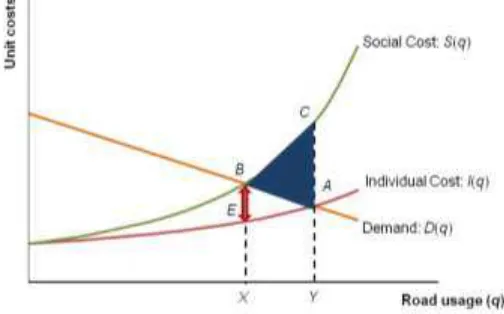
Figure 1 depicts a simple model of road usage. D(q) is the inverse demand for road usage in terms of the unit cost of using roads (costs per mile) and is a function of road usage (q). I(q) represents the unit individual cost (or marginal private cost) which is the per mile cost borne by a motorist. As road usage (q) increases, the travel time and consequently the average cost born by motorists, I(q), increases. The natural road usage is Y. The natural equilibrium is reached at point
A, where I(q) and D(q) intersect, in which the cost of driving is equal to the benefit of driving (Rouhani et al., 2014a):
D(q) = I(q)
An appropriate measure of social welfare (optimal) is the social welfare surplus
SW, defined as total social benefits (SB) minus total social costs (SC) of driving (Small and Verhoef, 2007). Total social benefits, SB, is the value of travel to all users measured by the area under the demand curve up to the equilibrium flow (q):
SB = ∫
Holding capacity fixed in the short run and excluding capital expenditures, we can determine total social costs (SC), as follows:
SC = I(q).q
where I(q) is the average variable cost function excluding tolls.
The natural equilibrium, A, is sub-optimal because of the difference between the marginal individual cost and the marginal social cost. Without any charges, the deadweight loss (DWL) or congestion cost of the triangle BCA is imposed on society. But we can reach the optimal road usage by imposing a tax or congestion charge of BE on road users, and avoid the DWL. To find the socially-optimal road usage, we should maximize social welfare (SB- SC) with respect to q, road usage. The necessary first-order condition is:
The intersection of the demand curve (D(q)) and the marginal social cost curve ( or
S(q)) determines the socially-optimal road usage. Imposing the optimal congestion tax (adding to the individual cost) will induce the optimal road usage. The gap between marginal social cost (S(q)) and individual cost (I(q)) would be filled by the congestion charge. Therefore, the external social cost (the optimal Pigouvian tax) is:
I(q) = I′(q
*).
q*
9
plus the cost of additional time spent by all other vehicles because one extra vehicle is on the road (time-based congestion externality or I′(q*). q*). The socially-optimal point is at B, where
[image:10.612.175.427.159.316.2]D(q) and S(q) intersect, and the socially-optimal road usage is X. For further discussion about the optimal road usage concept refer to McDonald et al. (1999) and Prud’homme and Bocarejo (2005).
Figure 2 Optimal road usage and congestion
The standard optimal road usage analysis generally ignores more complex issues (Rouhani et al., 2014c). For instance, the analysis excludes fuel and emissions externalities, assuming that these costs are either fixed or small relative to time costs (McCubbin, and Delucchi, 1999). Although the emissions and fuel costs are small under many conditions, their effects on the analysis could be substantial (Rouhani and Gao, 2014a).
In addition, the standard analysis considers the effects of charges only on the charge zone(s) (Rouhani and Gao, 2014b). However, we should take the spillover effects to all other parts of the system into account as well. Although researchers have extensively studied second-best pricing schemes, the effects of tolling a subset of links on a transportation network (Verhoef et al., 1996; Zhang and Ge, 2004; Verhoef, 2007), in the context of zone-based congestion pricing, a proper model to account such spillover effects has not been formulated in detail.
Another common setback of the optimal road usage analysis is that travel demand and congestion charge are usually estimated daily, instead of breaking the analysis into shorter periods with different demand characteristics. As a result, for empirical case studies e.g., the London congestion zone (Leape, 2006), only a fixed daily charge has been applied. This would in turn lead to sub-optimal charges for peak periods and super-optimal charges for off-peak periods. Accordingly, instead of minimizing (or lowering) the DWL of both peak and off-peak periods, a single daily charge leads to DWLs in both periods even though a single but optimal “daily” charge has been applied.
10
Pigou (1920) sets up the theory of congestion pricing. The theory show that to maximize the social net benefit a marginal cost pricing should be charged from all links (roads) of a transportation network, or what is called first-based pricing; the marginal cost tolls equal the difference between the marginal social cost and the marginal private cost of driving. Although many studies have shown the validity of marginal cost pricing theory under various conditions (see e.g., Yang, 1999), these prices are not practically possible because of very high costs of collecting tolls from all road segments (the entire network) and because of political resistance. Therefore, many researchers turned their attention to second-best pricing, where toll charges are levied only on a subset of roads (Verhoef, 2007). This problem or versions of this problem are called toll design problem, which is a subcategory of network design problems (Poorzahedy and Rouhani, 2007).
The literature around private road pricing is negligible relative to those of congestion pricing although the practice of private pricing is no less prevalent than that of congestion pricing, especially in the US. Theoretical modelling of private road pricing has analysed the effects of duopoly and monopoly structures (Zhang, 2008; Winston and Yan, 2011; Rouhani et al., 2013), the effects of traffic diversion to secondary roads (Swan and Belzer, 2010), the
interrelationships between pricing, capacity, and financing/investment (Verhoef and Rouwendal, 2004; Zhang, 2008), and impacts of alternative privatization structures and regulations (Yang and Meng, 2000; Tan et al. 2010; Zhang and Yusufzyanova, 2012).
The profit maximization model can be extended by considering more than one profit -maximizing firm. This more complex model must make an assumption about firm interactions. Considering the Bertrand-Nash (B-N) equilibrium based on non-cooperative behaviour, Rouhani et al. (2013) used demand analysis and game theory concepts to model the effects of including a few concession projects on a number of system performance measures. Most studies have focused mainly on system travel time on a few selected roads only. None have developed a detailed analysis of a range of welfare components in P3 implementation.
Generally, the policy makers problem is simulated by a bi-level or multi-level
programming model: road owners’ decision to charge a toll rate(s) (on a subset of roads) at the upper level model and the travel behavior of transportation network users at the lower level of the model (Rouhani and Niemeier, 2011; Rouhani et al., 2013).
Prior to formulating and solving a toll design problem, we should modify an existing transportation planning (travel demand) model through including multi-user (Chen and Bernstein, 2004) and calibrating endogenous travel demand elasticities. The modification is necessary since origin/destination (O/D) demand should not be assumed fixed; some studies assumed a fixed demand which is plain wring for toll design problems that significantly affect travel costs of driving (see e.g., Yang and Lam, 1996). The employed benchmark modelling could be improved by using multi-user equilibrium (Yang and Huang, 2004) and considering heterogeneity in VOT of users (Small, 2012), more detailed analysis of travel demand
11
system cost minimization (Rouhani et al., 2014a). Other important extensions to the common models include time-varying congestion pricing (Arnott et al., 1993; de Palma et al., 2005), general system cost minimization and spatial variation in tolls (Rouhani and Niemeier, 2014a).
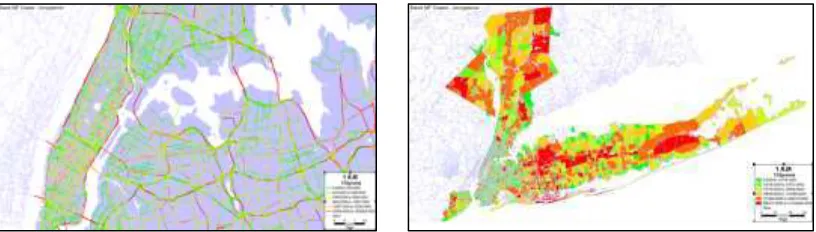
In any format, the toll design problem is a very complex problem to solve for a large metropolitan area with so many road links and transportation modes (Madani et al., 2014). Transportation network of a major urban area may consist of thousand links, and million O/D demand pairs. Figure 3 show the network of New York City with only major links of the
[image:12.612.103.511.238.354.2]network. To make it brief on the complexity of a real life toll design problem, we conclude with this fact that the travel demand model of such urban areas will take several hours to run.
Figure 3. Hourly traffic (left) and emissions level (right) estimates in NYC using BPM/MOVES, NYC’s travel demand model (User’s Guide for the NYBPM 2G, 2012)
12
[image:13.612.73.552.83.294.2]a) Off-peak b) AM-peak.
Figure 4 Socially optimal prices for Fresno, CA (Rouhani et al., 2013)
Conclusion
Designing a road pricing scheme, policy makers should address and take several important issues into account. One of the most important issues around the RP concept is how economists
approach this. Economists generally assume that RP increase user’s costs but these are economic transfers (e.g., see Prud’homme and Bocarejo, 2005). Users pay for it, but the government receives it. So the payments are offset by the revenue to the government. Economists only concern with the approach that revenues are used, and how toll rates should be set. But this ideal assumption is not valid in real examples. The first reason against this is that the transaction costs (capital and operation) of toll collection should be considered in the analysis. Even with the inclusion of transaction costs, this simplifying assumption is not valid for social welfare analysis for two reasons: First, knowing that all residents do not use road, the weights of different
stakeholders should be assumed different, e.g., the benefits to residents (through spending the toll revenue in the area) might be assigned a greater weight relative to the costs to users (based on the amount of toll paid). Second, the benefits and costs of users from outside the region (the amount of tolls they pay) should not be counted since the revenues will most likely be used locally (Rouhani et al., 2014a).
13
transaction for more costly publiclyrun systems. The difference in these numbers exist despite the fact that some studies have shown that private provision does not systematically result in lower costs (Bel and Warner, 2008; Bel et al., 2010). Nevertheless, scale or learning economies that cannot be reached by government could ensure lower unit costs of private services (De Bettignies and Ross, 2004). Considering a 30-year payback period and a 6% discount rate, the annual average capital cost of toll collection systems are $1.2 million per mile ($0.75 million per km) for highways and $1.5 million per mile per mile ($0.93 million per km) for arterials since arterials have a greater number of access points.
Opposition and distrust from the public is another concern for RP schemes. Residents fear that an RP will be implemented to increase government revenue and see it as “double taxation” (Rufolo and Kimpel, 2008). Another reason is the “free rider” problem. Average users will be worse-off without any redistribution (Kockelman, Kalmanje, 2005) since with an RP, they force to pay in order to use roads while roads are usually free of charge. However, radical policies like RP schemes require strong, committed, and stable leadership (Richards, 2008).
Copyright Note
14 References
Anas, A., & Lindsey, R., (2011). Reducing urban road transportation externalities: Road pricing in theory and in practice. Review of Environmental Economics and Policy, req019.
Arnott, R., De Palma, A., & Lindsey, R., (1993). A structural model of peak-period congestion: A traffic bottleneck with elastic demand. The American Economic Review, 161-179.
Balducci, P., Shao, G., Amos, A., & Rufolo, A., (2011). Costs of alternative revenue-generation systems. National Cooperative Highway Research Program-NCHRP REPORT 689, ISBN 978-0-309-21316-5.
Bel, G., & Warner, M., (2008). Does privatization of solid waste and water services reduce costs? A Review of Empirical Studies. Resources, Conservation & Recycling, 52(12), 1337–1348.
Bel, G., Fageda, X., & Warner, M., (2010). Is private production of public services cheaper than public production? A meta-regression analysis of solid waste and water services. Journal of Policy Analysis and Management, 29(3), 553–577.
Block, W., (1983). Public goods and externalities: The case of roads. Journal of Libertarian Studies, 7(1), 1-34.
Boardman, A., & Vining, A. R., (2010). Assessing the economic worth of public-private
partnerships. International Handbook on Public-Private Partnerships, Cheltenham, UK: Edward Elgar, pp. 159-186.
Boardman, A. E., & Vining, A. R., (2012). The political economy of public-private partnerships and analysis of their social value. Annals of Public and Cooperative Economics, 83(2), 117–141.
Börjesson, M., & Kristoffersson, I., (2014). Assessing the welfare effects of congestion charges in a real world setting. Transportation Research Part E: Logistics and Transportation Review, 70, 339-355.
Brownstone, D., & Small, K. A., (2005). Valuing time and reliability: assessing the evidence from road pricing demonstrations. Transportation Research Part A: Policy and Practice, 39(4), 279-293.
Chen, M., & Bernstein, D. H., (2004). Solving the toll design problem with multiple user groups. Transportation Research Part B: Methodological, 38(1), 61-79.
Chen, A., & Subprasom, K., (2007). Analysis of regulation and policy of private toll roads in a build-operate-transfer scheme under demand uncertainty. Transportation Research Part A, 41(6), 537-558.
de Bettignies, J. E., & Ross, T. W., (2004).The economics of public-private partnerships. Canadian Public Policy/Analyse de Politiques, (2004), 135-154.
de Palma, A., Kilani, M., & Lindsey, R., (2005). Congestion pricing on a road network: a study using the dynamic equilibrium simulator METROPOLIS. Transportation Research Part A: Policy and
Practice, 39(7), 588-611.
de Palma, A., & Lindsey, R., (2011). Traffic congestion pricing methodologies and technologies.
15
Eliasson, J., (2008). Lessons from the Stockholm congestion charging trial. Transport Policy, 15(6), 395-404.
Eliasson, J., (2009). A cost–benefit analysis of the Stockholm congestion charging system.
Transportation Research Part A: Policy and Practice, 43(4), 468-480.
Eliasson, J., & Mattsson, L. G., (2006). Equity effects of congestion pricing: quantitative methodology and a case study for Stockholm. Transportation Research Part A: Policy and Practice, 40(7), 602-620.
Hamilton, J., (2011). Revisiting the cost of the Stockholm congestion charging system. Transport Policy, 18(6), 836–847.
Halvorson, R., & Buckeye, K. R., (2006). High-occupancy toll lane innovations: I-394 MnPASS. Public Works Management & Policy, 10 (3), 242-255.
Han, D., Yang, H., & Wang, X., (2010). Efficiency of the plate-number-based traffic rationing in general networks. Transportation Research Part E: Logistics and Transportation Review, 46 (6), 1095-1110.
Hensher, D. A., & Puckett, S. M., (2007). Congestion and variable user charging as an effective travel demand management instrument. Transportation Research Part A: Policy and Practice, 41 (7), 615-626.
Ieromonachou, P., Potter, S., & Warren, J. P., (2006). Norway's urban toll rings: Evolving towards congestion charging? Transport Policy, 13(5), 367-378.
Jin, X. H., & Zhang, G., (2011). Modelling optimal risk allocation in PPP Projects using artificial neural networks. International journal of project management, 29(5), 591–603.
Jones, P., & Hervik, A., (1992). Restraining car traffic in European cities: an emerging role for road pricing. Transportation Research Part A: Policy and Practice, 26(2), 133-145.
Kockelman, K. M., & Kalmanje, S., (2005). Credit-based congestion pricing: A policy proposal and the
public’s response.Transportation Research Part A, 39(7), 671–690.
Leape, J., (2006). The London Congestion Charge. The Journal of Economic Perspectives, 20 (4): 157-176.
Levinson, D., (2010). Equity effects of road pricing: A review. Transport Reviews, 30(1), 33-57.
Li, Z., & Hensher, D. A., (2012). Congestion charging and car use: A review of stated preference and opinion studies and market monitoring evidence. Transport Policy, 20, 47-61.
Madani, K., Rouhani, O. M., Mirchi, A., & Gholizadeh, S., (2014). A negotiation support system for resolving an international trans-boundary natural resource conflict. Environmental Modelling & Software, 51, 240-249.
16
McCarthy, M. C., Eisinger, D. S., Hafner, H. R., Chinkin, L. R., Roberts, P. T., Black, K. N., & Winer, A. M., (2006). Particulate matter: a strategic vision for transportation-related research. Environmental science & technology, 40(18), 5593-5599.
McCubbin, D. R., & Delucchi, M. A., (1999). The health costs of motor-vehicle related air pollution.
Journal of Transport Economics and Policy, 33(3), 253–286.
McDonald, J. F., d’Ouville, E.L., & Nan Liu, L. (ed.), (1999). Economics of Urban Highway Congestion
and Pricing. Kluwer, Boston.
Olszewski, P., & Xie, L., (2005). Modelling the effects of road pricing on traffic in Singapore.
Transportation Research Part A, 39(7-9), 755–772.
Parry, I. W. H., & Bento, A. M., (2002). Estimating the welfare effect of congestion taxes: The critical importance of other distortions within the transport system. Journal of Urban Economics, 51 (2), 339– 365.
Pigou, A.C. (ed.), (1920). The economics of welfare. Macmillan and Co., London.
Poorzahedy, H., & Rouhani, O. M., (2007). Hybrid meta-heuristic algorithms for solving transportation network design. European Journal of Operational Research, 182(2), 578–596.
Prud’homme, R., & Bocarejo, J. P., (2005). The London congestion charge: A tentative economic
appraisal. Transport Policy, 12(3), 279–287.
Ramjerdi, F., & Fearnley, N., (2014). Risk and irreversibility of transport interventions. Transportation Research Part A: Policy and Practice, 60, 31-39.
Richards, M. G., (2008). Congestion charging: An idea whose time has come—but not yet, at least not in England. Transportation Research Record: Journal of the Transportation Research Board, 2079(1), 21-28.
Rouhani O. M., (2009). Road privatization and sustainability. MIT Journal of Planning,6, 82-105.
Rouhani, O. M., (2010). Gas Consumption Information: A Substitute for Congestion Pricing?. In the Proceedings of the Transportation Research Forum, 51st Annual Forum, Arlington, Virginia, USA.
Rouhani, O. M., (2012). Frameworks for Public-Private Partnerships. Ph.D. dissertation, University Of California, Davis.
Rouhani, O. M., (2013). Clean Development Mechanism: An appropriate Approach to reduce Greenhouse Gas Emissions from Transportation? Transportation Research Board 2013 92, No. 13-3195.
Rouhani, O.M., & Niemeier, D., (2011). Urban network privatization: A small network example.
17
Rouhani, O. M., & Gao, H. O., (2014a). An advanced traveler general information system for Fresno, California. Transportation Research Part A: Policy and Practice, 67, 254-267.
Rouhani, O.M., & Gao, O., (2014b). Implications of Fuel and Emissions Externalities, Spillovers to Outside, and Temporal Variations on Zonal Congestion Pricing Schemes. Working paper.
Rouhani, O. M., Madani, K., & Gholizadeh, S., (2010). Caspian Sea negotiation support system.
In Proceeding of the 2010 world environmental and water resources congress, ASCE, Providence, Rhode Island (pp. 2694-2702).
Rouhani, O.M., & Niemeier, D., (2014a). Flat versus spatially variable tolling: A case study of Fresno, California. Journal of Transport Geography, 37, 10–18.
Rouhani, O. M., & Niemeier, D., (2014b). Resolving the property right of transportation emissions through public–private partnerships. Transportation Research Part D, 31, 48–60.
Rouhani, O.M., Niemeier, D., Knittel, C. R., & Madani, K., (2013). Integrated modeling framework for leasing urban roads: A case study of Fresno, California. Transportation Research Part B, 48(1), 17–30.
Rouhani, OM, Gao, HO, Geddes, R, Bel, G, & Zarei, H, (2014a). Social Welfare Analysis for Alternative Investment Public-Private Partnership Approaches. Lecture presentation in the 2014 Transportation Research Board conference, Washington D.C.
Rouhani, O.M., Gao, O., & Geddes, R. R., (2014b). Policy lessons for regulating public-private partnership tolling schemes in urban environments. Poster presentation in the 2014 Transportation Research Board conference, Washington D.C.
Rouhani, O.M., Knittel, C., & Niemeier, D., (2014c). Road Supply in London: Addition of an Ignored Social Cost. Journal of Transportation Research Forum, 53 (1), 49–64.
Rufolo, A. M., & Kimpel, T. J., (2008). Responses to Oregon's experiment in road
Pricing. Transportation Research Record: Journal of the Transportation Research Board, 2079 (1), 1-7.
Safirova, E., Gillingham, K., & Houde, S., (2007). Measuring marginal congestion costs of urban transportation: Do networks matter? Transportation Research Part A, 41, 734–749.
Santos, G., Behrendt, H., Maconi, L., Shirvani, T., & Teytelboym, A., (2010). Part I: Externalities and economic policies in road transport. Research in Transportation Economics, 28(1), 2-45.
Schuitema, G., Steg, L., & Forward, S., (2010). Explaining differences in acceptability before and acceptance after the implementation of a congestion charge in Stockholm. Transportation Research Part A: Policy and Practice, 44(2), 99-109.
Small, K., (2012). Valuation of travel time. Economics of Transportation, 1(1-2), 2–14.
18
Swan, P. F., & Belzer, M. H., (2010). Empirical evidence of toll road traffic diversion and implications for highway infrastructure privatization. Public Works Management and Policy, 14(4), 351–373.
Tan, Z., Yang, H., & Gu, X., (2010). Properties of Pareto-efficient contracts and regulations for road franchising. Transportation Research Part B, 44(4), 415–433.
Transport for London (TFL), (2007). Central London Congestion Charging: Impacts Monitoring. Fifth Annual Report, 2007, July 2007, Available on-line at:
http://www.tfl.gov.uk/assets/downloads/fifth-annual-impacts-monitoring-report-2007-07-07.pdf , accessed September 2011.
Transport for London (TFL) website. Available on-line at www.tfl.gov.uk/, accessed June 2012
Ukkusuri, S. V., Karoonsoontawong, A., Waller, S. T., & Kockelman, K. M., (2008). Congestion pricing technologies: a comparative evaluation. New Transportation Research Progress, 121-142.
User’s Guide for the NYBPM 2G Model, (2012). in TransCAD 6.0. Caliper Corporation, Edited by
NYMTC staff.
Vonk Noordegraaf, D., Annema, J. A., & Van Wee, B., (2014). Policy implementation lessons from six road pricing cases. Transportation Research Part A: Policy and Practice, 59, 172-191.
Verhoef, E., Nijkamp, P., & Rietveld, P., (1996). Second-best congestion pricing: the case of an untolled alternative. Journal of Urban Economics, 40(3), 279-302.
Verhoef, E.T., (2007). Second-best road pricing through highway franchising. Journal of Urban Economics, 62 (2), 337–361.
Verhoef, E. T., & Rouwendal, J., (2004). Pricing, capacity choice, and financing in transportation networks. Journal of Regional Science, 44(3), 405-435.
Vickrey, W. S., (1963). Pricing in urban and suburban transport. The American Economic Review, 452-465.
Victoria Transport Policy Institute, (2014), TDM Encyclopedia: Road Pricing-Congestion Pricing, Value Pricing, Toll Roads and HOT Lanes. Available from:
http://www.vtpi.org/tdm/tdm35.htm
Walters, A. A., (1968). The economics of road user charges. Johns Hopkins University Press.
Winston, C., & Yan, J., (2011). Can privatization of U.S. highways improve motorists' welfare? Journal of Public Economics, 95(7-8), 993–1005.
Xie, L., & Olszewski, P., (2011). Modelling the effects of road pricing on traffic using ERP traffic data.
Transportation Research Part A, 45(6), 512-522.
19
Yang, H., & Huang, H. J., (2004). The multi-class, multi-criteria traffic network equilibrium and systems optimum problem. Transportation Research Part B, 38(1), 1–15.
Yang, H., & Meng, Q., (2000). Highway pricing and capacity choice in a road network under a build– operate–transfer scheme. Transportation Research Part A, 34(3), 207–222.
Yan, H., & Lam, W. H., (1996). Optimal road tolls under conditions of queueing and congestion. Transportation Research Part A: Policy and Practice, 30(5), 319-332.
Yuan, J., Zeng, A. Y., Skibniewski, M. J., & Li, Q., (2009). Selection of performance objectives and key performance indicators in public–private partnership projects to achieve value for money. Construction Management and Economics, 27 (3), 253–270.
Zhang, H.M., & Ge, Y.E., (2004). Modeling Variable Demand Equilibrium under Second-best Road Pricing. Transportation Research Part B, 38, 733–749.
Zhang, L. (2008). Welfare and financial implications of unleashing private-sector investment resources on transportation networks. Transportation Research Record, 2079, 96–108.
Zhang, X., (2014). Editorial: Optimisation methods of road pricing. EJTIR, 14(1), 1-6.