Munich Personal RePEc Archive
What Do Parties Do in Congress?
Explaining the Allocation of Legislative
Specialization
Ponce, Aldo F
Centro de Investigación y Docencia Económicas (CIDE)
4 April 2013
Online at
https://mpra.ub.uni-muenchen.de/46573/
1
What Do Parties Do in Congress? Explaining the Allocation of Legislative Specialization1
Aldo F. Ponce
Centro de Investigación y Docencia Económicas (CIDE)
2
What Do Parties Do in Congress? Explaining the Allocation of Legislative Specialization
Overview
This article studies the determinants of the concentration of legislative specialization of parties
across policy jurisdictions. Greater concentration of legislative specialization leads parties to
concentrate their legislative efforts on a smaller set of policy jurisdictions. Through enhancing
their concentration of legislative specialization in certain policy areas, parties can more clearly
signal their policy concerns and interests to voters.
Previous studies argue that delegation of legislative functions to committees in charge of
specific policy jurisdictions occur because of three reasons. First, under the informational
perspective legislative majorities delegate prerogatives to committees because they need
expertise and greater information on certain policy jurisdictions (Gilligan and Krehbiel 1987,
1989; Krehbiel 1991). As members of these specialized committees share their policy expertise,
legislatures accomplish collective benefits from specialization (Krehbiel 1991). Second, under
the distributional perspective, special privileges are granted to committees to solve the problem
of majority rule instability and to facilitate log rolls (Baron and Ferejohn 1989; Weingast and
Marshall 1988). Third, partisan theories contend that delegation to committees occurs to
strengthen the control of party leaders over the legislative agenda (Cox and McCubbins 1993;
Rohde 1991). Although these approaches offer convincing explanations on why legislative
specialization occurs through the delegation of rights and prerogatives to committees, there is
scant research on how legislative parties allocate their policy initiatives across committees. For
instance, are parties concentrating their legislative efforts equally or unevenly across policy
3 why the distribution of efforts is uneven. In fact, party attention varies across policy jurisdictions
prioritizing salient policy jurisdictions that provide greater electoral rewards to parties. However,
is the allocation of legislative efforts equal across parties? I argue and verify that the
concentration of legislative specialization varies across parties. The existence of this variation
leads to ask why some parties further concentrate their legislative efforts on a fewer number of
policy jurisdictions than other parties. This article aims at explaining why this occurs.
This study argues and shows that relatively low electoral volatility and a low number of
political parties (institutional traits) boost the concentration of legislative specialization. Greater
electoral stability increases the incentives for parties to specialize further on certain policy
jurisdictions. I also argue and verify that lower legislative fragmentation, producing larger
parties, reduces the opportunity costs of legislative specialization. As I explain below,
understanding the configuration of legislative specialization might help illuminate the evolution
of key characteristics of party systems such as its degree of programmaticness and its degree of
institutionalization, and to which extent parties are able to construct issue ownership.2
The rest of this article is divided into five sections. The following part describes the
electoral benefits legislative specialization can bring to parties. The second section elaborates
and presents the hypotheses of this study. The third segment justifies the case selection. This
part discusses how other studies have characterized the role of party leaders in coordinating
legislative actions in Latin American legislatures. In general, several studies have described this
role as decisive and relevant. The fourth segment shows how two key institutional traits –
legislative fragmentation and electoral volatility – are associated with the concentration of
2 Stefaan Walgrave, Jonas Lefevere, and Anke Tresch (2011) state that issue ownership refers to “the fact that
specific political parties are identified by the public at large with specific policy issues and are considered to be the
4 legislative specialization across policy jurisdictions. The final part concludes and presents
suggestions for further research.
The Advantages of Greater Concentration of Legislative Specialization
Greater concentration of legislative specialization can bring parties either short term or
long term benefits. In the short term, showing policy preferences in highly salient policy
jurisdictions might help parties gain support especially electoral advantages during campaigns
(Edwards et al. 1995; Fournier et al. 2003; Krosnik 1988, 1990; Rabinowitz et al. 1982; Bélanger
and Meguid 2008; Budge and Farlie 1983; Walgrave, Lefevere, and Tresch 2011). To enhance
support, parties deliberately target the media to inform the public about their actions in
legislatures (Walgrave and DeSwert 2007; Walgrave and DeSwert 2004; Norris et. al. 1999).
In the long term, as political parties consistently specialize in certain policy jurisdictions
in the legislature, they inform society about their policy preferences and expertise. Over time
legislative specialization might help them claim ownership of policy issues (Ponce 2012).
Parties take advantage of issue ownership to enhance the support of the electorate in future
elections. Empirical evidence supporting this assertion is coherent and consistent across several
studies of voting behavior in several countries (Petrocik 1996; Budge and Farlie 1983; Damore
2004; Holian 2004; Simon 2002; Bellucci 2006; Green and Hobolt 2008; and van der Brug 2004;
Sellers 1998; Hayes 2005; Ansolabehere and Iyengar 1994; Nadeau et al. 2001; Clarke et al.
2004; Aldrich and Griffin 2003). Petrocik et al. (2003:601) contend that issue ownership
becomes a major asset for parties in their efforts to convince citizens to vote along party lines,
since it indicates which problems the party will address. Furthermore, Bélanguer and Meguid
5 competent on a given issue. In general, studies contend that issue ownership can change to some
degree, but also contend that stability in issue ownership is predominant and, instead, shifts in
issue ownership are exceptional (Petrocik 1996; Budge and Farlie 1983; Damore 2004; Holian
2004). Likewise, Budge and Fairlie (1983) show that parties can win elections when they own
issues that are high on public's agenda. These advantages, electoral gains and relative stability,
represent payoffs parties consider when designing their strategies for achieving issue ownership.
In addition, parties can take advantage of issue ownership to deter entry of new parties, as
emerging parties will have to make additional efforts to overcome the electoral benefits of parties
already owning policies.
Greater concentration of legislative specialization in certain policy domains can provide
voters with greater information on parties’ preferences and goals, and help them distinguish
parties based on policy domains. Over time, these actions might help parties own policy issues
by persuading citizens that a particular party is the most competent to deal with problems in a
certain policy jurisdiction. Similarly, other studies view media as a facilitator in the construction
and maintenance of issue ownership by political parties (e.g., Norris et al. 1999; Walgrave and
De Swert 2004). In sum, parties might employ legislative specialization to maximize electoral
support in the short and long terms. Such actions also help explain the emergence and
consolidation of programmatic parties and party systems3 (Ponce 2012).
The Hypotheses: Explaining the Degree of Concentration of Legislative Specialization
3 If voters can distinguish across political parties according to the policy domains voters believe parties prioritize,
6 This section explains why and to which extent legislative parties employ legislative
specialization to maximize electoral support in the short and long terms. In this analysis, I treat
the legislative party as the unit of analysis that makes decisions to maximize electoral support.
Overall, I assume that legislative parties can win these seats by either responding to the demands
of both local constituencies or of the population at large. For simplicity, I also assume that this
unit of analysis is the average party, which holds a number of seats in the legislature equal to the
total number of seats divided by the number of legislative parties.
Moreover, I contend that the number of bill initiatives serves as a good proxy of
legislative effort. Bill initiation data can indicate the types of policies political parties target for
legislative specialization. I assume that bill initiation data can best reflect the priorities of
legislators and legislative parties. Bill initiation provides the media and supporters with more
visibility and clarity (and salience) to identify which legislators or which parties (or party) are
sponsoring a particular policy change. Rather than simply supporting or rejecting a particular
policy change (captured by roll call votes), bill initiation data can clearly and visibly signal the
authors of a particular initiative. While information on the authors of an initiative is clear and
easy to identify and transmit, data on who supports or rejects it (roll call data) remain diffuse,
difficult to identify, and more costly to transmit given the greater amount of information on the
different legislative entrepreneurs supporting or rejecting the initiative. The list of votes for each
legislator is not only longer than the list showing who proposed the initiative, but also less
indicative of whether or not a particular legislative party is supporting or rejecting an initiative.4
Considering the greater salience or visibility of legislative actions introducing potential
4 This does not mean necessarily that legislators and legislative parties more truly reveal their preferences through
7 legislation, it becomes reasonable to argue that legislative parties or legislators prioritize these as
a means to signal or publicize their preferences and goals to their constituencies even when these
initiatives are rejected.5
Defining Benefits
Why would parties pursue an unequal concentration of legislative specialization across policy
jurisdictions? As stated above, parties could gain electoral support, at least in the short term, by
targeting highly salient policies. Specifically, parties might seek to increase support from
focusing on highly salient policy jurisdictions that voters consider to be the most important areas
for enhancing their welfare. Previous studies find that issue saliency can have a relevant indirect
effect on voting behavior (Edwards et al. 1995; Fournier et al. 2003; Krosnik 1988, 1990;
Rabinowitz et al. 1982; Bélanger and Meguid 2008; Budge and Farlie 1983; Walgrave, Lefevere,
and Tresch 2011).
In fact, another answer to this question concerns the institutional factors that alter the
expected future electoral benefits party leaders estimate from accomplishing issue ownership.
Legislative parties might design strategies to construct issue ownership and maximize electoral
support in the long term. Over time, the persistent use of legislative efforts focused on particular
issues might help parties gain ownership of them. The pursuit of ownership of a particular issue
would lead a party to spend considerable legislative resources on highlighting its interest in a
particular policy jurisdiction. This strategy might be conducive to increase the degree of
concentration of legislative specialization. However, these short-term or long-term incentives
would make parties within a party system adopt similar degrees of concentration of legislative
5 Even when these initiatives are rejected, the act of proposing and debating the policy change can clearly signal
8 specialization. Perhaps, informational advantages -- on what policy jurisdictions can provide
parties with greater electoral benefits -- might help explain to some extent differences across
parties in their concentration of legislative specialization. Nevertheless, as this study shows
below, these differences across parties are striking and can hardly be explained by only
informational advantages. This leads to also consider other types of incentives. The rest of this
section proposes and discusses these incentives.
Defining Marginal Benefits, Marginal Costs, and Constraints
For the construction of my theory, I assume that the marginal electoral benefits of greater
concentration of legislative specialization for parties are positive but decrease as parties seek to
increase the concentration of legislative specialization (by targeting highly salient issues or
pursuing ownership of issues). This assumption reflects the different levels of satisfaction that
diverse issues convey to voters. In fact, it is reasonable to assume that legislative parties prefer
targeting or pursuing ownership of the most salient issues first. The heterogeneity in the voters’
levels of satisfaction across issues or policy jurisdictions helps explain why certain issues are
preferred to be targeted (by parties or legislators) while others are discarded. As parties target or
pursue ownership of additional issues, the saliency of subsequent issues is lower and therefore
the marginal benefits consequently decrease. Because of this reason, I assume that the marginal
electoral benefits are positive but decreasing.
However, greater concentration of legislative specialization and its potential benefits are
not exempt of costs. Opportunity costs6 are especially relevant as we consider the legislative
agenda of legislators. For instance, a bill initiative could either respond to the immediate
9 demands of the constituencies of a legislator, or it could contribute to enhancing its reputation
over time on how well a party deals with a particular issue. Although these two objectives –
legislator’s or party’s agenda -- might not be totally incompatible, it is almost certain that
opportunity costs will arise when a bill initiative cannot contribute to these two objectives
equally.
Specifically, as legislators spend more time and effort to present new bills that follow
party leaders’ directives, they might reduce their chances of winning seats in the legislature if
they lose votes based on less responsiveness to the immediate (short-term) demands of their
constituencies. Initiatives designed by leaders are more likely to favor the construction of issue
ownership or short-term support for the party than to respond to particular demands of citizens
residing in specific electoral districts. The opportunity costs of the actions supported by leaders
include all the votes that could have been gained under the best alternative strategy (e.g., votes
gained by responding to the immediate demands of a particular district).
In other words, a legislative party might actually lose seats in the legislature if it allocated
too much effort to pursuing issue ownership or short-term support for the party. A potential
trade-off between strategies strengthening the support for the party label and party
responsiveness to the demands of specific electoral circumscriptions must be taken into account
by party leaders in order to maximize electoral rewards for the party as a whole. For instance, as
legislative parties allocate more efforts to pursuing issue ownership, they might be reducing
localized electoral support as efforts to satisfy localized demands from their constituencies
suffer. This potential trade-off between legislators’ goals and partisan electoral benefits poses an
10 Furthermore, I assume in my theory of legislative specialization the existence of
increasing marginal electoral costs, which are determined by growing opportunity costs.
Specifically, these opportunity costs comprise the electoral support parties lose as they “invest”
more time, technical, and administrative resources to pursue issue ownership or target salient
policy jurisdictions. As parties target these jurisdictions or seek to own additional issues, they
risk losing seats in the legislature as their legislators respond less to the demands of their
electoral constituencies. These demands could respond to certain needs from particular electoral
districts or specific geographic areas (for polities with a single electoral district). This type of
support falls as these demands become increasingly unsatisfied.
Hence, I assume that as parties target salient policy jurisdictions or increase the number
of issues they try to own, their additional legislative efforts produce increasing opportunity costs
measured by these electoral losses. Under the assumption of positive but diminishing marginal
utility,7 it becomes straightforward to understand why additional unsatisfied demands produce
increasingly greater opportunity costs to political parties. As legislators increasingly ignore their
constituencies’ demands when following their leaders’ directives, they increasingly reduce their
voters’ levels of satisfaction. Therefore, opportunity costs increase as the concentration of
legislative specialization expands.
In other words, further targeting of salient policy jurisdictions or additional pursuit of
issue ownership (at expense of reducing response to localized demands) will increase the
electoral costs for the party while the electoral benefits of these strategies still grow but less than
the contributions of previous actions following these strategies. The presence of both
7 The assumption of diminishing marginal utility of individuals is commonly employed in neoclassical economics.
11 (increasing) marginal electoral costs and (decreasing) marginal electoral benefits can produce a
maximizing state in which legislative specialization’s marginal benefits equal its marginal costs.
Parties can maximize electoral support under this condition. Hence, this condition determines
parties’ optimal degree of concentration of legislative specialization.
Finally, limitations on presenting bill initiatives are determined by both the legislative
capabilities of legislative parties for proposing new bills and the number of all possible bills that
can be proposed by the average legislative party and/or legislator. Legislative capabilities vary
across legislative bodies and depend on the level of experience of legislators, the existence of a
qualified staff supporting legislators’ work, and the frequency or length of legislative sessions.
Party System Fragmentation and Party Size
I hypothesize that lower party size reduce the concentration of legislative specialization because
of two reasons. First, changes in the number of legislative parties will modify the cost structure
of the concentration of legislative specialization. An alteration in the number of legislative
parties modifies the opportunity costs of legislative parties and legislators. The likelihood of
winning seats in the legislature for legislative parties and legislators varies as the number of
legislative parties changes. As the number of effective legislative parties falls, it becomes
relatively less costly to further pursue ownership or target highly salient policy jurisdictions. A
decrease in the number of parties automatically increases the number of legislators of the average
party. For instance, if party leaders decide to pursue ownership of an additional issue, they could
delegate the preparation of law initiatives to a greater number of legislators. Each member of the
legislature will have to sacrifice less time and effort in complying with these directives since
12 bill initiatives legislators sacrifice when following party leaders’ goal of pursuing issue
ownership or targeting highly salient issues becomes lower. Clearly, the magnitude of
opportunity costs becomes lower.
In addition, since there are now fewer competitors, and legislative parties possess greater
resources (e.g., time, legislators), legislative parties might now count on winning these seats
(responding to short-term demands of local constituencies) with a lower proportion of bill
initiatives a legislative party can produce. Because of these reasons, the marginal costs and
average costs of greater concentration of legislative specialization decline as the number of
legislators increases. The reduction in average costs is not only experienced by a single
legislative party, but also by all parties in the system (as their allowance of legislators and
resources grow).
The existence of declining average costs of greater concentration of legislative
specialization as the number of parties goes down suggests the presence of informational scale
economies. In fact, the costs of constructing ownership of an issue or targeting a highly salient
issue ownership minimize when the number of parties equals two. For instance, parties will
more likely pursue ownership of another policy jurisdiction as the costs become lower. Because
of these lower average costs, the degree of concentration of legislative specialization becomes
greater since the remaining parties in the system can obtain greater net electoral benefits
(benefits minus costs) for each issue to be owned.
If I relax the assumption of the average party to assume the existence of heterogeneous
parties in terms of their sizes (parties have different number of legislators), there will be also
differences across parties in the degree of concentration of legislative specialization. For
13
less time and effort when obeying party leaders’ directives to pursue the ownership of an
additional issue. Hence, the opportunity costs of an additional issue fall. In sum, party size might
matter for explaining differences in the scope of legislative specialization across parties in party
systems composed by parties of different sizes.
Nevertheless, the smallest parties – as measured by the number of their legislators – are
very likely to prioritize the targeting of only highly salient issues (meeting citizen demands
rather than specializing based on issues) since their small number of legislators might not be able
to propose sufficient number of bill initiatives to own a single policy jurisdiction. Party leaders
and legislators of these parties might seek to target only those (a few) policy jurisdictions that
maximize electoral rewards in the short-term. Consequently, legislative specialization might also
be relatively high for the smallest parties. Hence, a U-shaped curve might define the relationship
between party size and the degree of concentration of legislative specialization. The degree of
concentration might be the highest for the smallest and the largest parties.
Second, the effective number of legislative parties also alters the maximum number of
bills the average party produces. More precisely, the average party proposes a number of bills
equal to the ratio between the total number of bills that can be proposed in the legislature during
a certain period and the effective number of legislative parties. If legislative fragmentation
increases, the number of bills that the average party can produce decreases. If a certain number
of law initiatives is necessary to own a policy area, greater fragmentation reduces the number of
issues that can be owned by the average party in the legislature. Hence, greater fragmentation
might impose a constraint to the capacity to deepen legislative specialization.
14 I also hypothesize that greater electoral volatility contributes to reduce the degree of
concentration of legislative specialization. Expectations about party’s survival in the legislature
might alter the expected electoral benefits of issue ownership. For instance, in an electorally
volatile context (new parties entering and old parties disappearing from the political market), the
expected electoral benefits of owning additional issues decrease. Under this volatile scenario, the
expectations about the benefits of issue ownership diminish as ownership endures a shorter
period of time. Therefore parties will value these benefits less.
Since legislative parties expect to obtain electoral rewards from issue ownership in the
long term, as previous empirical studies have found (Petrocik 1996; Budge and Farlie 1983;
Damore 2004; Holian 2004), they might be sensitive to changes in electoral volatility regarding
their decisions on how many issues to own. As the expected electoral benefits of issue ownership
decrease, political parties face fewer incentives to increase the concentration of legislative
specialization. For instance, if legislative parties observed increasing electoral volatility, they
might proceed to recalculate (discount by a factor capturing the electoral instability) the future
electoral benefits of issue ownership and prioritize the targeting of highly salient issues for
short-term benefits or increasingly allow legislators respond to their constituencies’ demands regarding
regional or local issues. Under these conditions, it is likely that legislative specialization reduces.
Legislative Capabilities
Finally, I hypothesize that lower capabilities might lead to lower legislative specialization.
Changes in legislative capabilities could also alter the total number of bill initiatives produced
per legislative period. Enhancements in technical capabilities of the legislature through more
15
propose more law initiatives in each legislative period. Also, legislators’ experience and the
quality of staff could impact the effectiveness of legislative parties’ bill initiatives and create or
enhance the party’s reputation. Legislative parties benefit from these enhancements because they
can produce more bill initiatives or more effective bill initiatives to signal their policy
preferences to their constituencies. The following section justifies the case chosen to test the
hypotheses of this study.
The Latin American Context
I proceed to examine the role of the determinants of legislative specialization within the
Latin American context for several reasons. First, differences in party system fragmentation,
electoral volatility, and legislative capabilities are also large enough to make comparisons
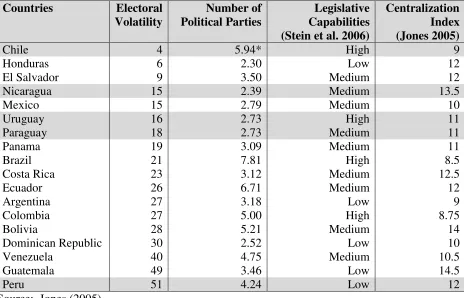
meaningful, as Table 1 shows.8 I include the seat volatility and legislative fragmentation
indicators taken from Jones (2005), which are calculated based on the Pedersen Index (1979),9
and the Laakso and Taagepera (1979)10 formula respectively. The index of legislative
8 Clear differences in these characteristics are not easy to find in the post-Communist new democracies where all of
them are crippled by high party system fragmentation and high electoral volatility (Toka and Henjak 2007). Furthermore, recent studies show how policy outcomes do not correspond well in relation to the mandates given to parties (Lipsmeyer 2009; Roberts 2010). Roberts (2010) also argues that the policy distinctiveness of party systems in most post-Communist new democracies has remained lower than that of established democracies. Hence, the study of this region hardly provides variation in both the dependent variable (programmatic linkages) and the key independent variables (party system fragmentation and electoral volatility) to ensure the existence of a control group.
9 Volatility is calculated by subtracting the percentage of the vote won by every party in an election from the
percentage won in the previous election, taking the absolute value of this result, summing the results for all parties, and then dividing this total by two.
16 capabilities, which is constructed by Stein et al. (2006), presents an important advantage. It
focuses only on Latin American legislatures, which probably improves its accuracy as it analyzes
fewer legislatures with more similar characteristics. The index compares legislatures according
to eight indicators, five quantitative and three qualitative. The quantitative indicators assess:
1) the confidence of citizens and business people in the performance of congress,
2) average years of legislator experience and percentage of legislators with university
educations, and
3) the average number of committee memberships per legislator.
The qualitative indicators constructed by capture:
1) the strength of committees,
2) whether the legislature is a good place to build a career, and
3) technical expertise.
This index examines both those characteristics that could boost not only productivity of bill
initiatives, and the experience and quality of legislators to produce more effective bill initiatives.
More effective bill initiatives might better persuade citizens that particular legislators or their
parties are the most competent to deal with problems in certain policy jurisdictions.
[ Insert Table 1 ]
Second, party leaders play a decisive role in Latin American legislatures. For instance,
according to John Carey (2009, 25),
Party groups are subordinate to national party organizations and generally can be instructed by them as to how to vote on specific issues. National party congresses invariably occur less frequently than legislative party group meetings, but national party executive committees generally have the authority to establish the party line.
17 There is frequently some overlap between members of party executive
committees and legislators, particularly among legislative group leaders. Many parties also retain disciplinary bodies, composed of national party leaders that are authorized to impose sanctions on legislators who break discipline on votes where a party line has been established.
Saiegh (2005, 23) notes that party leaders “usually set policy agendas, nominate candidates and
monitor the work of elected representatives.” These activities frequently take place in regularly
scheduled meetings, which usually occur once a week. It is in these meetings that party policy is
established, strategies for passing legislation or publicizing important matters are developed, and
party and legislative leaders are selected. According to Saiegh (2005), in most Latin American
countries the overwhelming majority of decisions are made by party leaders or in party meetings.
Indeed, party leaders make the nomination decision of candidates for congress in most Latin
American countries. The only exceptions correspond to four countries: Mexico, Argentina,
Colombia, and Brazil (Ancántara Sáez and Freidenberg 2001).
Jones (2005) builds an index of centralization of power within political parties. This
index is based on five factors: selection of legislative candidates, the electoral system employed
for the election of legislative candidates,11 the timing of presidential and legislative elections, the
presence of autonomous regional leaders, and the level of intra-party democracy. Countries in
which the most powerful party leaders can be found are Guatemala, Bolivia, Nicaragua,
Honduras, and Costa Rica. Table 1 displays these scores. However, even in countries where
national party leaders are consider to be relatively weaker (Brazil, Argentina, Mexico, Colombia,
and Chile), party leaders still possess several other tools and prerogatives to influence legislators’
behavior, such as guaranteed access to mass media, control of public campaign finance (in case
11 Most Latin American countries have adopted systems with closed lists, which favor the influence of party leaders
18 reelection is permitted), the use of the party label and the issues the party owns, support from the
party for their legislative agendas, and disciplinary actions.
Party leaders can strategically employ their prerogatives to reward obedient legislators or
punish defiance. This means help explain the influence of parties over legislators as described
above, and consequently, help clarify the relatively high levels of cohesion and party unity in the
legislative arena. Likewise, this sheds light on the reasons explaining why party leaders have
been found to play an important role in countries registering the weakest scores of the index of
centralization of power constructed by Jones (2005). For instance, Langston (2011: 10) reports
that party leaders in the legislature continue to dominate decision-making in Mexico after the
Partido Revolucionario Institucional's defeat in the 2000 Presidential election. Similar accounts
have been reported for Brazil -- a country in which electoral rules, federalism, and the inability
of party leaders to nominate candidates tend to favor individual legislators’ agendas over party
agendas. For example, Figueiredo and Limongi (2000, 2007) argue that internal rules organize
legislative work entirely around political parties, giving rise to highly centralized
decision-making. Although there is no clear consensus on the relative power of party leaders vis a vis that
of legislators -- especially in the Latin American countries listed above (Brazil, Argentina,
Mexico, Colombia, and Chile) – there is general agreement that party leaders can exert a
significant influence over legislators’ actions.
Furthermore, despite some variations across Latin American legislatures, overall levels of
party unity are rather high (Saiegh 2005; Carey 2009; Alemán, Ponce, and Sagarzazu 2011;
Alemán and Saiegh 2007), which suggest an effective party leadership. A conclusion this
literature can offer is that legislators’ decisions and actions are greatly influenced by their
19 instead, to intraparty competition (less power of party leaders to coerce legislators) (Carey 2009),
age of parties (Carey 2009), and a relatively low level of institutionalization of the party system
(Alemán, Ponce, and Sagarzazu 2011). Intra-party competition has also been associated with the
power of party leaders in the U.S. Congress (Palazzolo 2008).12 In sum, previous studies
attribute an important and decisive role to party leaders in coordinating actions and strategies in
Latin American legislatures.
Based on these previous studies, it becomes reasonable to presume that party leaders
could be strong enough to influence a particular legislator (or a few legislators) to propose a new
bill initiative that could help party leaders solve parties’ collective action problems. In particular,
these bill initiatives could help legislative parties accomplish greater electoral support through
short-term strategies or the accomplishment of ownership of additional issues through legislative
specialization. In sum, most studies focused on the role of party leaders in Latin American
legislatures find that these actors play a relevant role in coordinating strategies within their
parties. They seem to solve effectively collective action problems within their parties (in the
legislature). In any case, countries with either strong or weak leaders are included in the
empirical analysis to evaluate whether this difference can affect legislative specialization and to
observe whether the validity of the hypotheses of this study holds.
Third, democratization and democratic consolidation are still recent phenomena in most
countries of the region, which facilitates analyzing the potential construction of issue ownership
in settings where issue ownership is either unlikely to exist or presumably fragile. During this
12However, the party leader’s lack of interest in coercing legislators to make them follow the party agendas could
20 period parties might be using legislative specialization, and perhaps very intensively, to
accomplish issue ownership. Indeed, greater legislative specialization could lead to more
programmatic party systems as voters increasingly learn on how to distinguish parties. Then this
institutional trait might lead to lower electoral volatility as stronger programmatic linkages
between parties and citizens might help deter the entry of new competitors. Hence, analyzing
legislative specialization at the early stages of democratic consolidation helps avoid the potential
endogenous relationship between electoral volatility and programmatic bonds between parties
and citizens.
Fourth, Latin American countries share both common cultural roots and presidential
systems,13 which helps reduce the number of potential determinants explaining parties’
legislative specialization. Finally, data on bill initiatives is available for several countries, which
makes it feasible to test the hypotheses of this dissertation. The following section tests the
validity of the hypotheses within the Latin American context.
Testing Legislative Specialization
In this section, I examine empirically the hypotheses of this study. In order to test the effect of
the key institutional traits (high legislative capabilities, low legislative fragmentation, and low
electoral volatility) on legislative specialization, I select five different Latin American
legislatures. The legislatures of these five countries – Chile, Paraguay, Uruguay, Nicaragua, and
Peru – are strategically selected for several reasons. First, these countries register diverse scores
of legislative fragmentation, seat electoral volatility, and legislative capabilities (see Table 1).
Second, bill initiation data are available for these countries. Appendix 1 displays the sources of
13 According to the literature, presidentialism reduces party unity in congress (Carey 2009). If the hypotheses of this
21 these data, which are the official web pages of the national congresses of the selected countries
(lower houses for those countries with bicameral legislatures: Chile, Uruguay, and Paraguay).
Third, the relative strength of party leaders also varies across these countries according to
Jones’s Index of Centralization of Power in the Political Parties (2005). For instance, while the
Nicaraguan parties register one of the highest strength scores (13.5), Chilean parties present one
of the lowest scores in the region (it only reaches 9).
As I state above, I employ bill initiation data for testing my hypotheses. Appendix 1
shows the number of bill initiatives for each legislative period that I use in the analysis.14 The
number of bill initiatives scrutinized in the overall analysis totals 18,455 for all legislatures. To
assess the degree of concentration of specialization across parties and across party systems, I
classify these bill initiatives according to 12 possible policy jurisdictions. Appendix 3 presents
the list of issues.15 After classifying these bill initiatives, I assess the degree of concentration of
legislative specialization for both legislative parties and party systems and for each legislature.
In order to measure the concentration of legislative specialization of each party, I employ
the Gini coefficient. The Gini coefficient is a widely used measure of inequalities across units
(Creedy 1998; Shryock et al. 1976). It ranges from 0 in cases of perfect equality across all units
to 1 in cases of complete inequality. As used in this study, the Gini coefficient assesses the extent
to which a party specializes across policy jurisdictions. Thus, a Gini coefficient of 0 indicates
that a party allocated the same share of bill initiatives in every policy jurisdiction. A Gini
14 Appendix 2 displays further information such as the number of seats of each legislative party and the effective
number of legislative parties for each legislative period. Chile is the only case in which I compress four different legislatures into one. The number of bill initiatives of each legislative period is relatively much lower than those of other legislatures. In order to increase the robustness of the results, I condense the data.
15 I only exclude bill initiatives regarding constitutional reforms since these changes do not signal clearly a policy
22 coefficient of 1 means that a party assigned 100 percent of its bill initiatives in one policy
jurisdiction and 0 percent in all the rest.
Based on this concentration score for individual parties, I calculate a measure of the
concentration of party systems. I simply multiply the concentration score for every party by its
share of seats in the legislature, and then sum this product for all the parties. The contribution of
every party to the party-system concentration score is then proportionate to its share of seats in
the legislature. One important advantage the Gini coefficient offers is that it is not party or
party-system specific; a particular value of the Gini coefficient in one party party-system is comparable to
another value of the Gini coefficient in another party system.
To calculate these coefficients, I first count how many bills legislators of a certain party
presented. I exclude from this count all bill initiatives that legislators initiated clearly to favor
their constituencies in the electoral districts which they were elected. Legislators might employ
these initiatives to respond to their constituencies’ demands or to build “a reputation” as the most
competent to deal with particular issues (among their own electoral constituencies). Appendix 1
shows in the second column the number of bill initiatives of every party for every legislature,
after eliminating the bill initiatives conceived to foster individual electoral gains.
After counting the number of bill initiatives proposed in each policy jurisdiction, I
calculate the percentage of bills proposed by each party in each policy jurisdiction. Then, I
calculate the Gini coefficient for every party and for each legislative period using the Stata
command “ineqdec0” (Jenkins 2001). Alternatively, I calculate a second Gini coefficient for
every party by weighting every policy jurisdiction differently, employing the percentage of bill
initiatives in every policy jurisdiction. This takes into account differences in the salience or
23 target mostly those policy jurisdictions demanded by the median citizen (across several
dimensions – each of them representing a policy jurisdiction). I display the results of these
calculations in the third and fourth columns of Appendix 1. Appendix 1 also shows the scores for
party-system specialization computed based on the two (Gini coefficient) scores calculated for
every party.
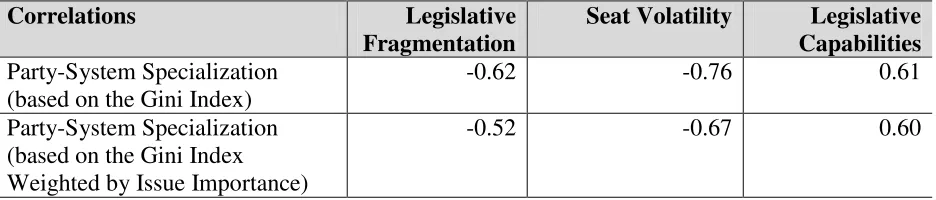
Simple correlations between party-system specialization scores and the values of the key
institutional traits of this study show support for hypothesis 1. These “specialization” scores
correlate negatively with seat volatility (-0.76) and legislative fragmentation (-0.62), and
positively with legislative capabilities (0.61). I find similar results for the party-system
specialization scores calculated based on the weighted Gini coefficients. These figures clearly
support my hypotheses. I present the values of these correlations in Table 2.
[ Insert Table 2 ]
Finally, I run two different econometric models to assess the accuracy of the hypotheses
from a different angle. This time I directly evaluate the ability of my expectations to predict
legislative specialization. Since this model relies on the legislative party as the unit of analysis, I
construct statistical models explaining the degree of specialization at the party level. Specifically,
I employ the scores of legislative concentration at the party level as the dependent variable (the
Gini coefficient).
This analysis primarily assesses the impact of seat volatility, party size, and legislative
capabilities on a party’s legislative concentration of specialization. Party size captures the effect
of legislative fragmentation at the party level (as legislative fragmentation increases, party size
24 the square of party size as an additional variable to assess the existence of U-shaped relationship
between party size and legislative specialization.
As other independent variables, I include both party system level variables: electoral
volatility16 and legislative capabilities. Finally, I control for the relative power of party leaders. I
use Jones’s Centralization of Power Index to account for these differences (2005). Since the
number of observations is relatively low (44 parties in the sample), I employ two different
models especially designed to deal with small samples (the classical frequentist estimations
could be biased in these contexts). First, I employ a parametric bootstrap17 in which I cluster
legislative parties by legislatures. Previous studies advocate the bootstrap technique, which was
invented by Efron (1979), to estimate parameters when working with small samples (Benton and
Krishnamoorty 2002; Scholz 2007). In particular, I fit a multilevel Tobit model (with limits
between 0 and 1 given the configuration of the Gini coefficient) varying intercept to account for
possible statistical dependence among observations belonging to the same legislature. I run this
model using the software Stata.
Second, I take advantage of a Bayesian Tobit model, which relies on Markov-Chain
techniques, to produce successive replications. As stated above, the use of the classical
frequentist approach18 is questionable for small sample sizes. In the frequentist approach using
maximum likelihood, inferences are based on the asymptotic theory. The normal asymptotic
16 I show in Appendix 2 the values and sources of the variable seat volatility.
17 Bootstrapping is the practice of estimating properties of an estimator when sampling several times from an
approximating distribution. The standard choice for an approximating distribution is the empirical distribution of the observed data. The technique employs a random sampling with replacement from the original dataset.
18In the classical frequentist approach, the inferential question is the “how often” question assuming that a
hypothesis is true (Jackman 2009). Specifically, the classical frequentist approach focuses on answering “how often would we obtain a result at least as extreme as the result actually obtained?” where the sampling distribution of the
25 approximation has been found to produce significant bias for small samples (Griffiths, Hill, and
Pope 1987; Zellner and Rosi 1984; Albert and Chib 1993). In order to avoid the lack of accuracy
of the frequentist approach for estimation in small samples, I employ a Bayesian Tobit model.19
Bayesian models have been found capable of providing analyses appropriate for both small and
large samples (Zellner and Rosi 1984). Specifically, I take advantage of the Tobit regression
model using the data augmentation approach (data-augmented Gibbs sampler).20 I run the
Bayesian Tobit models using the R package MCMCpack to produce the data-augmented Gibbs
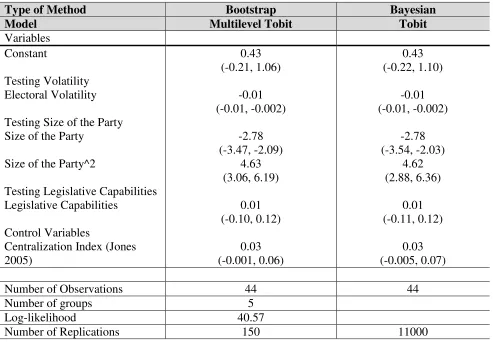
sampler for this estimation (Martin, Quinn, and Park 2009). I display the models’ results in Table
3. The Bayesian model reports the posterior mean and the quantiles at the 2.5% and 97.5% levels
of the posterior distribution for each of the explanatory variables. The bootstrap estimation also
reports confidence intervals at the 2.5% and 97.5% levels of the distribution.
Results
Results of these models once again confirm the argument that electoral volatility matters for
legislative specialization. Higher volatility reduces legislative concentration of specialization in
19 Unlike the frequentist approach, which conditions on a hypothesis to evaluate the plausibility of the data with
another step required to either reject or fail to reject hypotheses, the Bayesian approach conditions on the available data to evaluate the plausibility of a hypothesis (Jackman 2009). Based on the data at hand and priors (beliefs on the parameters and hypotheses), the result of a Bayesian analysis is a posterior probability density of parameters or hypotheses of direct interest for the researcher (Jackman 2009). This posterior density reflects the distribution of possible values of the parameter of interest, which can be characterized by typical indicators such as a mean, a variance, and confidence intervals. The mean and the confidence intervals are of especial importance for a
researcher when assessing possible parameters’ values. In addition to providing more appropriate estimations when
working with small samples, Bayesian analysis provides: 1) parameter estimates with good statistical properties; 2) parsimonious descriptions of observed data; 3) predictions for missing data and forecasts of future data; and 4) a computational framework for model estimation, selection and validation (Hoff 2009).
20 The Gibbs sampler rests on the idea that the joint probability densities can be completely characterized by their
component conditional densities. Therefore, rather than sampling from the high-dimensional density (p(β /data)), the Gibbs technique samples from the lower-dimensional conditional densities that put them together to define the joint
26 all specifications. The negative sign of the estimated mean and the quantiles of the posterior
densities (or confidence intervals for bootstrap), reported in Table 3 consistently show this
association across all specifications. Party size also matters. The results confirm the existence of
a U-shaped relationship between party size and the degree of concentration of specialization. As
the number of legislators increase within a party, the party embarks in further concentration.
Both the estimated mean and the quantiles of the posterior densities (or confidence intervals for
bootstrap) provide evidence of this influence.21 This is consistent with the idea that the
opportunity costs of pursuing ownership of additional issues goes down as party leaders can
distribute duties regarding the pursuit of issue ownership to a greater number of legislators.22
[ Insert Table 3 ]
Finally, I examine the effect of legislative constraints at the party level. Although the
results suggest a positive impact on the degree of concentration, these results are less conclusive
than previous findings, since the likelihood of a change of sign for the estimated mean is
relatively higher (as the quantiles indicate). However, it is also possible that the legislative
constraints Latin American parties face are not preventing them from choosing their optimal
amount of concentration. Since electoral volatility still remains relatively high in the region,
parties might be selecting a relatively low optimal amount of concentration. It is then likely that
parties do not encounter obstacles (or legislative constraints) to achieve their optimal amount of
21 These posterior distributions demonstrate that these parameters are highly unlikely to be zero, and they
corroborate the Bayesian model’s findings. The set of graphs in Appendix 4 (right side) displays these posterior
distributions. Graphical evaluation of the Gibbs sampler output can be helpful to assess how well the sampler is exploring the posterior densities. Specifically, the traceplots displayed on the left side of Appendix 4 correspond to the independent variables of the dataset. In all cases, the traceplots are indistinguishable from white noise (absence of clear patterns or trends), clearly suggesting that the sampler has successfully converged on the posterior density of the model parameters.
22 Even after controlling for party size, which captures the rationality for why the pursuit of ownership enhances, the
inclusion of legislative fragmentation as a different independent variable still seems to produce a negative impact on legislative specialization (the estimated mean is negative). However, the quantile (at 2.5%) of the posterior
27 concentration. This might help explain why these results are less convincing. I suggest
expanding the sample of legislatures in future research in order to corroborate the inconclusive
results related to this variable and provide further evidence to confirm the positive effect of
legislative capabilities on the degree of concentration. Finally, as expected, party centralization
also seems to affect specialization positively but these results are also inconclusive. Differences
in the degree of party centralization across countries might not be important enough to influence
the results.
Conclusions
This study provides several lessons. First, policy makers could encourage further concentration
in legislative specialization by implementing institutional changes conducive to reducing party
system fragmentation in legislatures, decreasing electoral volatility, and enhancing legislative
capabilities. These reforms can either enhance the incentives for greater concentration or reduce
the constraints that legislative parties face when deciding to what extent they want to concentrate
their efforts in the legislative body.
Second, studies already report that in relatively more fragmented party systems, parties
own fewer issues (usually at most one or two issues) than in two-party systems, and most of the
policy issues are not owned by any party (Bélanguer and Meguid 2008; Walgrave and De Swert
2007; Bélanguer 2003; Petrocik 1996). My study sheds light on (at least) some reasons
explaining why this occurs. It can also help explain why other studies have found an association
between lower party system fragmentation and higher degrees of party system
programmaticness. As greater legislative specialization and the pursuit of issue ownership
28 political parties. In this case, credibility and generation of information are more likely to increase
in a polity with programmatic parties; and this goal becomes less costly under less fragmented
party systems. For instance, accountability and responsiveness from the legislative body can be
amplified by a two-party system.
For further research, cross-regional comparisons could offer the opportunity to analyze
the effect of other determinants on the formation of programmatic linkages such as
presidentialism. Finally, I also suggest including cases from other (less volatile) regions to assess
more accurately the effect of legislative capabilities.
References
Albert, James, and Siddartha Chib. 1993. “Bayesian Analysis of Binary and Polychotomous
Response Data. Journal of the American Statistical Association,” 88, 422: 669-679.
Alcántara Sáez, Manuel, and Flavia Freidenberg, eds. 2001. Partidos Políticos de América Latina (three volumes). Salamanca: Ediciones Universidad de Salamanca.
Aldrich, John, and John Griffin. 2003. The Presidency and the Campaign: Creating Voter
Priorities in the 2000 Election. In Michael Nelson (ed.), The Presidency and the Political System,
seventh ed. Congressional Quarterly, Washington, DC, 239-256.
Alemán, Eduardo, Aldo F. Ponce, and Iñaki Sagarzazu. 2011. “Legislative Parties in Volatile, Nonprogrammatic Party Systems: The Peruvian Case in Comparative Perspective,” Latin American Politics and Society, 53, 3: 57-81.
Alemán, Eduardo and Sebastián M. Saiegh. 2007. “Legislative Preferences, Political Parties, and
Coalition Unity in Chile,” Comparative Politics, 39, 3: 253-272.
Alemán, Eduardo, Ernesto Calvo, Mark P. Jones, and Noah Kaplan. 2009. “Comparing Cosponsorship and Roll Call Ideal Points,” Legislative Studies Quarterly, 34: 87–116.
Ames, Barry. 2001. The Deadlock of Democracy in Brazil. Ann Arbor: University of Michigan
Press.
Ansolabehere, Stephen, and Shanto Iyengar. 1994. “Riding the Wave and Claiming Ownership
29
Baron, David and John Ferejohn. 1989. “Bargaining in Legislatures.” The American Political Science Review, 83: 1181-1206
Bélanger, Eric, and Bonny Meguid. 2008. “Issue Salience, Issue Ownership and Issue-Based
Vote Choice: Evidence from Canada,” Electoral Studies, 27, 3: 477-491.
Bellucci, Paolo. 2006. “Tracing the Cognitive and Affective Roots of "Party Competence": Italy and Britain, 2001,” Electoral Studies, 25: 548-569.
Benton, Denise, and K. Krishnamoorthy. 2002. “Performance of the Parametric Bootstrap
Method in Small Sample Interval Estimates,” Advances and Applications in Statistics, 2, 3:
269-285.
Budge, Ian, and Dennis Farlie. 1983. Explaining and Predicting Elections Issue Effects and Party Strategies in Twenty-Three Democracies. London: George Allen & Unwin.
Carey, John. 2009. Legislative Voting and Accountability. Cambridge: Cambridge University
Press.
Clarke, Harold, David Sanders, Marianne Stewart, and Paul Whiteley. 2004. Electoral Choice in 2001. In Harold Clarke, Sanders, Marianne Stewart, and Paul Whiteley, eds., Political Choice in Britain. Oxford University Press, 79-129.
Cox, Gary, and Matthew McCubbins. 1993. Legislative Leviathan: Party Government in the House. Berkeley: University of California Press.
Creedy, John. 1998. The Dynamics of Inequality and Poverty: Comparing Income Distributions.
Northhampton, MA: E. Elgar.
Damore, David. 2004. “The Dynamics of Issue Ownership in Presidential Campaigns,” Political Research Quarterly, 57: 391-397.
Edwards, George, William Mitchell, and Reed Welch. 1995. “Explaining Presidential Approval: The Significance of Issue Salience,” American Journal of Political Science, 39: 108-134.
Efron, B. 1979. “Bootstrap methods: Another look at the jackknife,” The Annals of Statistics, 7:
1-26.
Fournier, Patrick, Andre Blais, Richard Nadeau, Elisabeth Gidengil, and Neil Nevitte. 2003.
“Issue Importance and Performance Voting,” Political Behavior, 25: 51-67.
30 Gilligan, Thomas, and Keith Krehbiel. 1989. Asymmetric Information and Legislative Rules with a Heterogeneous Committee. American Journal of Political Science, 33: 459-490.
Green, Jane, and Sara Hobolt. 2008. “Owning the Issue Agenda. Party Strategies and Vote
Choices in British Elections,” Electoral Studies, 27: 460-476.
Griffiths, William, R. Carter Hill, and Peter Pope. 1987. “Small Sample Properties of Probit Model Estimators.” Journal of the American Statistical Association, 82: 929- 937.
Hayes, Danny. 2005. “Candidate Qualities through a Partisan Lens: A Theory of Trait
Ownership,” American Journal of Political Science, 49: 908-923.
Hoff, Peter. 2009. A First Course in Bayesian Statistical Analysis. New York: Springer
Holian, David. 2004. “He's Stealing my Issues! Clinton's Crime Rhetoric and the Dynamics of Issue Ownership,” Political Behavior, 26: 95-124.
Horowitz, John, John List, and K.E. McConnell. 2004. Diminishing Marginal Value. Paper presented at the American Agricultural Economics Association Annual Meeting, Denver, Colorado.
Jackman, Simon. 2009. Bayesian Analysis for the Social Sciences. John Wiley & Sons, Ltd.
Jenkins, Stephen. 2001. ‘ineqdec0.ado’. STATA Command. University of Essex.
Jones, Mark. 2005. The Role of Parties and Party Systems in the Policymaking Process. Paper prepared for Inter-American Development Bank Workshop on State Reform, Public Policies and Policymaking Processes, February 28-March 2, Washington, DC.
Kitschelt, Herbert, Kirk Hawkins, Juan Pablo Luna, Guillermo Rosas, and Elizabeth
Zechmeister, eds. 2010. Latin American Party Systems. New York: Cambridge University Press.
Krehbiel, Keith. 1991. Information and Legislative Organization. Ann Arbor: The University of
Michigan Press.
Krosnick, Jona. 1988. “The Role of Attitude Importance in Social Evaluation: A Study of Policy
Preferences, Presidential Candidate Evaluations, and Voting Behavior,” Journal of Personality and Social Psychology, 55: 196-210.
Krosnick, Jona. 1990. “Government Policy and Citizen Passion: A Study of Issue Publics in Contemporary America.” Political Behavior, 12: 59-92.
Laakso, Markku, and Rein Taagepera. 1979. “Effective Number of Parties: A Measure with Application to West Europe,” Comparative Political Studies, 12: 3-27.
31
Limongi, Fernando and Figueiredo, Argelina. 2000. ”Presidential power, legislative organization, and party behavior in Brazil,” Comparative Politics, 32, 2: 151-70.
Limongi, Fernando and Figueiredo, Argelina. 2007. “The Budget Process and Legislative
Behavior: Individual Amendments, Support for the Executive and Government Programs,”
World Political Science Review, 3, 3: 1-34.
Lipsmeyer, Christine. 2009. “Post-Communist Mandates,” Politics and Policy, 37, 4: 715-734.
Martin, Andrew, Kevin Quinn, and Jong Hee Park. 2009. MCMCpack: Markov Chain Monte Carlo (MCMC) Package. R Package version 0.9-6. CRAN Repository.
Nadeau, Richard, André Blais, Elisabeth Gidengil, and Neil Nevitte. 2001. Perceptions of Party Competence in the 1997 Election. In Hugh Thorburn and Alan Whitehorn, eds., Party Politics in Canada. Toronto: Prentice-Hall, 413-430.
Nicholson, Walter. 2002. Microeconomic Theory. Basic Principles and Extensions.
South-Western; Thomson.
Norris, Pippa, John Curtice, David Sanders, Margaret Scammell, and Holli Semetko. 1999. On Message: Communicating the Campaign. London: Sage.
Palazzolo, Daniel. 2008. “Evaluating Majority Party Leaders,” The Forum, 6, 3: 1-16.
Pedersen, Mogens. 1979. “The Dynamics of European Party Systems: Changing Patterns of
Electoral Volatility,” European Journal of Political Research, 7, 1: 1-26.
Petrocik, John. 1996. “Issue Ownership and Presidential Elections, with a 1980 Case Study,”
American Journal of Political Science, 40, 3: 825-50.
Petrocik, John, William Benoit, and Glenn Hansen. 2003. “Issue Ownership and Presidential
Campaigning, 1952-2000,” Political Science Quarterly, 118, 4: 599-626
Ponce, Aldo F. 2012. Linking Citizens and Parties: How Legislatures Matter for Political Representation and Accountability. Dissertation.
Rabinowitz, G., J Ponthro, W Jacoby. 1982. “Salience as a Factor in the Impact of Issues on Candidate Evaluation,” Journal of Politics, 44: 41-63.
Roberts, Andrew. 2010. The Quality of Democracy in Eastern Europe: Public Preferences and Policy Performance. New York: Cambridge University Press.
Rohde, David. 1991. Parties and Leaders in the Post-Reform House. Chicago: The University of
32 Saiegh, Sebastián. 2005. The Role of Legislatures in the Policymaking Process. Prepared for delivery at the Workshop on State Reform, Public Policies and Policymaking Processes, Inter-American Development Bank, Washington D.C.
Scholz, F.W. 2007. The Bootstrap Small Sample Properties. Technical Report, Boeing Computer Services, Research and Technology.
Sellers, Patrick. 1998. “Strategy and Background in Congressional Campaigns.” American Political Science Review, 92: 159-171.
Shryock, Henry S., Jacob S. Siegel, and Associates. 1976. The Methods and Materials of Demography. New York: Academic Press.
Simon, Adam. 2002. The Winning Message: Candidate Behavior, Campaign Discourse, and Democracy. New York: Cambridge University Press.
Stein, Ernesto, Mariano Tommasi, Koldo Echebarría, Eduardo Lora, and Mark Payne, eds., 2006. The Politics of Policies. Economic and Social Progress in Latin America. Cambridge:
David Rockefeller Center.
Toka, Gabor, and Andrija Henjak. 2007. Party Systems and Voting Behavior in the Visegrad Countries 15 Years After the Transition. In Pavel Saradín and Eva Bradová, eds., Visegrad Votes: Parliamentary Elections 205-2006. Olomuc: Palacky University Press, 210-244.
van der Brug, Wouter. 2004. “Issue Ownership and Party Choice”, Electoral Studies, 23:
209-233.
Walgrave, Stefaan, and Knut De Swert. 2004. “The Making of the (Issues of the) Vlaams Blok: The Media and the Success of the Belgian Extreme-Right Party,” Political Communication, 21:
479-500.
Walgrave, Stefaan, and Knut De Swert. 2007. “Where Does Issue Ownership Come From? From Party or From the Media? Issue-Identification in Belgium, 1991-2005.” The Harvard
International Journal of Press and Politics, 12: 37-66.
Walgrave, Stefaan, Jonas Lefevere, and Anke Tresch. 2011. The Associative Dimension of Issue Ownership. Conceptualization, Measurement, and Effect. Working paper, University of
Antwerp.
Weingast, Barry R., and William J. Marshall. 1988. “The Industrial Organization of Congress; or, Why Legislatures, Like Firms, Are Not Organized as Markets.” Journal of Political Economy
96: 132-63.
33
[image:34.612.75.539.139.437.2]Tables
Table 1. Seat Volatility, Number of Effective Parties, and Legislative Capabilities
Countries Electoral
Volatility
Number of Political Parties
Legislative Capabilities (Stein et al.2006)
Centralization Index (Jones 2005)
Chile 4 5.94* High 9
Honduras 6 2.30 Low 12
El Salvador 9 3.50 Medium 12
Nicaragua 15 2.39 Medium 13.5
Mexico 15 2.79 Medium 10
Uruguay 16 2.73 High 11
Paraguay 18 2.73 Medium 11
Panama 19 3.09 Medium 11
Brazil 21 7.81 High 8.5
Costa Rica 23 3.12 Medium 12.5
Ecuador 26 6.71 Medium 12
Argentina 27 3.18 Low 9
Colombia 27 5.00 High 8.75
Bolivia 28 5.21 Medium 14
Dominican Republic 30 2.52 Low 10
Venezuela 40 4.75 Medium 10.5
Guatemala 49 3.46 Low 14.5
Peru 51 4.24 Low 12
34
Table 2. Correlations between Party System Specialization and the Key Institutional Traits
Correlations Legislative
Fragmentation
Seat Volatility Legislative Capabilities
Party-System Specialization (based on the Gini Index)
-0.62 -0.76 0.61
Party-System Specialization (based on the Gini Index Weighted by Issue Importance)