Munich Personal RePEc Archive
Risks of large portfolios
Fan, Jianqing and Liao, Yuan and Shi, Xiaofeng
Princeton University, University of Maryland - College Park,
Princeton University
February 2013
Online at
https://mpra.ub.uni-muenchen.de/44206/
Risks of Large Portfolios
Jianqing Fan
∗†, Yuan Liao
‡and Xiaofeng Shi
∗∗Department of Operations Research and Financial Engineering, Princeton University
† Bendheim Center for Finance, Princeton University
‡ Department of Mathematics, University of Maryland
Abstract
Estimating and assessing the risk of a large portfolio is an important topic in finan-cial econometrics and risk management. The risk is often estimated by a substitution of a good estimator of the volatility matrix. However, the accuracy of such a risk esti-mator for large portfolios is largely unknown, and a simple inequality in the previous literature gives an infeasible upper bound for the estimation error. In addition, numer-ical studies illustrate that this upper bound is very crude. In this paper, we propose factor-based risk estimators under a large amount of assets, and introduce a high-confidence level upper bound (H-CLUB) to assess the accuracy of the risk estimation. The H-CLUB is constructed based on three different estimates of the volatility matrix: sample covariance, approximate factor model with known factors, and unknown factors (POET, Fan, Liao and Mincheva, 2013). For the first time in the literature, we derive the limiting distribution of the estimated risks in high dimensionality. Our numeri-cal results demonstrate that the proposed upper bounds significantly outperform the traditional crude bounds, and provide insightful assessment of the estimation of the portfolio risks. In addition, our simulated results quantify the relative error in the risk estimation, which is usually negligible using 3-month daily data. Finally, the proposed methods are applied to an empirical study.
Keywords: High dimensionality, approximate factor model, unknown factors, principal components, sparse matrix, thresholding, risk management, volatility
∗Address: Department of Operations Research and Financial Engineering, Sherrerd Hall, Princeton
1
Introduction
The potential of a portfolio’s loss is termed as the portfolio risk. There are two types of portfolio risks. Thesystematic risk(or market risk) is the risk inherent to the entire market, such as risk associated with interest rates, currencies, recession, war and political instability, etc. The systematic risk cannot be diversified away, even with a well-diversified portfolio. In contrast, specific risk (or idiosyncratic risk) refers to the risk that affects a very specific group of securities or even an individual security. For example, it can be the risk of price changes due to the unique circumstances of a specific stock. Unlike systematic risk, specific risk can be reduced through diversification.
Estimating and assessing the risk of a large portfolio is an important topic in financial econometrics and risk management. The risk of a given portfolio allocation vector w is conveniently measured by (w′Σw)1/2, in which Σ is a volatility (covariance) matrix of the
assets’ returns. Often multiple portfolio risks are at interests and hence it is essential to estimate the volatility matrix Σ. The problem becomes challenging when the portfolio size is large. Suppose we have created a portfolio from two thousand assets and invested in a part of selected assets. The covariance matrix Σ involved then contains over two million unknown parameters. Yet, the sample size based on one year’s daily data is around 252. It is hard to assess the estimation accuracy when the estimation errors from more than two million parameters are aggregated. Hence some regularization method is recommended to estimate and assess risks.
The interest on large portfolios surges recently. Pesaran and Zaffaroni (2008) examined the asymptotic behavior of the portfolio weights. Brodie et al. (2009) addressed the problem of portfolio selection using a regularization penalty. Gomez and Gallon (2011) numerically compared several methods of covariance matrix estimation for portfolio management. In particular, the optimal portfolio selection involves inverting an estimated Σ, which is a challenging problem under a large number of assets. The literature is also found in Jacquier and Polson (2010), Antoine (2011), Chang and Tsay (2010), DeMiguel et al. (2009), Ledoit and Wolf (2003), El Karoui (2010), Lai et al. (2011), Bannouh et al. (2012), Gandy and Veraart (2012), Bianchi and Carvalho (2011), among others.
size. Two factor-based methods are proposed. The first estimator assumes the factors to be known and observable. The second method deals with the case in which common factors are unknown. This is particularly important for analyzing many non-U.S. markets when assets’ returns are driven by a few unknown factors. In both cases, the factor model imposes a
conditionally sparse structure, in that the idiosyncratic covariance is a large sparse matrix.
This yields to an approximate factor model as in Chamberlain and Rothschild (1983), with a non-diagonal error covariance matrix.
Secondly, we provide a new and practical method to assess the accuracy of risk estimation
w′(Σb −Σ)w. In the literature (e.g., Fan et al. 2012), this term has been bounded by
ξT =kwk21kΣb −Σkmax
wherekwk1, theL1-norm ofw, is the gross exposure of the portfolio, which is bounded when
there are no extreme positions in the portfolio. However, this upper bound depends on the unknown Σ, hence is not applicable in practice. In addition, the numerical studies in this paper demonstrate that this upper bound is too crude: it is often of the same or even larger scale than the estimated risk. In contrast, we provide a high-confidence level upper bound (H-CLUB) forw′(Σb−Σ)w, which is of much smaller scale and easy to compute in practice. H-CLUB is constructed based on the confidence interval for the true risk. For each proposed risk estimator w′Σwb and a givenτ ∈(0,1), we find an H-CLUB Ub(τ) such that
P(|w′(Σb −Σ)w| ≤Ub(τ))→1−τ.
In contrast, P(|w′(Σb −Σ)w| ≤ ξT) = 1. Hence H-CLUB is an upper bound for the risk
estimation error with high confidence while the traditional bound ξT is of full confidence.
smaller than that of the sample covariance-based estimator, but the difference is small. This demonstrates that the benefit of using a factor model is not in terms of a much smaller asymptotic variance, because the systematic risk cannot be diversified. Rather, factor anal-ysis gives a strictly positive definite covariance estimator, which is essential to estimate the optimal portfolio allocation vector, and also interprets the structure of the portfolio risks.
Finally, using our simulated results based on the model calibrated from the real U.S. equity market data, we are able to quantify the relative error of the estimation error or coefficient of variation, defined as STD(w′Σwb )/w′Σwb , where STD(·) denotes the standard error of the estimated risk. Interestingly, this ratio is just a few percent and is approximately independent of the gross exposure kwk1 but sensitive to the length of the time series. On the other hand, we also quantify the relation between the crude bound and the practical H-CLUB. We find that ξT is many times larger thanUb(τ), and the ratio ξT/Ub(τ) increases
as the gross exposure increases.
We also contribute to the portfolio theory by introducing a sampling technique which picks a random portfolio with a given gross exposure level. This sampling scheme can be useful for portfolio optimization and understanding the overall risks within a given level of gross exposure.
We emphasize that the recent works by Fan et al. (2011, 2013) are only concerned about covariance estimations and no inferential theories were studied. In contrast, we focus on the risk estimation, with a particular attention to the risk assessment and the impact of covariance estimation on the limiting distributions of risk estimators.
The rest of the paper is organized as follows. Section 2 proposes new risk estimators based on factor analysis under both known and unknown factor cases. Section 3 constructs the H-CLUB for each risk estimator based on the confidence interval for risks. It also derives the limiting distributions of the risk estimators and compares their asymptotic variances. Section 4 presents simulation results. An empirical study is considered in Section 5. Finally, Section 6 concludes. All the proofs are given in the appendix.
Throughout the paper, kwk1 = PNi=1|wi| is used to denote the gross exposure of a
given portfolio allocation vector. For a square matrix A, λmin(A) andλmax(A) represent its
minimum and maximum eigenvalues. LetkAkmaxandkAkdenote its element-wise sup-norm
and operator norm, given by kAkmax= maxi,j|Aij| and kAk=λ1max/2 (A′A) respectively.
2
Estimation of Portfolio’s Risks
Let{Rt}Tt=1be a time series of anN×1 vector of observed asset returns andΣ= cov(Rt),
given by pvar(w′Rt), which is √w′Σw. How to estimate the risk of a large portfolio? A
straightforward answer ispw′Σwb with an estimator Σb. But, how good is it? How to assess
the accuracy of this estimator? We address the problem or risk estimation in this section. The assessment of the estimation accuracy will be discussed in Section 3.
The problem of estimating the risk of a given portfolio is challenging due to the high dimensionality of Σ. Often the number of assets can be of hundreds or even thousands. On the other hand, to adapt to the current market condition, a short period of financial data are often used. For example, the number of daily returns in three months is only of tens. Hence
N can be much larger than T. We assume Σ to be time-invariant within a short period, which holds approximately for locally stationary time series.
We consider three estimators for estimating var(w′Rt) for a given w, based on three different estimators Σb: sample covariance estimator, factor analysis with either observed or unobserved factors. Recently, Chang and Tsay (2010) proposed a Cholesky decomposition approach to estimate the large covariance matrix, and used simulation to assess its perfor-mance. On the other hand, the assets’ returns are usually driven by a few market factors. Due to the presence of these common factors,Σitself is not sparse. Moreover, as pointed out by Stock and Watson (2002) and Bai (2003), common factors are usually pervasive, so the factor loading matrix is not sparse either. Hence the factor-based risk estimators are widely applicable in analyzing financial data, whose asymptotic properties (as bothT, N → ∞) will be also presented below.
2.1
Sample-covariance-based estimator
The first estimatorΣb =Sis the conventional sample covariance matrix based on{Rt}Tt=1. The asymptotic impact of using S on the risk management has been studied by Fan et al. (2008, 2012) when N is much larger than T. The sample covariance estimator does not require any structural assumption on the assets’ returns. It was shown by the aforementioned authors that for a given portfoliowwith a bounded gross exposure (that is,kwk1is bounded),
w′(S−Σ)w=Op(
r
logN
T ).
2.2
Estimating risks based on factor analysis
To overcome the problem of singularity of the sample covariance under high dimensional-ity, we assume thatRtsatisfies an “approximate factor model” (Chamberlain and Rothschild
1983):
Rt=Bft+ut, t≤T, (2.1)
whereB is an N×K matrix of factor loadings; ft is a K×1 vector of common factors, and
ut is an N ×1 vector of idiosyncratic error components. In contrast to N and T, here K
is assumed to be fixed. The common factors may or may not be observable. For example, Fama and French (1992, 1993) identified three known factors that have successfully described the U.S. stock market. In addition, macroeconomic and financial market variables have been thought to capture systematic risks as observable factors. On the other hand, in an empirical study, Bai and Ng (2002) determined two unobservable factors for stocks traded on the New York Stock Exchange during 1994-1998.
Let cov(ft) and Σu = cov(ut) denote the covariance matrices of ft and ut, K ×K and
N ×N respectively. Suppose ft and ut are uncorrelated. The factor model then implies the following decomposition of Σ:
Σ=Bcov(ft)B′+Σu.
Sparsity is one of the most common structures for large covariance estimation, which as-sumes many off-diagonal elements of the covariance to be either zero or nearly so. In the approximate factor model, a natural assumption is to place a sparse structure on Σu. The
rationale is, after the common factors are taken out, the remaining idiosyncratic components should be mostly weakly correlated with each other. Such a condition is called conditional
sparsity. We now propose new risk estimators based on the conditional sparsity assumption.
2.2.1 Factor-based estimator
We first assume that the common factors are observable, and construct an estimator of
Σbased on thresholding on the covariance matrix of idiosyncratic errors. Suppose Bb is the least squares estimator of B. The residual sample covariance matrix ofut is then given by
Su =T−1 T
X
t=1
b
Let sij(·) : R → R be an entry-dependent adaptive thresholding function and for some
thresholding parameterτijf >0,
sij(z) = 0 when |z| ≤τijf, and |sij(z)−z| ≤τijf. (2.2)
A simple example is that sij(z) =zI(|z| ≥τijf) with τ f
ij =τ(su,iisu,jj)1/2, namely, setting all
correlation coefficients smaller than τ to zero. This rule is called hard thresholding in the literature. The soft-thresholding rule is given by sij(z) = (z−τijf)+. Let
b
Σu,ij =
Su,ii, i=j
sij(Su,ij), i6=j.
Let cov(c ft) denote the sample covariance of the common factors. Define the estimated
covariance matrices as
b
Σf =Bbcov(c ft)Bb′+Σbu, Σbu = (Σbu,ij)N×N. (2.3)
The first condition of the thresholding function plays a role of thresholding. When applied to a sample covariance, it thresholds off most of the small entries that are likely due to the estimation errors. The second condition in (2.2) is used for “shrinkage”, which helps to produce a positive definite covariance estimator for a given finite sample. Commonly used examples of sij(·) include hard-thresholding, soft-thresholding, SCAD thresholding, etc. See
Antoniadis and Fan (2001), Rothman et al. (2009) and Cai and Liu (2011) for details. The cut-off is taken to be, for some C > 0,
τijf =CpSu,iiSu,jj
r
logN
T ,
which corresponds to applying the thresholding with parameter CplogN/T to the correla-tion matrix of Su. One can adjust C to gain the strictly positive definiteness of Σbf for any
given finite sample (see the discussion in Fryzlewicz 2012).
2.2.2 POET estimator
whose corresponding eigenvectors are denoted by {bξj}Nj=1. We then estimate Σby
b
ΣP = K
X
j=1
b λjbξjbξ
′
j +Ω, Ω= (Ωij)N×N, Ωij =
PN
k=K+1bλkξbk,i2 , i=j
sij(PNk=K+1bλkξbk,iξbk,j), i6=j.
where sij(·) is the same adaptive thresholding function as before, based on an
entry-dependent threshold τP ij:
τijP =C
p
ΩiiΩjj
r
logN
T +
1
√ N
! .
Recall that K denotes the number of common factors. Here C is a user-specified constant to maintain the finite sample positive definiteness. Thanks to the thresholding, even when
T =o(N), there is C∗ >0 such that for any C > C∗, both Σb
f and ΣbP are strictly positive
definite with probability approaching to one. Simulated and empirical studies suggested that
C = 0.5 is a good choice when sij is the soft thresholding.
Based on the factor analysis, our proposed risk estimator is either
q
w′Σbfwor
q
w′ΣbPw
for a given portfolio allocation vector w, depending on whether ft is observable. Note that
Fan et al. (2013) is concerned only about the covariance estimation. In contrast, this paper focuses on the asymptotic behaviors of these risk estimators and their assessment for a given diversified w, which have never been addressed before. We will see that under high dimensionality, the factor-based estimators have the same asymptotic variance, and is smaller than that of the sample covariance-based estimator. The effect of estimating the unknown factors on the limiting distributions is asymptotically negligible.
3
Assessment of the Risk Estimation
This section proposes a new method to assess the estimated risks for a given portfolio allocation vector w. We will assume kwk1 ≤ c for some c > 0, where kwk1 is the gross
exposure of the portfolio. This prevents extreme positions.
3.1
Measuring risks using full confidence bound
upper bound when N is large. An alternative (and commonly used) upper bound for ∆ is based on the following inequality:
∆≤ kwk21kΣb −Σkmax ≡ξT, (3.1)
which is usually tighter for risk assessment.
However, for the purposes of statistical inference, ξT is infeasible as it depends on the
true Σ. As a result, this upper bound cannot be evaluated in practice for a given data set. In addition, our simulation results have shown that the upper boundξT is actually too crude
to be useful. Let us consider the following toy example.
Example 3.1. Consider three stocks with annualized returns that jointly follow a multi-variate Gaussian distribution N3(0,Σ) where Σ = 0.04·I3. An equally weighted portfolio
w = (1/3,1/3,1/3)′ is constructed and the task is to estimate the portfolio risk using the
sample covariance matrix S based on the simulated 21-day (one month) returns.
The theoretical value of portfolio variance is w′Σw = 0.0133, which corresponds to a true risk of 11.55% per annum. Based on a typical simulated data, the estimated portfolio variance wΣwb = 0.0131, equivalent to a perceived risk of 11.43% per annum. Moreover
ξT = kΣ−Σbkmax = 0.0248. Based on this upper bound, a simple calculation shows that
w′Σw∈ [0,0.0379], that is, the true risk √w′Σw lies in [0,19.46%], an interval that is too
wide to be meaningful.
Note that the inequality (3.1) holds for every sampling sequence {Rt}Tt=1. HenceξT is in
fact an upper bound of full confidence, that is,
P(|w′(Σb −Σ)w| ≤ξT) = 1.
The toy example is typical in the sense that ξT is already too crude for small portfolios. In
statistical inference, often people use bounds of high confidence levels instead, e.g., quantities that bound ∆ with a high probability. This paper pursues such a high-confidence-level upper bound (H-CLUB) based on the confidence interval.
3.2
H-CLUB
We propose a new confidence upper bound for ∆ =|w′(Σb−Σ)w|to assess the estimation error of the portfolio risks. More specifically, for each proposed matrix estimatorΣb and any given τ >0, we find a quantity Ub(τ) such that for all largeN and T,
Therefore, Ub(τ) is an asymptotic (1−τ)100% confidence upper bound for ∆. In addition, it is data-driven (up to user-specified tuning parameters), hence can be easily calculated in practice and used to construct confidence intervals for the true risks.
Before proceeding, we make a technical comment that one needs to be careful about the limiting behaviors of T and N. In this paper, we will treat N as an increasing function of
T. Hence N grows via a fixed trajectory, e.g., N = NT = Tα for some α > 0, and can be
faster than T, namely, α > 1. As a result, we need to apply the triangular array central limit theorem with weakly dependent time series data.
3.3
Sample covariance based risk estimator
Let us start with the sample covariance matrix of Rt. For simplicity and exposition, let
us assume that the returns have mean zero and S=T−1PT
t=1RtR′t. We make the following
assumptions, under which the serial dependence across t is allowed.
Assumption 3.1. (i) {Rt}Tt=1 is strictly stationary with ERt= 0 and cov(Rt) =Σ.
(ii) There is M >0 such that maxi≤NE|Rit|8 ≤M.
Let us introduce the strong mixing condition. Let F0
−∞(R) and FT∞(R) denote the σ
-algebras generated by {Rt :−∞ ≤ t≤ 0} and {Rt: T ≤t ≤ ∞} respectively. In addition,
define the mixing coefficient αR(T) = supA∈F0
−∞(R),B∈F ∞
T (R)|P(A)P(B)−P(AB)|.
Define the autoregressive function γT(h) = cov((w′Rt)2,(w′Rt+h)2), which depends on
T through dim(w) =N =NT.Let
σ2T =γT(0) + 2
∞
X
h=1
γT(h). (3.2)
Assumption 3.2. (i) There exists r0 >0 and M >0 such that: for all T ∈Z+,
αR(T)≤exp(−M Tr0).
(ii) P∞h=1|γT(h)|=O(1), PTh=1hγT(h)/T =o(σT2) and αR(T) =o(γT(0)).
Assumption 3.2 requires the weak dependence of the time series. Strong mixing con-dition is assumed. The first two concon-ditions in (ii) are usually mild. When a diversified
w is used, the last condition in (ii) is easy to satisfy as long as the dimensionality is not exponentially large in T because the mixing coefficient is assumed to decay exponentially fast. To illustrate its meaning, consider a simple case where w = (1/N,· · ·,1/N), then
Due to the strong mixing condition in Assumption 3.2(i), αR(T) = o(γT(0)) if N = NT
grows at a polynomial rate of T.
We are now ready to define the H-CLUB for the estimation error w′(S−Σ)w. Let
b
γ(h) =T−1
T−h
X
t=1
((w′Rt)2−w′Sw)((w′Rt+h)2−w′Sw).
In particular, bγ(0) = T−1PT
t=1(w′Rt)4−(w′Sw)2. Let zτ /2 denote the upper τ /2 quantile
of the standard normal distribution. For some increasing sequence L=L(T)→ ∞, let
b
σ2 =bγ(0) + 2
L
X
h=1
b
γ(h), UbS(τ) =zτ /2
p b
σ2/T . (3.3)
HereL is a truncation parameter, and as L slowly increases, bσ2 consistently estimates σ2
T.
Lemma 3.1. Under Assumptions 3.1-3.2,
|bσ2−σ2T|=Op(L3/2T−1/2+
X
h>L
γT(h)),
If in addition L3 =o(T σ4
T) and
P
h>Lγ(h) =o(σT2), then
|bσ2−σT2|=op(σT2) and UbS(τ) = o
r
logN T
! .
The following theorem gives the limiting distribution of the estimated risk. It also demon-strates that UbS(τ) is a valid H-CLUB for |w′(S−Σb)w|.
Theorem 3.1. Under the assumptions of Lemma 3.1, as T, N → ∞,
"
var
T
X
t=1
(w′Rt)2
!#−1/2
Tw′(S−Σ)w→dN(0,1),
and for any τ >0,
P |w′(S−Σ)w| ≤UbS(τ)
→1−τ.
As a result Ub(τ) = zτ /2
p b
σ2/T is an H-CLUB with confidence level (1−τ)100% and is
data-driven once a user-specified L is determined. Compared to the traditional bound ξT,
b
US(τ) can be easily calculated for any given time series data. The scale of UbS(τ) is much
smaller than that of ξT.Our simulation results show that even for a smallτ (e.g., τ = 0.01),
By the δ-method, we have the following corollary for the risk estimation. Define
ˆ
R(w) = √w′Sw, R(w) =√w′Σw.
Corollary 3.1. Under the assumptions of Lemma 3.1, for any τ > 0, as T, N → ∞,
P|Rˆ(w)−R(w)| ≤UbS(τ)/
√
4w′Sw→1−τ.
3.4
Factor-based risk estimator
Let us now approach the problem via factor analysis. We assume
Rt=Bft+ut, (3.4)
where in this section,{ft}Tt=1 are observed common factors. In the approximate factor model,
the idiosyncratic covarianceΣuis non-diagonal. However, the risk componentw′(Σbu−Σu)w
introduced by the idiosyncratic error can be diversified away by a selected portfolio allocation vector. Hence the estimation error of the risk only comes from the systematic error brought by the common factors. Compared to the sample covariance based risk estimator, factor analysis always gives strictly positive risk estimators even when N > T for any nonzero allocation vector w.
For the factor-based risk estimation, a different set of assumptions are needed instead of those in Section 3.3. First of all, the factor model is assumed to be conditionally sparse, in the sense that Σu is a sparse matrix. We employ the approximate sparsity assumption in
Bickel and Levina (2008) as follows:
Assumption 3.3. There is q∈[0,1) such that
sN ≡max
i≤N N
X
j=1
|Σu,ij|q =o(min{(T /logN)(1−q)/2, N(1−q)/2}).
Whenq = 0 we definesN = maxi≤NPNj=1I(Σu,ij 6= 0) as the maximum number of
nonva-nishing elements in each row, and the assumption requires thatsN =o((T /logN)1/2, N1/2).
Assumption 3.4. (i) {ut,ft}Tt=1 is strictly stationary, {ut}Tt=1 and {ft}Tt=1 are independent,
and Euit =Efjt = 0 for all i, j.
(ii) There exist r1, r2 >0 and b1, b2 >0, such that for any s >0, i≤p and j,
P(|uit|> s)≤exp(−(s/b1)r1), P(|fjt|> s)≤exp(−(s/b2)r2).
(iii) There is C > 0 such that C−1 < λ
min(Σu) ≤ λmax(Σu) < C, maxi≤NER2it < C,
kBkmax < C and λmin(cov(ft))> C−1.
Let F0
−∞ and FT∞ denote the σ-algebras generated by {(ft,ut) : −∞ ≤ t ≤ 0}
and {(ft,ut) : T ≤ t ≤ ∞} respectively. Define the mixing coefficient αf(T) =
supA∈F0
−∞,B∈F∞
T |P(A)P(B)−P(AB)|.Let
γf(h) = cov((w′Bft)2,(w′Bft+h)2)
forh ≥0. It follows from theα-mixing condition that P∞h=1|γf(h)|=O(1) (see Lemma B.5
in the appendix). In addition, define
σf2 =γf(0) + 2
∞
X
h=1
γf(h). (3.5)
Assumption 3.5. (i) There exists r3 >0 and M >0 satisfying: for all T ∈Z+,
αf(T)≤exp(−M Tr3).
(ii) P∞h=1hγf(h)/T =o(σf2) and αf(T) = o(γf(0)) as T, N → ∞.
Assumption 3.6. w′Σuw=o(σ4
f +σfT−q/2(logN)−(1−q)/2s−N1).
Note thatσ4
f =O(1). This assumption allowsσf4 to decay asN increases due to diversified
allocation vectors. Recall that q is defined in Assumption 3.3. Assumption 3.6 requires
kwk = o(1), which assumes a diversified portfolio to reduce the idiosyncratic risk. To illustrate the intuition, consider the following simple example.
Example 3.2. Consider a one-factor model on the asset returns:
Rit =bift+uit
where var(f2
t) > 0 and Σu is a diagonal matrix. Hence q = 0 and sN = 1. For simplicity,
eigenvalues ofΣu are bounded away from zero and infinity, Assumption 3.6 is equivalent to:
w′w=o((w′B)8+ (w′B)2/plogN), (3.6)
which holds if w is “diversified” enough. For example, the equal-weight allocation w =
(1/N,· · · ,1/N) gives w′Σuw =O(N−1). Writing CN = |N−1PNi=1bi|, then (3.6) holds as
long as N−1√logN =o(C8
N). This is true since CN is often bounded away from zero.
To construct H-CLUB, we need to first estimate γf(h). For cov(c ft) = T−1PTt=1ftft′,
define
b
γf(h) = T−1
TX−h
t=1
[(w′Bfb t+h)2−w′Bbcov(c ft)Bb′w][(w′Bfb t)2−w′Bbcov(c ft)Bb′w],
where Bb is the least squares estimator of B. For some L=L(T), define
b
σ2f =bγf(0) + 2 L
X
l=1
b
γf(h), Ubf(τ) =zτ /2
q b
σ2
f/T . (3.7)
Letβ = 3r−11+ 1.5r2−1 +r3−1.
Lemma 3.2. Suppose (logN)2β+2 = o(T) and Lp(L+ logN)/T +P
h>Lγf(h) = o(σ2f).
Under Assumptions 3.3-3.6,
|bσf2 −σf2|=Op(L
r
L+ logN
T +
X
h>L
γf(h)),
and
b
Uf(τ) =o
r
logN T
! .
Hence the H-CLUB has a smaller stochastic order than that of the crude bound ξT.
The following theorem shows thatUbf(τ) is a valid H-CLUB for the risk estimation error,
and can be computed easily from the data in practice. Technically, Theorems 3.2 and 3.3 (to be introduced in the next subsection) below are not simple applications of the triangular array central limit theorem. We need to show that after thresholding, the idiosyncratic risk can be diversified away by the portfolio vector w, and the estimation error for the factor loadings is asymptotically negligible even under high dimensionality.
Theorem 3.2. Suppose that the common factors are observable, and that the thresholded
b
T, N → ∞,
"
var
T
X
t=1
(w′Bft)2
!#−1/2
Tw′(Σbf −Σ)w→dN(0,1),
and for any τ >0,
P |w′(Σbf −Σ)w| ≤Ubf(τ)
→1−τ.
Remark 3.1. Similar to Corollary 3.1, if we use ˆRf(w) =
q
w′Σbfw to estimate R(w) =
√
w′Σw, then applying a delta method gives
P
|Rˆf(w)−R(w)| ≤Ubf(τ)/
q
4w′Σbfw
→1−τ.
Hence Ubf(τ)/
q
4w′Σbfwis a valid H-CLUB for |Rˆf(w)−R(w)|.
It is interesting to compare Ubf(τ) with UbS(τ) and see if knowing the factor structure
results in a reduced upper bound. This is equivalent to comparing σb2 in (3.3) with σb2
f in
(3.7). Essentially we are to compare the asymptotic variances of the estimated risks between a pure nonparametric risk estimator (sample covariance) and an estimator based on factor analysis. We will see in the following section that when the factor structure is specified, the factor-based risk estimator indeed gives a slightly smaller asymptotic variance.
3.5
Risk estimation with unknown factors
Often the market assets’ returns are driven by a few unknown factors. Hence the common factors ft may not be observable which makes the analysis more practical and challenging. In this case, we apply the POET estimator forΣto handle the difficulty of not knowing the factors:
b
ΣP = K
X
j=1
b λjbξjbξ
′
j+Ω (3.8)
withK being the number of common factors. For simplicity, we will assumeK to be known, and in practice it can be estimated consistently using the BIC method (Bai and Ng 2002). Then K in the above estimator can be replaced with its consistent estimator.
Under the conditional sparsity condition, Fan et al. (2011, 2013) showed that
kΣb−P1−Σ−1k=Op sN
logN
T +
1
N
1/2−q/2!
and when common factors are observable,
kΣb−f1 −Σ−1k=Op sN
logN T
1/2−q/2!
(3.10)
where q and sN are defined in Assumption 3.3. The term 1/N in (3.9) is the price for not
knowing ft. WhenT =o(NlogN), the above convergence rates are the same. Intuitively, as
the dimensionality increases, more information about the common factors is collected, and eventually the common factors can be treated as though they are known. Moreover, both
b
ΣP and Σbf are strictly positive definite for all large N and T.
We will see that with large enough pool of assets and a diversified portfolio allocation, the effect of estimating the unknown factors on the estimated risk is negligible. As a result,
w′ΣbPw and w′Σbfw have the same asymptotic limiting distribution. For this purpose, we
impose additional conditions.
Assumption 3.7. As N → ∞, the eigenvalues of B′B/N are bounded away from both zero and infinity.
Intuitively, Assumption 3.7 means that the common factors should be pervasive, that is, impact on a non-vanishing proportion of individual time series. It implies that the first K
eigenvalues ofΣare growing with rate O(N), which are well separated from the eigenvalues of Σu. For identification, we assume cov(ft) =IK and B′B to be diagonal. Consequently,
Σ=BB′+Σu.
Write B = (b1,· · · ,bN)′. The following assumption is common in the literature of
high-dimensional factor analysis, e.g., Bai and Ng (2002), Bai (2003).
Assumption 3.8. There is M > 0 such that E[N−1/2(u′
sut − Eu′sut)]4 < M and
EkN−1/2PN
i=1biuitk4 < M.
Motivated by (3.9) and (3.10), we require T =o(NlogN) so that the effect of estimating the common factors is first-order negligible. This is often true for the asset returns’ time series data. In addition, the portfolio vector wshould still be diversified enough. This leads to the following assumption:
Assumption 3.9. σ2
fT → ∞, σf2N/T → ∞, and w′Σuw=o(
q
σ2
fs−N1N1/2−q/2T−1/2).
Assumption 3.9 can be verified similarly by an example like Example 3.2.
To define an H-CLUB for a factor model with unknown factors, we first apply the principal components method (Stock and Watson 2002 and Bai 2003) to estimate σ2
(bf1,· · · ,bfT) be aK×T matrix such that the rows ofFb/√T are the eigenvectors corresponding to the K largest eigenvalues of the T × T matrix R′R, where R = (R1,· · · ,RT). Let
b
B=RFb′/T. Define
b
γP(h) = T−1
TX−h
t=1
[(w′Bbbft+h)2−w′BbBb′w][(w′Bbbft)2−w′BbBb′w].
For someL=L(T)→ ∞, let
b
σ2P =bγP(0) + 2 L
X
h=1
b
γP(h), UbP(τ) = zτ /2
q b
σ2
P/T . (3.11)
Lemma 3.3. Suppose L=o(√N σ2
f). Under Assumptions 3.3-3.9,
|bσ2P −σf2|=Op(L
r
L+ logN
T +
L √
N +
X
h>L
γf(h)) =op(σf2).
and
b
UP(τ) =o
r
logN T
! .
The following theorem shows that UbP(τ) is an H-CLUB for w′(ΣbP −Σ)w, and can be
computed easily from the data. Interestingly,w′ΣbPwandw′Σbfwhave the same asymptotic limiting distribution. The price paid for not knowing the factors is asymptotically negligible.
Theorem 3.3. Suppose the common factors are unobservable, and ΣbP (3.8) is used as the
covariance estimator. Under the assumptions of Lemma 3.3, as T, N → ∞,
"
var
T
X
t=1
(w′Bft)2
!#−1/2
Tw′(ΣbP −Σ)w→d N(0,1),
and for any τ >0,
P|w′(ΣbP −Σ)w| ≤UbP(τ)
→1−τ.
Remark 3.2. Similarly, if we define ˆRP(w) =
q
w′ΣbPw, then UbP(τ)/
q
4w′ΣbPwis a valid
H-CLUB for |RˆP(w)−R(w)|.
Knowing the factor-structure of the returnRt improves the estimation efficiency relative
Theorem 3.4. Under the assumptions of Theorem 3.3,
var
" T X
t=1
(w′Rt)2
#
>var
" T X
t=1
(w′Bft)2
# .
The difference of the above two variances is actually small whenwis diversified enough, and this fact is further verified by our simulation results (see Tables 3 and 4 in Section 4). The reason is that the systematic risk cannot be diversified. On the other hand, factor analysis gives a strictly positive definite covariance estimator, whereas the sample covariance may produce a risk estimator being zero for certain portfolio allocation vectors. The positive definiteness is particularly important to estimate the optimal portfolio allocation vector. Furthermore, factor analysis interprets the structure of portfolio’s risks. It is clearly seen that the idiosyncratic risks can be diversified away by the portfolio allocation.
4
Monte Carlo Examples
In this section, we examine the finite-sample performance of both the full confidence upper bound ξT defined in (3.1) and H-CLUB, based on three covariance estimators Σb,
using portfolioswwith different gross exposure constraints. Graphical and numerical results illustrate that ξT is indeed a very crude bound and H-CLUB has much better performance
in general. The number of factors and length of time are both fixed withK = 3 andT = 300 respectively. The dimensionality N gradually increases from 20 to 600.
Excess returns of theith stock of a portfolio over the risk-free interest rate,yit, is assumed
to follow the Fama-French three-factor model [Fama and French(1992)]:
yit =λi1f1t+λi2f2t+λi3f3t+uit.
The first factor is the excess return of the whole equity market, while the second and third factors are SMB (“small minus big” cap) and HML (“high minus low” book/price) respec-tively. Using US equity market data, we calibrate a submodel to generate the loadings
bi = (λi1, λi2, λi3)′, the idiosyncratic noises ut and the factorsft = (f1t, f2t, f3t)′.
4.1
Calibration
To calibrate parameters in the model, we use the data on daily returns of S&P 500’s top 100 constituents ranked by market capitalization (on June 29th 2012), the data on 3-month
from COMPUSTAT database, the data library of Kenneth French’s website, and CRSP database respectively. The excess returns (˜yt,˜ft) are analyzed for the period from July 1st,
2008 to June 29th 2012, approximately 1000 trading days.
(1) Calculate the least square estimator ˜Bof ˜yt =B˜ft+ut, and compute the sample mean
vectorµBand sample covariance matrixΣBof all the row vectors of ˜B. These parameters are
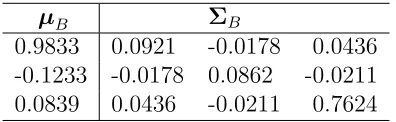
reported in Table 1. The factor loadings{bi}Ni=1 of the simulated models are then generated
from a trivariate Gaussian distribution N3(µB,ΣB).
µB ΣB
[image:20.612.208.406.207.268.2]0.9833 0.0921 -0.0178 0.0436 -0.1233 -0.0178 0.0862 -0.0211 0.0839 0.0436 -0.0211 0.7624
Table 1: Mean and covariance used to generate bi
(2) Assume that the factors follow the stationary vector autoregressive VAR(1) model
ft = µ+Φft−1 +εt for some 3×3 matrix Φ, where εt follows i.i.d N3(0,Σǫ). The model
parameters Φ,µ and Σǫ are calibrated using the daily excess returns of the Fama-French
factors ˜ft. The covariance matrix cov(ft) is then obtained by solving the linear equation
cov(ft) =Φcov(ft)Φ′+Σǫ. Results are summarized in Table 2.
µ Φ cov(ft)
0.0260 -0.1006 0.2803 -0.0365 3.2351 0.1783 0.7783 0.0211 -0.0191 -0.0944 0.0186 0.1783 0.5069 0.0102 -0.0043 0.0116 -0.0272 0.0272 0.7783 0.0102 0.6586
Table 2: Parameters used to generate ft
(3) The error covariance matrix is sparse in our setting. For each fixed N, it is created byΣu =DΣ0D, where D= diag(σ1,· · · , σp). To be more specific, σ1,· · · , σp are generated
independently from a Gamma distribution G(α, β), in which α and β are selected to match the sample mean and sample standard deviation of the 100 standard deviations of the errors ˜
ut = ˜yt−B˜˜ft (recall that each ˜ut is 100 dimensional). An additional restriction is imposed
on σi that only values in between the minimum and maximum of the standard deviation
of ˜ut are accepted. We then generate the off-diagonal entries of the correlation matrix Σ0
independently from a Gaussian distribution, with mean and standard deviation equal to those of the sample correlations of the estimated residuals. Moreover, absolute values of the off-diagonal entries are set to no greater than 0.95. Finally the hard-thresholding is applied to make Σ0 sparse, where the threshold is set to be the smallest constant that makes Σ0
[image:20.612.140.473.405.468.2]4.2
Representative portfolios
We examine the performance of H-CLUB based on w with a couple of different gross exposures. For a given exposure cand given number of assets N, there are infinitely many portfolios w that satisfy PNi=1wi = 1 and PNi=1|wi| =c. In order to be representative, we
take some portfolios randomly from this set. This task, which generates uniformly for the above set inRN, is of independent interest for portfolio optimization and research. It is also challenging.
Let w+ be the total long position and w− be the total short position. Then, w+ =
(c+ 1)/2 and w− = (c−1)/2. For c = 1, there are no-short positions. For c > 1, there
are both long and short positions. The identities (or indices) of long and short positions are hard to identify, but the following sampling scheme is a reasonable approximation: The positive positions are determined by a Bernoulli trial (N times) with probability of success
w+/(w++w−) = (c+ 1)/(2c). Once the identities are determined, we can normalize them
and the problem reduces to the case with c = 1. For the case with c = 1, the uniform distribution on the set {wi : PNi=1wi = 1, wi ≥ 0} can be generated from a normalized
exponential distribution:
wi =ζi/
N
X
i=1
ζi, ζi ∼i.i.d. standard exponential.
Combination of the the above two steps, we can generate a randomly selected portfolio from its feasible set as follows.
1. Generate a positive integer k, the number of stocks with positive weights inw, from a binomial distribution Bin(N,c+1
2c ).
2. Let w+= (w1+,· · · , w+k) be a temporary vector of the positive weights inw. Generate
independently {ζi}ki=1 from the standard exponential distribution and set each wi+ =
(c+ 1)ζi/(2Pkj=1ζj).
3. The temporary negative weights in w− = (w1−,· · · , wN−−k) are generated analogously with each wi− = (1−c)ζi/2PNj=1−kζj, where {ζj}Nj=1−k are obtained independently from
the standard exponential distribution.
4.3
Simulation
For each simulation with a given c, we fix T = 300 and gradually increase N from 20 to 600 in a multiple of 20. For each fixed N, we use 50 different model parameters and 200 testing portfolios for each given set of model parameters so that a total of 10,000 portfolios were actually used. In other words, we iterate the following steps for 50 times, record values of R(w),∆ = |w′(Σb − Σ)w|, ξT and Ub(τ), and compute their own means and standard
deviations. The details are summarized as follows:
1. Generate {bi}Ni=1 independently from N3(µB,ΣB). Set B= (b1,· · · ,bp)′.
2. Generate {ut}Tt=1 independently from Np(0,Σu).
3. Generate {ft}Tt=1 from a VAR(1) model ft =µ+Φft−1+εt with parameters specified
in the calibration part.
4. Calculate yt=Bft+ut for t = 1,· · · , T.
5. Calculate the sample covariance matrix S = T−1PT
t=1(yt−y¯)(yt−y¯)′; obtain the
factor-based covariance estimator Σbf by using the hard-thresholding rule with the threshold ωT = 0.10K
p
logN/T; and get the POET covariance estimator ΣbP using
the soft-thresholding with thresholding parameter 0.5pΩiiΩjj(
q
logN T +
1
√
N).
6. Generate 200 w according to the method described in Section 4.2.
7. Over the 200 generated portfoliosw, compute the average of true riskR(w) =√w′Σw;
Also for Σb = S,Σbf and ΣbP, compute their respective average of ∆ = |w′(Σb −Σ)w|,
ξT = kwk21kΣb −Σkmax and Ub(0.05) = 2
p b
σ2/T. In our setting, the number of lags
L= 5.
Under several gross exposure constraints c, we produce the graph of risk domain by plotting R(w) as a function of cand N (20 to 600 in increments of 20). Averages of ∆, ξT
and Ub(0.05) are also plotted against N, for all three types of covariance estimators Σb. We will observe from the graphs that portfolios with larger care exposed to have higher risks.
Finally, we fix the dimensionality N = 600 and the number of simulation replications is now set to 500. Values of two ratios are recorded, namely ratio of bounds
RE1 =
ξT
b
U(0.05) =
kwk21kΣb −Σkmax
2
q c
var(w′Σwb )
and relative error
RE2 =
b
U(0.05)
4w′Σw =
q c
var(w′Σwb )
2w′Σw .
This is computed for cin a practical range of [1,2] and for several lengths of the time series. The means and standard deviations of the two ratios are summarized in tables below.
4.4
Results
In Figure 1, averages of annualized true risks R(w) of 10000 portfolios 50 sets of model parameters are plotted against dimensionalityN. Multiple curves with different settings on
[image:23.612.178.424.346.565.2]c are produced for comparison purpose. As shown in the figure, average of the actual risk ranges from less than 30% to around 50% per annum, ascvaries from 1 to 4 andN gradually grows from 20 to 600.
Figure 1: Averages of annualized risksR(w) withkwk1 = 1, 2, 3 and 4, over 10000 portfolios.
0 100 200 300 400 500 600
30
35
40
45
N
Ann
ualiz
ed Risk (%)
The Risk Domain
c=1 c=2 c=3 c=4
The following two observations can be made from Figure 1:
(1) The average risk is higher for a larger exposure parameter c. This is consistent with the fact that portfolios with greater gross exposure are more volatile, and hence incur higher risk.
with the theory that as N increases, the portfolio becomes more diversified and the idiosyncratic risk is reduced through diversification.
Figure 2: Averages of ∆ = |w′(Σb −Σ)w| (blue curve), Ub(0.05) = 2
q c
var(w′Σwb ) (dashed
curve) and ξT =kwk21kΣb −Σkmax (red curve) forc= 1 and 1.6 over 10,000 portifolios.
0 100 200 300 400 500 600
0.0
0.5
1.0
1.5
2.0
N
Sample Covariance Estimator
0 100 200 300 400 500 600
0.0
0.5
1.0
1.5
2.0
N
Factor−based Estimator
0 100 200 300 400 500 600
0.0
0.5
1.0
1.5
2.0
N
POET Estimator
(a) c = 1
0 100 200 300 400 500 600
0
1
2
3
4
5
N
Sample Covariance Estimator
0 100 200 300 400 500 600
0
1
2
3
4
5
N
Factor−based Estimator
0 100 200 300 400 500 600
0
1
2
3
4
5
N
POET Estimator
(b) c = 1.6
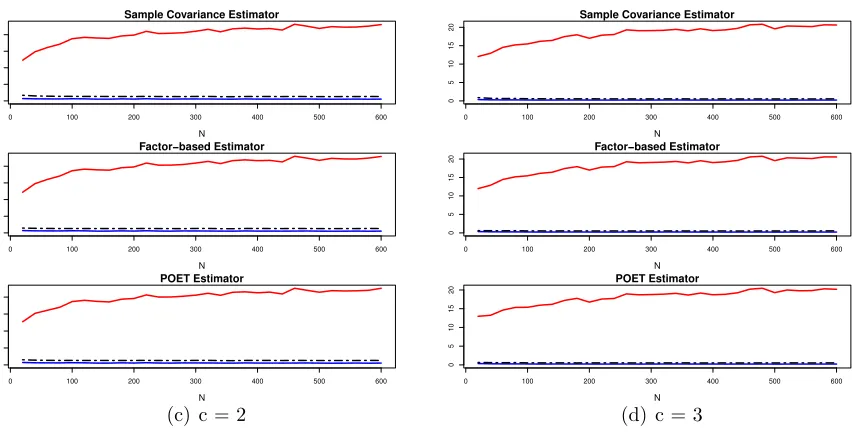
In Figures 2 and 3, the average risk estimation errors are plotted along with their es-timated error bounds for different exposure parameters c=1, 1.6, 2 and 3, using different estimators Σb = S,Σbf and ΣbP. In particular, c = 1.6 results in 130% long positions and 30% short positions (130/30 strategy). The 130/30 structure is popular in long-short funds. In each of the small figure, the dashed curve corresponds to Ub(0.05), the solid red curve corresponds to ξT and the solid blue curve corresponds to ∆. Based on these plots, we can
observe the following features.
(1) The dashed curves lie entirely above the solid blue one, reflecting the validity of the 95%-error bound of Ub(0.05).
(2) The full confidence upper bound ξT is indeed a very crude bound and is much larger
than Ub(0.05). The larger c is, the worse the difference, which will be further detailed in Table 3.
0 100 200 300 400 500 600 0 2 4 6 8 N
Sample Covariance Estimator
0 100 200 300 400 500 600
0 2 4 6 8 N Factor−based Estimator
0 100 200 300 400 500 600
0 2 4 6 8 N POET Estimator
(c) c = 2
0 100 200 300 400 500 600
0 5 10 15 20 N
Sample Covariance Estimator
0 100 200 300 400 500 600
0 5 10 15 20 N Factor−based Estimator
0 100 200 300 400 500 600
0 5 10 15 20 N POET Estimator
[image:25.612.89.518.68.284.2](d) c = 3
Figure 3: Same as in Figure 2, with c= 2 and 3.
Means and standard deviations (in parentheses) of RE1 =ξT/Ub(0.05) are summarized in
Table 3, which quantifies the relation between the full confidence bound and the H-CLUB. Numerical results justify our observations in Figures 2 and 3 in the sense thatξT is in general
many times greater than Ub(τ). Moreover, the ratio ξT/Ub(τ) increases dramatically as the
gross exposure kwk1 increases.
Table 3: Averages and standard deviations (in parenthesis) of RE1 over 500 iterations using
three different estimators.
c= 1 c= 1.2 c= 1.4 c= 1.6 c= 1.8 c= 2
RE1 5.1280 7.4632 10.4257 12.7665 16.7107 20.7675
S (2.1303) (3.2754) (4.3942) (5.5150) (7.1332) (9.0050)
RE1 5.1294 7.4764 10.4544 12.7822 16.8100 20.9012
b
Σf (2.1630) (3.3155) (4.4402) (5.5731) (7.2942) (9.2622)
RE1 5.0910 7.3989 10.3536 12.6485 16.6076 20.6935
b
ΣP (2.1672) (3.3350) (4.5094) (5.5913) (7.3239) (9.3091)
Averages and standard deviations of relative error RE2 =
q c
var(w′Σwb )/2w′Σw with
two choices of the length of time series T are summarized in Table 4-5. RE2 measures
the accuracy of the perceived risk Rb(w)12 with respect to the actual risk R(w) 1
2, indeed
RE2 ≈ ASD(Rb(w)
1
2)/R(w) 1
2. From the tables, it is not difficult to observe that standard
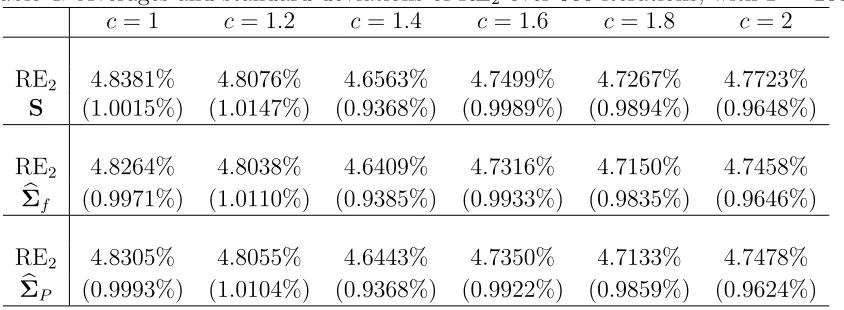
[image:25.612.127.483.463.613.2]the relative error are negligible, at around 3% ∼5%, ensuring the estimate of R(w) a high level of accuracy. More interestingly, we realize that this ratio is approximately independent of the gross exposurec but sensitive to the length of the time series. RE2 steadily decreases
as T grows. In addition, the asymptotic standard deviation of the factor-based estimators (Σbf and ΣbP) are slightly smaller than that of the sample covariance based risk estimator.
Table 4: Averages and standard deviations of RE2 over 500 iterations, with T = 200.
c= 1 c= 1.2 c= 1.4 c= 1.6 c= 1.8 c= 2
RE2 4.8381% 4.8076% 4.6563% 4.7499% 4.7267% 4.7723%
S (1.0015%) (1.0147%) (0.9368%) (0.9989%) (0.9894%) (0.9648%)
RE2 4.8264% 4.8038% 4.6409% 4.7316% 4.7150% 4.7458%
b
Σf (0.9971%) (1.0110%) (0.9385%) (0.9933%) (0.9835%) (0.9646%)
RE2 4.8305% 4.8055% 4.6443% 4.7350% 4.7133% 4.7478%
b
[image:26.612.96.518.191.346.2]ΣP (0.9993%) (1.0104%) (0.9368%) (0.9922%) (0.9859%) (0.9624%)
Table 5: Averages and standard deviations of RE2 over 500 iterations, with T = 400.
c= 1 c= 1.2 c= 1.4 c= 1.6 c= 1.8 c= 2
RE2 3.4773% 3.4840% 3.4836% 3.4857% 3.5176% 3.4846%
S (0.5081%) (0.4936%) (0.4783%) (0.5303%) (0.5117%) (0.5602%)
RE2 3.4693% 3.4759% 3.4699% 3.4708% 3.5009% 3.4588%
b
Σf (0.5081%) (0.4976%) (0.4775%) (0.5217%) (0.5127%) (0.5621%)
RE2 3.4744% 3.4773% 3.4737% 3.4737% 3.5029% 3.4619%
b
ΣP (0.5092%) (0.4964%) (0.4783%) (0.5229%) (0.5132%) (0.5629%)
Finally, we also observe from Tables 3-5 that the asymptotic variances (reflected byUb(τ)) of the estimators based on known and unknown factors are almost the same, and slightly smaller than that of the sample covariance estimator.
5
Empirical Studies
(T = 1000). At the end of each month the covariance matrix is estimated by three estimators, the sample covariance, the factor-based estimator, and the POET estimator, using daily returns of the preceding 12 months (T = 252). In particular, we employ the Fama-French three-factor model to construct the factor-based estimator. Two types of strategies are tested, namely the equally weighted portfolio, and the minimum variance portfolio. The optimal portfolios are constructed under different exposure constraints (c= 1 andc= 1.6). The equally weighted portfolio is given by wb = (1/N,· · · ,1/N). The minimum variance portfolio is given by
b
w= argminw′
1=1,kwk1=cw
′Σwb .
Portfolios are held for one month (T = 21) and rebalanced at the beginning of the next month. Their actual risks in the holding month for wb defined above are
R(wb) = wb′Σwb1/2, Σ= 1
21
21
X
t=1
yty′t.
[image:27.612.71.559.414.625.2]This is aggregated over the entirely testing period.
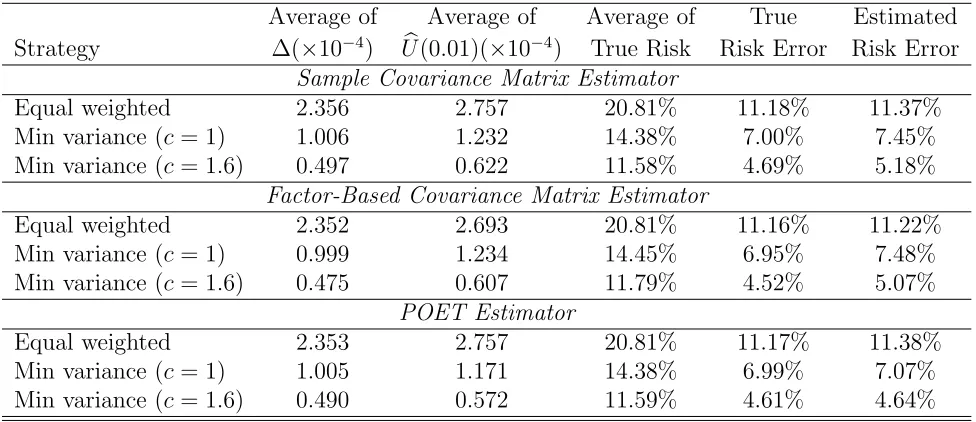
Table 6: True risk errors and estimated risk errors based on the 100 Fama-French Industrial Portfolios.
Average of Average of Average of True Estimated Strategy ∆(×10−4) Ub(0.01)(×10−4) True Risk Risk Error Risk Error
Sample Covariance Matrix Estimator
Equal weighted 2.356 2.757 20.81% 11.18% 11.37%
Min variance (c= 1) 1.006 1.232 14.38% 7.00% 7.45% Min variance (c= 1.6) 0.497 0.622 11.58% 4.69% 5.18%
Factor-Based Covariance Matrix Estimator
Equal weighted 2.352 2.693 20.81% 11.16% 11.22%
Min variance (c= 1) 0.999 1.234 14.45% 6.95% 7.48% Min variance (c= 1.6) 0.475 0.607 11.79% 4.52% 5.07%
POET Estimator
Equal weighted 2.353 2.757 20.81% 11.17% 11.38%
Min variance (c= 1) 1.005 1.171 14.38% 6.99% 7.07% Min variance (c= 1.6) 0.490 0.572 11.59% 4.61% 4.64%
Here ∆ =|w′(Σ−Σb)w|and Ub(0.01) = 2.58(var(c w′Σwb ))1/2. True risk is R(wb). The True Risk
Error and Estimated Risk Error are|(w′Σw)1/2−(w′Σwb )1/2|andUb(0.01)/p4w′Σwb respectively.
example, Corollalry 3.1. Here the risks are annualized. By comparing the first two columns in Table 6, we observe that Ub(0.01) is uniformly greater than ∆, regardless of the strategies and the covariance matrix estimators. This is in line with the expectation that Ub(0.01) is a 99% upper bound of the estimation error of portfolio variances. Moreover, as shown in the two rightmost columns, results are satisfactory in the sense that the estimated risk errors are close (<1% per annum) to the true risk error.
6
Conclusions
In this paper we address the estimation and assessment for the risk of a large portfolio. The risk is estimated by a substitution of a good estimator of the volatility matrix. We propose factor-based risk estimators, based on the approximate factor model with known factors and unknown factors. For the first time in the literature, we derive the limiting distribution of the estimated risks under high dimensionality.
Given that the existing upper bound for the risk estimation error is too crude and not applicable in practice, we introduce a new method, H-CLUB, to assess the accuracy of the risk estimation based on the confidence intervals. Our numerical results demonstrate that the proposed upper bounds significantly outperform the traditional crude bounds, and provide insightful assessment of the estimation of the true portfolio risks.
It is demonstrated in the empirical study that the financial excess returns may not be glob-ally stationary. Our method also allows for locglob-ally stationary time series and can also allow slow-time varying covariance matrices through localization in time (time-domain smoothing).
A
Proofs for the Sample Covariance
Define ZT,t =w′RtR′tw−Ew′RtR′tw, where Z depends on T through dim(Rt) =N =
NT and allocation vector w. ThenγT(h) = EZT,tZT,t+h. In particular,γT(0) = var(ZT,t).
A.1
Proof of Lemma 3.1
Lemma A.1. (i) |(w′Sw)2−(w′Σw)2|=O
p(T−1/2σT).
(ii) maxh≤L|T−1PtT=1−h(w′Rt)2(w′Rt+h)2−E(w′Rt)2(w′Rt+h)2|=Op(
p
L/T).
(iii) maxh≤L|w′Sw−T−1PTt=1−h(w′Rt)2|=Op(L2w′Σw/T).
(iv) maxh≤L|w′Sw−T−1PTt=1−h(w′Rt+h)2|=Op(L2w′Σw/T).
Proof. Note that for anyN×N matrixA= (aij),|w′Aw| ≤ kAkmaxkwk21. Thus|(w′Sw)2−
(w′Σw)2| = O
|T−1PT
t=1ZT,t|=Op(T−1/2
p
σ2
T).
(ii) Let Xt,h = (w′Rt)2(w′Rt+h)2. By the Chebyshev inequality, for any s >0,
P(max
h≤L |
1
T
T
X
t=1
Xt,h−EXt,h|> s)≤Lmax
h≤L P(|
1
T
T
X
t=1
Xt,h−EXt,h|> s)≤
Lmaxh≤Lvar(PTt=1Xt,h)
T2s2 .
Note that maxh≤Lvar(PTt=1Xt,h) =O(T) since maxh≤Lvar(Xt,h) =O(1) and
maxh≤LPTt=1cov(X1,h, Xt+1,h) = O(1). Therefore, for arbitrarily small ǫ > 0, by
choosing s > pLM/(ǫT), P(maxh≤L|T1 PTt=1Xt,h − EXt,h| > s) < ǫ, which implies
maxh≤L|T1 PTt=1Xt,h − EXt,h| = Op(
p
L/T). The conclusion then follows from the ad-justment of theL terms in the summation.
(iii) The left hand side is maxh≤LT−1PTt=T−h+1(w′Rt)2 = maxT−L+1≤t≤T(w′Rt)2L/T.
For any s > 0,P(maxT−L+1≤t≤T(w′Rt)2 > s) ≤LP((w′Rt)2 > s)≤Lw′Σw/s, which then
implies maxT−L+1≤t≤T(w′Rt)2 =Op(Lw′Σw). The desired result then follows.
(iv) A similar argument as above shows maxT+1≤t≤T+L(w′Rt)2 =Op(Lw′Σw). Hence
maxh≤LT−1PTt=T−h+1(w′Rt+h)2 ≤ maxT+1≤t≤T+L(w′Rt)2L/T = Op(L2w′Σw/T). This
im-plies that the desired quantity is bounded by a+Op(L2w′Σw/T) where
a= max
h≤L |
1
T
T
X
t=1
[(wRt)2−(w′Rt+h)2]| ≤ |
1
T
L
X
t=1
(w′Rt)2|+|
1
T
L
X
t=1
(w′RT+t)2|.
Note that |1
T
PL
t=1(w′Rt)2| ≤ max1≤t≤L(w′Rt)2L/T = Op(L2w′Σw/T). Similarly we have
|1
T
PL
t=1(w′RT+t)2|=Op(L2w′Σw/T).
Lemma A.2. maxh≤L|bγ(h)−γT(h)|=Op(
p
L/T).
Proof. The triangular inequality implies maxh≤L|bγ(h)−γT(h)| ≤P4i=1ai, where
a1 = max
h≤L |T
−1
T−h
X
t=1
(w′Rt)2(w′Rt+h)2 −E(w′Rt)2(w′Rt+h)2|, a2 =|(w′Sw)2−(w′Σw)2|
a3 =w′Swmax
h≤L |w
′Sw−T−1
TX−h
t=1
(w′Rt)2|, a4 =w′Swmax
h≤L |w
′Sw−T−1
T−h
X
t=1
(w′Rt+h)2|.
We have, w′Sw ≤ |w′(S−Σ)w|+w′Σw = Op(w′Σw+T−1/2σT2). It then follows from
Lemma A.1 and σ2
T =O(1), L3 =O(T), w′Σw =O(1) that ai =Op(
p
L/T) for i= 1...4, which implies maxh≤L|bγ(h)−γT(h)|=Op(
p
L/T).
By the triangular inequality, |bσ2−σ2
T| ≤
P3
i=1bi, where
b1 =|bγ(0)−γT(0)|, b2 = 2
L
X
h=1
|bγ(h)−γT(h)|, b3 = 2
X
h>L
γT(h)
Hereb2 ≤2Lmaxh≤L|bγ(h)−γT(h)|=Op(L
p
L/T). The convergence rate then follows from Lemma A.2. The second part UbS(τ) = o(
p
logN/T) is due to σb2 =O
p(σT2) as |σT2 −bσ2|=
op(σT2) and σT2 =O(1) =o(logN), as N → ∞.
A.2
Proof of Theorem 3.1
Lemma A.3. (i) EZ2
T,1 =O(1) and maxl≤T |γT(l)|=O(1).
(ii) For any K ∈[m, T], var(PKt=1ZT,t) =KγT(0) + 2KPKh=1(1−h/K)γT(h) = O(K).
Proof. (i) It suffices to show E(w′R
t)4 =O(1). In fact by maxi≤N ER4it =O(1),
E(w′Rt)4 =PN
ijkl=1wiwjwkwlERitRjtRktRlt ≤maxi≤N ER4itkwk41 =O(1). The second part
follows immediately.
(ii) It is well known that for a stationary process with zero mean, var(K−1PK
t=1ZT,t) =
K−1γ
T(0) + 2K−1PKh=1(1−h/K)γT(h), which implies the result.
Lemma A.4. Under the assumptions of Theorem 3.1,
"
var
T
X
t=1
(w′Rt)2
!#−1/2
Tw′(S−Σ)w→dN(0,1). (A.1)
Proof. The proof is based on Theorem 2.1 of Peligrad (1996). We have √Tw′(S−Σ)w=
T−1/2PT
t=1ZT,t. Define BT,K2 = var(
PK
t=1ZT,t) and BT2 = var(
PT
t=1ZT,t) = O(T). Also let
σ2
T =γT(0) + 2P∞h=1γT(h). By Davydov’s inequality (Proposition 2.5 of Fan and Yao, 2003
with p= 1/2 and q= 1/4), there are constants M, M1, M2 >0 such that for any integer h,
|γT(|h|)| ≤8αR(|h|)1/4(E(w′Rt)2)1/2(E(w′Rt)4)1/4 =M2exp(−M|h|r3/4)
where the last equality follows from the α-mixing condition and that E(w′Rt)4 =
O(1). By the assumption that αR(T) = o(γT(0)), the correlation |Corr(ZT,t, ZT,t+T)| ≤
|γT(T)|/γT(0) = o(1). Moreover, the Lindeberg condition holds given maxi≤NER8it <
∞. Hence the conditions of Theorem 2.1 of Peligrad (1996) are satisfied, which implies
BT−1PTt=1ZT,t→dN(0,1), equivalent to (A.1).
Now let ξ(T) = −2PTh=1hγT(h)/T. By the assumption that ξ(T) = o(σT2), we have
T−1/2(σ2
T)−1/2
PT
t=1ZT,t→d N(0,1). This also implies
s T
σ2
T
w′(S−Σ)w→dN(0,1). (A.2)
Due to the assumptions that L3/2T−1/2 = o(σ2
T) and
P
h>LγT(h) = o(σT2), and Lemma
3.1, we have |σ2
T −σb2|=op(σT2). Sincew′(S−Σ)w=Op(T−1/2
p
σ2
T),
√
T|w′(S−Σ)w|
1 p σ2 T
− √1
b σ2
=op(1).
It then follows from (A.2) that pT /bσ2w′(S−Σ)w→d N(0,1), which gives the H-CLUB.
Corollary 3.1 follows straightforward from applying the delta method.
B
Proofs for the Factor-based Estimation
B.1
Proof of Lemma 3.2
Lemma B.1. maxh≤L|bγf(h)−γf(h)|=Op(
p
(L+ logN)/T).
Proof. The triangular inequality implies maxh≤L|bγf(h)−γf(h)| ≤P4i=1ai, where
a1 = max
h≤L |T
−1
T−h
X
t=1
(w′Bfb t+h)2(w′Bfb t)2−E(w′Bft)2(w′Bft+h)2|,
a2 = |(w′Bbcov(c ft)Bb′w)2−(w′Bcov(ft)B′w)2|
a3 = w′Bbcov(c ft)Bb′wmax
h≤L |w
′Bbcov(c f
t)Bb′w−T−1 T−h
X
t=1
(w′Bfb t)2|,
a4 = w′Bbcov(c ft)Bb′wmax
h≤L |w
′Bbcov(c f
t)Bb′w−T−1 T−h
X
t=1
(w′Bfb t+h)2|.
a1 is bounded by a11+a12, where
a11 = maxh≤L|T−1PTt=1−h(w′Bft+h)2(w′Bft)2−E(w′Bft)2(w′Bft+h)2|, and
a12 = maxh≤L|T−1PTt=1−h(w′Bfb t+h)2(w′Bfb t)2−(w′Bft+h)2(w′Bft)2|.
Given the assumption that maxh≤LPTt=1cov[(w′Bf1)2(w′Bf1+h)2,(w′Bf1+t)2(w′Bf1+t+h)2] =
O(1), the same argument of the proof of Lemma A.1(ii) implies a11 = Op(
p
L/T). On the other hand, by (B.14) of Fan et al. (2011), kBb −Bkmax = Op(
p
kw′(Bb−B)k=Op(
p
logN/T). It is then easy to show thata12=Op(
p
logN/T). It follows that a1 =Op(
p
(L+ logN)/T). By the triangular inequality, a2 =Op(
p
logN/T). Finally, by the same argument of the proof of Lemma A.1, we have a3 =Op(L2/T) =a4.
Proof of Lemma 3.2
We have |bσ2
f − σ2f| ≤
P3
i=1bi, where b1 = |bγf(0) − γf(0)|,b3 = 2Ph>Lγf(h), and
b2 = 2PLh=1|bγf(h) − γf(h)|. Lemma B.1 implies b2 ≤ 2Lmaxh≤L|bγf(h) − γf(h)| =
Op(L
p
(L+ logN)/T), which gives the convergence rate. The second statement is due toσb2
f =op(logN).
B.2
Proof of Theorem 3.2
Write R = (R1, ...,RT) be N ×T; F = (f1, ...,fT) be r×T, and cov(c ft) = FF′/T. We
have Bb =RF′(FF′)−1. Define C
T =Bb −B and DT =cov(c ft)−cov(ft). The we have the
following decomposition: w′(Σbf −Σ)w=P4i=1di, where
d1 =w′BDTB′w; d2 = 2w′CTcov(c ft)B′w;
d3 =w′CTcov(c ft)C′Tw, d4 =w′(Σbu−Σu)w.
We now study each of the above four terms separately. LetE= (u1, ...,uT) beN×T. Then
CT =EF′(FF′)−1.
Lemma B.2. (i) kFE′wk=Op(T1/2(w′Σuw)1/4(E|w′ut|4)1/8).
(ii) |d2|=Op(T−1/2(w′Σuw)1/4(E|w′ut|4)1/8)).
Proof. We have,
EkFE′wk2 = E[tr(w′EF′FE′w)] = tr[E(FE′ww′EF′)] = tr[E(FE(E′ww′E|F)F′)] = tr[E(FE(E′ww′E)F′)].
For the inner expectation, E(E′ww′E) = (E[u′tww′us])t≤t,s≤T = (cov(w′ut,w′us))t≤t,s≤T.
By Davydov’s inequality, (see, e.g., Proposition 2.5 of Fan and Yao, 2003 with p= 1/2 and
q= 1/4),|cov(w′ut,w′us)| ≤8αf(|t−s|)1/4(w′Σuw)1/2(E|w′ut|4)1/4, whereα(·) denotes the
α-mixing coefficient. By P∞t=1αf(t)1/4 <∞, we have
EkFE′wk2 =
r
X
k=1
T
X
t=1
T
X
s=1
cov(w′ut,w′us)E(fktfks)
= O(1)(w′Σuw)1/2(E|w′ut|4)1/4
T
X
t=1
T
X
s=1