doi:10.4236/ib.2011.33039 Published Online September 2011 (http://www.SciRP.org/journal/ib)
Technology Acceptance of a Gold Dinar Based
Electronic Payment System
Mohd-Nazri Muhayiddin
1*, Elsadig Musa Ahmed
2, Hishamuddin Ismail
31
Faculty of Entrepreneurship & Business, Universiti Malaysia Kelantan, Kota Bharu,Malaysia; 2Faculty of Business & Law, Multi-media University, Melaka, Malaysia; 3Faculty of Business & Law, Multimedia University, Melaka, Malaysia.
Email: *[email protected], {elsadig.musa, hisham}@mmu.edu.my
Received April 22nd, 2011; revised June 20th, 2011; accepted June 30th, 2011.
ABSTRACT
This study is intended to solve a few constraints existed in physical gold dinar when used as a form of payment. One dinar is equal to 4.25 gram of fine gold. Specifically, this work proposes the use of e-commerce technology to solve those constraints. But before the actual system can be implemented, this research seeks to find out whether or not the public would be ready to adopt the concept of an electronic dinar payment system. The research framework is based on Unified Theory of Acceptance and Use of Technology (UTAUT)[1]. It measures the user acceptance based on these constructs; performance expectancy, effort expectancy, social influence, facilitating conditions, behavioral intention to use. In addition, anxiety and perceived credibility are added as two new constructs. Data collection is based on a questionnaire survey. From the descriptive analysis results, it is discovered that most of the respondents participated in this survey generally agree with the idea of using the proposed dinar based payment system (mean rating of above 4.00).
Keywords: Electronic Payment Systems, Inflation, Monetary Economics, Gold Dinar
1. Introduction
With the prices of gold and silver having hit a new “all-time” high in August 2011, our society has begun to take notice and thus started to ponder on the importance of the two precious metals (gold and silver). It was re-ported [2] that the US dollar has lost 82% of its purchas-ing power, as measured by the Consumer Price Index (CPI) since 1971. The author [2] further illustrated that if 100 widgets can be bought with $1 in 1971, only 18 of such widgets can be bought for $1 in 2006. Mathematics calculation will reveal something even more startling. Back then in 1971 the price of gold was $35 per ounce [3]. At its highest price (11 August 2011), we need to fork out $1786 [4] to buy exactly the same one ounce of gold. Thus from 1971 to 2011 (in 40 years), in terms of US dollars, the inflation has gone up by 5003% i.e.
(1786- 35)/35 × 100%. Or equivalently, for the duration of 40 years, the US dollar has lost 5003% of its purchas-ing power. The strength of purchaspurchas-ing power in gold and silver has become known facts by now and it is widely discussed in many literatures [3,5,6].
2. Background of Problem
In order to be as close to a practical situation as possible,
this study uses actual data (from real Malaysian market) to show the superior performance of gold’s purchasing power as compared to that of Ringgit Malaysia (RM). Prices of a few inflationary items are shown in RM as well as their corresponding prices in dinar (gold). In this case, the price performance (purchasing power) between these two competing currencies can be compared side by side. The readers can therefore make a straight-forward comparison on the performance of purchasing power between fiat currency and that of sound money (dinar and dirham).
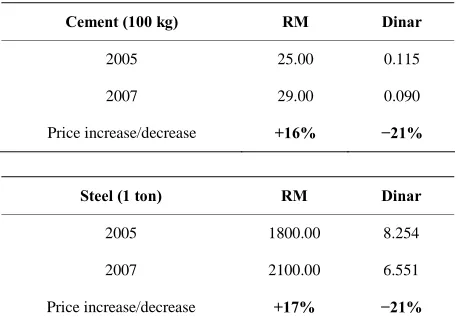
Tables 1 to 4 below illustrate the performance of dinar as compared to the performance of fiat currency (i.e. RM) for various critical consumer items and services. It is to be noted that dinar is to be used for high-valued items whereas dirham is used for low-valued items. Table 5 shows salary comparison—paid in dinar versus paid in Ringgit Malaysia (RM).
Table 1. Fuel price comparison (in RM and Dinar).
Petrol (50 liter) RM Dinar
2000 60.00 0.428
2009 90.00 0.178
Price increase/decrease +50% −58%
Diesel (50 liter) RM Dinar
2000 35.50 0.253
2009 85.00 0.168
Price increase/decrease +139% −34%
[image:2.595.309.535.101.170.2]Note: Prices of gold are USD270 and USD1050 respectively per ounce in Oct. 2000 and Oct. 2009 (London fix); Prices of petrol are RM1.20 and RM1.80 respectively per liter in 2000 and 2009; Prices of diesel are RM0.71 and RM1.70 respectively per liter in 2000 and 2009.
Table 2. Electricity price comparison (RM and Dinar).
Electricity (Domestic, 300 kWh) RM Dinar
2000 69.40 0.495
2009 72.50 0.233
Price increase/decrease +4% −53%
Electricity (Commercial, 3000 kWh) RM Dinar
2000 864.00 6.163
2009 969.00 3.114
Price increase/decrease +12% −49%
Note: Prices of gold are USD270 and USD1050 respectively per ounce in Oct. 2000 and Oct. 2009 (London fix).
Table 3. Construction items price comparison (RM and Dinar).
Cement (100 kg) RM Dinar
2005 25.00 0.115
2007 29.00 0.090
Price increase/decrease +16% −21%
Steel (1 ton) RM Dinar
2005 1800.00 8.254
2007 2100.00 6.551
Price increase/decrease +17% −21%
[image:2.595.312.534.237.324.2]Note: Prices of gold are USD420 and USD690 respectively per ounce in 2005 and 2007 (London fix).
Table 4. Cost of Hajj (travel) in RM and Dinar.
Cost of Hajj (lowest package) RM Dinar
2002 13,500 93.53
2009 19,990 39.53
Price increase/decrease +48.1% −57.7%
[image:2.595.58.286.317.481.2]Note: Prices of gold are USD278 and USD1050 respectively per ounce in 2002 and 2009 (London fix). Cost of Hajj is based on the lowest THTS package as per stated in TH Annual Report; (TH: Tabung Haji, THTS: TH Travel & Services).
Table 5. Salary comparison in RM and Dinar.
Salary Paid (Malaysia) Dinar RM
Jan 1992 15.50 *1800
Jan 2007 15.50 4968
Feb 2009 15.50 6975
Oct 2009 15.50 7838
Note: Price of gold in Jan. 1992 is USD340 per ounce. Price of gold in Jan. 2007 is USD690 per ounce; Price of gold in Feb. 2009 is USD915 per ounce; Price of gold in Oct. 2009 is USD1050 per ounce; *RM1800 is a starting salary for a fresh engineer in Malaysia in 1992; (All gold prices are based on London fix price).
ings. As for the case of salary, Table 5 clearly shows that dinar preserve the value of salaries over time. Apparently, salaries paid in dinar appreciate over time automatically, even without annual increments.
It should be noticed from the tables above that the performance of dinar is much superior as compared to that of RM (or other fiat money). Apparently in all tables, what appears to be a “price increase (inflation)” in RM is merely a “price decrease” in dinar. It becomes obvious from the above tables that dinar (gold) is able to preserve their “intrinsic value”; whereas the paper (fiat) money simply could not do that.
[image:2.595.58.287.539.701.2]addressed would be how to identify the purity of dinar denominations in each transaction such that fraud and cheating cases would be minimized and if possible, to-tally prevented. The fourth is divisibility constraint asso-ciated with the dinar. In today’s price, the value of 1 di-nar is in the range of RM800-RM850 a piece, thus mak-ing it impractical for buymak-ing of small-priced items. The last constraint of physical dinar is the possible consumer losses due to the existence of buying and selling prices (known as spread) imposed by dinar traders. Shop own-ers will accept the value of physical dinar at buying prices (lower) instead of at selling prices (higher).
Therefore those issues of portability, wear and tear, purity concern, divisibility and the dinar spread—all of them must be properly addressed in order for dinar to be widely accepted by the public. In particular, this work would focus on using the e-commerce technology in a form of an electronic payment system to solve a few limitations associated with dinar (gold). The reason to introduce the electronic commerce technology in dinar is because it offers several advantages that the physical (brick-and-mortar) methods of dinar transactions simply could not offer. This research believes that the electronic commerce technology is capable of solving such a few constraints associated with the physical dinar. With the use of electronic dinar payment system, the physical movements of dinar will be expected to be very minimal, and thus it is believed it can solve the portability issue. Apart from that, the electronic dinar payment system would also solve problem with “wear and tear” since users do not keep their dinar at their premises but rather in storage vaults somewhere else with user accounts strictly associated with each of them. Another advantage offered by electronic dinar payment system is the ability to bypass unnecessary checking of purity; due to the fact that the dinar is kept at providers’ storage vaults whereby its purity are already known beforehand and they are undisturbed by outside parties. As for divisibility con- straint; electronic dinar payment system would enable customers to buy small-valued items e.g. up to 0.001 dinar (equivalent to RM0.80) because data are stored and processed by computers. Furthermore, using electronic dinar payment system would be much safer, because we don’t carry the expensive gold in our pocket—only its electronic representation. Lastly, the proposed electronic dinar payment system would also be able to solve prob- lems with ‘spread’ imposed by gold sellers. If this elec- tronic dinar payment system could be set-up as identical as possible to credit/debit card system, the 3% - 5% spread value would be converted into a transaction fee. This kind of fee would normally be absorbed by the shop owners. Therefore all in all, the proposed electronic dinar payment system would solve a few constraints with
physical dinar, and at the same time it carries with it the great advantage of purchasing power.
But before the actual system can be implemented in Malaysian market, this research attempts to find out be- forehand whether the public would be willing to adopt the proposed dinar electronic payment system. Specifi- cally, this research would explore what are those factors that influence the acceptance of the electronic dinar payment system. Those factors could be a positive factor whereby it will enhance the effect of intention to use; or it could as well be a negative factor of which in this case it will degrade the effect of intention to use. Following a research framework adapted from Unified Theory of Acceptance and Use of Technology (UTAUT), those factors would include performance expectancy, effort expectancy, social influence, facilitating conditions, per- ceived credibility, and anxiety.
3. Literature Review
An understanding of technology acceptance models is very important in order to fully appreciate why one model is chosen over the other. Researchers are always confronted with choosing the most appropriate model for their particular researches. Often times, they must “pick and choose” constructs among the various models avail- able. Alternatively, they may choose one “favored model” and largely ignore the possible contributions from other models. Effort by [1] to solve this predicament is greatly welcomed among the information system (IS) research circles. His [1] team has introduced and tested the new and unified model, known as Unified Theory of Accep- tance and Use of Technology (UTAUT) which integrates the previous eight (8) models used in technology accep- tance studies. Those eight models are: Theory of Rea- soned Action (TRA), Technology Acceptance Model (TAM), Motivational Model (MM), Theory of Planned Behavior (TPB), a model which combines TAM and TPB (C-TAM-TPB), Model of PC Utilization (MPCU), Innovation Diffusion Theory (IDT), and Social Cognitive Theory (SCT).
With the objective of introducing a comprehensive model that considers all variables included in the previ- ous eight prominent models, [1] developed a research to empirically compare and test each of the constructs in those models. Their research has found that the eight previous models were able to explain (between) 17 per- cent to 53 percent of the variance in user intentions (that is, to use information technology). Subsequently, a uni- fied model (UTAUT) that integrates elements across the eight models are thereby formulated and empirically validated. With UTAUT, it is found the model had out- performed the previous eight individual models (adjusted
from two new organizations; it still gave very similar re- sults (adjusted R2 of 70 percent). Having had this sub- stantial improvement over its predecessors, UTAUT would thus provide a very useful tool in order to assess the likelihood acceptance factors of introducing a new technology.
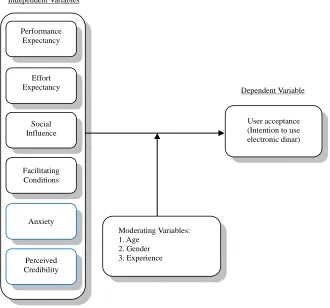
Therefore, the research framework for this work is adapted from UTAUT with two additional variables added. This study intends to find out the consumer ac- ceptance of electronic dinar payment system based on the four original constructs of UTAUT model. Those con- structs are performance expectancy, effort expectancy, social influence, and facilitating conditions. This research also intends to find out how significant is the contributions of moderators in this case. Out of four moderators in the original UTAUT model, only three would be applied in this study. Those three moderators are gender, age, and experience while the fourth moderator (voluntariness of use) is not included since the proposed electronic dinar payment system would be purely voluntary in nature and therefore its purpose is irrelevant in this case. The two additional variables, “perceived credibility” and “anxi-ety”, are hypothesized to be very relevant to this study
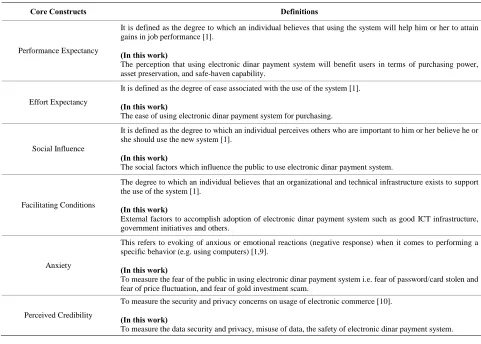
and therefore their influence is expected to be significant in the proposed model. Anxiety is adapted from [9] as well as [1] while perceived credibility is adapted from [10]. Table 6 explains all constructs included in this re-search framework. Figure 1 illustrates the model of re-search framework used for this study.
4. Methodology
This research is a quantitative research whereby an analysis and classification of numerical data will be col- lected from survey questionnaires. The questionnaires will be developed based on research frameworks which is adapted from the Unified Theory of Acceptance and Use of Technology (UTAUT) model—with two extra variables added (anxiety, and perceived credibility). The introduction of two variables is specifically tailored to reflect the individual technology acceptance of electronic dinar payment system. All surveys consist of a closed- ended question. Respondents will only choose answers already provided with the questions.
[image:4.595.55.536.387.731.2]This paper investigates the descriptive analysis results, of which the survey was distributed to 500 respondents in the Multimedia Super Corridor (MSC) area in Malaysia.
Table 6. Research framework core constructs used in this study.
Core Constructs Definitions
Performance Expectancy
It is defined as the degree to which an individual believes that using the system will help him or her to attain gains in job performance [1].
(In this work)
The perception that using electronic dinar payment system will benefit users in terms of purchasing power, asset preservation, and safe-haven capability.
Effort Expectancy
It is defined as the degree of ease associated with the use of the system [1].
(In this work)
The ease of using electronic dinar payment system for purchasing.
Social Influence
It is defined as the degree to which an individual perceives others who are important to him or her believe he or she should use the new system [1].
(In this work)
The social factors which influence the public to use electronic dinar payment system.
Facilitating Conditions
The degree to which an individual believes that an organizational and technical infrastructure exists to support the use of the system [1].
(In this work)
External factors to accomplish adoption of electronic dinar payment system such as good ICT infrastructure, government initiatives and others.
Anxiety
This refers to evoking of anxious or emotional reactions (negative response) when it comes to performing a specific behavior (e.g. using computers) [1,9].
(In this work)
To measure the fear of the public in using electronic dinar payment system i.e. fear of password/card stolen and fear of price fluctuation, and fear of gold investment scam.
Perceived Credibility
To measure the security and privacy concerns on usage of electronic commerce [10].
(In this work)
Performance Expectancy
Effort Expectancy
Social Influence
Facilitating Conditions
Anxiety
Perceived Credibility
Moderating Variables: 1. Age
2. Gender 3. Experience
[image:5.595.135.465.104.412.2]User acceptance (Intention to use electronic dinar) Dependent Variable Independent Variables
Figure 1. Research framework for user acceptance of electronic dinar payment system.
The MSC area is selected because e-commerce applica- tions are widely expected to be active in those areas. The response rate was 87.2% (436 respondents had answered it completely). The first section of the survey contains questions related to respondents’ experiences with e-com- merce, gold, and dinar. Section A contains questions re- lated to performance expectancy. Section B has questions measuring effort expectancy. Section C has questions related to social influence. Section D consists of ques-tions investigating factors related to facilitating condi-tions. Section E investigates factors related to anxiety (concerns) of adopting the proposed electronic dinar payment system. Section F measures perceived credibil-ity (securcredibil-ity and privacy concerns). Section G contains at least three questions measuring respondents’ behavioural intention to use the electronic dinar payment system. The last section of the survey consists of questions related to respondents’ information such as gender, race, age, monthly income, educational attainment, marital status, and employment status. A five-point Likert scale is used to measure to what extent an individual agree or disagree to the questions being asked. Likert scale is measured as follows: “1” is for Strongly Disagree, “2” is for
Dis-agree, “3” is for neither agree nor disDis-agree, “4” is for Agree, and “5” is for Strongly Agree. The SPSS soft-ware is used in this descriptive analysis of the collected data.
[image:5.595.310.540.562.716.2]5. Results
Table 7 shows the general profiles of the respondents participated in this study.
Table 7. Profiles of the respondents.
Frequency Percent
Male 263 60.3
Gender
Female 173 39.7
Below 24 28 6.4
25 - 39 334 76.6
Age
40 and above 74 17.0
Yes 239 54.8
Experience (buying dinar)
6. Discussion
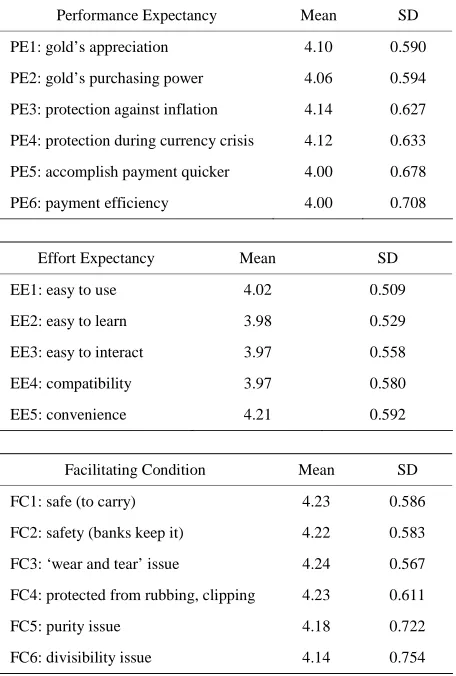
Overall, most of the respondents in this study would agree on the idea of using electronic dinar payment sys- tem. This is based on their ratings of behavioral intention to use which range from 3.98 to 4.03 (mean rating of 4.01). This is a positive result and in agreement with the ratings of independent variables that are supposed to in- fluence it. The ratings of those independent variables will be discussed next.
6.1. Performance Expectancy
[image:6.595.59.287.383.721.2]It can be concluded that the respondents agree with the performance expectancy construct (Table 8) with its rat-ings range from 4.00 to 4.14. The first four items with ratings greater than 4.00 show that most respondents agree with the advantage of electronic dinar in terms of appreciating values, purchasing power, inflation proof and “safe haven” capability. The last two factors in this construct carry slightly lower influence with ratings of only 4.00 for both of them. The two factors show that a few respondents are still not sure whether or not the sys-
Table 8. Ratings of BI and factors affecting respondents’ intention to use.
Performance Expectancy Mean SD
PE1: gold’s appreciation 4.10 0.590
PE2: gold’s purchasing power 4.06 0.594
PE3: protection against inflation 4.14 0.627
PE4: protection during currency crisis 4.12 0.633
PE5: accomplish payment quicker 4.00 0.678
PE6: payment efficiency 4.00 0.708
Effort Expectancy Mean SD
EE1: easy to use 4.02 0.509
EE2: easy to learn 3.98 0.529
EE3: easy to interact 3.97 0.558
EE4: compatibility 3.97 0.580
EE5: convenience 4.21 0.592
Facilitating Condition Mean SD
FC1: safe (to carry) 4.23 0.586
FC2: safety (banks keep it) 4.22 0.583
FC3: ‘wear and tear’ issue 4.24 0.567
FC4: protected from rubbing, clipping 4.23 0.611
FC5: purity issue 4.18 0.722
FC6: divisibility issue 4.14 0.754
Social Influence Mean SD
SI1: people who influence 3.90 0.542
SI2: people who are important 3.90 0.584
SI3: family factor 3.86 0.618
SI4: friends factor 3.85 0.620
SI5: people who understand gold’s value 4.16 0.641
Perceived Credibility Mean SD
PCR1: personal information 4.17 0.743
PCR2: secured transactions 4.19 0.661
PCR3: companies should be trustworthy 4.51 0.641
PCR4: services own by owned by government 4.20 0.898
PCR5: services operated by major banks 4.35 0.707
PCR6: backed by physical dinar coins 4.47 0.589
PCR7: physical dinar coins withdrawal allowed 4.47 0.573
PCR7: widely accepted 4.52 0.561
Anxiety Mean SD
ANX1: gold investment scam 4.26 0.873
ANX2: computer hacking 4.27 0.768
ANX3: gold price fluctuation 3.86 1.027
ANX4: losing card or password 3.48 1.137
ANX5: lack of internet and computer skills 1.91 1.245
Behavioral Intention (BI) Mean SD
BI1: intend to use 4.02 0.507
BI2: predict to use 3.98 0.542
BI3: plan to use 4.03 0.556
tem would be effective. This skepticism is understood since the actual electronic dinar payment system is not there yet in the market and therefore they have no ex- perience of using the system.
6.2. Effort Expectancy
Most of the respondents agree that electronic dinar pay- ment system would be easy to use, learn, and interact if is similar to existing electronic payment systems (ratings of 3.97 to 4.02). The 4.21 rating on the last factor in this construct (convenience) shows that they would agree using electronic dinar would be more convenient com- pared to using physical dinar coins.
6.3. Facilitating Condition
(six of them). The range is from 4.14 to 4.24. Those fac- tors that can facilitate the effective usage of electronic dinar payment system are explored in this construct. So it is not surprising, this construct carries high ratings. Please refer to Table 8 for factors influencing this con- struct.
6.4. Social Influence
There appears to be a mixed perception from respondents whether factors from this construct could influence their acceptance of electronic dinar payment system. Among the first four factors, the “people who influence” and “people who are important” factors carry the highest rat-ing (3.90). Family and friends items carry slightly lower influence (ratings 3.86 to 3.85 respectively). However, most of them agree with the perception that those who understand the true value of gold would likely use this system (rating 4.16).
6.5. Perceived Credibility
This is another construct which has scores > 4.00 in all of their factors (ratings from 4.17 to 4.52). Most of the re-spondents agree that perceived credibility is an important construct that will determine whether or not they intend to accept the proposed electronic dinar payment system in the future.
6.6. Anxiety
Most of the respondents are sure that they would be afraid to use the proposed electronic dinar system due to the many cases of gold investment scam and also due to problems with hacking in computer/payment systems (ratings of 4.26 and 4.27 respectively). For factors 3 and 4 i.e. afraid of gold price going down and afraid of losing card or password, respondents are pretty much undecided in their opinions (mean 3.86/SD = 1.027 and mean 3.48/ SD = 1.137 respectively). However, most of them dis- agree with factor 5 i.e. they are not afraid of lacking internet and computer skills (rating 1.91). The standard deviation of 1.245 in factor 5 indicates that respondents are quite dispersed in opinion with regards to this factor.
7. Conclusions and Limitations
This research added a new research framework to an ac-ceptance study of a dinar system in Malaysia, particularly in the study of the electronic version of dinar payment system. The framework for this research is adapted from UTAUT model with an addition of two new constructs; to suitably explore the “intention to use” of an electronic dinar payment system. This study discovered that most of the respondents generally agree to accept the idea of us- ing the proposed electronic dinar payment system. Ap-
parently, it is found that certain factors are perceived to have stronger influence than the others. This is generally expected in any information system (IS) acceptance studies whereby different factors do exert various degree of influence on different constructs. The performance expectancy, facilitating condition, and perceived credi- bility carry the most weight (4.00 and above) among all of the constructs. It is expected that researchers and prac- titioners in dinar and dirham institutions would benefit from this study. This result has given an early indication as to what would be the public’s acceptance of dinar and dirham in the near future. This research is limited in its generalization due to the fact that the data were taken only in the Multimedia Super Corridor area. The results would have been more significant if the survey data is covered for the whole Malaysia. Furthermore, due to the constraints on the length of the paper, the multiple re- gression analysis and the effects of moderating variables (such as age, gender, and experience) have not been ex-amined in this descriptive study. These two limitations will be taken up later in our future publications.
REFERENCES
[1] V. Venkatesh, M. G. Morris, G. B. Davis and F. D. Davis, “User Acceptance of Information Technology: Toward a Unified View,” MIS Quarterly, Vol. 27, No. 3, 2003, pp. 425-478.
[2] N. Barisheff, “August 15, 1971: Inflation Unleashed,” 2006. http://www.bmgbullion.com/document/316
[3] N. Lewis, “Gold, the Once and Future Money,” John Wiley & Sons, New Jersey, 2007.
[4] Kitco Inc., “Past Historical London Fix,” 2011. http://www.kitco.com/gold.londonfix.html
[5] A. K. M. Meera, “The Islamic Gold Dinar,” Pelanduk Publication, Selangor, 2002.
[6] J. Turk and J. Rubino, “The Coming Collapse of the Dol-lar and How to Profit from It,” Currency Doubleday (Di-vision of Random House Inc.), New York, 2004. [7] S. Leeb and G. C. Strathy, “The Coming Economic
Col-lapse: How You Can Thrive When Oil Costs $200 a Bar-rel,” Warner Business Books, New York, 2006.
[8] D. Paarlberg, “An Analysis and History of Inflation,” Praeger Publishers, Connecticut, 1993.
[9] D. R. Compeau and C. A. Higgins, “Computer Self-Efi- cacy: Development of a Measure and Initial Test,” MIS
Quaterly, Vol. 19, No. 2, 1995, pp. 189-211.
[10] Y. S. Wang, Y. M. Wang, H. H. Lin and T. I. Tang, “De-terminants of User Acceptance of Internet Banking: An Empirical Study,” International Journal of Service
In-dustry Management, Vol. 14, No. 5, 2003, pp. 501-519.