Reliability Analysis of Systems Based on the UFLP under
Facility Failure and Conditional Supply Cases
Min Wang, Zongtian Wei, Yun He
Department of Mathematics, Xi’an University of Architecture and Technology, Xi’an, China Email: [email protected]
Received November 24, 2011; revised January 10, 2012; accepted January 20,2012
ABSTRACT
The reliability of facility location problems has been received wide attention for several decades. Researchers formulate varied models to optimize the reliability of location decisions. But the most of such studies are not practical since the models are too ideal. In this paper, based on the classical uncapacitated fixed-charge location problem (UFLP) and some supply constraints from the reality, we distinguish deterministic facility failure and stochastic facility failure cases to formulate models to measure the reliability of a system. The computational results and reliability envelopes for a specific example are also given.
Keywords: Reliability Analysis; Facility Failure; Supply Constraint; Uncapacitated Fixed Charge Location Problem
1. Introduction
The uncapacitated fixed-charge location problem (UFLP) [1] is a classical facility location problem that chooses facility locations and assignments of customers to facili-ties to minimize the sum of fixed and transportation costs. Once a set of facilities has been constructed, however, one or more of them may from time to time become un-available, we call it the facility failure. For example, due to inclement weather, earthquakes, sabotage, or changes in ownership. The facility “failures” may result in exces-sive transportation costs as customers previously served by these facilities must now be served by more distant ones. Snyder and Daskin [2] define the “reliability” of a system as the ability of a system to perform well even when parts of the system have failed. They formulate models based on the UFLP and other classical discrete location problems to optimize the reliability of a system. However, they ignore an actual situation that suppliers would not like to serve the customers too far from them when the supplier who serves these customers previously has failed.
Throughout this paper, we use the concept “reliability” defined in [2]. In this paper, adopting the facility location analysis framework, we consider facility systems’ reli-ability analysis based on the UFLP and some supply cons- traints when subject to facility failures.
The remainder of this paper is structured as follows. We formulate two reliability analysis models based on the UFLP in§2. The computational results and the reli-ability envelops of an example are presented in§3. In§4,
we give a summary of this paper.
2. Models
The facility location problem is a classical optimization problem to determine the number and locations of a set of facilities and assign customers to these in such a way that the total cost is minimized. Two types of costs are considered in the problem. A setup cost (facility cost) oc- curs while a facility is opened, and a connection cost occurs while a customer is assigned to the opened facility. A fruitful research results have obtained in this field and the topic remain hot still (see [3-6] and the references therein).
2.1. The Uncapacitated Fixed-Charge Location Problem
If an arbitrary number of customers can be connected to a facility, the problem is called UFLP. The follows is the model of the classical facility location problem UFLP.
Sets:
I: set of customers, indexed by i;
J: set of potential facility locations, indexed by j.
i
h iI
Parameters:
: demand at customer ;
fj: fixed cost of open a facility at jJ; ij
d i j
i c
: the distance from customer to facility ; : transportation cost per unit per distance;
: weight of the fixed cost in the objective function.
Decision variables:
1, if a facility is opened
0, ot
j X
at location herwise
j
d to facility herwise
i j
1, if customer is assign
0, ot
ij Y
The model of the UFLP is as follows
min j j 1
j J i
i i ij ij I j J
Z f X
c h d Y
(2) (3) (4) (5) * (1)
1 , . . 0,1 0,1 , ij j J ij j j ijY i I
Y X i I j J
s t
X j J
Y i I j J
The objective function (1) minimizes the weighted sum of the fixed cost for opening the facilities and the demand weighted total distance. Constraints (2) stipulate that each customer is assigned to exactly one facility, while constraints (3) limit assignments to open sites. Fi-nally, constraints (4) and (5) are integrality constraints. 2.2. The Reliability Analysis Model under
Deterministic Facility Failure Case
In the UFLP, when one or more facilities have failed, the overall supplement of the facility system will decrease dramatically but the total demand does not change. If in this situation all demands must be met, then every node must has no any supply capacity limit. However, the ca-pacity of facilities are designed a priori, when facility failures happen, how can the remained facilities guaran-tee the increased demands? Even the remaining facilities can satisfy the whole demands, the transportation cost will increase dramatically because the customers served by the failed facilities now must be served by the re-maining facilities that are far away from them. In most cases, conditional service is a desirable policy, e.g., once the weighted distance between a supplier and a customer exceed some value, the demand can be given up. Based on this idea, we formulate a new reliable model under deterministic facility failures as the follows.
Let Xj and Yij be an optimal solution of the UFLP and S be the corresponding system. Denote
*
*
C
j X: j 1
and Nj
i Y: ij 1
,j1, 2,,C. Let F C be the potential failure facility set, where the failure is defined as a facility losses its designed function completely. Let r be the set of scenarios cor-responding to the failure of r facilities from S, i.e., every
r
S
sS explicitly specifies the failed facilities in S. r Denote the failed facility set corresponding to s as Fs, then the set of customers which need to reassign suppli-
ers is
s
j s
j F
N N F
r
. Parameters:
: number of failed facilities; j
V : supply constraint of facility j; i
: per unit penalty due to give up the supply to cus-tomer i;
i
c : transport cost to customer i per unit per distance.
Max ,
j
j i ij i
i N
V h d j C
Where
,
c d i N
and
i i ij i
, i and i are the weight ratio, and ij denotes the shortest distance between customer i and distribution center such that Y in the op-timal solution of the UFLP.
d
j ij 1
1, Y
We define the assignment variables as ijs if cus- tomer i is served by facility j in scenario s, ,
0 other- wise. The model is:
\ \
Min min 1
1
r
s j s
r j
s S
j C
i i ij ijs i i ijs i i ij
i N j C F i N j C F
Z f
c h d Y h Y c h d
\. . 1, ,
s
ijs r
j C F
(6)
s t Y i N s S
(7), , \ ,
i ij ijs j s r
h d Y V i N jC F sS (8)
0, 1 , , \ ,ijs s r
Y i N jC F sS (9) r
r
The objective function (6) selects failed facilities from F in order to minimize the resulting total cost. Con-straints (7) require that each customer be served by at most one server in any scenario. Constraints (8) represent the supply conditions. Constraints (9) require the as-signment variables to be binary.
Changing “Min” to “Max” in the objective function, then we can obtain the worst case model that is the model to measure the maximal system cost under the facility failure level .
2.3. The Reliability Analysis Model under Stochastic Facility Failure Case
The reliability model formulated above is based upon a deterministic analysis. We now consider the case where the facility failure is not a certainty. Usually, the chances of losing a facility are based upon some probability. We wish to derive the maximal or minimal expected effi-ciencies associated with an existing system. To do this we need to identify both the worst case and the best case expected outcomes.
F
F at most once and that the facilities in each facility in
F will be hit simultaneously. Let be the scenario set when
r S
0
r r F facilities in F have been at-tacked. Each FsSr specifies which r facilities in
F have been attacked. We also use s to denote the facility set that have been attacked. Then any Fss can be used to represent a failed facility set in scenario
s. Let pj be the failure probability of facility jF after one attack and the failures are independent each other for any two facilities. It is easy to see that scenario
s
F occurs with probability
\
1
s s
s
F j pj
Y
j F j
s F
1,
P p
We define the decision variables as
s
ijF if
cus-tomer i is served by facility j in scenario Fs; 0, otherwise. The parameters not define here are as the same in that of the last subsection. The model is as the follows.
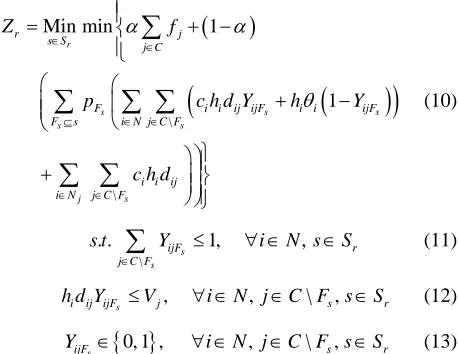
\ \ min s s s s j s r j j CF ijF ijF
i N j C F
i i ij j C F
Z f
h Y
c h d
r
1s i i
d Y h
, Min r s S F s i N 1 i i p c 1, ij (10) \ . . s s ijF j C F
s t Y
iN s \ s C F
\ s, N j
r S
,sSr
r C F sS
r r , (11) , , s
j ijFY Vj j
0, 1 , ,i i
h d
ijF
i
Y i
N (12)
s (13)
The objective function (10) selects failed facilities from F in order to minimize the resulting total cost ex-pectation. Constraints (11) require that each customer be served by at most one server in any scenario. Constraints (12) represent the supply conditions. Constraints (13) require the assignment variables to be binary.
Changing “Min” to “Max” in the objective function, then we obtain the worst case model, that is, the model to measure the maximal system cost expectation under the facility failure level .
3. A Computing Example and Reliability
Envelopes
The models described above can be applied to a given facility system over a range of facility loss level . One can easily enumerate each of the possible ways of losing one facility as well as calculate the impact of each possi-ble loss in terms of changes in cost. The results of this series of calculations will define a range of losses from
the best case (i.e. the least increase in cost) to the worst case (i.e. the greatest increase in cost). We then have a region defined by an upper curve and a lower curve, where the upper and the lower curve represent the solu-tions of the least or the greatest impact associated with a given facility loss level, respectively. The region de-picted between these two curves can be defined as the operational envelope or reliability envelope. For a given edge loss level, this envelope specifies the range of pos- sible system performance from the best-case to the worst-case. Actual performance will fall within this range.
J I
Assume we use the data set (see [7]) to opti-mally solve an UFLP with 0.7
1.2
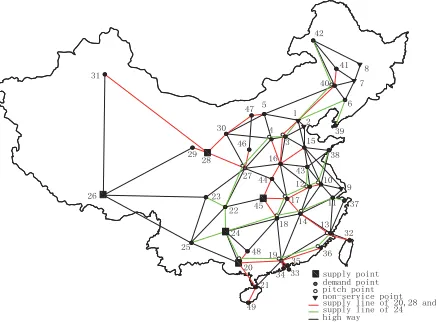
in order to establish a facility system. Figure 1 shows the optimal solution, where the 8 distribution centers are city 4, city 7, city 11, city 20, city 24, city 26, city 28 and city 45, and the edges marked by red color represent the delivery routes from each distribution center to its customers.
Given this operating system of 8 facilities and a poten-tial facility failure set F which is consisted of 7 facilities: 4, 7, 11, 20, 24, 28, 45, and i , i1.5, we solve the deterministic facility failure model. The solu-tions are given in Table 1.
Since the 8 distribution centers are also customers and city 26 only serves itself, we let the supply constraint of city 26 be V max
V ,jCandj26 .
i
j The penalty
value of the customers in C are established to be
max ,i I C\ .
i
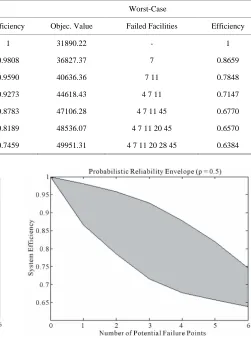
By using the same data, we then solve the stochastic reliability model with facility failure probability p = 0.5. The solutions are shown in Table 2. In this paper, we define the reliability of a system as the ratio of the sys-tem’s total operational cost when no facility failures and the total cost after some facilities have failed. Figures 2 and 3 are the corresponding reliability envelopes.
[image:3.595.59.288.316.493.2]
Figures 4 and 5 give the operational conditions of the
Figure 1. Optimal solution of the UFLP with α = 0.7.
Table 1. Solution of the deterministic reliability model with α = 0.7.
Level Best-Case Worst-Case
r Objec. Value Failed Facilities Efficiency Objec. Value Failed Facilities Efficiency
0 31890.22 - 1 31890.22 - 1
1 33139.68 24 0.9623 41764.52 7 0.7636
2 34617.96 24 28 0.9212 49382.51 7 11 0.6458
3 36893.28 24 28 45 0.8644 60474.09 4 7 11 0.5273
4 40725.83 4 11 24 45 0.7830 70701.22 4 7 11 45 0.4511
5 44537.72 4 11 24 28 45 0.7160 75905.44 4 7 11 28 45 0.4201
6 48673.00 4 11 20 24 28 45 0.6552 79165.84 4 7 11 20 28 45 0.4028
Table 2. Solution of the stochastic reliability model with facility failure probability 0.5.
Level Best-Case Worst-Case
r Objec. Value Failed Facilities Efficiency Objec. Value Failed Facilities Efficiency
0 31890.22 - 1 31890.22 - 1
1 32514.95 24 0.9808 36827.37 7 0.8659
2 33254.09 24 28 0.9590 40636.36 7 11 0.7848
3 34391.75 24 28 45 0.9273 44618.43 4 7 11 0.7147
4 36309.65 20 24 28 45 0.8783 47106.28 4 7 11 45 0.6770
5 38941.59 4 20 24 28 45 0.8189 48536.07 4 7 11 20 45 0.6570
6 42755.11 4 7 20 24 28 45 0.7459 49951.31 4 7 11 20 28 45 0.6384
[image:4.595.64.350.283.622.2]Figure 2. The reliability envelope associated with solutions presented in Table 1.
Figure 3. The reliability envelope associated with solutions presented in Table 2.
system when facility failure level is 3, since the probabil-ity of this case is the largest one.
system when subject to facility failures. We distinguish deterministic and stochastic cases to formulate and com-pute a specific example. Reliability envelopes in these two different cases are also given. The information in the reliability envelopes can be very useful in looking at ways to protect a facility system.
4. Summary and Conclusions
[image:4.595.281.532.284.623.2]Figure 4. The Best-Case with 3 failed facilities.
Figure 5. The Worst-Case with 3 failed facilities.
Therefore, the value of our analysis could lead to higher levels of safety as well as efficient levels of re-source allocation for security measures (whether that involves a possible natural disaster or an attacker).
We also notice that, when the facility loss level r = 3
in the deterministic model, the optimal solution in the worst case are not very ideal, since the transport distance of facility 24 are too far, so the service time will be too long. We need to do some improvement in our models, i.e., the service and other constraints.
5. Acknowledgements
This paper was supported by the SXESF (No. 09JK545) and the BSF (No. JC0924).
REFERENCES
[1] M. L. Balinski, “Integer Programming: Methods, Uses, Computation,” Management Science, Vol. 12, No. 3, 1965, pp. 253-313.
[2] L. V. Snyder and M. S. Daskin, “Reliability Models for Facility Location: The Expected Failure Cost Case,”
Transportation Science, Vol. 39, No. 3, 2005, pp. 400- 416.
[3] Z.-J. Shen, “Integrated Supply Chain Design Models: A Survey and Future Research Directions,” Journal of In-dustrial and Management Operation, Vol. 3, No. 1, 2007, pp. 1-27.
[4] J. Current, M. Daskin and D. Schilling, “Facility Location: Applications and Theory,” In: Z. Drezner and H. W. Ha- macher, Eds., Springer-Verlag, New York, 2001.
[5] M. S. Daskin, “What You Should Know about Location Modeling,” Naval Research Logistics, Vol. 55, No. 4, 2008, pp. 283-294. doi:10.1002/nav.20284
[6] L. V. Snyder and Z.-J. Shen, “Managing Disruptions to Supply Chains,” National Academy of Engineering, Vol. 36, No. 4, 2006, pp. 39-45.
[7] Z. T. Wei and H. Y. Xiao, “Reliability Analysis of Facil-ity Systems Subject to Edge Failures: Based on the Un-capacitated Fixed-Charge Location Problem,” Open
Jour-nal of Discrete Mathematics, Vol. 1, No. 3, 2011, pp.
153-159. doi:10.4236/ojdm.2011.13019
[image:5.595.60.280.282.443.2]