ASSESSING EFL TEACHERS’ IMPLEMENTATION OF COOPERATIVE LANGUAGE LEARNING WITH
REFERENCE TO PROMOTING SPEAKING SKILL: THE CASE OF GRADE 10 IN LIMU
HIGH SCHO
Department of English Language, Faculty of S
ARTICLE INFO ABSTRACT
The aim of this study was to assess EFL teachers’ implementation of cooperative language learning method with reference to promoting speaking
grade ten and fifty
research approach was used to collect the data. Specifically; questionnaires, classroom observations and textbook analysis were employed. The quantitative data were analyzed through frequency and percentages distribution and the qualitative data were analyzed in words. The results of the quantitative data were triangulated with the qualitative data analyz
findings of the study revealed that teachers had the conceptual awareness of the advantage of cooperative language learning method in enhancing students’ spoken language proficiency through interaction with each other. H
teachers’ level of awareness could not match to the actual implementation. I.e. there is little made use of the principles/techniques of CL, many of the elements of cooperative learning ar
The commonly stated factors for low level of practicing cooperative learning principles were rushing after the contents to cover the portion, teachers’ incompetence in CLL principles, students’ lack of willingness to cooperate with eac
communicative language incompetence and other related factors were mentioned. Thus, English teachers have to facilitate the effective use of English for communicative purpose rather than focusing on language knowledge through cooperative groups. Accordingly, it is suggested that teachers have to work hard to improve their interactive teaching skills and to create greater opportunity for students through pair/group work in line with CLL principles. There
methodology, various in
be established for EFL teachers. In doing so, the mismatch between awareness and implementation of cooperative lan
Copyright©2017, Dereje Negeri Ethicha.This is an open access article distributed under the Creative Commons Att
use, distribution, and reproduction in any medium, provided the original work is properly cited.
INTRODUCTION
English language achievement in EFL class is affected many factors, of which proper utilization of teaching methods have a great contribution. Many teaching methods have been practiced ranging from the oldest grammar translation method up to the current learner-centered communicative approach (Richards & Rodgers, 2001). Proponents of the current communicative approach suggest that contextualized and meaningful communication is the best possible practice that language learners can engage in as they give o
their own learning through pair or group work activities.
*Corresponding author: Dereje Negeri Ethicha,
Department of English Language, Faculty of Social Sciences and Humanity, Mettu University, Ethiopia.
ISSN: 0975-833X
Article History:
Received 11th February, 2017
Received in revised form 19th March, 2017
Accepted 09th April, 2017
Published online 31st May,2017
Citation: Dereje Negeri Ethicha, 2017. “Assessing efl teachers’ implementation of cooperative language learning with reference to promoting speaking skill: the case of grade 10 in limu high school, East wollega Zone, Ethiopia
Key words:
Teachers, Language, Speaking, Limu, EFL and Ethiopia.
RESEARCH ARTICLE
ASSESSING EFL TEACHERS’ IMPLEMENTATION OF COOPERATIVE LANGUAGE LEARNING WITH
REFERENCE TO PROMOTING SPEAKING SKILL: THE CASE OF GRADE 10 IN LIMU
HIGH SCHOOL, EAST WOLLEGA ZONE, ETHIOPIA
*Dereje Negeri Ethicha
Department of English Language, Faculty of Social Sciences and Humanity, Mettu University, Ethiopia
ABSTRACT
The aim of this study was to assess EFL teachers’ implementation of cooperative language learning method with reference to promoting speaking skill. To this end, three English language teachers of grade ten and fifty-one students of the same grade level were involved in the study. A mixed research approach was used to collect the data. Specifically; questionnaires, classroom observations and textbook analysis were employed. The quantitative data were analyzed through frequency and percentages distribution and the qualitative data were analyzed in words. The results of the quantitative data were triangulated with the qualitative data analyz
findings of the study revealed that teachers had the conceptual awareness of the advantage of cooperative language learning method in enhancing students’ spoken language proficiency through interaction with each other. However, the responses dealing with the implementation depicted that teachers’ level of awareness could not match to the actual implementation. I.e. there is little made use of the principles/techniques of CL, many of the elements of cooperative learning ar
The commonly stated factors for low level of practicing cooperative learning principles were rushing after the contents to cover the portion, teachers’ incompetence in CLL principles, students’ lack of willingness to cooperate with each other due to lack of language proficiency, teachers’ communicative language incompetence and other related factors were mentioned. Thus, English teachers have to facilitate the effective use of English for communicative purpose rather than focusing nguage knowledge through cooperative groups. Accordingly, it is suggested that teachers have to work hard to improve their interactive teaching skills and to create greater opportunity for students through pair/group work in line with CLL principles. Therefore, in order to cope up with this teaching methodology, various in-service training programs and continuous professional development should be established for EFL teachers. In doing so, the mismatch between awareness and implementation of cooperative language learning method will be resolved.
is an open access article distributed under the Creative Commons Attribution License, which use, distribution, and reproduction in any medium, provided the original work is properly cited.
English language achievement in EFL class is affected by many factors, of which proper utilization of teaching methods have a great contribution. Many teaching methods have been practiced ranging from the oldest grammar translation method centered communicative approach (Richards & Rodgers, 2001). Proponents of the current communicative approach suggest that contextualized and meaningful communication is the best possible practice that language learners can engage in as they give opportunities for their own learning through pair or group work activities.
Department of English Language, Faculty of Social Sciences and
CLL as an extension of CLT embraces communicative interaction in the classroom through learner
with central goals of providing opportunity for interactive pair or group activities. Cooperative learning, if properly implemented in actual classroom, is considered as one solution for the fear of language educators about the attainment of English language proficiency in formal classroom, and is a very useful instructional strategy in comparison with the other teaching methods particularly in e
skill. Furthermore, From the researcher’s point of view of English language teaching experience in Limu High School (LHS hear after), the practical implementation of CL in teaching speaking skill does not seem satisfactory. That even though the students of EFL classrooms have mastered a great number of vocabularies and could engage a great deal of grammatical rules in their minds, they can hardly speak International Journal of Current Research
Vol. 9, Issue, 05, pp.51584-51591, May, 2017
Assessing efl teachers’ implementation of cooperative language learning with reference to promoting speaking
the case of grade 10 in limu high school, East wollega Zone, Ethiopia”, International Journal of Current Research, 9, (05),
ASSESSING EFL TEACHERS’ IMPLEMENTATION OF COOPERATIVE LANGUAGE LEARNING WITH
REFERENCE TO PROMOTING SPEAKING SKILL: THE CASE OF GRADE 10 IN LIMU
ocial Sciences and Humanity, Mettu University, Ethiopia
The aim of this study was to assess EFL teachers’ implementation of cooperative language learning skill. To this end, three English language teachers of one students of the same grade level were involved in the study. A mixed-method research approach was used to collect the data. Specifically; questionnaires, classroom observations and textbook analysis were employed. The quantitative data were analyzed through frequency and percentages distribution and the qualitative data were analyzed in words. The results of the quantitative data were triangulated with the qualitative data analyzed based on their similarities. The findings of the study revealed that teachers had the conceptual awareness of the advantage of cooperative language learning method in enhancing students’ spoken language proficiency through owever, the responses dealing with the implementation depicted that teachers’ level of awareness could not match to the actual implementation. I.e. there is little made use of the principles/techniques of CL, many of the elements of cooperative learning are not yet practiced. The commonly stated factors for low level of practicing cooperative learning principles were rushing after the contents to cover the portion, teachers’ incompetence in CLL principles, students’ lack of h other due to lack of language proficiency, teachers’ communicative language incompetence and other related factors were mentioned. Thus, English teachers have to facilitate the effective use of English for communicative purpose rather than focusing nguage knowledge through cooperative groups. Accordingly, it is suggested that teachers have to work hard to improve their interactive teaching skills and to create greater opportunity for students fore, in order to cope up with this teaching service training programs and continuous professional development should be established for EFL teachers. In doing so, the mismatch between awareness and implementation of
ribution License, which permits unrestricted
CLL as an extension of CLT embraces communicative interaction in the classroom through learner-centered approach with central goals of providing opportunity for interactive pair or group activities. Cooperative learning, if properly lassroom, is considered as one solution for the fear of language educators about the attainment of English language proficiency in formal classroom, and is a very useful instructional strategy in comparison with the other teaching methods particularly in enhancing students’ speaking skill. Furthermore, From the researcher’s point of view of English language teaching experience in Limu High School (LHS hear after), the practical implementation of CL in teaching speaking skill does not seem satisfactory. That is, even though the students of EFL classrooms have mastered a great number of vocabularies and could engage a great deal of grammatical rules in their minds, they can hardly speak
OF CURRENT RESEARCH
complete sentences, they are reluctant to use English during the spoken classes, many of them are embarrassed if they make a mistake in front of the students. Generally speaking, it is difficult for grade ten students to communicate in English; their communication language proficiency is very low. As far as the researcher is concerned, this problem is closely related to the traditional teaching methods that have some weakness in themselves. That is, the teachers were regularly spending more of the lesson time by structuring the content, explaining it to the students, providing them with exercises and asking questions to be attempted by voluntary students rather than involving all the students. Thus, most of the students found speaking difficult and even unable to express themselves in the target language. In this regard, linguistics complains that achieving effective foreign/second language highly depends on the instructional method teachers employ. On the other hand, some changes of curricula and methods in ELT have been made in the past decades to tackle students’ problem of English language usage. However, they have frequently remained deficient in the ability to actually use and understand English language in normal communication, their performance and achievement have been found to be below the expectation (Alamirew, 1992).Therefore, this study attempted to assess teachers’ implementation of CLL method in their classroom teaching to enhance students’ speaking skill.
Objectives of the Study
The general objective of the study is to investigate EFL teachers’ Classroom implementation of CLL method in promoting speaking skill in high school classroom. To achieve this general objective, the following specific objectives have been set:
To assess the EFL teachers’ awareness of the
importance of cooperative learning in promoting students’ speaking skills.
To explore teachers’ implementation of CL method in teachings peaking.
To identify the factors that influences the effective implementation of cooperative learning on students’ speaking proficiency.
Operational Definition of Key Terms
Cooperative Language Learning - is an instructional method
that makes maximum use of cooperative activities involving pairs/or small groups of learners in the classroom, usually with the goal of completing specific language tasks whereby each member of the group is responsible not only for learning what is taught but also for helping teammates learn.
Cooperative Learning - is more than learning language .But
in this particular study, principles, techniques and procedural works with EFL are used and hence, CLL and CL are used interchangbly both to refer to the same entity.
Cooperative group - is students grouped together for common
goal from simple task group to long-term stable group to support each other for their academic achievement
MATERIALS AND METHODS
Research Design: The main purpose of this study was to
assess EFL teachers’ implementation of CL method in
enhancing students’ speaking skill. Thus, in order to address the intended research questions, mixed-method research approach was employed. Mixed-method research approach enables the researcher to draw all the possibilities and provides a broader perspective to the study as the qualitative data helps to describe aspects the quantitative data cannot address (Cresswell, 2003).
The Participants of the Study
The study was conducted at LHS found in East Wollega Zone in general and particularly in grade ten. The school was selected based on convenience sampling because of the researcher’s familiarity to the area that would make data collection easier. According to Mujis (2004), convenience sampling is the most common sampling method in educational studies at present time as it allows the researcher to have easy accesses to particular research area where there are teachers he/she has worked with. Hence, the participants of the study were grade ten English language teachers and sample students of the same grade level.
Sample population
According to the information obtained from the director of the school, there were a total of 549 grade ten students learning in nine sections and three English language teachers teaching in the grade level in 2017 academic year. From these sections, three of the teaching-learning classrooms were selected for classroom observation. In addition, all of the teachers and fifty-one students were included in the study. Students were not the focal points of the study but meant to serve the
crosschecking purpose. Altogether, three classroom
observations and fifty-four people were included in the study.
Sampling techniques
In order to grantee the reliability and validity of the samples, the researcher has used simple random sampling, availability sampling and systematic sampling techniques. Through simple random sampling technique process, fifty-one students were selected as a sample population to respond to the closed-ended questionnaires. Of these students, the total numbers of female respondents from the whole sections were 27(52 94%) and that of male were 24(47.05%). Thus, all the EFL teachers of grade ten were included in the study to respond to the questionnaires because they were the only available.
Instruments for Data Collection
A combination of open-ended and close-ended items of
questionnaires for teachers, close-ended items of
questionnaires for students, classroom observation and text book analysis were used for data collection. However, closed-ended questionnaires were highly weighted in the study.
Questionnaires
was delivered to sample students to get additional information on teachers’ responses and to invite them to contribute information on their actual state of learning in terms of the use of cooperative group work.
Classroom observation
Classroom observation has been conducted particularly to answer research question three. That is, to assess the current situation of teaching and learning English speaking lessons in which the researcher would like to know whether: CL was applied or not, students individually or in a group were free to express their opinion or not, interact with each other and their teacher or not.
Textbook Analysis
The objective of administering this instrument was to triangulate the data gathered through classroom observation. Beside this, it was also aimed at examining the degree of correspondence between contents of speaking lessons and teachers’ method of teaching speaking in order to attain the objectives of the study. Thus, the researcher have selected some significant criteria suggested by Cunnings worth (1995) and analyzed some grade ten students’ English language textbook to assess whether or not the speaking lessons in the textbook promote CL. Based on these general principles of CLL as guide lines, the contents of sample speaking lessons of grade ten textbook which were taught while observations were conducted were analyzed.
Procedures of Data Collection
In this study, the researcher has not administered all instruments at the same time; rather he has employed them one after the other. In the first place, questionnaires were delivered to teachers and students. Then, classroom observations and textbook analyses were conducted turn by turn.
Procedures of Data Analysis
Data obtained through teachers’ and students’ questionnaire, classroom observation checklists and textbook analyses were analyzed in terms of their respective similarities. Since students’ questionnaire, classroom observation and textbook analyses were used to triangulate/ crosscheck the responses gained from teachers’ implementation questions, all of them were analyzed together with teachers’ implementation
questions. Quantitative data collected from teachers’ and
students’ closed-ended questionnaires were analyzed
quantitatively by using frequency for teachers and percentage distributions for students, and were presented with the help of tables.
RESULTS AND DISCUSSION
The chapter was divided into two main sections. The first section deals with the analysis of teachers’ awareness of the importance of CL in developing students’ speaking skill. The second section discusses the implementation of CL method in speaking lessons. The items were categorized into thematic groups according to their similarities. Questions related to teachers’ awareness of CLL method were measured using interval scales supplying five alternatives. Beside this, the technique they mostly use and the most serious problems they face in teaching speaking skill were presented to teachers through open-ended questions. On the other hand, items related to the implementation of CL method in spoken lessons were presented to teachers and students through closed-ended questionnaires. These questions were measured by interval scales having five alternatives; always, usually, sometimes, rarely and never to show how often teachers implement CLL method in spoken lessons.
Analysis of Teachers’ Awareness of CLL
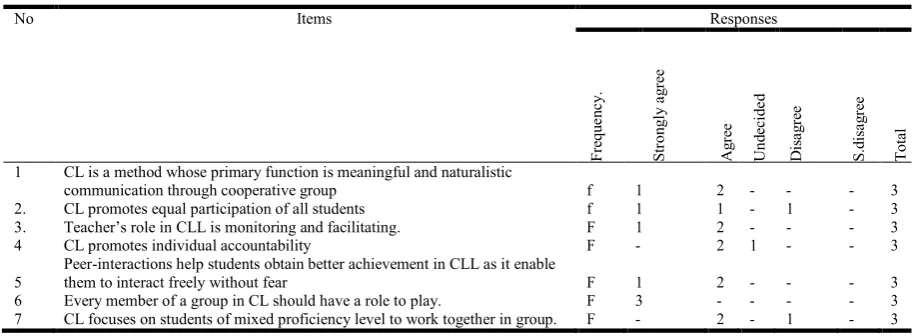
Teachers’ awareness of the use of CL in enhancing students’ speaking skill was analyzed using descriptive statistics. That is, items related to teachers’ awareness of CL were categorized into groups and analyzed in frequency distribution. As can be seen from Table 1, Item1 that deals with the functions of CL as a meaningful and naturalistic communication through cooperative groups, two teachers agreed and one teacher strongly agreed that CL is a method whose primary function is
meaningful and naturalistic communication through
cooperative group in EFL teaching.
[image:3.595.69.528.520.688.2]With Regard to Item 2, two of the teachers (strongly agreed and agreed) except one who opt for disagree replied that CL gives all students the opportunity to participate equally in speaking language practice. The third Item was meant to obtain information on the perceptions of teachers to their own roles in CLL classroom. In response to this item, all of the teachers (two agreed and one strongly agreed) perceived that teachers’ roles are that of facilitators and monitors. Concerning this, Cohen (1994) states that teachers’ role in CLL teaching Table 1. Teachers’ understanding of CLL
No Items Responses
F
re
q
u
e
n
c
y
.
S
tr
on
g
ly
a
g
re
e
A
g
re
e
U
nd
ec
id
e
d
D
is
a
g
re
e
S
.d
is
a
g
re
e
T
o
ta
l
1 CL is a method whose primary function is meaningful and naturalistic
communication through cooperative group f 1 2 - - - 3
2. CL promotes equal participation of all students f 1 1 - 1 - 3
3. Teacher’s role in CLL is monitoring and facilitating. F 1 2 - - - 3
4 CL promotes individual accountability F - 2 1 - - 3
5
Peer-interactions help students obtain better achievement in CLL as it enable
them to interact freely without fear F 1 2 - - - 3
6 Every member of a group in CL should have a role to play. F 3 - - - - 3
method should not be that of someone who measures the capacities of the students in terms of a final product but in terms of facilitating the learning process. Item 4 in Table 1 was intended to elicit information on whether CL promotes individual accountability or not, two of the respondents except one who responded undecided, have agreed that CLL method promotes students’ individual accountability. Furthermore, all of the teachers (two agreed and one strongly agreed) perceived that peer interaction among students promotes communication in the target language. In a similar way, all of the respondents strongly agreed that every member of the group in CLL classroom should have a role to play. Coming to the response on the importance of mixing students of different proficiency levels, two of the teachers agreed that forming groups of students with different proficiency levels enhances learning. In sum, from the above points it is possible to conclude that the teachers included in the study have positive perception of CL principles. They seem to perceive that CL enables students to practice the language effectively because of the presence of interaction among them. Moreover, the responses from open-ended questions regarding teachers’ awareness of CLL method verified that it is one method of EFL teaching in which students are taught in groups to attain common goals through cooperation with each other.
Analysis of teachers’ instructional views of CLL
As can be seen from Table 2 Item 1, two of the teachers; one agreed and one strongly agreed perceived that CLL improves the performance of low proficiency students when grouped with high achievers. Similarly, in response to the second Item, two of the respondents except one have agreed that CL is a recommended teaching method of speaking since it encourages doing language tasks by themselves than waiting for teachers. Regarding the third Item, two teachers with agreed and strongly agreed each replied that CL enhances cooperation among students, but one of the respondent disagreed. With respect to the fourth Item, two of the three teachers except one agreed that students learn more when they are taught in line
with CL method than with teacher-fronted the whole class teaching. Lastly, in response to the question which says “using cooperative learning method does not hinder teachers from covering the portions”, only one teacher opt agreed and the rest two disagreed. This reveals that the high proportion of the respondents perceive that CLL is time consuming than other EFL teaching methods to cover the portion. The overall responses demonstrated that teachers’ instructional view of CL method is positive for students to improve their spoken language proficiency by enhancing their participation through cooperation. This is also confirmed in open-ended questions in that the most serious problems teachers face in implementing CL was shortage of time. Kagan (1995) shares this idea in that one of the limitations of CL is that it is time consuming. But this is true until teachers and students experience how to use the materials in line with CL techniques and principles.
Analysis of teachers’ awareness of students’ role in CLmethod
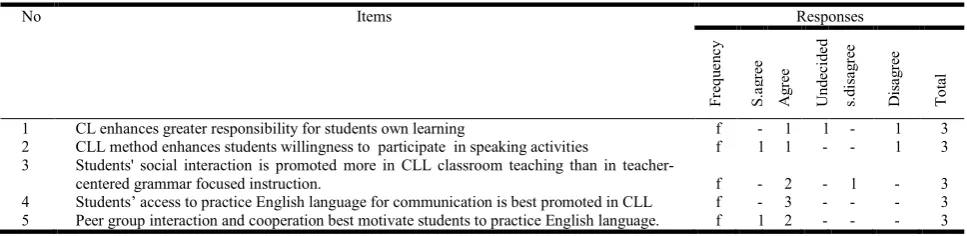
As it can be inferred from Table 3 Item 1, all of the teachers responded differently (one agreed, one undecided and one disagreed) that CL enhances greater responsibility for students. In response to the second Item, two teachers (strongly agreed
[image:4.595.39.561.349.493.2]and agreed) indicated their agreement to the view that CL enhances students’ willingness to participate in the speaking activities. This could be an indication of the power of CL to bear the responsibility for students’ self-learning. Coming to the third Item; two of the teachers except one who opt for disagree showed their agreement to the suitability of CL method in promoting social interaction among students while communicating with each other. Consequently, teachers’ response to Item 4 disclosed that all of the teachers were convinced of CL’s role in creating better opportunity for practicing English. With regard to Item 5, again all of the teachers; two agreed and one strongly agreed indicate their belief that CL best promotes peer interaction and cooperation Table 2. Responses of teachers’ regarding their instructional views of CLL
No Items Responses
F
re
q
u
e
n
c
y
S
.a
g
re
e
A
g
re
e
U
n
d
ec
id
e
d
S
.d
is
a
g
re
e
D
is
a
g
re
e
T
o
ta
l
1 In my view, CLL improves the performance low proficiency students if they are grouped with high
achievers
F 1 1 - - 1 3
2 In my view, CLL is a good method to practice speaking because students do not have to wait for teachers to
ask them to do the tasks
F - 2 - 1 - 3
3 Teachers in EFL classroom should use CLL, because it enhances cooperation among students to
practice the language.
F 1 1 - 1 - 3
4 Students practice speaking more when they are taught in cooperative group than in whole class. F - 2 - 1 - 3
5 I prefer CLL to lecture method since it gives students the opportunity to use the language. F - - - 2 1 3
6 Using CLL method does not hider teachers from covering the portion. F - 1 - - 2 3
Table 3. Teachers’ responses related to their awareness of students’ role
No Items Responses
F
re
qu
e
n
c
y
S
.a
g
re
e
A
g
re
e
U
n
d
ec
id
e
d
s.d
is
a
g
re
e
D
is
a
g
re
e
T
ot
al
1 CL enhances greater responsibility for students own learning f - 1 1 - 1 3
2 CLL method enhances students willingness to participate in speaking activities f 1 1 - - 1 3
3 Students' social interaction is promoted more in CLL classroom teaching than in
teacher-centered grammar focused instruction. f - 2 - 1 - 3
4 Students’ access to practice English language for communication is best promoted in CLL f - 3 - - - 3
[image:4.595.57.541.518.636.2]thus motivating them to practice English language. In general, the five Items dealing with students’ roles indicated that teachers’ perceive the positive aspects of CL in that it develops the students’ responsibility and willingness to participate in the speaking activities which in turn positively affects their spoken language development and social interaction through cooperation. With regard to this, Hopkins (2005) stated that CL has a powerful effect in raising students’ active participation in learning and collaborative behavior by developing social as well as academic skills.
Analysis of the Implementation of CL Method in Spoken Lessons
The way teachers perceive CL method and its principles has been described thoroughly. In this section, the extent to which they were implementing CL in English spoken lessons is addressed. The same questions were posed to students to triangulate the data obtained from the teachers. The responses of items of both teachers and students were analyzed together because of their conveniences and relationship. Then, the results obtained from the two sources are triangulated with the data gathered through classroom observation and textbook analysis.
Teachers’ and students’ responses to items related to cooperative group
As can be seen from Table 4 Item1, two of the teachers indicated that they rarely arrange groups of students on heterogeneous basis and one of them replied that he sometimes form groups based on heterogeneity principle. Coming to students’ responses to the same Item, 58.82 %( 31.37% and 27.45%) of them responded that their teachers rarely and never form heterogeneous groups respectively. 25.49% responded sometimes, and 15.68% always respectively. So, the data gained from the two sources implied that students have not got chance to help each other and learn from one another.
In response to Item 2 which was intended to identify whether or not teachers take cooperative groups’ report from all group members randomly, two of the three teachers responded that
they rarely and never took groups’ report on random basis, and the remaining one teacher replied that he sometimes involve students in responding to groups’ report randomly. Students’ responses to this Item are almost similar to teachers in that, 74.50 %( 39.21% and 35.29%) of the students replied that their teachers never/rarely took groups’ report at random base. 13.72% of the students responded sometimes and 11.72% responded usually to the item. This shows that, the majority of the teachers were not providing all members of the group with the opportunity to report their groups’ effort randomly. This could imply that participation is limited to only few active/voluntary students. Regarding to Item 3 that was intended to elicit information on if teachers assign roles to every member in all groups, two out of the three teachers reported that they rarely assign roles for every member of the group. And one of the teacher responded that he sometimes assign roles for every member in a group. With regard to students’ response, 49.01 %( 25.49% and 23.52%) of the students claimed that their teachers rarely and never assign roles to all of them respectively, and 23.52% of them claimed sometimes. On the other hand, 27.44 %( 13.72% each) responded always and usually to the item. Hence, the extent to which teachers assign roles for every member of the groups is very less. This implies that teachers lack the skills of facilitating roles.
To substantiate the responses obtained concerning the components of grouping processes, it is important to look at what Johnson &Johnson (1990) state. According to these authors, placing students in groups to work together, even under the name of cooperative learning or task structure did not ensure that they would engage in the kinds of positive interactions that promote learning. Thus, it can be concluded from the results of the two sources that teachers lack facilitation skills on how to organize and guide students for effective implementation of CL strategies and how to encourage students to group work. As a result, they often made little focus to group formation and the students’ involvement
[image:5.595.48.551.520.645.2]into the activities. So the researcher has of the view that due attention was not given to create conducive environment for effective implementation of CL in teaching speaking skill. Table 4. Teachers form cooperative group analysis
No Items
Su
b
je
cts
Responses
fr
e&
p
er
N
ea
rl
y
A
lw
a
y
s
U
su
al
ly
So
m
eti
m
e
s
R
are
ly
N
ev
er
T
ot
al
1 Teachers form cooperative groups of students based on
heterogeneity principle.
T f - - 1 2 - 3
S f 3 5 13 14 16 51
% 5.88 9.80 25.49 27.45 31.37 99.98
2 Teachers take cooperative groups’ report from all group
members randomly.
T f - - 1 1 1 3
S f 2 4 7 18 20 51
% 3.92 7.84 13.72 35.29 39.21 99.98
3 Teachers assign roles to every member in all groups. T f - - 1 2 - 3
S f 7 7 12 13 12 51
% 13.72 13.72 23.52 25.49 23.52 99.97
Table 5. Responses of teachers and students to teachers’ facilitating roles
No Items Response
Su
b
je
cts
F
re
&
p
er
c
N
ea
rl
y
al
w
ay
s
U
su
al
ly
So
m
et
im
es
R
are
ly
N
ev
er
T
ot
al
1 Teachers walk around groups and ensure that students
discuss in English to raise the performance of all students.
T f - - 1 2 - 3
S f 4 7 12 14 14 51
[image:5.595.58.543.672.757.2]Item 1 in table 5 was aimed at investigating how often teachers ensure the participation of all students in discussion of cooperative groups. Both of the teachers replied that they rarely walk around the group to ensure the participation of all students in the activities. But, one of the three teachers responded that he sometimes play the facilitating role by walking around the groups while the students are discussing the activities. However, 54.90% (27.45% each) of students’ response showed that their teachers rarely and never walk around the groups and perform facilitative roles. And 23.52% and 21.56% of the students responded that their teachers sometimes and usually play facilitative roles respectively. In line with this, (kagan, 1994) claimed equal participation, which refers to the involvement of all students equally in tasks in their groups and contribute as equally as possible regardless of perceived ability or social status to the groups’ achievement, is among principles of CLL.
Provision of adequate spoken language practices
In providing adequate spoken language tasks so as to enable students practice the language for a wider communication purpose, teachers are expected to have a lion’s share contribution. For this reason, questions under this were aimed at assessing whether teachers provide speaking opportunities to allow students get access to communicate and cooperate with each other.
Regarding Item 1 in Table 6, two of the three teachers responded that they rarely provide students with adequate spoken language practice. But one of the teacher replied sometimes to the item. With respect to students’ responses to the same Item, a total of 64.70 %( 35.29% and 25.41%) claimed that they were never and rarely exposed to adequate spoken language activities that help them develop self-confidence in using English language. On the other hand, 15.68% of the students replied that they had been given
language tasks sometimes. The rest 19.60% of the students replied almost always and usually. This data asserts that teachers give students with few speaking practice activities and they rather focus on devoting greater portion of their time for formal teacher-centered instructional method. This shows the absence of sufficient exposure inpracticing the target language which could be the cause for students’ reluctance to participate actively which in turn makes them unconfident to express themselves in the target language. Coming to Item 2, two of the three teachers’ responses indicated that they rarely incorporate real- life like tasks during spoken lessons and one of the three teachers responded that he provides the students with real-life like tasks sometimes. On the other hand, 64.70%(33.3% and 31.37%) of students’ response to this Item revealed that teachers were never and rarely provide them with sufficient real-life like tasks respectively, and 21.56% of them responded that their teachers provide them sufficient real-life tasks sometimes. From the classroom observation also what teachers were seen providing in their teaching speaking skill was mainly dealing with activities that require predetermined grammatical answers than giving attention to subjective activities that initiate students towards generating ideas of their own that match their life experience. In response to Item 3, two of the teachers except one who opt for sometimes claimed that they rarely/never attempt to help low achievers by using CL method. Likewise, 58.82% of students’ response showed that teachers rarely/never use group activities to help low achievers
[image:6.595.55.547.393.521.2]and 17.64% of them responded mildly some times to the item. But, 23.52 %( 13.72% and 9.80%) responded usually and always respectively to the Item. The result from classroom observation also confirmed students’ responses. All of the teachers during classroom observation were seen lecturing and doing exercises in the textbook only with few active students. Almost all of the students were passive implying and teachers were lecturing rather than providing tasks to help low achievers through group work. As a result, classroom Table 6. Response regarding teachers’ provision of adequate spoken language practices
No Items Responses
Su
b
je
cts
F
re
&
P
er
N
ea
rl
y
A
lw
a
y
s
U
su
al
ly
So
m
et
i
m es Rare
ly
N
ev
er
T
o
ta
l
1 Teachers expose students to adequate spoken language practices
with their peers to increase their self confidence in using the language.
T f - - 1 2 - 3
S f 4 6 8 15 18 51
% 7.84 11.76 15.68 29.41 35.29 99.98
2 Teachers provide life-like language tasks such as role playing,
diagrams, pictures, storytelling, simulation etc during speaking lessons.
T f - - 1 1 1 3
S f 4 3 11 16 17 51
% 7.84 5.88 21.56 31.37 33.33 99.98
3 Teachers use cooperative group activities since low students are
more beneficiary through wider practices with high achievers.
T f - - 1 1 1 3
S f 7 5 9 15 15 51
% 13.72 9.80 17.64 29.41 29.41 99.98
Table 7. Responses to items involving students in speaking practices
No Items Response
Su
b
je
cts
F
re
&
p
er
A
lw
a
y
s
U
su
al
ly
So
m
eti
m
e
s
R
are
ly
N
ev
er
T
ot
al
1 Teachers ask students to express their individual
views and opinions supporting or opposing ideas reported by other students.
T f - 1 1 1 - 3
S f 4 6 11 16 14 51
% 7.84 11.76 21.56 31.37 27.45 99.98
2 Teachers engage students to discuss in groups and
then give feed-back on their practices.
T f 1 1 - 1 - 3
S f 7 8 9 14 13 51
% 13.72 15.68 17.64 27.45 25.49 99.98
3 Teachers work on developing students’ social skill
by using CL method.
T f - - 2 1 - 3
S f 6 9 12 14 10 51
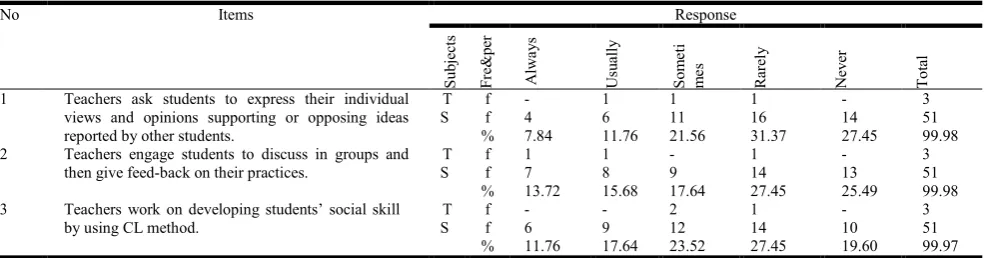
[image:6.595.54.547.558.687.2]observations approximate students’ response than teachers’ response in that teachers often did not work to organize and ensure the involvement of all the students in to their lessons; they did not facilitate students’ group discussions. Item 1 in Table 7 was intended to investigate if teachers involve students to express their individual views on ideas reported by other students from any other group. In response to this item, one of the teacher responded that he usually make students express their individual views by supporting or opposing the ideas reported by other group members. And the rest two responded that they sometimes and rarely each involve students to suggest their individual opinions. Regarding students’ response to the same item, 58.82% (31.37% and 27.45%) of them claimed that their teachers rarely and never involve them to express their individual views to the report provided by other group members. But 21.56% of the students answered that their teachers sometimes engage them in the process. As far as the result from classroom observation is concerned, the researcher could not come across any student who suggested on groups’ report either supporting or opposing. However, teachers were observed trying to involve students to comment on answers’ on tasks. But students were waiting for what the teacher was saying and writing. Most of the students were sitting idly when the teacher attempt to let them do the activities in the textbook. Thus, many students were the passive listeners to the teachers and to the few active students. This implies that teachers lack adequate skill to arouse their students’ interest and to involve them into the lessons effectively. It could also lead to the implication that students’ silence could be due to fear of making mistake that make them over dependent on their teachers and think that teachers as knowledge giver. Contrary to this reality, the tasks provided in speaking parts of the textbook analyzed enable students to act up on in role-playing, storytelling and debating techniques.
The speaking sections were designed with several CL activities that involve students in short talk and conversations on specific topics that are closely related to their daily life. Regarding Item 2, two of the teachers responded usually and always each and one replied rarely that they engage students to discuss in groups and provide feedback to the discussion. Contrary to this, more than half (52.94%) of students responded that they were rarely / never given feedback on their discussion, and 29.40 %( 15.68% and 13.72%) of them claimed usually and always to the item respectively. Item 3 was attempted to extract information on teachers’ effort to work on developing students’ social skill through cooperative learning method. Thus, the result showed that two of the teachers responded that they sometimes work to develop students’ social skills through the use of CL method and one replied rarely to the item. On the other hand, students’ responses with 47.05% indicated teachers’ attempt to involve students in cooperative groups to develop their social skills is found to be rare/never, 29.40%
always/usually and 23.52% sometimes respectively. From the observation as well, teachers were seen initiating students to help each other though the practice was very little. This shows that still teachers’ and students’ involvement in line with cooperative learning principle is insufficient. In connection to this concept, Oxford (1997; 447) quotes the advantage of CL over other teaching methods saying that, “what we know about effective instruction indicates that cooperative learning should be used when we want students to learn more, like the school better, like each other better, like themselves better, and learn more effective social skills ’’. She further claims that numerous studies confirmed the advantages of CL compared to competitive and individualistic learning experiences in that it is more effective in promoting intrinsic motivation and task
achievement, generating higher-order thinking skills,
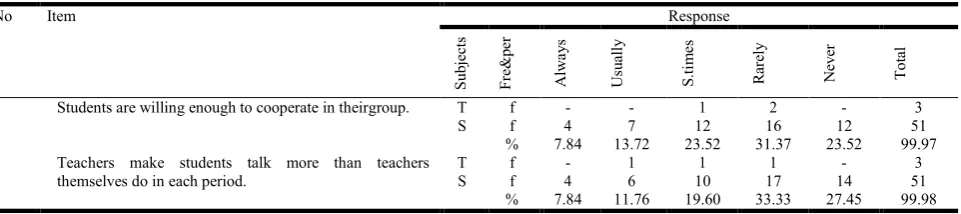
improving attitudes toward the subject and developing academic peer norms etc. Though teachers often try to use some cooperative learning strategies like group discussion, debating and guide their students to do some speaking activities depending on the students’ textbook, they often focus on demonstrating how to do an activity rather than encouraging the whole class to learn by themselves through interaction and sharing of ideas. In addition to this, they rarely rearrange the students’ seats, ensure their students’ organization in to small groups and supervise/facilitate their activities moving around the groups. The first Item of Table 8 was intended to investigate students’ willingness to cooperate in their groups. Two of the teachers’ response to this item showed that students are not/rarely cooperative enough to work together, and one of the teachers responded that students sometimes help each other during group activities. Likewise, 54.89 %( 31.37% and 23.52%) of the students’ responses indicated that their interest to learn from each other was found to be rare and never respectively.
[image:7.595.65.546.475.582.2]And 23.52% of them responded sometimes. It is possible to deduce from the above responses is that students’ lack of interest to cooperatively do the tasks could be due to lack of adequate exposure to language practices at the earlier stages of learning which is resulted in fear of making mistakes. Moreover, the result from observation depicts that students were not involved actively in cooperative groups even with short talk requiring teacher-led questions. This discloses students’ unwillingness as one factor for teachers not to implement CLL teaching principles by exposing students to sufficient communicative language practice. Accordingly, the second Item was aimed at eliciting information on whether or not teachers make students talk more with each other than they do to enhance their language use. One of the teachers responded that he usually make students to talk with each other, and two of them claimed that they sometimes and rarely make students discuss with each other during spoken lessons respectively. From the students’ side as well, 60.78 %( 33.33% Table 8. Teachers’ and students’ responses on students’ willingness to talk in the classroom
No Item Response
Su
b
je
cts
F
re
&
p
er
A
lw
a
y
s
U
su
al
ly
S
.ti
m
e
s
R
are
ly
N
ev
er
T
ot
al
1 Students are willing enough to cooperate in theirgroup. T f - - 1 2 - 3
S f 4 7 12 16 12 51
% 7.84 13.72 23.52 31.37 23.52 99.97
2 Teachers make students talk more than teachers
themselves do in each period.
T f - 1 1 1 - 3
S f 4 6 10 17 14 51
and 27.45%) of them replied that they From the students’ side as well, 60.78 %( 33.33% and 27.45%) of them replied that they rarely / never talk in the classes, and only 19.60 % each responded always, usually and sometimes that they were given ample time to practice speaking. The classroom observation also confirmed that most of the students were seen to be passive listeners during teachers’ presentations. Only few of them were participating in answering questions which they have done as homework or as class work, and the majority of the students were actively copying whatever teachers wrote on the blackboard and listening to what few voluntary students were attempting.
Conclusion and Recommendations
Conclusion
The study shows that all the teachers have the
conceptual understanding of the advantage of CLL method, they were found to have positive outlook to the majority of the techniques and principles it utilizes in enhancing students’ speaking skill. In sum, in spite of some unfavorable views to some of the principles of CL method, all of the teachers perceived the favorable instructional outlook.
Regarding learners’ roles, the teachers have positive perception to the roles of students in CLL. However, the teachers still resisted the centrality of the learners’ role due to students’ unwillingness to cooperate with each other, and still insisted on the prevalence of the roles of the teachers as a sole provider of knowledge and responsible body for the learning serving as the
main actor of the classroom activities. The
implementation of CL method during speaking lessons is not frequent and many of the elements of CL are not well practiced.
Role sharing to group members in such a way that students take responsibility of their own learning and their groups’ learning was not practiced. Over all, teachers were inclined towards grammar sections that allow them to lecture than involve students though the current English for Ethiopia textbooks of grade ten do not allow deductive way of teaching grammar.
Even though the speaking tasks in the textbook promote
teachers and students for CL, and teachers have positive understanding of the use of CL, they were not practicing many of the principles and techniques of CL.As a result, teachers do not pay due attention to how their students form groups and conduct the activities.
Recommendation
Involving students in cooperative learning method
through pair/group work requires extensive and consistent practice. But almost only sample activities in the textbook have been done by the teachers. Therefore, teachers should commit themselves by investing their time and energy to provide adequate life-like tasks and apply interactive teaching methods in order to raise students’ level of language use.
The problem of students’ language proficiency to
interact each other with the target language was among the major factors that hinder students from working actively in their cooperative groups. As a result, students fear to participate actively in their groups and refrain from uttering a word in front of their classmates. The solution to decrease this interaction problem can be
creating extra class activities such as drama, dialogues, role playing, and group discussions for students as they offer them with the opportunities to use the target language for real life communicative purpose.
Students’ willingness to participate in cooperative groups can be increased by devising the strategy on how to cooperate with peers for interactive language use.
REFERENCES
Alamirew G.Mariam,1992. The application of group work in learning English .un published MA thesis. Addis Ababa University.
Apple, M. T. 2006. Language learning theories and cooperative learning techniques in the EFL classroom.
Doshisha Studies in Language and Culture, 9(2), 277 –
301.
Boussiada Soraya, 2010. Enhancing students’ oral proficiency through cooperative group work. Algeria.
Brown, H. D. 1994. Teaching by principle: An Interactive approach to language teachin pedagogy, (2ndEd). New Jersey: Prentice Hall Reagents.
Brown,H.D. 2000. Principles of language learning and
teaching, (4th ed). Addison WelseyLongman,Inc:NewYor
Byrne, D.1986. Teaching oral English, (2ndEd). London: Longman Publishing.
Candlin, C. N., & Mercer, C. N. 2001.English language
teaching in its social context.London: Routledge.
Carpini, M. D. 2009. Enhancing cooperative learning in TESOL teacher education.ELT Journal Volume 63(1), pp.
42-50. Oxford: Oxford University Press.
Cohen, E. G., Brody, C. M., &Shevin, M. S. 2004. Teaching cooperative learning: The challenge for teacher education. New York: State University of New YourkPress.
Cohen, E.G. 1994.Designing groupwork: Strategies for
heterogeneous classrooms.NewYork: Teachers College
Press.
Cresswell, J.W. 2003. Advanced mixed method research
designs. A Tashkkori and C Cunningsworth,
A.1995.Choosing Your Course book. Oxford: Hememann DerbessaDufera, 2006 Tension between Traditional and
Modern Teaching-Learning approaches in Ethiopian Primary schools. Jornal of International Cooperation in Education, 9 (1), 123-140.
EndalewFufa. 2009. Factors negatively affecting students’ cooperative learning. Adama: Adama University.
Free man, 2000.Techniques and principles in language teaching, (2ndEd).Oxford: Oxford University Press.
Freeman, D. L.1986. Techniques and principles in language teaching. Oxford: Oxford University