UNIVERSITY OF TWENTE
Master’s Thesis
Generating specifications for JSON APIs
for formal and semantic use
Author: Committee:
Willem Siers 1 dr.ir. S.J.C. Joosten2,3
ir. R.W. van Dalen2,4
prof.dr.ir. A. Rensink3
dr.ir. M.E.T. Gerards 3
Faculty of Electrical Engineering, Mathematics and Computer Science Formal Methods And Tools
7500 AE Enschede, The Netherlands
August 18, 2019
1w.h.siers@{student,alumnus}.utwente.nl
2Supervisors: dr.ir. S.J.C. Joosten and ir. R.W. van Dalen 3University of Twente
A
bstract
Contents
1 Introduction 4
1.1 Motivation . . . 5
1.1.1 Why specifications? . . . 6
1.1.2 Why automatically generate specifications? . . . 7
1.2 Outline . . . 8
2 Background 9 2.1 JSON . . . 9
2.2 URL format . . . 10
2.3 APIs . . . 10
2.4 Specification languages . . . 11
2.4.1 JSON Schema . . . 11
2.4.2 Swagger and OpenAPI . . . 13
3 Method 15 3.1 Requirements . . . 15
3.2 Method Overview . . . 16
3.3 Type System . . . 18
3.3.1 Definition . . . 18
3.4 Initial type inference . . . 20
3.4.1 Instance data model . . . 20
3.4.2 Conversion . . . 21
3.5 Type Minimisation: Merging . . . 21
3.5.1 Algorithm . . . 22
3.6 Type Minimisation: Fusion . . . 23
3.6.1 Heuristics . . . 23
3.6.2 Introducing Map types . . . 24
3.6.3 Propagation . . . 24
3.7 Clustering . . . 26
3.7.1 Clustering by Operation . . . 28
3.7.2 Similarity metric . . . 28
3.7.3 Filters and candidate selection . . . 29
3.7.4 Refinement . . . 30
4 Evaluation 32 4.1 Implementation . . . 32
4.1.1 Architecture . . . 32
4.1.2 Parameters . . . 33
4.2 Input datasets . . . 33
4.2.1 Datamining method . . . 33
4.3 Results . . . 35
4.3.1 Sizes of the output of Type Inference . . . 35
4.3.2 Sizes and Filters of Clustering . . . 36
4.3.3 Schemas of Type Inference . . . 38
4.3.4 Schemas of Clustering . . . 41
4.3.5 Cross-Validation and Generalisation . . . 44
4.3.6 Runtimes . . . 46
4.4 Discussion . . . 48
4.4.1 Completeness . . . 49
4.4.2 Lack of Soundness . . . 49
4.4.3 Effects of different parts of Type Inference . . . 49
4.4.4 The effect of clustering on sizes of types . . . 50
4.4.5 The effect of clustering . . . 50
4.4.6 Generalisation of specifications . . . 51
4.4.7 Runtime performance . . . 52
5 Related Work 53 5.1 Outline . . . 53
5.2 JSON Schema inference tools . . . 53
5.2.1 Single instance inference tools . . . 54
5.2.2 Schema Guru . . . 54
5.3 Relational schemas for semi-structured data . . . 54
5.4 Structural schema inference . . . 55
5.5 Generating API specifications . . . 55
5.6 Comparison . . . 56
6 Conclusion 57 6.1 Limitations and Future work . . . 58
Chapter 1
Introduction
Traditionally, when a user ran a computer program, the software executed locally on their computer. In the current age, a lot of software functionality on one computer is provided externally over the internet, by another computer. A web service is such soft-ware, that offers functionality over the internet that is to be interacted with by other software. User-facing programs such as websites or smartphone applications are not web services, but the external software components they rely on to provide the function-ality are. For example, these services provide functionfunction-ality such as getting the weather forecast and posting a message on a forum.
A programmer uses web services by communicating with their APIs (Application Programming Interface). This is the interface to a web service, consisting of the opera-tions the service supports, and thedata types of the data these operations return. APIs enable re-use of software, because they allow multiple programs to make use of a single service. They can be used internally by an organisation, to communicate between sev-eral applications of its IT infrastructure, or they can be accessible to the public. Many popular web services, like Twitter, Instagram, and Wikipedia, have publicly available APIs.
In order to use an API, one needs to know its specification. An API specification is a technical document that specifies features of an API. In our case, we are interested in the differentoperationsthe API supports, and what thedata typesare of the data returned by these operations.
We are interested in APIs that uses data in the JSON (JavaScript Object Notation) format, which is a simple and widely-used data format that is human-readable and computer-readable . Broadly speaking, we call the structure of a JSON document its
type (also called schema). Such types are captured in a specification, and the indus-try standard for stating such data type specifications is JSON Schema. JSON Schema is specification language, in which the type of (a corpus of) JSON documents can be described.
The current thesis presents a method to automatically generate type specifications for theoperationsin an API. These specifications are inferred from network traffic data logs, which is a log that contains what was sent over a network to a web service (request), together with the data that the web service sent back (response). To discover which operations exist we require the information in the requests, and to infer the data types that they return we require the responses. Through an example we now illustrate what our method does, after which we continue with the motivation for this research. Here we provide only the minimally required descriptions of some terminology, which we give details for in Chapter 2.
ma-1.1. MOTIVATION CHAPTER 1. INTRODUCTION
chine, supporting espressos and cappuccinos in cheap and in premium variations. The captions of the figures indicate the request that yielded this response. To understand these requests, it is sufficient to see that theoperationget=drinkyields the cheap version of a drink, get=variations yields the possible variations of a drink, and theargument
type=indicates which drink we want.
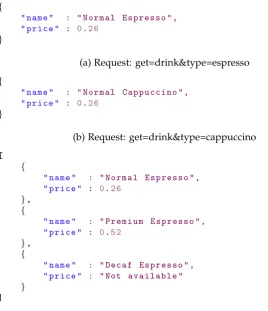
The response in Figure 1.1a shows an object (indicated by braces {...}) with two properties: name with textual value"Normal Espresso"andpricewith numeric value
0.26. Despite the responses in Figures 1.1a and 1.1b being different, they have the same type in our type system, because the objects have the same keys (nameandprice), and the types of their values are the same (textual and numeric respectively). Figure 1.1c shows an array (indicated by braces [...]), with three objects as elements. Because the three elements do not have the same type, we call the array heterogeneous.
Our algorithm infers a specification for these three requests, for which the JSON Schemas are shown in Figure 1.2. It consists of two types. Figure 1.2a states the type of the object in Figures 1.1a and 1.1b. For now, the most important aspects of the schema are "type":"object", which indicates that the top-level type is an object, for which the value of"properties"states the names of the fields in that top-level object (priceand
name), which in turn state that their values arenumbersandstringsrespectively. In the second schema, in Figure 1.2b, the values of itemsare the types of the elements of the array. Note that despite the array in Figure 1.1c being heterogeneous, there is only one
item. TheanyOffield is used to indicate that thepricefield has either numeric or string values.
One more thing to note is that we identify operations using filters. A filter of a schema specifies a condition on therequests, such that the schema is valid for only those requests that match the filter. For example, the filter get=drink (see the caption of Figure 1.2a) matches the requests of Figure 1.1a and 1.1b, but not of 1.1c.
In short, our method has the following properties:
• It identifies operations of an API, and their data types.
• It is an automated approach. That is, it does not require user-input.
• It generates correct specifications. That is, all data from which a specification is inferred is accepted by this specification.
• It aims to generate specifications that convey semantics of an API. That is, it con-veys some meaning of the API to a human programmer.
• It works on heterogeneous data: the traffic log can be a mix of differently typed responses.
Our method computes type specifications from a set of JSON responses as follows. The first step is to compute types of each response separately. Then, these types are com-bined in various ways to create more general, yet still precise, types. Because the set of responses correspond to several operations (that is, the set is heterogeneous), the method analyses both the computed type of a response together with the corresponding request with the aim of identifying operations. The type specifications are then improved by computing types per operations instead of for the complete set of responses at once.
1.1
Motivation
1.1. MOTIVATION CHAPTER 1. INTRODUCTION
{
" n a m e " : " N o r m a l E s p r e s s o " ,
" p r i c e " : 0.2 6
}
(a) Request: get=drink&type=espresso
{
" n a m e " : " N o r m a l C a p p u c c i n o " ,
" p r i c e " : 0.2 6
}
(b) Request: get=drink&type=cappuccino
[
{
" n a m e " : " N o r m a l E s p r e s s o " ,
" p r i c e " : 0.2 6
},
{
" n a m e " : " P r e m i u m E s p r e s s o " ,
" p r i c e " : 0.5 2
},
{
" n a m e " : " D e c a f E s p r e s s o " ,
" p r i c e " : " Not a v a i l a b l e "
}
]
(c) Request: get=variations&type=espresso
Figure 1.1: Three requests and their JSON responses
1.1.1 Why specifications?
In software engineering, software is often described using informal documentation[8]. These are documents consisting of explanations in natural language and usage-examples, intended for the programmer. Informal documentation of an API convey semantics of an API to the programmer. We define semantics of an API in the same manner as for programming languages, namely as how syntactic structures are to be interpreted by a human [3]. Although our method does not generate informal documentation but formal specifications, it is desirable that they convey semantics of an API as well as possible.
The problem with informal documentation is that they can be ambiguous, outdated and incomplete (or even non-existent). Learning how to use an API then becomes a trial-and-error process. Incorrect usage obviously leads to incorrect results and bugs.
1.1. MOTIVATION CHAPTER 1. INTRODUCTION
{
" $ i d $ " : " C . s c h e m a . j s o n " ,
" t y p e " : " o b j e c t " ,
" p r o p e r t i e s " : {
" p r i c e " :
{" t y p e " : " n u m b e r "} ,
" n a m e " :
{" t y p e " : " s t r i n g "}
} },
" r e q u i r e d " : [ " p r i c e ", " n a m e "
]
}
(a) Filter: get=drink
{
" $ i d $ " : " M . s c h e m a . j s o n " ,
" t y p e " : " a r r a y " ,
" i t e m s " : [ {
" $ i d $ " : " P . s c h e m a . j s o n " ,
" t y p e " : " o b j e c t " ,
" p r o p e r t i e s " : {
" p r i c e " : {
" $ i d $ " : " N . s c h e m a . j s o n " ,
" a n y O f " : [
{" ty p e " : " n u m b e r "} ,
{" ty p e " : " s t r i n g "}
]
},
" na m e " : {
" t y p e " : " s t r i n g "
} },
" a d d i t i o n a l P r o p e r t i e s " : false ,
" r e q u i r e d " : [ " p r i c e ", " n a m e " ]
} ]
}
(b) Filter: get=variations
Figure 1.2: Two inferred types (with their corresponding filters)
1.1.2 Why automatically generate specifications?
There exist languages and tools for writing API specifications (which we describe later, in Section 2.4). This should increase how often specifications are available for APIs. According to a survey, adoption of OpenAPI specifications (an industry standard for API specifications) rose among respondents, from 25% in 2015, to 69% in 2019 [16]. It should however be noted that the respondents are users of their API tools, and therefore this might not represent absolute usage of specification languages.
Still, many APIs do not have specifications, which may be due to difficulty and costs associated with creating them. Creating a specification of existing software incurs high initial costs, because software systems are increasingly complex. Capturing behavior of software is far from trivial, and often involves reverse engineering. This is especially apparent in legacy systems, which are old but functional systems whose notoriously complex software is not fully understood by a single person. Additionally, just like other forms of documentation, specifications require maintenance. When the software changes, the specification may need to be updated to reflect this. This is another reason not to create APIs for existing systems, as it introduces another artifact that requires maintenance.
1.2. OUTLINE CHAPTER 1. INTRODUCTION
1.2
Outline
The current thesis is structured around three research questions. The first research question is treated in Chapters MethodandRelated work(Chapter 3 and 5). The second and third research questions are the concern of the chapter Evaluation (Chapter 4).
• Research Question 1: How can API specifications be generated in an automated man-ner?
We answer this question by describing the method we developed for this goal, as this was the central point during our research. Also, we describe related research, techniques and tools that have similar goals.
• Research Question 2: How useful are these automatically learned API specifications for formal purposes?
We want these specifications to be usable for formal methods, such as static anal-ysis and type checking. To answer this question, we evaluate correctness of the specifications, by checking the specifications against the data it is learned from. Additionally, we check the specification against data it was not learned from, to assess whether or not our approach is useful if one has an incomplete traffic log (that is, it does not contain all possible responses of some API operation).
• Research Question 3: How useful are these automatically learned API specifications for semantic purposes?
Because specifications are not merely consumed by computers, for formal pur-poses, it is also interesting to look at if they provide semantic value for a program-mer. That is, they are a useful piece of documentation to a programprogram-mer. This question is answered through in part through subjective evaluation of the gener-ated specifications, and also by evaluating statistics of the genergener-ated types, such as their sizes and (the number of) identified operations.
Chapter 2
Background
This chapter describes background concepts for our research. It serves to clear up the terminology used throughout this document.
2.1
JSON
JSON1 is a simple and widely used data-interchange format. It is commonly used for serialising data and sending it over a network, such as in many JavaScript based web applications. By serialising some data into this format it can be transferred from one piece of software to another.
Before we give the formal syntax of JSON, see Figure 2.1 for an example of a JSON object. It shows a JSON object that represents a person named John. An objectis an unordered set of members. The object has three members, which arename:valuepairs, starting with a{token, and ending with a}token. The first member has a string value
"John". The second member has an array value. Arrays are ordered collections of values, starting with a [token, and ending with a ]token. Its first value is a number, its second value is another object. The third member has a boolean value.
Here we state a simplified version of the JSON syntax, and refer to ECMA-404 for a complete formal definition[7]. It is simplified by not addressing details such as whites-pace and which characters make up a string or a number. Terminals are written in lowercase, and non-terminals start with a capital letter.
Json:= Element
Elements := Element|Element , Elements Element:= Value
Value:= Object|Array|String|Number|true|false|null Object:= { } |{Members}
Members:= Member|Member , Members Member:= String : Element
Array:= [ ]|[ Elements ]
WhereStringis a sequence of Unicode characters that starts and ends with a quote, and a Number can be an integral number, decimal number, or a number in scientific notation.
2.2. URL FORMAT CHAPTER 2. BACKGROUND
In this document, we call a JSON-document containing oneElementaninstance. An instance is what we use as training data to generate types, and as validation data to test the generated schemas.
Because objects and arrays allow nesting, graph like structures can be represented. However, because JSON does not support referencing other nodes, it does not allow cyclic graphs. Therefore, JSON object can be represented as trees. For this reason, we adopt terminology originating from trees, such as leafs, nodes, edges, root of the tree, et cetera, and apply it to JSON objects.
{
" n a m e ": " Jo h n " ,
" d a t e s ": [2 0 1 9, { " y e a r " : " 1995" , " m o n t h " : " J u l y " } ] ,
" a l i v e ": tr u e
}
Figure 2.1: JSON object representing a person.
2.2
URL format
A Uniform Resource Locator (URL) is an address that points to some resource on the web. For our purpose, URLs are used to provide access to APIs. The most important thing to know is its basic syntax, which is the same as that of a Uniform Resource Identifier (URI).
A URL consists of a few components, as described in RFC3986 [4]. These are referred to as thescheme,authority,path,query, andfragment. The syntax can be given as:
scheme:[//authority]path[?query][#fragment]
For example, the URL"https://wikipedia.org/w/api.php?title=computer&action= search"has the following components:
scheme:https
authority:wikipedia.org path: /w/api.php
query:title =computer&action =search f ragment:(none)
The path can be subdivided in path-segments: w and api.php. Furthermore, the query can be divided into parameters and arguments. In this example, title andaction
are parameters, andcomputerandsearchare arguments.
2.3
APIs
2.4. SPECIFICATION LANGUAGES CHAPTER 2. BACKGROUND
In recent years, the software industry started noticing the importance of explicitly specifying APIs, and publishing them. Incentivised by gaining more users, companies now offer their service through publicly accessible APIs. This is accomplished because application programmers can now create applications based on the service. As an ex-ample, the online Twitter API spawned 3rd party Twitter applications, and websites that embed twitter functionality such as sharing a news article.
Usability and power (i.e. expressiveness) are the two basic qualities of an API [12]. When an API is hard to use, it costs more time to develop software, adoption rates will be lower and the resulting software often contains more bugs and security issues. Design methods can be used as guidelines, but usability evaluation of a created API yields better insight into the actual quality. Creating an API is a design task, and what constitutes agoodone is subjective. For resources that discuss guidelines for creating a good API we refer to two documents discussing general API design principles, by Bloch [6] and Blanchette [5].
In the APIs that we have used to evaluate our current work, the URL schema, au-thority and path are constant throughout different requests to the API. The URL query changes between calls, and thus the query uniquely identifies a request. For different APIs, there are different, but fixed, sets of valid query parameters (we call them valid if they are defined by the API). The arguments to these parameters can be chosen freely. While this thesis assumes that API requests are identified only by their queries, many APIs have a different approach. For example, in the APIs based on the Representa-tional State Transfer (REST) architecture, the URL path must also be used to identify requests[13]. Our related work, and OpenAPI (which we discuss later in this chapter) specifically target this style of API, but limit ourselves to APIs in which the path is irrelevant and only the query of the request is considered.
2.4
Specification languages
There exist standardised ways to represent JSON types and APIs, which are introduced now.
2.4.1 JSON Schema
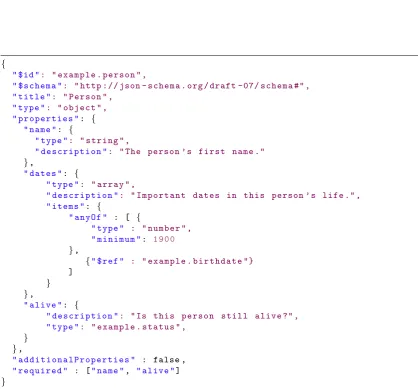
JSON Schema was created as a standard for specifying the structure of JSON files[14]. A JSON Schema is a specification that describes the structure of some JSON data. A schema is itself is written in JSON, and has meta-information about another JSON object. The most current version is draft 72. Use-cases for schemas are to implement type-checking for JSON objects and for documentation purposes, giving the developer insight into the structure of JSON data.
An example of a JSON Schema is shown in Figure 2.2, corresponding to the JSON object in figure 2.1. We explain the semantics of a relevant subset JSON Schema here. The work-in-progress draft is available to get details on the full language3. The lefthand-side terms we list below are keys in a JSON Schema with a special meaning, and the righthand-side describes what the value of this key represents.
2https://json-schema.org/(accessed 24th July 2019)
3https://json-schema.org/latest/json-schema-core.html and https://json-schema.org/
2.4. SPECIFICATION LANGUAGES CHAPTER 2. BACKGROUND
{
" $id ": " e x a m p l e . p e r s o n " ,
" $ s c h e m a ": " h t t p :// json - s c h e m a . org / draft - 0 7 / s c h e m a #" ,
" t i t l e ": " P e r s o n " ,
" t y p e ": " o b j e c t " ,
" p r o p e r t i e s ": {
" n a m e ": {
" t y p e ": " s t r i n g " ,
" d e s c r i p t i o n ": " The person ’ s f i r s t n a m e ."
},
" d a t e s ": {
" t y p e ": " a r r a y " ,
" d e s c r i p t i o n ": " I m p o r t a n t d a t e s in t h i s person ’ s l i f e ." ,
" i t e m s ": {
" a n y O f " : [ {
" t y p e " : " n u m b e r " ,
" m i n i m u m ": 1 9 0 0
},
{" $ r e f " : " e x a m p l e . b i r t h d a t e "}
]
} },
" a l i v e ": {
" d e s c r i p t i o n ": " Is t h i s p e r s o n s t i l l a l i v e ?" ,
" t y p e ": " e x a m p l e . s t a t u s " ,
} },
" a d d i t i o n a l P r o p e r t i e s " : false ,
" r e q u i r e d " : [" n a m e ", " a l i v e "]
[image:13.595.93.512.176.565.2]}
2.4. SPECIFICATION LANGUAGES CHAPTER 2. BACKGROUND
$id:=A unique identifier used to reference the current (sub-)schema.
$schema:=Points to the meta-schema of the version of JSON Schema that is being used.
$ref:=Reference another schema that is defined elsewhere, using its $id. In our example, the dates array may contain values of typeexample.birthdate(not shown).
title:=An informal name for the schema.
description:=An informal description of the schema.
type:=The type of the value described by this schema. Eithernull,
boolean,object,array,number,integerorstring.
items:=The types of values in an array. If one type is given, all ele-ments have that type. If an array of types is given, the type of an element is given by its position in the array.
properties:=The keys and their types of members in an object.
required:=Which members in properties are always present in an ob-ject. Non-required members still match the given type if it exists, but are ignored otherwise.
additionalProperties:=If true, the object may have members that are not specified in
properties. Otherwise, there are never more members than those inproperties
.
patternProperties:=Likeproperties, except that all members whose key match the regular expression have the given type.
anyOf:=Lists one or more types the values may have.
minimum/maximum:=Specifies ranges for number types.
minLength/maxLength:=Specifies length ranges for string types.
minItems/maxItems:=Specifies ranges for the number values in an array.
enum:=Specifies which literal values a value may have. For example, to say that some date property only contain strings from the set ”Januari”, ”Februari”, ...
There are more constructs in JSON Schema, but this subset is sufficient to understand our research, and was sufficient to represent all types we generate in our type system.
2.4.2 Swagger and OpenAPI
Swagger4, first created in 2011, is a toolkit for designing, documenting and testing REST
APIs using JSON (and YAML) format. It defines a standard format for writing API definitions, and as a result it can offer tools for automatically generating documentation webpages, clients to call the API, and testing tools for experimenting on the API.
OpenAPI is the continuation of Swagger. In 2015, the Swagger Specification was renamed to OpenAPI specification. It is being maintained as an open source project by the OpenAPI initiative5. Swagger still provides the tools for APIs conforming to
the Open API specification, but the specification itself is maintained by the Open API initiative. OpenAPI incorporate parts of JSON Schema in its definitions, namely the types in Swagger are defined using JSON Schema. On top of that, OpenAPI groups
2.4. SPECIFICATION LANGUAGES CHAPTER 2. BACKGROUND
" / p e t s /{ id } ": {
" get ": {
" d e s c r i p t i o n ": " R e t u r n s a pet b a s e d on a s i n g l e ID " ,
" o p e r a t i o n I d ": " f i n d P e t B y I d " ,
" p r o d u c e s ": [
" a p p l i c a t i o n / j s o n "
] ,
" p a r a m e t e r s ": [
{
" n a m e ": " id " ,
" in ": " p a t h " ,
" d e s c r i p t i o n ": " ID of pet to f e t c h " ,
" r e q u i r e d ": true ,
" t y p e ": " i n t e g e r " ,
" f o r m a t ": " i n t 6 4 "
}
] ,
" r e s p o n s e s ": {
" 200 ": {
" d e s c r i p t i o n ": " pet r e s p o n s e " ,
" s c h e m a ": {
" \ $ r e f ": " #/ d e f i n i t i o n s / Pet "
} }, ...
[image:15.595.93.476.72.387.2]} } }
Figure 2.3: A part of a openAPI specification, that defines an operation.
these operations by API operation, so that each operation indicates type of its response. An operations is defined per REST resource, that is a combination of the URL path, method (e.g. GET or POST), and its parameters (i.e. the URL query).
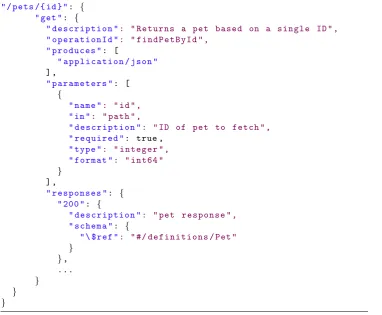
Figure 2.3 shows an example of an OpenAPI specification6. Starting at the top of the example, it shows the definition of an operation at the path /pets, with a pa-rameter id. So, for example, it matches the following request (with GET as method):
"http://example.org/pets/14". The parameters object defines the type of this pa-rameter and its location (thein property). The responses object states that, if the sta-tuscode is200(which is a code that means that the server handled the request without errors), the response has the type as described by the child object (which is written in JSON Schema). In this case, the response type is defined by an external schema
#/definitions/Pet.
Just as with JSON Schema, there exists a wide variety of tooling for working with OpenAPI, such as converters between different specification formats, GUI specification editors, schema validators and data validators, parsers, documentation generators and SDK generators that generate a functioning client or a server stub that supports the operations that are in the specification7.
6taken from https://github.com/OAI/OpenAPI-Specification/blob/
73b79bf7db9adb45a3d5d8076e614e64ab0f0897/examples/v2.0/json/petstore-simple.json (accessed
14th August 2019)
Chapter 3
Method
This chapter describes our method for generating specifications for JSON APIs, for which the motivation given in chapter 1. This chapter gives detailed descriptions of the parts it consists of, as well as an overview of how they relate to each other. We also discuss the requirements which led us to this method. The method is described in increasingly precise explanations. Section 3.1 starts by stating our requirements. Sec-tion 3.2 gives a high-level overview of our method. SecSec-tion 3.3 gives the overview of our type system, and remaining sections 3.4 through 3.7 go into detail on the four parts of our method.
3.1
Requirements
This section states the approach we used to deal with the problem that was introduced in our Introduction chapter and certain sections of the Background. The global goal is that the generated specifications serve both formal usage and semantic usage. Our requirements bridge the gap between our motivation and our created method. The re-quirements for our method are expressed in terms of rere-quirements on the specifications that it generates.
Requirement 1: The specification is complete.
We consider the method correct if creates specifications that are complete with respect to the input to the method. A specification is complete with respect to an input to our method (consisting of a set of JSON instances), if it flags as correct all these inputs. This means that a specification is inferred from a set of instances, accepts all instances in this set. For a type checker, completeness means that no correctly typed values are flagged as incorrectly typed (i.e., it gives no false negatives). Section 3.3 explains what it means for a value to be (in)correctly typed. We do not require the stronger notion of completeness, completeness with respect to an API, which means that it flags as correct all valid inputs for this API. Checking this requires knowledge of all valid inputs, but our datasets merely contain a subset of every valid input (incomplete dataset).
3.2. METHOD OVERVIEW CHAPTER 3. METHOD
Requirement 2: The specification conveys semantics.
It is desirable that the specifications is not only computer-interpretable, but also capture the human-interpretable meaning of elements of the API. Our method aims to achieve this is through identification of commonalities and variations in types, and through grouping types by their operations.
Requirement 3: The specification is small.
A small specification is less complex, and thereby easier to read for a programmer. This requirement does not mean that given two specifications, the smaller is always better. It only means that a small size, on an absolute scale, is preferable.
Requirement 4: The specification generalises over multiple instances.
A network traffic log is unlikely to contain every possible value an API may return. We call such a set incomplete. A specification that matches exactly such a set of instances conforms to the completeness requirement for that set, but fails to match any unseen instances. This is also known as over-fitting. We say that a specification generalises if it describes some class of values. Ideally, we want our specifications to generalise over values with the same semantics. Similarly to Requirement 3, a type that generalises more than another is not by definition better.
Requirement 5: The specification is specific.
A specification should match only a specific group of instances. Imagine that we would simplify our type specification to the universal type, that matches any instance. Such a specification is neither useful for type checking because it does not identify typing errors, nor is it useful for a programmer to learn anything about the API. This is also known as under-fitting. This requirement balances out Requirement 4.
Requirement 6: Minimal user input required.
Our problem statement is that it is costly to create specifications, and our solution is automation. Therefore, our method must not be guided by a user or require extensive configuration.
Requirement 7: Training data can be heterogeneous.
As addition to Requirement 6, we require minimal data preparation. This means that the method must handle an input of a mix of differently typed responses.
Requirement 8: Training data can be provided by network traffic.
Network traffic logs are relatively accessible if one has control over the API in question. We list this as a requirement to make it clear that we did not want to rely on data sources, such as the source code of the API.
3.2
Method Overview
3.2. METHOD OVERVIEW CHAPTER 3. METHOD
Initial Type
Inference Types Response data
(JSON)
Fusion
Introduce Sum types
Fusion
Propagate Sum types Merging
Type Minimisation Type Inference
Training InstancesInstancesTrainingTraining
Instances
[image:18.595.93.519.67.294.2]Training InstancesInstancesTrainingTypes Inferred types
Figure 3.1: Overview of Type Inference
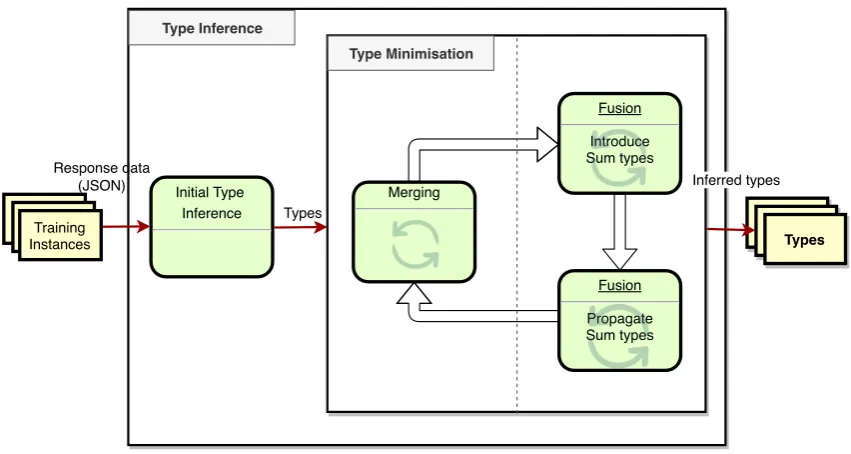
Figures 3.1 and 3.2 together show an overview of the architecture. The green boxes represent algorithms in our method, the yellow boxes represent data, and the red di-rected arrows indicate the flow of data.
Type Inference(Figure 3.1) takes as input a set of instances, and computes one or more types for it. It consists of two algorithms, Initial Type Inference, and Type Minimisation. The former creates one type per instance, and the latter processes these and reduces the number of types and their sizes. Type Minimisation consists of aMergingalgorithm and a Fusion algorithm. Merging reduces the number of types and their sizes by merging (parts of) types that are equivalent. Fusion minimises types further, by introducing sum types based on heuristics, and propagating these through transformations on the types. In Type Minimisation, each of these two algorithms can introduce new work for another, and therefore they are called iteratively until a minimal type is returned. We explain Type Inference in Sections 3.4, 3.5 and 3.6.
Note that Type Inference normally yields one or more types, but we can force it to create a single type that describes all instances. From a set of types, we can create a single type by moving them into a Sum type, which is the supertype of all those types (details on this in the following section). This is done after Initial Type Inference and before minimisation, so that the single type is minimised. This has the advantage that all types are fused into one minimal type, but has the disadvantage that, for semantically unrelated inputs, it creates an equally semantically meaningless type. We refer toSingle Type Inferencewhen such a single type is created, and toMulti Type Inferenceotherwise.
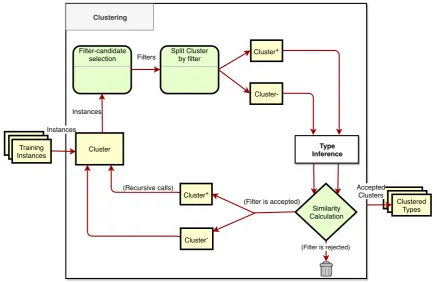
Clustering(Figure 3.2) generates specific types for specific groups of instances. This allows our method to find better types for heterogeneous data. It also allows us to spec-ify a relation between the request and the type of the response of an API call. Filter Candidate Selectionselects potential Filters from the request data, which are used to split a cluster in two non-overlapping clusters. Then, similarity of its types is calculated, and new clusters are only accepted if the types of the two are dissimilar enough. This rests on the assumption that requests to different functions in an API yield significantly differ-ently typed responses, and requests to the same function but with different arguments, yield relatively similarly typed responses. Clustering is detailed in Section 3.7.
3.3. TYPE SYSTEM CHAPTER 3. METHOD
Clustering
Filter-candidate selection
Split Cluster by filter
Instances
Filters
Cluster
(Recursive calls) Instances
Cluster-Cluster+
Cluster -Cluster+
(Filter is rejected) Similarity Calculation (Filter is accepted)
Type Inference
Training InstancesTraining
InstancesTraining Instances
Training InstancesInstancesTrainingClustered
Types Accepted
[image:19.595.90.528.68.350.2]Clusters
Figure 3.2: Overview of Clustering
1 (completeness) is a hard requirement that is preserved throughout all algorithm. Re-quirement 6 (user-input) is also generally preserved at runtime, although tweaking can be done, such as configuring the heuristics of the fusion algorithm. For Requirement 2 (semantics), clustering has the biggest effect on unveiling semantics, and minimisation contributes also, albeit less obviously. For Requirement 3 (size), decreasing sizes of types is the largest concern of minimisation, but also clustering. Requirement 4 (generalisa-tion) is achieved in part by a general type system (upcoming Section 3.3, but increased further by fusion. Requirement 5 (specificity) is mostly the concern of clustering, just like requirements 7 (heterogeneity), as it creates specific data groups from the heteroge-neous data.
3.3
Type System
This section defines the syntax and semantics of our type system, and give other defi-nitions that are useful for later sections. It serves as a reference for the reader, which is why it already names terminology that we explain later in this chapter.
3.3.1 Definition
3.3. TYPE SYSTEM CHAPTER 3. METHOD
Terminals are written in lowercase, and non-terminals start with a capital letter.
Root := Type (3.1)
Type:= Primitive|Collection|Clustering (3.2)
Primitive:= number|text|boolean|null (3.3)
Collection:= Record|Array |Sum| Map (3.4)
Label:= Key|Optionalkey (3.5)
Record:= {Label1: Type1, ...,Labeln:Typen} (3.6)
Array:= [Type] (3.7)
Sum:= (Type1+...+Typen) (3.8)
Map:= hPattern: Typei (3.9)
Pattern:= P(Regex) (3.10)
Clustering:= [Filter1 →Type1, ...,Filtern →Typen] (3.11) Filter:= F(Condition1&...&Conditionn) (3.12) Condition:= Stringk :Stringv |Stringk :∗ | !Condition (3.13)
The type system can be used to form directed acyclic graphs, similarly to how JSON objects form trees (Section 2.1). The nodes in this graph are formed by the terms in the syntax. Every Type is either a Primitive, Collection or a Clustering. Primitives are the simple Types, number, text, boolean and null, which always form leafs in the graph.
Collections are Types that can contain child types, and thereby form nodes in the graph. A Collection is either a Record, an Array, a Sum type or a Map type. Broadly speaking, these types relate to JSON as follows: Records and Map types describe Objects, Array
types describe Arrays and Sum types can describe a mix of Values. A Record contains associations of the form Label :Typec, where Typec is the child of the Record. TheLabel
is a string, which corresponds to a String in a JSON Object that is associated with some Value. When a Label is a Key, the Label is required to be present in an Object, whereas if it is a Optionalkey is not required that it is present. A Map is similar to a Record, but instead of specifying all Labels, a single regular expression (specified by Pattern) is used that matches all Strings in an Object. It can be seen as mapping from strings to some child Type, where all these strings match the Pattern. A Sumtype represents a supertype of its children, that is, it is the type of all Values whose type is given by any of the children of the Sum type. A Clustering is a conditional type, which we use to specify that the type of some JSON Value depends on which condition on the Value holds. These Conditions are expressed in a Filter, for which at this point it is sufficient to know that it expresses some boolean condition on a Value. We also define Rootas a Type without parents, which therefore only occurs at the root of the graph.
We express semantics of the type system more precisely by the definition of a type checking function, called check. This function takes as arguments aType and aValue, and returns true if and only if the Value has the given Type, and returns false otherwise. If checkreturns true for some Type T and some Value V, then we say that T is the type of V. Value has been defined by the JSON grammar in Section 2.1.
LetTbe some Type, and we letVbe some Value, then the functioncheckreturns true if any of the following conditions hold:
• Tis number andVis a Number.
• Tis text andVis a String.
3.4. INITIAL TYPE INFERENCE CHAPTER 3. METHOD
• Tis null andVis null.
• T is a Record{Label1 : Type1, ...,Labeln : Typen}andV is an Object, such that for
eachLabeli : Typei inT:
– if Labeli is a Key, then there exists a Member in V,s : v, such that s matches Labeli, and the type ofvisTypei.
– if Labeli is a Optionalkey, then there need not exist such a Members :v in V
such thatsmatchesLabeli, but if it does, then the type ofv isTypei.
• T is an Array [Typec] and the Vis an Array, such that all children in V have type Typec.
• Tis a Sum(Type1+...+Typen)andVis some Value, such that at least one of the
children ofTis the type ofV.
• Tis a MaphPattern:TypeciandVis an Object, such that for each Members: vin
V,smatches the Pattern andvhas typeTypec.
• Tis a Clustering [Filter1 → Type1, ...,Filtern → Typen]andV is some Value, such
that there exists one Filteri → Typei in T such that the request that yielded V
matches all Conditions of Filteri and the type ofVisTypei.
In this thesis we give examples of types by a visualisation of the graph it forms, Such as Figure 3.3 in the next section. Types are visualised such that each node has the formname : Type, where the name is a (arbitrary) one-letter identifier for that node, and the Type is one from the syntax. Collection types can have outgoing edges, which signals a parent-child relation. For Records, the Label that points to a child is written on the outgoing edge to that child. If a Label is a Optionalkey, it is written with a question mark ? at the end. For Maps, the Pattern is written on the outgoing edge to the child. This is a regular expression that starts with the token ^ and ends with the token $. Arrays have only one child, and Primitives can only form leafs in the graph. Clusterings are the only Types that we do not visualise in this manner.
3.4
Initial type inference
Initial Type Inferenceis the first step in type inference, which infers simple types for JSON instances. It generates exactly one root type for each instance it sees. Figure 3.3 already shows an example of a JSON document and its inferred Type.
We first state the format of the input to this algorithm. Then, we state how types are inferred from this input.
3.4.1 Instance data model
3.5. TYPE MINIMISATION: MERGING CHAPTER 3. METHOD
[
{
" n a m e " : " N o r m a l E s p r e s s o " ,
" p r i c e " : 0.2 6
},
{
" n a m e " : " D e c a f E s p r e s s o " ,
" p r i c e " : " Not a v a i l a b l e "
}
]
(a) Example JSON
A : Text
B : Number C : Record
name price
D : Text
E : Text
F : Record name
price H : Sum
I : Array
[image:22.595.94.522.70.406.2](b) Inferred type byInitial Type Inference
Figure 3.3: Initial type inference example
3.4.2 Conversion
Initial Type Inference converts the response field of one instance to one Type in our type system. It traverses the JSON tree and generates a tree in the internal representation of our type system. Each visited JSON Value corresponds to one term of our syntax. We describe the conversion as a function called initial. It takes as argument a Value, and returns a Root type. If the Value is a Number, String, true or false, or null, it returns respectively a number, text, boolean and null Type. If theValueis an Object, a Record is returned with equivalent Keys (so that all members are required), and the children are recursively computed byinitial. If theValueis an Array, an Array is returned whose child type is a Sum type, whose children are computed by applyinginitialon the elements of the Array Value. The Root type that it returns is a tree, which is the type of the provided JSON tree.
Note that the only Primitives, Records with required keys, Arrays and Sum types are generated.
3.5
Type Minimisation: Merging
3.5. TYPE MINIMISATION: MERGING CHAPTER 3. METHOD
completely equivalent. The former two happen when only parts the graph formed by a root type are equivalent. This enables sharing of subgraphs of Types, that is, a node may now have multiple parents, which indicates that some data structure is reused. See Figure 3.4 for an example, where three Root types are merged into two. Initially, Record nodes (I, F and C) are not merged because none of them are equivalent due to not having the same children. After merging the leaf nodes, leaving only A and B for the Primitives, Records C and F have the same labels pointing to the same children, and are thus merged.
A : Text
B : Number C : Record
name price
D : Text
E : Number F : Record name
price
G : Text
H : Text I : Record
name price
(a) Step 0: 9 Types from Initial Type Inference.
A : Text B : Number C : Record name
price F : Record
name price
I : Record
name price
(b) Step 1: equivalent leafs (G, H and D) and (E and B) are merged.
A : Text B : Number C : Record
name price
I : Record nameprice
[image:23.595.101.504.197.353.2](c) Step 2 : equivalent records (F and C) are merged.
Figure 3.4: Merging example
3.5.1 Algorithm
The merging algorithm removes redundancy in a Type in an iterative manner. We define it as the functionmergewhich takes as argument a set of Types and returns another set of Types.
The way it works can be split into two steps. The first step is to identify which types are equivalent. This is done by defining an equivalence relation that groups equivalent types together. A set of equivalent types is called the equivalence class of those types. From each equivalence class we preserve only one element (picked arbitrarily from the class), and remove the others. Because the types that are to be removed may have parents, edges incoming to these types are moved to point to the preserved Type in the equivalence class. The second step is to remove all the redundant Types, and move their incoming edges.
A single application of these two steps removes one or more equivalent Types from the input (assuming there are equivalent types). When equivalent types are removed, it can simultaneously “create” new equivalent Types, because of the way the equivalence relation is chosen. Therefore, removing all redundancy requires iterative application of the two steps. Iteration halts when there are no more equivalent types (that is, all non-empty equivalence classes have size 1).
3.6. TYPE MINIMISATION: FUSION CHAPTER 3. METHOD
A : Text
B : Number
E : Text
I : Array L : Record
name
[image:24.595.99.519.81.162.2]J : Sum price
Figure 3.5: Fusion applied to the Type of Figure 3.3
types are in the relation if and only if both have an equal set of children (disregarding order). Map types are in the relation if and only if the Patterns of both are equal, and their child Types are equal. Any other types are not in the relation.
3.6
Type Minimisation: Fusion
The fusion algorithm supplements the merging algorithm. It achieves two things: First of, it makes Types that contain Sum types more precise by propagating these Sum types downwards. Secondly, syntactically different types which appear to represent the same semantics are fused together by introducing a Sum type for these types, yielding a more general type.
Consider the previous example in Figure 3.3. The two Records (Cand F) represent the same thing semantically (a coffee entry), yet they are two distinct types. Because they are part of a Sum type already suggests they are the same, but the Type is verbose and can be more precise. The Sum type can be propagated downwards, yielding the Type in Figure 3.5. The two Record C and F are fused into Record L, and it is now explicit that the Type of the value at name isText, andprice is either aNumberor Text. Furthermore, the Sum typeIis removed, because it would only have one entry (L).
Sum types are propagated towards its children, whereby inherited attributes are imposed upon the subgraphs of Sum types. Note that determining semantically equiv-alent types relies on assumptions, and whether or not these assumptions hold differs between APIs. The algorithm captures these assumptions using heuristics, which may be adapted for different APIs.
3.6.1 Heuristics
The algorithm considers a number of heuristics to decide if Types will be fused. A heuristic together with a (user-provided) threshold forms a condition, and when this condition is met, a Sum type is introduced. First, consider the following heuristics:
1. # of keys in a Record
2. # of optional keys in a Record
3. # of optional keys# of keys
4. children are equal types (boolean)
5. regularity of the labels (allow specific patterns or broad patterns)
3.6. TYPE MINIMISATION: FUSION CHAPTER 3. METHOD
object. It seems that if a Record is very large, then neither each individual Label nor its associated value are semantically relevant. These Records instead represent a Map type. For example, we encountered objects with language-codes as keys and a country name as value. This represents a map from a language-code to country names. Apart from conveying semantics more concisely, a Map type may also form a more proper generalisation, as it does not become incorrect if the set of object were to be extended or shrunk (for example, if more languages are added).
The number of optional keys and the ratio of optional keys are a measure for how specific a type is. If there are several instances with a language object with different subsets of languages, then most members in the Record are optional.
The equality of children is true if all children of a Record point to the same Type node, and therefore depends on the result of the merging algorithm. This is used to form an extra condition on Records that are turned into Map types, namely that the children are equal. This is currently a boolean heuristic, but a numeric value expressing similarity of children would be an interesting heuristics for future work.
The regularity of labels relates to the size of the language that captures all labels. In some cases, a transformation is only sensible if all labels match a specific pattern, for example a date likedd/mm/yyyy, or a language code consisting of exactly three letters. In other cases, labels are very irregular but a using a broad pattern is still sensible because all children are semantically equivalent, for example when article titles are used as keys, and the values are objects that represent articles.
Our implementation lists two conditions that allow a Record to be transformed into a Map if any of them is met. The first condition is that a Record has at least 5 keys in a Record and all children are the same Type (that is, there is only one child), and the Pattern must be specific (for example, dates are allowed, but generic patterns such as “any sequence of characters” are not). The second condition is that a Record has at least 12 optional Labels, the fraction of optional Labels must be at least 0.9, the children need not be of equal types, and broad Patterns are allowed. Which heuristics and conditions are used are parameters to the algorithm (and somewhat subjective), and by inspecting the network traffic we found these two conditions capture (mis)usage-patterns of JSON.
3.6.2 Introducing Map types
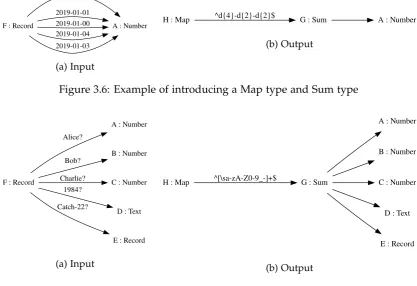
Map types are introduced when a condition is met. We show how a Sum type is in-troduced for children of a Record. Note that creation of a Sum type with merely one element is always disallowed, as to avoid an infinite loop of creating, followed by remov-ing sremov-ingle-element Sum types. Two examples are shown in Figure 3.6 and Figure 3.7.
As the first step, a Pattern is inferred from the labels of a Record. This is done by selecting the first Pattern from a pre-defined ordered list of Patterns that matches all Labels. By ordering this list from specific to broad, it prefers picking specific patterns over broad patterns. Then, a Sum type is created of all children of the Record. Finally, a Map type is created to replace the Record, using the inferred pattern as label and the Sum type as child.
As mentioned earlier, this only happens if certain conditions are met. If, for example, the number of keys does not exceed the threshold, or a pattern can not be inferred from the Labels, then the transformation is not performed.
3.6.3 Propagation
3.6. TYPE MINIMISATION: FUSION CHAPTER 3. METHOD
A : Number F : Record
2019-01-02
2019-01-01 2019-01-00 2019-01-04 2019-01-03
(a) Input
A : Number G : Sum
H : Map ^d{4}-d{2}-d{2}$
(b) Output
Figure 3.6: Example of introducing a Map type and Sum type
A : Number
B : Number
C : Number
D : Text
E : Record F : Record
Alice?
Bob?
Charlie? 1984?
Catch-22?
(a) Input
A : Number
B : Number
C : Number
D : Text
E : Record G : Sum
H : Map ^[\sa-zA-Z0-9_-]+$
[image:26.595.97.515.86.372.2](b) Output
Figure 3.7: Example of introducing a Map type and Sum type
of its children, the overall effect of these transformations is that large sub-types are transformed into smaller sub-types.
Propagation: general
A Sum type with a single child Type is replaced with its child Type. That is, the Sum type(T)is replaced withT.
Children of nested Sum types are moved to the parent Sum type. That is, a Sum type of the form((T1+...+Tn) +Tn+1+...+Tm)is replaced with(T1+...+Tm).
Propagation: Primitives
Primitive types are simply merged, in the same way as in the merging algorithm of Section 3.5. That is, a Sum type of the form (Primitive1+Primitive2+ · · · ) with
equivalent Primitive types (e.g. both are Number) is replaced with (Primitive1+ · · ·).
Propagation: Arrays
The Sum type of two Arrays becomes an Array that holds the children of both. That is, a Sum type of the form ([Type1] + [Type2] + · · ·)is replaced with([(Type1+Type2)] + · · ·). See for example Figure 3.8 which shows fusion of two Arrays into a single Array.
Propagation: Maps
3.7. CLUSTERING CHAPTER 3. METHOD
A : Text B : Array
C : Number D : Array
E : Sum
(a) Input
A : Text
C : Number
F : Array
(b) Output
Figure 3.8: Example of fusion of Arrays
A : Boolean
B : Text C : Number D : Record
color size
E : Record color F : Sum
(a) Input
A : Boolean
B : Text C : Number
G : Sum H : Record
size? color
[image:27.595.93.516.82.330.2](b) Output
Figure 3.9: Example of fusion of two Records
hPattern2 :Type2i+ · · ·)wherePattern1 andPattern2 were respectively inferred from
the set of LabelsL1andL2, is replaced with(hPattern3 :(Type1+Type2)i+ · · ·), where Pattern3is inferred from both sets of Labels,L1∪L2.
Propagation: Records
For a Sum type of two Records becomes one Record with members of both. Children of the new Record are formed by creating Sum types of the child types of both Records. The Label wil be required if it is present in both Record, and it is required in both Records. That is, a Sum type of the form (Record1+Record2+ · · · )is replaced with
(Record3+ · · · )where the set of Labels inRecord3 is the union of those inRecord1and Record2, which are required if and only if they occur in both, and the child at a Label is either the Sum of the children at the corresponding Labels inRecord1 andRecord2, or, if
only one of the two Records has the Label, the child from that Record. Figure 3.9 shows an example of this transformation.
3.7
Clustering
We apply a clustering algorithm to group related instances together, as to improve in-ferred types. A cluster is a subset of inter-related instances, and a Clustering is set of (non-overlapping) clusters. Note that clustering can also be described as finding a par-tition on a set of types. It makes types smaller, specific for a particular set of instances, and it relates therequestof an instance with theresponse. An overview has been depicted in Figure 3.2.
3.7. CLUSTERING CHAPTER 3. METHOD
the parameter-argument pair get=drink and the subset whose requests do not. Note that while the first and third request also have a commonality, type=espresso, but the types of the responses show less similarity. In this case no more Clusters are made because splitting either of these Clusters further does not yield a (sufficiently) different Type compared to if they are not split further.
{
" n a m e " : " N o r m a l E s p r e s s o " ,
" p r i c e " : 0.2 6
}
(a) Request: get=drink&type=espresso
{
" n a m e " : " N o r m a l C a p p u c c i n o " ,
" p r i c e " : 0.2 6
}
(b) Request: get=drink&type=cappuccino
[
{
" n a m e " : " N o r m a l E s p r e s s o " ,
" p r i c e " : 0.2 6
},
{
" n a m e " : " P r e m i u m E s p r e s s o " ,
" p r i c e " : 0.5 2
},
{
" n a m e " : " D e c a f E s p r e s s o " ,
" p r i c e " : " Not a v a i l a b l e "
}
]
[image:28.595.141.410.154.466.2](c) Request: get=variations&type=espresso
Figure 3.10: Three requests and their JSON responses
The issue that clustering deals with is that the data we work with is heterogeneous, because we do not manually segment the traffic logs. Then, the type computed from a heterogeneous set of instances, using Single Type Inference, covers a wide range of se-mantic concepts. Another issue is that, when sese-mantically unrelated instances are fused together, the assumptions that the heuristics of the fusion algorithm are based on do no longer hold. Compared to a type from Single Type Inference, the number of root types increases from 1 in total to 1 per cluster, the overall size of the type thereby increases, but each individual sub type is smaller. A Cluster prescribesConditionsthat hold for all instances that it contains. (These conditions are not pre-defined, but determined as we go, which is called refinement of the clusters.) Identifying suitable conditions, which in our case is identifying which API operation an instance belongs to, is the largest challenge for clustering.
con-3.7. CLUSTERING CHAPTER 3. METHOD
ditions. After that, we explain how refinement works, which is the act of turning a Clustering into a more precise Clustering.
3.7.1 Clustering by Operation
For our research, ideally one cluster is formed by instances of one operation of a given API. It then only contains instances of a single operation. We define an operation as a unit of functionality that, from the programmers perspective, does one single thing, but can be applied to different (sets of) arguments. In our previous example, we can say that one operation is to get details on one type of drink, and the other is to list all variations of a type of drink. Parameter-argument pairget=drinkis that first operation, and type=espresso and type=cappuccino are arguments to this operation. From a programmer’s perspective, an API specification that makes this explicit is semantically meaningful, because one is typically interested in the argument-types and return-types for a given operation. (Additionally, this allows these clustered types to be encoded in the openAPI format, which also segments an API into operations.)
Unfortunately, which part of a request indicates what the operation is that the re-quest represents, is ambiguous. For example, consider the query?operation=search & title=hamlet. Through human interpretation we may identify that operation=search
is the operation, with the argument title=hamlet. There is however no standardisa-tion in calling convenstandardisa-tions, which makes it hard to identify this algorithmically. As a result, clustering becomes a search algorithm over all possible partitions of the set of instances. Some parts of a URL that may identify an operation are, among others: the path, the existence of a parameter, a specific argument to such a parameter, the presence of a URL parameters. Combination are also possible, such that the combination of two parameters together identify an operation.
We rely on the following assumption to deal with this unknown. We assume that all queries on a given operation return similarly typed responses regardless of the provided arguments, and that queries on a different operation returns significantly differently typed responses. With this idea we differentiate operations from arguments as follows: All instances of one operation have similar types, and the different arguments in these instances merely result in variations of the same type.
3.7.2 Similarity metric
Similarity of two Types is calculated through a similarity metric. We created a metric that depends on our Type Inference algorithm and compares the sizes of inferred types. It is used in the refinement step (Section 3.7.4) to assess how to refine a clustering. This section only describes how the metric is computed, and later how it is used to refine clusterings. The similarity of two types is zero for two completely dissimilar types, and it is maximal (we chose 1.0) when two types are exactly the same.
For this section, we say that the size of a Type is the number of nodes, excluding Sum nodes, in the graph that does not share nodes. With this we mean that nodes that are shared, will not just be counted once, but counted multiple times. This is the same as making a summation, over every node, of the number of paths from the root to that node. Sum nodes are excluded because they do not represent nodes in JSON instances. We denoted size with vertical bars |, such as |Type1|. For example, in Figure 3.11b, |I|=4.
Now, let Type1 and Type2 be two minimised types, and Type1+2 the results from
applying the Minimisation algorithm on the Sum type(Type1+Type2)(that is, it is the
3.7. CLUSTERING CHAPTER 3. METHOD
may have. We know that when Type1 andType2 have high similarity, minimisation
re-moves more redundancy inType1+2 than when they are dissimilar. The extreme case is
whenType1is a subtype ofType2, thenType1+2equalsType2, because fusing a supertype
with its subtype yields the same supertype. Therefore, Type1+2 can be no simpler than
the most complex of the two, and thusmax(|Type1|,|Type2|)≤ |Type1+2|. On the other
hand, if Type1 andType2 are completely dissimilar, they can not be fused, and Type1+2
contains the full graphs of both types. Thus,Type1+2| ≤ |Type1|+|Type2|. Thegrowthof
the fused type relative to its lower bound is |Type1+2| −max(|Type1|,|Type2|). Because |Type1+2|can never exceed|Type1|+|Type2|, andmax(|Type1|,|Type2|)is the minimum
size, the growth can never be more than the potentialgrowth min(|Type1|,|Type2|).
Dis-similarity is then calculated by dividing the actual growth by the potential growth, that is:
dissimilarity= (|Type1+2| −max(|Type1|,|Type2|))
min(|Type1|,|Type2|)
Intuitively speaking, this measures the growth that occurs if two types were fused to-gether. We define similarityas 1 minus the dissimilarity.
For an example, see Figure 3.11. In Figure 3.11a, the Types labelledC and Dshare more similarity than E and D. Figure 3.11b shows the fused type ofC and D, and Fig-ure 3.11c shows the same for E and D. Type Ehas size 2, Cand D have size 3. Type I
has size 4, andNhas size 4. Then, for the two similar types we have dissimilarityCD = 4−3
3 =0.33, and for the dissimilar types we havedissimilarityED = 4 −3
2 =0.5. Note that
the goal is to maximise similarity within a cluster, but to minimise similarity between clusters.
A : Text B : Number
C : Record
name price
D : Record name price E : Record calories
(a) Input
A : Text
B : Number G : Sum
I : Record
name price
(b) Output similar types
A : Text
B : Number N : Record
name?
price? calories?
[image:30.595.99.516.400.606.2](c) Output dissimilar types
Figure 3.11: Similarity Example
3.7.3 Filters and candidate selection
The syntax for a Filter indicates that it is a conjunction of a number of Conditions. A Filter is evaluated with an Instance, and we say that an instance matches a Filter if the request of the instance matches all Conditions of the Filter. A request matches a Condition if using the following rules. If the condition is of the formStringk1 :Stringv1,
then it matches any request whose query contains Stringk1 = Stringv1. If the condition
is of the form Stringk1 : ∗, then it matches any request whose query contains Stringk1
or, for some arbitrary other string, Stringk1 : stringv2. If the condition is of the form
3.7. CLUSTERING CHAPTER 3. METHOD
Examples of a filter that evaluates to true for all coffee machine examples (Fig-ure 3.10) is Filter(get:* & type:*) and one that only evaluates to true for two of the examples isFilter(!get:variations & get:drink).
A complete search for a clustering would entail computing every possible cluster-ing. Instead of that, clusterings are only computed for a selection of filters, to mitigate the combinatorial explosion. By picking filter candidates from the request part of an instance (as opposed to the response part), it is prevented that multiple types are gener-ated for a single operation. Our approach for selecting filter candidates is as follows:
• frequently occurring key-value pairs are candidates for conditions of the form
Stringk :Stringv in a filter.1
• frequent keys are candidates for conditions of the formStringk :∗in a filter.2
• If a filter with some key-value pair yielded good clusters (explained further in the upcoming Section 3.7.4), we extend the candidates with this key. For example if
get:drink was successful, then get:* and get:variations also become candi-dates in the next refinement iteration.
In each iteration of clustering (that is, each refinement step), a procedure is executed to find a list of candidate filters, that satisfy these requirements.
3.7.4 Refinement
Finally, the heart of the clustering algorithm is the refinement of a Clustering, which is the process of splitting existing clusters into more, and more specific, clusters. The refinement algorithm takes as input a Clustering that needs refinement, and returns a Clustering that is fully refined (that is when further refinement does not improve the result). For example, say we have some Clustering:
[F(get= drink)→(Type1+Type2),F(!get=drink)→(Type3+...+Typen)]
The second cluster in this clustering may be refined, giving the following:
[F(get= drink)→(Type1+Type2),
F(get= snack)→(Type3+...+Typem),
F(!get= drink& !get=snack)→(Typem+1+...+Typen)]
This happens if (Type3+...+Typem) is sufficiently dissimilar from (Typem+1+...+ Typen).
To perform clustering from a set of instances, we initially make atrivial Clustering using all provided instances, consisting of one cluster: [Ftrue → (Type1+...+Typen)]
where Ftrue is a filter that always evaluates to true and (Type1+...+Typen) are the
Types of the responses of each individual instance. Refinement works by repeatedly selecting the “best” new Condition from a number of candidates, which is used to split the current Cluster further. The iterative process works as follows.
At the start of each iteration we have a Clustering, of which some clusters are marked
final and some are not. A cluster has a final mark if and only if refining it yields no improvement, and therefore only clusters without this mark are further refined in an iteration. In the first iteration no clusters are marked as final (and the algorithm will halt when they all have a final mark).
1limited by the parametern
f ilter, see Section 4.1
3.7. CLUSTERING CHAPTER 3. METHOD
An iteration handles one cluster, say F(Condition1& .... &Conditionm) → (Type1+
...+Typen). The first step in each iteration determines candidate filters, as described
in Section 3.7.3. These are determined from those instances of which the types in the current cluster were inferred. From these candidates, the “best” one is determined as follows. For each candidate, Conditionm+1, the cluster is split into one with the new
filter and one with the negation of that filter . These form new clusters, respectively
F(Condition1& ... &Conditionm+1) → T+ and F(Condition1& ... & !Conditionm+1) → T−, where T+ and T− represent the type of the (non-overlapping) set of instances that match those filters. Both T+ and T− are subsets of set {Type1, ...,Typen}. Then, the
similarity between T+andT−is calculated. From all candidates, the one that yields the highest dissimilarity is picked. Then, if and only if the dissimilarity is higher than some