warwick.ac.uk/lib-publications
A Thesis Submitted for the Degree of PhD at the University of Warwick
Permanent WRAP URL:
http://wrap.warwick.ac.uk/87637
Copyright and reuse:
This thesis is made available online and is protected by original copyright. Please scroll down to view the document itself.
Please refer to the repository record for this item for information to help you to cite it. Our policy information is available from the repository home page.
Rewriting History Through the
Performance of Tragedy
1799–1815
by
Clare Frances Imogen Siviter
A thesis submitted in partial fulfilment of the requirements for
the degree of Doctor of Philosophy in French Studies
University of Warwick
French Studies, School of Modern Languages and Cultures
Table of Contents
List of Illustrations and Tables ... 4
Acknowledgements ... 6
List of Abbreviations ... 7
Note on the Text ... 7
Declaration of Originality ... 8
Abstract ... 9
Introduction ... 1
Chapter 1: Rewriting French ‘Classical Tragedy’: The Case of the Napoleonic ‘Classique’ ... 47
Chapter 2: New Napoleonic Tragedy and the ‘Classique’ Model ... 113
Chapter 3: The Rewriting of History in Napoleonic Tragedy ... 178
Chapter 4: Censorship: Rewriting the Performance of Power ... 234
Conclusion ... 308
Appendix A: Calendar of Performances 30 May 1799–9 July 1815 ... 319
Appendix B: Calendar of Performance Figures ... 587
Appendix C: Index of Tragedies in 'Corrections, coupures et variantes' BMCF, Ms Rés 048 ... 598
Appendix D: Népomucène-Louis Lemercier's Conditions for Tragedy ... 600
Appendix E: Short Napoleonic Tragedy Summaries ... 602
List of Illustrations and Tables
Introduction:
Table 1. Table of the major groups of new Napoleonic tragedies...18
Chapter 2: Figure 1. Paris, BnF, ‘Pièce satyrique contre les critiques de l’Année littéraire, Journal des Débats. Dédiée à M.r l’abbé G.... y’...120
Figure 2. Paris, BnF, transcription from Costumes des Comédiens Français dans Omasis tragédie (Paris: Perlet; Fain et Compagnie, [1807]), p. 14...172
Figure 3. Paris, BnF, Costumes des Comédiens Français dans Omasis tragédie (Paris: Perlet; Fain et Compagnie, [1807]), p. 16...173
Chapter 3: Figure 1. Coventry, University of Warwick, Marandet Collection, Jean-Charles-Julien Luce de Lancival, Hector, tragédie en cinq actes suivie de plusieurs Fragmens imités de l’Iliade, et d’une Scène du rôle d’Hélène que l’auteur a supprimé (Paris: Chaumerot, 1809), p. ii...187
Figure 2. Paris, BnF, Grand Maître des Templiers [costume de Saint-Prix] (Paris: Martinet, 1805)...213
Figure 3. Paris, BnF, TALMA, rôle de MARIGNI FILS, dans Les Templiers (Paris: Martinet, 1805)...213
Appendix A: Table 1. Calendar of Performances ...319
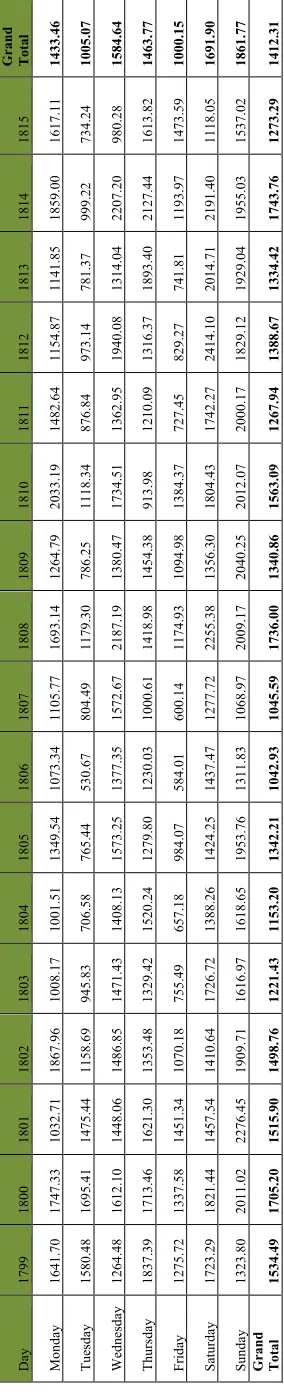
Appendix B: Table 1. Average takings by weekday...587
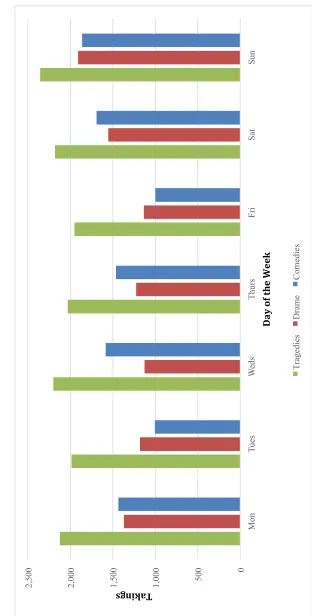
Figure 1. Average takings by weekday, 1799–1815...588
Table 2. Average takings per month...589
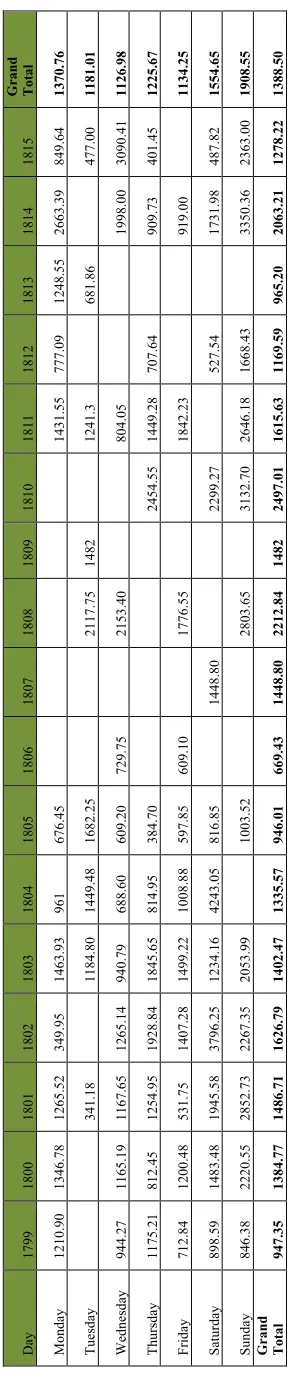
Table 3. Average takings tragedy (first play) ...590
Table 4. Average takings comedy (first play) ...590
Table 6. Genre per weekday (first play) ...591
Table 7. Genre per year (first play) ...592
Figure 2. Visualisation of genre per year (first play) ...592
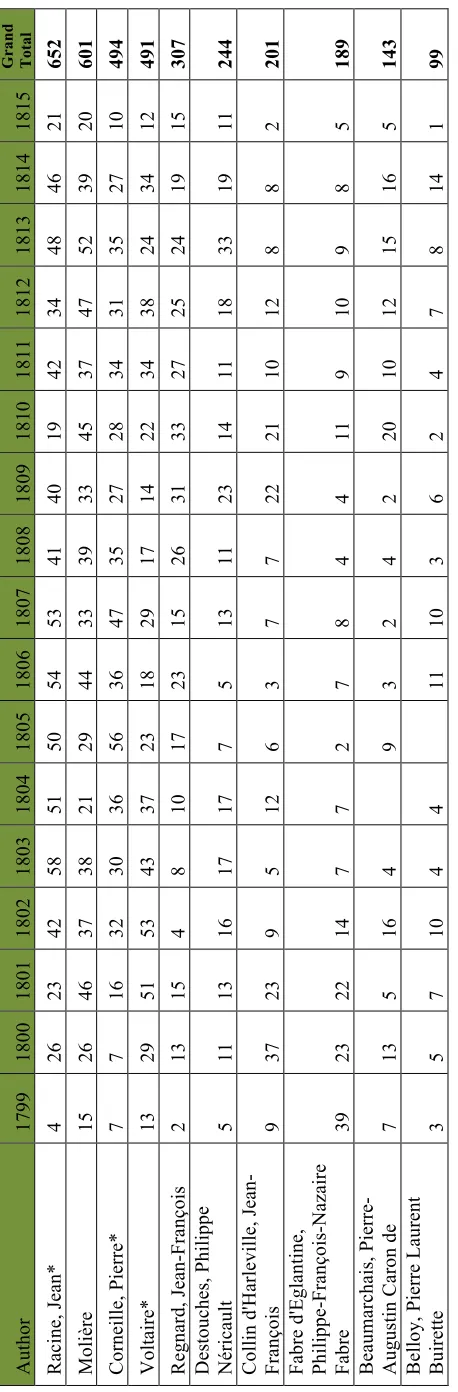
Table 8. Top ten authors (first play) ...593
Table 9. Average takings of top ten authors (first play) ...594
Table 10. Century of first play...595
Table 11. Corneille, Racine, and Voltaire’s tragedies per year...596
Figure 3. Corneille, Racine, and Voltaire’s tragedies per year...596
Appendix C: Table 1. Index of Tragedies in ‘Corrections, coupures et variantes’, BMCF MS Rés 048, pp. 327–29...598
Acknowledgements
As this thesis will show, writing is far from an isolated activity. First and
foremost I thank my supervisor, Kate Astbury, who has tirelessly encouraged and supported me as both an undergraduate and doctoral candidate. I am also
indebted to the two postdoctoral fellows on the AHRC Napoleonic project, Katherine Hambridge and Vincenzo De Santis, whose advice and help at all hours has been invaluable.
Thanks must additionally go to the Arts and Humanities Research Council for the PhD Studentship to undertake this project. I am likewise very grateful to the Erasmus scheme, the French Embassy in London, and the Entente Cordiale scholarship which allowed me to undertake extensive archival research in France. This research would have been impossible without the help of Agathe Sanjuan and her diligent team at the Bibliothèque-Musée de la
Comédie-Française, and the patience and cooperation of these archivists with the librarians of the Bibliothèque nationale de France.
I would like to thank a variety of scholars who have helped and supported me, and commented on my work. Beyond the supportive environment of French Studies at Warwick, especially the advice of my upgrade examiners Ingrid De Smet and Susannah Wilson, thanks must go amongst others to Philippe Bourdin, David Charlton, Oskar Cox Jensen, Pierre Frantz, Sarah Hibberd, Jonathan Hicks, David Lees, Mark Philp, Marielle Silhouette, Tom Stammers, David Taylor, and Cyril Triolaire. I am also grateful to the Revolutionary Researchers and Memory Studies networks, alongside the postgraduate community at Warwick and in Paris.
List of Abbreviations
AN – Archives nationales
BnF – Bibliothèque nationale de France
BMCF – Bibliothèque-Musée de la Comédie-Française
Note on the Text
Declaration of Originality
I declare that this thesis is my own work and has not been submitted for a degree at another university.
Part of an earlier version of Chapter One feeds into the following article:
Clare Siviter, ‘La réécriture tragique d’“Héraclius” de Corneille pour la France napoléonienne’, @nalyses , 11 (2016), 98–122
Another earlier section from Chapter One contributed to a forthcoming book chapter:
Clare Siviter, ‘La tragédie “classique” transformée à l’époque napoléonienne’, in
Fièvre et vie du théâtre sous la Révolution française et l’Empire, ed. by
Vincenzo De Santis and Thibaut Julian(Paris: Classiques Garnier, forthcoming [2017]).
Word Count:
Thesis (excluding footnotes): 78,482 words
Abstract
This thesis constitutes the first extensive study of tragedy during the Napoleonic era. The new tragic productions of this period have been sidelined by French theatre history, allegedly because they were tired copies of seventeenth-century classical models, conduits for propaganda, and suffocated by censorship. I challenge this judgement by excavating this period’s theatre and by applying renewed critical approaches, notably André Lefevere’s notion of rewriting which posits that all productions are subject to poetics and ideology. This thesis is comprised of two principal axes. The first focuses on poetics to contend that new productions were not simply copies of classical plays. Although tragedy was based on the imitation of seventeenth-century models, which scholars refer to as
classiques, these examples were rewritten during the eighteenth century, an activity which continued under Napoleon. Therefore, there was no stable example to imitate, rather there was a particular contemporary understanding, which I label the ‘classique’ model to underline its specificity. Using
contemporary treatises to form a generic framework, I examine how new tragedies performed at the Comédie-Française depart from this inheritance, reconsidering the passage from theatrical Classicism to Romanticism. The second axis engages with Napoleonic cultural politics by rethinking the terms ‘propaganda’ and ‘censorship’. Although tragedy was used for its propagandistic properties, this policy was not always successful. Moreover, the works’ reception reveals that playwrights and the public appropriated tragedy’s rewriting of
historical narratives as a means of mediating the Revolution. Finally, I examine censorship, investigating how the State’s bureaucratic and the
Introduction
‘Tragedies in hindsight look like farces.’1
In 1873 a French literary editor designed a collection of ‘Les Cents Bons Livres’ to form a library for every family and for use in the education system. In the section dedicated to theatre, he chose to include François-Juste-Marie
Raynouard’s (1761–1836) Les Templiers (1805) over better-known tragedies such as Pierre Corneille’s2Horace (1640) and Jean Racine’s (1639–1699)
Phèdre (1677).3 Within the restriction of 100 titles, the selection of Les
Templiers might surprise us today. This tragedy was a Napoleonic hit, but whilst the authors of Horace and Phèdre adorn the exterior walls of the Comédie-Française and are regularly still performed, what has happened to Raynouard and
Les Templiers?4
Histories of French theatre and literature skip over the Napoleonic period with worrying ease. Although Napoleonic tragedy sits at the crossroads of the theatrical movements of Classicism and Romanticism, the general scholarly
1 Julian Barnes, The Noise of Time (London: Jonathan Cape, 2015), p. 164. Barnes is rewriting Karl Marx’s famous declaration that ‘Hegel bemerkt irgendwo, daß alle großen weltgeschichtlichen Tatsachen und Personen sich sozusagen zweimal ereignen. Er hat bergessen, hinzuzufügen: das eine Mal als Tragödie, das andere Mal als Farce.’ Karl Marx, Der achtzehnte Brumaire des Louis Bonaparte (Stuttgart: Dietz Nachf, 1921), p. 7. Amongst other historical patterns, Marx considered Napoleon’s coup (1799) to be the tragedy, and that of his nephew Napoleon III (1808–1873) in 1851 as the farce. Marx’s use of theatrical genres to understand history and politics and Barnes rewriting of this famous quotation for a modern audience are pertinent to many of the themes of this thesis.
2 Corneille will refer to Pierre Corneille unless otherwise stated.
3 François-Juste-Marie Raynouard, Les Templiers, tragédie en cinq actes avec
Notice historique sur la mort des Templiers. Nouvelle édition publiée par Ad. Rion (Paris: Les Libraires, 1873), p. 64. Dates following the titles of plays refer to the date of their first publication apart from Napoleonic tragedies produced for the first time between 1799 and 1815.
opinion is that Napoleonic tragedy simply imitated its seventeenth- and
eighteenth-century predecessors without introducing any innovations—that it is
classique.5 This judgment has certainly contributed to the neglect of Napoleonic tragedy. Scholarly dismissal has been exacerbated by the perception of
Napoleonic tragedy’s relationship with propaganda and censorship, regardless of the fact that theatre has been used for propagandistic purposes for centuries. So while the theatre of the Bourbons and the later drame romantique are lauded with critical praise, Napoleonic theatre has been overlooked. This thesis, the first sustained and detailed analysis of the period’s tragic production, will reveal how Napoleonic tragedy is much more significant than hitherto believed: it is a central moment in the evolution of French theatre and it offers an insight into the fascinating interactions between the State and culture.
The bicentenary of the fall of the Napoleonic Empire, which once stretched from the Iberian Peninsula to Russia, showed that Napoleon continues
5 For early nineteenth-century reactions to French theatre, see Edmond Eggli and Pierre Martino, Le Débat romantique en France, 1813–1830, pamphlets,
manifestes, polémiques de presse, 2 vols (Paris: Société d’édition ‘Les Belles Lettres’, 1933) and Pierre Frantz, ‘L’Invention du classicisme aux sources de la modernité’, in Révolutions du moderne, ed. by Daniela Gallingani, Claude Leroy, André Magnan, and Baldine Saint Girons (Paris: Méditerranée, 2004), pp. 116– 26. For other post-Romanticism uses of the term classique regarding the Napoleonic era, see Eugène Lintilhac, ‘La Théorie du théâtre en France de Scaliger à Victor Hugo’, La Nouvelle Revue, 9 (1901), pp. 3–20 (p. 6); Gustave Lanson, Esquisse d’une histoire de la tragédie française (New York: Columbia University Press, 1920) p. 130; Louis Bertrand, La Fin du classicisme et le retour à l’antique dans la seconde moitié du XVIIIe siècle et les premières années du XIXe siècle en France, 2nd edn(Paris: Arthème Fayard & Cie, 1897), pp. 326–27; Maurice Albert, La Littérature française sous la Révolution,
l’Empire, et la Restauration (Paris: Société française d’imprimerie et de Librairie, 1898), pp. 285–86. The official Napoleonic theatre is also seen as classical by Marvin Carlson, Marvin Carlson, Theories of the Theatre, A Historical and Critical Survey, from the Greeks to the Present (Ithaca and London: Cornell University Press, 1984), p. 197; Jean-Pierre Perchellet,
L’Héritage classique. La Tragédie de 1680 à 1814 (Paris: Honoré Champion, 2004); Pierre Frantz, ‘Le Théâtre sous l’Empire : entre deux révolutions’, in
to attract popular and scholarly attention.6 Napoleon, as saviour or despot, remains an integral part of French and European cultural memory. Even in 1979, A. J. P. Taylor observed that there were more works about Napoleon (1769– 1821)7 than any other human being, yet only a comparative handful concentrate on Napoleonic culture, let alone theatre.8 This dearth is even more striking given that the theatre was a key cultural institution at the time for Napoleon, for the political regime, and for post-revolutionary France.9 Tragedy played a central role in the exercise of Napoleonic cultural power and control, part of the ‘soft power’ used for national reconstruction after the French Revolution and for acculturation and assimilation not just in new Napoleonic lands but in France too.10 An extended study of Napoleonic theatre in general would be an Olympic, albeit necessary, task.11 Admittedly, this thesis only covers one genre from 1799
6 Nathalie Petiteau uses surveys to show that in 1997 less than half of the French population (forty-six per cent) thought that France could be proud of the
Napoleonic era and that sixty per cent believed his wars were wars of oppression rather than liberation, yet paradoxically by 2004 there was a rise in popularity of Napoleon: Natalie Petiteau, Napoléon, de la mythologie à l’histoire (Paris: Seuil, 2004), p. 397 and p. 401. This popularity has arguably increased as the 1815 celebrations have shown.
7 The birth and death dates have been taken from the authoritative source at the Bibliothèque nationale de France (<data.bnf.fr>), where possible. Napoleon was born Napoleone di Buonaparte. He was known as Bonaparte during the
Revolution and the Consulate and became ‘Napoleon’ with the start of the Empire. For terminological ease, he will be referred to as Napoleon throughout this thesis, unless it is necessary to underline his contemporary name form. 8 A. J. P. Taylor, ‘The Emperor Industry’, The New York Review of Books, 18 December 1969, available at <http://www.nybooks.com/articles/1969/12/18/the-emperor-industry/> [accessed 27 April 2016]. On Napoleonic culture, see
L’Empire des muses.
9 For Napoleon’s theatrical tastes, see Louis Henri Lecomte, Napoléon et le
monde dramatique : étude nouvelle d’après des documents inédits (Paris:
Daragon, 1912) and David Chaillou, Napoléon et l’Opéra, la politique sur scène (1810–1815) (Paris: Fayard, 2004).
10 On Napoleonic ‘soft power’, acculturation, and assimilation in Napoleonic Europe see Michael Broers, ‘The First Napoleonic Empire, 1799–1815’, in
Théâtre-to 1815 and concentrates on Paris as the centre of tragedy, but these foci are key to excavate and understand this major genre for the Napoleonic period.12
I will review tragedy between 18 Brumaire when Napoleon rose to power to the termination of the First French Empire in 1815.13 I will investigate the position of this corpus between the movements of Classicism and Romanticism and challenge the prevailing accounts of this period’s tragic productions. Theatre must be understood within its historical context: tragedies were (re)written for the public to evolve with its changing tastes, leading to digressions from the traditional generic framework. This contests the novelty of later nineteenth-century theorists and playwrights. By prioritising reception, I will shed new light on Napoleon’s cultural politics and how contemporary society used culture to comprehend the present. The findings of this study will deepen our
understanding of this vital period, between Classicism and Romanticism, between Revolution and Restoration.
1. The Comédie-Française Under Napoleon
This thesis moves beyond anecdotes and the traditional focus on star actors to look at a variety of Comédie-Française agents to comprehend better their impact on the period’s tragedy. Tragedy was an inherent part of the Comédie-Française, or the Théâtre Français as it was known at the time. This institution was the
Français (Paris: Plon, 1911). More recently, Rüdiger Hilmer has taken a larger view of the Napoleonic theatre system in Paris but concentrates mainly on the secondary theatres, Rüdiger Hilmer, Die Napoleonische Theatrepolitik
Geschäftstheater in Paris, 1799–1815 (Cologne: Böhlu, 1999). Studies covering provincial theatre scene are rare but one work is Cyril Triolaire, Le Théâtre en province pendant le Consulat et l’Empire (Clermont-Ferrand: Presses
Universitaires Blaise-Pascal, 2012). As of yet, there is no work uniting Parisian and provincial theatre.
12 Some readers might also desire more of a reflection of the simultaneous developments of tragedy abroad in areas such as the German Lands. Although these developments are important, they are beyond the scope of this thesis which will only deal with them when they have a direct implication on the subject of this thesis, namely tragedy destined to be performed at the Comédie-Française between 1799 and 1815.
guardian of French tragic heritage, and it was the only Parisian theatre allowed to perform tragedy as of 1801 (en principe).14 This genre played a significant role at this theatre since forty-four per cent of its first plays were tragedies.15 By
studying the theatrical life of the provinces, recent scholarship has decentralised the study of Napoleonic theatre, but Cyril Triolaire states that tragedy accounted for only six to twelve per cent of provincial performances,and Philippe Bourdin maintains that these heavily favoured Voltaire (1694–1778).16 This disregard for tragedy outside of Paris echoes the statistics gathered by Rahul Markovits for European performances of French theatre during the eighteenth century.17 However, tragedy did travel abroad as the chosen genre of Napoleonic representation. Markovits doubts the efficacy of these foreign tragic
performances, but this has been contested by Florence Filippi in her analysis of Napoleon’s use of French tragedy for political gain in the German Lands.18 The
14 Letter 26 ventôse an IX (17 March 1801), Laplace to Mahérault, Paris, BMCF, ARAD 1 Dossier Administration Mahérault 2 (34) and ‘Observations sur un ordre donné à la Comédie-Française’, 27 ventôse an IX (18 March 1801), Paris, BMCF, 3 AG 1801-4 27.
15 See Appendices A and B.
16 Triolaire, p. 323. Triolaire’s assessment is based on the eleventh theatrical arrondissement. Philippe Bourdin extends this to six to twelve percent in the provinces, Philippe Bourdin, ‘Préface’, in Le Théâtre en Province, pp. 17–26 (p. 25). Lauren Clay, has also taken a wider geographical approach for her recent study of eighteenth-century theatre, Lauren Clay, Stagestruck. The Business of Theater in Eighteenth-Century France and Its Colonies (Ithaca; London: Cornell University Press, 2013).
17 Rahul Markovits, Civiliser l’Europe. Politiques du théâtre français au XVIIIe
siècle (Paris: Fayard, 2014). See for example his annexes, ‘Auteurs les plus joués’ and ‘Pièces les plus jouées’, pp. 377–79.
18 Using selective sources, Markovits maintains that Napoleon’s use of tragedy abroad was unsuccessful, Rahul Markovits, ‘Sociopolitique des genres : la Comédie-Française à Erfurt, ou du mauvais usage de la tragédie (1808)’, Revue Parlement(s), 8 (2012–13), 67–80. Florence Filippi, ‘Détournement du mythe sur la scène impériale : Napoléon et la tragédie classique’, in Teatro do Mundo. A reescrita de mitos no teatro, Centro de Estudos Teatrais da Universidade do Porto, Centro de Literaturas e Culturas Lusofonas e Europeias (Porto: Tipografia Fonseca, Lda, 2012), pp. 135–50. Since the planned expedition of actors for the Egypt campaign in 1799, Napoleon had understood the importance of travelling performers. For example, letter Laplace to Mahérault, ‘le
special relationship between Napoleon and tragedy can be demonstrated by the programming at the Théâtre de la Monnaie in Brussels, where tragedy was rarely performed apart from when either Napoleon or his star actor François-Joseph Talma (1763–1826) were present.19 The Comédie-Française’s actors were sent around France and then the French Empire, notably to Lyon (1802), Mainz (1804), Brussels (1803, 1811), Erfurt (1808), Holland (1811), and Dresden (1813) at considerable personal cost to Napoleon.20 Similarly, one of the principal actresses of the Comédie-Française, Mademoiselle Raucourt (1756– 1815), formed her own troupe for the Italian provinces.21
Both abroad and at court the Emperor was fond of theatre and of tragedy in particular. Napoleon restored the practice of court performances, using the artists of the Comédie-Française, the Opéra, and the Opéra-Comique amongst others. The 1806 court entertainment budget of 75,000 francs had doubled by 1811.22 Indeed, sometimes Napoleon desired the presence of the actors to such an extent that the Comédie-Française was unable to perform for the public that evening.23
comédiens’, 30 brumaire an VIII (21 November 1799) Paris, BMCF, ARAD 1/1 and ‘Rapport confidentiel présenté par M sur le projet de troupe en Egypte’, 13 nivôse an IX (3 January 1801), Paris, BMCF, ARAD 1/2, 22. There is also a whole dossier on the expedition in BMCF, ARAD 1/11.
19 On the tragedies performed by Talma and those for Napoleon’s visit to Brussels in 1803, see Henri Liebrecht, Comédiens Français d’autrefois à Bruxelles (Paris; Brussels: Maison du livre français; Labour, 1932), pp. 218–24.
Les Templiers was performed in 1811, coinciding with a journey to Holland. ‘Théâtre de la Monnaie, Agenda journalier des recettes et dépenses, mois de mars 1811’, Brussels, Archives générales du royaume, T019, 69.
20 The performances at Erfurt cost 71,274 francs and 12 sols and the actors were paid a gratification totalling 113,500 francs for the performances at Dresden, the musicians were paid 13,182 francs and the return cost for the troupe cost 42,800 francs, Lecomte, p. 238 and pp. 264–65.
21 Paris, AN, F/7/8961, Markovits, Civiliser l’Europe, pp. 284–88. Mademoiselle Raucourt’s full name is Françoise Marie Antoinette Josèphe Saucerotte.
22 Paris, AN, O/2/36 and 0/2/39.
Napoleon’s fondness for the theatre, both personally and politically, led to his increased involvement with and significant regulation of the Comédie-Française’s running and the larger theatrical landscape, as scholarship has recognised.24 Before 18 Brumaire, the Comédie-Française had reunited its two revolutionary troupes at the ‘salle de la rue de Richelieu’, where the Comédie-Française remains today. The troupe of the Théâtre de la République—‘les rouges’—including Talma who left the Comédie-Française in 1791—and ‘les noirs’—those who remained in the newly baptised Théâtre de la Nation during the Revolution before its closure in September 1793—came together in May 1799 under the Ministre de l’Intérieur, the playwright Nicolas François de Neufchâteau (1750–1828). The Directory had tightly controlled theatre, and this surveillance continued, in recognition of the theatre’s role as a key site of sociability, its weight in the public sphere, and its function in the exercise of power.
Napoleon famously reinstated the privilège of the Comédie-Française: it regained the monopoly of tragedy and high comedy as early as 17 March 1801.25 By 1802, the Comédie-Française received 100,000 francs annually from the government,26 and Napoleon signed the papers outlining its definitive
Ce Relache a été occasionné par le service de la cour. On devait donner Britannicus et le Mercure galant. A Midy on reçut l’ordre d’aller jouer Andromaque aux Thuileries. Cet ordre inattendu dérangea tellement les dispositions du Répertoire qu’il fut impossible de trouver un spectacle convenable a substituer a celui annoncé et on fut obligé de mettre des Bandeaux sur les affiches sur les quels etaient ecrits les mots. Relache Pour le Service de la Cour.
24 Works on Comédie-Française under Napoleon include Eugène Laugier,
Documents historiques sur la Comédie-Française pendant le règne de Napoléon
(Paris: Firmin-Didot frères, 1853); Frédéric Loliée, La Comédie-Française, histoire de la maison de Molière de 1658–1907 (Paris: Lucien Laveur, 1907); and Sylvie Chevalley, ‘La Comédie-Française et l’avènement de l’Empire’,
Europe, 480–81 (1969), 263–70.
25 Letter 26 ventôse an IX (17 March 1801), Laplace to Mahérault, BMCF, ARAD 1 Dossier Administration Mahérault 2 (34) and ‘Observations sur un ordre donné à la Comédie-Française’, 27 ventôse an IX (18 March 1801), BMCF, 3 AG 1801-4 27. Nevertheless, other theatres continued to perform tragedies.
organisation on 18 January 1803, leading to its ‘acte de société’ on 17 April 1804.27 The ‘acte de société’ reaffirmed roles, such as that of Jean-François-René Mahérault (1764–1833) as ‘commissaire du gouvernement’, a position he had occupied since 1799, and Auguste-Laurent de Rémusat (1762–1823) as the ‘Préfet du palais’ and ‘Surintendant des spectacles’ in post since 1802,28 whilst clarifying the practical and economic administration of the theatre, the rights of the actors (reinstating their hierarchy according to their ‘ancienneté’), the logistics surrounding the reception of new plays, and the formation of the repertoire. Mahérault then swore allegiance to the government on behalf of the Comédie-Française, making it a de facto State institution. Consequently, as of 3 July 1804, the actors were renamed ‘les comédiens ordinaires de l’Empereur’.29 The theatre decrees of 1806 and 1807, which have generated scholarly interest,30 did not fundamentally change the organisation or takings of the Comédie-Française as they would other theatres—conversely, they actually weakened the average takings31—but it is important to note that they did transform the
theatrical landscape, quashing potential rivals such as the adjacent Théâtre Montansier in the Palais-Royal and increasing the powers of Rémusat, and thus the government.32 The next major administrative development was the Moscow
27 Ibid., pp. 28–31.
28 Frederick Hemmings, Theatre and State in France, 1760–1905 (Cambridge: Cambridge University Press, 1994), p. 104. This is confirmed by the Journal des débats, 26 October 1802 (the order came into force on 27 November 1802 according to Hemmings).
29 Laugier, p. 75. The Journal des débats lists them thus on 4 July 1804, Journal
des débats, 4 July 1804.
30 Louis Véron proposes a useful comparative analysis of the theatre decrees of 1806, 1807, and 1860, Louis Véron, Paris en 1860.Les Théâtres de Paris depuis 1806 jusqu’en 1860 (Paris: Librairie Nouvelle; A. Bourdiliat et Cie., 1860). Likewise theatre regulations form the core of Jean-Claude Yon’s examination of theatrical privilege from 1807 to 1864, Jean-Claude Yon, ‘Les Théâtres parisiens à l’ère du privilège (1807–1864)’, in Production de l’immatériel : théories, représentations, et pratiques de la culture au XIXe siècle (Saint-Étienne: Presses universitaires de Saint-Étienne, 2007), pp. 61–74.
31 The analysis of the daily takings shows that the decrees did little to affect the position of the Comédie-Française, whose health was really restored in 1802 and 1803. See Appendix B.
decree of 1812—a decree which continues to regulate the Comédie-Française today. Although in many ways this decree was merely a solidification of all the developments since 1802,33 the particular moment that the Moscow decree appeared reveals the contemporary importance of the Comédie-Française to Napoleon: most likely drafted in 1813, rather than the official date of October 1812, the decree was a statement of Napoleon’s control of the cultural sphere amid military crisis, emphasising the centrality of theatre for the Emperor.34
A theatre is more than a machine subject to legislation or repertoire, of course: it is clear that the Comédie-Française was as much defined by its troupe, whose actors became some of the first celebrities.35 Despite performing together, the relations between the Comédie-Française’s actors were notoriously tense, and the cabals of the audience and partisan publications added fuel to the fire.36
33 The continued pertinence of the Napoleonic decrees in the twentieth-century is demonstrated by Hippolyte Buffenoir and Maurice Haquette, Le Décret de Moscou et la Comédie-Française, historique et texte intégral avec une
reproduction du manuscrit original portant la signature de Napoléon 1er(Paris: Maurice Haquette, 1902) and Simon Siaud, La Comédie-Française, son histoire-son statut (Paris: Libraire Générale de Droit et de Jurisprudence, 1936). In terms of the Moscow decree as the culmination of the other orders since 1802, see Laugier, p. 86.
34 Tony Sauvel suggests that this decree dates from 1813 rather than the decree’s official date of October 1812, Tony Sauvel cited in Jean Tulard, Napoléon: ou le mythe du sauveur (Paris: Fayard, 1977), p. 407. The archives record a change in the theatre’s administration which corroborates this proposition: the new theatre commissioner, Nicolas Bernard (17?–18?), took the reigns in 1813, not 1812 and there was a fresh administrative register, for example, the register containing the ‘procès-verbaux des séances du comité’, which had lasted over a decade, was changed to a new ‘Registre du comité d’administration du Théâtre Français de S. M. Empereur et Roi’, in 1813, BMCF, R 415 and R 416.
35 Antoine Lilti has a section of his work on the rise of the modern celebrity which is dedicated to Talma. Antoine Lilti, Figures publiques, l’invention de la célébrité 1750–1850 (Paris: Fayard, 2014), pp. 60–73.
36 On the topic of partisan publications, for just the rivalry between
Talma was rivalled by Lafon (1773–1846),37 as Mara Fazio notes in her excellent work using untapped archives from the Comédie-Française,38 and Lafon had a pro-Talma cabal unleashed against him.39 The most notorious example of the period is the intense rivalry between Mesdemoiselles Duchesnois (1777–1835) and George (1787–1867).40 The cabals interrupted performances to praise an actress or to reject her.41 Crowds flocked to see Mesdemoiselles Duchesnois and George perform together in Racine’s Iphigénie en Aulide (1675)or with
Mademoiselle Volnais (1786–1837).42 The Comédie-Française’s Comité of actors and the government ordered that the young actresses share the role ‘des reines et premiers rôles, avec la faculté de jouer deux fois de suite le même rôle
June 1803; an éloge to Mademoiselle Duchesnois and a selection of songs
praising her can be found in L’Opinion du parterre, I (1803); see the prints ‘La Couronne Théâtrale disputée par les Demoiselles Duchesnois [et] George Weimer’ (Paris: Martinet, [n.d.]) and ‘Le Goût du jour, no. 86. La fin du procès. Malgré George, Geoffroy, Raucour et sa cohorte La voix publique parle et Duchesnois l’emporte’ (Paris: Martinet, [n.d.]).
37 Full name: Pierre Rapenouille.
38 Mara Fazio, François-Joseph Talma, le théâtre et l’histoire de la Révolution à
la Restauration, trans. by Jérôme Nicolas(Paris: CNRS Éditions, 2011), p. 130. 39 Lanzac de Laborie, p. 53.
40 There was another struggle between Mademoiselle Volnais (1786–1837) [full name: Claudine-Placide Croizet-Ferreire] and Mademoiselle Bourgoin, Edmond-Denis de Manne, Galerie historique des comédiens de la troupe de Talma : notices sur les principaux sociétaires de la Comédie françoise depuis 1789 jusqu’aux trente premières années de ce siècle (Lyon: Scheuring, 1866), p. 255. Mademoiselle Duchesnois’s full name was Catherine-Joséphine Raufin and Mademoiselle George’s was Marguerite Josephine Weimer.
41 In terms of audience behaviour, George was verbally attacked during a performance of Cinna when the parterre wanted to see Mademoiselle
Duchesnois, Journal des débats, 28 April 1803; the audience made a lot of noise when Mademoiselle Duchesnois appeared in Esther, Journal des débats,4 June 1803. L’Opinion du parterre also notes how Mademoiselle Raucourt gave 400 free tickets for George’s performance so that her student would have the support she needed, Pierre-David Lemauzier L’Opinion du parterre, I (1803), 143.
42 Mesdemoiselles Duchesnois and George performed together, Journal des
chacune à son tour’, in an attempt to calm the fury.43 Nonetheless, the cabals remained.44 Theatre critics mediated the discourse surrounding actors, their lives, and their performances, sometimes with such spite that in revenge Talma
physically attacked the conservative critic Julien-Louis Geoffroy (1743–1814).45 The Comédie-Française under Napoleon was a very animated environment, and this had a direct effect on tragedy, its government regulation, and its reception by the public.46
Concentrating on the actors also draws attention to the varied nature of Comédie-Française performances, despite its portrayal as an institution which prided itself on purity. In terms of the Napoleonic period as a transfer from Classicism to Romanticism, it is crucial to remember that the elder actors had been trained under the ancien régime in the wake of Henri-Louis Lekain (1729– 1778) who first performed Voltaire’s tragedies and reconceptualised
seventeenth-century roles. There was a definite changing of the guard marked by
43 Lanzac de Laborie, p. 95, quoting BMCF registers, 23 fructidor an XI (10 September 1803).
44 The Journal des débats records huge applause when Mademoiselle
Duchesnois came on-stage in act II of Iphigénie, Journal des débats, 21 June
1803. The battle between Mesdemoiselles Duchesnois and George was settled when Mademoiselle George fled the Comédie-Française in 1808 (before returning in 1813).
45 Fazio, p. 162. This discourse continues in their afterlives: Filippi speaks of the ‘myth’ of Talma Florence Filippi, ‘François-Joseph Talma, ou le paradoxe d’un comédien entre avant-garde et tradition’, in Teatro do Mundo, Tradiçào e vanguardas : cenas de uma conversa inacabada, ed. by Cristina Marinho and Nuno Pinto Ribeiro (Porto: SerSilito, 2009), pp. 47–62. Mademoiselle George has been the subject of recent biographies, but these works prefer to focus upon the actress’s lovers rather than her dramatic endeavours. For biographies of Mademoiselle George, see A. Augustin-Thierry, Mademoiselle George, maîtresse d’empereurs (Paris: Albin Michel, 1936) and Hélène Tierchant,
Mademoiselle George, la tragedienne de Napoléon (Paris: Aubéron, 2008). This image has also been conserved in literature; see for example Leo Tolstoy, War and Peace (London: Penguin Classics, 2007). Indeed, even in modern popular culture she is still relegated to her role as lover, see Robert Hudson and Marie Phillips, Warhorses of Letters (London: Unbound, 2012) p. 75 where she is referred to—in jest—as ‘Napoleon’s other mistress’ and ‘a bit more of a slapper’. 46 For more detail on the troupe under Napoleon, see Manne, Galerie historique
a series of deaths during the Consulate, such as Mademoiselle Clairon (1723– 1803) amongst others.47 A cohort of actors remained, like Talma, and debutants renewed the troupe. These actors either came from the provinces, such as Mademoiselle George,48 the Conservatoire, or were the protégés of members of the theatrical and political world, such as Mademoiselle Duchesnois.49 If the Comédie-Française and the government were satisfied with their performances, the new actors were admitted to the troupe. Many of these younger Napoleonic actors would later incarnate some of the iconic roles of the drame romantique: Victor Hugo (1802—1885) was inspired by Talma to write Cromwell (1828), Mademoiselle George created the role of Lucrèce Borgia (1833),50 Firmin
(1784–1859)51 that of Hernani, and Joanny (1775–1849) that of Don Ruy Gomez de Silva in Hernani (1830).
It was not just the actors’ crossover of generations which was occurring under Napoleon, but also a crossover of genres, despite the division between tragic and comic roles. For example, in Alexandre Duval’s (1767–1842)
47 Other examples include François-René Molé (1734–1802),
Marie-Françoise Dumesnil (1713–1803), Bellemont (1728–1803), and Madame Vestris (1743–1804). This information has been taken from the Comédie-Française La Grange database, available at <http://www.comedie-francaise.fr/la-grange-recherche-simple.php?id=550> [accessed 15 June 2016].
48 Other examples of Comédie-Française actors with provincial origins include: Lafon and Joanny (1775–1849). The dates have been taken from the Comédie-Française La Grange database, available at <http://www.comedie-francaise.fr/la-grange-recherche-simple.php?id=550> [accessed 15 June 2016].
49 Mademoiselle Duchesnois was supported by the tragic playwright Gabriel Legouvé and recommended by Napoleon’s wife and the future Empress, Joséphine de Beauharnais, Fiche biographique, Paris, BMCF, dossier
Mademoiselle Duchesnois. Marie-Thérèse-Étiennette Bourgoin (1781–1833) was supported by Mademoiselle Dumesnil and Jean-Antoine Chaptal (1756–1832), the then Ministre de l’Intérieur. Bourgoin’s dates have been taken from the Comédie-Française records, available at
<http://www.comedie-francaise.fr/la-grange-autorite.php?id=554&aut=00008112&ref=BIB00024404&p=1> [accessed 21 March 2016].
50 Although I would like to refer to women by their surnames as men are, in this thesis I refer to both the Comte and Comtesse de Rémusat so for clarity’s sake I have kept the traditional feminine title when referring to women.
Guillaume le Conquérant (1804), a drame historique, the tragic actor Baptiste aîné (1761–1835),52 performed the main role Guillaume, Talma that of Harold, Mademoiselle George that of Mathilde, and Mademoiselle Bourgoin (1781– 1833) was the comic ‘petite paysanne’.53 Here, all the tragic actors were performing alongside their comic counterparts, in a different genre, and in prose.54 In Duval’s drame, Édouard en Écosse (1802), the tragic actor Étienne Meynier Saint-Fal (1752–1835) appeared with the comic star who had famously performed the role of Figaro, Dazincourt (1747–1809).55 This mixture of acting styles and experience continued in Népomucène-Louis Lemercier’s (1771–1840) ‘comédies historiques’ Pinto, ou la journée d’une conspiration (1801) and
Christophe Colomb (1809). Indeed, several tragic actors also performed comedy56 and the comic celebrity Mademoiselle Mars (1779–1847)57 cross-dressed for the tragedy Omasis, ou Joseph en Égypte (1806).
To be sure, the Comédie-Française actors have been studied before, but the focus has been on the star actors and the evidence often anecdotal. In this thesis, the actors will be integrated into a wider consideration of agency within the theatre, as a means of integrating a history of genre into a history of actors and institutions.
2. Generic Boundaries: Defining ‘Tragédie’
Delineating a project by genre necessitates a reflection on this categorisation of artistic production. Modern theatre critics often use Germanic scholars to
theorise genre, especially the ‘tragic’ as an experience or world-view,58 but there
52 Full name: Nicolas-Eustache Anselme. 53Journal des débats, 6 February 1804.
54Journal des débats, 6 February 1804 and Paris, BMCF, R 327. 55 Full name: Joseph-Jean-Baptiste Albouy.
56 For instance, Talma performed in Duval’s comedy Shakespeare amoureux, ou
la pièce à l’étude (1804), BMCF, R 327 and all the troupe were supposed to attend the ceremonies for Molière’s Le Bourgeois Gentilhomme (1670).
57 Full name: Anne Françoise Hippolyte Boutet de Monvel.
58 See for example Walter Benjamin, The Origin of German Tragic Drama, with
is a distinct French tradition of placing emphasis on ‘tragédie’ as a genre that emerges from the strict seventeenth-century division between ‘tragédie’ and ‘comédie’ in high spoken drama. As Mark Ledbury observes, genre was central to the French cultural world but it was taken as read, and consequently little commented on.59 In 1798, the fifth edition of the Dictionnaire de l’Académie Française defined tragedy as ‘Poëme dramatique, Pièce de théâtre, dans laquelle on représente une action importante entre des personnes illustres, qui est propre à exciter la terreur ou la pitié, et qui finit d’ordinaire par un événement funeste’.60 This definition relies heavily on the poetics developed by seventeenth-century theorists in their understanding of Aristotle (384–322 BC). The draft for the
‘Nouvelle organisation des théâtres après les principes établis par le décret du 8 juin 1806’ likewise uses the seventeenth century as a reference point, noting that ‘tragédie’ and ‘comédie’ are ‘clairement désigné[s] par les pièces qu’ont données les grands maîtres de la scène française: Corneille, Racine, Molière et
Regnard.’61 The seventeenth-century model had by the nineteenth century become widely codified: in 1808 Louis-Sébastien Mercier (1740–1814)
denounced modern poets and playwrights as ‘ces malheureux qui bénissent leurs chaînes’.62 Appreciated or not, tragedy as a genre in early nineteenth-century France was thus very much linked to its seventeenth-century roots.
Napoleonic accounts such as the above ratify the modern scholar André Lefevere’s argument that all literary production is subjected to poetological and ideological constraints.63 Ideologically, the funding sources of the selective
of tragic experience over the formal structure of tragedy, Hans-Thies Lehmann,
Tragödie und Dramatisches Theater (Berlin: Alexander Verlag, 2013). 59 Mark Ledbury, Sedaine, Greuze and the Boundaries of Genre (Oxford: Voltaire Foundation,2000), p. 18.
60Dictionnaires d’autrefois, available at
<http://artflsrv02.uchicago.edu/cgi-bin/dicos/pubdico1look.pl?strippedhw=tragédie> [accessed 20 January 2016]. 61 Paris, AN, F/21/953.
62 Louis-Sébastien Mercier, Satyres contre Racine et Boileau, dédiées à A. W.
Schlegel, Auteur de ‘Comparaison entre la Phèdre de Racine et celle d’Euripide’
(Paris: Hénée; Tourneisen, 1808), p. 5.
63 André Lefevere, Translation, Rewriting and the Manipulation of the Literary
Comédie-Française (the government and Napoleon personally) and its position as a State theatre impacted on new creations. Poetologically, the Comédie-Française controlled genre through reception since a playwright might compose a play in a certain genre, but it is the reception of this play which affirmed its generic label. As Chapters Three and Four will demonstrate, new ‘tragédies’ could be
reclassified as drames before their performance or were rejected because they did not correspond to the generic model. Garin Dowd has rightly argued that genre is a system of classification, the imposition of order linked to Michel Foucault’s disciplinary power enforced by the administrative and social systems which the Napoleonic era helped to consolidate.64 Here, the power of the
Comédie-Française regulated genre. This institution’s role is accentuated by the fact that although tragedies were performed in other theatres during the Consulate, when the Institut de France published its report for the prix décennaux in 1809, only tragedies which were ‘représentées sur le Théâtre français’ over the last decade could be entered, unveiling the increasing poetological and ideological
constraints to which ‘tragédie’ was subjected.65
The audience also poetologically regulated the genre in reception, and manifested its displeasure at a ‘tragédie’ which eluded their ‘horizon of expectation’.66 For instance, the turmoil following Antoine Vincent Arnault’s (1766–1834) Don Pèdre, ou le roi et le laboureur (1802) or Lemercier’s Isule et Orovèse (1802) exhibits how the ‘generic contract’ had been broken:67 genre taken from Lefevere. Although Lefevere is known for his work on translation, here he is focusing on literary creation.
64 Garin Dowd, ‘Introduction: Genre Matters in Theory and Criticism’, in Genre
Matters: Essays in Theory and Criticism, ed. by Garin Dowd, Lesley Stevenson, and Jeremy Strong(Bristol: Intellect Books, 2006), pp. 11–27 (p. 11). Michel Foucault, Surveiller et Punir. Naissance de la Prison (Paris: Gallimard, 1975), p. 165.
65Rapport du jury institué par sa Majesté l’Empereur et Roi, pour le jugement
des prix décennaux (Paris: Imprimerie Impériale, 1810), p. 61.
66 This term is taken from Hans Robert Jauss, Towards an Aesthetic of Reception, trans. by Timothy Bahti(Brighton: Harvester, 1982).
must be understood within its sociological context. Nonetheless, genre is also historical. The preeminent tragic theorist Péter Szondi has advocated a ‘historical poetics of tragedy’;68 ‘tragédie’ is not static. Likewise, as Tzvetan Todorov argues, genre is a system in a constant state of evolution.69 For example, Les Templiers, which was judged worthy of the prize for ‘tragédie’ in 1809, was vastly different from a ‘tragédie’ in 1709: notably the characters, sentiment, and subject matter of ‘tragédie’ had developed. The evolution of tragedy echoes the idea, used by Napoleonic critics and modern theorists alike, that a ‘genre’ contains multiple ‘espèces’.70 This distinction is especially applicable to
tragedies created during the early nineteenth century: the Archives littéraires de l’Europe described Les Templiers as belonging ‘sinon à un nouveau genre de tragédie, du moins à un genre depuis longtems négligé’.71 Similarly, tragedy could have sites of transferral with other genres: The Journal des débats argued that ‘[o]n sait qu’un mélodrame est une tragédie de boulevard, dont les
personnages entrent et sortent de musique’.72 The repeated attempts for genre to be regulated through the theatrical decrees reveal the state of theatrical flux in early nineteenth-century Paris, but the simultaneous desire for classification and order.
From this sociological and historical approach to genre it is evident that the defining elements of ‘tragédie’ were structural. The emotions of the tragedy has been used more recently, see Ralph Cohen, ‘History and Genre’, in The Lyric Theory Reader: A Critical Anthology, ed. by Virginia Jackson and Yopie Prins (Baltimore: The John Hopkins University Press, 2014), pp. 53–63.
68 Peter Szondi, An Essay on the Tragic, trans. by Paul Fleming (Stanford, CA: Stanford University Press, 2002), p. 1.
69 Tzvetan Todorov, ‘The Origin of Genres’, in Tzvetan Todorov, Genres in
Discourse, trans. by Catherine Porter (Cambridge: Cambridge University Press, 1990), pp. 13–26 (p. 15).
70 For a brief overview of the history of genre and species, see David Duff, ‘Introduction’, in Modern Genre Theory, ed. by David Duff(Harlow: Pearson, 2000), pp. 3–24 (p. 4). Duff highlights how both genre and evolutionary theory used similar vocabulary. For the Napoleonic era, see Népomucène-Louis Lemercier, Cours analytique de littérature générale : tel qu’il a été professé à l’Athénée de Paris, 4 vols (Paris: Nepveu, 1817), I, 16.
71 Ch. Vg., ‘Sur la tragédie des Templiers, de M. Raynouard’, Archives littéraires
de l’Europe, VII (1805), 105–20 (p. 106).
may vary, but the audience expected it to adhere to a certain model. To be as faithful as possible to this contemporary understanding, I will consider plays given the generic qualifier ‘tragédie’ at the time. ‘Tragédie’ was not a label limited to new productions during the Napoleonic era: new creations had an inherent relationship with their generic precursors, many of which were still being performed more often than new tragedies. This is crucial because these earlier examples of tragedy formed the background against which new tragedies were received and judged. Therefore, the primary focus of this research is any ‘tragédie’ destined to be performed at the Comédie-Française during the Napoleonic regime, be it rewritten for or prevented from reaching the public. Consequently, it is necessary to concentrate on the performance and
contemporary comprehension of seventeenth-century tragedy which formed the basis of the generic model, notably plays by Corneille and Racine, and its relationship with the new productions. Reception is key to this generic understanding, and thus in this thesis it will be vital also to venture into the worlds of publishing and education to grasp Napoleonic tragedy as globally as possible.
a. New Napoleonic Tragedies
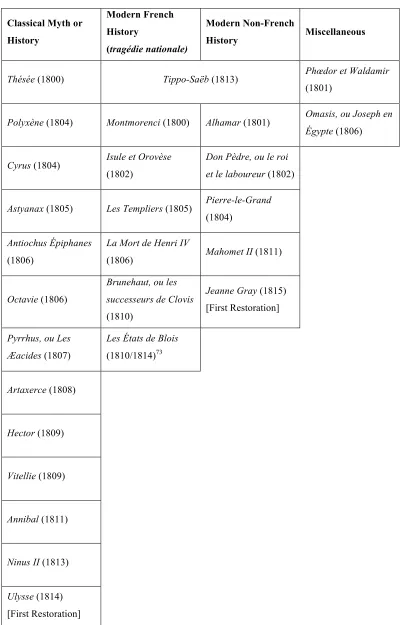
New Napoleonic tragedies fall into three major groups. The first is composed of those based on classical myth and history; the second is those tragedies
Classical Myth or History
Modern French History
(tragédie nationale)
Modern Non-French
History Miscellaneous
Thésée (1800) Tippo-Saëb (1813) Phœdor et Waldamir
(1801)
Polyxène (1804) Montmorenci (1800) Alhamar (1801) Omasis, ou Joseph en
Égypte (1806)
Cyrus (1804) Isule et Orovèse
(1802)
Don Pèdre, ou le roi et le laboureur (1802)
Astyanax (1805) Les Templiers (1805) Pierre-le-Grand (1804)
Antiochus Épiphanes
(1806)
La Mort de Henri IV
(1806) Mahomet II (1811)
Octavie (1806)
Brunehaut, ou les successeurs de Clovis
(1810)
Jeanne Gray (1815) [First Restoration]
Pyrrhus, ou Les Æacides (1807)
Les États de Blois
(1810/1814)73
Artaxerce (1808)
Hector (1809)
Vitellie (1809)
Annibal (1811)
Ninus II (1813)
[image:27.595.111.511.64.689.2]Ulysse (1814) [First Restoration]
Table 1. Table of the major groups of new Napoleonic tragedies.
New Napoleonic tragedies were not homogenous; neither were their authors’ careers. These men—for men they were—worked within the larger literary and political fields, demonstrating the same generic mixedness as the Comédie-Française’s actors. Lemercier, who wrote novel historical comedies performed at both the Comédie-Française and its sister theatre, the Théâtre de l’Odéon, also composed poetry, and gave lectures on drama, as Gabriel Vautier, Maurice Souriau, and Vincenzo De Santis have shown.74 Raynouard became a specialist in Provençal languages;75 Arnault was also a politician and an
administrator, as Raymond Trousson has detailed; Marie-Joseph Chénier (1764– 1811) donned many political caps over the years; Pierre-Marie-François Baour-Lormian (1770–1854) famously translated Jérusalem délivrée (1796) and Ossian
(1800) which would inspire a whole generation of Romantics.76 Michel Faul has described how Étienne de Jouy (1764–1846), like other playwrights, had a career in the army and spent time abroad, before turning to theatre, particularly opera (such as La Vestale (1807) and Les Bayadères (1810)) and vaudeville.77 The
74 Gabriel Vautier, Essai sur la vie et les œuvres de Népomucène Lemercier (Toulouse: A. Chauvin et fils, 1886), Maurice Souriau, Népomucène Lemercier et ses correspondants (Paris: Vuibert et Nony Éditeurs, 1908) and Vincenzo De Santis, ‘Le Dramaturge dissident. Le Théâtre de Louis Lemercier entre Lumières et Romantisme’ (unpublished doctoral thesis, Université Paris IV-Sorbonne, 2013), which has now been published as Le Théâtre de Louis Lemercier entre Lumières et Romantisme (Paris: Classiques Garnier, 2015).
75 André Jaubert, Just-François-Marie Raynouard (1761–1836) : un provençal
illustre : essai sur sa vie et son œuvre (Toulon: Société Nouvelle des Imprimeries Toulonnaises, 1936), p. 26. On Rayouard, see also Jules David, Raynouard : sa vie et ses œuvres (Caen: Le Blanc-Hardel, 1865). There is also another work on Raynouard which is only available in Strasbourg: André Guiraud, F. M. J. Raynouard 1761–1836. 1ère partie, sa vie (Bonn: Imprimerie de l’Université, 1913).
76 Maurice Gallagher, Baour-Lorman, Life and Works, 1770–1854 (Paris: Perrin, 1938); Eugène Hangar, Baour-Lormian (de l’Académie française) esquisses historiques sur la littérature de l’empire et de la restauration (Toulouse: imprimerie de Bonnal et Gibrac, 1865); and Jean-Noël Pascal, ed.,
Baour-Lormian, un poète toulousain à l’aurore du romantisme, Cahiers Roucher-André Chénier, études sur la poésie du XVIIIe siècle, 31 (2011).
77 Michel Faul, Les Aventures militaires, littéraires et autres de Étienne de Jouy
authors who wrote new tragedies, then, were infused with multiple national and international influences.
Trauma was also an intrinsic part of the tragedians’ life. Like the actors of the Comédie-Française who were imprisoned during the Terror,78 several playwrights had also personally endured trauma during the Revolutionary period. To mention but a few cases Jouy was in exile, imprisoned, then sentenced to death;79 Raynouard was incarcerated in 1794;80 Chénier’s brother, the poet André Chénier (1762–1794), was guillotined; Arnault witnessed Marie-Antoinette (1755–1793), in whose service he had been employed, being taken to the scaffold.81 Then there was the collective traumatic experience of the French Revolution and the Revolutionary and Napoleonic wars which killed more than the guillotine.82 The effect of trauma on tragedy was real: the tragic actor Saint Prix (1758–1834) could not perform for a long period after the death of his son whilst on campaign in 1812 and he repeatedly pleaded for permission to retire.83 Tragedy was both on the stage and an integral part of contemporary life and we must be aware of these circumstances, for the playwrights, the actors, and the public, when analysing new Napoleonic tragedies.
3. The Case for Disregard: Classique, Propaganda, and Censorship
Paul Theodore Comeau, ‘Étienne de Jouy: His Life and His Paris Essays’
(unpublished doctoral thesis, Princeton University 1968).
78 ‘Arrêté du Comité du Salut Public, 2 September 1793’ reproduced in Noëlle Guibert and Jacqueline Razgonnikoff, Le Journal de la Comédie-Française 1787–1799. La Comédie aux Trois Couleurs ([n.p.]: Sides, 1989), p. 231. 79 Faul, pp. 38–39.
80 Jaubert, p. 13.
81 Raymond Trousson, Antoine-Vincent Arnault (1766–1834). Un homme de
lettres entre classicisme et romantisme (Paris: Honoré Champion, 2004), p. 71. 82 William Doyle, ‘Already by 1802 a million French citizens lay dead; a million more would perish under Napoleon, and untold more abroad.’ William Doyle,
The Oxford History of the French Revolution, 2nd edn (Oxford: Oxford University Press, 2002), p. 425.
Three words have condemned Napoleonic tragedy: ‘classique’, ‘propaganda’, and ‘censorship’. By reviewing these terms within wider theatre history, it is possible to contest their pejorative application to the Napoleonic period. Firstly, we must tackle the hydra that is the label classique. Through this label, scholars have denied the dynamism of this era’s tragic production, describing it as a field which was damningly ‘vide’.84 The history of this term in relation to tragedy will be handled in Chapter Two; for the moment it suffices to say that when scholars describe Napoleonic tragedy as classique, it is not to evoke this tragedy’s standing as part of the cultural patrimoine. Napoleonic tragedy is not ‘classic’ like that of Racine, but generic, overly-formulaic, and resting on an out-of-date formula.85 In reaction to post-war scholars who often used classique as a means to unify French mid-seventeenth-century theatre into a homogenous entity, Alain Viala argues that this aesthetic qualifier has ‘pris une acceptation de plus en plus restreinte qui soulève de nombreux problèmes.’86 Whilst recent works on
seventeenth-century tragédie classique have attempted to emphasise the heterogeneity of the movement or extend the classique period,87classique as a
84 Lanson, pp. 130–31.
85 Stéphane Zékian has recently investigated the construction of the ‘Siècle de Louis XIV’ in the early nineteenth century, which he aptly names ‘l’invention des classiques’.Classique, for Zékian, is based in a work’s reception(s), its place within the literary and national patrimoine. This argument is certainly valid, but his work is not specific to theatre and is based in the early nineteenth century, whereas this thesis considers the historiographical afterlife of Napoleonic tragedy and the generically specific term of tragédie classique.Stéphane Zékian,
L’Invention des classiques, le ‘siècle de Louis XIV’ existe-t-il ? (Paris: CNRS éditions, 2012)
86 Alain Viala, ‘Qu’est ce qu’un classique ?’, Bulletin des bibliothèques de
France, 1 (1992), available at < http://bbf.enssib.fr/consulter/bbf-1992-01-0006-001> [accessed 7 April 2016] (para. 10). For instance, René Bray reduced seventeenth-century theatre to the structural ‘doctrine classique’, René Bray, La Formation de la doctrine classique en France (Paris: Nizet, 1961). Jacques Scherer also adopted a semilar approach, Jacques Scherer,
La Dramaturgie classique en France (Paris: Nizet, 1962).
term is still imbued with a sense of belonging to the seventeenth century. Its use by theatre historians thus negates the evolution of Napoleonic tragedy. Pierre Frantz has shown that the French cherish conflicts of theatrical evolution such as
La Querelle desAnciens et des Modernes and the transition from Classicism to Romanticism during the Napoleonic era was no different.88 Ironically, although the portrayal of a schism between Romanticism and Classicism was initially a device of the former’s critics, this divide became part of the self-mythologising of the new movement and allowed the Romantic generation to rewrite theatre history, emphasising their novelty compared to pre-existing theatre.89 What is more, this debate became even more ideologically imbued against the Empire and its theatre: Hugo became a Republican icon and the drame romantique was taken up after the horrors of the Second World War by Jean Vilar (1912–1971) as a means of connecting with the nation and the population.90 To situate Napoleonic tragedy within its own context and to take account of the theatrical evolution between the seventeenth and nineteenth centuries, I shall not use the term classique to refer to Napoleonic tragedy but ‘classique’ to distinguish how contemporaries understood specific version of the past models to be imitated.
‘Propaganda’ is another term which theatre historians use as an excuse to disregard Napoleonic tragedy.91 Sheryl Tuttle Ross has been instrumental in reconsidering propaganda by attempting to move away from its negative connotations, which are largely twentieth-century characteristics intensified by
deux cents ans? Les XVIIe et XVIIIe siècles : continuités et discontinuités (Paris: Desjonquères, 2004); Perchellet; Georges Forestier, La Tragédie française: passions tragiques et règles classiques (Paris: A. Colin, 2010). Maurizio Melai even extends tragédie classique up until 1854, Maurizio Melai, Les Derniers Feux de la tragédie classique au temps du romantisme (Paris: Presses de l’université Paris-Sorbonne, 2015).
88 Frantz, pp. 116–26 (p. 116) and Frantz, pp. 173–97. 89 Eggli, p. 12; Viala, para. 6.
90 Florence Naugrette, Le Théâtre romantique en France. Histoire, écriture, mise
en scène (Paris: Seuil, 2001), pp. 298–99. On Vilar and the drame romantique in his project for his théâtre the Théâtre National Populaire, see Anne Ubersfeld, ‘Vilar et le théâtre de l’histoire’, Romantisme, 28 (1998), 17–25.
the World and Cold Wars.92 Instead of merely reducing propaganda to a top-down effect, where propaganda is directed from the government to its citizens,93 Ross has reconceptualised the model: ‘not only does propaganda involve persuading, but also the one persuading (Sender) is doing so intentionally, and moreover there is a target for such persuasion (Receiver) and a means of reaching that target (Message).’94 Ross’s understanding of propaganda being ‘sent on behalf of a political organisation or cause’, expands the term’s
application beyond the government, where the ‘Sender’ could be an individual whose ideas are in line with the government or a political cause, and the target must be ‘a socially significant group of people’, for example a readership or an audience.95 The intention to persuade is primary and given the theatrical maxim ‘plaire et instruire’, can theatre be anything other than propaganda? If we take propaganda as State sanctioned works, Racine’s Esther (1689) was a ‘pièce de commande’,96 read in a political light at the time: Louis XIV (1638–1715) was the just King Assuérus and Madame de Maintenon (1635–1719) was the altruistic Esther, who became Assuérus’s second wife after the fall of his first, Vasthi, or Louis’s ‘maîtresse-en-titre’, Madame de Montespan (1640–1707).97 If we take propaganda to be the desire to persuade on behalf of a political regime without explicit State direction, we must note that many tragedies drew useful parallels with seventeenth-century France: Corneille’s Horace, for example, showed once amicable families at war, like the Austrian and French royal
92 Sheryl Tuttle Ross, ‘Understanding Propaganda: The Epistemic Merit Model and Its Application to Art’, The Journal of Aesthetic Education, 36 (2002), 16– 30 (p. 17).
93 For example, the definition of Hans Speier, where propaganda is the ‘activities and communications from a government to its own citizens, other governmental personnel, or foreign audiences in general,’ Speier, quoted in Ross, pp. 16–30 (p. 18).
94 Ibid., p. 18.
95 Ibid., p. 19 and p. 20.
96 Jean Racine, ‘Préface’ to Esther, in Jean Racine, Œuvres complètes, édition
présentée, établie et annotée par Georges Forestier, 2 vols (Paris: Gallimard, 1999) I,945–48.
97 Madame Lafayette, Mémoires de la Cour de France pour les années 1688 et
1869 cited by Georges Forestier, ‘Esther: Notice’, in Racine, Œuvres, I, 1673–90
families, not to mention the civil tensions under Louis XIII (1601–1643);98
Cinna (1643) reflected numerous seventeenth-century revolts and their harsh repression.99 In the eighteenth century, tragédie nationale developed in the context of the Seven Years War and Voltaire’s tragedies in particular were used as vehicles for the ideas of the philosophes.100 But whereas the labels of ‘théâtre politique’ and ‘théâtre historique’ exempt these politically persuasive tragedies from the qualifier of ‘propaganda’, Napoleonic tragedy remains condemned.
Like his predecessors, Napoleon used theatre for propaganda purposes on both the national and international stage. Annie Jourdan has even suggested that Napoleon’s dissemination of his own image in the cultural sphere was
intentionally directed towards the creation of his own legend,101 while Napoleon has been described as the founding father of modern propaganda by Robert Holtman.102 Yet Frank Healey remains the only scholar to address literary propaganda thoroughly. Through his analysis of memoires, correspondence, and contemporary policy, Healey demonstrates Napoleon’s literary cultivation of
98 Georges Couton, ‘Horace: Notice’, in Pierre Corneille, Œuvres complètes,
textes établis, présentés et annotés par Georges Couton, 3 vols(Paris: Gallimard, 1980–87), I (1980), 1533–52 (pp. 1543–44).
99 Couton, ‘Cinna: Notice’, in Corneille, Œuvres, I, 1573–96 (pp. 1582–83). 100 Ronald S. Ridgway, La Propagande philosophique dans les tragédies de
Voltaire (Geneva: Institut et Musée Voltaire, 1961).
101 Annie Jourdan, Napoléon : héros, imperator, mécène (Paris: Aubier, 1998). Amongst others, the Napoleonic Legend has been the focus of Albert Guérard,
Reflections on the Napoleonic Legend (London: T. Fisher Urwin, 1924);
Kathleen O’Flaherty, ‘The Genesis of the Napoleonic Legend’, Studies: An Irish Quarterly Review, 58 (1969), 256–66; Jean Tulard, L’Anti-Napoléon, la légende noire de l’Empereur (Paris: Gallimard, 1973); Petiteau, Napoléon, de la
mythologie à l’histoire; Philip Dwyer, ‘Napoleon Bonaparte as Hero and Saviour: Image, Rhetoric and Behaviour in the Construction of a Legend’,
French History, 18 (2004), 379–403; Sudhir Hazareesingh, The Legend of
Napoleon (London: Granta, 2004); and Sudhir Hazareesingh, La Saint-Napoléon. Quand le 14 juillet se fêtait le 15 août (Paris: Tallandier, 2007). Louis-Henri Lecomte and Maurice Descotes have taken a more literary approach in
examining Napoleon’s changing image among French writers, see Lecomte and Maurice Descotes, La Légende de Napoléon et les écrivains français du XIXe
siècle (Paris: Lettres modernes, Minard, 1967).


![Figure 2. Paris, BnF, Grand Maître des Templiers [costume de Saint-Prix] (Paris: Martinet,](https://thumb-us.123doks.com/thumbv2/123dok_us/9496311.455301/222.595.213.406.70.377/figure-paris-grand-maitre-templiers-costume-saint-martinet.webp)