warwick.ac.uk/lib-publications
Original citation:Wang, Bo, Liakata, Maria, Tsakalidis, Adam, Georgakopoulos Kolaitis, Spiros, Papadopoulos, Symeon, Apostolidis, Lazaros, Zubiaga, Arkaitz, Procter, Rob and Kompatsiaris, Yiannis (2017) TOTEMSS : topic-based, temporal sentiment summarisation for Twitter. In: International Joint Conference on Natural Language Processing, Taipei, Taiwan, 27 Nov - 01 Dec 2017. Published in: Proceedings of the IJCNLP 2017 pp. 21-24.
Permanent WRAP URL:
http://wrap.warwick.ac.uk/96084
Copyright and reuse:
The Warwick Research Archive Portal (WRAP) makes this work of researchers of the University of Warwick available open access under the following conditions.
This article is made available under the Creative Commons Attribution 4.0 International license (CC BY 4.0) and may be reused according to the conditions of the license. For more details see: http://creativecommons.org/licenses/by/4.0/
A note on versions:
The version presented in WRAP is the published version, or, version of record, and may be cited as it appears here.
TOTEMSS: Topic-based, Temporal Sentiment Summarisation for Twitter
Bo Wang1, Maria Liakata1,2, Adam Tsakalidis1, Spiros Georgakopoulos Kolaitis1,
Symeon Papadopoulos3,Lazaros Apostolidis3,Arkaitz Zubiaga1,Rob Procter1,2
Yiannis Kompatsiaris3 1University of Warwick, UK 2 The Alan Turing Institute, London, UK
3 Information Technologies Institute (ITI), CERTH, Greece
{bo.wang, a.tsakalidis, m.liakata}@warwick.ac.uk
Abstract
We present a system for time-sensitive, topic-based summarisation of sentiment around target entities and topics in collec-tions of tweets. We describe the main ele-ments of the system and present two exam-ples of sentiment analysis of topics related to the 2017 UK general election.
1 Introduction
In recent years social media such as Twitter have gained prominence as a rich resource for opinion mining and sentiment analysis on diverse topics. However, analysing sentiment about diverse topics and how it evolves over time in large volumes of tweets is a difficult task. In this paper, we present a system for analysing sentiment about specific topics or entities over time while providing fine-grained summaries to give insights into the under-lying reasons. We illustrate its use with examples of topics discussed on Twitter during the 2017 UK general election.
Our problem formulation is related to work on prospective information needs, represented by the
Microblog (Lin et al., 2015), Temporal
Sum-marisation (Aslam et al., 2015) and Real-Time
Summarisation (Lin et al.,2016) tracks at recent
Text Retrieval Conferences (TRECs). However, while the aim of these tasks is to keep users up-to-date with topics of interest via push notifica-tions or email digests, our aim is to provide an in-teractive user interface that shows how sentiment towards specific entities or topics develops over time. We have incorporated an automatic sum-marisation feature to assist users in understanding the underlying reasons. Thus, our motivation is
re-lated to the one discussed in (Meng et al.,2012),
which also proposes a topic-oriented opinion sum-marisation framework. However, we use
state-of-the-art methods enabling intuitive and interactive visualisation of sentiments in chronological order. This provides a useful tool for analysing an impor-tant event over time, such as elections, both quan-titatively and qualitatively.
Here, we describe our system that aims at the aforementioned objectives. Its interactive web
in-terface is accessible online1. We also present two
use cases to demonstrate how the system can be used in analysing public sentiment.
2 System Design
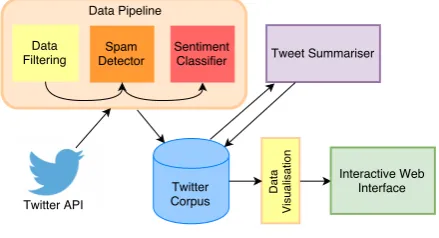
An overview of the system is depicted in Figure1
[image:2.595.307.527.456.575.2]and comprises: 1) Data collection and sampling; 2) Sentiment classification; 3) Tweet summarisa-tion; and 4) Data visualisation.
Figure 1: System overview.
2.1 Data Collection and Sampling
We collected a corpus of tweets about the 2017 UK general election through Twitter’s streaming
API by tracking 15 hashtags2. Data harvesting
was performed between 26 May and 21 June 2017
1Live demo:http://bit.ly/2g5lBcH
2#ukelection2017, #ge2017, #ge17, #ukge2017, #ukgeneral-election2017, #bbcqt, #bbcdp, #marrshow, #generalelec-tion2017, #generalelection, #electionuk, #ukelection, #elec-tionuk2017 and #brexit
to capture discussions in the two weeks running up to and after the election. To identify relevant topics and entities in each tweet, we match tweets against two manually curated lists of keywords (both were created during the 2015 UK election cycle) which include 438 topic keywords relevant to nine popular election issues (e.g., immigration, NHS) and a list of 71 political party aliases (e.g. ‘tories’, ‘lib dems’). The resulting corpus contains 3,663,090 tweets, with each tweet mentioning at least one keyword. To increase data quality and reduce noise in the corpus, we trained and applied a Twitter spam detection model using features de-scribed in (Wang et al.,2015).
2.2 Sentiment Classification
Jiang et al. (2011) showed that 40% of Twitter sen-timent classification errors are caused by tweet-level approaches that disregard topics/entities. We go beyond tweet-level approaches and adopt the
multi-target-specific approach proposed in (Wang
et al., 2017b), which finds the syntactically con-nected parts of a tweet associated with each topic or entity, and extracts word embedding features from them to classify sentiment as ‘negative’, ‘positive’ or ‘neutral’. This approach obtained state-of-the-art performance in both single- and
multi-target benchmark data sets (Wang et al.,
2017b). The whole data pipeline of Figure 1 is designed to dispatch work to many machines in
parallel3, processing many data batches
simulta-neously, which makes it very fast.
2.3 Tweet Summarisation
Here we aim to extract a list of representa-tive tweets summarising the sentiment(s) ex-pressed towards each topic/entity on each day (e.g. tweets containing positive sentiment towards ‘NHS’ posted on 26 June 2017).
As a prerequisite for summarisation, we group tweets containing the same sentiment towards a topic/entity on a day into a number of clusters, with each cluster assumed to represent a common theme or reason underlying the particular choice of sentiment. We adopt the two-stage
hierarchi-cal topic modelling approach proposed in (Wang
et al., 2017a) and select the GSDMM+OLDA model for this task due to its effectiveness and ef-ficiency. If there are fewer than 10 unique tweets containing the same sentiment towards a topic (or
3We ran it on a server with 40 CPU cores and 64 GB of RAM.
entity) on a particular day, we skip clustering and treat each of these tweets as a cluster.
To extract representative tweets summarising each cluster, we place every tweet in one com-mon embedding space and identify 20 tweets clos-est to the cluster centroid (also known as metroid tweets) as summary candidates. The embedding space here is constructed using a simple but ef-fective sentence embedding method proposed by
Arora et al. (2017), which reported good
perfor-mance on 22 textual similarity data sets, including a Twitter corpus. We then rank the 20 summary candidates based on weighted average tf-idf scores in the cluster; these scores can be regarded as a measure of informativeness.
We select the most informative tweet from the 20 candidates as the summary for that cluster and the final summary for the sentiment expressed to-wards the topic/entity is the combination of all its cluster summaries (e.g., tweets containing positive sentiment towards ‘NHS’ posted on 26 June 2017, comprise 8 clusters, each summarised by a single informative tweet).
2.4 Data Visualisation
For each topic/entity we calculate the following
daily features: # of tweets, # of unique users, #
of tweets per sentiment type (pos, neg, neutral)
and# of unique users per sentiment. These
fea-tures were selected on the basis of previous work
on election prediction with social media (
Tsaka-lidis et al.,2015). These are accompanied by the daily summaries of each sentiment type for a given topic/entity as described above.
In addition to showing the raw values of the above features, we also normalised sentiment
fea-tures (# of tweets per sentiment, # of unique users
per sentiment) to reflect the percentage of
senti-ment of a particular type towards a topic/entity on a particular day. To allow time series comparisons
across different topics/entities we normalised the#
of tweetsand# of unique usersof all topics/entities across all days in the range [0, 1]. Finally, to ac-count for differences in popularity, we calculated
the average (per-topic and across all days) # of
tweetsand# of unique users.
The web interface is implemented on Web stan-dards (HTML5/CSS3). The timeline graphs are
built using the NVD34 library (reusable charts
for d3.js), while the auto-complete
function-4http://nvd3.org/
ality is based on the ‘Ajax AutoComplete for
jQuery’ library5. In addition, jQuery from
Google Hosted Libraries6 and D3.js from
Cloud-fare Hosted Libraries7 are used for DOM
manip-ulation (add/remove elements, click events, etc.) and accessing data (from tsv files) respectively.
3 Example Use Cases
We use two use cases to demonstrate how our sys-tem can help analyse public sentiment on Twitter.
3.1 Use Case #1 – Party Sentiment
Recent election campaigns suggest that the Twit-tersphere tends to contain more negative sentiment during the election period. Hence, in the first case study, we compare negative sentiment trends on Twitter for the two major UK political parties, ‘Conservative’ and ‘Labour’, before and after the 2017 UK general election. As described in
sec-tion 2.4, the negative sentiment reflects the
per-centage of negative sentiment for each party on each day over all sentiment bearing tweets.
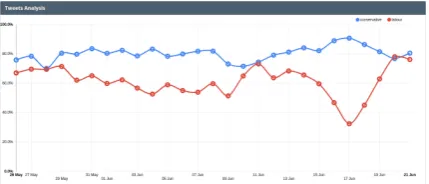
Figure2reveals consistently more negative
sen-timent towards ‘Conservative’ than ‘Labour’, es-pecially for the week before election day (8 June).
Figure 2: Negative sentiment trends for ‘Labour’ (red) and ‘Conservative’ (blue).
3.2 Use Case #2 – Grenfell Tower Fire
To provide deeper insight into the advantages of our opinion summarisation system, we present a case study on how public sentiment towards the topic ‘housing’ developed before and after the
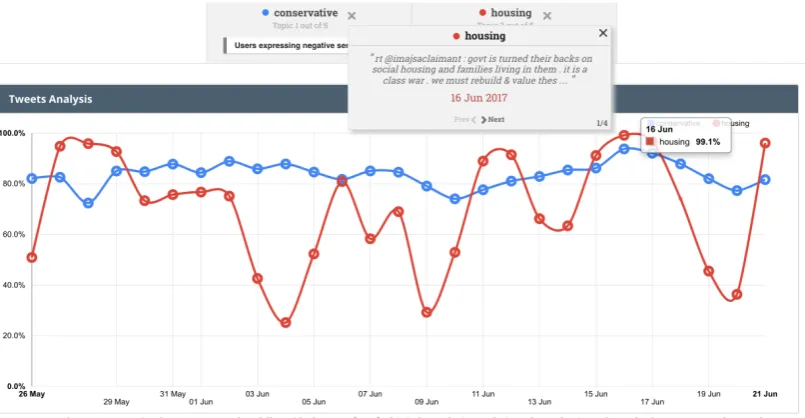
Grenfell Tower Fire disaster8. Figure3shows the
percentage of users expressing negative sentiment towards ‘housing’ as well as the governing party
5https://www.devbridge.com/sourcery/
components/jquery-autocomplete/
6https://developers.google.com/speed/
libraries/
7https://cdnjs.com/
8https://en.wikipedia.org/wiki/Grenfell_
Tower_fire
‘conservative’ over the period covering the inci-dent. Our web interface allows users to click on each circle shown on the graph to display tweet summaries for that topic on that particular day.
We can see the number of users expressing neg-ative sentiment for the topic ‘housing’ fluctuated throughout the election period while it remained fairly constant for ‘Conservative’. Negative senti-ment peaked in both cases on June 16th.
Table1presents a negative sentiment summary
for each day between June 12 and 15, and all three negative opinion summary tweets on the peak day of June 16 showing each summary tweet repre-sents a different aspect of the topic. Along with
the graph shown in Figure3, this summary offers
a tight integration of topic, sentiment and insight into reasons behind the sentiment. Before the fire, negative sentiment towards ‘housing’ was auster-ity related; after the fire, the incident dominated the ‘housing’ discussion on Twitter. A large por-tion of users blame the Conservative government for the decline of social housing and ultimately the Grenfell Tower fire. Finally, on June 16 each of the negative opinion summaries represents one theme related to this topic, namely ‘the decline of so-cial housing’, ‘immigration and housing’ and ‘the votes on housing safety’.
4 Conclusion
We presented a monitoring system for topic-entity sentiment on Twitter that summarises public opin-ion around the sentiment towards each entity. The system deployment for the 2017 UK election, pro-vides an interactive visualisation for comparing sentiment trends and display opinion summaries on the graph. In the future, we plan to improve our system to produce more concise summaries and al-low near real-time processing of new events.
References
Sanjeev Arora, Yingyu Liang, and Tengyu Ma. 2017. A simple but tough-to-beat baseline for sentence
em-beddings. In Proceedings of the 5th International
Conference on Learning Representations (ICLR). Javed Aslam, Fernando Diaz, Matthew
Ekstrand-Abueg, Richard McCreadie, Virgil Pavlu, and Tet-suya Sakai. 2015. Trec 2015 temporal
summariza-tion track overview. InProceedings of the 24th Text
REtrieval Conference, TREC.
[image:4.595.73.288.415.507.2]senti-Figure 3: Negative sentiment trends for ‘housing’ (red) and ’conservative’ (blue), with a summary tweet displayed for the former.
Topic entity Opinion Summaries Date
housing rt @user1 : the audacity to even refer to tackling a “ housing crisis ”after being in government for 7 years . https://t.co/lifwybhryp 12 June 2017
housing universal credit taper , welfare freeze , esa cuts , inflation is up . #ge17austerity is still here , bedroom tax , foodbanks , pip , housing cap , 13 June 2017
housing @bbcnews @skynews @itvnews tories cuts in society kill just look at socialhousing #grenfelltower sold to cheapest bidding #ge17 #bbcqt 14 June 2017
housing tory capitalism cutting kills social housing on the cheap #grenfelltower cutsin fire ambulance police nhs services #victorialive #ge17 15 June 2017
housing rt @user2 : govt is turned their backs on social housing and familiesliving in them . it is a class war . we must rebuild & value thes ... 16 June 2017
housing rt @user3 : laura perrins again blaming the death toll of #grenfelltoweron immigration - putting pressure on housing . laura bt ... 16 June 2017
[image:5.595.98.501.66.275.2]housing rt @user4 : it is a shame the ministers hearts did not go out to the peoplein grenfell tower when they were voting on housing safety #bbcqt 16 June 2017
Table 1: Negative opinion summary for ‘housing’ before and after the Grenfell Tower fire
ment classification. InProceedings of the 49th
An-nual Meeting of the Association for Computational Linguistics.
Jimmy Lin, Miles Efron, Yulu Wang, Garrick Sherman, and Ellen Voorhees. 2015. Overview of the
trec-2015 microblog track. In Proceedings of the 24th
Text REtrieval Conference, TREC.
Jimmy Lin, Adam Roegiest, Luchen Tan, Richard Mc-Creadie, Ellen Voorhees, and Fernando Diaz. 2016. Overview of the trec 2016 real-time summarization
track. In Proceedings of the 25th Text REtrieval
Conference, TREC, volume 16.
Xinfan Meng, Furu Wei, Xiaohua Liu, Ming Zhou, Su-jian Li, and Houfeng Wang. 2012. Entity-centric topic-oriented opinion summarization in twitter. In Proceedings of the 18th ACM SIGKDD.
Adam Tsakalidis, Symeon Papadopoulos, Alexandra I
Cristea, and Yiannis Kompatsiaris. 2015. Predict-ing elections for multiple countries usPredict-ing twitter and
polls.IEEE Intelligent Systems, 30(2):10–17.
Bo Wang, Maria Liakata, Arkaitz Zubiaga, and Rob Procter. 2017a. A hierarchical topic modelling
ap-proach for tweet clustering. In Proceedings of the
9th International Conference on Social Informatics (SocInfo).
Bo Wang, Maria Liakata, Arkaitz Zubiaga, and Rob Procter. 2017b. Tdparse-multi-target-specific
senti-ment recognition on twitter. InProceedings of the
15th Conference of the European Chapter of the As-sociation for Computational Linguistics.
Bo Wang, Arkaitz Zubiaga, Maria Liakata, and Rob Procter. 2015. Making the most of tweet-inherent
features for social spam detection on twitter. In5th
Workshop on Making Sense of Microposts (#Micro-posts2015) WWW, volume 1395, pages 10–16.
[image:5.595.100.496.330.504.2]