1
MASTER THESIS
FORMATIVE EVALUATION OF
AN ADVANCED PROFESSIONAL
DEVELOPMENT PROGRAMME
FOR UNIVERSITY TEACHERS
AUTHOR N. Basbas S1917749
FACULTY OF BEHAVIOURAL, MANAGEMENT AND SOCIAL SCIENCES
EXAMINATION COMMITTEE dr. K. Schildkamp
dr. J. T. van der Veen
2
Table of Contents
Acknowledgement 4
Summary 5
1. Introduction 6
2. Theoretical Framework 7 2.1 Review of professional development literature in higher education 7
2.2 SUTQ description 9
2.3 Formative evaluation and evaluands 10
2.4 Evaluating alignment with programme context 11
2.5 Evaluating alignment with learners’ needs 12
3. Method 13
3.1 Research Design 17
3.2 Respondents 17
3.3 Instrumentation 17
3.4 Procedure 16
3.5 Data Analysis 17
4. Results 19
4.1 Sub-question 1: How can SUTQ be improved to better reflect the programme context? 19 4.2 Sub-question 2: How can SUTQ be improved to better respond to learners’ needs? 24
4.2.1 Programme content 24
4.2.2 Programme organization 26
4.2.3 Programme context 28
5. Discussion 28
5.1 Implications of the findings and theoretical suggestions for improvement 29
5.2 Practical suggestions for improvement of SUTQ 38
5.3 Limitations 40
5.4 Future research 40
5.5 Conclusion 41
3
List of Figures
Figure 1: An overview of research questions, methods, and respondents Figure 2: Suggested overall structure of SUTQ
List of Tables
Table 1: Competencies of a SCT as Defined by the University HR Policy
Table 2: Competency Profile of a Participant Upon Completion of the SUTQ Programme Table 3: Numbers of Academic Staff in December 2018 Who Will Be Required to
Become SCTs
List of Appendices
Appendix A: SUTQ Description Appendix B: Codebook 1 Appendix C: Codebook 2
Appendix D: Coordinator interview instrument Appendix E: Instructor interview instrument Appendix F: Interview slides
4
Acknowledgement
I realize I have been extremely privileged to go to a university and work on this thesis. I have certainly been a beneficiary of the work of people of the past and present societies that allowed me to take for granted the peace and comfort I enjoy and to worry about nothing but my studies. I also had the privilege of being around people who helped me write this thesis and who I would like to thank here. First, I would like to give special thanks to my supervisor dr. Kim Schildkamp for reading my thesis over and over with unwavering determination and providing me with useful tips for improvement. Second, I would like to thank dr. Jan T. van der Veen, Martine ten Voorde - ter Braack and Marije E. Hahnen - Florijn for helping me find the focus of my thesis and answering the heaps of emails I sent to them. Next, I thank my friends for making me work, helping me rest and cheering me up when I needed it. Special thanks belong to my family, who have always trusted in my decisions about what I want to do in life and supported me in pursuing my passions. Lastly, my colleagues at work have been wonderful in allowing me to work flexible hours. I am deeply grateful for all the fortune that I have received, thank you all.
Nikos Basbas
5
Summary
Teaching quality assurance has recently received attention from higher education institutions around the world (Jacob, Xion, & Ye, 2015), including a research-led university in the Netherlands. One of the university initiatives for improving teaching quality has been development and implementation of a unique advanced professional development programme for teaching staff called Senior University Teaching Qualification (SUTQ). The goal of this study was to formatively evaluate SUTQ, identify potential areas for further growth and development and propose both theoretical and practical suggestions for improvement of the programme. The focus of the evaluation was the programme alignment with the institutional context and participants’ needs. A case study employing multiple qualitative research methods including document analysis, interviews and a focus group session was conducted. The investigation identified potential for improvement in the following five areas: curriculum, instruction, delivery, community formation and feedback. The main contribution of this study are theoretical suggestions for improvement in each of the identified areas and a modified model of SUTQ that integrates these theoretical suggestions and applies them to the SUTQ case.
Keywords
6
1. Introduction
What are characteristics of an excellent professional development (PD) programme? First, it should be relevant, i.e. the goals of the PD programme are set in response to current learning needs of learners and current context and second, it should be effective, which means that the goals of the programme are attained (Desimone, 2009). For example, although a training in welding may be effective, it will be irrelevant to a social science university teacher. Similarly, a training on teacher collaboration may be very relevant, but if it will come as an asynchronous online course, its effectiveness may be contested (in comparison with e.g. on-site training).
Additionally, there is consensus that creating an excellent PD programme requires an iterative process of designing, testing and adjusting the programme based on evidence about its success (e.g. Seel, Lehmann, Blumschein, & Podolskiy, 2017; McKenney & Reeves, 2012; Reigeluth & Carr-Chellman, 2009). It means that evidence about the programme relevance and effectiveness should be actively sought from an early stage in the implementation process and used for improving the programme. Currently at a university in the Netherlands, an advanced teacher PD programme called Senior University Teaching Qualification (SUTQ) is being implemented and the team in charge of the programme (in this report they will be referred to as
programme administrators) is seeking feedback from different stakeholders in order to improve the programme. The improvement of the SUTQ programme is the focus of this study.
7 teacher professionalization initiatives into coherent development and career paths that recognize and reward teaching excellence (Cashmore, Cane, & Cane, 2013; Hitch, Mahoney, & Macfarlane, 2017; Teräs, 2014). And finally, from the macro perspective, improving pedagogical competencies of teachers is important, because teaching quality is an important facilitator of student learning (Timperley, 2008) and learning and education is often cited as the key to human relevance in the forthcoming age of automation (Frey & Osborne, 2013).
The purpose of this study was to help improve the SUTQ programme and bring it closer to professional development excellence. The lead research question guiding this study was:
How can the teacher professional development programme SUTQ be improved?
To answer this question, selected aspects of the programme were evaluated formatively. More specifically, this study focused on the programme matching the institutional context and learners’ needs. Several areas of potential improvement were identified, the materiality of the findings was discussed, and eventually scholarly literature was searched for relevant improvement strategies. The culmination of this study are suggestions of selected theoretical strategies for improvement and a draft of a modified SUTQ design that integrates the theoretical suggestions. This study thus hopes to contribute to the theoretical body of literature on the design of advanced university teacher professional development programmes and give practical tips for improving SUTQ.
2. Theoretical Framework
2.1 Review of professional development literature in higher
education
To set SUTQ into a broader context of professional development in higher education, a brief academic literature review of contemporary PD trends was performed. First, it resulted in a finding that names academic development, faculty development, or educational development
8 PD in tertiary education in general and PD of teachers in primary and secondary education (Amundsen & Wilson, 2012). In this report, the term professional development in higher education will be used.
PD in higher education may be categorized in three basic forms: self-directed learning activities, formal professional development programmes and organizational development strategies (Caffarella & Zinn, 1999). Most learning happens through self-directed activities, which are any job-related activities such as preparation of class materials, teaching classes, course design, etc. Formal PD programmes, of which SUTQ is an example, prepare academics for one of the three typical roles they assume in their careers: teacher and educator, researcher and scholar, and manager and leader (Steinert, 2014). As mentioned above, SUTQ aims at developing competencies pertaining to the teacher and educator role. The last PD form, organizational development strategies, are interventions aiming at an organizational change, such as quality management procedures, change of institutional atmosphere and culture, organizational restructuring or career policies (Caffarella & Zinn, 1999). Examples of higher education career policies are the Career Framework by Graham (2018), the UK Professional Standards Framework by Higher Education Academy (HEA, 2011) or the one by Fraser, Greenfield, Pancini (2017). The common denominator of the three career frameworks is the incremental progression from novice to expert to scholarly teacher, followed by an educational leader. However, the scholarly step is not included in all frameworks, but there is some evidence that the ability to research educational practice in a scholarly manner may be an important part of a skill set of an educational leader (Fields, Kenny, & Mueller, 2019).
In line with the conceptual distinctions above, Amundsen and Wilson (2012) clustered the curricula of PD programmes into the following categories: (1) skill, in which participants acquire a particular teaching skill (e.g. presentation skills), (2) method, focused on a particular pedagogical method (problem-based learning), (3) reflection, focused on changing teachers’
conceptions of teaching through reflection, (4) disciplinary focus, in which participants learn discipline-specific teaching strategies, reflecting the specific structure of knowledge in the discipline, and (5) action research or inquiry, which includes formal inquiry methods for investigating instructional interventions. The SUTQ curriculum resembles the most programmes the fifth category action research or inquiry.
9 Schildkamp, & van der Veen, 2017). The predominant delivery format is face-to-face, although online and blended courses are being introduced, too (Hitch, Mahoney, & Macfarlane, 2018).
A recent study that tried to summarize research into PD interventions in higher education listed characteristics that seem to contribute to effectiveness of those interventions: evidence-informed educational design, relevant content, experiential learning, feedback and reflection, educational projects, intentional community building, longitudinal program design, and institutional support (Steinert et al., 2016). Another study offers ten recommendations for university PD centres based on a review PD systems at ten world-class universities: (1) provide excellent administrative support to PD centres, (2) focus on consultative and collaborative leadership style of professional developers, (3) pay attention to the needs of individual faculty members, (4) foster communities of practice of two to five members with the same instructional needs, (5) establish a strong link between PD centres and libraries, (6) base instructional decisions on data and evidence, (7) diversify the delivery forms of PD interventions, (8) avoid technology-driven interventions, (9) become instructional technology hubs, and (10) develop a meaningful reward systems for all invested stakeholders.
Against this literature review of the global professional development in higher education, the purpose, curriculum and delivery form of the SUTQ will be described.
2.2 SUTQ description
The Senior University Teaching Qualification (SUTQ) constitutes one of the many university initiatives for achieving teaching excellence (University of Twente, 2018a). It is a behaviour change programme focused on improving teaching practise of more senior, experienced teachers. To achieve this goal, the chosen approach was to strengthen teachers’ research competencies in the domain of educational sciences, so they are better able to assess the success of their own innovative teaching interventions using evidence collected by a scientific method. Successful candidates are also expected to share their findings with the local and wider academic community.
10 described as an activity of, first, methodical investigation of questions related to student learning and, second, making the results of the inquiry public in order to advance improvement of teaching practice outside one’s own classroom (Hutchings & Shulman, 1999; Kern, Mettetal, Dixson, & Morgan, 2015). In the two subsequent months participants had to write a proposal for a research project they would like to conduct later on. The purpose of the research proposal was to help participants plan their project, to provide them with feedback, and to perform an additional selection of participants eligible for continuing in the programme. The rationale for the additional selection was that if a participant is unable to finish the proposal in time, (s)he in unlikely to finish the main project in time. In the next phase of the programme participants worked on their individual research projects. They had an option to choose between descriptive and design-based methodology to research an innovative pedagogical intervention which they planned to implement in their own teaching (preferably). At the time of writing this report, participants are finalizing their projects, so the following description is how the programme is planned to continue. Results of the research are to be delivered in any form of participants’ choice, e.g. a poster, a paper, etc. These deliverables together with a reflection report will be assessed by a review committee, who will decide if participants are eligible for the SUTQ certificate. Total time investment is projected to 160 hours. A more comprehensive description of the programme can be found in Appendix A.
2.3 Formative evaluation and evaluands
To find out how SUTQ can be improved, the programme must be evaluated first. The definition of evaluation adopted in this study is the following: “Evaluation is the systematic assessment of the design (...) of a program, compared to a set of implicit or explicit standards” (Weiss, 1998, p.4). Scriven (1991) used an analogy to make a distinction between two types of evaluation depending on its purpose: “When the cook tastes the soup, that’s formative evaluation; when the guest tastes it, that’s summative evaluation” (p.19). In other words, the cook tastes the soup in order to test and improve the taste, the guest to make a decision about whether he likes it or not. In the context of programme evaluation, formative evaluation is performed in order to identify areas for improvement (Weiss, 1998).
11 document, whereas the latter is the design that is enacted in the real world. Notwithstanding the importance of careful planning of educational interventions, participants typically have knowledge of and experience only how the design is enacted, which is the reason why this study was focused on the design as implemented.
One of the two primary goals of a programme design (see opening of this report) is to be relevant to participants’ learning needs by utilizing resources bounded by the context (McKenney & Reeves, 2012). Therefore, the focus of this study was the alignment of SUTQ with its context and learners’ needs, which is captured in the following research sub-questions:
RSQ1: How can SUTQ be improved to better reflect the programme context? RSQ2: How can SUTQ be improved to better respond to learners’ needs?
2.4 Evaluating alignment with programme context
McKenney & Reeves (2012) list characteristics that are in the instructional design discipline considered relevant context: vested stakeholders, target group, physical context, organizational or policy context, educational context and organizational viability. In relation with the scope and the focus of this study, the main contextual foci of this study are the target group (in relation with sub-question RSQ2), and organizational context and policy, and educational context. Select target group characteristics of relevance in the current study are years of teaching experience, career level and professional background. Relevant aspects of an organization are its structure, mission, budget for professional development, and type of business (McKenney & Reeves, 2012). The focus on the organizational level also encompasses current policies, human resources (HR) and otherwise, which assign power and responsibility to individual stakeholders and organizational units, or in case of HR policies define career paths and promotion criteria (McKenney & Reeves, 2012). The last aspect of context typically relevant to programme designers is educational, which in the current case includes other professional development initiatives, the relations between them, content, delivery mode, whether they are compulsory to participate in, and general attitude of stakeholders toward those initiatives.
12 and at the same time bounds the space and resources that may be used by the programme to meet the learning needs (Branch & Kopcha, 2014).
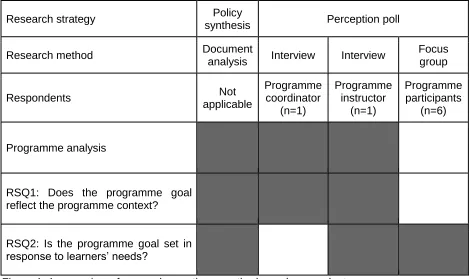
In order to evaluate alignment of the programme design with the local context, both the design and context must be analysed first. McKenney & Reeves (2012) propose four general research strategies for such an analysis: policy synthesis, perception poll, field portrait and SWOT analysis, of which the former two were selected. Policy synthesis pertains to a review of current policies and organizational routines, which typically includes document analyses of relevant documentation. Perception poll refers to interviews and focus groups that try to capture stakeholders’ perceptions of the policies and tap into routines that are not necessarily codified and exist only as procedural knowledge of individuals or teams. In addition, perception polls scan stakeholders’ beliefs, feelings or attitudes. An overview of the selected policies may be seen in Figure 1.
2.5 Evaluating alignment with learners’ needs
Learners may have a wide variety of needs. The goal of PD programmes is to primarily satisfy programme participants’ learning needs. Learning needs may be conceptualized as gaps between what is known to a learner and what needs to be known (Pilcher, 2016). However, biological or emotional needs such as physical discomfort, hunger, eye fatigue or psychological stress are also relevant to programme designers, because they may interfere with learning process and influence the success of a programme (Guskey, 2000). A related construct to learners’ needs is learners’ wishes. A wish has been defined as a preferred way how a particular need is satisfied (Edvardsson & Olsson, 1996). In general, not responding to learners’ needs and wishes has also been identified as one of the common causes of failure of PD programmes (Loucks-Horsley, Love, Stiles, Mundry, & Hewson, 2009).
Typically, evaluating if and to what extent a PD programme addresses participants’ needs and wishes is done by eliciting participant reactions to the programme (Trigwell, Rodriguez & Han, 2012). A commonly used framework for PD evaluation by Guskey (2000) advises to elicit participant reactions in areas of programme content, organization and context. Questions about the content attempt to elicit participants’ opinions on relevance, utility, level and
13 length of the programme, the number and frequency of meetings, preferred types of learning activities and particularities of delivery. Lastly, questions about context attend to biological needs like timing of coffee breaks, room temperature, or catering, because these too have an influence of the success of the programme. In the current study, questions are focused on the venue, time of the day when meetings took place or opinions about catering.
3. Method
3.1 Research Design
The goal of this study was to provide suggestions for improvement of the SUTQ design based on formative evaluation of programme alignment with the context and participants’ needs. To achieve this goal, a qualitative case study was conducted. The qualitative nature was determined by the need to gain in-depth understanding of the current programme design, context and stakeholder opinions. The research methods below were applied to conduct an analysis of the programme design and to answer the research questions of this study. An overview of research strategies, methods and respondents can be found in Figure 1.
Document analysis. A large proportion of relevant data was available through various documents ranging from university websites that informed potential SUTQ candidates about the programme to university HR policy documents (more details about the documents analysed can be found in the Procedure section). This method, falling under the policy synthesis research strategy (McKenney & Reeves, 2012), was used to collect data for the analysis of the programme design and context. Moreover, this method was used to extract demographic information about programme participants to help answer sub-question 2.
Interviews. Interviews were used to (i) collect information about the programme design that was not obtainable from documents, (ii) to elicit perceptions from programme administrators about initial findings of sub-question 1 emerging from the document analysis, and (iii) to obtain data for answering sub-question 2. Two interviews were conducted, and both took place online.
14 1996), because focus group members usually engage in interaction with each other which may generate associations in participants’ thoughts that would have not been triggered only by interviewer’s questions (Liamputtong, 2011). This method was used to collect data about how well the programme responds to participants’ needs (sub-question 2).
3.2 Respondents
Programme coordinator. The first interview respondent was the programme coordinator, who is formally responsible for the programme. The coordinator could provide information about the programme design that was not possible to obtain from the document analysis and clarify initial findings from the document analysis.
Programme instructor. The second person interviewed was one of the two programme instructors. The instructor could provide insights into the programme design, his/her experience with teaching the programme and clarify initial findings from the document analysis.
Programme participants. Programme participants were experienced university teachers who have not only completed the more basic University Teaching Qualification (UTQ) or received an exemption from it but are considered forerunners in their department in terms of teaching. They were selected to the programme based on their curiosity and ambition to improve education and have ideas about innovative pedagogical interventions, or who are or want to be an example for their fellow teachers and want to pursue a teaching career besides a research career. Faculty of Behavioural, Management and Social Sciences (1), Faculty of Engineering Technology (2), Faculty of Electrical Engineering, Mathematics and Computer Science (1), Faculty of Geo-Information Science and Earth Observation (2). On average, participants had 13.5 years of teaching experience in higher education, with the shortest of 4 years and longest of 23 years. The career levels represented were: full professor (1), assistant professor (4) and lecturer (1).
15
Research strategy Policy
synthesis Perception poll
Research method Document
analysis Interview Interview
Focus group
Respondents Not
applicable
Programme coordinator
(n=1)
Programme instructor
(n=1)
Programme participants
(n=6)
Programme analysis
RSQ1: Does the programme goal reflect the programme context?
[image:15.612.71.541.72.351.2]RSQ2: Is the programme goal set in response to learners’ needs?
Figure 1. An overview of research questions, methods, and respondents.
3.3 Instrumentation
16
Complementary interview slides. To clarify the questions asked, to cue interviewees’
recall of past events or materials used in the programme, and to use a mutually shared vocabulary, complementary slides were prepared to aid the interviews. For example, when the principal investigator asked the question “Could you please help me understand the Final Competencies and Qualifications Matrix?”, a slide was presented that contained a snippet of the matrix. Other slides contained e.g. the SUTQ timeline, assessment forms or quotes from policy documents. The slides can be found in Appendix F.
Focus groups instrument. This instrument contained a description of the focus group session procedure and a list of questions. The procedure was described from the step one, collecting a recording device from the university research equipment department to the last step, transferring the audio data from the recording device to the principal investigator’s computer. More information on the procedure can be found in Section 3.4. The focus group aimed at collecting participants’ experience with the programme. Questions were grouped into three categories following Guskey (2000). First, the opening questions group were phrased so that participants express the level of a match between their expectations and the actual programme. In addition, their overall liking of the programme was surveyed. Example questions were “Does the actual programme meet your initial expectations of the programme?” and “What did you like the best about the course?”. Then, questions focused on the programme content, i.e. the activities and materials. For example, “What is your opinion on the ERD workshops?”.
Organization questions pertained to the sequence of learning activities, timeline or administrators-participants communication, for example “What do you think about the amount of time you had for the research proposal and for the project?”. Lastly, questions about the
context, like adherence to human biological needs like nourishment, rest or room temperature were prepared. An example question was “Workshops usually ended around 7 or 8 pm. Did this schedule suit you?”. The instrument can be found in Appendix G.
3.4 Procedure
Before collecting any data from human respondents, a permission from the Ethics Committee was asked. The granted permission can be found in Appendix H.
17 folder in the university learning management system was accessed to download materials including the Participant’s Manual or lecture slides, programme administrators were contacted with a request for any relevant internal materials (different manuals, filled-out application forms, guides and review forms), the spokesperson of the university Executive Board and one of the student political parties were contacted for HR policy documents, and other materials related to the HR policy were obtained from a representative of the Centre of Engineering Education (4TU.CEE). In total, 24 documents were reviewed. These documents were coded and used for creating a major part of the case description. The case description was sent to the programme coordinator who reviewed it for correctness and completeness. Coordinator’s comments were incorporated to improve the case description.
Interviews. Interviewees were contacted via e-mail by the principal investigator and asked for an interview. After setting a time and date, the interviews took place via Skype for Business and were recorded by the built-in recording tool.
Focus groups. The data collection date was set to take advantage of the fact that on the same day there was a mandatory SUTQ workshop scheduled and most participants were present at the meeting. The programme administrators changed the agenda of the workshop so that the last part of the meeting was dedicated to the focus group (FG) session. One week before the meeting, participants received an email from the programme coordinator with the new agenda and an invitation to the FG session written by the principal investigator. The invitation stated that although attendance of the FG session was not mandatory, it would be highly appreciated.
At the beginning of the SUTQ workshop, the principal investigator again invited the participants to the session. During a dinner that followed the end of the workshop, the principal investigator prepared the venue for data collection. Eventually, six participants participated. At the beginning of the FG, respondents were given consent forms (Appendix I) and asked to read and sign them. Then, the FG session started and was recorded using an audio recorder.
3.5 Data Analysis
All data from document analysis, interviews and focus groups are qualitative in nature. First, audio files were transcribed verbatim. Then, all documents were coded using ATLAS.ti software (version 8), which allowed for export of codebooks and calculation of inter-rater coding reliability.
18 transcript and the first part of the programme instructor interview transcript. The codebook was developed by a combination of inductive and deductive approaches, creating groups based on the theoretical framework as well as creating codes reflecting the programme structure. This resulted in code groups “context” and “design product”. Examples of codes for the “context” group were: "career policy" or "programme participants" and examples from group “design product” were "timeline" or "purpose and goals of SUTQ". More information on the codes in available in the codebook.
To estimate inter-rater reliability, Hodson’s (1999) advice to recode 10% of the data was followed. Data for recoding was selected purposefully, because the principal investigator does not speak Dutch and some of the documents were written in Dutch. The principal investigator used an online translation tool and his limited knowledge of Dutch to translate the documents into English and code the documents. Therefore, the to-be-recoded data was selected to be representative of the proportion of English and Dutch language in all documents. The second coder was a native Dutch speaker. Before the second coder began working, codes were removed from quotations. After the second coder finished coding, inter-rater reliability was computed using ATLAS.ti. After adjustments of the codebook including renaming codes, clarifying code descriptions and adjusting quotations, Krippendorff’s Cuα was .87. Krippendorf
(2018) recommends aiming at values of Cuα larger than .8, but values above .667 are
acceptable. This means that the degree to which coders identify reliably all semantic domain is acceptable (Krippendorff, 2018). Note that the inter-rater agreement was calculated of a previous version of the codebook that contained more semantic domains. After all documents and interview transcripts had been coded, for each code, all quotations relating to that code were summarized.
19 codes were assigned to them. By the same procedure of estimating inter-rater reliability, Krippendorf’s Cuα was .73, so the inter-coder reliability of Codebook 2 is acceptable. After all
documents and interview transcripts had been coded, for each code, all quotations relating to that code were gathered and summarized. The summary process included cross-checking of the content of the quotations to compare how aligned or contradicting the views among respondents were. Contradicting findings were elaborated on in the discussion section. Themes that were discussed by more than two respondents were included in the Results section.
4. Results
4.1 Sub-question 1: How can SUTQ be improved to better reflect
the programme context?
To answer this sub-question, an analysis of documents pertaining to the programme context was performed first. The analysis yielded preliminary findings which were subsequently validated during interviews with the programme instructor and coordinator. Description of the programme context may be found in Appendix A. In this Results section, misalignments between the programme and its context are presented.
Programme curriculum
20 a particular teaching level and help advance their careers as well as contribute to improving teaching quality across the institution.
SUTQ is explicitly described as a programme aiming at developing participants to the level of skilled and collegial teacher (University of Twente, 2018b). The skilled and collegial teacher (SCT) is defined as someone whose work impacts their students and academic colleagues and who
[image:20.612.71.509.347.710.2]takes an evidence-informed approach to developing and improving their teaching practice over time. They also provide leadership and mentorship to peers to help nurture a collective and collegial culture of excellence in teaching and learning across their group or discipline (Graham, 2018, p.26; Oosterhuis-Geers, 2018, p.7).
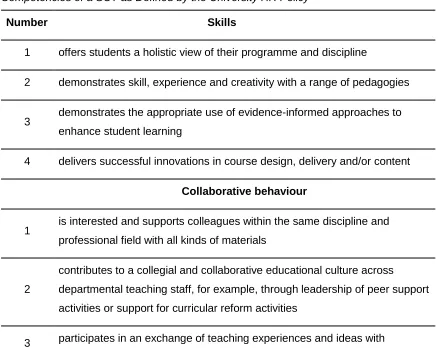
Table 1
Competencies of a SCT as Defined by the University HR Policy
Number Skills
1 offers students a holistic view of their programme and discipline
2 demonstrates skill, experience and creativity with a range of pedagogies
3 demonstrates the appropriate use of evidence-informed approaches to enhance student learning
4 delivers successful innovations in course design, delivery and/or content
Collaborative behaviour
1 is interested and supports colleagues within the same discipline and professional field with all kinds of materials
2
contributes to a collegial and collaborative educational culture across
departmental teaching staff, for example, through leadership of peer support activities or support for curricular reform activities
21 colleagues and the wider higher education community
4
proactively monitors the student teaching and learning experience and responds in a timely and professional manner to concerns about course design, content and delivery (at programme, year or module level)
Table 1 shows the competency profile of a SCT as defined by the HR policy (Oosterhuis-Geers, 2018). The competencies are split into two categories; the first category skills requires of a teacher to use a variety of evidence-based pedagogies, innovate their teaching and have comprehensive knowledge of their field. The second category collaborative behaviour describes how SCTs within and outside their department proactively help each other by sharing materials, experience, experiences, ideas and contribute to changes in education in response to feedback.
Table 2
Competency Profile of a Participant Upon Completion of the SUTQ Programme
Upon completion of SUTQ, a teacher will:
1 be able to address a current and relevant educational question
2 have an innovative and/or creative approach to stimulating and enhancing student learning
3
where and when applicable, will use the following general educational principles:
● Reflect relevant aspects of educational context
● Align constructively learning objectives, instructional methods and assessment
● Formulate concrete and measurable learning objectives
● Observe quality criteria / requirements of assessment: validity, reliability and transparency
22 5 share the research findings with the departmental and/or institutional teacher
community or even publishes them in an academic journal 6 form a habit reflecting on the impact of their teaching
Table 2 is a summary of the competency profile of a teacher who successfully completed SUTQ. The profile was constructed by taking a competency profile outlined in one of the documents available to SUTQ participants (Participant’s Manual; Ten Voorde - Ter Braack, 2018) and adjusting it based on the conducted interviews to better reflect the current SUTQ programme. In conclusion, a teacher who completes the SUTQ programme should be able to answer a current educational question by researching an innovative pedagogical intervention using descriptive or design-based methodology. The teacher shares the findings with the local or wider local community and regularly reflects on his or her teaching.
A comparison of the two competency profiles shows that they match well in the core ideas of innovation, evidence-based approach and community orientation, but the latter two seem to be interpreted in some measure differently in each profile. The competencies of the SCT are phrased in terms of using evidence-based interventions, not necessarily producing evidence to research an intervention. In contrast, a major part of learning activities in SUTQ train participants for conducting descriptive and design-based research, in order to produce evidence for answering an educational question. This difference is accentuated when the SUTQ competency profile is compared with level 3 teacher in the HR policy, the scholarly teacher, which is defined as:
The scholarly teacher makes a significant contribution to pedagogical knowledge by engaging with a scholarly approach to their teaching practice and contributing to the scholarly research literature. Successful candidates would influence educational practice as well as educational knowledge. Scholarly teachers are grounded in a student-centred perspective and share their findings with institutional colleagues, promoting communities of practice around their educational research (Graham, 2018, p.27; Oosterhuis-Geers, 2018, p.7).
23 bear strong resemblance with the behaviour expected of teachers who complete SUTQ (see also section 2.1 and Appendix A for an overview of the SUTQ curriculum and learning activities). Although difficult to quantify, it may be asserted that the SUTQ interpretation of the term ‘evidence-based’ is closer to the scholarly teacher than to the skilled and collegial teacher. The other difference between the SUTQ and SCT competency profiles is in the interpretation of collaboration. While at least three out of eight SCT competencies are strictly collaborative and include proactive supporting colleagues with a variety of materials, experiences and ideas, the SUTQ curriculum seems to limit the development of collaborative skills to peer feedback and to presenting the research results to others at the end of the programme.
To conclude, there is evidence that the SUTQ curriculum may not correspond to the competencies of the skilled and collegial teacher as described by the university HR policy.
Programme capacity
There is evidence suggesting that the current programme capacity of 15 participants may be insufficient under the new university HR policy. The policy makes it compulsory for all academic staff at the level of Lecturer 2 and higher (Assistant Professors, Associate Professors and Full Professors) to update their teaching skills to the level of the SCT (Oosterhuis-Geers, 2018). Table 3 shows the numbers of current academic staff who will be required to attain their competencies to the level of the SCT.
To obtain an estimate of how many teachers may apply for SUTQ and what the capacity of SUTQ would have to be to accommodate all eligible applicants, the following calculation may be performed. Because an SUTQ certificate is neither required nor it guarantees becoming an SCT, it may be arbitrarily assumed that half of all affected teachers will decide to pursue the SUTQ certificate. By the end of the current SUTQ, 30 teachers will have received the SUTQ certificate. This calculation yields a number of 315 teachers who may potentially apply for SUTQ in the upcoming years. With the current capacity of 15 participants per year, it would take at least 21 years for all applicants to obtain the SUTQ certification, which is perhaps too long. However, this estimate depends heavily on the assumption of how many teachers may want to take SUTQ.
Table 3
Numbers of Academic Staff in December 2018 Who Will Be Required to Become SCTs
24
Full Professor 169
Associate Professor 158
Assistant Professor 311
Lecturer 2 (estimated) 52
Total 690
4.2 Sub-question 2: How can SUTQ be improved to better
respond to learners’ needs?
This section contains themes that came up in programme instructor’s and focus group respondents’ answers. Five such themes were identified, while three of them were found in both the interview as well as focus group data, the remaining two came from the focus group discussion. The five findings described below may be interpreted as issues that relate to learners’ needs that have not yet been met after three quarters of the programme had passed.
4.2.1 Programme content
Research approach of SUTQ
25 Four respondents seemed to have expectations of the programme that were different from the actual SUTQ curriculum. One out of six respondents hoped to learn competencies that would make the respondent a “person who can judge the education regulations, exam regulations, be involved in accreditation issues”. Three respondents agreed that they expected to improve their teaching by mastering the competencies learned in previous professional development programmes (like the preceding University Teaching Qualification) and learn about current pedagogical developments. In response, one respondent added "I hoped I could more grip on how can I develop my education more and how can I make better use of the developments going on". This interest in pedagogical trends may explain the success of seminars, which are "bonus" inspirational sessions, in which guest speakers present trending pedagogical topics such as new forms of assessment or the role of reflection in education. Seminars were mentioned by four out of six respondents as the aspect of SUTQ they liked the most.
Differences in prior knowledge
26 responded to a question about the number of teachers who are currently potentially eligible for entering SUTQ as “There are a lot, because almost every teacher with UTQ is in our target group.” The openness and related unpredictability of the characteristics of eventual programme participants was confirmed by the programme instructor saying “...in the first year [of SUTQ] it was of course a bit of a search, what kind of people are going to apply.” The instructor explained that the issue of varying prior knowledge was tackled by grouping learners in peer feedback session to take the advantage of the differences, opening instructional sessions with a plenary discussion where teaching examples from different fields were presented and including interactive moments where participants could discuss their own projects with peers and instructors.
4.2.2 Programme organization
Feasibility
There was an agreement among all respondents that it is not easily feasible to finish their projects as planned in time. The perceived cause was that the current programme schedule does not allow all participants to collect data on their own intervention, because some of them teach in periods outside the SUTQ schedule. One participant reported that although (s)he teaches from September till November, which is a period of time when SUTQ participants are supposed to work on their projects, is was not feasible for him/her to prepare the intervention sufficiently, implement it in his/her teaching and conduct research about it. More implicitly, it seemed that participants think the programme is too short for the amount of work to be done. Five out of six respondents agreed that extending the programme duration to 1.5 or 2 years would solve both problems. A variety of other suggestions have been proposed ranging from changing the start date, to making SUTQ a continuous, open programme where participants could opt in and out at their convenience. The idea was supported with the argument that it would be “real student-driven learning”. One participant objected to extending the programme to 1.5 years or more, because then it would “be too long”.
27
Community building
The interviewed programme instructor and most of focus group respondents reported that the intended community feeling among programme participants is not yet present. The instructor mentioned that it may be due to the fact that participants work on their own individual projects. This reason was also mentioned by some of the focus group respondents. One said that “[it is] not driven on the (...) expectation that you want in the long run, or short term even, the community of researchers reflecting on their teaching“. Other suggested cause was the short duration of the programme. It was proposed to extend the duration in such a way that it overlaps with a previous and/or following cohort of SUTQ participants, which would lead to greater peer learning and community formation.
Not all focus group respondents identified themselves with the idea that a community has not been built. One participant said that the programme has brought him/her added value: “[it is helpful] that I know you all and that you are also busy with teaching and interested in that and hear your stories and that you read also the other people’s research things. That really helps.” The respondent was however open to the possibility of strengthening the community feeling. One respondent did not comment on the issue of community.
Feedback
In this finding, participants’ perceptions on all the feedback channels designed into SUTQ are presented. Based on participants’ responses, feedback was divided between
28 lot of let’s say comments on the proposal like this is weak, but then [the feedback givers] did not explain why”.
Cognitive feedback was provided by experts (instructors, supervisors and faculty educational advisors) and peers. Respondents showed unanimous appreciation of the access and variation of expert feedback. Respondents especially appreciated that there were many people with different perspectives whom they could approach for advice or discuss ideas, the accessibility and willingness to help and the possibility to choose one’s supervisor. On the account of all the support, one participant said, “That was real support.” and another added “The triangulation that you had so many to consult, that’s really nice. That’s a really luxurious thing.”
4.2.3 Programme context
Time, venue and catering
Focus group respondents agreed that the time of SUTQ meetings, which often took place in the afternoons and evenings, suited them. The most often mentioned reason was that had the meetings been scheduled earlier during the day, they would have likely interfered with other responsibilities of the participants. Much appreciated was also the availability of the planning of the SUTQ meetings before the commencement of the programme, so participants could have checked their agendas for potential clashes with other activities and possibly put the SUTQ meetings into their agendas. Participants also expressed appreciation for the venue where most meetings were located at, because they found it spacious and hidden from looks from passers-by and liked that the setting was different from where they typically work. Additionally, they mentioned preference for working at group tables to tables arranged in U-shape. Lastly, respondents showed appreciation for the provided catering. One respondent summarized it by saying “I like it that it is here and that you are here in the evening and you get a lunch, it’s also little treated. Because you put it the extra time and you get good food, you get nice drinks and that’s sort of a little reward for joining this and that’s what I really like, better coffee. That’s really something extra.” Overall, the contextual aspect of the programme was perceived as important to participants’ satisfaction with the programme.
5. Discussion
29 interventions ranging from a new HR policy for academic staff to corresponding professional development programmes for teachers. The goal of this study was to formatively evaluate an advanced professional development programme called SUTQ, which has been currently implemented for the second time, the first run being in the previous academic year. The study aimed at providing suggestions for improvement in two particular aspects of the programme, namely its alignment with the institutional context and with programme participants’ needs. To achieve these two goals, a qualitative case study employing multiple research methods was conducted, including document analysis, interviews and a focus group session. The investigation identified several areas of potential improvement. In this section, these areas are summarized, implications for the success of SUTQ are discussed in light of past research and theoretical suggestions for improvement are formulated (Section 5.1). In Section 5.2 the theoretical suggestions are integrated and applied to SUTQ, resulting in an overall design proposition.
5.1 Implications of the findings and theoretical suggestions for
improvement
Finding: Disconnect between programme goal and HR policy
30
Finding: Research approach of SUTQ
Another finding related to the SUTQ curriculum is that expectations of the programme content of at least four out of fourteen (i.e. more than one quarter of all participants) SUTQ participants were not fully met. Participants displayed some discontent with the research aspect of the programme curriculum and reported a wish for learning more about e.g. pedagogical strategies or accreditation issues. The importance of respondents’ expectations being not met lies with the relation of expectation with conscious needs and wishes (Edvardsson & Olsson, 1996). Therefore, unmet expectations about the programme content may mean that participants’ learning needs or wishes were not met. However, the relationship between needs and expectations is mediated by knowledge of the product or service (in the current case, SUTQ) (Edvardsson & Olsson, 1996), so unmet expectations may also be explained by inaccurate or incomplete prior knowledge of the programme content. Nevertheless, unmet expectations are often followed by disappointment (Bell, 1985; Kruger, Van Rensburg & De Witt, 2016), which may negatively influence participants’ performance in the programme (Seifert, 1995). Perhaps more important than the exact cause is the way expectations have not been met. Participants would prefer focusing on current pedagogical trends to focusing on educational research, which is aligned with the competencies of a SCT as defined by the HR policy. The concurrence of design requirements both from the HR policy and participants’ needs seems material enough to become a foundation for the following suggestion for improvement:
Suggestion 1: Change SUTQ curriculum to reflect the current HR policy and participant expectations
31
Finding: Differences in prior knowledge
The following finding is the issue of varying prior knowledge of principles of social science research among SUTQ participants. Prior knowledge can be defined as all relevant knowledge a learner has that can be used for further learning (Tomlinson, 1999). It is used to interpret new information and serves as mental building blocks on top of which new knowledge is added (Campbell, 2008). Its amount and quality have therefore a decisive effect on learning, which can be both positive if the learner has adequate levels of accurate prior knowledge, or detrimental in case of missing and/or incorrect prior knowledge (e.g., Nagy, Anderson, & Herman, 1987; Dochy, Segers, & Buehl, 1999; Tamir, 1996; Hailikari, Katajavuori & Lindblom-Ylanne, 2008). The role of prior knowledge for learning is what makes this finding important.
There is mixed evidence that the variation of prior knowledge of social science principles among SUTQ participants was indeed high. More than one of the focus group respondents who did not have formal training in social science implied that they personally did not feel they lacked prior knowledge of social science research principles. However, the lack of training in social science indeed may have prevented the respondents from seeing their own lack of relevant knowledge (Dunning, Johnson, Ehrlinger, & Kruger, 2003). On the other hand, there is evidence that speaks in favour of the assertion of high variation in prior knowledge among SUTQ participants. The social science professor among the respondents raised the issue during the session more than once and the SUTQ instructor, also an expert in the field, is of the opinion that there were significant differences in prior knowledge among the group (see Results section). To conclude, it is likely that the differences in level of prior knowledge of social science principles were significant among the group of SUTQ participants.
32
Suggestion 2: Differentiate instruction to attend to differences in prior knowledge among SUTQ participants
In educational settings where there is significant amount of variation in prior knowledge relevant to the instruction among the learners, a pedagogical strategy called differentiation may be applied (Tomlinson & Imbeau, 2010; Prast, van de Weijer-Bergsma, Kroesbergen, & van Luit, 2018). Although there is no standardized operationalization of a differentiated classroom, some common practices inside and outside of a classroom may be found in literature. Effective differentiated classes contain whole-class, small group, and individual instruction (Tomlinson, 2005). One option may be to gather learners into homogeneous groups according to the level of their prior knowledge and adjust the level of discussed material to the needs of that group. Group arrangements should not be fixed, meaning that mobility across groups is possible when learners’ needs change (Prast et al., 2018). Learners may also be grouped based on their common interests (Tomlinson, 1999). Such grouping may be planned in advance with the knowledge of which faculties participants come from. Importantly, differentiation requires regular collection of data on students’ progress and needs (Deunk et al., 2018; Prast et al., 2018; Van Geel et al., 2018). The collected data serves as input for adapting instruction, planning learning materials and activities, rearranging groups, and providing individual instruction (Roy, Guay, & Valois, 2013). An example of differentiation outside the classroom is a practice called flipped classroom (Davies, Dean & Ball, 2013). One flipped classroom strategy that may have potential in the SUTQ context is assigning readings to participants before coming to class. Alternatively, instruction may be video-taped. This way, participants with less knowledge on a particular topic would be allowed to spend more time on it, whereas participants with enough knowledge on the topic may skip the readings or video altogether. The final effect is that the knowledge gap among participants is narrowed, which eases in-class instruction (Davies, Dean & Ball, 2013).
Finding: Feasibility
33 in February, only participants teaching in the first academic quartile (September till November) were able to feasibly conduct the research embedded in their own teaching. Hence, the programme timeline did not allow other participants to draw on the benefits of situated learning. The suggestion for improvement of SUTQ following from this finding is that the new design could be flexible enough in terms of time to allow all participants anchor their learning into their own teaching.
Finding: Disconnect between programme capacity and HR policy
Another finding associated with programme flexibility is that there is a chance that as a consequence of the new HR policy, which requires almost all teaching staff to achieve the level of the SCT, the number of applicants to the programme may increase significantly. It is difficult to estimate the increase in demand for the programme, because the SUTQ certificate does not guarantee or is required for becoming an SCT. However, there is some probability that the number of applicants will increase in the future and it would help achieving the university goal to accept all eligible applicants. Therefore, the suggestion for improvement stemming from this finding is to make the SUTQ design flexible in terms of capacity to accommodate the changing demand for enrolment in SUTQ.
Suggestion 3: Make programme delivery more flexible in terms of time and capacity
There are three basic delivery formats of instruction: online, face-to-face and blended, which is a combination of the former two. The online format typically allows instruction to happen at a different time and in a different location than learning happens, whereas the face-to-face format requires the learner and the instructors to be at the same place at the same time (Branch & Kopcha, 2014). Both of these delivery formats have a potential to let all participants anchor their learning in their own teaching practise. First, an online delivery of SUTQ suggests itself, because it would allow participants to take the programme at whatever time of the year they teach. However, face-to-face delivery may also fulfil the situated learning requirement. The programme might be at least one full year long, so that all participants have the opportunity to prepare their intervention, implement it in their teaching period and reflect on it afterwards. Alternatively, the programme may run multiple times a year, each of the runs covering a particular period of the academic year.
34 instructor time by delivering instruction in an online or blended format. Online multimedia have a zero-marginal-cost property, which means that the cost associated with an increase of one learner is (almost) zero (Weimer & Vining, 2015). The multimedium is not consumed by being viewed, so the cost of producing it is independent of the number of times the multimedia is viewed (Cornes & Sandler, 1986). In a face-to-face delivery, instruction costs may be decreased by replacing the expert instructor by a peer. However, there is a risk that peers may be perceived as lacking expertise and therefore insufficiently credible (Molloy & Clarke, 2005), which may result in lower instruction effectiveness in terms of learning outcomes. The credibility problem will be addressed in Section 5.3.
Community building
The next finding is associated with the perceived lack of success to facilitate emergence of a community of practitioners (CoPs) reported by both SUTQ participants and the instructor. The various definitions of a CoP typically include a group of practitioners with varying levels of expertise in a particular domain who interact with each other primarily to share knowledge (Seely Brown & Duguid, 1996). In higher education, communities of teachers have been called faculty learning community (FLC), defined as “a special type of CoP in higher education that is
structured, multidisciplinary, yearlong, voluntary, and of size 8–12, meeting tri-weekly with a focus on building community and developing a scholarly product, usually Scholarship of Teaching and Learning” (Cox, 2013, p.1), or professional learning communities, which differ from FLCs by not focusing explicitly on scholarship of teaching and learning and including e.g. leadership models instead (Cherrington et al., 2018).
35 changes in teaching practices, reflection on teaching, valuing teaching (Cherrington et al., 2018), higher rate of tenuring of academics, increase in interest in teaching and scholarship of teaching and learning (Cox, 2013). Apart from the described general benefits that CoPs bring to an organization, the attempt to facilitate community building as part of SUTQ is congruent with the new HR policy, which requires of the SCT to contribute to a collegial and collaborative learning environment (Oosterhuis-Geers, 2018). Therefore, the next suggestion for improvement contains strategies for strengthening the SUTQ community.
Suggestion 4: Implement strategies that would facilitate formation and maintenance of a community among SUTQ participants
There is a variety of strategies for establishing CoPs in organizations to be found in literature. Wenger, McDermott, and Snyder (2002) list seven principles for cultivating communities of practise and add a description of the development of CoPs in time. In the context of higher education, Cox (2004) devised a list of ten qualities of a community necessary for emergence and maintenance of faculty learning communities (FLCs), accompanied by a list of thirty components of FLCs. Cherrington et al. (2018), who use the term professional learning communities (PLC), give three suggestions for facilitating the introduction of communities as targeted means of professional development in higher education.
The common denominator of the concepts of CoP, FLC and PLC is trust among community members. Trust is established gradually by longitudinal observation of others, for which to-be community members must have opportunity to spend time together (Mayer, Davis, & Schoorman, 1995; Aubert & Kelsey, 2003). Therefore, one important strategy is to arrange that SUTQ participants meet and interact by e.g. organizing group-based activities. An important distinction between higher education communities is that of cohort-based and topic-based
communities (Cox, 2004). Members of cohort-based communities are faculty staff typically from one career level or function, such as programme directors, PhD students or deans. In contrast, members of topic-based communities consist of academics with the same interest in teaching in a particular field or, e.g. in a specific teaching method (Cox, 2004). Depending on the course the SUTQ will take, it may be worth considering which type of community may be most desirable in the context of the current university.
36 the meantime make use of the fact that the current university has its own campus and distances between individual faculties and departments are relatively short, which enables organization opportunities of face-to-face meetings.
Finding: Feedback
The last finding pertains to the feedback channels which were part of the SUTQ design. Focus group respondents very much appreciated the amount, variety and accessibility of cognitive feedback provided by instructors, supervisors and faculty educational advisors. They also appreciated the peer feedback sessions. However, respondents mentioned two occasions where they saw room for improvement in performance feedback that was given to them for their pre-proposals and proposals.
Both of the conceptual paradigms that dominate thinking in the learning sciences assign feedback great importance. In the behaviourist tradition, where learning is associated with behaviour change, feedback is a piece of information that is used to change a behaviour, i.e. learn (Molloy & Boud, 2014). Feedback, as seen by theorists operating under the constructivist paradigm, not only contributes to a change in behaviour, but also helps to expand or correct knowledge, beliefs and motivation, and calibrate learners’ capacity for self-evaluation, so they are better able to judge the quality of their performance (Molloy & Boud, 2014). Therefore, the
existence of feedback is a prerequisite for learning.
Meta-analyses of experimental research also show that feedback on average improves learner performance and motivation (Kluger & DeNisi, 1996; Hattie & Timperley, 2007), although factors like learner’s propensity to use feedback in a beneficial manner (Dweck, 2013), the nature of the task on which feedback is given (Kluger & Van Dijk, 2010), various aspects of feedback content (Shute, 2008; Sadler, 1989), timing (Hattie & Timperley, 2007), and perceived quality of the feedback giver (Molloy & Clarke, 2005; Ladyshewsky, 2010) mediate the effect of feedback and may even render it detrimental to performance and motivation.
37 communicating the gap and strategies how to close the gap, which also aids learning (Fantuzzo & Riggio, 1989).
This brief review on feedback highlights the benefits of the plentiful cognitive, expert and peer feedback SUTQ participants receive. The last theoretical suggestion for improvement of this study relates to the two occasions when participants felt feedback was lacking or incomplete.
Suggestion 5: Maintain the current expert and peer cognitive feedback systems and provide plentiful and complete performance feedback
The first part of this suggestion is to maintain the possibility for participants to consult their ideas and questions with a variety of instructors, supervisors and educational advisers. In addition, peer feedback activities have been shown beneficial by both scientific literature and focus group results, so it is suggested to keep peer feedback in the future SUTQ design, too. The second part of this suggestion pertains to providing plentiful opportunities for learners to practise and accompanying them by subsequent feedback consisting of four elements: (i) performance target, (ii) actual performance, (iii) strategies for improvement to bridge the gap and (iv) observation of opportunities for further practise (Sadler, 1989; Molloy & Boud, 2014). Feedback containing these four elements makes learners conscious of their own performance in relation to a performance standard, helps them calibrate their self-evaluation skill, equips them with knowledge on how to improve and orients them toward the next opportunity to practise.
Finding: Time, venue and catering
Guskey’s (2000) assertion that contextual aspects of a PD programme which pertain to biological needs also play an important role in participants’ satisfaction with the programme was confirmed by one focus group respondent him/herself (see Results). In the case of SUTQ, it may be concluded that participants were overall satisfied with the contextual aspects of the programme.
Suggestion 6: Maintain the time scheduling, venue and catering
38
5.2 Practical suggestions for improvement of SUTQ
In this section, the theoretical suggestions described above will be applied to the current SUTQ case. It will be explained using Figure 2, where the overall programme structure is portrayed.
It is common in the Netherlands that the academic year is divided into four quartiles instead of two semesters, meaning that academic courses typically do not span over the whole semester, but only one quarter. This also means that some teachers teach only in one quartile per year. To allow every teacher to embed their SUTQ learning into their teaching period, a new SUTQ design is proposed. The design will be explained on the example of cohort 1 in Figure 2.
year 1 year 2 ... quartile 1 quartile 2 quartile 3 quartile 4 quartile 1 ...
cohort 1 E I G
cohort 2 E I G
cohort 3 E I G
cohort 4 E I
cohort 5 E
...
[image:38.612.83.531.266.662.2]E…Exploration phase I…Implementation phase G...Giving back phase