‘What is at stake?’ Successful
participation in road infrastructure
projects
Conducted by Supervisors
S. P. (Simon) Agterhuis dr. ir J (Joanne) Vinke- de Kruijf
Studentnumber: s1853384 Construction Management & Engineering [email protected] Faculty of Engineering Technology
Bachelor Civil Engineering University of Twente ir. P. (Peter) Brouwer
Department of Contracts and Procedures Antea Group
A CASE STUDY INTO PARTICIPATORY PROCESSES APPLIED BY
ANTEA GROUP DURING THE N35 PROJECT IN THE
NETHERLANDS
(CorpGov.net, 2019)
5 July
1
Preface (Dutch)
Dit zijn de laatste woorden die ik aan dit rapport toevoeg. De afgelopen tijd heb ik onderzoek gedaan naar participatie in wegenprojecten in Nederland. Dit rapport is daar het resultaat van. Toen we eindelijk aan onze eindopdrachten konden beginnen was ik ontzettend blij. Eindelijk kon ik mijn interesses in enerzijds infrastructuur en anderzijds stakeholder management kwijt, niet ten minste omdat ik de diepgang op dit onderwerp altijd een beetje miste tijdens mijn opleiding. De grote rijkswegen waar zoveel mensen elke dag over heen rijden fascineerden mij als kind al. De mogelijkheid die ik kreeg om al deze interesses te combineren heb ik van harte aangekomen. Dit rapport beslaat één van de meest leuke en leerzame ervaringen van mijn bachelor aan de Universiteit Twente.
Hierbij wil ik alle betrokkenen bij dit onderzoek van harte bedanken voor hun medewerking. De grootse steun kwam van mijn begeleiders, Joanne vanaf de universiteit en Peter in Deventer voor Antea Group. Met de vele feedbackgesprekken, mailtjes en sparsessies hielpen jullie mij om een berg aan informatie gestructureerd in mijn hoofd en in dit rapport te krijgen. Het enthousiasme waarmee Joanne mij begeleid heeft was aanstekelijk. De meer dan uitgebreide feedback en sturing hebben mij ontzettend geholpen om deze opdracht tot een goed einde te brengen. Door mij een groot scala aan literatuur te bieden kon ik op een gestructureerde manier mijn opdracht vormgeven. De steun van Peter binnen de organisatie was fantastisch. Niet alleen wist hij altijd bij wie ik terecht kon of met wie ik eens moest gaan praten, maar de scherpe analyses en leuke verhalen hebben mijn tijd bij Antea Group uiterst plezierig gemaakt.
Antea Group is een fijne organisatie geweest om dit onderzoek voor uit te voeren. Vanaf het eerste gesprek met Jacco en Paul had ik er een goed gevoel over. Op het kantoor in Deventer voelde ik me welkom en dat blijkt wel uit de wederzijdse interesse die er is voor elkaar en elkaars werk. De gesprekken met collega’s hebben mij vaak verder geholpen als ik ergens vast kwam te zitten. Graag wil ik jullie allemaal bedanken voor de gezelligheid, kopjes koffie en voorproefjes van civiel werk in de echte wereld.
Er zijn veel mensen die hun kennis en ervaringen met mij wilden delen. Mijn dank gaat uit naar Eric, Maike, Harm, René en in het bijzonder Paul voor hun tijd en enthousiasme tijdens de interviews. Het was fantastisch om meer kennis op te doen en discussies met jullie te voeren over de onderwerpen van dit onderzoek.
Deze eindopdracht heeft bijgedragen aan mijn motivatie om de komende twee jaar twee masters te doen. Na de zomer zal ik beginnen aan ‘Construction Management and Engineering’ en daar komt over een jaar ‘Public Administration’ hopelijk bij.
2
Executive Summary (Dutch)
In grote wegenprojecten in Nederland moet participatie plaatsvinden. De Tracéwetprocedure verplicht dit, maar hoe wordt in het midden gelaten. Met de invoering van de Omgevingswet krijgt participatie een nog grotere rol in ruimtelijke projecten (Informatiepunt Omgevingswet, sd). Tegelijkertijd moet veel infrastructuur in de komende jaren vervangen worden. Urbanisatie en publieke weerstand maken het moeilijk om deze wegenprojecten op tijd en binnen budget af te ronden.
Volgens de Tracéwet moeten belanghebbenden bezwaar kunnen maken tegen de voorgenomen plannen tijdens een groot wegenproject. Tijdens de planuitwerkingsfase is er de mogelijkheid tot het insturen van zienswijzen na de publicatie van het ontwerptracébesluit. Een participatieproces kan als doel hebben om weerstand vanuit de omgeving te verminderen. Derhalve is het interessant om de relatie tussen het participatieproces en de hoeveelheid zienswijzen te evalueren.
Antea Group voert voor Rijkswaterstaat planstudies uit bij Tracéwetprojecten. Het bedrijf is hierbij ook verantwoordelijk voor het participatieproces. Zo ook bij het project N35 Nijverdal – Wierden, waar de rijksweg N35 tussen Nijverdal en Wierden wordt opgewaardeerd naar een stroomweg. Het participatieproces was uitgebreid. Desalniettemin werden er veel meer zienswijzen ingediend dan verwacht. Eén van de doelen van Antea Group is om een participatieproces succesvol uit te voeren en zo het aantal zienswijzen in toekomstige projecten te minimaliseren. Het doel van dit onderzoek is om advies te geven om dit te bewerkstelligen en heeft daarom de hoofdvraag:
‘Hoe kan Antea Group zijn participatieprocessen bij grote wegenprojecten verbeteren om het aantal zienswijzen te verminderen?
Met behulp van literatuuronderzoek en een casestudie is deze vraag beantwoord. Het theoretisch kader uit literatuuronderzoek is gebruikt om de casus en het bijbehorende participatieproces te analyseren. De casus naar het project ‘N35 Nijverdal – Wierden’ is geschikt voor het onderzoeksdoel en is bestudeerd met de analyse van documenten en het houden van interviews. Er zijn ook interviews met interne experts gehouden om de externe validiteit van het onderzoek te verhogen. Deze interviews gingen over de vraag hoe gangbaar de kenmerken van het project zijn,
Uit literatuuronderzoek blijkt dat de Tracéwet een besluitvormingsprocedure is voor rijkswegenprojecten in Nederland. De besluitvormingsprocedure kent een startbeslissing en een verkenning, waaruit een voorkeursalternatief volgt. In de planstudie wordt dit voorkeursalternatief tot een ontwerptracébesluit uitgewerkt. Na het verwerken van de zienswijzen op dit OTB wordt het definitieve Tracébesluit gepresenteerd, waarna bij de Raad van State in beroep kan worden gegaan. Volgens literatuur hebben participatieprocessen verschillende dimensies. Ze hebben doelen, identificatiemethodes, categoriseringsmethodes en participatiestrategieën voor deelnemers en activiteiten. Door het doorlopen van deze dimensies kan men een participatieproces ontwerpen. Zienswijzen kunnen geanalyseerd worden aan de hand van verschillende aspecten gerelateerd aan de identiteit en betrokkenheid van de indieners. Ook de inhoud van de zienswijzen en informatie over de structurering van de ‘probleemoplossing’ combinatie zijn onderdeel van deze aspecten.
3 Uit een analyse van de zienswijzen blijkt dat de overgrote meerderheid van de zienswijzen wordt ingediend door bewoners. Zij zijn vaak niet betrokken bij participatieactiviteiten en voelen zich niet gehoord. Hun klachten gaan meestal over de onderwerpen geluid, scope en effecten op natuur en milieu. Veelal dienen zij de zienswijze in omdat hun eigen belang wordt geschaad (NIMBY). Ze zijn het niet eens met het gebruik van wettelijke normen voor de ‘schadelijkheid’ van de gevolgen en doelmatigheid van mitigerende maatregelen. Er bestaat onzekerheid over de effecten van de N35 en de onderzoeksmethodes die gebruikt zijn om die effecten te bepalen. Er bestaat ook onzekerheid over de kosten van alternatieve ontwerpen. Concluderend is de onenigheid over de probleemoplossing combinatie die gepresenteerd wordt in het OTB ongestructureerd.
Uit de interviews blijkt dat het project N35 Nijverdal - Wierden gelijkenissen, maar ook verschillen vertoont met andere Tracéwetprojecten. Het project is onder andere speciaal omdat het tracé gedeeltelijk wordt verlegd door een waterwingebied, de hoofddoelstelling verbetering van de verkeersveiligheid betreft en de nadruk die door Rijkswaterstaat wordt gelegd op het participatieproces. De gelijkenissen bestaan uit het feit dat de weg wordt opgewaardeerd naar een stroomweg en de aanwezigheid van ontwerpobjecten zoals ongelijkvloerse kruisingen en een ecoduct. Ook gaat de KES-werkwijze standaard worden toegepast bij toekomstige Tracéwetprojecten.
De resultaten leiden tot verschillende aanbevelingen aan Antea Group om het participatieproces te verbeteren om het aantal zienswijzen te minimaliseren in toekomstige projecten. Dit onderzoek beveelt aan om:
- Te evalueren of de focus van een participatieproces moet liggen op het maximaliseren van waarde, omdat dit leidend is bij het ontwerpen van een participatieproces.
Deze focus leidt er namelijk toe dat de vaak minder professionele mogelijke indieners van zienswijzen niet voldoende worden betrokken en daarom niet in staat zijn hun zorgen uit te spreken.
- Ook een bottom-up werkwijze toe te passen bij de identificatie van deelnemers voor een deel van de activiteiten zoals de locatie specifieke bijeenkomsten.
Deze bottom-up werkwijze zorgt ervoor dat stakeholders die hun zorgen willen uiten zich met wellicht nuttige informatie kunnen melden. Het helpt het projectteam om te bepalen welke stakeholders zich betrokken voelen bij het project en mogelijk een zienswijze zullen indienen.
- Een bijeenkomst tijdens de planstudie te organiseren om de onderzoeksmethodiek en gebruikte wettelijke normen voor effecten, in het specifiek geluid, doelmatigheid van mitigerende maatregelen en financiering van alternatieve ontwerpen toe te lichten aan met name omwonenden, die direct gevolg ondervinden van externe effecten.
Door het wederzijdse begrip van kennis en normen, wat deze bijeenkomst bewerkstelligd zullen veel indieners geen zienswijze indienen. Ze begrijpen de ontwerpkeuzes beter. Veel zienswijzen werden ingediend vanuit eigen belang (NIMBY). Een meer persoonlijke benadering van deze groep indieners kan voorkomen dat zulke zienswijzen worden ingediend.
4
Table of Contents
Preface (Dutch) ... 1
Executive Summary (Dutch) ... 2
Table of Contents ... 4
1 Introduction ... 6
1.1 Background ... 6
1.2 Problem Context ... 7
2 Research Plan ... 8
2.1 Objectives, Research Questions and Strategy ... 8
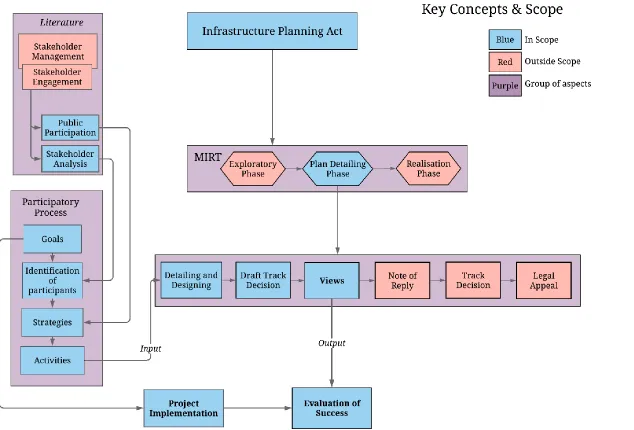
2.2 Key Concepts and Definitions ... 9
2.3 Scope and Limitations ... 12
3 Literature Study ... 13
3.1 Methodology and Sources ... 13
3.2 Road Infrastructure in the Netherlands ... 14
3.3 Dimensions of Participatory Processes ... 15
3.4 Assessment of Views and Participatory Success ... 20
4 Methodology ... 23
4.1 Case Study Design... 23
4.2 Data Collection Methods ... 24
5 Results ... 28
5.1 N35 Nijverdal - Wierden ... 29
5.2 Participatory Process ... 30
5.3 Analysis of Views ... 34
5.4 Generalisability of Results... 38
6 Discussion ... 43
6.1 Reflection on theoretical framework ... 43
6.2 Reflection on case study design ... 43
7 Conclusion and Recommendations... 45
7.1 Conclusion... 45
7.3 Recommendations to Antea Group ... 46
7.2 Recommendations for further research ... 47
References ... 48
5
List of Figures
Figure 1: Flow Diagram of Key Concept Relations and Scope ... 11
Figure 2: Scope of N35 Project - Route between Nijverdal and Wierden (Rijksoverheid, sd) ... 29
List of Tables
Table 1: Classification of activities (Krywkow, 2009) ... 19Table 2: Problem Types, (adapted from Hommes 2008) ... 21
Table 3: Categorisation of View topics (deductively derived and inductively completed) ... 22
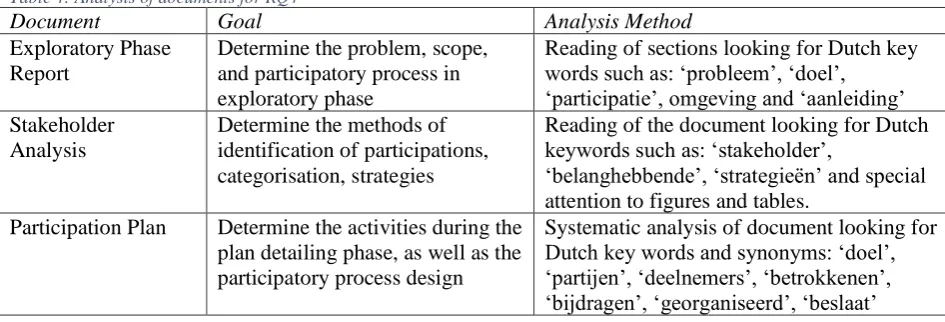
Table 4: Analysis of documents for RQ4 ... 24
Table 5: Framework for the analysis of Views ... 26
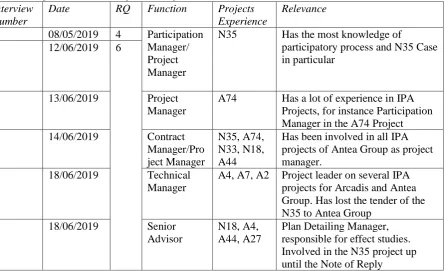
Table 6: List of conducted interviews for case study ... 28
Table 7: Characterisation of participatory goals ... 30
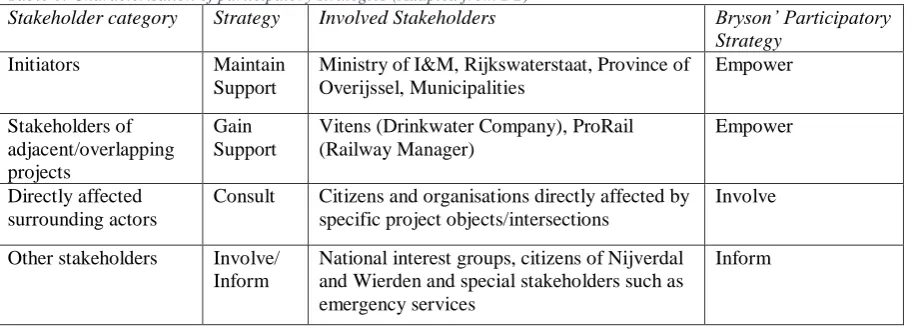
Table 8: Characterisation of participatory strategies (Adapted from D2) ... 31
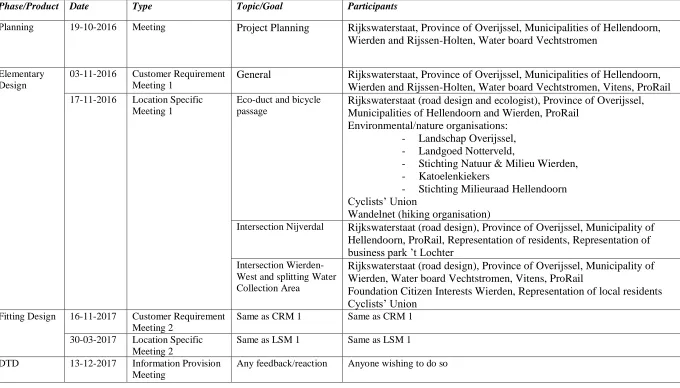
Table 9: Characterisation of participatory activities ... 33
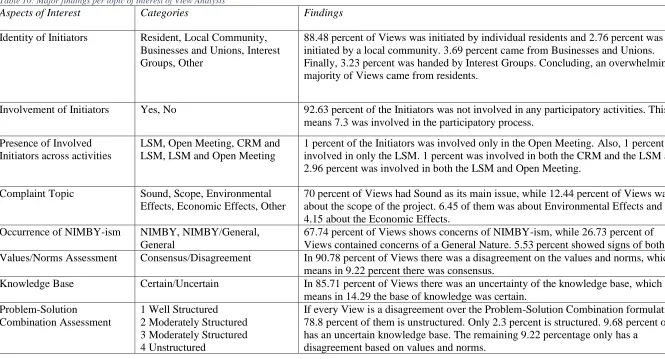
Table 10: Major findings per topic of interest of View Analysis ... 35
List of Abbreviations
Dutch Translation:
CRM Customer Requirement Meeting Klanteisspecificatie
DTD DTD Ontwerptracébesluit
ED Elementary Design Elementair Ontwerp
EIS Environmental Impact Statement Milieu-effectenrapport
FD Fitting Design Inpassend Ontwerp
GIS Geographic Information System Geografisch Informatiesysteem
IPA Infrastructure Planning Act Tracéwet
LSM Location Specific Meeting Locatie specifieke bijeenkomst
MCA Multi-Criteria Analysis Multicriteria Analyse
MIRT Multi-Year Program for Infrastructure, Public Space and Transport
Meerjarenprogramma Infrastructuur Ruimte
en Transport
MIWM Minister of Infrastructure and Water Management
Minister van Infrastructuur en
Rijkswaterstaat
NIMBY Not in My Backyard Niet in mijn achtertuin
N35
N35 Freeway
Rijksweg N35
6
1 Introduction
Operations in major road, railway and waterway projects in the Netherlands are done in accordance with the Infrastructure Planning Act (IPA, Dutch: Tracéwet). This legal framework ensures that decision making procedures regarding road infrastructure projects are thorough and structured (Gierveld, 2016). Several changes have been made to the framework over the years and as of 2012, the obligation to ‘contact the environment’ has been implemented into the law. However, it has been customary practice for years, with Rijkswaterstaat researching methods to use interaction with the environment to develop policy as far back as 1997 (Meesters, Enthoven, & Snepvangers, 1998). The result is a law where participation through ‘participatory processes’ must occur over the course of road infrastructure projects. The Draft Track Decision (DTD, Dutch: Ontwerp-tracébesluit) and the Track Decision (TD, Dutch: Tracébesluit) are to be made available to the public and every piece of formal written feedback regarding these Decisions, known as ‘Views’ needs to be addressed. If the initiators are not satisfied with the assessment and handling of their ’Views’, they may choose to start a Legal Appeal after the TD has been published. Such an extension of project duration is not desirable, due to the additional resources necessary, both in terms of possible delays and funding.
In 2021 the new Environment and Planning Act will be implemented in the Netherlands. It will replace all current laws on spatial planning and public space including the IPA. Participation will become more important and every governmental body needs to guarantee and elaborate on the use of participation in spatial projects. (Informatiepunt Omgevingswet, sd)
This is the report of research that was conducted for Antea Group. Central to this research was the question on how this company can improve its methods of conducting participatory processes, considering current and past developments in an infrastructure project concerning the widening of the N35 freeway (N35) road in the Netherlands.
1.1 Background
An extension of road infrastructure project duration is not desirable, due to the additional resources needed, especially to the client Rijkswaterstaat. This problem can be viewed in relation to ongoing societal developments and scientific phenomena. This will be done to further illustrate its relevance to Antea Group.
Antea Group is a Dutch engineering and consultancy firm. First, there will be major investments in infrastructure, which means Antea Group will have opportunities to increase its revenue. Globally, major infrastructure is nearing its end of life and investments of a total of 35 to 40 trillion dollars are needed to improve and replace it (Airoldi, Biscarini, & Saracino, 2010). To combat further traffic congestion the Dutch government intends to invest over 19 billion euros on the improvement of existing and construction of new roads up until 2030 (Rijkswaterstaat, 2019).
At the same time, increasing urbanisation across the globe will put more pressure on existing road infrastructure and has major implications for liveability, for instance through increased risks to health. Between 2005 and 2040 the proportion of the population living in urban areas will increase from 49 to 60 percent, with 81 percent of the population of developed regions living in cities (International Federation of Surveyors, 2010). This urbanisation will increase the number of affected citizens and therefore the amount of interests needed to be considered in projects with high spatial influences, such as major road infrastructure projects. The stakes of decision-making processes will be higher than ever.
7 are a known cause for cost overruns and the waste of public resources (Singh, 2009). Causes for these problems are poor management, such as slow decision making, poor planning, including changes to design specifications, rework and poor procedure management (Adam, Lindahl, & Josephson, 2015). While techniques of cost estimation have improved the occurrence of cost overruns has overall not decreased in the last decennia (Cantarelli, Flybjerg, Molin, & van Wee, 2012). It is therefore emphasized that cost overruns are more often caused by physiological and political-economic factors, rather than technical factors. Overrunning of costs occurs less in the Netherlands in comparison to other countries and budget overruns in the Netherlands are rather a planning problem than a management problem (Cantarelli, Flybjerg, Molin, & van Wee, 2012). This means that improving participatory processes, especially in the Netherlands is necessary to prevent budget and time overruns from occurring.
A scientific phenomenon known as public opposition is relevant to road infrastructure projects (Coppens, van Dooren, & Thijssen, 2018). The replacement or expansion of current road infrastructure is often vital to society but also results in severe negative externalities for a specific but small part of the population (Esaiasson, 2014). This causes public opposition or lack of public acceptation (Coppens, van Dooren, & Thijssen, 2018). Public opposition has been defined in a multitude of ways, the first one being the ‘Not-In-My-Backyard’ (NIMBY) principle. This idea is defined as opposition of citizens to the placement or construction of a public facility for selfish or parochial reasons. This theory has found low empirical support and other theories, which are more favourable, propose that public opposition is due to ideological concerns regarding social justice and ecological sustainability (Esaiasson, 2014).
The urbanisation mentioned also has implications for public opposition. Cities enable for citizens to collaborate and communicate and are therefore a catalyst for successful protests (Glaeser & Steinberg, 2017). A key factor in escalation of public opposition into actual protests or legal appeals against major infrastructure projects is this social interaction.
Participatory processes are defined as ‘the interaction of experts such as planners, ecologists, engineers or water managers with lay people throughout a planning procedure with the aim of including the perspectives and views of these lay people to support a decision-making process’ (Krywkow, 2009, p. 45). These participatory processes can be designed along numerous dimensions, often including goals, identification and categorisation of participants, strategies and activities. One of the goals of participatory processes is to benefit project implementation and reduce public opposition to road infrastructure projects. An empirical analysis on whether a participatory process design along those dimensions is beneficiary to project implementation is missing in literature.
1.2 Problem Context
8 Council of State (Cellarius, 2019). How did this occur even when the participatory process’ aim was to prevent it? The company has its own vision on how to execute participatory processes, not necessarily based on scientific literature, but rather on experience. Antea Group wants to gain insight into possible errors or opportunities for improvement in their methods for participation, with the aim of reducing Views to the DTD. This will in the end benefit the company’s commercial position relative to its competitors. When it can conduct participatory processes more effectively and efficiently than them, Antea Group has more qualifications to win future tenders on.
The problem statement therefore is as follows:
Antea Group wants to successfully execute participatory processes to benefit the timely implementation of road infrastructure projects. This will result in effective use of financial resources. The participatory process they used in the N35 project resulted in more Views than expected. Scientific literature on participatory processes, and phenomena like Public Opposition and NIMBY might provide explanations for this problem, but a literature gap exists in the application of these theories to road infrastructure projects. Upcoming investments in infrastructure will result in more projects, while urbanisation will further complicate these projects, due to the increase in stakes and stakeholders. All in all, this research will solve a problem highly relevant to both Antea Group, society and science.
2 Research Plan
After the problem context, background and its relevance have been explained the research plan can be elaborated on. This chapter discusses the research objective along with the research questions and the main strategy. Then the key concepts and definitions needed to understand those questions will be given, after which the scope and limitations of the research will be explained.
2.1 Objectives, Research Questions and Strategy
This research assumes that a well-designed, high quality participatory process can contribute to successful project implementation with low public opposition. This would mean that a high-quality participatory process would lead to a minimal amount of Views handed in after the DTD of a road infrastructure project has been published. This claim is not supported by scientific literature, since there is a gap in the literature addressing the link between successful design and successful implementation. Presuming this hypothesis, the problem statement and therefore the objective of this research will be:
To identify possible improvements of the participatory processes used by Antea Group in major road infrastructure projects with the goal of limiting the amount of ‘Views’.
To achieve this, it is necessary to define what participatory processes are and how their characteristics can be described, mainly their goals and what makes them a success. Also, it is necessary to elaborate on the legal framework for major road infrastructure projects and specifically the role of participation in that framework. To gain new insights we examine the N35 Nijverdal Wierden road project and its participatory process as a case study. Subsequently it is required to assess whether it was a success and connect the theoretical definition of success with the ‘Views’ handed in. Afterwards it can be determined which general conclusions can be drawn from the results of this single project analysis and how they can be inferred into implications for future projects.
To achieve the research objective the following main research question has been defined:
9 The following sub-questions are derived from this main question:
1. How is participation embedded in the legal framework for major road infrastructure projects in the Netherlands?
2. How can participatory processes be described according to literature in terms of goals, identification of participants, strategies and activities?
3. What is the relationship between the occurrence of Views and participatory process’ success in terms of project implementation?
4. How can the N35 project and the participatory process up from the Decision to Start until the Note of Reply as applied by Antea Group be described?
5. What patterns in terms of participatory process success in the N35 can be drawn from an analysis of the ‘Views’ handed in after the publication of the DTD?
6. How does the N35 Nijverdal - Wierden Project compare to other IPA Projects Antea Group has experience within terms of the scope and Exploratory Phase, participatory process design, project specific elements and View Patterns?
Question 1, 2 and 3 will be answered using a literature study of both peer reviewed articles from scientific journals and other sources. Question 1,2 and 3 are relevant because they will provide the framework for characterisation and evaluation of the case, used for the other questions. Questions 4, 5 and 6 will be answered using the N35 Project as a case study, based on document and data analysis. The sixth and last question will be answered using a set of interviews with employees of Antea Group. All these interviewees will be experts with experience in road infrastructure projects, Plan Detailing Phases and participation. The topic of this meeting will be how the N35 project compares to other major infrastructure projects and what implications that notion has for the results of the research in relation to other projects.
2.2 Key Concepts
and
Definitions
To answer the research questions, key concepts and their definitions need to be defined as to understand ‘what’ this research will exactly concern.
Participatory Process: ‘the interaction of experts such as planners, ecologists, engineers or water managers with lay people throughout a planning procedure with the aim of including the perspectives and views of these lay people to support a decision-making process’ (Krywkow, 2009, p. 45).
Infrastructure Planning Act: (Dutch: Tracéwet): Most important Dutch act in the field of the planning of new national infrastructure projects. This means it provides a planning framework for projects concerning the construction of new and modification of national motor- rail- and waterways. It incorporates aspects from the Environmental Management Act (Dutch: Wet milieubeheer) and Spatial Planning Act (Dutch: Wet ruimtelijke ordening) (Hobma & Jong, 2016).
Major Road Infrastructure Project: As defined by the IPA, a construction project concerning the modification, upgrading, such as widening or redesigning junctions or construction of a road of national importance, mainly high- or freeways (Hobma & Jong, 2016).
Rijkswaterstaat: ‘executive agency of the Ministry of Infrastructure and Water Management,
responsible for the Dutch main road network, the main waterway network, the main water systems, and the environment in which they are embedded.’ (Rijksoverheid, sd)
10
Legal Appeal (Dutch: bezwaarschrift/beroepsschrift): A written document in which formal objection is made against a TD addressed to the Administrative Jurisdiction Division of the Council of State. This document is the beginning of a legal procedure, where the Council of State can in the end nullify the decision of the Minister. It is important to note that the decision is judged on its legal grounds and not whether it reflects is the ‘right’ policy.
Stakeholder: A popular definition of this term by Freeman (1984, p. 46) was adapted to fit the scope of this research: ‘any group or individual who can affect or is affected by the achievement of the projects’ objective’.‘Stakes’ are interests in certain activities, and stakeholders are individuals or groups with
said interests, since they are either positively or negatively affected by a project. They have claims, rights and expectations that ought to be honoured (Chinyio & Olomolaiye, 2009).
Public Participation/Stakeholder Engagement: The interaction with lay-people can be generally referred to as stakeholder participation, but when it specifically encompasses the ‘meaningful involvement of the relevant members of the target populations in different stages of a policy development process’ it is referred to as Public Participation (Hasan, Nahiduzzaman, & Aldosary, 2018). Stakeholder Engagement is the process of identifying and incorporating stakeholder concerns, needs and values in the decision-making process (Cascetta & Pagliara, 2013).
2.3 Scope and Limitations
Below the relevant theories and boundaries of the proposed research will be explained. This is necessary to inform the reader about which principles and parts of the project will be examined and to ensure the scope complies with the completion of the research in a timely manner.
Participatory Processes and Stakeholder Management
Participatory processes are a part of Stakeholder Engagement, a phase in the much broader term Stakeholder Management. Since this research is of a more inductive nature, it does not require a full explanation of participatory processes in relation to Stakeholder Management. For this research it is assumed that even though the participatory process had a scope much wider, the Views are predominantly sent in by affected citizens. This means that the description of participatory processes in this research paper is related more to ‘Public Participation’ or ‘Citizen Participation’. Relevant aspects of this participatory process are goals, identification of participants, strategies, activities and success evaluation.
Analysis of Views
The Views will be analysed in a brief way, meaning the topics of interests will be the involvement of initiators, their identities, the complaint categories, the occurrence of NIMBY-ism within the Views and the assessment of problem types. In short, this research will not be about which party was ‘right’. The issue at hand is why this discussion ‘escalated’ into a View.
Available Time
Most of the limitations to this research are a result of the limited amount of time available. The research needs to be conducted in 10 weeks, with a 40-hour workweek. Ideally, this research would encompass multiple finished road infrastructure projects, selected on the basis of similar physical characteristics. This would ensure that the conclusions drawn are thorough and generalizable. This time limit means research methodology and scope had to be adjusted to make for a practically viable research plan and therefore that the description above is only carried out for one project.
Project Specific Limitations
The project at hand is in its final phase before realisation can commence. The TD with final set of designed measures has been approved and signed for by the Minister. As mentioned in the introduction, the legal appeals are under review by the Council of State at the time of writing this research. The response to and assessment of Legal Appeals is also part of a participatory process, but this part cannot be reviewed because the procedure is ongoing.
At the same time this project’s route between Nijverdal and Wierden has location specific issues. The general description of those issues applies to other road infrastructure projects as well, but the Views handed in will most likely concern highly specific sections of the road or intersections. This limits the generalisability of the conclusions drawn.
13
Methodology
The methodology has limitations too, since by only conducting a literature study into participatory processes and a document analysis of Views a possibility for clarification of written information is lost. An interview with for instance initiators of Views would solve this issue but the available time for this research renders that impractical.
The single case study to be explained comes with limitations to the generalisability of the results and the risk of ‘putting all the eggs in one basket’. This is simply due to the reason that Antea Group as of now has no access to other historical IPA road infrastructure projects in which they organised the participatory process in the Plan Detailing Phase.
The only way to map and evaluate the participatory process and its results is through the documents available on the internal server of Antea Group. This limits the research to the documenting of the process done by Antea Group. Since participatory processes are inherently of an iterative nature, this complicates and possibly limits the mapping of the process to internal methods, which cannot be evaluated.
The interviews have the limitation that all participants will be internal employees of Antea Group. It would have been interesting to inquire several involved stakeholders with experience in road infrastructure projects, such as the client Rijkswaterstaat or involved municipalities on how ‘common’ or ‘normal’ they perceive the N35 project to be in relation to other projects. This limitation means that the validation of the results of the set of interviews will be limited. Confidentiality will be maintained by not publishing a list of participants of this meeting and anonymising any information used in the final report.
3 Literature Study
This chapter defines a theoretical framework through the execution of a literature study. The legal framework for projects concerning national road infrastructure projects is elaborated upon. Multiple aspects of participatory processes will be explained to help classify currently applied strategies as well as a definition for ‘successful’ participatory processes.
3.1 Methodology and Sources
The sources used to define the legal framework for road infrastructure projects were gathered using the search engine of Google, using the Dutch keywords: ‘Tracéwet’, ‘Tracéwetprocedure’, ‘Participatie’, ‘Zienswijzen’,’Infrastructuurprojecten’ and ’N35’. A book by F. A. M. Hobma and P. Jong called ‘Planning and Development Law in the Netherlands’ was used as well.
Possible sources of information had to adhere to the following criteria: - May not be older than 10 years
- Published by government entities, advisory bodies or experts, meaning information from blogs or other websites is not included
For the part concerning dimensions of participatory processes the search engine of Google Scholar, and ScienceDirect by Elsevier were used. These databases were used to gather information related to participatory processes, stakeholder management and their relation to construction and infrastructure projects. For this the following search key words were used in various combinations: ‘infrastructure projects’, ‘construction’, ‘road’, ‘highway’, ‘public participation’, ‘citizen participation’, ‘stakeholder’, ‘engagement’, ‘identification’, ‘mapping’, ‘management’, ‘project management’, ‘stakeholder power’, ‘NIMBY’, ‘protest’, ‘reason’, ‘motivation’, ‘resistance’ and ‘public opposition’.
14 - Can be of both a qualitative and quantitative nature
- Need to discuss above mentioned terms in relation to, preferably, but not limited to road construction projects
- Preference for articles researching or evaluating projects in the Western world or internationally
- Preference for articles written after 2000, since articles older (than 2000) are often included in literature review articles published more recently (after 2000) and the possible invalidation and correction of those theories is considered
3.2 Road Infrastructure in the Netherlands
The legal framework for major road infrastructure projects in the Netherlands is defined as said before by the so-called IPA. In its first article it states the types of infrastructure it applies to. A ‘major road’ is described as a ‘highway or freeway of national importance’ and the law applies to a modification or construction of such a road. The current version has been enacted as of the 1st of May 2017 (Kennis- en Exploitaticentrum Officiële Overheidspublicaties, 2019).
The law prescribes two procedures: an extensive one in case a new major road is constructed or a road is widened with more than two lanes and a regular procedure if otherwise. The regular procedure will be explained based on information of Rijkswaterstaat (2019). In each phase the possibility of participation will be evaluated. Generally speaking there are two formal and legal feedback moments during the regular procedure.
1 Decision to start (Dutch: Startbeslissing)
The decision to do an Exploratory Phase into an existing or future problem is taken by the Minister of Infrastructure and Water Management (MIWM). The MIWM involves all concerned governmental bodies. This decision determines the area on which the Exploratory Phase will be conducted, as well as the problem and relevant spatial developments to assess. The decision should include a description of the methods to include public, public organisations and governmental bodies as well as the duration of the exploratory phase.
2 Exploratory Phase (Dutch: Verkenning)
During this phase information is gathered concerning the problem, the relevant spatial developments and possible solutions. During this phase public parties are involved in information sessions. This is a first legal mandate for participation, although no further specifications as to the design of this participatory process is given in the law itself.
In the Multi-Year Program for Infrastructure, Public Space and Transport (Dutch: ‘MIRT’), which contains the current status and financing of national spatial projects and programs, the initial decision and exploratory phase are referred to as ‘MIRT Exploratory Phase’ (Ministerie van Infrastructuur en Milieu, 2016).
3 Preferred Decision (Dutch: Voorkeursbeslissing)
After the exploratory phase has been completed the MIWM states a preference for a certain solution or no solution at all. In the extensive procedure the results of the previous phase and this preference would be combined into a Draft Structure Vision Dutch: Ontwerpstructuurvisie). This report, together with an Environmental Impact Statement (EIS, Dutch: Milieu-effectenrapport) would be available for feedback to the public for a period of six weeks. This is not the case in the regular procedure. In the
regular procedure, the results of the exploratory phase and MIWM preference are processed into the next phase, in which it is also determined whether an EIS is needed.
15 The results of the exploratory phase and the MIWM preferred decision are further expanded and detailed during this phase. This phase, along with the next, is referred to as the ‘MIRT Plan Detailing’, the focus of this research. The result of this phase is the DTD, which is made public, available for inspection, together with the EIS. This DTD contains an overview of the future measures and the methods to meet any legal norms, as well as the integration with surrounding environment (Rijkswaterstaat, 2015). The publication is done at public libraries, town halls of the involved municipalities and an online participation platform called ‘Platform Participation’. During a six-week period, all involved can respond to the DTD with a ‘View’. This view can concern subjects of interest, alternative solutions or factual inaccuracies in the DTD. Most of the time the Commission EIS will also evaluate the EIS and issue an advisory report.
5 Track Decision (Dutch: Tracébesluit)
After the six-week period all Views are assessed by the project team responsible for this phase and a ‘Note of Reply’ is issued. The issues raised are evaluated and changes to the DTD are made, after which it is finalised in the final TD. This TD is accepted and signed by the MIWM. The TD, together with the Note of Reply, again is available for public inspection for another six weeks. It is only possible for stakeholders to respond to changes made to the original DTD or to the handling of their original View. They can issue this response via a Legal Appeal to the Council of State. The Council of State will assess the appeals and give a verdict. If the TD is verified, it is irrevocable and local legislators must adapt spatial plans and issue necessary permits.
As stated, the scope of this research concerns the Plan Detailing Phase, which according to this definition contains ‘4 DTD’ and 5 ‘TD’. As explained in section 2.3 Scope and Limitations this research only involved section ‘4 DTD’, since phase 5 is still ongoing.
After the 5 phases of the formal legal procedure above have ended, Rijkswaterstaat identifies two further phases of concerned projects (Rijkswaterstaat, 2019).
6 Realisation
A TD has been made in which the measures to be taken, activities and the means to finance them are warranted. The realisation of the said measures can commence.
7 Monitoring and Completion Test (Dutch: Opleveringstoets en monitoring)
The TD also states when monitoring of environmental impacts will take place. This way, it can be judged whether estimations in the EIS are correct. If not, appropriate measures can be taken. A final Completion Test will determine if the completed project adheres to legal norms on environmental matters, noise levels, air pollution levels and effects to nature.
Synthesis: The legal framework for road infrastructure projects and participation in the Netherlands
The IPA provides a legal framework where participation has been implemented into the decision-making process. The regular procedure issues a demand for participation in the Exploratory Phase and the Plan Detailing Phase before the DTD. The framework does allow full freedom in the design of the participatory process. After the DTD is finished the Views can be handed in during a six-week period after which all of them are assessed and a response is issued in the form of the Note of Reply.
3.3 Dimensions of Participatory Processes
16
Goals
When defining the goals of a participatory process it is important to state no uniform definition of such goals exists, since they differ depending on the used perspective. Effectiveness is defined as ‘the degree to which something is successful in producing a desired result’ (Hasan, Nahiduzzaman, & Aldosary, 2018). According to this definition ‘success’ and ‘effectiveness’ are the same. The nature of the ‘desired’ results differs with the perspective you use. The following perspectives can be distinguished.
1. The desirable result is to achieve democracy/empowerment in the process
‘Public participation … shall enable those that are affected by a decision to influence that decision’ (Glucker, Driessen, Kolhoff, & Runhaar, 2013, p. 106). It will empower marginalised individuals and groups. This goes back to the well-known and influential goal definition by Arnstein stating participatory processes are ‘the redistribution of power that enables the have-not citizens, presently excluded from the political and economic processes, to be deliberately included in the future’ (Arnstein, 1969, p. 216).
2. The desirable result is to achieve maximum value in the product
Infrastructure projects are a product of value creation between a client and supplier. But ‘due to their public nature, additional value expectations are set on infrastructure projects by the public sector actors and the general public’ (Vuorinen & Martinsuo, 2018, p. 750). Since value is a multi-dimensional concept and subjective in nature there is a need to incorporate different stakeholders' viewpoints to understand project value well. Necessary to this goal of achieving a ‘better’ solution is the exchange or inclusion of experimental and value-based information including input from those affected, so that the decision-maker can make the most informed and well-considered decision (Glucker, Driessen, Kolhoff, & Runhaar, 2013).
3. The desirable result is to achieve consensus amongst the stakeholders, to legitimise the decisions made and to therefore benefit the project implementation
Public participation shall legitimise the decision-making process and thus provide legitimacy to authorities. ‘It is essential to enhance the (perceived) legitimacy of the decision-making process because … governments … depend on the support of the electorate’ (Glucker, Driessen, Kolhoff, & Runhaar, 2013, p. 108). In this definition of legitimacy, it means the same as consensus or stakeholder support since it is about the perceptions of stakeholders. Public participation shall contribute to the identification and resolution of conflict before final decisions are made. Both facts facilitate project implementation. (Glucker, Driessen, Kolhoff, & Runhaar, 2013).
4. The desirable result is for the process to be (cost)-effective and proportional to the project’s size
From this economic perspective the participatory process should be cost-effective (Hasan, Nahiduzzaman, & Aldosary, 2018). This means that time and financial resources spent on the participatory process must be relevant and proportional to the project’s size and scope.
17
Identification of Participants
After the goals of the participatory process have been defined by a company such as Antea Group the design of the process can start by identifying participants. It is important to first identify and assess the relevance of all stakeholders to determine which stakeholders will participate in participatory activities. Several methods for that exist in literature.
There are multiple methods for identifying stakeholders from which participants can be chosen depending on the goals of the process. These types of stakeholders, be it the organisations or individuals can and are usually involved in an infrastructure project are: institutions/authorities, users, transport operators, business and unions, local communities, media and financial institutions (Cascetta & Pagliara, 2013).
The methods for identifying these stakeholders are:
- Stakeholder meeting: This technique comprises of meetings between a growing group of stakeholders, which share information and opinions. This way the project team can determine which stakeholders should be present at subsequent meetings and can include them. (Bryson, 2004)
- Semi-structured interviews to obtain expert opinions with experts and stakeholders themselves (Reed, et al., 2009)
- Snow-ball sampling: asking identified stakeholders to identify further stakeholders, for instance for mapping relevant local affected stakeholders (Reed, et al., 2009)
- Document search (Krywkow, 2009)
It is important to both include top-down and bottom-up identification methods to prevent biases from the team leading the identification. The purpose of the stakeholder analysis determines ‘who is included, and who is omitted’ (Reed, et al., 2009). However, ‘stakeholders are often identified and selected on an ad hoc basis and this has the potential to marginalise important groups, bias results and jeopardise long-term viability and support for the process ‘(Reed, et al., 2009, p. 1933). It is however not possible to include all stakeholders and a line must be drawn based on well-founded criteria, such as geographical boundaries.
Positions in stakeholder analysis change throughout the project and should be monitored (Manowong & Ogunlana, 2009). This means that the type of participation per stakeholder may change during a project. A case study into stakeholder influence during construction projects in Sweden found that the influence of residents changed through different stages. Especially in the stages of legal appeals, they had gained substantial amounts of power over the project, strengthened by media attention and public opinion (Olander & Landin, 2005).
Categorisation of Participants
After a set of stakeholders and possible participants has been found using the above-mentioned methods, it is necessary to categorise which stakeholders should participate on which level, depending on the chosen participatory goal. However, literature is not conclusive and lacking in its matching of stakeholders to participatory goals.
For instance, ‘in general, people should be involved if they have information that cannot be gained otherwise, or if their participation is necessary to assure successful implementation of initiatives built on the analyses’ (Bryson, 2004, p. 27). This can be identified as useful for a process with the value
18 In the end literature provides methods for categorising stakeholders with the means of assigning participatory strategies to those categories. These strategies will determine in which activities the stakeholders will participate.
The first categorisation considers ‘social entities’ and categorises them as ‘the public’, ‘stakeholders’, ‘responsible authorities’ and ‘experts’ (Krywkow, 2009). It should be noted that this categorisation is made for the field of water resource management, but it is assumed that these also apply to the scope of this research. Krywkow (2009) notes that there is no hard distinction between stakeholders and the public and that actors from both categories might shift throughout the project.
Other techniques for conducting the categorisation focus on all identified stakeholders to improve the stakeholder analysis. Examples of analytical categorisations (Reed, et al., 2009) include those using levels of
- Interest and Influence
- Cooperation and Competition - Cooperation and Threat
- Urgency, Legitimacy, and Influence
Of these techniques for conducting categorisation ‘Interest and Influence’ is used by a method called the ‘Power/Interest’ or ‘Influence/Interest’ matrix categorising stakeholders as ‘Key Players’, ‘Context setters’, ‘Subjects’ and ‘Crowd’. It can be further improved by adding other attributes to the matrix in a visual way, for instance to show level of support (Reed, et al., 2009). The popularity of this method results in the risk of only identifying the ‘usual suspects’ and the under-representation of marginalised or powerless groups (Reed, et al., 2009).
When categorising stakeholders, it is important again to determine whether it should be of a top-down nature, where the project team uses above mentioned (theoretical) techniques or of a bottom-up nature, involving the stakeholders themselves in a more empirical analysis. Such bottom-up techniques include:
- Card-sorting method: each stakeholder can sort the stakeholders based on their own criteria. - Q Methodology: stakeholders are grouped based on perceived commonalities.
Strategies/Levels of Participation
Several authors have defined participatory strategies following the identification and categorisation of participants in the previous section. Mostert (2003a) identified 6 possible strategies or levels of public participation. These strategies only concern ‘the public’, or citizens: information, consultation, discussion, co-designing, co-deciding and deciding.
Krywkow (2009) notes that when democracy is the only goal of a participatory process, the framework by Mostert (2003a), as well as the Ladder of Participation by Arnstein (1969) are sufficient. He mentions that other types of effectiveness might not be achieved with the highest levels of participation from their frameworks, since the ‘public’ does not have sufficient expertise to fully control and make decisions.
Bryson formulates 5 possible strategies to include certain stakeholders in the participatory process. Each of these strategies resembles a different level of participation and comes with a promise to the stakeholders representing that level (Bryson, 2004):
- Inform: We will keep you informed.
19 - Involve: We will work with you to ensure your concerns are considered and reflected in the
alternatives considered and provide feedback on how your input influenced the decision. - Collaborate: We will incorporate your advice and recommendations to the maximum extent
possible.
- Empower: We will implement what you decide
Since Bryson’s strategies are, in contrast to the frameworks by Mostert and Arnstein, applicable to every stakeholder and not strictly connected to the goal of democratisation. This framework will be used to assess the strategies or level of participation per stakeholder as done by Antea Group in the N35 project.
Activities
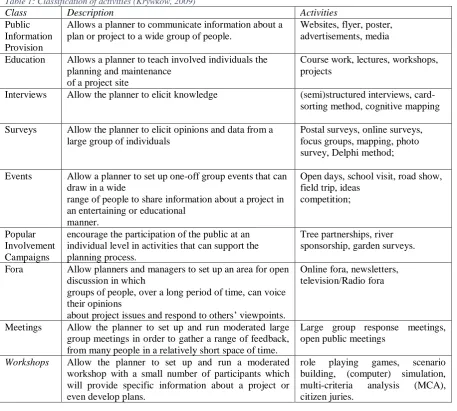
[image:20.595.66.524.312.723.2]After the participatory strategies for each stakeholder have been defined, the classes of participatory methods can be connected to them. This term is defined as ‘groups of methods with similar functions, methodology and requirements for expertise and skills’ (Krywkow, 2009, p. 46) and summarises methods that may be applied for the achievement of the same goals of a participatory process. They are shown in Table 1.
Table 1: Classification of activities (Krywkow, 2009)
Class Description Activities
Public Information Provision
Allows a planner to communicate information about a plan or project to a wide group of people.
Websites, flyer, poster, advertisements, media Education Allows a planner to teach involved individuals the
planning and maintenance of a project site
Course work, lectures, workshops, projects
Interviews Allow the planner to elicit knowledge (semi)structured interviews, card-sorting method, cognitive mapping Surveys Allow the planner to elicit opinions and data from a
large group of individuals
Postal surveys, online surveys, focus groups, mapping, photo survey, Delphi method; Events Allow a planner to set up one-off group events that can
draw in a wide
range of people to share information about a project in an entertaining or educational
manner.
Open days, school visit, road show, field trip, ideas
competition;
Popular Involvement Campaigns
encourage the participation of the public at an individual level in activities that can support the planning process.
Tree partnerships, river sponsorship, garden surveys. Fora Allow planners and managers to set up an area for open
discussion in which
groups of people, over a long period of time, can voice their opinions
about project issues and respond to others’ viewpoints.
Online fora, newsletters, television/Radio fora
Meetings Allow the planner to set up and run moderated large group meetings in order to gather a range of feedback, from many people in a relatively short space of time.
Large group response meetings, open public meetings
Workshops Allow the planner to set up and run a moderated
workshop with a small number of participants which will provide specific information about a project or even develop plans.
role playing games, scenario building, (computer) simulation, multi-criteria analysis (MCA), citizen juries.
20
Synthesis: A description of participatory processes according to literature
Four goals of participatory processes have been identified through literature. Success is a term that can be defined as ‘effective in reaching its desired results’. Those desired results are maximum value, project implementation (maximum consensus), democracy and cost-effectiveness.
The participants of participatory processes are identified using techniques following the stakeholder analysis. Several top-down and bottom-up identification methods exist to map stakeholders on a variety of aspects, such as influence, interest, and urgency. The link between successful achieving participatory goals and the identification of participants is lacking in literature. This identification leads to several categorisations of stakeholders for participation, where a strategy determines how involved a stakeholder will be. The ladder of participation and the strategies of Mostert (2003a) do not suffice because they only regard participation as a means to achieve democracy. Bryson’s framework will be used, because it regards all stakeholders for participation, and not only citizens. Several classes of activities have been identified covering a wide array of methods. The literature is not conclusive in its description of the relation between goals, participant and their strategies and activities. The system of Krywkow (2009) will be used to assess the activities of Antea Group.
3.4 Assessment of Views and Participatory Success
The assumption for the context of this research is made that if the process was effective in achieving all goals mentioned in section 3.3 Dimensions of Participatory Processes the process is a full, 100 percent success. This means that the process achieved maximum democracy, maximised smooth project implementation, is cost effective and made the product with the highest value. For a commercial party such as Antea Group, when working for a client as Rijkswaterstaat it however is most important to achieve goal 3, consensus and thus fast project implementation. This also means that Antea Group should not infringe on the fourth goal, cost-effectiveness, which means cost and time expenses are in line with original estimations.
Because of the relevance to Antea Group, this research addresses success as achieving the goal of smooth project implementation. Views show disagreement regarding the proposed designs in the DTD or the way these designs were made. Therefore, each View submitted decrease the achievement of participatory success. These Views can be handed in by several actors, possibly speaking for a larger group. They might or might not have been involved in participatory activities. The Views might concern specific aspects or effects of the proposed design or the way in which it was achieved. They can be of a more general or NIMBY nature.
One could view the occurrence of Views to a DTD as the result of different perceptions of a ‘problem-solution’ combination. The N35 Nijverdal Wierden project is a process of solving a ‘problem’ with the existing reality. This problem is a difference between a factual current situation from reality and the desired situation (Hommes, 2008). Problems are highly subjective social constructs and based on actor’s perceptions of the existing situations, their causes and consequences, their future developments and potential solutions (de Kruijf, 2007). This means that a problem-solution combination has these three elements (de Kruijf, 2007):
1. A description of present and future situation including a causal structure. 2. Definition of criteria, constraints and values to aim at and to sacrifice. 3. Definition of which direction(s) for solutions to consider and which not.
Since problems are highly subjective the problem formulation along the three elements above can differ. The proposed DTD can be viewed as a ‘problem-solution combination’ and the Views of stakeholders can be viewed as disagreements with this problem-solution combination.
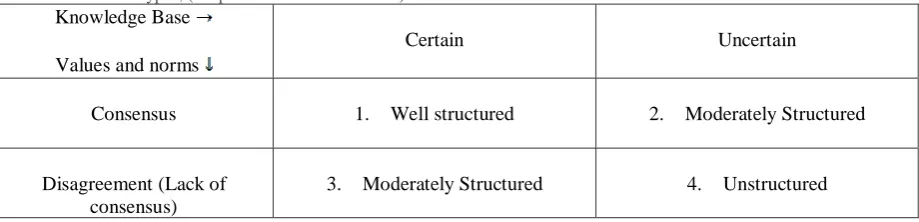
21 knowledge. This means that an Initiator of a View can disagree with a normative element or with a cognitive element of the problem-solution combination.
[image:22.595.68.528.191.302.2]From an analysis along these two dimensions four types of problems could become apparent, shown in Table 2. This classification comes with strategies for policy processes. These strategies pose for advice to Antea Group to prevent this difference in problem formulation from occurring in future projects. By considering the different perceptions of stakeholders regarding the problem-solution combination better.
Table 2: Problem Types, (adapted from Hommes 2008) Knowledge Base
Values and norms
Certain Uncertain
Consensus 1. Well structured 2. Moderately Structured
Disagreement (Lack of consensus)
3. Moderately Structured 4. Unstructured
The consensus or disagreement regarding value and norms in road infrastructure projects comes from different perceptions of stakeholders and the fact that they primarily serve their own interests. For example, two farmers could both want the road to stay off over their land, which means one of them will never be satisfied. What might be added ‘value’ for Rijkswaterstaat might be a negative externality for a local resident. This is a disagreement over what is ‘important’, ‘fair’ or ‘worth it’. Knowledge uncertainty regarding the designs and their effects, between stakeholders and project team may exist as well, due to it simply being unknown to both, a lack of research or because of a knowledge asymmetry. When a View is submitted there is a difference between the factual current DTD and the desired problem-solution combination of the initiator.
Therefore, the following premise is made:
A disagreement on norms/values (normative element) or an uncertainty of knowledge (cognitive element) area potential reasons for stakeholders to hand in ‘Views’ during an infrastructure project.
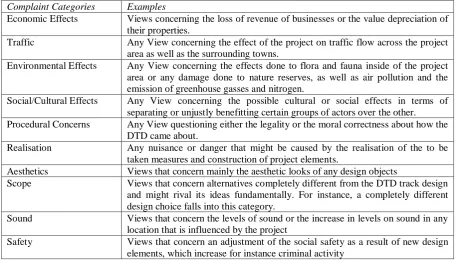
For each View it is possible to assess what type of problem it described, by determining its position in the two dimensions. Also, the aspects of infrastructure projects are of interest. These are mainly but not limited to all to effects caused by proposed measures and their locations or the procedure through which these measures were designed. These so-called ‘complaint categories’ were deductively derived and inductively completed while conducting the case study. Separately it was also addressed whether the Views is of a general or NIMBY nature. This is a separate assessment of the ‘complaint category’, since it is for instance possible to complain about noise nuisance from a general or NIMBY point of view.
22
Table 3: Categorisation of View topics (deductively derived and inductively completed)
Complaint Categories Examples
Economic Effects Views concerning the loss of revenue of businesses or the value depreciation of their properties.
Traffic Any View concerning the effect of the project on traffic flow across the project area as well as the surrounding towns.
Environmental Effects Any View concerning the effects done to flora and fauna inside of the project area or any damage done to nature reserves, as well as air pollution and the emission of greenhouse gasses and nitrogen.
Social/Cultural Effects Any View concerning the possible cultural or social effects in terms of separating or unjustly benefitting certain groups of actors over the other. Procedural Concerns Any View questioning either the legality or the moral correctness about how the
DTD came about.
Realisation Any nuisance or danger that might be caused by the realisation of the to be taken measures and construction of project elements.
Aesthetics Views that concern mainly the aesthetic looks of any design objects
Scope Views that concern alternatives completely different from the DTD track design and might rival its ideas fundamentally. For instance, a completely different design choice falls into this category.
Sound Views that concern the levels of sound or the increase in levels on sound in any location that is influenced by the project
Safety Views that concern an adjustment of the social safety as a result of new design elements, which increase for instance criminal activity
Of the Views several relevant aspects can thus be identified, such as the type of stakeholder, whether they participated in the participatory process, the category of their complaint and what type of problem the View can be seen as.
I now have established the legal framework for participation in national road infrastructure programs. Also, we have defined the dimensions along which participatory processes can be characterised. Finally, a definition for the assessment of success in terms of effectiveness regarding project implementation has been made. This theoretical framework is needed for the research methodology as proposed in the next section.
Synthesis: the relation between participatory process success and Views
If a participatory process is one hundred percent effective, maximum value, consensus, democracy and cost-effectiveness are reached. However, most of the time a trade-off is made to achieve one goal, which will inherently be able to achieve the other goals to some extent.
23
4 Methodology
This chapter explains the research methodology. It elaborates on aspects of the case study design such as case selection and data collection.
4.1 Case Study Design
The purpose of this research was of a descriptive and exploratory nature. The strategy used was a case study as described by Robert K. Yin (2003) into the N35 project. ‘The case study is one of several ways of doing social science research’ and ‘the preferred strategy when "how" or "why" questions are being posed’ (Yin, 2003, p. 1). It is an empirical inquiry that investigates a contemporary phenomenon within its real-life context (Yin, 2003, p. 13). This research into the N35 participatory process was on recently completed and ongoing activities, meaning it is of a contemporary nature. Another reason for this is the fact that the efforts of Antea Group in the past are also part of their current practices. The case study is suitable when the investigator has little or no control over occurring events (Yin, 2003). Other research methods, such as just an archival analysis or survey would not fit the scope of the research. The research method ‘conduction of experiments’ is also not in line with the scope since control of behaviour events is not relevant. Therefore, a case study with elements from other strategies fits the research objective best. The case study was of a qualitative nature, since the description of a participatory process is inherently qualitative. The analysis of the ‘Views’ led to results, as in ’40 percent of the Views had this characteristic.’ However, the research still is of a qualitative nature, since the variables measured cannot be expressed in units.
The case study was conducted on a holistic single case of the N35 project. The reason for selecting this case is the rationale that this case meets the requirements to test the relevant theories regarding participation in the IPA. The case is also a ‘typical case’ since this is an example of participatory processes as applied by Antea Group. It is an example of the application of methods Antea Group developed, and these methods will also be used in future projects. The unit of analysis for this case was the ‘participatory process as used in the Plan Detailing phase’.
Four types of validity need to be maintained by the case study design (Yin, 2003).
1. Constructional validity: the opinion of experts regarding the documents analysed will play a major role in this research.
2. Internalvalidity: the analysis of the Views will be done by pattern-matching and leads to explanation building, while also looking for possible counter explanations. Also, by inquiring after the results in interviews with experts, possible counter explanations can be identified.
3. External validity: the theoretical framework established along with a specific research question and a set of interviews provided me with enough insight into a wider population of cases and therefore increase the generalisability of the research conclusions.
4. Reliability: A detailed prescription for the analysis for documents and proper documentation of any other activities of this case study research will lead to a reliable possibility for assessing and reproducing the results.