http://wrap.warwick.ac.uk/
Original citation:
Yao, Yi and Li, Chang-Tsun (2012) Hand posture recognition using surf with adaptive
boosting. In: British Machine Vision Conference Workshop, Guildford, United Kingdom,
3-7 Sep 2012 pp. 1-10.
Permanent WRAP url:
http://wrap.warwick.ac.uk/65260
Copyright and reuse:
The Warwick Research Archive Portal (WRAP) makes this work of researchers of the
University of Warwick available open access under the following conditions. Copyright ©
and all moral rights to the version of the paper presented here belong to the individual
author(s) and/or other copyright owners. To the extent reasonable and practicable the
material made available in WRAP has been checked for eligibility before being made
available.
Copies of full items can be used for personal research or study, educational, or
not-for-profit purposes without prior permission or charge. Provided that the authors, title and
full bibliographic details are credited, a hyperlink and/or URL is given for the original
metadata page and the content is not changed in any way.
Publisher’s statement:
© 2011. The copyright of this document resides with its authors.
It may be distributed unchanged freely in print or electronic forms.
A note on versions:
The version presented in WRAP is the published version or, version of record, and may
be cited as it appears here.
YAO et al.: HAND POSTURE RECOGNITION USING SURF WITH ADAPTIVE BOOSTING 1
© 2011. The copyright of this document resides with its authors. It may be distributed unchanged freely in print or electronic forms.
Abstract
An approach making use of SURF feature and Adaboost for hand posture recognition is proposed. First the SURF key points are extracted to describe the blob or ridge-like structures from grey level images. These are potential points of interest that can be used to match with other images with similar structures. Then the statistic parameters of the tendency of gradient changes within small patches surrounding the points of interest are calculated as feature vectors. With all the points of interest, Adaboost is used to train a strong classifier for each posture by selecting the most efficient features, which largely lowers the computational cost of the classification stage. The proposed method was tested on the Triesch Hand Posture Database which is the benchmark in the field. Experimental results showed that our method outperforms existing methods in terms of better recognition accuracy.
1
Introduction
As the need for human-computer interaction (HCI) grows in many aspects of the digital world, various ways of communicating with computers have been exploited and there is little doubt that hand gesture is one of the most intuitive ways for this end. More and more applications in virtual reality (VR), gaming, human-robot interaction (HRI) and HCI based on hand gesture and posture recognition have emerged in the past decade.
In this paper, we focused on hand posture recognition. Many works have been done to improve the performance of hand posture recognition. Viola and Jones [6] successfully developed a face detection framework using Harr-like features and Adaboost to build a strong classifier. Adaboost is used for both feature selection and training of the classifier. This idea has been tested on hand posture recognition by Chieh-Chih Wang and Co-Chih Wang [5] for human robot interaction. They presented a method making use of SIFT [2] to achieve in-plane rotation and scale invariant hand detection. However, their work focused on recognising only 3 hand postures as the commands for communication with robot. The task was not challenging since all 3 postures are very distinct, which makes their method less scalable. Furthermore, their experiments did not test user independency of the method, which is a fairly important criterion of testing hand posture recognition system. Jiatong Bao et al proposed a method for dynamic hand gesture recognition using Speeded-Up Robust Features (SURF) [1] as matching feature to track hand in different frames. Then the hand trajectory used as the main feature to distinguish hand gestures [10]. After extracting
Hand Posture Recognition Using SURF
with Adaptive Boosting
Yi Yao
Chang-Tsun Li
Department of Computer Science, University of Warwick,
all SURF features from adjacent frames, instead of using the feature selection method, they used all SURF patches in the frame to locate the same hand. The videos with complex background possibly contain areas with sharp edges and dramatic texture changing. Hence applying feature extraction methods based on detecting texture changing extreme points, such as SURF extraction, will produce large number of points of interests from frames of the input video sequence. Hence the procedure of finding a match for every points of interests with 64 dimensional feature vector between two adjacent frames is very time consuming, given that the computational complexity of the procedure is O(M×N), where M and N are number of SURF points in adjacent frames. A method using features based on Modified Census Transform was proposed in 2006 [9]. They trained a simple linear classifier, using feature lookup-tables. But their method did not produce satisfying result on images with complex background. Also, their method did not achieve scale and rotation invariant. Another approach presented by Yikai Fang et al [8]. Their approach is based on the concept of co-training. Since their method is also a boosting based method, the training stage requires large number of samples. They tested their method also on Triesch Hand Posture Database [7], which is the benchmark in this field. But the Triesch Database does not have enough amount of training samples for boosting based methods. Hence they had to enlarge the training set at first by making perturbations on every training sample, which added more computation to the training stage, and made their method less scalable for larger database. Kumar et al [11], proposed a method with novel features which can be extracted by using the computational model of the ventral stream of the visual cortex. Their reported accuracy was 96.35% on uniform background. However the method was only tested on images with uniform background, which is hardly practical for real life scene settings.
The above mentioned methods are those with high reported accuracy on the Triesch Database at one time, and among them the work of Yikai Fang et al [8] and A. Just et al [9] are the ones with highest reported accuracy by now, on different number of training samples. Given the limitations of the afore-reviewed works, we propose the current work with the aims of improving hand posture recognition performance in terms of higher recognition accuracy, lower computational complexity on images with single colored background and also complex backgrounds. The experimental results show that our method outperforms the work of Yikai Fang et al [8] and A. Just et al [9].
2
PROPOSED APPROACH
A method based on SURF and Adaboost is proposed in this paper. First the SURF features are extracted from training samples. Then for each posture, a strong classifier is trained with boosting procedure to find a small combination of features which can distinguish this posture from others most efficiently. Finally the strong classifiers are used to perform classification on test set.
2.1
Feature Extraction
YAO et al.: HAND POSTURE RECOGNITION USING SURF WITH ADAPTIVE BOOSTING 3
space using Hessian-matrix approximation with the approximate second order Gaussian derivatives which shown in Figure 1 [1].
Figure 1 [1]: Approximation of Gaussian second order partial derivative. From left to right: the original second order derivative of Gaussian, y and xy direction; the approximation in y and xy direction, respectively.
SURF uses filters of various sizes to build a scale space, instead of using the same filter iteratively, as shown in Figure 2 [1]. The method called 'integral image' was used for fast convolution. In an integral image, the value of each pixel x is the sum of all pixels from the original image within a rectangular region from the top-left corner pixel to x. With the approximate second order derivatives of the Gaussian filter and the calculated integral image, convolution with Gaussian filters of various sizes can be done at the same speed. Since with the integral image, the summation of intensities inside a rectangular area of any sizes only requires three additions and four accesses to the memory. The candidate points are then picked out of all pixels if they have the extreme value of the determinant of the Hessian matrix in 27 pixels neighbouring area which comprises the upper, lower and current scale levels.
Figure 2 [1]: The difference of scale space structure in SIFT and SURF.
The localisation of interest points is performed next using scale space interpolation. For every interest points, the Haar wavelet response in both x and y direction within a circular neighbourhood with 6s radius of interest points are calculated, where s stands for the scale of the level where this key point is found. Then from a sliding window of size π⁄3, the orientation with the largest sum of wavelet response is picked as the dominant orientation. At last for each interest point, Haar wavelet responses within a 20s×20s surrounding region are used to form the final descriptor. The final feature vector of SURF is 64 dimensional, which is half the size of the SIFT descriptor. Figure 3 shows that with similar blob or ridge structures, and despite of the presence of the sleeve or ring on the finger as noise, the same posture from different performers (see the picture on the left-hand side of Figure 3) still have more matched interest points than different postures from the same performer (see the picture on the right-hand side of Figure 3).
[image:4.408.74.341.66.113.2] [image:4.408.111.298.298.368.2]binary images with hand region enhanced. However, they require segmentation of the hand region from the background. SURF is based on gray scale images, which does not require hand region segmentation, thus largely reducing the computational cost. Thirdly, SURF depends on gradient information on sub-patches, instead of individual gradients, which makes SURF less sensitive to noise. SURF not only uses the sum of wavelet responses, but
Figure 3: Matched SURF pairs in different postures.
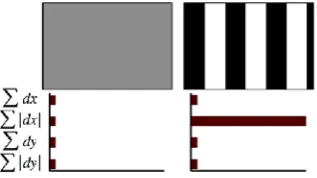
also the sum of absolute values of them in the patches for information of polarity of the intensity changes. As such the descriptor can also indicate the number of changes across the patch, which is shown in Figure 4 [1]. For region on the left, without dramatic intensity changes, the sum of wavelet response and absolute values of them do not have much difference. For region on the right, which has more intensity changes in x direction, the sum of wavelet response will not be changing much, which will fail to show the intensity changing information within the region. On the other hand, the sum of absolute values of wavelet response will be high, which can preserve important information for patch-matching process. Hence for every sub-patches, a 4 dimensional descriptor is built as part of the final feature vector. The most important merit of the proposed method is that it handles the complex background noise without any additional training images with random background [3] or high computational cost of skin color based hand tracking [4]. For those methods using color information, if there are skin colored region in the background, the method will be largely affected. But for our method, the gradient of intensity changes is used other than skin color model, which has much more tolerance on distractions in background. Because in uncontrolled real life scene settings, it is highly possible that people other than posture performer would appearing in the scene. That makes the possibility of regions with exact same texture of target hand shape appearing in the background much less than the possibility of skin-liked region appearing.
Figure 4 [1]: The sum of absolute values of wavelet response can preserve information of intensity changes in the sub-patches.
[image:5.408.114.273.437.526.2]YAO et al.: HAND POSTURE RECOGNITION USING SURF WITH ADAPTIVE BOOSTING 5
manner. With Adaboost as the feature selector, we fill the training set with images of complex background. Since all positive and negative training samples have complex background, the selected interest points are the ones that represent blob and ridge-like structures that can best distinguish the target posture from negative samples, with other postures and background textures. Hence the selected patches are the ones appear in positive samples with high frequency and almost never appear in other postures and random background. Experimental results showed that this method can achieve high accuracy.
2.2
Classifier training
Regardless of the relatively small 64 dimensional feature vector of SURF, even images of size as small as 128×128 pixels still dozens of interest points can be detected as features. Without feature selection process to sift out the useful ones, the computational cost is enormous. Boosting based methods can be used to find a subset of all points of interests, which is tested to be most effective. Adaboost is one of the most popular boosting learning algorithms, and based upon the idea of Adaboost we build a training process for classifier. The feature selection mechanism of proposed method is described in details in Algorithm 1. Assuming there are X images in the training set, and Y postures in total, and let T be the maximum number of weak classifiers for one posture. Firstly the SURF features are extracted from all positive samples in the training set. Different weights will be assigned to all samples in training set. All positive samples share the same initial weight, and so are the negative samples. For every target posture, the SURF vectors of all positive samples labelled with this posture will be put into the weak classifier pool. All SURF vectors which are the weak classifiers of this target posture in the pool will be tested to label all samples in the training set. To evaluate the performance of each SURF vectors, a error rate will be calculated for every vector using the weight of all training samples. One SURF vector with the lowest error rate will be chosen as a weak classifier ℎ𝑡𝑡(𝐼𝐼) of the strong classifier of this posture. Then the weight of all training samples will be updated based on the error rate of the chosen SURF vector. The weights of those samples were correctly classified by the chosen vector will be reduced by a factor. For those were not correctly classified, the weight will stay large. The process iterates until the error rate of latest chosen vector is smaller than a threshold or the number of selected vector reaches a certain limits. In every iteration, since the wrongly classified samples have large weights, then the process will looking for next weak classifier which can specifically classify those samples with large weight. This process has fairly intuitive pattern. Every chosen SURF vector is specifically suitable for classifying samples with certain characteristics, which cannot be efficiently classified by other chosen vectors. Therefore for every target postures the selected weak classifier will form a strong classifier. Every weak classifier consists of a weight, a selected SURF feature and its threshold.
this weak classifier is. The larger the error rate is, the smaller the weight will be, which indicates the importance of this weak classifier is lower.
Training process for all target postures
Input: The training set consists of X images and their corresponding posture sets: ( I1,𝑃𝑃1), ... , ( IX, 𝑃𝑃𝑋𝑋), where Ix is the xth image and 𝑃𝑃𝑥𝑥
is the posture label set of Ix ,𝑃𝑃𝑥𝑥=�𝑝𝑝𝑥𝑥,𝑦𝑦| 𝑦𝑦= 1,2, …𝑌𝑌�. If posture y
appearing in the xth image, 𝑝𝑝𝑥𝑥,𝑦𝑦= 1, otherwise 𝑝𝑝𝑥𝑥,𝑦𝑦 = 0. 1. fory = 1, ... ,Ydo
2. Initialise weights 𝑤𝑤 1,x = 1 2⁄ 𝑁𝑁𝑝𝑝for positive samples,
𝑤𝑤1,x =1 2⁄ 𝑁𝑁𝑛𝑛 for negative samples, where 𝑁𝑁𝑝𝑝 and 𝑁𝑁𝑛𝑛
are number of positives and negatives respectively; 3. fort = 1, ... , Tdo
4. Initialise the error rate 𝑒𝑒𝑡𝑡 = 1; 5. while 𝑒𝑒𝑡𝑡 < = Error Rate Threshold
6. Normalise weight of all training samples, so that
∑𝑋𝑋𝑥𝑥=1𝑤𝑤𝑡𝑡,𝑥𝑥 = 1;
7. Select one feature (ft) and its threshold (𝜃𝜃𝑡𝑡), from the
SURF interest points of all positive samples, which minimise the error rate:
𝑒𝑒𝑡𝑡= ∑𝑋𝑋𝑥𝑥=1𝑤𝑤𝑡𝑡,𝑥𝑥�ℎ𝑡𝑡(𝐼𝐼𝑥𝑥,𝑓𝑓𝑡𝑡,𝜃𝜃𝑡𝑡)− 𝑝𝑝𝑥𝑥,𝑦𝑦� (1)
8. For each weak classifier ℎ𝑡𝑡(𝐼𝐼), where 𝑓𝑓𝑡𝑡,𝜃𝜃𝑡𝑡 are minimisers of 𝑒𝑒𝑡𝑡, assign weight 𝛼𝛼𝑡𝑡:
𝛼𝛼𝑡𝑡= log1−𝑒𝑒𝑡𝑡
𝑒𝑒𝑡𝑡 (2)
Put ℎ𝑡𝑡(𝐼𝐼) =ℎ(𝐼𝐼,𝑓𝑓𝑡𝑡,𝜃𝜃𝑡𝑡,𝛼𝛼𝑡𝑡 ) into 𝐻𝐻𝑦𝑦 (I), which is the selected feature set (strong classifier) of the yth posture; 9. Update the weights of all training samples:
𝑤𝑤𝑡𝑡+1,𝑥𝑥 =𝑤𝑤𝑡𝑡,𝑥𝑥( 𝑒𝑒𝑡𝑡
1−𝑒𝑒𝑡𝑡)
1−𝜆𝜆 (3)
Where 𝜆𝜆= 0 if sample Ii is correctly classified,
𝜆𝜆 = 1, otherwise; 10. End while
11. End for 12. End for
13. return strong classifier 𝐻𝐻(𝐼𝐼) = (𝐻𝐻1(𝐼𝐼), ... , 𝐻𝐻𝑌𝑌(𝐼𝐼)).
YAO et al.: HAND POSTURE RECOGNITION USING SURF WITH ADAPTIVE BOOSTING 7
The value of T in the training stage, needs to be evaluated in the experiments. In order to guarantee the efficiency of the classification stage, we need to terminate the training process at some point when the number of selected weak classifiers is larger than the threshold T, but the error rate is still not low enough. T is set to 20 in our experiment. That means this training process only picks necessary amount of weak classifiers. The amount of selected weak classifiers for every target posture could be different.
2.3
Classification
The proposed method incurs even less computation in the classification stage than [5] due to the various number of weak classifiers h_t (I) involved in every strong classifier
H_y (I) of each posture in the training process. This is because the training process
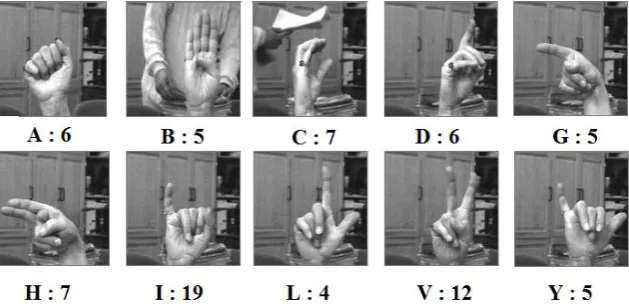
terminates when the error rate e_t is lower than the predefined threshold, every H_y (I) can achieve the target accuracy without wasting time on selecting a certain number of weak classifiers for every posture. That means in classification stage the computation will focused on those posture with relatively large number of weak classifiers, which could be very important for pattern recognition tasks require real time response rate like hand posture and gesture recognition. For postures with higher similarity and relatively harder to be classified, like posture 'I' and 'Y' in Triesch database, there will be more features picked out for the classification task. Shown in Figure 2, posture 'I' has 19 selected features. For posture 'L', only 4 features selected. Because the SURF features of posture 'L' are so unique that only using 4 of them can distinguish this posture from the others quite well.
Figure 5. Number of weak classifiers within trained strong classifier for all 10 postures with complex background in Triesch Hand Posture Database.
The classification mechanism is shown with details in Algorithm 2. Given a testing image, firstly the SURF feature vectors will be calculated. Then for each strong classifier, all weak classifiers within it will produce a matching result, which is 1 or 0, according to the thresholds of all weak classifiers. This score will have the weight of this weak classifier. Then the weighted sum of all weak classifiers in this strong classifier, i.e.,
[image:8.408.49.364.289.441.2]will be produced as matching result of this strong classifier. If H_y (I) is larger than a certain percentage μ of sum of weights
𝜇𝜇 ∑𝑇𝑇𝑡𝑡=1𝛼𝛼𝑡𝑡 (5)
then output of H_y (I) is 1. The parameter μ needs to be estimated through experiments. If a learning algorithm like EM is used here to estimate the optimal value of μ, the computational cost of the proposed method can be shortened even further. If there are more than one classifier producing 1 as result, the actual weighted sum in Eq.(4) from these classifiers will be compared and the one with the highest sum wins.
Classification with SURF
Input: A testing image: I, with the strong classifier 𝐻𝐻(𝐼𝐼) = (𝐻𝐻1(𝐼𝐼), ... , 𝐻𝐻𝑌𝑌(𝐼𝐼)) from the training stage, where 𝐻𝐻𝑦𝑦(𝐼𝐼), y = 1,2, ... Y, consists of
𝑇𝑇𝑦𝑦 weak classifiers ℎ𝑡𝑡(𝐼𝐼) = ℎ(𝐼𝐼,𝑓𝑓𝑡𝑡,𝜃𝜃𝑡𝑡,𝛼𝛼𝑡𝑡), 𝛼𝛼𝑡𝑡,𝑓𝑓𝑡𝑡,𝜃𝜃𝑡𝑡 indicating the
weight, selected SURF interest point and threshold respectively. 1. Extract the SURF features set S = 𝑠𝑠1, ... 𝑠𝑠𝑀𝑀, from I;
2. Initialise WeightSum = 0; 3. for y = 1, ... , Ydo 4. fort = 1, ... , 𝑇𝑇𝑦𝑦do
5. Find the nearest match of ℎ𝑡𝑡, 𝑠𝑠𝑚𝑚 in S; if Euclidean Distance d(ℎ𝑡𝑡, 𝑠𝑠𝑚𝑚) < 𝜃𝜃𝑡𝑡, then WeightSum := WeightSum + 𝛼𝛼𝑡𝑡; 6. End if
7. End for 8. End for
9. if WeightSum > 𝜇𝜇 ∑𝑇𝑇𝑡𝑡=1𝛼𝛼𝑡𝑡then 10. return 1
11. else
12. return 0 13.end if
Algorithm 2. The classification stage with strong classifiers of all target postures trained by Algorithm 1.
3
EXPERIMENTAL RESULTS
YAO et al.: HAND POSTURE RECOGNITION USING SURF WITH ADAPTIVE BOOSTING 9
consists of 10 hand postures performed by 24 persons. There are three kinds of background settings, namely uniform light, uniform dark and complex. In total, there are 720 greyscale images of 128×128 pixels. Samples of the database are shown in Figure 5. There are 72 images for each posture. We test the proposed method in two different experiments. Experiment 1: For comparison with work of Yikai Fang et al [8], we apply the exact same experiment setting as in [8]. For each posture, the training set consists all 30 images from 10 performers and the remaining images of the other 14 performers form the testing set. Also for the convenience of comparison with A. Just et al [9], the same experimental setting is deployed in Experiment 2. For each posture the training set has images of 8 performers and the testing set has 16 performers' image. The results are shown in Table 1 and 2, respectively.
[image:10.408.74.343.170.316.2]Light Dark Complex Average Our method 93.9% 94.4% 90.2% 92.8% Reported in [8] - - - 90.1%
Table 1. Results of Experiment 1
Light Dark Complex Average Our method 93.6% 94.3% 90.0% 92.6% Reported in [9] 92.8% 92.8% 81.3% 89.0%
Table 2. Results of Experiment 2
In Experiment 1, the proposed method outperforms [8] (They only reported the average accuracy which is 90.1%) with the same number of training and testing images. Furthermore, better than method in [8], our method does not require any perturbations work on training images. That makes the proposed method more efficient and scalable. Producing decent accuracy with small training set is fairly rare for boosting based methods, which indicates out method can be further generalised on dynamic hand posture and dynamic hand gesture recognition, which are based on video sequences. The boosting method with SURF could serve well, since the training methods requiring large number of video sequences are not practical.
With the same experimental setting with [9] in Experiment 2, the proposed method outperformed [9]. Our experimental results revealed that the proposed method can achieve higher accuracy without a large number of training samples or perturbation on the training set. Especially on complex background images, our method produced 92.6% of truth positive.
4
CONCLUSION
[image:10.408.77.343.173.221.2]and only the most efficient features from the feature pool are selected to build the strong classifier. The proposed method achieved high recognition accuracy on the Triesch Hand Posture Database at a low computational cost with a small training set, without including any additional training images of complex backgrounds or perturbation on the training set.
References
[1] Herbert Bay, Andreas Ess, Tinne Tuytelaars, Luc Van Gool, SURF: Speeded-Up Robust Features, Computer Vision and Image Understanding (CVIU), Vol. 110, No. 3, pp. 346-359, 2008.
[2] David G. Lowe, Distinctive image features from scale - invariant keypoints, International Journal of Computer Vision, 60(2), pp. 91-110, 2004.
[3] L. Anton-Canalis and E. Sanchez-Nielsen, Hand posture dataset creation for gesture recognition, International Conference on Computer Vision Theory and Applications (VISAPP’06), Set´ubal, Portugal, February 2006.
[4] Mahmoud Elmezain, Ayoub Al-Hamadi, Bernd Michaelis, Hand trajectory-based gesture spotting and recognition using HMM, 16th IEEE International Conference on Image Processing (ICIP), Cairo, Egypt, 2009.
[5] Chieh-Chih Wang, Co-Chih Wang, Hand Posture Recognition Using Adaboost with SIFT for Human Robot Interaction, Proceedings of the International Conference on Advanced Robotics (ICAR'07), Jeju, Korea, 2007.
[6] P. Viola and M. J. Jones, Robust real-time face detection, International Journal of Computer Vision, vol. 57(2), pp. 137-154, 2004.
[7] J. Triesch and C. V. D. Malsburg, Robust classification of hand postures against complex backgrounds, Second International Conference on Automatic Face and Gesture Recognition, pp. 170–175, 1996.
[8] Yikai Fang, et al., Hand posture recognition with co-training, 19th International Conference on Pattern Recognition, Tampa, FL, 2008.
[9] A. Just, Y. Rodriguez, and S. Marcel, Hand posture classification and recognition using the modified census transform, 7th International Conference on Automatic Face and Gesture Recognition, pp. 351–356, 2006.
[10] Jiatong Bao, et al., Dynamic hand gesture recognition based on SURF tracking, 2011 International Conference on Electric Information and Control Engineering (ICEICE), pp.338– 341, 2011.
![Figure 1 [1]: Approximation of Gaussian second order partial derivative. From left to right: the original second order derivative of Gaussian, y and xy direction; the approximation in y](https://thumb-us.123doks.com/thumbv2/123dok_us/9640357.466397/4.408.111.298.298.368/approximation-gaussian-derivative-original-derivative-gaussian-direction-approximation.webp)