2223
Practical, Efficient, and Customizable Active Learning
for Named Entity Recognition in the Digital Humanities
Alexander Erdmann,†‡David Joseph Wrisley,‡Benjamin Allen,†Christopher Brown,† Sophie Cohen-Bod´en`es,∗ Micha Elsner,†Yukun Feng,†Brian Joseph,†
B´eatrice Joyeux-Prunel∗ and Marie-Catherine de Marneffe† †Ohio State University, USA‡New York University Abu Dhabi, UAE
∗Ecole Normale Sup´erieure, France
{ae1541,djw12}@nyu.edu,{allen.2021,brown.2583,elsner.14, feng.749,joseph.1,demarneffe.1}@osu.edu,
[email protected], [email protected]
Abstract
Scholars in inter-disciplinary fields like the Digital Humanities are increasingly interested in semantic annotation of specialized corpora. Yet, under-resourced languages, imperfect or noisily structured data, and user-specific clas-sification tasks make it difficult to meet their needs using off-the-shelf models. Manual an-notation of large corpora from scratch, mean-while, can be prohibitively expensive. Thus, we propose an active learning solution for named entity recognition, attempting to maxi-mize a custom model’s improvement per addi-tional unit of manual annotation. Our system robustly handles any domain or user-defined label set and requires no external resources, enabling quality named entity recognition for Humanities corpora where such resources are not available. Evaluating on typologically dis-parate languages and datasets, we reduce re-quired annotation by 20-60% and greatly out-perform a competitive active learning baseline.
1 Introduction
Reaping the benefits of recent advances in Named Entity Recognition (NER) is challenging when dealing with under-resourced languages, niche do-mains, imperfect or noisily structured data, or user-specific classification tasks. Scholars in inter-disciplinary fields like the Digital Humanities (DH) are increasingly interested in semantic an-notation of specialized corpora that invoke many of these challenges. Thus, such corpora cannot easily be annotated automatically with blackbox, off-the-shelf NER models. Manual annotation of large corpora from scratch, meanwhile, can be prohibitively costly. Successful DH initiatives like the Pelagios Commons (Simon et al.,2016), which collects geospatial data from historical sources, often require extensive funding, relying on con-siderable manual annotation (Simon et al.,2017).
To this end, we introduce the Humanities Entity Recognizer (HER),1 a whitebox toolkit for build-your-own NER models, freely available for public use. HER robustly handles any domain and
user-defined label set, guiding users through an active learning process whereby sentences are chosen for manual annotation that are maximally informative to the model. Informativeness is determined based on novel interpretations of theuncertainty, repre-sentativeness, and diversity criteria proposed by
Shen et al. (2004). In contrast to literature em-phasizing the disproportionate or exclusive impor-tance of uncertainty (Shen et al.,2017;Zhu et al.,
2008;Olsson, 2009), we observe significant im-provements by integrating all three criteria.
In addition to a robust active learning based NER toolkit, we also contribute a novel evalua-tion framework. This inclusive framework con-siders the accuracy with which an entire corpus is annotated, regardless of which instances are an-notated manually versus automatically, such that no instance is held out when the active learn-ing algorithm considers candidates for annotation. The standard,exclusiveevaluation framework, by contrast, only measures the accuracy of the final trained model’s predictions on a held out test set. Thus, the inclusive framework is relevant to the user who wants to annotate a finite corpus as fast and as accurately as possible by any means neces-sary, whereas the exclusive framework is relevant to the user who wants to build an NER tool that can generalize well to other corpora.
We conduct extensive experiments comparing several combinations of active learning algorithms and NER model architectures in both frame-works across many typologically diverse lan-guages and domains. The systematic differences between inclusive and exclusive results demon-strate that while deep NER model architectures
(Lample et al., 2016) are highly preferable for tagging held out sentences, shallow models ( Laf-ferty et al., 2001) perform better on sentences that could have been chosen for manual annota-tion but were not selected by the active learning algorithm. We argue for the importance of con-sidering both frameworks when evaluating an ac-tive learning approach, as the intended application determines which framework is more relevant and thus, which model should be employed. Control-ling for the NER model,HER’s active learning sen-tence ranking component achieves significant im-provement over a competitive baseline (Shen et al.,
2017). BecauseHERdoes not reference the infer-ence model during sentinfer-ence ranking, this provides counter evidence toLowell et al.(2018)’s hypoth-esis thatnon-nativeactive learning is suboptimal.
2 Related Work
The best known NER systems among humanists are Stanford NER (Finkel et al.,2005), with pre-trained models in several languages and an in-terface for building new models, and among re-searchers interested in NER for spatial research, the Edinburgh Geoparser (Grover et al., 2010), with fine grained NER for English. Erdmann et al. (2016) and Sprugnoli (2018), among oth-ers, have shown that such off-the-shelf models can be substantially improved on DH-relevant data. Work such asSmith and Crane(2001) andSimon et al.(2016) represent a large community mining such data for geospatial entities. Additional DH work on NER concerns the impact of input data structure and noisy optical character recognition (Van Hooland et al.,2013;Kettunen et al.,2017).
Low Resource NER Language agnostic NER is highly desirable, yet limited by the data avail-able in the least resourced languages. Curran and Clark (2003) demonstrate that careful feature en-gineering can be typologically robust, though data hungry neural architectures have achieved state-of-the-art performance without feature engineer-ing (Lample et al., 2016). To enable neural ar-chitectures in low resource environments, many approaches leverage external resources (Al-Rfou et al., 2015). Cotterell and Duh (2017), for in-stance, harvest silver annotations from structured Wikipedia data and build models for typologically diverse languages, though their approach is lim-ited to specific domains and label sets. Lin and Lu (2018) adapt well-resourced NER systems to
low resource target domains, given minimal anno-tation and word embeddings in domain. Several translation-based approaches leverage better re-sourced languages by inducing lexical information from multi-lingual resources (Bharadwaj et al.,
2016;Nguyen and Chiang,2017;Xie et al.,2018). In a slightly different vein,Shang et al.(2018) use dictionaries as distant supervision to resolve entity ambiguity. Unfortunately, external resources are not always publicly available. It is in fact impossi-ble to replicate many of the above studies without a government contract and extensive knowledge of linguistic resources, limiting their applicability to many DH scenarios.Mayhew et al.(2017) suggest manually building bilingual dictionaries when no other translation resources are available to facili-tate their method, though active learning provides a more direct means of improving NER quality.
Active Learning Active learning seeks to max-imize the performance of a model while mini-mizing the manual annotation required to train it.
Shen et al. (2004) define three broad criteria for determining which data will be most informative to the model if annotated: uncertainty, where in-stances which confuse the model are given prior-ity; diversity, where instances that would expand the model’s coverage are prioritized; and repre-sentativeness, prioritizing instances that best ap-proximate the true distribution over all instances. Uncertainty-based approaches outperform other single-criterion approaches, though many works, primarily in Computer Vision, demonstrate that considering diversity reduces repetitive training examples and representativeness reduces outlier sampling (Roy and McCallum, 2001;Zhu et al.,
2003;Settles and Craven,2008;Zhu et al.,2008;
Olsson, 2009; Gu et al., 2014; He et al., 2014;
Yang et al.,2015;Wang et al.,2018b).
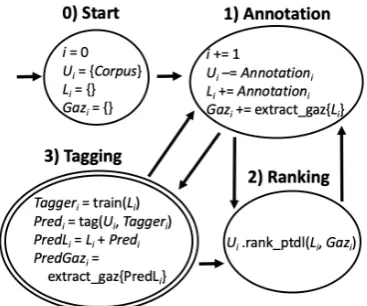
Low-Figure 1: High levelHER system architecture. Unla-beled sentences inU are manually labeled and moved toL, enabling iterative updates of gazetteers, the NER model, and the informativity ranking of sentences inU.
ell et al.(2018) compare calculating MNLP from thenativeinference model and from anon-native model with a separate architecture. They con-clude that non-native models are ill-suited to ac-tive learning, which our findings using more ro-bust informativeness criteria contradict.
3 The Humanities Entity Recognizer
As illustrated in Figure 1, HER consists of three components: (1) a human U serwho provides an unlabeled corpus U at state 0 and annotates se-lected sentences in state 1, thus moving them from U to the labeled corpus L, (2) an active learn-ing engine,Ranker, that ranks sentences fromU in state 2 forU ser to annotate based on how in-formative they might be to (3), the NER model, T agger, to be trained onLin state 3.2
All states are linked by an interface that “white-boxes” the process. It advises U ser on quali-tative observations which might improve perfor-mance by manually interacting withRanker, e.g., removing problematic gazetteer entries, or with T agger, e.g., forcing it to sample some known minority labels. The contributions of the interface will not be reflected in our human-out-of-the-loop experiments on standard datasets, as these evalu-ate only the contributions ofRankerandT agger. Thus, reported performances should be considered a lower bound that can often be improved with minimal human intervention.
2In our experiments, we assume no previous annotation or
pre-existing gazetteers at state 0, though, in practice,HER ro-bustly leverages non-emptyL0and/orGaz0when available.
3.1 Ranking Sentences by Informativeness
At state 1 with i=0, U ser is prompted to an-notate randomly ordered sentences until 50-100 named entities are labeled. We use a 200-sentence seed for all experiments except that of Section
4.1, where an entity-sparse corpus requires a 300-sentence seed. Such a small seed, often anno-tated in less than 30 minutes, is sufficient to sup-port Ranker’sPre-Tag DeLex (PTDL) algorithm in state 2. PTDL uses only shallow, fast
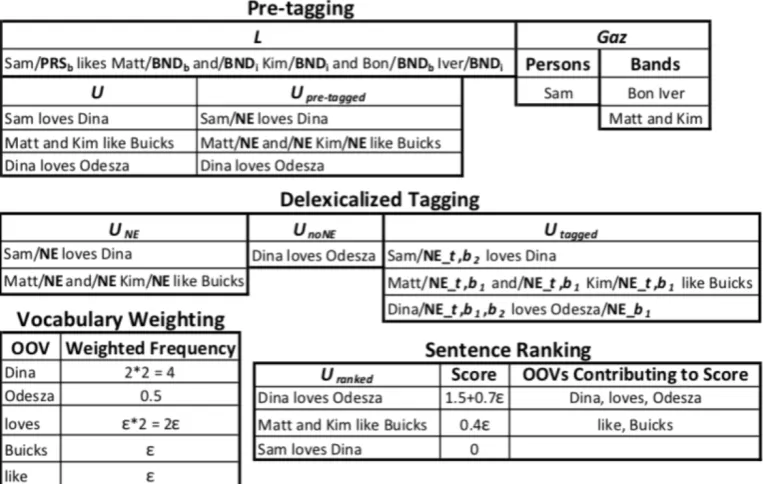
Con-ditional Random Fields (CRF) to avoid delaying manual annotation. As demonstrated on a sam-ple corpus in Figure 2, PTDL involves four
sub-tasks: pre-tagging,delexicalized tagging, vocabu-lary weightingandsentence ranking.
Pre-tagging We naively and greedily pre-tag U with binary entity–non-entity labels based on gazetteer matches. Hence, every n-gram in U matching a named entity from a gazetteer gets pre-tagged as such unless it overlaps with a longer named entity. State 2 cannot occur until the seed has been annotated, soGazwill never be empty, as entities are automatically extracted into gazetteers after each annotation batch in state 1.
Delexicalized Tagging Upre−tagged is divided into UN E, containing sentences with at least one pre-tagged named entity, and its complement, UnoN E. We train a trusted NER model (t) on L and twobiasedmodels (b1andb2) onLplus ran-dom mutually exclusive halves ofUN E.b1andb2 are biased in that they use non-gold data (UN E) exhibiting an exaggerated density of named en-tities. Models are trained using only delexical-ized features, which, unlike character n-grams for example, do not directly reference the focal word or its form. Many delexicalized features are context-based, like preceding and following words. Trained thus, models are less hampered by the class imbalance problem (Japkowicz, 2000), more likely to predict more named entities, and more capable of determining which Out Of Vocab-ulary (OOV) lexical items (inU but notL) make good named entity candidates.
[image:3.595.90.274.61.214.2]Figure 2: Step-by-step example outputs from ranking unlabeled sentences in a sample corpus withPTDL.
This motivatesPTDLto target frequent OOVs after
exhausting OOVs more likely to be named entities.
Sentence Ranking As shown in Figure2, sen-tences in U are ranked by the sum of scores of unique OOVs therein, normalized by the word length of the sentence. OOVs occurring in higher ranked sentences do not count toward this sum.
While typical active learning strategies for NER rely on the inference model’s output probabili-ties, these are noisy, especially given scarce an-notation. Data-scarce models lexically memorize training instances, yielding high precision at the expense of recall. They struggle to model non-lexical features more subtly correlated with en-tity status but also more likely to occur on OOVs. Hence, data-scarce models know what they know but are somewhat equally perplexed by everything else (Li et al.,2008). For this reason, uncertainty-based active learners can suffer from problemati-cally weak discriminative power in addition to re-dundant and outlier-prone sampling.
By forcing reliance on delexicalized features and biasing models toward recall, our three-criteria approach identifies frequent (representa-tiveness) OOV words (diversity) that are plausible candidate members of named entities. These make for better indicators of where the model may fail (uncertainty) because named entities are minority labels in NER and minority labels are challenging.
3.2 Sentence Tagging Architectures
U ser can stop iteratively annotating and re-ranking U at any time to train a T agger on L to perform the full NER task on U (state 3). L is combined with T agger’s predictions on U (P red) to formP redL, from which an imperfect gazetteer is extracted (P redGaz). U sermust in-spect these to determine if additional annotation is required. We explore threeT aggerarchitectures:
CRF For tagging withOkazaki(2007)’s feature-based CRF,T agger first trains preliminary mod-els onL, cross-validating on folds of the random seed. Each model leverages a unique permuta-tion drawn from a universal set of features. The best performing feature set is used to train the fi-nal model. Training and inference are fast, even with preliminary cross-validation. In the exclu-sive evaluation, CRF is the best tagger until about 40K tokens of training data are acquired. In the inclusive evaluation, CRF’s tendency to overfit is rewarded, as it outperforms both deep models re-gardless of corpus size.
all other models in the exclusive evaluation for a stretch of the learning curve between about 40K tokens acquired and 125K. While faster than the other deep model considered here, training time is slower than the CRF and computationally costly.
BiLSTM-CRF The state-of-the-art BiLSTM-CRF architecture of (Lample et al.,2016) projects a sequence of word embeddings to a character level BiLSTM which in turn projects into a CRF at the tag level, with an additional hidden layer be-tween the BiLSTM and CRF. In our experiments, BiLSTM-CRF surpasses CNN-BiLSTM perfor-mance once about 125K tokens are acquired.
3.3 HERin the Digital Humanities
HERwas developed to benefit diverse DH projects. It is currently facilitating three such ventures.
The Herodotos Project (u.osu.edu/ herodotos) aims at cataloguing ancient ethnogroups and their interactions (Boeten,
2015; de Naegel, 2015). HER is used to
iden-tify such groups in Classical Greek and Latin texts. Manually annotated data as well as a trained NER tagger are freely available from github.com/alexerdmann/Herodotos-
Project-Latin-NER-Tagger-Annotation.
Artl@s artlas.huma-num.fr is a global database of art historical catalogs from the 19th and 20th centuries for the scholarly study of the diffusion and globalization of art. HER serves as a method for mining semi-structured texts char-acterized by noisy OCR and recurrent patterns of granular named entities.
Visualizing Medieval Places Wrisley (2017) concerns the study of recurrent places found within a mixed-genre corpus of digitized medieval French texts. NER has heretofore been chal-lenged by sparsity from the unstandardized or-thography. The related Open Medieval French project (github.com/OpenMedFr) benefits fromHER’s robust handling of sparsity, using the system to create open data regarding people and places referenced in medieval French texts.
4 Experiments
We now describe several experiments evaluating
HER’s performance on diverse corpora. When a standard test set is available, we perform inclusive
evaluation on the combined train and dev sets and evaluate exclusively on test. Otherwise, we only evaluate inclusively. In both settings, we compare multiple combinations of ranking systems and tag-gers over a learning curve, reporting F1 exact match accuracy of identified entities. In all fig-ures, line dashing (contiguous, dashed, or dotted) denotes inference model (CRF, BiLSTM-CRF, or CNN-BiLSTM), whereas line accents (stars, cir-cles, triangles, or squares) denotes active learning method. BesidesPTDL, we also consider a random active learning method (RAND), MNLP, and Erd-mann et al. (2016)’s CAP algorithm. Like PTDL, CAPranks sentences based on frequency weighted OOVs, but calculates weights based on capitaliza-tion patterns, prioritizing capitalized OOVs occur-ring in non-sentence initial position.
Quantity of training data is reported as percent-age of the entire corpus for inclusive evaluations, and as tokens actively annotated (i.e., not counting the random seed sentences) for exclusive evalua-tions. For consistency, following seed annotation, we always fetch additional annotation batches at the following intervals, in tokens: 1K, 4K, 5K, 10K, 20K until we reach 100K total tokens, 50K until 300K total, 100K until 500K total, and 250K from there. For all experiments leveraging neural taggers, we use freely available pretrained embed-dings (Grave et al.,2018), except for Latin, where we train fasttext (Bojanowski et al., 2017) em-beddings on the Perseus (Smith et al., 2000) and Latin Library collections with default parameters (using pretrained embeddings yield small perfor-mance boosts that decrease with additional train-ing data). We conclude this section with a direct comparison to the recently proposed active learn-ing pipeline ofShen et al.(2017) and theirMNLP
ranking algorithm.
4.1 Consistency of Non-deterministic Results
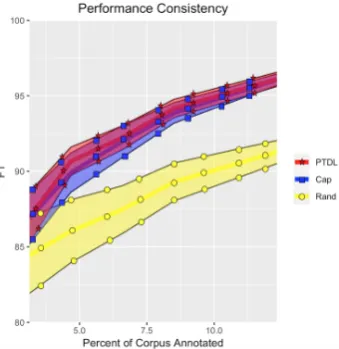
Because the active learning pipeline involves tak-ing a random seed and many of the experiments on larger corpora could not be averaged over several runs, we first measure performance variation as a function of ranking algorithm and quantity of an-notation. Figure3displays our findings on a sam-ple corpus of about 250K tokens3 in five diverse, pre-1920 prose genres extracted from the FranText corpus (www.frantext.fr) and annotated for
3
Figure 3:±1standard deviation bands around the mean performance of each sentence ranking algorithm using the CRF tagger over 100 inclusive evaluations on our FranText corpus.
geospatial entities. Our sample covers topics from gastronomy to travel, exhibiting inconsistent en-tity density characteristic of DH corpora.
Noise is much higher for the first few batches of annotation, particularly due to the low recall of data scarce models. Reluctant to generalize, they behave more like look-up tables extracted from the seed, exacerbating the effect of random seed variation. After about 20K tokens annotated or 10% of the corpus, performance becomes much more predictable. All algorithms start with about a 5 point spread for ±1 standard deviation, with means around 70 F, and all exhibit the diminishing variation trend, thoughRANDdoes less so. Unlike
CAP and PTDL, subsequent annotation batches in
RAND are not predictable from previous annota-tion batches. This results in a spread of 0.76 af-ter annotating 12.33% of the corpus, whereas the other algorithms are close to 0.4.
While we only tested variation on one corpus, multiple runs on other corpora tended to reflect the same diminishing variation trends despite marked differences in entity granularity, density or corpus size. Switching to the exclusive evaluation only minimally increases variation. It was not feasible to rigorously test variation using neural taggers, though we note that they are somewhat more prone to seed related noise which does not diminish as rapidly as it does for CRF with more annotation.
In terms of performance, random annotation re-quires one to label between 23% and 31% of the corpus to achieve the performance of PTDL after labeling just 12%. For this corpus, PTDLreduces
annotation time between 46% and 60%, requiring only 32K tokens from annotators instead of 60-80K.CAP’s competitiveness withPTDLis not sur-prising given that French uses the capitalization standards it is designed to exploit. Both algorithms achieve 15% error reduction aboveRANDafter the first post-seed annotation batch (left edge of Fig-ure3), increasing monotonically to 55% error re-duction after the fifth batch (right edge).
[image:6.595.328.508.221.549.2]4.2 Inclusive Versus Exclusive Evaluation
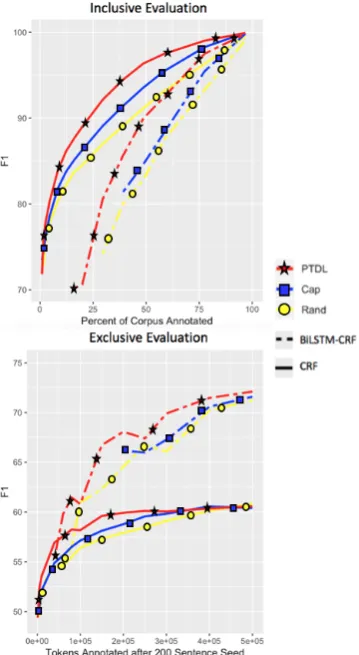
Figure 4: Comparing shallow and deep learning archi-tectures on inclusive and exclusive evaluations with the CoNLL Spanish corpus.
Using the Spanish CoNLL corpus (Tjong Kim Sang and De Meulder, 2003) with canoni-cal train, dev, test splits, we examine the relation-ship between evaluation framework,Ranker, and T agger in Figure 4.4 For the inclusive frame-work, Ranker selects sentences from train+dev for T agger to train on, and the performance is calculated over the combination of those
se-4Lample et al.(2016) achieve 85.75 F on the exclusive
lected sentences (trivially all correct) and trained T agger’s predictions on the rest of train+dev. By reporting results over a learning curve, this evalu-ation framework is meaningful to the user whose primary goal is to produce a finite annotated cor-pus as efficiently and accurately as possible, a frequent concern in DH. The standard exclusive framework also givesRankeraccess to train+dev sentences, but calculates accuracy fromT agger’s predictions on the held out test set. The exclu-sive framework is thus more meaningful for future users ofT agger who need the tool to generalize to sentences outside of train+dev.
In the inclusive framework, regardless of corpus size, BiLSTM-CRFs do not surpass CRFs until the accuracy is so high that the distinction is negligi-ble. Promoting overfitting by reducing dropout did not significantly affect this result. In the exclusive framework, BiLSTM-CRF surpasses CRF around 50K tokens annotated. This holds for all languages and corpora we investigate, suggesting quantity of data annotated is more predictive of exclusive per-formance trends, whereas proportion of the corpus annotated better predicts inclusive trends.
4.3 Typology, Granularity, and Corpus Size
We consider the effect of language typology, label scheme granularity, and corpus size on inclusive and exclusive evaluations of taggers and rankers.
4.3.1 Insights from German
We repeat our experiments from Section4.2on the German NER corpus, GermEval (Benikova et al.,
2014), to determine how robust our findings are to a larger corpus with finer label granularity and different capitalization standards. Our results in Figure 5 confirm many of our previous findings, with BiLSTM-CRFs overtaking CRFs of the same ranker after 50K tokens annotated on the exclu-sive evaluation. Shallow CRFs again dominate inclusively, and again, exclusive performance is less predictable, though the contribution of PTDL
is more obvious.
GermEval contains over 520K tokens to Span-ish CoNLL’s 321K, showing that deep models are not just slower to overtake shallow models in the inclusive evaluation, but they only asymptot-ically approach shallow performance.5 Further-more, the finer grained named entity distinctions
5Our evaluation is equivalent to metric 3 from the shared
[image:7.595.327.507.63.391.2]task (Benikova et al.,2014), though our results are not com-parable as we did not leverage nested labels.
Figure 5: A comparison of shallow and deep learn-ing architectures on inclusive and exclusive evaluations with the GermEval corpus.
in GermEval do not seem to affect our previ-ous findings, but do cause BiLSTM-CRF to start slowly, as the model does not begin training un-til all possible labels manifest in the training set. While this is merely an effect of programming choices, it provides interesting insights. For in-stance, BiLSTM-CRF CAP models consistently start later thanRANDwhich starts later thanPTDL, meaning that PTDL is doing well on the
diver-sity criteria, whereasCAPlikely struggles because it relies on English-like capitalization standards. Since German capitalizes all nouns,CAPstruggles
here, having to search through many capitalized OOVs before finding named entities of each cat-egory. By not considering uncapitalized OOVs as named entity candidates, it can systematically avoid entire labels which do not take capitaliza-tion, such as dates. Thus, while PTDL performs
4.3.2 Insights from Latin
Latin presents an opportunity to explore the im-pact of capitalization on ranking algorithms more thoroughly. Erdmann et al. (2016) selected their Latin corpus because English capitalization stan-dards had been imposed during digitization, mak-ingCAPmore likely to succeed. Figure6 demon-strates that it even marginally outperforms PTDL
on the corpus (left pane). However, capitaliz-ing proper nouns is not a native attribute of Latin orthography and is not available in all digitized manuscripts, limiting the Latin texts in whichCAP
will succeed. The right pane in Figure6 demon-strates this, as the same evaluation from the left pane is repeated on a lower cased version of the same corpus. The minuscule error reductionCAP
achieves over RAND in this environment is due
to its general preference for OOVs. Meanwhile, despite suffering from weaker named entity sig-nals without capitalization,PTDLstill manages to
robustly identify what non-capitalization features are relevant, maintaining 25% error reduction over
RAND. Finally, in German, where capitalization is
a weak signal of entity status, PTDL is similarly better equipped to incorporate the weak signal, re-ducing error twice as much asCAP. Interestingly, PTDL performance in the lower cased Latin cor-pus almost exactly matchesRANDperformance on the capitalized version. This suggests the benefits ofPTDL are comparable to the benefits of having English-like capitalization to mark entities.
4.3.3 Insights from Arabic
Unlike the other corpora, the news domain ANER Arabic corpus (Benajiba and Rosso, 2007) fea-tures rich templatic morphology, frequent lexical ambiguity, and an orthography lacking capitaliza-tion. Hence, not only will feature-based signals be more subtle, but the gazetteer-based pre-tagging component of PTDL will suffer from low
preci-sion, because Arabic is written in an abjad orthog-raphy where short vowels among other characters are seldom marked, making many words polyse-mous. Even so, PTDL significantly outperforms
RAND, likely due to its ability to shift reliance to contextual features better suited for newswire, where formulaic expressions are often used to re-fer to certain entity types.
WhilePTDLcompares well toRAND, it does not
approach 100% accuracy after annotating 50% of the corpus as in Section 4.3.2. Besides ambigu-ity and lack of capitalization, this could be due to
a typological bias in our “universal” feature set. Contiguous character n-grams, for example, will not capture non-concatenative subword phenom-ena. Going forward, we will investigate which feature sets were most useful as a function of lan-guage typology to identify gaps in our coverage.
4.4 Comparing to MNLP
Shen et al.(2017) and Lowell et al.(2018) eval-uate the purely uncertainty-based MNLP active NER system on English corpora, reporting starkly different results. We address discrepancies and test the robustness of their findings by comparing
MNLP to PTDL and RAND on the GermEval cor-pus. Results are displayed in Figure8, with shaded regions corresponding to the range of performance over multiple runs. To compare fairly, we use the same CNN-BiLSTM tagger for all rankers and iteratively update weights instead of re-training from scratch after each annotation batch, as in
Shen et al. (2017). We report results on our previously mentioned batch annotation schedule, though results were comparable using the batch schedule ofLowell et al.(2018).Shen et al.(2017) claim iterative updating does not affect accuracy significantly, though the best performing active CNN-BiLSTM in Figure 8 lags a few points be-hind the BiLSTM-CRF after 150K tokens anno-tated, with that gap reaching nearly 5 F when train-ing on the whole corpus. Meanwhile, a CNN-BiLSTM trained from scratch on the whole corpus scores only 1 F less than the BiLSTM-CRF.
While Lowell et al. (2018) report improve-ment over RAND using MNLP when training on 0-10% of the corpus, we see little improvement after about 2%, and even then, PTDL greatly
outperforms both. The relationship between the
PTDL curves in the exclusive evaluation shows that CNN-BiLSTM is actually the optimal tag-ging architecture for a brief window, overtaking CRF around 30K tokens and staying in front of BiLSTM-CRF until about 125K tokens.
5 Conclusion and Future Work
We have presented the HER toolkit and its novel
in-Figure 6: Percent error reduction overRANDin three corpora exhibiting typologically distinct capitalization stan-dards. Corpora are presented in descending order of the correlation of capitalization with named entity status.
Figure 7: Effect ofPTDLin the ANER Arabic corpus.
clusive evaluations, demonstrating that a shallow CRF tagger outperforms deep taggers on sen-tences which the active learner could have se-lected for training. The CRF’s tendency to over-fit is rewarded in this case, as the selected sen-tences are especially representative of the remain-ing sentences to be tagged. When taggremain-ing held out test sets, CRFs are only optimal until about 30K training tokens are acquired, then CNN-BiLSTMs are preferable until 125K tokens when BiLSTM-CRFs become the best high resourced tagger.
In future work, we will investigate sources of noise in performance to see if these are due to gaps in the model, idiosyncrasies of corpora, or both. Additionally, we will expandHERto model
hierarchically nested entity labels. Named entities are often difficult to label deterministically, invit-ing a problematic level of subjectivity, which is of crucial interest in DH and should not be over-simplified. We will consider strategies such as
Wang et al. (2018a)’s shift-reduced-based LSTM architecture orSohrab and Miwa(2018)’s method of modeling the contexts of overlapping potential named entity spans with bidirectional LSTM’s.
Figure 8: Inclusive and exclusive comparisons of the
MNLPandPTDLrankers on GermEval.
Acknowledgments
[image:9.595.85.279.249.395.2] [image:9.595.319.514.249.543.2]References
Rami Al-Rfou, Vivek Kulkarni, Bryan Perozzi, and Steven Skiena. 2015. Polyglot-NER: Massive mul-tilingual named entity recognition. InProceedings of the 2015 SIAM International Conference on Data Mining, pages 586–594. SIAM.
Yassine Benajiba and Paolo Rosso. 2007. Conquer-ing the NER task for the Arabic language by com-bining the maximum entropy with POS-tag infor-mation. In Proceedings of Workshop on Natural Language-Independant Engineering.
Darina Benikova, Chris Biemann, Max Kisselew, and Sebastian Pado. 2014. Germeval 2014 named entity recognition shared task: companion paper.
Akash Bharadwaj, David Mortensen, Chris Dyer, and Jaime Carbonell. 2016. Phonologically aware neu-ral model for named entity recognition in low re-source transfer settings. InProceedings of the 2016 Conference on Empirical Methods in Natural Lan-guage Processing, pages 1462–1472.
Julie Boeten. 2015. The Herodotos project (OSU-UGent): Studies in ancient ethnography. Barbarians in Strabos geography (Abii–Ionians) with a case-study: the Cappadocians. Master’s thesis, Gent Uni-versiteit.
Piotr Bojanowski, Edouard Grave, Armand Joulin, and Tomas Mikolov. 2017. Enriching word vectors with subword information. Transactions of the Associa-tion for ComputaAssocia-tional Linguistics, 5:135–146.
Ryan Cotterell and Kevin Duh. 2017. Low-resource named entity recognition with cross-lingual, character-level neural conditional random fields. In Proceedings of the Eighth International Joint Conference on Natural Language Processing (Volume 2: Short Papers), volume 2, pages 91–96.
James R Curran and Stephen Clark. 2003. Language independent NER using a maximum entropy tagger. InProceedings of the seventh Conference on Natural Language Learning at HLT-NAACL 2003-Volume 4, pages 164–167. Association for Computational Lin-guistics.
Alexander Erdmann, Christopher Brown, Brian Joseph, Mark Janse, Petra Ajaka, Micha Elsner, and Marie-Catherine de Marneffe. 2016. Challenges and solu-tions for Latin named entity recognition. In Pro-ceedings of the Workshop on Language Technol-ogy Resources and Tools for Digital Humanities (LT4DH), pages 85–93.
Jenny Rose Finkel, Trond Grenager, and Christopher Manning. 2005. Incorporating non-local informa-tion into informainforma-tion extracinforma-tion systems by Gibbs sampling. InProceedings of the 43rd annual meet-ing on Association for Computational Lmeet-inguistics, pages 363–370. Association for Computational Lin-guistics.
Edouard Grave, Piotr Bojanowski, Prakhar Gupta, Ar-mand Joulin, and Tomas Mikolov. 2018. Learning word vectors for 157 languages. In Proceedings of the International Conference on Language Re-sources and Evaluation (LREC 2018).
Claire Grover, Richard Tobin, Kate Byrne, Matthew Woollard, James Reid, Stuart Dunn, and Julian Ball. 2010. Use of the Edinburgh geoparser for georefer-encing digitized historical collections. Philosophi-cal Transactions of the Royal Society of London A: Mathematical, Physical and Engineering Sciences, 368(1925):3875–3889.
Yingjie Gu, Zhong Jin, and Steve C Chiu. 2014. Ac-tive learning combining uncertainty and diversity for multi-class image classification. IET Computer Vi-sion, 9(3):400–407.
Tianxu He, Shukui Zhang, Jie Xin, Pengpeng Zhao, Jian Wu, Xuefeng Xian, Chunhua Li, and Zhiming Cui. 2014. An active learning approach with uncer-tainty, representativeness, and diversity. The Scien-tific World Journal, 2014.
Nathalie Japkowicz. 2000. The class imbalance prob-lem: Significance and strategies. InProceedings of the Intl Conf. on Artificial Intelligence.
Kimmo Kettunen, Eetu M¨akel¨a, Teemu Ruokolainen, Juha Kuokkala, and Laura L¨ofberg. 2017. Old con-tent and modern tools–Searching named entities in a Finnish OCRed historical newspaper collection 1771-1910. DHQ: Digital Humanities Quarterly, 11(3).
John D Lafferty, Andrew McCallum, and Fernando CN Pereira. 2001. Conditional random fields: Prob-abilistic models for segmenting and labeling se-quence data. InProceedings of the Eighteenth In-ternational Conference on Machine Learning, pages 282–289. Morgan Kaufmann Publishers Inc.
Guillaume Lample, Miguel Ballesteros, Sandeep Sub-ramanian, Kazuya Kawakami, and Chris Dyer. 2016. Neural architectures for named entity recognition. InProceedings of NAACL-HLT, pages 260–270.
Lihong Li, Michael L Littman, and Thomas J Walsh. 2008. Knows what it knows: a framework for self-aware learning. InProceedings of the 25th Interna-tional Conference on Machine learning, pages 568– 575. ACM.
Bill Yuchen Lin and Wei Lu. 2018. Neural adaptation layers for cross-domain named entity recognition. In Proceedings of the 2018 Conference on Empiri-cal Methods in Natural Language Processing, pages 2012–2022.
Stephen Mayhew, Chen-Tse Tsai, and Dan Roth. 2017. Cheap translation for cross-lingual named entity recognition. InProceedings of the 2017 Conference on Empirical Methods in Natural Language Pro-cessing, pages 2536–2545.
Anke de Naegel. 2015. The Herodotos project (OSU-UGent): Studies in ancient ethnography. Barbarians in Strabos geography (Isseans–Zygi). with a case-study: the Britons. Master’s thesis, Gent Univer-siteit.
Toan Q Nguyen and David Chiang. 2017. Trans-fer learning across low-resource, related languages for neural machine translation. In Proceedings of the Eighth International Joint Conference on Natu-ral Language Processing (Volume 2: Short Papers), volume 2, pages 296–301.
Naoaki Okazaki. 2007. CRFsuite: a fast implementa-tion of condiimplementa-tional random fields.
Fredrik Olsson. 2009. A literature survey of active ma-chine learning in the context of natural language pro-cessing.
Nicholas Roy and Andrew McCallum. 2001. Toward optimal active learning through sampling estimation of error reduction. In Proceedings of the 18th In-ternational Conference on Machine Learning, 2001, pages 441–448.
Burr Settles and Mark Craven. 2008. An analysis of active learning strategies for sequence labeling tasks. InProceedings of the conference on Empiri-cal Methods in Natural Language Processing, pages 1070–1079. Association for Computational Linguis-tics.
Jingbo Shang, Liyuan Liu, Xiaotao Gu, Xiang Ren, Teng Ren, and Jiawei Han. 2018. Learning named entity tagger using domain-specific dictionary. In
Proceedings of the 2018 Conference on Empirical Methods in Natural Language Processing, pages 2054–2064.
Dan Shen, Jie Zhang, Jian Su, Guodong Zhou, and Chew-Lim Tan. 2004. Multi-criteria-based active learning for named entity recognition. In Proceed-ings of the 42nd Annual Meeting on Association for Computational Linguistics, page 589. Association for Computational Linguistics.
Yanyao Shen, Hyokun Yun, Zachary Lipton, Yakov Kronrod, and Animashree Anandkumar. 2017. Deep active learning for named entity recognition. InProceedings of the 2nd Workshop on Representa-tion Learning for NLP, pages 252–256.
Rainer Simon, Elton Barker, Leif Isaksen, and Pau de Soto Ca˜namares. 2017. Linked data annotation without the pointy brackets: Introducing Recogito 2.
Journal of Map & Geography Libraries, 13(1):111– 132.
Rainer Simon, Leif Isaksen, ETE Barker, and Pau de Soto Ca˜namares. 2016. The Pleiades gazetteer and the Pelagios project. In Placing Names: En-riching and Integrating Gazetteers, pages 97–109. Indiana University Press.
David A Smith and Gregory Crane. 2001. Disam-biguating geographic names in a historical digi-tal library. InInternational Conference on Theory and Practice of Digital Libraries, pages 127–136. Springer.
David A Smith, Jeffrey A Rydberg-Cox, and Gregory R Crane. 2000. The Perseus project: A digital library for the humanities. Literary and Linguistic Comput-ing, 15(1):15–25.
Mohammad Golam Sohrab and Makoto Miwa. 2018. Deep exhaustive model for nested named entity recognition. InProceedings of the 2018 Conference on Empirical Methods in Natural Language Pro-cessing, pages 2843–2849.
Rachele Sprugnoli. 2018. Arretium or Arezzo? a neu-ral approach to the identification of place names in historical texts. http://www. ceur-ws. org.
Erik F Tjong Kim Sang and Fien De Meulder. 2003. Introduction to the CoNLL-2003 shared task: Language-independent named entity recognition. In
Proceedings of the seventh Conference on Natural Language Learning at HLT-NAACL 2003-Volume 4, pages 142–147. Association for Computational Lin-guistics.
Seth Van Hooland, Max De Wilde, Ruben Verborgh, Thomas Steiner, and Rik Van de Walle. 2013. Ex-ploring entity recognition and disambiguation for cultural heritage collections. Digital Scholarship in the Humanities, 30(2):262–279.
Bailin Wang, Wei Lu, Yu Wang, and Hongxia Jin. 2018a. A neural transition-based model for nested mention recognition. In Proceedings of the 2018 Conference on Empirical Methods in Natural Lan-guage Processing, pages 1011–1017.
Zengmao Wang, Xi Fang, Xinyao Tang, and Chen Wu. 2018b. Multi-class active learning by integrating uncertainty and diversity. IEEE Access, 6:22794– 22803.
David Joseph Wrisley. 2017. Locating medieval French, or why we collect and visualize the geographic information of texts. Speculum, 92(S1):S145–S169.
Yi Yang, Zhigang Ma, Feiping Nie, Xiaojun Chang, and Alexander G Hauptmann. 2015. Multi-class ac-tive learning by uncertainty sampling with diversity maximization. International Journal of Computer Vision, 113(2):113–127.
Jingbo Zhu, Huizhen Wang, Tianshun Yao, and Ben-jamin K Tsou. 2008. Active learning with sam-pling by uncertainty and density for word sense dis-ambiguation and text classification. InProceedings of the 22nd International Conference on Computa-tional Linguistics-Volume 1, pages 1137–1144. As-sociation for Computational Linguistics.