3336
Investigating Robustness and Interpretability of Link Prediction
via Adversarial Modifications
Pouya Pezeshkpour University of California
Irvine, CA
Yifan Tian University of California
Irvine, CA
Sameer Singh University of California
Irvine, CA
Abstract
Representing entities and relations in an em-bedding space is a well-studied approach for machine learning on relational data. Existing approaches, however, primarily focus on im-proving accuracy and overlook other aspects such as robustness and interpretability. In this paper, we propose adversarial modifica-tions for link prediction models: identifying the fact to add into or remove from the knowl-edge graph that changes the prediction for a target fact after the model is retrained. Us-ing these sUs-ingle modifications of the graph, we identify the most influential fact for a pre-dicted link and evaluate the sensitivity of the model to the addition of fake facts. We in-troduce an efficient approach to estimate the effect of such modifications by approximating the change in the embeddings when the knowl-edge graph changes. To avoid the combinato-rial search over all possible facts, we train a network todecodeembeddings to their corre-sponding graph components, allowing the use of gradient-based optimization to identify the adversarial modification. We use these tech-niques to evaluate the robustness of link predic-tion models (by measuring sensitivity to addi-tional facts), study interpretability through the facts most responsible for predictions (by iden-tifying the most influential neighbors), and de-tect incorrect facts in the knowledge base. 1 Introduction
Knowledge graphs (KG) play a critical role in many real-world applications such as search, structured data management, recommendations, and question answering. Since KGs often suffer from incom-pleteness and noise in their facts (links), a number of recent techniques have proposed models that em-bedeach entity and relation into a vector space, and use these embeddings to predict facts. These dense representation models for link prediction include
tensor factorization [Nickel et al., 2011, Socher et al., 2013, Yang et al., 2015], algebraic opera-tions [Bordes et al.,2011,2013b,Dasgupta et al., 2018], multiple embeddings [Wang et al., 2014, Lin et al.,2015,Ji et al.,2015,Zhang et al.,2018], and complex neural models [Dettmers et al.,2018, Nguyen et al.,2018]. However, there are only a few studies [Kadlec et al.,2017,Sharma et al.,2018] that investigate the quality of the different KG mod-els. There is a need to go beyond just the accuracy on link prediction, and instead focus on whether these representations are robust and stable, and what facts they make use of for their predictions.
Ferdinand Maria
Princess Henriette
Violante Bavaria
isMarried
hasChild hasChild
target prediction
hs, r, oi
(a) KG, with the target prediction
Ferdinand Maria
Princess Henriette
Violante Bavaria
A.S.D. Astrea isMarried
hasChild 0hs
,
r
0,o
i
remo
v
ed
hasChild
(b) Afterremovinga fact
Ferdinand Maria
Princess Henriette
Violante Bavaria
New York
Al Jazira Club
isMarried
hasChild
playsFor
hs0, r0, oi
added
hasChild
[image:2.595.89.517.60.187.2](c) Afteraddinga fact
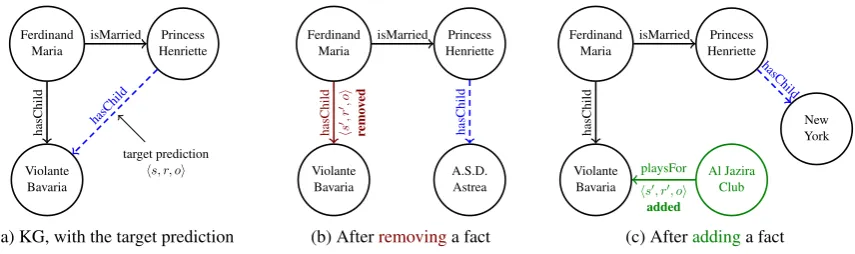
Figure 1: Completion Robustness and Interpretability via Adversarial Graph Edits (CRIAGE):Change in the graph structure that changes the prediction of theretrainedmodel, where (a) is the original sub-graph of the KG, (b) removes a neighboring link of the target, resulting in a change in the prediction, and (c) shows the effect of adding an attack triple on the target. These modifications were identified by our proposed approach.
et al.,2014,Zügner et al.,2018].
Since the setting is quite different from tradi-tional adversarial attacks, search for link prediction adversaries brings up unique challenges. To find these minimal changes for a target link, we need to identify the fact that, when added into or removed from the graph, will have the biggest impact on the predicted score of the target fact. Unfortunately, computing this change in the score is expensive since it involves retraining the model to recompute the embeddings. We propose an efficient estimate of this score change by approximating the change in the embeddings using Taylor expansion. The other challenge in identifying adversarial modifi-cations for link prediction, especially when con-sidering addition of fake facts, is the combinato-rial search space over possible facts, which is in-tractable to enumerate. We introduce aninverterof the original embedding model, todecodethe em-beddings to their corresponding graph components, making the search of facts tractable by performing efficient gradient-based continuous optimization.
We evaluate our proposed methods through fol-lowing experiments. First, on relatively small KGs, we show that our approximations are accurate com-pared to the true change in the score. Second, we show that our additive attacks can effectively reduce the performance of state of the art mod-els [Yang et al.,2015,Dettmers et al.,2018] up to
27.3%and 50.7%in Hits@1 for two large KGs: WN18 and YAGO3-10. We also explore the util-ity of adversarial modifications in explaining the model predictions by presenting rule-like descrip-tions of the most influential neighbors. Finally, we use adversaries to detect errors in the KG, obtaining up to55%accuracy in detecting errors.
2 Background and Notation
In this section, we briefly introduce some notations, and existing relational embedding approaches that model knowledge graph completion using dense vectors. In KGs, facts are represented using triples of subject, relation, and object, hs, r, oi, where s, o ∈ ξ, the set of entities, andr ∈ R, the set of relations. To model the KG, a scoring function ψ:ξ× R ×ξ→Ris learned to evaluate whether any given fact is true. In this work, we focus on multiplicativemodels of link prediction1, specifi-cally DistMult [Yang et al., 2015] because of its simplicity and popularity, and ConvE [Dettmers et al.,2018] because of its high accuracy. We can represent the scoring function of such methods as ψ(s, r, o) =f(es,er)·eo, wherees,er,eo ∈Rd
are embeddings of the subject, relation, and object respectively. In DistMult, f(es,er) = es er,
whereis element-wise multiplication operator. Similarly, in ConvE,f(es,er) is computed by a
convolution on the concatenation ofesander.
We use the same setup asDettmers et al.[2018] for training, i.e., incorporate binary cross-entropy loss over the triple scores. In particular, for subject-relation pairs (s, r) in the training data G, we use binaryys,ro to represent negative and positive
facts. Using the model’s probability of truth as σ(ψ(s, r, o))forhs, r, oi, the loss is defined as:
L(G) =X
(s,r)
X
o
yos,rlog(σ(ψ(s, r, o)))
+ (1−ys,ro ) log(1−σ(ψ(s, r, o))). (1)
Gradient descent is used to learn the embeddings
es,er,eo, and the parameters off, if any.
1As opposed to
3 Completion Robustness and
Interpretability via Adversarial Graph Edits (CRIAGE)
For adversarial modifications on KGs, we first de-fine the space of possible modifications. For a tar-get triplehs, r, oi, we constrain the possible triples that we can remove (or inject) to be in the form ofhs0, r0, oii.es0 andr0may be different from the target, but the object is not. We analyze other forms of modifications such ashs, r0, o0iandhs, r0, oiin appendicesA.1andA.2, and leave empirical evalu-ation of these modificevalu-ations for future work.
3.1 Removing a fact (CRIAGE-Remove)
For explaining a target prediction, we are inter-ested in identifying the observed fact that has the most influence (according to the model) on the pre-diction. We defineinfluenceof an observed fact on the prediction as the change in the prediction score if the observed fact was not present when the embeddings were learned. Previous work have used this concept of influence similarly for sev-eral different tasks [Kononenko et al.,2010,Koh and Liang, 2017]. Formally, for the target triple
hs, r, oiand observed graphG, we want to identify a neighboring triplehs0, r0, oi ∈ Gsuch that the scoreψ(s, r, o)when trained onGand the score ψ(s, r, o)when trained onG−{hs0, r0, oi}are max-imally different, i.e.
argmax
(s0,r0)∈Nei(o)
∆(s0,r0)(s, r, o) (2)
where∆(s0,r0)(s, r, o) =ψ(s, r, o)−ψ(s, r, o), and
Nei(o) ={(s0, r0)|hs0, r0, oi ∈G}.
3.2 Adding a new fact (CRIAGE-Add)
We are also interested in investigating the robust-ness of models, i.e., how sensitive are the predic-tions to small addipredic-tions to the knowledge graph. Specifically, for a target prediction hs, r, oi, we are interested in identifying a single fake fact
hs0, r0, oithat, when added to the knowledge graph G, changes the prediction scoreψ(s, r, o)the most. Using ψ(s, r, o) as the score after training on G∪ {hs0, r0, oi}, we define the adversary as:
argmax
(s0,r0)
∆(s0,r0)(s, r, o) (3)
where ∆(s0,r0)(s, r, o) = ψ(s, r, o) − ψ(s, r, o).
The search here is over any possibles0 ∈ξ, which is often in the millions for most real-world KGs,
and r0 ∈ R. We also identify adversaries that increase the prediction score for specific false triple, i.e., for a target fake fact hs, r, oi, the ad-versary is argmax(s0,r0)−∆(s0,r0)(s, r, o), where ∆(s0,r0)(s, r, o)is defined as before.
3.3 Challenges
There are a number of crucial challenges when con-ducting such adversarial attack on KGs. First, eval-uating the effect of changing the KG on the score of the target fact (ψ(s, r, o)) is expensive since we need to update the embeddings by retraining the model on the new graph; a very time-consuming process that is at least linear in the size ofG. Sec-ond, since there are many candidate facts that can be added to the knowledge graph, identifying the most promising adversary through search-based methods is also expensive. Specifically, the search size for unobserved facts is|ξ| × |R|, which, for ex-ample in YAGO3-10 KG, can be as many as4.5M possible facts for a single target prediction.
4 Efficiently Identifying the Modification
In this section, we propose algorithms to address mentioned challenges by (1) approximating the ef-fect of changing the graph on a target prediction, and (2) using continuous optimization for the dis-crete search over potential modifications.
4.1 First-order Approximation of Influence
We first study the addition of a fact to the graph, and then extend it to cover removal as well. To capture the effect of an adversarial modifi-cation on the score of a target triple, we need to study the effect of the change on the vector representations of the target triple. We use es,
er, and eo to denote the embeddings of s, r, o
at the solution of argminL(G), and when con-sidering the adversarial triple hs0, r0, oi, we use
es, er, andeo for the new embeddings ofs, r, o,
respectively. Thus es,er,eo is a solution to argminL(G ∪ {hs0, r0, oi}), which can also be written asargminL(G) +L(hs0, r0, oi). Similarly,
f(es,er)changes tof(es,er)after retraining.
Since we only consider adversaries in the form ofhs0, r0, oi, we only consider the effect of the at-tack oneoand neglect its effect onesander. This
effect oneo. Further, calculating the effect of the
attack onesanderrequires a third order derivative
of the loss, which is not practical (O(n3) in the number of parameters). In other words, we assume thates'esander 'er. As a result, to calculate
the effect of the attack,ψ(s, r, o)−ψ(s, r, o), we need to computeeo−eo, followed by:
ψ(s, r, o)−ψ(s, r, o) =zs,r(eo−eo) (4)
wherezs,r =f(es,er). We now derive an efficient
computation foreo−eo. First, the derivative of the
lossL(G) =L(G) +L(hs0, r0, oi)overeois:
∇eoL(G) =∇eoL(G)−(1−ϕ)zs0,r0 (5)
wherezs0,r0 = f(e0s,er0), andϕ= σ(ψ(s0, r0, o)).
At convergence, after retraining, we expect
∇eoL(G) = 0. We perform first order Taylor
ap-proximation of∇eoL(G)to get:
0' −(1−ϕ)z|s0,r0+
(Ho+ϕ(1−ϕ)z|s0,r0zs0,r0)(eo−eo) (6)
whereHois thed×dHessian matrix foro, i.e.,
sec-ond order derivative of the loss w.r.t.eo, computed
sparsely. Solving foreo−eogives us,eo−eo=:
(1−ϕ)(Ho+ϕ(1−ϕ)z|s0,r0zs0,r0)−1z| s0,r0.
In practice,Ho is positive definite, makingHo+
ϕ(1−ϕ)z|s0,r0zs0,r0 positive definite as well, and
invertible. Then, we compute the score change as:
ψ(s, r, o)−ψ(s, r, o) =zs,r(eo−eo) (7)
=zs,r((1−ϕ)(Ho+ϕ(1−ϕ)z|s0,r0zs0,r0)−1z| s0,r0).
Calculating this expression is efficient sinceHois
ad×dmatrix (dis the embedding dimension), and
zs,r,zs0,r0 ∈Rd. Similarly, we estimate the score
change ofhs, r, oiafterremovinghs0, r0, oias:
−zs,r((1−ϕ)(Ho+ϕ(1−ϕ)z|s0,r0zs0,r0)−1z| s0,r0).
4.2 Continuous Optimization for Search
Using the approximations provided in the previous section, Eq. (7) and (4.1), we can use brute force enumeration to find the adversaryhs0, r0, oi. This approach is feasible when removing an observed triple since the search space of such modifications is usually small; it is the number of observed facts that share the object with the target. On the other hand, finding the most influential unobserved fact
s es
r
er
f(es,er) (Fixed)
zs,r
Inverter Network
˜ s ˜ es
˜ r
[image:4.595.309.521.66.192.2]˜er
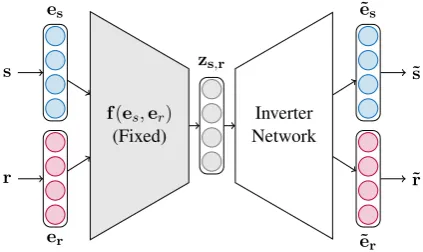
Figure 2:Inverter NetworkThe architecture of our in-verter function that translatezs,rto its respective(˜s,r˜).
The encoder component is fixed to be the encoder net-work of DistMult and ConvE respectively.
to add requires search over a much larger space of all possible unobserved facts (that share the object). Instead, we identify the most influential unobserved facths0, r0, oiby using a gradient-based algorithm on vectorzs0,r0 in the embedding space (reminder,
zs0,r0 =f(e0s,e0r)), solving the following
continu-ous optimization problem inRd:
argmax zs0,r0
∆(s0,r0)(s, r, o). (8)
After identifying the optimalzs0,r0, we still need
to generate the pair(s0, r0). We design a network, shown in Figure2, that maps the vectorzs0,r0to the
entity-relation space, i.e., translating it into(s0, r0). In particular, we train an auto-encoder where the encoder is fixed to receive thesandras one-hot inputs, and calculateszs,rin the same way as the
DistMult and ConvE encoders respectively (using trained embeddings). The decoder is trained to take
zs,ras input and producesandr, essentially
invert-ingfand the embedding layers. As our decoder, for DistMult, we passzs,r through a linear layer and
then use two other linear layers for the subject and the relation separately, providing one-hot vectors as
˜
sandr˜. For ConvE, we passzs,r through a
decon-volutional layer, and then use the same architecture as the DistMult decoder. Although we could use maximum inner-product search [Shrivastava and Li, 2014] for DistMult instead of our defined inverter function, we are looking for a general approach that works across multiple models.
We evaluate the performance of our inverter net-works (one for each model/dataset) on correctly recovering the pairs of subject and relation from the test set of our benchmarks, given thezs,r. The
WordNet YAGO
DistMult ConvE DistMult ConvE
Recovers 93.4 96.1 97.2 98.1
Recoverr 91.3 95.3 99.0 99.6
[image:5.595.75.289.63.125.2]Recover{s, r} 89.5 94.2 96.4 98.0
Table 1: Inverter Functions Accuracy, we calculate the accuracy of our inverter networks in correctly re-covering the pairs of subject and relation from the test set of our benchmarks.
# Rels #Entities # Train #Test
Nations 56 14 1592 200
Kinship 26 104 4,006 155
WN18 18 40,943 141,442 5000
YAGO3-10 37 123,170 1,079,040 5000
Table 2:Data Statisticsof the benchmarks.
is given in Table1. As shown, our networks achieve a very high accuracy, demonstrating their ability to invert vectorszs,rto{s, r}pairs.
5 Experiment Setup
Datasets To evaluate our method, we conduct several experiments on four widely used KGs. To validate the accuracy of the approximations, we use smaller sized Kinship and Nations KGs for which we can make comparisons against more expensive but less approximate approaches. For the remain-ing experiments, we use YAGO3-10 and WN18 KGs, which are closer to real-world KGs in their size and characteristics (see Table2).
Models We implement all methods using the same loss and optimization for training, i.e., Ada-Grad and the binary cross-entropy loss. We use validation data to tune the hyperparameters and use a grid search to find the best hyperparameters, such as regularization parameter, and learning rate of the gradient-based method. To capture the effect of our method on link prediction task, we study the change in commonly-used metrics for evalua-tion in this task: mean reciprocal rank (MRR) and Hits@K. Further, we use the same hyperparame-ters as inDettmers et al.[2018] for training link prediction models for these knowledge graphs.
Influence Function We also compare our method with influence function (IF) [Koh and Liang,2017]. The influence function approximates the effect of upweighting a training sample on the loss for a specific test point. We use IF to approximate the
20 40 60 80 100
Number of entities
0 200 400 600 800 1000 1200 1400 1600
Time (s)
IF (d=5)
IF (d=10)
CRIAGE (d=5)
CRIAGE (d=10)
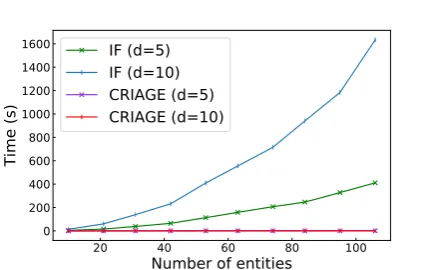
Figure 3:Influence function vs CRIAGE. We plot the average time (over10facts) of influence function (IF) and CRIAGE to identify an adversary as the number of entities in the Kinship KG is varied (by randomly sam-pling subgraphs of the KG). Even with small graphs and dimensionality, IF quickly becomes impractical. change in the loss after removing a triple as:
Iup,loss(hs0, r0, oi,hs, r, oi) =
−∇θL(hs, r, oi,θˆ)|H−1ˆ
θ ∇θL(hs
0, r0, oi,θˆ) (9)
wherehs0, r0, oiandhs, r, oiare training and test samples respectively,θˆrepresents the optimum pa-rameters andL(hs, r, oi,θˆ)represents the loss func-tion for the test sample hs, r, oi. Influence func-tion does not scale well, so we only compare our method with IF on the smaller size KGs.
6 Experiments
We evaluate CRIAGE by (6.1) comparing CRIAGE estimate with the actual effect of the attacks, (6.2) studying the effect of adversarial attacks on evaluation metrics, (6.3) exploring its application to the interpretability of KG representations, and (6.4) detecting incorrect triples.
6.1 Influence Function vs CRIAGE
[image:5.595.308.526.64.199.2]Methods
Nations Kinship
Adding Removing Adding Removing
ρ τ ρ τ ρ τ ρ τ
[image:6.595.84.515.65.181.2]Ranking Based on Score 0.03 0.02 -0.01 -0.01 -0.09 -0.06 0.01 0.01 Influence Function without Hessian 0.15 0.12 0.12 0.1 0.77 0.71 0.77 0.71 CRIAGE (Brute Force) 0.95 0.84 0.94 0.85 0.99 0.97 0.99 0.95 Influence Function 0.99 0.95 0.99 0.96 0.99 0.98 0.99 0.98
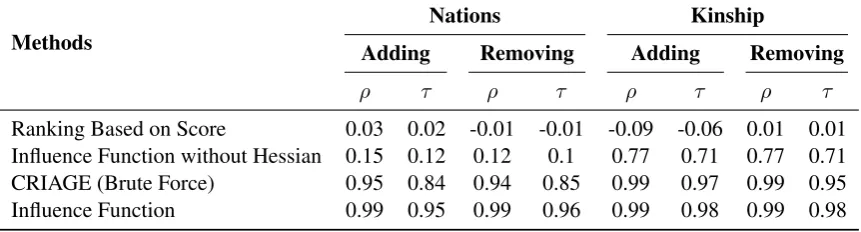
Table 3:Ranking modifications by their impact on the target. We compare thetrueranking of candidate triples with a number of approximations using ranking correlation coefficients. We compare our method with influence function (IF) with and without Hessian, and ranking the candidates based on their score, on two KGs (d = 10, averaged over 10 random targets). For the sake of brevity, we represent the Spearman’sρand Kendall’sτ rank correlation coefficients simply asρandτ.
the largest impact when removed). Similarly, we evaluate CRIAGE-Add by considering200random triples that share the object entity with the target sample as candidates, and rank them as above.
The average results of Spearman’s ρ and Kendall’sτ rank correlation coefficients over 10 random target samples is provided in Table 3. CRIAGE performs comparably to the influence function, confirming that our approximation is ac-curate. Influence function is slightly more accurate because they use the complete Hessian matrix over all the parameters, while we only approximate the change by calculating the Hessian over eo. The
effect of this difference on scalability is dramatic, constraining IF to very small graphs and small em-bedding dimensionality (d ≤ 10) before we run out of memory. In Figure 3, we show the time to compute a single adversary by IF compared to CRIAGE, as we steadily grow the number of enti-ties (randomly chosen subgraphs), averaged over 10 random triples. As it shows, CRIAGE is mostly unaffected by the number of entities while IF in-creases quadratically. Considering that real-world KGs have tens of thousands of times more entities, making IF unfeasible for them.
6.2 Robustness of Link Prediction Models
Now we evaluate the effectiveness of CRIAGE to successfullyattacklink prediction by adding false facts. The goal here is to identify the attacks for triples in the test data, and measuring their effect on MRR and Hits@ metrics (ranking evaluations) after conducting the attack and retraining the model.
Since this is the first work on adversarial attacks for link prediction, we introduce several baselines to compare against our method. For finding the
adversarial fact to add for the target triplehs, r, oi, we consider two baselines: 1) choosing a random fake facths0, r0, oi(Random Attack); 2) finding
(s0, r0)by first calculatingf(es,er)and then
feed-ing−f(es,er)to the decoder of the inverter
func-tion (Opposite Attack). In addition to CRIAGE-Add, we introduce two other alternatives of our method: (1)CRIAGE-FT, that uses CRIAGE to increase the score of fake fact over a test triple, i.e., we find the fake fact the model ranks second after the test triple, and identify the adversary for them, and (2)CRIAGE-Bestthat selects between CRIAGE-Add and CRIAGE-FT attacks based on which has a higher estimated change in score.
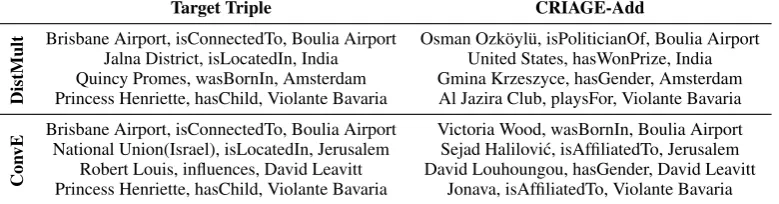
All-Test The result of the attack on all test facts as targets is provided in the Table 4. CRIAGE-Add outperforms the baselines, demonstrating its ability to effectively attack the KG representations. It seems DistMult is more robust against random attacks, while ConvE is more robust against de-signed attacks. CRIAGE-FT is more effective than CRIAGE-Add since changing the score of a fake fact is easier than of actual facts; there is no ex-isting evidence to support fake facts. We also see that YAGO3-10 models are more robust than those for WN18. Looking at sample attacks (provided in AppendixA.4), CRIAGE mostly tries to change thetypeof the target object by associating it with a subject and a relation for a different entity type.
Models
YAGO3-10 WN18
All-Test Uncertain-Test All-Test Uncertain-Test
MRR Hits@1 MRR Hits@1 MRR Hits@1 MRR Hits@1
DistMult
DistMult 0.458 37(0) 1.0 100(0) 0.938 93.1(0) 1.0 100(0)
+ Adding Random Attack 0.442 34.9(-2.1) 0.91 87.6(-12.4) 0.926 91.1(-2) 0.929 90.4(-9.6)
+ Adding Opposite Attack 0.427 33.2(-3.8) 0.884 84.1(-15.9) 0.906 87.3(-5.8) 0.921 91(-9)
+ CRIAGE-Add 0.379 29.1(-7.9) 0.71 58(-42) 0.89 86.4(-6.7) 0.844 81.2(-18.8)
+ CRIAGE-FT 0.387 27.7(-9.3) 0.673 50.5(-49.5) 0.86 79.2(-13.9) 0.83 74.5(-25.5)
+ CRIAGE-Best 0.372 26.9(-10.1) 0.658 49.3(-50.7) 0.838 77.9(-15.2) 0.814 72.7(-27.3)
Con
vE
ConvE 0.497 41.2(0) 1.0 100(0) 0.94 93.3(0) 1.0 100(0)
+ Adding Random Attack 0.474 38.4(-2.8) 0.889 83(-17) 0.921 90.1(-3.2) 0.923 89.7(-10.3)
+ Adding Opposite Attack 0.469 38(-3.2) 0.874 81.9(-18.1) 0.915 88.9(-4.4) 0.908 88.1(-11.9)
+ CRIAGE-Add 0.454 36.9(-4.3) 0.738 61.5(-38.5) 0.897 87.8(-5.5) 0.895 87.6(-12.4)
+ CRIAGE-FT 0.441 33.2(-8) 0.703 57.4(-42.6) 0.865 80(-13.3) 0.874 79.5(-20.5)
[image:7.595.75.527.63.239.2]+ CRIAGE-Best 0.423 31.9(-9.3) 0.677 54.8(-45.2) 0.849 79.1(-14.2) 0.858 78.4(-21.6)
Table 4: Robustness of Representation Models, the effect of adversarial attack on link prediction task. We consider two scenario for the target triples, 1) choosing the whole test dataset as the targets (All-Test) and 2) choosing a subset of test data that models are uncertain about them (Uncertain-Test).
0 1 2 3 4 5 6 7 8
Change in Hits@1 isAffiliatedTo
playsFor
isConnectedTo
isMarriedTo
4.50 3.30
7.20 5.80
0.70
4.60
6.90 6.40 Hits@1 Change in Per-Relation Breakdown
[image:7.595.74.285.309.454.2]DistMult ConvE
Figure 4: Per-Relation Breakdown showing the effect of CRIAGE-Add on different relations in YAGO3-10.
test sets, and we provide results of attacks on this data in Table4. The attacks are much more effec-tive in this scenario, causing a considerable drop in the metrics. Further, in addition to CRIAGE signifi-cantly outperforming other baselines, they indicate that ConvE’s confidence is much more robust.
Relation Breakdown We perform additional anal-ysis on the YAGO3-10 dataset to gain a deeper understanding of the performance of our model. As shown in Figure4, both DistMult and ConvE provide a more robust representation for isAffili-atedToandisConnectedTorelations, demonstrat-ing the confidence of models in identifydemonstrat-ing them. Moreover, the CRIAGE affects DistMult more in playsForandisMarriedTorelations while affecting ConvE more inisConnectedTorelations.
Rule Body,R1(a, c)∧R2(c, b)⇒ Target,R(a, b)
Common to both
isConnectedTo(a, c)∧isConnectedTo(c, b) isConnectedTo
isLocatedIn(a, c)∧isLocatedIn(c, b) isLocatedIn
isAffiliatedTo(a, c)∧isLocatedIn(c, b) wasBornIn
isMarriedTo(a, c)∧hasChild(c, b) hasChild
only in DistMult
playsFor(a, c)∧isLocatedIn(c, b) wasBornIn
dealsWith(a, c)∧participatedIn(c, b) participatedIn
isAffiliatedTo(a, c)∧isLocatedIn(c, b) diedIn
isLocatedIn(a, c)∧hasCapital(c, b) isLocatedIn
only in ConvE
influences(a, c)∧influences(c, b) influences
isLocatedIn(a, c)∧hasNeighbor(c, b) isLocatedIn
hasCapital(a, c)∧isLocatedIn(c, b) exports
hasAdvisor(a, c)∧graduatedFrom(c, b) graduatedFrom
Extractions from DistMult [Yang et al.,2015]
isLocatedIn(a, c)∧isLocatedIn(c, b) isLocatedIn
isAffiliatedTo(a, c)∧isLocatedIn(c, b) wasBornIn
playsFor(a, c)∧isLocatedIn(c, b) wasBornIn
isAffiliatedTo(a, c)∧isLocatedIn(c, b) diedIn
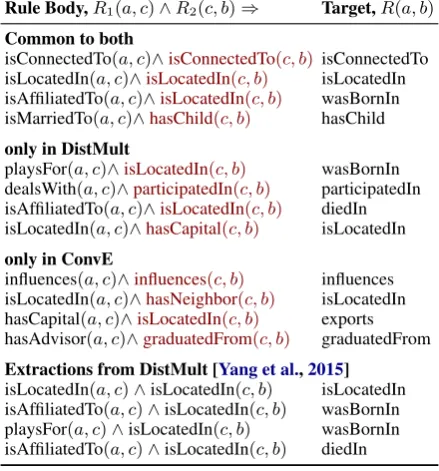
Table 5: Extracted Rulesfor identifying the most in-fluential link. We extract the patterns that appear more than90%times in the neighborhood of the target triple. The output of CRIAGE-Remove is presented inred.
6.3 Interpretability of Models
[image:7.595.307.527.311.547.2]Methods hs 0
, r0, oiNoise hs0, r, oiNoise
Hits@1 Hits@2 Hits@1 Hits@2
Random 19.7 39.4 19.7 39.4
Lowest 16 37 26 47
CRIAGE 42 62 55 76
Table 6: Error Detection Accuracyin the neighbor-hood of 100 chosen samples. We choose the neighbor with the least value of∆(s0,r0)(s, r, o)as the incorrect
fact. This experiment assumes we know each target fact has exactly one error.
find simple patterns on subgraphs that surround the target triple and the removed fact from CRIAGE-Remove, and appear more than90%of the time. We only focus on extracting length-2 horn rules, i.e.,R1(a, c)∧R2(c, b)⇒R(a, b), whereR(a, b) is the target andR2(c, b)is the removed fact.
Table5shows extracted YAGO3-10 rules that are common to both models, and ones that are not. The rules show several interesting inferences, such thathasChildis often inferred via married parents, andisLocatedInvia transitivity. There are several differences in how the models reason as well; Dist-Mult often uses the hasCapital as an intermedi-ate step forisLocatedIn, while ConvEincorrectly usesisNeighbor. We also compare against rules extracted byYang et al.[2015] for YAGO3-10 that utilizes the structure of DistMult: they require do-main knowledge on types and cannot be applied to ConvE. Interestingly, the extracted rules contain all the rules provided by CRIAGE, demonstrating that CRIAGE can be used to accurately interpret mod-els, including ones that are not interpretable, such as ConvE. These are preliminary steps toward inter-pretability of link prediction models, and we leave more analysis of interpretability to future work.
6.4 Finding Errors in Knowledge Graphs
Here, we demonstrate another potential use of ad-versarial modifications: finding erroneous triples in the knowledge graph. Intuitively, if there is an error in the graph, the triple is likely to be inconsistent with its neighborhood, and thus the model should put least trust on this triple. In other words, the error triple should have the least influence on the model’s prediction of the training data. Formally, to find the incorrect triple hs0, r0, oi in the neigh-borhood of the train triplehs, r, oi, we need to find the triplehs0, r0, oithat results in theleastchange
∆(s0,r0)(s, r, o)when removed from the graph.
To evaluate this application, we inject random
triples into the graph, and measure the ability of CRIAGE to detect the errors using our optimiza-tion. We consider two types of incorrect triples: 1) incorrect triples in the form ofhs0, r, oiwheres0 is chosen randomly from all of the entities, and 2) in-correct triples in the form ofhs0, r0, oiwheres0and r0 are chosen randomly. We choose100random triples from the observed graph, and for each of them, add an incorrect triple (in each of the two sce-narios) to its neighborhood. Then, after retraining DistMult on this noisy training data, we identify error triples through a search over the neighbors of the100facts. The result of choosing the neighbor with the least influence on the target is provided in the Table6. When compared with baselines that randomly choose one of the neighbors, or assume that the fact with the lowest score is incorrect, we see that CRIAGE outperforms both of these with a considerable gap, obtaining an accuracy of42%
and55%in detecting errors.
7 Related Work
Learning relational knowledge representations has been a focus of active research in the past few years, but to the best of our knowledge, this is the first work on conducting adversarial modifications on the link prediction task.
Knowledge graph embedding There is a rich lit-erature on representing knowledge graphs in vector spaces that differ in their scoring functions [Wang et al.,2017,Goyal and Ferrara,2018,Fooshee et al., 2018]. Although CRIAGE is primarily applicable to multiplicative scoring functions [Nickel et al., 2011,Socher et al.,2013,Yang et al.,2015, Trouil-lon et al.,2016], these ideas apply to additive scor-ing functions [Bordes et al., 2013a, Wang et al., 2014,Lin et al.,2015,Nguyen et al.,2016] as well, as we show in AppendixA.3.
Furthermore, there is a growing body of litera-ture that incorporates an extra types of evidence for more informed embeddings such as numeri-cal values [Garcia-Duran and Niepert,2017], im-ages [Oñoro-Rubio et al.,2017], text [Toutanova et al.,2015,2016,Tu et al.,2017], and their combi-nations [Pezeshkpour et al.,2018]. Using CRIAGE, we can gain a deeper understanding of these meth-ods, especially those that build their embeddings wit hmultiplicative scoring functions.
learning models [Biggio et al., 2014, Papernot et al.,2016,Dong et al.,2017,Zhao et al.,2018a,b, Brunet et al., 2018] to attain the interpretability, and further, evaluate the robustness of those mod-els.Koh and Liang[2017] uses influence function to provide an approach to understanding black-box models by studying the changes in the loss occur-ring as a result of changes in the training data. In addition to incorporating their established method on KGs, we derive a novel approach that differs from their procedure in two ways: (1) instead of changes in the loss, we consider the changes in the scoring function, which is more appropriate for KG representations, and (2) in addition to searching for an attack, we introduce a gradient-based method that is much faster, especially for “adding an attack triple” (the size of search space make the influence function method infeasible). Previous work has also considered adversaries for KGs, but as part of training to improve their representation of the graph [Minervini et al.,2017,Cai and Wang,2018].
Adversarial Attack on KG Although this is the first work on adversarial attacks for link prediction, there are two approaches [Dai et al.,2018,Zügner et al., 2018] that consider the task of adversarial attack on graphs. There are a few fundamental dif-ferences from our work: (1) they build their method on top of a path-based representations while we fo-cus on embeddings, (2) they consider node classifi-cation as the target of their attacks while we attack link prediction, and (3) they conduct the attack on small graphs due to restricted scalability, while the complexity of our method does not depend on the size of the graph, but only the neighborhood, allowing us to attack real-world graphs.
8 Conclusions
Motivated by the need to analyze the robustness and interpretability of link prediction models, we present a novel approach for conducting adversarial modifications to knowledge graphs. We introduce CRIAGE, completion robustness and interpretabil-ity via adversarial graph edits: identifying the fact to add into or remove from the KG that changes the prediction for a target fact. CRIAGE uses (1) an es-timate of the score change for any target triple after adding or removing another fact, and (2) a gradient-based algorithm for identifying the most influential modification. We show that CRIAGE can effec-tively reduce ranking metrics on link prediction models upon applying the attack triples. Further,
we incorporate the CRIAGE to study the inter-pretability of KG representations by summarizing the most influential facts for each relation. Finally, using CRIAGE, we introduce a novel automated error detection method for knowledge graphs. We have release the open-source implementation of our models at:https://pouyapez.github.io/criage.
Acknowledgements
We would like to thank Matt Gardner, Marco Tulio Ribeiro, Zhengli Zhao, Robert L. Logan IV, Dheeru Dua and the anonymous reviewers for their detailed feedback and suggestions. This work is supported in part by Allen Institute for Artificial Intelligence (AI2) and in part by NSF awards #IIS-1817183 and #IIS-1756023. The views expressed are those of the authors and do not reflect the official policy or position of the funding agencies.
References
Battista Biggio, Blaine Nelson, and Pavel Laskov. Poisoning attacks against support vector machines. In International Conference on Machine Learning (ICML), 2012.
Battista Biggio, Giorgio Fumera, and Fabio Roli. Se-curity evaluation of pattern classifiers under attack.
IEEE transactions on knowledge and data engineer-ing, 2014.
Antoine Bordes, Jason Weston, Ronan Collobert, Yoshua Bengio, et al. Learning structured embed-dings of knowledge bases. InAAAI Conference on Artificial Intelligence, 2011.
Antoine Bordes, Nicolas Usunier, Alberto Garcia-Duran, Jason Weston, and Oksana Yakhnenko. Translating embeddings for modeling multi-relational data. In Neural Information Processing Systems (NeurIPS), 2013a.
Antoine Bordes, Nicolas Usunier, Alberto Garcia-Duran, Jason Weston, and Oksana Yakhnenko. Translating embeddings for modeling multi-relational data. In Neural Information Processing Systems (NeurIPS), 2013b.
Marc-Etienne Brunet, Colleen Alkalay-Houlihan, Ash-ton Anderson, and Richard Zemel. Understand-ing the origins of bias in word embeddUnderstand-ings. arXiv preprint arXiv:1810.03611, 2018.
Liwei Cai and William Yang Wang. Kbgan: Adversar-ial learning for knowledge graph embeddings. In
Igino Corona, Giorgio Giacinto, and Fabio Roli. Ad-versarial attacks against intrusion detection systems: Taxonomy, solutions and open issues. Information Sciences, 2013.
Hanjun Dai, Hui Li, Tian Tian, Xin Huang, Lin Wang, Jun Zhu, and Le Song. Adversarial attack on graph structured data. InInternational Conference on Ma-chine Learning (ICML), 2018.
Shib Sankar Dasgupta, Swayambhu Nath Ray, and Partha Talukdar. Hyte: Hyperplane-based tempo-rally aware knowledge graph embedding. In Em-pirical Methods in Natural Language Processing (EMNLP), 2018.
Tim Dettmers, Pasquale Minervini, Pontus Stenetorp, and Sebastian Riedel. Convolutional 2d knowledge graph embeddings. AAAI Conference on Artificial Intelligence, 2018.
Yinpeng Dong, Hang Su, Jun Zhu, and Fan Bao. Towards interpretable deep neural networks by leveraging adversarial examples. arXiv preprint arXiv:1708.05493, 2017.
David Fooshee, Aaron Mood, Eugene Gutman, Mo-hammadamin Tavakoli, Gregor Urban, Frances Liu, Nancy Huynh, David Van Vranken, and Pierre Baldi. Deep learning for chemical reaction predic-tion. Molecular Systems Design & Engineering, 2018.
Alberto Garcia-Duran and Mathias Niepert. Kblrn: End-to-end learning of knowledge base representa-tions with latent, relational, and numerical features.
arXiv preprint arXiv:1709.04676, 2017.
Palash Goyal and Emilio Ferrara. Graph embedding techniques, applications, and performance: A sur-vey.Knowledge-Based Systems, 2018.
Guoliang Ji, Shizhu He, Liheng Xu, Kang Liu, and Jun Zhao. Knowledge graph embedding via dynamic mapping matrix. In Annual Meeting of the Associ-ation for ComputAssoci-ational Linguistics and the 7th In-ternational Joint Conference on Natural Language Processing, 2015.
Rudolf Kadlec, Ondrej Bajgar, and Jan Kleindienst. Knowledge base completion: Baselines strike back.
Annual Meeting of the Association for Computa-tional Linguistics (ACL), 2017.
Pang Wei Koh and Percy Liang. Understanding black-box predictions via influence functions. In Inter-national Conference on Machine Learning (ICML), 2017.
Igor Kononenko et al. An efficient explanation of indi-vidual classifications using game theory. Journal of Machine Learning Research, 2010.
Yankai Lin, Zhiyuan Liu, Maosong Sun, Yang Liu, and Xuan Zhu. Learning entity and relation embeddings for knowledge graph completion. InAAAI Confer-ence on Artificial IntelligConfer-ence, 2015.
P Minervini, T Demeester, T Rocktäschel, and S Riedel. Adversarial sets for regularising neural link predic-tors. InUncertainty in Artificial Intelligence (UAI), 2017.
Dai Quoc Nguyen, Tu Dinh Nguyen, Dat Quoc Nguyen, and Dinh Phung. A novel embedding model for knowledge base completion based on con-volutional neural network. InAnnual Conference of the North American Chapter of the Association for Computational Linguistics (NAACL-HLT), 2018. Dat Quoc Nguyen, Kairit Sirts, Lizhen Qu, and Mark
Johnson. Stranse: a novel embedding model of enti-ties and relationships in knowledge bases. InAnnual Conference of the North American Chapter of the Association for Computational Linguistics (NAACL-HLT), 2016.
Maximilian Nickel, Volker Tresp, and Hans-Peter Kriegel. A three-way model for collective learning on multi-relational data. InInternational conference on machine learning (ICML), 2011.
Daniel Oñoro-Rubio, Mathias Niepert, Alberto García-Durán, Roberto González-Sánchez, and Roberto J López-Sastre. Representation learning for visual-relational knowledge graphs. arXiv preprint arXiv:1709.02314, 2017.
Nicolas Papernot, Patrick McDaniel, Somesh Jha, Matt Fredrikson, Z Berkay Celik, and Ananthram Swami. The limitations of deep learning in adversarial set-tings. In IEEE European Symposium on Security and Privacy (EuroS&P), 2016.
Pouya Pezeshkpour, Liyan Chen, and Sameer Singh. Embedding multimodal relational data for knowl-edge base completion. InEmpirical Methods in Nat-ural Language Processing (EMNLP), 2018.
Aditya Sharma, Partha Talukdar, et al. Towards un-derstanding the geometry of knowledge graph em-beddings. InAnnual Meeting of the Association for Computational Linguistics (ACL), 2018.
Anshumali Shrivastava and Ping Li. Asymmetric lsh (alsh) for sublinear time maximum inner product search (mips). In Neural Information Processing Systems (NeurIPS), 2014.
Richard Socher, Danqi Chen, Christopher D Manning, and Andrew Ng. Reasoning with neural tensor net-works for knowledge base completion. In Neural Information Processing Systems (NeurIPS), 2013. Kristina Toutanova, Danqi Chen, Patrick Pantel,
Hoi-fung Poon, Pallavi Choudhury, and Michael Gamon. Representing text for joint embedding of text and knowledge bases. InEmpirical Methods in Natural Language Processing (EMNLP), 2015.
Théo Trouillon, Johannes Welbl, Sebastian Riedel, Éric Gaussier, and Guillaume Bouchard. Complex em-beddings for simple link prediction. InInternational Conference on Machine Learning (ICML), 2016. Cunchao Tu, Han Liu, Zhiyuan Liu, and Maosong Sun.
Cane: Context-aware network embedding for rela-tion modeling. InAnnual Meeting of the Association for Computational Linguistics (ACL), 2017.
Quan Wang, Zhendong Mao, Bin Wang, and Li Guo. Knowledge graph embedding: A survey of ap-proaches and applications. IEEE Transactions on Knowledge and Data Engineering, 2017.
Zhen Wang, Jianwen Zhang, Jianlin Feng, and Zheng Chen. Knowledge graph embedding by translating on hyperplanes. In AAAI Conference on Artificial Intelligence, 2014.
Bishan Yang, Wen-tau Yih, Xiaodong He, Jianfeng Gao, and Li Deng. Embedding entities and rela-tions for learning and inference in knowledge bases.
International Conference on Learning Representa-tions (ICLR), 2015.
Zhao Zhang, Fuzhen Zhuang, Meng Qu, Fen Lin, and Qing He. Knowledge graph embedding with hierar-chical relation structure. In Empirical Methods in Natural Language Processing (EMNLP), 2018. Mengchen Zhao, Bo An, Yaodong Yu, Sulin Liu, and
Sinno Jialin Pan. Data poisoning attacks on multi-task relationship learning. InAAAI Conference on Artificial Intelligence, 2018a.
Zhengli Zhao, Dheeru Dua, and Sameer Singh. Gener-ating natural adversarial examples. InInternational Conference on Learning Representations (ICLR), 2018b.
Daniel Zügner, Amir Akbarnejad, and Stephan Günne-mann. Adversarial attacks on neural networks for graph data. In ACM SIGKDD International Con-ference on Knowledge Discovery & Data Mining, 2018.
A Appendix
We approximate the change on the score of the target triple upon applying attacks other than the
hs0, r0, oiones. Since each relation appears many times in the training triples, we can assume that applying a single attack will not considerably af-fect the relations embeddings. As a result, we just need to study the attacks in the form ofhs, r0, oi
and hs, r0, o0i. Defining the scoring function as ψ(s, r, o) = f(es,er)·eo =zs,r·eo, we further
assume thatψ(s, r, o) =es·g(er,eo) =es·xr,o.
A.1 Modifications of the Formhs, r0, o0i
Using similar argument as the attacks in the form of
hs0, r0, oi, we can calculate the effect of the attack, ψ(s, r, o)−ψ(s, r, o)as:
ψ(s, r, o)−ψ(s, r, o) = (es−es)xs,r (10)
wherexs,r =g(er,eo).
We now derive an efficient computation for(es−
es). First, the derivative of the lossL(G) =L(G)+ L(hs, r0, o0i)overesis:
∇esL(G) =∇esL(G)−(1−ϕ)xr0,o0 (11)
wherexr0,o0 =g(e0r,eo0), andϕ=σ(ψ(s, r0, o0)).
At convergence, after retraining, we expect
∇esL(G) = 0. We perform first order Taylor
ap-proximation of∇esL(G)to get:
0' −(1−ϕ)x|r0,o0+
(Hs+ϕ(1−ϕ)x|r0,o0xr0,o0)(es−es)
(12)
whereHsis thed×dHessian matrix fors, i.e.
sec-ond order derivative of the loss w.r.t.es, computed
sparsely. Solving fores−esgives us:
es−es=
(1−ϕ)(Hs+ϕ(1−ϕ)x|r0,o0xr0,o0)−1x| r0,o0
In practice,Hs is positive definite, makingHs+
ϕ(1−ϕ)x|r0,o0xr0,o0 positive definite as well, and
invertible. Then, we compute the score change as:
ψ(s, r, o)−ψ(s, r, o) =xr,o(es−es) =
((1−ϕ)(Hs+ϕ(1−ϕ)x|r0,o0xr0,o0)−1x|
r0,o0)xr,o.
(13)
A.2 Modifications of the Formhs, r0, oi
In this section we approximate the effect of attack in the form ofhs, r0, oi. In contrast to hs0, r0, oi
attacks, for this scenario we need to consider the change in thees, upon applying the attack, in
ap-proximation of the change in the score as well. Using previous results, we can approximate the
eo−eoas:
eo−eo =
(1−ϕ)(Ho+ϕ(1−ϕ)z|s,r0zs,r0)−1z| s,r0
Target Triple CRIAGE-Add
DistMult
Brisbane Airport, isConnectedTo, Boulia Airport Osman Ozköylü, isPoliticianOf, Boulia Airport
Jalna District, isLocatedIn, India United States, hasWonPrize, India
Quincy Promes, wasBornIn, Amsterdam Gmina Krzeszyce, hasGender, Amsterdam
Princess Henriette, hasChild, Violante Bavaria Al Jazira Club, playsFor, Violante Bavaria
Con
vE
Brisbane Airport, isConnectedTo, Boulia Airport Victoria Wood, wasBornIn, Boulia Airport
National Union(Israel), isLocatedIn, Jerusalem Sejad Halilovi´c, isAffiliatedTo, Jerusalem
Robert Louis, influences, David Leavitt David Louhoungou, hasGender, David Leavitt
[image:12.595.106.496.67.169.2]Princess Henriette, hasChild, Violante Bavaria Jonava, isAffiliatedTo, Violante Bavaria
Table 7: Top adversarial triples for target samples.
and similarly, we can approximatees−esas:
es−es=
(1−ϕ)(Hs+ϕ(1−ϕ)x|r0,oxr0,o)−1x| r0,o
(15)
whereHsis the Hessian matrix overes. Then using
these approximations:
zs,r(eo−eo) =
zs,r((1−ϕ)(Ho+ϕ(1−ϕ)z|s,r0zs,r0)−1z|
s,r0)
and:
(es−es)xr,o¯=
((1−ϕ)(Hs+ϕ(1−ϕ)x|r0,oxr0,o)−1x| r0,o)xr,¯o
and then calculate the change in the score as:
ψ(s, r, o)−ψ(s, r, o) =
zs,r.(eo−eo) + (es−es).xr,o¯=
zs,r((1−ϕ)(Ho+ϕ(1−ϕ)z|s,r0zs,r0)−1z| s,r0)+
((1−ϕ)(Hs+ϕ(1−ϕ)x|r0,oxr0,o)−1x| r0,o)xr,o¯
(16)
A.3 First-order Approximation of the Change For TransE
In here we derive the approximation of the change in the score upon applying an adversarial modifi-cation for TransE [Bordes et al., 2013a]. Using similar assumptions and parameters as before, to calculate the effect of the attack,ψ(s, r, o)(where ψ(s, r, o) =|es+er−eo|), we need to compute
eo. To do so, we need to derive an efficient
com-putation for eo. First, the derivative of the loss L(G) =L(G) +L(hs0, r0, oi)overeois:
∇eoL(G) =∇eoL(G) + (1−ϕ)
zs0,r0−eo
ψ(s0, r0, o) (17)
wherezs0,r0 = e0s+e0r, andϕ = σ(ψ(s0, r0, o)).
At convergence, after retraining, we expect
∇eoL(G) = 0. We perform first order Taylor
ap-proximation of∇eoL(G)to get:
0'
(1−ϕ)(zs0,r0−eo) |
ψ(s0, r0, o) + (Ho−Hs0,r0,o)(eo−eo) (18)
Hs0,r0,o= (1−ϕ)ϕ
(zs0,r0−eo)|(zs0,r0−eo)
ψ(s0, r0, o)2 +
1−ϕ
ψ(s0, r0, o)−(1−ϕ)
(zs0,r0 −eo)|(zs0,r0−eo)
ψ(s0, r0, o)3
(19)
whereHois thed×dHessian matrix foro, i.e.,
sec-ond order derivative of the loss w.r.t.eo, computed
sparsely. Solving foreogives us:
eo=−(1−ϕ)(Ho−Hs0,r0,o)−1(zs
0,r0 −eo)|
ψ(s0, r0, o)
+eo (20)
Then, we compute the score change as:
ψ(s, r, o) =|es+er−eo|
=|es+er+ (1−ϕ)(Ho−Hs0,r0,o)−1 (zs0,r0 −eo)|
ψ(s0, r0, o) −eo| (21)
Calculating this expression is efficient sinceHo
is ad×dmatrix.
A.4 Sample Adversarial Attacks