2396
SC-LSTM: Learning Task-Specific Representations in Multi-Task
Learning for Sequence Labeling
Peng Lu RALI-DIRO Université de Montréal
Montréal, Canada
Ting Bai˚
School of Information Renmin University of China
Beijing, China
Philippe Langlais RALI-DIRO Université de Montréal
Montréal, Canada
Abstract
Multi-task learning (MTL) has been studied recently for sequence labeling. Typically, aux-iliary tasks are selected specifically in order to improve the performance of a target task. Jointly learning multiple tasks in a way that benefit all of them simultaneously can in-crease the utility of MTL. In order to do so, we propose a new LSTM cell which con-tains both shared parameters that can learn from all tasks, and task-specific parameters that can learn task specific information. We name it a Shared-Cell Long-Short Term Mem-ory (SC-LSTM). Experimental results on three sequence labeling benchmarks (named-entity recognition, text chunking, and part-of-speech tagging) demonstrate the effectiveness of our SC-LSTM cell.
1 Introduction
As one of the fundamental tasks in NLP, se-quence labeling has been studied for years. Before the blooming of neural network methods, hand-crafted features were widely used in traditional approaches like CRFs, HMMs, and maximum en-tropy classifiers (Lafferty et al.,2001;McCallum et al.,2000;McCallum and Li,2003;Florian et al.,
2003). However, applying them to different tasks or domains is hard. Recently, instead of using handcrafted features, end-to-end neural network based systems have been developed for sequence labeling tasks, such as LSTM-CNN (Chiu and Nichols,2015), LSTM-CRF (Huang et al.,2015;
Lample et al., 2016), and LSTM-CNN-CRF (Ma and Hovy,2016). These models utilize LSTM to encode the global information of a sentence into a word-level representation of its tokens, which avoids manual feature engineering. Moreover, by incorporating a character-level representation of tokens, these models further improve.
˚ Co-first author.
In many such studies, though, neural network models are trained toward a single task in a super-vised way by making use of relatively small anno-tated training material. Jointly learning multiple tasks can reduce the risk of over-fitting to one task, and many attempts have been made at doing so for sequence labeling tasks (Caruana,1997;Collobert and Weston,2008;Collobert et al.,2011). Results so far are not conclusive.
Some works have reported negative results overall. For instance in their pioneering work,
Collobert et al.(2011) observed that training their model on NER, POS tagging and chunking alto-gether led to slight decrease in performance com-pared to a similar model trained on each task sepa-rately.Søgaard and Goldberg(2016) study chunk-ing and CCG super taggchunk-ing, coupled with an ad-ditional POS tagging task. They do report gains on both target tasks over single task models, but results varied depending where the additional task was taken care of in their architecture. The au-thors actually reported a failure to leverage other labelling tasks, and concluded that combined tasks should be sufficiently similar to the target one, for significant gains to be observed. Similarly,
Alonso and Plank(2017) achieved significant im-provements for only 1 out of 5 tasks considered. Also of interest is the work of (Changpinyo et al.,
2018) where the authors investigate the classical shared encoder-based MTL framework (Collobert et al.,2011;Collobert and Weston,2008) on 11 se-quence labeling datasets including POS, NER, and chunking. They report that chunking is beneficial to NER, while POS tagging can be harmful.
related works in Section 7 and conclude in Sec-tion8.
2 Multi-task Learning
2.1 Problem Statement
We are given a set of K tasks (in our case named-entity recognition, text chunking and part of speech tagging) that we want to train jointly in an end-to-end fashion. Each taskk has an asso-ciated training setSk “ tpxki, yikqiP r1,nksu ofnk examples, wherexki andyikare sequences of size
mi of tokens and tags respectively. We wish to
learn a single function F which maps any token input sequencexito its task-specific labels, where
the mapping defines a probabilistic distribution for each involved task:ppy1i, . . . , yKi q “Fpxiq.
2.2 Existing Shared Encoder Methods
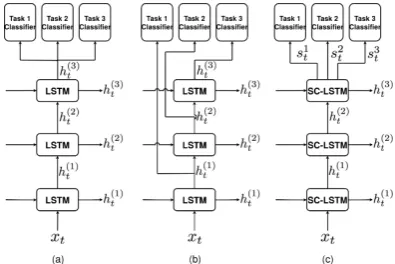
There are two kinds of neural-based MTL meth-ods. The first one — LSTM-s hereafter — uses an identical representation for all tasks, as proposed in (Collobert et al., 2011). This is illustrated in Figure1(left), where 3 layers of LSTMs are being stacked.1 While different tasks directly interact with all parameters of the model, this increases the risk of optimization conflicts when gold-standard labels from different tasks have no significant cor-relation.
The second class of multi-task architectures is depicted in the middle part of Figure 1, and is named LSTM-d hereafter. In this configuration, each LSTM layer feeds a task-specific classifier and serves as input to the next stacked LSTM layer (Søgaard and Goldberg,2016). The underlying as-sumption is that tasks may be ordered in such a way that easier tasks are learned first, the target tasks being the latest one considered, thus benefit-ing the hidden state of the lower layers. One draw-back, however, is that one must decide which task to consider first, a decision which may impact the overall performance. Furthermore, using the hid-den state of lower layers increases the limitation of learning representation for that task.
We believe that one reason for the lack of con-sistent benefits of MTL in the labelling litera-ture is that the proposed models share all or part of parameters for extracting hidden states, which leads to optimization conflicts when different tasks
1This typically delivers better performance than having
just one. In practice also, LSTM layers are replaced by bi-LSTM ones.
require different features. We believe it would be helpful if we make the model have ability to learn a task-specific representation (Ammar et al.,
2016;Östling and Tiedemann,2016;Kiperwasser and Ballesteros, 2018) at the same time. This observation led us to design a new LSTM cell which allows at almost no additional computa-tion cost to efficiently train a single RNN-based model, where task-specific labelers clearly outper-form their singly-tasked counterparts. Actually, by training our model on NER, chunking and POS tagging, we report state-of-the-art (or highly com-petitive) results on each task, without using exter-nal knowledge (such as gazetteers that has been shown to be important for NER), or hand-picking tasks to combine.
Figure 1: Overview of three shared encoder MTL tag-ging system: (a) LSTM-s (b) LSTM-d (c) our SC-LSTM based system.
3 Proposed Method
[image:2.595.317.515.296.428.2]3.1 LSTM Cell
An LSTM cell (Hochreiter and Schmidhuber,
1997) is made up of four functional gates which control the input and output of the memory state
ct: a forget gate ft controls what information to remove from the memory state of the last time step, an input gate it controls the informa-tion to add to the current memory, and an out-put gate ot controls what information to release from the current memory state. This mecha-nism is formalized in Equation1where xt,htis
the input vector and hidden vector at time step
t, σ is the sigmoid function, ˆc is the new can-didate state, ct is the memory state, which
en-codes information of the current input and his-tory information, and˚indicates the element-wise product. Wf,Uf,Wi,Ui,Wo,Uo,Wc,Ucare
weight matrices that are being learned.
ft“σpWfht´1`Ufxtq, (1)
it“σpWiht´1`Uixtq,
ot“σpWoht´1`Uoxtq,
ˆ
c“tanhpWcht´1`Ucxtq,
ct“it˚ˆc`ft˚ct´1,
[image:3.595.74.290.338.639.2]ht“ot˚tanhpctq,
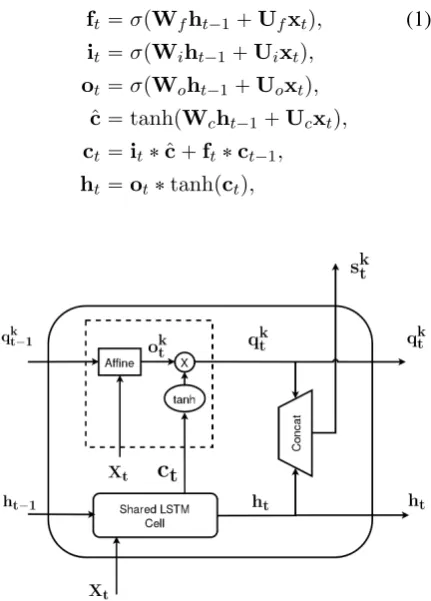
Figure 2: Structure of an SC-LSTM cell. The dashed delimited box depicts the task-specific cell. For clarity reasons, we only show one such cell, while in practice there is one task-specific cell for each task.
3.2 SC-LSTM Cell
The overall structure of our cell is depicted in Fig-ure2. On top of a standard LSTM cell, we add one
cell per task with its own parameters. The stan-dard LSTM cell is thus shared among theK task-specific cells, therefore the name we choose for this new cell, which stands for Shared-Cell LSTM. Task-specific cells are each parametrized by an output gate okt which learns to select the useful information from the shared memory cellct and
outputs qkt. This is formally described in Equa-tion 2, whereWk andUk are two extra weight
matrices that parametrize thekth task, andqkt has to be understood as a task-specific hidden repre-sentation since parameters ofkth task-specific cell are only updated by supervision from taskk.
okt “σpWkqt´k 1`Ukxktq (2)
qkt “okt ˚tanhpctq
In order to make use of both shared and task-specific information (Kim et al.,2016;Peng et al.,
2017;Hershcovich et al.,2018), for the kth task, we concatenate the output of the shared cellhtand
of the task-specific oneqkt to generate the final la-tent representation, as noted in Equation3, where ‘is the concatenation operation. In practice, we stack SC-LSTM layers. The top-most layer uses
sk
t as a representation of the current input, while
cells in lower layers pass the current shared hidden statehtto the upper SC-LSTM cell. The use ofs
in the topmost layer only is arbitrary and should be investigated.
skt “qkt ‘ht (3)
3.3 Training procedure
The training material available may be gathered from different datasets Sk which means that
in-put sequences differ from one task to another. Therefore in practice, we buildKdataloaders, and the training is achieved in a stochastic manner by looping over the tasks at each epoch, as detailed in Algorithm1.
The loss function we minimize is a linear combination of task-specific loss functions, where the weighting coefficients (λk in Equation 4) are hyper-parameters.
“
K ÿ
k“1
Algorithm 1Stochastic training procedure
1: procedureTRAINING
2: foreach epochdo
3: Randomly choose a taskk.
4: Randomly choose a training example not yet considered in the datasetSk
5: Update the parameters for this task by taking a gradient step based on this example.
6: Go to step 3 until using all examples.
We seek to minimize cross-entropy of the predicted and true distributions, therefore task-specific loss functions are defined according to Equation5.
Lpyk,yˆkq “ ´
nk
ÿ
i“1
mi
ÿ
j“1
yki,j log ˆyki,j (5)
where yˆki,j is the prediction of the kth softmax classifier parametrized by a projection matrixWk
and a bias vectorbk:
ˆ
yi,jk “sof tmaxpWkski,j`bkq (6)
whereski,j stands forjth token of theith sequence for task k. In an SC-LSTM cell with k tasks, we will add k matrices andk bias vectors, com-pared with a vanilla LSTM cell, which increases the capacity of the resulting model. This extra cal-culation is conducted in parallel with the original LSTM computations.
4 Experimental Setting
4.1 Benchmarks
We test several baseline systems and our SC-LSTM model on three well-established se-quence labeling benchmarks: CoNLL2003 (Tjong Kim Sang and De Meulder, 2003) for named-entity recognition, CoNLL2000 (Tjong Kim Sang and Buchholz, 2000) for chunking, and the more recent Universal Dependency dataset (Nivre et al., 2016) for part-of-speech tagging,2 and on which recent MTL investigations have been con-ducted (Alonso and Plank, 2017; Changpinyo et al.,2018).
We conformed to the pre-defined splits into train/dev/test except for chunking that does not contain a validation set. For this dataset, following
2We used UD English POS v1.3.
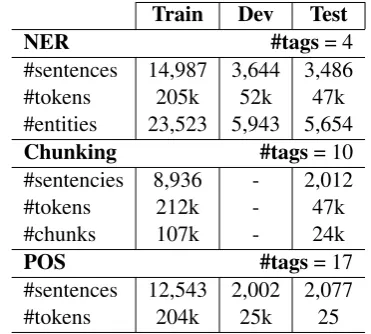
recent works (Peters et al.,2017;Liu et al.,2017), sections 15-18 of the Wall Street Journal are used for training, and we randomly sampled 1000 sen-tences in the training set as the development set. Section 20 is used for tests. Table1presents the main characteristics of the training, development and test sets we used.
Train Dev Test
NER #tags= 4
#sentences 14,987 3,644 3,486
#tokens 205k 52k 47k
#entities 23,523 5,943 5,654
Chunking #tags= 10
#sentencies 8,936 - 2,012
#tokens 212k - 47k
#chunks 107k - 24k
POS #tags= 17
#sentences 12,543 2,002 2,077
[image:4.595.322.508.165.332.2]#tokens 204k 25k 25
Table 1: Main characteristics of the datasets used.
4.2 Architectural Choices
We used bidirectional LSTM or SC-LSTM as our encoders for the vector representation of words. Bidirectional LSTM can capture global informa-tion of the whole sentence, thanks to the en-coding of a sequence in a recurrent way. The vector representation of words consists of three parts: word embedding, character-level represen-tation and contextual represenrepresen-tation:
• previous works have proven that pre-trained word embeddings like Word2vec (Mikolov et al.,2013), SENNA (Collobert et al.,2011), or Glove (Pennington et al.,2014) have a pos-itive impact on sequence labeling tasks. We used Glove embeddings3 of dimension 100, that are fine-tuned during training;
• character-level information has been proven useful for three sequence labeling tasks ( San-tos and Zadrozny,2014;Ma and Hovy,2016;
Lample et al., 2016) and Some works fur-ther show its effectiveness (Reimers and Gurevych, 2017; Yang et al., 2018). In or-der to encode character sequences, we used a CNN. The character embedding look-up ta-ble is initialized by randomly sampling from
3The embedding fileglove6Bare availablehttps://
the uniform distribution in the range [-0.1, 0.1];
• the third part of the input vector is contextual embedding. Most of the recent works found that contextualized features such as ELMo or BERT (Peters et al.,2018;Devlin et al.,2018) can greatly boost performance. We incor-porate ELMo into our input vector by using the ELMo implementation of Gardner et al.
(2018).
Conditional random field (CRF) classifiers can consider the dependency of output tags and has been proven useful for tasks like NER or chunk-ing. We consider CRF layers in our models.
To compare the effectiveness of three MTL models, we first test our SC-LSTM and other vanilla LSTM based models without CNN based character-level information extractor and contex-tual embeddings. In this case, the input will be a concatenation of word embedding and capital-ization features4. To compare with the state-of-art models, we further implemented three more vari-ants: SC-LSTM-CNN-CRF which makes use of CNN-based character level features with a CRF layer on top, very similar to (Ma and Hovy,2016), and SC-LSTM-LM-CNN, a variant which consid-ers contextualized word embeddings as in (Peters et al.,2018).
4.3 Implementation
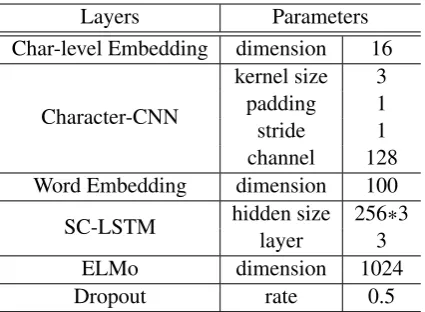
For SC-LSTM-LM-CNN, we used mainly the configuration advocated in (Peters et al.,2018) ex-cept for the hidden size of SC-LSTM, which we report in Table 2. We further weighted the NER task in the objective function of Equation 4 to 3 (λN ER), the weights of the other tasks where set
to 1.5 We trained this model SC-LSTM-LM-CNN using the Adam optimizer (Kingma and Ba,2014) with default setting. Such a model spends typi-cally less than 30 epochs to converge. We choose the mini-batch size of 10 and used the gradient clipping threshold 5. All models are implemented using the Pytorch library (Paszke et al.,2017).
Several tagging schemas have been proposed for conducting chunking and NER tasks. We used the most common BIO one in this work.
4
Eight features encode capitalization patterns, such as AllUpper, InitialUpper, etc.
5We found the loss of the NER task to be around 1/3 of
the loss of the chunking and POS tasks.
Layers Parameters
Char-level Embedding dimension 16
Character-CNN
kernel size 3
padding 1
stride 1
channel 128
Word Embedding dimension 100
SC-LSTM hidden size 256˚3
layer 3
ELMo dimension 1024
[image:5.595.311.524.61.217.2]Dropout rate 0.5
Table 2: Hyper-parameters used for training the SC-LSTM-LM-CNN model.
5 Experiments
In this section, we start by comparing MTL ap-proaches based on LSTM and SC-LSTM cells. We then report the performance of variants of our ap-proach we implemented and compare it to state-of-the-art models.
5.1 biLSTM versus biSC-LSTM
We compare bidirectional LSTM (STL), SC-LSTM, and baseline MTL models. The results are shown in Table3. Training Bi-LSTM models on each task separately (STL) was first conducted as a point of comparison (line 1).
For LSTM-s and LSTM-d, we regard one task as the main task and the others as auxiliary tasks; a setting consistent with Søgaard and Goldberg
(2016). Because LSTM-s and LSTM-d always fail to achieve stable and competitive results on the three tasks we considered at the same time, we report the best performance we could obtain for each task (line 2 and 3) specifically. On the con-trary, our SC-LSTM model is trained once jointly on all tasks, and only one model is being tested in the end, which is much easier and more realistic of a real deployment (line 4).
The results show that our SC-LSTM model im-proves the performance of the three tasks simul-taneously compared with LSTM (STL), and out-performs the other two MTL methods. By joint learning three tasks, both LSTM-s and LSTM-d can boost the chunking task significantly, but both fail to improve NER and POS tasks. This is con-sistent with observations made in (Collobert et al.,
fur-ther in Section6.
POS chunking NER
LSTM (STL) 95.46 94.44 89.39
LSTM-s 95.45 95.12 89.35
LSTM-d 95.44 95.24 89.37
[image:6.595.321.509.59.351.2]SC-LSTM 95.51 96.04 89.96
Table 3: Results of models being trained in STL or MTL mode. For all MTL models, we report the best performance via a small grid search over combinations of the hidden size [100, 200, 300, 400] and the number of layers [1, 2, 3]. The best performance of each MTL model was obtained with hidden size 300 and 3 layers.
5.2 SC-LSTM versus state-of-the-art
To further demonstrate the effectiveness of our SC-LSTM model, we compared different variants with state-of-the-art approaches, that we classify into three broad categories:
• Single sequence labelingwhere models are trained without the supervision of other tasks. Specifically, we compare our results to the LSTM-CRF model of Lample et al. (2016) and the LSTM-CNN-CRF of Ma and Hovy
(2016), since those are state-of-the-art singly tasked sequence labelers.
• Multi-tasked sequence labelerswhere mod-els leverage the supervision of other tasks. We compare our model with the representa-tive approaches ofLuo et al.(2015);Søgaard and Goldberg(2016);Collobert and Weston
(2008);Collobert et al.(2011).
• Models with language model. Recently, several studies in using contextualized word embeddings achieved great success in a num-ber of tasks. Some recent studies (Peters et al., 2017; Rei, 2017; Peters et al., 2018;
Devlin et al., 2018) are particularly consid-ered.
It is worth noting that we did not engineer tasks specific features or integrate external ressources such as gazetteers in our variants.
5.2.1 NER
Results for the CoNLL 2003 dataset are reported in Table 4. We observe that our SC-LSTM-LM-CNN model outperforms all approaches but De-vlin et al.(2018) andAkbik et al.(2018). The lat-ter work is using the development set as training
NER F1-score
Collobert et al.(2011) 89.59
Chiu and Nichols(2015)♣ 91.62
Huang et al.(2015) 88.83
Luo et al.(2015) 91.20
Ma and Hovy(2016) 91.21
Lample et al.(2016) 90.94
Shen et al.(2017) 90.89
Yang et al.(2017) 91.20
Rei(2017) 86.26
Liu et al.(2017) 91.71
Peters et al.(2017) 91.93
Zhang et al.(2018) 91.2
Liu et al.(2018) 91.95
Peters et al.(2018) 92.22
Clark et al.(2018) 92.60
Akbik et al.(2018)♣ 93.09
Devlin et al.(2018) 92.80
SC-LSTM 89.96
SC-LSTM-CNN-CRF 91.37
[image:6.595.84.282.84.156.2]SC-LSTM-LM-CNN 92.60
Table 4: F1-score on the CoNLL03 NER dataset. Mod-els with♣use both train and dev splits for training.
material, which avoids a direct comparison. The former model (BERT) is achieving great success by leveraging a huge amount of unannotated data as well as a lot of computation resources we could not afford in this study. We are however pleased that our model is leveraging contextual embed-dings with 0.38 absolute F1 improvement over the results ofPeters et al.(2018). We leave as future work to investigate whether our MTL model can leverage BERT embeddings.
5.2.2 Chunking
We compared a number of models on the CoNLL2000 chunking dataset. A few of them (Ma and Hovy,2016;Lample et al.,2016;Peters et al.,
2018) where not tested on this benchmark, and we reimplemented them. We also trained the compan-ion toolkits of those models, but (as detailed in the next section) got slightly lower results for some reasons. Table 5 reports the performance of the many approaches we tested.
ofClark et al.(2018).
Chunking F1-score
Collobert et al.(2011) 94.32
Huang et al.(2015) 94.13
Ma and Hovy(2016) 94.81:
Lample et al.(2016) 94.68:
Hashimoto et al.(2016) 95.77
Søgaard and Goldberg(2016) 95.56
Shen et al.(2017) 93.88
Yang et al.(2017) 94.66
Liu et al.(2017) 95.96
Peters et al.(2017) 96.37
Liu et al.(2018) 96.13
Peters et al.(2018) 96.92:
Clark et al.(2018) 97.00
Akbik et al.(2018) 96.72
SC-LSTM 96.04
SC-LSTM-CNN-CRF 96.41
[image:7.595.334.500.60.215.2]SC-LSTM-LM-CNN 97.40
Table 5: F1-score on the CoNLL00 chunking dataset. Configurations with a:sign are approaches we reim-plemented.
5.2.3 POS
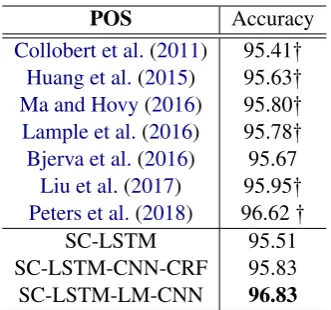
We conducted experiments on the Universal De-pendency POS English dataset and present the re-sults in Table 6. The only study we found that reports results on the UD v1.3 benchmark we used here is (Bjerva et al.,2016), and we report the re-sults they published. For Liu et al. (2017), Pe-ters et al. (2018) we used the available compan-ion toolkits6 that we trained ourself with the de-fault settings. We re-implemented the other ap-proaches.
Again, we observe that SC-LSTM-LM-CNN outperforms all other approaches we tested. The absolute improvement in F1 score over the current state-of-the-art ofPeters et al.(2018) is 0.21%.
In order to further validate our implementations, we also ran the toolkits of Ma and Hovy (2016) and Lample et al. (2016) and obtained slightly lower results7.
6https://github.com/LiyuanLucasLiu/
LM-LSTM-CRF and https://github.com/ allenai/allennlp
7We obtained 95.7% for the toolkit we took fromhttps:
//github.com/XuezheMax/NeuroNLP2 and 95.6% for the one at https://github.com/glample/ tagger.
POS Accuracy
Collobert et al.(2011) 95.41:
Huang et al.(2015) 95.63:
Ma and Hovy(2016) 95.80:
Lample et al.(2016) 95.78:
Bjerva et al.(2016) 95.67
Liu et al.(2017) 95.95:
Peters et al.(2018) 96.62:
SC-LSTM 95.51
SC-LSTM-CNN-CRF 95.83
[image:7.595.83.278.90.340.2]SC-LSTM-LM-CNN 96.83
Table 6: Accuracy on the Universal Dependency En-glish POS dataset. Configurations with a:sign are ap-proaches we reproduced.
6 Analysis
We conducted a number of investigations in order to understand better why our multi-task learning model is effective.
6.1 Convergence Analysis
We report in Figure3 the convergence of differ-ent MTL models on the developmdiffer-ent set. To ob-tain those curves, we collected the F1-score on the NER and chunking tasks as well as the accuracy of the POS task, and averaged them after each epoch.
Figure 3: The change of F1-score/Accuracy on the development datasets at different epochs for SC-LSTM (red solid line), SC-LSTM-s (blue dotted line) and LSTM-d (green dashed line) baselines. (a) reports re-sults with NER, chunking and POS; (b) rere-sults with NER and POS; (c) results with chunking and POS; and (d) results with NER and chunking. All models were trained using the Adam optimizer with the same set-ting, and the mini-batch size was set to 10.
[image:7.595.309.530.453.608.2]performance after the first epoch, and after about ten epochs, it shows a smooth performance curve, while LSTM-s and LSTM-d models still fluctuate. This indicates that our model can learn the hid-den representation of multiple tasks in a faster and smoother way than the other two methods.
Besides, we observe in Figure 3c and 3d that combinations of tasks involving chunking typi-cally show a smooth training curve, on the con-trary to Figure 3b where NER and POS tasks are combined. The fact that the training regi-men fluctuates in the latter case for both LSTM-s and LSTM-d suggests that conflicts with those two tasks happen during optimisation, which we do not observe for our model. Also, Figure3a illustrates that combining the three tasks altogether leads to comparably better performance of our model over LSTM-s and LSTM-d.
6.2 Effect of Different Task Combinations
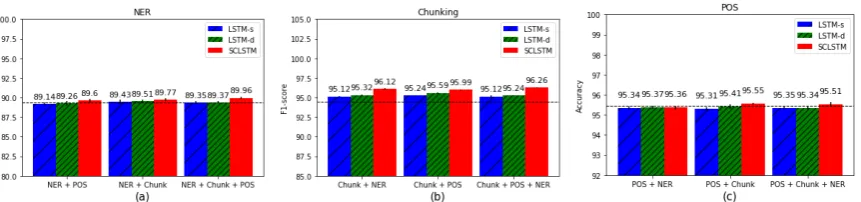
We analyzed which task is benefited or harmed by others under the three MTL settings we considered and present results in Figure4.
We find that it leads to better performance for all MTL models by jointly learning chunking with NER or POS(see in Figure4b). This is in particu-lar the case of our SC-LSTM model which records the largest gain, especially when all tasks are be-ing trained on.
Figure4c shows results obtained on POS. Only our SC-LSTM model achieves a meaningful im-provement. We however observe that the NER task tends to hurt the performance of POS, since in most cases, the performance of POS+NER is lower than the one obtained with POS+chunking.
For NER, Figure 4 shows that POS hurts LSTM-s and LSTM-d models, while the chunking task is beneficial for all MTL methods.
Clearly, the combination of different tasks has a different effect on the final performance of each task. The chunking task seems compatible with NER and POS tasks, and it boosts the other two tasks in all three MTL settings, which is consis-tent with the results ofChangpinyo et al. (2018). Directly jointly training on POS and NER datasets tends to reduce the performance in LSTM-s and LSTM-d, which is also consistent with the con-clusion in (Changpinyo et al., 2018). In conclu-sion, all of the results show that our SC-LSTM model is effective at capturing the mutual bene-fits of all combined tasks. Since it performs
con-sistently better in various settings, we believe our model to be more robust.
7 Related Work
There are many works that use extra knowledge to improve the performance of sequence labeling tasks.
Many works have focussed on jointly learning two tasks, often with one being considered as the main task, the other being the auxiliary one ( Sø-gaard and Goldberg, 2016; Bjerva et al., 2016;
Alonso and Plank, 2017). For instance, chunk-ing, combinatory categorical grammar supertag-ging, NER, super senses (SemCor), or multiword expression + supersense will be taken as the main task, while POS is the auxiliary task in (Søgaard and Goldberg, 2016). Exceptions to this line of work include (Collobert et al.,2011) that evaluates four tasks: POS, chunking, NER and semantic role labeling; (Kiperwasser and Ballesteros,2018) that considers a machine translation task with POS and dependency parsing. AndNiehues and Cho(2017) considers machine translation with POS and NER tasks; Zhang and Weiss(2016) show that jointly learning a POS tagger and a dependency parser is effective. Miwa and Bansal(2016) jointly trained models for entity detection and relation extraction in the field of relation extraction.
Other works are also trying to leverage language models to empower the performance of sequence labeling tasks. Notably,Liu et al.(2017) propose a model which uses a neural language model to learn character-level knowledge, and conducts se-quence labeling to guide the language model to-wards specific tasks. Others (Peters et al.,2017,
2018; Devlin et al., 2018) use neural language models pre-trained on a large unlabeled corpus to learn context-sensitive representations of words, and leverage this representation into the sequence labeling model.
More related to the present work are studies that analyze the effectiveness of different combi-nations of sequence labeling tasks in a multi-task learning. In particular, Changpinyo et al. (2018) conduct an investigation on 11 sequence labeling tasks, while Alonso and Plank(2017) evaluate 5 tasks but report signifiant gains for only one task.
8 Conclusion
task-Figure 4: Results of different task groups on each test set: (a) NER, (b) chunking, and (c) POS. Horizontal lines show results for single-task models(NER: 89.39, Chunking: 94.44 and POS: 95.46).
specific parameters in a multi-task setting de-signed for sequence labelling. We conduct ex-tensive experiments to compare both single-task learning and multi-task learning models. We an-alyzed the influence of grouping different tasks under various multi-task settings. Experiments demonstrate the effectiveness of our model for se-quence labeling tasks. We report new state-of-the-art results on both POS and chunking tasks, and close to state-of-the-art performance on NER, without exploiting external ressources, neither diving into dedicated feature engineering.
Despite those positive outcomes, several issues with multi-task learning for sequence labeling re-main open. In particular, we only considered 3 tasks here, and therefore plan to test our approach on more tasks, perhaps understanding better why some tasks are less useful to others. Also, there are several ways we could have used our SC-LSTM cell into our models which we would like to inves-tigate further. In particular, in this work, we only used the specific-task hidden states in the last layer of the model, which can obviously be revisited.
References
Alan Akbik, Duncan Blythe, and Roland Vollgraf. 2018. Contextual string embeddings for sequence labeling. In Proceedings of the 27th International Conference on Computational Linguistics, pages 1638–1649. Association for Computational Linguis-tics.
Hector Martinez Alonso and Barbara Plank. 2017. When is multitask learning effective? semantic se-quence prediction under varying data conditions. In EACL 2017-15th Conference of the European Chap-ter of the Association for Computational Linguistics, pages 1–10.
Waleed Ammar, George Mulcaire, Miguel Ballesteros, Chris Dyer, and Noah A Smith. 2016. Many lan-guages, one parser. Transactions of the Association for Computational Linguistics, 4:431–444.
Johannes Bjerva, Barbara Plank, and Johan Bos. 2016. Semantic tagging with deep residual net-works. arXiv preprint arXiv:1609.07053.
Rich Caruana. 1997. Multitask learning. Machine learning, 28(1):41–75.
Soravit Changpinyo, Hexiang Hu, and Fei Sha. 2018. Multi-task learning for sequence tagging: An em-pirical study. arXiv preprint arXiv:1808.04151.
Jason PC Chiu and Eric Nichols. 2015. Named en-tity recognition with bidirectional lstm-cnns. arXiv preprint arXiv:1511.08308.
Kevin Clark, Minh-Thang Luong, Christopher D. Man-ning, and Quoc Le. 2018. Semi-supervised se-quence modeling with cross-view training. In Pro-ceedings of the 2018 Conference on Empirical Meth-ods in Natural Language Processing, pages 1914– 1925. Association for Computational Linguistics.
Ronan Collobert and Jason Weston. 2008. A unified architecture for natural language processing: Deep neural networks with multitask learning. In Pro-ceedings of the 25th international conference on Machine learning, pages 160–167. ACM.
Ronan Collobert, Jason Weston, Léon Bottou, Michael Karlen, Koray Kavukcuoglu, and Pavel Kuksa. 2011. Natural language processing (almost) from scratch. Journal of Machine Learning Research, 12(Aug):2493–2537.
Jacob Devlin, Ming-Wei Chang, Kenton Lee, and Kristina Toutanova. 2018. Bert: Pre-training of deep bidirectional transformers for language understand-ing.arXiv preprint arXiv:1810.04805.
Radu Florian, Abe Ittycheriah, Hongyan Jing, and Tong Zhang. 2003. Named entity recognition through classifier combination. In Proceedings of the seventh conference on Natural language learn-ing at HLT-NAACL 2003-Volume 4, pages 168–171. Association for Computational Linguistics.
[image:9.595.88.519.64.165.2]Kazuma Hashimoto, Caiming Xiong, Yoshimasa Tsu-ruoka, and Richard Socher. 2016. A joint many-task model: Growing a neural network for multiple nlp tasks.arXiv preprint arXiv:1611.01587.
Daniel Hershcovich, Omri Abend, and Ari Rappoport. 2018. Multitask parsing across semantic representa-tions. InProceedings of the 56th Annual Meeting of the Association for Computational Linguistics (Vol-ume 1: Long Papers), volume 1, pages 373–385.
Sepp Hochreiter and Jürgen Schmidhuber. 1997. Long short-term memory. Neural computation, 9(8):1735–1780.
Zhiheng Huang, Wei Xu, and Kai Yu. 2015. Bidirec-tional lstm-crf models for sequence tagging. arXiv preprint arXiv:1508.01991.
Young-Bum Kim, Karl Stratos, and Ruhi Sarikaya. 2016. Frustratingly easy neural domain adaptation. In Proceedings of COLING 2016, the 26th Inter-national Conference on Computational Linguistics: Technical Papers, pages 387–396.
Diederik P Kingma and Jimmy Ba. 2014. Adam: A method for stochastic optimization. arXiv preprint arXiv:1412.6980.
Eliyahu Kiperwasser and Miguel Ballesteros. 2018. Scheduled multi-task learning: From syntax to translation. arXiv preprint arXiv:1804.08915.
John D. Lafferty, Andrew McCallum, and Fernando C. N. Pereira. 2001. Conditional random fields: Probabilistic models for segmenting and labeling se-quence data. InProceedings of the Eighteenth Inter-national Conference on Machine Learning, ICML ’01, pages 282–289, San Francisco, CA, USA. Mor-gan Kaufmann Publishers Inc.
Guillaume Lample, Miguel Ballesteros, Sandeep Sub-ramanian, Kazuya Kawakami, and Chris Dyer. 2016. Neural architectures for named entity recognition. arXiv preprint arXiv:1603.01360.
Liyuan Liu, Xiang Ren, Jingbo Shang, Jian Peng, and Jiawei Han. 2018. Efficient contextualized represen-tation: Language model pruning for sequence label-ing. arXiv preprint arXiv:1804.07827.
Liyuan Liu, Jingbo Shang, Frank Xu, Xiang Ren, Huan Gui, Jian Peng, and Jiawei Han. 2017. Empower sequence labeling with task-aware neural language model. arXiv preprint arXiv:1709.04109.
Gang Luo, Xiaojiang Huang, Chin-Yew Lin, and Za-iqing Nie. 2015. Joint entity recognition and disam-biguation. InProceedings of the 2015 Conference on Empirical Methods in Natural Language Pro-cessing, pages 879–888.
Xuezhe Ma and Eduard Hovy. 2016. End-to-end sequence labeling via bi-directional lstm-cnns-crf. arXiv preprint arXiv:1603.01354.
Andrew McCallum, Dayne Freitag, and Fernando CN Pereira. 2000. Maximum entropy markov models for information extraction and segmentation. In Icml, 2000, pages 591–598.
Andrew McCallum and Wei Li. 2003. Early results for named entity recognition with conditional random fields, feature induction and web-enhanced lexicons. InProceedings of the seventh conference on Natural language learning at HLT-NAACL 2003-Volume 4, pages 188–191. Association for Computational Lin-guistics.
Tomas Mikolov, Ilya Sutskever, Kai Chen, Greg S Cor-rado, and Jeff Dean. 2013. Distributed representa-tions of words and phrases and their compositional-ity. InAdvances in neural information processing systems, pages 3111–3119.
Makoto Miwa and Mohit Bansal. 2016. End-to-end re-lation extraction using lstms on sequences and tree structures.arXiv preprint arXiv:1601.00770.
Jan Niehues and Eunah Cho. 2017. Exploiting linguistic resources for neural machine transla-tion using multi-task learning. arXiv preprint arXiv:1708.00993.
Joakim Nivre, Marie-Catherine de Marneffe, Filip Gin-ter, Yoav Goldberg, Jan Hajiˇc, Christopher D Man-ning, Ryan McDonald, Slav Petrov, Sampo Pyysalo, Natalia Silveira, et al. 2016. Universal dependencies v1: A multilingual treebank collection. InTenth In-ternational Conference on Language Resources and Evaluation (LREC 2016).
Robert Östling and Jörg Tiedemann. 2016. Efficient word alignment with markov chain monte carlo. The Prague Bulletin of Mathematical Linguistics, 106(1):125–146.
Adam Paszke, Sam Gross, Soumith Chintala, Gre-gory Chanan, Edward Yang, Zachary DeVito, Zem-ing Lin, Alban Desmaison, Luca Antiga, and Adam Lerer. 2017. Automatic differentiation in pytorch. InNIPS-W.
Hao Peng, Sam Thomson, and Noah A Smith. 2017. Deep multitask learning for semantic dependency parsing. InProceedings of the 55th Annual Meet-ing of the Association for Computational LMeet-inguistics (Volume 1: Long Papers), volume 1, pages 2037– 2048.
Jeffrey Pennington, Richard Socher, and Christopher Manning. 2014. Glove: Global vectors for word representation. InProceedings of the 2014 confer-ence on empirical methods in natural language pro-cessing (EMNLP), pages 1532–1543.
Matthew E. Peters, Mark Neumann, Mohit Iyyer, Matt Gardner, Christopher Clark, Kenton Lee, and Luke Zettlemoyer. 2018. Deep contextualized word rep-resentations. InProc. of NAACL.
Marek Rei. 2017. Semi-supervised multitask learn-ing for sequence labellearn-ing. In Proceedings of the 55th Annual Meeting of the Association for Compu-tational Linguistics (Volume 1: Long Papers), vol-ume 1, pages 2121–2130.
Nils Reimers and Iryna Gurevych. 2017. Optimal hy-perparameters for deep lstm-networks for sequence labeling tasks.arXiv preprint arXiv:1707.06799.
Cicero D Santos and Bianca Zadrozny. 2014. Learning character-level representations for part-of-speech tagging. In Proceedings of the 31st International Conference on Machine Learning (ICML-14), pages 1818–1826.
Yanyao Shen, Hyokun Yun, Zachary C Lipton, Yakov Kronrod, and Animashree Anandkumar. 2017. Deep active learning for named entity recognition. arXiv preprint arXiv:1707.05928.
Anders Søgaard and Yoav Goldberg. 2016. Deep multi-task learning with low level tasks supervised at lower layers. InProceedings of the 54th Annual Meeting of the Association for Computational Lin-guistics (Volume 2: Short Papers), volume 2, pages 231–235.
Erik F Tjong Kim Sang and Sabine Buchholz. 2000. Introduction to the conll-2000 shared task: Chunk-ing. InProceedings of the 2nd workshop on Learn-ing language in logic and the 4th conference on Computational natural language learning-Volume 7, pages 127–132. Association for Computational Lin-guistics.
Erik F Tjong Kim Sang and Fien De Meulder. 2003. Introduction to the conll-2003 shared task: Language-independent named entity recognition. In Proceedings of the seventh conference on Natural language learning at HLT-NAACL 2003-Volume 4, pages 142–147. Association for Computational Lin-guistics.
Jie Yang, Shuailong Liang, and Yue Zhang. 2018. De-sign challenges and misconceptions in neural se-quence labeling. arXiv preprint arXiv:1806.04470.
Zhilin Yang, Ruslan Salakhutdinov, and William W Cohen. 2017. Transfer learning for sequence tag-ging with hierarchical recurrent networks. arXiv preprint arXiv:1703.06345.
Yuan Zhang, Hongshen Chen, Yihong Zhao, Qun Liu, and Dawei Yin. 2018. Learning tag dependencies for sequence tagging. InProceedings of the Twenty-Seventh International Joint Conference on Artificial Intelligence, IJCAI-18, pages 4581–4587. Interna-tional Joint Conferences on Artificial Intelligence Organization.
![Table 3: Results of models being trained in STL orMTL mode. For all MTL models, we report the bestperformance via a small grid search over combinationsof the hidden size [100, 200, 300, 400] and the numberof layers [1, 2, 3]](https://thumb-us.123doks.com/thumbv2/123dok_us/1386330.672879/6.595.321.509.59.351/results-trained-bestperformance-search-combinationsof-hidden-numberof-layers.webp)