Combining Deep Linguistics Analysis and Surface Pattern Learning:
A Hybrid Approach to Chinese Definitional Question Answering
Fuchun Peng, Ralph Weischedel, Ana Licuanan, Jinxi Xu
BBN Technologies
50 Moulton Street, Cambridge, MA, 02138
fpeng, rweisched, alicuan, jxu @bbn.com
Abstract
We explore a hybrid approach for Chinese definitional question answering by com-bining deep linguistic analysis with sur-face pattern learning. We answer four questions in this study: 1) How helpful are linguistic analysis and pattern learning? 2) What kind of questions can be answered by pattern matching? 3) How much an-notation is required for a pattern-based system to achieve good performance? 4) What linguistic features are most useful? Extensive experiments are conducted on biographical questions and other defini-tional questions. Major findings include: 1) linguistic analysis and pattern learning are complementary; both are required to make a good definitional QA system; 2) pattern matching is very effective in an-swering biographical questions while less effective for other definitional questions; 3) only a small amount of annotation is required for a pattern learning system to achieve good performance on biographi-cal questions; 4) the most useful linguistic features are copulas and appositives; re-lations also play an important role; only some propositions convey vital facts.
1 Introduction
Due to the ever increasing large amounts of online textual data, learning from textual data is becom-ing more and more important. Traditional document retrieval systems return a set of relevant documents
and leave the users to locate the specific information they are interested in. Question answering, which combines traditional document retrieval and infor-mation extraction, solves this problem directly by returning users the specific answers. Research in textual question answering has made substantial ad-vances in the past few years (Voorhees, 2004).
Most question answering research has been focus-ing on factoid questions where the goal is to return a list of facts about a concept. Definitional ques-tions, however, remain largely unexplored. Defini-tional questions differ from factoid questions in that the goal is to return the relevant “answer nuggets” of information about a query. Identifying such an-swer nuggets requires more advanced language pro-cessing techniques. Definitional QA systems are not only interesting as a research challenge. They also have the potential to be a valuable comple-ment to static knowledge sources like encyclopedias. This is because they create definitions dynamically, and thus answer definitional questions about terms which are new or emerging (Blair-Goldensoha et al., 2004).
One success in factoid question answering is pattern based systems, either manually con-structed (Soubbotin and Soubbotin, 2002) or ma-chine learned (Cui et al., 2004). However, it is unknown whether such pure pattern based systems work well on definitional questions where answers are more diverse.
Deep linguistic analysis has been found useful in factoid question answering (Moldovan et al., 2002) and has been used for definitional questions (Xu et al., 2004; Harabagiu et al., 2003). Linguistic
sis is useful because full parsing captures long dis-tance dependencies between the answers and the query terms, and provides more information for in-ference. However, merely linguistic analysis may not be enough. First, current state of the art lin-guistic analysis such as parsing, co-reference, and relation extraction is still far below human perfor-mance. Errors made in this stage will propagate and lower system accuracy. Second, answers to some types of definitional questions may have strong local dependencies that can be better captured by surface patterns. Thus we believe that combining linguistic analysis and pattern learning would be complemen-tary and be beneficial to the whole system.
Work in combining linguistic analysis with pat-terns include Weischedel et al. (2004) and Jijkoun et al. (2004) where manually constructed patterns are used to augment linguistic features. However, man-ual pattern construction critically depends on the do-main knowledge of the pattern designer and often has low coverage (Jijkoun et al., 2004). Automatic pattern derivation is more appealing (Ravichandran and Hovy, 2002).
In this work, we explore a hybrid approach to combining deep linguistic analysis with automatic pattern learning. We are interested in answering the following four questions for Chinese definitional question answering:
How helpful are linguistic analysis and pattern learning in definitional question answering?
If pattern learning is useful, what kind of ques-tion can pattern matching answer?
How much human annotation is required for a pattern based system to achieve reasonable per-formance?
If linguistic analysis is helpful, what linguistic features are most useful?
To our knowledge, this is the first formal study of these questions in Chinese definitional QA. To an-swer these questions, we perform extensive experi-ments on Chinese TDT4 data (Linguistic Data Con-sortium, 2002-2003). We separate definitional ques-tions into biographical (Who-is) quesques-tions and other definitional (What-is) questions. We annotate some question-answer snippets for pattern learning and we perform deep linguistic analysis including pars-ing, taggpars-ing, name entity recognition, co-reference,
and relation detection.
2 A Hybrid Approach to Definitional Ques-tion Answering
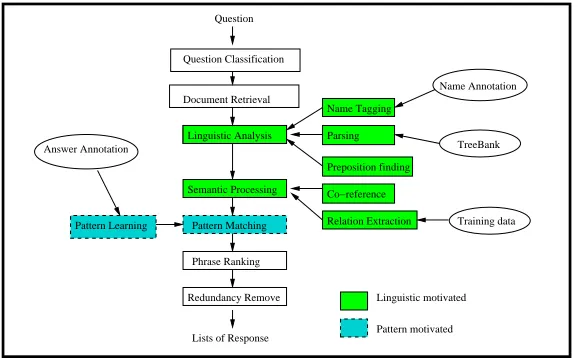
The architecture of our QA system is shown in Fig-ure 1. Given a question, we first use simple rules to classify it as a “Who-is” or “What-is” question and detect key words. Then we use a HMM-based IR system (Miller et al., 1999) for document retrieval by treating the question keywords as a query. To speed up processing, we only use the top 1000 rel-evant documents. We then select relrel-evant sentences among the returned relevant documents. A sentence is considered relevant if it contains the query key-word or contains a key-word that is co-referent to the query term. Coreference is determined using an in-formation extraction engine, SERIF (Ramshaw et al., 2001). We then conduct deep linguistic anal-ysis and pattern matching to extract candidate an-swers. We rank all candidate answers by predeter-mined feature ordering. At the same time, we per-form redundancy detection based on -gram over-lap.
2.1 Deep Linguistic Analysis
We use SERIF (Ramshaw et al., 2001), a linguistic analysis engine, to perform full parsing, name entity detection, relation detection, and co-reference reso-lution. We extract the following linguistic features:
1. Copula: a copula is a linking verb such as “is” or “become”. An example of a copula feature is “Bill Gates is the CEO of Microsoft”. In this case, “CEO of Microsoft” will be extracted as an answer to “Who is Bill Gates?”. To extract copulas, SERIF traverses the parse trees of the sentences and extracts copulas based on rules. In Chinese, the rule for identifying a copula is the POS tag “VC”, standing for “Verb Copula”. The only copula verb in Chinese is “
”.
2. Apposition: appositions are a pair of noun phrases in which one modifies the other. For example, In “Tony Blair, the British Prime
ister, ...”, the phrase “the British Prime Min-ister” is in apposition to “Blair”. Extraction
Question Classification
Document Retrieval
Linguistic Analysis
Semantic Processing
Phrase Ranking
Redundancy Remove
Lists of Response Answer Annotation
Name Tagging Parsing Preposition finding Co−reference
Relation Extraction Training data TreeBank Name Annotation
Linguistic motivated Pattern motivated Question
[image:3.612.171.460.55.234.2]Pattern Matching Pattern Learning
Figure 1: Question answering system structure
in (Ramshaw et al., 2001).
3. Proposition: propositions represent predicate-argument structures and take the form:
predicate(
:
, ...,
:
). The
most common roles include logical subject, logical object, and object of a prepositional phrase that modifies the predicate. For ex-ample, “Smith went to Spain” is represented as a proposition, went(logical subject: Smith,
PP-to: Spain).
4. Relations: The SERIF linguistic analysis en-gine also extracts relations between two ob-jects. SERIF can extract 24 binary relations defined in the ACE guidelines (Linguistic Data Consortium, 2002), such as spouse-of, staff-of, parent-of, management-of and so forth. Based on question types, we use different relations, as listed in Table 1.
Relations used for Who-Is questions ROLE/MANAGEMENT, ROLE/GENERAL-STAFF,
ROLE/CITIZEN-OF, ROLE/FOUNDER, ROLE/OWNER, AT/RESIDENCE,
SOC/SPOUSE, SOC/PARENT,
ROLE/MEMBER, SOC/OTHER-PROFESSIONAL Relation used for What-Is questions AT/BASED-IN, AT/LOCATED, PART/PART-OF
Table 1: Relations used in our system
Many relevant sentences do not contain the query key words. Instead, they contain words that are co-referent to the query. For example, in “Yesterday UN
Secretary General Anan Requested Every Side...,
He said ... ”. The pronoun “He” in the second
sen-tence refers to “Anan” in the first sensen-tence. To select such sentences, we conduct co-reference resolution using SERIF.
In addition, SERIF also provides name tagging, identifying 29 types of entity names or descriptions, such as locations, persons, organizations, and dis-eases.
We also select complete sentences mentioning the term being defined as backup answers if no other features are identified.
The component performance of our linguistic analysis is shown in Table 2.
Pre. Recall F Parsing 0.813 0.828 0.820 Co-reference 0.920 0.897 0.908 Name-entity detection 0.765 0.753 0.759
Table 2: Linguistic analysis component performance for Chinese
2.2 Surface Pattern Learning
We use two kinds of patterns: manually constructed patterns and automatically derived patterns. A man-ual pattern is a commonly used linguistic expression that specifies aliases, super/subclass and member-ship relations of a term (Xu et al., 2004). For exam-ple, the expression “tsunamis, also known as tidal
use 23 manual patterns for Who-is questions and 14 manual patterns for What-is questions.
We also classify some special propositions as manual patterns since they are specified by compu-tational linguists. After a proposition is extracted, it is matched against a list of predefined predicates. If it is on the list, it is considered special and will be ranked higher. In total, we designed 22 spe-cial propositions for Who-is questions, such as
(become),
(elected as), and (resign), 14 for What-is questions, such as (located at),
(created at), and
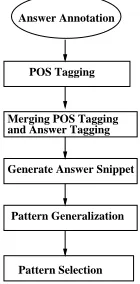
(also known as). However, it is hard to manually construct such patterns since it largely depends on the knowledge of the pattern designer. Thus, we prefer patterns that can be automatically derived from training data. Some annotators labeled question-answer snippets. Given a query question, the annotators were asked to highlight the strings that can answer the question. Though such a process still requires annotators to have knowledge of what can be answers, it does not require a computational linguist. Our pattern learn-ing procedure is illustrated in Figure 2.
Generate Answer Snippet
Pattern Generalization
Pattern Selection POS Tagging
Merging POS Tagging and Answer Tagging
[image:4.612.158.228.383.525.2]Answer Annotation
Figure 2: Surface Pattern Learning
Here we give an example to illustrate how pat-tern learning works. The first step is annotation. An example of Chinese answer annotation with English translation is shown in Figure 3. Question words are assigned the tag QTERM, answer words are tagged
ANSWER, and all other words are assigned BKGD,
standing for background words (not shown in the ex-ample to make the annotation more readable).
To obtain patterns, we conduct full parsing to ob-tain the full parse tree for a sentence. In our current
Chinese annotation: “ ” ( "!
#
ANSWER)($&%(')(* QTERM),+-,/.01&2 3465
(78-9-:;
English translation: (U.S. Secretary of the State ANWER) (Albright QTERM), who visited North Korea for the “ice-breaking trip”, had a historical meeting with the leader of North Korea, Kim Jong Il.
Figure 3: Answer annotation example
patterns, we only use POS tagging information, but other higher level information could also be used. The segmented and POS tagged sentence is shown in Figure 4. Each word is assigned a POS tag as defined by the Penn Chinese Treebank guidelines.
( P)( NR)( VV)(“ PU)( VV)( NN)(< NN)(” PU)( DEC)(= NR)(!
#
NR)($<% NR)('<)<* NR)(, PU) (+>, NT)(. DT)( NR)(12 NR)(
3?45
NN)(@ VV)(78
9 JJ)(:; NN).
Figure 4: POS tagging
Next we combine the POS tags and the answer tags by appending these two tags to create a new tag, as shown in Figure 5.
( P/BKGD)(A NR/BKGD)(A VV/BKGD)(“ PU/BKGD)( VV/BKGD)( NN/BKGD)( NN/BKGD)(” PU/BKGD)( DEC/BKGD)(
NR/ANSWER)( !
#
NR/ANSWER)($ % NR/QTERM)(')B* NR/QTERM)(, PU/BKGD) (+
, NT/BKGD)(. DT/BKGD)(C NR/BKGD)(1D2 NR/BKGD)(E
45
NN/BKGD)( VV/BKGD)(7F8
9 JJ/BKGD)(:; NN/BKGD)
Figure 5: Combined POS and Answer tagging
We can then obtain an answer snippet from this training sample. Here we obtain the snippet (GIH
HKJML NR/ANSWER)(TERM).
(measurement word such as ) with their POS tags. Third, we ignore adjectives.
After obtaining all patterns, we run them on the training data to calculate their precision and recall. We select patterns whose precision is above 0.6 and which fire at least 5 times in training data (parame-ters are determined with a held out dataset).
3 Experiments
3.1 Data Sets
We produced a list of questions and asked annota-tors to identify answer snippets from TDT4 data. To produce as many training answer snippets as pos-sible, annotators were asked to label answers ex-haustively; that is, the same answer can be labeled multiple times in different places. However, we re-move duplicate answers for test questions since we are only interested in unique answers in evaluation.
We separate questions into two types, biographi-cal (Who-is) questions, and other definitional ques-tions (What-is). For “Who-is” quesques-tions, we used 204 questions for pattern learning, 10 for parame-ter tuning and another 42 questions for testing. For “What-is” questions, we used 44 for training and an-other 44 for testing.
3.2 Evaluation
The TREC question answering evaluation is based on human judgments (Voorhees, 2004). However, such a manual procedure is costly and time consum-ing. Recently, researchers have started automatic question answering evaluation (Xu et al., 2004; Lin and Demner-Fushman, 2005; Soricut and Brill, 2004). We use Rouge, an automatic evaluation met-ric that was originally used for summarization eval-uation (Lin and Hovy, 2003) and was recently found useful for evaluating definitional question answer-ing (Xu et al., 2004). Rouge is based on -gram co-occurrence. An -gram is a sequence of con-secutive Chinese characters.
Given a reference answer and a system answer
, the Rouge score is defined as follows:
!
!
" #
$
%'&)()*
+,.-/10325467),8
*
+,.-9:,8
where ; is the maximum length of -grams,
<
= ?>9@ACBD7EGFIH
H KJ is the number of common -grams of and
, and <
= ?>FIH KJ is the number
of -grams in . If; is too small, stop words and bi-grams of such words will dominate the score; If
; is too large, there will be many questions without answers. We select; to be 3, 4, 5 and 6.
To make scores of different systems comparable, we truncate system output for the same question by the same cutoff length. We score answers trun-cated at lengthL times that of the reference answers, whereL is set to be 1, 2, and 3. The rationale is that people would like to read at least the same length of the reference answer. On the other hand, since the state of the art system answer is still far from human performance, it is reasonable to produce an-swers somewhat longer than the references (Xu et al., 2004).
In summary, we run experiments with parameters
;NMPOQH3RHSQHT and LUMVWHXQHO , and take the average over all of the 12 runs.
3.3 Overall Results
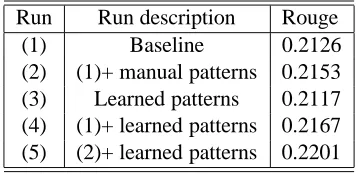
We set the pure linguistic analysis based system as the baseline and compare it to other configurations. Table 3 and Table 4 show the results on “Who-is” and “What-is” questions respectively. The baseline (Run 1) is the result of using pure linguistic features; Run 2 is the result of adding manual patterns to the baseline system; Run 3 is the result of using learned patterns only. Run 4 is the result of adding learned patterns to the baseline system. Run 5 is the result of adding both manual patterns and learned patterns to the system.
The first question we want to answer is how help-ful the linguistic analysis and pattern learning are for definitional QA. Comparing Run 1 and 3, we can see that both pure linguistic analysis and pure pattern based systems achieve comparable mance; Combining them together improves perfor-mance (Run 4) for “who is” questions, but only slightly for “what is” questions. This indicates that linguistic analysis and pattern learning are comple-mentary to each other, and both are helpful for bio-graphical QA.
to 0.3860; manual patterns improve the baseline to 0.3657; combining both manual and learned patterns improve it to 0.4026, an improvement of 18.4% compared to the baseline. However, the effect of patterns on “What-is” is smaller, with an improve-ment of only 3.5%. However, the baseline perfor-mance on “What-is” is also much worse than that of “Who-is” questions. We will analyze the reasons in Section 4.3. This indicates that answering gen-eral definitional questions is much more challenging than answering biographical questions and deserves more research.
[image:6.612.104.281.224.310.2]Run Run description Rouge (1) Baseline 0.3399 (2) (1)+ manual patterns 0.3657 (3) Learned patterns 0.3549 (4) (1)+ learned patterns 0.3860 (5) (2)+ learned patterns 0.4026
Table 3: Results on Who-is (Biographical) Ques-tions
Run Run description Rouge (1) Baseline 0.2126 (2) (1)+ manual patterns 0.2153 (3) Learned patterns 0.2117 (4) (1)+ learned patterns 0.2167 (5) (2)+ learned patterns 0.2201
Table 4: Results on “What-is” (Other Definitional) Questions
4 Analysis
4.1 How much annotation is needed
The third question is how much annotation is needed for a pattern based system to achieve good perfor-mance. We run experiments with portions of train-ing data on biographical questions, which produce different number of patterns. Table 5 shows the de-tails of the number of training snippets used and the number of patterns produced and selected. The per-formance of different system is illustrated in Fig-ure 6. With only 10% of the training data (549 snip-pets, about two person days of annotation), learned patterns achieve good performance of 0.3285, con-sidering the performance of 0.3399 of a well tuned
system with deep linguistic features. Performance saturates with 2742 training snippets (50% train-ing, 10 person days annotation) at a Rouge score of 0.3590, comparable to the performance of a well tuned system with full linguistic features and man-ual patterns (Run 2 in Table 3). There could even be a slight, insignificant performance decrease with more training data because our sampling is sequen-tial instead of random. Some portions of training data might be more useful than others.
Training Patterns Patterns snippets learned selected
10% train 549 56 33
[image:6.612.103.282.367.454.2]30% train 1645 144 88 50% train 2742 211 135 70% train 3839 281 183 90% train 4935 343 222 100% train 5483 381 266
Table 5: Number of patterns with different size of training data
Figure 6: How much annotation is required (mea-sured on biographical questions)
4.2 Contributions of different features
The fourth question we want to answer is: what fea-tures are most useful in definitional question answer-ing? To evaluate the contribution of each individ-ual feature, we turn off all other features and test the system on a held out data (10 questions). We calculate the coverage of each feature, measured by Rouge. We also calculate the precision of each fea-ture with the following formula, which is very sim-ilar to Rouge except that the denominator here is based on system output <
= ?>F
H KJ instead of ref-erence <
[image:6.612.331.536.375.494.2]those in Rouge.
+
*
+, 7):
!
!
" #
$
%'&)( *
+W, - /1032546 :),8
*
[image:7.612.95.294.75.117.2]W, - ):,8
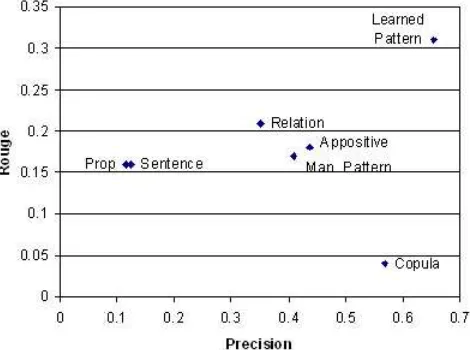
Figure 7 is the precision-recall scatter plot of the features measured on “who is” questions. Interest-ingly, the learned patterns have the highest coverage and precision. The copula feature has the second highest precision; however, it has the lowest cover-age. This is because there are not many copulas in the dataset. Appositive and manual pattern features have the same level of contribution. Surprisingly, the relation feature has a high coverage. This sug-gests that relations could be more useful if relation detection were more accurate; general propositions are not more useful than whole sentences since al-most every sentence has a proposition, and since the high value propositions are identified by the lexical head of the proposition and grouped with the manual patterns.
Figure 7: Feature precision recall scatter plot (mea-sured on the biographical questions)
4.3 Who-is versus What-is questions
We have seen that “What-is” questions are more challenging than “Who-is” questions. We compare the precision and coverage of each feature for
“Who-is” and “What-“Who-is” in Table 6 and Table 7. We see that
although the precisions of the features are higher for “What-is”, their coverage is too low. The most useful features for “What-is” questions are propo-sitions and raw sentences, which are the worst two
features for “Who-is”. Basically, this means that most of the answers for “What-is” are from whole sentences. Neither linguistic analysis nor pattern matching works as efficiently as in biographical questions.
[image:7.612.348.520.136.238.2]feature who-is what-is copula 0.567 0.797 appositive 0.3460 0.3657 proposition 0.1162 0.1837 relation 0.3509 0.4422 sentence 0.1074 0.1556 learned patterns 0.6542 0.6858
Table 6: Feature Precision Comparison
feature who-is what-is copula 0.055 0.049 appositive 0.2028 0.0026 proposition 0.2101 0.1683 relation 0.2722 0.043 sentence 0.1619 0.1717 learned patterns 0.3517 0.0860
Table 7: Feature Coverage Comparison
To identify the challenges of “What-is” questions, we conducted an error analysis. The answers for “What-is” are much more diverse and are hard to capture. For example, the reference answers for the question of “
/ What is the in-ternational space station?” include the weight of the space station, the distance from the space station to the earth, the inner structure of the space station, and the cost of its construction. Such attributes are hard to capture with patterns, and they do not contain any of the useful linguistic features we currently have (copula, appositive, proposition, relation). Identify-ing more useful features for such answers remains for future work.
5 Related Work
[image:7.612.351.517.284.388.2] [image:7.612.80.315.360.535.2]have fixed anchors, such as “where was X born”. For general definitional questions, we do not know what the anchors should be. Thus we prefer using small amounts of human annotation to derive pat-terns. Cui et al. (2004) uses a similar approach for unsupervised pattern learning and generalization to soft pattern matching. However, the method is actu-ally used for sentence selection rather than answer snippet selection. Combining information extrac-tion with surface patterns has also seen some suc-cess. Jikoun et al. (2004) shows that information extraction can help improve the recall of a pattern based system. Xu et al. (2004) also shows that mually constructed patterns are very important in an-swering English definitional questions. Hildebrandt et al. (2004) uses manual surface patterns for tar-get extraction to augment database and dictionary lookup. Blair-Goldensohn et al. (2004) apply su-pervised learning for definitional predicates and then apply summarization methods for question answer-ing.
6 Conclusions and Future Work
We have explored a hybrid approach for definitional question answering by combining deep linguistic analysis and surface pattern learning. For the first time, we have answered four questions regarding Chinese definitional QA: deep linguistic analysis and automatic pattern learning are complementary and may be combined; patterns are powerful in an-swering biographical questions; only a small amount of annotation (2 days) is required to obtain good per-formance in a biographical QA system; copulas and appositions are the most useful linguistic features; relation extraction also helps.
Answering “What-is” questions is more challeng-ing than answerchalleng-ing “Who-is” questions. To improve the performance on “What-is” questions, we could divide “What-is” questions into finer classes such as organization, location, disease, and general sub-stance, and process them specifically.
Our current pattern matching is based on simple POS tagging which captures only limited syntactic information. We generalize words to their corre-sponding POS tags. Another possible improvement is to generalize using automatically derived word clusters, which provide semantic information.
Acknowledgements This material is based upon work
sup-ported by the Advanced Research and Development Activity (ARDA) under Contract No. NBCHC040039. We are grate-ful to Linnea Micciulla for proof reading and three anonymous reviewers for suggestions on improving the paper.
References
S. Blair-Goldensoha, K. McKeown, and A. Hazen Schlaikjer. 2004. Answering Definitional Questions: A Hybrid Approach. New Directions In Question
An-swering., pages 47–58.
H. Cui, M. Kan, and T. Chua. 2004. Unsupervised Learning of Soft Patterns for Definitional Question Answering. In WWW 2004, pages 90–99.
S. Harabagiu, D. Moldovan, C. Clark, M. Bowden, J. Williams, and J. Bensley. 2003. Answer Mining by Combining Extraction Techniques with Abductive Reasoning. In TREC2003 Proceedings.
W. Hildebrandt, B. Katz, and J. Lin. 2004. Answer-ing Definition Questions with Multiple Knowledge Sources. In HLT-NAACL 2004, pages 49–56.
V. Jijkoun, M. Rijke, and J. Mur. 2004. Information Extraction for Question Answering: Improving Recall Through Syntactic Patterns. In COLING 2004. J. Lin and D. Demner-Fushman. 2005.
Automati-cally Evaluating Answers to Definition Questions. In
ACL2005. to appear.
C. Lin and E. Hovy. 2003. Automatic Evaluation of Summaries Using N-gram Co-occurrence Statistics. In HLT-NAACL 2003.
D. Miller, T. Leek, and R. Schwartz. 1999. A Hidden Markov Model Information Retrieval System. In
SI-GIR 1999, pages 214 – 221.
D. Moldovan, M. Pasca, S. Harabagiu, and M. Sur-deanu. 2002. Performance Issues and Error Analysis in an Open-Domain Question Answering System. In
ACL2002.
L. Ramshaw, E. Boshee, S. Bautus, S. Miller, R. Stone, R. Weischedel, and A. Zamanian. 2001. Experi-ments in Multi-Model Automatic Content Extraction. In HLT2001.
D. Ravichandran and E. Hovy. 2002. Learning surface text patterns for a Question Answering System. In
ACL2002, pages 41–47.
R. Soricut and E. Brill. 2004. A Unified Framework For Automatic Evaluation Using N-Gram Co-occurrence Statistics. In ACL 2004, pages 613–620.
M. Soubbotin and S. Soubbotin. 2002. Use of Patterns for Detection of Likely Answer Strings: A Systematic Approach. In TREC2002 Proceedings.
E. Voorhees. 2004. Overview of the TREC 2003 Ques-tion Answering Track. In TREC Proceedings. R. Weischedel, J. Xu, and A. Licuanan. 2004. A Hybrid
Approach to Answering Biographical Questions. New
Directions In Question Answering., pages 59–70.